Enterprise
Caribou County
The Idaho
Caribou County's Newspaper Since 2024
Caribou County, Idaho
April 16, 2026 | Vol. 3 No. 16
$1.50
NEWS IN BRIEF Iran Update
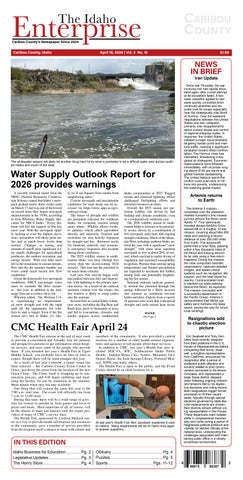
The whitewater season will likely be another thing hard hit by what is predicted to be a difficult water year across southern Idaho and much of the west.
Water Supply Outlook Report for 2026 provides warnings A recently released report from the NRSC (Natural Resources Conservation Science) stated that Idaho’s snowpack peaked nearly three weeks early on March 17 and was one of the lowest on record since they began snowpack measurements in the 1930s, according to Erin Whorton, Water Supply Specialist for NRCS Idaho. “Every Idahoan will feel the impacts of this low snow year. With the snowpack rapidly melting at even the highest elevations, streamflow will likely peak earlier and at much lower levels than normal. Changes in timing and amount of runoff pose significant water supply challenges for agricultural producers, the outdoor recreation, and energy sectors. With very little snow left in the mountains to sustain streamflow into the dry summer months, our rivers could reach record low flow conditions.” Given the historically low snowpack conditions, NRCS encourages water users to consider the ‘drier scenario’, this year, in addition to the midrange forecast to reduce their risk. Whorton added, “the Western U.S. is experiencing an unprecedented snow drought and with the rapid melt off, the opportunity for wildfires to start is longer. Even if the fire season isn’t bad in Idaho, it’s like-
ly we’ll see impacts from smoke from neighboring states.” Current snowpack and precipitation conditions for each basin can be accessed via https://nwcc-apps.sc.egov. usda.gov/imap The issues of drought and wildfire are perennial concerns for southeast Idaho, for economic reasons among many others. Wildfire affects weather patterns which affect agriculture directly and indirectly. Tourism and recreation are also heavily impacted by drought and fire. Resource needs for financial, material, and economic emergency responses also escalate during those conditions. The 2025 wildfire season in southeastern Idaho was busy (though less severe than the record-setting 2024 season). This year has the potential to be much more extreme. Last year, Fire activity began early and peaked between July and September, with lightning as the primary ignition source. As a result of the reduced moisture content over the winter, the fire window is likely to creep earlier into the summer. Several fires in central Idaho wilderness areas, including the Big Bear and Rush fires, grew to thousands of acres and led to evacuations, closures, and smoke impacts across southeastern
Idaho communities in 2025. Rugged terrain and clustered lightning strikes challenged firefighting efforts and stretched resources at times. Overall, the 2025 season saw persistent wildfire risk driven by fuel buildup and climate conditions, even in a comparatively moderate year. The 2026 wildfire season in southeastern Idaho is forecast to be potentially severe, driven by a combination of low snowpack, early heat, and ongoing drought conditions. Much of the Mountain West, including southern Idaho, entered the year with a significant “snow drought,” with some areas reporting snowpack as low as about 20% of normal, which can lead to earlier drying of vegetation and increased susceptibility to ignition. Warmer-than-normal spring temperatures and limited precipitation are expected to accelerate this further, drying fuels and potentially lengthening the fire season. National outlooks indicate generally normal fire potential through late spring, followed by a likely increase into summer as conditions become hotter and drier. Experts from a variety of agencies also warn that widespread drought and early-season heat across
CMC Health Fair April 24 The CMC Health Fair returns at the end of next week to provide a convenient and friendly way for patients and prospective patients to get information about hospital services, and meet some of the people who provide them. If you attended last year’s Health Fair at Tigert Middle School, you probably have an idea of what to expect, though there will be some changes this year. As a result of last year’s turnout, a larger venue has been selected – the Caribou County Event Center in Grace, just down the street from the location of the new Grace Clinic. The Clinic itself is wrapping up its construction process, and will begin outfitting and finalizing the facility for use by sometime in the summer. More details when they become available. One thing that will remain the same this year is the 7:00 a.m. start time. The event will officially run from 7 a.m. to 12:00 noon. During that time, there will be a wide range of activities for visitors to partake in, from games and trivia to prizes and treats. Most important of all, of course, will be the chance to meet and interact with the expert providers of many of CMC’s service lines. The Health Fair, sponsored by Caribou Medical center as a way to provide health information and resources to the community, gave a number of service providers from the hospital itself a chance to meet with clients and
WATER On Page 2
members of the community. It also provided a central location for a number of other health-related organizations and agencies to tell people about their services. In addition to CMC, last year’s Health Fair also included SEICAA, WIC, Southeastern Idaho Public Health, Enhabit Home Care, Symbii, Mountain View Dental, Bayer, the Soda Springs Library, Portneuf Medical, SSPD, and many others. The Health Fair is open to the public, and the Event Center should be an ideal location for it.
At last year's Health Fair, Ben Jacobsen explained X-rays to visitors. Many departments will be on hand once again to answer questions.
IN THIS EDITION Idaho Business for Education...............Pg. 2 Legislative Updates..............................Pg. 3 The Henry Store...................................Pg. 4
Obituary...............................................Pg. 4 Puzzles................................................Pg. 5 Sports......................................... Pgs. 11-12
Since last Thursday, the war involving Iran has rapidly escalated again after a brief attempt at de-escalation failed. A twoweek ceasefire agreed to last week quickly unraveled amid continued airstrikes and disputes over its scope, especially near the strategically vital Strait of Hormuz. Over the weekend, negotiations between the United States and Iran collapsed, primarily over disagreements about nuclear issues and control of regional shipping routes. In response, the United States initiated a major naval blockade targeting Iranian ports and maritime traffic, marking a significant escalation toward direct confrontation. The Hormuz crisis has intensified, threatening a key global oil chokepoint. Economic repercussions have followed immediately, with oil prices surging above $100 per barrel and global markets destabilizing. The United Nations warns the conflict could push tens of millions into poverty, underscoring the widening global impact.
Artemis returns to Earth The Artemis II mission, completed over the weekend, marked humanity’s first crewed journey around the Moon since Apollo 17. Four astronauts traveled aboard NASA’s Orion spacecraft on a roughly 10-day mission, covering about 694,000 miles and reaching a record distance of over 250,000 miles from Earth. The spacecraft performed a lunar flyby, passing within a few thousand miles of the Moon and looping around its far side using a free-return trajectory. During the mission, the crew conducted scientific observations, captured detailed images, and tested critical systems such as navigation, life support, and the heat shield for reentry. Communication briefly blacked out while passing behind the Moon, as expected. The mission concluded with a successful splashdown in the Pacific Ocean. Artemis II demonstrated that NASA can safely send humans into deep space, paving the way for future lunar landings.
Resignations add to chaotic election picture Eric Swalwell and Tony Gonzales have recently resigned from their positions in the U.S. House of Representatives before completing their terms. Swalwell, a longtime representative from California, announced his resignation after a period of sustained public attention and scrutiny related to prior controversies connected to his tenure. Gonzales, who represented a large Texas district, stepped down following ongoing criticism and tensions tied to his legislative decisions and voting record. Both resignations trigger formal processes to fill their vacant seats, typically through special elections governed by state law. Until replacements are chosen, their districts remain without voting representation in the House. These departures mark notable shifts in congressional membership and come during a period of heightened political pressure and visibility for elected officials at the national level, underscoring the challenges associated with maintaining public office in a closely scrutinized environment.