How to Make Every Slide Count?
Creating a presentation is easy. Creating a presentation where every slide adds value, keeps attention, and drives action is much harder. Many business presentations become overloaded with text, repetitive visuals, and unnecessary information. As a result, audiences lose focus before the presentation reaches its key message.
Whether you're pitching investors, presenting quarterly results, training employees, or showcasing a new product, every slide should have a clear purpose. When each slide contributes to the overall story, presentations become more engaging, memorable, and effective.
Why Every Slide Matters?
Research consistently shows that audience attention spans are limited. If a slide doesn't communicate value within a few seconds, viewers often disengage. A presentation filled with weak slides can dilute even the strongest business message.
Effective presentations are not about the number of slides. They are about the quality and impact of each slide.
Every slide should answer at least one question:
● What is the key message?
● Why should the audience care?
● What action should they take next?
If a slide doesn't support your objective, it may not belong in the presentation.
Common Reasons Slides Fail
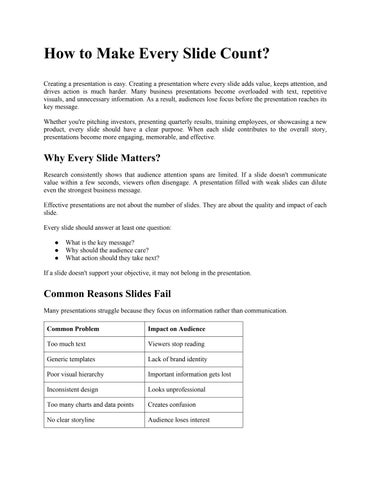
Many presentations struggle because they focus on information rather than communication.
Common Problem
Too much text
Generic templates
Poor visual hierarchy
Impact on Audience
Viewers stop reading
Lack of brand identity
Important information gets lost
Inconsistent design Looks unprofessional
Too many charts and data points
No clear storyline
Creates confusion
Audience loses interest
The goal is not to show everything you know. The goal is to make your audience understand and remember what matters most.
Start with a Clear Story
Before designing slides, define the story you want to tell.
A strong presentation follows a logical flow:
1. Introduce the Challenge
Explain the problem, opportunity, or situation.
2. Present Insights
Share findings, data, or market information.
3. Offer the Solution
Show how your product, service, or strategy addresses the challenge.
4. End with Action
Guide the audience toward a decision, approval, investment, or next step.
When slides follow a narrative structure, audiences stay engaged because they understand how each slide connects to the bigger picture.
Focus on One Message Per Slide
One of the biggest mistakes in presentation design is trying to communicate multiple ideas on a single slide.
Instead:
● Use one key takeaway per slide
● Create a clear headline
● Remove unnecessary details
● Support the message with visuals
For example, instead of displaying five different statistics on one slide, highlight the most important metric and build supporting content around it.
This approach helps audiences absorb information faster and remember it longer.
Use Visuals That Support the Message
Visual communication is often more powerful than text.
Consider replacing:
● Long paragraphs with icons
● Complex explanations with diagrams
● Large data tables with charts
● Bullet lists with visual frameworks
High-quality visuals make information easier to understand and create a stronger emotional connection with the audience.
The most successful presentations balance information and design to create a seamless viewing experience.
Make Data Easy to Understand
Business presentations often include valuable data, but poorly presented data can overwhelm viewers.
To improve data slides:
● Highlight key numbers
● Use simple charts
● Remove unnecessary gridlines
● Add clear labels
● Focus attention on insights rather than raw data
Instead of showing dozens of numbers, explain what the numbers mean and why they matter.
The audience should immediately understand the story behind the data.
Maintain Design Consistency
Consistency builds credibility.
When fonts, colors, layouts, and visual styles change from slide to slide, presentations appear rushed and unprofessional.
A consistent presentation should include:
● Standardized typography
● Brand-aligned colors
● Consistent icon styles
● Uniform spacing
● Reusable layouts
MyBusiness Visual teams often create design systems that ensure every slide feels connected and polished.