SING, DANCE, PLAY
Dr. Dan Turner
Music Director and Principal Conductor
Featuring vocalist
Amanda Di Giovine
Younts Conference Center
2005 Rugby Rd, Greenville, SC 29613
3:00 PM, February 8, 2026
Greenville Concert Band
Suite from Hymn of the Highlands ........ Philip Sparke (b. 1951)
Ardross Castle
Alladale
Dundonnell
Philip Sparke’s Suite from Hymn of the Highlands is a three-movement work transcribed from his dramatic seven-movement Scottish-inspired brass band composition. The titles of each movement are named after locations in the Scottish Highlands. The suite opens with “Ardross Castle,” built on an expansive theme of solos by clarinet and bassoon before a martial bagpipe tune is introduced. The opening solo material returns in a quickly paced central section that leads to a passionate, slow ending. The second movement, “Alladale” (a tributary of the River Carron, which leads out into the Dornoch Firth on the east coast), is a warm, gentle saxophone trio with an accompaniment featuring the percussion. The finale, “Dundonnell” (a charming village at the head of Little Loch Broom, which leads out to the ocean near Summer Isles), is a driving and energetic finale that paints a portrait of the Mackenzie Clan, who have long lived in the area. It starts in a martial mood but soon breaks into a wild presto leading to the return of the bagpipe tune of the first movement. Aggressive rhythms and brilliant scoring bring an exhilarating close to the piece. Philip Sparke’s vivid orchestration and memorable themes are on full display as they create
a dramatic musical journey, allowing the band to play music of the strength, charm, and rhythm of Scotland’s Highlands.
Amanda DiGiovine
‘S Wonderful! ... Music by George Gershwin (1898-1937); Lyrics by Ira Gershwin (1896-1983)
Arranged by Warren Barker
This beloved song is a testament to the genius of the brothers George and Ira Gershwin. Written for their 1927 Broadway musical, Funny Face, the song is in many ways a living museum piece of the American Jazz Age. The lyrics are a model of Ira’s signature style: clever, conversational, and highly playful. The song is famous for Ira Gershwin’s inventive use of colloquial contraction. By dropping the first syllable of words (e.g., “’S wonderful” instead of “It is wonderful”), Ira captured the breezy, informal speech of 1920s youth culture. This rhythmic device dubbed an “Ira-ism” perfectly mirrors George’s bouncy, syncopated melody. It is deceptively simple, memorable, and charming, with smooth, light syncopations characteristic of the period. When the elements are combined, they model the way in which the Gershwins elevated popular music to the artistic stratosphere.
Moon River .......
Music by Henry Mancini (1924-1994); Lyrics by Johnny Mercer (1909-1976)
Arranged by Michael Brown
“Moon River” is one of the most recognizable and widely known melodies ever written for film. The song was introduced in the 1961 cinematic classic film, Breakfast at Tiffany’s, and went on to win the Academy Award for Best Original Song. It also won the Grammy Award for “Record of the Year” and for “Song of the Year” in 1962. The tune was specifically tailored for actress Audrey Hepburn because she was not a trained singer. Henry Mancini restricted the melody to uncomplicated rhythms and a one-octave range, ensuring it to remain intimate and approachable. The song is a gentle, nostalgic waltz that captures a sense of wanderlust and longing. While Mancini provided the sweeping, melancholic melody, Johnny Mercer’s lyrics were inspired by his own childhood in Savannah, Georgia. The “real” Moon River was a waterway near his boyhood home, and the phrase “huckleberry friend” often a point of curiosity for listeners is a nod to Mark Twain’s Huckleberry Finn, symbolizing a kindred spirit in a lifelong journey of discovery. The song’s haunting, highly personal style, with its text of hopefulness, continues to resonate with modern audiences.
Blue Moon .... Music by Richard Rodgers (1902-1979); Lyrics by Lorenz Hart (1895-1943)
Arranged by Warren Barker
The title may not be familiar, but “Blue Moon” is a unique standard from the legendary collaboration of Richard Rodgers and Lorenz Hart. The two met as students while in Columbia University in 1919 and began writing for student shows. They launched their first professional collaboration in 1920, beginning a 23-year creative adventure that ended with Hart’s untimely death in 1943. Their output was stunning. They worked together on 28 stage musical revues, 12 Hollywood films, and produced more than 500 songs. Of these, “Blue Moon” has remained popular because of the beauty of the tune and the lonely longing expressed in the lyrics. It also has a unique history it is the result of a long and somewhat cynical evolution. It did not originate on the Broadway stage, but rather in the grueling “song factory” of 1930s Hollywood. The melody we know today actually went through three different sets of lyrics before finding success. It began as a song called “Prayer,” intended for a 1934 Jean Harlow film. When it was cut, it was rewritten as “It’s Just That Kind of Play,” and when that was cut from its intended film, it was rewritten again as a number titled “The Bad in Every Man.” Lyricist Lorenz Hart, frustrated by the constant revisions, finally penned “Blue Moon” as a concession to his publisher. Scorning the hackneyed “June-Moon” rhyming scheme he had often mocked, Hart created a masterpiece that became the only song in the Rodgers-Hart catalog to become a hit without being tied to a specific theatrical production.
Greenville Concert Band
With Pleasure (Dance Hilarious) John Philip Sousa (1854-1932)
Edited by Robert Foster
When the name “John Philip Sousa” is mentioned, one immediately thinks of “The March King” and his greatest march, The Stars and Stripes Forever. Sousa, however, produced much more than marches. His output included serious concert works, suites, operettas, numerous song accompaniments, and lighter works designed to be attractive to his band’s large audience in the concert hall and on the dance floor. With Pleasure, written in 1894, is one of these delightful light numbers. Sousa initially titled the piece “Dance Hilarious” to underscore its upbeat, playful character. As a “galop,” a fastpaced dance form then popular in Europe, it is one of the first Sousa
numbers in which he showcased his exploration of the newest musical craze, ragtime.
Wedding Dance .................................
Jacques Press (1903 - 1985)
Arranged by Herbert N. Johnston; edited by Frederick Fennell Jacques Press, born in 1903 in Europe in what is now Tbilisi, Georgia, began piano study at age 6, played in movie houses for silent movies as a teenager, and later studied piano and composition in Paris. He organized his own orchestra and concertized throughout Europe in 1925-26, finally immigrating to the United States in 1926. After working for twelve years arranging music for New York movie house orchestras, he moved to Hollywood to compose and pursue film scoring. His most popular work was the orchestral suite Hasseneh (The Wedding). The electrifying Wedding Dance, composed in 1955 as the second movement, was arranged for band in 1967 by arranger and aviation engineer Herbert N. Johnston. It eventually came to the attention of conductor Frederick Fennell, who reintroduced the piece to the band world in 1997 with the Eastman Wind Ensemble. Its musical roots are deeply embedded in the Klezmer tradition the celebratory, instrumental music of the Ashkenazi Jewish community of eastern Europe. It is filled with fire, passion, driving rhythms, and unbridled communal joy.
Amanda Di Giovine
How Far I’ll Go from MOANA ........ Lyrics and Music by LinManuel-Miranda
(b. 1980) )
Arranged by Thom Fletcher
Following the recent success of Hamilton on Broadway, Lin-Manuel Miranda brought his distinct rhythmic and lyrical sensibility to Disney’s Moana. “How Far I’ll Go” is the defining anthem from the 2016 animated film, Moana. The song captures the film’s core theme: the magnetic “pull of destiny versus the comfort of obligation.” It is an “I Want” song a song that communicates the core desire and motivation of a character and the young South Sea island girl Moana makes a declaration of courage that details the internal conflict she feels between the duty to her people and the love she has for her secure island home, pitted against her desire to explore her dreams, regardless of the challenge. Musically, the piece builds from a quiet, wistful reflection to a powerful climax, mirroring the moment she commits to taking the first step toward an unknown future.
They Can’t Take That Away from Me .. George & Ira Gershwin
Arranged by Warren Barker
Written for the 1937 film Shall We Dance, “They Can’t Take That Away from Me” is George and Ira Gershwin’s most refined and bittersweet collaboration. The song has an elegant mixture of nostalgia and restraint. Ira’s lyrics list the memorable traits of a loved one “the way you wear your hat,” “the way you sing off-key” while acknowledging the relationship’s inevitable parting. George’s brilliant music reinforces this tension: the melody subtly shifts between major and minor, creating an atmosphere of reflection rather than one that is sentimental. Over decades, “They Can’t Take That Away from Me” has had countless interpretations, from jazz standards by Ella Fitzgerald and Louis Armstrong, to modern vocal and instrumental arrangements. Its appeal comes from the universality of its message: even when circumstances change, the memories of those we love remain ours to keep.
Greenville Concert Band
Selections from “My Fair Lady” .... Music by Frederick Loewe; Lyrics by Alan Jay Lerner Arranged Robert Russell Bennett
The Broadway musical My Fair Lady, with music by Frederick Loewe and book and lyrics by Alan Jay Lerner, premiered in 1956 and became one of the most successful and enduring musicals of all time. Based on George Bernard Shaw’s 1913 play Pygmalion, the story follows the story of Professor Henry Higgins, a pompous, arrogant phonetics expert. He wagers that he can transform a common Cockney flower girl, Eliza Doolittle, into a refined lady who can pass for gentry simply by teaching her to speak correctly. Its success was immediate and profound, running for over 2,700 performances and launching the careers of its stars, Rex Harrison as Professor Higgins and Julie Andrews as Eliza Doolittle. The 1964 film with Harrison and Audrey Hepburn as Eliza, was equally popular, setting theater attendance records and winning eight Academy Awards. The score for My Fair Lady is renowned for its blend of romantic melodies and witty, character-driven songs. Unlike many musicals of the era where songs were often inserted as simple entertainment, Lerner and Loewe integrated their musical numbers to advance the plot and reveal the inner lives of the characters. The score includes iconic songs that are now American standards, such as “On the Street Where You Live,” “Wouldn’t
It Be Loverly,” “The Rain in Spain,” “Get Me to the Church on Time,” and “I Could Have Danced All Night." Composer and arranger Robert Russell Bennett was arguably one of the most important American orchestrators of the 20th century, having orchestrated over 300 shows, including classics like Oklahoma!, South Pacific, Show Boat, and My Fair Lady. He had a gift for translating a composer’s piano score into a full, dynamic orchestral soundscape. Schooled by his mother to disdain popular music, Bennett struggled throughout his life with the dichotomy between his serious compositions and his arranging work. In spite of his prolific output, which included one opera, more than seven symphonies, a large variety of chamber works, and at least five concertos, his reputation today rests primarily on his Broadway scores and two often-recorded wind band masterworks, Suite of Old American Dances (1949) and Symphonic Songs for Band (1957).
Amanda Di Giovine, vocal soloist
Amanda is no stranger to the Greenville Concert Band audience. She grew up in an Air Force family and lived for several years in Sumter, South Carolina, where she began her music education as a junior high school clarinetist. Amanda now holds the Bachelor of Arts degree in music performance from Washburn University as well as the Bachelor of Arts degree in Italian from Clemson University. She serves in the United States Army National Guard, holding the rank of Sergeant First Class, and performs regularly with the 208th Army Band in North Carolina. Amanda and her husband, Sgt. Roby Di Giovine, live in Greenville, and they have one little Army recruit, Loui.
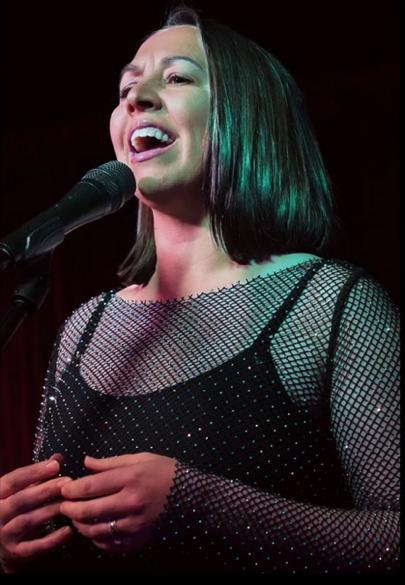
As a U.S. Army musician, Amanda has performed hundreds of concerts throughout the United States both singing and playing clarinet. She currently plays clarinet with the 208th Army Band and when her schedule allows, with the Greenville Concert Band. She shares her vocal stylings performing the finest American ballads and big band tunes in concerts with both bands as well as in private engagements in the area.
Performers of the Greenville Concert Band
Piccolo: Carri Burgess
Flute:
Amanda Sherman
Deborah Thomas
Terry Davidson
Holly Wallace
Jana Hach
Maggie Josephson
Guthrie Gullion
Renee Blackwelder
Jen Weaver
Charan Lee
Betty McIntosh
Oboe: Gwin Lankford
Justin Huefner
Bassoon:
Rebecca Marigliano
Tracey Miller
Nancy Criss
Eb Clarinet: Stan Widener
Bb Clarinet:
Robert Chest
Bill Lee
Elise Payne
Stan Widener
Nancy William
Tammy Than
Kathrin Albinski
Tom Rollert
Carol Buccellato
Kerry Deese
Tom Roche
Kathy Woods
Erica Woods
Sara Knutson
Kathi Reeder
Marge Hafer
Bass Clarinet: Mike Criss
Aaron Ashkenasy
Alto Saxophone: Mackenzie Eck
Jumpei Iiyama
Alex Fields
Sam Liaw
Tenor Saxophone:
Stan Morris
Brad Hansen
Baritone Saxophone: Tyler Barbarino
Horn: Joy O’Connor
Lauren Diaz
Leigh Phillips
Lance Hafer
Cherice Hameister
Virginia Furr
Trumpet:
Matthew Phillips
Greg Burris
Ian Milne
Terry Rushing
President: Stanley Widener
Board of Directors
Vice-President: Richard Nelson
Secretary: David Zitzman
Host: Beth Cofer
Script: John Cofer
Keylee Ray
Tim Turner
Jeffrey Maddox
Winona Brackett
David VanDenBerg
Steve Wilson
Michael McGarry
Trombone: Robert Oakman
Fred Hall
Alan Lohr
Jon Nottingham
Keith Shields
Matt Anderson
Lee Eernisse
Euphonium: Pete Buccellato
Conner Christ
Jim Knudsen
Jonathan Redlinger
Emma Waters
Dave Zitzman
Tuba:
Laureen Copeland
John Cofer
Koby Flannery
Kyle Neds
Percussion:
Laura Bradshaw-Day
Joe Dennis
Kam Lokhande
Matthew Myers
Richard Nelson
Bethany Webb
Treasurer: Laura Bradshaw-Day
At Large: Tammy Than
At Large: Kyle Neds
Support Personnel
Librarian: Kathy Woods, Kerry Deese
Transportation: Kyle Neds