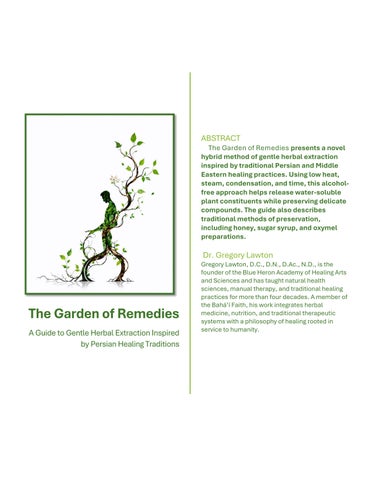
The Garden of Remedies

Page 1


The Garden of Remedies

A Guide to Gentle Herbal Extraction Inspired by Persian Healing Traditions

ABSTRACT

The Garden of Remedies presents a novel hybrid method of gentle herbal extraction inspired by traditional Persian and Middle Eastern healing practices. Using low heat, steam, condensation, and time, this alcoholfree approach helps release water-soluble plant constituents while preserving delicate compounds. The guide also describes traditional methods of preservation, including honey, sugar syrup, and oxymel preparations.

Dr. Gregory Lawton

Gregory Lawton, D.C., D.N., D.Ac., N.D., is the founder of the Blue Heron Academy of Healing Arts and Sciences and has taught natural health sciences, manual therapy, and traditional healing practices for more than four decades. A member of the Bahá’í Faith, his work integrates herbal medicine, nutrition, and traditional therapeutic systems with a philosophy of healing rooted in service to humanity.

The

Garden of Remedies

A Guide to Gentle Herbal Extraction Inspired by Persian Healing Traditions

Founder

Blue Heron Academy of Healing Arts and Sciences

Grand Rapids, Michigan 2026

Copyright © 2026 Gregory

All rights reserved. No part of this publication may be reproduced, stored in a retrieval system, or transmitted in any form or by any means, electronic, mechanical, photocopying, recording, or otherwise, without prior written permission from the author, except for brief quotations used in reviews, educational discussions, or scholarly works.

This material is provided for educational purposes only. The information contained in this guide is not intended to diagnose, treat, cure, or prevent any disease. Students and practitioners should use professional judgment and consult appropriate health professionals when applying herbal preparations in clinical or personal practice.

Disclaimer

The information presented in this book is provided for educational purposes only. The author and publisher do not diagnose, treat, prescribe, or claim to cure any disease. The herbal preparations and methods described are intended to support general health and traditional herbal practice and are not a substitute for professional medical care.

Readers are encouraged to consult a qualified physician or licensed health care professional before using herbal remedies, particularly if they are pregnant, nursing, taking prescription medications, or managing a medical condition. The author and publisher assume no responsibility for any adverse effects, misuse, or consequences resulting from the application of the information contained in this work.

The preparation and use of herbal medicines should be undertaken with proper knowledge, care, and respect for individual health needs.

“All beings, whether large or small, were created perfect and complete from the very beginning… and in the mineral, vegetable, and animal kingdoms there exist remedies for every disease.”

‘Abdu’l-Bahá

“It is incumbent upon the physician to treat disease first with diet and food. If he cannot cure it with foods, then he should prescribe simple medicines.”

‘Abdu’l-Bahá

‘Abdu’l-Bahá also spoke of a future time when the science of medicine would advance to such a degree that many diseases would be treated through foods and natural remedies.

Foreword

Throughout human history, plants have served as one of humanity’s oldest and most reliable sources of medicine. Long before the rise of modern pharmaceutical science, physicians, herbalists, and healers developed sophisticated systems for preparing and administering plant remedies. These traditions were cultivated across many cultures, but they reached remarkable levels of refinement in the medical traditions of the Middle East and Persia.

The methods described in this guide reflect a renewed exploration of those earlier principles. By combining gentle heat, moisture, and controlled condensation, this approach creates a gradual and respectful process of herbal extraction. Rather than relying primarily on alcohol or high-temperature decoction, the method allows plant tissues to soften slowly so that their medicinal constituents may diffuse naturally into the surrounding liquid.

This technique represents a modern hybrid approach inspired by traditional herbal pharmacy. It draws upon concepts found in Persian herbal medicine, early distillation science, and classical herbal preparation methods while adapting them into a practical process that students and practitioners can easily reproduce.

In doing so, the method invites students to participate in a long tradition of botanical medicine that blends careful observation, scientific curiosity, and respect for the healing potential present within the natural world.

Preface

The extraction method presented in this guide emerged from a desire to explore alternatives to common herbal preparation techniques, particularly those that rely heavily on alcohol tinctures or prolonged high-temperature decoctions. While these traditional approaches remain valuable and widely used, they are not always suitable for every patient or every circumstance.

Some individuals prefer to avoid alcohol-based preparations for personal, medical, or spiritual reasons. In addition, certain religious traditions discourage or prohibit the use of alcohol entirely. Within Islamic law, the consumption of alcohol is forbidden, and similar guidance appears in the teachings of the Bahá’í Faith, where the use of alcohol is prohibited except when prescribed by a physician as medicine. For individuals who follow these traditions, alcohol-based herbal preparations may be unacceptable except in limited circumstances.

There are also practical clinical reasons for avoiding alcohol in some cases. Children, individuals in recovery from alcohol dependency, and people with digestive sensitivities or liver concerns may not tolerate alcohol-based preparations well. For these individuals, water-based extractions preserved with honey, syrups, or vinegar-based preparations may provide a more appropriate option.

These considerations encouraged the exploration of an alternative approach one that emphasizes water, gentle steam, condensation, and time rather than alcohol as the primary extracting solvent.

The process described in this guide may be understood as a novel hybrid extraction method inspired by traditional Persian and Middle Eastern herbal practices, while also informed by modern understanding of plant chemistry and extraction dynamics. By using light steam and repeated condensation cycles, the method gradually softens plant tissues and encourages the natural release of water-soluble plant constituents.

Historically, many herbal traditions of the Middle East and Persia relied heavily on water infusions, aromatic distillations, honey syrups, and vinegar preparations rather than alcohol tinctures. These techniques formed an important part of early medical practice and continue to influence herbal medicine today.

This guide therefore presents both a practical instructional method and an invitation to rediscover aspects of traditional herbal pharmacy that remain highly relevant. Students are encouraged to see these techniques as part of an ongoing

continuum of botanical knowledge that blends traditional insight with modern observation.

Through thoughtful experimentation and careful practice, students may learn to prepare herbal medicines that are effective, accessible, and respectful of the diverse cultural and spiritual traditions that shape how healing practices are used in the world.

Table of Contents

Epigraph

Foreword

Preface

Introduction

Historical Roots of Steam and Condensation Extraction in Persian Herbal Medicine

Description of the Gentle Steam Reflux Extraction Method

Method 1: Basic Gentle Steam Reflux Extraction

Method 2: Enhanced Condensation Reflux Extraction

Method 3: Freeze–Thaw Preparation to Increase Cell Rupture

Method 4: Preserving the Extract with Honey

Method 5: Preserving the Extract with Sugar Syrup

Method 6: Preserving the Extract as an Oxymel

How This Method Differs from Other Herbal Extraction Methods

Best Herbs for This Method

Limitations of the Method

Safety Considerations

Glossary of Herbal Extraction Terms

Comparison of Extraction and Preservation Methods

Conclusion

Closing Reflection

References

About the Author

Introduction

A Modern Hybrid Herbal Extraction Method Rooted in Traditional Herbalism

The extraction methods described in this guide represent a modern hybrid approach inspired by traditional herbal medicine. Rather than relying primarily on alcohol tinctures or high-temperature decoctions, this method combines several time-tested principles drawn from historical herbal practices of the Persian, Middle Eastern, and Mediterranean traditions.

Traditional herbalists understood that plants contain their medicinal properties within the structure of their cells. Through the use of moisture, gentle heat, time, and repeated infusion, plant tissues gradually soften and release their constituents into a surrounding liquid. The method described here uses a controlled cycle of light steam and condensation to repeatedly wash the plant material, encouraging the gradual diffusion of medicinal compounds into the collecting liquid.

This process may be understood as a form of gentle steam reflux extraction, combining elements of traditional infusion, hydrodiffusion, and reflux techniques. Because the heat is kept low, delicate plant constituents are better preserved than in strong boiling decoctions. At the same time, repeated cycles of condensation improve extraction efficiency.

In many historical herbal traditions, particularly those of Persia and the broader Middle Eastern world, herbal preparations were commonly preserved with honey, sugar syrups, or vinegar-honey preparations known as oxymels. These preparations avoided the use of alcohol while still producing stable and effective herbal medicines. The preservation methods included in this guide follow that same tradition. These approaches also align closely with principles expressed in the writings of ‘Abdu’l-Bahá, who emphasized the importance of natural remedies and diet in maintaining health.

‘Abdu’l-Bahá wrote:

“It is incumbent upon the physician to treat disease first with diet and food. If he cannot cure it with foods, then he should prescribe simple medicines.”

In another passage He explains that the natural world contains many healing agents placed there for human benefit:

“All beings, whether large or small, were created perfect and complete from the very beginning… and in the mineral, vegetable, and animal kingdoms there exist remedies for every disease.”

These statements reflect a philosophy that encourages the thoughtful use of natural foods, plants, and simple medicines in maintaining health and restoring balance to the body.

The method presented in this guide follows that spirit. It is designed to allow herbalists and students to prepare effective herbal extracts using water, gentle heat, and traditional natural preservatives, making these preparations accessible to those who prefer to avoid alcohol for personal, medical, or spiritual reasons.

By combining traditional knowledge with careful observation and modern understanding of plant chemistry, students can learn to prepare herbal medicines that are both practical and rooted in long-standing healing traditions.

Historical Roots of Steam and Condensation Extraction in Persian Herbal Medicine

The gentle steam and condensation extraction method described in this guide is not entirely new. Its underlying principles echo techniques that have been used for centuries in the herbal and medical traditions of the Middle East and Persia, particularly during the flourishing scientific period of the Islamic Golden Age. During this time, physicians, pharmacists, and scholars developed sophisticated methods for preparing plant medicines, many of which relied on controlled heat, steam, and condensation.

One of the most influential figures in this tradition was the Persian physician Avicenna (Ibn Sina), whose monumental work The Canon of Medicine became one of the most influential medical texts in both the Islamic world and medieval Europe.¹ His monumental medical text, the The Canon of Medicine, became the standard medical reference throughout the Middle East and Europe for several centuries. In this work, Avicenna described many herbal medicines and discussed the preparation of plant extracts using water, heat, and distillation.

Footnote 1

Avicenna (Ibn Sina), The Canon of Medicine (Al-Qanun fi al-Tibb), trans. Laleh Bakhtiar (Chicago: Kazi Publications, 1999).

Persian physicians and herbalists developed techniques for extracting the aromatic and medicinal properties of plants through steam distillation and hydrodiffusion. In these methods, water was heated beneath plant material so that steam would pass through the herbs. As the steam rose, it softened plant tissues and released their volatile and water-soluble constituents. The vapor would then condense in a cooler chamber, where the resulting liquid extract could be collected.

These early distillation techniques were widely used to produce aromatic waters such as rose water, orange blossom water, and other herbal distillates that became staples of both medicine and daily life throughout the Persian world. The technology used in these preparations was later refined by Arab and Persian chemists and transmitted to Europe, where it influenced the development of early pharmaceutical distillation apparatus. These early physicians and pharmacists developed sophisticated techniques of plant extraction and distillation that later influenced the development of pharmacy in Europe.²

The gentle steam reflux method described in this guide operates on many of the same principles. Warm vapor passes through plant material, softening the cellular structure and encouraging the release of plant constituents. As the vapor condenses and drips back through the herbs, it repeatedly washes the plant material and carries dissolved compounds into the collecting liquid below.

Unlike classical distillation, which separates volatile oils and aromatic waters, this method allows the condensed liquid to recycle through the plant material, producing repeated cycles of extraction. In this sense, the process combines elements of infusion, decoction, and hydrodiffusion into a single gentle extraction system. By using low heat, moisture, and time, this approach reflects the careful and thoughtful methods historically used by herbalists and physicians who sought to preserve the natural integrity of plant medicines.

Students who learn these methods are therefore participating in a long tradition of herbal pharmacy that stretches back through centuries of medical practice in Persia and the Middle East. Rather than representing a completely new invention, this method may be understood as a modern adaptation of traditional principles, combining historical knowledge with contemporary understanding of plant chemistry and extraction processes.

Footnote 2

Manfred Ullmann, Islamic Medicine (Edinburgh: Edinburgh University Press, 1978), and Martin Levey, Early Arabic Pharmacology (Leiden: Brill, 1973).

Through such methods we are reminded that the preparation of herbal medicine has always been both a science and an art, developed through observation, experience, and respect for the healing properties placed within the natural world.

How This Method Differs from Other Herbal Extraction Methods

Herbal medicine has traditionally relied on several well-established extraction techniques. Each method uses a different combination of solvent, heat, and time to draw medicinal constituents from plant material. Understanding how these methods differ helps students appreciate the purpose of the gentle steam reflux approach described in this guide.

An infusion is one of the simplest herbal preparations. Hot water is poured over plant material, usually leaves or flowers, and the mixture is allowed to steep for several minutes before straining. Infusions work well for delicate plant parts but generally produce relatively mild extracts.

A decoction involves simmering plant material often roots, bark, or seeds in water for an extended period of time. The sustained heat helps break down tougher plant tissues and releases deeper constituents, but the higher temperatures may also degrade delicate compounds.

Alcohol tinctures use ethanol as the extracting solvent. Alcohol penetrates plant tissues effectively and dissolves many constituents that water alone cannot extract. Tinctures are highly stable and long-lasting, but they may not be suitable for children, individuals in recovery, or those who prefer to avoid alcohol for personal, medical, or spiritual reasons.

Steam distillation is used primarily to isolate volatile aromatic compounds, such as essential oils and hydrosols. In this method, steam passes through plant material and carries volatile oils into a condenser where they are separated from the water.

The gentle steam reflux method described in this guide differs from these approaches by combining elements of infusion, hydrodiffusion, and condensation cycles. Warm vapor passes through the herbal material while condensed droplets repeatedly wash through the plant tissues. This repeated cycle gradually draws water-soluble constituents from the plant without the aggressive temperatures of decoction or the use of alcohol as a solvent.

Best Herbs for This Method

The gentle steam reflux method works best with herbs that contain significant water-soluble constituents. Leaves, flowers, roots, and certain mucilaginous plants respond especially well to this type of extraction because their medicinal compounds dissolve readily in warm water.

Aromatic leaves and flowers often produce excellent extracts using this method. Examples include peppermint, lemon balm, chamomile, thyme, and lavender. These plants contain volatile oils and flavonoids that are preserved more effectively when exposed to moderate heat rather than prolonged boiling.

Many roots and rhizomes also respond well to gentle steam extraction, particularly when they are finely chopped before preparation. Examples include dandelion root, burdock root, ginger, and licorice root. The extended exposure to warm moisture allows these tougher plant tissues to soften gradually and release their constituents.

Herbs containing soothing mucilage may also benefit from this method. Marshmallow root and slippery elm are examples of plants that release polysaccharides into warm water, producing extracts that support the digestive and respiratory systems.

While many herbs respond well to water extraction, plants that contain primarily resins, waxes, or fat-soluble constituents may require other preparation methods such as alcohol tinctures or infused oils.

Limitations of the Method

Although the gentle steam reflux method offers many advantages, it is important for students to recognize its limitations. No single extraction method is suitable for every medicinal plant or every type of plant constituent.

This method is designed primarily for extracting water-soluble compounds such as flavonoids, glycosides, tannins, polysaccharides, and certain alkaloids. It is less effective for extracting compounds that are strongly lipophilic or resinous.

Plant constituents that often require alcohol or oil extraction include resins, waxes, and certain essential oil components. In these cases, traditional tinctures or infused oil preparations may provide more complete extraction.

Water-based preparations also have a shorter shelf life than alcohol tinctures unless they are preserved using honey, sugar syrups, vinegar-based oxymels, or refrigeration.

Understanding these limitations allows the practitioner to select the most appropriate preparation method for each plant and each therapeutic goal.

Gentle Low-Heat Steam Reflux Herbal Extraction

A Student Guide to Alcohol-Free Herbal Extraction Methods

The methods described here are designed to extract medicinal constituents from plants using gentle heat, moisture, time, and repeated condensation rather than strong boiling or alcohol. This approach reflects traditional herbal pharmacy practices that aim to preserve delicate plant compounds while still producing effective extracts.

In this system, plant tissues are gradually softened by warm moisture. As the plant cells absorb heat and water, the cell walls begin to loosen and weaken. This allows intracellular plant constituents to diffuse outward into the surrounding liquid.

One of the key principles used in these methods is condensation cycling. Light steam rises through the herbal material, condenses on a cool surface above, and then drips back down through the plant. Each cycle acts like a fresh infusion washing through the herb and carrying additional compounds into the liquid below.

Because these preparations use water rather than alcohol, they are suitable for individuals who avoid alcohol, including children, people in recovery, and those with digestive sensitivities. However, water extracts require proper preservation methods, which are discussed later.

Method 1

Basic Gentle Steam Reflux Extraction

Narrative Description

The basic steam reflux method is built on a simple physical process. A small amount of water is heated below the plant material. As the water warms, light steam rises upward through the herbs. This warm moisture softens the plant tissues and begins to loosen the cell walls.

A lid placed over the vessel captures the rising steam. When the steam contacts the cooler lid surface, it condenses into droplets of water. These droplets fall back down through the herbal material and wash through it before collecting in the liquid below.

Each cycle of rising vapor and falling condensate acts as a repeated gentle infusion, gradually drawing plant constituents from the herbs. Because the heat is kept very low, delicate phytochemicals are less likely to be damaged compared to stronger decoction methods.

This method is especially useful for extracting water-soluble compounds such as flavonoids, glycosides, tannins, polysaccharides, minerals, and certain alkaloids.

Equipment Needed

• cooking pot with lid

• fine metal strainer or steaming basket

• 1–2 inches of water

• chopped herbal material

• low heat source

• glass jar for storage

Preparation of the Herb

1. Select clean, high-quality herbs.

2. Chop or mince the plant material into small pieces.

3. Roots and bark should be cut as finely as practical.

4. Fresh herbs may be lightly bruised to expose inner tissues.

Preparation of the Apparatus

1. Place 1–2 inches of water in the bottom of the pot.

2. Position the strainer or steaming basket above the water.

3. Place the herbs inside the strainer.

4. Cover with the lid.

Heating Procedure

1. Turn the heat to the lowest practical setting.

2. The water should barely simmer.

3. Only a small amount of steam should rise.

4. Avoid vigorous boiling.

Suggested Time Range

Leaves and flowers: 30–45 minutes

Soft aerial herbs: 45–60 minutes

Roots and bark: 60–120 minutes

Suggested Temperature

140–185°F

60–85°C

Finishing the Extract

1. Remove the herbs.

2. Strain the liquid if necessary.

3. Allow to cool slightly.

4. Transfer to a clean glass container.

Method 2

Enhanced Condensation Reflux Extraction

Narrative Description

This method improves upon the basic reflux technique by increasing the amount of condensation that forms on the lid. The more condensation that forms, the more droplets fall back through the herbal material, increasing the repeated washing action.

A domed lid naturally encourages condensation to collect and drip downward. The effect can be increased further by cooling the lid from above. When the lid is cooled, steam condenses more rapidly underneath it, producing more droplets.

These droplets repeatedly pass through the plant material, effectively creating multiple infusion cycles during a single extraction period. This increases extraction efficiency while still maintaining low temperatures.

Additional

Equipment

• domed lid (preferred)

• bowl of cool water or ice placed on top of lid

Procedure

1. Set up the apparatus as in Method 1.

2. Place the herbs in the steaming basket.

3. Cover with a domed lid.

4. Place a bowl of cool water or ice on the lid if desired.

5. Maintain very low heat.

6. Continue extraction for the recommended time.

Method 3

Freeze-Thaw Preparation to Increase Cell Rupture

Narrative Description

Plant cells contain water within their internal structures. When plant material is frozen, the water inside the cells forms ice crystals. These ice crystals expand and may puncture or weaken the surrounding cell walls.

When the plant material is thawed, the damaged cells become more permeable and their contents can leak out more easily. This process can improve extraction efficiency without increasing heat.

The freeze-thaw method is especially useful for fresh plant material, where intact plant cells may otherwise resist releasing their contents during extraction.

Procedure

1. Chop or bruise fresh herbs.

2. Place in a freezer container.

3. Freeze thoroughly.

4. Remove and allow the herbs to thaw completely.

5. Use the thawed herbs in Method 1 or Method 2.

Method 4

Preserving the Extract with Honey

Narrative Description

Water-based herbal extracts spoil quickly because they contain nutrients that support microbial growth. Honey has been used for centuries as a natural preservative because of its high sugar concentration and low moisture content.

The sugars in honey create strong osmotic pressure that inhibits bacterial and fungal growth. In addition, honey contains natural antimicrobial compounds.

When a water extract is mixed with sufficient honey, the result is a medicated honey or herbal syrup that is both stable and pleasant tasting.

Basic Honey Ratio

1 part herbal extract

1 part honey

For longer preservation:

1 part extract

1.5–2 parts honey

Procedure

1. Complete the extraction.

2. Strain the herbal liquid.

3. Warm gently if needed.

4. Add honey and stir until fully dissolved.

5. Bottle and refrigerate.

Method 5

Preserving the Extract with Sugar Syrup

Narrative Description

Sugar has long been used in pharmacy to preserve medicinal syrups. When sugar concentration reaches approximately two-thirds of the total solution, microbial growth is greatly reduced.

This produces a traditional herbal syrup similar to those used historically in medicine and pharmacy.

Sugar Ratio

1 part herbal extract

2 parts sugar

Procedure

1. Complete the extraction.

2. Strain the liquid.

3. While warm, add sugar.

4. Stir until dissolved.

5. Bottle and store in a cool place.

Method 6

Preserving the Extract as an Oxymel

Narrative Description

Oxymel is a traditional preparation made from honey and vinegar. It has been used in herbal medicine for thousands of years. The combination of sugar and acidity creates a hostile environment for microbial growth, helping to preserve the herbal preparation.

Vinegar also extracts certain plant compounds and minerals that water alone may not dissolve easily. When combined with honey, the result is a balanced sweet-sour medicinal syrup.

Oxymel Ratio

1 part herbal extract

1 part vinegar

2 parts honey

Procedure

1. Complete the extraction.

2. Strain the herbal liquid.

3. Add vinegar.

4. Add honey.

5. Warm gently and stir until blended.

6. Bottle and store in a cool place.

Optional Final Step

Alcohol Preservation (Optional)

Although the primary goal of these methods is to avoid alcohol during extraction, alcohol may be added after the process as an optional preservative for those who do not object to its use.

This step should be avoided for:

• children

• individuals in recovery

• people who object to alcohol for personal or religious reasons

• those with digestive sensitivities

If used, alcohol is added only after extraction, not as the main solvent.

Safety Considerations

The preparation and use of herbal medicines should always be approached with care, knowledge, and respect for the potency of medicinal plants. Although many herbs are gentle and widely used, others may have strong physiological effects and should be used with appropriate guidance.

Students should make every effort to correctly identify plant materials before preparing herbal remedies. Misidentification of plants can lead to ineffective preparations or potential harm. When possible, herbs should be obtained from reputable suppliers who provide properly identified and high-quality botanical materials.

Clean equipment and proper preparation techniques are also essential. Extraction vessels, containers, and utensils should be clean and free from contamination. Prepared extracts should be stored in sterilized glass containers and labeled clearly.

Individuals who are pregnant, nursing, taking prescription medications, or managing chronic medical conditions should consult a qualified health care professional before using herbal preparations. Herbal medicine can be a valuable complement to modern health care, but it should be practiced responsibly and with appropriate knowledge.

Conclusion

The preparation of herbal medicine is both an ancient craft and an evolving science. Across cultures and centuries, physicians and herbalists have sought ways to draw healing substances from plants in forms that are safe, effective, and respectful of the natural qualities of the plant itself. The gentle steam reflux extraction method described in this guide represents a modern adaptation of that long tradition.

By combining low heat, moisture, and condensation cycles, this method allows plant tissues to soften gradually and release their medicinal constituents without the aggressive temperatures often used in decoction or the reliance on alcohol tinctures. In this way, the process honors a central principle of traditional herbalism: that medicines drawn from nature should be prepared in ways that preserve the integrity of the plant.

The approach described here also reflects historical herbal practices found throughout the Middle East and Persia, where physicians and herbalists developed sophisticated methods of infusion, distillation, and preparation using water, honey, syrups, and vinegar-based preparations. These traditions emphasized simplicity, careful observation, and a deep respect for the healing properties placed within the natural world.

The Bahá’í teachings encourage the advancement of the science of medicine while also affirming that remedies exist within the natural world and that diet and simple medicines should be considered before stronger interventions. In this spirit, the gentle extraction methods described in this work offer students and practitioners another way to explore the healing potential of plants through careful preparation and thoughtful application.

As students experiment with these methods, they become participants in a living tradition of herbal medicine one that stretches back through centuries of human inquiry and continues to grow through observation, study, and service to the wellbeing of others. The garden of remedies is vast, and the knowledge contained within it continues to unfold for those who approach it with curiosity, humility, and respect.

Glossary of Herbal Extraction Terms

Condensation

The process by which vapor cools and returns to liquid form. In these methods, steam rising from warm water condenses on the lid of the vessel and drips back through the herbal material, helping to extract plant compounds.

Decoction

A traditional herbal preparation made by simmering plant material, especially roots or bark, in water for an extended period of time to extract medicinal compounds.

Diffusion

The natural movement of dissolved substances from an area of higher concentration to an area of lower concentration. During extraction, plant compounds diffuse from inside plant cells into the surrounding liquid.

Extraction

The process of removing medicinal or chemical constituents from plant material using a solvent such as water, alcohol, vinegar, oil, or glycerin.

Flavonoids

A class of plant compounds often responsible for antioxidant, anti-inflammatory, and circulatory-supporting effects. Many flavonoids are water soluble and are extracted well with gentle heat and water.

Glycosides

Plant compounds composed of a sugar molecule bound to another active compound. Many medicinal plants contain glycosides that dissolve readily in water.

Hydrodiffusion

An extraction process in which steam passes through plant material, helping to release plant constituents and carry them into a collecting liquid.

Infusion

An herbal preparation made by pouring hot water over plant material and allowing it to steep for a period of time. Infusions are commonly used for leaves and flowers.

Menstruum

The liquid solvent used to extract plant constituents. Examples include water, alcohol, vinegar, oils, or glycerin.

Oxymel

A traditional herbal preparation made with honey and vinegar. Oxymels preserve herbal extracts and often have a pleasant sweet–sour flavor.

Polysaccharides

Complex carbohydrates found in many plants, particularly roots and medicinal mushrooms. These compounds often support immune function and are typically extracted with water.

Reflux Extraction

A method in which vapor rises, condenses, and repeatedly returns to the extraction vessel. This creates repeated extraction cycles without constantly adding fresh solvent.

Steam

Water vapor produced by heating water. Steam can penetrate plant tissues, soften cell walls, and help release plant constituents.

Syrup

A medicinal preparation in which sugar or honey is used to preserve a water-based herbal extract.

Tannins

Plant compounds that produce an astringent taste. Tannins often have antimicrobial and tissue-tightening properties and extract well into water.

References

Avicenna (Ibn Sina). The Canon of Medicine (Al-Qanun fi al-Tibb). Chicago: Kazi Publications.

Bone, Kerry, and Simon Mills. Principles and Practice of Phytotherapy: Modern Herbal Medicine. 2nd ed. London: Churchill Livingstone.

Chevallier, Andrew. Encyclopedia of Herbal Medicine. New York: DK Publishing.

Grieve, Maud. A Modern Herbal. New York: Dover Publications.

Hoffmann, David. Medical Herbalism: The Science and Practice of Herbal Medicine. Rochester, VT: Healing Arts Press.

Levey, Martin. Early Arabic Pharmacology. Leiden: Brill.

Mills, Simon, and Kerry Bone. The Essential Guide to Herbal Safety. St. Louis: Churchill Livingstone.

Tilgner, Sharol. Herbal Medicine from the Heart of the Earth. Creswell, OR: Wise Acres Press.

Ullmann, Manfred. Islamic Medicine. Edinburgh: Edinburgh University Press.

Watson, Andrew M. Agricultural Innovation in the Early Islamic World. Cambridge: Cambridge University Press.

Bahá’í Sources

‘Abdu’l-Bahá. Some Answered Questions. Wilmette, IL: Bahá’í Publishing Trust.

‘Abdu’l-Bahá. Paris Talks. Wilmette, IL: Bahá’í Publishing Trust.

‘Abdu’l-Bahá. Selections from the Writings of ‘Abdu’l-Bahá. Wilmette, IL: Bahá’í Publishing Trust.

Closing Reflection

Throughout history, human beings have turned to the natural world in search of healing. Plants have provided nourishment, medicine, and comfort across cultures and generations. Within forests, fields, and gardens there exists a remarkable diversity of botanical life, each species containing unique compounds that can support the health and well-being of the human body.

When students learn to prepare herbal medicines, they begin to see the natural world in a new way. What once appeared to be ordinary plants becomes a living pharmacy and a garden of remedies placed within creation for the benefit of humankind.

The methods described in this guide are offered as one small contribution to that continuing tradition. Through careful preparation, thoughtful observation, and a spirit of service, students may rediscover the wisdom that generations of herbalists have known: that within the garden of nature there are many remedies waiting to be understood and used for the healing of others.

About the Author

Gregory Lawton, D.C., D.N., D.Ac., N.D., is the founder of the Blue Heron Academy of Healing Arts and Sciences and has spent more than four decades teaching natural health sciences, manual therapy, and traditional healing practices. His work integrates physiology, nutrition, herbal medicine, and traditional therapeutic systems with modern understandings of human health and metabolic regulation.

Dr. Lawton has developed numerous educational programs for students and practitioners in massage therapy, naturopathic health sciences, herbal medicine, and clinical bodywork. A member of the Bahá’í Faith for more than fifty years, his work is inspired by the spiritual principle of service to humanity and the belief that the natural world contains remedies placed within creation for the healing of humankind.

Turn static files into dynamic content formats.

Create a flipbook
The Garden of Remedies by Gregory Lawton - Issuu