

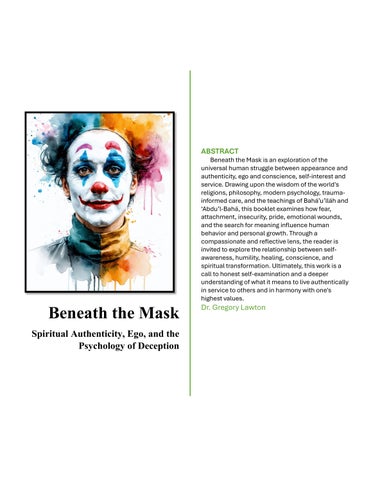
Beneath the Mask is an exploration of the universal human struggle between appearance and authenticity, ego and conscience, self-interest and service. Drawing upon the wisdom of the world's religions, philosophy, modern psychology, traumainformed care, and the teachings of Bahá’u’lláh and ‘Abdu’l-Bahá, this booklet examines how fear, attachment, insecurity, pride, emotional wounds, and the search for meaning influence human behavior and personal growth. Through a compassionate and reflective lens, the reader is invited to explore the relationship between selfawareness, humility, healing, conscience, and spiritual transformation. Ultimately, this work is a call to honest self- examination and a deeper understanding of what it means to live authentically in service to others and in harmony with one's highest values.
Dr. Gregory Lawton
Spiritual Authenticity, Ego, and the Psychology of
By Dr. Gregory T. Lawton
Copyright
Beneath the Mask
Spiritual Authenticity, Ego, and the Psychology of Deception
Reflections on Self-Examination, Emotional Healing, and Spiritual Authenticity
Copyright © 2019, 2026 by Dr. Gregory T. Lawton
All rights reserved.
No portion of this publication may be reproduced, stored in a retrieval system, transmitted, or distributed in any form or by any means, electronic, mechanical, photocopying, recording, scanning, or otherwise, without prior written permission from the author, except for brief quotations used in reviews, educational discussion, or scholarly reference.
This publication is intended for educational, spiritual, and informational purposes only. The material presented in this booklet reflects the opinions, observations, studies, and professional experiences of the author and is not intended to diagnose, treat, cure, or prevent any psychological, psychiatric, or medical condition.
References to psychological concepts, personality traits, behavioral patterns, or interpersonal dynamics are provided for educational discussion and self-reflection and should not be interpreted as formal psychological diagnosis or mental health assessment.
The quotations from the writings of Bahá’u’lláh and other Bahá’í sources are used respectfully for educational and reflective purposes. All such quotations remain the property of their respective copyright holders and publishers.
Grand Rapids, Michigan
Printed in the United States of America
First Edition, May 2019, Revised May 2026
For educational information, workshops, and professional training programs please contact: Blue Heron Academy of Healing Arts and Sciences
To all those who have struggled to remain sincere in a world increasingly dominated by appearance, performance, recognition, and the many masks human beings wear to protect themselves from fear, insecurity, and vulnerability.
To those who continue striving toward humility, conscience, authenticity, compassion, and purity of motive despite human weakness and imperfection.
And with special gratitude to Susan Lewis Wright, whose sharing of a remarkable passage from Bahá’u’lláh rekindled my interest in revisiting and expanding ideas I first explored many years ago concerning ego, human motivation, authenticity, and spiritual growth. Her thoughtful encouragement helped inspire the revision of this work and its integration into the Blue Heron Academy Trauma-Informed Care Training and Certification Program.
I also wish to acknowledge the dedicated staff, instructors, assistants, and volunteers of Blue Heron Academy of Healing Arts and Sciences. Their commitment to education, service, healing, and community building has contributed immeasurably to the Academy's mission and to the lives of countless students and community members. Without their assistance, encouragement, and countless contributions behind the scenes, many of the educational programs, workshops, publications, and community initiatives that have emerged from the Academy, including this work, would not have been possible.
May these reflections encourage greater self-awareness, kindness, humility, and understanding in all who read them.
This booklet arose from many years of observation, reflection, teaching, counseling, rehabilitation work, and spiritual study regarding the hidden motivations that influence human behavior. Throughout life, I have observed that the greatest dangers to individuals, families, organizations, and spiritual communities often do not arise from obvious weakness or imperfection, but from concealed motives, ego attachment, manipulation, and the gradual loss of authenticity.
Over time, certain recurring behavioral patterns became increasingly visible:
• the need for personal recognition,
• the desire for power and control,
• the fear of vulnerability,
• the compulsive need to be right,
• the manipulation of perception,
• and the tendency to hide behind carefully constructed social, intellectual, moral, or spiritual masks.
At the same time, my studies in psychology, rehabilitation, behavioral science, spirituality, and trauma-informed care continually revealed that beneath many destructive behaviors lies insecurity, fear, emotional fragmentation, unresolved pain, and the universal human struggle with identity and self-worth.
The writings of Bahá’u’lláh offer remarkable insight into these conditions. His teachings repeatedly emphasize truthfulness, sincerity, humility, purity of motive, consultation, conscience, and authentic spiritual transformation. His warnings regarding hypocrisy, manipulation, and ego attachment remain profoundly relevant within modern psychological, organizational, religious, and social environments.
As this work evolved, it became increasingly apparent that the questions explored within these pages are not uniquely Bahá’í, psychological, or clinical. They are profoundly human questions. For this reason, the booklet begins with a brief examination of how many of the world's religions, philosophies, and modern psychological traditions have addressed the universal challenge of the ego and the search for authenticity.
This material also forms part of the educational foundation of the Blue Heron Academy Trauma-Informed Care Training and Certification Program. The program explores the relationship between trauma, behavioral adaptation, emotional survival mechanisms, stress physiology, identity formation, interpersonal dynamics, conscience, and authentic healing. Many of the psychological and spiritual patterns discussed within this booklet, including defensiveness, projection, control behaviors, recognition-seeking, manipulation, and emotional masking, are frequently encountered within trauma-informed educational, clinical, rehabilitative, and community settings.
This work is not intended as an attack upon individuals, institutions, or communities. Nor is it written from a spirit of superiority or judgment. Every human being struggles with ego, insecurity, defensiveness, attachment, and the desire for validation. The purpose of this booklet is not condemnation of others, but greater self-awareness within ourselves.
As this booklet evolved, I found myself repeatedly confronting an uncomfortable reality. Many of the behaviors, motivations, defenses, and psychological patterns described in these pages were not merely concepts to be studied or observed in others. To varying degrees, I recognized aspects of them within myself.
There were moments during the writing process when I found it easier to identify these tendencies in organizations, communities, clients, patients, students, friends, and acquaintances than in my own life. Yet honest self-examination requires a different standard. It requires the willingness to acknowledge that every human being, regardless of age, experience,
education, profession, or spiritual aspiration, remains engaged in the lifelong struggle between authenticity and appearance, humility and pride, conscience and ego.
At times this realization was uncomfortable. Some passages caused me to reflect upon my own motivations, attachments, defensiveness, need for recognition, certainty, or control. In those moments, the booklet ceased being an academic exercise and became something far more personal.
For that reason, I offer these reflections not as the observations of someone who has mastered these lessons, but as a fellow traveler who continues to learn them. The pages that follow represent not only a study of human behavior, but an ongoing effort to better understand my own heart, motives, strengths, weaknesses, and capacity for transformation.
If this work encourages deeper honesty, humility, compassion, selfreflection, emotional maturity, or sincere consultation, then it will have served its purpose.
Ultimately, authentic transformation begins when we find the courage to look beneath the mask.
Dr. Gregory T. Lawton
We live in an age of image.
Public identity, social recognition, emotional performance, ideological certainty, and the careful management of appearance increasingly shape modern human interaction. In many environments, the outward presentation of morality, spirituality, intelligence, compassion, or virtue has become more important than the difficult inward work of sincerity, humility, conscience, and authentic self-examination.
Yet beneath the surface of human behavior often lies a far more complicated reality.
Fear disguises itself as certainty. Insecurity disguises itself as authority. The desire for recognition disguises itself as service. The need for control disguises itself as moral concern. And the ego frequently hides behind masks so convincing that even the individual wearing them may no longer recognize the difference between appearance and truth.
Long before modern psychology identified concepts such as projection, triangulation, impression management, narcissistic masking, emotional manipulation, cognitive rigidity, and identity overattachment, the great spiritual teachers warned humanity of these same conditions in spiritual and moral language.
Among the most penetrating voices was Bahá’u’lláh. His writings repeatedly call humanity toward truthfulness, moderation, humility, consultation, courage, purity of motive, and independent conscience. At the same time, they offer powerful warnings regarding hypocrisy, manipulation, spiritual pride, domination, and the corruption of the human heart through attachment to ego and appearance.
One of the most compelling aspects of this work is its recognition that the struggle with ego, pride, attachment, self-deception, and authenticity is not unique to any one religion, culture, or philosophy. From the teachings of the world's great faith traditions to the observations of philosophers, psychologists, and trauma specialists, a remarkably consistent theme emerges: human beings flourish when they cultivate humility, self-awareness, conscience, compassion, and truthfulness, and they suffer when they become excessively attached to image, recognition, certainty, control, or self-importance.
This booklet explores the intersection between those spiritual insights and modern psychological understanding.
Drawing upon decades of experience in behavioral science, rehabilitation, trauma-informed care, addiction recovery, organizational consultation, spirituality, and human development, Gregory T. Lawton examines the hidden motivations that often drive conflict, defensiveness, manipulation, recognition-seeking, emotional control, and the compulsive need to dominate through certainty or influence.
The pages that follow are not intended as an exercise in judgment or condemnation. Every human being struggles with insecurity, fear, attachment, pride, defensiveness, and the desire to protect identity and self-image. Rather, this work invites the reader toward honest reflection, deeper self-awareness, emotional maturity, and spiritual authenticity.
The questions explored within this booklet are ultimately universal.
What motivates human behavior beneath the surface?
Why do individuals seek recognition, control, validation, or dominance?
Why do people hide behind masks?
What happens when image replaces sincerity?
And how does one preserve conscience, humility, and authenticity within a world increasingly shaped by performance and illusion?
These are not merely psychological questions. They are spiritual questions. And they remain central to the health of individuals, families, communities, organizations, and society itself.
Authentic transformation begins when the individual develops the courage to look honestly beneath the mask.
Human beings have always worn masks.
Some masks are necessary and harmless. We learn to function socially, protect vulnerability, preserve dignity, and navigate the expectations of family, work, religion, and society. Yet beneath these ordinary social adaptations lies a more dangerous possibility: the gradual replacement of authenticity with performance, sincerity with image, and conscience with ego attachment.
The writings of Bahá’u’lláh speak with extraordinary directness regarding this danger. Again and again, Bahá’u’lláh warns humanity not merely against wrongdoing, but against hypocrisy, manipulation, false appearance, concealed motives, and the corruption of the human heart through attachment to ego, recognition, control, and power.
One of the most striking examples appears in the following passage:
“Be thou of the people of hell-fire, but be not a hypocrite. Be thou an unbeliever, but be not a plotter. Make thy home in taverns, but tread not the path of the mischief-maker. Fear thou God, but not the priest. Give to the executioner thy head, but not thy heart. Let thine abode be under the stone, but seek not the shelter of the cleric.”
Bahá’u’lláh, from a Tablet translated from the Persian, cited in The Compilation of Compilations, Vol. II.
At first reading, the passage appears paradoxical and even shocking. Bahá’u’lláh seems to place greater spiritual danger upon hypocrisy, manipulation, plotting, and spiritual pretense than upon outward weakness, doubt, or imperfection. Yet the deeper meaning gradually becomes clear. The central issue is authenticity versus deception.
A flawed person who remains honest about his condition retains the possibility of transformation. But the individual who becomes attached
to image, performance, recognition, manipulation, or control may slowly lose the ability to see himself truthfully.
Modern psychology, trauma-informed care, and behavioral science increasingly recognize similar dynamics. Many defensive and controlling behaviors arise not only from pride or ego attachment, but also from fear, insecurity, unresolved emotional injury, early childhood trauma, emotional neglect, shame, PTSD, chronic stress exposure, and adaptive survival mechanisms developed over many years.
Individuals who experienced unstable, unsafe, rejecting, humiliating, or emotionally unpredictable environments early in life may unconsciously construct protective psychological masks in order to survive emotionally and socially. These adaptations may later appear as:
• compulsive control,
• defensiveness,
• recognition-seeking,
• emotional withdrawal,
• manipulation,
• projection,
• perfectionism,
• inability to tolerate criticism,
• compulsive certainty,
• domination of conversations,
• or the constant need to preserve self-image.
In many cases, these patterns originated not as deliberate malice, but as emotional survival strategies shaped by fear, insecurity, rejection, trauma, or unresolved emotional pain. Over time, however, these protective adaptations may become deeply ingrained and eventually interfere with authentic relationships, consultation, emotional maturity, spiritual growth, and truthful self-awareness.
This understanding is central to trauma-informed care. Trauma-informed approaches recognize that beneath many difficult behaviors lies a nervous system attempting to protect itself from perceived emotional danger, vulnerability, shame, abandonment, criticism, or loss of control. The individual may outwardly appear controlling, manipulative, argumentative, prideful, defensive, or emotionally reactive, while inwardly struggling with insecurity, fear, fragmentation, or unresolved trauma.
Yet trauma alone does not fully explain the human condition. Spiritual traditions, including the teachings of Bahá’u’lláh, also speak of conscience, responsibility, humility, sincerity, purity of motive, and the lifelong struggle between the higher and lower dimensions of human nature.
This booklet therefore explores the intersection between:
• spirituality,
• psychology,
• trauma-informed care,
• behavioral adaptation,
• emotional survival mechanisms,
• ego attachment,
• and authentic transformation.
It examines the hidden motivations that often drive human behavior:
• the need for recognition,
• the desire for control,
• fear of vulnerability,
• attachment to personal opinion,
• manipulation through deflection and triangulation,
• and the compulsive need to preserve self-image.
At the same time, it explores the possibility of something higher:
• sincerity,
• humility,
• conscience,
• emotional maturity,
• truthful self-examination,
• compassion,
• and spiritual authenticity.
The purpose of this work is not condemnation or judgment of others. Every human being struggles with insecurity, attachment, defensiveness, fear, ego, and emotional survival patterns. Rather, the purpose is selfreflection: to look honestly beneath the mask, to examine the hidden motivations that shape thought and behavior, and to better understand the psychological and spiritual conditions that either strengthen or fragment the human soul.
• Authenticity requires courage.
• Truthfulness requires humility.
• Healing requires honesty.
And spiritual maturity requires the willingness to confront oneself without collapsing into shame, defensiveness, or illusion.
The journey inward is often uncomfortable, but it remains essential. For only beneath the mask can the authentic self emerge.
The chapters that follow examine these questions from several perspectives. We begin by exploring how religions, philosophies, and modern psychology have understood the challenge of the ego. We then turn to the writings of Bahá’u’lláh, whose insights into authenticity, conscience, hypocrisy, and transformation provide the foundation for the discussions that follow. Finally, we examine the psychological dimensions of human motivation, the need for recognition and control,
the compulsive need to be right, and the role of conscience and authenticity in personal growth and spiritual transformation.
Long before the development of modern psychology, the world's religions, philosophers, and wisdom traditions recognized that one of the greatest obstacles to human flourishing lies within the human self. While different traditions use different language, many describe a struggle between higher and lower aspects of human nature, between self-interest and service, between attachment and detachment, between illusion and truth, and between the demands of the ego and the voice of conscience.
Throughout history, spiritual teachers, philosophers, and moral leaders have observed that human beings often become trapped by pride, selfimportance, attachment to recognition, the desire for control, fear of vulnerability, and the tendency to place personal desires above truth and wisdom. Although these observations emerged from different cultures and civilizations, they reveal a remarkable degree of agreement regarding the challenges of human growth and development.
Within Judaism, ancient teachers described the ongoing struggle between the Yetzer HaTov, often translated as the good inclination, and the Yetzer HaRa, the self-centered inclination. Human beings were understood to possess the capacity for both selfishness and selflessness, and spiritual growth was seen as the conscious effort to align one's life with justice, compassion, humility, and obedience to God.
Christian teachings similarly emphasize the dangers of pride and selfexaltation. The teachings of Jesus repeatedly call humanity toward humility, forgiveness, service, and love. One of His most profound questions speaks directly to the issue of misplaced priorities and ego attachment: “For what shall it profit a man, if he shall gain the whole world, and lose his own soul?” Throughout Christian history, pride has often been described as one of the most dangerous obstacles to spiritual growth because it blinds individuals to their own weaknesses while magnifying the faults of others.
Islamic teachings contain a rich tradition concerning the nafs, often translated as the self or lower nature. Many Islamic scholars have described the spiritual journey as one of transforming the lower self from a condition dominated by pride, desire, anger, selfishness, and attachment into one characterized by humility, discipline, wisdom, compassion, and submission to the will of God. The struggle against the lower self has often been described as one of the greatest challenges facing every believer.
Within Hindu philosophy, the concept of ahamkara refers to the ego or the mistaken identification of the self with status, possessions, social identity, and personal desires. Spiritual development involves moving beyond attachment to the limited self and recognizing a deeper spiritual reality. Similarly, Buddhist teachings identify attachment, craving, and excessive identification with the self as primary causes of suffering. The path toward enlightenment involves cultivating awareness, compassion, detachment, and freedom from the illusions created by ego-centered thinking.
Taoist philosophy likewise warns against excessive striving, domination, self-importance, and the desire to control people or circumstances. The Tao Te Ching repeatedly emphasizes humility, moderation, simplicity, balance, and harmony with the natural order of life. According to Taoist thought, wisdom emerges not through force or self-assertion but through alignment with deeper principles that transcend the demands of the ego.
The philosophers of ancient Greece also addressed these themes. Socrates encouraged self-examination and famously taught that “the unexamined life is not worth living.” Later Stoic philosophers such as Marcus Aurelius, Epictetus, and Seneca emphasized self-discipline, humility, emotional regulation, personal responsibility, and freedom from destructive passions. They taught that true strength comes not from controlling others but from mastering oneself.
Modern psychology has approached many of these same questions from a different perspective. Rather than speaking of the soul, pride, or
spiritual attachment, psychologists often discuss identity, self-image, defense mechanisms, emotional adaptation, narcissism, projection, impression management, trauma responses, and cognitive distortions. Although the language differs, many psychological theories describe patterns remarkably like those identified by spiritual traditions for thousands of years.
Trauma-informed care has added another important dimension to this understanding. Contemporary research suggests that many behaviors associated with defensiveness, control, perfectionism, emotional withdrawal, manipulation, compulsive certainty, and recognitionseeking may develop as adaptive responses to fear, insecurity, shame, rejection, emotional neglect, chronic stress, or traumatic experiences. What may appear outwardly as arrogance or control can sometimes reflect an attempt to protect a wounded or vulnerable sense of self.
Yet neither spirituality nor psychology excuses harmful behavior simply because its origins can be understood. Rather, both recognize that healing and growth require awareness. Transformation becomes possible when individuals develop the courage to examine their motivations honestly, acknowledge their vulnerabilities, accept responsibility for their actions, and cultivate greater humility, compassion, authenticity, and self-awareness.
Although the world's religions, philosophies, and psychological traditions differ in their theology, language, and methods, they share a common insight: human suffering is often intensified when individuals become excessively attached to image, recognition, control, certainty, status, or self-importance. Conversely, personal growth, emotional maturity, healthy relationships, and spiritual development emerge through humility, conscience, compassion, self-examination, truthful self-awareness, and service to others.
It is within this universal context that the teachings of Bahá’u’lláh concerning authenticity, hypocrisy, conscience, and spiritual transformation may be better understood. His words do not stand apart
from humanity's great wisdom traditions. Rather, they contribute a powerful and deeply relevant voice to an ancient and ongoing conversation regarding the nature of the human heart and the path toward genuine transformation.
“Look ye not upon the creatures save with the eye of kindness.”
Bahá’u’lláh
Every human being struggles with weakness, insecurity, fear, pride, attachment, defensiveness, and imperfection. None of us moves through life without emotional wounds, blind spots, contradictions, or moments in which fear, ego, insecurity, or unresolved pain influence our thoughts and behavior. Every person carries both strength and fragility within the human heart.
For this reason, the purpose of this discussion is not to judge, condemn, criticize, or expose others. The goal is not self-righteousness, faultfinding, or moral superiority. Rather, the purpose is greater selfawareness, compassion, humility, emotional maturity, and truthful selfexamination.
The writings of Bahá’u’lláh repeatedly encourage humanity toward sincerity, truthfulness, purity of motive, moderation, consultation, courage, and authentic spiritual character. At the same time, they warn against the subtle dangers of hypocrisy, manipulation, ego attachment, spiritual pride, and the gradual replacement of authenticity with appearance.
One of the greatest challenges of human life is that the ego often hides itself even from the individual. Fear may disguise itself as certainty. Insecurity may disguise itself as authority. The need for recognition may disguise itself as service. Emotional wounds may disguise themselves as control, defensiveness, manipulation, or domination. As a result, individuals may gradually become more attached to preserving image than to pursuing truth.
Modern psychology, trauma-informed care, and behavioral science increasingly recognize similar patterns. Many defensive and controlling behaviors arise not simply from deliberate malice, but from emotional
survival strategies shaped by fear, shame, rejection, trauma, insecurity, chronic stress, early childhood conditioning, or unresolved emotional pain. Over time, however, these adaptations may interfere with authentic relationships, emotional maturity, consultation, self-awareness, and spiritual growth.
The following passage from Bahá’u’lláh is one of the most profound spiritual commentaries on sincerity, authenticity, conscience, and the dangers of hypocrisy found in the Bahá’í writings:
“Be thou of the people of hell-fire, but be not a hypocrite. Be thou an unbeliever, but be not a plotter.
Make thy home in taverns, but tread not the path of the mischief-maker.
Fear thou God, but not the priest.
Give to the executioner thy head, but not thy heart. Let thine abode be under the stone, but seek not the shelter of the cleric. Thus doth the Holy Reed intone its melodies, and the Nightingale of Paradise warble its song, so that He may infuse life eternal into the mortal frames of men, impart to the temples of dust the essence of the Holy Spirit and the heavenly Light, and draw the transient world, through the potency of a single word, unto the Everlasting Kingdom.”
Bahá’u’lláh, from a Tablet translated from the Persian, cited in The Compilation of Compilations, Vol. II, p. 337, no. 2050.
At first reading, the passage appears startling, even shocking.
Bahá’u’lláh seems to compare unbelief, taverns, and “hell-fire” favorably against hypocrisy, plotting, manipulation, and religious pretense. Yet the meaning becomes clearer when we recognize that the central theme of the passage is not sin versus virtue in the ordinary sense, but authenticity versus deception.
Again and again, Bahá’u’lláh contrasts honest human weakness with concealed corruption of motive. A flawed person who is truthful about his condition remains spiritually alive and capable of transformation. The hypocrite, however, hides behind masks, appearances, and
performance. The danger lies not merely in imperfection, but in the deliberate concealment of truth from others and eventually from oneself.
Modern psychology, though using different language, often describes similar conditions. Hypocrisy involves a division between the outward persona and the authentic self. This may appear as impression management, narcissistic masking, false virtue, moral posturing, or chronic self-deception. The person may gradually become attached to maintaining an image that conceals inner contradiction, vulnerability, fear, or insecurity.
Bahá’u’lláh’s reference to the “plotter” reflects patterns recognized today as manipulative or Machiavellian behavior. Such individuals may engage in covert aggression, strategic deception, triangulation, emotional manipulation, or hidden hostility while outwardly presenting innocence or righteousness.
Likewise, the “mischief-maker” corresponds psychologically to those who generate conflict, confusion, instability, or division within relationships and communities. Some individuals unconsciously externalize their own unresolved inner turmoil by creating disruption around themselves. Modern family systems psychology recognizes this process in the dynamics of scapegoating, conflict displacement, and emotional contagion.
One of the most psychologically sophisticated dimensions of this passage is Bahá’u’lláh’s condemnation of spiritual performance and religious intimidation. “Fear thou God, but not the priest” is not merely a rejection of clerical authority; it is a call for independent conscience and moral courage. Psychologically, this reflects healthy differentiation, the capacity to think truthfully and independently without surrendering one’s conscience to external pressure or social fear.
The passage also speaks powerfully to the subject of deflection. Deflection is a psychological defense mechanism used to redirect attention away from one’s own behavior, motives, contradictions, or
accountability. Rather than confronting truth directly, the individual changes the subject, creates confusion, attacks the critic, exaggerates the faults of others, or generates emotional drama to avoid self-examination.
Projection is one common form of deflection. A person may accuse others of precisely the qualities he cannot tolerate seeing within himself. The manipulative person becomes obsessed with warning about manipulation. The controlling person accuses everyone else of seeking control. The hypocrite loudly performs moral purity while concealing inner contradiction.
Spiritually, this is profoundly dangerous because the soul gradually becomes attached not to truth itself, but to the maintenance of the constructed self-image.
Bahá’u’lláh repeatedly emphasizes that honest weakness is spiritually healthier than concealed corruption. A person who can admit failure, fear, confusion, or doubt remains open to transformation. But a person committed to preserving appearances at all costs may slowly lose the ability to see himself truthfully.
Modern psychology increasingly recognizes the destructive consequences of chronic self-deception and fragmentation. Long-term suppression of authenticity may contribute to emotional numbness, relational instability, identity diffusion, chronic resentment, projection, and moral disengagement.
The remedy offered by Bahá’u’lláh is not perfectionism. He does not demand flawless behavior before spiritual growth can begin. Instead, He calls humanity toward radical sincerity, truthful self-examination, humility, courage, and purity of motive.
The passage ultimately teaches that the soul is preserved not by outward image, but by inward honesty. One may suffer weakness, confusion, hardship, or even failure and still remain spiritually alive if truthfulness is retained. But when deception, manipulation, deflection, and hypocrisy
dominate the inner life, the soul becomes fragmented and increasingly separated from reality itself.
Thus, the words of Bahá’u’lláh remain not only a spiritual teaching, but also a profound commentary on human psychology, conscience, authenticity, and the moral health of individuals and communities.
1. Why do you think Bahá’u’lláh places greater spiritual danger upon hypocrisy than upon outward weakness or imperfection?
2. What is the difference between a person who is struggling honestly and a person who is maintaining a false appearance?
3. How can outward spirituality sometimes conceal insecurity, pride, attachment, or the need for recognition?
4. What does the phrase “Give to the executioner thy head, but not thy heart” suggest about conscience, courage, and integrity?
5. Why does Bahá’u’lláh warn against fear of religious authority while encouraging fear of God?
6. How does modern psychology help explain behaviors such as hypocrisy, projection, manipulation, and self-deception?
7. Why is truthful self-examination psychologically difficult for many people?
8. What are some common signs of deflection, projection, or impression management in relationships and organizations?
9. Why is authenticity essential for both psychological and spiritual health?
10. What does this passage teach about the relationship between truthfulness and transformation?
Many destructive interpersonal and spiritual behaviors arise from deeper underlying motivations that distort human relationships, conscience, and authenticity. Over years of observation, three recurring negative motivators often emerge beneath hypocrisy, manipulation, triangulation, and deflection:
The desire to acquire, possess, dominate resources, secure advantage, or protect self-interest at the expense of truth, fairness, or compassion.
The craving for validation, admiration, importance, praise, status, or identity reinforcement through the approval of others. This often manifests as image management, moral performance, virtue signaling, exaggerated self-presentation, or hypersensitivity to criticism.
The desire to influence, dominate, manipulate, intimidate, control narratives, shape perceptions, or direct the behavior of others for personal, emotional, ideological, or institutional purposes.
These motivators may operate consciously or unconsciously. In many cases, individuals sincerely believe their actions are justified, moral, or even spiritually necessary while remaining unaware of the deeper ego attachments driving their behavior.
From a psychological perspective, these motivators frequently underlie:
• hypocrisy,
• triangulation,
• deflection,
• manipulation,
• projection,
• coercion,
• emotional control,
• conflict generation,
• and relational instability.
From a spiritual perspective, these motivators strengthen attachment to the ego-self and weaken sincerity, humility, truthfulness, and purity of motive.
The passage from Bahá’u’lláh repeatedly warns against these distortions. The hypocrite seeks recognition through appearance. The plotter seeks influence through manipulation. The mischief-maker seeks control through instability and division. The fearful submission to religious authority reflects surrender to power structures rather than devotion to truth itself.
By contrast, Bahá’u’lláh repeatedly elevates authenticity above image, sincerity above performance, and conscience above social control.
A person may be weak, uncertain, struggling, or imperfect and still remain spiritually alive if truthfulness and humility remain intact. But when greed, recognition-seeking, and the desire for control dominate the inner life, the soul gradually becomes fragmented by self-deception and attachment to the false self.
True spiritual development therefore requires continual selfexamination:
Why am I saying this?
Why do I need others to see me this way?
Am I seeking truth, or influence?
Am I serving, or controlling?
Am I correcting injustice, or defending ego?
Am I communicating directly, or manipulating perception through others?
The purpose of such reflection is not self-condemnation, but liberation from illusion and movement toward sincerity, humility, and authentic spiritual maturity.
This integrates beautifully with your long-standing behavioral motivation model because it bridges:
• spirituality,
• psychology,
• ethics,
• interpersonal dynamics,
• and self-awareness.
It also fits strongly with your broader teaching emphasis on authenticity, conscience, and the distinction between true service and ego-driven performance.
1. Which of the three negative motivators:
• greed,
• need for personal recognition,
• or desire for power and control, do you believe is most destructive, and why?
2. How can the need for recognition disguise itself as spirituality, service, leadership, or moral concern?
3. In what ways can the desire for control appear subtle, indirect, or socially acceptable?
4. How do greed, recognition-seeking, and control contribute to hypocrisy and manipulation?
5. Why do individuals sometimes seek influence or dominance over others?
6. How can ego attachment distort sincerity, humility, and purity of motive?
7. What role does self-awareness play in identifying unhealthy motivations within ourselves?
8. How can a person distinguish between genuine service and egodriven behavior?
9. Why is continual self-examination important for spiritual maturity?
10. How do these motivators affect families, organizations, spiritual communities, and society as a whole?
Another destructive psychological and spiritual pattern closely related to hypocrisy, deflection, and manipulation is the compulsive need to always be right and to persistently impose one’s opinions, interpretations, or conclusions upon others.
At first glance, this behavior may appear to arise from conviction, intelligence, moral concern, or commitment to truth. However, beneath the surface, the need to always be right is often deeply connected to ego attachment, insecurity, recognition-seeking, or the desire for psychological control.
For some individuals, disagreement is experienced not as a normal exchange of ideas, but as a personal threat to identity, status, authority, or self-worth. As a result, the individual may feel compelled to:
• dominate conversations,
• endlessly repeat opinions,
• resist contrary evidence,
• reinterpret events to preserve self-image,
• overwhelm others verbally,
• persist beyond reasonable dialogue,
• or continue arguing until others withdraw emotionally or surrender from exhaustion.
In such cases, the individual may gradually cease seeking truth and instead seek validation, victory, dominance, or control.
This dynamic often overlaps with several of the previously discussed patterns:
• deflection,
• projection,
• triangulation,
• manipulation,
• and recognition-seeking behavior.
When direct persuasion fails, the person may increasingly attempt to control group perception through indirect means:
• gathering allies,
• moralizing,
• pressuring others socially,
• reframing disagreement as disloyalty,
• or repeatedly revisiting settled issues.
Psychologically, this pattern may reflect:
• cognitive rigidity,
• low tolerance for ambiguity,
• narcissistic traits,
• authoritarian tendencies,
• compulsive control needs,
• anxiety-driven certainty,
• or identity overattachment.
Spiritually, this condition reflects excessive attachment to the ego-self and to personal opinion. The individual becomes attached not merely to truth, but to being perceived as correct.
This distinction is critically important.
A sincere truth-seeking person retains the ability to say:
“I may be mistaken.”
“I need to reflect further.”
“You may see something I do not.”
“Let us consult together.”
By contrast, the compulsive need-to-be-right personality often experiences concession as humiliation, weakness, or loss of control.
The teachings of Bahá’u’lláh repeatedly call humanity toward humility, moderation, consultation, detachment from ego, and purity of motive. Healthy consultation requires:
• listening without domination,
• persuasion without coercion,
• conviction without arrogance,
• and the ability to disagree without attempting to overpower others emotionally or socially.
One of the clearest signs of psychological and spiritual maturity is the capacity to let go of the need for the final word.
True confidence is often quiet, restrained, and detached. It seeks illumination rather than conquest.
This section would integrate beautifully into the larger handout because it expands the discussion from overt manipulation into subtler ego dynamics that often appear inside religious, intellectual, organizational, and interpersonal environments.
It also strongly reinforces your earlier framework regarding:
• greed,
• need for personal recognition,
• and the desire for power and control over others.
The compulsive need to be right is often one of the primary behavioral expressions of those deeper motivators.
1. Why do some individuals experience disagreement as a personal threat rather than a normal exchange of ideas?
2. What emotional or psychological needs may underlie the compulsive need to always be right?
3. How does excessive attachment to personal opinion interfere with consultation and healthy communication?
4. What is the difference between seeking truth and seeking victory?
5. Why is the ability to say “I may be mistaken” a sign of psychological and spiritual maturity?
6. How does insecurity sometimes disguise itself as certainty, authority, or intellectual superiority?
7. What role do deflection, projection, and triangulation play in argumentative or controlling personalities?
8. Why do some individuals continue arguing long after productive dialogue has ended?
9. What are the signs of emotionally mature consultation and communication?
10. Why is the ability to let go of the need for the final word an important sign of humility and inner confidence?
“Bring thyself to account each day ere thou art summoned to a reckoning.” Bahá’u’lláh
Authenticity begins when the individual develops the courage to see himself truthfully. Yet this is one of the most difficult tasks in human life. The ego instinctively seeks comfort, protection, recognition, certainty, and emotional safety. As a result, human beings often construct identities, defenses, explanations, and social masks that protect them from vulnerability, shame, criticism, emotional pain, insecurity, or accountability. Over time, however, the protective mask may slowly become confused with the authentic self, and the individual may gradually become more concerned with appearance than sincerity, recognition than truth, or control than humility.
Modern psychology increasingly recognizes that many destructive patterns arise from this growing separation between the authentic self and the constructed social persona. Trauma-informed care likewise recognizes that emotional defenses often begin as survival adaptations shaped by fear, rejection, instability, humiliation, emotional neglect, chronic stress, or unresolved trauma. Behaviors such as control, perfectionism, emotional withdrawal, manipulation, compulsive certainty, defensiveness, recognition-seeking, and the need to dominate conversations may initially develop as attempts to preserve emotional safety and psychological stability. Yet over time, these same defenses may interfere with emotional maturity, authentic relationships, truthful self-awareness, consultation, compassion, and spiritual growth.
The writings and example of ‘Abdu’l-Bahá offer a profoundly different model of human development. Throughout His life, ‘Abdu’l-Bahá demonstrated extraordinary humility, gentleness, emotional balance, forgiveness, compassion, patience, and selflessness, even while enduring imprisonment, suffering, humiliation, hardship, and relentless opposition. His example repeatedly emphasized kindness, moderation,
truthful self-examination, and compassion toward the weaknesses and struggles of others.
He taught:
“If a person commits an error and wrong toward you, you must instantly forgive him.”
Selections from the Writings of ‘Abdu’l-Bahá
And elsewhere He counseled humanity:
“Look at the shortcomings of nobody; see with the sight of forgiveness.” ‘Abdu’l-Bahá
Such teachings do not deny the existence of harmful behavior, manipulation, ego attachment, or emotional dysfunction. Rather, they remind us that every human being struggles with weakness, fear, insecurity, attachment, emotional wounds, and the lifelong challenge of overcoming the lower tendencies of the self. The purpose of selfexamination is therefore not self-condemnation or judgment of others, but transformation through honesty, humility, conscience, compassion, and greater awareness.
Conscience occupies a central place within this process. Conscience is the inward capacity to recognize truth, responsibility, integrity, and moral reality beyond ego attachment or social pressure. When conscience is ignored repeatedly, the individual may gradually lose the ability to distinguish between authentic sincerity and self-justification. Defensiveness, projection, blame, manipulation, triangulation, compulsive certainty, and emotional control may increasingly dominate behavior as the individual struggles to preserve a carefully constructed self-image.
Yet genuine humility does not weaken the individual. It strengthens emotional stability, psychological flexibility, compassion, wisdom, and authentic confidence. The emotionally mature and spiritually grounded
individual no longer feels compelled to dominate conversations, preserve appearances, control perceptions, or win every disagreement in order to feel secure. Instead, such a person develops the capacity to listen, reflect, consult, admit mistakes, and grow without feeling psychologically threatened by vulnerability or imperfection.
Authentic transformation therefore requires courage. It requires the willingness to confront insecurity, pride, fear, attachment, emotional wounds, recognition-seeking, control behaviors, and self-deception without collapsing into shame or despair. The goal is not perfection. The goal is sincerity. Spiritual and psychological maturity do not create flawless human beings, but truthful ones individuals increasingly capable of humility, compassion, accountability, conscience, consultation, emotional maturity, and authentic love.
For only when the mask begins to fall away can the authentic self fully emerge.
Having examined the influence of ego, attachment, recognition-seeking, control, manipulation, defensiveness, and self-deception, an important question remains. How does one move beyond these patterns? How does an individual cultivate greater authenticity, sincerity, humility, and emotional maturity?
Awareness is an essential beginning, but awareness alone does not produce transformation. Throughout history, the world's religions, philosophers, and wisdom traditions have recognized that personal growth requires more than understanding human weakness. It requires the conscious development of virtues and qualities that strengthen character and refine the human spirit. The goal is not merely to overcome pride, manipulation, fear, or self-centeredness. The goal is to cultivate sincerity, humility, kindness, wisdom, courage, compassion, and authenticity.
The teachings explored in this booklet are not intended to encourage self-condemnation or endless self-analysis. Rather, they invite a process of self-discovery grounded in honesty, compassion, and hope. Human beings are not imprisoned by their weaknesses. They possess the capacity to grow beyond them. The journey begins with the willingness to see oneself truthfully.
One of the most consistent recommendations found throughout the world's wisdom traditions is the practice of self-examination. Socrates encouraged individuals to examine their lives. The Stoic philosophers engaged in daily reflection and self-accounting. Religious traditions throughout the world have encouraged believers to evaluate their motives, actions, and intentions. Bahá’u’lláh expressed this principle with remarkable simplicity when He counseled: "Bring thyself to account each day ere thou art summoned to a reckoning."
Such self-accounting is not intended to produce guilt or shame. Its purpose is awareness. Growth becomes possible when individuals become willing to look honestly at themselves without distortion, excuse, defensiveness, or self-deception. Authentic transformation begins when a person develops the courage to ask difficult questions regarding motives, attitudes, fears, attachments, and behavior.
Humility plays a central role in this process. Yet humility is often misunderstood. It is not weakness, passivity, or a lack of confidence. Genuine humility reflects strength. The humble individual is not constantly occupied with protecting an image, defending a position, proving superiority, or controlling the perceptions of others. Humility allows a person to acknowledge mistakes, accept correction, reconsider assumptions, and continue learning throughout life.
Many of the difficulties examined in this booklet are sustained by the belief that personal worth depends upon being right, being admired, being recognized, being important, or maintaining control. Humility loosens these attachments. It allows individuals to seek truth rather than victory, understanding rather than validation, and growth rather than self-protection.
Closely related to humility is the capacity to listen. Many conflicts arise because individuals become attached to their opinions and identities. Consultation becomes difficult when people are more interested in defending conclusions than discovering truth. Authentic consultation requires the willingness to listen deeply, to consider perspectives different from one's own, and to recognize that no individual possesses complete understanding. The pursuit of truth demands both conviction and openness.
The Bahá’í teachings place great emphasis upon consultation because consultation shifts attention away from ego and toward collective wisdom. It requires individuals to detach from ownership of their ideas
and become willing to modify their views when a clearer understanding emerges. Consultation teaches humility in action.
Service offers another powerful remedy for excessive self-concern. The ego constantly directs attention inward toward personal wants, personal recognition, personal success, and personal importance. Service redirects attention outward toward the needs, welfare, and well-being of others. For this reason, nearly every spiritual tradition places service near the center of the spiritual life.
‘Abdu’l-Bahá beautifully described this relationship between service and self-discovery:
"The more we search for ourselves, the less likely we are to find ourselves; and the more we search for God, and to serve our fellow-men, the more profoundly will we become acquainted with ourselves."
Service expands perspective, softens self-centeredness, and cultivates compassion. It reminds us that life is not measured solely by what we receive, but by what we contribute. Service does not diminish individuality. Rather, it allows individuality to find its highest expression through usefulness, generosity, and love.
The life of ‘Abdu’l-Bahá provides a remarkable example of this principle. Despite decades of imprisonment, deprivation, hardship, and opposition, He consistently responded with kindness, generosity, courtesy, patience, and service. Those who encountered Him often remarked not upon His authority, but upon His humility. His life demonstrated that true greatness is not measured by power, recognition, influence, or status, but by one's capacity to uplift, encourage, and serve others.
Gratitude likewise contributes to emotional and spiritual maturity. Gratitude shifts attention away from what is absent and toward what has
been given. It weakens entitlement and strengthens appreciation. Grateful individuals tend to become less preoccupied with comparison, competition, and recognition because they increasingly recognize the abundance already present within their lives.
Modern trauma-informed care contributes another important insight. Many of the defensive patterns discussed throughout this booklet originated as attempts to survive emotional pain, fear, rejection, shame, criticism, instability, or loss. Understanding this reality encourages compassion. The goal is not to judge oneself harshly for past adaptations but to recognize that survival strategies which were once necessary may no longer serve growth and healing.
This understanding creates space for a healthier relationship with vulnerability. Many individuals spend years attempting to appear strong while concealing insecurity, fear, emotional pain, uncertainty, or imperfection. Yet authentic growth often begins when individuals become willing to acknowledge their humanity. Vulnerability, when balanced with wisdom and discernment, becomes a source of connection rather than weakness.
Throughout this process, conscience remains an indispensable guide. Conscience helps individuals distinguish between appearance and reality, between self-justification and truth, between image and integrity. It quietly calls human beings toward honesty, responsibility, compassion, and accountability. The more faithfully conscience is followed, the more authentic life becomes.
Bahá’u’lláh repeatedly calls humanity to rise above excessive selfconcern and attachment to personal interests. He writes:
"Let your vision be world-embracing, rather than confined to your own self."
Gleanings from the Writings of Bahá’u’lláh
This simple statement captures the essence of spiritual maturity. The ego narrows vision. Authenticity expands it. The ego asks, "What do I want?" Conscience asks, "What is right?" The ego seeks recognition. The spirit seeks service. The ego seeks control. Wisdom seeks understanding. The ego protects image. Authenticity pursues truth.
Ultimately, the opposite of hypocrisy is not perfection but sincerity. The opposite of manipulation is truthfulness. The opposite of domination is service. The opposite of pride is humility. The opposite of self-deception is self-awareness. The opposite of fear is not invulnerability but courage.
Authenticity is not a destination. It is a lifelong process of becoming. It requires continual self-examination, humility, learning, service, compassion, and growth. It asks individuals to remove the masks that separate them from themselves, from others, and from truth.
The journey is not easy. Yet every step toward greater authenticity strengthens character, deepens relationships, nurtures emotional maturity, and contributes to spiritual transformation.
The mask begins to fall away.
And the authentic self begins to emerge.
Every human being wears masks.
Some are created consciously, while others emerge gradually through life's experiences, disappointments, fears, insecurities, wounds, successes, and failures. Many of these masks begin as attempts to protect us from pain, rejection, criticism, vulnerability, uncertainty, or loss. They may help us survive difficult circumstances, preserve dignity, or navigate the complex demands of human relationships. Yet over time, the masks that once protected us can also separate us from ourselves.
The purpose of this booklet has never been to condemn, diagnose, or expose the weaknesses of others. Rather, it has been an invitation to selfexamination. The themes explored within these pages, including ego attachment, recognition-seeking, control, defensiveness, manipulation, projection, hypocrisy, and the need to be right, are not conditions that belong only to certain individuals or groups. They are part of the universal human condition.
The world's religions, philosophers, and psychologists have all recognized that human beings possess both noble and self-centered capacities. We are capable of compassion and selfishness, humility and pride, courage and fear, truthfulness and self-deception. The struggle between these opposing tendencies is not a sign of failure; it is part of what it means to be human.
Modern psychology and trauma-informed care remind us that many behaviors arise from emotional wounds, adaptive survival mechanisms, fear, shame, insecurity, and unresolved pain. Spiritual traditions remind us that human beings also possess conscience, moral responsibility, and the capacity for transformation. Together, these perspectives invite us toward greater understanding, compassion, and accountability.
Throughout this work, the writings of Bahá’u’lláh have served as a guiding light. His teachings repeatedly call humanity toward sincerity,
truthfulness, humility, purity of motive, courage, consultation, and authentic spiritual growth. His warning against hypocrisy is not merely a warning against dishonesty toward others. It is a warning against dishonesty toward ourselves.
The path of transformation begins when we become willing to see ourselves clearly. It begins when we can acknowledge our fears without being ruled by them, recognize our attachments without being controlled by them, admit our mistakes without being crushed by them, and examine our motives without losing hope.
The example of ‘Abdu’l-Bahá offers perhaps the clearest model of this process. Despite hardship, imprisonment, opposition, and suffering, He consistently demonstrated humility, kindness, forgiveness, emotional balance, compassion, and service. His life reminds us that true greatness is not found in power, recognition, control, or certainty, but in love, authenticity, selflessness, and unwavering concern for the well-being of others.
Ultimately, the goal is not perfection.
The goal is sincerity.
The goal is not to eliminate every weakness, but to become increasingly truthful about them. It is not to create a flawless image, but to cultivate an authentic character. It is not to win every argument, control every circumstance, or secure the approval of every person. Rather, it is to develop a life grounded in conscience, humility, compassion, wisdom, and truth.
The journey toward authenticity is lifelong. It requires courage, patience, self-awareness, and grace. Yet it remains one of the most important journeys any human being can undertake.
For it is only beneath the mask that the authentic self can emerge, and only through authenticity that genuine healing, meaningful relationships, spiritual growth, and lasting transformation become possible.
One of the most remarkable discoveries made during the preparation of this booklet was not how much the world's religions, philosophies, and psychological traditions differ from one another, but how often they arrive at similar conclusions regarding the challenges of human nature.
Separated by centuries, continents, languages, cultures, and theological beliefs, humanity's great wisdom traditions have repeatedly warned of the dangers associated with pride, excessive self-concern, attachment, self-deception, domination, greed, and the misuse of power. Although these traditions employ different terminology and explanations, they frequently identify a common obstacle to human flourishing: the tendency of the self to become excessively attached to its own desires, opinions, status, fears, and illusions.
The ancient Hebrew teachings spoke of the ongoing struggle between higher and lower inclinations within the human heart. Christian teachings repeatedly emphasized humility, forgiveness, self-sacrifice, and the dangers of pride. Islamic scholars wrote extensively about the challenge of transforming the lower self into a more disciplined, compassionate, and spiritually mature condition. Hindu philosophy described the ego's tendency to mistake temporary identities and attachments for ultimate reality. Buddhist teachings warned that attachment to self, desire, and illusion contributes to suffering and dissatisfaction. Taoist sages cautioned against force, domination, selfimportance, and excessive striving. Stoic philosophers taught that true freedom comes not from controlling others but from mastering oneself.
Even modern psychology, operating within a largely secular framework, has identified many of the same patterns. Narcissism, self-deception, projection, impression management, defensiveness, emotional manipulation, identity attachment, cognitive rigidity, and the need for external validation all describe behaviors that earlier traditions
recognized in moral, spiritual, or philosophical terms. Contemporary trauma-informed care has added another important insight by helping us understand how many of these behaviors may emerge as adaptive responses to fear, insecurity, shame, rejection, emotional neglect, or traumatic experience.
Yet neither psychology nor spirituality excuses harmful behavior simply because its origins can be understood. Understanding is not the same as permission. Awareness is not the same as transformation.
The world's great wisdom traditions consistently point toward a similar conclusion. Human beings possess the capacity to become trapped within their fears, attachments, insecurities, desires, and illusions. At the same time, they possess the capacity to rise above them through selfawareness, conscience, humility, compassion, wisdom, discipline, service, and love.
This distinction is critically important. The great teachers did not call for the destruction of individuality, personality, creativity, ambition, or healthy self-respect. They did not teach self-hatred, self-condemnation, or emotional suppression. Rather, they taught mastery of the self instead of servitude to it. They taught that human beings are healthiest when conscience guides desire, when wisdom tempers impulse, when compassion moderates power, and when truth takes precedence over image.
In many ways, these teachings may be even more relevant today than when they were first spoken. Modern society often rewards selfpromotion, image cultivation, certainty, outrage, competition, ideological attachment, and the pursuit of recognition. Social media platforms, political movements, commercial interests, and cultural pressures frequently encourage individuals to construct carefully managed public identities while neglecting the more difficult work of self-examination and character development.
Against this backdrop, the teachings of the world's religions, philosophers, and psychologists offer a timeless reminder. Lasting fulfillment is not found through the endless pursuit of recognition, status, control, wealth, influence, or victory. Human beings flourish when they cultivate authenticity, humility, conscience, compassion, emotional maturity, meaningful relationships, and service to others.
The purpose of this booklet has never been to identify villains or expose the weaknesses of others. Every person struggles with fear, insecurity, pride, attachment, defensiveness, and self-deception. Every person carries both strengths and weaknesses, virtues and shortcomings, courage and vulnerability. The challenge is not to become perfect. The challenge is to become honest.
The journey toward authenticity begins when we become willing to examine ourselves with courage and compassion. It deepens when we recognize our own motivations, attachments, defenses, and blind spots without becoming overwhelmed by shame or self-condemnation. It matures when we learn to replace judgment with understanding, arrogance with humility, certainty with wisdom, and self-interest with service.
Perhaps this is why the call to self-examination appears so consistently throughout the world's wisdom traditions. Human transformation begins not when we discover the faults of others, but when we become willing to see ourselves clearly.
The ancient conversation continues. Each generation must decide whether it will be guided by image or truth, pride or humility, fear or courage, self-interest or service. The answer to that question ultimately shapes not only individual lives, but families, communities, nations, and civilizations.
The challenge remains the same as it has always been. To look beneath the mask, and having seen what is there, to continue the work of becoming a better version of yourself.
Glossary
Authentic Self
The inward, genuine dimension of human identity that exists beneath social masks, defensive adaptations, emotional performance, and ego attachment.
Authenticity
The condition of being genuine, truthful, and internally consistent rather than presenting a false or performative image to others.
Cognitive Rigidity
A psychological tendency toward inflexible thinking, difficulty reconsidering opinions, and resistance to alternative viewpoints or new information.
Compassion
The capacity to respond to human weakness, suffering, imperfection, and emotional struggle with kindness, understanding, forgiveness, and mercy rather than condemnation or cruelty.
Conscience
The inward moral awareness that guides honesty, responsibility, integrity, truthfulness, compassion, and recognition of right and wrong beyond ego attachment or social pressure.
Deflection
A psychological defense mechanism in which attention is redirected away from one’s own behavior, motives, or accountability through distraction, blame, argument, emotional diversion, or manipulation.
Differentiation
A concept in family systems psychology describing the ability to maintain personal identity, independent thinking, and emotional balance while remaining emotionally connected to others.
The shaping of emotional responses, attachment patterns, beliefs, selfimage, coping behaviors, and interpersonal expectations through early developmental experiences and family environments.
Ego Attachment
Excessive identification with personal opinions, status, recognition, control, image, or self-importance.
Emotional Manipulation
Attempts to influence, pressure, confuse, control, or emotionally dominate others through indirect, deceptive, coercive, or psychologically controlling means.
Emotional Maturity
The capacity for self-awareness, emotional regulation, humility, empathy, accountability, truthful communication, and balanced response to stress, disagreement, criticism, or emotional discomfort.
Emotional Survival Mechanisms
Protective psychological and behavioral adaptations developed to reduce emotional pain, vulnerability, fear, shame, rejection, or perceived danger. While initially protective, these patterns may later interfere with emotional health, authentic relationships, and spiritual growth.
False Self
A psychological term describing an artificial or socially constructed persona used to conceal insecurity, vulnerability, fear, emotional pain, or the authentic self.
Gaslighting
A manipulative behavior intended to cause another person to question their memory, perception, judgment, or sense of reality.
Greed
An excessive desire for possession, advantage, status, recognition, or self-benefit at the expense of balance, fairness, compassion, or integrity.
Hypocrisy
A condition in which outward appearance, moral presentation, or expressed values become disconnected from inward truth, sincerity, motives, or behavior.
Identity Overattachment
A condition in which personal identity becomes excessively fused with beliefs, opinions, status, ideology, roles, or self-image, making disagreement or criticism feel personally threatening.
Impression Management
Conscious or unconscious efforts to control how one is perceived by others, often through image construction, selective self-presentation, or emotional performance.
Manipulation
Indirect, deceptive, coercive, or controlling behavior intended to influence the thoughts, emotions, perceptions, or actions of others.
Mischief-Maker
A person who creates division, instability, confusion, conflict, emotional disruption, or relational disturbance within families, organizations, communities, or social groups.
Moral Courage
The willingness to uphold truth, conscience, integrity, and responsibility despite fear, criticism, opposition, emotional discomfort, or social pressure.
Narcissistic Traits
Patterns involving excessive self-focus, need for admiration, entitlement,
emotional sensitivity to criticism, image protection, or diminished empathy toward others.
Perfectionism
An excessive need to appear flawless, competent, morally superior, emotionally controlled, or beyond criticism.
Plotter
A person who engages in covert manipulation, strategic deception, indirect hostility, hidden influence, or efforts to control or undermine others behind the scenes.
Power and Control
The desire to dominate, direct, influence, pressure, intimidate, regulate, or shape the behavior, thoughts, perceptions, or emotions of others.
Projection
A psychological defense mechanism in which individuals attribute their own unacceptable feelings, motives, fears, weaknesses, or behaviors to other people.
PTSD
A psychological condition that may develop following traumatic experiences and may involve hypervigilance, emotional reactivity, avoidance, anxiety, emotional numbing, intrusive memories, or persistent feelings of threat or insecurity.
Purity of Motive
Acting from sincere, truthful, compassionate, and unselfish intentions rather than ego attachment, recognition-seeking, manipulation, or selfinterest.
Recognition-Seeking
The psychological need for praise, validation, admiration, approval, status, attention, or emotional reinforcement from others.
Self-Accounting
The practice of regular self-examination, reflection, and honest evaluation of one’s motives, attitudes, behaviors, emotional patterns, and spiritual condition.
Self-Deception
The unconscious distortion, denial, or avoidance of truth in order to protect ego, identity, emotional security, self-image, or psychological comfort.
Shadow
A term in depth psychology referring to denied, repressed, hidden, or unrecognized aspects of the personality.
Spiritual Authenticity
The alignment of outward behavior with inward truth, sincerity, conscience, humility, compassion, and integrity.
Spiritual Bypassing
The misuse of spiritual ideas, language, beliefs, or practices to avoid emotional honesty, accountability, psychological work, unresolved conflict, or emotional healing.
Spiritual Transformation
The gradual process of developing greater sincerity, humility, conscience, compassion, emotional maturity, truthfulness, wisdom, and detachment from ego-centered behavior.
Trauma-Informed Care
An approach to understanding human behavior that recognizes the effects of trauma, chronic stress, emotional injury, and adverse life experiences on emotional regulation, relationships, behavior, identity, and psychological adaptation.
Triangulation
A relational process in which conflict, emotional tension,
communication, or psychological pressure between two people is redirected through a third person instead of being addressed directly.
Honesty in speech, motive, conduct, self-perception, and human relationships; a central spiritual and ethical principle in the Bahá’í teachings.
Bahá’u’lláh. Gleanings from the Writings of Bahá’u’lláh Wilmette, IL: Bahá’í Publishing Trust.
Bahá’u’lláh. The Hidden Words Wilmette, IL: Bahá’í Publishing Trust.
Bahá’u’lláh. Tablets of Bahá’u’lláh Revealed after the Kitáb-i-Aqdas Wilmette, IL: Bahá’í Publishing Trust.
Bahá’í World Centre. The Compilation of Compilations, Vol. II Haifa, Israel: Bahá’í World Centre Publications.
‘Abdu’l-Bahá. Selections from the Writings of ‘Abdu’l-Bahá Wilmette, IL: Bahá’í Publishing Trust.
‘Abdu’l-Bahá. Paris Talks London: Bahá’í Publishing Trust.
Berne, Eric. Games People Play New York: Grove Press.
Bowen, Murray. Family Evaluation New York: W.W. Norton & Company.
Bowen, Murray. Family Therapy in Clinical Practice New York: Jason Aronson.
Cialdini, Robert. Influence: The Psychology of Persuasion New York: Harper Business.
Cloud, Henry and Townsend, John. Boundaries Grand Rapids, MI: Zondervan.
Edinger, Edward. Ego and Archetype Boston: Shambhala Publications.
Frankl, Viktor. Man’s Search for Meaning Boston: Beacon Press.
Goffman, Erving. The Presentation of Self in Everyday Life New York: Anchor Books.
Goleman, Daniel. Emotional Intelligence New York: Bantam Books.
Johnson, Robert A.. Owning Your Own Shadow San Francisco: HarperSanFrancisco.
Lerner, Harriet. The Dance of Anger New York: Harper & Row.
Peck, M. Scott. People of the Lie New York: Simon & Schuster.
Peck, M. Scott. The Road Less Traveled New York: Simon & Schuster.
Stone, Douglas, Patton, Bruce, and Heen, Sheila. Difficult Conversations New York: Penguin Books.
van der Kolk, Bessel. The Body Keeps the Score New York: Viking.
Walker, Pete. Complex PTSD: From Surviving to Thriving Boulder, CO: Azure Coyote Publishing.
Universal House of Justice. Toward a Truly Free Society Haifa, Israel: Bahá’í World Centre.
Zimbardo, Philip. The Lucifer Effect New York: Random House.
Bahá’í Writings and Spiritual Sources
The Compilation of Compilations, Vol. II
Contains the verified quotation from Bahá’u’lláh discussed in this booklet, along with passages on trustworthiness, sincerity, consultation, purity of motive, unity, and moral character.
Gleanings from the Writings of Bahá’u’lláh
Selections exploring truthfulness, humility, detachment, conscience, spiritual integrity, and transformation of character.
The Hidden Words
Short mystical and ethical passages emphasizing self-examination, sincerity, humility, compassion, and detachment from ego.
Tablets of Bahá’u’lláh Revealed after the Kitáb-i-Aqdas
Contains important discussions regarding justice, moderation, consultation, integrity, wisdom, and the dangers of pride and corruption.
Selections from the Writings of ‘Abdu’l-Bahá
Explores forgiveness, compassion, emotional balance, spiritual maturity, humility, service, and the refinement of human character.
Paris Talks
Accessible discussions on ethics, kindness, truthfulness, emotional balance, spirituality, and human relationships.
The Seven Valleys and The Four Valleys
Mystical reflections on selflessness, detachment, humility, spiritual struggle, and inner transformation.
The Body Keeps the Score
A foundational work on trauma, emotional survival mechanisms, PTSD, stress physiology, emotional memory, and healing.
Complex PTSD: From Surviving to Thriving
Explores childhood trauma, emotional adaptation, toxic shame, inner criticism, emotional flashbacks, and recovery.
Man’s Search for Meaning
Classic reflections on suffering, conscience, responsibility, meaning, resilience, and inner freedom.
The Road Less Traveled
Discusses discipline, emotional growth, spiritual maturity, responsibility, and psychological development.
People of the Lie
A psychological and spiritual exploration of deception, narcissism, scapegoating, hypocrisy, manipulation, and evil.
The Narcissism Epidemic
Examines modern narcissistic traits, recognition-seeking, entitlement, image culture, and emotional fragility.
The Presentation of Self in Everyday Life
Classic work exploring social masks, role performance, identity construction, and impression management.
Games People Play
Foundational work in Transactional Analysis examining manipulative interactions, unconscious social “games,” and ego states.
Family Evaluation
Foundational text on family systems theory, emotional triangles, differentiation, relational anxiety, and triangulation.
Family Therapy in Clinical Practice
Explores projection, emotional fusion, indirect control, relational conflict, and family emotional systems.
The Dance of Anger
Practical discussion of emotional systems, boundaries, indirect communication, overfunctioning, and relational maturity.
Boundaries
Explores emotional responsibility, manipulation, control behaviors, healthy limits, and relational accountability.
Influence: The Psychology of Persuasion
Important for understanding persuasion, manipulation, compliance strategies, social influence, and behavioral conditioning.
Ego, Shadow, and Self-Deception
Owning Your Own Shadow
Discusses projection, denial, hidden aspects of personality, and the importance of honest self-confrontation.
Ego and Archetype
Depth psychological examination of ego inflation, identity, symbolism, and psychological transformation.
Leadership and Self-Deception
Explores self-justification, blame, defensiveness, ego-protection, and relational blindness.
The Lucifer Effect
Examines how power, systems, role identification, conformity, and authority can distort conscience and behavior.
Emotional Maturity, Consultation, and Communication
Emotional Intelligence
Explores self-awareness, emotional regulation, empathy, communication, and relational intelligence.
Difficult Conversations
Practical framework for healthy communication, accountability, listening, emotional regulation, and conflict resolution.
Discusses moral autonomy, freedom, responsibility, consultation, and spiritual maturity within society.
Dr. Gregory T. Lawton studied psychology and sociology at the undergraduate level and pursued graduate studies in psychology and probation science at Arizona State University, with a focus on behavioral science, rehabilitation, human motivation, and personal transformation. Early in his career, he worked as a youth probation officer in St. Louis County, Minnesota, and in youth group homes and drug rehabilitation settings, gaining extensive experience in addiction recovery, behavioral disorders, trauma, family dysfunction, and the challenges of personal change.
He was a founding member of the Berrien County Drug Rehabilitation Center and later served as Vice President of Human Resource Associates, one of the largest psychotherapy and behavioral health organizations in West Michigan. During his career, he developed hospital-based and corporate drug rehabilitation, behavioral health, and employee assistance programs utilized by major healthcare systems and Fortune 100 corporations.
For more than five decades, Dr. Lawton has worked as an educator, clinician, author, and consultant in the fields of health promotion, rehabilitation, behavioral change, holistic health care, and personal development. He is the author of a distance education certification program on trauma-informed care and continues to teach courses and workshops exploring the relationship between psychology, spirituality, trauma, PTSD, early childhood conditioning, human behavior, stress physiology, conscience, healing, emotional adaptation, and personal transformation.
The reflections contained within this booklet arise not only from academic study, but also from many years of observation, teaching, counseling, rehabilitation work, and personal reflection concerning the complex relationship between ego, authenticity, human motivation, emotional healing, conscience, and spiritual growth.
For more than five decades, Blue Heron Academy of Healing Arts and Sciences has been dedicated to the advancement of traditional healing arts, holistic health care, manual medicine, natural health sciences, and the education of compassionate practitioners committed to service.
The Academy traces its origins to a small educational initiative created to assist women in transition, particularly survivors of rape, incest, domestic violence, assault, and other forms of trauma. What began as an effort to provide hope, education, empowerment, and practical skills for individuals rebuilding their lives gradually evolved into a broader vision of healing that recognized the profound relationship between physical health, emotional well-being, personal growth, resilience, and human dignity.
From these beginnings emerged a lifelong commitment to serving individuals who have experienced adversity, trauma, illness, loss, disability, social challenges, and life transitions. This commitment continues to influence the Academy's educational philosophy and its emphasis on trauma-informed care, compassionate service, emotional healing, personal transformation, and community building.
Throughout its history, Blue Heron Academy has sought to bridge timeless healing wisdom with modern scientific understanding. Its educational programs draw from diverse traditions including naturopathic medicine, herbal medicine, Asian medicine, manual therapy, massage therapy, rehabilitation sciences, trauma-informed care, health promotion, wellness education, and the study of human behavior and personal transformation. The Academy's philosophy recognizes that healing is both a science and an art, requiring technical competence, critical thinking, compassion, ethical conduct, and a commitment to lifelong learning.
Central to the Academy's mission is the conviction that health care is ultimately an act of service. Inspired by principles of kindness, respect
for human dignity, personal responsibility, and the pursuit of truth, Blue Heron Academy strives to prepare practitioners who not only possess knowledge and skill, but who also contribute positively to the lives of individuals, families, and communities.
Our mission is to Build Healing Communities by educating practitioners, empowering individuals, preserving the wisdom of traditional healing, and fostering environments where healing, growth, resilience, and service can flourish. Through education, compassion, and personal transformation, we seek to cultivate a new generation of healers dedicated to reducing suffering, promoting health, and uplifting humanity.