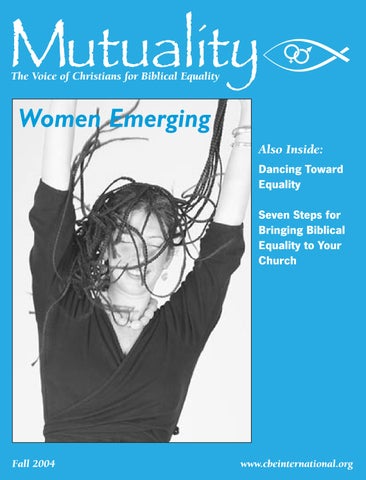
Mutuality The Voice of Christians for Biblical Equality
Women Emerging Also Inside: Dancing Toward Equality Seven Steps for Bringing Biblical Equality to Your Church
Fall 2004
www.cbeinternational.org
Contents 23 BOOK REVIEW By Alvera Mickelsen Tracing God’s Women from Genesis to the New Testament
FEATURES 5 EMERGING WOMEN By Jen Lemen Are women leaders finding a place in the post-modern church?
25 STUDY GUIDE: A RESOURCE FOR STUDY GROUPS By Mary Gonsior
7 TRAVELING TO OZ By Rachelle Mee-Chapman An emerging church pastor blazes her own trail.
26 FRESH PERSPECTIVES: YOUR SIDE OF THE STORY By Jessica Gaylord
10 DANCING TOWARD EQUALITY IN THE EMERGING CHURCH By Kelly Bean The dance toward equality has begun, sometimes beautifully and sometimes stumbling. 19 SEVEN STEPS FOR BRINGING BIBLICAL EQUALITY TO YOUR CHURCH By Karl Vaters There are a few things people can do to help bring biblical equality to their churches.
22 BREAKING FREE
27 THE CHAPTER’S CORNER 28 COUNSELORS AND THERAPISTS LIST 30 PRESIDENT’S MESSAGE By Mimi Haddad A Turning Ship, a Church Renewed
DEPARTMENTS
10
3 FROM THE EDITOR By Jaime Hunt Who Makes Mouths?
DANCING TOWARD EQUALITY
4 IN OUR MAILBOX 14 MINISTRY NEWS 22 ARTS AND CULTURE By Jaime Hunt Breaking Free: A Review of ‘Mona Lisa Smile’
2 Mutuality Fall 2004
7 TRAVELING TO OZ www.cbeinternational.org
Mutuality
From the Editor
Let us then pursue what makes for peace and mutual upbuilding. – Romans 14:19
WHO MAKES MOUTHS?
Jaime Hunt
The Voice of Christians for Biblical Equality
VOLUME 11, ISSUE 3 MUTUALITY seeks to provide inspiration, encouragement and information about equality within the Christian church around the world. President/Publisher: Editor: Editorial Assistant: Staff Writer: Art Director:
Mimi Haddad Jaime Hunt Jessica Gaylord Mary Gonsior Cari Roettger
EDITORIAL AND ADVERTISING OFFICE Christians for Biblical Equality 122 W. Franklin Ave., Suite 218 Minneapolis, MN 55404-2451 Phone (612) 872-6898 Fax (612) 872-6891 E-mail: mutuality@cbeinternational.org Web site: www.cbeinternational.org Advertising in MUTUALITY does not imply organizational endorsement. SUBMISSIONS MUTUALITY welcomes submissions. E-mail mutuality@cbeinternational.org or write to CBE for writer’s guidelines. PERMISSIONS Christians for Biblical Equality grants permission for any original article (not a reprint) to be photocopied for local use provided no more than 1,000 copies are made, they are distributed free, the author is acknowledged and CBE is recognized as the source. MUTUALITY (ISSN: 1533-2470) is published quarterly by Christians for Biblical Equality and is sent free to members. For membership information, see page 31.
EVANGELICAL
PRESS ASSOCIATION
www.cbeinternational.org
By Jaime Hunt I only look 16. I preface my column with that statement because I have often been mistaken for a high school student. While getting my hair cut, my 19year-old stylist asked me what grade I was in. My financial planner thought I was my husband’s daughter. At a church I visited, people in my demographic put on their “talking to a teenager” voices and asked if I was having problems meeting people “my own age.” And I am intimately familiar with the patronizing looks people give teenagers — I’ve been the recipient of those looks for 14 years. Needless to say, I am sensitive about my age — or rather; I am sensitive about my perceived age. It is that sensitivity that gives me pause when I’m asked to take a leadership role. “But they won’t listen to me,” I whine pathetically to my husband. “They all think I’m just out of high school. At best they’ve labeled me as a recent college graduate. No one will want to take direction from a teenager!” Of course it all comes down to fear — fear of rejection, fear of failure, fear of matching up with people’s low expectations. If I’m ever able to hop over the perceived-age hurdle, I am sure those same fears will rise again when I realize the fact that I am a woman — and not a seminary graduate — could be a bigger problem for some people. We’re all alike in our fears, whether our hindrances are our ages, our genders or the lack of letters after our names. But it’s through the story of Moses that I am able to step into roles not designed for people like me. Moses didn’t think he could do it either. When God spoke out of the burning bush and told Moses his plan, Moses reacted the same way I do; he said, “But…but God, I can’t do that. They won’t listen to me!” Then God said some of my favorite words in the Bible: “Who makes mouths? Who makes people so they can speak or not speak, hear or not hear, see or not see? Is it not I, the Lord? Now go, and do as I have told you. I will help you speak well, and I will tell you what to say.” The Lord is with us when we step out into the world. He is with us when we lead and with us when we follow. If he has called us for something, he will surely equip us to do it. He made our mouths, our hands, our feet, our minds. What he did not make are racism, classism, sexism and ageism, so when we tremble with fear, have hope! The Lord of all things is good; he will provide. Jaime Hunt, who will be 28 in the not-so-distant future, is the editor of Mutuality. She can be reached at jhunt@cbeinternational.org.
Mutuality Fall 2004
3
In Our Mailbox ‘Rules to Date By’ was helpful I really liked the “Rules to Date By” article in the [Summer 2004] issue of Mutuality. It is the perfect follow up to a discussion of biblical views of women and their gifts and roles that we held at a Bible study for teenaged girls at our home last week. Jessica [Gaylord] did a great job highlighting the inconsistencies and flaws in the restrictive gender roles presented. The earlier we can help young women recognize and debunk such utuality teaching in the church Singles Fin the better! I wish I Their Valueding had been exposed as a from God teenager to the kind of balanced and intelligent articles that CBE offers in Mutuality. Teaching that God assigns males to be active initiators and females to be dependent responders is a dangerous distortion of Scripture that is harmful to both genders and to the Body of Christ as a whole. Keep up the good work equipping and encouraging all the saints! Whit Trumbull Durham, N.C.
things change. We must generate change. I Approximately 450 members were cho- think that this kind of active responsible sen at random to take Mutuality’s annual living should be the centerpiece of readership survey. Below are some of the Mutuality.” comments we received.
From our readership survey:
“At this time, I [wonder] what more can be said in defense of women in ministry. … [I’d like to see] more about how can we reach churches and individuals with the message, what truly works to change hearts.”
M The Voice
of Christi ans for Bib lical Equ ality
Also Inside :
Filling a GodShaped Hol e
A Woma n’s Worth
An Egalita rian Guide to Chivalry
Summer
2004
www.cbeinte
rnational.o
Disagrees with chivalry guide I wonder if those guiding chivalry [in the article “An Egalitarian Guide to Chivalry” in the Summer 2004 issue] would balk at my opening the door for them? I become concerned when acts of kindness become distinct in function according to gender so becoming role-distinct kindness and role-distinct honor. This doesn’t seem either kind or honoring. Assumption of the role of benevolent benefactor is perhaps the subtlest form of oppression. Personally, I would prefer to be allowed and even encouraged to participate in the door-opening hospitality rather than be relegated to solely its recipient. This to me imparts a better honor in the implication that I can and am able to participate in all parts of life. Brenda Fletchall Edmond, Okla.
4 Mutuality Fall 2004
rg
“I would like to see more responses to the ideas or movements that are fads in the Christian subculture. … The difficulty would be honestly analyzing some of these things without becoming overly critical, but CBE always has such a nice tone that I think this could be done successfully.” “The [Summer 2004] issue’s treatment of singleness was thoughtful, honest, biblical and inspired. The coverage had a depth that was very moving.” “There could be more recognition of some of the problems facing males as well. Some are quite different, of course, such as “helping eligible single males find the right girl.” There are also subtle and seemingly unimportant things like someone telling me, as a widowed older man, “You don’t have to bring a dish to the potluck supper.” [They seem to be] implying that I am incapable of cooking, but also feeding the stereotype that there are gender roles.” “[In the Winter 2003 issue] ‘Exploring Spiritual Direction’ was tremendously helpful. I was working on a long letter for a young woman in an abusive situation and couldn’t think of the appropriate Scripture reference for what I wanted to tell her. That article mentioned Luke 13:34, comparing Jesus to a mother hen gathering her chicks under her wings. The fact that God put that in front of me exactly when I needed it moved me to tears. Thank you!” “I think Mutuality must offer a call to women to live responsibly and authoritatively when necessary. We must not simply quietly hold correct opinions and hope that
We’d love to hear from you! Send your comments, suggestions and critiques to: MUTUALITY 122 West Franklin Ave., Suite 218 Minneapolis, MN 55404-2451 Phone: (612) 872-6898 Fax: (612) 872-6891 E-mail: mutuality@cbeinternational.org Web site: www.cbeinternational.org Letters may be edited for clarity and brevity.
Visit CBE’s Web site at www.cbeinternational.org
For the latest: • Cutting-edge Biblical Resources • Ministry News • Free Articles www.cbeinternational.org
Emerging Women: Are Women Leaders Finding a Place in the Post-Modern Church? By Jen Lemen On a Sunday morning in downtown Portland, Deborah Loyd stands to offer the message to a crowd of 150 at the church she planted with her husband, Ken, and best friend, Crystal. Her whiteblonde dreadlocks tucked neatly in a colorful scarf, tattooed arms outstretched so she can read the text for today’s sermon — Deborah defies the modern church’s definition of what a pastor should be. A thousand miles away in a 150-yearold church in St. Paul, Minn., Debbie Blue stands at a simple lectern and reads her prose to a group of 30-something urbanites, many over-educated and underemployed. This is not an open mic night. This is church. This is the House of Mercy — the space Debbie created with her pastor friends Russ and Mark, so people like her could gather and move together toward a shared vision of Christ. As our culture continues to wax cynical about the viability of religion, women across the country are using their creativity and their pastoral callings to make space for people drawn to God in ways hard to explain on a traditional Sunday morning. This is the emerging church — that invisible life force that manifests itself in living rooms, artist studios, old cathedrals and borrowed back rooms of neighborhood bars. No single institution or network of friends can claim full responsibility for its inception. No hierarchy or denomination holds its keys, and as a result more and more women leaders such as Deborah Loyd and Debbie Blue are finding the freedom and flexibility to innovate in ways that previously could not have been imagined. This is especially true for women whose faith springs from more conservative evangelical settings where the pastoral call of women is
www.cbeinternational.org
often ignored at best and more commonly, silenced. For Blue, getting to this place required some imagination, faith and the camaraderie of friends. As pastor and parishioner in denominations where the inclusion of women was a long-held and livedout value, Blue’s obstacles centered around figuring out how to make a living
(an ongoing challenge), and explain to her newly formed congregation that this was church after all, even if the sermon sounded more like poetry and the theology seeped through the finely crafted music of the rockabilly House of Mercy band. For Loyd, the move to pastorate and church planting came with the realization that there was really no room in the
Mutuality Fall 2004
5
church she had been attending for women to fulfill their callings — and less room still for the disenfranchised youth to whom she longed to offer Christ’s love and hope. It didn’t take long for Loyd to realize following her call would also require leaving everything familiar behind. Finding the funds and emotional resources to bring her sense of mission to reality required raiding her own bank account as well as taking her marriage to the heart of egalitarian practice, far beyond the comforts of a shared ideology. Deborah and Ken succeeded, but it wasn’t easy. When Loyd and Blue arrive in the strange new land we call the emerging church, where do they find the encouragement and support to establish new forms of ministry? Mentors and friends For many women involved in new church plants, access and opportunity come in the form of friendships with key mentors, often male, who have both the desire and ability to open new doors and
represents would gain nothing from his generous effort. Other leaders, including Spencer Burke, Jim Henderson and Brian McLaren are well known for their similar styles of encouragement. But this kind of tangible support for women is rare, even in the organizations and communities that seek to provide resources to the emerging church. Too often these women, while experiencing warm welcome and support within the communities they create and sustain, find themselves oddly placed on the outskirts of the very conversations and gatherings that seek to represent the realities of the emerging church — the very realities they themselves as innovative women leaders embody. As an active participant in Emergent and a blogger who focuses on women in leadership, I often find myself in the unique position of hearing about these women’s experiences. At national conferences and during theological conversations, male participation still dominates many seminar discussions. When emerging women innovators manage to overcome obstacles of expense
their own voices. Perhaps new allies will be needed across gender lines to mentor the movement to the truest embodiment of gender equality. Thankfully, for women who find themselves compelled to live out their mission call in the everyday world of the postChristian culture, participation in a national dialogue about the seismic cultural shifts affecting the church today is not required. Women leaders beyond the personal reach of allies like Rudy Carrasco, Jim Henderson, Spencer Burke or others may miss opportunities to bring their well-tried wisdom and creativity to the larger conversation, but they are never excluded from the adventures of the Spirit. This is the beauty of the emerging church; no form of innovation and creative expression is out of place where the local community issues a welcome. Only time and patience will reveal if the emerging church in all its forms — local communities and national gatherings — will come together to jointly reflect the power and innovation of women’s unique leadership. In the inter-
Only time and patience will reveal if the emerging church in all its forms will come together to jointly reflect the
power and innovation of women’s unique leadership. make vital connections. While success in the emerging church is not dependent on this kind of openhandedness, women leaders are well aware of the benefits they reap when friends, especially those with a long history of ministry experience, allow their influence and resources to be tailored to the needs of the leader and her new endeavor. Church planter and founder of the Center for Emerging Female Leadership, Liz Rios cites Rudy Carrasco, a recognized voice in the faith-based initiative arena, as a personal encouragement. “To me, Rudy is a bridge builder and a model of how to encourage woman leaders. Rudy has been opening doors and helping make connections for me since the beginning of our friendship. I love the way he’s always thinking about how different kinds of people can contribute to the conversation. Gender just isn’t a barrier.” This kind of encouragement made all the difference for Rios, especially when it was clear Carrasco and the communities he
6 Mutuality Fall 2004
and childcare to attend, they are met with a scant handful of female presenters, many of whom have no first-hand, onthe-ground knowledge of the emerging church, and many more male presenters who are often unaware of the unique contributions women are making in the movement. Mutuality, where men and women lead together and share power as peers, is still not a functional reality in the organizations and networked friendships that claim the mission of providing resources to the emerging church. And while the ideology is present to fully embrace women as viable leaders in our new context, old ties to a more conservative evangelical ethos are painfully apparent as key male leaders in the movement struggle to recognize female peers and share power so these essential voices can stand beside them to lead the way. Movement leaders, eager for change, find themselves stretched to make room in a conversation that has so far been largely shaped by
im, more and more women are finding the courage to embrace the call to cultivate new communities of faith, often overcoming obstacles within themselves to recognize their place in God’s kingdom. More men are finding ways to offer tangible support. And little by little, partnerships will continue to develop where men and women join as peers to fully engage the ethos of the changing culture — a culture that often holds mutuality as a litmus test for what is trustworthy and right. Jen Lemen is actively involved in the Emerging Women’s Leadership Initiative and Emergent, a generative friendship among missional friendships around the world. As a writer, blogger and online community organizer, Jen advocates for new expressions of leadership from her home in Takoma Park, where she lives with her husband and two children. You can read Jen’s perspectives on the emerging church daily at www.jenlemen.com.
www.cbeinternational.org
Traveling
toOz
By Rachelle Mee-Chapman The walls of my dining room are umber and the ceiling glows warm red. Mike and Alicia are here early, as usual, and they circle the room lighting all the little tea lights on the plate rail. There is soup on the stove in the kitchen and I have prayed for each member of my crew as I chopped and stirred until the kitchen is covered with peels and splatters. There is a chalice on the table, a plate with bread from the bakery down the street. Sean is in charge of music and provides a CD he has named “The Sanctified Mix.” We gather round the table. We sing a Peruvian tune in call-and-response. We pray our Sabbath prayer: Blessed are you, Oh Lord our God, who has given us the fruit of the vine, the grain of the earth, the blood of your vein, the pulse of your heart. We break bread. We pour soup. We drink wine. We keep Sabbath. We are a house church, a neo-monastic order. We are Thursday Night Gathering. Later we will clear the table and wipe up the crumbs. By this time in the evening, the art supplies have been retrieved from the buffet drawers, and sometimes we do lectio divina — the Scriptures printed on cards in front of us, and our hands busy with pen and paper, paints and charcoals as we demarcate the words and images that rise up to us as we sink into the message. Some nights April plays the harp and we lie on the floor to practice centering prayer, focusing on God and seeing what he reveals to us. During the high holy seasons we meditate on pieces of art created by one of the many artists in our crew. Once we lit candles and let them
www.cbeinternational.org
float in a pool to symbolize our intercession for one another. Sometimes we sing. A lot of times I make plans that fall short, or need to be altered. Often someone falls asleep on the window seat, or curls in an armchair reading or flipping through a magazine. In the summer we live on the front porch, or on the grass under Chinese paper lanterns. Then we relax and read bits of our favorite books and tell stories. We count it all as worship The bulk of our time is spent with our friends. Our missions’ budget is spent on
How did I get here? There were help-meets, some of the most significant of which happened to be men — men who didn’t
see me as inferior to themselves, but as a peer and maybe even a prophet … men who
sat in the same space as me and waited with me as we watched the Spirit give birth. things that will attract our neighbors, our friends. We throw a lot of parties. Our mission field feels like the moon to most people, but we are learning to speak the native language. The language in the post-modern world is one of welcome and embrace. As we abandon our old language of debate and persuasion, we find our own most intuitive tongue. We learn what it means to get out of the way and
let the incarnational Christ move through us. We learn to hear and tell stories. We let the Holy Spirit worry about conviction. We sow and receive love. I pastor this crew. I don’t use that term often, though it is what most people understand. I wanted to be called “Soul Farmer” but everyone said it was too creepy, so I am the Cultivator. I cultivate this company, try to tend the soil and pull a few weeds. Mostly I make the space to drink water. Sometimes I work in some fertilizer. I don’t lead them like a captain rallying his troops. Instead I take my metaphorical inspiration from a lecture I once heard by Brian McClaren. I am Dorothy. I am going to Oz — the real Oz not the one with the man behind the curtain. Sometimes I lead and sometimes I give the lead to others, to those who are learning to have courage, or brains, or a heart. I make sure we remember which road we are on; I point in a given direction. To use theological terms — I am a seminary graduate after all — I set the eschatology. Then I get out of the way. How did I get here? Mostly I followed my gut. But also there were help-meets, some of the most significant of which happened to be men — men who didn’t see me as inferior to themselves, but as a peer and maybe even a prophet; men who had power, connection, and influence and used it on my behalf; men who sat in the same space as me and waited with me as we watched the Spirit give birth. Three years ago I was ordained as a pastor in the Association of Vineyard Churches. I was to help a senior pastor, Ed Cook, begin something called “multicongregational church planting” so we could plant several local congregations
Mutuality Fall 2004
7
“Jim, would you like to go to lunch?” “Are you asking me to have lunch with you?” (Uh oh! Had I crossed some sort of unseen gender barrier?) “Yes. I am.” “Okay then.” At lunch, my housepainter-cum-mentor, Jim Henderson, said, “Ten years ago no pastor would have asked a housepainter to have lunch with him to talk about planting a church.”
8 Mutuality Fall 2004
Photo by Emily Button
that would be linked together for support. Ed ordained me. The very next week the AVC said it was okay for him to do so. That is how I began my life as a professional clergy member — always one step ahead of the “go ahead,” always perched a little bit on the edge of acceptability. I’m not really sure how I got from there (traditional church) to here (emerging church). I know it had something to do with the fact that I worked very closely with Israel Button, our then worship director, and he kept saying, “people intuit truth through art.” He spent long hours with me while we poured ideas like puzzle pieces out onto a table and shuffled them around, trying to see what picture they formed. Finally, we realized there was a little core of people who thought like we did. These people liked that I didn’t know all the answers. These people liked that instead of quoting Scripture I read children’s stories. These people were fine with skipping a worship set in order to sit in front of a sculpture. These people were hungry for something different, and so was I. So I asked to go with this crew to Oz, and Ed gave them to me — gave me these gifted leaders, these regular tithers, these productive healthy members of his congregation. He gave them to me and he let me go to a place that was largely foreign and at times quite worrisome to him. He made space for something new to be born, and it worked, and it was good. I was happy with this. The church I was building was one I actually wanted to go to, and I felt at ease in my own skin. But I felt very alone in a strange and possibly heretical world. I wasn’t sure how to navigate these new charts. I wasn’t sure what methods would get me to Oz. One day I stood in my driveway and looked up at the man who was on an extension ladder, painting my house.
In celebration of Passover, Rachelle Mee-Chapman performs the Urchatz, a ritual hand washing usually reserved for the priest or the head of the household, on Fiona. Mee-Chapman performs the Urchatz on all of the members of her church to symbolize the priesthood of all believers.
I replied, “Ten years ago no pastor would have had lunch with me, a woman, trying to plant a church.” And so we misfits met and began our partnership. Since then I have walked through doors Jim has kicked open — doors I, as a woman, was not allowed the keys to. He has helped me find connections with other like-minded practitioners. He has introduced me to authors and conference organizers. He has ceded the floor at his Off the Map events so that I could have a voice, so I could lead the way for a while. He has made it a priority to set down his power and influence in order to bring me, and many other women, to the table where
we can actually shape the conversation. He is learning how to do this, and his women friends are teaching him how to let us be not Vanna White — making a token appearance on stage — but Dorothy — leading the gang towards Oz. What I am doing is not traditional, but it is becoming common. It is happening over and over again as women find their own voices and are empowered to lead in their own styles. This is not a typical way of planting a church, of doing missions, of preaching, of worshipping. So I seek solace in my emerging friends, the small and unheard of practi-
www.cbeinternational.org
tioners who are pioneering this new ground, who are actively sweeping off the yellow brick road. Jim and I gather a little crew about us once a month. “Our Support Group” we call it. The men haul the women out of the kitchen and sit us down on the couch; they take turns jumping up from the table when crying erupts from the playroom. There are no existing structures that work for us. We blaze on our own trail. That is why we are always emerging and never emergent — because we are still on the growing edge, still surveying the moon, still deconstructing and reconstructing a faith that must be made to have feet in a post-modern world. And
while women have permission to be here, we must still find our own structures that will allow for children and childcare, story and ritual, new rules and new spaces. The praxis must make room for the ideology it has embraced. The men who journey alongside us help us kick down doors, and we show them new paths they’ve never considered. It’s getting better, there are things to celebrate — but still, it is a long way to Oz. Rachelle Mee-Chapman is the “Cultivator” of Thursday Night Gathering in Seattle, Wash. She is an ordained minister in the Association of Vineyard Churches.
Help Build For the Future! GOAL $100,000
$75,000
$55,000
$25,000 $10,000
Photo by Emily Button
$5,000
Paul Chapman dishes up matzah balls for his daughter during Thursday Night Gathering’s annual Passover dinner.
We love it when a glimpse of God’s vision for CBE comes through the gifts of our members. Due to the gifts of generous donors, CBE established an endowment fund of over $57,000. The board designated this money for investment, and the interest from the principal will be used for projects above those outlined in our annual budget. For example, the interest from the endowment fund was used to bring speaker Funmi Para-Mallam from Nigeria to our Orlando conference. Imagine what income from this fund can provide in time. We need your help to make these dreams reality. At CBE, we see the endowment fund as a sapling tree. It will grow over time, but we may not be the ones to see it to maturity. With faith, we ask for your help to invest in the future. Please help us care for this fund like a vulnerable tree that needs water, sun and fertilizer to grow. Your contributions will lead to the growth of a large tree that can provide shade for many under its branches.
www.cbeinternational.org Mutuality Fall 2004
9
Dancing Toward Equality in the Emerging Church
By Kelly Bean Maybe it started with the constricting feeling I had as a young wife and mother attempting to fill the role of the “good woman” in the church. Maybe it was because I wondered about all those other people outside the church who didn’t fit, who didn’t come from the “right places” or look or talk quite like “church people” should. And I wondered: is there a place for them, do we care about them? Whatever the case, I always felt different; I didn’t fit, never felt that I truly had a spiritual home. Seventeen years in one church and 12 years in another provided opportunity for me to serve and grow as a leader. Over these years I taught Sunday school and led women’s Bible studies. I led people in feeding the poor, I wrote curricula, designed and led interactive Holy Week services, preached and led the always-evolving weekly spiritual growth community in our home. While I was free to practice in these roles, I was in the awkward position of doing so within the constraints of a leadership structure that did not find it scripturally permissible for a woman to serve as a pastor or an elder. I was leading without
10 Mutuality Fall 2004
consent or guidance, but it was in this place that I grew as a leader. The ongoing weekly group that met in our home got serious about spiritual formation and study, and I took more clear leadership for our direction and teaching. The pastor struggled with my leadership because it defied his ideas of acceptable practice, but he didn’t interfere. But still I felt like a misfit in ways I couldn’t articulate. This tension became increasingly difficult for me to navigate. I was relieved when the pastor called a congregational forum on the subject of women in ministry. He asked all interested parties to prepare a personal statement backed by study and research to be presented at this forum. When the date to submit statements came around, he and I were the only two who prepared papers. Although congregation members expressed interest in exploring other options, the pastor made a unilateral proclamation that the status quo held. I was faced with a challenge. I felt set up, misled, and so angry and disappointed. But I made the difficult decision to forgive and to re-enter the life of the community. I chose to lay down bitterness and resentment, to allow my anger to work itself out
in safe places and to move forward. As I look back, I can see how I was formed for the better in this painful time. I encountered Christ in a deeper way and discovered the value of being empowered without disempowering others. In the years that followed I was asked to chair an interim church leadership team. When the team completed its term, an elder board was installed. My husband was ordained as an elder and I was invited to serve alongside him on the board. Although I struggled with the fact that only the men would have “a vote” on the board, I accepted the invitation. However, I eventually came to the sad but clear realization that in participating I was supporting a hierarchical system. Although it meant leaving work that I loved, I stepped down. Two years later we made the difficult choice to leave the church. Finding a place in the emerging church In the meantime, I began making weekly treks to the Benedictine Abbey at Mt. Angel near my home. I was moved by the liturgy and encountered a Christ who understood suffering. I earnestly began to seek expressions of Christian faith that could be more relevant in the real world,
www.cbeinternational.org
and I discovered there were many others like myself who were exploring ministry in a postmodern context. This “emerging church” conversation came alive for me in a week-long gathering offered by Mars Hill Graduate School in Seattle, Wash. I traveled to Seattle with my husband and a few friends. We soaked up the incredible array of ideas and possibilities presented by Dan Allender, Heather Webb, Brian McLaren, Sally Morgantholer, the Damah Film Festival and more. I felt for the first time someone was speaking the language I had not known how to form! I left with a pile of
Leadership didn’t have to look like the playground of my childhood or the church of my origin. Making a difference In the fall of 2002, pastor/author Brian McLaren announced the formation of the Emergent Village and invited attendees to an informational meeting. He described Emergent as a generative friendship, racially diverse and fully inclusive of women in leadership. As much as I had been responding to the language, thoughts and forms of the emerging church gatherings and reading
The dance has begun, sometimes beautifully and
sometimes stumbling, most partners willing. books and a sense of being keenly alive. I had found my tribe. I was no oddity in this bunch. This felt like a spiritual home. New worlds began to open as I read about teaching through story, about the incarnational life, about doubt and uncertainty as normal, about non-coercive and winsome ways to follow Christ and about other artists who were finding a home in the church for the first time. In the spring of 2001, I headed to Seattle again, this time for an event produced by Jim Henderson and Dave Richards of Off the Map. This three-day event was full of practical application. Not only did it make sense to connect with people in relevant ways, but it could be done. Pragmatic and savvy connector Jim Henderson gathered wise practitioners and voices that discussed “do-able” evangelism and “ordinary attempts”. I began weaving these new ideas into my own weekly community gathering; sharing books, resources, thoughts and practice. This group, affectionately called “Friday Niters” for their devoted pilgrimage to our home every Friday night, learned along with me. We shared meals, life, ritual, story, exploration of Scripture, song and prayer together. My community group had become home to an assortment of artists and creative thinkers with their own gifts to share and an interest in exploring through art and creative ritual. I thoroughly enjoyed this process of leading by noticing what others could bring and making a place for them; not a style that had been modeled for me but that I discovered others in the emerging church practicing as well.
www.cbeinternational.org
I was taking in, I had certainly noticed that most of the presenters, writers and even attendees were men. So when I heard the announcement I was delighted. I eagerly went to the meeting and found myself one of two women in a room with perhaps 150 men. I approached Brian McLaren about this afterward. He responded with an invitation, “Come along and make a difference”. I took him to heart and attended Emergent’s first gathering in Houston. Theologian JoAnne Badley was the featured female presenter. I overheard a group of men seated behind me speak in a way that seemed dismissive of what JoAnne had to say. Their air was self-congratulatory: “We are progressive on the women question and it’s a done deal.” It is, however, one thing to say this but an entirely different thing to explore how to really hand power to women and honor the gifts they have to bring. As leaders of communities and as husbands and fathers there were indeed new ways these men could lead that would release women and back up the words with new practices that help build a new culture. I asked to share my impassioned response.
After I shared, a number of men in the crowd approached me to say they were challenged to make personal changes. One said he was going to phone his wife right away, make some specific apologies to her and see where they could make changes together. Another said he was going to help his wife access support systems and find relief from the some of the daily load of caring for several young children so she would be free to practice her call as a painter. Others appreciated the encouragement to continue doing what they were attempting already. Although they didn’t talk about how they were going to make changes in their churches or their ministries, I was heartened by these humble men who were willing to realize that authentic change is a dance that requires practice and mutual respect with intentionality. These men were willing to look clumsy on the dance floor as they took new steps. The two years that followed held deep conversations, countless e-mails and friendships forged with other men and women who are on similar journeys. These conversations and relationships have empowered me to lead. For years, I led without permission. Now my call and my gifts are being recognized and developed intentionally in the widespread community of the emerging church. Jim Henderson and Brian McLaren have used their power and influence to open doors for me. They are inviters and connecters of people. Because of strategic introductions and invitations from these leaders, today I am part of a team of incredible women — the Rev. Heather Kirk-Davidoff, Jen Lemen, Grace McLaren and Holly RankinZaher. Together we form the Emerging Women Leaders Initiative sponsored by Emergent, collaborating to empower women leaders in the emerging church.
Mutuality Fall 2004 11
e-Priscilla Papers Every back issue of Priscilla Papers, CBE’s scholarly journal, has been archived on an interactive CD-ROM! Every informative, thoughtprovoking article is accessible at the click of a button, and indices are included to help you with your search! At just $99.99, this disc is a must-have for every person who is serious about biblical equality! To order, call 612-872-6898 or visit us on the Web at www.cbeinternational.org.
Did You
Know?
You can contribute part or all of a particular stock or mutual fund to CBE! It is generally more tax-wise to donate appreciated securities rather than sell the securities and donate the proceeds. Your tax deduction is the market value at the time of the contribution – not just mut the cost. If you have a loss, it is ual fun ds more tax-wise to sell your depreciatSto ed assets and consider donating the cks proceeds to CBE. The transfer of appreciated assests may be as simple as a telephone call or an e-mail. For further information please contact the national office at cbe@cbeinternational.org, or phone CBE at 612-872-6898. 12 Mutuality Fall 2004
The dance has begun Because of the evangelical heritage of much of the emerging church, cultural shifts need to be made to make way for women to minister as co-equals. We all have new steps to learn in order to move fluidly together in our kingdom work, but the dance has begun, sometimes beautifully and sometimes stumbling, most partners willing. It is on this emerging church dance floor that I have gone from ministering without permission to ministering with invitation and opportunity. My gifts and skills, which were developed in non-tra-
It is on this emerging church dance floor that
I have gone from ministering without permission to ministering with invitation and opportunity. ditional and non-academic arenas, are valued and my voice has not been silenced. I do look forward to the day when the church will be led by men and women pioneering together as equals truly empowering one another. In the meantime, I have found a place that I can “come along and make a difference,” a place where my leadership style is recognized, a place where there is room for difference and room for questions, a place where I can practice new ways of being a leader with permission. In addition to leading Friday Nites, Kelly Bean serves on the Emerging Women Leadership Initiative team, www.emergingwomenleaders.org, and on the board of directors for Off the Map, www.off-the-map.org. Kelly is a Masters of Divinity student at George Fox Seminary in Portland, Ore., a community activist and artist, and a wife and mother.
www.cbeinternational.org
www.cbeinternational.org
Mutuality Fall 2004 13
Ministry News
Lively Discussions, Thoughtful Exchanges Mark CBE’s Presence at Cornerstone Hundreds of people were drawn to the message of biblical equality By Jaime Hunt A sense of unity permeated CBE’s presence at the Cornerstone Festival this July. “I really think it was the best thing we’ve ever done,” says CBE President Mimi Haddad. This year was the third that CBE had a presence at the annual Jesus People USA-sponsored music festival, but it was the first time CBE sponsored an entire tent. Hundreds of people found their way to CBE’s Gender Revolution tent for a series of workshops, discussions and fellowship. With few exceptions, people were open and interested in the message of biblical equality. Even those who disagreed did so in a gracious way, says CBE staffer Jessica Gaylord. “Everyone was very respectful,” says Gaylord. “Even when people got intense, there was a peaceful spirit about most of the communication.” From 10 a.m. until late evening, the Gender Revolution tent offered a place for Cornerstone attendees to explore biblical equality — and hear opinion leaders share Above, CBE staffers Elizabeth McGrew (right) and Jessica Gaylord moderated discussions and manned CBE’s on-site bookstore, which sold a record number of resources to attendees. Left, a thoughtful and lively discussion on the last day of Cornerstone attracted dozens of people to CBE’s tent. their thoughts. Over the three-day weekend, CBE offered workshops on a variety of topics, including presentations by Haddad, New Testament professor Linda Belleville, Cornerstone Magazine editor Jon Trott, World Hope director Jo Anne Lyon and Global Women coordinator, Suzannah Raffield. Attendance at each of the workshops averaged about 50 people, says CBE staff member Elizabeth McGrew, although some workshops were so compelling that all of the seats were filled and people had to sit on the ground. At one point, a man loudly expressed his disbelief in the message of equality, which drew dozens of people into the tent and sparked a two-hour discussion. Gaylord, who
14 Mutuality Fall 2004
www.cbeinternational.org
Ministry News
Remember CBE in your Will Choose your giving while you are living. Leave a legacy through CBE. For more information visit CBE’s Web site: http://www.cbeinternational.org/ new/help_cbe/will_to_cbe.shtml
Above, Linda Belleville presents her workshop advocating for gender equality. Below, CBE President Mimi Haddad presented four workshops to rapt audiences.
Called to ministry? Women in Leadership A Study of Women Pastors on Video or DVD $39.95 plus shipping
jumped into the fray to moderate the conversation, says that although the young man’s opinion was expressed harshly, the end result was very positive. “I think it was the best thing that could have happened,” says Gaylord. “We closed by singing the doxology and praying. It ended with a powerful sense of unity in Christ.” Another woman thanked Haddad for the impact of her lectures. “She said she was from a PCA church and that she didn’t think she’d hear anything that would change her mind on gender roles,” says Haddad. “But she did and she thanked me for it!” Plans are underway to expand CBE’s presence at Cornerstone next summer. To make a donation toward this endeavor, visit http://www.cbeinternational.org/new/help_c be/you_can_help.shtml.
www.cbeinternational.org
This look at women in the Presbyterian Church will give all people interested in the topic a peek at the opportunities and challenges for women in the pastoral role.
To order, contact: Dr. Elizabeth Klein 4801 Hyada Blvd NE Tacoma, WA 98422 253.952.4441 www.kleinink.com kleinink@comcast.net Mutuality Fall 2004 15
Ministry News
Honor a Giving catalog Loved One
CBE has several opportunities for members and friends to support the ministry. Below are just a few of the many options available. To make a contribution, call 612-872-6898; mail a check or credit card information to 122 W. Franklin Ave., Suite 218, Minneapolis, MN 55404; or visit http://www.cbeinternational.org/new/help_cbe/appeal_projects.shtml.
Where Most Needed Donations that are not designated for specific purposes are used to support the programs and the operations of Christians for Biblical Equality. These funds provide the flexibility to respond where the need is greatest.
CBE Conferences This fall, CBE will jointly sponsor a symposium on gender and the Bible in the United Kingdom! Additionally, next summer CBE will be holding its biennial conference in Pennsylvania. Be a part of these global events by giving a gift to support the costs associated with them.
Make a donation in a loved one’s name and CBE will send you a certificate to present to the recipient. Consider an honor gift for the following occasions:
• Anniversaries • Birthdays • Weddings • Sympathy • Ordinations • Baptisms • Graduations • Holidays Help CBE spread the message of equality with your gift today! To order, call 612-872-6898 or visit www.cbeinternational.org today!
16 Mutuality Fall 2004
Outside Conferences To reach the “tipping point” — the time at which a movement has become common knowledge — only a small percentage of people need to be aware of it. Every year we draw closer to the tipping point. Our presence at outside conference plays an important role in that effort. In 2004 we plan to participate in a number of events, including the Evangelical Theological Society meeting, the Lausanne Forum on World Evangelism and many more. Financial support is needed to pay for the materials, staff time and airfare necessary to attend these events. Your gift will expand CBE’s outreach in influential Christian circles.
International Literature Project Imagine the message of biblical equality reaching men and women in Africa, India, Turkey and beyond! Consider a contribution to help us send materials to our sisters and brothers around the world.
Endowment Fund Christians for Biblical Equality has provided a biblical basis for shared ministry of men and women, in the church and home for over 15 years! Consider a gift to our endowment fund, which has grown to over $57,000 in the last year. Your donation will grow and extend the important work of CBE into the future.
Curriculum Project Many individuals and churches have requested CBE-developed curriculum for their adult education programs. Your gift will help us write, publish and promote such a curriculum to churches around the world!
Cathie Kroeger Leadership Fund The life, study and ministry of Cathie Kroeger, CBE president emeritus, have inspired many women and men to pursue leadership in order to share the message of biblical equality with the world. CBE has established the Cathie Kroeger Leadership Fund to provide scholarships for future leaders to attend CBE’s conferences.
www.cbeinternational.org
Ministry News
Future Events United Kingdom Symposium CBE will join Men, Women and God and WATCH in the United Kingdom Sept. 3-5, for a symposium titled: Men, Women and the Church: A Biblical Approach to Relationships. The event will feature world-renowned scholars including Bishop of Durham N.T. Wright, Trinity expert Kevin Giles and author Elaine Storkey. For more information about the event, visit http://www.cbeinternational.org.
Lausanne CBE President Mimi Haddad will serve as a convener of the issue group focusing on gender at the upcoming 2004 Forum on World Evangelization, hosted by the Lausanne Committee for World Evangelization in fellowship with the Great Commission Roundtable and members of the World Evangelical Alliance. It will be held Sept. 29-Oct. 5, in Pattaya, Thailand. For more information about the forum and Lausanne, visit http://www.lausanne.org.
Evangelical Theological Society The Evangelical Theological Society is a professional society of about 4,000 biblical scholars, teachers, pastors and others involved in evangelical scholarship. CBE will attend its annual conference Nov. 1719, in San Antonio, Texas. CBE will sponsor a booth, and CBE President Mimi Haddad will be a part of the society’s Gender Study Group.
www.cbeinternational.org
SOME EMPLOYERS WILL MATCH YOUR CONTRIBUTIONS TO CBE Does your employer offer a matching funds program? Over the years CBE has been the grateful recipient of matching gifts from employers, United Way and the Mustard Seed Foundation. Perhaps your employer or your local United Way will match your contribution to CBE. Please check with your human resources department. What a wonderful way to double the pleasure of giving, making it possible for CBE to reach twice as many with the good news of Galatians 3:28.
Discovering Biblical Equality Edited by Ronald W. Pierce and Rebecca Merrill Groothuis
To further discussion on gender roles, Rebecca Merrill Groothuis and Ronald W. Pierce, with the aid of Gordon D. Fee, have assembled a distinguished array of evangelical scholars to explore the whole range of issues – historical, biblical, theological, hermeneutical and practical. They offer a sound, reasoned case that affirms the complementarity of the sexes without requiring a hierarchy of roles. 496 pages, InterVarsity Press, 2004. Was $25.00/Introductory Price $18.75 CBE is now accepting pre-orders of Discovering Biblical Equality, which will be available in late October. To order, please send a check for $18.75 to 122 W. Franklin Ave., Suite 218, Minneapolis, MN 55404 or visit us online at www.equalitydepot.com.
Mutuality Fall 2004 17
Ministry News
Prayers and Praises “O praise ye the Lord! Thanksgiving and song to him be outpoured all ages along! For love of creation, for heaven restored, for grace of salvation. O Praise ye the Lord!” Henry Williame Baker (1821-1877)
Praises: • For a successful trip to Cornerstone. We had several compelling discussions with young adults who visited our tent. Even during conversations with those who disagreed with CBE’s message, an ever-present spirit of unity through Christ pervaded our tent. • For CBE’s presence at other important events this year, including the Evangelical Press Association Convention and the Vine Convention in May, and the upcoming Evangelical Theological Society meeting in November. • For CBE’s Web site improvements. We’re in the process of redesigning the Web site to be more visually appealing in hopes of attracting more Web traffic. We are also upgrading to a new shopping cart service, which should better serve our members, donors and bookstore customers. “As you come to him, the living Stone – rejected by human beings but chosen by God and precious to him – you also, like living stones, are being built into a spiritual house to be a holy priesthood, offering spiritual sacrifice, acceptable to God through Jesus Christ.” 1 Peter 2:4-5 NIVI
Prayers: • For CBE’s international conferences. Please pray that God will sustain our energy and enthusiasm as the symposium in Durham, England approaches. Also, the planning of the 2005 conference, which will be held at Eastern College in Pennsylvania, is underway! • For CBE’s presence at the 2004 Lausanne Committee for World Evangelization Forum. In the months leading up to the forum there is a great deal of work to be done in preparation. • For CBE’s work with the Evangelical Theological Society’s Evangelicals and the gender study group. Members of the study group will be critiquing the book, Discovering Biblical Equality, which was written and edited by several CBE members. InterVarsity Press will publish the book in the fall. The study group will also facilitate a discussion between two married couples, one representing the egalitarian viewpoint, and the other a complementarian viewpoint. • For funds to hire new staff and acquire more office space. As CBE grows, we are continually in need of new staff members and space to accommodate them. — Jessica Gaylord Scriptures provided by Susan McCoubrie, one of the founders of CBE and a retired staff member.
18 Mutuality Fall 2004
Honor in Our Ranks Craig Keener received an award of merit in the Biblical Studies category of Christianity Today’s book of the year awards for his book The Gospel of John: A Commentary, Volumes One and Two.
Alice Mathews received an Award of Merit in the Church and Pastoral Leadership category of Christianity Today’s book of the year awards for her book Preaching that Speaks to Women. The book is available through Equality Depot.
N.T. Wright, who will be speaking at CBE’s United Kingdom symposium, received a Book of the Year Award from Christianity Today for his book The Resurrection of the Son of God.
Cathie Clark Kroeger received an honorary doctorate of humane letters from Gordon Conwell Theological Seminary. Kroeger is president emerita of CBE and an adjunct faculty member at Gordon Conwell Theological Seminary.
J. B. Preato graduated summa cum laude with her master’s of divinity degree from Bethel Seminary San Diego. Dennis Preato graduated magna cum laude with his master’s of divinity degree from Bethel Seminary San Diego.
www.cbeinternational.org
Seven Steps
7
for Bringing Biblical Equality to Your Church
By Karl Vaters Have you had a hard time bringing the principles of egalitarianism into your church? If so, you’re not alone. Getting biblical egalitarian principles accepted in a local congregation can be a daunting task, but there are a few things anyone can do to help this vision become a reality. In some ways, I may seem extremely unqualified to write about inequality in the church. I am white. I am male. I am able-bodied. My native tongue is English. I am between 35 and 50. I am married. I am tall. And I’m even right-handed. In short, the culture in which I live has been designed specifically for me and for people like me. As a result, I have never personally been the victim of prejudice. On the other hand, as the “poster boy” for the stereotypically “empowered” people of our society, I have a unique perspective to offer, especially as this subject relates to the local church. I know how pastors think because I am one. Over 90 percent of pastors are male — so the majority of people have someone like me as their pastor. Maybe your pastor appears to be the main obstacle preventing biblical equality from becoming a reality in your church. If so, allow me to offer seven suggestions for influencing the typical American church toward seeing the value of biblical equality, specifically as it applies to men and women in leadership in the church.
www.cbeinternational.org
Mutuality Fall 2004 19
1.
Stand up for the rights of others first.
Are you a man? Stand up for the rights of women. Are you a woman? Stand up for the rights of racial minorities. A minority? Stand up for kids. Young? Stand up for the elderly. Elderly? Stand up for the disabled. Phillipians 2:3 states: “In humility consider others better than yourselves. Each of you should look not only to your own interests, but also to the interests of others.” So don’t we stand up for our own rights? Yes! But only after we’ve stood up for others. That way we have more sway with those we are trying to influence. If it appears the only time we stand up for someone’s rights is when we stand up for our own rights — or for the rights of those who are like us — we are at risk of being perceived as greedy or self-centered. If we are trying to defeat those who disagree with us, their perceptions are irrelevant. But if we are truly trying to influence them, we must realize that their perceptions are their realities and act accordingly. Standing up for the rights of others first is not only biblical, it works!
positive steps. Listen for the times your pastor attempts to use egalitarian language and then offer your thanks. Praise decisions that bring women into any leadership roles, no matter how small the steps may be. Then point out the ways having a woman’s influence or perspective was of benefit in those roles. Most “enemies” of biblical equality are people who, through their upbringing or theological training, simply have sincere theological difference as it relates to the equality of men and women. With few exceptions, they are not anti-woman; they are simply living according to the patterns they have already seen. All of life is a Bell Curve. The extremes on either end are small. Those on the extreme end against biblical equality are not the ones I’m interested in influencing. It’s the vast majority in the “sincere middle” who need to hear the message of biblical equality from someone who is living life through a biblical worldview. I believe it is these people the apostle Paul was referring to when he instructed us in 1 Thessalonians 5:14 to “… warn those who are idle, encourage the timid, help the weak, be patient with everyone.”
3. 2.
Recognize and praise positive steps in others — even if the steps are small.
Pastors deal with a lot of criticism in an average week — from the style of music used in worship services to the Bible version they use. Since much of it is trivial, most pastors have learned to filter most of it out, especially from “chronic complainers.” So when someone criticizes a pastor for using the word “men” when he should have said “people,” that criticism gets trapped in the pastor’s “trivial filter.” It can be difficult to get valid points, such as the importance of gender-neutral language, past the filter without appearing to be a chronic complainer. The best way I know how to do that is to start by praising the
20 Mutuality Fall 2004
Be gracious in defeat.
Defeat can never be accepted and it must never deter us from doing and teaching what we know is right. But we must realize we are in a marathon, not a sprint. I have been the pastor at three different churches. Each one had never had a woman on the deacon board until I arrived. In two of those churches, the change was easy. I suggested women ought to be considered for nomination to the deacon board along with men. After some question and answer sessions in which the tough Pauline passages were brought up and properly exegeted, they agreed it was not only appropriate to let women be nominated, but the majority recognized that they had been wrong for excluding women for so many years. Qualified women were nominated alongside qualified men. When the votes were taken, these churches had female members on their deacon boards for the first time in their histories.
But in one church, nearly everyone was shocked and some were outraged when I suggested we ought to allow women on the deacon board. No amount of teaching or question and answer sessions could sway certain vocal church members from their opinions. But because there was no outright prohibition in their Constitution and Bylaws against women, they had to allow women to be nominated. The first election failed to get a highlyqualified woman elected rather than the less-qualified man running opposite her. Those on the losing side of the election did not argue or get visibly angry, although we believed the decision was wrong. Arguing would have felt good, but it would have been counterproductive. Instead, we chose to follow the lead of Colossians 3:13, which told us to “bear with each other and forgive whatever grievances you may have against one another. Forgive as the Lord forgave you.” Women continued to be nominated for the deacon board year after year. After a few tries, when the newness of seeing a woman’s name on the ballot wore off, a woman was finally elected. There were a handful of church members on the extreme end of things who didn’t vote for her and never will. But the “sincere middle” was all that was needed. A patient approach worked best. I remember hearing about a time the alternate approach was attempted. A woman had been nominated, and when she wasn’t elected her vocal supporters began a huge argument. The “sincere middle” responded by saying they didn’t elect her because her overly vocal supporters “seemed like they just wanted a woman on the deacon board whether she was qualified or not.” Whether or not that was true, the appearance of it was deadly.
Be more gracious in victory.
4.
There are those in any congregation who will see any victory for biblical equality not as everyone’s victory (which it is), but as their loss. They need to see that it is a victory for the entire Body of Christ! It is here that Paul’s instructions in 1 Corinthians 12:26 come into play. “If one part suffers,
www.cbeinternational.org
every part suffers with it; if one part is honored, every part rejoices with it.” Those who have a misperception of biblical equality will be in a place of emotional suffering when certain steps are made that they perceive as theologically wrong. The long-time elder who complains that a theological “standard” has been “lowered” when a woman is chosen to serve in a position formerly reserved for men is hurting. While it may be easy to dismiss him as a bigot, that is neither biblical nor beneficial. No matter how much we like to think otherwise, our experience colors our theology. The anti-egalitarian in your congregation has probably never had the experience of seeing women in positions of ecclesiastical authority. Or, worse, has had a negative experience. Either way, I have seldom seen people like this brought into a place of agreement with biblical equality using theological arguments; and I have never seen them brought to it by having their feelings dismissed. Most pastors are not much different from their congregations in this respect. They have also had experiences that color their theology, and most of them are also in the “sincere middle.” They need to have some positive experiences with women in leadership before they can open their hearts to accept a biblical theology of women in leadership. Being a gracious winner can be a big part of that.
middle” — including pastors — are at least open to be influenced. The dangerous extremes are not teachable, and that is not biblical authority.
6.
Teach the young.
Recently I sat in a college class in a fairly progressive evangelical college. The subject of a minister’s marital infidelity came up. Several students instantly blamed the wife for the infidelity, saying, “He wouldn’t have looked elsewhere if everything had been fine at home.” On the other hand, I have seen grandparents who are thrilled that they have “lived to see the day” when women are serving communion and are being elected to deacon boards. We cannot assume the next generation will be more open to biblical equality than past generations have been. It is not a matter of age, but of teaching. But the next generation is where our best hope lies. Deuteronomy 6:6,7 tells us: “These commandments that I give to you today are to be upon your hearts. Impress them on your children.” The young are impressionable. Just as those who are in positions of authority were impressed to be anti-egalitarian by their experiences, so must we work to impress the next generation toward biblical equality.
5. 7. Operate under biblical authority.
The best leaders are good followers first, and the best teachers begin as good learners. We all need to find a place where we are under godly, biblical authority. Those who bounce from congregation to congregation looking for the “perfect” church will never find it. They will never develop any position of influence in any church because they will be perceived as “unteachable” and, therefore, not to be desired as teachers or leaders. I am sometimes asked, “But what if the authority I am under is on the extreme end of the Bell Curve?” My answer: Find a place of biblical authority. While no earthly authority is perfect, those in the “sincere
www.cbeinternational.org
See biblical equality as a means, not an end.
When we get to heaven, there will be no inequality. But equality is not the goal of our work here on earth. It is a necessary means to another end. To discover what that “end” is we turn to Paul, who was a champion of biblical equality. Paul said in Ephesians 4:12-13 that the work of the church is “to prepare God’s people for works of service, so that the body of Christ may be built up until we all reach unity in the faith and in the knowledge of the Son of God and become mature, attaining to the whole measure of the fullness of Christ.” God’s desire is that we work together in
unity, doing works of service, so that we all become more like Jesus. Equality is not the focus of that, Christ is. Equality is a necessary tool in bringing this about. After all, the requisite unity cannot take place without everyone working to his or her full potential. A church full of equals that does not have its focus on worshipping Jesus is dead. Christ is the goal. Anything, even good things that divert our attention from him are to be avoided. But in a church where Christ is truly the focus of our attention, mutual submission and mutual opportunity for mutual service would be the norm — and the results of that would be extraordinary! Karl Vaters is the pastor of Cornerstone Christian Fellowship in Fountain Valley, Calif. He is also a Bible teacher at Orange County Teen Challenge in Santa Ana, Calif. He is married and has three children.
Send your friend a CBE informational packet! This packet includes brochures and intriguing articles from Mutuality and Priscilla Papers.
Name: Address:
E-mail: Phone: Please send to: Christians for Biblical Equality 122 W. Franklin Ave., Suite 218 Minneapolis, MN 55404-2451 Or e-mail to: cbe@cbeinternational.org
Mutuality Fall 2004 21
A &Culture rts
Welcome to Mutuality’s new “Arts and Culture” section! Included in this segment will be reviews of Christian and secular movies, music and other artistic forms of communication addressing gender. If you would like to submit a review, please e-mail Jaime Hunt at jhunt@cbeinternational.org or send a copy of your review to Christians for Biblical Equality, 122 W. Franklin Ave., Suite 218, Minneapolis, MN 55404.
Breaking Free: A Review of ‘Mona Lisa Smile’ By Jaime Hunt
Culturally — and legally — the 20th century marked a period of dramatic change in the status of women. At the turn of the century, women were neither legally able to vote nor hold office in America. One hundred years later “soccer moms” are among the most powerful political forces in the country and women hold office as governors, senators and advisors to the president. However, getting from there to here was a rocky road. One of the bumps in the road occurred following World War II. During the war, the government appealed to women, asking them to take on highly skilled “men’s work” for the good of the country. Women flooded the workforce with Rosie the Riveter as their mascot. However, when soldiers returned home from the war, women were expected to leave their high-paying, rewarding careers and retreat to the kitchen — a career transition that was driven by a great wave of ads, media and other propaganda. Naturally strife arose, causing tension between men and women. Meanwhile, the Cold War — which was, in part, a culture war — put American families at the center of conflict. The propaganda of the time embedded the notion that the nuclear family was what made America superior to Communism. Soviet women were shown toiling in factories dressed in rough gunny sacks. Women in America, however, were wellcoifed and “feminine” as they tended the hearth and home. According to an article by PBS titled “Mrs. America: Women’s Roles in the 1950s,” women felt tremendous pressure to focus their aspirations on matrimony. “The U.S. marriage rate was at an all-time high and couples were tying the knot, on average, younger
22 Mutuality Fall 2004
Betty Warren demonstrates the "perfect housewife" for a photo shoot. than ever before. Getting married right out of high school or while in college was considered the norm. A common stereotype was that women went to college to get a ‘Mrs.’ (pronounced M.R.S.) degree, meaning a husband. Although women had other aspirations in life, the dominant theme promoted in the culture and media at the time was that a husband was far more important for a young woman than a college degree.” It is against this backdrop that the film “Mona Lisa Smile” is set. Featuring Julia Roberts as “bohemian” Katherine Watson — an art history professor from Berkley — the movie is set at Wellesley, one of the best women’s colleges in the country. Katherine is appalled to discover that the women at Wellesley are more concerned with
acquiring husbands than degrees. She is dismayed when she stumbles into a class on elocution and poise and finds students taking notes on how to be good wives. She is equally aghast at a college ritual that pits the women against each other in a contest that declares the winner will be the next to wed. These scenes are amusing, but offer very little meat on a topic of great importance. Having an interest in the history of women in America, I was hoping for more light to be shed on the issues of the era. I have studied the images in magazines and on television — seemingly benign images that promoted ultrafemininity and marriage as the only ideal a woman could achieve. In my experience, many people are not familiar with the subtle Breaking Free continued on page 29
www.cbeinternational.org
Book Review By Alvera Mickelsen
Tracing God’s Women from Genesis to the New Testament This book, written by two ordained women, deals in a winsome and loving way with the issue of women in leadership in the church and home. While solid in scholarship, the book is easy to read and full of personal and biblical illustrations. Both of the authors earned their doctorates at Fuller Theological Seminary. Gill has been a missionary and pastor, and is currently National Director of Christian Education for Assemblies of God. Cavaness was also a missionary and is a teacher at Assemblies of God Theological Seminary, in Springfield, Mo. Each has dealt at length with gender problems on mission fields and in churches in the United States. The authors trace the hand of God on women from Genesis through the New Testament. They confront longheld traditions, prejudices, and assumptions with a loving, non-judgmental spirit that makes it possible for readers to examine their own God’s Women Then and Now beliefs without being threatened. In their handling of “problem pasBy Deborah M. Gill and Barbara Caveness sages” in Ephesians, 1 Timothy and 238 pages, Grace and Truth Ministries, 2004 Corinthians, the writers give fair, accurate accounts of various interpreWas $11.95/On Sale $9.56 tations, and then gently explain which they prefer and why. and men who are being called by God to This is not an argumentative book, service. but an inspirational one that encourages This is a great book to give to lay the reader to examine his or her own people and pastors who are seeking relationship with God and the opportu- God’s direction or are dealing with nities that God can and does give to issues that arise from traditions and every man and woman to serve him and “proof-texting” regarding the place of to encourage and support other women women in God’s plans.
www.cbeinternational.org
Equality Depot: CBE’s Bookstore Makes Big Changes in July By Jaime Hunt Did you know buying books from CBE’s bookstore helps support the ministry? We are so appreciative of our many members and friends who choose to order their books from Equality Depot. In an effort to offer improved service and greater flexibility for our customers, in late July we moved the bookstore to http://www.equality depot.com. The new site will permit us to offer great new features. • Customers will be able to view their order histories and save their information for future “quick checkout.” Customers will also be able to quickly reorder products they have purchased in the past. • Customer loyalty programs will allow us to offer special savings to repeat shoppers. • Quantity discounts will be available online on selected products, which will allow patrons to quickly find the best values when buying multiple copies of the same title. • Shoppers will have the option to easily email information about products to their friends and family. • Both individual members and church members will be able to apply their respective discounts to their orders online. • A list of our entire inventory can be sent via e-mail at the click of a button. • Upon placing an order, customers will receive tracking information to help them determine when their orders will arrive. • New shipping options give shoppers greater flexibility. • A new layout makes it easier to find books on specific topics or to browse various categories. Additionally, related products will be linked, making it easier than ever to find information! We carry over 175 books in various categories, plus hundreds of videotapes, audiotapes, articles and other materials. Visit us soon to take advantage of “Grand Opening” specials! And thank you for supporting CBE.
Mutuality Fall 2004 23
New Resources Hidden Voices: Biblical Women and Our Christian Heritage By Heidi Bright Parales Read and discover the modern research that sheds new light on traditional teachings and inspires an examination of life and embodiment of gifts. This Bible study discussion book, for women and men, employs careful scholarship and lends support to women in roles of equality with men an provides models for issues affecting contemporary women. Was $15.00/Introductory Price $12.00
The Power of Woman: The Life and Writings of Sarah Moore Grimke By Pamela Durso Sarah Moore Grimke (1792–1873) was a spokeswoman for and a leader in the abolition movement, but perhaps her greatest contribution was as an advocate of women’s rights. Her beliefs are set forth in her Letters on the Equality of the Sexes (1838). In this collection of letters, she implemented a new hermeneutic to interpret biblical verses traditionally considered to subject women to men. This is indispensable reading for those interested in women’s studies, racism, suffrage history and religious history. Was $28.00/Introductory Price $21.00
A Passion for the Impossible: The Life of Lilias Trotter By Miriam Huffman Rockness This captivating book tells the story of Lilias Trotter, the woman whose faith and devotion to the Gospel message inspired the hymn “Turn Your Eyes Upon Jesus.” She left her life of privilege, an upperclass Victorian home in England and her promising art career to settle in hostile Algeria. Because she was a woman, she was dismissed and falsely accused of spying. Her faith in God and her desire to share the Gospel message fueled her incredible drive. A Passion for the Impossible offers a glimpse at the miraculous ways the Lord used Lilias Trotter to pierce the shadows of that Islamic landscape. Was $14.99/Introductory Price $11.24
Reading Women’s Stories: Female Characters in the Hebrew Bible By John Petersen John Petersen’s Reading Women’s Stories: Female Characters in the Hebrew Bible assists the reader — utilizing the approach of “the school of poetics” — to reread familiar passages about women to more coherently grasp the author’s intended meaning. Petersen examines the stories of Hebrew women including Hannah, Deborah, Judah and Tamar. Although the book is technical, it is nevertheless accessible to the reader. Peterson skillfully demonstrates his task by unearthing several hidden gems from each of the women’s stories. It is a book that should be discussed among those striving to recapture what it means to “read” the Bible — which is indeed a clarion call for all Christians. Was $22.00/Introductory Price $17.60
Reimagining the Human: Theological Anthropology in Response to Systemic Evil By Eleazar S. Fernandez Fernandez writes with passion and depth on attempting to recover what it means to be human in a world infested and ravaged by sin. He illustrates how structures of oppression are linked with and dependent on one another. He also offers a theological reflection on the concepts of sin and evil. He proposes an anthropology that moves beyond patriarchy and makes possible the development of an integrated self. Was $34.99/Introductory Price $26.24 Women at the Well Volume 2: Meditations to Quench Our Thirst Edited by Linda-Marie Delloff and Bernadette Glover-Williams In this devotional, dozens of women writers, ministers and leaders offer more than 250 devotions. The meditations are written by women from diverse ethnic backgrounds and are aimed at providing spiritual nourishment. Undated for flexibility, this volume covers a wide range of topics from prayer and spirituality to testimonies of faith to struggles with personal pain and grief. Each devotion offers a Scripture reference and prayer. The collection includes several wonderful devotions about women in ministry. Was $16.00/Introductory Price $12.80
Sale ends September 30, 2004. Member discounts do not apply to sale-priced items.
24 Mutuality Fall 2004
www.cbeinternational.org
Study Guide: Resources for Study Groups By Mary Gonsior
Welcome to Mutuality’s new study guide page! It is our hope that this page will serve as a resource for church study groups. This year Paul, Women, and Wives by Craig S. Keener will be featured, and each issue will offer a summary and discussion questions relating to subsequent chapters of the book. If you have comments or suggestions for ways this resource can better serve you, contact cbe@cbeinternational.org.
Paul, Women, and Wives Marriage and Women’s Ministry in the Letters of Paul By Craig S. Keener CHAPTER FOUR: Why Paul Told Wives to Submit — The Social Situation of Ephesians 5:18-33 In chapter four, Keener discusses the social and political climate that existed in the first-century Greco-Roman world. The Roman aristocracy was increasingly threatened by social changes around them. Socially inferior individuals — former slaves, foreigners and women — saw increases in wealth and social status. Eastern religions and cults were growing in popularity. While Roman society was tolerant of foreign religions, some sects were considered by the aristocracy as too disruptive to the social order to be tolerated. Eastern religions were not trusted, and both Egyptian cultists and Jews were seen as “secretive” and “subversive.” These religions were viewed with suspicion and were accused of diverting women from their husbands’ religions. Since Christianity was thought to be a special form of Judaism, Roman suspicion regarding Christians forms the best explanation for why Paul addressed household codes. At a time when the Roman Senate was actively seeking to re-establish the traditional social order, Paul’s writings made clear to a Roman aristocracy that Christian household codes were not subversive to their cultural traditions.
CHAPTER FIVE: Mutual Submission in Ephesians 5:18-33 In chapter five, Keener explores the meaning of submission in ancient culture and how Paul’s command to mutual submission in the Christian household upheld and even surpassed the progressive ideals of Roman society. The vast majority of male writers viewed women as socially subordinate, suited by virtue of their disposition to be followers, not leaders. Most ancient authors assumed that wives, like slaves and children, were to obey their men. Philosophers extolled this virtue and most Jewish writers seem to have shared this view. Paul, however, avoids the nuances of “obedience” and “ruling.” While it was not radical for Paul to call on wives to submit to their husbands, Paul called on husbands to love their wives; radically calling for husbands to become their wives’ servants, too. His exhortation to husbands to love rather than rule stands out strongly in the context of Roman culture and in our own. Further strengthening the context of mutual submission, Paul uniquely addresses the Christian household codes not just to the men, but also to each member of the household. By placing the wife’s submission within the context of mutual submission out of reverence for Christ, he defines it quite differently. Husbandly love and wifely submission become examples of virtue, not unlike Christ’s self-sacrificial service on behalf of the church.
Discussion Questions: 1. Paul prefaces his discussion of Christian household codes with the command to “be filled with the Spirit.” Why was this important? How does this part of the Christian code differ from pagan household codes? 2. When Paul calls on wives to submit, was he requiring them to behave contrary to the existing Roman culture? Did Paul also ask husbands to submit in Ephesians 5:21? When Paul calls on husbands to love their wives as Christ loves the church, was he requiring them to behave contrary to the existing Roman culture? 3. What behavior was expected of wives in Roman culture? What factors explain women’s status in Roman society? 4. What cultural factors today have an effect on our view of feminine traits? What cultural factors today have an effect on our view of masculine duties and responsibilities? 5. What traits made up the feminine “ideal” of Roman culture? What traits are considered feminine today? 6. The husbands’ duty to love his wife was assumed by Roman culture, but was largely missing from ancient writings. Why did Paul write instructions to husbands on this subject? 7. If Paul was writing household codes to Christians today, what factors in our present culture would he consider? What do you think he would say to wives? To husbands?
www.cbeinternational.org
Mutuality Fall 2004 25
Fresh Perspectives
Your Side of the Story
by Jessica Gaylord
Welcome to Mutuality’s youth section! We hope this page’s title gives away its purpose: we are in search of fresh perspectives from you. If you have ideas for topics you’d like to see discussed or extraordinary people you’d like to see featured, let us know! We’d love to hear your thoughts; e-mail jgaylord@cbeinternational.org with comments or suggestions.
Incredible Individuals Helen Cadbury 1877-1969 “If only we can get people to read the book for themselves it will surely lead them to Christ.” — Helen Cadbury When Helen Cadbury was 12 years old, she found salvation and with it a desire to tell her classmates about her new friend Jesus. The first person Helen witnessed to was a girl named Anna. Through this experience, Helen discovered that discussing her relationship with Have you ever Jesus was much easier gotten a Cadbury Creme Egg in when she had the Bible your Easter basket? Helen’s father, beside her. When Anna Richard Cadbury worked with his father, the founder of Cadbury asked questions, Helen Chocolate, and eventually took over could answer by the company with his brother. The pointing to specific Cadbury Chocolate Company was verses. Not only did known for treating employees justly and equally, which was referring to God’s Word rare during that time. ease Helen’s nervousness, it assured Anna that Helen wasn’t making up stories, but actually telling her the truth about the things Jesus had said and done. Helen carried her bulky hard-cover Bible to school each day, prepared to tell others about Jesus whenever she had a chance. Helen’s father noticed her efforts and gave her a copy of the New Testament that was small enough to fit in her pocket. Helen loved the pocket-sized Bible because it was more comfortable to carry and was easily available for witnessing whenever opportunities arose. Before long, many of Helen’s new Christian friends decided to carry pocket-sized New Testaments as well. Eventually, Helen and her friends formed the Pocket Testament League. Members of the league promised to always carry copies of the New Testament, to read the Bible every day and to use God’s Word as a tool for witnessing to others in their lives. Fifty-two years later, the Pocket Testament League had over 8 million members! Helen and her friends had launched the beginning of an international ministry. One 12-year-old girl’s courage inspired mil-
26 Mutuality Fall 2004
lions of people to share the Gospel with their friends and neighbors. Although World War II stunted the growth of the Pocket Testament League, it was revived in 2000. Today the league has 75,000 members and continues to grow. The story of Helen Cadbury continues to motivate others to tell the story of Jesus today.
Verses: 1 Peter 1:25 “But the word of the Lord will last forever.” (NLT) Ephesians 6:17 “God's Word is an indispensable weapon.” (The Message)
Reflection Questions: ◆ Is it hard for me to talk with my friends about Jesus? Why is it difficult? What would make it less difficult? ◆ What is my favorite verse or story in the Bible? How can I use this passage to tell my friends about Jesus?
What do you think? Tell us (in 250 words or less) about a time you used a verse or story in the bible to According witness to a friend. Responses may be to the current printed in an issue of Mutuality or directors of the posted on CBE’s Web site. Please Pocket Testament include your name and age with League, today’s submissions. Is there an incredible individual you’d like to see featured in Fresh Perspectives? Let us know! Send questions or submissions via e-mail to jgaylord@cbeinternational.org Or mail them to: Christians for Biblical Equality, 122 West Franklin Ave., Suite 218 Minneapolis, MN 55404-2451
members are expected to share their faith with over 2 million people this year! www.cbeinternational.org
Chapters’ Corner Chapters and Chapters-in-Process Contact List U.S. CHAPTERS ALABAMA** Birmingham Chapter conference@cbeinternational.org Huntsville* ajhartwig@j-e-s-u-s.net ARIZONA * Phoenix/Scottsdale conference@cbeinternational.org CALIFORNIA Chico Chapter** bestillandknow@sbcglobal.net or chicocbe@hotmail.com Greater Los Angeles Chapter glacccbe@yahoo.com Santa Cruz County Chapter cvanloon@jps.net South Bay/Peninsula Chapter rmichelsen@mail.arc.nasa.gov or becky@dogoodmusic.com San Diego Chapter MkarenEdith@aol.com COLORADO Denver Chapter hanson139@comcast.net Pike’s Peak Chapter, Colorado Springs cbe_coloradosprings@hotmail.com CONNECTICUT Connecticut Chapter* Claire_Brydon@hotmail.com or Equality3in1@aol.com DISTRICT OF COLUMBIA ** National Capitol District** carlsonthies@juno.com FLORIDA Central Florida Chapter paulinepedersen@hotmail.com Tampa Bay* conference@cbeinternational.org
www.cbeinternational.org
ILLINOIS Greater Chicago Chapter vcpatterson@sbcglobal.net
OHIO Ashland Theological Seminary bcolijn@ashland.edu
City Chapter* jtrott@jpusa.org
OKLAHOMA Oklahoma City Chapter* twrunner@hotmail.com
Students for Biblical Equality — Wheaton College Not an official chapter of CBE HanluenK@aol.com Greenville College Chapter yeeseon.kwon@greenville.edu North Park Seminary Chapter* mcannon@northpark.edu MASSACHUSETTS Greater Boston Chapter krisjohn@usadatanet.net MICHIGAN Grand Rapids Chapter mail@cbegrandrapids.org www.cbegrandrapids.org MINNESOTA** Minneapolis/St. Paul Chapter** mgonsior@cbeinternational.org MISSOURI Greater Kansas City Area Chapter** Ppayne510@aol.com NEW MEXICO Santa Fe and Albuquerque Chapter* conference@cbeinternational.org NEW YORK New York, Smithtown, Long Island Chapter fortunatos@juno.com NORTH CAROLINA Triangle Area, Raleigh, Durham Chapter** mboccia@email.unc.edu. Charlotte Chapter* carol.wilson@sim.org
OREGON Greater Portland Chapter** CBEOregon@yahoo.com TENNESSEE Smoky Mountain Chapter, Knoxville bprenshaw@yahoo.com TEXAS Houston Chapter* randrreds@earthlink.net North Texas Chapter** conference@cbeinternational.org www.cbenorthtexas.org INTERNATIONAL CHAPTERS AUSTRALIA* findley@tpg.com.au BOLIVIA* cranefj@yahoo.com CANADA Toronto Chapter karen.jutzi@tel.tdsb.on.ca VANCOUVER glenwhitmore@shaw.ca ENGLAND Men, Women and God (CBE’s sister organization in London) www.menwomenandgod.com FINLAND** a_m_mik@yahoo.com NORWAY* Oslo Chapter www.bibelsklikeverd.no
SOUTH AFRICA**** Port Elizabeth Chapter epittaway@telkomsa.net
* Developing Chapter: Individuals looking to form a chapter in that area. ** Re-forming Chapter: Chapter under construction. *** In-Process Chapter: Group established working on planning events. **** Informal Chapter: Group not established but events taking place.
To help CBE to raise awareness, consider placing a public service announcement such as this in a local paper or on a cable channel. Christians for Biblical Equality is a nonprofit organization of Christian men and women who believe that the Bible, properly interpreted, teaches the fundamental equality of men and women of all racial and ethnic groups, all economic classes, and all age groups, based on the teachings of Scriptures such as Galatians 3:28. CBE promotes these ideas through annual conferences, a bookstore and three publications. CBE’s core purpose is to broadly communicate the biblical truth that men and women are equally responsible to use their God-given gifts to further Christ’s kingdom. CBE envisions a future where all believers will exercise their gifts for God’s glory, with the full support of the Christian community. For more information, visit CBE’s Web site www.cbeinternational.org or call the organization at 612-872-6898.
Mutuality Fall 2004 27
Counselors List 2004 CBE Counselors and Therapists List Christians for Biblical Equality does not necessarily endorse these counselors/therapists as professionals. We present these names because these people agree with CBE’s Statement of Faith and are active CBE members. Counseling arrangements should be made with the individual counselor/therapist. ALABAMA Jane N. Geiger, MA Pastoral Counselor Grace Ministries 1309 19th St. S. Birmingham, AL 35205 205-939-3311 www.sacramentalhealth.org CALIFORNIA Jeff Bisaga, PhD Licensed Psychologist PSY 5229 1430 East Ave. 4-C Chico, CA 95926 530-342-3377 Labrichico@earthlink.net
Connie M. Liden 920 Saratoga Ave., Suite 212 San Jose, CA 95129 408-249-8047 COLORADO Sara Van Anrooy, MD 1025 S Perry St., Suite 101C Castle Rock, CO 80104 303-681-9572 Edith Woolard 6253 Chantilly Place Colorado Springs, CO 80922 719-638-4649 D49_ewoolard@yahoo.com
Patricia Reed New Hope Counseling 500 Calaveras Blvd., Suite 317 Milpatas, CA 95035 408-262-4871 Patricia@newhopecounseling.org
Dr. Joan B. Winfrey, PhD Licensed Clinical Psychologist New Life Clinics, Suite 304 7730 E. Belleview Ave. Englewood, CO 80111 303-740-8002
Dr. Barbara L. McGraw Box 463 Mount Herman, CA 95041 831-335-4370 blmcgraw@ix.netcom.com
Dr. Brenda K. O’Reilly, PhD Licensed Clinical Psychologist 2629 Redwing Road, Suite 316 Fort Collins, CO 80526 970-613-4172 info@drboreilly.com
G. Peter Schreck Kairos Counseling Services 30 S. Valley Road Paoli, CA 19301 610-647-4656 pschreck@ebts.edu Carol Young Schreck Kairos Counseling Services 30 S. Valley Road Paoli, CA 19301 610-647-4656 Linda M. Ikeda, MFCC 1101 S. Winchester Blvd., K236 San Jose, CA 95128 408-247-1600 RMIKeda@aol.com
28 Mutuality Fall 2004
Dr. Karen Mason, PhD Licensed Psychologist 5005 W. 81st Place Westminster, CO 80030 303-452-2891 KarenMason@juno.com CONNECTICUT Dr. Constance Lawrence, PhD Individual, Marriage & Family Therapy 48 Briar Oak Drive Weston, CT 06883 203-226-6262 lawrence2@snet.net
GEORGIA F. Gayle Roberts, MED, LPC Master’s Counseling Center 259 Arrowhead Blvd., Suite B1 Jonesboro, GA 30236 770-471-0725 David Key 1381 Cedar Dr Madison, GA 30650 706-347-0480 dkey@emory.edu ILLINOIS Ms. Linda Haines, MA, LMFT 6607 N. Newgard Ave. Chicago, IL 60626 773-743-7958 Linda L. Alford Lakeside Center 41 E. Main St., Suite 104 Lake Zurich, IL 60047 847-540-9625 t.l.alford@worldnet.att.net Beverly J. Burch, MA, LCPC Summit Clinical Services 1761 S. Naperville Rd., Suite 200 Wheaton, IL 60187 630-260-0606 bjburch@juno.com Dr. Betty A. Riley, PsyD Bethel Center for Psychotherapy 213 W. Wesley St., Suite 204 Wheaton, IL 60187 630-681-1900 DocBARiley@aol.com KANSAS Dr. M. Gay Hubbard, PhD 745 County 388 Drive Osborne, KS 67473 785-346-2171 hubcca@ruraltel.net
Marjorie Cox 5620 SW 22nd St., #502 Topeka, KS 66614 785-228-1795 KENTUCKY John D. Scanish James Kassell, PsyD and Associates, PLLC 320 Whittington Parkway Suite 101 Louisville, KY 40222 502-339-4511 john.scanish@mail.state.ky.us Donald and Robbie Joy 600 North Lexington Ave. Wilmore, KY 40390 859-858-3817 rodojoy@juno.com MASSACHUSETTS Geraldine Elliott, LICSW ReVision Counseling and Consulting Liberty Square, Suite 212 Danvers, MA 01923 978-762-5435 MICHIGAN Jamie Maynard-Nuzman, MSW, CSW 39829 Lynn St. Canton, MI 48187 248-345-2309 Dan Austin, MA, LPC, LLMFT Hope Marriage and Family Counseling 1050 N. Liverhois Rochester Hills, MI 48306 810-752-4034 dhaustin@comcast.net Mary Shuman, MS, NCC, LPC Licensed Professional Counselor 2663 44th St. S.W., Suite 206 Wyoming, MI 49509
www.cbeinternational.org
Breaking Free from page 22
Counselors List 616-681-2457 shumann77@yahoo.com MINNESOTA Brian A. Nystrom, LICSW, LMFT Nystrom and Associates Ltd Brighton Professional Building 1900 Silver Lake Road, Suite 110 New Brighton, MN 55112 651-628-9566 nystroms@aol.com Rebekah Brandvold 3550 Lexington Ave., Suite 112 Roseville, MN 55116 763-754-5159 brandvolDr.jkv@ crosswalkmail.com Shannon Staiger, MA, LICSW Licensed Psychotherapist 1492 Goodrich Ave. Saint Paul, MN 55105 651-642-5073 sstaiger@compuserve.com Pastor Rob and Jan Hart 78 County Road 24 Wabasha, MN 55981 507-528-2283 MISSOURI Marie W. Knowles 3407 Berrywood Drive, Suite 200 Columbia, MO 65201 573-443-1177 indiainks@juno.com Tammy Jackson, MS Licensed Psychologist Healing Grace Counseling Centers 688 S.E. Bayberry Lane Suite 103C Lee’s Summit, MO 64063 816-246-4465 NORTH CAROLINA Maria L. Boccia Center for Psychological and Family Services 101 Cloister Court, Suite E Chapel Hill, NC 27514 919-408-3212 Ext. 28 mboccia@email.unc.edu
www.cbeinternational.org
OHIO Morven R. Baker MA, LPCC Cornerstone Psychological Affiliates 259 Sandusky St. Ashland, OH 44805 419-289-1876 PENNSYLVANIA Dr. Mardee Alff, PsyD Clinical Psychologist Building One 6321 Library Road, Route 88 Library, PA 15129 412-831-9183 Susan Weaver Ellis, DMin Pastoral Counselor 3414 County Line Road Quakertown, PA 18951 swellis1229@rcn.com VIRGINIA William G. Bixler, PhD 9300 Forest Point Circle Suite 168 Manassas, VA 20110 703-369-2362 WASHINGTON Marilyn Campbell, MS Counseling 1520 140th Ave. N.E. Suite 210 Bellevue, WA 98005 425-603-1949 Dr. Shelia Goodwin, PhD, RN, CS, CMFT Pearl Counseling Associates 1919 N. Pearl St., Suite C-1 Tacoma, WA 98406 253-752-1860 WISCONSIN Steven B. Tyvoll, MA, CAZ 36 South Ave. E. Clear Lake, WI 54005 Jade Mueller, PhD Lighthouse Clinic 2577 N. Downer Ave., Suite 560 Milwaukee, WI 53211 414-291-1669 jewel_jade@msn.com
Mary E. Bonneson, MS, LPC, NCC Family Care Psychological Services 2500 Mayfair Road Suite 560 Wauwatosa, WI 53226 414-771-5002 INTERNATIONAL CANADA Katharina Rempel 2024 Montrose Ave. Abbotsford V25 359 BC Canada 604-942-1110 PHILIPPINES Heather and Fred Gingrich Counseling Alliance Bibical Seminary P.O. Box 1095 Manilla 1099 Philippines 632-371-3984 frether@jmf.org.ph DOMINICAN REPUBLIC Patricia Ebersole Zwier, MS, MA Family Therapist GRIP – Grupo de Reflexion e Intervencion Psicoterapeutica San Juan Bautista de la Salle #115 Santo Domingo, Dominican Republic 809-534-0072 grip@codetel.net.do
If you are a CBE member and a counselor or therapist and your name does not appear in this list, please contact the CBE office for an application.
and not-so-subtle ways these images impacted our society during the 1950s and 1960s. Unfortunately, “Mona Lisa Smile” did little to address this area. While Katherine does strive to free the women from their narrow, marriage-as-fulfillment thinking, she only briefly addresses the culture that created that ideal during an overwrought speech featuring a few slides of the advertisements prevalent in the 1950s. Passing over the causes of the societal pressures of the era is not the film’s only flaw. Where it really fails is in its stereotyped portrayals of the film’s characters. The men in the film are womanizers, liars or chauvinists. The most marriage-driven woman finds herself in a horrible marriage. The “subversive” teacher remains single. The nurse who distributes illegal contraceptives is homosexual. However, the movie does offer a few bright points of light. For example, the film’s portrayal of Joan Brandwyn, played by Julia Stiles, shines. The bright, intelligent and ambitious woman applies to Yale Law School at Katherine’s prompting. Although she is accepted, she turns down the coveted position to get married. When Katherine questions this decision, Joan tells her that she wants to be a wife and mother — she is making a choice to follow a desire and a calling that is not pre-empted by Katherine’s notion that intelligent women must exercise their intelligence in lofty careers. Although it is not the overarching message of the movie, the issue of choice is at its heart. For women to be truly equal, they must have the right to choose to respond to God’s promptings. Man-made ideas of femininity and women’s roles are only hindrances to our callings. The truth is God can call a woman to marriage and motherhood, to leadership, to both or to neither.
Mutuality Fall 2004 29
President’s Message By Mimi Haddad
A Turning Ship, a Church Renewed An American journalist covering the ordination of women in the Church of England entitled her article: “Women’s Ordination: A Second Reformation?” As I consider the similarities between reformist movements of the past and the current gender debate within the Church, I see why one might refer to it as a “reformation.” Throughout history, God endeavors to return the Church to its biblical moorings, its core of truth. Reformers, like prophets, play a critical role in calling the faithful to live more holy and consistent lives, lending credibility to the Gospel message. In each generation, Christians turn to Scripture to meet the challenges of their era. What do past reformist movements and the gender debate have in common? Consider, for example, how reform movements often begin with a rigorous examination of Scripture — a bursting of biblical scholarship. Though academics are often the first to cast vision for reform, the discussion eventually moves to a popular debate. Make no mistake about it, reformation movements elicit great furor as they challenge sin and theological inaccuracies, particularly within the Church. As the heated exchange of ideas spreads to nearly every corner of the Church, these movements ultimately bring needed change on some key moral or theological issue. One also observes that reform movements are never isolated events. Rather, as Christians from nearly every corner speak out on behalf of reform, the effects are far-reaching and help turn around a very large ship — the global Church — in a more biblical direction. Each year we observe the elements of reform within the ministry of CBE. We have noted the amazing growth of scholarship related to biblical equality. We have gone from half a dozen books sold 15 years ago to the more than 180 titles
30 Mutuality Fall 2004
we sell today. Equality Depot, our bookstore, cannot keep up with the burgeoning amount of literature written by Christians from almost every denomination, from nearly every continent. While much of this literature is scholarly, much of it is also popular. And, as Christians from many cultures speak out on behalf of God’s gender reform within the Church, the movement is decidedly international. The global exchange of ideas has recently reached new heights. Six months ago I was asked to lead the Gender Forum at the next Lausanne Conference, in Thailand. That one of the most respected global mission movements would solicit CBE’s leadership was unexpected. Even more encouraging is the realization that many of the members of the Gender Forum express a committment to biblical equality, though many have never heard of CBE. One missionary from India wrote: The greatest barriers to the advancement of the Gospel are often found inside the church! These can be barriers in our relationship with God and with each other, including gender barriers. Satan uses them to make the church weak and a poor witness for the Lord. Does this not suggest that through global leadership God is bringing reform? God’s Spirit is drawing Christians from many cultures back to the Bible where they find inspiration for mutuality in ministry, for equality of service. God is turning the ship — the Church, in a more biblical, egalitarian direction. Those leading reform are often those who, like missionaries, have unique opportunities to observe the biblical truth that the spiritual gifts are not given along gender lines. As missionaries live out the truth that God gifts all
people for service regardless of gender, they serve as models for mutuality of ministry. They also function as reformers by calling the Church to live a more credible witness, thus gaining new opportunities for the Gospel message. As Church reformers respond to the Holy Spirit working within the Bible, I am reminded of a powerful painting of Catherine of Siena (1347-1380), a great Church reformer. She is featured with a large ship on her shoulder, symbolizing her important rescue of the Church. Through individuals like Catherine, God brought renewal and reform to a Church struggling under multiple popes, under church leaders grasping for power and wealth. Catherine represents a long tradition of individuals who under the guidance of the Holy Spirit, confronted sin and boldly sought to renew a spiritually impoverished Church. Though women had no official voice or authority, apart from that given to them by God, Jesus used this humble prophet to bring the Church back to a safe harbor. What does Catherine have in common with the Church today? I cannot but help but believe that we, like Catherine of Siena, are part of a great reforming tradition that enabled the Gospel to find safe harbor through living and serving in a more biblical fashion. Join with us at CBE as we celebrate the reality that the ship is turning and embracing more perfectly the biblical truth that women and men are equal in their spiritual status, and also equal in the call to serve.
www.cbeinternational.org
CHRISTIANS FOR BIBLICAL EQUALITY Christians for Biblical Equality is an organization of Christian men and women who believe that the Bible, properly interpreted, teaches the fundamental equality of believers of all racial and ethnic groups and all economic classes, and all age groups, based on the teachings of scripture as reflected in Galatians 3:28: There is neither Jew nor Greek, there is neither slave nor free, there is neither male nor female; for you are all one in Christ Jesus.
CBE membership is available to those who support CBE’s Statement of Faith. Members receive quarterly issues of CBE’s newsmagazine, Mutuality, and CBE’s educational journal, PRISCILLA PAPERS. Members are eligible for discounts on items from CBE’s Book Service, including books, articles, tapes, and videos. Members are also offered discounts on all international CBE conferences.
CBE Membership Application
Core Values We believe the Bible teaches the equality of women and men. We believe God has given each person gifts to be used for the good of the Christ’s kingdom. We believe Christians are to develop and exercise their Godgiven gifts in home, church, and society.
Enclosed is my yearly CBE Membership fee. All fees are in U.S. dollars. Please check one: United States Members 1 Year 3 Years Individual $35 $95 Household $50 $140 Low Income/Student $25 N/A Subscriptions* $30 $85
Mission Statement CBE equips believers by affirming the biblical truth of equality. Thus all believers, without regard to gender, race, and class are free and encouraged to use their God-given gifts in families, ministries, and communities.
International Members Individual Household Low Income/Student Subscriptions*
1 Year $44 $59 $34 $39
3 Years $122 $167 N/A $112
*Does not include membership benefits.
Core Purpose CBE will broadly communicate the biblical truth that men and women are equally responsible to use their God-given gifts to further Christ’s kingdom. Envisioned Future CBE envisions a future where all believers will exercise their gifts for God’s glory, with the full support of the Christian community.
STATEMENT OF FAITH We believe the Bible is the inspired Word of God, is reliable, and is the final authority for faith and practice. We believe in the unity and trinity of God, eternally existing as three equal persons. We believe in the full deity and full humanity of Jesus Christ. We believe in the sinfulness of all persons. One result of sin is shattered relationships with God, others, and self. We believe that eternal salvation and restored relationships are possible through faith in Jesus Christ who died for us, rose from the dead, and is coming again. This salvation is offered to all people. We believe in the work of the Holy Spirit in salvation, and in the power and presence of the Holy Spirit in the life of believers. We believe in the equality and essential dignity of men and women of all races, ages, and classes. We recognize that all persons are made in the image of God and are to reflect that image in the community of believers, in the home, and in society. We believe that men and women are to diligently develop and use their God-given gifts for the good of the home, church and society. We believe in the family, celibate singleness, and faithful heterosexual marriage as God’s design.
www.cbeinternational.org
Additional Contribution $ ___________ TOTAL ENCLOSED $ _____________ CBE is an exempt organization as described in IRC Sec. 501 (c) 3 and as such, donations may qualify as charitable contributions where allowed by law. Name Address City State/Province/Country
Zip/Postal Code
Phone
E-mail address
Church Denomination
Method of Payment Check/Money Order (payable to Christians for Biblical Equality) Visa
MasterCard
Discover
American Express
Account Number ___________________________________ (Please include your card’s verification code, the four digits on the top right corner of American Express or final three digits found on the back of other cards.) __________________
Exp. Date _______________________ Signature_______________________________________ Please mail or fax to: Christians for Biblical Equality 122 West Franklin Avenue, Suite 218 Minneapolis, MN 55404-2451 Phone: (612) 872-6898 Fax: (612) 872-6891 E-mail: cbe@cbeinternational.org http://www.cbeinternational.org
Mutuality Fall 2004 31
CBE’s Ninth International Conference
One Body, Many Gifts July 29-31, 2005 Eastern University, St. Davids, PA Main Session Speakers:
Craig Keener and Mary Stewart Van Leeuwen Christians for Biblical Equality 122 West Franklin Ave., Suite 218 Minneapolis, MN 55404-2451 Forwarding Service Requested
Non-Profit Org. U.S. POSTAGE
PAID Brainerd, MN 56401 Permit No. 440