MUTUALITY
THE VOICE OF CHRISTIANS FOR BIBLICAL EQUALITY
www.cbeinternational.org
Fall 2003
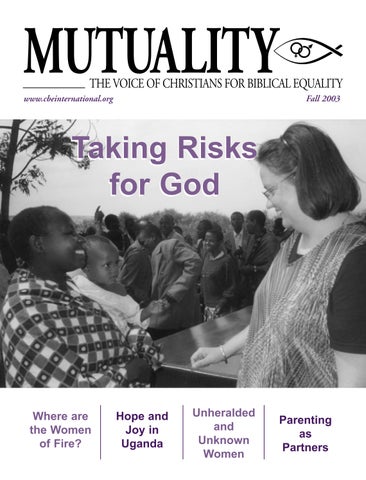
Taking Risks for God
Where are the Women of Fire?
Hope and Joy in Uganda
Unheralded and Unknown Women
Parenting as Partners
What’s Inside FEATURES
DEPARTMENTS
5 Where Are the Women
3 From the Editor
of Fire? ■ BY J. LEE GRADY
5
FALL 2003
Women are taking active roles in spreading the Word of God throughout the world. What is preventing American women of fire from stepping forward?
■ BY JOANNE NYSTROM JANSSEN
An Unexpected But Beautiful Message
4 In Our Mailbox 16 Book Review
9 Hope and Joy in Uganda ■ BY R. ELAINE TAMEZ
One Finnish woman discovers a passion for the message of biblical equality in an unexpected place — Africa.
9
12 Unheralded and Unknown ■ BY LORRY LUTZ
Brave, risk-taking women have existed throughout history. This article takes a look at just a handful of the unheralded women who have courageously lifted high the cross.
24 Parenting as Partners 12
■ BY SUSAN FINCK-LOCKHART
How can couples craft their lives to reflect the belief that the vocations of both spouses are equally valuable? Includes five tips for creating an equal partnership in your home.
plus: Dividing Chores Without Multiplying Frustration
■ BY REBECCA LEVERINGTON
What Bible History Says About Women in Ministry
17 New Resources 18 Ministry News 21 Honor in Our Ranks
28 Chapters’ Corner ■ BY HARRIET SIDER BICKSLER
Chapters Reach Communities Through Local Events
30 President’s Message ■ BY MIMI HADDAD
Brave-Hearted Women
■ BY JAIME HUNT
24 2
MUTUALITY
COVER PHOTO Courtesy of Anne Mikkola
www.cbeinternational.org
Fall 2003
MUTUALITY
THE VOICE OF CHRISTIANS FOR BIBLICAL EQUALITY
Let us then pursue what makes for peace and for mutual upbuilding. –Romans 14:19 VOLUME 10, ISSUE 3 MUTUALITY seeks to provide inspiration, encouragement and information about equality within the Christian church around the world. President/ Publisher: Editors: Editorial Assistant:
Mimi Haddad Joanne Nystrom Janssen Jaime Hunt Victoria Peterson-Hilleque
Staff Writer: Julia Bloom EDITORIAL AND ADVERTISING OFFICE Christians for Biblical Equality, 122 W. Franklin Ave., Suite 218, Minneapolis, MN 55404-2451 Phone (612) 872-6898 Fax (612) 872-6891 E-mail: mutuality@cbeinternational.org Web site: www.cbeinternational.org Advertising in MUTUALITY does not imply organizational endorsement. SUBMISSIONS MUTUALITY welcomes submissions. E-mail mutuality@cbeinternational.org or write CBE for our writer’s guidelines. PERMISSIONS Christians for Biblical Equality grants permission for any original article (not a reprint) to be photocopied for local use provided no more than 1,000 copies are made, they are distributed free, the author is acknowledged, and CBE is recognized as the source. MUTUALITY (ISSN: 1533-2470) is published quarterly by Christians for Biblical Equality and is sent free to members. For membership information, see page 31.
■ From the Editor JOANNE NYSTROM JANSSEN
An Unexpected But Beautiful Message
A
s the Mutuality editor, I pride myself on keeping the publication organized by planning ahead. Each issue follows a series of deadlines — dates when articles are due, editing is completed and the issue is published. This planning also applies to the themes addressed in each issue, as these are determined about a year in advance. Except this time. When I e-mailed writer J. Lee Grady about addressing one of the pre-selected themes, he responded by asking, “Does every article go with the theme?” He went on to explain that while he was willing to write about one of them, something else was really stirring his heart — getting the message out to the nations. “That is becoming my focus,” he wrote, “planting the seed in other nations and helping to release women from cultural and religious oppression so they can be used by God. The women who preach the glad tidings are a great host, and they aren’t all white Americans!” Around the same time, I received a letter proposing an article about a CBE member from Finland who, in a leap of faith, journeyed to Uganda. An evangelist had invited her to speak about biblical equality at a conference there. God blessed her courage, and she was able to share the message with the conference attendees, as well as with 6 million people in a radio broadcast! I’m so grateful that God’s direction sometimes comes so loud and clear we can’t ignore it. The connections between the two articles were so strong that we realized God was prompting us to tell the story of past and present women who have taken incredible risks to serve God. What a beautiful message! The articles in this issue have also encouraged me personally, as I am preparing to embark on an adventure of my own. I will be moving to Indiana this fall to attend graduate school, a dream that has been unfolding for many years. I discovered biblical equality because of two college professors who invested in me, and since then I’ve wanted to study to become a professor to help other students who are at such pivotal times in their lives. God, who is so faithful, provided an experienced writer and editor named Jaime Hunt to serve as Mutuality’s new editor. Her passion for biblical equality can be seen in an article she wrote to explain her decision to work for CBE: “[CBE’s] cause has been mine since the day I discovered my call to ministry wasn’t tainted because of my womanhood. ... I want to make a difference.” I believe God will bless that desire. Thank you for the encouragement and support you’ve shown me over the last few years. My prayer is that God will continue to bless this ministry and open hearts around the world to biblical equality.
■
Fall 2003
www.cbeinternational.org
MUTUALITY
3
■ In Our Mailbox Searching Scripture in Africa I noted the Summer 2003 Mutuality report on Princess Kasune Zulu and your interest in exploring how CBE can be more i n v o l v e d i n re a c h i n g Africa with biblical equality. I would like to share my experiences while teaching at Nairobi Evangelical Graduate School of Theology (NEGST) in 1988. One of the three courses I taught was Culture, the Bible and Women. There were 10 African women — some were wives of students and some in Christian work — and three men, including the pastor of the local Anglican church in the nearby village of Karen. The course turned out to be the most significant teaching experience I've ever had. After clarifying our agenda to search the biblical data from its own perspective of biblical equality, every session became both learning the Scriptures in a new light and a catharsis of joy in experiencing for the first time that what most of them really felt inside about equality was indeed what the Bible actually teaches. It was a time of being set free, but also of new fear and trepidation: How do I share this with my husband or pastor or friends at church — other believers who won't accept this as right? While in Nairobi I searched out Judy Mbugua, leader of Pan Africa Christian Women Assembly. As I shared with her the course at NEGST she was very interested. Biblical equality was new to her. I sent her some of the best books and some copies of Priscilla Papers. She wrote me, “I am determined to read. … I’m sure by the time I go through these books I will be much wiser.” Del Birkey Wheaton, Ill.
been challenged to address egalitarian concerns, it was as if the Lord allowed me to be inspired by this painting. I reproduced the Pentecost painting on fabric and framed it with gold sequin ribbon. I superimposed glittering silver letters on gold and created a globe in glitter fabric to show God’s power throughout the world today. We’ve often heard the saying, “One picture is worth 1,000 words.” The words from Acts 1:8 could be fulfilled with one picture/banner and fewer than 1,000 words! Jacquelyn Gunnarson Sioux Falls, S.D.
‘And There Shall Be No More Curse’ I am pastor of Covenant of Peace Church in Huntsville, Ala. I had 1,500 people from all denominations at a Christian Passover celebration in April under the auspices of my teaching outreach, Awareness Ministry. I was reading in Genesis 3:14-19 and the Spirit of God opened my eyes to the fact that every word spoken in those six verses spells out the effects of the original “curse.” It affects both men and women — even the husband and wife arrangement. My mind immediately went to Revelation 22:3: “And there shall be no more curse.” I am writing my own thesis on it and your material may prove helpful. I was just surfing the Internet and discovered you. I intend to do my part to “set my (God’s) people (women) free” in this city. This is all rather revolutionary for me and I have to crucify some old theological sacred cows but the truth will always set us free. Blessings! Pastor Robert S. Somerville Gurley, Ala. continued on page 27
Equality in Color
We’d love to hear from you!
The Summer 2003 Mutuality article, “Mirroring a Creative Creator with Art” was such an encouragement to me. I especially appreciated the Pentecost painting by Nora Kelly. I opened the listed Web site to view her creation in color. I had been asked by our senior pastor to create a banner for his teaching theme on Acts 1:8. Because the church has
4
MUTUALITY
A Thousand Words: “The words from Acts 1:8 could be fulfilled with one picture/banner and fewer than 1,000 words.” Jacquelyn Gunnarson was inspired by Mutuality’s Summer 2003 article about art. She created this banner for her church utilizing a painting featured in the article.
Send your comments, suggestions andcritiques to: MUTUALITY 122 West Franklin Ave., Suite 218 Minneapolis, MN 55404-2451 Phone: (612) 872-6898 Fax: (612) 872-6891 E-mail: mutuality@cbeinternational.org Web site: www.cbeinternational.org
www.cbeinternational.org
Letters may be edited for clarity and brevity.
Fall 2003
PHOTOS COURTESY OF CHARISMA MAGAZINE
Jailed But Not Silenced: Christians in China pay a high price for their beliefs. Many are arrested and jailed, but upon release they return to sharing the gospel.
Where Are the Women of Fire? What American Women Can Learn from Female Leaders in China, Russia and Africa By J. Lee Grady
S
ister Peng pays a high price to be a Christian in China. She has been arrested many times, and she will go to jail again if the police catch her preaching the gospel. Forced to live as a fugitive, she must sneak into her home at night to visit her husband and young daughter. The first time Peng was taken into custody, just after the Tienanmen Square massacre in Beijing in 1989, she was delivering a fresh shipment of Chinese Bibles to some unregistered pastors. She was thrown into a dirty detention cell and tortured with an electric cattle prod in an effort to force a confession of her “crimes.” She shivered in that cell for months. Guards offered no coats, blankets or feminine hygiene supplies. “For eight months I had no contact with anyone. I just ate soup in my cell,” Peng told me when I visited China three years ago. “It is really God’s mercy that he fed me and kept me warm.”
Fall 2003
When Peng was transferred to a women’s prison, she spent two lonely years there. But during that time she led 32 female inmates to Christ. Upon her release, she immediately resumed her itinerant preaching ministry. Now 43, Peng doesn’t let her thin frame or her femininity stop her from taking on dangerous assignments. And she is not alone. She is one of the many female heroes of China’s underground church movement. When I visited a group of unregistered church leaders in a city near Hong Kong in 2001, I discovered that between one-half to two-thirds of all church planters in China today are women, most between the ages of 18 and 24. These women, along with their male colleagues, lead an estimated 25,000 people to Christ daily. One evening after a meeting with these humble Chinese leaders, I returned to my hotel room and discovered two of the female leaders waiting at my
www.cbeinternational.org
continued on page 6 MUTUALITY
5
Women of Fire continued from page 5
door with a translator. “They would like you to pray for them,” the translator said. “Are you pastors or evangelists?” I asked, hoping to better understand their needs. They smiled and replied, “Yes.” “How many churches do you oversee?” I inquired. The translator pointed to the woman on the left. “This one oversees 2,000 churches, and this other one oversees 5,000 churches,” he said. I was stunned. Some denominations in the United States are still arguing about whether a woman can stand behind a pulpit, I said to myself. Meanwhile, women in China are engaging in dangerous missions and governing thousands of new churches. There’s something wrong with this picture! Sister Peng is a woman on assignment, and her passion is not waning. On the last day of my visit, she
Starved for the Truth: Christians sit in an alley next to a house church near Guangzhou, listening to a worship service inside. 6
MUTUALITY
shared with me her plans to take teams of Chinese Christians into the Muslim republics on the western border of China — a place where she expects to encounter harsher persecution than anything she experienced under the communist police. Her ultimate goal, she told me, is to see the Chinese church “march from China to Jerusalem until all the Muslim world hears the gospel.” Peng added, “I used to think that missionaries going from China would not happen until after I die. But God has shown me that it will soon be time. I want to raise up 700 missionaries. God is going to raise up apostolic teams throughout China. It’s our time to go to the world.”
God Needs a Junia Since my trip to China I have met many other women who face incredible hardships as they engage in bold ministry. Like the female apostle Junia, who served alongside the apostle Paul and who was imprisoned with him (see Romans 16:7), these women are willing to die for Christ. One of these modern Junias is Natasha Shedrevaya, a Russian church planter who was recently appointed to head her denomination, based in Moscow. The first woman to be appointed a bishop in her country, Shedrevaya oversees 30 churches in Russia and 300 churches in the former republics of the Soviet Union. Shedrevaya is a woman on a mission. Her goal is to plant a church in every village in the Siberian north — a region spanning several time zones where most people have never heard the gospel. She is fulfilling her vision with little aid from the West and no help from the Orthodox religious establishment in her own country. I met another modern Junia two years ago when Kayy Gordon visited my office in Florida. Gordon spent 40 years in the far north of Canada, reaching the isolated Inuit people sometimes called Eskimos. Never married, this dedicated woman obeyed God’s call and went to live in a desolate place most people would never dare visit. Gordon had to travel from village to village by dog sled during the first years of her difficult ministry. Later, after more workers joined her team, she lost one of her best staff members in a plane crash. Yet even the most discouraging circumstances did not take Gordon off the front lines. At the time she retired, she had planted 12 churches and founded two Bible colleges. The seeds she planted in the Arctic tundra produced a spiritual awakening throughout that region. Amazingly, when I share stories of women like Kayy Gordon, Natasha Shedrevaya or Sister Peng,
www.cbeinternational.org
Fall 2003
A Persecuted Audience: Pastor Li Dexian preaches at a house church in southern China. The structure the Christians are meeting in was later destroyed by government officials.
some people still object. They say, “I don’t think women can be leaders,” or “God wants men to be the initiators, not women.” You might expect such responses from men who are blinded by a chauvinistic mindset. But I have learned that many women in the American church today hold the same views. They don’t think it is proper for a woman to display the courage necessary to plant churches or take nations for Christ. How ridiculous! The Bible calls all believers — not just men — to be bold witnesses. And the Scriptures do not suggest that only men can initiate. All of us should display the kind of overcoming faith that drives us to surmount obstacles, believe for miracles, trample on devils and challenge the status quo. Why do so many American Christian women shy away from this challenge? I’ve identified four reasons: 1. They are too comfortable in their religious boxes. There is a religious spirit in the church that tells women they must fit a certain God-ordained “female role.” Many conservative Christians believe that a woman is not fulfilling this role unless she stays home all day and focuses on domestic duties. Yet the Bible does not say all women must fulfill the same role, or that all women should function primarily as maids, cooks and caregivers. All women are not wives and mothers, and all are not called to stay at home full-time. Many women — even those with children — can be called upon by God to do exploits for his kingdom. I have a friend named Jackie Rodriguez who is a gifted evangelist. In December of last year, Rodriguez Fall 2003
took her baby with her to southern Mexico, where she preached in several villages. She led many people to Christ during that week. Some women would balk at such a seemingly dangerous mission. But Rodriguez has decided that she cannot excuse herself from fulfilling the Great Jackie Commission just because she is Rodriguez nursing a baby. She lives outside the box! Of course not all women are called to preach in foreign countries. But my question is this: Are you willing to? Have you taken all your objections and excuses to the cross, or are you keeping God at arm’s distance because you think he might ask you to go on a mission that you feel unqualified to accomplish? 2. They are paralyzed by fear. Another friend of mine, Kim Daniels, has an apostolic ministry that she began in the inner city. Earlier this year, during the conflict with Iraq, she greeted me on the telephone with excitement in her voice. “Hey Lee, do you want to go to Iraq?” she asked. “Right now?” I asked in amazement. “During the war?” Daniels was serious. As a former soldier in the United States Kim Daniels
www.cbeinternational.org
continued on page 8 MUTUALITY
7
Women of Fire continued from page 7
Army, Daniels was eager to go to the front lines and minister to troops stationed in Iraq and Kuwait. During the Gulf War in 1991, Daniels led many soldiers to Jesus — and she wanted to do it again. I was struck by Daniels’ total lack of fear. Her boldness was such a contrast to the passivity and timidity I see in so many American women — many of whom stopped flying in airplanes after Sept. 11, 2001, because of their fear of terrorism. (Daniels did not end up going to Iraq during the war, but she did minister to servicemen’s wives at a military base in Germany.) God has not called any of us to live under the control of fear, and women cannot use their gender as an excuse to be mousy or fainthearted. In fact, the Apostle Peter commands women to renounce fear in order to be true daughters of Sarah (1 Peter 3:6). Have you made sure that fear is not a stumbling block in your heart?
disciples on Easter morning. If you are waiting for a man’s permission to do some form of ministry, that permission may never come. You must obey the Lord’s voice. When you stand before the throne of judgment, don’t assume that “My husband wouldn’t let me do that” will be a permissible excuse. 4. They have not embraced the Great Commission. So few American Christians — men or women — have genuine zeal to see Christ’s kingdom expand to the nations. Even though Jesus told us to seek his kingdom first, missionary endeavors quickly drop to the bottom of our priority lists when we are distracted by materialism and the cares of this life. But we must remember that even in this season of terrorist threats, SARS outbreaks and economic instability, God has not revoked the Great Commission. He has not said to us: “That’s OK. You don’t have to take the gospel to the nations right now, at least until the threat of Muslim violence subsides.” No, the Great Commission still stands. We must take up the challenge, swallow our fears, and love not our lives “even unto death” (Revelation 12:11). I believe God is calling women like never before to rise to this occasion. Every previous generation has had brave women warriors. From the days of the early church, when women of faith were ripped to pieces by Caesar’s lions, the daughters of the church have provided a bold witness. Where are these women of fire today? My prayer is that they will emerge in this decade with hotter zeal, deeper compassion and stronger commitment than at any other time in history.
We must take up the challenge, swallow our fears, and love not our lives “even unto death” (Revelation 12:11).
3. They are waiting for men to give them permission. The conservative church in the United States has conditioned women to be passive. For years we’ve told women to be quiet, to stay out of church leadership and to wait for men to give them instructions. Meanwhile, the Holy Spirit has been wooing women to tune out the voice of religion so they can hear his voice. My Bible says that God calls women to special tasks, and certainly God does not need a man’s permission before he commissions a woman to do something. The Hebrew midwives, in fact, defied Pharaoh’s mandate and deliberately did the opposite. Deborah, the great Old Testament prophet, took her orders from God — not a man. When God announced the coming of the Messiah to Mary, he did not consult her father or her fiance first. And let’s remember that Jesus came to Mary Magdalene at the tomb before he appeared to his male
8
MUTUALITY
■ J. Lee Grady is editor of Charisma and an outspoken advocate for women in ministry. His new book, 25 Tough Questions About Women and the Church (Charisma House), was released in April. A version of this article also appeared in the August/September issue of SpiritLed Woman.
www.cbeinternational.org
Fall 2003
PHOTOS COURTESY OF ANNE MIKKOLA
Spreading the Message: Dr. Anne Mikkola discusses biblical equality with an African woman during an evangelistic event. Mikkola visited Uganda in 2002 to speak at a conference.
Hope and Joy in Uganda African Men and Women Embrace Biblical Equality By R. Elaine Tamez
G
ood news about the church in Africa is hard to find. We hear that the continent is without hope — dying through war, famine and AIDS. But if the church is there, then God is there — and hope is, too. When Dr. Anne Mikkola, a Finnish economist, was called to go to Uganda, she knew little about the country beyond the political turmoil that makes the news. Her calling came through a series of e-mails among friends involved in women’s ministry. One of those emails reached a “completely unknown man from Uganda” who said he was praying for Mikkola. That man was Medad Birungi, an evangelist who heard through a mutual friend about Mikkola’s teaching at a previous conference. He was overjoyed that they shared a vision of biblical equality. “It was really a direct leading of God — definitely not my plan,” said Mikkola, “I had no idea whatsoever to go abroad, not to mention
Fall 2003
Africa.” In May 2002, Birungi asked Mikkola to join a team that was planning to speak in September at a seven-day conference in the capital city of Kabale titled “Woman Don’t Cry.” Mikkola and two companions had only a few months to prepare. Mikkola thought that biblical equality found enough challenge in Finland, and she could not imagine its reception in a country and culture so far away. “None of us had ever been to Africa and we were to go all by ourselves, invited by a man none of us knew,” she said. It was a leap of faith unlike she and her two companions had ever made. “[But] knowing that somewhere there were real people who would want to hear the message that God had put on my heart was just so overwhelming that there was no doubt — I had to go,” she said. Once Mikkola arrived in Uganda and spoke for the first time, she was overwhelmed at the response. “It was totally amazing how these people in the midst of revival received the
www.cbeinternational.org
continued on page 10 MUTUALITY
9
Hope and Joy in Uganda continued from page 9
message of equality with joy, men and women alike,” she said. “They spread anything I [said] like fire around!” Women were not the only ones who received the message. Of the 300 people attending the conference, she estimates about 20 percent were men. Mikkola’s concern that the women would be left without support after the conference also diminished the first night. “I was touched by the realization that these women already had a support network for women in the surrounding areas,” Mikkola recalled. After meeting the women, Mikkola and her companions felt free to teach fully in the spirit of Galatians 3:28. More opportunities to witness and discuss biblical equality opened up both during and after the sessions. One morning, as Birungi translated, Mikkola presented a 30-minute message about biblical equality on a radio program that reached 6 million people. “[Later that day] we went to visit an evangelistic outreach in a very poor village,” said Mikkola. “The women in the countryside huts heard [the message]! You cannot imagine how this made me feel. I had thought people in my home country did not understand me because of my ‘academic’ biblical argumentation that did not relate to their lives. And now here in Uganda these women, not all of whom were literate, understood what I said.”
From Strangers to F r i e n d s : D r. A n n e Mikkola (left) originally connected with Medad Birungi (right, standing) through a series of e-mail messages. Overjoyed with Mikkola’s perspective on biblical equality, Birungi invited her to speak at a conference in Uganda.
Another thing became clear as the guests and their hosts came to know each other: The problems in Finland and Uganda are much the same. “Sexual habits are equally loose,” said Mikkola. “Many men in Finland have problems with alcohol; so do Ugandans. Both in Finland and Uganda women do most of the [housework] and manipulate their husbands at home [because they are not] able to have a voice outside of home. … The similarities were striking; the devil’s patterns are the same everywhere.” Uganda has faced many challenges as well as victories, according to Birungi, the conference’s organizer. Known as the Pearl of Africa because of its rich natural resources, Uganda was devastated by the decades of Idi Amin’s dictatorship and the AIDS epidemic. The traditional role of women in a culture that
A Strange Land: Although Africa and Finland appear vastly different, Dr. Anne Mikkola discovered disappointing parallels in the way both cultures regard women. “The similarities are striking,” she said. “The devil’s patterns are the same everywhere.” 10 MUTUALITY
www.cbeinternational.org
Fall 2003
Worshipping Together: Children worship God at an evangelical event in Uganda. Despite war, famine and AIDS, the country is experiencing a spiritual revival.
tutions of learning,” he added, “but in villages and rural places and among the Moslems and traditionalists it has not been easy. We have been misunderstood and persecuted by men whose position is being threatened and church leaders whose theology we have challenged.” However, Birungi believes that it is a battle worth fighting. The conference and the team’s visit gave Birungi’s ministry new focus — evangelizing and preaching a biblical understanding of the mutual worth of men and women. Birungi’s organization has made a commitment to address the burden that the low status of women places on society. The organization, Swallow Evangelistic Revival Ministry, took its name from Psalm 84:3 — a verse in which Birungi sees hope for women in Africa: “Even the sparrow has found a home, and the swallow a nest for herself, where she may have her young — a place near your altar, O Lord Almighty, my King and my God.” “We are using a Christian and evangelical voice to preach biblical equality and people are amazed to discover the truth,” said Birungi. “We have boldly talked about it, and the response is overwhelming.”
assigns a “bride-price” on one hand and a low status on the other leaves women vulnerable to AIDS and abuse. Since the late 1980s, however, the country has rebuilt. Revival has touched every level of society, including members of the government. Uganda’s AIDS initiatives make it the only country in Africa seeing true progress against ■ the disease. Education is a funding priority and R. Elaine Tamez is a freelance writer and artist in is available to girls more than ever before. Texas. “Uganda seems to have been in winter both politically, socially and economically as far as female equality is c oncerned,” said Birungi, invoking Isaiah 43:18-19. “But now we are in spring and many things are coming up and life is springing out and God is doing a new thing. This is bringing hope and joy in Uganda, but it is a result of fervent, desperate and persevering prayers of the saints — and many tears. “The message of CBE has been very highly welcomed in many A Crowd of Believers: Over 300 people attended Mikkola’s seminar on biblical equality during a churches and instiseven-day conference called “Woman Don’t Cry.”
Fall 2003
www.cbeinternational.org
MUTUALITY
11
Unheralded and Unknown
By Lorry Lutz
“E
ven as a young teenager, Catherine of Siena refused to marry so that she could serve Christ,” I started to tell my young friend Betsy. “Catherine was so respected in the 14thcentury church that she was able to instruct Pope Gregory about the problems of the church and charge him to return to Rome to deal with them.” The stories I’d been reading about women in church history had gripped my heart, and I wanted to share them with someone. Betsy listened eagerly, her eyes growing big with wonder. “I didn’t know there were women like that in the church,” she said. “Why have we never heard about them?” Why indeed? From the time of the early church, women have been actively serving Christ and holding respected positions of leadership, but church historians have virtually ignored them. Take a look at just a few key women across history.
Early Church Women played a vital role in the early church. Paul refers to 10 women in Romans 16, calling some “fellow workers,” a term he also uses to describe male workers in the church. He sends greetings to Junia, commenting that she is “outstanding among the apostles.” John Chrysostom, eloquent fourth-century bishop of Constantinople, wrote of her, “Oh, how great is the devotion of this woman that she should even be counted worthy of the appellation of apostle.” As Paul traveled through Greece, he often preached to the educated and powerful, and the New Testament reports that “prominent women” accepted his message. A picture in the Priscilla catacomb in Rome dating back to the first century shows a “deaconess” serving the Lord’s Supper to a group of women. Very early in the church an order of widows developed who were referred to as presbyteresses. Women actively participated in the private domain as long as the church met in homes. After the third century, when the church became “public,” women’s roles became restricted through progressive church council decisions.
12 MUTUALITY
Martyrs — Perpetua (Martyred 203 A.D.) The young church grew rapidly, and so did persecution by the Roman rulers who feared hostility to the state and failure to Perpetua honor the emperor as supreme ruler. In John Foxe’s Book of Martyrs, horrendous stories of persecution are told about many women who chose to suffer and die for Christ rather than renounce their faith. One of the best-documented reports of martyrdom comes from the pen of Perpetua, a 22year-old woman in Carthage (modern Tunisia) who recorded the story of her conversion and arrest until the time of her death in March 203 A.D. Perpetua was the mother of a tiny infant. Her father pleaded with her on several occasions to renounce Christianity for the sake of her son and her family. Perpetua was eventually put to the sword by the gladiators for her faith. Her courage and commitment to Christ are evident in her writing, especially as she records the last meeting with her father as she appeared before Hilarianus the governor: All the others when questioned admitted their guilt. Then, when it came to my turn, my father appeared with my son, dragged me from the step and said, “Perform the sacrifice — have pity on your baby!” “I will not,” I retorted. “Are you a Christian?” said Hilarianus. And I said, “Yes I am.” When my father persisted in trying to dissuade me, Hilarianus ordered him to be thrown to the ground and beaten with a rod. I felt sorry for father, just as if I myself had been beaten. Then Hilarianus passed sentence on all of us; we were condemned to the beasts, and we returned to prison in high spirits.
www.cbeinternational.org
PHOTO BY STEVE NICKERSON, FROM THE BASILLICA OF EUFRASIUS AT DOREC, CROATIA.
Although Virtually Ignored, Women Played a Vital Role in Church History
Fall 2003
In the early centuries after the spread of Christianity, immorality, frivolity and indecent luxury marked the life of Rome’s upper classes. Women spent literally hours painting their faces and plaiting golden tresses into their own dark hair. Their homes glittered with gold Marcella and lavish ornamentation. Wealthy Christian women who had access to Scripture began to denounce the opulent decadence of the Roman way of life. One of these was Marcella. After her conversion, Marcella exchanged her luxurious clothing for a coarse brown dress and opened her palatial home for Bible studies. In 382 A.D. she invited Jerome, translator of the Latin translation of the Bible, to teach. Jerome frequently discussed Scripture with Marcella and expressed amazement that she had learned on her own what he had discovered through long study and constant meditation. Jerome was so confident of Marcella’s understanding that he once asked her to settle a dispute between bishops and presbyters in Rome concerning the meaning of a certain Scripture. The studies in Marcella’s home were soon called the “Church of the Household,” which became a center not only for Bible study and prayer but also for ministry to the poor. She established the first convent where women in the West came to devote themselves to prayer, study of the Scriptures and good works. She also established several religious houses and initiated the meticulous copying of Scriptures.
During the Middle Ages the institutionalized church fell into avarice, political intrigue and spiritual apathy. Early reformers — some of whom were women — desired to purify the church and to lift the entire population of Christians to a higher level. While women had no official voice in church matters, Fall 2003
mystics who received direct revelations from God were honored. Catherine of Siena was a mystic who labored for peace and reform throughout her short life. As a young child, Catherine had a profound religious experience, seeing a vision of Christ above the steeple of the church. Her family was exasperated with her resulting zealousness. However, her father recognized her unique spiritual qualities and allowed her to live in silence and seclusion in an underground room of their home. As a girl of 12, she ate only bread and water, and slept on a straw pallet often no more than two hours a night. Prayer became the staff of her life. After three years of solitude, she heard a call from God to purify the church. In 1363, Catherine chose the life of a religious laywoman, and served the poor on the streets of Siena. Her overriding burden was the conversion of sinners, and she entreated the rich and poor, sick and healthy to repent and be saved. When the Black Death struck the city in 1374, people fled to the country to escape the disease that would kill one-third of the city’s population. However, Catherine and her followers stayed in the city and worked indefatigably day and night to care for the sick and dying. As Catherine’s fame and influence grew, she attempted to persuade church leaders to unify and reform the church. She exorted the Pope to leave Avignon where he was living in lavish luxury and return to Rome. After Gregory died, she moved to Rome to assist the new pope, Urban VI, still hoping to bring about reform in the church. After some years of failing health, she died at the age of 33 in Rome.
Women of the Reformation — Katherina von Bora (1499–1555)
SCULPTOR: JOHN M. SODERBERG; ADRAIN DOMINICANS HOSPITAL, HENDERSON, NEVADA; PHOTOGRAPHER, JOYCE ROACH, OP
Mystics of the Middle Ages — Catherine of Siena (1347–1380)
ICON COURTESY OF HOLY TRANSFIGURATION MONESTARY
Wealthy Women — Marcella (325–410 A.D.)
When Martin Luther finally brought the growing Reformation sentiments to a head, life for men and women of the church in Europe changed forever. Zeal to reform the Roman Catholic Church spread like wildfire. Luther’s teaching even slipped into Katherina von Bora’s convent, where strict silence was enforced and friendship between nuns discouraged. Yet, somehow, the teachings of the Reformation made their way in and stirred up new passions and convictions. One can only imagine how the silenced nuns slipped notes to each other and whispered surreptitiously when the abbess was out of hearing. Katherina approached her parents and friends for help to leave the convent, but they refused. Then a daring plot evolved. One dark night a vendor appeared at the convent delivering barrels of herring.
Catherine of Siena
www.cbeinternational.org
continued on page 14 MUTUALITY
13
Unheralded and Unknown continued from page 13
ending child labor, and even helping to protect England from the French Revolution. In 1789 Hannah visited a mining area, and she was appalled by the poverty and ignorance she saw. She began teaching Scriptures to the children, which grew into one of the first Sunday Schools in England. Incredibly, she was condemned and persecuted by the church curates for this action because of the prevailing belief that education of the poor would destroy their interest in farming and other menial tasks. Hannah also wrote many tracts for the Clapham Sect. When she died, she left her estate of about 30,000 pounds to 70 Christian organizations.
Eleven nuns rode out inside the barrels to an uncertain future. Martin Luther was faced with the problem of what to do with these nuns. Eventually all but Katherina were married. She refused the man he recommended, but she sent word to Luther that she would be willing to consider Luther himself. Luther had not thought of marriage for himself, expecting to be burned at the stake as a heretic at any time. He wrote to his friends, “While I was thinking of other things, God has suddenly brought me to Women in Missions — Mary Slessor marriage … God likes to work miracles.” They were (1848–1950) and Sarah Platt Doremus married and enjoyed more than 20 years of a tumultuous but happy union. (1802–1877) Katherina Bora Luther became the revered British mission agencies, such as the London matriarch of the Protestant parsonage. She looked Missionary Society, pioneered in many parts of the after orchards and gardens and served hundreds of world — India, the South Seas and West Africa. Wives people who came through the Luther home during were considered indispensable to the hectic Reformation days. She the work, but nevertheless many turned part of her home into a agencies simply listed the man’s By the middle of the hospital. Katherina’s eldest son, name followed by a small m. to 19th century, the who became a physician, testified indicate he was married. Doors that she treated the sick as well as opened slowly for single women, women of the church any doctor. and only the most courageous and could no longer wait visionary would venture into the for the existing New Opportunities for uncharted heathen regions. Perhaps the best known of Women — Hannah More boards to send these early pioneers is Mary (1745–1833) single missionaries Slessor, who responded to God’s The humanistic awakenings of the call after the death of her brother and to focus on the Renaissance opened some doors for who had long felt he should be a upper-class women to gain an needs of women and missionary. Born in Scotland, Mary education and follow less children. went to Nigeria. She was conforming roles. During the next disappointed to find the three centuries, tremendous changes missionary community emulating in society as a whole brought new opportunities for the British lifestyle with high teas, fancy hats and women to gain education and to become involved in gloves, and social occasions that were as foreign to social reforms. The Industrial Revolution led to this lower-class mill worker as village life in Africa. pressing social needs, and women began to take more Because she wanted to live with and like the public roles in issues such as abolition, prohibition Africans, Mary moved inland. “She discarded the and suffrage. Victorian missionary’s hat, gloves, boots, bustle, long Vivacious and intellectual, Hannah More spent curls, and sometimes even her outer dress,” wrote the first part of her life moving in the social circles of Miriam Adeney in Missiology. “She spent time in London. A gifted playwright, she became friends with African houses, sleeping beside big sweating bodies, such renowned writers as Dr. Samuel Johnson, who eating native food, going barefoot, suffering local encouraged her to publish her writing. diseases — but awake, aware, curious, asking At the age of 35, she joined a small group of questions, categorizing information, applying it.” Christian activists known as the Clapham Sect, who Mary Slessor spent 40 years in Africa, moving believed that Christians must make a social impact ever farther into the interior among warring people and work for change in society. They had much to do immersed in witchcraft. She rescued twins who with abolishing the slave trade in the British empire, 14 MUTUALITY
www.cbeinternational.org
Fall 2003
Join CBE’s Leave a Legacy Initiative
Sarah Doremus By the middle of the 19th century, the women of the church could no longer wait for the existing boards to send single missionaries and to focus on the needs of women and children. In 1861, the first of 41 women’s missionary societies was formed in the United States: the Woman’s Union Missionary Society of Sarah Doremus America. Sarah Doremus became the first president and served until her death in 1877. R. Pierce Beaver describes her as “one of the most remarkable laywomen in the whole history of American Protestantism.” She organized a society for the relief of Greek women then suffering under the Turks, started services in the New York prison, and encouraged the organization of the Women’s Prison Association. She served on the board of the New York Bible Society, founded the House and School of Industry and helped found a children’s and women’s hospital. She was also one of the founders of the Presbyterian Home for Aged Women. With such obvious gifts and commitment, it is no wonder that the Woman’s Union became an effective ministry, supporting more than 100 women missionaries in Burma, India, China, Syria, Greece and Japan in its first 20 years. Doremus’s leadership became an inspiration to women around the country, and denominational women’s missions emerged in ensuing years. By 1929, 67 percent of all North American missionaries were women. We have barely touched upon the courageous women risk-takers who through history have lifted high the cross unheralded and unknown, but they urge us on to add to their numbers.
E
■
Adapted from Women as Risk-Takers for God. After serving with her husband Allen in Africa for 22 years, Lorry Lutz acted as head of publications for Partners International. In 1991, she founded and directed the AD2000 Women’s Track. Her ninth book, Women Finishing Well, will be published by Baker early in 2004.
Fall 2003
PHOTO COURTESY OF CHRISTIAN HISTORY INSTITUTE
would have been killed by the community, and raised seven adopted children. She opened up the interior of Nigeria to the gospel and served as an intermediary between tribal factions.
ach of us wants to know that the things to which we’ve contributed time and money will last long after we’ve entered Christ’s presence. How wonderful to know that you can continue to give to the work of CBE, even after your earthly pilgrimage has ended. By joining CBE’s Leave a Legacy Initiative, you continue to exercise stewardship over the blessings of your life. By naming CBE as one of the benefactors in your will, trust, insurance policy or estate plan, you give a gift that becomes a legacy — a helping hand to those who come after you looking for answers regarding gender and the Bible. If you would like to learn more about this plan, we would be honored to discuss the details more fully. Or, if you have already included CBE in your estate, will or insurance policy, please let us know. We would love to include your name. Simply contact CBE at cbe@cbeinternational.org, by phone 612-872-6898, or mail CBE, 122 W. Franklin Ave., Suite 218, Minneapolis, MN 55404-2451. First Class of CBE’s Leave a Legacy Initiative Janis and Wes Balda Mary Hackman Cosette Jolliff Carl and Bernice Menold Virginia Patterson JoAnn Leiffers and John Swart
Jocelyn Garner Jo Ellen Heil Tom and Missy McCarthy Alvera Mickelsen Sara Robertson Lilya Wagner
■
CBE is Looking for Spiritual Directors Who Support CBE’s Mission If you are a Spiritual Director and would like your name added to our list of egalitarian spiritual directors, send your name and credentials to us at cbe@cbeinternational.org. Our spiritual directors list will be published in the next issue of Mutuality.
www.cbeinternational.org
Thank you!
MUTUALITY
15
■ Book Review REVIEWED BY REBECCA LEVERINGTON
What Bible History Says About Women in Ministry third century but f you want one book that clarifies controversial especially during the biblical passages about women in leadership, Dark Ages. She shows documents God’s use of women in both the Old how the church’s and New Testaments, and explains how and why the attitudes toward women church grew away from equality after the time of have been influenced by culture and sin, rather than Christ, this is it. In From Bondage to Blessing, Dee Alei by biblical teaching. This provides a reader with a traces the argument for biblical equality good understanding of the basis for the present day chronologically through the Bible and history. She struggles. also takes readers through the questions to a greater Chapters 10-13 provide detailed but readable depth of understanding of biblical equality. studies on the Alei is an ordained controversial passages minister who has From Bondage to Blessing: that are most frequently worked in a team cited to prohibit women ministry with her The Redemption, Restoration and in leadership and husband for the past Release of God’s Women ministry in the church. 11 years in northeast These include 1 By Dee Alei England. She is a teacher, C o r i n t h i a n s 11 , 1 pastor and counselor. 223 pages, Sovereign World Ltd., 2002. Ti m o t h y 2 : 11 - 1 5 , With careful research B267P . . . . . . . . .$12.99/ Introductory Price $9.74 Ephesians 5:21-33 and 1 but understandable Corinthians 14:33-35. The language, Alei gives the variety of cited research, reader tools to see the biblical standard for women’s including Alei’s own research, provides the reader equality within the church. She cites ancient with a solid basis for understanding God’s heart manuscripts, past and current biblical scholars, and toward women in ministry. Although comprehensive her own research, giving readers a thorough but clear and thorough, these chapters are clear and succinct understanding of what the Bible teaches about enough to provide assistance to readers who are new women in ministry and leadership. to this topic as well as to those who want a complete The first chapter explains why there has been so summary of the passages in question. much confusion within the church regarding the Finally, Alei documents individuals and church gender issue — even among evangelicals with similar movements in the past three centuries that have commitments to biblical authority. The second begun reversing this trend away from biblical equality chapter documents the necessity for in-depth study of for women. The book ends with a challenge to the the Scriptures, utilizing sound scholarship and the reader to take up the cause. The author believes we many resources available today. Alei also explains the are on the edge of a spiritual revolution in this area of importance of cultural and historical studies. equality for women, poised to move from bondage to The next three chapters provide a study of the Old blessing. Testament passages on the Creation, clarifying God’s intent for women. Alei then documents God’s ■ utilization of women in leadership in the Old Testament. The next three chapters study Christ’s Rebecca Leverington is a marriage and family therapist teaching and involvement of women in ministry, and working as a missionary counselor for Wycliffe Bible its radical challenge to the culture of the day, as well Translators in Dallas, previously serving in Papua New as to the religious culture of that time. Guinea. She has been married 30 years and has two adult Alei also outlines the church’s movement away children. from Christ’s teaching, beginning as early as the
I
16 MUTUALITY
www.cbeinternational.org
Fall 2003
■ New Resources 25 Tough Questions About Women and the Church: Answers from God’s Word that Will Set Women Free By J. Lee Grady God’s kingdom isn’t about exclusion and hierarchy, but about community, liberty and love, says J. Lee Grady in this powerful follow up to his best-seller 10 Lies the Church Tells Women. The book is divided into 25 chapters, each asking a question women have posed regarding their roles as church members and women. Topics include applying mutual submission in marriage, answering God’s call to ministry, and responding to an abusive spouse. 160 pages, Charisma House, 2003. B266P . . . . . . . . . .Was $9.99/Introductory Price $7.49 Blessed One: Protestant Perspectives on Mary Edited by Beverly Roberts Gaventa and Cynthia Rigby A thought-provoking and provocative look at a figure often ignored by Protestants, Blessed One is a compilation of scholarly essays about Mary. Some traditional Catholic teachings are questioned, while Mary’s unique contribution to the history of salvation is recognized and honored. Blessed One is a must-read for anyone who wants a better understanding of the role of Mary in Christianity. 158 pages, Westminster John Knox Press, 2002. B268P . . . . . . . .Was $19.95/Introductory Price $14.96 Is It I, Lord? Discerning God’s Call to Be a Pastor By James O. Chatham This book provides an excellent introduction to the mystery of how God calls people into ministry. Readerfriendly and down-to-earth, Is It I, Lord? presents questions for anyone who feels called by God — and offers insight into the process of declaring a vocation in ministry. The book is an excellent resource for those who feel called as well as those who walk beside them. 107 pages, Westminster John Knox Press, 2003. B269P . . . . . . . . .Was $10.95/Introductory Price $8.21
Leading with Passion and Grace: Encouraging and Mentoring Women Leaders in the Body of Christ By Joyce Strong With candor and sensitivity, Joyce S t ro n g a d d re s s e s t h e s p i r i t o f leadership and offers guidance. Principles such as humility, teamwork, community and reliance on God are interwoven throughout the text. Check lists, bullet-points and “Discussion Probes” help the reader explore personal leadership issues. This book leaves the reader feeling, “I can do it, with God’s grace.” 218 pages, Xulon Press, 2003. B270P . . . . . . . .Was $13.99/Introductory Price $10.49 Putting Women in Their Place: Moving Beyond Gender Stereotypes in Church and Home; The Baptist Debate Over Female Equality Edited by Audra and Joe Trull Recent declarations by the Southern Baptist Convention concerning male and female roles have ignited major controversies. In Putting Women in Their Place, 12 respected authors address key questions for Baptists desiring a biblically based and theologically sound discussion of gender issues. The editors expose fuzzy thinking, spotlight a dark corner of Baptist life and make clear Christian teaching about the role of women. 176 pages, Smyth and Helwys, 2003. B271P . . . . . . . .Was $17.00/Introductory Price $12.75 Relationship-Empowerment Parenting: Building Formative and Fulfilling Relationships with Your Children By Judy and Jack Balswick and Boni and Don Piper This book is filled with practical tips and ideas for parenting children using a relationshipempowerment model. This style of parenting allows parents to build a solid foundation with their children that will transcend culture’s negative pressures. The authors also present a philosophy of gift-based parenting, and include helpful first-person anecdotes, illustrations and discussion questions. 208 pages, Baker Book House, 2003. B272P . . . . . . . . .Was $12.99/Introductory Price $9.74
*Prices do not include shipping and handling. Member discount does not apply to sale-priced books. Sale ends October 31, 2003. Fall 2003
www.cbeinternational.org
MUTUALITY
17
Ministry News
Remembering a Leader Who Made Lasting Contributions Carol Thiessen Edited CBE’s ‘Priscilla Papers’ CBE — and the church at large — has lost a gifted and faithful friend. After a short battle with cancer, Carol Thiessen, editor of Priscilla Papers, died on May 28, 2003, leaving behind a legacy of careful editorial work, gentle leadership and devotion to the church. Carol began her lifetime involvement in Christian ministry soon after her high school graduation when she joined the staff of Youth for Christ International in Wheaton, Ill. Later she worked with Pioneer Girls, also in Wheaton. In 1979, Carol joined the staff of Christianity Today magazine, and worked as an editor there for over 20 years. In a tribute to Carol published in Books and Culture magazine, editor John Wilson said, “In more than 20 years in publishing … I have been fortunate enough to work
18 MUTUALITY
with several outstanding copyeditors. But the best of them all was Carol Thiessen. She was a superb copyeditor of the old school, vigilant against errors of style and errors of fact, with an uncanny ability to spot a typo.” Following her retirement from Christianity Today in 2000, Carol became editor of CBE’s academic journal, Priscilla Papers. As editor, Carol developed strategic marketing initiatives and instituted editorial policies and procedures. She cast vision for the organization and created a consulting theological team. She also encouraged CBE to join the Evangelical Press Association (EPA). Under her leadership, CBE has won four Higher Goals Awards from EPA. Carol richly blessed all of her work with a keen professionalism, lasting vision, clarity of thought and commonsense logic. She was deeply loved by her co-workers and colleagues at CBE. She made lasting contributions to CBE’s ministry and her work continues to empower many around the world. CBE members are remembering Carol’s work through a contribution to the Carol Thiessen Memorial Fund. Donations will be used to further the outreach of Priscilla Papers. (See page 23.) In addition to her paid work, Carol was deeply involved in the work of the churches she attended, including Chicago’s Woody Memorial Church and Circle Church (where she also served as board chairman), and North Lakeland Presbyterian Church of Lakeland, Fla., where she served as an elder.
■
—Julia Bloom www.cbeinternational.org
Future Events
Evangelical Theological Society The Evangelical Theological Society is a professional society of about 3,800 biblical scholars, teachers, pastors and others involved in evangelical scholarship serving Christ and his church. CBE will attend its annual conference in Atlanta, Ga., Nov. 19-21. CBE will host a booth, and several egalitarian scholars will present papers. President Mimi Haddad will present a paper titled “Evidence for and Significance of Feminine God-Language from the Church Fathers to the Reformation.”
Urbana 03 Urbana is InterVarsity Christian Fellowship’s student mission convention held every three years in Urbana, Ill. About 20,000 college students, missionaries, and church and campus leaders will gather to learn about world missions and find ways to be involved in God’s mission. Mimi Haddad will present two workshops about historical women who have answered God’s call to mission work. The conference will be held Dec. 27-31.
■
Fall 2003
MINISTRY NEWS
CBE Celebrates 30 Years of Social Action with ESA
Future Leaders Converge in the Farmland CBE Reaches Rockers at Cornerstone
O
n July 1, CBE journeyed to a farm in Bushnell, Ill., to spend four days at the Cornerstone Festival. Sponsored by Jesus People USA of Chicago, Cornerstone is a gathering of over 20,000 people who share in music concerts, academic seminars, film showcases, sports tournaments, visual art, children’s programs and more. Aspects of Cornerstone are centered on the gospel and Christian community. This was CBE’s second year at the festival. Last year the staff met artists and scholars, teenagers and older adults who enthusiastically interacted with the ideas of biblical equality, many for the first time. Some of them revisited CBE’s booth this year, along with others who learned of biblical equality for the first time. CBE’s presence extended beyond the booth. President Mimi Haddad offered a seminar titled “Women’s Wild Hearts: Considering the Leadership and Historical Contributions of Women.” In addition, North Park Theological Seminary professor Linda Belleville, a member of CBE’s board of reference, led the workshop “Men, Women and the Battle of the Sexes,” which explored the biblical passages that are often
E
used to prescribe gender roles and prohibit women from leadership in the church. Both seminars were well attended and sparked great discussions. Four CBE staff members and four volunteers staffed the booth. They sold books and gave away many free articles and promotional literature. The booth included a small area where people could sit and read books or articles, or discuss ideas with the staff and volunteers. Each day many of these interactions occurred. In addition, CBE staff, members and friends encouraged one another and exchanged personal stories at an informal gathering over dinner on Friday evening. Christianity Today recently quoted Haddad in an article about Cornerstone titled “Jesus’ Woodstock.” “This is a group of Christian pilgrims,” Haddad told the publication. “They are not settled into their opinions; they want to continue to explore, learn and debate. You are going to find your leaders of tomorrow from this group.”
vangelicals for Social Action (ESA) is an organization seeking to promote Christian engagement, analysis and understanding of major social, cultural and public policy issues. Their 3 0 t h Anniversary Celebration and Challenge Conference was held July 24-27, 2003, at Eastern University in Saint Davids, Penn. CBE hosted a booth at the event and President Mimi Haddad presented a workshop. Other presenters included CBE c o - f o u n d e r G re t c h e n Gaebelein Hull and CBE board of reference members Vernon Grounds, Roberta Hestenes, Tony Campolo and Ron Sider. ESA’s mission is to challenge and equip the church to be agents of God’s redemption and transformation in the world. To accomplish that mission, ESA offers training in holistic ministry, links people together for mutual learning and action, and provides reflection on church and society from a biblical perspective.
■
■
—Julia Bloom
—Jaime Hunt
Meeting Others: CBE President Mimi Haddad had an opportunity to meet prominent evangelist John Perkins while at the Cornerstone Festival.
In Fellowship: CBE staff members gather with other attendees at the Cornerstone Festival. Fall 2003
www.cbeinternational.org
MUTUALITY
19
MINISTRY NEWS
CBE’s Scholarly Journal Wins Two EPA Awards Editors Receive Feedback, Tips and Encouragement from Attendees
C
BE’s scholarly journal Priscilla Papers won two coveted writing awards from the Evangelical Press Association — an exciting moment for CBE editors Joanne Nystrom Janssen and myself at the organization’s annual conference held in Atlanta. Gordon Fee’s article “The Cultural Context of Ephesians 5:186:9” won second place in the category of biblical exposition. John R. Kohlenberger’s article “What About the ‘Gender Accurate’ TNIV?” won fifth place in the category of critical review. What a wonderful tribute to the CBE authors and their careful scholarship! Held from May 4-7, the conference included three general sessions and six workshop sessions. We attended workshops about improving multicultural communications, redesigning a publication, finding a focus in writing, and improving manuscripts. We returned home with many ideas for strengthening
Constructive Criticism: Connie Willems and Sue Kline, editors of Discipleship Journal, offered a critique of Mutuality and Priscilla Papers at the annual EPA convention.
CBE’s publications. We also signed up for a critique session with Sue Kline, the editor of Discipleship Journal, and her associate Connie Willems. We appreciated their praise of the quality of writing in our publications. They also provided some helpful suggestions for strengthening particular sections and improving design. Another highlight was attending a late-night affinity
group meeting. Conference attendees were divided into groups based on the types of publications they offered. We went to the group for organizational publications and found encouragement and support. The people in the group were able to offer tips about working within a limited budget, surveying readers and communicating the vision of the organization through the publication. While Joanne and I were prepared to learn a great deal about editing and publishing at the conference, we were not prepared for the relational impact of the conference. We couldn’t believe how many people we met who had stories to tell about their personal experiences with biblical equality. We were also encouraged by the amount of respect people had for the work of CBE and scholars associated with us.
■
— Victoria Peterson-Hilleque
Campaign to Reprint ‘God’s Word to Women’ Is Successful
K
atharine Bushnell’s classic defense of women in ministry, God’s Word to Women, is now back in print after being briefly unavailable. The reprinted version includes a newly redesigned cover. Two CBE members, Cosette Jolliff and Bernice Menold, had previously published the book, but were unable to continue the process after stock dwindled early in 2003. With the financial help of
20 MUTUALITY
many donors, CBE raised over $5,000 to keep the book in print. Susie Larson, a graphic designer who designs CBE’s publications, was so inspired by Jolliff and Menold’s dedication to the book that she donated her skills to redesign the cover. Katharine C. Bushnell (18561946) was a brilliant scholar and passionate advocate for the oppressed. Her career included serving as a medical doctor, working for social reform and founding a mission for homeless women. Also a scholar, she studied the Bible in its original languages www.cbeinternational.org
in order to determine the biblical status of women. Scholars have leaned on Bushnell’s groundbreaking work since its first publication in 1921, deeming it one of the best wholeBible approaches to the question of women’s place in the church and home. The book is available from CBE for $14.99, plus shipping and handling. Order online at www.cbeinternational.org or by calling toll-free at 1-877-285-2256.
■
—Joanne Nystrom Janssen
Fall 2003
MINISTRY NEWS
■ Honor in Our Ranks Romancing Your Husband, written by Debra White Smith, was recently nominated for an Evangelical Christian Publishers Association Gold Medallion Book Award. The award, established in 1978, recognizes the highest quality in Christian books. A panel of distinguished judges examine excellence in content, literary quality, design, and significance of contribution. Carolyn Kohlenberger received the Outstanding Counseling Student Award from George Fox University this spring. The award is given by the school’s counseling department faculty to a student with the highest GPA who “embod[ies] the mission of the department in spirit and achievement.” Kohlenberger also received her master’s degree in counseling from George Fox this spring. Richard Mouw, president of Fuller Theological Seminary, recently appeared on Speaking of Faith, a M i n n e s o t a P u b l i c R a d i o program. Mouw was in St. Paul on April 24 to speak with the program’s host, Krista Tippett, about the war in Iraq, evangelical and fundamentalist religion, and Christian relations and attitudes toward Muslims and Israel since the Sept. 11, 2001, terrorist attack on the United States. Mouw has also taken part in two other Speaking of Faith shows, including “The Power of Fundamentalism” and “Where Was God?”
■
■ In Honor Of
■ Prayers and Praises “I will praise you, O Lord, with all my heart … for your love and your faithfulness … when I called, you answered me; you made me bold and stout-hearted.” Psalm 138: 1-3 Praise the Lord with us … • For CBE’s presence at important events. At the Cornerstone Festival and the Evangelicals for Social Action conference, we shared the message of biblical equality. •
For the successful campaign to bring God’s Word to Women back into print. We’re also praising God for the burgeoning sales in our bookstore, which means resources about biblical equality are being distributed widely!
•
For an opportunity to present two workshops at Urbana 03!
•
For God’s provision of qualified and passionate staff members just as we need them.
“Search me, O God, and know my heart; test me and know my anxious thoughts. See if there is any offensive way in me, and lead me in the way everlasting.” Psalm 139:23-24 Please pray with us … • For God’s direction as CBE develops a presence in Africa. We’re asking for wisdom as we consider partnering with ministries and as we brainstorm ways to address problems related to AIDS and a low view of women. •
For the lives touched by our conference in Orlando. Pray that that God would continue to work in the hearts and minds of the attendees, shaping individuals to hear God’s call and giving them the courage to act.
•
For ministry finances. In a troubled economic time, we invite you to pray that we would be good stewards of what God has given us, and that God would provide for the work he has called us to do at CBE.
■
Dan and Barbara Kent made a contribution in honor of Carol Thiessen. Thiessen, the former editor of Priscilla Papers, died in May after a short battle with cancer.
■
Fall 2003
—Victoria Peterson-Hilleque Scriptures provided by Susan McCoubrie, one of the founders of CBE and a retired staff member.
www.cbeinternational.org
MUTUALITY
21
MINISTRY NEWS
2002: A Year of Growth and Blessings Generous Member Support Helped CBE Weather the Economy
E
ach year CBE provides its members with an annual report of our operating income and expenses. The accompanying pie charts are pictorial representations of God’s goodness and your faithful partnership in CBE’s vital work for the year 2002. We praise God for another wonderful year of growth at CBE. With respect to income, we noted nearly 5 percent growth in contributions and 3.6 percent growth in membership. Our growth of income was enhanced by the careful stewardship of our dedicated staff, who endeavored to find creative ways of cutting expenses. For example, in 2002 we saved 24 percent in printing expenses, over 58 percent on
22 MUTUALITY
conference facilities expenses, 30 percent on CBE travel, and 6.6 percent on postage. The growth in income and savings in expenses was providential as it helped us weather not only a difficult economy, but also skyrocketing insurance costs. Our insurance fees rose 87 percent! What is even more remarkable is that through careful management of funds we were also able to grow our staff by 7.32 percent. We have you, our members, to thank for your selfless giving throughout 2002! You donated needed items such as software, plane tickets and books throughout the year. You gave sacrificially so CBE might take the message of
www.cbeinternational.org
gifted-based ministry to many new people throughout 2002. While many nonprofits cut staff and eliminated benefits, CBE not only added staff, but we also added to computer and office equipment, giving our staff the tools they need to excel. Together we built a stronger organization in the face of all odds. It is an honor to work at CBE and we are indeed filled with courage as we face another year of opportunities to serve. We praise God for your love, prayers and generous support. Thank you for making 2002 a great success!
■
—Mimi Haddad, President
Fall 2003
Some Employers Will Match Your Contributions to CBE
mi n bi istry bl ica news lr eso ur ce s
Does your employer offer a matching funds program? Over the years CBE has been the grateful recipient of matching gifts from employers, United Way and the Mustard Seed Foundation. Perhaps your employer or your local United Way will match your contribution to CBE. Please check with your human resources department. What a wonderful way to double the pleasure of giving, making it possible for CBE to reach twice as many with the good news of Galatians 3:28.
s cle i t r ea e fr
Help CBE Build For the Future
W
e love it when a glimpse of God’s vision for CBE GOAL comes through the gifts $100,000 of our members. Due to the gifts of generous donors, CBE established an endowment fund of almost $75,000 $30,000. The board designated this money for investment, and the interest from the principal will be $50,000 used for projects above those outlined in our annual budget. $25,000 For example, the interest from the endowment fund was used to bring speaker Funmi Para-Mallam $10,000 from Nigeria to our Orlando conference. Imagine what income from this fund can provide in time. $ 5,000 We need your help to make these dreams reality. At CBE, we see the endowment fund as a sapling tree. It will grow over time, but we may not be the ones to see it to maturity. With faith, we ask for your help to invest in the future. Please help us care for this fund like a vulnerable tree that needs water, sun and fertilizer to grow. Your contributions will lead to the growth of a large tree that can provide shade for many under its branches. CBE’s First Class of Endowment Donors Russ Edwards and Ruby Renz Jocelyn Garner Jane Goleman Jo Ellen Heil Cosette Jolliff Patti Ricotta
■
Carol Thiessen Memorial Fund Visit CBE’s Web site at
www.cbeinternational.org for the latest ministry news, cutting-edge biblical resources and free articles! Fall 2003
A
fter a short battle with cancer, Carol Thiessen, editor of Priscilla Papers, entered into the loving presence of Christ on May 28, 2003. She leaves behind a lasting legacy through her editorial work, her gentle leadership and her devotion to the church. Because Carol loved Priscilla Papers and devoted her last years to furthering it, we have established a memorial fund, and the proceeds will forward the outreach of the journal. You can donate online at www.cbeinternational.org. ■
www.cbeinternational.org
MUTUALITY
23
Parenting as Partners Five Tips for Creating an Equal Partnership at Home By Susan Finck-Lockhart
H
e’s an attorney. She’s a professor at a Christian university. Their 2-year-old son has just started to walk. Although they both say he’s a handful, more often than not it’s her hands that are full. She packs the bag for the sitter each evening. She takes their son to daycare. She cancels her classes and stays home when he’s sick. Like many couples struggling to balance parenting, household tasks and two vocations, something has broken down between their belief in shared parenting and its actual, everyday practice. Although some women are called to be homemakers, this article is for families where God calls both spouses into realms of responsibility beyond the home. For these couples there is still laundry to wash, meals to prepare, grass to mow, a house to keep clean and — most importantly — children to nurture. How can couples craft their lives to reflect the belief that the vocations of both spouses are equally valuable? It’s easier to default to a traditional model of marriage, particularly as more children enter the picture. An equal partnership is harder to achieve because it takes more communication, negotiation and emotional work. What follows are five principles that can serve as building blocks, or at least discussion starters, for couples seeking to implement an equal partnership. The results are worth the thought, discussion and time: happier spouses, richer marriages and children who see themselves as part of a team.
It’s All in Your Head Developing a marriage where each spouse recognizes and supports the calling of the other spouse is a crucial first step toward an equal partnership. Try this exercise: Can you write a paragraph about your spouse’s calling or vocation? What are his or her passions? In which areas of kingdom business is your spouse uniquely gifted? Read these thoughts to one another and discuss them. Refine them with the other person’s input. Pray over your spouse’s vision regularly during your personal times with the Lord. As partners who support each other, each spouse should understand and accept each other’s God-given vocations. 24 MUTUALITY
Equal Partnership: Although it may be easier to fall into more traditional roles in marriage, couples can successfully build equal partnerships.
During the first years of our marriage, I was a seminary student with a two-hour early morning commute. My husband, Bill, woke up with me to make breakfast or help pack my lunch. He listened as I wrestled with new ideas and challenges. I felt loved, supported and validated in this new, unfamiliar calling. In turn, I helped out at Bill’s inner-city mission: sleeping with the homeless on holidays and distributing food to neighborhood residents. With an understanding of each other’s calling, supporting each other came naturally.
Mutuality or Perfection? An equal partnership requires giving up control. Many spouses resist doing this in the areas of life that have traditionally been their gender’s domain. For example, I have a friend who complains incessantly that her spouse doesn’t “pitch in and help,” but she has high standards and a strict timetable for every chore. It’s much more important to delegate responsibility and to have the family function as a team. This means one spouse doesn’t assume responsibility for everything that needs to be done. Let some things slide so other family members will take the initiative and notice things that need to be done. For example, when my children were young, I was the pastor at a small rural church about an hour from our home. Bill and the kids attended a church closer to home. Each Sunday, he dressed the kids so I could get ready. Some Sunday afternoons I noticed some of the “creative” outfits my husband put on the children. “What did my friends at church think?” I wondered. Then I stopped those thoughts and said to myself, “I was able to get up and prepare to preach and teach. I was able to pursue my ministry all day.” I loved what I did, and I was thankful for the type of marriage we had. I never said a word about the kids’ clothes. Instead I offered to lay out their clothes on Saturday
www.cbeinternational.org
Fall 2003
nights, which Bill said he would appreciate. Even if he wouldn’t have taken me up on the offer, I know that mutuality is more important than perfection. It has a higher priority than control. A great benefit of living out mutuality in everyday life and tasks is that children grow up participating in household tasks. We have enlisted our four children to be part of our “team” and, as the saying goes, “many hands make light work.” Now that the kids are older, they help clean the house while Bill maintains the yard. I teach the kids to do certain tasks and offer plenty of praise. Is the house perfect? No. But is it presentable? Yes. As an added bonus, if we miss a week of cleaning, the kids now say, “Ugh. The house is dirty. We need to clean.” They feel ownership.
Don’t Despair — Share! After exploring your beliefs about gender roles and identifying each spouse’s calling, mutuality in parenting begins with the birth of the first child. Take turns responding to the baby’s cries. If one person always responds, the pattern will be difficult to change. When the baby cries and both of you are in another room or are otherwise occupied, discuss who should respond this time, asking, “Do you want to get her or do you want me to?” A question frames the issue as a task that either of you could perform instead of seeming like one spouse is telling the other what to do. In the areas in which you tend to assume responsibility, leave space for your spouse to initiate taking care of the need — be it a crying child in the other room, a meal that needs to be fixed or taking out the trash. Unless you have mutually decided that one spouse will be responsible for all of the family’s meals, asking “What should we do for dinner?” or “Do you have any thoughts on dinner?” is more diplomatic. Sharing responsibilities can be more structured and formal, however. For example, when our kids were little, Bill and I developed the concept of the “parent-in-charge.” This person handles the kids and
Mutuality vs. Perfection: “An equal partnership requires giving up control. Many spouses resist doing this in the areas of life that have traditionally been the domain of their gender … Mutuality is of a higher value than perfection.”
Fall 2003
whatever needs to be done at home. We took turns being the parent-in-charge so the other person could be alone for an hour or so in the morning to exercise, have time with the Lord or get ready for the day.
Let’s Talk About … Besides being a day for worship and rest, Sunday in our home is for planning the week. With our calendars, Bill and I look at each day of the upcoming week. Who has a late meeting? Who will take Maria to gymnastics and pick up everyone from choir? This is the micro-planning and negotiating that makes us feel on top of our week and solidifies us as a family team. During macro-planning, we decide who is responsible for which tasks on a regular basis. We base our decisions on personal interest, gifting and time available. Each month we look ahead, planning any trips or special things. Both of us have work or ministry responsibilities that take us out of town for days at a time on several occasions during the year. We always check with each other before making commitments. For example, in January I went to Nicaragua for 10 days to minister to Young Life staff. Bill was the parent-in-charge so I could be in ministry in this country I love so much. Because he finds it helpful when I plan out as much as possible in advance, I helped arrange meals and rides for the kids. I tried to make things as easy as possible since Bill would be shouldering the whole “home front” for so long. Each spouse must be sensitive to how much “managing” the other spouse appreciates.
Seek Out Mentors Do you know of another couple that has a marriage you admire? Make a point to get to know them, to watch how they “do life.” In college, a couple in my church had a unique marriage and family life that made an impression on me. He was a dentist who set up his practice next to their home and she handled all the administration for the practice. They had two children who were home schooled. The husband worked fewer hours than a traditional dentist. He said he could make enough money by working six hours per day, freeing up time for him to participate in family life. From this family, I learned the importance of allowing kids to see each parent doing various tasks in the hope that they will grow up with less gender stereotyping. As parents, you are investing in their future adult lives. As you are also modeling this style of parenting to your married peers, you might provide impetus to help others who desire a more mutual marriage. continued on page 26
www.cbeinternational.org
MUTUALITY
25
Parenting as Partners continued from page 25
A final word: Make sure you schedule time to play. Plan regular date nights and overnights. Mutual marriages can easily turn into all business. Regular playtime as a couple helps to keep the joy in marriage.
■
For the Union: When each family member considers tasks as being “for the union,” a sense of teamwork and ownership results.
Susan Finck-Lockhart, a PCUSA pastor, writes from her home near Waco, Texas.
Dividing Chores Without Multiplying Frustration By Jaime Hunt
D
espite 10 weeks of premarital counseling and a shared belief in the importance of an equal partnership, my husband, Dave, and I experienced turbulence as we attempted to put those beliefs into practice. At first we divided up the chores, sorting them so we were each responsible for at least one onerous task such as cleaning out the refrigerator or scrubbing the bathroom. However, the most repugnant tasks were seldom completed due to our household policy that we would never “nag” each other about the undone chores. So with mold growing on the shower walls and rotting apples in our produce drawer, Dave and I tried Plan B. Under our new philosophy, we would each be responsible for an entire room or area of the house. For example, Dave was in charge of all the chores completed in the bathroom while I took care of things in the kitchen. The person responsible for the room was supposed to complete his or her tasks by the end of the week. On paper, Plan B sounded perfect. But the lack of flexibility inherent in strict chore divisions made it difficult to adjust to changes. After a lot of tinkering and a move into a much larger space, Dave and I have discovered a strategy for sharing household tasks that works. We identified the areas in which we are gifted and applied those to the chore breakdown. For example, Dave loves to cook and wields a saucepan with authority. Therefore, he has taken over preparing meals while I clean the kitchen after dinner. Meanwhile, I love to vacuum but I am recovering from a hand injury, so Dave totes the Dirt Devil up and down the stairs for me so I can banish dirt with a
26 MUTUALITY
flourish. He runs ahead and moves remote controls and pets as needed. For the distasteful tasks no one likes, we take turns. It may have taken a lot of work to find a plan that is effective, but the important thing is that we proceeded with love and respect — and we didn’t get bogged down by “traditional” roles. Finding a spouse who is willing to work with you as you attempt to form “a more perfect union” will save a lot of heartache as you get the bugs out of your division of labor plan. Although Dave and I knew we were in sync as far as biblical equality goes, we took several steps that helped us develop a strategy. First, we asked ourselves: how important is it that each person spends an equal amount of time on chores? For our marriage, we decided that the time was important, given our fixation on “fairness.” If one person feels the balance of labor has become unequal, he or she asks the other to take over a task. Second, we determined where our individual gifts were. Initially, I was the family chef because my husband had seldom prepared a meal while growing up. However, we quickly discovered he is a gifted cook and shifted the chores to reflect that fact. Third, we identified our personal pet peeves. The dog is “my” pet and therefore any messes she makes are mine to remedy. Similarly, I despise toting the trash to the bin in the garage, so Dave usually performs that task. Finally, we reminded ourselves what is important. A clean house is not as important as the teamwork it requires. By working together as “homemakers,” Dave and I have grown closer to each other. We see the home as “our” space rather than the domain of one or the other. That is worth all the effort we put into it.
www.cbeinternational.org
■
Fall 2003
In Our Mailbox continued from page 4
Permission to Be Egalitarian Whatever CBE sends to my wife and me, I read from cover to cover at least once. Your publications have contributed greatly to our understanding of Scriptures that gave us “textual permission” to be egalitarian, even though our marriage and lifestyle seemed to get there first. Sidney Barefoot LeRoy, N.Y.
Peace Through Prayer Thank you, CBE, for praying for my concerns. I know that only through prayer can there be any changes. When my church’s senior pastor and ruling elder came to my home to meet about egalitarian issues I realized there were things about which I could have reacted. But because of the peace of others praying for me I was able to be gracious and listen to what they came to say. It was after my daughter explained CBE to me in 1990 — when she was mentored by Berkley and Alvera Mickelsen — that I began to feel the “peace that passes understanding” with egalitarianism. I remind myself “the battle is mine says the Lord” and know that I am not humanly able to change their minds — it needs to come from the Lord Jesus, in answer to prayer! Anonymous
■
■ Honor Someone Special through a CBE Honor Gift Honor someone you love by making a special contribution in his or her name. Occasions to consider: • Birthdays • Anniversaries • Graduations • Weddings • Ordinations • Birth of a new child • Memorials • Gratitude for one’s parents, siblings, friends, pastors, youth leaders, choir director, mentor, or anyone who has made a contribution to your life.
❑ Yes, I want to remember the following persons with a special Honor Gift Enclosed is my tax-deductible honor gift of $____________ In Honor Of: _______________________________________ On the Occasion Of:__________________________________ CBE would love to honor your someone special in the next issue of Mutuality. Your special message: ____________________________________________________ ____________________________________________________
❑ Please send the acknowledgement to: Name ______________________________________________ Address ____________________________________________ City _________________________State ____ ZIP _________
Send your friend a CBE informational packet!
❑ Send the acknowledgement to me, so I can present it
This packet includes brochures and intriguing articles from Mutuality and Priscilla Papers.
Address ____________________________________________
Name _____________________________
personally: Your name __________________________________________
City _________________________State _____ ZIP ________
__ I authorize CBE to charge my credit card for the above amount. __ MasterCard __ Visa __ Discover __American Express
Card Number _________________________________
Address ___________________________
(Please include your card’s verification code, the three final digits found on the back of your card and on the front of American Express.)
___________________________________
Expiration Date _____/_____ Authorized Signature __________________________
Please send to: Christians for Biblical Equality 122 West Franklin Ave., Suite 218 Minneapolis, MN 55404-2451 cbe@cbeinternational.org or e-mail:
Please clip and mail to:
Fall 2003
Christians for Biblical Equality 122 West Franklin Ave., Suite 218 Minneapolis, MN 55404-2451
www.cbeinternational.org
■ MUTUALITY
27
■ Chapters’ Corner Chapters Reach Communities Through Local Events By Harriet Sider Bicksler
C
hapter member Becky Prenshaw volunteered to head a project that involved managing countless details and donating hours of time. In spite of this, she was thrilled with the project, because it allowed her to share biblical equality with her community by hosting a booth at a local event. “Since this is my passion, I found it very stimulating because I love to talk about biblical equality,” she said. She reported that more than 300 people visited the chapter’s booth at the NewsSentinel Women Today Expo to register for the door prize, and over 100 indicated they wanted more information about CBE. Of those, she estimated 25 people were “very, very interested.” The Smoky Mountain Chapter in Knoxville, Tenn., is one of two chapters that reached out to its local community by hosting a booth at a large convention. For the second consecutive year, this chapter participated in a women’s expo, which brings together over 30,000 women for the largest gathering of products and services for women in eastern Tennessee. Smoky Mountain: Becky Prenshaw (left) helped organize and staff a booth at the NewsSentinel Women Today Expo in Tennessee.
Denver Revived: Members of CBE’s dormant Denver chapter (right) felt revived after participating in the Christian Ministries Convention.
28 MUTUALITY
Meanwhile, the Denver chapter, which was in the midst of trying to reactivate itself, sponsored a booth at the Christian Ministries Convention. The purpose of the convention was to serve the local church by educating, encouraging and equipping Christians for effective ministry. It was run by volunteers and offered workshops in many ministry-related areas. Members from both chapters found their experiences to be worthwhile, although planning and hosting a booth requires a financial investment as well as a lot of hard work before and during the event. There was an entrance fee for each event and chapter members were asked to commit to helping staff the booth. Materials such as free pens, book catalogs, brochures, sample copies of Mutuality and Priscilla Papers, posters, bookstands and a door prize were supplied by CBE headquarters. The Denver booth also benefited from the presence of President Mimi Haddad, who spoke at the convention and spent much of her spare time participating in conversations at the booth. Mary Hanson, who helped with the Denver booth, estimated that about half of those who visited the booth greeted staff like old friends. Many of them were members or former members of CBE and had wondered why CBE wasn’t at the convention before. The chapter collected 65 new contacts who received packets of information from CBE headquarters and were placed on the mailing list to receive the Equalizer, the “unofficial CBE newsletter for the front range area in Colorado.” While many people seemed to welcome the opportunity to discuss biblical equality and were pleased with CBE’s presence at the events, both Prenshaw and Hanson reported some negative interactions. One man asked Hanson, “Why don’t you write Aquila Papers?” Another simply turned and walked off after his barrage of angry words, leaving Hanson to comment, “Our side of the argument doesn’t deliver the one-liner slam dunks intended to devastate the opponent.” In all situations, CBE encourages volunteers and staff to respond to those who visit a booth in a Christ-like fashion. Another encounter had a surprisingly positive conclusion. In that case, a woman glared at the table and asked, “What does Paul really say about women?”
www.cbeinternational.org
Fall 2003
(There were copies of the book by that title for sale at the booth.) Prenshaw declared, “We love Paul. We don’t believe he limited women at all.” The woman immediately smiled and called her friends, saying, “Come on over here. These people know the truth!” Her anger was coming from her expectation that CBE would have the opposite opinion. There were also poignant moments as CBE members realized how much the message of biblical equality is needed. Hanson described women who acted as though they were afraid of being challenged and noted that many women had been hurt many times, necessitating gentle treatment. In separate conversations with two police officers at her booth, Prenshaw learned that when the officers answer domestic violence calls, the offending husband often uses the Bible to justify the violence against his wife. Besides providing means to reach out to the community with CBE’s message, sponsoring the booths helped chapter members get to know each other better. The Denver chapter benefited from getting together and communicating by e-mail for several months before the event, and then during the event those staffing the booth had time for impromptu brainstorming and planning. The booth was an energizing and unifying force in their efforts to revive their chapter, Hanson said. Both Hanson and Prenshaw suggest careful advance preparation — and a lot of prayer for what Prenshaw called “seed planting.” One never knows, she said, what happens over time to those seeds. Prenshaw and Hanson also suggest having a oneor two-sentence description of CBE available. It is important to listen and respond appropriately to the audience and not make assumptions about people who visit the booth. Hanson says there is an art to working a booth effectively and added, “[This experience] stretched my interpersonal skills beyond my comfort zone because I am not a very outgoing person. I was exhausted at the end of each day, but it was very good for me, and I would get better at it if I did it often.” The biggest drawback for both chapters was finding funding for the price of the booth. Other than the cost and the hard work involved, Hanson and Prenshaw recommend this method of advertising CBE and promoting the message of biblical equality.
Chapters and Chapters-in-Process Contact List U.S. CHAPTERS ALABAMA Birmingham Chapter raggamuffin@mindspring.com
CALIFORNIA Chico Chapter chicocbe@hotmail.com Greater Los Angeles Chapter swm-docdir@dept.fuller.edu or jhao@earthlink.net San Jose Chapter (In Process) becky@dogoodmusic.com or sandy@2live4.com Santa Cruz Chapter cvanloon@jps.net South Bay/Peninsula Chapter rmichelsen@mail.arc.gov COLORADO Denver Chapter hanson139@attbi.com Pike’s Peak Chapter, Colorado Springs pettitk@ccmi.org CONNECTICUT (In Process) dnclrby1@juno.com DISTRICT OF COLUMBIA National Capitol District Chapter carlsonthies@juno.com FLORIDA Central Florida Chapter paulinepedersen@hotmail.com or PoppaBiz@aol.com ILLINOIS Greater Chicago Chapter virginia@enteract.com Students for Biblical Equality (Wheaton College Chapter) Sarah.E.Kielsmeier@wheaton.edu
■
MASSACHUSETTS Greater Boston Chapter fleursavag@aol.com or Gymay@email.com
Harriet Sider Bicksler is a CBE member living in Mechanicsburg, Penn. She is a member of the Grantham Brethren in Christ Church.
MICHIGAN Grand Rapids Chapter www.cbegrandrapids.org MISSOURI Greater Kansas City Area Chapter Ppayne510@aol.com
Fall 2003
www.cbeinternational.org
NEW MEXICO mr_mao_chow@juno.com NEW YORK New York, Smithtown, Long Island Chapter fortunatos@juno.com NORTH CAROLINA Triangle Area, Raleigh, Durham Chapter mboccia@email.unc.edu OKLAHOMA (In Process) twrunner@hotmail.com OREGON Greater Portland Chapter CBEoregon.tripod.com TENNESSEE Smoky Mountain Chapter, Knoxville www.korrnet.org/cbe TEXAS Houston Chapter (In Process) randrreds@earthlink.net North Texas Chapter www.cbenorthtexas.org
INTERNATIONAL CHAPTERS AUSTRALIA (Interest Group) findley@tpg.com.au BOLIVIA Cochabamba, Bolivia (In Process) cranefj@yahoo.com CANADA Toronto Chapter www.geocities.com/cbe_toronto/ index.html Vancouver Chapter glenwhitmore@shaw.ca ENGLAND Men, Women and God, (CBE’s sister organization in London) valgriff@ntlworld.com or helendorothy@yahoo.com NORWAY Oslo Chapter www.bibelsklikeverd.no SOUTH AFRICA Port Elizabeth Chapter (In Process) epittaway@telkomsa.net If you would like more information about a chapter but do not have access to the Web, please call CBE at 612-872-6898 in order to receive additional contact information.
■
MUTUALITY
29
■ President’s Message MIMI HADDAD
Brave-Hearted Women
C
.S. Lewis said that we are more easily beguiled and led astray by statements that are mostly, but not entirely, true. An inaccuracy is made more potent by being comprised largely of truth. This is often the case when it comes to popular Christian literature on what it means to be male or female. For example, one prominent evangelical leader says that the essence of femininity is submission to God. This sounds right, doesn’t it? As devoted Christian women, we long to please God and so we strive to be submissive. Yet, Jesus was totally submissive to God. Does that make Jesus feminine? Aren’t men supposed to be submissive to God too? Perhaps we are misguided because such comments are partially true. Confusion over gender is a very real problem, as noted by one CBE academic. After disguising the fruit of the Spirit (mentioned in Galatians 5:22-23), this professor asked her class to identify the attributes as either feminine or masculine. Can you guess what they said? They said all are feminine attributes. Should not all Christians, both male and female, be known as bearing the fruit of the Spirit? Why do we seem so eager to delineate these attributes along gender lines? Another popular Christian leader, John Eldredge, has written a book called Wild at Heart. In his book, he tells us that men have a desperate desire to find “a battle to fight, an adventure to live and a beauty to rescue.” Men, he says, are born with a lust for adventure, “with all its requisite danger and wildness.” While men must know they are powerful, Eldredge claims women must know they are beautiful, that they are “worth fighting for.” Here is another example of attributing to one gender alone what we all share as human beings. To be human is to be born with a God-given desire to be joined to something larger than oneself. However, at times we seem more interested in our gender than we are in being Christians. While perhaps not everyone craves a wild adventure, Dorothy Sayers suggests in her book Are Women Human? that all human beings are born with
an innate desire for meaningful work. I think we would all agree. Both Scripture as well as history are replete with examples of men and women who have invested their lives in purposeful activity, in the great adventure of serving the living God. Both men and women have been given gifts to participate in the largest battle of all — the building of Christ’s church. And in so doing, both men and women rescue a great beauty — the gospel. Regardless of the risks, both men and women have counted their lives as nothing for the sake of Christ’s church. That is one reason I delight in bringing to life the contributions women have made throughout the history of the church. Maybe I should call my lectures “BraveHearted Women,” in an effort to tell the entire story — that to be a Christian, regardless of race, class or gender, is to embark on a gospel adventure of epic proportion. We are all risk-takers for Jesus by virtue of being called by his name. By rehearsing the contributions women have made on the mission field, as scholars, Bible translators, martyrs, administrators, church leaders and reformers, we provide a glimpse of what humans can achieve when born of the Spirit! Through telling the story of bravehearted women, I see a power unleashed. By recalling the contributions of those who have used their gifts faithfully, we cast vision that empowers others to do the same. Moreover, even a short sample of church history brings a reality check to such notions that men alone possess leadership gifts; that men alone have served as Bible scholars and translators; and that men alone have a passion for adventure. From the pages of history, we learn that both men and women preached the gospel and died as martyrs. To be created in God’s image and born of the Spirit is to be endowed with abilities for that great adventure, and these gifts, we are told by Paul, are never delineated along gender lines. We are all brave-hearted if our lives are submitted to our Lord Jesus. We can all hope for an epic journey because our Lord leads us to the cross — the greatest epic of all!
To be human is to be born with a God-given desire to be joined to something larger than oneself.
30 MUTUALITY
www.cbeinternational.org
■
—Mimi Haddad is the president of CBE. Fall 2003
Core Values Christians for Biblical Equality is an organization of Christian men and women who believe that the Bible, properly interpreted, teaches the fundamental equality of men and women of all racial and ethnic groups, all economic classes, and all age groups, based on the teaching of Galatians 3:28 — There is neither Jew nor Greek, there is neither slave nor free, there is neither male nor female; for you are all one in Christ Jesus. Core Values We believe… • The Bible teaches the equality of women and men. • God has given each person gifts to be used for the good of Christ’s kingdom. • Christians are to develop and exercise their God-given gifts in home, church and society. Mission Statement CBE equips believers by affirming the biblical truth of equality. Thus all believers, without regard to gender, race and class are free and encouraged to use their God-given gifts in families, ministries and communities. Core Purpose To broadly communicate the biblical truth that men and women are equally responsible to use their God-given gifts to further Christ’s kingdom. Envisioned Future CBE envisions a future where all believers will exercise their gifts for God’s glory, with the full support of the Christian community.
CBE membership is available to those who support CBE’s Statement of Faith. Members receive quarterly issues of CBE’s newsmagazine, Mutuality, and CBE’s scholarly journal, Priscilla Papers. Members are eligible for discounts on items from CBE’s Book Service, including books, articles, tapes and videos. Members are also offered discounts on all international CBE conferences.
CBE Membership Application Enclosed is my yearly CBE membership fee. All fees are in US dollars. Please check one: United States __ Individual Membership __ Household Membership __ Low Income Membership __ Subscription Only* International __ Individual Membership __ Household Membership __ Low Income Membership __ Subscription Only*
3 Years $ 95 $140
1 Year $35 $50 $25 $30
$ 85 $122 $167
$44 $59 $34 $39
$112
* Does not include membership benefits. Additional contribution: ________________________ TOTAL ENCLOSED: __________________________ CBE is an exempt organization as described in IRC Sec. 501(c)3 and as such, donations in excess of the basic membership fee may qualify as a charitable contribution where allowed by law.
Name ________________________________________ Address ______________________________________
Statement of Faith
City__________________________________________
We believe the Bible is the inspired Word of God, is reliable, and is the final authority for faith and practice. We believe in the unity and trinity of God, eternally existing as three equal persons. We believe in the full deity and full humanity of Jesus Christ. We believe in the sinfulness of all persons. One result of sin is shattered relationships with God, others, and self. We believe that eternal salvation and restored relationships are possible through faith in Jesus Christ who died for us, rose from the dead, and is coming again. This salvation is offered to all people. We believe in the work of the Holy Spirit in salvation, and in the power and presence of the Holy Spirit in the life of believers. We believe in the equality and essential dignity of men and women of all races, ages, and classes. We recognize that all persons are made in the image of God and are to reflect that image in the community of believers, in the home, and in society. We believe that men and women are to diligently develop and use their God-given gifts for the good of the home, church, and society. We believe in the family, celibate singleness, and faithful heterosexual marriage as God’s design.
Fall 2003
State/Prov __________ ZIP/Postal Code__________ Phone _______________________________________ E-mail _______________________________________ __ I authorize CBE to charge my credit card for the above amount. __ MasterCard __ Visa __ Discover __American Express
Card Number _________________________________ (Please include your card’s verification code, the three final digits found on the back of your card and on the front of American Express.)
Expiration Date _____/_____ Authorized Signature __________________________ Please mail to: Christians for Biblical Equality 122 West Franklin Ave., Suite 218 Minneapolis, MN 55404-2451 Phone: (612) 872-6898; Fax: (612) 872-6891 E-mail: cbe@cbeinternational.org Web site: http://www.cbeinternational.org
www.cbeinternational.org
MUTUALITY
31
THESE ARE JUST A FEW OF THE RESOURCES AVAILABLE AT CBE! See pages 16, 17 and 20 for more information.
Christians for Biblical Equality 122 West Franklin Ave. Suite 218 Minneapolis, MN 55404-2451 Forwarding Service Requested