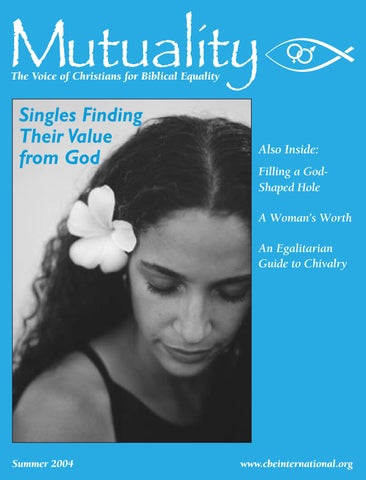
Mutuality The Voice of Christians for Biblical Equality
Singles Finding Their Value from God
Also Inside: Filling a GodShaped Hole A Woman’s Worth An Egalitarian Guide to Chivalry
Summer 2004
www.cbeinternational.org
Contents FEATURES 5 FILLING A GOD-SHAPED HOLE By Jaime Hunt To find fulfillment, women need to understand their value does not come from the love of a man, but from the love of the Son of Man. 8 A WOMAN’S WORTH By Sherri Langton As a single woman, Sherri Langton felt like a failure until God helped her redefine success. 10 ‘WITH GLADNESS AND SINGLENESS OF HEART’ By Jo Ellen Heil The Bible is filled with single people who were loved, called and used by God. 13 RULES TO DATE BY By Jessica Gaylord Do teens receive unhealthy messages about dating?
19 ARTS AND CULTURE By JoAnn A. Shade By His Wounds We are Healed: A Review of ‘The Passion of the Christ’ 20 NEW RESOURCES 21 BOOK REVIEW By Pat Kissel Singles and the Church: A Match Made in Heaven?
12
24 MINISTRY NEWS 26 THE CHAPTER’S CORNER 27 STUDY GUIDE: A RESOURCE FOR STUDY GROUPS By Mary Gonsior 30 PRESIDENT’S MESSAGE By Mimi Haddad Rarely Safe, But Always Good
22
22 AN EGALITARIAN GUIDE TO CHIVARLY By Jon Trott Is is okay to open a door for a lady? Sometimes small things tell us something about big things.
DEPARTMENTS 3 FROM THE EDITOR By Jaime Hunt God Longs to Embrace Us 4 IN OUR MAILBOX
13 2 Mutuality Summer 2004
www.cbeinternational.org
Mutuality
From the Editor
Let us then pursue what makes for peace and mutual upbuilding. – Romans 14:19
GOD LONGS TO EMBRACE US
VOLUME 11, ISSUE 2
When Rebecca* saw the notice in the church bulletin about a short-term mission trip to Haiti, she was elated. For years she had felt called to the small, impoverished nation and she believed she could offer much to the islanders. After the service, Rebecca approached her pastor and told him she wanted to sign up for the trip. She was shocked when he scoffed. “You are an unmarried student,” he said. “You would just be an extraneous adult appendage.” More than a decade later, Rebecca is still single — and she still recalls that painful moment when she realized that to some people her value as a person was directly tied to her marital status. Rebecca’s story and a myriad of others haunted me as I worked on this issue of Mutuality. Since my early days as a Christian, I have been aware of the subtle and not-so-subtle ways women’s callings are marginalized or, worse, negated, but somehow the unique challenges facing singles — and single women in particular — escaped my attention. As we worked on this issue, it became clear that this topic touches tender spots for many singles. It also became obvious that this is a subject that generates much attention, but no clear guidance. Some writers and speakers encourage singles to “put themselves out there” in the quest for a mate. Others encourage singles to make the most of their lives “while waiting for Mr. Right.” But platitudes cannot fill a void and no advice can replace God’s will. I often hear God. Sometimes he whispers. Sometimes he shouts. Sometimes he fills my hands with his message and sends me scurrying to share it. For this issue of Mutuality I heard his message loud and clear: “My children need to know I love them. My children need to know I value them. My children need to know that this is all that matters.” God yearns for our love. He wants us to fall into his embrace. He has a plan for each of us; a plan more beautiful than any we could dream of on our own. May we lay our trust in his divine wisdom and find our value in his love.
Jaime Hunt
The Voice of Christians for Biblical Equality
MUTUALITY seeks to provide inspiration, encouragement and information about equality within the Christian church around the world. President/Publisher: Editor: Editorial Assistant: Staff Writers: Art Director:
Mimi Haddad Jaime Hunt Jessica Gaylord Julia Bloom Mary Gonsior Cari Roettger
EDITORIAL AND ADVERTISING OFFICE Christians for Biblical Equality 122 W. Franklin Ave., Suite 218 Minneapolis, MN 55404-2451 Phone (612) 872-6898 Fax (612) 872-6891 E-mail: mutuality@cbeinternational.org Web site: www.cbeinternational.org Advertising in MUTUALITY does not imply organizational endorsement. SUBMISSIONS MUTUALITY welcomes submissions. E-mail mutuality@cbeinternational.org or write to CBE for writer’s guidelines. PERMISSIONS Christians for Biblical Equality grants permission for any original article (not a reprint) to be photocopied for local use provided no more than 1,000 copies are made, they are distributed free, the author is acknowledged and CBE is recognized as the source. MUTUALITY (ISSN: 1533-2470) is published quarterly by Christians for Biblical Equality and is sent free to members. For membership information, see page 31.
By Jaime Hunt
Jaime Hunt can be reached at jhunt@cbeinternational.org. EVANGELICAL
PRESS ASSOCIATION
www.cbeinternational.org
*Not her real name.
Mutuality Summer 2004
3
In Our Mailbox Thanks for encouragement I have been a great fan of J.R.R. Tolkien for many years, but I never made the connection with the gender-accurate versus utuality gender-generic lanMen and guage translation ToServing GoWdomen gether regarding Eowyn and the Lord of the Nazgul [as noted in the Spring 2004 review of “Return of the King”]. It was terribly funny to me and at the same time I realized it was absolutely true. I also liked Jaime Hunt’s comment [in her Editor’s Letter]: “Our differences are not sinful. How we respond to those differences can be.” Thanks for the encouraging and heart-warming stories in Mutuality! I have CBE on my daily prayer list. Anne Sims Dallas, Texas
M The Voice
of Christia ns for Bibl ical Equality
Also Inside:
Created for Life Together
Business Partners/Ki ngdom Partners
Conquering Sexual Sin in the Ministry
Spreading the Word
Spring 2004
through the many materials you gave me. I am especially impressed by the tone of your publications, which is so far from the antagonism that I have always assumed accompanies discussions about gender. Instead, your organization seems to embody a really cooperative spirit — and this is especially refreshing. I hope our paths cross again in the future! Ali Symons Nova Scotia, Canada
www.cbei nternational .org
From shipwreck to safe waters CBE has been a lifeline to me — thank you for the work you do. Church has been a consistently hurtful, alienating and discouraging experience in my life, and I consider myself pastored by your ministry and the books I’ve read through it. God has used you to lead me from shipwreck to safe waters, and it’s a privilege to pray for you and be part of your work. Keely Emerine Mix Moscow, Idaho Highlights of Urbana I met [Mimi Haddad] at Urbana this past December. I attended [her] “CBE as a Reformist Movement” presentation and then we chatted for a bit afterwards. That was definitely one of the highlights of Urbana for me. I didn’t think that I would find anyone who shared my interests at Urbana, so it was really encouraging to talk to an academic Christian woman interested in gender issues. I've enjoyed learning about CBE
4 Mutuality Summer 2004
We’d love to hear from you! Send your comments, suggestions and critiques to: MUTUALITY 122 W. Franklin Ave., Suite 218 Minneapolis, MN 55404-2451 Phone: (612) 872-6898 Fax: (612) 872-6891 E-mail: mutuality@cbeinternational.org Web site: www.cbeinternational.org Letters may be edited for clarity and brevity.
Visit CBE’s Web site at www.cbeinternational.org For the latest: • Cutting-edge Biblical Resources • Ministry News • Free Articles
www.cbeinternational.org
Filling a God-shaped hole Women must find their value not from a man, but from the Son of Man By Jaime Hunt
G
Growing up, my father’s esteem was the most important in my life. Throughout my childhood I attempted to meet — and exceed — his expectations for me. I longed for his approval. If he thought I was smart, I was. If he thought I was pretty, I was. If he thought I was worthy of love, I was. My father’s sense of who I was shaped who I wanted to be. And it shaped who I wanted to be with. Whether a girl’s relationship with her father was good or bad, existent or not, he is still the first man in her life. As girls move from childhood to adolescence to adulthood, their fathers are often the first people they turn to discover their worth. But no father is perfect; and no matter how much effort he exerts, at some point he will fall short. Whether because of little disappointments or spectacular failures, fathers are not able to fulfill all our needs. “We have places of aching need in our souls that even the best father cannot humanly touch,” writes Paula Rinehart in her book Sex and the Soul of a Woman. “The question that shapes our lives is Filling a God-shaped hole continued on page 6
www.cbeinternational.org
To find fulfillment, women need to understand their value does not come from the love of a man, but from the love of the Son of Man.
Mutuality Summer 2004
5
Filling a God-shaped hole continued from page 5
where we take this need. Many of us envision redemption in the shape of a man — a living breathing person very different from ourselves who seems destined to fill the void.” But there is no man on earth who can fill that void. Only God can meet all of our needs and give us a lasting sense of self worth. Instead of relying on a man to give us value and purpose, we must learn to shift our focus to God and his Son. Looking at the women in Jesus’ life, we can see the love and devotion he attracted. During his ministry, the women who followed him ranged from the wife of a powerful associate of a king to a woman tormented by demons. All who sought his love found it. Even the woman in John 8:3-11 — a woman who had been caught in the act of adultery — found redemption and worth in Jesus’ eyes. These women left behind their pasts, which were littered with disappointment and hurt, and followed Jesus. Throughout his life, he never disappoint-
“Friends … We have come to bring you the Good News that you should turn from these worthless things to the living God, who made heaven and earth, the sea, and everything in them.” — Acts 14:15 ed them. And his greatest, most unbelievable promise — his resurrection on the third day — was fulfilled. “The best explanation for the devotion of these women is that no one ever loved them like he did,” writes Rinehart. “Innumerable women would echo just that: ‘No one ever loved me like Jesus.’”
In the arms of God To find fulfillment, women need to understand their value does not come from the love of a man, but from the love of the Son of Man. But since the Fall, both women and men have sought their worth in the arms of other humans. Since that fateful day in the garden, people have hunted for validation, often
Sometimes God takes us through deserts – times when life seems empty and alone. 6 Mutuality Summer 2004
www.cbeinternational.org
Finding validation from God Men must look to God to find their purpose Like women, men must also turn to God to find their value and purpose. No human being can confer it. Further, until a man is confident of his worth in God’s eyes, he is not prepared to reflect God’s love to another. But it may be even more difficult for a man to accept that God is the only true judge of his value. It is hard for men to escape a Western culture that ranks careers, income, status, cars and gadgets as the measure of a man. I can see many men in my life striving for something they can never attain. No job title, no fancy sports car, no six-figure paycheck will ever fulfill them. A God-shaped hole cannot be filled with “stuff” — or with people. To set that all aside and take up God’s love as a cloak of value can be a Herculean task — not to mention counter-cultural. However, to fully experience God’s kingdom on earth, to fully be a part of God’s community, to fully participate in God’s purpose, men must fall in love with Jesus. He alone can bestow what a man needs most — value, purpose and worth. — Jaime Hunt in their human relationships. If we are alone, we are unloved — or so we believe. Countless books, movies and songs direct us toward each other to find wholeness. (Think of the tear-jerking scene in Jerry Maguire when Tom Cruise desperately cries out to Renée Zellweger, “You complete me.”) Even popular Christian literature often promotes this message, suggesting that only through marriage can people find their ultimate calling — to be loved by a spouse and to raise a family. What a hurtful message for those not in that season of their lives, or for those who never marry. On the flip side of the same coin lies independence. In Western culture, women are taught to be independent, to move through life without assistance from anyone. “The strong, independent single
www.cbeinternational.org
woman has become a cultural icon,” says Rinehart. “Oddly enough, in Christian circles, ‘not needing anyone’ is sometimes mistaken for a virtue, as though godliness were about looking to God alone, without any real human touch. But this defies God’s plan for you as a woman created for connectedness, with a heart full of longing. It blinds you to the special symmetry that is possible in the presence of a man — no matter what the setting. What he brings to the table and what you bring to the table is, indeed, a sum greater than other part.” This Western glorification of independence leaves women wandering aimlessly in an attempt to find fulfillment in themselves instead of in their Father’s arms. Embracing God’s love Another great myth is that marriage is a cure-all for loneliness. But anyone can feel alone, even married people. So what’s a woman to do? With a God-giving longing for connectedness, how do we reconcile our understanding that nothing but God can give us value? Again we must direct our eyes to Jesus. Acknowledging that only God can fill a God-shaped hole and actually living that are two different things. But aloneness can be the catalyst that drives us back to the Father. Sometimes God takes us through deserts – times when life seems empty and alone. In my own life I experienced this when a debilitating injury took away nearly everything I used to gauge my value. In one moment I lost my professional successes, my future as an officer in a publishing company and my substantial income. I clung to what remained, hoping to find my value in my husband, my family and my friends. But when those things inevitably failed me, I floundered in a desert of sorrow. It wasn’t until I finally stopped wrestling with God and let him embrace me that I realized he alone is able to give me worth and value. I found my truest self, and worth, in the arms of God. Wrestling with God is a time-consuming and exhausting, but worth it if the fear of aloneness is banished and self worth takes its place. People confident in their own value are ready to embrace the plans God has for their lives — whether or not marriage and children are a part of those plans.
Help CBE Build For the Future GOAL $100,000
$75,000
$55,000
$25,000 $10,000
$5,000
We love it when a glimpse of God’s vision for CBE comes through the gifts of our members. Due to the gifts of generous donors, CBE established an endowment fund of over $56,000. The board designated this money for investment, and the interest from the principal will be used for projects above those outlined in our annual budget. For example, the interest from the endowment fund was used to bring speaker Funmi Para-Mallam from Nigeria to our Orlando conference. Imagine what income from this fund can provide in time. We need your help to make these dreams reality. At CBE, we see the endowment fund as a sapling tree. It will grow over time, but we may not be the ones to see it to maturity. With faith, we ask for your help to invest in the future. Please help us care for this fund like a vulnerable tree that needs water, sun and fertilizer to grow. Your contributions will lead to the growth of a large tree that can provide shade for many under its branches.
Mutuality Summer 2004
7
A Woman's Worth As a single woman, I felt like a failure — until God helped me redefine ‘success’ By Sherri Langton
“You need to find a husband,” my stylist announced, briskly clipping my curls. Ignoring my silence, Janet (not her real name) bubbled about an eligible male customer of hers who was “just right” for me. There was a time when such comments about my single state would rub me raw. To Janet and the others who meddled in my personal life, a woman my age should be in the happily-ever-after set — not still searching for Mr. Right. If a thirty-something woman hadn’t tied the knot, folks thought something was wrong with her. For many years, I agreed with them. The word single sounded like a disease to be avoided at all costs. Sometimes the Bible’s support for the single life helped me feel less weird. But if being single was so great, as the apostle Paul said in 1 Corinthians 7, then why did most of my friends constantly date in an effort to head toward the altar? And why did the few single women I knew seem like miserable misfits? I concluded marriage and motherhood equaled “success” for a female; singleness branded her a failure. Thankfully, as I got older, I got wiser. God challenged my notion that a woman’s worth is based solely on her marital status. Over the years he’s opened my eyes to the many ways he considers me a success
8 Mutuality Summer 2004
— even as a single woman. God can help change your definition of success, too. Here’s how. Holding Fast to God’s Standards Oddly enough, God began teaching me my best lessons as a single through a few forgettable dates. First there was “Richard,” a college classmate, who took me to dinner and a movie, then cheerfully suggested we spend some time at his apartment since his roommate was gone. When I refused, Richard’s easygoing manner switched to anger. He mashed down on the accelerator and abruptly drove me home. After I had a good cry, God pointed out that I’d protected my virginity, a counter-cultural move he considers a huge success. Next was a blind date with a handsome, well-dressed guy named Hans. Unfortunately, the best part of our evening together was the movie we watched — two blessed hours in which I didn’t have to hear Hans talk about himself. Our time together taught me how deceiving looks can be. Jesus’ words in Matthew 12:34 proved true: “Out of the overflow of the heart the mouth speaks.” Preferring inner beauty in a guy more than outer, God showed me, is success. Influencing Little Ones With the birth of my first nephew, Ryan, God began correcting another misconception of mine. A successful woman isn’t solely one who raises godly sons or daughters, but rather one who also positively influences the children he places in her life. My heart wrapped quickly around Ryan. I snapped scads of pictures of him and took turns feeding and burping him. As my nephew grew, we progressed to playing with Legos, puzzles and Hot Wheels.
Eight years after Ryan’s birth, I delighted in the arrival of my second nephew, James. I fell into the same feeding/burping routine as I had with Ryan. Soon I advanced from reciting nursery rhymes to studying bugs, playing ball, flying kites and collecting rocks. With each activity, God showed me he was using our special bond to bless these little boys he’d placed in my life. As time went on, both my nephews learned life isn’t all kites and Legos. Ryan developed diabetes at 13 and rebelled against the injections and a diet that set him apart from his peers. When he was 10, James underwent surgery for a hematoma on his brain. Although the operation was successful, he battled headaches for months and wrestled with his faith, wondering why God didn’t heal him. I realized our times of playful bonding had prepared me to relate to James and Ryan on a deeper level. During our “teachable moments” together, I told them that while it’s OK for boys to cry and get mad at God, they must trust him no matter what. Passing on biblical truth to young lives, I’ve come to realize, is a fulfillment of the command in Deuteronomy 4:9 to teach God’s laws to our children — and another mark of a woman’s worth. Giving Away My Gifts Since my teens, I’d written poetry for my family and friends. But when I offered this gift to God when I was in my 30s, he mixed it with my love for the Bible, and I created my own line of greeting cards called Godsend. Each month I wrote a poem based on Scripture, printed it on card stock, and mailed it to people suffering through divorce, grief, chronic illness, depression and other problems. I also joined a writing group, and before our monthly meetings, I meet for dinner with friends who share my love of writing
www.cbeinternational.org
but not my Christian beliefs. These informal times provide opportunities for me to talk about my faith and invite them to church. I’ve felt God smile at my willingness to give him my gifts, allowing him to use them to bless others — and me. No matter what I do, the best part is knowing God will call me “good and faithful” for
Homes and Gardens, mainly for what it symbolized: God’s faithfulness in answer to my dependence on him. I didn’t know then how much more I’d have to lean on him. Two years after I moved, a layoff cut my well-paying job out from under me. Worry plagued my thoughts: What if I lose my condo? What if I have to declare bankruptcy? But Jeremiah
Placing faith in God's promises — even in uncertain times — helps me grow in spiritual maturity and find worth as his daughter. Instead of needing a spouse and kids to find my worth as a woman, I’ve come to realize success is measured only in following God and making the most of where he has me in life. With God shap-
Influencing children — whether others or your own — is another mark of a woman’s worth. not wasting the talents and abilities he gave me. Leaning on My Lord When the woman I’d shared a house with for seven years decided to go solo, I realized it was time for me to buy a house. Part of me relished the thought of buying furniture and selecting a color scheme. The other part froze: What about property taxes and homeowner headaches? Fear pushed me to commit my plans to God and trust in him, as Psalm 37:4 says. When I finally signed the papers and settled into a condo, my new home meant more to me than any house out of Better
www.cbeinternational.org
29:11 told me God had plans for me — for hope and a future. As I circulated résumés and scoured want ads, God listened to my questions, pumped me full of peace and stood by me during my fits of depression. And true to his Word, he prepared a job just right for me — three weeks before my unemployment checks stopped. For the past 12 years, he’s guided me in a career that fits my desires and skills perfectly — proof that his plans are for my good. I’ve built more than equity in my home and stability in my job; I’ve built trust through the best partnership I could have with the One who will not let me go.
ing my perspective, there’s no such thing as failure. Sherri Langton is a freelance writer and workshop speaker at Christian writers conferences. She is also associate editor of Bible Advocate magazine and Now What? e-zine. This article first appeared in Today’s Christian Woman (March/April 2003), published by Christianity Today International, Carol Stream, Illinois.
Mutuality Summer 2004
9
gladness and singleness of heart’ ‘With
Single souls of the Bible By Jo Ellen Heil
Did you know that the Bible is filled with single people who were loved, called and used by God? Whether prophets or widows, eunuchs or church leaders, these single souls served God “with gladness and singleness of heart.” And the greatest among them was the Son of God. In contrast to best sellers like The Da Vinci Code, Scripture provides its readers with a wholesome, balanced picture of Jesus of Nazareth. A healthy, celibate man, he enjoyed the hospitality of friends, wept at funerals, played with children and was at times misunderstood by his family. He paid his taxes in sometimes humorous ways and cooked breakfast on the beach for those he loved. Along the way he regularly took time to be alone and nurture his relationship with the Father. Providing him with a balanced spiritual community, his followers included married people like Peter (Matthew 8:1417) and Joanna (Luke 8:3), and single friends such as Mary, Martha and Lazarus of Bethany (John 11:1-14; 12:1-11). Sometimes those around him got carried away with the technical importance of marriage, as in the debate over the woman who had been widowed seven times. Focusing instead on eternal realities, Jesus told them, “How wrong you are! And do you know why? It is because you don’t know the Scriptures or God’s
10 Mutuality Summer 2004
power. For when the dead rise to life, they will be like the angels in heaven and will not marry” (Mark 12:24-25). Because he was a single man living in a marriage-oriented world, his choice to quote from Isaiah can provide particular encouragement for those who have ever felt marginalized because of their singleness: “Thus says Yahweh: ‘Have a care for justice, act with integrity, for soon my salvation will come and my integrity be manifest.’ Let no foreigner who has attached themselves to Yahweh say, ‘Yahweh will surely exclude me from his people.’ For Yahweh says this: ‘To you eunuchs who observe my Sabbaths I will give, in my house and within my walls, a monument and a name better than sons and daughters. I will give you an everlasting name that will never be effaced. Those of you who have attached yourselves to Yahweh to serve me, to love my Name and be my servants, you I will bring to my holy mountain I will make you joyful in my house of prayer. Your holocausts and sacrifices will be accepted on my altar, for my house shall be called a house of prayer for all peoples.’ It is Yahweh who speaks, who gathers the outcasts” (Isaiah 56:1, 3-7). Prophets: God’s visionaries in perilous times God did not hesitate to call single peo-
In contrast to best-sellers like The Da Vinci Code, Scripture provides its readers with a wholesome, balanced picture of Jesus of Nazareth. ple to speak prophetic truth whether they lived during the Exodus, the fall of Jerusalem or the life of Jesus. A prophet and leader of the Exodus alongside her brothers Moses and Aaron (Micah 6:4), Miriam was the first female singer recorded in the Bible. Using her musical skill, she led her people in worship when they left Egypt after 400 years of slavery (Exodus 2:4-9; 15:19-21). Told specifically not to marry nor have children (Jeremiah 16:1), God called Jeremiah to prophesy during the final turbulent years of the Kingdom of Judah. Taunted, unjustly accused and imprisoned, he witnessed the Babylonian invasion and fall of Jerusalem. Yet his words of promise from God still ring true: “I
www.cbeinternational.org
alone know the plans I have for you, plans to bring you prosperity and not disaster, plans to bring about a future full of hope” (Jeremiah 29:11). Widowed after only seven years of marriage, Anna of the tribe of Asher spent a lifetime worshiping, fasting and praying. Recognizing the fulfillment of Messianic prophesies when Jesus’ parents brought him to the Temple to be dedicated, she proclaimed his arrival “to all who were waiting for God to set Jerusalem free” (Luke 2:36-38). Eunuchs: Given a name better than sons and daughters When God is in charge, being in the right place at the right time is never an accident. Perceiving God at work in their midst, these two eunuchs, Ebedmelech and Heget, broke through racial and cultural boundaries to do what was right. Ebedmelech the Sudanese served King Zedekiah in Jerusalem just before the Babylonian invasion. When he learned that political leaders had thrown Jeremiah down a muddy well in the courtyard, he went before the king and declared, “Your Majesty, what these men have done is wrong.” Ordered to pull Jeremiah out before he died, the African courtier took workers to the storeroom, gathered up rags and instructed the prophet to pad himself so that he would not be injured by the ropes which pulled
Young and old, rich and poor, male and female,
single people were included in the early church from the very beginning. interview. She became queen and saved the Jewish people from destruction (Esther 2:8-9, 15).
Ovens and the Valley Gate (Nehemiah 3:12). Like Nehemiah, they believed in God’s promises for a brighter future.
Daring daughters who claimed God’s promises Full of youthful enthusiasm, these daring daughters defied convention to claim God’s promises. On the eve of the Jews’ entry into the Promised Land, Zelophehad’s daughters set a legal precedent for the recognition of women. When their father died, Mahlah, Noah, Hoglah, Milcah and Tirzah of the tribe of Manassah could not inherit his goods or lands because they were female. The five sisters went to the entrance of the Tabernacle and presented their case to Moses, the High Priest and community leaders: “Give us property among our father’s relatives” (Numbers 27:4). When Moses consulted God, God responded, “What the daughters of Zelophehad request is right.” As a result they not only received their inheritance, but also a new Mosaic law was created: “If a man dies without leaving a son, his
Widows: Recipients of God’s generous abundance In addition to providing for them under Mosaic law, God sometimes miraculously intervened to sustain widows during times of famine, hardship and loss. The Phoenician widow of Zerephath and her son lived near the port of Sidon during a famine caused by drought when Elijah arrived. Close to starvation, she nevertheless obeyed the prophet’s request for food and water and, as a result, the three were miraculously fed (1 Kings 17:8-24). Nine hundred years later, Jesus praised her faith in his first public sermon (Luke 4:25). God’s promise to her still provides hope: “The bowl will not run out of flour nor the jar run out of oil before the day that I, the Lord, send rain” (1 Kings 27:14). When her husband died, the widow of a prophet was saddled with his debts and the reality that her sons could be sold away as slaves. Following the prophet Elisha’s instructions, she borrowed her neighbors’ empty jars and poured her small supply of olive oil into them. God filled each one to the brim. Her debts were paid, her future secured (2 Kings 4:1-7). Already bereaved, the widow of Nain was left without economic and emotional support when her only son died. Filled with compassion over her loss, Jesus first comforted her (“Don’t cry”) and then raised her son from the dead in front of a crowd of astonished mourners (Luke 7:11-17). It was the first time Jesus raised someone from the dead.
single persons to speak prophetic truth whether they lived God did not hesitate to call
during the Exodus, the fall of Jerusalem or the life of Jesus. him to safety (Jeremiah 38:5-13). Highly conscious of his own tenuous position, Ebedmelech was rewarded by God with an intimate — and practical — promise: “I will keep you safe because you have put your trust in me” (Jeremiah 39:1518j). In charge of King Xerxes’ harem at the palace in Susa, Hegei perceived Esther’s uniqueness out of all the candidates for Queen of Persia. Providing her with special foods and beauty treatments, he gave her seven servants (a sign of domestic power) and advised her before her royal
www.cbeinternational.org
daughter is to inherit his property” (Numbers 27:9). Women’s property rights were recognized for the first time in history (Numbers 27:1-11). Authorized by the Emperor of Persia to rebuild Jerusalem after the Babylonian invasion, Nehemiah turned politicians, perfume makers, priests, goldsmiths and merchants into construction workers. Together they reconstructed the city’s walls, towers, gardens and gates. Shallum’s daughters were among them. Daughters of the ruler over half of Jerusalem, they built the wall between the Tower of the
I will pour out my spirit upon all flesh:’ Leaders of the early church Whether young or old, rich or poor, single people were included in the early ‘With gladness and singleness of heart’ continued on page 12
Mutuality Summer 2004
11
Remember CBE in your Will Choose your giving while you are living. Leave a legacy through CBE. For more information visit CBE’s Web site: http://www.cbeinternational.org/ new/help_cbe/will_to_cbe.shtml
Called to ministry? Women in Leadership A Study of Women Pastors on Video or DVD $39.95 plus shipping This look at women in the Presbyterian Church will give all people interested in the topic a peek at the opportunities and challenges for women in the pastoral role.
To order, contact: Dr. Elizabeth Klein 4801 Hyada Blvd NE Tacoma, WA 98422 253.952.4441 www.kleinink.com kleinink@comcast.net 12 Mutuality Summer 2004
‘With gladness and singleness of heart’ continued from page 11
church from the very beginning. Phillip, one of the deacons originally elected in Jerusalem to distribute relief to the poor (Acts 6:5), had four daughters who prophesied or “proclaimed God’s message.” While living in Caesarea the family hosted Paul and his party just before Paul was arrested in Jerusalem (Acts 21:8-9). An active, recognized group within the early church, widows “of a certain age” prayed, taught younger believers, collected alms and cared for orphans (1 Timothy 5:3-16). Dorcas of Joppa may
have been one of these. Her philanthropy, compassion and skill as a tailor had already given her a wide following. When she was raised from the dead many became believers (Acts 9:36-42). Half Greek and half Jewish, Timothy was raised by his mother Eunice and grandmother Lois in Lystra, a city in the Roman province of Galatia (Acts 16:1-2). Paul praised the abundant faith of all three (2 Timothy 1:5) and called Timothy “my true son in the faith” (1 Timothy 1:2). Jailed on occasion, he traveled to the Roman colony of Philippi (Acts 16:12), Macedonia (Acts 19:22), the Greek city of Corinth (1 Corinthians 4:17) and Thessalonica (1 Thessalonians 3:2) to share the Good News. Contentedly single, the apostle Paul worked alongside believers of every racial, marital and economic status, often praising them by name in his letters. Devoted to spreading the Gospel despite physical hardship, political opposition and separation from those he loved, Paul held energetic views on almost every topic. His affirmation of singleness was no exception: “A man does well not to marry ... I would prefer that all of you were as I am; but each one has a special gift from God, one person this gift, another one that gift. “I would like to have you free from worry. An unmarried man concerns himself with the Lord’s work, because he is trying to please the Lord ... An unmarried woman or a virgin concerns herself with the Lord’s work, because she wants to be dedicated both in body and spirit. “I want you to do what is right and proper and to give yourselves completely to the Lord’s service without any reservation... “The man who marries does well, but the one who doesn’t marry does even better” (1 Corinthians 7). Jo Ellen Heil is a charter member of CBE and has led workshops on women in history at several CBE conferences. In addition to being a quilt maker, she is currently a newspaper columnist, independent bookseller and library technician. Always single, she recently celebrated her “50 is nifty” birthday with great joy.
www.cbeinternational.org
Rules to Date By A r e t e e n s r e c e i v i n g u n h e a l t hy m e s s a g e s a b o u t d a t i n g ?
By Jessica Gaylord
Every time I visit a Christian bookstore, the section on teenage dating has grown. Many of these books advocate for alternate dating methods like courtship, others promote sexual purity and some denounce the dating process altogether. Each book has its own angle, but it’s apparent that a substantial number of books are tackling the issues associated with adolescent relationships. Two of the most recent releases in this rapidly developing genre are Dateable: Are You? Are They? and its companion book The Dateable Rules. Authors Hayley Morgan and Justin Lookadoo provide a set of rules for dating, which are intended to minimize the pain and regret that often result from broken teenage relationships. Dateable, the first book in this series, expresses Morgan and Lookadoo’s general philosophies on dating, while The Dateable Rules breaks down the concept of being “dateable” in a more practical manner. A Narrow Interpretation of Gender Roles An integral concept of the Dateable series is the idea that “men need to be men” and “women need to be women.” Independence and competitiveness are “guy qualities.” Readers are told, “Dateable guys know that they aren’t as sensitive as girls and that’s okay. They know that they are stronger, more dangerous, and more adventurous and that’s okay too. Dateable guys are real men who aren’t afraid to be guys.” At the beginning
of The Dateable Rules, Lookadoo says, “Since the day the first caveman swatted at the giant pterodactyl, men have been the tough ones. We fight the wars, save the country, and rescue the beauties. It’s God’s plan so we can’t argue. We gotta
“a strong girl. She’s confident in herself. A good student. Great athlete. An allover solid girl. She’s also totally independent….She’s her own woman. She’s strong enough to open the door for herself, thank you very much. She doesn’t
As teens mature, most of them realize that godly relationships between men and women are not as simple as many of these books suggest. They are then left in the undesirable position of trying to unlearn what they’ve been taught about relationships. break stuff, kill things, and get dirty. It’s just part of the male nature.” In The Dateable Rules, Morgan focuses less on what girls should be and more on what they should not be. She introduces readers to Melissa, a hypothetical high school girl who can’t get a date. Melissa is
want guys to think she’s weak and dependent. So she acts strong and independent.” Morgan explains that Melissa doesn’t have a boyfriend because she has no need for one. “She’s got it all under control. Rules to Date By continued on page 14
www.cbeinternational.org
Mutuality Summer 2004
13
Rules to Date By continued from page 13
She’s doing everything he would normally do for her.” Melissa’s independence “becomes a deterrent instead of an attractant. It deters guys from offering a helping hand, from getting a door, from being the stronger of the two.” Lookadoo inserts a note here, telling the girls, “…when you never need me, you take away your beauty.” Instead of encouraging girls to present themselves as unable to handle the “guy things,” both genders should be encouraged to look to the Lord to fulfill their needs. As teens grow and mature in the Holy Spirit, they will be able to present themselves as whole people ready to compliment the lives and gifts of other whole people. Male and Female Differences: To be Celebrated or Tolerated? Most of us acknowledge that differences between the sexes exist. Yet, rather than presenting the unique qualities of each gender as glorious God-given gifts, Morgan and Lookadoo portray these differences as irritating defects that each gender must learn to endure. Both books portray the male “nature” in a negative manner. In Dateable’s chapter, “Guys Will Lie to You to Get What They Want,” Lookadoo and Morgan urge girls not to forget that, “in the end, no matter how sweet he is, he is male first. And that means he has one goal, and that is the physical pay-off.” Later Lookadoo claims, “Guys are male first, and Christian second.” Although he does acknowledge that as Christians “we let God begin to change our character,” he still maintains that, “our basic nature comes from being male. And our first thought is sex.” The males aren’t the only ones receiving criticism. In The Dateable Rules Lookadoo and Morgan explain, “Girl’s faults are really obvious and they all start with the mouth.” Guys are told, “She bonds by talking, so listen. At all costs, listen. She will shut up eventually.” In The Dateable Rules, Morgan teaches girls to “shut up and be mysterious.” On the quest to increase their mystery quotients, Morgan even encourages girls to choose a day to stop talking altogether. Lookadoo and Morgan take their ideas of proper female behavior a dangerous step further by stating, “You need to understand that when you take on the
14 Mutuality Summer 2004
Instead of encouraging girls to present themselves as unable to handle the “guy things,” both genders should be encouraged to look to the Lord to fulfill their needs. role of the guy (asking out, calling, paying, etc.) not only do you mess up your dating relationships but you also mess up your spiritual relationship by telling God you just don’t trust him. Don’t get caught in a lie. It isn’t okay for girls to be guys.” Not only is this claim not supported by
Scripture, but Morgan and Lookadoo contradict many of their own assertions about appropriate female behavior throughout both books. In Dateable, the girls are told that, “once you start being honest with yourself, you will become more beautiful.
www.cbeinternational.org
Guys start flipping over a girl who is confident, smart, and honest with herself. You will have a glow about you. An aura that attracts people. You will be more elusive and therefore more sought after. Remember, people want what is rare and hard to get.” This girl doesn’t sound like she needs a boyfriend. Rather, she is “elusive and hard to get.” How can readers reconcile this image with the story of Melissa and its conclusion that guys “need to be needed?” The Truth: Who is in Control? The last page of Dateable contains what may be the most troubling statement of all, “This has not been a philosophy book or a ‘what if’ book. It has simply been the truth. It’s like saying the sky is blue — that’s the truth.” This disturbs me because the only book we can and should count on for that “sky is blue” kind of truth is God’s Word. Lookadoo and Morgan imply several times throughout both books that complying with their rules will guarantee the desired result: an ideal pain-free high school relationship. Some of these references sprinkled throughout Dateable include, “You’re entire social life is under your control, and you’re in the position of social power.” “You are in control of what you do and how much you hurt.” “You get to control your own destiny. Now when the relationship begins, you can read your own future.” It’s quite possible that some teens will accept the content of Dateable and The Dateable Rules as Truth and resolve to abide by all of the rules in these books. These teens may believe that God will automatically honor their obedience to these rules with a lot of dates or a perfect relationship. But God is never bound by rules invented by humans. While it wouldn’t be fair to lump every book in the Christian dating genre with Dateable and The Dateable Rules, I do believe the majority of these books encourage teens to focus on each book’s own particular set of “rules.” Rather than basing guidelines for healthy relationships on the salvation and grace of Christ, guidelines are based on the best ways to attain a perfect future mate or relationship. In the process, the characteristics and complexities of each sex are often oversimplified. Vast generalizations are made, and these generalizations have
www.cbeinternational.org
Teens may believe that God will automatically honor their obedience to these rules with a lot of dates or a perfect relationship. But God is never bound by rules invented by humans. the potential to foster harmful stereotypes. As teens mature, most of them realize that godly relationships between men and women are not as simple as many of these books suggest. They are then left in the undesirable position of trying to unlearn the things they’ve been taught about relationships. A Healthier Focus At the beginning of Dateable, Lookadoo and Morgan tell readers, “…so often we focus our energy and desire on someone else. A person. A crush. We never get to explore that destiny we were designed for because we’re so busy trying to get someone to like us.” What a true statement! Unfortunately, they spend the rest of the book undermining this message. Rather than discovering God’s destiny and design, the focus is shifted to rules intended to transform the reader into a “dateable” person. Energy and desire focused on becoming “dateable” isn’t any more useful than energy and desire focused on a particular person or crush. At the end of The Dateable Rules, readers are encouraged to commit to a list of rules designed to increase “dateablility.” Some of the girls’ rules include letting him lead, needing him and being mysterious. The guys’ rules include standing up like a real man, controlling how far their dating relationships go physically and keeping the women in their lives “covered up.” Perhaps the discussion with teens regarding relationships would be more fruitful if the focus was on a different list. I suggest we look to a list in Galatians 5:22-23, which includes love, joy, peace,
patience, kindness, goodness, gentleness, faithfulness and self-control. Immediately following this list, Paul reminds us that, “Those who belong to Christ Jesus have crucified the sinful nature with its passions and desires. Since we live by the Spirit, let us keep in step with the Spirit.” As God’s sons and daughters, living by the Spirit should be our primary concern. The virtues on the list will develop naturally as the Holy Spirit’s power germinates within us. That means we don’t need to worry about our maleness, femaleness or dateableness. The “rules” associated with these classifications don’t bind us when we are living in the Spirit. Young and old, singles and couples, male and female; this is the sky is blue truth for every one of us.
Send your friend a CBE informational packet! This packet includes brochures and intriguing articles from Mutuality and Priscilla Papers.
Name:
Address:
Please send to: Christians for Biblical Equality 122 W. Franklin Ave., Suite 218 Minneapolis, MN 55404-2451 Or e-mail to: cbe@cbeinternational.org
Mutuality Summer 2004
15
MEN, WOMEN AND THE CHURCH: A BIBLICAL APPROACH TO RELATIONSHIPS September 3-5, 2004 St. John’s College, Durham, England A Symposium Sponsored by: • Christians for Biblical Equality • Men, Women and God • WATCH
Registration Registration Rates: US: $249.00 US non-lodging: $185.00 British: £129.00 British non-lodging: £99.00
Send in your registration quickly; space is limited to 250 registrants.
What Registration Covers: Conference Registration: all of the workshops and general sessions Meals: dinner on Friday, Sept. 3; breakfast, lunch, tea and dinner on Saturday, Sept. 4; and breakfast on Sunday, Sept. 5. Lodging at St. John’s or St. Chad’s: Friday, Sept. 3 and Saturday Sept. 4.*
General Session Speakers N. T. Wright: “Biblical Basis for Women’s Service in the Church” N.T. Wright is the Church of England’s Bishop of Durham. He is the author of over 30 books, including Jesus and the Victory of God and The Resurrection of the Son of God, as well as the popular Everyone series of guides to the New Testament.
Elaine Storkey: “Biblical Feminism: 20 Years Later”
Paying Registration:
Elaine Storkey is a writer and broadcaster. She lectures at the University of London and in the United States, and is president of the TearFund. Elaine is the author of Contributions to Christian Feminism: An Integrated Christian Approach, Search for Intimacy and Gender: Created or Constructed?
If you are from: The United Kingdom: Make checks payble in £ to WATCH and mail to: Charles Read, St. John’s College, 3 South Bailey, Durham DH1 3RJ. WATCH cannot accept credit cards.
David Instone-Brewer: “The Scandal of Equality in First Century Christian Teaching”
(Non-lodging rates do not include breakfasts or lodging.) *Extra nights can be booked by contacting gillian.stewart@durham.ac.uk
Anywhere Else: Pay by credit card or check in US dollars. Mail in payment to CBE, 122 W. Franklin Ave., Suite 218, Minneapolis, MN 55404. Fax to 612-872-6891. Register online at www.cbeinternational.org. Refund Policy:
Rev. David Instone-Brewer is a research fellow at Tyndale House, which is linked to Cambridge University. His current interest is rabbinic traditions that can be dated to New Testament times. David is author of Divorce and Remarriage in the Bible: The Social and Literary Context.
Full refunds minus a $35 administrative fee will be granted until July 15.
Travel Information Durham is one of the most beautiful cities in England. The conference is across the street from Durham Cathedral. During the conference, the Cathedral will hold an Octave of Celebration for the 900th anniversary of the Translation of the Relics of St. Cuthbert. Durham is 264 miles from London, 187 miles from Birmingham and 125 miles from Edinburgh.
Travel Tips: 1. Book your flight and rail travel early! 2. Check out deals at discount travel Web sites. 3. Fly into Edinburgh or Glasgow, Scotland instead of London. 4. Use frequent flyer miles for travel to the UK. 5. Price tickets on airfare consolidators.
www.cbeinternational.org
Esther D. Reed: “Authority, Scripture and Women in the Church” Esther D. Reed is a lecturer in theology and ethics at the University of St. Andrews. She is the editor of the journal Studies in Christian Ethics, and is the author of several books including The Genesis of Ethics: On the Authority of God as the Origin of Christian Ethics. She is a member of the Methodist Church of Great Britain and has served on its Faith and Order Committee, and on the Methodist European Theological Committee. She is currently writing a book on human rights from a Christian ethical perspective.
Michele Guinness: “Service to Christ: My Personal Journey” Michele Guinness is a dynamic and popular Christian speaker in the U.K and is currently the head of communications for the Cumbria and Lancashire Strategic Health Authority.
Mutuality Summer 2004
16
Workshop Speakers Charles Read: “Inclusive Language and God: How Language Helps Us Think Biblically”
Mimi Haddad: “WildHearted Women: A Survey of Women Leaders in the Church”
Christina Rees: “The Philosophical Background to Hierarchy in the Church”
Charles Read teaches liturgy and shares in the teaching of systematic theology at Manchester University.
Mimi Haddad is the president of Christians for Biblical Equality.
Christina Rees is the author of several books and articles. She is also a freelance broadcaster who comments on Christianity and the Church of England.
Valerie and Michael Griffiths: “A Biblical Basis for Women Elders?” Valerie holds bachelors and master’s degrees in theology. Mike holds a bachelor’s degree in natural sciences and was awarded a DD from Wheaton. Mike and Valerie spent 10 years in Japan and 13 years in Singapore as members of the Overseas Missionary Fellowship.
Ellen Armstrong: “Sexual Exploitation and Violence Toward Women: Global and Local Concerns”
David Instone-Brewer: “Equality in the Biblical Marriage Vows: The Origins of Love, Honour and Cherish”
Mary Evans: “The Powerless Leader: A Contradiction in Terms or a Biblical Ideal?”
Kevin Giles: “Subordination, the Trinity and the Gender Debate” Kevin Giles is vicar of St. Michael’s Church (Anglican) in North Carlton, Australia.
Elisabeth Goddard: “Under Authority? Men, Women and the Bible.” Elisabeth Goddard is an ordained priest/presbyter in the Church of England, and currently serves as chaplain of Jesus College, Oxford University.
Per-Axel Sverker: “Feminist Theology-A Challenge to Evangelicals” Per-Axel Sverker oversees the Department for Systematic and Historical Theology at Örebro Theological Seminary, in Sweden.
Alison Wilkinson: “Empowering Women as Leaders” Alison Wilkinson is a parttime Methodist minister in Durham and Deerness Valley, where she has pastoral charge of two churches. She recently finished her Ph.D. in Christian Formation, assessing how women are formed in their discipleship and leadership.
17 Mutuality Summer 2004
(See bio on page 16.)
Paul Chilcote: “Biblical Equality and the Spirituality of Early Methodist Women” Paul Chilcote is a professor of historical theology and Wesleyan studies at Asbury Theological Seminary, in Orlando, Fla.
Ellen Armstrong is the assistant project manager of Trust, a Christian community project supporting women involved in prostitution in South London.
Mary Evans teaches Old Testament at London Bible College.
Ron Pierce: “The Feminine Voice of God: Women as Prophets in the Bible” Ron Pierce has taught biblical studies and theology at Biola University since 1976. He has been ordained with the Evangelical Free Church since 1989.
Ellen Alexander and Beulah Wood: “Helping Christians Set Trends for Oppressed Women in India”
Panel Discussion: “Serving Christ as Husband and Wife: Marriage, Ministry and the Church” David and Alison Wilkinson and Elisabeth Goddard will participate in this discussion.
Ellen Alexander, a teacher of ethics and a longtime voluntary worker with the Union of Evangelical Students of India, recently completed her M.Th. from the University of Wales. Beulah Wood, B.D., D.Min, has worked in India and Nepal since in 1968.
David Wilkinson holds a Ph.D. in astrophysics, and is a fellow in Christian Apologetics and Associate Director of the Centre for Christian Communication, St. John’s College, University of Durham.
www.cbeinternational.org
A Call for Papers
Beyond Abuse Creating Peace and Safety in the Christian Home
February 24 - 26, 2005 Newport Beach, California Henry Cloud, PhD
Catherine Clark Kroeger, PhD
Dan Allender, PhD
PASCH invites workshop and paper proposals for a conference to discuss strategies for creating peace and safety in the Christian home. Henry Cloud, Dan Allender, Catherine Kroeger, and others will seek to examine the impact of abuse in Christian families worldwide. Issues of safety and healing as well as therapeutic responses to violence will be considered. Workshop and paper topics are encouraged from the following four tracks. •
Mental Health Professionals: Faith based creative and innovative strategies for facilitating hope and healing for batterers, victims and their families.
•
Clergy and Para-church Organizations: Key strategies to empower leadership to find solutions for control and abuse issues in the Christian community, such as pastoral challenges and congregational impact.
PEACE AND SAFETY IN THE CHRISTIAN HOME
•
Community Support: Strategies to equip every concerned Christian as they assist those affected by domestic violence, such as building bridges between secular and sacred interventions or ways to promote safety in the faith community.
•
The Arts: Explore the role of the arts in facilitating hope and healing.
Proposals for workshops and papers should be sent to: Elizabeth Kroeger Elliot, Proposal Coordinator 422 East Columbia Street, Falls Church, BA 22046 (703) 536-5608 • Elizabeth@peaceandsafety.com Deadlines: Workshop Proposals, 90 minutes, (title and description): September 1, 2004 Paper Proposals, 30 minutes, (title and abstract): October 15, 2004 Sponsored by: PASCH (Peace and Safety in the Christian Home). (Visit our website at www.peaceandsafety.com)
18 Mutuality Summer 2004
www.cbeinternational.org
A &Culture rts
Welcome to Mutuality’s new “Arts and Culture” section! Included in this segment will be reviews of Christian and secular movies, music and other artistic forms of communication addressing gender. If you would like to submit a review, please e-mail Jaime Hunt at jhunt@cbeinternational.org or send a copy of your review to Christians for Biblical Equality, 122 W. Franklin Ave., Suite 218, Minneapolis, MN 55404.
By His Wounds We are Healed: A Review of ‘The Passion of the Christ’ By JoAnn A. Shade In what has been described as a postChristian American culture, it is fascinating when Christ breaks through. In the making and marketing of Mel Gibson’s “The Passion of the Christ,” Jesus has broken through in a powerful and profound way. I remember the “Jesus Christ Superstar” sensation of my late adolescence, which asked Jesus, “Who are you?” Today, people are flocking to theaters to see another superstar’s depiction of the passion of Jesus, a portrayal that attempts to answer two enduring questions: “Who are you and what have you sacrificed?” A group of 60 congregants of the Salvation Army Church I pastor headed to Tinseltown on a Sunday evening. What a sanctuary that glittering theater became as we solemnly found seats that night. I wasn’t sure I wanted to attend, as I have been known to cover my eyes and ears when the wicked witch appears in “The Wizard of Oz.” Could I stand to look upon the blood of this sacrificial lamb in 21stcentury Technicolor? But look I did. The visual effects of this film were intense. The opening scene in Gethsemane presented a suffering savior already physically marked by the depth of soul turmoil over the drinking of the cup of sacrifice. As the film progressed, the blood — crimson and profuse — was everywhere. It spattered upon Jesus’ torturers, seeped through his coarse robe, fell drop by painful drop from the cross and clung to the faithful. I will never again use the phrase “washed in the blood
www.cbeinternational.org
Was it Mary’s tenacious presence throughout the passion that stood as a symbol of the enduring mother-love of God? of the Lamb” without those vivid images in my mind. I was determined to watch without averting my eyes, and for a while I was able to. In fact, I was attracted as if by a relentless magnet to the drama unfolding before me. It wasn’t until the scene in which Jesus’ hands were pierced that I had to turn away. It wasn’t just the sight of the horror of Golgotha that disturbed me — it was the sound of the spikes being hammered into the helpless hands of Jesus that rocked my soul. These were wounded hands, scarred hands, sacred hands. “Hands strong to smite the sins that [we] enthrone,” as Albert Orsborn wrote. As those hands were
stretched out along the crossbeam and pounded into place, my eyes, shamed, left the screen. Fain would I hide mine eyes From love so torn with pain; Yet all within me cries To look, and look again. I cannot pierce the mystery, But this I know; he dies for me. (Albert Orsborn, The Salvation Army Song Book) In the end, it was through the eyes of Mary, the mother of Jesus, that I was able to By His Wounds We are Healed continued on page 24
Mutuality Summer 2004
19
New Resources Before the Ring: Questions Worth Asking By William L. Coleman Using a serious yet light-hearted approach, Coleman helps dating or engaged couples as they prepare for a future together. The book is refreshing in its approach to gender roles. Before the Ring helps couples build the base for an ideal marriage, assists them in getting to know each other, offers questions worth asking and serves as an excellent resource for marriage counselors. 174 pages, Discovery House Publishers, 1998. Was $9.99/Introductory Price $7.49 Christian Perspectives on Gender, Sexuality, and Community Edited by Maxine Hancock At a time when our culture desperately needs models of sexual wholeness and holy relationships, the Christian community is torn by division over issues of gender roles and sexuality. In this book, several Christian scholars approach the topic of gender and sexuality using various disciplinary approaches. Contributors include Miriam Adeney, Gordon D. Fee, Craig M. Gay, Stanley J. Grenz, Barbara H. Mutch, Iain W. Provan, John G. Stackhouse Jr. and Rikk E. Watts. 208 pages, Regent College Publishing, 2003. Was $19.95/Introductory Price $14.96 Cross-Cultural Communication in a Multicultural Church: A Model for Progressive Change By LaDonna Osborn Dramatic societal changes of twenty-first century America are impacting the Christian church in ever increasing ways. The cultural diversity of many congregations evidences one of these changes. This book is a brief study and practical guide for any pastor or educator who desires to lead people of diverse cultures to increased participation in Christian ministry. 61 pages, Osborn Publishers, 2002. Was $3.95/Introductory Price $2.97
20 Mutuality Summer 2004
Daughters of Hope: Stories of Witness and Courage in the Face of Persecution By Kay Marshall Strom and Michele Rickett Throughout the world today Christians continue to face intense persecution and Christian women are most vulnerable. In this deeply moving book, the authors tell the stories of persecuted Christian women from around the globe, giving voice to our sisters persevering under the yoke of oppression and injustice. Each section includes prayer points and practical action steps. 200 pages, InterVarsity Press, 2003. Was $12.00/Introductory Price $9.00 Does Christianity Teach Male Headship? Edited by David Blankenhorn, Don Browning and Mary Stewart Van Leeuwen This book argues that authentic Christianity does not teach that husbands have spiritual superiority over their wives, and its authors listen to and engage voices that still claim that it does. Written by distinguished Protestant and Roman Catholic scholars, the book first demonstrates how deep strands of the Christian tradition have always taught an ethic of gender mutuality, sowing the seeds for what is today called the “equal-regard marriage.” Though patriarchy was pervasive in the ancient world surrounding early Christianity and sometimes influenced the church, new research shows that the earliest layers of Christianity both resisted and worked to transform it. 141 pages, Wm.B. Eerdmans Publishing Co., 2004. Was $15.00/Introductory Price $11.25 Pentecost By Nora Kelly Avoca Publishers commissioned “Pentecost” from Irish artist Nora Kelly in 2002 to provide a more faithful portrayal of the original event described by Luke in the Acts of the Apostles. Nora Kelly has captured the arrival of the Holy Spirit upon this group of men, women and children. All are in traditional Jewish dress, with the men wearing the distinctive prayer shawls and Tefelin straps on their left forearms. Medium Print (14 x 19 inches): $10.00 Large Print (27 x 39 inches): $24.00
Secret Power for Girls Video Devotionals Featuring Susie Shellenberger Secret Power for Girls Video Devotionals are in-depth profiles of five Christ-following girls facing the real world–the real world's challenges, stresses and conflicts. The 25-minute video provides great inspiration to teenage girls who want to follow both their dreams and God’s will. Secret Powers for Girls Video Devotionals includes a 32-page Leader’s Guide by noted author and speaker Susie Shellenberger containing five devotionals for student viewers, each based on the video profiles. 25 minutes, Zondervan, 2003. Was $19.99/Introductory Price $14.99 Woman — The Full Story: A Dynamic Celebration of Freedoms By Michele Guinness What does it mean to be a woman today? What have women inherited from their radical, risk-taking sisters of the past? And how does God view this half of humanity? Michele Guinness invites us on an adventure of discovery, exploring the biblical texts, the annals of history and the experiences of women today in search of the challenges and achievements, failures and joys, of women throughout the ages. 319 pages, Zondervan, 2003. Was $12.99/On Sale $9.74 e-Priscilla Papers All 67 back issues of Priscilla Papers are now available on an interactive CD-ROM. The disc includes an easy-to-use navigation system, indices and PDF files of volumes 1-17 of Priscilla Papers. Every informative, thought-provoking article is accessible at the click of a button. $99.99 Sale ends June 30, 2004. Member discounts do not apply to sale-priced items.
www.cbeinternational.org
Book Review By Patricia D. Kissell
Singles and the Church: A Match Made in Heaven? At my former church, I offered a suggestion to the pastor. I told him that his morning sermon had been geared toward the married members of the congregation, but did not have application for singles. I suggested that he try to include messages relevant for single churchgoers as well. He looked at me and straightforwardly replied, “I don’t know how to include singles because I am married.” I think I will send him a copy of Wendy Widder’s new book, A Match Made in Heaven: How Singles and the Church can Live Happily Ever After. In addition to helping single people, I believe the book could benefit pastors and church leaders in their understanding of single church members. Throughout the book, Widder asserts that today’s church is broken when it comes to singleness. But she holds both singles and the church responsible for not treating each other with respect and dignity. She makes great effort to show that God loves everyone and desires a relationship with each of us, whether we are single or married. The book also demonstrates how an understanding of the Bible (and biblical equality) affects relationships with others. Widder discusses Adam and Eve and develops the redemption story. She believes singleness is a result of the fall. She uses Christ’s life as an example of the single life, but points out that Jesus “actually talked very little about marriage and family, giving us scant material to use as a how-to manual for single living.” She believes the church needs to understand and love singles, and singles need to understand and love those who are not single in the church. She intersperses appropriate stories of her own life and those of her friends. The book reflects Widder’s strong belief that singles should not run from church to church for activities, but become bulwarks in their own churches. Sometimes singles have to seize the opportunity to serve in the church, she asserts.
www.cbeinternational.org
A Match Made in Heaven: How Singles and the Church Can Live Happily Ever After By Wendy Widder 253 pages, Kregel Publications, 2003 B327P Was $11.99, Introdutory Price $8.99
Perhaps the greatest strengths of her book are her suggestions on how singles can be a true part of the church, and what both the church and singles can do to accomplish this. Her endnotes include seven specific strategies for “singles who want to serve the body of Christ with the best of who they are and what they have.” In addition, she includes ways in which singles can be an encouragement for childless married friends or empty-nesters. Overall, this is a much-needed resource for singles or any church that is struggling to reach out to unmarried people.
Honor a Loved One
Make a donation in a loved one’s name and CBE will send you a certificate to present to the recipient. Consider an honor gift for the following occasions:
• Anniversaries • Birthdays • Weddings • Sympathy • Ordinations • Baptisms • Graduations • Holidays Help CBE spread the message of equality with your gift today! To order, call 612-872-6898 or visit www.cbeinternational.org today! Mutuality Summer 2004
21
An Egalitarian
Guide to Chivalry By Jon Trott
Sir Almroth E. Wright said: “What, then, is chivalry if it is not a question of serving woman without reward?” But these days, it needs to be a thinking chivalry rooted in mutual respect and mutual agreement.
Chivalrous; a: marked by honor, generosity, and courtesy b: marked by gracious courtesy and high-minded consideration especially to women. — Merriam Webster Is it okay to open a door for a lady? Come on, no laughing. Sometimes small things tell us something about the big things. I’m a fairly egalitarian male; some would say I’m hyper-sensitive regarding unequal treatment of women in the church and in society. But when it comes to the traditional chivalrous role the male gets to play … I confess I enjoy it. So am I a hypocrite? I ride Chicago’s “L” train (the elevated transit system) quite a bit. One day, during a crowded rush hour, I was sitting near the back of a train car when a new
22 Mutuality Summer 2004
group of passengers pushed into the little space left. Many of them had nowhere to sit. Above the rattle of the train, one young woman suddenly asked, “Isn’t anyone going to give up their seat? Is chivalry dead?” Before I could react, a male voice rose in anger. “Yes, chivalry’s dead! The women’s lib movement killed it!” He looked around, challenging any disagreement, then blustered on, “You can’t have it both ways, you know!” Embarrassed at the man’s rage and the woman’s blushing confusion, I gave her my seat, pondering both her question and the man’s response.
While helping moderate a discussion among egalitarian couples at CBE’s Marriage Conference in 2002, I asked the wives how they felt about having doors opened for them. The results of that unscientific survey were about four to one in favor of chivalry. Afterward, one woman not in favor approached me, apologetic. “It isn’t so much questioning your desire to open the door … I don’t like what it symbolizes, though.” Well, she’d nailed it. That’s the issue for me, too. When I give up my seat or open a door, what do I mean by it and what am I perceived to mean by it?
www.cbeinternational.org
Something as simple as opening a door can be profoundly patronizing. That is, it may be about a perceived power disparity between the man and the woman. She is too weak to open the door; she needs protection from her stronger counterpart. There are far-reaching meanings within meanings that may wound the sensitive feminine heart. Of course, my take on it is a bit less complicated. Once, while attending college, I opened the door for a female friend. She promptly stepped back and said, “I don’t need or want you opening doors for me!” I smiled and replied, “Okay, then, you can open the door for me!” In other words, my issue was one of mutual respect, deferring to each other in this very small way. She didn’t change her mind, but she laughed. Perhaps it is a heart thing. Particularly with my wife, I enjoy the sensation of publicly honoring her by opening doors, pulling out her chair at a restaurant, helping her take off her coat. None of it is as important as honoring her in a conversation by listening fully, or honoring her by putting her ahead of my work or my own desires. And of course there’s an element of showing off in such actions. I enjoy not only my wife’s response but also the responses of others whom I imagine are thinking, “Isn’t that a nice man!” But since nothing I do in this life is likely free of self-interest or impure motives, I can only try to do my best and trust grace for the rest. Those small chivalrous things are, to me, signs that her well-being is central to my wellbeing, that her good is my good, that her ease and comfort are my ease and comfort. In short, chivalry isn’t dead. Male chivalry at its best may have been described by Sir Almroth E. Wright: “What, then, is chivalry if it is not a question of serving woman without reward?” But these days, it needs to be a thinking chivalry rooted in mutual respect and mutual agreement. My wife likes doors opened for her in public just like she appreciates me doing the dishes or folding the laundry at home. All of these together create a fabric of service on her behalf that signifies a tender respect. Likewise, it is deeply meaningful to me when she allows me to escort her and make much of her. When I honor other women, I honor her. And by honoring her, I honor other women. By hon-
www.cbeinternational.org
oring women, I also honor my gender and myself. Let’s not be foolish. When my wife pours my weary self a cup of coffee, offers to trim my errant eyebrows, or shops the thrift store for my cozy winter running sweats, she is also chivalrous. Chivalry can be practiced by both sexes! Christians are to defer one to another out of reverence for Christ. As with all things, opening or not opening a door is about love. There is the love I wish to express, but there is also the love or lack of love someone receives from my (in)action. Love is relational. And relationships are built (among other things) upon acts of tender, other-centered consideration. So will I continue opening doors for my wife and other female acquaintances? Most likely, yes, unless they let me know it signifies something unpleasant or unwelcome to them. At least that’s how one egalitarian lover of chivalry sees it. Jon Trott is the editor of Cornerstone magazine. He lives in Chicago, Ill., with his wife Carol.
SOME EMPLOYERS WILL MATCH YOUR CONTRIBUTIONS TO CBE Does your employer offer a matching funds program? Over the years CBE has been the grateful recipient of matching gifts from employers, United Way, and the Mustard Seed Foundation. Perhaps your employer or your local United Way will match your contribution to CBE. Please check with your human resources department. What a wonderful way to double the pleasure of giving, making it possible for CBE to reach twice as many with the good news of Galatians 3:28.
e-Priscilla Papers Every back issue of Priscilla Papers, CBE’s scholarly journal, has been archived on an interactive CD-ROM! Every informative, thoughtprovoking article is accessible at the click of a button, and indices are included to help you with your search! At just $99.99, this disc is a must-have for every person who is serious about biblical equality! To order, call 612-872-6898 or visit us on the Web at www.cbeinternational.org.
Mutuality Summer 2004
23
His Wounds We are Healed CBE Hosts a Gender Revolution at Cornerstone By continued from page 19
Event will take place July 1-4 in rural Illinois By Julia Bloom Once again CBE is gearing up to hit the dusty Cornerstone trail. Now in its 21st year, Cornerstone Festival is a multi-day gathering of over 25,000 people — and a lot fewer shower stalls — in the sweltering flatlands of rural Illinois. Held July 1-4, its gracious hosts are the hippie-esque folks of Jesus People USA (JPUSA), an intentional Christian community in inner-city Chicago. While the largest aspect of Cornerstone is the music (over 100 bands are scheduled and many unofficial campsite stages are expected), it would be possible for a festival-goer to never attend a concert and still come home tired from all the activities. Rounding out the already-bursting music program are other tracks, including a Flickerings film festival, a Creation Station for children, sports contests (including a skate park and a climbing wall), a visual arts program and gallery, the Prairie School of Writing, the Imaginarium, and Cornerstone University, which gathers thoughtful and progressive thinkers from the Christian community to lecture and facilitate discussions with festival attendees. For the past two years, CBE has had an exhibition booth in one of the three vendor tents at Cornerstone where staff members and volunteers distributed information, sold books and engaged in many conversations with interested attendees. CBE president Mimi Haddad also taught a seminar series about women in church history in one of the six seminar tents of Cornerstone University. This year, Haddad, CBE staff members and volunteers will return to co-sponsor (with Cornerstone) an entire tent at Cornerstone University. Dubbed the Gender Revolution, the tent will house programs from 10 a.m. until 6 p.m. each day. The programs include a variety of lectures and discussions related to the topic of gender equality and the Bible. Haddad will present a series entitled “ B i b l i c a l Feminism: A
24 Mutuality Summer 2004
Reformist Movement?” Other lecturers include New Testament professor Linda Belleville (North Park Theological Seminary), and JPUSA member and Cornerstone Magazine editor Jon Trott. In addition to these multi-day lectures, the Gender Revolution tent will feature three other seminar tracks. “Gender and World Issues” will feature topics ranging from women in missions to the church’s role in the African AIDS pandemic. Speakers include Jo Anne Lyon, executive director of World Hope International, and Global Women coordinator Suzanah Raffield. The “Monday Morning USA: Gender in Everyday American Life” track will include sessions discussing archetypal gender roles in popular art and literature, gender portrayals in the media and technology’s impact on gender stereotypes (as well as gender stereotypes’ impact on technology). Music and culture critic Dwight Ozard will emcee a third track, “Artists Speak Out,” featuring discussions with various musicians appearing at the festival. CBE has found that one of the best opportunities for impact at events such as Cornerstone is to gather for a meal. This year, a dinner and discussion time is planned for each evening of the festival. Here attendees can talk about ideas they’ve encountered throughout the day or start new conversations, make new friends and share stories of their own experiences related to biblical equality. In addition, CBE will co-sponsor a showing of the Oscar-nominated movie “Whale Rider” in the Flickerings film festival. The film, released in 2002, tells the story of a young Maori girl struggling against limitations placed upon her because of her gender. A CBE representative will introduce the film and facilitate a discussion time afterwards. “Patriarchy stinks, and so does genderbiased theology and practice. But there’s far more to mutuality in Christ’s body than agitating for individual ‘rights,’” says Trott. “That is why I have a very special place in my heart for CBE. Christians for Biblical Equality has wonderfully represented Jesus in championing women and men working side by side to advance the kingdom of God. Submitting mutually to one another out of reverence for Christ is CBE’s message, and it thrills me to have that message represented so vividly at our Cornerstone Festival 2004.” CBE is raising funds to help support its presence at Cornerstone. To make a contribution, visit http://www.cbeinternational. org or call 612-872-6989.
to return my gaze to the screen and to the savior. While to all appearances the Father had deserted the beloved Son (My God, my God, why have you forsaken me? Mark 15:34), Mary remained. Was it her tenacious presence throughout the passion that stood as a symbol of the enduring motherlove of God, and which sustained Christ’s resolve, allowing him to say, “Abba, Father, I entrust my spirit into your hands?” As she embraced her bloodied, broken son, I wept with a mother’s love and a sinner’s sorrow. I was also deeply struck by the scene in which Mary used the linen towels proffered by Pilate’s wife Claudia to soak up the blood that had been spilled during the beating of Christ. While this is not an account found in the Gospels, it was nevertheless one full of reverence. My head wanted to figure out what she was doing and why, but my heart was able to quiet my inquiring mind long enough to grasp hold of the fierce sense of worship in her offering — and in Claudia’s. “And a sword will pierce your very soul” (Luke 2:35). How Simeon’s words must have echoed as Mary lingered in the place of the scourging, as she stumbled up Golgotha’s cruel hill and as she stood in the midst of the storm at the foot of the cross. As a mother, I want to know how Mary bore the horrible scene. As I left the theater, I overheard a woman ask her companion what he thought of the film. “It was nice,” he replied. I pray we never look upon the crucified one and say, “It was nice.” May we feel abject shame, profound gratitude and incredible awe — but not “nice.” In contrast, one young man who went with us reported that after seeing the film he wept all night. There are those who ask, “Where was the love? How could a God of mercy do this?” Yet wasn’t this a severe and supreme mercy? Isaac Watts wrote: “Love so amazing, so divine, demands my life, my soul, my all.” This is indeed the love of God. Truly, he was wounded for our transgressions, yet by his wounds we are healed. JoAnn Shade serves with her husband Larry as a corps officer (pastor and administrator) at the Canton Salvation Army center. She has written The Heartwork of Hope: A Directed Journal, Occasional Notes for Kids and is currently completing a book on the seasons of ministry for women within The Salvation Army.
www.cbeinternational.org
CBE has a
global impact through Lausanne Forum Christians around the globe will be impacted by the work CBE’s president and members are doing with the Lausanne Committee for World Evangelization (LCWE). Mimi Haddad is currently serving as the convener of the LCWE’s gender study group. CBE member Lorry Lutz is the co-convener. The s t u d y group is working to empower w o m e n and men to utilize their gifts together for the spreading of the Gospel. The group will convene during LCWE’s global gathering Sept. 29-Oct. 5 in Pattaya, Thailand. The Lausanne Committee is best known for its major world congresses in 1974 and 1989. In the months preceding the forum, the study group is gathering information related to gender equality from sources around the globe. At the event this fall, the group will make recommendations to the Church that could be collaboratively implemented globally, nationally and locally by evangelical leaders. “It is both humbling and exhilarating to work with so many missionaries and global Christian leaders who have numerous opportunities to experience first-hand the vibrancy and power of serving Jesus with their spiritual gifts as the primary requisite,” said
www.cbeinternational.org
Haddad. “I can see now, more clearly than ever, why the message of biblical equality is so important to God in bringing the full Gospel to our broken and needy world.” The group is expected to identify the biblical grounds for women in ministry; indicate the problems created w h e n women are abused and how the church can speak to this issue; outline ways in which spiritual gifts can be used and developed and how men and women can minister together; and suggest ways women can be freed from the various bondages placed upon them so they can effectively use their gifts in the proclamation of the Gospel. Currently CBE is raising money to help support this endeavor. Haddad’s presence at the event is expected to cost approximately $3,000. To make a donation to support this important work, send a check to 122 W. Franklin Ave., Suite 218, Minneapolis, MN 55404; call 612-872-6898; or visit CBE’s Web site at www.cbeinternational.org and click on “Contribute Online.” – Jaime Hunt
Future Events Evangelical Press Association CBE editors Jaime Hunt and Jessica Gaylord will attend the 2004 Evangelical Press Association meeting May 5-7, in Minneapolis, Minn.
Cornerstone 2004 From July 1-4, CBE will have a significant presence at the Cornerstone Music Festival, in Bushnell, Ill. Sponsored by Jesus People USA, Cornerstone is an annual gathering of Christians from all over the world. For the last two years, CBE has had a booth in the merchandise tent with other organizations, but this year CBE will sponsor its own tent, called “The Gender Revolution!” Everything in the tent will deal with gender issues. Various speakers will give workshops and movies about gender will be shown.
United Kingdom Symposium CBE will join Men, Women and God and WATCH in the United Kingdom Sept. 3-5, for a symposium titled Men, Women and the Church: A Biblical Approach to Relationships. The event will feature world-renowned scholars including Bishop of Durham N.T. Wright, Trinity expert Kevin Giles and author Elaine Storkey. For more information about the event, visit http://www.cbeinternational.org.
Lausanne CBE President Mimi Haddad will serve as a convener of the issue group focusing on gender at the upcoming 2004 Forum on World Evangelization, hosted by the Lausanne Committee for World Evangelization in fellowship with the Great Commission Roundtable and members of the World Evangelical Alliance. It will be held in Pattaya, Thailand, from Sept. 29-Oct. 5. For more information about the Forum and Lausanne, visit http://www.lausanne.org.
Mutuality Summer 2004
25
Chapters’ Corner Are you reaching your chapter audience? By Kari MacKellar Even when a group shares a common interest, reaching each individual member of the group can be complicated. When coordinating a CBE chapter, appealing to every person involved is often difficult. Some people have embraced biblical equality for years, some are just discovering it and many are somewhere in between. So, how do you reach all of these people at your chapter meetings and events? Here are a few ideas: ◆ Conduct a survey of the individuals who attend chapter meetings. Why do they keep coming? What would they like to hear in the future? Where do they see your chapter in the future? What are they looking for in the meetings — fellowship, a support group, a Bible study, special speakers? ◆ Contact members of CBE in your area and find out why they don’t come or have stopped coming to chapter meetings and
events. Let them respond anonymously and be prepared for honest answers. ◆ Be willing to change what you are doing at your meetings. Be flexible and open to new ideas and remember that a chapter’s mission is not catering to personal preferences, but spreading the message of biblical equality. ◆ Determine what the needs are regarding biblical equality. Find out how the message would be best applied to the lives of those in your area. For example: Is domestic abuse a problem? Consider holding events or booths at conferences discussing domestic abuse. Becky Prenshaw from the Knoxville, Tenn., chapter has found this to be a successful avenue for getting out the message of biblical equality. ◆ Do you live in a college town? Maybe academic studies and speakers would be good options for your chapter meetings and events. Contact the national CBE office to see
if there are egalitarian academics in your area and ask them to speak at a chapter meeting or event. Plan events that interest college students; discuss singleness in the church or issues of gender in movies or music. ◆ Is there a lot of focus on family and marriage in your area? Address mutual submission in marriage by inviting an egalitarian speaker to come for an event, or consider hosting a pre-martial/engagement conference. Consider holding an event about mutual parenting. ◆ Rotate the leaders who stand “up front” at every meeting. Make sure different ages and voices are represented while promoting the message of biblical equality. For more tips and help with your chapter, contact Kari MacKellar at kmackellar@cbeinternational.org.
Chapters and Chapters-in-Process Contact List U.S. CHAPTERS ALABAMA** Birmingham Chapter conference@cbeinternational.org Huntsville* ajhartwig@j-e-s-u-s.net ARIZONA * Phoenix/Scottsdale conference@cbeinternational.org CALIFORNIA Chico Chapter bestillandknow@sbcglobal.net or chicocbe@hotmail.com Greater Los Angeles Chapter glacccbe@yahoo.com Santa Cruz County Chapter cvanloon@jps.net South Bay/Peninsula Chapter rmichelsen@mail.arc.nasa.gov or becky@dogoodmusic.com
ILLINOIS Greater Chicago Chapter vcpatterson@sbcglobal.net
MINNESOTA** Minneapolis/St. Paul Chapter mgonsior@cbeinternational.org
COLORADO Denver Chapter hanson139@attbi.com
City Chapter* jtrott@jpusa.org
Pike’s Peak Chapter, Colorado Springs cbe_coloradosprings@hotmail.com
Students for Biblical Equality — Wheaton College Not an official chapter of CBE HanluenK@aol.com
MISSOURI** Greater Kansas City Area Chapter Ppayne510@aol.com
CONNECTICUT * Connecticut Chapter Claire_Brydon@hotmail.com or Equality3in1@aol.com
Greenville College Chapter yeeseon.kwon@greenville.edu
San Diego Chapter *** MkarenEdith@aol.com
DISTRICT OF COLUMBIA ** National Capitol District carlsonthies@juno.com FLORIDA Central Florida Chapter paulinepedersen@hotmail.com Tampa Bay* conference@cbeinternational.org
North Park Seminary Chapter* mcannon@northpark.edu MASSACHUSETTS Greater Boston Chapter krisjohn@usadatanet.net MICHIGAN Grand Rapids Chapter mail@cbegrandrapids.org www.cbegrandrapids.org
NEW MEXICO* Santa Fe and Albuquerque Chapter conference@cbeinternational.org NEW YORK New York, Smithtown, Long Island Chapter fortunatos@juno.com NORTH CAROLINA** Triangle Area, Raleigh, Durham Chapter mboccia@email.unc.edu. OHIO Ashland Theological Seminary bcolijn@ashland.edu List continued on page 29
26 Mutuality Summer 2004
www.cbeinternational.org
Study Guide: Resources for Study Groups Welcome to Mutuality’s new study guide page! It is our hope that this page will serve as a resource for church study groups. This year Paul, Women, and Wives by Craig S. Keener will be featured, and each issue will offer a summary and discussion questions relating to subsequent chapters of the book. If you have comments or suggestions for ways this resource can better serve you, contact cbe@cbeinternational.org.
Paul, Women, and Wives Marriage and Women’s Ministry in the Letters of Paul By Craig S. Keener CHAPTER TWO: Questions about Questions in 1 Corinthians 14:34-35 In Chapter 2, Keener notes that 1 Corinthians 11:4-5 allows women to pray and prophesy in church. Conversely, in 1 Corinthians 14:34-35 Paul appears to “silence” women. If taken to the extreme, Paul’s instructions to the Corinthian church would appear more restrictive toward women than nearly any church’s policies today. Keener provides a thorough discussion of some of the most significant interpretations of this passage and concludes that an objective, contextual interpretation is needed. Paul is addressing his letter to a specific situation in Corinth; the disruption of the orderly use of spiritual gifts in the church service, caused by women in the congregation who were interrupting with inappropriate questions. Paul instructs the churches that those who do not know the Bible very well should not set the pace for learning in the Christian congregation. By receiving private instruction from their husbands at home, the women were to be educated in the knowledge they’d been lacking.
Discussion Questions: 1. Why does Paul oppose women learning in public in the Corinthian churches? 2. How do we know that Paul doesn’t forbid all speaking in church by all women? 3. What specific type of speech does Paul describe that causes disturbance in the Corinthian church? 4. How would you react if someone interrupted your church service with questions? What actions would your church consider taking to restore order? 5. What women does Paul commend in other passages? What does he commend these women for? 6. Does Paul permit women to learn only from their husbands at home? What examples from the Bible show women learning scripture and the law? 7. What cultural factors affect opportunities for women to learn and teach scripture today?
www.cbeinternational.org
CHAPTER THREE: Learning in Silence in 1 Timothy 2:9-15 1 Timothy 2 begins by encouraging public prayer for rulers and authorities. By first calling on men to pray in a certain way — forsaking anger and conflict (v. 8) — it seems that Paul assumes women’s right to pray in public as well, for he goes on to instruct the women regarding their apparel and their teaching (v. 9-15.) Concerning dress codes, the text suggests that women were causing a disturbance in their churches. Excessive external adornment was viewed as indicative of undesirable characteristics and women were expected to be “modest” in demeanor and dress. Paul instructs Timothy that the women are to learn in “silence” and forbids them to teach in such a manner as to “take authority” over a man. Paul then draws an analogy between the easily deceived Eve and the easily deceived women in Ephesus. The word used here for “silence” normally refers to respectful attention or a quiet demeanor and would be an appropriate “attitude” for the unlearned women of Ephesus. It is not exactly clear what the Greek term here translated “take authority” means, and scholars’ opinions on the correct translation are divided. By referring to Eve’s subordination under man (Genesis 3:16), Paul reminds us of the consequences of sin. Paul may here be warning against a domineering use of authority, rather than merely any use of authority. Keener concludes that Paul is reminding the Ephesians that the curse has been affected by Christ’s triumph, and elements of it are passing away. If Paul does not want the women to teach in some sense, it isn’t because they are women, but because they are unlearned. His principle here is that those who do not understand the Scriptures and are unable to teach them accurately should not be permitted to teach others.
Discussion Questions: 1. Does Paul oppose women teaching? 2. Ostentatious or inappropriate apparel would certainly have caused the same sort of tension caused by uncovered women in Corinth. What behavior in modern churches might cause similar problems? 3. What opportunities for learning Scripture and the law were common among women of the early church? How were these opportunities different from those available to men? 4. What opportunities exist for men and women to become teachers of Scripture today? Are these opportunities the same for men and women today? 5. What was the ancient view of physical beauty? Does today’s society view physical beauty in the same way? How does the emphasis on one’s looks affect our walk with God? How does this effect how others see us as Christians? 6. Paul warned about false teachers. How were false teachings being spread in the church? Were women more susceptible to false teaching? Why or why not? 7. What political and social customs existed in Ephesus? Did these customs or views affect the Christian church? In what ways? 8. Why might the women in Ephesus want to “lord it over” the men in church? Why would Paul remind them of the creation order and Eve’s sin?
Mutuality Summer 2004 27
Fresh Perspectives
Your Side of the Story
by Jessica Gaylord
Welcome to Mutuality’s new section for youth! We hope this page’s title gives away its purpose: we are in search of fresh perspectives from you. If you have ideas for topics you’d like to see discussed or extraordinary people you’d like to see featured, let us know! In future issues we hope to include essays written by you as well; see “Aspiring Authors.” We’d love to hear your thoughts; e-mail jgaylord@cbeinternational.org with comments or suggestions.
Incredible Individuals Bottom Line: Mary McLeod Bethune 1875-1955 “From the first, I made my learning, what little it was, useful every way I could.” — Mary McLeod Bethune Have you ever wanted something you were told was forbidden? Maybe your parents said you couldn’t see a movie that all of your friends were allowed to see, or perhaps your sister or brother wouldn’t let you borrow a shirt or a CD you liked. Did the fact that this certain thing was off-limits suddenly make you want it even more? The desire for what we can’t have can sometimes lead to temptation and disobedience, however, in the case of Mary McLeod Bethune, God used a forbidden book to ignite in her a passion for reading and learning that changed America. Mary was born shortly after the Civil War. Her parents were slaves before the war, so as they adjusted to their new freedom, they continued to work for their ex-master to earn money. Mary grew up assisting her mother with odd jobs to make ends meet. One of those extra jobs was doing laundry for white families in the area. One day, while her mother spoke with a customer during a laundry delivery, Mary began to play with the woman’s granddaughter. As Mary browsed through the white girl’s toys, she came across a book. She began to page through it, but when the girl noticed Mary holding the book, she snatched it and rebuked her. “You can’t have that! Black people can’t read!” From that moment on, Mary was fascinated with books and all they represented. Mary was determined to learn to read, despite the odds against her as an AfricanAmerican girl in the post-slavery days. She achieved not only this goal, but she also studied at Scotia Seminary in North Carolina and Moody Bible Institute in Chicago. Motivated by her hard-won education, Mary eventually founded her own school for African-American girls in Daytona, Fla. Named The Industrial Institute for Negro Girls, Mary’s school opened on October 3, 1904. In 1923, a school for African-American boys joined with Mary’s school to create Bethune-Cookman College, which exists today.
Application: God began planting a dream in Mary’s heart when she was very young. He planted the seed by giving her the desire to read, and eventually the dream blossomed into an aspiration to teach others like her to read. God helped Mary fulfill her dream, but she worked hard to nourish it too. When Mary finally did get the chance to go to school, she had to walk 5 miles to get there and back each day. She had to endure ridicule and mockery from those who thought African-American girls didn’t belong in school. But Mary didn’t let these things stop her from accomplishing her goals. The school Mary opened was one of the first in the country for African-American girls. Her efforts not only helped her own students, but also encouraged other girls like her to also pursue an education.
28 Mutuality Summer 2004
Sometimes God’s plan requires doing something unpopular. We need to learn to look to God, rather than other people, for approval.
Verses: Deuteronomy 31:8 God is striding ahead of you. He’s right there with you. He won’t let you down; he won’t leave you. Don’t be intimidated. Don’t worry. (The Message) 1 Timothy 4:12 Don’t let anyone think less of you because you are young. Be an example to all believers in what you teach, in the way you live, in your love, your faith, and your purity. (NLT)
Questions to Think About: ◆ Have I ever been told I can’t do something because of my gender, race or age? How did that make me feel? ◆ Have I ever assumed someone couldn’t or shouldn’t do something because of their gender, race or age? Why might thoughts like these be harmful?
Aspiring Authors: We are still looking for more submissions to the essay question that appeared in the last issue of Mutuality. We’ve reprinted the questions and are eager to hear from you! Look at the “Fresh Perspectives” page in the Spring 2004 Mutuality for inspiration. Tell us about a time when you worked together with a member of the opposite sex. What were some of the hard things about it? How did you handle these issues? Tell us about a friend or friends you have of the opposite sex. Is your relationship with those friends different than your relationship with friends of the same sex? How do you handle these differences? Please respond to one of these questions in 250 words or less. Responses may be printed in an issue of Mutuality or posted on CBE’s Web site. Please include your name and age with submissions. Send questions or submissions via e-mail to jgaylord@cbeinternational.org Or mail them to: Christians for Biblical Equality, 122 West Franklin Ave., Suite 218 Minneapolis, MN 55404-2451
www.cbeinternational.org
Prayers and Praises Praise the Lord with us…
Please pray with us…
• For CBE’s expanded presence at the 2004 Cornerstone Festival in Bushnell, Ill. For the past two years CBE has had a booth in the merchandising tent, but this year CBE will join Cornerstone in sponsoring an entire tent. This means holding events all day and evening! This opportunity more than doubles our influence. Every event in the tent will deal with gender. We are so thankful for the opportunity to reach the 25,000 people expected to attend the festival.
• For financial sustenance. CBE’s 2004 budget and strategic plan are aggressive and optimistic about the work God has planned for CBE this year. In order to accomplish our goals, we need to surpass last year’s contribution total by 11 percent. We pray that despite difficult economic times, we will experience an influx of generosity and contributions.
• For new staff members and interns. God has been so faithful in providing passionate, visionary and dedicated people with the right skills to come alongside current staff members and contribute their unique gifts to CBE’s team. • For new HTML e-mail software. This software has allowed us to revamp our online newsletter E-Quality and spruce up other electronic communication as well. The software also automatically manages CBE’s mailing lists, which frees up staff time. • For new software that helped create an interactive CD-ROM containing all of the back issues of Priscilla Papers. • For Web improvements, including streaming audio capabilities. We are now able to place audio files promoting our message on our Web site. • For world-renowned speakers scheduled to speak at our United Kingdom symposium, including Elaine Storkey, N.T. Wright, Michele Guinness, Esther Reed, Per-Axel Sverker and David Instone-Brewer. “Each time we pray for you, we thank God, the Father of our Lord Jesus Christ. We have heard of your faith in Christ and of your love for all God’s people…The good news is spreading all over the world with great success…We have not stopped praying for you since the first day we heard of you. In fact, we always pray that God will show you everything he wants you to do and that you may have all the wisdom and understand that his Spirit gives. Then you will live a life that honors the Lord, and you will always please him by doing good deeds. You will come to know God even better. His glorious power will make you patient and strong enough to endure anything and you will be truly happy.” Colossians 1:1-4, 6a, 9-11 CEV
www.cbeinternational.org
• For the continued planning of and preparation for our 2004 symposium in Durham, England. Registration is currently open for the symposium, which will be held Sept. 3-5. We pray that we will meet our goal of 250 registrations and that the workshops and sessions will be informative and enlightening for attendees. • As our 2004 catalog is distributed throughout the world, we pray that all of the resources will be helpful to members and friends of CBE, as well as those still uncertain about the issue of biblical equality. — Jessica Gaylord. Scripture provided by Susie McCoubrie, one of CBE’s founders and a retired staff member.
List continued from page 26 OKLAHOMA* Oklahoma City Chapter twrunner@hotmail.com OREGON** Greater Portland Chapter CBEOregon@yahoo.com TENNESSEE Smoky Mountain Chapter, Knoxville bprenshaw@yahoo.com TEXAS Houston Chapter* randrreds@earthlink.net North Texas Chapter** conference@cbeinternational.org www.cbenorthtexas.org INTERNATIONAL CHAPTERS AUSTRALIA* findley@tpg.com.au BOLIVIA* cranefj@yahoo.com CANADA Toronto Chapter karen.jutzi@tel.tdsb.on.ca VANCOUVER glenwhitmore@shaw.ca ENGLAND Men, Women and God (CBE’s sister organization in London) www.menwomenandgod.com FINLAND** a_m_mik@yahoo.com NORWAY* Oslo Chapter www.bibelsklikeverd.no SOUTH AFRICA**** Port Elizabeth Chapter epittaway@telkomsa.net
* Developing Chapter: Individuals looking to form a chapter in that area. ** Re-forming Chapter: Chapter under construction. *** In-Process Chapter: Group established working on planning events. **** Informal Chapter: Group not established but events taking place.
Mutuality Summer 2004 29
President’s Message By Mimi Haddad
Rarely Safe, But Always Good Christians condemned to death by fire were asked by their anxious families and friends to raise their hands if the suffering was endurable. Onlookers awaited the signal. As the flames began to rise and consume their victims, one by one these noble martyrs waved their hands overhead exuberantly as if to say God’s ecstatic presence met them in the flames. What seemed a horrific death to onlookers was, in reality, a participation in God’s boundless joy. Things are not always as they appear. God, as C.S. Lewis has suggested, is not safe, but he is always good. During my lectures at the recent Urbana conference, I watched several young Christians grow “wide-eyed” as we celebrated the lives of women evangel-
freed American slave and worldrenowned evangelist whose life of service made Gospel inroads wherever she went. Men would say they learned more from observing Smith’s evangelistic endeavors than from any other missionary or Christian teacher. As we honored these heroines of faith, I could see hearts and minds open to the call of missionary work. The lives of these female martyrs and missionaries were compelling, except for one matter — their marital status. Two young women lingered after my presentation to say how much they enjoyed the workshop. Then the inevitable questions were asked: Did these women ever marry? Was I married? They anxiously awaited my
I will arise and go to Jesus, He will embrace me in his arms; in the arms of the dear Savior; Oh there are a thousand charms. —Joseph Hart, 1712-1768 ists, martyrs and missionaries. Students were awed by the courage of Lottie Moon, who ventured alone to the furthest reaches of northern China. Despite severe opposition, she trained leaders and pastors, built a church and led many to Christ. The leadership of Frances Willard, president of one of the most successful Christian women’s organizations in America — the Women’s Christian Temperance Union — stunned them. Willard built consensus among women both south and north of the MasonDixon Line prior to the Civil War. She succeeded where political leaders of her day had failed, and at a time when women were denied the vote. Then we celebrated Amanda Smith, a
30 Mutuality Summer 2004
answers. I wanted to wave my arms wildly over my head as if to say, remember, the fire does not hurt! Christ is more than sufficient. His call always leads to joy. God is not safe, but he is always good! Yet, they seemed torn between marriage and ministry. I often wonder if men feel the same tension. History is filled with examples of women whose desires for husbands, families and wealth did not rule them. I wanted to take my hesitant sisters to the docks of Rome as Paula sailed to Palestine in the fourth century. Though her children cried and begged her not to leave, she bid them farewell in order to accomplish God’s work. Paula left behind her life of Roman aristocracy so that she might work with Jerome, giving the
world a Bible in the language of the day — Latin. Paula purchased the ancient manuscripts and, as she worked with Jerome, her linguistic abilities proved a priceless resource in rendering the biblical languages accessible to her world. One hundred years before Paula, prominent Christians fled to the deserts of Turkey, Palestine and Cappadocia in a dramatic rejection of the sex, wealth and power that possessed their culture. These Desert Mothers and Fathers, as they are called, sought a life of utter dependence on and attendance to God. Alone in the desert, they battled the illusions of sin, and by fasting from these they attained an interior freedom that created enormous space for God. And, their inner transformation was so profound, they attracted many to the desert life. Through the desolations of the desert they found their truest selves, remade in God’s refining presence. Things aren’t always what they seem. As Christians, we participate in a long tradition of pilgrims who have shown us that the things of this world are passing away. Through their legacy we understand that our fullest potential is reached when God defines our worth, our future, our vocation, rather than marriage, children, power or wealth. Though our life may endure many challenges and desert desolations, responding to Christ’s radical call to “come and follow me” means our journey will rarely be safe, but it will always be good. For God is very good!
www.cbeinternational.org
CHRISTIANS FOR BIBLICAL EQUALITY Christians for Biblical Equality is an organization of Christian men and women who believe that the Bible, properly interpreted, teaches the fundamental equality of believers of all racial and ethnic groups and all economic classes, and all age groups, based on the teachings of scripture as reflected in Galatians 3:28: There is neither Jew nor Greek, there is neither slave nor free, there is neither male nor female; for you are all one in Christ Jesus.
CBE membership is available to those who support CBE’s Statement of Faith. Members receive quarterly issues of CBE’s newsmagazine, Mutuality, and CBE’s educational journal, PRISCILLA PAPERS. Members are eligible for discounts on items from CBE’s Book Service, including books, articles, tapes, and videos. Members are also offered discounts on all international CBE conferences.
CBE Membership Application
Core Values We believe the Bible teaches the equality of women and men. We believe God has given each person gifts to be used for the good of the Christ’s kingdom. We believe Christians are to develop and exercise their Godgiven gifts in home, church, and society.
Enclosed is my yearly CBE Membership fee. All fees are in U.S. dollars. Please check one: United States Members 1 Year 3 Years Individual $35 $95 Household $50 $140 Low Income/Student $25 N/A Subscriptions* $30 $85
Mission Statement CBE equips believers by affirming the biblical truth of equality. Thus all believers, without regard to gender, race, and class are free and encouraged to use their God-given gifts in families, ministries, and communities.
International Members Individual Household Low Income/Student Subscriptions*
1 Year $44 $59 $34 $39
3 Years $122 $167 N/A $112
*Does not include membership benefits.
Core Purpose CBE will broadly communicate the biblical truth that men and women are equally responsible to use their God-given gifts to further Christ’s kingdom. Envisioned Future CBE envisions a future where all believers will exercise their gifts for God’s glory, with the full support of the Christian community.
STATEMENT OF FAITH We believe the Bible is the inspired Word of God, is reliable, and is the final authority for faith and practice. We believe in the unity and trinity of God, eternally existing as three equal persons. We believe in the full deity and full humanity of Jesus Christ. We believe in the sinfulness of all persons. One result of sin is shattered relationships with God, others, and self. We believe that eternal salvation and restored relationships are possible through faith in Jesus Christ who died for us, rose from the dead, and is coming again. This salvation is offered to all people. We believe in the work of the Holy Spirit in salvation, and in the power and presence of the Holy Spirit in the life of believers. We believe in the equality and essential dignity of men and women of all races, ages, and classes. We recognize that all persons are made in the image of God and are to reflect that image in the community of believers, in the home, and in society. We believe that men and women are to diligently develop and use their God-given gifts for the good of the home, church and society. We believe in the family, celibate singleness, and faithful heterosexual marriage as God’s design.
www.cbeinternational.org
Additional Contribution $ ___________ TOTAL ENCLOSED $ _____________ CBE is an exempt organization as described in IRC Sec. 501 (c) 3 and as such donations in excess of the basic membership fee may qualify as a charitable contribution where allowed by law. Name Address City State/Province/Country
Zip/Postal Code
Phone
E-mail address
Church Denomination
Method of Payment Check/Money Order (payable to Christians for Biblical Equality) Visa
MasterCard
Discover
American Express
Account Number ___________________________________ (Please include your card’s verification code, the four digits on the top right corner of American Express or final three digits found on the back of other cards.) __________________
Exp. Date _______________________ Signature_______________________________________ Please mail or fax to: Christians for Biblical Equality 122 West Franklin Avenue, Suite 218 Minneapolis, MN 55404-2451 Phone: (612) 872-6898 Fax: (612) 872-6891 E-mail: cbe@cbeinternational.org http://www.cbeinternational.org
Mutuality Summer 2004 31
CBE is joining “Men, Women and God,” and WATCH in England for a symposium titled:
"Men, Women and the Church: A Biblical Approach to Relationships." September 3-5, 2004 in Durham, England at St. John’s College General Session Speakers include:
N.T. Wright
Elaine Storkey
Esther Reed
Michele Guinness
David Instone-Brewer
See Pages 16-17 for more information.
Photo of Durham Cathedral by kind permission of the Chapter of Durham and Jarrold Publishing.
Workshop Speakers include:
Ellen Armstrong
Mimi Haddad
Alison Wilkinson
Charles Read
Christina Rees
Elisabeth Goddard
Valerie and Michael Griffiths
Check CBE’s Web site at www.cbeinternational.org for information or to register!
Christians for Biblical Equality 122 West Franklin Ave., Suite 218 Minneapolis, MN 55404-2451 Forwarding Service Requested
Non-Profit Org. U.S. POSTAGE
PAID Brainerd, MN 56401 Permit No. 440