MUTUALITY
THE VOICE OF CHRISTIANS FOR BIBLICAL EQUALITY
www.cbeinternational.org
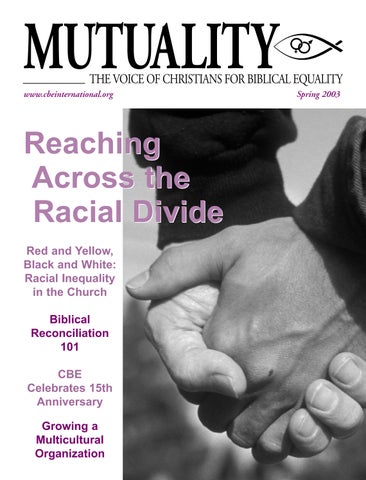
Reaching Across the Racial Divide Red and Yellow, Black and White: Racial Inequality in the Church Biblical Reconciliation 101 CBE Celebrates 15th Anniversary Growing a Multicultural Organization
Spring 2003
What’s Inside FEATURES
DEPARTMENTS
5 Red and Yellow, Black
3 From the Editor
and White: Racial Inequality in the American Church ■ BY JULIA BLOOM
5
While the Christian church has rejected racial inequality, Sunday mornings are still often segregated. How can we build bridges across racial and ethnic lines?
plus: Resources on Reconciliation
9 Biblical Reconciliation 101 9
■ BY JOANNE NYSTROM JANSSEN
United in Word, But Segregated on Sunday
4 In Our Mailbox 17 Book Review ■ BY KRISS ERICKSON
What Science Says About Superiority
18 New Resources 19 Ministry Highlights
■ BY VICTORIA PETERSON-HILLEQUE
■ BY JULIA BLOOM
Quick Bible quiz: Name one African person in the Bible. If you’re stumped, read this article.
Global Outreach Sees Refugees as Royalty
11 Living into the Hard Choices ■ BY DEE DEE RISHER
As followers of Christ, we are trying to walk the talk. Dee Dee Risher explores how to live out our commitments to equality, in spite of our own limitations.
23 CBE Celebrates 15th 11
SPRING 2003
Anniversary ■ BY JOANNE NYSTROM JANSSEN
After starting with a recipe box on a TV tray, CBE has grown by leaps and bounds over 15 years, not only in the space required for recordkeeping, but in influence as well.
25 Honor in Our Ranks
25 In Honor Of 26 Prayer Update ■ BY JOANNE NYSTROM JANSSEN
Equality Reaches New Audiences
28 Chapters’ Corner ■ BY CHRISTINE BAYNES
Starting a CBE Chapter: Perspectives from Toronto
30 President’s Message ■ BY MIMI HADDAD
Growing a Multicultural Organization
23 2
MUTUALITY
COVER PHOTO Jim West Photography (Specializing in Labor & Social Issues) Detroit, MI 48224 E-mail: jim@jimwestphoto.com Web: www.jimwestphoto.com
www.cbeinternational.org
Spring 2003
MUTUALITY
THE VOICE OF CHRISTIANS FOR BIBLICAL EQUALITY
Let us then pursue what makes for peace and for mutual upbuilding. –Romans 14:19 VOLUME 10, ISSUE 1 MUTUALITY seeks to provide inspiration, encouragement and information about equality within the Christian church around the world. President/ Publisher:
Mimi Haddad
Editor:
Joanne Nystrom Janssen
Editorial Assistant:
Victoria Peterson-Hilleque
Staff Writers: Christine Baynes Julia Bloom EDITORIAL AND ADVERTISING OFFICE Christians for Biblical Equality, 122 W. Franklin Ave., Suite 218, Minneapolis, MN 55404 Phone (612) 872-6898 Fax (612) 872-6891 E-mail: mutuality@cbeinternational.org Web site: www.cbeinternational.org Advertising in MUTUALITY does not imply organizational endorsement. SUBMISSIONS MUTUALITY welcomes submissions. E-mail mutuality@cbeinternational.org or write CBE for our writer’s guidelines. PERMISSIONS Christians for Biblical Equality grants permission for any original article (not a reprint) to be photocopied for local use provided no more than 1,000 copies are made, are distributed free, the author is acknowledged, and CBE is recognized as the source. MUTUALITY (ISSN: 1533-2470) is published quarterly by Christians for Biblical Equality and is sent free to members. For membership information, see page 31.
■ From the Editor JOANNE NYSTROM JANSSEN
United in Word, But Segregated on Sunday
C
hristians’ attitude towards gender, while having some ambiguities, is on the whole pretty straightforward. Churches often state whether leadership positions are open to women or only to men. In relationships between men and women, people usually either believe that the Bible teaches mutual submission or distinct roles. The church’s attitude toward race, however, is hard to nail down. Most Christians would assert that people are equal regardless of race, and few would openly discriminate against people of color. Yet this spoken equity and unity isn’t always visible on Sunday mornings: Our churches are often painfully homogenous. This contradiction makes the issue difficult to address. How do we talk about the reality of racial discrimination when Christians appear to be unified against it? How do we address the chasm that exists between people of different races when many outward signs suggest that everything’s okay? And how do we work for change, when we can’t clearly see the problem? In “Red and Yellow, Black and White: Racial Inequality in the Church,” Julia Bloom brings some clarity to the issue. She defines what it means to live in a “racialized” society, where people may contribute to racial division and inequality without having that intent. She also offers suggestions about how to create greater unity in the church. The Bible also has much to say about reconciliation, which readers sometimes miss because they don’t understand the cultural forces at work in the ancient world. In “Biblical Reconciliation 101,” Victoria Peterson-Hilleque opens our eyes to these forces, and points out parallels that exist between gender and race in the Bible. Finally, in “Living Into the Hard Choices,” Dee Dee Risher asks how each of us can put racial and gender equality into practice in our lives, while still being honest about our limitations, gifts and the challenges of our unique circumstances. You may also notice that this issue offers changes in the Prayer Update and The Chapters Corner, with the goal of making the sections more interesting and relevant. These changes were initiated because of the responses we received from our online survey, which was distributed randomly. We’re grateful for your encouraging comments as well as ideas for improvement. Please know that your ideas are always welcome at mutuality@cbeinternational.org. This year is also an important milestone, as it marks CBE’s 15th anniversary of being incorporated as a non-profit organization. You may be surprised that its membership began with a recipe box on a TV tray. Visit page 23 to find out more about CBE’s origins, as well as its plans for the future!
■
Spring 2003
www.cbeinternational.org
MUTUALITY
3
■ In Our Mailbox
Uniting in the Fight for Equality
CBE Fosters Global Perspective I would like to commend [the CBE] staff for the most recent Mutuality. For some time, I’ve been praying that CBE would be able to “expand its borders” to give members a sense of the circumstances for women around the world. Each of us needs to step beyond our involvement in our own “sad, sweet selves” (to quote Oswald Chambers) and realize that, in comparison, we in the United States really don’t have it so bad. I am especially pleased to learn that CBE is continuing contact with the Pan African Christian Women’s Association (PACWA). CBE was just beginning to develop that in the mid-1990s when PACWA was getting organized. It is a pleasure to specifically pray for that work. Reading the list of countries given in the international prayer section of Mutuality is really exciting for me, as I remember when many of those persons made first contact with CBE. It is not easy to expand internationally with limited staff and resources, but it is very necessary for the support of the good news of Jesus Christ globally. Susan McCoubrie Rosemount, Minn.
Riding the Radio Waves I was pleasantly surprised to read your editorial in Mutuality. The same awakening has happened to me this past six months. God set me up miraculously via e-mail [with] Medad Birungi in Kabale, Uganda, in May 2002. After couple of short e-mails, he invited me to speak in a women’s conference in Uganda. [On] Sept. 11, 2002, I flew with two Finnish women to Uganda for the first time in our lives. It was totally amazing how these people in the midst of revival received the message of equality with joy, men and women alike. I was taken to a radio [station] to give an egalitarian 30-minute talk. The coverage of that radio station was 6 million people. It was just so wonderful to speak directly and have people receive the message. I can envision the western missionaries going to central Africa and being taught about equality sometime soon. Anne Mikkola Helsinki, Finland 4
MUTUALITY
The magazine and the articles have helped me in my campaign for women in Uganda and Kenya. The ideas are very educational, and I am using them in my ministry. It has also shown me that I am not alone in this struggle for women’s equality; [and] I have been sensitized about women’s issues worldwide. Medad Birungi Kabale, Uganda
Suffering of Women Leaves Lonely Men I just received Mutuality and, as usual, devoured it swiftly. As I was out for my daily walk yesterday, I was reminded to pray for women around the world. My thoughts took me to China, and I tried to imagine what will happen when those 50 million young men discover there are no women. The thought of unimaginable numbers of young men, like my son, having no one to marry grieves me. I found myself weeping for them as I walked. Their wives — murdered before they even knew day from night! Think about the implications of this horrible dilemma. This issue of Mutuality has struck at my heart like no other! These articles show the ultimate [consequence] of woman-hatred: murder and the horrible, irreversible effects which will thunder down through the future. Carol Zechlin Land O’Lakes, Wis.
Creative Recycling As we get two copies [of Mutuality], we are able to give one away, but I am having a hard time trying to decide which of the several potential recipients I should choose. A couple people who have received our extra copies have said that they were greatly helped by them. A third one attended our local CBE meeting last month as a result of receiving [Priscilla Papers] from us. Ruth Morrison Kentwood, Mich.
We’d love to hear from you! Send your comments, suggestions and critiques to: MUTUALITY 122 West Franklin Ave., Suite 218 Minneapolis, MN 55404-2451 Fax: (612) 872-6891 Phone: (612) 872-6898 E-mail: mutuality@cbeinternational.org Web site: www.cbeinternational.org
www.cbeinternational.org
Letters may be edited for clarity and brevity.
Spring 2003
Red and Yellow, Black and White: Racial Inequality in the American Church By Julia Bloom
I
n the movie Swing Kids, a German teenager joins the Hitler Youth and is assigned a job delivering packages. At each house a child or woman answers the door, and as the teenager turns to leave after making his delivery, he hears screaming and crying from the house. Shaking with fear, he opens one of the packages to find a gold wedding band in a pile of ashes. Tears of rage and guilt begin to flow as he realizes he has unknowingly participated in a cruel system: delivering the remains of husbands and fathers who have been murdered in the name of Hitler. To be white and middle class in America is to be a participant in a privileged power structure. Often unknowingly, we lay poverty and discrimination at the door of communities of color. The challenge to white middle-class people who follow Jesus is to begin to notice the cries of pain from these communities.
What is ‘Race?’ “Race is not a God-given concept,” says George A. Yancey in his book Beyond Black and White: Reflections on Racial Reconciliation. “All the misery that has developed because of racial issues is not part of the Lord’s plan but is something that we have caused ourselves. We made up the concept of race.” The Bible begins by focusing on the oneness of humanity, notes Curtiss DeYoung in his book Coming Together: The Bible’s Message in an Age of Diversity. Male and female are the only human differences noted in the creation account. Through this first man and woman came all of humanity with its many colors and cultures. But rather than celebrating this diversity, human society has used it to group people into “races” and then create a hierarchy. “There is such a thing as ‘racism’ because we have organized and laid out a world in terms of ‘race’,” says Douglas R. Sharp in No Partiality: The Idolatry of Race & the New Humanity.
Gender Connections “CBE’s mission is biblical equality, as outlined by Galatians 3:28,” says CBE President Mimi Haddad. “While CBE holds gender as our primary lens in approaching biblical equality, at times this lens
Painful Past: The sin of racism is tightly woven into American history. It’s been barely 40 years since the Civil Rights Act repealed overtly racist laws.
becomes myopic. Other Christian organizations working for equality use race or class as their primary lens. We need to learn from each other, work together and build a whole church.” “All forms of injustice are interlinked,” says DeYoung. “There’s a common power dynamic at work. If somebody can understand the dynamics of race, they have a better chance of understanding the dynamics of gender. If you can get the dynamics of gender, you have a better chance of understanding race.” Men of color and white women share a unique perspective on equality, as both are members of a privileged group (men and whites) and a marginalized group (women and people of color). This perspective may provide opportunities for them to serve as bridge builders in working out racial and gender equality. Women of color, especially those who live in poverty, offer another important perspective. When asked about the relationship between race, class and gender, Karen McKinney, a professor at Bethel College in Saint Paul, Minn., said, “It is magnified, not added. It’s race times class times gender. They all create different lenses through which you see the world and through which you are perceived. As the persons who continued on page 6
Spring 2003
www.cbeinternational.org
MUTUALITY
5
Inequality in the Church continued from page 5
are most pushed to the margins, we have a lot to say. Our voice is needed at the table.” White males are not typically oppressed by racism or sexism. But they can show the world what it looks like to reject a system that gives them the advantage. In Jesus’ day, race prejudice based on skin color did not exist, notes Curtiss DeYoung, but ethnic division, such as that between Jew and Gentile, did. As a Jewish male, “Jesus was able to speak to the men of that time and visibly demonstrate how to empower women and treat them as equals,” he says. He also notes that Paul, another Jewish male, worked hard to integrate Jews and Gentiles and men and women together in the church, both as members and as leaders.
The Reality of Racism Karen McKinney, who grew up in Minneapolis, Minn., says she cannot remember a time when she wasn’t aware of race. “The first lens — the lens I’m most conscious of, at least growing up — was black,” she says. “Even as a college person, I was still way more conscious of the lens through which I look as a black person than the lens through which I look as a female.” The United States acquired much of its land through the near-genocide of Native Americans. “Western colonialism may speak of an American history. Native People speak of an American holocaust,” says Steve Charleston in America’s Original Sin: A Study Guide on White Racism (quoted by DeYoung in Coming Together). Less than 150 years ago the United States abolished slavery, and it’s been barely 40 years since the Civil Rights Act repealed overtly racist laws. The sin of racism is tightly woven into American history. “We’re not going to undo racism in a generation,” says DeYoung. “We’ll make progress, though, if we keep at it.” “We have made great strides, but racial inequality does still exist,” says Dr. Jeanne Porter, a consultant and former professor of communication and culture. “Though we experience a rising middle class of African Americans in this country, there is an even larger class of African Americans in poverty.” Porter notes that urban school districts receive less funding than suburban ones, and racial profiling continues to “target people of color in the name of safety.” In their book Divided by Faith, Michael Emerson and Christian Smith describe American society as 6
MUTUALITY
“racialized.” “In the post-Civil Rights United States, the racialized society is one in which intermarriage rates are low, residential separation and socioeconomic inequality are the norm, … and ‘we are never unaware of the race of a person with whom we interact,’” they say. They continue, “Because racialiFringe Perspective: Women of zation is embedded color offer an important point of view, because they are marginalized both within the normal, because of their race and their everyday operation gender. of institutions, this framework understands that people need not intend their actions to contribute to racial division and inequality for their actions to do so.” The church continues to reflect this racialized society. “Almost everyone would say that segregation is wrong, but our congregations are pretty much as segregated as they’ve ever been,” says Curtiss DeYoung. “People still basically worship with folks like themselves.”
White Guilt “He who conceals his disease cannot expect to be cured.” – Ethiopian proverb “Throughout history, we Christians have often failed to have enough collective God-vision to discern the sin — both obvious and subtle, deliberate and unintended — carried out through social institutions,” write Spencer Perkins and Chris Rice in More Than Equals: Racial Healing for the Sake of the Gospel. “The result of our social blinders is that subtle and careless patterns, traditions and systems that encourage racial separation and inequality remain unnoticed, intact and unchallenged. They even seem normal.” Cutting away at these “social blinders” involves listening to the perspectives of the oppressed. For white people, this can bring a new and painful awareness of unconscious participation in a system that produces racial inequality. Author and Eastern Seminary professor Craig Keener recounts his own struggle with guilt: “I was reading the slave narratives and the autobiography of Malcolm X, seeing what people who look like me had
www.cbeinternational.org
Spring 2003
done to people who look like my friends who were so kind to me, and I was so ashamed of my skin color that I wanted to grab a knife and rip my skin off. That’s not a good stage, but it’s a stage I had to get through to get to the other side.” In her article “White Privilege: Unpacking the Invisible Knapsack,” Peggy McIntosh lists some of the privileges white Americans take for granted: “I can turn on the television or open to the front page of the paper and see people of my race widely represented … When I am told about our national heritage or about ‘civilization,’ I am shown that people of my color made it what it is … I can if I wish arrange to be in the company of people of my race most of the time.” Karen McKinney tries to encourage her students, most of whom are white middle-to-upper-class, to learn from the guilt they inevitably feel after being exposed to the realities of racism. She explains that guilt helps “to motivate us to move.” And, like Keener, she sees it as a stage we must experience in order to act. “Live in it and deal with it, study the contours of it,” McKinney says. “Ask, ‘What is this about, what is God telling me, what do I need to learn from this? I want to move, but what’s the movement — where do I go so I don’t end up right back here?’”
Thoughtful Action Careful thought must precede and work in balance with action. “Read widely — read authors of races other than yourself, and the same with gender, I think that men need to read books written by women,” suggests Curtiss DeYoung. (See sidebar for resource suggestions.) Read the Gospels and Paul’s letters in the Bible, noting the ways that Jesus, Paul and other Christians intentionally reached out to others across ethnic and gender lines. Are you willing to move into a new neighborhood or join a different church in order to build community with people outside your racial group? “You have to say that seeking first God’s kingdom is your primary goal, not seeking your own comfort,” says Jo Kadlecek, a freelance author. “And that’s an enormous challenge to a very comfort-oriented culture. Building crosscultural communities of faith is costly and difficult, yet the benefits and joys are extraordinary.” “A lot of times white Christians say, ‘We don’t want our church to be segregated, we want black people to come to our church,’” says Craig Keener. “But instead of just wanting other people to come to our church, maybe we need to go to their church, and begin to desegregate that way. The members of the dominant culture know much less of the minority cultures than the reverse, and ought to come to minority cultures as learners.” Suzanne Burdick, a first-year student at Hamline University in Saint Paul, Minn., is doing just that. She participates in Hamline’s Black Student Alliance and the
Resources on Reconciliation Available Through CBE: Black Man’s Religion By Glenn Usry and Craig S. Keener $14.99 Coming Together: The Bible’s Message in an Age of Diversity By Curtiss Paul DeYoung $15.00 Divided by Faith: Evangelical Religion and the Problem of Race in America By Michael Emerson and Christian Smith Was $13.95/Now $10.46 No Partiality: The Idolatry of Race and the New Humanity By Douglas R. Sharp $23.00 Shattering the Myth of Race: Genetic Realities and Biblical Truths By Dave Unander, Ph.D. Was $14.00/Now $10.50
Other Resources Quoted in This Article: Beyond Black and White: Reflections on Racial Reconciliation By George A. Yancey More Than Equals: Racial Healing for the Sake of the Gospel By Spencer Perkins and Chris Rice “White Privilege: Unpacking the Invisible Knapsack” By Peggy McIntosh
continued on page 8 Spring 2003
www.cbeinternational.org
MUTUALITY
7
What if you are a person of color? “White America has a whole lot more power than Africancontinued from page 7 Americans and other people of color,” says Leo Gabriel, a business professor at Bethel College. “But I believe that it’s important for people of color to look Hmong Student Association. “As a white person, it’s at the power we do have and to look at ways in which different than anything else I’ve experienced, because we can use that power to bring about change.” it’s not exactly me in the center of it. It’s just really “As a person of color, I am socialized into weird for me to feel like I’m on the outside, because inferiority, and I have to recognize that that’s a lie and I’ve never had that experience before.” throw that off,” says McKinney. “I have to DeYoung also notes the importance of integration. consciously, intentionally do something to counter “If you read the book of Acts, you see that Paul that message.” Even intentionally went very young chilto the Jews and then dren begin to to the Gentiles. internalize the mesThere was an sage of inferiority, intentional strategy she continues, so to build multishe works to teach cultural congreblack children an gations, because in alternative meshis mind that’s sage. what proved that Jesus said the the gospel had world would know power — its ability we are his disciples to cross boundaries. by the love we have The church has an for one another. important solution Divided as we are, to racial segregation the church is greatly sitting right there in crippled to show Equality Education: Young black children begin to internalize the the gospel and it’s the world what love message of inferiority, says Karen McKinney, so it’s important for adults been preaching it to teach them an alternative message. looks like. But hope but not practicing remains for those it.” willing to reach across the divide. Writing about “For me, the presence of diverse faces in a church racism in Beyond Black & White, Yancey says, “What does not reflect racial equality or multiculturalism,” humans have created I am confident God can says Porter. “A church which truly embraces racial destroy.” equality and multiculturalism will have those diverse “I think one of the biggest things for white people faces represented in leadership; the worship and is to just hear the stories — to know and to care,” says educational ministries will reflect that same Craig Keener. “We can’t make people care but at least diversity.” we can make people know. And if Christians who In Divided by Faith, Emerson and Smith note that really have the love of God in their hearts hear the many white evangelicals believe the only way to pain and know the hurts that have been inflicted, then racial reconciliation is through personal relationships. Christians will work for reconciliation.” But while healing on a personal level is important, further steps are needed to deal with the racialized society in which we live. Similarly, a husband and ■ wife may live out an equal partnership and be reconciled to one another as man and woman, but Julia Bloom is CBE’s international and membership male superiority on an institutional level still must be coordinator. She lives in Minneapolis with her husband, addressed. Nathan, and is a member of a racially integrated church in “We have to learn how to develop a collective her neighborhood. identity. The sins of the world are the sins of society,” says Karen McKinney. Old Testament prophets such as Nehemiah (Nehemiah 1:6-7) and Daniel (Daniel 9:5-6) understood that they partook in the collective sins of their community.
Inequality in the Church
8
MUTUALITY
www.cbeinternational.org
Spring 2003
Biblical Reconciliation 101 Abraham and Sarah’s slave Hagar was an Egyptian, whose story is told in Genesis 16. When Sarah’s mistreatment leads Hagar to run away, an angel of the Lord comforts her. According to Kroeger, this is “the first time in the Bible where we have seen someone cry out to God in trouble, and seen the response.” Although the Israelites are God’s chosen people, through Hagar’s story, we see how God works through the Jewish people to touch people of other nations.
By Victoria Peterson-Hilleque
Q
uick Bible quiz: Name one African person in the Bible.
Did you mention Hagar, Simon of Cyrene or Apollos of Alexandria? What about the Ethiopian eunuch, or Queen Candace? If none of these characters came to mind, perhaps it’s due to a lack of understanding of the cultural and ethnic forces Quick Bible Quiz: Name one African person in the at work in the Bible. Bible. Understanding these forces can bring new light to familiar passages. For example, even though the word “Africa” is Models of Reconciliation not mentioned in the Bible, the word “Cush” is, which While the Bible includes important figures of African scholars think refers to Ethiopia or to Africa as a descent, it also provides models of reconciliation, whole. Countries such as Egypt, Ethiopia and Libya especially through Jesus’ ministry on earth. His are also mentioned. While they might not correspond interaction with a Samaritan woman in John 4 exactly to the countries on a 21st century map, they do provides an example of racial and gender refer to places in Africa. reconciliation. In fact, the Israelites believed that Egypt would The tension of this passage is easy to miss without ultimately share Israel’s hope of salvation, say Glenn some cultural understanding of Samaritan people and Usry and Craig S. Keener in their book Black Man’s their relationship to the Israelites. In her Priscilla Religion. Isaiah 19:21 says, “The Lord will make Papers article “A More Excellent Way,” Brenda Salter himself known to the Egyptians; and the Egyptians McNeil says the Samaritan race formed through will know the Lord on that day, and will worship with intermarriages between Israelites and people of sacrifice and burnt offering, and they will make vows conquering nations. In fact, in modern terms they to the Lord and perform them.” were bi-racial people. Jewish people had been going Specific places and people in Africa play an out of their way to travel around Samaria for years, important role in the Bible. Queen Candace ruled over but the passage says, “Jesus had to go through Ethiopia, and it was her treasurer (more commonly Samaria.” McNeil suggests Jesus acted on a “divine called the Ethiopian eunuch) that Philip ministered to mandate,” which is necessary for reconciliation. in Acts 8. Moses’ wife Zipporah was also an Because Jesus’ thirst is a real need that the Ethiopian, and he spent 40 years with her family in Samaritan woman is equipped to address, she is their homeland. Catherine C. Kroeger points out that affirmed, McNeil says. As a Jewish man, Jesus had the Moses possibly received training from African power in this situation, and yet he requested water in women and men while he lived there, in her article a way that the woman could refuse. His example “Black is Blessed.” demonstrates how people in power can behave Egypt is also prominent in the Bible, which towards others with less power. But we can learn from testifies to the connection between African people, the the Samaritan woman too, says McNeil. The woman Israelites and the Gospel. While Egypt differs from goes back to her people to tell them about Jesus, other African nations due to Semitic cultural becoming a bridge-builder between cultures. influences, say Usry and Keener, the Egyptian people Jesus laid a foundation for a diverse church, so were racially diverse but not divorced from their that when the power of the Holy Spirit was unleashed African heritage. continued on page 10
Spring 2003
www.cbeinternational.org
MUTUALITY
9
know that both of you have the same Master in heaven, and with him there is not partiality.” Craig continued from page 9 Keener also points out in The IVP Bible Background Commentary that unlike slaves in the United States, slaves in the ancient world “were able to work for and on early believers, representatives of many cultures achieve freedom, and some freed slaves became were gathered, as told in Acts Chapter 2: “Parthians, independently wealthy.” Medes, Elamites, and residents of Mesopotamia, A similar misunderstanding relates to what Judea and Cappadocia, Pontus and Asia, Phrygia and Scripture says about men and women. Consider Pamphylia, Egypt and the parts of Libya belonging to Ephesians 5:22: “Wives, be subject to your husbands Cyrene, and visitors from Rome, both Jews and as you are to the Lord.” The preceding verse says to proselytes, Cretans and Arabs.” In this listing of both men and women, “Be subject to one another out nations we see African people from Egypt and of reverence for Christ.” Cyrene, as well as people from nations in Europe, In this cultural situation, Keener points out that Asia and the Middle East. Paul’s audience was afraid Christianity would break Peter preached to this racially and culturally down family traditions. Paul borrows from Grecodiverse crowd, and 3,000 people gave their lives to Roman moral writing, speaking of the head of the Christ. These believers created a community where household, but undermines the basic premise when “they devoted themselves to the apostles’ teaching he explains that both men and women are subject to and fellowship, to the breaking Christ first, says Keener. The of bread and the prayers,” reciprocal act of submission is Other arguments once according to Acts 2:42. required of husbands and Unfortunately the church today used to support slavery wives, just as it is for masters is typically a segregated body, and slaves. have also been applied to divided between races and Other arguments once used support hierarchical denominations. This limits the to support slavery have also ability of the church to do God’s marriages and a limited been applied to support work, because it cannot draw hierarchical marriages and a role of women in the from the strengths and gifts of a limited role of women in the united body. church. church. For example, proponents of slavery used to say that Misunderstanding the Message African Americans were inferior to whites, and Even though the Bible clearly includes people of color traditionally, advocates of women’s subordination and provides examples of reconciliation, Christians in have argued that women are inferior to men. history have misunderstood the Bible’s message. In As Christians, our overarching concern should America, Christians have supported the institution of center on the gospel. Swartley says that the institution slavery by saying it is rooted in Scripture, using verses of slavery or the subordination of women cannot be like Ephesians 6:5, which says, “Slaves, obey your sustained under the application of Christian morality, earthly masters with fear and trembling.” noting, “The biblical imperative of love forbids The controversy over master/slave relationships oppressing anyone.” as well as the roles of men and women is Consider what Jesus says in Matthew 22:37-40: understandable, says Willard M. Swartley in his book “You shall love the Lord your God with all your heart Slavery, Sabbath, War, and Women, since the Bible and all your soul and all your mind. This is the appears to give mixed messages. Swartley says this greatest and first commandment. And a second is like ambivalence is not due to God’s nature, but to the fact it: You shall love your neighbor as yourself.” Skin “that divine revelation comes into and through color and gender seem inconsequential to the history and culture.” business of loving God and loving our neighbor as Understanding passages in their historical and ourself! cultural contexts, as well as within the context of the Now you can try our quiz again, and pass with Bible, is necessary for biblical interpretation. It’s also flying colors! For your next assignment, brainstorm important to differentiate between when the Bible is on how to build bridges between different cultures, describing something the way it was, says Swartley, applying biblical passages. instead of stating the way it should be. ■ With the example of slavery, shortly after the Victoria Peterson-Hilleque is CBE’s editorial assistant. verse that seems to endorse slavery, Ephesians 6:9 says masters should stop threatening slaves, “for you
Biblical Reconciliation 101
10 MUTUALITY
www.cbeinternational.org
Spring 2003
Living into the Hard Choices By Dee Dee Risher
A
t the heart and soul of our lives as followers of Christ is this: We are trying to walk the talk. In the Scriptures and in the healing witness of Jesus, we have encountered the powerful, lifechanging invitation to an alternative way of living. We have been given a vision of the realm of God, and invited to live out that vision in the particular soil of our lives. How do we incarnate Jesus’ values in our life choices? As I seek to answer this question in my own daily life, I find myself constantly confronted with contradictions, with times when my ideal paradigms meet the person I am — my limitations, my gifts, and the challenges of my unique circumstances and social location. As I’ve wrestled with these dynamics, I’ve been drawn to a powerful but obscure story nestled in the Hebrew Bible. I’ve come to see the story as a metaphor for the struggle we all face in seeking to incarnate God’s way of justice and peace in our unique situations. In 2 Kings 4:8-37, we find the tale of an unnamed woman identified only as “the Shunammite” who makes in her home a room for the prophet Elisha. It is a simple space — a small upper chamber with a bed, table, chair and lamp — and it is open to Elisha whenever he chooses. In response to her gesture, the holy man makes the Shunammite woman an offer: Perhaps she’d like him to put in a good word with the king or the head of the army? The woman’s response is both significant and powerful: “I live among my own
people.” These are deeply rooted words spoken by one who is willing to know herself and where she comes from. Like the woman, we have chosen to make a place in our lives for the Word of God. Yet our work of becoming who God created us to be must begin with being honest about who we are. I believe that this must include a willingness to explore how issues of race, class, gender and cultural assumptions have shaped us. Only when we have been unrelentingly honest and specific about who we are — and where we have come from — can we learn to build bridges across lines of difference. I have found it important to name my varied identities: Christian, woman, white, North American, Southern, from a family background that includes both working and upper-middle classes. Surely, these terms leave out a host of particulars that shape who I am. But they are far more than just labels. These words represent real experiences in my life, powerful forces that shape how I see the world, how I read the Scriptures, and how I understand the teachings of Jesus.
Birthing the Unexpected This story in 2 Kings also has an unexpected incarnation. Elisha, flush with the power of God and grateful for the woman’s hospitality, extends to the Shunammite woman the promise of a son. Within a patriarchal setting where women’s status and even survival hinged on having men to care for them, Elisha offers this woman security for her future. The Shunammite is taken aback — and is less than polite: “Man of God, do not lie continued on page 12
Spring 2003
www.cbeinternational.org
MUTUALITY
11
Hard Choices continued from page 11
to me.” Yet the following year, a son is born to her. When the Shunammite woman built a room to shelter the holy one, she followed a call with no sense of where it was going. In following that path, unexpected things came to birth in her life. Similarly, my efforts to follow in the way of Jesus brought new passions to birth in my life. Fired by his teachings, I became excited by how we, as Christians, live out genuine alternatives to the dominant culture. For me, that has meant thoughtful, intentional work on issues of race and gender. And that passion has been a gift of unexpected life. As a white Southerner born in the plantation region of South Carolina, I have a complex racial heritage. My grandparents’ bed, which I played on as a young child, was made by slaves. One of my paternal grandmother’s relatives owned more than 100 human beings — a fact that was shared somewhat matter-of-factly in my family. In the world of my childhood, the lives of African Americans and European Americans were both interwoven and starkly segregated in a way that was somewhat surreal. After college, I worked to organize a communitybased health fair in North Carolina. The community was 70 percent African American and 30 percent white, and racially polarized. All farms (except the
very tiny ones) were owned by whites — and I felt an eerie familiarity with their way of life. Members of my family in South Carolina worked similar farms and grew many of the same crops. It quickly became clear that most whites in this county wanted nothing to do with the health-fair project, so almost all of my time was spent in the African-American community. It was as though I had suddenly crossed over; instead of living with my aunts, uncles and cousins, my “family” that summer were the workers who labored on the white-owned farms and houses or in the meat-processing factory down the road. These were the people who housed me, fed me, told me their stories and took me into their churches and lives. I suddenly began to notice how the assumption or reinforcement of whiteness dominated everything — television, media, social policy. It amazed me then — and continues to amaze me — that this black community would offer such care for a naive white girl. In return, I tried to pay attention and learn my racial lessons. This was the unexpected miracle God brought to birth in my life — a chance to begin to understand, at a deep level, my racial heritage. Since then, I’ve been very conscious of trying to be a “race traitor,” seeking to break down wherever I can the norms of whiteness. I’ve never again chosen to live in a neighborhood that is predominately white. I’ve tried to avoid taking leadership in racially mixed groups. It’s important to me that my children be in multiracial settings. I’ve tried to emphasize and build strong interracial friendships. I have tried to raise my own racial consciousness and that of other white people. There have been some successes. But that is only part of the story.
Potential for Pain
“
Instead of living with my aunts, uncles and cousins, my ‘family’ that summer were the workers who labored on the white-owned farms and houses. 12 MUTUALITY
”
www.cbeinternational.org
The account in 2 Kings reminds us that the process of birth is fraught with danger. The child grows into a young man. One day, while he is working with his father in the field, he is overtaken by a powerful sickness. He returns home, only to die in his mother’s arms. She takes her son’s lifeless body upstairs, lays him on the bed of the holy man, shuts the door, and heads out in search of Elisha. The story of miraculous birth and new life becomes a story of Spring 2003
searing grief. This child — whom she did not ask for, who nonetheless burst into her world and changed it — dies. The prophet’s promised gift becomes a hole torn in her life — open, raw, and gaping. As we begin to incarnate new ways of being, we learn that every birth carries with it the potential for deep grief. We will face moments of deep, intense loss. Those things God brings to birth are not invincible. They may falter, fail or die. Whatever God has brought to birth in my heart, it has not flourished fully in the fruit of my life. This is a reality I weep over. My husband and I have tried for the past 10 years to challenge traditional gender roles in our marriage. But with two kids under three, our egalitarian partnership seems suddenly skewed by gender stuff. Besides juggling childcare and work, we have church and activist commitments that take up our time. Internally, I find myself haunted by Heloise and her housekeeping tips — always longing for a home that is immaculate, orderly and wonderfully organized. But the 200-year-old house we rent gathers dust by the hour, and the always neglected yard is a weed nursery. We’ve shared childcare for more than three years, and for the last year we have both worked as editors. Is this lifestyle rich? Yes. But it is also awful. I can’t keep up. In more traditional old days, I would be clear on which responsibilities were mine, and which were not. But while we are sharing editorial work and childcare and home-management and gardening — we both feel responsible for everything. If we really begin living out alternatives, we hit the hard stuff. Our deep personal commitments against patriarchy or racism do not help us defeat those forces, because these assumptions and behaviors are as deep in us as our very breath. They will rise up again and again like the crabgrass in my garden, still vigorous after a decade. This is unimaginably painful. It is essential to grieve our losses. When we try to break down the barriers in the world and in our lives, we are living in uncharted territory. This is a real strain that is fraught with the danger of losing out, of failure. In the back of our heads are voices that gloat that the traditional answers are right: “People are
more comfortable with their own race.” “It is better for women to stay home and men to work — we’re just wired that way.” Those things God promises to bring to birth — and does — die inexplicably and impossibly. Why would God give us these visions if they were to die? How do we grieve? I am convinced that our inability to address issues we face in trying to live the way of Jesus is rooted in our having lost touch with whole parts of ourselves, the sad and wounded parts, the parts of us that have also been hurt by the injustice. We have not been able to cry, to lament. The witness of Jesus is that our lives must die in order to experience resurrection. There can be no death without grief, and therefore no life. It is in our grief that the real work of God begins, in our particular lives. We have to find our own answers. When those answers come, they will not fit our perfect ideologies. They will be born of concession and compromise, of trying first one new model and then another. They will instill in us a deeper appreciation of grace — the kind of grace that infused the writings of Paul because he understood just how human he could be, a zealous murderer who was loved and transformed into a builder of community.
I am convinced that our inability to address issues we face in trying to live the way of Jesus is rooted in our having lost touch with whole parts of ourselves, the sad and wounded parts, the parts of us that have also been hurt by the injustice.
Spring 2003
Hope for Resurrection The story of the Shunammite woman does not end without hope. The child that God has brought to birth, the one who was lost, comes back to life. It is not your typical cut-and-dried healing. It has little triumphalism. Elisha’s underling tries to revive the boy with his magic staff, and it fails. The expected solution does not work. So the holy man prays to God and then lays himself, eye to eye, mouth to mouth, on the boy. No life. He has to work with it — go downstairs, walk around, come back, and do it again. As readers, we have the sense that this is an uncertain process, that Elisha is groping, trying one thing, then another, sure of God, and yet… How do we fully become ourselves? By knowing of the false gods of the world and resisting them, certainly. But I believe the workings of God are less in
www.cbeinternational.org
continued on page 14 MUTUALITY
13
Hard Choices
Donate $1,000 and Receive a Concordance
continued from page 13
the resistance itself and more in finding the shape of our own particular incarnation of resistance. We must find an organic way to live out that resistance — a way that feels like our own face, our own flesh. Once we move beyond the theories and constructs of what is wrong, we are on new ground. That new ground will shape us, if we work with it. And then, inexplicably, the joy erupts because, despite the failures and the deaths, we know that we are in touch with the holy path. Even if our lives have a clunky, experimental quality that strains us, we will also have some certainty that this is the path we must take. My husband and I Although the have tried for the past 10 Scriptures do not tell years to challenge us, we know that traditional gender roles in both the woman and our marriage. In more her child were never traditional old days, I again the same. would be clear on which Those who have responsibilities were witnessed the powmine, and which were not. er of resurrection But we both feel will never again fear responsible for death. everything. Growing up, my evangelical faith taught me that we were baptized into Jesus’ death and resurrection one single time. But the greater truth is that we spend our lives living into Jesus’ death and Jesus’ resurrection, over and over. It is our ongoing struggle, but it is also our ongoing hope. It is the only way we find new life.
“
”
■ Condensed and reprinted with permission from the November/December 2002 issue of The Other Side. For subscriptions or more information call 1-800-700-9280 or visit www.theotherside.org.
14 MUTUALITY
Have you been meaning to join CBE’s Partners Program by contributing $1,000 or more per year? Last year we offered a free copy of The Analytical Concordance to the New Revised Standard Version of the New Testament by Richard Whitaker and John R. Kohlenberger III to new gifts of $1,000 or more. Because we still have a few left, we’re extending the offer. Hurry — concordances are available while supplies last! Donate online at www.cbeinternational.org, and we will send you this valuable resource.
Some Employers Will Match Your Contributions to CBE Does your employer offer a matching funds program? Over the years CBE has been the grateful recipient of matching gifts from employers, United Way and the Mustard Seed Foundation. Perhaps your employer or your local United Way will match your contribution to CBE. Please check with your human resources department. What a wonderful way to double the pleasure of giving, making it possible for CBE to reach twice as many with the good news of Galatians 3:28.
www.cbeinternational.org
Spring 2003
EVANGELICALS FOR SOCIAL ACTION I N V I T E S Y O U T O PA R T I C I PAT E I N T H E
Celebration & Challenge 30TH ANNIVERSARY CONFERENCE JULY 24- 27, 2003 • PHILADELPHIA, PA
ESA SPEAKERS INCLUDE: TONY CAMPOLO • JOHN DIIULIO • DEAN TRULEAR • JIM WALLIS
ROBERTA HESTENES • JOEL CARPENTER • GRETCHEN GAEBELEIN HULL • ANDY CROUCH BARBARA WILLIAMS SKINNER • VERNON GROUNDS • BILL PANNELL • PHIL OLSON GARY HAUGEN • MIMI HADDAD • JOHN GALLOWAY • JAN JOHNSON • RON SIDER
FOR MORE INFORMATION CONTACT ESA AT: 610-645-9390 AND/OR VISIT OUR WEBSITE www.esa-online.org
Send your friend a CBE informational packet! This packet includes brochures and intriguing articles from Mutuality and Priscilla Papers. Name____________________________________ Address__________________________________ _________________________________________ Please send to: Christians for Biblical
Equality 122 West Franklin Ave., Suite 218 Minneapolis, MN 55404-2451
m bi inis bl try ica ne lr ws es ou rc es
or e-mail: cbe@cbeinternational.org
Join CBE’s Leave a Legacy Initiative
E
ach of us wants to know that the things to which we’ve contributed time and money will last long after we’ve entered Christ’s presence. How wonderful to know that you can continue to give to the work of CBE, even after your earthly pilgrimage has ended. By joining CBE’s Leave a Legacy Initiative, you continue to exercise stewardship over the blessings of your life. By naming CBE as one of the benefactors in your will, trust, insurance policy or estate plan, you give a gift that becomes a legacy — a helping hand to those who come after you looking for answers regarding gender and the Bible. If you would like to learn more about this plan, we would be honored to discuss the details more fully. Or, if you have already included CBE in your estate, will or insurance policy, please let us know. We would love to include your name. Simply contact CBE at cbe@cbeinternational.org, by phone 612-872-6898, or mail CBE, 122 W. Franklin Ave., #218, Minneapolis, MN 55404. First class of CBE’s Leave a Legacy Initiative Janis and Wes Balda Jocelyn Garner Mary Hackman Jo Ellen Heil Cosette Jolliff Tom and Missy McCarthy Carl and Bernice Menold Alvera Mickelsen Virginia Patterson Sara Robertson JoAnn Leiffers and John Swart Lilya Wagner
les tic r ea fre
■
CBE is Looking for Spiritual Directors Who Support CBE’s Mission Visit CBE’s Web site at
www.cbeinternational.org for the latest ministry news, cutting-edge biblical resources and free articles!
16 MUTUALITY
If you are a Spiritual Director and would like your name added to our list of egalitarian spiritual directors, send your name and credentials to us at cbe@cbeinternational.org.
www.cbeinternational.org
Thank you!
Spring 2003
■ Book Review REVIEWED BY KRISS ERICKSON
What Science Says About Superiority He also discusses work hattering the Myth of Race by Dale Unander is a done by Paul Broca rethoughtful discussion of the conflict of race and garding brain size and its ethnicity against the backdrop of the history of link to genetic superiority. Western Europe and the United States. These studies showed that many variables, including Unander speaks of many people’s lack of family head size and shape, invalidate brain size as a roots in his Chicago neighborhood in the 1920s and determinant for superiority. In fact, women’s brains 1930s to suggest that people can lose a sense of racial are generally smaller than men’s without showing or cultural identity. Living in a multiethnic any lack of intelligence. neighborhood, Unander based his opinions of people By viewing race as a on what they were like cultural concept, Unaninstead of on their racial der hopes to open a way or ethnic background. Shattering the Myth of Race: for people to see others Racial identity is an as human and as Genetic Realities and Biblical Truths established part of the children of God without culture in the United By Dave Unander, Ph.D. racial labels and States and many other 127 pages, Judson Press, 2000. stereotypes. He believes countries, Unander says. B241P . . . . . . . .$14.00/Introductory Price $10.50 that, as in selective Viewing others and breeding of seeds, huourselves as members of man traits are unique a certain race is a way of and can reappear no matter how harshly they are seeing the world. He claims that there were no races repressed. It is not our skin color that matters, but our before 1400 A.D., because the cultural concept of race expressions of kindness, generosity, patience, or their as we see it did not exist. He ties racial troubles in lack, that are true human traits. churches to the white European academics of the Unander explains that the Bible is not a scientific Enlightenment era, who assumed the superiority and book. Science is limited to what it can measure. inferiority of certain races, and incorporated these Throughout the book he explains many attempts to ideas into church and secular culture. measure racial superiority and inferiority, none of Unander gives a brief history of early Christianity, which has proved the inherent superiority of any race. Arab Islamic culture, medieval Europe, medieval So he ends with a discussion of the question: “What Christians and the Spanish Conquista to lay a does it mean to be human?” foundation for how race is viewed in our culture Personal identity, which he defines as an accurate today. He also explains the effect that race has had on and appropriate understanding of oneself, is key in economics, and how slavery affected the concept of defining what it means to be human. He sees the race. An important distinction is that not all slaves biblical definition of race as different kinds of people were black, giving slavery a broader racial and living together in peace, drawing on each other’s cultural base, and showing the complexity of our strengths. To be racist is to deny Christ. To be human ideas of superiority and inferiority. is to live a life of reconciliation. Graduate training in genetics has given Unander a unique view of what race means. In his studies he ■ has relied heavily upon the work of Gregor Mendel Kriss Erickson is a freelance writer, currently attending and his keys to heredity. This research led him to see Western Seminary, Seattle. She plans to finish her master’s that at a certain genetic level, race no longer exists. No degree in counseling and her Certificate in Spiritual race is genetically superior or inferior to any other, Direction in the summer of 2003. and we are not as different as we look to each other. God did not create people to be viewed according to race.
S
Spring 2003
www.cbeinternational.org
MUTUALITY
17
■ New Resources The Truths That Free Us: A Woman’s Calling to Spiritual Transformation By Ruth Haley Barton This book discusses aspects of freedom for Christian women, including freedom of finding identity in Christ, freedom to embrace sexuality, freedom from the role of supermom, and freedom to be Christ in the world. Spiritual exercises conclude each chapter, such as ideas for prayer and meditation on the topic at hand. The book also includes helpful appendices and a study guide, and incorporates content originally appearing in Becoming a Woman of Strength. 283 pages, Shaw Publishers, 2002. B244P . . . . . . . . .Was $12.99/Introductory Price $9.74 Divided by Faith: Evangelical Religion and the Problem of Race in America By Michael O. Emerson and Christian Smith Emerson and Smith provide a groundbreaking analysis of the evangelical church in America and its consistent struggle with racial segregation. Based on over 2,000 surveys and interviews, they contend that the evangelical movement’s focus on individualism hinders its members from seeing that racial discrimination exists on a systematic level, and that this segregation cannot be overcome by individual repentance or personal relationships alone. 224 pages, Oxford University Press, 2001. B246P . . . . . . . .Was $13.95/Introductory Price $10.46 Redeeming Eve: Finding Hope Beyond the Struggles of Life By Heather P. Webb Rather than denying the power of their own voices, Webb encourages women to use their voices to bring about healing in themselves and others. Each chapter focuses on a different aspect of women’s lives, including encountering men, relating with other women, and body image. Study questions at the end of each chapter encourage thoughtful self-examination. 185 pages, Baker Book House, 2002. B245P . . . . . . . . .Was $12.99/Introductory Price $9.74
18 MUTUALITY
Great With Child: Reflections on Faith, Fullness and Becoming a Mother By Debra Rienstra Chronicling the birth of her third child — from the longing for another baby through pregnancy, birth and the baby’s first year — Rienstra offers an uncommonly poetic and thoughtful meditation on mothering. Rather than unrealistically glorifying or negating the value of motherhood, this narrative is infused with honesty and spiritual depth, producing a book that truly celebrates the gift of bringing forth life. A wonderful gift for expectant mothers! 288 pages, J.P. Tarcher, 2002. B242H . . . . . . .Was $23.95/Introductory Price $17.96 My Brother's Keeper: What the Social Sciences Do (and Don’t) Tell Us About Masculinity By Mary Stewart Van Leeuwen Building on the work she began in Gender and Grace, Van Leeuwen examines biological, psychological, biblical and cultural data in an effort to understand masculinity. Practical applications include raising sons, sexuality, and dealing with addiction. The book also casts a vision for a Christian worldview that encourages men and women to honor God’s creation of humankind by blessing one another. 255 pages, InterVarsity Press, 2002. B243P . . . . . . . .Was $17.00/Introductory Price $12.75
■
Would you like to review books for CBE’s book service? Send an e-mail to books@cbeinternational.org in order to receive an application.
*Prices do not include shipping and handling. Member discount does not apply to sale-priced books. Sale ends April 30, 2003.
www.cbeinternational.org
Spring 2003
■ Ministry Highlights JULIA BLOOM
Global Outreach Sees Refugees as Royalty “My desire is to see women in Africa raised from orphans, refugees, and exiles into queens!”
A
CBE member from Uganda sent us this message, recalling the story of Esther, the Jewish orphan girl who became a queen and saved her people from death. This member shares the truth of biblical equality with the women and men to whom he ministers. He became connected with CBE through another member from Finland, who discovered his passion for equality while she was in Uganda. It was a joy for both him and us at CBE to discover one another — we had already been working towards a common goal in the name of Jesus! This story inspires us as we look forward to our 8th international conference, this year in Orlando, Fla., August 8-10. God is working to help CBE reach around the world with its vital message, and we are growing more and more into a truly international ministry! We are filled with excitement as we make plans for this conference. If you haven’t already done so, be sure to look at the unfolding details on our Web site: www.cbeinternational.org. God has brought a richly diverse group of people together to present general sessions and workshops about many different topics. We are learning to be creative with office space, as three new staff members have joined our team since the beginning of January. We thank God for bringing each one to us. As we meet to pray together each morning, the widening circle of people testifies to God’s faithfulness in continuing to grow this ministry. Our staff now includes seven full-time and three parttime workers. A network of dependable volunteers graciously supports the staff. December’s annual volunteer party brought together founding mothers of CBE, new and
seasoned staff members, and young men and women who help us with everything from moving heavy furniture and assembling mailings to assisting at conference booths and casting vision for the future. It was such a blessing to celebrate the work of these dear ones who continue to help expand the impact of our ministry. Once again, CBE attended the annual meeting of the Evangelical Theological Society (ETS) in November. Many scholars, young and old, visited our booth, and we shared dinner and fellowship with about 40 people at the end of the week. People hearing of CBE for the first time continue to write to us every week. People are interested in starting chapters in such places as New Mexico, Ohio, Nevada, California, Indiana and Australia. If you would like to find out if there’s a chapter in your area, or start a new one, you can find out more at our Web site, www.cbeinternational.org. Follow the link called “Events/Conferences.” Though the economy continued its downward spiral throughout 2002, contributions to CBE remained strong, and in some cases, exceeded budgeted goals. Income from December’s “Buy 2, Get 1 Free” book sale also tripled over income from the same sale in 2001. With many members and supporters of CBE experiencing financial difficulties from job losses and other cutbacks, we are amazed at God’s faithfulness, and thankful for the many who have sacrificed more than other years to give to CBE. God’s mercies are new every morning. We begin this new year with eager anticipation, ready to move forward with grace and enthusiasm.
As we meet to pray together each morning, the widening circle of people testifies to God’s faithfulness in continuing to grow this ministry.
Spring 2003
■
Julia Bloom is CBE’s international and membership coordinator.
www.cbeinternational.org
MUTUALITY
19
Does Your Church Support Women in Ministry? Somebody Wants to Know
Egalitarian Church Form Church Name Address City State/Province/Country
Zip/Postal Code
Phone E-mail
Church Denomination
■ I recommend the above church as one that supports a biblical basis for the equality of women and men in church, home and society. ■ The above church would like to become a member of CBE. ■ I wish to give a gift membership to the above church. My Name Address City
State/Province/Country
Zip/Postal Code
CBE church membership is available to those who support CBE’s Statement of Faith. (See page 31.) All membership fees in U.S. Dollars: (Please circle one)
0 - 100 members 101 - 500 members 501 - 1000 members 1001 - 2000 members 2001 - 5000 members 5001 - 7500 members
$ 40 $ 60 $ 80 $100 $200 $300
Additional Contribution Enclosed: $_________ TOTAL ENCLOSED: $_________ CBE is an exempt organization as described in IRC Sec. 501(C) 3 and as such donations in excess of the basic membership fee may qualify as a charitable contribution where allowed by law.
Visa
MasterCard
Discover
American Express
Credit Card Number
Expiration Signature of Authorized Buyer
S
ince graduating from college a year ago, Karen has been discouraged in her search for a church. “I have found nothing,” she says. “Attending church has actually been a frustration and source of spiritual depletion.” Maggie’s church doesn’t believe in biblical gender equality. She says little boys as young as 10 years old can do more than she ever could as a grown woman, like read Scripture, serve communion or lead singing. “I’ve almost quit attending services because of my anger, frustration, sadness and feelings of futility,” she says. Every day, individuals visit CBE’s Web site seeking a church that supports women in leadership and ministry. They turn to us for help. CBE depends on you for recommendations of churches that support biblical equality. Churches do not need to be member churches to be listed on CBE’s Web directory, but need only to agree with our Statement of Faith. If your church or other churches in your area affirm women in ministry, please let CBE know. Just fill out the coupon on this page and mail or fax it to CBE. With your help, CBE can help women like Maureen, who has all but given up trying to serve within her church. She and other women have formed their own Bible study groups, written curriculum and serve in Christian organizations. “We feed off the success stories of CBE where women are free to experience all their God-given potential and calling,” says Maureen. “We see you down the road and appreciate the path that you are clearing. Thanks!” You can also give a gift membership to your church or have CBE send them information about our church membership program. Visit CBE’s Web site at www.cbeinternational.org and recommend a church online today!
■
Date
Please send payment to: Christians for Biblical Equality 122 West Franklin Avenue, Suite 218 Minneapolis, MN 55404-2451 Phone: (612) 872-6898 Fax: (612) 872-6891 E-Mail: cbe@cbeinternational.org www.cbeinternational.org
20 MUTUALITY
www.cbeinternational.org
Spring 2003
8TH INTERNATIONAL
CONFERENCE
Celebrating the Priesthood of All Believers: Serving Christ as a Global Community AUGUST 8-10, 2003 ORLANDO, FLORIDA
A CHRISTIANS FOR BIBLICAL EQUALITY CONFERENCE
“But you are a chosen race, a royal priesthood, a holy nation, God’s own people, in order that you may proclaim the mighty acts of him who called you out of darkness into his marvelous light.” —1 Peter 2:9
8TH INTERNATIONAL CONFERENCE GENERAL SESSIONS: Why the Devil Hates Women in Ministry J. Lee Grady
Commissioned to Harvest by the Lord Our Spokesman: An Exposition on the Book of Ruth
Funmi Josephine Para-Mallam
The Kingdom of God and the Ministry of Women John E. Phelan
Women Leading Men: Seven Biblical Observations Linda Belleville
Workshop sessions: There are 25 workshops discussing marriage and family, missions and ministry, church history, and biblical studies and theology. Speakers include LaDonna Osborn, Timothy Abraham, Mimi Haddad, Kevin Giles, Donald and Robbie Joy, John R. Kohlenberger III, Paul Chilcote, and many more. Spring 2003
www.cbeinternational.org
MUTUALITY
21
Panel Discussion: Serving Christ as a Global Community
Registration information: Hotel Information:
Featuring: David Hamilton, International Associate Provost for University of the Nations, YWAM
Renaissance Orlando Airport Hotel 5445 Forbes Place Orlando, FL 32812 1-800-468-3571 $79.00 per room/night
Kevin Giles, vicar of St. Michael’s Church (Anglican) in North Carlton, Australia Funmi Josephine Para-Mallam-Ford, International Fellow at the National Institute for Policy and Strategic Studies in Kuru, Nigeria Brian Peterson, media liason for World Vision United States and founding editor for New Man magazine Lianne Roembke, moderator, who works with Campus Crusade in Marburg, Germany
Call for reservations before July 15, 2003.
Registration: Early Bird Rate (until June 27)
Member Non-member Group Rate (7 or more) Full-time student CBE Member Church (1 staff member)
Reg. Rate
$149 $184 $130 $90
$169 $204 $150 $90
$75
$75
Come and Celebrate Community… 8TH INTERNATIONAL
CONFERENCE
From Friday evening to Sunday morning, experience this renewing conference. Gifted speakers from around the world will offer biblical insights into how we serve Christ as a global community. CBE’s bookstore will feature books and tapes from the general session and workshop speakers as well as other relevant materials. Come and be challenged by Christian leaders from around the world, who are building communities that forward the biblical truth of equality. Orlando has warm, sunny weather and is located near some of the greatest theme parks in the United States. It is also a major airport portal from around the world. Register today! See you in Orlando!
Mimi Haddad
22 MUTUALITY
▼ A CHRISTIANS FOR BIBLICAL EQUALITY CONFERENCE
Questions? Call 612-872-6898 or e-mail conference@cbeinternational.org.
▼
President
Need more information? For general session and workshop descriptions or to register online, see www.cbeinternational.org. www.cbeinternational.org
Spring 2003
CBE Celebrates 15th Anniversary The group initially explored becoming an American branch of the British organization called Men, Women and God. In order to meet United States nonprofit requirements, they decided instead to form an independent organization called Christians for Biblical Equality. Kroeger remembers the excitement of the early days, when they realized people were interested in this new organization. “We were just so thrilled when we got our first 100 memberships, we couldn’t believe it,” she said.
By Joanne Nystrom Janssen
C
hristians for Biblical Equality (CBE) has come a long way in 15 years, according to Susan McCoubrie. As CBE’s first membership coordinator, she remembers when the organization’s membership information was organized in a recipe box on a TV tray. “We were very hopeful, but we knew we were on an uphill battle,” said McCoubrie. “We had to continually prove ourselves as possessing a high view of Scripture.” Since January 2, 1988, when CBE was incorporated as a nonprofit organization, the organization has grown by Snapshot of a Start: CBE was born in August 1987, when several leaps and bounds, people gathered in Catherine Clark Kroeger’s home in Cape Cod, Mass. not only in the Top row: Berkeley Mickelsen, Diane Chynoweth, Jim Beck, Nancy Graf space required for Peters, Deborah Lunde, Alice Mathews; Bottom row: Alvera Mickelsen, record-keeping, but Catherine Kroeger, Susan McCoubrie. in influence as well.
Humble Beginnings When CBE co-founder and President Emerita Catherine Clark Kroeger approached Gretchen Gaebelein Hull about starting an organization about biblical equality, Hull said, “‘Oh no, we don’t need another organization.’” Hull said she initially didn’t see what Kroeger understood: “There were so many hungry women and men who needed an organization like CBE, and couldn’t get it elsewhere.” While Kroeger and others had explored the need for an organization through several meetings in 1987, the first official planning meeting was held in August 1987 at Kroeger’s home in Cape Cod, Mass. At this meeting, CBE was born. “We all felt the need to encourage people to not be weighed down by the culture in which we live,” said attendee Alvera Mickelsen, first chair of CBE’s board and editor of Women, Authority and the Bible. “I think the feeling was, somebody had to stand up and tell what the Bible really said. Everybody was tired of hearing the other [view] for so long.” Spring 2003
Early Highlights
Several key moments led to CBE’s initial growth, and confirmed that its message was needed. For Mickelsen, one of these highlights was the organization’s first conference in July 1989 at Bethel College in St. Paul, Minn., with over 250 attendees. “Nothing like this had ever been done before,” Mickelsen said. “We were surprised at how many people came, and how much interest there was.” Priscilla Papers was also an important voice for CBE. The first issues (which Kroeger calls “perfectly awful”) were published independently by Catherine and Richard Kroeger in 1987, when CBE was yet unformed. Hull became editor in 1989, and served in this capacity until 2000. Influential people in colleges and seminaries began to read Priscilla Papers, said Hull, because she worked to make it as accurate and true to Scripture as possible, which gave the journal credibility. Another important project was the “Statement on Men, Women and Biblical Equality,” a document that Kroeger calls “our first solid piece of theology.” Kroeger and Hull, along with five others, drafted the document, which addresses biblical truths as well as applications. Completed in 1989, the document was
www.cbeinternational.org
continued on page 24 MUTUALITY
23
15th Anniversary continued from page 23
published as an advertisement in Christianity Today in 1990. Letters poured in from this exposure, said Kroeger, which led to many new members. “That statement gave expression to what thousands of us believed in a manner that was balanced, biblically based and theologically informed,” said Stan Gundry, who was one of the statement’s drafters. “It has come to be regarded as the defining statement of the movement.” The organization received additional national coverage through a favorable column by Clark Morphew published in the St. Paul Pioneer Press. Newspapers around the country printed the syndicated article when they had space. Whenever many letters arrived from the same town, the staff knew that the article had been published in a particular location. “That was a tremendous push because it got us into areas where we wouldn’t have been known,” said Mickelsen.
Sustained Growth From these initial key achievements, CBE’s membership has grown, and its operating budget and staff has more than quadrupled. An important organizational change that is linked to this growth, according to President Mimi Haddad, is the board’s transition from a decision-making board to a policymaking one. This decision grants the staff greater freedom to implement the mission of CBE. This change, as well as the development of a strategic plan, was initiated by Virginia Patterson, chair of the board from 1995-2000. Patterson said the board, together with the staff, developed mission, vision and core values statements as well as areas in which they hoped to see results. They then projected goals and strategies to achieve the results, which has given focus to the ministry, she added. The organization has also grown in influence, which can be seen in the resources available about 24 MUTUALITY
biblical equality: Only a few books were available when CBE began, but now the bookstore carries over 150 books. This growth is significant for Hull, who says the resources represent credible scholarship published by reputable publishing companies. CBE has also worked to make its message accessible to a wider audience. McCoubrie notes that CBE appealed largely to academics in its beginning, but that now the organization is also
Then and Now: CBE has grown in influence, which can be seen in the resources available about biblical equality. Compare conference bookstores between 1989 (left) and 2001 (right).
reaching the general Christianpublic. She cites the Internet, literature and CBE’s presence at popular conferences as efforts that successfully reach new audiences. Important to Stan Gundry is the role CBE plays in supporting isolated egalitarians. Stan was asked to resign or be fired from his teaching post at Moody Bible Institute in 1979 after members of Stop ERA, a political action group, mounted a smear campaign against him and his wife, Patricia. The group hoped to persuade Moody to make a policy statement opposing the Equal Rights Amendment. The Gundrys were ultimately targeted because Patricia had written a book supporting women in ministry in 1977 called Woman Be Free. Because of the risks they have taken to promote biblical equality, Stan and Patricia received the Priscilla and Aquila Award from CBE. As a result of CBE’s efforts, said Hull, even the discussions about women’s roles have changed. In the 1970s and 80s, traditionalists talked about “subordination” of women. Now they use the word “complementarity,” a term Hull used as she described biblical equality in her 1987 book Equal to Serve.
www.cbeinternational.org
continued on page 27 Spring 2003
■ Honor in Our Ranks Jeanette Yep will serve as Vice President of InterVarsity Christian Fellowship as well as the Director of Multiethnic Ministries beginning March 1, 2003. The fellowship works in colleges and universities witnessing to communities of students and faculty. In the 25 years Yep has been on InterVarsity’s staff, she has been known for encouraging multi-ethnicity and biblical reconciliation. Elaine Heath received a doctorate in systematic theology from Duquesne University in December 2003. Heath’s dissertation explored the work of Phoebe Palmer, a 19th century Christian apologist who focused on women’s right to engage in ministry. When Heath decided to move into ministry, she had a high school diploma and has spent 20 years working toward her current degree. Evangelicals for Social Action (ESA) celebrates its 30th anniversary this year. ESA is an association of Christians seeking to promote Christian engagement, analysis and understanding of major change including social, cultural and public policy issues. Their 30th anniversary conference, called “Celebration and Challenge,” will include speakers affiliated with CBE, such as President Mimi Haddad, Gretchen Gaebelein Hull and Roberta Hestenes.
■
■ Honor Someone Special through a CBE Honor Gift Honor someone you love by making a special contribution in his or her name. Occasions to consider: • Birthdays • Anniversaries • Graduations • Weddings • Ordinations • Birth of a new child • Memorials • Gratitude for one’s parents, siblings, friends, pastors, youth leaders, choir director, mentor, or anyone who has made a contribution to your life.
❑ Yes, I want to remember the following persons with a special Honor Gift Enclosed is my tax-deductible honor gift of $____________ In Honor Of: _______________________________________ On the Occasion Of:__________________________________ CBE would love to honor your someone special in the next issue of Mutuality. Your special message: ____________________________________________________ ____________________________________________________
❑ Please send the acknowledgement to: Name ______________________________________________ Address ____________________________________________ City _________________________State ____ ZIP _________
❑ Send the acknowledgement to me, so I can present it
■ In Honor Of
personally: Your name __________________________________________
V
irgil Olson has made a contribution to Christians for Biblical Equality in honor of the memory of his wife, Carol Olson.
■
Address ____________________________________________ City _________________________State _____ ZIP ________
❑ I authorize CBE to charge my credit card for the above contribution.
Do you know someone who deserves to be featured in Honor in Our Ranks? Send the information to Christians for Biblical Equality 122 West Franklin Ave., Suite 218 Minneapolis, MN 55404-2451 or e-mail mutuality@cbeinternational.org. Spring 2003
___ Visa ___MasterCard ___ Discover ___American Express Expiration Date ___ / ___ Authorized Signature __________________________
Please clip and mail to: Christians for Biblical Equality 122 West Franklin Ave., Suite 218 Minneapolis, MN 55404-2451
www.cbeinternational.org
■ MUTUALITY
25
■ Prayer update JOANNE NYSTROM JANSSEN
Equality Reaches New Audiences Praise the God and Father of our Lord Jesus Christ for the spiritual blessings that Christ has brought us from heaven! Eph. 1:3 CEV
S
ince our last issue of Mutuality, which was focused on the worldwide suffering of women, we’ve heard many exciting reports from those who are working for change internationally! Friends in Kenya, Uganda, India and Pakistan are teaching biblical equality through conferences and other outreach. CBE members have also traveled to countries such as Chile, Mexico and Nigeria, sharing biblical equality. We praise God for these many opportunities, as well as for the dedication and passion of our members who are bringing this message around the world. CBE’s ministry has also spread through other venues. We were excited to have a presence at the Christian Ministries Convention in Denver from February 6-8, a conference dedicated to “educating, encouraging and equipping Christians for effective ministry.” President Mimi Haddad presented workshops called “Forgotten People: Women Builders of the Church” and “Paul Said What About Women?” The Denver chapter hosted a booth, where they made CBE’s materials available to the 2,000 attendees. Other recent outreach events include the Lutheran Church Library Association and Evangelical Theological Society conferences. We’re grateful that God has provided these venues to share biblical equality, and our prayer is that our materials will have touched many people’s lives. Be careful then how you live … understand what the will of the Lord is … be filled with the Spirit … giving thanks to God the Father at all times and for everything in the name of our Lord Jesus Christ. Eph. 5:15-20 NRSV Each month our staff has chosen to pray for a denomination that does not encourage women to use their gifts in leadership capacities. (If you would like us to add your denomination to our list, please feel free to let us know.) Sometimes we have struggled in our faith that God will change the hearts of those in denominations entrenched in hierarchy. We recently were reminded of God’s faithfulness, however, when we received a request for catalogs from someone in
26 MUTUALITY
one of these denominations. This person plans to distribute these materials at an upcoming denominational women’s conference! Please pray that these catalogs will reach many women, and open the door for continued discussion about women’s roles in the church. We have also been praying fervently for some new staff members. Sarah Edwards, our executive administrative assistant, took a 5-month leave of absence to participate in a puppet ministry tour. We also needed a conference coordinator for the Orlando conference and an editorial assistant for Mutuality! We were swamped with qualified applicants, but our prayer was to find employees who were passionate about CBE’s mission and who would build up our existing team. God answered these prayers in his perfect timing, and we’re so pleased to have each position filled. Please pray that these new employees would be able to learn their new positions quickly, and that their transitions to CBE would be smooth. Never stop praying, especially for others. Always pray by the power of the Spirit. Stay alert and keep praying for God’s people. Eph. 6:18 CEV While a complete staff is indeed a blessing, it has come with a significant challenge: Our staff is nearly bursting out of our office space! If we continue to grow, we will either have to acquire additional space or become even more creative with the space we have. Please pray that God will continue to grant the staff unity and efficiency in tight quarters, and that he will provide affordable space as the organization needs it. Our 8th international conference in Orlando is only six months away! We are working to finalize speaker details, and to create an attractive yet affordable conference brochure. Our prayer is that all of these details will come together in God’s perfect timing! We have also received 10 requests for scholarships from international members and friends, and our deepest desire is to find a way for these people to attend our conference. Please pray that God will provide a way to attend for each person who could benefit from our conference. This is a busy time of year for the book service too, as we are creating our 2003 catalog. We would appreciate prayer for accuracy as we confirm and
www.cbeinternational.org
Spring 2003
compile many details, and for inspiration as we work on graphic design. Because so many people are released from hierarchy due to resources on biblical equality, we are aware of the significance of each year’s catalog. We have heard many prayer requests from members who are seeking jobs or are afraid they will lose their jobs. Many have also asked for prayer because they are trying to sell their home or business. Our prayer is that God will provide for these individuals and their families. This also has had obvious implications for CBE, since many people have had to reduce their giving to CBE due to financial difficulties. As you pray for these people, please also ask God to continue providing for CBE through new people and venues. We would also appreciate prayer for wisdom and discernment as we finalize our 2003 budget. It’s difficult to plan financially for the future in uncertain times.
Thank you so much for remembering CBE in your prayers! Feel free to share any requests you have with our staff, since we pray together each morning for the needs of our members and the ministry.
15th Anniversary
Haddad also hopes that CBE can become a support to women internationally. Marilyn Cramolini, a volunteer who duplicates audio tapes for CBE, shares this dream, saying she hopes CBE will be more prominent in “Afghanistan,” a term she uses to mean the places where CBE is most needed. McCoubrie also shares this vision to reach out globally, especially by training people who go to countries where women are oppressed and continuing to develop materials. “We need to be able to continually be on the lookout for means of service and means of contact,” she said. In order to bring about further change, Haddad hopes to nurture the next generation of leaders. “We have to give what we can to CBE and then give it to those whom God would raise up to bring it forward,” she said. She also hopes this next generation will bring a wider outreach than the organization has known. Given the growth Haddad has already seen, she said she has no question that it will continue. She has seen God’s faithfulness through organizations restructuring to include women and important research becoming available just as it’s needed. “[God] has been in the planning and executing of this ministry all along,” said Haddad. “I think we will reach the groups we want to reach.”
continued from page 24
“Their minds have changed, and they’re moving much more in the direction of CBE,” Hull said. “It might not be apparent to younger people who say, ‘Why don’t we have a female pope?’ From my perspective there’s been enormous movement.” This change in CBE’s acceptance also can be seen in the organization’s plentiful ministry opportunities, says Haddad. “People turn to us for vision and leadership, and rather than fighting for our right to be heard, we are more often welcomed and included as important members of the evangelical community,” she said. Kroeger confirms that CBE has raised a voice that is listened to and respected. “We came from a place where no one was willing to buy into this,” she said. “We tried to be faithful in our witness; we tried to be prophetic; we tried to speak of issues of the Bible; and we got an acceptance.”
Vision for the Future As CBE’s leaders look to the future, they hope CBE will continue to grow in important ways. In the strategic plan developed by Haddad, Patterson and the board, they identified four goals: promote egalitarian scholarship, popularize the message, produce greater market penetration, and establish a financially sound organization.
Spring 2003
Now to him who by the power at work within us, is able to accomplish abundantly far more than all we can ask or imagine, to him be glory in the church and in Christ Jesus to all generations forever and ever. Amen. Eph. 3:20-21 NRSV
■
Scriptures provided by Susan McCoubrie, one of the founders of CBE and retired staff member. Prayer items recorded by Mary Gonsior from daily staff prayer.
■ Joanne Nystrom Janssen is the editor of Mutuality.
www.cbeinternational.org
MUTUALITY
27
■ Chapters’ Corner Starting a CBE Chapter: Perspectives from Toronto By Christine Baynes
S
haron Tam didn’t rely on a secret system or formula for starting a chapter in Toronto. In fact, she said, starting a chapter is easier than you might think. “Simply go find two to three like-minded people and start praying together,” said Tam. “It’s amazing what God will do when we pray.” The Toronto Chapter was officially formed in November 2002, about a year and a half after Tam first began to pursue the idea. The key to their formation has been building personal relationships and then planning chapter activities.
Starting Small Though the idea and vision of forming a chapter was in Tam’s heart for many years, it wasn’t until May 2001 that she started actively recruiting other members. Because Tam believed establishing social relationships was important, she began having lunch with people interested in equality issues. It wasn’t until the third lunch, Tam said, that she found someone not only interested but also committed to starting a chapter with her. Tam calls this meeting with Miriam Charter “a divine appointment,” because Charter had been active in starting a chapter in Calgary, Alberta, in the 1980s. Tam, a pastor at Mississauga Chinese Baptist Church, and Charter, the academic dean of Canadian Theological Seminary, together arranged a round table discussion in the fall of 2001 to connect with CBE members in the Toronto area. Tam Making It Official: After a requested a list of meeting with President Mimi names from the Haddad (upper right), Toronto international offchapter members Margaret ice, and then sent Amanatides, Julie Daly, Karen letters to the peoJutzi and Sharon Tam signed ple, inviting them their charter in November in order to become an official chapter. to this discussion. 28 MUTUALITY
Sixteen people attended Dr. Chuck Guth’s presentation about New Testament teachings on women in ministry. At this meeting, Tam met Karen Jutzi, who agreed to co-chair the chapter with her. Tam considers this another divine appointment, as Jutzi also had been thinking about starting a chapter only a year previously. The interest and enthusiasm at the round table discussion confirmed the vision and need for a chapter in Toronto. The group planned a follow-up meeting in December to discuss their goals and direction, which eight people attended. Shortly after, they started a monthly book study on Beyond Sex Roles by Gilbert Bilezikian, which they followed with Equal to Serve by Gretchen Gaebelein Hull and Beyond the Curse by Aída Besançon Spencer. The chapter also developed a Web site, which went live in November.
Increasing Outreach In March 2002, the group tackled its most ambitious outreach to date: hosting a booth at MissionFest, a three-day missions conference with about 15,000 attendees. The group gave information about CBE to many attendees and sold numerous egalitarian books. About 25 people signed up to receive information about events in the Toronto area. The featured speaker at the next chapter event was President Mimi Haddad, who was in Toronto for the Evangelical Theological Society (ETS) meeting in November 2002. Haddad’s lecture was entitled “Paul Said What About Women?” “[Haddad] pointed out that [Paul’s] actions contradicted traditional interpretations of his words, and this shows that some of his exclusive teachings on women were limited to the particular context or culture that he was dealing with,” said Jutzi. Approximately 50 people attended the event, which was the chapter’s highest turnout to date. They advertised for the event through e-mail and with posters displayed on the college campus and at churches. “Most of the people who were there we had not seen before, and were not on our e-mail list, so we are reaching a greater number of people,” said Jutzi. “It was encouraging that so many people stayed afterward to talk. I think the topic has sparked some thinking in people’s minds.”
www.cbeinternational.org
Spring 2003
KAREN JUTZI
Chapters and Chapters-in-Process Contact List
Trading Thoughts: “It was encouraging that so many people stayed afterward to talk,” said Karen Jutzi, of the crowd at Haddad’s lecture. “I think the topic has sparked some thinking in people’s minds.”
Overcoming Challenges Miriam Charter said forming a chapter in Toronto has been a challenge, since the city is so large that interested people often live far away from each other. Busy schedules only complicate the problem. The group’s leaders, including Tam, Jutzi, Charter, Julie Daly and Margaret Amanatides, also had some questions about what was involved in becoming a formal chapter, specifically with obtaining charitable donation status, said Jutzi. In fact, they didn’t have a clear idea of the steps they needed to take. They discussed some of these challenges at a special planning and strategy meeting held the day after Haddad’s lecture. The meeting included Haddad and Julia Bloom, CBE’s international and membership coordinator, who was also in Toronto for ETS. Through this meeting, the group developed a clearer understanding of the vision of CBE, as well as for the future of the Toronto chapter. As many of their questions were answered, the group realized they had the information they needed to move forward. They signed their charter and became an official chapter that day! In the future, the Toronto chapter hopes to create a quarterly newsletter and form a chapter membership system. This would give people information about egalitarian issues in Canada, and an opportunity to donate finances for the chapter’s events. “We need to focus on reaching as many people as possible so that we can mobilize as much people power as possible [to achieve] our hopes for the future,” Jutzi said. Upcoming events planned by the Toronto Chapter include a book study on Daughters of Islam: Reaching Out to Muslim Women by Miriam Adeney, as well as another outreach event in the spring or summer of 2003.
■
Christine Baynes is CBE’s executive administrative assistant. Spring 2003
ALABAMA Birmingham Chapter raggamuffin@mindspring.com
CALIFORNIA Chico Chapter chicocbe@hotmail.com Greater Los Angeles Chapter Gwhite5964@aol.com or jhao@earthlink.net San Jose Chapter (In Process) becky@dogoodmusic.com or sandy@2live4.com Santa Cruz Chapter cvanloon@jps.net South Bay/Peninsula Chapter c-miles@juno.com COLORADO Denver Chapter cbedenver@yahoo.com Pike’s Peak Chapter, Colorado Springs pettitk@ccmi.org
NEW YORK New York, Smithtown, Long Island Chapter fortunatos@juno.com NORTH CAROLINA Triangle Area, Raleigh, Durham Chapter mboccia@email.unc.edu OKLAHOMA (In Process) twrunner@hotmail.com OREGON Greater Portland Chapter CBEoregon.tripod.com TENNESSEE Smoky Mountain Chapter, Knoxville www.korrnet.org/cbe TEXAS Houston Chapter (In Process) randrreds@earthlink.net North Texas Chapter www.cbenorthtexas.org
INTERNATIONAL CHAPTER EVENTS
CONNECTICUT (In Process) Equality3in1@aol.com
AUSTRALIA (Interest Group) findley@tpg.com.au
DISTRICT OF COLUMBIA National Capitol District Chapter carlsonthies@juno.com
CANADA Toronto Chapter www.geocities.com/cbe_toronto/ index.html
FLORIDA Central Florida Chapter paulinepedersen@hotmail.com or PoppaBiz@aol.com
Vancouver Chapter lilwhitmore@home.com
ILLINOIS Greater Chicago Chapter virginia@enteract.com Students for Biblical Equality (Wheaton College Chapter)
ENGLAND Men, Women and God, (CBE’s sister organization in London) tdale@netcomuk.co.uk
Sarah.E.Kielsmeier@wheaton.edu
NORWAY Oslo Chapter www.bibelsklikeverd.no
MASSACHUSETTS Greater Boston Chapter fleursavag@aol.com or Gymay@email.com
SOUTH AFRICA Port Elizabeth Chapter (In Process) epittaway@telkomsa.net
MICHIGAN Grand Rapids Chapter www.cbegrandrapids.org
If you would like more information about a chapter but do not have access to the Web, please call CBE at 612-872-6898 in order to receive additional contact information.
MISSOURI Greater Kansas City Area Chapter Ppayne510@aol.com
www.cbeinternational.org
■
MUTUALITY
29
■ President’s Message MIMI HADDAD
Growing a Multicultural Organization
T
he student council at the seminary I attended called a special meeting to decide one matter: Should supporters of biblical equality have access to student funds to host forums on gender equality, when only a portion of the student body supports this position? In fact, should gender egalitarians be represented on student council at all? The dean of students came to observe deliberations. No one was in high spirits. In fact, the mood was tense and divided. The discussion was circular, until one voice was raised. Articulate and impassioned, the senator representing Students of Color made our case. “Only people of color understand the challenges of attending a predominately white, northern seminary,” he said. “We are your most valuable resource to building a community where people of color feel included. You have spent white student funds to make this seminary a better place for people like me. I am asking you to do the same for my egalitarian brothers and sisters. “While you may not agree with their reading on gender, they are part of this community. By eliminating their voice, you impoverish rather than enrich our academic environment. As scholars, let us create forums to explore differing opinions with rigor, respect and a willingness to admit we might be in error. As followers of Christ we should build a community that embraces all who sign our seminary mission statement, regardless of other differences. Let us invest our resources to understand and encourage even those with whom we disagree.” Few in that room will forget the power and poise of his speech. Because of his vision, egalitarians continued their work with the support of student council funds. I imagine it was like that to hear Sojourner Truth speak on behalf of suffragists and abolitionists. Perhaps this is why advocates of gender and racial justice have labored in tandem throughout history. The parallels are indeed endless. This is true also in the ministry of CBE. We have had the privilege of partnering with leaders in racial reconciliation like Curtiss DeYoung, Brenda Salter McNeil, Jeanette Yep, Cecilia Yau, Craig Keener, Cheryl Sanders and Ron Sider, who have raised their voices only to enrich the ministry of CBE. Cathie
30 MUTUALITY
Kroeger too has done much to recover the contributions of Africans in the Bible. Our book service, conferences and publications work to provide helpful resources on the interlocking logic of race and gender. Despite these efforts, CBE has remained largely white. I say this with much sorrow. CBE’s lack of racial diversity can feel discouraging. It is the result of several factors, one being the location of our headquarters. Because Minnesota is not as racially diverse as other parts of the country, it limits our ability to network closely with people of color. Also, we admit that we have our hands full promoting gender equality in the church. However, thanks to the passion and God-given vision of CBE leaders like Craig Keener, International Coordinator Julia Bloom and others, we look for new ways of partnering across racial and ethnic lines. We are making intentional efforts to unite with people of color through our strategic plan, and we are working to broaden the resources we carry in our bookstore about racial reconciliation. We are also working to bring many more speakers from other nations to our events. Our 2003 conference is focused on the theme: “Celebrating the Priesthood of All Believers, Serving Christ as a Global Community!” Members from CBE’s international community featured as speakers include Funmi ParaMallam from Nigeria, Kevin Giles from Australia, Ed and Coralee Murray from Hungary, and Lianne Roembke from Germany. Carolyn Gordon and MelindaJoy Mingo will lead workshops on racial and cultural diversity. And, two Ugandan CBE members would like to attend our conference to share their experiences as egalitarians in a country in which they hold a minority viewpoint. All we need is $4,000 to make this possible. Like that senator from my seminary, I am asking CBE members to make a special contribution so we can learn from others who have labored under the banner of Galatians 3:28. Help make CBE a truly multicultural organization.
■ Mimi Haddad is the president of CBE.
www.cbeinternational.org
Spring 2003
Core Values Christians for Biblical Equality is an organization of Christian men and women who believe that the Bible, properly interpreted, teaches the fundamental equality of men and women of all racial and ethnic groups, all economic classes, and all age groups, based on the teaching of Galatians 3:28 — There is neither Jew nor Greek, there is neither slave nor free, there is neither male nor female; for you are all one in Christ Jesus. Core Values We believe… • The Bible teaches the equality of women and men. • God has given each person gifts to be used for the good of Christ’s kingdom. • Christians are to develop and exercise their God-given gifts in home, church and society. Mission Statement CBE equips believers by affirming the biblical truth of equality. Thus all believers, without regard to gender, race and class are free and encouraged to use their God-given gifts in families, ministries and communities. Core Purpose To broadly communicate the biblical truth that men and women are equally responsible to use their God-given gifts to further Christ’s kingdom. Envisioned Future CBE envisions a future where all believers will exercise their gifts for God’s glory, with the full support of the Christian community.
CBE membership is available to those who support CBE’s Statement of Faith. Members receive quarterly issues of CBE’s newsmagazine, Mutuality, and CBE’s educational journal, Priscilla Papers. Members are eligible for discounts on items from CBE’s Book Service, including books, articles, tapes and videos. Members are also offered discounts on all international CBE conferences.
CBE Membership Application Enclosed is my yearly CBE membership fee. All fees are in US dollars. Please check one: United States __ Individual Membership __ Household Membership __ Low Income Membership __ Library Subscription International __ Individual Membership __ Household Membership __ Low Income Membership __ Library Subscription
3 Years $ 95 $140
1 Year $35 $50 $25 $30
$ 85 $122 $167
$44 $59 $34 $39
$112
Additional contribution: ________________________ TOTAL ENCLOSED: __________________________ CBE is an exempt organization as described in IRC Sec. 501(c)3 and as such, donations in excess of the basic membership fee may qualify as a charitable contribution where allowed by law.
Name ________________________________________ Address ______________________________________
Statement of Faith
City__________________________________________
We believe the Bible is the inspired Word of God, is reliable, and is the final authority for faith and practice. We believe in the unity and trinity of God, eternally existing as three equal persons. We believe in the full deity and full humanity of Jesus Christ. We believe in the sinfulness of all persons. One result of sin is shattered relationships with God, others, and self. We believe that eternal salvation and restored relationships are possible through faith in Jesus Christ who died for us, rose from the dead, and is coming again. This salvation is offered to all people. We believe in the work of the Holy Spirit in salvation, and in the power and presence of the Holy Spirit in the life of believers. We believe in the equality and essential dignity of men and women of all races, ages, and classes. We recognize that all persons are made in the image of God and are to reflect that image in the community of believers, in the home, and in society. We believe that men and women are to diligently develop and use their God-given gifts for the good of the home, church, and society. We believe in the family, celibate singleness, and faithful heterosexual marriage as the patterns God designed for us.
Spring 2003
State/Prov __________ ZIP/Postal Code__________ Phone _______________________________________ E-mail _______________________________________ __ I authorize CBE to charge my credit card for the above amount. __ MasterCard __ Visa __ Discover __American Express
Card Number _________________________________ Expiration Date _____/_____ Authorized Signature __________________________ Please mail to: Christians for Biblical Equality 122 West Franklin Ave., Suite 218 Minneapolis, MN 55404-2451 Phone: (612) 872-6898; Fax: (612) 872-6891 E-mail: cbe@cbeinternational.org Web site: http://www.cbeinternational.org
www.cbeinternational.org
MUTUALITY
31
“But you are a chosen race, a royal priesthood, a holy nation, God’s own people, in order that you may proclaim the mighty acts of him who called you out of darkness into his marvelous light.” —1 Peter 2:9
8TH INTERNATIONAL
CONFERENCE
Celebrating the Priesthood of All Believers: Serving Christ as a Global Community AUGUST 8-10, 2003
A CHRISTIANS FOR BIBLICAL EQUALITY CONFERENCE
ORLANDO, FLORIDA
See details on pages 21-22 inside! Christians for Biblical Equality 122 West Franklin Ave. Suite 218 Minneapolis, MN 55404-2451 Forwarding Service Requested