6 Voices of Outrage against Rape: Textual Evidence in Judges 19
Deirdre Harlow
11 Judges 19 as a Paradigm for Understanding and Responding to Human Trafficking
Chuck Pitts
16 He Made Her Play the Harlot: Judges 19 through the Lens of Domestic Abuse
Evelyn Sweerts-Vermeulen
21 Rape, Dismemberment, and Chaos in Judges 19–21
Kimberly Dickson
Priscilla and Aquila instructed Apollos more perfectly in the way of the Lord. (Acts 18:26)
Editorial
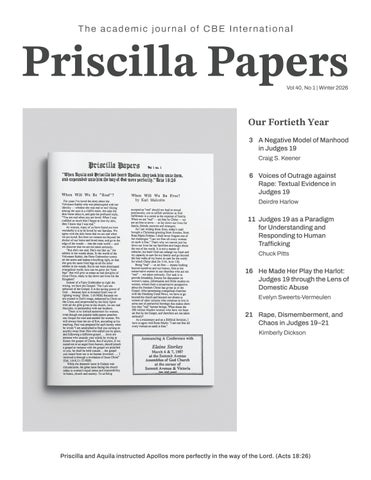
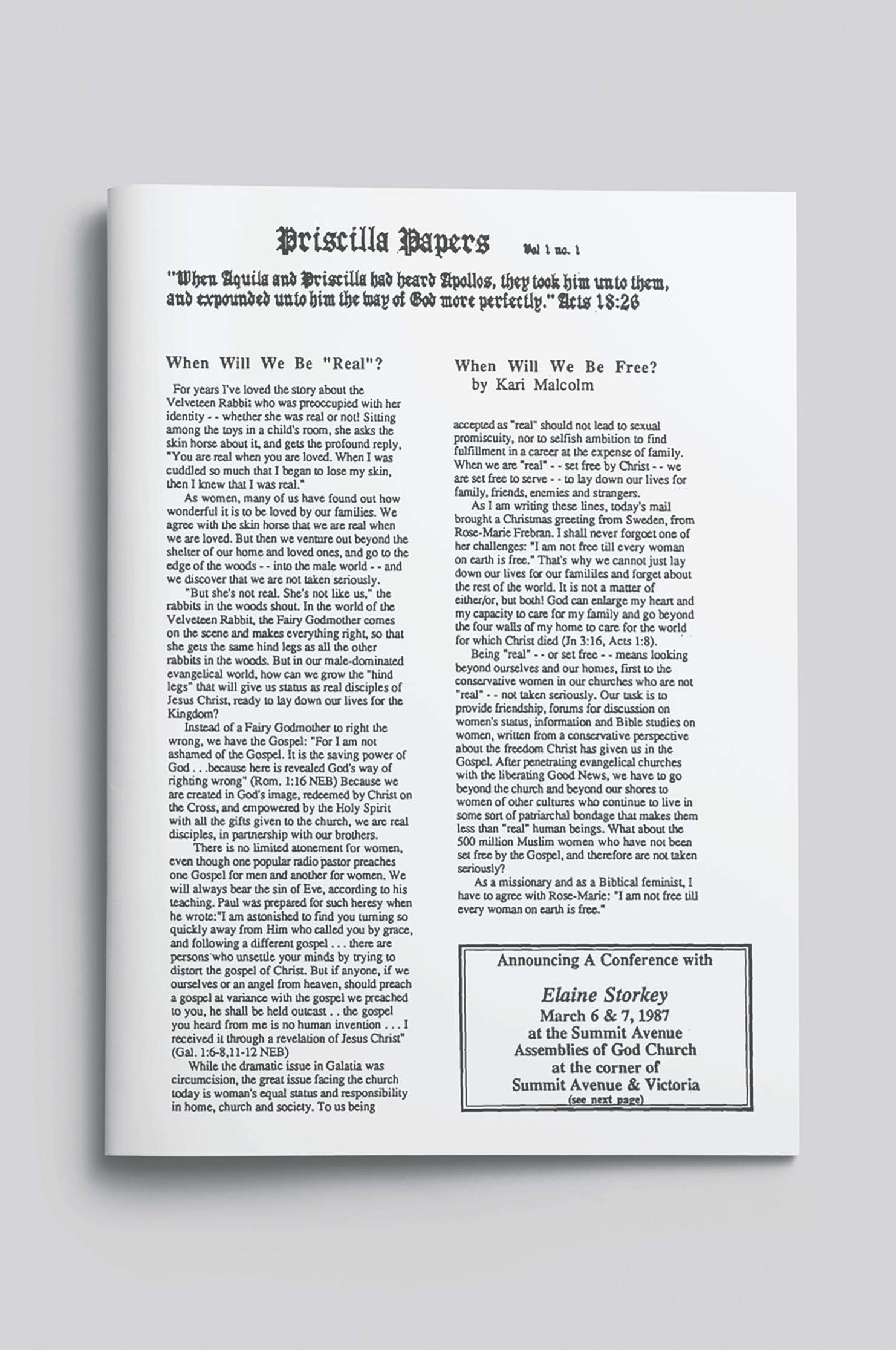
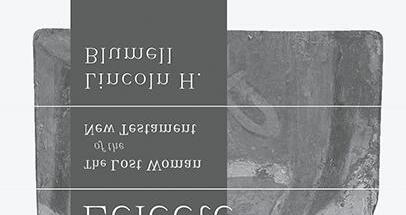
With this issue of Priscilla Papers, the journal begins its fortieth year! The cover photo shows the first issue, from the winter of 1987. Its opening article was, “When Will We Be Real? When Will We Be Free?,” by Kari Torjesen Malcolm.
I wonder if Kari and others from the early days of CBE would be surprised to learn that the first forty years have produced the same number of articles on the tragedies recorded in Judges 19–21 as they have on certain key passages. Priscilla Papers has published six articles each on 1 Corinthians 11, 1 Corinthians 14, Ephesians 5, and yes, Judges 19–21. The immensely important Genesis 3:16 and Galatians 3:28 have similar representation in the online Priscilla Papers index.
I propose that the prominence of the woman of Judges 19 in recent egalitarian scholarship illustrates how all-encompassing biblical gender equality is. Biblical exegesis is often the springboard for egalitarian thought and ethics, but that diving board inevitably propels us toward a pool, a deep and wide reservoir of topics, disciplines, concerns, challenges, opportunities . . . .
I became editor of Priscilla Papers in 2014 (I am now briefly standing in for editor Havilah Dharamraj), and I immediately began to grapple with the fact that egalitarian scholarship is interdisciplinary. I am a biblical scholar, and I rightly expected many exegetical articles to come across my desk. I was struck, however, by the large number of articles from historians. Nearly as many come from sociologists,
psychologists, and counselors. Also, from scholars of literature, experts in ministry and missions . . . the list goes on.
Moreover, many articles are themselves interdisciplinary. Indeed, the perspectives on Judges 19 in this issue bring together the ancient and the modern in profound ways.
In the following pages, you will be blessed and challenged by:
• Craig Keener’s “A Negative Model of Manhood in Judges 19” (Spring 1995).
• Deirdre Harlow’s “Voices of Outrage against Rape: Textual Evidence from Judges 19” (Winter 2014).
• Chuck Pitts’s “Judges 19 as a Paradigm for Understanding and Responding to Human Trafficking” (Autumn 2015).
• Evelyn Sweerts-Vermeulen’s “He Made Her Play the Harlot: Judges 19 through the Lens of Domestic Abuse” (Summer 2021).
• Kimberly Dickson’s “Rape, Dismemberment, and Chaos in Judges 19–21” (Winter 2022).
As you turn to these articles on Judges 19, I leave you with the narrator’s chapter-ending exhortation: “Consider it, take counsel, and speak out.” Or, to quote the NIV, “Just imagine! We must do something! So speak up!”
Jeff Miller Interim Editor
Priscilla Papers is indexed in the ATLA Religion Database® (ATLA RDB®), http://www.atla.com, in the Christian Periodical Index (CPI), in New Testament Abstracts (NTA), and in Religious and Theological Abstracts (R&TA), as well as by CBE itself. Priscilla Papers is licensed with EBSCO’s full-text informational library products. Full-text collections of Priscilla Papers are available through EBSCO Host’s Religion and Philosophy Collection, Galaxie Software’s Theological Journals collection, and Logos Bible Software. Priscilla Papers can also be found on Academia, Faithlife, and JSTOR. Priscilla Papers is a member publication of the American Association of Publishers.
Advertising in Priscilla Papers does not imply organizational endorsement. Please note that neither CBE International, nor the editor, nor the editorial team is responsible or legally liable for any content or any statements made by any author, but the legal responsibility is solely that author’s once an article appears in Priscilla Papers
CBE grants permission for any original article (not a reprint) to be photocopied for local use provided no more than 1,000 copies are made, they are distributed for free, the author is acknowledged, and CBE is recognized as the source.
Priscilla Papers is the academic voice of CBE International, providing peer-reviewed, interdisciplinary scholarship on topics related to a biblical view of women and men in the home, church, and world.
Editor: Havilah Dharamraj
Interim Editor: Jeff Miller
Graphic Designer: Margaret Lawrence
President / Publisher: Mimi Haddad
Peer Review Team: Andrew Bartlett, Joshua Barron, Stephanie Black, Lynn H. Cohick, Seblewengel (Seble) Daniel, Mary Evans, Laura J. Hunt, Chongpongmeren (Meren) Jamir, Jung-Sook Lee, Jill McGilvray, Ian Payne, Finny Philip, Charles Pitts, Terran Williams
On the Cover: The first issue of Priscilla Papers published in 1987.
Priscilla Papers (issn 0898–753x) is published quarterly by CBE International, 122 W Franklin Avenue, Suite 610, Minneapolis, MN 55404–2426 | cbeinternational.org | 612–872–6898
DISCLAIMER: Final selection of all material published by CBE International in Priscilla Papers is entirely up to the discretion of the publisher, editor, and peer reviewers. Please note that each author is solely legally responsible for the content and the accuracy of facts, citations, references, and quotations rendered and properly attributed in the article appearing under her or his name. Neither CBE, nor the editor, nor the editorial team is responsible or legally liable for any content or any statements made by any author, but the legal responsibility is solely that author’s once an article appears in print in Priscilla Papers
Priscilla Papers | 40/1 | Winter 2026
A Negative Model of Manhood in Judges 19
Craig S. Keener
Reprinted from Priscilla Papers 9/2 (Spring 1995)
Although the circles of young people where I minister rarely have a problem with women’s ministry, many young men and women are looking for more models of what it means to be a “real” man. Although some hold traditional and others hold egalitarian ideals of marriage, many of the young women who would like to someday marry lament the fact that there are not enough respectful Christian young men to go around in society as a whole.
Most of the young men … want to serve God. They are simply struggling right now to define for themselves and one another what it means to be a “good man” growing up in a society where fathers are too often absent, and where the majority of manhood models they have seen have been abusive toward women.
Many young people come from homes where they have seen or experienced abuse. Apart from God’s grace some of the young men now defining their manhood could become abusive, taking “lordship” over a wife for granted. But most of the young men we minister to sincerely want to serve God. Thus they are simply struggling right now to define for themselves and one another what it means to be a “good man” growing up in a society where fathers are too often absent, and where the majority of manhood models they have seen have been abusive toward women.
With these sorts of crises in mind, I have begun preaching more often from texts which, despite the very different culture in which they were written, provide sounder models for male identity than the ones my younger brothers in Christ often see. I like to preach from the example of the young man Joseph (probably not much older than 20 at the time) in Matthew 1:18–25, who showed that he was a “righteous” man—not only by taking sin seriously, but by showing mercy to someone (Mary) he felt had deeply betrayed him. Joseph and Mary also showed incredible self-control of their sexuality before Jesus’ birth, although they were married some months before that event (Mt. 1:25).
But I find another kind of man in Judges 19:1–20:7—an account that has often drawn insightful comments from feminist and womanist theologians.1 This story occurs in a section of Judges lamenting how immoral Israel had become in a period with no higher moral standard than each person’s personal values (cf. 18:1; 19:1; 21:25). This account provides the longest and starkest picture of Israel’s depravity in this period.
The story involves various kinds of characters, some wholly evil and abusive, others more ambivalent. The people of Gibeah come across as wholly evil—a characterization that undoubtedly serves the narrator’s purpose well. After all, the narrator may have
incorporated this story into Judges toward the beginning of David’s reign, when some still doubted the value of having a king (cf. 21:25) and still others remained loyal to the house of Saul. At this time it was important to show the diverse kinds of backgrounds from which David and Saul came.
Bethlehem, David’s home town, was the epitome of the ancient near eastern virtue of hospitality (19:2–9; cf. Ruth 1:19–2:16; 4:13–22) whereas Gibeah, Saul’s home town, was comparable to Sodom in its mistreatment of visitors (Judg. 19:22–24; cf. Gen. 19:5–8). The only hospitable man in Gibeah, like Lot in Sodom, was actually from somewhere else (Judg. 19:16–21). That the Levite bypassed a possibly harmless Canaanite enclave expecting to find greater hospitality from an Israelite town like Gibeah (19:11–15) simply underlines the pagan character of Gibeah’s citizens.
The narrative leaves no doubt that both the individuals directly responsible, and the society which refused to set moral standards for their behavior, invited God’s wrath. As in the story of Sodom, where Lot’s neighbors accused him of being judgmental for objecting to attempted rape (Gen. 19:9), the people of Gibeah refuse to hand over the murderers for justice (Judg. 20:13), thus making the whole community corporately responsible (see Deut. 21:1–9). Therefore the rest of Israel considered not only the evildoers but the immoral society that supported them to be under the rules of herem, rules previously only applied to the Canaanites: They obliterated nearly all of them (Judg. 20:42–48). The narrative portrays this event as divine judgment despite the fact that the rest of Israel does not appear particularly virtuous in this period, either. The contrast with the Lot story in Genesis 19 makes the lack of divine intervention in this account (as well as the massive casualties suffered by Israel’s avenging armies in Judges 20:21, 25, in contrast to most conquest narratives in Joshua) significant.
The anonymous Levite is a more round, ambivalent character. The text provides no evidence that he was normally abusive; he actively seeks justice on behalf of his murdered concubine. Yet the text hardly presents him in an unambiguously positive light. Given how the story ends, we might surmise why his concubine may have left him, but the story itself is not clear on this point, only revealing that she traveled a great distance to return to the home where she had been raised (19:2). That a concubine’s status was considerably lower than a wife’s (though often higher than a slave’s) undoubtedly created an unpleasant situation for her, but many Israelites hearing the story would think the Levite compassionate for seeking out
his concubine rather than simply demanding repayment from her father so he could acquire a more pliable concubine (19:3). Although we know that other explanations of his behavior are possible (and are put off by the very social setting which permitted such inequities as concubinage), the narrative probably suggests that the Levite genuinely cared for his concubine.
Many Israelite men, considering homosexual sin more disgusting than heterosexual sin, undoubtedly thought that sending a woman to be raped rather than a man constituted the lesser of two great evils (19:24–25; cf. Gen. 19:8). Be that as it may, the Levite who had apparently loved his wife in the preceding narrative seemed to love himself more; the wording suggests (he “took” her and “sent her out”) that she had little or no say in her being handed over to the men outside. The Levite held power over her both as a man in a patriarchal society and as a master over a concubine; he used that power to send her rather than himself out to certain suffering. The narrative indicates that the Levite is not proud of his behavior; the way he later recounts this story to the Israelite armies called to execute vengeance is telling in what it omits. He claims that the men of Gibeah wished to “kill” him (Judg. 20:5)—not have intercourse with him. From the Levite’s account, one would never know that he himself handed his concubine over for the act of torture (19:25), that she was alive when they finished with her but he was afraid to open the door before daylight (19:26), or that he had callously offered her a command without so much as acknowledging what she had been through (19:28). Instead of using his power to serve, perhaps to heroically lay down his own life, he had sent her to suffer instead, and he does not care to admit it when he retells the story (20:4–6).
The narrator of Judges presents for his readers the evil character of people in an evil time. While the self-interested Levite was not as guilty as the murderers, neither does the narrative absolve him of responsibility, for it tells the whole story that the Levite neglected to tell. This fits the rest of the Book of Judges. We should not expect the narrator to ignore the woman’s plight; he is well aware of heroic (e.g., Judg. 4:4, 21) and spiritually wise (e.g., 13:22–23) women. We should not assume that he would portray the Levite in a wholly positive light; even many of his positive heroes sometimes appear in a negative light. Thus whereas Deborah and Samuel (the latter in 1 Samuel) appear spotless, Jephthah (like some people determined to get ahead today) sacrifices his own family (only Jephthah does it literally—11:30–40); Gideon created an ephod that became an object of idolatrous veneration in his lifetime (8:27); Samson preferred sleeping with idolaters—only to one of whom was he even married—to a marriage with a woman with whom he could share the same faith, a sin that ultimately did him in (chs. 14–16). The narrator is teaching us about heroic and cowardly character in the story of the Levite and his concubine.
This passage reveals the hideousness of abusing power, not only the way the men of Gibeah did, but also the way the Levite did. Those who teach male headship should recall how Paul defined the husband’s role of “headship” in Ephesians 5:23, 25–31: one who lays down his life for his wife. Yet in a time of testing, perhaps even some of us egalitarians would prefer our own life to someone else’s.
This narrative summons all self-centered human beings (whatever our beliefs on paper) to reconsider our values. By its essentially
negative model of manhood, the story of the Levite and his concubine suggests that young men seeking to become truly mature men cultivate values of self-sacrifice, not pursuit of power.
We desperately need models of manhood that stress responsibility rather than exploitation, service rather than abuse of power.
In a society where men still hold most of the social power and where the average husband possesses more physical power than the average wife, we desperately need models of manhood that stress responsibility rather than exploitation, service rather than abuse of power. A “real” man, in contrast to an immature child, must not cling to self-satisfaction, but must consider first the needs of his wife, children and others. If traditionalists and egalitarians can find consensus on this issue, perhaps we can join forces at least in addressing the rampant abuse of power in many patriarchal marriages today. My heart aches for many of the hurting women and men my age I know, and I pray that the women and men in our campus ministry may find the greater joy that God intended.
Notes
1. It was Koala Jones-Warsaw in a paper at SBL two years ago who first drew my attention to this passage. After teaching on Judges 19 and preparing this manuscript, I compared my conclusions with the more detailed analysis of Phyllis Trible, which gives special attention to the Hebrew literary constructions, finding many points of similarity. Readers interested in a more detailed and nuanced discussion of the passage should pursue Phyllis Trible, Texts of Terror: Literary-Feminist Readings of Biblical Narratives (Philadelphia: Fortress Press, 1984), pp. 65–91; viewing not only the concubine’s suffering as a woman but other dimensions of injustice in the story, see Koala Jones-Warsaw, “Toward a Womanist Hermeneutic: A Reading of Judges 19–21,” The Journal of the Interdenominational Theological Center 22 (1, Fall 1994): 18–35.
Craig S. Keener holds a PhD in NT and Christian Origins from Duke University as well as MA and MDiv degrees from Assemblies of God Theological Seminary. He teaches biblical studies at Asbury Theological Seminary near Lexington, Kentucky. Well over a million of his thirty-plus books are in circulation. Craig is married to Médine Moussounga Keener, who holds a PhD from University of Paris 7. Craig and Médine work for ethnic reconciliation in the U.S. and Africa. Their story together is told in their book, Impossible Love: The True Story of an African Civil War, Miracles, and Hope Against All Odds (Chosen Books, 2016).
Made Whole: Healing the Body of Christ
August 6–9, 2026 | Chicago, IL
Crowne Plaza O’Hare Hotel & Conference Center
Join us in Chicago, August 6–9, 2026, as we gather to learn, heal, and grow as one body— women and men serving side by side as equal gospel partners. Through sessions on theology, pastoral care, church history, and more! We’ll explore women’s legacy of faithful leadership and seek healing from the wounds of theological patriarchy for both women and men. And, for the first time, we will offer introductory sessions on biblical equality for those who are new to the subject! Don’t miss this time of encouragement and renewal before the Lord.
In-Person Registration Includes:
• Access to keynotes, workshops, and devotions from Christian egalitarian leaders.
• Networking with scholars, speakers, students, and ministry professionals.
• Onsite CBE Bookstore featuring conference speakers and authors.
• An author reception where attendees will have the chance to meet renowned authors and scholars.
• Prayer room available for reflection and support.
• Conference workbook with schedule, maps, and speaker information.
• Two dinners for all attendees and breakfast for those staying onsite at the Crowne Plaza O’Hare Hotel.
• Free O’Hare airport shuttle for hotel guests staying onsite.
• Access to the mobile event app group—and more!
Visit cbe.today/chicago2026 or scan the QR code to learn more.
Sarah Ago
Taffi Dollar Joy J. Moore
Andrew Bartlett Roy Ciampa
Jo Anne Lyon
Kathy Myatt
Beth Felker Jones
Tara Korpi
Todd Korpi
Patrick J. Knapp Paige Cunningham
Heidi I. Knapp
Ingrid Faro Mimi Haddad
Flavio Prestes III
Charles Read
Carina Prestes
Doug Groothuis
Israel Steinmetz
Amber Burgess Elizabeth Beyer
Voices of Outrage against Rape: Textual Evidence in Judges 19
Deirdre Harlow
Reprinted from Priscilla Papers 28/1 (Winter 2014)
Rape is a timeless and worldwide1 epidemic that violates the divine image and personhood of a human being and renders its victims voiceless, powerless,2 and fragmented from self, others, and God. Rape causes a desolate and disordered reality psychologically, relationally, and spiritually, often resulting in theological and “existential crisis.”3 Although this crisis impacts millions each year,4 rape has a history of silence, denial, and serious misperceptions.5 These misperceptions include blaming the victim and minimizing the multidimensional impact and trauma of rape. Healing requires breaking the silence, which many voices are doing today, including one particular community more than two thousand years old. Rather than silencing, denying, or minimizing rape, this community speaks relevantly and powerfully by voicing outrage against rape.
The voices of this community are represented by the writers and narrators of the Hebrew Bible, otherwise known as the Old Testament (OT). The OT has often been misinterpreted and misperceived as oppressive toward women and silent about abuse. However, evidence within the OT reveals that the biblical writers and narrators highly value women and speak adamantly against rape, including the rape of a woman from Bethlehem recorded in Judges 19. By demonstrating how the biblical writers view women and rape, and how the narrator of Judges 19 speaks outrage against rape, I hope to prove how these voices within the OT, which represent the divine perspective,6 speak relevantly and redemptively today. We will begin by establishing how the biblical writers view women and rape.
Background and Terminology
Examples of how the biblical writers view women are found in the creation account and the wisdom and prophetic literature. As one who is able to conceive, bear, and sustain life, the first woman is named “Life”7 and is called “the mother of all living” (Gen 3:20).8
According to the creation account, woman is created in God’s image (Gen 1:27)9 and shares the same substance and nature as man (Gen 2:23). She is “corresponding to” man (Gen 2:18), his equal and yet distinct from him. The wisdom literature describes women as valiant, strong, intelligent, and wise,10 and also personifies wisdom as a woman who speaks truth and brings life.11
The prophetic literature metaphorically 12 portrays Jerusalem as a woman13 who defends, nurtures, and sustains those within her walls.14 This evidence from the creation account and the wisdom and prophetic literature reveals that the biblical writers highly viewed women15 as representatives of life, wisdom, sustenance, and strength.
Examples of how the biblical writers view rape are found in the legal, prophetic, and narrative texts of the OT. The legal texts16 reveal that rape was viewed as equivalent to murder (Deut 22:26) and as
According to the narrative texts, rape is viewed as an “outrage” (nebalah), which also means godlessness and abomination.“Outrage” occurs only thirteen times in the OT and is reserved for extreme acts of violation against God and human beings.
pressuring a woman physically (Deut 22:25–27) or psychologically (Deut 22:28–29)17 into sexual intercourse. The legal texts value the consent and voice of the woman (Deut 22:27) and assume her innocence (Deut 22:27, 28). They also perceive rape as a threat to the social and economic survival of the woman (Deut 22:29; Exod 22:16–17) and as a serious violation not only against the woman, but also against her family (Deut 22:29; Exod 22:16–17).18 The prophetic texts reveal that rape was understood as physically and psychologically traumatic. The book of Ezekiel employs rape as a metaphor in order to convey the horror, trauma, and desolation of foreign invasion and warfare (Ezek 16; 23).19
According to the narrative texts, rape is viewed as an “outrage”20 (nebalah), which also means godlessness21 and abomination.22 “Outrage” occurs only thirteen times in the OT23 and is reserved for extreme acts of violation against God and human beings,24 including the rapes of Dinah, Tamar, and the woman of Bethlehem.25 Based on its usage, an “outrage” was considered a serious threat to the life and wellbeing of an individual, community,26 and nation27 that resulted in a dangerous breakdown28 of social, communal, and cosmic norms.29 The biblical writers record Tamar’s outcry and grief (2 Sam 13:19) which testifies that rape was understood as physically, socially, and psychologically devastating, resulting in desolation (2 Sam 13:20).30
This evidence from the legal, prophetic, and narrative texts reveals that the biblical writers understood the multidimensional trauma and devastation of rape and viewed rape as life-threatening and a serious violation of God-ordained, life-sustaining order.31
A Closer Look at the Woman from Bethlehem
We now proceed to Judges 19 in order to determine how the narrator of this text voices outrage against the rape of the woman from Bethlehem. The narrator’s voice is conveyed through his portrayal of the characters and his choice of words and themes throughout the narrative.32 Before approaching Judges 19,33 let us begin by situating this narrative within its cultural context and by getting to know the woman from Bethlehem. The narrator does not name her or the characters within this narrative in order to signify a nation
that had dehumanized those within its community. So, for the sake of simplicity and in order to restore personhood and identity to the woman of Bethlehem, I will refer to her as Beth.
Beth was a woman from the tribe of Judah.34 As a woman, she represents life, wisdom, sustenance, and strength. She was born in Bethlehem soon after the death of Joshua (Judg 1:1), and shortly after the exodus account, the wilderness wanderings, and the fall of Jericho. Her family was one of the first to settle the promised land, and the men in her family led the Israelites in battles against their Canaanite enemies (Josh 15:14–18; Judg 1:1–20). Beth’s family included Caleb35 and Caleb’s daughter Acsah, who is the first woman mentioned in the book of Judges—a woman with name, voice, land, and power (Judg 1:14–15).
Beth grew up in an agrarian, pre-industrial society under the harsh conditions of pioneer settlement. Her family had to cultivate and farm a dry and difficult land in order to survive. She lived in a grouporiented culture in which the survival of the society depended on the family, the resources of the land, and the equal contribution of both men and women.36
Beth eventually married a Levite from the hill country of Ephraim and became part of the tribe of Moses and Aaron (Exod 6:13–27). Rather than having the status of a wife, she is described as a young concubine (pilegesh) and was therefore expected to provide progeny for her husband.37 As a Levite, her husband had been set apart to “stand and serve in the name of the Lord” (Deut 18:5; Judg 17:13).38
Beth and the Levite lived in the hill country of Ephraim (Judg 19:1).39
“The hill country of Ephraim” are the last words of the book of Joshua (Josh 24:33) and therefore connect the concluding events in Joshua with the events recorded in Judges 19. The book of Joshua ends after the Israelites recount the Passover and exodus (Josh 24:5–13, 16–18). The Israelites profess their loyalty to God by renewing their covenant with him and denouncing other gods (Josh 24:14–27). In contrast, the events recorded in Judges 19 reveal a generation that did not know God or what he had done for Israel (Judg 2:10), a generation that had broken covenant with him and had turned to other gods. This is the period in which Beth lived, a period of political and spiritual chaos, which was reflected through the idolatry of the nation40 and through corrupt political and spiritual leaders.41 This was a time when there was no king in Israel42 and when all of them did what was good in their eyes (Judg 17:6; 21:25), but evil in God’s eyes.43 This is where Beth’s story begins and where we tune in to the narrator’s voice, which is conveyed through his portrayal of the characters, choice of words, and integration of themes from the creation, exodus, and Sodom and Gomorrah accounts.
The Narrative of Judges 19 Unfolds
The narrator begins by portraying Beth as a young woman44 who boldly left her husband and returned to her father’s house in Bethlehem. According to the narrator, Beth left the Levite because she was angry, described by a word that comes from the Hebrew root zanah. Zanah is a verb that can mean to prostitute,45 to be unfaithful,46 or to be angry.47 Based on the fact that Beth was welcomed back into her father’s household and that her husband eventually pursued her to reconcile with him, it seems most probable that Beth left the Levite because she was angry with him.48
The narrator initially portrays the Levite as questionable. Although the Levite pursues Beth in order to speak to her heart (Judg 19:3), he never speaks to Beth or to her heart. Instead, he spends five days sustaining his own heart (Judg 19:5, 6, 8, 9) through the generous, life-giving hospitality of Beth’s father.49 While it seems as though the Levite has forgotten Beth, the narrator remembers her by purposefully and redundantly mentioning her nine times in the first nine verses of Judges 19.50
The Levite’s decision to leave Bethlehem and return home to Ephraim becomes the turning point of the narrative. The Levite, who decides to begin his journey when darkness was approaching (Judg 19:9, 11, 15, 16), appears unwise. By leaving Bethlehem at the end of the day and by choosing to lodge in the city of Gibeah rather than Jerusalem, the Levite unknowingly places himself and Beth in grave danger.
The narrator next introduces a second hospitality scene as Beth and the Levite are confronted with unexpected neglect in the city square of Gibeah. Such neglect contrasts with the generous welcome and hospitality previously portrayed in Bethlehem. Suddenly, a fellow sojourner from the hill country of Ephraim approaches Beth and the Levite and generously offers to care for their needs. While in the home of the Ephraimite host, the Levite again sustains his heart. The narrator’s continued repetition of heart highlights the Levite’s neglect of Beth’s heart.
While the Levite sustains his heart, men of Gibeah surround the house. The men of Gibeah are “sons of Israel” (Judg 19:12) from the tribe of Benjamin. However, the narrator explicitly calls these men “sons of Belial” (Judg 19:22), which means sons of worthlessness, wickedness, destruction,51 and death (2 Sam 22:5–6).52 At this point in the narrative, the narrator begins to make deliberate parallels between Judges 19 and the narrative of Sodom and Gomorrah (Gen 19).
Like the men of Sodom, the men of Gibeah beat violently 53 on the door of the house (cf. Gen 19:9) and demand to know the Levite sexually (cf. Gen 19:5). Knowing another sexually refers to the creation mandate to be fruitful and multiply (Gen 1:28), just as Adam knew Eve (Gen 4:1). However, the men of Gibeah seek to reverse the creation mandate into fruitlessness and death. The narrator highlights the Ephraimite host’s condemnation of their intention to rape as “evil”54 and an “outrage.”55 These words reveal the narrator’s view of rape as an abominable, godless, and life-threatening act that violates God-ordained, life-sustaining order.
The text compares the Ephraimite host to Lot when the host gives the men of Gibeah permission to “rape” Beth and his daughter and to do “what is good in their eyes.”56 By equating “rape” with doing the “good in their eyes,” the text makes a powerful rhetorical statement by connecting a key theme throughout Judges with the rape of Beth: Everyone was doing what was good in their eyes, but evil in God’s eyes.
The Levite, who had initially pursued Beth in order to speak to her heart, seizes (chazaq)57 her and forces her through the doorway of the house to be brutally raped by men of death and destruction. By forcing her outside, the Levite sacrifices her in order to save himself and to prevent death from entering the house.58 The Levite remains safe inside the house while Beth is violently and repeatedly 59 known all night long, and then ruthlessly discarded (Judg 19:25).
The combination of the words “violent abuse” and “know” conveys rape (Judg 20:5) and the exact opposite of the life, goodness, and fruitfulness of the creation account.
At this point in the narrative, the parallels cease between Judges 19 and the Sodom and Gomorrah narrative, which enables the narrator to depict the rape of Beth as exceeding the evil of Sodom and Gomorrah.60
By presenting the Levite’s neglect and betrayal,61 the horror of the gang-rape by men of death and destruction, and the intensity of Beth’s pain and suffering, the narrator evokes revulsion for the Levite and the men of Gibeah, and deep compassion for Beth. The narrator is the one person in the narrative who does not abandon Beth and who is ardently attentive to her critical condition. She is bleeding, dying, and desperate. With nowhere else to go, she returns to the Levite and collapses at the doorway of the house with her hands on the threshold.
The narrator’s earnest awareness to the placement of Beth’s hands (Judg 19:27) is paradoxical to the Levite’s oblivious indifference to her. Surely, now the Levite will speak to Beth’s heart as she hangs onto the threshold between life and death. However, the Levite’s first and only words to her are, “Get up, let’s go.”62 Such callousness evokes even more compassion for Beth and revulsion for the Levite.
Beth, who had initially left Ephraim to return to her father, now returns to Ephraim lifeless.63 Once again, the Levite seizes (chazaq)64 her in order to sacrifice her. According to the narrator, the Levite gruesomely cuts (natach) Beth apart limb by limb65 into twelve pieces in order to send her to the twelve tribes of Israel.66 As the narrator describes the dismemberment, he uses sacrificial language67 that appears elsewhere only in reference to sacrificial animals68 and burnt offerings.69 By dismembering Beth, the Levite offers an anti-sacrifice. Her broken and divided body is the antithesis of the creation mandate to “be fruitful and multiply” (Gen 1:28). She is multiplied in order to bring about war and divided in order to unite the Israelites as “one man” (Judg 20:1, 4–8, 11). However, the Israelites unite in order to dismember the nation by nearly annihilating the tribe of Benjamin, reflecting a society in chaos and disorder (Judg 20–21).
The narrator concludes by stating, “Nothing like this had happened since the days the Israelites came out of Egypt.” Nothing like this had happened since the eve of the exodus, when a lamb was sacrificed and its blood smeared on the doorway of a house in order to prevent death from entering the house (Exod 12:21–23). By referring to the exodus from Egypt and by highlighting Beth, fallen at the doorway with her hands on the threshold, the narrator portrays the rape, death, and dismemberment of Beth as an antithesis of the Passover sacrifice.70 The narrator concludes Judges 19 with the exhortation to set your heart71 upon Beth, counsel wisely on her behalf,72 and speak out (Judg 19:30; cf. 20:7).73
Through his compassion toward Beth, negative portrayal of the Levite, condemnation of the rapists, indictment of rape as an outrage, depiction of Beth’s rape as exceeding the evil of Sodom and Gomorrah, and portrayal of Beth’s rape as an antithesis of the creation mandate and the Passover sacrifice, the narrator of Judges 19 voices outrage against rape.
Conclusion
My hope has been to demonstrate that the voices of the biblical writers and narrators within the OT speak outrage against rape in ways that are relevant and redemptive for us today. Evidence throughout the OT shows that the biblical writers highly value women and view rape as physically, socially, and psychologically devastating and as a serious violation of God-ordained, life-sustaining order. The evidence within Judges 19 reveals that the narrator voices outrage against the rape of Beth by sharing her suffering, siding with her compassionately, and conveying the evil and horror of rape and its ravaging effects.
The biblical writers and narrators validate the pain and trauma of rape and its multidimensional impact and devastation at individual, communal, and national levels. Through their voices, which represent the divine perspective, we hear God’s own voice of outrage against rape.
These voices have ensured that Beth’s story is not silenced or forgotten. They have set their hearts upon her and have spoken out on her behalf. She has been remembered in light of God’s historical act of redemption (Judg 19:30; cf. Exod 13:17–14:31) and God’s redemptive work through desolation (Ruth 1–4). The tragedy of Beth’s rape and death is followed by hope through the story of another desolate woman of Bethlehem, who has a name and a voice, and a daughterin-law named Ruth.74 From a desolate woman of Bethlehem comes the messianic line of David (Ruth 4:9–22). Out of Bethlehem emerge the greatest atrocity and the greatest hope (Mic 5:2).
Notes
1. According to Steven Tracy’s research, “South Africa has the highest documented sexual assault rates in the world,” tens of thousands of women were raped in Bosnia during the 1990s, 75 percent of the women in Liberia were raped during its civil war, and tens of thousands of women and children have been raped in the Congo. Steven R. Tracy, “Definitions and Prevalence Rates of Sexual Abuse: Quantifying, Explaining, and Facing a Dark Reality,” in The Long Journey Home, ed. Andrew J. Schmutzer (Eugene, OR: Wipf & Stock, 2011), 8–9.
2. Diane Mandt Langberg, Counseling Survivors of Sexual Abuse (Maitland, FL: Xulon, 2003), 59.
3. Judith Lewis Herman, Trauma and Recovery (New York, NY: BasicBooks, 1997), 51.
4. Tracy, “Definitions and Prevalence Rates of Sexual Abuse,” 4–5, 8. According to Tracy’s research, one out of six women in the United States is a victim of rape. Tracy also notes that sexual abuse is one of the most underreported crimes in the United States due to conflicting data based on diverse definitions of “sexual abuse” as well as the humiliating and traumatic nature of sexual abuse.
5. See Joy Schroeder, Dinah’s Lament (Minneapolis, MN: Fortress, 2007); and John L. Thompson, Writing the Wrongs: Women of the Old Testament among Biblical Commentators from Philo through the Reformation (Oxford: Oxford University Press, 2001).
6. See Shimon Bar-Efrat, Narrative Art in the Bible (Sheffield: Sheffield Academic, 1989; repr., New York: T&T Clark, 2004), 13; and Miriam J. Bier, “Colliding Contexts: Reading Tamar (2 Samuel 13:1–22) as a Twenty-First Century Woman,” in Tamar’s Tears, ed. Andrew Sloane (Eugene, OR: Pickwick, 2012), 175.
7. “Eve” (ḥawah), F. Brown, S. R. Driver, and C. A. Briggs, A
Hebrew and English Lexicon of the Old Testament (Peabody, MA: Hendrickson, 2007), (hereafter BDB), 295.
8. Eve is also called “helper,” which refers to a military ally and to God. See Exod 18:4; Deut 33:7, 26, 29; Josh 1:14; 10:4, 6, 33; 1 Sam 7:12; 2 Sam 8:5; 18:3; 21:17; 1 Kgs 1:7; 20:16; 2 Kgs 14:26; Ps 20:2; 28:7; 33:20; 37:40; 70:5; 89:19; 115:9–11; 121:1–2; 124:8; 146:5; Isa 41:6; Dan 11:34; Hos 13:9.
9. God is described in female terms such as midwife (Isa 66:7–9) and mother (Isa 42:14; 66:13).
10. Prov 31:10, 17, 25, 29; Song 4:4; 6:4; 7:4. Cf. Ruth 3:11; 1 Sam 14:48, 52; 2 Sam 17:10; 22:40.
11. Prov 3:18; 8:7, 10, 14, 15, 20, 35; 16:22.
12. Christl Maier stresses the importance of acknowledging the use of metaphor in the prophetic texts. See Christl M. Maier, Daughter Zion, Mother Zion: Gender, Space, and the Sacred in Ancient Israel (Minneapolis, MN: Fortress, 2008), 136, 139.
13. Isa 54; Ezek 16:1–46; 23:1–34; Lam 1:1–11.
14. Tikva Frymer-Kensky, In the Wake of the Goddesses (New York, NY: The Free Press, 1992), 172. See Ps 51:18; 122:5–7; Isa 62:6; 66:10–13. Both Jerusalem and women are also vulnerable to foreign invasion. See Lam 1:8; Ezek 16:37; 23:10, 29; Hos 2:3; Nah 3:5.
15. Carol Meyers and Richard Davidson argue for the high valuation of women in ancient Israel. See Richard M. Davidson, Flame of Yahweh: Sexuality in the Old Testament (Peabody, MA: Hendrickson, 2007), 224–25; and Carol Meyers, Discovering Eve: Ancient Israelite Women in Context (New York, NY: Oxford University Press, 1988).
16. It is important to discern that these laws were most likely descriptive of the reality of the culture rather than prescribed by God.
17. Cf. Exod 22:16–17. See Richard M. Davidson, “Sexual Abuse in the Old Testament: An Overview of Laws, Narratives, and Oracles,” in The Long Journey Home, ed. Andrew J. Schmutzer (Eugene, OR: Wipf & Stock, 2011), 136–37.
18. See Davidson, “Sexual Abuse in the Old Testament,” 136–38; Bar-Efrat, Narrative Art, 267; and Daniel I. Block, Deuteronomy, NIV Application Commentary (Grand Rapids, MI: Zondervan, 2012), 531.
19. Ezek 16:6–7, 39–40; 23:28–29. See Maier, Daughter Zion, 123; and Hilary B. Lipka, Sexual Transgression in the Hebrew Bible (Sheffield: Sheffield Phoenix Press, 2006), 223. According to Lipka and Kamionkowski, sexual abuse was a form of psychological warfare in the ancient Near East in order to shame and dehumanize the enemy, to undermine the enemy’s sense of self, and to render the enemy powerless. See S. Tamar Kamionkowski, Gender Reversal and Cosmic Chaos (London: Sheffield Academic, 2003), 61–65; and Lipka, Sexual Transgression, 238.
20. “Nebalah,” David J. A. Clines, ed., The Dictionary of Classical Hebrew (Sheffield: Sheffield Academic, 2001), (hereafter DCH), 5:595.
21. L. Koehler, W. Baumgartner, and J. J. Stamm, Hebrew and Aramaic Lexicon of the Old Testament, trans. and ed. M. E. J. Richardson (Leiden: Brill, 1994–1999), (hereafter HALOT), 1:663. See Isa 32:6; cf. Josh 7:15; Ps 14:1; Isa 9:16; Jer 29:23. Chou-Wee Pan notes that the “disorderly views” of Job’s friends (Job 42:8) have “prevented any constructive theological discussion of the suffering of the righteous.” Chou-Wee Pan, “nbl,” in New International Dictionary of Old Testament Theology and Exegesis, ed. Willem A. Van Gemeren (Grand Rapids, MI: Zondervan, 1997), 3:12. See also Phillips, who claims that Job’s friends are accused of nebalah because they “failed to enter into the reality of Job’s experience” (Anthony Phillips, “Nebalah–A Term for Serious Disorderly and Unruly Conduct,” Vetus Testamentum 25 [1975]: 240).
22. M. Soebø, “nabal,” in Theological Lexicon of the Old Testament, ed. Ernst Jenni and Claus Westermann, trans. Mark E. Biddle (Peabody, MA: Hendrickson, 1997), 2:713.
23. Eight of the thirteen times that the noun nebalah appears are within the context of sexual violation (Gen 34:7; Deut 22:21; Judg 19:23, 24; 20:6, 10; 2 Sam 13:12; Jer 29:23).
24. Marböck, “nabal,” in Theological Dictionary of the Old Testament, ed. G. Johannes Botterweck, Helmer Ringgren, and Heinz-Josef Fabry, trans. David E. Green (Grand Rapids, MI: Eerdmans, 1977), 9:171. See also Soebø, “nabal,” 713.
25. Gen 34:7; Judg 19:23, 24; 20:6, 10; 2 Sam 13:12, 13.
26. Alice A. Keefe, “Rapes of Women/Wars of Men,” Semeia 61 (1993): 82.
27. Lipka, Sexual Transgression, 208; P. Kyle McCarter Jr., 2 Samuel (Garden City, NJ: Doubleday, 1984), 328.
28. Phillips, “Nebalah,” 237–38.
29. See Frank M. Yamada, Configurations of Rape in the Hebrew Bible: A Literary Analysis of Three Rape Narratives (New York, NY: Peter Lang, 2008), 7; and Lipka, Sexual Transgression, 208. According to the Myth of Enlil and Ninlil, Enlil is banished by those “who uphold the world and its fundamental order” as a consequence of taking Ninlil by force and violating the order of society. Thorkild Jacobsen et al., “Mesopotamia,” in The Intellectual Adventure of Ancient Man (Chicago, IL: University of Chicago, 1946), 156.
30. Shmm (“desolate”) is found 91 times in the OT, predominantly in prophetic texts (62 times) and “occurs most frequently (55 times) with the sense to suffer destruction.” Tyler F. Williams, “shmm,” in New International Dictionary of Old Testament Theology and Exegesis, ed. Willem A. Van Gemeren (Grand Rapids, MI: Zondervan, 1997), 4:168. Shmm appears only eight times in reference to people (2 Sam 13:20; Isa 54:1; 62:4; Lam 1:13, 16; 3:11; 4:5; Job 16:7). See also Isa 49:19; 64:10; Jer 4:23–27; Lam 1:4; 5:18; Ezek 36:34–36.
31. The root of nebalah (nbl) also appears in the Dead Sea Scrolls (1QS 7:9) in reference to offenses against the community. Nebalah also appears in 1 QS 10:21f and is connected with “Belial.” See Marböck, “nabal,” 171, and Judg 19:22.
32. The narrator’s voice reveals his perspective, which is often equated with the divine perspective. See Bar-Efrat, Narrative Art, 13; and Bier, “Colliding Contexts,” in Tamar’s Tears, 175.
33. My approach to Judges 19 is with a hermeneutic of trust rather than a hermeneutic of suspicion. See Jacqueline E. Lapsley, Whispering the Word: Hearing Women’s Stories in the Old Testament (Louisville, KY: Westminster John Knox, 2005), 18; Davidson, Flame of Yahweh, 3; and Andrew Sloane, ed., Tamar’s Tears (Eugene, OR: Pickwick, 2012), xi–xii. For an approach that incorporates a hermeneutic of suspicion, see Phyllis Trible, Texts of Terror: Literary-Feminist Readings of Biblical Narratives (Philadelphia, PA: Fortress, 1984), 3, 86.
34. See Judg 1:1–20; Ruth 1:22; 4:11; 1 Sam 17:12; Matt 1:5; Luke 2:4–7.
36. Carol Meyers argues that premonarchic women would have experienced a higher degree of equality with men because of the absence of political and economic hierarchies and the lack of division between public and private realms. See Meyers, Discovering Eve, 145, 182. Cf. Gen 16:1–6; 27:5–17; 38:13–26; Exod 15:20–21; Josh 2; Judg 1:14–15; 4:4–14; 13:3–23; Ruth 1:16–18; 2:2; 3:7–9.
37. Cf. Gen 16:2; 30:3.
38. Cf. Num 8:5–11. Aaron’s grandson Phineas possibly served as high priest during this time (Judg 20:26–28; cf. Exod 6:25; Num
25:7; Josh 24:33).
39. Ephraim means “doubly fruitful” (Gen 41:52). This is where Joshua was buried (Josh 24:29–30), Deborah led the tribes of Israel (Judg 4:5), and Samuel was born (1 Sam 1:1). Ephraim later becomes associated with the northern tribes of Israel (1 Kgs 12:25).
44. The narrator refers to Beth as a young woman in relation to her father (Judg 19:4, 5, 6, 8, 9), but as a concubine in relation to the Levite (Judg 19:1, 9). The narrator refers to the Levite as her husband (Judg 19:3; 20:4) and master (Judg 19:26–27).
45. BDB, 275. JPS, KJV, NAS, and NKJ.
46. ESV and NIV.
47. HALOT, 1:275; DCH 3:121, 123. NET, NJB, and NRS. LXXA also translates “she was angry” (ὠργίσθη, ōrgisthē). Ansell argues that this recension of the LXX “represents a textual tradition that is superior to the MT.” See Ansell, “This Is Her Body . . . Judges 19 as Call to Discernment” in Tamar’s Tears, ed. Andrew Sloane (Eugene, OR: Pickwick, 2012), 148. According to Susan Niditch, many scholars follow LXXA. See Susan Niditch, “The ‘Sodomite’ Theme in Judges 19–20: Family, Community, and Social Disintegration,” Catholic Biblical Quarterly (1982): 366.
48. Many scholars believe that a woman who prostituted herself would not return to her father; otherwise, she would be stoned (Deut 22:13–21). See Robert G. Boling, Judges (Garden City, NY: Doubleday, 1975), 274; Ken Stone, “Gender and Homosexuality in Judges 19: Subject-Honor, Object-Shame?” Journal for the Study of the Old Testament 67 (1995): 90; and Victor H. Matthews, “Hospitality and Hostility in Genesis 19 and Judges 19,” Biblical Theology Bulletin 22 (Spring 1992): 7. Exum adds that a Levite would not pursue an adulterous wife. J. Cheryl Exum, Fragmented Women: Feminist (Sub)versions of Biblical Narrative (Sheffield: JSOT Press, 1993), 179.
49. I favor Block’s and Niditch’s view that the father is the model of hospitality. See Daniel I. Block, Judges, Ruth, New American Commentary (Nashville, TN: Broadman and Holman, 1999), 527; and Niditch, “The ‘Sodomite’ Theme,” 366–67. However, some scholars interpret this scene as male bonding (Trible, Texts of Terror, 68) or excessive hospitality (Stuart Lasine, “Guest and Host in Judges 19: Lot’s Hospitality in an Inverted World,” Journal for the Study of the Old Testament 29 [1984]: 56–57; Yamada, Configurations of Rape, 72–77). According to Ansell and Lapsley, the father is subtly reminding the Levite to speak to the woman’s heart (Ansell, “This Is Her Body,” 153; Lapsley, Whispering the Word, 41).
50. Judg 19:1, 2, 3, 4, 5, 6, 8, 9.
51. BDB, 116.
52. According to Boling, Belial is “one of the most maleficent characters of the mythic underworld.” Boling, Judges, 276.
53. Hithpael of dpq (BDB, 200).
54. Cf. Judg 2:11; 3:7, 12; 4:1; 6:1; 10:6; 13:1.
55. Judg 19:23–24; 20:6, 10. Cf. Gen 34:7; Deut 22:21; 2 Sam 13:12–13.
58. See Exod 12:21–23. Ansell makes a connection between the death of the Bethlehemite woman and the Passover ritual. See Ansell, “This Is Her Body,” 158.
59. Hithpael of ‘ll. Cf. 1 Sam 31:4; Jer. 38:19. The LXX translates ‘ll as ἐµπαίζω [empaizō] (cf. Luke 22:63; 23:11, 36). ‘ll refers to gleaning a vineyard (Lev 19:10; Deut 24:21), but, when referring
to human beings, it expresses the intention to annihilate. Eugene Carpenter, “‘ll,” in New International Dictionary of Old Testament Theology and Exegesis, ed. Willem A. Van Gemeren (Grand Rapids, MI: Zondervan, 1997), 3:423.
60. Deut 29:23; Isa 1:9; 13:19; Jer 23:14; 49:18; Amos 4:11. Cf. Hos 9:9; 10:9.
61. Both Yamada and Lasine believe that the narrator condemns the Levite through subtle use of irony and absurd behavior. See Yamada, Configurations of Rape, 91; and Lasine, “Guest and Host in Judges 19,” 38.
62. Cf. 2 Sam 13:15.
63. While the MT is ambiguous regarding when the Bethlehemite woman died, the LXX inserts that she was already dead. The narrator later refers to her as “the murdered woman” (Judg 20:4).
64. Cf. Judg 19:25.
65. Cf. Ezek 16:40.
66. Sending a message in such a grisly way is without parallel in biblical and ANE sources. One Mari text (ARM II, 48) attests to sending the head of an executed criminal throughout the land in order to convince the Haneans to prepare for war. See J. Alberto Soggin, Judges, trans. John Bowden (Philadelphia, PA: Westminster, 1981), 289. However, the closest comparison is found in 1 Sam 11:6–8, when Saul dismembered an ox and sent the pieces throughout Israel as a summons to war. Cf. 1 Kgs 11:30; 18:30–33.
67. The sacrificial language is ntḥ (“cut”) and hamma’akeleth (“the knife”). Ntḥ appears this one time in reference to cutting apart a human being. See Milton C. Fisher “ntḥ,” in Theological Wordbook of the Old Testament, ed. R. Laird Harris, Gleason L. Archer Jr., and Bruce K. Waltke (Chicago, IL: Moody, 1980), 2:607–08. “The knife” only appears elsewhere in Gen 22:10, when Abraham “took the knife” in order to sacrifice Isaac as a burnt offering. This particular knife also appears in Prov 30:14, which describes a generation whose teeth are like knives in order to devour the afflicted.
68. Exod 29:17; Lev 1:6, 8, 12; 8:20; 9:13; 1 Sam 11:7; 1 Kgs 18:23, 33; Ezek 24:4, 6.
69. Eugene Carpenter, “ntḥ,” in New International Dictionary of Old Testament Theology and Exegesis, ed. Willem A. Van Gemeren (Grand Rapids, MI: Zondervan, 1997), 3:201. See Lev 1:1–17; 6:8–13; 8:18–21; 16:24.
70. Butler notes, “The narrator simply wants to place this event in sharp contrast to the exodus event as its polar opposite.” Trent C. Butler, Judges, Word Biblical Commentary, vol. 8 (Nashville, TN: Thomas Nelson, 1999), 416.
71. According to the BHS critical apparatus, a few manuscripts, including the Targum, say, “Set your heart upon her” (BHS, 437).
72. Ansell notes that ‘etsah (Judg 19:30) is a cognate of tsuts (“counsel”) and “one of the most important terms in wisdom discourse” (Ansell, “This Is Her Body,” 154). Cf. Judg 20:7; Prov 1:25, 30; 8:14.
73. According to the LXX, these are the words of the Levite. According to the MT, these are the words of the Israelite tribes.
74. The book of Ruth follows the book of Judges in the LXX, while 1 Samuel follows the book of Judges in the MT.
Deirdre Harlow is committed to cultivating human flourishing, nurturing strong relationships, and supporting faith-informed growth. She is an expert in the Hebrew language. In addition to this article, Deirdre published “Tamar’s Voice of Wisdom and Outrage in 2 Samuel 13” in the Autumn 2014 issue of Priscilla Papers
Judges 19 as a Paradigm for Understanding and Responding to Human Trafficking
Chuck Pitts
Reprinted from Priscilla Papers 29/4 (Autumn 2015)
Judges 19 contains a seldom read, let alone studied or discussed, story of misogyny, subjugation, rape, murder, and dismemberment. Determining how to handle such atrocities in the Bible makes texts such as these difficult to address. More than thirty years ago, Phyllis Trible labeled Judges 19 as one of the “texts of terror” in the Hebrew Bible (along with the stories of Hagar, Tamar, and the daughter of Jephthah).1 Texts of terror tend to be avoided unless the reader can clearly separate the perpetrators of evil in the text from themselves. David Garber and Daniel Stallings have argued that the church must stop ignoring sexually explicit texts “because the story of the Levite’s concubine and the brutality contained therein speak vividly to issues of sexual violence that persist to this day. The silencing of sexually explicit biblical texts in American churches mirrors the silencing of issues of sexual violence in contemporary society.”2 This article will begin with a look at various approaches to exegesis of this text and then seek to show that we cannot exempt ourselves from this text of terror in light of its application to the twenty-first century problem of human trafficking, especially sex trafficking.
The Biblical Story
Phyllis Trible labeled Judges 19 as one of the “texts of terror” in the Hebrew Bible. Texts of terror tend to be avoided unless the reader can clearly separate the perpetrators of evil in the text from themselves.
the metaphorical reading seems justified, perhaps as an act of autonomy, as Ackerman suggests.6 However, the reader soon learns that the woman had no autonomy.
First, here is the story. A Levite (hence, an apparently important man) from the hill country of Ephraim took a concubine from Bethlehem. A concubine was a woman used for a man’s pleasure without the legal protection of a primary wife;3 indeed, some would argue that the concubine in Judges 19 is not a “wife” at all, but is part of a “mistress-type relationship.”4 The primary wife is not mentioned in this narrative, which lends a bit of irony to the story. The concubine left the Levite and returned to her father’s house in Bethlehem, either because she committed adultery or because of some type of mistreatment of or by the Levite. The Hebrew text uses the verb zanah, which is normally translated “prostitute” or “fornicate,” to describe her behavior. However, the Septuagint Greek version uses the verb orgizō, meaning “to be angry” (followed by RSV and NRSV). This could suggest that she became angry or disgruntled and left him. The reason for the Masoretic Text’s reference to sexual infidelity is unknown, although suggestions have been made. Several interpreters have suggested a metaphorical meaning for “prostitution” or “sexual sin,” much like Jeremiah and Hosea use the concept of sexual infidelity as a metaphor for Israel and Judah’s relationship with God. Thus, the act of leaving her husband was an act of unfaithfulness.5 Since neither the Levite, the woman’s father, nor the narrator ever mentions any act of unfaithfulness,
Four months after she left him, the Levite went after his concubine. He took with him two donkeys and a male attendant. After several days of hospitality and negotiation between the Levite and her father— with no input from the woman herself—the Levite left to return to Ephraim with his concubine. The journey began late in the day, so night was approaching before they reached their final destination. The male servant suggested that they stop in non-Israelite Jebus (later to become Jerusalem), but the Levite refused, preferring instead to proceed into the familiar territory of the tribe of Benjamin. One was better off with “brothers” than “strangers,” after all. A bit farther up the road, they entered the Benjaminite town of Gibeah. After no local resident offered hospitality, an Ephraimite who was living in Gibeah offered them the safety of his home (relative safety, as it turned out). After they had settled in for the evening, some men of Gibeah came to the door demanding sexual pleasures from the stranger who had entered the house. The Ephraimite defended the rights of his guest, the Levite, by offering the men his own virgin daughter and the Levite’s concubine for their pleasure, since it was an “outrageous thing” to abuse a visitor (a male visitor, that is). Cheryl Exum points out that male rape by another male would have been a “de-gendering” of the man.7 The Levite threw his concubine to the men, who ravaged her. After being gang raped throughout the night, the woman dragged herself to the threshold of the house, and there the Levite found her the next morning. He could not rouse her from her unconscious state, so he placed her on the donkey and made the trip home.
After he arrived home, the Levite took a knife and dismembered her body. Interestingly, the Hebrew text gives no clue whether the concubine was already dead when he cut up her body.8 The Septuagint apparently assumes her death, and the Levite claims that she was dead in his explanation in the next chapter, to which we will soon turn. The Levite cut his concubine into twelve pieces to broadcast the sin of the Gibeahites to his own tribal relations. All the people who saw it (apparently those receiving the body parts) said, “Such a thing has never been seen or done, not since the day the Israelites came up out of Egypt” (Judg. 19:30 NIV). We will return to this statement later in this article; however, a brief summary of the events of Judges 20–21 is first necessary, since as Jan Fokkelmann has pointed out, Judges 19 cannot be read apart from Judges 20–21.9
The Levite manipulates the real outrage against his wife (which he himself caused) to exact retribution for the attempted outrage against himself. He could not reveal to the tribes that he was almost raped by dissolute men.
In Judges 20, the Levite meets with the representatives of the recipients of the body parts for an explanation. The people of Israel gather at Mizpah to hear from the Levite, asking him “How did this evil thing happen?” The Levite’s answer is important and is thus quoted here in its entirety:
To Gibeah of Benjamin I came, I and my concubine, to spend the night. And the leaders [lit. “lords”] of Gibeah surrounded the house at night because of me. They intended to kill me, and my concubine they humiliated and she died. So I grabbed my concubine. I cut her into pieces, and I sent her to all the land of the inheritance of Israel. For they committed a shameful act—a foolish act—in Israel. Look here, you children of Israel, give your word—give counsel here. (Judg. 19:24–27, author’s translation)
This brief account given by the Levite warrants comment. First, the Levite leaves out several events found in the earlier narrative. He neglects to say that the men of Gibeah first tried to “humiliate” him and only took the concubine as a last resort. In fact, the same Hebrew word that the Levite uses—nĕbalah, translated “foolish act” here—was used by the host in Judges 19 concerning the planned act against the Levite. Gale Yee comments,
The Levite manipulates the real outrage against his wife (which he himself caused) to exact retribution for the attempted outrage against himself. He could not reveal to the tribes that he was almost raped by dissolute men. He would have incurred dishonor and loss of prestige. Instead, he manipulates his relationship with a woman in order to maneuver his male relations to accomplish his personal vendetta against Gibeah.10
More importantly, he neglects to tell his fellow Israelites that he himself had sent the concubine out to the men of Gibeah, choosing to have her humiliated rather than himself.
Second, the Levite adds elements to the earlier narrative account. He calls the men of Gibeah “lords” or “leaders” (Hebrew ba’ale). This could have the effect of making the attack an official act of the city, rather than of a rabble as suggested by the original narrative account. He also states that the men “planned to kill” him, while the narrative states that they wanted sexual relations with him. Also, he adds in this report that his concubine “died” as a result of the attack. However, the previous narrative does not include her death (except in the LXX translation, probably a later addition to remove
the possibility that the Levite actually killed the ravaged woman himself). The results of the Levite’s report were both immediate and severe. The Israelites immediately began plans to punish the men of Gibeah. However, when the tribe of Benjamin refused to surrender the guilty men to the other Israelites, a civil war erupted and virtually all the men of Benjamin were killed in the ensuing battles.
If the story ended with the rape of the concubine and subsequent destruction of the men of Benjamin, the results would be tragic. However, the actual end of the story is even worse. The Israelites were remorseful that an entire tribe was destroyed and decided they needed women to repopulate Benjamin. Their solution to the loss of Benjamin’s men was to conquer the town of JabeshGilead—killing everyone except four hundred young virgins— and taking their virgins to repopulate Benjamin. Unfortunately, there were not enough virgins in Jabesh-Gilead for all the men of Benjamin, so virgins participating in a ritual celebration at Shiloh were kidnapped and given to the men of Benjamin. Thus, the punishment of Gibeah for the rape of the Levite’s concubine was more rape! As Alice Keefe concludes, “there is an element of dark absurdity in both the horror of the woman’s fate at the hands of the Levite and the horror of a war among the tribes which is to no purpose except mass death and more rape.”11 The tragic irony of this reality is an appropriate point of departure to discuss interpretive approaches to Judges 19–21.
Connections with Sex Trafficking
Because sex trafficking is a relatively new addition to social justice discussions, no monograph on Judges makes a connection between human trafficking and the events of Judges 19. Several current studies have focused on the topic of rape in the Hebrew Bible. Alice Keefe’s study, “Rapes of Women/Wars of Men,” leads the way. She points out that the Hebrew word translated above as “foolish act” is also found in the narratives of the rapes of Dinah in Gen 34 and Tamar in 2 Sam 13.12 Other emphases for interpretation include homosexuality, hospitality, and gender inequality. Although some recent interpreters continue to emphasize a condemnation of homosexuality in Judges 19, this does not seem to be the point of the text, but a side issue.13 In fact, Michael Carden argues that a man penetrated by another man demasculinizes the man, causing the man to lose his position as a male in the male-dominated society.14 Thus, while gender inequality is certainly a significant interpretive matter in the text, homosexuality is tangential. The role of hospitality is important to the text, since the Ephraimite host in Gibeah offers his virgin daughter and the Levite’s concubine to maintain the honor of his guest; we will return to this topic later in the study. The studies of Trible, Exum, and Ackerman argue that the primary interpretive issue in Judges 19 (interestingly with little interest in Judges 20–21) is the subjugation of women in ancient Israelite culture. In fact, Ackerman states that the “entire plot concerns the concubine’s inability to exert any control over her own fate.”15 That the inequality of gender is important in reading this text—and exegeting the ancient culture—is without debate, but these authors probably do overstate the “entire plot” of the story. The events represent the downfall of a society, the lack of shalom in a community, or a “Canaanization”16 of Israel, where “there is no king and everyone does as he sees fit” (Judg. 21:25). One might argue that “everyone does as he sees fit” is an appropriate description of
modern western culture, with human trafficking as an example of this characteristic.
How do these events mirror modern human trafficking, and more explicitly, sex trafficking? First, as Mitzi Smith wrote in one of the few studies that connects Judg. 19 with human trafficking, “travel or journey provides a . . . framework for . . . the story.”17 Much of modern trafficking is predicated on the ability of traffickers to transport victims across borders or even across town, normally in circumstances where the victim’s travel rights are limited. Typically, this travel begins with “dreams of a better and different life.”18 The concubine fled from her husband to her father, presumably for a better life. Smith compares the plight of the runaway wife to the one million to three million runaways on America’s streets—the country’s most vulnerable population. Not to mention the much larger global number! In the end, however, her travel was restricted by both her father and the Levite. Her father negotiated her back to her husband, and she again travelled. This travel, unfortunately, was completely in the control of her husband. Even as she lay at the threshold, the Levite continued her journey. As Smith has commented, “The young woman’s terror in the night will not interfere with the Levite’s business in the day.”19 Carried even further, her final travel incited a retributory war—even after she was dead and dismembered.
A second similarity between the Judges 19 concubine and sex trafficking victims is anonymity. Actually, all of the characters in the story are anonymous, but the concubine is anonymous, hidden, and silent. She is the only character in the story who never speaks. Keefe states, “Her narrative silence points to the eclipse of any speaking of truth in the midst of this black and bloody comedy.”20 In her silence, the concubine seems to be the only person in the narrative with no identity of her own. In comparison, a modern sex trafficking victim from Cambodia testified that:
I want you to remember we are not “problems,” we are not animals, we are not viruses, we are not garbage. We are flesh, skin and bones; we have a heart, and we have feelings. We are a sister to someone, a daughter, a granddaughter. We are people, we are women, and we want to be treat [sic] with respect, dignity. And we want rights like the rest of you enjoy.21
The term “invisible” is often used to describe victims of human trafficking.22 In fact, a recent documentary on sex trafficking was entitled, “In Plain Sight,” because these victims are invisible, even in plain sight.23 The concubine—like modern sex-trafficking victims— was invisible, except when the men wanted her seen.
This brings into view the third similarity in our story to modern human trafficking—patriarchalism. As Smith points out, the concubine’s “victimization is concealed behind ideas of patriarchal normalcy.”24 In the ancient Near East, as in most of the world today, men had authority, power, and often authorization to abuse and even traffic women.25 In Judg. 19, “hospitality occurs among men.”26 Andrew Ng has suggested, in fact, that “the rape and murder of the concubine is meant . . . to indict the patriarchal system and to expose the entrenched sinfulness of the men—fathers and husbands who are supposed to function as guardians,” but have “renounced this vital role for cowardly self-preservation.”27 Men need not be
At the end of the story in Judges 19, the concubine is literally cut into pieces, perhaps symbolizing the destruction that had already occurred in her life. As Trible points out, she has no one to mourn for her.
bothered with women or servants. When the “brothers” in Gibeah come for the Levite, two women are offered by the host in his place. As Smith stated, “an acceptable substitute for sexually ravishing one man is the offering up of two women.”28 The Levite subjugated and oppressed the concubine and clearly had no problem with other men doing the same—and worse. As Trible stated, the male who could have been protector becomes the procurer.29 Stone has pointed out that the honor of the man was at least partially dependent upon his ability to control the women in his care—and under his control.30 In the same way, modern human traffickers control and subjugate victims in this system of patriarchal normalcy. Furthermore, in many family systems (especially, though not exclusively, nonwestern) fathers and brothers in authority over women in the family will sell or trade women into sex-trafficking.31
Finally, and not unrelated to the patriarchal issue, in both Judges 19 and modern human trafficking, the myth of familiarity and homogeneity hides the realities of pain, rape, abuse, and treachery. The concubine’s father would not protect her. The host in Gibeah would not protect her. The Levite would not protect her. At the end of the night, she is left lying sprawled before the door of safety, behind which all the men slept, prompting one writer to state, “the Knights in Shining Armor inside the house were snoring.”32 In modern trafficking, familiarity often hides trafficking. Modern-day sex traffickers place themselves in relationships with victims, and potential victims, that appear to be caring, loving relationships. They pretend to love the victims in order to place the victims in positions of vulnerability.33 Children are pimped by their parents. Women are sold by brothers and husbands. Behind the façade of familiarity lies a web of deceit and destruction.
At the end of the story in Judges 19, the concubine is literally cut into pieces, perhaps symbolizing the destruction that had already occurred in her life. As Trible points out, she has no one to mourn for her. “Passing her back and forth among themselves, the men of Israel have obliterated her totally. Captured, betrayed, raped, tortured, murdered, dismembered, and scattered—this woman is the most sinned against.”34 As Garber and Stallings write, “her broken body communicates far more than her words ever could have expressed: The nation of Israel is in chaos and something must be done.”35 Like the concubine’s broken body, the oppressed, wounded, and devastated bodies of victims of sex-trafficking in the twenty-first century cry out. Christine, a survivor who was born into sex slavery in Minnesota, writes these words:
It is no small achievement to survive sexual slavery. Survivors are split into pieces, fragmented, broken, filled with despair, pain,
rage, and sorrow. We have been hurt beyond belief. We are silent; we are numb. Our eyes see, our ears hear, but we do not tell. Our voices are nonexistent, but even if they did exist, who would believe what we have to say? Who would listen? Who would care? We are dirty, ruined, despised, the whores of the earth. The men who use us throw us away. We are their garbage to piss on, to pile up in the corner. We are their property, they own us. The rest of you turn your backs, avert your eyes, pretend not to see, go on your way. You leave us to the predators.36
We must recognize the evil as evil. What masquerades as shalom is actually evil.
How to Respond?
The above quotation from a survivor slaps us in the face with a question: what can we do? First, we can recognize that the conclusion of the Judges narrative is incorrect. The narrator said, “Such a thing has not happened or been seen” before (v. 30). This statement is simply untrue. These scenes have been repeated for millennia! In scripture, Dinah was raped. Tamar was raped. Jephthah’s daughter was sacrificed. The concubine was raped and murdered. The virgins of Jabesh-Gilead and Shiloh were kidnapped and raped, even if in culturally sanctioned marriages. We must stand up for the victimized.
Second, we must recognize the evil as evil. What masquerades as shalom is actually evil. The men of the story saw life as shalom. The concubine knew better, but those in power were saying with the false prophets of Jeremiah’s day, “Shalom, shalom,” but as Jeremiah retorted, “There is not shalom here” (Jer 6:14). As Garber and Stallings concluded, “In a society where women and children are becoming the victims of horrible violence at an alarming rate, all is not well.”37 We must speak up for the silenced, for the oppressed, for the victimized. Our world, like that of the Levite and concubine, is broken and filled with evil. We must speak the truth into this world.
Third, to quote Trible, “We must take counsel to say ‘Never again.’ Yet this counsel is itself ineffectual unless we direct our hearts to that most uncompromising of all biblical commands, speaking the word not to others but to ourselves: Repent. Repent.”38 This repentance must include a confrontation of the evil. No one came to the defense of the concubine. She could get to the threshold of safety but never over that threshold. Lapsley concludes:
The narrator [of Judges 19] gently encourages us to read this story so that we will evaluate the actions of the characters, yes, but also, and equally importantly, so that we will enter sympathetically into the experience of these characters, to sit and weep and cry out with the Israelites, because they are us.39
Yes, the Levite, concubine, father, Ephraimite host, and Gibeahites are us. And the experience of the concubine is the experience
of millions of women in our world—even in the “enlightened west.”40 We must act! To remain ignorant and living in blissful— and sinful—ignorance cannot suffice any longer. The expectations of the biblical Creator and the Son Jesus are clear: Care for the oppressed and the captive and the helpless. Repent! And repentance must include action!
The narrator [of Judges 19] gently encourages us to read this story so that we will evaluate the actions of the characters, yes, but also, and equally importantly, so that we will enter sympathetically into the experience of these characters, to sit and weep and cry out with the Israelites, because they are us.
Notes
1. Phyllis Trible, Texts of Terror: Literary-Feminist Readings of Biblical Narratives, OBT (Fortress, 1984) 65–91.
2. David G. Garber Jr. and Daniel Stallings, “Awakening Desire Before It Is Season: Reading Biblical Texts in Response to the Sexual Exploitation of Children,” RevExp 105 (Summer 2008) 454.
3. See Trent Butler, Judges, WBC 8 (Thomas Nelson, 2009) 419, for discussion of the meaning of “concubine.”
4. See Susan Ackerman, Warrior, Dancer, Seductress, Queen: Women in Judges and Biblical Israel, ABRL (Doubleday, 1998) 236–37.
5. Jacqueline Lapsley, Whispering the Word: Hearing Women’s Stories in the Old Testament (Westminster John Knox, 2005) 37–38. See also Butler, Judges, 407.
6. Ackerman, Warrior, Dancer, 237.
7. Cheryl Exum, Fragmented Women: Feminist (Sub)versions of Biblical Narratives, JSOTSup 163 (JSOT, 1993) 183. See also Ken Stone, Sex, Honor and Power in the Deuteronomistic History, JSOTSup 234 (JSOT, 1996) 81.
8. Trible, Texts of Terror, 80, points out the parallel language with Abraham in Gen 22, suggesting that the text may assume that she was not dead and that, unlike Isaac, no one saved her from the knife.
9. Jan Fokkelmann, “Structural Remarks on Judges 9 and 19,” in “Sha’arie Talmon”: Studies in the Bible, Qumran, and the Ancient Near East Presented to Shemaryahu Talmon, ed. M. Fishbane, E. Tov, and W. W. Fields (Eisenbrauns, 1992) 42.
10. Gale Yee, “Ideological Criticism: Judges 17–21 and the Dismembered Body,” in Judges & Method: New Approaches in Biblical Studies, ed. Gale Yee (Fortress, 2007) 156.
11. Alice Keefe, “Rapes of Women/Wars of Men,” Semeia 61 (1993) 92.
12. Keefe, “Rapes of Women,” 82. See also Richard Davidson, Flame of Yahweh: Sexuality in the Old Testament (Hendrickson, 2007) 521–22. See also Deirdre Brouer, “Voices of Outrage against Rape: Textual Evidence from Judges 19,” Priscilla Papers 28, no.
1 (Winter 2014) 24–28, reprinted in this issue of Priscilla Papers
13. See, for example, K. Lawson Younger Jr., Judges/Ruth, NIV Application Commentary (Zondervan, 2002) 359–66; Daniel Block, Judges, Ruth, NAC (Broadman & Holman, 1999) 536–37, 542–45.
14. Michael Carden, “Homophobia and Rape in Sodom and Gibeah: A Response to Ken Stone,” JSOT 82 (1999) 86. See also Ken Stone, “Gender and Homosexuality in Judges 19: Subject-Honor, Object-Shame?,” JSOT 67 (1995) 87–107.
15. Ackerman, Warrior, Dancer, 237.
16. Block, Judges, Ruth, 518–19.
17. Mitzi J. Smith, “Reading the Story of the Levite’s Concubine Through the Lens of Modern-day Sex Trafficking,” ATJ 41 (2009) 17.
18. Smith, “Reading the Story,” 17.
19. Smith, “Reading the Story,” 26.
20. Keefe, “Rapes of Women,” 92. Concerning the word “comedy,” Keefe earlier says on p. 90, “And though the ludicrously callous behavior of the Levite would tempt one to read this scene as a black comedy, the stark contrast of complete insensitivity and complete suffering still has the rhetorical effect of heightening the reader’s empathy for the tortured woman. If the Levite does not care, who does?”
21. Kevin Bales and Zoe Trodd, eds., To Plead Our Own Cause: Personal Stories by Today’s Slaves (Cornell, 2008) 103, quoted in Smith, “Reading the Story,” 19.
22. Smith, “Reading the Story,” 19.
23. Noah Lamberth and David Trotter, In Plain Sight: Stories of Hope and Freedom, documentary DVD, 2014.
24. Smith, “Reading the Story,” 19.
25. This statement does not reflect ignorance of the fact that many trafficked individuals are male.
26. Smith, “Reading the Story,” 26.
27. Andrew Hock-Soon Ng, “Revisiting Judges 19: A Gothic Perspective,” JSOT 32/2 (2007) 201.
28. Ng, “Revisiting Judges 19,” 201.
29. Trible, Texts of Terror, 74.
30. Stone, “Gender and Homosexuality,” 95.
31. See Smith, “Reading the Story,” 19–20.
32. E. T. A. Davidson, Intricacy, Design, & Cunning in the Book of Judges (XLibris, 2008) 176.
33. Smith, “Reading the Story,” 22–24.
34. Trible, Texts of Terror, 81.
35. Garber and Stallings, “Awakening Desire,” 454.
36. Bales and Trodd, To Plead Our Own Cause, 101, quoted in Smith, “Reading the Story,” 28.
37. Garber and Stallings, “Awakening Desire,” 466.
38. Trible, Texts of Terror, 87.
39. Lapsley, Whispering the Word, 66.
40. Lapsley, Whispering the Word, 66.
Chuck Pitts holds MDiv and PhD degrees from New Orleans Baptist Theological Seminary. He taught at Houston Graduate School of Theology from 1999 – 2015. He now teaches high school history in inner-city Houston. He has served several congregations, both as a staff member and a volunteer. In all these settings, he has worked with a strong concern for civil rights, social justice, and ministry to the economically challenged. He also supports and volunteers for United against Human Trafficking. Chuck is a member of the Priscilla Papers Peer Review Team.
Where leaders, pastors, and authors share women’s biblical equality in Scripture. A CBE International Podcast
He Made Her Play the Harlot: Judges 19 through the Lens of Domestic Abuse
Evelyn Sweerts-Vermeulen
Reprinted from Priscilla Papers 35/3 (Summer 2021)
The story of the gang rape and murder of an unnamed woman in Judges 19 is one of the bleakest narratives of the OT. Although it is mostly avoided in churches, since it is in the Bible it is important to ask how it might be read as a vehicle for justice.1 Compounding the difficulties the text presents, certain key elements of the narrative are ambiguous—for example, what the woman’s status was and why precisely she left the Levite. A close exegetical analysis, brought into conversation with the domestic abuse cycle, makes the story internally coherent and resolves the textual difficulties. Furthermore, by drawing attention to this dynamic in the text, churches can be challenged to address these issues more openly. Doing so must be a priority, given the prevalence of abuse and the imperative of the gospel.
Seeing and Understanding Domestic Abuse
In her seminal work, Texts of Terror: Literary-Feminist Readings of Biblical Narratives, Phyllis Trible says about Judges 19 that “to hear this story is to inhabit a world of unrelenting terror that refuses to let us pass by on the other side.”2 This indirect call from Trible not only to notice but to act when confronted with abuse cannot be made insistently enough. In our neighborhoods and churches people of every age, ethnicity, and socio-economic status are being hurt. Domestic abuse helplines in the USA receive more than 19,000 calls daily.3 More than twenty-three percent of women and almost fourteen percent of men have experienced severe physical violence by an intimate partner, which means a significant minority of people who have experienced or witnessed severe violence are present in most churches. Indeed, there will almost certainly be abusers lurking in the pews. Many more will have had exposure to (or committed) other types of abuse or “milder” violence (is there such a thing as mild physical violence, given its emotional effects?).4
Domestic abuse can take many forms. As well as physical violence, those victimized may be subjected to emotional, psychological, financial, and sexual abuse or, usually, some combination of these in a pattern of controlling, coercive, and threatening behaviors.5 Even love-bombing (lavish affection), while appearing kind, in the context of domestic abuse is manipulative and controlling.6 The research shows that ending the abusive relationship without adequate safeguards in place often leads to serious and even fatal violence.7 In such cases, the most dangerous time is after the escape.
Churches have been largely and shamefully silent on the issue of domestic abuse. A Lifeway poll found that forty-two percent of Protestant pastors rarely or never speak about domestic abuse, presumably in part because thirty percent believed it was not a problem in their congregations.8 The statistics above suggest that they are almost certainly mistaken. It is past time for the church
to do the theological work, get educated about the facts and local sources of support, engage in educating others, speak out for justice, and offer safety to those who are hurting.
The theological work is vital, and it needs to consider not only those texts most often used to send victims back to their abusers (e.g., Eph 5:22 and 1 Pet 2–3) but also those which may shape the conversation in unseen ways.9 For example, Renita J. Weems broke new ground in her study of how depictions of Yahweh as an abusive husband in the prophetic literature may wrongly serve to legitimate human abuse.10 Reading the story of the Levite and his concubine through the lens of domestic abuse can be a refusal to remain complicit in the silencing and minimizing that surrounds the issue. Furthermore, just as feminist readings can sensitize us to other voices that are marginalized or silenced, so seeing domestic abuse in this text may open our eyes to violence elsewhere, both in the Bible and in the lives of our neighbors. Abuse can be challenged, and victims supported, only if it is first seen.
The Domestic Violence Cycle
In 1979, psychologist Lenore Walker proposed a cyclical model for understanding domestic violence, which she developed from interviews with 1,500 battered women.11 In the first phase, tension builds, eventually leading to an incident of abuse. This is followed by reconciliation and then calm, together making a honeymoon phase. Gradually tensions increase again as the cycle repeats. This model has been critiqued for its emphasis on physical aggression, its neglect of the power and control aspects of domestic abuse, and its focus on male-on-female violence.12 While it may be an imperfect tool in victim support and criminal justice settings, it is nevertheless a helpful model for the story of the Levite and his concubine.13
Judges 19
Given its clear parallels with Gen 19, commentators have readily treated this story as one about hospitality. Frank M. Yamada has done literary analyses of the rape narratives of the OT. He argues that the meaning of the rape in Judges 19 “is structured through the two hospitality scenes.”14 His summary is typical: “Both . . . stories are more properly understood not as a condemnation against homoeroticism . . . but instead as a failure of hospitality.”15 Quite apart from the fact that the story can be about both hospitality and sexual relations, note that there is no mention of the victim in Yamada’s summary. The horrific gang rape of the woman readily becomes mere evidence in a discussion about hospitality.
The introduction to the book of Judges (1:1–3:6) tells first of social, then of religious fragmentation, and the epilogue (chs. 17–21) does the reverse, giving an A B B' A' framing to the book.16 As a result, the story of the Levite and his concubine can best be understood
in terms of social disintegration, of which both inhospitality and violence are aspects. The story “epitomizes the ultimate deterioration and betrayal of family relations—a moral bankruptcy the Bible chastises.”17 The story in Judges 19 may have many lessons to impart and possible polemics to share concerning hospitality, the relative merits of Benjamin and Judah (and by extension Saul and David), and the familial, social, and religious disintegration of Israel. But, just as importantly, here is also a story of a woman who was abused and was fatally unable to find safety.
Furthermore,
the writer raises questions in the mind of the reader that are never answered: Why did the Levite take a pilegesh (usually translated “concubine”) and what is that exactly?
The Setting
An overview of the context of the narrative will be helpful at this point. The narrator says that the story takes place when there was no king in Israel (Judg 19:1). This signals to the reader that moral chaos similar to the previous narrative can be expected, which was also framed by the indication of the absence of monarchy (Judg 17–18). Likewise, the immediate mention of Ephraim, Bethlehem, Judah, and a Levite, which have been shown in a negative light in the previous story, lets the reader know that more of the same is likely to follow.18 These narrative clues communicate that what follows serves as a terrible warning rather than a good example.
The story starts with an unnamed adult male Levite who lives in a remote part of Ephraim and takes a concubine from Bethlehem in Judah (19:1). No one in this story is given a name: protagonists are marked by their origins and locations, their relationships to one another, and by their explicit or implicit status. This lack of naming “illustrates the disintegration and dehumanization of society while it universalizes the characters in this sordid story.”19 Although this man is a Levite (of the tribe set aside by God to provide priests for the nation) nothing that follows relates to his status as a Levite. Set alongside the story before, perhaps it simply serves to illustrate how far the religious life of Israel had crumbled. The Levites were not given land but were allocated towns to live in and allotted pastureland (Josh 18:7, Josh 21). The fact that this Levite lives in a tent (Judg 19:9) in the far reaches of Ephraim (v. 1) and not in a Levite town may also signal cause for concern. Here is a male protagonist about whom the reader is invited to have doubts.
Furthermore, the writer raises questions in the mind of the reader that are never answered: Why did the Levite take a pilegesh (usually translated “concubine”) and what is that exactly? Whatever translation is chosen for pilegesh (e.g., “concubine,” “second wife”), current scholarship on the word has not conclusively answered the questions about her status, rights, or inheritance procedures.20 None of the references in the Bible define the status of a pilegesh, and their rights and those of their children vary from text to text.21 Based in
part on family experience and her cultural context as a ZimbabweanAmerican, Christine Mafana offers the intriguing suggestion that the pilegesh was a wife of lower status for whom the bride price had not been paid.22 Why not marry the girl properly? Why did her father accept this lesser status for his daughter? Why did the Levite take a woman from so far away, or why did he move to be far away afterwards? What is clear is that this is not a desirable situation for her, as she was unlikely to have “the legal protection of a primary wife.”23 Although it is impossible to know the backstory, it seems the author intends to sow doubts in the minds of the readers. Right from the beginning the set-up is strange. The girl is in a dubious relationship with a questionable man, rendering her doubly vulnerable.
The Domestic Violence Cycle: Escalating Tension and Abuse
The setting, then, includes a man about whom there is ambiguity and a female of uncertain status who is nevertheless in his power. In the cycle of abuse the first two phases of escalating tensions and an incident of abuse are folded into v. 2a: “But his concubine became angry with him” (NRSV) or “But she was unfaithful to him” (NIV).24 These radically different translations reflect the two existing manuscript traditions. The Hebrew Masoretic Text uses zanah (“fornicate,” “play the harlot”) whereas the Greek Septuagint opts for “became angry.”25 Translation is interpretation, so the task in the face of significantly differing options is “to reconstruct what the text must mean.”26 The translation choice has a sharp edge here because it affects how the rest of the story is likely to be understood. To be sure, no one deserves to be gang raped, and rape is always sin, but the reader, or at least the reader imagined by the author, will hear the story differently if the concubine was sleeping with others before leaving the Levite. In his commentary on the book of Judges, Barry Webb rightly rejects any reading of “grim irony” where the woman who “played the harlot” winds up the “common property” of the men of Gibeah.27
There are good reasons for reading the story with the assumption of the woman’s innocence. First, the fact that she goes straight to her father’s house suggests no wrongdoing on her part, but rather simple escape from the Levite. It cannot have been easy, nor particularly safe, for a woman to travel on her own from the far side of Ephraim to Bethlehem, so there probably was some desperation driving her to undertake the journey. This hints at the presence of domestic abuse, or at the very least a situation sufficiently intolerable that the risk of traveling alone was worth taking. The second reason to believe her innocence is revealed through an analysis of the grammar of vv. 2–3. Pamela Tamarkind Reis has done a lexical and grammatical examination of Judges 19, which leads her to offer a plausible new reading for vv. 2–3, namely that the concubine had been prostituted for the Levite (i.e., he was her pimp), so she ran away, and he then tried to persuade her to take him back.28 To be pimped out is a horrifying form of abuse—domestic or otherwise—and, if this reading is right, the story is not only about one (gang) rape but also about many individual rapes. In this reading a man has charmed or otherwise won for himself a young woman, whom he then proceeds to abuse by selling her body to other men. In contemporary parlance this is sex trafficking. She has effectively been recruited, transported to the far reaches of Ephraim, and is now living as a sex slave. In response to this abuse, the woman makes her escape back to “her father’s house at Bethlehem in Judah” (v. 2).
The Domestic Violence Cycle: Reconciliation and Calm
In the domestic violence cycle, the next step is reconciliation, and this is precisely what happens next in the narrative. The Levite eventually sets out after her with the intention to “speak tenderly to her” (v. 3, literally “speak to her heart”) and bring her back. This suggests she was the injured party.29 “To speak tenderly” is exactly the kind of charm offensive that is to be expected in this phase of the cycle of abuse, when the abuser typically uses kindness, gifts, and loving gestures to win back the trust of the victim. The Levite’s delay was likely due to initially waiting for her to come back and then setting out after her when it was clear she was not going to return.30 As Reis says, “there is no illogic in supposing that a father would receive a wronged daughter and a husband would want to recover his meal ticket.”31
The next part of the story takes place in the father’s house. The woman is pushed to the very edge of the narrative with all the described interaction taking place between the two men. The girl’s father offers aggressive hospitality. It is he who welcomes the Levite “with joy” (v. 3) and who makes him stay (v. 4). The reader is told neither what has passed between the father and daughter in the previous months nor what, if anything, passes between her and the Levite. The repetition of the “heart” language in vv. 5, 7, 8 and 9 (which is usually obscured in translation) echoes the Levite’s desire to “speak to her heart” and highlights that, as far as the reader can discern, he has not done so successfully. There is nothing in the text to suggest that “genuine reconciliation has taken place.”32
The text here demands an act of imagination on the part of the reader. If she did not tell her story, or was not believed, the father’s hospitality may be seen as compensation for the wrong he believes his daughter has done to the Levite. He is embarrassed and trying to make up for his daughter’s shortcomings. This may explain the hospitality, but not the pleading to stay because, in that case, he would presumably be delighted that the Levite was once again willing to take his daughter and urge them on their way. Note also that he does not take his daughter back to the Levite, although he had four months in which to do so. On the other hand, if the woman told her father what had happened, and if he believed his daughter, it may be that he wants to do what he can to protect her, but his hands are tied to some extent. In that case, the abundant hospitality and attempts to keep the Levite in his house may be read as both the desire to appease the Levite into better behavior and the only avenue for keeping his daughter with him in safety. It is thus fair to draw a tentative conclusion that the father recognized something was profoundly wrong but considered himself powerless to do anything meaningful or permanent about it.
The text supports this reading through the repetition of the word “father,” and particularly “girl’s father,” in this section (vv. 3–6, 8–9).33 The particular phrase used (“the father of the na’arah”) occurs only here and in Deut 22:15–16, 19, where it concerns the father of a married daughter whose virginity has been cast into doubt by her new husband, to whom responsibility for her had been transferred upon marriage. If it is slander, the father can present the evidence, thus defending his daughter. Recall Mafana’s suggestion that this pilegesh may be one for whom the bride price had not been paid. If that is correct, all parties would find themselves without
legal clarity in a lawless land. Thus, the repeated use of the phrase shows the father’s powerlessness in a situation where responsibility for her has been transferred to the Levite. He is the girl’s father, but unlike the father in Deuteronomy he has no legal way to defend his daughter. Thus, it serves to emphasize his incapacity rather than his indifference.
The way the nomenclature changes also speaks volumes. At no point in her father’s house is the woman called a pilegesh. Her father is referred to as the father-in-law and the Levite as the sonin-law. She is a na’arah, a “maiden” or “girl.”34 These changes are likely deliberate decisions highlighting the woman’s greater status and therefore relative safety in her father’s house. The use of “sonin-law” also reminds the reader of the obligations the Levite has towards her.
It is only in v. 9, the liminal moment between staying and leaving, that the text reverts to “the man with his concubine” followed immediately by “his father-in-law, the girl’s father.” The language signals a change is coming. Where the “servant” is consistently a na’ar (“boy,” “lad,” “youth”), the woman is no longer a na’arah (“girl,” “maiden”). It appears as if the male protagonist with the upper hand in the story also regains control of the way the story is told. As the Levite wrests agency back from the father, the language reflects the Levite’s perspective on the relationships. The final attempt of the father to get them to stay reverts to his use of language but is to no avail. As the light fails and evening approaches, the language of security fades and that of vulnerability reappears.
The Domestic Violence Cycle: Escalating Tension
The party leaves and manages to get as far as Gibeah by nightfall (v. 14). The next sequence has strong echoes of Lot and the angelic visitors of Gen 19, with the crucial and fatal difference that there the divine visitors save everyone from the mob. The absence of the divine in Gibeah results in the sacrifice of the woman. Social breakdown both causes and follows Israel’s unfaithfulness to the covenant with God, when “all the people did what was right in their own eyes”: This is the narrator’s final denunciation (Judg 21:25b).
When the travelers meet their eventual host in the town square— also an outsider from Ephraim—the Levite calls the woman ’amah (“maidservant”). Sarah uses the same word to describe Hagar when she wants her expelled, and it is also consistently used in the legal texts for female slaves (Gen 21:10; Exod 21:7, 20, 26–27). This appears to be demeaning, and it could be seen as a return to phase one of the cycle, escalating tension. It seems that her status has sunk even lower than before and any rights she may have enjoyed as a pilegesh have been lost. She is entirely at the mercy of this Levite and how he presents her.
The Domestic Violence Cycle: Abuse
As in Gen 19, men of the city surround the house, pound on the door and demand to have sex with the male guest. There is no ambiguity in the text about this; it is utterly condemned. The men are “a depraved lot” (Judg 19:22). The host begs the mob not to do this “scurrilous thing” (v. 23).35 The host offers these worthless men the two women in his house, his own virgin daughter and the Levite’s
concubine. He says the men can ’anah (“afflict,” “violate,” “rape”) the girls and “do what is good in their own eyes” (v. 24). The use of this refrain from Judges advertises the narrator’s condemnation.36 People doing what seems good in their own eyes, instead of what is right in God’s eyes, is a core problem in Israel at the time of Judges. There is a catastrophic failure of Torah obedience.
Realizing his host is not able to resolve the situation by reasoning with the men, the Levite takes charge by seizing his concubine and “putting her out to them” (v. 25). The Levite here fails utterly in his duties as a master (as he is called in v. 26 and as is implied by calling her ’amah), let alone as a husband (as he is considered in the girl’s father’s house). As indicated above, the most dangerous time for certain women who are subject to domestic abuse is right after they leave. That sad fact is reflected in this story. The unnamed woman left her abuser at risk to herself, tried to find shelter in her father’s house, but was returned to her abuser, who now exacts his revenge in a cruel move that demonstrates his utter disregard for her personhood. He sacrifices her to save himself.
The narrator does not mince words: they rape and abuse her all night and then send her away (Webb offers an evocative, “discarded her”37). The third-person plurals indicate gang rape.38 The repetition of the temporal phrases (v. 25c) emphasizes the length of time of the abuse.39 On the basis of the brevity of the description in v. 25b, Trible says the narrator is indifferent to the woman’s suffering.40 This seems unfair; as well as the wider context of the narrative, which consistently suggests sympathy for the woman, the brevity of the description suggests the brutality of the act (as Trible in fact argues in relation to v. 25a).41
Having been released, one imagines she drags her bruised, bleeding, and battered body to the house where she should have been able to sleep in safety—the house, as the narrator says, “where her master was” (v. 26). The language in this verse is revealing. First, the man has become “her master,” a clear highlighting of the inequality of power in their relationship. Second, it is the first time she is called ’ishah (“woman”) rather than “concubine,” “servant,” or “girl.” However fragile, as a concubine or servant she was tied into a relationship with the Levite; as a girl she was her father’s daughter. Now she is an isolated woman: utterly abandoned and disconnected from all protective social bonds, physically and metaphorically outside the security of a home. Her hands on the threshold are a chilling sign that haunts the reader. After hours of abuse, she seeks the only safe place she can think of and almost makes it.
In the morning, the Levite gets up (v. 27). In contrast to the emphasis on getting up early at the father’s house (vv. 5, 8), the different phrasing suggests he may have had a more relaxing start to the day. The succession of verbs conveys the sense that he was merely getting on with things.42 It is not clear from the text whether he planned to look for the woman.43 His callous indifference is confirmed both by the sense of surprise in the text when he opens the doors to go and finds her on the doorstep (hinneh, “behold!”) and his pitiless command to her to get up because they are going. When she does not answer he puts her on a donkey and brings her home (v. 28). Once there, he gets a knife, cuts her down to the bone into twelve pieces, and sends the body parts around Israel with a call to respond (vv. 29–30). There is double horror here. Instead of
a proper burial, he desecrates her body. But more dreadful still, the text never states when she dies, leaving open the possibility that he cut her up when she was still alive (did she die on the long journey or start to recover from her ordeal?). It says, after all, that he put her on a donkey, not that he put her body on a donkey. This ambiguity is deliberate and designed to add to the horror. The Levite is shown to be a man capable of personal physical violence by this act, whether violence to a corpse or a living person. In the following scene the reader learns he is also a manipulative liar, telling a twisted version of events designed to make him appear an innocent victim (Judg 20:4–5). These are traits typically seen in abusers, so a context of abuse is coherent with the facts as presented by the narrator.44
Beyond the Text
Seeing the dynamics of domestic abuse in this text can helpfully put a range of related issues on the table for discussion. I offer here some ideas for further exploration. First, while the narrative most closely follows Walker’s domestic violence cycle, linking domestic violence with this ancient story opens the door to a much wider conversation about all forms of domestic abuse and the church’s role in supporting and protecting victims, while holding justice and mercy in tension in relation to perpetrators. Second, although the precise status and power of this Levite is unclear, in general Levites enjoyed the special status that came with the responsibility for Israel’s corporate worship. In the current context of the #metoo movement and its challenge to sexual assault perpetrated by powerful men, the text can become a jumping off point for necessary conversations about power and authority, about its abuse in churches by (male) leaders, and what safeguards need to be put in place to prevent the power vested in religious leaders being abused in any way. Third, as indicated, the first part of the story of the Levite and the concubine echoes the dynamics of sex trafficking in recruitment and transportation. Whether these contemporary understandings can be read back into the text with integrity is an open question, but to allow these hints in the text to stimulate discussion in the present can only be helpful. Finally, the sexual violence in this story can and should stimulate conversation about pornography, and whether the sexual violence there reflects inherent violence and misogyny, functioning in a permission-giving way, or whether it generates a violence that was not previously present. Perhaps the deepest questions of the human condition lie there, in what comes first: action or representation, whether evil is inherent, or merely imitated.45 Indeed, the book of Judges as a whole might be read as an extended meditation on the root of evil in disobedience to God, and humankind’s responsibility for choosing to “do justice, and to love kindness, and to walk humbly with . . . God” (Mic 6:8).
Conclusion
Reading the story of the Levite’s concubine through a lens of the cycle of domestic abuse makes sense of some of the superficially puzzling aspects of the narrative. It becomes clear why she left him, why he chased after her, why her father behaved the way he did, and adds depth to why he threw her to the mob. In key narrative moments the escalating tension, abuse, and reconciliation of the domestic violence cycle can be discerned. The value, however, of reading the story in this light is not only for its internal narratival coherence, but also because it becomes an avenue for bringing these issues out into the open in churches.
The Bible aims to move its readers towards justice and mercy.46 When this story is read as an example of domestic abuse, there is hope that even a tale this unrelentingly horrific might move the church towards justice and mercy. The suffering can be redeemed, the woman’s life not given in vain, if it leads to a better response from churches to the issue of domestic abuse (and indeed human trafficking). Churches need to be, and be seen as, safe spaces for people being abused. The church cannot be trusted by those who are suffering to listen well until it has shown that it can speak well, addressing the issues in preaching and in the community.
After her one moment of agency, when she leaves the Levite, the concubine’s personhood is gradually deconstructed, from concubine to servant to isolated woman, until she is literally deconstructed with a knife. Remembering her can be a way of bearing witness and thus a positive resource in the face of domestic and other forms of violence.47 To read the story of the Levite’s concubine through a lens of domestic abuse can help us to see, to remember, and to give a voice to all those who have been so victimized.
Notes
1. No part of this story is included in the Revised Common Lectionary, for example.
2. Phyllis Trible, Texts of Terror: Literary-Feminist Readings of Biblical Narratives (Fortress, 1984) 65.
3. National Coalition Against Domestic Violence (NCADV), Domestic Violence (2020), https://assets.speakcdn.com/ assets/2497/domestic_violence-2020080709350855. pdf?1596811079991.
4. NCADV, Domestic Violence
5. Natalie Collins, Out of Control: Couples, Conflict, and the Capacity for Change (SPCK, 2019) 15.
6. Collins, Out of Control, 30–31.
7. Kevin Barry, “Domestic Violence: Perspectives on the Male Batterer,” Journal for Pastoral Counselling 38 (2003) 60.
8. Anon., “Intimate Dangers: Domestic Violence Is Pervasive but Hidden,” ChrCentury 131/2 (Oct 2014) 7.
9. Steven Tracy, “Domestic Violence in the Church and Redemptive Suffering in 1 Peter,” CTJ 41/2 (Nov 2006) 279–96 has a helpful analysis; Merle W. Longwood, “Theological and Ethical Reflections on Men and Violence: Toward a New Understanding of Masculinity,” Theology & Sexuality 13/1 (Sept 2006) 47–61, offers constructive avenues for theological exploration and action.
10. Renita J. Weems, Battered Love: Marriage, Sex, and Violence in the Hebrew Prophets (Fortress, 1995).
11. Crystal Raypole, “Understanding the Cycle of Abuse,” https:// healthline.com/health/relationships/cycle-of-abuse; the original book is Lenore E. Walker, The Battered Woman (Harper & Row, 1979).
12. Raypole, “Understanding the Cycle of Abuse.”
13. For those interested in learning more about the dynamics of domestic abuse, the “Power and Control Wheel” is a helpful tool, offering a multifaceted understanding of intimate partner violence; see https://theduluthmodel.org/wheels/.
14. Frank M. Yamada, Configurations of Rape in the Hebrew Bible: A Literary Analysis of Three Rape Narratives, StBibLit 109 (Peter Lang, 2008) 70.
15. Frank M. Yamada, “Rape,” NIDOTTE 4:102.
16. Barry G. Webb, The Book of Judges, NICOT (Eerdmans, 2012) 32.
17. Pamela Tamarkin Reis, “The Levite’s Concubine: New Light on
a Dark Story,” SJOT 20/1 (2006) 146.
18. Tammi J. Schneider, Judges, Berit Olam (Liturgical Press, 2000) 246.
19. Reis, “The Levite’s Concubine,” 146.
20. Schneider, Judges, 248.
21. Schneider, Judges, 248.
22. Christine Mafana, “Judges 19: The Story of the Unnamed Woman” (paper presented at RELS 2326 Women and the Bible in 2013), https://sites.stedwards.edu/pangaea/judges-19-thestory-of-the-unnamed-woman/).
23. Chuck Pitts, “Judges 19 as a Paradigm for Understanding and Responding to Human Trafficking,” Priscilla Papers 29/4 (Autumn 2015) 3.
24. All quotations from Scripture are NRSV unless otherwise indicated.
25. Trent C. Butler summarises the linguistic debates: Butler, Judges, rev. ed., WBC 8 (Zondervan, 2014) 418.
26. Schneider, Judges, 249.
27. Webb, The Book of Judges, 456.
28. Reis, “The Levite’s Concubine,” 129.
29. Robert G. Boling, Judges, AB (Doubleday, 1975) 274.
30. Schneider, Judges, 253, proposes that the Levite waited four months to be sure she was not pregnant, which would imply there had been fornication. This interpretation is dubious; pregnancy could have been the result of promiscuity on the road or after she returned home, so waiting four months would have guaranteed nothing.
31. Reis, “The Levite’s Concubine,” 129.
32. Webb, The Book of Judges, 461.
33. Reis, “The Levite’s Concubine,” 133, argues unconvincingly that the constant repetition of “father” is meant to show his uselessness by reminding the reader of his relationship with and responsibilities towards her, in which duties he falls far short.
34. Boling, Judges, 274, argues that this change shows a redactor was using two different sources. Multiple sources and redactors, however, are not needed to explain this shift. Furthermore, a redactor is capable of making lexical changes to suit his ends.
35. Robert Alter, The Hebrew Bible: A Translation with Commentary, 3 vols. (Norton, 2019) 2:150.
47. Paula M. Cooey, “Re-Membering the Body: A Theological Resource for Resisting Domestic Violence,” Theology & Sexuality 3 (Sept 1995) 27.
Evelyn Sweerts-Vermeulen holds MA degrees from the Universities of Bristol and Durham, UK. She serves the Church of England as Bishop’s Chaplain in the Diocese in Europe.
Rape, Dismemberment, and Chaos in Judges 19–21
Kimberly Dickson
Reprinted from Priscilla Papers 36/1 (Winter 2022)
The unifying theme of Judges 19–21 is the dismal failure of Israel to care for their most vulnerable, ultimately contributing to the demise of the nation. This theme is the culmination of two different agendas within the story. The first and more obvious is the backstory of a devastating civil war due to the collapse of hospitality, a value central to Israel’s national identity. The second is an illustration of Israel’s moral degeneracy that could only be reversed (or so they thought) through a new form of government, a monarchy. Like concern for the “least of these” shrouded in Israel’s hospitality rules, Israel’s moral collapse is symbolized in its degenerate treatment of women, both through an individual and the broader group she represents.1
Structure and Placement
Structure and Themes
The overarching structure divides this tale into three parts. Chapter 19 provides the backstory with what could be termed a “human interest story” that culminates in a Levite calling the tribes together to incite civil war. Chapter 20 describes the tribes’ rationale for civil war and the battles that lead to its military outcome. Chapter 21 wrestles with the future of the tribe of Benjamin, as Israel seeks to provide wives for the tribe’s remaining warriors. Embedded within this structure are recurring ideas that drive the theme of the story. These four ideas are: “the heart”; hospitality manipulated, denied, and abused; sexual abuse and outrage; and the destruction of women.
Judges 19–21 is a grim ironic narrative.2 Intentionally contrasting with Lot’s guests in Sodom in Gen 19, Judges 19 uses the same plot but reshapes it so the reader recognizes the irony.3 Features common to the two stories include sojourners seeking hospitality, being taken in by another foreigner, a mob seeking to sexually assault the guests, a host seeking to protect his guests using the same words to the townsfolk, and girls offered in the place of the men. The differences between the stories are where the gruesome irony becomes apparent.4 One set of God’s representatives arrive immersed in
Each of these two stories is centered on the actions of a Levite who is meant to serve as an intermediary with God but, instead, is wholly inept and unqualified to lead the people.
prayer to protect while the other comes as a pimp; one protects the weakest while the other thrusts the weakest out to protect himself; one physically grabs the family to take them to safety while the other grabs the devastated to take her to dismember.5
The irony continues beyond the Genesis/Sodom and Judges/ Gibeah parallel. The story revolves around terminology of “the heart.” The Levite intends to persuade the girl to return by “speaking to her heart.” Instead, he makes his own “heart merry” with his father-in-law and with the host in Gibeah. Likewise, the tribes of Israel advise one another to “set their heart” on the dismembered girl as they consider their actions. Instead, by the close of Judges 21, the women of Israel have been “dismembered” like the concubine. 6
The lament that surrounds the story solidifies the grim irony: “In those days there was no king in Israel; all the people did what was right in their own eyes” (NRSV). What was right in their own eyes was evil in the eyes of God and all others.
The book of Judges begins with the accounts of morally upright and good leaders, only to progressively descend until it reaches its most ignoble conclusion with the final two stories at the close of the book, Judges 17–18 and Judges 19–21.7 Together they demonstrate the revolting depravity into which the nation had fallen without a king, as the stories are uniquely surrounded by and even interrupted by the saying, “In those days there was no king in Israel; all the people did what was right in their own eyes” (NRSV).
Each of these two stories is centered on the actions of a Levite who is meant to serve as an intermediary with God but, instead, is wholly inept and unqualified to lead the people. In Judges 17–18, not only is the Levite tainted by idol worship, but he also lacks the leadership clout to stop the Danite tribe from annihilating a “quiet and trusting people” (18:27). At sword point his courage fails him and he acquiesces to their genocide. The final Levite ups the ante, actually instigating civil war. Again, irony seeps through these stories as Levites, who were never meant to be a warrior tribe, are central to these unholy wars.8
Canon Position and Its Significance
The Jewish and Christian canons position Judges differently, revealing emphases in their traditions. The Jewish canon juxtaposes Israel’s abysmal leadership and abuse of women in Judges with the book of Samuel. Directly following the demise of women in Judges, Eli summarizes how great a sin YHWH considered sexual abuse against women in his warning against his own sons. He states that their sexual use of women serving at the tent of meeting is worse than sinning against men (1 Sam 2:22–25). Instead, this type of abuse incites the judgment of YHWH (1 Sam 2:27–36). True to
Eli’s word, YHWH removes leadership from Eli’s descendants and through Samuel transfers the leadership to a monarchy.
Alternatively, the Christian canon reacts to the violated hospitality, which destroyed rather than protected the weakest of society, by placing the story of Ruth and Naomi directly after Judges.9 This canonical placement highlights that both the concubine and also Naomi and Ruth return to Bethlehem in distress. But instead of Bethlehem failing to protect a vulnerable girl, the defeated widow and powerless foreign daughter-in-law are honored and protected, and they flourish. Hospitality fulfills its role of protecting the weakest of society.
Judges 19–21: Section by Section
Judges 19:1–10, Something Is Not Right
The concubine and the Levite are introduced in the midst of conflict. The concubine has no voice throughout the narrative, yet her one action launches the entire story. She has fled a day’s journey to her father’s house in Bethlehem. The term used to describe her, na’ara, refers to a girl just married, likely between twelve and fourteen years old, right after puberty begins.10 Yet her marriage is not one that gives her the legal rights of a wife. Rather, she is a concubine with the status of a slave.11 The Hebrew word indicating why she ran away has to do with prostitution or harlotry. However, the ancient Greek translation omits any reference to prostitution, saying she left angry or repulsed by the Levite. Pamela Tamarkin Reis bridges this difference by arguing that the Hebrew text is most naturally translated to say that the Levite was prostituting her.12 This understanding is consistent with the biblical documentation of ancient leadership and priestly involvement with temple prostitution. Examples can be found in the story of Judah, who assumed he had slept with a temple prostitute rather than his daughter-in-law Tamar (Gen 38), as well as in the story of Eli’s priestly sons’ sexual use of women who served at the tent of meeting (1 Sam 2:22–25).13 The Greek translation “repulsion” would be sympathetic to a young girl with the status of a slave rather than a wife; taken to be prostituted, she runs away in anger or disgust to her father’s house.14 True even of some pimps today, to get her back the Levite knows he must “speak to her heart.”
When the Levite journeys to persuade her to return, her father’s behavior further alerts the reader that something is not right. Daughters are not expendable in Israel, and her father thus provided a safe place for his daughter to flee for the past four months.15 When the Levite arrives, the father protects his daughter by manipulating the rules of hospitality. He offers the Levite a joyous welcome, thereby performing the host’s duty of keeping his son-in-law from losing face. This action maintains his power to stall his son-in-law’s (and by extension his daughter’s) departure. Through inebriating his son-in-law (making his heart merry) daily, he makes it nearly impossible for the Levite to depart on his own terms.16 Phyllis Trible confirms this power-play by noting that the father-in-law insults the Levite’s “tent,” as compared to his own “house” where he has been able to extend grand hospitality.17 Mieke Bal also recognizes the power competition around who keeps the girl.18 Ultimately the father-in-law’s efforts fail. Defeated, he shares his foreboding about them leaving at a time unsafe to travel—the evening of the fifth day.19
In a desperate effort to protect his guest, he seeks to minimize his own foreignness by addressing the mob as “brothers,” which indicates legal equality.
Judges
19:11–21,
Vulnerable Travelers
While the section before introduced hospitality manipulated, this section reveals hospitality denied, and then only granted through an immigrant. Irony is introduced as the Levite discriminates against foreigners in Jebus, only to be denied hospitality by fellow Israelites in Gibeah. However, a fellow sojourner from the hills of Ephraim finds them sitting in the city square as evening descends. He listens to their story and likely recognizes the representation of God, as the Levite makes his case that they are heading to the House of YHWH. Following the hospitality rules of his Israelite identity, he offers his own home, warning them against spending the night in the square.20 His warning likely alerts the reader that he is aware of an unsafe undercurrent against foreigners.21
Judges 19:22–30, The Levite’s Character Revealed
While the old man, the host, entertains and makes their “hearts merry,” the city “scoundrels” come to the house and demand “to know” the Levite. In a desperate effort to protect his guest, he seeks to minimize his own foreignness by addressing the mob as “brothers,” which indicates legal equality.22 He then rebukes the mob for such a vile proposal using the word nebalah, meaning “vile” or “outrage.” It hearkens to the sexual prohibitions of Lev 18, where homosexual acts are described as an abomination. Instead, the host offers what he considers the lesser of two evils, his own virgin daughter and the concubine.23 In contrast to Lot, he specifically tells the mob to rape and abuse these girls and do what is good in their eyes, equating rape to that which is good.24
The mob rejects both him and his proposal. But when the Levite “seizes” and thrusts out his concubine to them, they rape the girl all night, releasing her early in the morning. She crawls to where the Levite, now called her “master,” is housed and collapses.25
The Levite gets up in the morning, ready for an early start home alone, as all the verbs for departure are expressed in the third masculine singular.26 He had already disposed of his concubine. Thus, the Hebrew expresses surprise, “behold,” when he finds the girl collapsed at the door, touchingly with “her hand upon the threshold” as if reaching for him and safety. When she does not respond to his order that she get up and go with him, he loads her on his donkey. Upon reaching home, he “seizes” her to dismember her, in the same way that he “seized her” to thrust her out the door to be raped and abused all night. As he had sacrificed her for his safety in Gibeah, he now cuts her up like an animal sacrifice.27 He then sends the parts to the twelve tribes of Israel. When the Israelites see the dismembered body parts, they counsel themselves to direct their hearts towards this girl as they decide what to do.
Judges 20:1–19, The Israelites Gather, Seek Reconciliation, and Prepare for War
The Israelite men gather to hear the details of what happened, whereupon the Levite lies. Instead of describing the Gibeahites’ intent to rape him, he reports that they meant to kill him, but instead abused his wife and she died.28 Just as the text is ambiguous regarding who killed her, he fails to say that he threw his wife out to protect himself. He does, however, readily admit that he dismembered her. His point of view reduces the story to his loss of property through Benjamin’s violation of hospitality.
The Israelites lose focus on the girl as the Levite touches upon the core of their identity in the care of sojourners. They must always provide hospitality in remembrance that their early ancestors were sojourners. Furthermore, the law required special care to be given to Levite sojourners.29 Israel’s anger did not correspond to the host’s revulsion at the threat of same-sex rape because they had not been told the whole story. Likewise, their anger was not about the girl’s treatment, as evidenced by the Levite feeling free to reveal that he had dismembered the girl, and the Israelites’ later actions of murdering, abducting, and offering hundreds of innocent girls to trafficking, forced marriage, and resulting rape. Rather, Israel was horrified that hospitality to a fellow Israelite, a Levite no less, was so violated that it resulted in the loss of his property, his concubine.30 In essence the Benjamites had denied their heritage, which could not be tolerated.
Israel vowed not to go home until justice was complete. To their credit, they first confronted the tribe of Benjamin to demand they offer up the scoundrels, giving Benjamin an opportunity to demonstrate solidarity with Israel and evade war. The highly skilled warrior tribe of Benjamin refused, in effect pronouncing a declaration of secession. Civil war ensued. In seeking YHWH’s support for what they had already decided, Israel asked who should first attack Benjamin, rather than if they should attack. Tellingly, the girl’s tribe of Judah was selected—the tribe most likely to desire revenge.31
Judges 20:20–28, The Humbling of the Israelite Tribes and the Annihilation of Benjamin
To the surprise of the Israelite forces, they were routed by Benjamin—twice. The first twenty-five thousand deaths brought the Israelites before YHWH in tears. Then they gathered themselves to fight again and in one day lost eighteen thousand. This defeat humbled the Israelites who, for the first time, asked YHWH whether they should be at war at all. YHWH answered that Benjamin would be delivered into their hands. Israel did rout Benjamin, but the killings were abominable. Rather than remembering the killing of an innocent girl and vowing not to do the same, Israel killed essentially all the inhabitants of Benjamin, as well as their livestock and any innocent bystander they came upon.
Judges 21:1–14, Murder of Jabesh-Gilead, Save the Virgins
The Israelite warriors then made oaths denying their daughters marriage to surviving Benjamites, reminding the reader that, like the concubine, women had no voice. They doomed the existence
of the tribe of Benjamin by murdering their wives and children and withholding their own daughters. But in further irony, they blamed YHWH instead of recognizing that it was their own doing. Again, after their reckless actions, they brought offerings before YHWH. But YHWH remained silent. Thus, they devised their own plan that accomplished two of their goals. In retaliation against the city of Jabesh-Gilead for its restraint in not joining the civil war, they abducted the city’s virgins and annihilated its remaining inhabitants.32 Israel then delivered the 400 traumatized girls to the surviving Benjamites to be raped as “wives.”
Judges 21:15–25, The Final Act of Israelite “Justice”: Abduction and Rape of Worshipping Girls
Still in need of 200 more girls, the next plot did not include the consent of all the Israelite men to anticipate the complaints of fathers and brothers. This plan gave Benjamin permission to abduct the young girls who came to dance before YHWH at an annual festival in Shiloh. The group deciding these girls’ fates preyed on guilt of their fathers and brothers to give their abducted girls as gifts.33 Thus the story ends, with Benjamin given full blessings to abduct and rape girls celebrating before God. Israel, satisfied that justice was complete, went home. In deep irony the narrator dryly remarks, “In those days there was no king in Israel, everyone did what was right in his own eyes.”
The Levite demonstrates corrupt leadership, where those who are meant to protect instead abuse, use, and sacrifice the most vulnerable for their own pleasures, financial gain, protection, and political means.
Theological Significance for the Church
This story is so troubling that commentators throughout history have tended to avoid it.34 Then as now, they struggled with how to demonstrate any hope that could speak to the Jewish and Christian faiths. In truth, it is a story that does not intend to show hope, but to serve as a warning through illustrating the moral depths to which humanity can fall.
• The Levite demonstrates corrupt leadership, where those who are meant to protect instead abuse, use, and sacrifice the most vulnerable for their own pleasures, financial gain, protection, and political means.
• The host in Gibeah demonstrates the vulnerability of immigrants in a host culture, where they are not seen as equals and are targeted for abuse.
• The deeply entrenched value of hospitality for vulnerable outsiders demonstrates how a positive value can be marshalled as a war cry and thus eclipse its primary value and commit in gross degrees the same crime that incited the war.
• Israel’s devastation at the hands of Benjamin demonstrates how damaging war can be when God’s intentions are not humbly consulted before such action is taken.
• These events demonstrate that those who seek to resist the hysteria of national sin are often targeted for destruction.
• Israel’s vows to withhold their daughters from a Benjamite marriage demonstrate how promises and actions made in the heat of a great injustice can cause even more harm. This further demonstrates how easy it is to blame others, especially YHWH, rather than accept responsibility.
• And finally, the slow demise of women over the course of Judges, concluding with this horrific rape and dismemberment, demonstrates how easy it is for a people to target and sacrifice a distinct population group whom they once valued as equals, whose wit, skill, and intelligence had previously saved and enriched them as a people.
This demise parallels the Israelites’ history. Like Joseph who was Egypt’s second in command and saved his people, Deborah’s leadership among men saved Israel. But like Israel, who was eventually enslaved by Egypt, the Levite’s concubine and the women of Israel were enslaved and devastated by men. As the Israelite slaves called out for salvation, so too did the women of Judges 19–21.
Judges 19–21 is a warning to those of faith, that when hearts have lost focus, and people do what is good in their own eyes, all that is good and precious will be lost.
The editor of Judges lamented the depravity into which the people of Israel had fallen. Doing what was good in their own eyes, they lost sight of all that was good. The narrator sought salvation and displayed, through the final two stories of the corrupt Levites, that religious leadership sat at the pinnacle of corruption. Therefore, the nation needed a king who could at least impose laws to rein in the excesses of a sinful people.35 However, as the canon reveals, the kings and their laws become just as corrupt and abusive as the religious leaders.
Ultimately this yearned-for salvation can only come through one who can love others more than oneself. It must come from one willing to be sacrificed when the “scoundrels” demand abuse, rather than to thrust others out to be sacrificed in one’s place. Salvation must come from one whose heart is focused on the salvation needed for all, the weak and vulnerable as well as the mighty and corrupt. The good news is this salvation came through the Jewish story, through Jesus.
Judges 19–21 is a warning to those of faith, that when hearts have lost focus, and people do what is good in their own eyes, all that is good and precious will be lost. The warning must work to direct hearts and eyes back to the servant King who saves the weak and
the mighty and restores a world where women and men serve together as respected equals.
Notes
1. G. M. L. Bachman, “Judges 19:1–21:25: The Apotheosis of Gendered Violence,” in Judges, Wisdom Commentary 7, ed. C. P. Ahidi and B. E. Reid (Liturgical, 2018) 213. Bachman notes that violation of hospitality demonstrates the story is concerned with a society unconcerned about its weakest members.
2. Stuart Lasine, “Guest and Host in Judges 19: Lot’s Hospitality in an Inverted World,” JSOT 9/29 (1984) 38. Lasine notes the genre of Judges 19 as irony in parallel with Gen 19.
3. Lasine, “Guest and Host in Judges 19,” 38.
4. Lasine, “Guest and Host in Judges 19,” 37.
5. T. J. Schneider elaborates on how the messengers of Sodom protected the daughters: Schneider, “Mothers who Predate the Promise,” in Mothers of Promise (Baker Academic, 2008) 18.
6. Phyllis Trible, “Levite’s Concubine,” in Texts of Terror: LiteraryFeminist Readings of Biblical Narratives (Fortress, 1984) 83.
7. D. T. Olson (“Judges,” NIB, 872–73) notes this decline in Judges parallels the declining status of women, beginning with Deborah and Jael and ending with the dismemberment of the concubine and the women of the nation; see also Trent C. Butler, Judges, WBC 8 (Thomas Nelson, 2009) 429–30.
8. D. A. Garrett, “Levi, The Levites,” in Dictionary of the Old Testament: Pentateuch, ed. T. Desmond Alexander and David W. Baker (InterVarsity, 2003) 521. Garrett confirms that Levites were not meant to be a warrior tribe.
9. Bachman, “Judges 19:1–21:25,” 213.
10. Butler, Judges, 420.
11. M. J. Evans, “Women in Legal and Ritual Texts,” in Dictionary of the Old Testament: Pentateuch, ed. Alexander and Baker (InterVarsity, 2003) 898.
12. Pamela Tamarkin Reis, “The Levite’s Concubine: New Light on a Dark Story,” SJOT 20/1 (2006) 128; see also Evelyn SweertsVermeulen, “He Made Her Play the Harlot: Judges 19 through the Lens of Domestic Abuse,” Priscilla Papers 35/3 (Summer 2021) 15–19, reprinted in this issue of Priscilla Papers
13. John Peterson, Reading Women’s Stories: Female Characters in the Hebrew Bible (Fortress, 2004) 140–41. The term qedesha(h) or hierodule is used by Judah when he instructs Hirah to find and pay the prostitute. This term is distinct from the more inclusive term zonah for “prostitute,” which can include temple prostitution or a commercial sex worker. Peterson indicates that Judah understood he had slept with a temple prostitute.
14. Butler, Judges, 407, 418.
15. Joseph Blenkinsopp, “The Family in First Temple Israel,” in Families in Ancient Israel, ed. Don S. Browning and Ian S. Evison (Westminster John Knox, 1997) 77.
16. Katherine Southwood, “‘This Man Has Come into My House:’ Hospitality in Genesis 19; 34; and Judges 19,” BibInt 26/4–5 (2018) 473.
17. Trible, Texts of Terror, 68–69.
18. Mieke Bal, Death & Dissymmetry (University of Chicago Press, 1988) 84–90. She postulates that this is a competition between marriage patterns that are in the process of shifting away from patrilocal marriage toward the bride staying in her husband’s house. While Bal’s placement of this story within a cultural shift away from patrilocal marriage may be debatable, the theory is not new. A century ago, first wave feminist scholar Katharine Bushnell noticed a similar trend of patrilocal marriages within the early biblical stories: Katharine C. Bushnell, God’s Word to Women (Christians for Biblical Equality, 2003).
19. Bachman, “Judges 19:1–21:25,” 220.
20. Bachman, “Judges 19:1–21:25,” 242.
21. Southwood identifies this “other”ness assigned to foreigners in this story and therefore the opportunity to abuse: Southwood, “This Man Has Come into My House,” 474.
22. Gerhard von Rad, Genesis: A Commentary, rev. ed., trans. John H. Marks (Westminster, 1972) 218.
23. Bachman, “Judges 19:1–21:25,” 224; Deirdre Brouer, “Voices of Outrage against Rape: Textual Evidence in Judges 19,” Priscilla Papers 28/1 (Winter 2014) 2, reprinted in this issue of Priscilla Papers.
24. Brouer, “Voices of Outrage against Rape,” 3.
25. Butler, Judges, 426.
26. Trible, Texts of Terror, 78.
27. Brouer, “Voices of Outrage against Rape,” 4.
28. Lasine, “Guest and Host in Judges 19,” 48.
29. R. J. D. Knauth, “Aliens, Foreign Residents,” in Dictionary of the Old Testament: Pentateuch: A Compendium of Contemporary Biblical Scholarship, ed. T. Desmond Alexander and David W. Baker (InterVarsity, 2003) 28; Bachman, “Judges 19:1–21:25,” 242.
30. Women had no legal rights and were considered the property of men. In this case, the girl was a concubine, not even a wife; her status was below that of a slave. Evans, “Women in Legal and Ritual Texts,” 898.
31. Bachman, “Judges 19:1–21:25,” 230.
32. Lasine also notes that Jabesh-Gilead had shown laudable judgment: Lasine, “Guest and Host,” 37–59.
33. Bachman, “Judges 19:1–21:25,” 239.
34. Trible, Texts of Terror, 86; John L. Thompson, “Four Expendable Women,” in Writing the Wrongs: Women of the Old Testament among Biblical Commentators from Philo through the Reformation (Oxford University Press, 2003) 32.
35. Thompson, “Four Expendable Women,” 32.
Kimberly Dickson holds a Master's of Theology from Fuller Theological Seminary and a Master's in International Public Health from Loma Linda University. She is pursuing her PhD in Hebrew Studies and Old Testament at the University of Edinburgh. She has hosted podcasts with CBE International’s Mutuality Matters. Her numerous CBE publications about women in our Bibles and Christian history are available in English and Spanish. Kimberly lives in California’s Sierra Nevada foothills with her husband.
Leave a Legacy of Biblical Truth and Mutuality
Benefits of Gifts in a Will
• Satisfaction: Experience the joy of putting your resources to work for God's purposes.
• Availability: Retain access to your God-given resources for the remainder of your lifetime, or for as long as you need them.
• Flexibility: Change your mind at any time about how your charitable gifts are designated.
• Capacity: Potentially give the largest gift you’ll ever have the ability to give.
• Impact beyond your lifetime: Ensure that CBE continues to promote the biblical message that God calls and gifts women and men to serve and lead equally in the home, church, and world.
Language for Your Will
I give to Christians for Biblical Equality, a nonprofit ministry with its principal offices located at 122 W. Franklin Ave., Suite 610, Minneapolis, MN [the sum of $ ___] OR [___% of the residue of my estate], to be used [for its general purposes] OR [designated purpose]. If, in its opinion, the need for funds for the designated purpose no longer exists, CBE is authorized to use these funds for a similar purpose.
CBE
INTERNATIONAL (Christians for Biblical Equality)
CBE International (CBE) is a nonprofit organization of Christian men and women who believe that the Bible, properly interpreted, teaches the fundamental equality of men and women of all ethnic groups, all ecomomic classes, and all age groups, based on the teachings of Scriptures as Galatians 3:28.
Priscilla Papers is the academic voice of CBE International, providing peer reviewed, interdisciplinary, scholarship on topics related to a biblical view of women and men in the home, church, and world “ when Priscilla and Aquila heard Apollos, they took him aside and explained the Way of God to him more accurately,” (Acts 18:26b, NRSV)
MISSION STATEMENT
CBE exists to promote the biblical message that God calls women and men of all cultures, races, and classes to share authority equally in service and leadership in the home, church, and world. CBE’s mission is to eliminate the power imbalance between men and women resulting from theological patriarchy
STATEMENT OF FAITH
• We believe in one God, creator and sustainer of the universe, eternally existing as three persons equal in power and glory
• We believe in the full deity and the full humanity of Jesus Christ.
• We believe that eternal salvation and restored relationships are only possible through faith in Jesus Christ who died for us, rose from the dead, and is coming again. This salvation is offered to all people.
• We believe the Holy Spirit equips us for service and sanctifies us from sin.
• We believe the Bible is the inspired word of God, is reliable, and is the final authority for faith and practice.
• We believe that women and men are equally created in God’s image and given equal authority and stewardship of God’s creation.
• We believe that women and men are equally responsible for and distorted by sin, resulting in shattered relationships with God, self, and others.
• Therefore, we lament that the sins of sexism and racism have been used to historically oppress and silence women throughout the life of the church.
• We resolve to value and listen to the voices and lived experiences of women throughout the world who have been impacted by the sins of sexism and racism.
CORE VALUES
• Scripture is our authoritative guide for faith, life, and practice.
• Patriarchy (male dominance) is not a biblical ideal but a result of sin that manifests itself personally, relationally, and structurally
• Patriarchy is an abuse of power, taking from women and girls what God has given them: their dignity, freedom, and leadership, and often their very lives.
• While the Bible reflects a patriarchal culture, the Bible does not teach patriarchy as God’s standard for human relationships
• Christ’s redemptive work frees all people from patriarchy, calling women and men to share authority equally in service and leadership.
• God’s design for relationships includes faithful marriage between a woman and a man, celibate singleness, and mutual submission in Christian community.
• The unrestricted use of women ’ s gifts is integral to the work of the Holy Spirit and essential for the advancement of the gospel worldwide
• Followers of Christ are to advance human flourishing by opposing injustice and patriarchal teachings and practices that demean, diminish, marginalize, dominate, abuse, enslave, or exploit women, or restrict women ’ s access to leadership in the home, church, and world.
ENVISIONED FUTURE
CBE e nvisions a futu re whe re all belie vers a re f reed to exe rcis e their gifts for God ’ s glory and purposes, with the full support o f their Christian communities.
CBE MEMBERSHIP
CBE is pleased to ma ke available, for f ree, e very P r iscill a Pap e r s article e ver published. In addition, f ind the full a rchi ve o f CBE ’ s ma gazine, Mutua l it y , and hund reds o f book reviews an d reco rdings o f lectu res gi ven by world- renowned scholars li ke Linda Belleville, Lynn Cohick, Nij ay Gupta, N. T. Wright, an d mo re! Find it a ll at ww w.cbei n ter n a t io n al.or g
CBE BOARD OF REFERENCE
Miriam Adeney, Myron S. Augsburger, Raymond J. Bakke, Michael Bird, Esme Bowers, Paul Chilcote, Havilah Dharamraj, Lee Grady, Joel B Green, David Joel Hamilton, Fatuma Hashi, Roberta Hestenes, Richard Howell, Craig S. Keener, Tara B. Leach, Gricel Medina, Joy Moore, LaDonna Osborn, Jane Overstreet, Philip B. Payne, John E. Phelan Jr., Ron Pierce, Kay F. Rader, Paul A. Rader, Ronald J. Sider, Aída Besançon Spencer, William David Spencer, John Stackhouse, Todd Still, Ruth A Tucker, Cynthia Long Westfall, Cecilia Yau.
JOIN
If your church, seminary, school, or nonprofit agrees with CBE’s Statement of Faith and Core Values, join CBE as an organizational member to receive publications, discounted conference registrations, and more Visit cbe.today/orgmembers for more info
SUBSCRIBE
Receive a year of print copies of Priscilla Papers , CBE’s academic journal, and Mutuality , CBE’s popular magazine. Subscriptions are available for individuals, churches, and libraries. Learn more at cbe.today/subscriptions
CONNECT WITH CBE
Connect with CBE online to learn more about us, enjoy the resources we offer, and take part in our ministry
Visit our website, cbeinternational.org, to find thousands of free resources—articles, book reviews, and video and audio recordings.
Get news, updates, and free resources (cbe.today/news).
Follow our blog (cbe.today/mutuality).
Follow us on X @CBEInt (twitter.com/cbeint).
Find us on Facebook (facebook.com/cbeint).
Follow us on Instagram @cbeinternational (instagram.com/cbeinternational).
Follow us on LinkedIn (linkedin.com/company/christians-for-biblical-equality).
Find us on YouTube (youtube.com/@cbeinternational).
Listen to us on Soundcloud (soundcloud.com/cbe-international).
CBE International 122 W Franklin Ave, Suite 610 Minneapolis, MN 55404-2426 | (612) 872-6898
Scan to subscribe to Priscilla Papers
U.S. POSTAGE PAID (St. Paul, MN) #26907
cbeBookstore
providing quality resources on biblical gender equality
Featured in CBE Bookstore! Scan the QR code or visit cbe.today/bookstore and browse new resources.
Confronting Sacred Inequalities: Creating Christian Organizations Where Women Thrive
Leanne M. Dzubinski
Why do women often struggle to thrive in Christian workplaces? Is it because of a few bad actors or is something systemically amiss in Christian organizations?
In Confronting Sacred Inequalities , Leanne Dzubinski shows how secular inequalities have been imported into Christian spaces and treated as sacred. Dzubinski explains how organizational dysfunction is often caused by systems that prioritize men over women in ways that are detrimental to the organization as well as to the people in them--men and women alike. Each chapter offers scriptural perspectives and practical suggestions to help leaders create organizational cultures where everyone can flourish and work together as siblings in Christ.
Lady
Eclecte:
The Lost Woman of the New Testament
Lincoln H. Blumell
While scholars have long noted that the opening address of 2 John is ambiguous, the received reading that is printed in all Greek editions of the New Testament for the last 150 years is typically translated as "to an elect lady." The nearly universal view in modern scholarship is to take "elect lady" as a metonym for a church that is metaphorically personified as a woman.
Drawing upon a wide range of evidence that includes Greek papyri, New Testament manuscripts, and a host of other sources, this study shows that the received address printed in all editions of the Greek New Testament is not correct. Rather, the address should be translated "to the lady Eclecte" so that the principal recipient of the letter is a named woman.