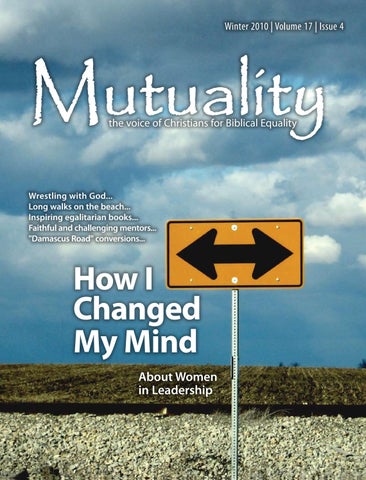
Winter 2010 | Volume 17 | Issue 4
Mutuality the voice of Christians for Biblical Equality
Wrestling with God... Long walks on the beach... Inspiring egalitarian books... Faithful and challenging mentors... "Damascus Road" conversions...
How I Changed My Mind About Women in Leadership
Mutuality 17.4, Winter 2010 “Let us then pursue what makes for peace and for mutual upbuilding” (Rom. 14:19, NRSV). Mutuality (issn: 1533-2470) seeks to provide inspiration, encouragement, and information about equality within the Christian church around the world.
Contents 4
Reconciling Two Worlds | Carole felt a widening gap between her life as a leader in the business world and her life as a submissive Christian woman in church and home. by Carole Eldridge
8
From Hatchet-Man to Woman's Advocate | In an interview with CBE, author and professor Cleophus J. LaRue explains his dramatic conversion to gender equality. by Nicholas Colby Watson Wolfe
Editorial staff: Megan Greulich, editor; Image Spigot, graphic designer; Mimi Haddad, president/publisher. Contact us at: Christians for Biblical Equality; 122 W Franklin Ave, Suite 218; Minneapolis, MN 55404-2451; phone: (612) 872-6898; fax: (612) 872-6891; email: mgreulich@cbeinternational.org; web: cbeinternational. org. We welcome your comments, article submissions, and advertisements. For writers' guidelines and upcoming themes and deadlines, visit CBE’s website and follow the link under the Resources tab. Advertising in Mutuality does not imply organizational endorsement. Please note that neither Christians for Biblical Equality, nor the editor, nor the editorial team is responsible or legally liable for any content or any statements made by any author, but the legal responsibility is solely that author’s once an article appears in Mutuality. All Scripture quotations, unless otherwise indicated, are taken from the Holy Bible, Today’s New International Version®. TNIV®. Copyright © 2002, 2004 by International Bible Society. Used by permission of Zondervan. All rights reserved. CBE grants permission for any original article (not a reprint) to be photocopied for local use provided no more than 1,000 copies are made, they are distributed free, the author is acknowledged, and CBE is recognized as the source. Mutuality is published quarterly by Christians for Biblical Equality and is sent free to members and supporters.
11 A Long Walk on the Beach | Anthony's friends and family were certain he was on dangerous ground, but he had questions about gender and leadership that needed answers. by Anthony Parrott 14 No Longer “Blind” | Kristine was taught that biblical womanhood was defined by passivity, but Jesus' affirmation of women showed her otherwise. by Kristine Lowder 17 Alan F. Johnson's How I Changed My Mind About Women in Leadership | A book review. by Lisa Baumert
MINISTRY NEWS 18 Women and Christian History: The Chicago Conference Report 19 In Remembrance: Rev. Dr. Richard Clark Kroeger, Jr and Dr. Roger Nicole
19 CBE at the ETS 2010 Convention 19 Reflect with Us: Decisions, Decisions
D E PA R T M E N T S 3 From the Editor: When We Encounter Emmanuel 20 Giving Opportunities: Healed and Released for Ministry 22 President’s Message: How I Didn't Change My Mind
2 M U T U A L I T Y | Winter 2010
websi te : cbeinternational.org
From the Editor by Megan Greulich
When We Encounter Emmanuel I will admit that I love New Year’s resolutions. I love to imagine joy, and praise for our Savior is when we are privileged to hear how new adventures and projects. And I love to set goals, taking care a particular pastor, professor, student, spouse, or parent found to write them each down and share them with friends and family biblical equality. Many of us in the church have found ourselves (which, my psychology professors in college assured me, make us weary, confused, or brokenhearted because of the mistaken belief much more likely to successfully complete them). Just a few days that women are inferior to men and unfit for leadership. There ago, I was catching up with an old friend and happily comparing are few things that encourage us at CBE more than learning how our “2011 lists.” He is going to learn a new language; I’m going to these people encountered biblical equality and were profoundly run a half-marathon. And our lists went on and on. changed. This is why I am excited to present this issue of Mutuality, As frivolous as New Year’s resolutions may or may not be, it is full of stories of individuals who found biblical equality. I am undeniable that many of us look forward to the promise of change confident that they will encourage and challenge you, and point at this time each year. Perhaps 2010 was marked by weariness, you to the One who changes us, just as they did for me. isolation, even desperation. Or maybe it was marked by the less A note: Our theme is borrowed from the title of Alan F. dramatic but just as frustrating sense of being stuck or stagnant. Johnson’s new edited volume, How I Changed My Mind About Thankfully, we have the deep hope of change. Women in Leadership: Compelling Stories from With the memory of the Christmas season—the Prominent Evangelicals. It, like this issue, is a A guarantee celebration of Emmanuel, “God with us”—fresh compilation of stories of encounters with God, we have as in our minds, we can cling to the truth that, as the and journeys of change. And already, the response famous Christmas carol reminds us, “A thrill of hope, from the evangelical community to it has been Christians is the weary world rejoices.” When all of creation was encouraging. The title and storied approach of the that when we book have received an “almost universal interest” in despair—worn out, lost, grasping for purpose and redemption, and groaning in expectation for encounter God, among the women Alan has encountered, he our Savior—the incarnation of God, in a humble, shared with me in a recent interview. It has been we change. vulnerable baby, changed the world profoundly and an affirming and healing resource for many women forever. It may be both terrifying and irresistible, who have been hurt by gender inequality in the but, truly, when we encounter God, we change. And we know church. “What a precious gift to find this book—one that I’ve that, as Christians, Christ transformed us to our very core and will been waiting for all of my adult life. I want to jump up and continue to transform us as we grow closer to him in faith. down and scream Hallelujah!” one woman wrote. According to As evangelicals, we love testimonies of transformation—the Alan, the book is also challenging those who are “not completely stories of how God has touched and changed each of us. And these convinced to look further into the credibility of this evangelical stories serve important purposes in making visible our faith, both understanding of gender and leadership.” individually and together as the body of Christ. Hearing or reading We at CBE look forward in anticipation to how this unique the journeys of others can help point us to God. As we learn about book will influence the important discussion on gender, authority, the hope and healing others have found through Jesus, we can and the Bible. We pray that God will use it, and this issue of better see how we ourselves are in need of change, and we can better Mutuality, to transform us all, as only true encounters with our appreciate and praise the God who has indeed changed us. Savior, Emmanuel, can do. Blessings to you as you read and reflect! Communicating our testimonies to one another is also important because it highlights our shared experiences. As we each Megan Greulich is the editor of Mutuality magazine. She may be struggle through questions, pain, and loss, others—through their reached at mgreulich@cbeinternational.org. stories—can offer encouraging words that they too were there at one time and that they survived, emerging transformed, closer to P.S. It’s important to remember that some evangelicals have never God, and more aware of God’s faithfulness and goodness. changed their minds about women in leadership; they have There are many reasons why I love working for the ministry always been egalitarians! Such is the case for our very own Mimi of CBE, but the one reason that fills me with the most surprise, Haddad. Be sure to read her story on page 22!
booksto re : equalitydepot.com
M U T U A L I T Y | “How I Changed My Mind”
3
Reconciling Two Worlds The more leadership I took on in the secular world, the wider the gap became between who I was at work and who I was expected to be at church and home. by Carole Eldridge
I married a minister when I was twenty years old, just as I was finishing my degree in nursing. I had long felt a call to ministry, and I believed my training as a health care worker would enable us to minister as a couple to hurting people. My husband and I worked together in churches as God led, with me filling leadership roles suited to my gifts and interests. We had an egalitarian marriage from the beginning. We believed that Scripture taught mutual submission, and that the dominance of any person over another, in marriage or otherwise, went against Christ's teachings. Our views on gender and relationships were often different from those held by people we ministered with, but initially our choice was accepted. We lived and taught servanthood founded on love, with men and women equal in all respects. My husband was my encourager, offering me opportunities for service and inspiring me by his confidence in my abilities. A few years after we married, it became apparent that a shift was occurring in our denomination. We began hearing
4 M U T U A L I T Y | Winter 2010
from our leaders and teachers that Scripture prohibited women from leading in church or home, and that God wanted men to be the authority in all matters. We heard at one conference after another that the scriptural model for families and churches required submissive women and decision-making male leaders. Complementarianism became the approved model, and other views were deemed to go against God’s order for the world. We tried earnestly to conform to this model, even though it felt awkward to us both. I dropped from leadership roles at church, and with our two children I continually deferred to their father as the decision-maker and spiritual leader. I felt like I was abdicating my responsibilities, but the lessons I heard from our denomination were clear and definite, so I did my best to follow them. We believed that the people holding positions of authority in our churches and in our denomination must know more than we did about such matters. We saw apparently successful marriages that seemed to conform to the approved model, so it made sense to follow their example. I taught
websi te : cbeinternational.org
complementarianism to the women in our local church, and strived to live it. Meanwhile, I was doing well in my career. I started health care businesses, worked hard to make them successful,
As my work responsibilities grew, my husband and I finally realized we had to rethink our division of labor. We worked things out so that everyone pitched in to keep our home on an even keel. We took on nontraditional roles in which we had strengths: I managed the money, while my husband cooked and decorated. We resumed our collaborative approach to decision-making. We moved back into the egalitarian marriage we were most comfortable with, working as a team for the health and security of our family, at least as far as tasks, finances, and everyday decisions were concerned. However, I still wanted to follow my church’s teachings, so I continued trying to conform in other ways. I stopped leading our children in prayer and Bible study. I left that to my husband, although my resentment grew as I felt he wasn’t doing the right things. I wanted him to provide spiritual leadership as I defined it, which meant I was asking him to take on responsibilities God had actually given me. As I look back on this, I am particularly ashamed of abdicating this responsibility to help lead my children in spiritual growth. I continued trying to conform to expectations at church. Putting on the cloak of a submissive woman, however, became more and more burdensome as time went on. I felt a stranger to myself at the denominational gatherings I attended, smiling and pretending to be content with being on the sidelines. On more than one occasion I wanted to shout, “I have abilities that could help this organization, but I cannot contribute because my ideas are not welcome!” I identified with an acquaintance of ours, a chief financial officer for a major banking system, who left her church after being told she could not serve on the finance committee because that level of decision-making was reserved for men. As I led my companies—and as it became apparent that the best, most loving, and most practical model for our family was egalitarian—I became increasingly conflicted. My own lived experience of what was right for me and for my family was in direct contradiction to the things we were being taught, and I couldn’t make sense of why what I felt and lived were so at odds with what God supposedly wanted. One morning the conflict inside me came to a breaking point. As I was entering one of our branch offices, I was stopped by an employee who was waving a page of The Wall Street Journal and wearing a wicked grin. “So,” my employee said, “are you going to start being a submissive woman now?” I didn’t know what she was talking about, but I soon learned. Our denomination had made a historic change to its statement of faith, adding language that affirmed the complementarian view
I felt a stranger to myself at the denominational gatherings I attended, smiling and pretending to be content with being on the sidelines.
and then sold them to bigger companies. I became chief executive officer of a multi-state corporation and then senior vice president of a large publicly held national firm. My husband was also succeeding in his world, assuming ministry positions in successively larger churches and then moving into a denominational role with wide inf luence. Our lives were very full, with enormous demands, but in our respective work worlds we were happily using our gifts. The problem was that the more leadership I took on in the secular world, the wider the gap became between who I was at work and who I was expected to be at church and home. I tried to find ways to reconcile the two worlds. I was traveling a lot, speaking at national conferences, and finding myself with previously unimagined opportunities. Yet I still carried the work burdens of the household and was the main caregiver for our children. Paradoxically, I continued pushing decision-making onto my husband. He didn’t want the role I was trying to force on him any more than I wanted to be subservient. I was fulfilled at work and frustrated at home; conflicted and confused.
booksto re : equalitydepot.com
M U T U A L I T Y | “How I Changed My Mind”
5
of men and women. Women were being told very publicly what our scriptural place was, and that we were to stay firmly in it or be out of God’s will. Although I knew this was the message being taught in many of our churches, it had never before been the official position of the denomination. Now it was, and my internal conflict finally had to be faced. One thing was clear: I could not continue to lead my hypocritical double life. I either had to find some way to reconcile my personal experiences, sense of calling, and abilities with the scriptural teachings that seemed to deny women an equal place in the world, or I would abandon my faith. I could no longer live with the inconsistencies, and I no longer wanted to follow a God who seemed to want to make me a second-class citizen.
I am convinced that God does not want to relegate me to the margins of life. God wants me and other women in the thick of things, changing our worlds for the better.
Not long after this, our denomination declared that all the ministers holding denominational posts would be required to sign a document affirming their agreement with the revised statement of faith. This was a difficulty of another level entirely. My husband was supportive of my journey, and together we were exploring other ways to understand the confusing scriptural passages about women. But he did not feel as strongly as I did, and now he had to choose between keeping his job and making his wife happy. I actually threatened to divorce him if he signed it, although we both knew that was an empty threat. He signed, not knowing any other way to keep his job, and feeling that I was making too big an issue of it anyway. He said I should just learn to ignore this particular teaching and make the best of the other good things our church offered. On most days, I thought he was right, and that it was very unloving of me to expect him to change his career because of my struggles with principles that millions of other people believed. On other days, I knew this was a teaching I couldn’t ignore, because it meant living my entire life as a lie. We continued studying, reading, and praying to achieve a proper understanding of Christian gender roles. Someone recommended Dr. Bilezikian’s book, Beyond Sex Roles: What the Bible Says About a Woman's Place in Church and Family,
6 M U T U A L I T Y | Winter 2010
and I read it eagerly. My excitement grew the more I read, because here was a respected Bible teacher giving a reasoned picture of God’s true view of women, based soundly on Scripture. I experienced enormous relief as the puzzling inconsistencies in my head and heart began to dissolve. I understood at last the overarching principle of God’s empowerment of women through the centuries, his encouragement of our gifts, and his liberation of our gender from the restrictions placed on us by culture. I began to feel whole again and affirmed in my leadership abilities, instead of feeling out of God’s will. I could finally accept what I knew in my heart—God gifted me as a leader, and he wants those gifts used in his service. My husband, however, pleased that I was settling things in my own head, put the issue aside for a few years. During that time, pressures at his job to conform to increasingly rigid theological positions led him to start looking for alternatives. As he followed God’s prompting away from his denominational role and into another area of ministry, he came across another of Dr. Bilezikian’s books, Community 101: Reclaiming the Local Church as Community of Oneness. The picture of God as community, and our call to community, transformed my husband’s view of how God wants us to operate, including how God views people in community, male and female as equal contributors to the whole. As God continued bringing us the books we needed to read, I found CBE. I cried as I realized there was an entire organization devoted to helping people like us. My husband, after much agonizing, deliberation, and prayer, left his denominational position and stepped out on a risky ministry venture that was more compatible with our new understanding. He even began, slowly and cautiously, to quietly champion women in ministry leadership. Interestingly, sometimes I still have to remind myself that it’s okay to lead, okay to step out and be in front at church and home. I have to give myself permission to be a whole person everywhere, not just leading at work but also in God’s kingdom. Yet, I am convinced that God does not want to relegate me to the margins of life. God wants me and other women in the thick of things, changing our worlds for the better. Dr. Carole Eldridge is the dean of the Houston campus of Chamberlain College of Nursing. She has more than thirtyfive years of leadership experience in business, nursing, and education. Dr. Eldridge was VP of Assisted Living Concepts and CEO of Pacesetter Home Care Group before starting a consulting and publishing company, CareTrack Resources. She is the author of two books, four textbook chapters, over fifty training publications, and several journal articles, and has received a number of awards for teaching innovation and leadership.
websi te : cbeinternational.org
Christians for Biblical Equality Presents
Featured Sessions
Transformation of Relationships: The Biblical Subversion of the Nature and Exercise of Power Manfred T. Brauch, past president and professor emeritus of Biblical Theology at Palmer (formerly Eastern Baptist) Theological Seminary; author of Abusing Scripture: The Consequences of Misreading the Bible
Bridging the Gap Between Call and Office Among Black Clergywomen Kanyere Eaton, senior pastor of the Fellowship Covenant Church (Bronx, NY); former executive director of The Sister Fund
Student Paper Competition Three selected students will have an opportunity to present their research papers at the conference on July 30 at 4:10pm. All entries may also be considered for publication in CBE’s journals.
Servant Leadership and Power: Can We Have It Both Ways? MaryKate Morse, professor of leadership and spiritual formation at George Fox Evangelical Seminary; author of Making Room for Leadership: Power, Space, and Influence
Justice and Equality for Women Created in God’s Image: The Scriptural Mandate for Ministry and Marriage Philip Payne, founder and president of Linguist's Software and author of Man and Woman: One in Christ
For more information, visit cbeinternational.org/2011-cbe-conference 612-872-6898. | “How M U T U A L I Tor Y call I Changed My Mind”
booksto re : equalitydepot.com
7
From Hatchet-Man to Women’s Advocate An Interview with Cleophus LaRue
by Nicholas Colby Watson Wolfe
Growing up in the church, “I didn’t sense that women were oppressed,” author and seminary professor Cleophus J. LaRue admitted. The Baptist church he attended was made up of 75% women, and they served in many leadership positions. Women taught Sunday school and headed up the missionary society and Baptist training 8 M U T U A L I T Y | Winter 2010
union. LaRue even learned the foundations of Christian faith from a woman in his church who was the matron of the usher board on which he served. He realized these women were gifted individuals, and his exposure to earnest women doing the work of the Lord stayed with him. But he understood and accepted that they could websi te : cbeinternational.org
not ascend to the pulpit; in the congregation where he came to faith, it was known to be absolutely unacceptable for a woman to claim that she had been called by God to preach. When LaRue was a young pastor, he was invited to sit on a scholarship committee in Texas. LaRue took his prejudice against women preachers to his new position of power. The scholarship committee interviewed prospective ministers and decided whether or not money would be awarded to them for their education. When African American males were in front of the committee in need of financial assistance, LaRue wholeheartedly supported them. Few questions were asked, and as much money was awarded to them as possible. If a woman came forward in need of money to become a trained missionary or chaplain, he would support them, as well. But if a woman
reject her. His Southern white colleagues—who were sensitive to allegations of racism, discrimination, and unfair treatment— needed LaRue, and they counted on him to speak out against the women aspiring to be preachers. “I unfortunately did their bidding,” LaRue said, believing at the time that he was following the will of God. “After my questioning, they gave up seeking money from that committee.” As the hatchet-man, LaRue effectively cut women out. One day, after LaRue and his colleagues on the scholarship committee board had adjourned, a woman who had been refused funds to become a minister approached him outside of the building. He had been a major part of barring her from the scholarship money. He had chopped her up, and he felt good about it. But this woman confronted and challenged him. She
Cleophus with MDiv student, Laura Evans.
ever came to the committee claiming that she had been called to preach and be an ordained minister, that is when, LaRue explained, he would become “the African American hatchet-man.” LaRue knew his position on the committee board. It was an unspoken understanding that women would not be given funds to be preachers or ministers. When an African American woman would come forward, the committee looked to LaRue to
booksto re : equalitydepot.com
told him that she knew he had played a major role in the decision to deny her funds; she could tell by his questioning that he had no intention of allowing her to receive any money. This determined woman turned the questions on LaRue. “Who are you?” she asked him. “Who are you to say where God has called me?” She plainly pointed out to LaRue the unjust and ungodly way he was behaving: sitting comfortably with his education and with his church but denying others the right to the
M U T U A L I T Y | “How I Changed My Mind”
9
same opportunities. She told him that it was one thing for him to not give her money—she could accept that from him—but he was in no place to bring her vocation into question. She had no money and no idea how she was going to get an education, but she was certain of her calling. Tears graced her cheeks as she spoke. “I will go to school regardless of whether or not you will
“It was not the writing of scholars. It was exposure that changed my mind; it was seeing women in the trenches doing God’s work at every level.”
help me because I know that God has called me to preach the gospel.” For Cleophus LaRue, this was an experience like that of the Apostle Paul’s conversion on the road to Damascus. He drove home that day a profoundly changed person. LaRue went before the leaders in his church. As he recounted the events of the incident, he saw the disgust on the senior women’s faces as they learned that he had been keeping women from realizing their call to preach. LaRue continued, “I’ve had a change of heart,” he told them. “We need to do things differently. I am ready now to be receptive of women and to accept their calls.” He said to his elder board that equality for women was his new conviction. He told them that he didn’t know what it meant for his future in the church. He didn’t know if they had a place for him, but he could no longer continue his restrictive behavior. LaRue’s new belief was so strong that he was willing to risk the same rejection that he had been carrying out himself on the scholarship board. LaRue feared backlash from the elders at his church, but to his surprise he learned that many of the leaders already supported women in preaching positions. “We were wondering when you were going to catch up, Reverend!” chimed many of the senior women. Although some of the men in the church tried to assure LaRue that he had been doing the right thing on the scholarship committee, his epiphany was affirmed by senior leaders in his church. These were women that carried his church and he was right by them. “I’m happy to say that the entire church has embraced women fully, and I’d like to think that I played a part in that,” says LaRue.
10 M U T U A L I T Y | Winter 2010
LaRue attributes much of his new resolve to that experience with the young African American woman seeking a scholarship; she pried open his eyes to recognize clearly the strong women leaders he had encountered throughout his whole life. LaRue finally obtained a practical, down-to-earth understanding of God’s work in and through women. He puts it this way, “It was not the writing of scholars. It was exposure that changed my mind; it was seeing women in the trenches doing God’s work at every level.” Eventually it entered into his psyche that it was not right to keep capable women from the pulpit. “It dawned on me because [women] permeated every other sphere of religious activity and leadership in the black church.” LaRue recognized that women in ministry are an invaluable asset. He saw that preventing them from using their gifts was not only discriminatory to women, but also hinders the work of the gospel. However, LaRue’s new path was not easily traveled. He had to learn what this new attitude meant for his life. Even after his revelation, there were stages of his life that he is not proud of. There were times when LaRue would be in situations with other men where they would start slandering women and he would just sit, nod, smile, and say nothing. Even though he had changed his own mind, at this juncture he did not see it as his obligation to change the minds of other men. But now he has moved into the role of advocate. LaRue excitedly declares, “I am actively involved in trying to place women in leadership positions, and I do not sit quietly when men start the womenbashing! I consider it to be a work of justice and a work that aids me in my witness to the Word of God.” As part of his work to actively change minds about gender equality, LaRue edited a book, This is My Story: Testimonies and Sermons of Black Women in Ministry, in which women share their journeys to reaching their call to ministry. Today, after fifteen years of teaching at the seminary level, LaRue remains a committed advocate for women in the church. “I’m convinced that some of my better preachers are women, and I know that some men wouldn’t want to hear me say that,” he laughs. LaRue believes that part of the reason women are stronger is because they have had to suffer more. Women have had to justify their call. They have had to stand against difficult odds and because of this, their calling means much more to them. LaRue’s testimony challenges us to understand that preventing women from realizing their call to leadership is both an injustice and a disservice to the church. There are dedicated women already down in the trenches doing the work of the Lord. As LaRue’s experience shows and as the Bible teaches, woman can be, and are now, powerful teachers and preachers. Nicholas Colby Watson Wolfe is a writing intern at Christians for Biblical Equality and student at Bethel University in St. Paul, Minnesota. Nicholas is finishing his undergraduate degree with a major in reconciliation studies and a minor in political science. He is now looking at law schools focusing on social justice, alternative dispute resolution, and international law.
websi te : cbeinternational.org
A Long Walk on the Beach by Anthony Parrott
I don’t know many college students who, during their spring break trip to Florida, take along and read Discovering Biblical Equality. But there I was, just a few years ago, sitting on a beach and devouring the 528-page book. Road trips, beaches, and scholarly essays—I felt like a living example of the Sesame Street children’s song, “One of these things is not like the other things…” To me, though, this was just the next step. I was a couple of months away from proposing to my then-girlfriend Emily and only a year away from graduating from college with a biblical studies degree and then moving on to full-time ministry. Understanding headship in marriage, leadership in the church, and biblical views on gender were at the forefront of my mind. I had questions and I needed answers. Had you asked me about these issues a couple of years before that spring break trip, I would have had no questions to speak of. I was raised in a patriarchal home, had never been taught by so much as a female Sunday school teacher, and had been homeschooled using a fundamentalist Baptist curriculum. I had full confidence in my own understanding of what the Bible said about women and their role in the home and in the church: submit to men. Admittedly, my parents were fairly balanced. My dad never angrily ruled over my mom or belittled her intellect, abilities, or talents. But, in times of differing opinion, it was always stated, “Dad is the head of the household and his is the judgment that matters above all.” I never questioned this position. In Genesis 2, the male was created first. In Ephesians, Paul said something about women submitting to men. My family made sense. This lack of questioning changed within my first couple months of college. I was in a class called “Exploring the Christian Faith” taught by Dr. Tim Erdel. Our class took on contentious issues: pacifism, predestination, secular art, and—of course— biblical equality.
booksto re : equalitydepot.com
Bibles flew open, fingers jabbed at people and at verses, and I soon realized that my family’s level of emotional attachment to the gender debate far outweighed my cognitive ability to argue back.
M U T U A L I T Y | “How I Changed My Mind”
11
many within the CBE community, she is well known as a contributor to Discovering Biblical Equality, Zondervan’s Two Views on Women in Ministry, and her own Women Leaders and the Church. At first, she was yet another challenge to my worldview. My patriarchal beliefs about women had softened some, but I still had many years of fundamentalist Bible training under my belt. And, I have to confess, I let it get to me. I avoided a class taught by Dr. Belleville for two semesters. Somehow, I had convinced myself that by taking one of her classes I was endorsing some twisted view of Scripture. But, by junior year of college, I had finally been humbled enough to realize I didn’t know all there was to know about Scripture. I couldn’t help but want to learn from Dr. Belleville; the level of training, expertise, and experience she had to offer was impressive. I enrolled in her Gospels course, and it didn’t take long for me to realize that Dr. Belleville was not only a good professor, but she was also better than most! Teaching is usually about conversation, and that is exactly what she offered—discussions on those difficult, messy, and sometimes contentious teachings of Scripture. I knew that my mind had begun to change on what the Bible said about marriage and gender roles when my older brother had me listen to an MP3 of a sermon on relationships. It followed the typical p a t t e r n o f q u o t ing Genesis 2 and Ephesians 5, using these passages as texts to prove that it was the husband’s re sp onsibi l it y to spi r it ua l ly, emo tionally, and physically provide and care for his wife. When I gave my brother back the MP3 player, I said, “Thanks, but I really don’t agree with what this pastor has to say.” Minutes later, I found myself at the dining room table, defending myself against my brother, his wife, and my mom. Bibles flew open, fingers jabbed at people and at verses, and I soon realized that their level of emotional attachment to this debate far outweighed my cognitive ability to argue back. The conversation ended when my brother simply walked away from the table, while shaking his head and saying, “Well, colleges just get more liberal as time goes on. It’s a shame that they’re teaching these things to you.” I knew I had to do some research on this topic before I ever brought it up again. I went to Dr. Belleville, who pointed me in the direction of the library and to Discovering Biblical Equality. A couple of weeks later, I found myself reading it on a beach in Florida.
Many in the church condemn questions, and I’m afraid it’s not because we understand Scripture so well, but rather because we don’t understand it well enough.
His first assignment was easy enough: find and discuss each time Scripture used the phrase “head of the household.” I went to—what else!—my trusty King James Version exhaustive concordance and couldn’t find anyt hing. I then remembered Ephesians 5, but there I found “man is head of the wife.” Nothing about the household in general. I finally went to an online concordance. The closest thing I could find was 1 Timothy 5:14, “…I counsel younger widows to marry, to have children, to manage their homes…” (emphasis my own). This simple discovery—that the “biblical” phrase “man is the head of the household” wasn’t biblical at all—was enough to cause me to question most everything I had assumed I knew about the Bible. In fact, I changed majors from piano performance to biblical studies. God, through Dr. Erdel, had kindled in me a passion for knowing what Scripture actually said and for understanding what it meant for those who read or heard it for the first time. I didn’t put much more thought into biblical equality, however, until sophomore year, when our biblical studies department asked Dr. Linda Belleville to come on staff. To
12 M U T U A L I T Y | Winter 2010
websi te : cbeinternational.org
Even the act of reading this book was enough to arouse suspicion in my friends. Two of my fellow ministry students also on the spring break trip asked me to take a “long walk on the beach” with them. Once we were out of earshot of the rest of the group (which included my then-girlfriend Emily), I was immediately assaulted with questions and concerns about where my theology was going. “We know you care about Emily,” they said, “but doesn’t that include taking care of her spiritually, of being willing to take responsibility and being the head of the household?” Later I found out that the girls had also taken Emily aside and asked her the same sort of questions. “What if he doesn’t take care of you like he should? What if he makes you responsible for everything in the household?” When I returned from spring break, I asked Dr. Belleville, “What on earth makes everyone so scared of this topic?” “Because they don’t know any other way to handle it.” I realized that what I was dealing with—with my family and with my peers—was mostly misunderstanding. A misunderstanding of Scripture. A misunderstanding of the people who see male and female as equal before God. I myself had assumed the worst of Dr. Belleville, but instead found a great teacher and friend. My brother had supposed that my college had “gone liberal,” when, in fact, it was trying to teach Scripture the way it was meant to be understood. In a matter of a few years I had completely changed my mind on biblical equality. What’s more, I was able to
articulate why. I don’t know if my friends on the beach ever changed their minds about this topic, but at least they got an intelligent response from me when they asked what was going on. What changed? First of all, I was given permission to ask questions. Many in the church condemn questions, and I’m afraid it’s not because we understand Scripture so well, but rather because we don’t understand it well enough. When you’re allowed to confess you don’t know something, you’re simultaneously given the freedom to learn. Secondly, relationships change minds. Dr. Erdel and Dr. Belleville never rammed a certain perspective down anyone’s throat. But by getting to know them and comprehending their love for God and for Scripture, I was able to discover for myself that what they said made sense. It wasn’t an attempt to escape the truth of Scripture, but rather an endeavor to live in it. A few months after that spring break trip, Emily and I went hiking and got engaged. Together we decided to become one in marriage; together we decided to go into full-time ministry; and together we submit to our Lord and to each other, eagerly serving God’s kingdom. I’m glad I changed my mind. Anthony Parrott is the director of worship for Good News Community Church in Okoboji, Iowa and a graduate of Bethel College, Indiana. Anthony and Emily have been married for two years and together enjoy travel, music, and reading. You can usually find Anthony sipping Pepsi, banging out notes on a piano, or tinkering on a computer.
---------------------------------------- Advertisement ----------------------------------------
booksto re : equalitydepot.com
M U T U A L I T Y | “How I Changed My Mind”
13
No Longer “Blind”
by Kristine Lowder If you haven’t seen The Blind Side (Warner Brothers), you’re missing one of the great films from 2009. It’s based on the true story of a remarkable Christian family, the Tuohys, and an equally remarkable young man and future football star from the Memphis, Tennessee projects, Michael Oher. The Blind Side is a powerful story of redemption that struck a resonant chord with me because the heroine is a Christian mom with grit. Spunk. Pluck. Call it whatever you want. Leigh Anne Tuohy can and does go toe-to-toe with obstinate high school teachers, coaches, skeptical friends, drug pushers, and gang bangers. Leigh Anne is smart, sensitive, compassionate, and generous. And she’s no cream puff. You don’t mess with Leigh Anne. You especially don’t mess with her family, which includes Michael when the Tuohys become “Big Mike’s” legal guardians. Besides the inspiring story, what I appreciated most about The Blind Side is that a Christian woman is portrayed as something other than a meek and mild subordinate, glitzy sidekick, or an anemic “helper.” Leigh Anne is something rarely
14 M U T U A L I T Y | Winter 2010
I wondered, “Is a strong, capable Christian female that threatening? Is the concept of a ‘strong Christian woman’ unbiblical, or an oxymoron? How? Why?”
websi te : cbeinternational.org
seen as an example of “biblical womanhood”: a powerful agent of rescue. Let me explain. I’d always been taught that “biblical womanhood” looks like Suzy Homemaker, June Cleaver, Betty Crocker, and Martha Stewart. From childhood Sunday school through graduation from a top Christian liberal arts university to conferences; from women’s retreats and Bible studies to bestselling books and countless sermons on the subject, the inevitable message was: Men are divinely designed as strong leaders and women are followers. “Masculine” means leadership, assertiveness, decisiveness, and headship. “Feminine” means docile, quiet, retiring, subordinate, and “nice.” My role as a wife was to submit to and follow my husband’s leadership and wait for permission from men to serve. That was The Biblical Model. Period. Anything different was anathema. I bought that gender model for nearly fifty years. I didn’t know any better. Trouble was, I’ve never really gotten the hang of that Suzy/June/Betty/Martha thing. It just isn’t me. Thinking the model I’d grown up with was soundly and solely biblical, however, I thought I was the problem. So I spent more than forty years shoehorning myself into a “gender role” that fit like a rhino in leotards. It never occurred to me that the “problem” wasn’t me, but the model. For decades, every diagnostic tool or “spiritual inventory assessment” I took indicated strong gifting in leadership, teaching, and administration. But I was always taught—and I always believed—that because of my gender, those gifts were properly exercised within the contexts of women’s or children’s ministry. Teaching and leading a mixed gender adult fellowship, small group, or class were out-of-bounds. Church leadership and pulpit preaching were “testosterone-only” zones.
I’m not about disrespect or demanding “rights” or “power.” I’m about a biblically sound, biblically balanced, and biblically accurate view of gender. In 2007, I participated in a “Proverbs 31” women’s Bible study associated with our former church. I did something in that group I’d never done before: I began wondering if what I’d always been taught regarding “biblical womanhood,” “a wife’s role,” and so on was indeed The Biblical Model. I started asking questions. I soon discovered that you don’t ask some questions unless you want to be the featured event at the next piñata party. As a result, I pondered further: If the hierarchical view of gender—the permanent subordination of women to men— instead of an egalitarian, mutual view is indeed The Biblical Model, shouldn’t it be able to stand up to scrutiny? If this is really God’s design, it can handle some honest investigation! I saw women heading corporations, universities, and countries; serving in courtrooms, the medical world, think tanks, and the media; and as governors, in Congress, and as Secretary of State, but these same capable, gifted women were excluded from church leadership based on their gender. Do their skills and gifts mysteriously vanish when they walk through the church door on Sunday morning? (Dr. Philip Payne addresses this in his masterful work, Man and Woman: One in Christ, Zondervan, 2009.)
Little Did We Know… A short time later, my husband Chris (who has a degree in biblical studies and theology and who can read the New Testament in the original Greek) and I embarked on a grand adventure with God. Setting aside our preconceptions, we asked God what he thought about men and women. And we listened. We started an intense review of the biblical text, digging deep. Bible in hand, we also read thousands of pages related to gender and gender roles, from the far left to the far right and all points in between. We prayed, discussed, and dialogued. We attended conferences and seminars. And we read and discussed some more. We inched out of the “hierarchical complementarianism” camp. Why? Short answer: Because, proof-texting aside, we didn’t see it supported by the whole counsel of Scripture. Chris and I eventually embraced mutuality as God’s design because we’re convinced from the text that gender hierarchies and topdown pecking orders aren’t God’s design at all. And I began to recognize that the Lord Jesus turned the world upside down in the way he interacted with and treated women. The more I read about the Lord Jesus without my blinders, the more I fell in love with him. Again. To cite just one example from Scripture, my wonderful Savior first revealed himself as
The more I read about the Lord Jesus without my blinders, the more I fell in love with him. I would be happily accepted as a church secretary, bulletin-board decorator, kitchen helper, or children’s Sunday school teacher, but even raising the question of serving in more prominent church leadership was a “no-no.” A big one. And you didn’t go there—unless you wanted to be accused of “usurping authority,” being “insubordinate,” or that other problem word, a “liberal.” (This always struck me as curious, since I self-identify as a “conservative evangelical” with a high view of Scripture.) I wondered, “Is a strong, capable Christian female that threatening? Is the concept of a ‘strong Christian woman’ unbiblical, or an oxymoron? How? Why?” It didn’t add up. I’ve never been interested in “threatening” or “usurping” anything from anyone. Nor am I “anti-male.”
booksto re : equalitydepot.com
M U T U A L I T Y | “How I Changed My Mind”
15
Messiah not to his disciples, nor to a Jew, or to a man! Check out John 4: Jesus first revealed his true identity to a woman—and a Samaritan woman at that! This is the only time prior to his trial that Jesus specifically says he is the Messiah. Was this an accident, or was Jesus saying something—something significant? In a time and culture when no Jewish male, let alone a rabbi, would be caught dead with a female in broad daylight, Jesus not only engaged the Samaritan woman, but he effectively made her the first evangelist! Remember how she high-tailed it back to her village and told everyone about this incredible man she met at the well? Verse 39 says, “Many of the Samaritans from that town believed in him because of the woman’s testimony” (emphasis added). And to whom did Jesus first appear after he exploded out of the garden tomb, defeating death and the grave? That’s right: Mary Magdalene (see John 20:10–18). According to John, the first word of the resurrected Christ is, “Woman” (see John 20:15). Are these “coincidences”—or is Jesus trying to tell us something?
That’s why The Blind Side and the mission of CBE resonate with me. And Michael Oher? Thanks to the love of the Tuohys and the indomitable Leigh Anne, “Big Mike” graduated from ‘Ole Miss, where he became an All-American and first-round National Football League draft pick. I can’t help but wonder what would’ve happened to Michael if spunky, feisty, “stand the world on its ear” Leigh Anne hadn’t been in his corner,
Check out John 4: Jesus first revealed his true identity to a woman… was Jesus saying something— something significant?
“Powerful Agents of Rescue” The more Chris and I studied, the more often our jaws hit the floor. One question we couldn’t get around: Why do some Christians base gender roles on the fall rather than the resurrection? As Mimi Haddad writes: I discovered (from Scripture) my dignity and worth as a female, created like Eve, to bring a special version of rescue to our world. Our task as ezer is not to wait for permission from men to serve. My vocation comes from God, who from the beginning created me as a powerful agent of rescue” (Mutuality, Spring 2010).
cheering him on, refusing to take no for an answer. I also wonder what other “Michaels” might find hope, healing, and purpose if more strong, ezer women shed gender myths and stereotypes and become who we are created to be: “powerful agents of rescue.” Kristine Lowder, a native of California, now lives with her husband, Chris, in Washington state. Together, they are the founders and leaders of the Grays Harbor CBE Chapter.
Should My Institution Join CBE? Discover the many benefits of organizational membership today! Web: cbeinternational.org/institutions Email: cbe@cbeinternational.org
This emblem could be on your website! And, as a CBE member, we will place your logo on our site, for those looking for an egalitarian school.
16 M U T U A L I T Y | Winter 2010
websi te : cbeinternational.org
BOOK REVIEW
by Lisa Baumert
Alan F. Johnson's How I Changed My Mind About Women in Leadership Alan F. Johnson’s compilation of narratives entitled How I the individuals featured Changed My Mind About Women in Leadership: Compelling in Johnson’s book had Stories from Prominent Evangelicals is a particularly fresh, e xp eri en c e d—thro ug h honest, and persuasive resource in the growing collection their mothers, wives, of books on gender equality and women in leadership. sisters, or daughters—the The recognizable evangelicals in this book speak humbly strength, spiritual vitality, and clearly about how their theological convictions and and effective leadership of understanding of Scripture, with reference to women in women. Their experience leadership, were transformed through personal experience. had confirmed what their churches and theological convictions While maintaining a high view of the authority of the had not—namely, that women are full and equal spiritual Bible and an allegiance to their evangelical beings. In our quest to spread the truth traditions, they convincingly describe how Johnson's book puts faces of biblical equality, individual experience the gospel message affirms gender equality. and personal stories must play an and lived experiences to Each chapter is an individual narrative important role in the dialogue we create. that reads easily, as if one were having an theological doctrine about Narratives and personal experiences of honest and open conversation with a friend. strong, talented, and spiritually mature women in ministry in While academic resources on gender equality women will illuminate the illogic of the same way that Jesus’ keeping women from serving fully and in the church are vitally important, they are also plentiful and may not speak to certain parables brought to life the freely in the church. audiences. Therefore, Johnson’s conception And finally, the stories in Johnson’s truth of the gospel. for a compilation of personal journeys that book highlight to us that the transformation also addresses the scriptural, rational, and of one’s beliefs about women’s role within historical basis of gender equality in an accessible way is very the church and home is ultimately the work of God. It was not timely and important. How I Changed My Mind About Women abstract doctrines or systematic reasoning that propelled the in Leadership puts faces and lived experiences to theological authors to change their views, but rather a personal realization doctrine about women in ministry in the same way that Jesus’ that manifested itself in a quiet moment of relation with God. parables brought to life the truth of the gospel. Their stories should serve as humble reminders that the success Although the stories of these individuals are unique of our efforts to spread the gospel truth about gender equality is and varied, several important themes emerge throughout this dependent upon the grace and work of God. work—themes which I believe provide insight into how the How I Changed My Mind About Women in Leadership is an message of gender equality might be effectively spread and excellent resource for anyone wishing to know more about the basics received. First, the narratives in the book testify that Scripture of gender equality because it presents a coherent scriptural basis for is not a stumbling block to our cause, but rather the reason for women’s leadership in simple and approachable ways. It also describes it. Many of the authors in this book were initially kept from the hard and often painful struggle many have undertaken to accept supporting gender equality because of certain interpretations and spread women’s full and equal place in all spheres of life, while of particular scriptural passages. However, it was ultimately the offering redemptive glimpses into the success of this message and Bible itself that solidified the transformation of perspective that insights into how it might be spread further. Thus, How I Changed they experienced. The Bible is a great and necessary resource for My Mind About Women in Leadership is a powerful, encouraging, spreading the truth about women in leadership. The very tool and persuasive resource, and I recommend it highly. that has been used to subordinate women is that which frees Lisa Baumert is a former intern at Christians for Biblical them to serve the church unhindered. Equality. She graduated from Wheaton College in Second, How I Changed My Mind About Women in 2009 with a BA in theology and political science. She is Leadership shows us that the role of experience in our faith currently working on her Masters of Divinity at Princeton Theological Seminary. is a significant yet often overlooked source for coming to a right and fuller understanding of the gospel. Almost all of booksto re : equalitydepot.com
M U T U A L I T Y | “How I Changed My Mind”
17
Conference Report:
What Attendees are Saying:
Women and
“We are so thankful that [our daughter] attended the conference. She told me it was amazing, empowering, and totally lifeaffirming...and in the mind of her parents, just the encouragement she needed. The truth taught has already strengthened her foundation as a woman of God...I know [our daughter] will look back on Saturday as a key event in her life.”
Christian History
Building on a Legacy
Theodora, Bishop of the Church of Saint Praxedis, Rome, 820 A.D.
“Dr. Bilezikian’s session was powerful, amazing, passionate, relevant, and meaningful!” “Excellent scholarship! I was moved greatly by the stories of our historic heroes shared by Mimi Haddad.” Photo Joan Morris†
by Charity Kroeker
“I once turned down the nomination of deacon at the small church we used to attend and instead suggested they nominate my husband.” So begins the story of Helen, a woman who attended the first ever oneday CBE conference, “Women and Christian History: Building on a Legacy” on September 25, 2010. She, like many others, was challenged by the conference and convicted to follow God’s call to leadership, just as her Christian predecessors—both men and women—had done. Long before the day of the conference, members of the CBE Greater Chicago Chapter (GCC) were struck by the need to share the stories of these female predecessors. In the spring of 2009, the GCC gathered to watch Not for Ourselves Alone: the Story of Elizabeth Cady Stanton and Susan B. Anthony, a documentary that follows the women’s suffrage movement in the US. The strong Christian origin of this movement surprised and impressed chapter members. “Pride and sadness came to mind when watching the movie,” said GCC president Evelia Naranjo. “On the one hand, we were honored that the Christian faith had played a dominant role in the women’s suffrage movement. However, we were disappointed that nowadays we no longer remember nor teach about this history.” A conviction spread throughout the group: A conference was needed so that many more people may hear about the work of these strong and faithful female Christian leaders. This quickly developed into “Women and Christian History,” featuring speakers and scholars Dr. Gilbert Bilezkian, Dr. Lynn Cohick, Dr. Mimi Haddad, Dr. Dorothy Irvin, and Dr. Alan F. Johnson. “With the encouragement I received from the conference, I was ready recently to be nominated for a similar position in another small church we are currently in.”
18 M U T U A L I T Y | Winter 2010
“I thoroughly enjoyed the presentations with rich, solid research work, as well as the people attending who hold the same passion for God.”
Each speaker relayed Christian history through a different lens, sharing the challenging stories of women throughout centuries who served God wholeheartedly. Some talks were more academic and others more practical, but, as one attendee noted, “The strength of the conference was in its variety.” It seems that each person found something to carry back to their Christian community. Originally, plans for the conference had been made for 110 attendees. Our hopes were greatly exceeded; in the end, 154 men and women attended this event. Longtime CBE members shared tables with those who had heard of CBE only days before. Throughout the day, the mood was one of fellowship, scholarship, and lively discussion as women and men shared their desires, their convictions, and the obstacles that stand in their way. One attendee said, “I’m so glad to have this opportunity to share with others who have the same understanding.” Simply being in the presence of others who support biblical equality was refreshing for many. This one day provided the strength for attendees to continue seeking God’s will for them and to encourage others to do the same. “I will continue to wait and see how God leads my way ahead; meanwhile I will also continue to encourage sisters at our church to reconsider God's calling for them…I was so grateful that God used [the conference] to make me even more convicted about His calling to me as His servant.” Christians like the woman at the well, the early female bishops, and Frances Willard have left us an exciting challenge! By remembering their stories and surrounding ourselves with others who strive to follow God’s leading, we continue to build upon this great legacy. September 25, 2010 was a day to do just that. websi te : cbeinternational.org
reflect with us…
IN REMEMBRANCE
Decisions, Decisions by Jo Ellen Heil and Susan McCoubrie
by Mimi Haddad
"Let us examine our ways and test them. Let us return to the Lord. Let us lift up our hearts and hands to God in heaven" (Lam. 3:40-41).
What does the Bible say about the decisions we make? As Christians, we hope to make choices with hearts dedicated to God and minds open to biblical values. We can echo the psalmist when we pray, “I have chosen the way of truth; I have set my heart on your Word” (Ps. 119:30). And, just as when God encouraged the prophet Isaiah with “Come, let us reason together” years ago, we can be assured that the Holy Spirit will continue to work in our lives today. Our decisions often influence others. As believers, we are to make wise choices which enable everyone to come closer to God's love. Paul urges us, “Whatever you do, whether you eat or drink, do it all for God's glory. Live in such a way as to cause no trouble...try to please everyone in all you do, not thinking of your own good, but of the good of all, so that they might be saved” (1 Cor. 10:21). Unsure as to how to proceed? This supplication from the eighth century still provides a focus for modern believers: “Direct us, O Lord, in all our doings with your most gracious favor, and further us with your continual help; that in all our works begun, continued and ended in you, we may glorify your Holy Name, and finally, by your mercy, obtain everlasting life; through Jesus Christ our Lord.” Looking for clarity and light? This meditation from the 1928 Book of Common Prayer still rings true. “O God, by whom the meek are guided by judgment, and light rises up in darkness for the Godly: Grant us, in all our doubts and uncertainties, the grace to ask what you would have us do, that the Spirit of wisdom may save us from all false choices, that in your light we may see light and in your straight path we may not stumble; through Jesus Christ our Lord. Amen.”
MINISTRY NEWS:
CBE at the ETS 2010 Convention by Mimi Haddad Thanks to generous donors, CBE sent every Evangelical Theological Society (ETS) member (over 3,400) a special edition publication of academic and popular CBE articles. The journal arrived one week before the November convention and its influence worked in tandem with egalitarian lectures, our booth, and our community meal. These collective efforts were a “taking back the night,” theologically and practically, in a society where only 2% of its members are female. Within minutes of opening CBE’s booth, scholars, pastors, and students stopped by to thank us for the journal. With deep anguish in his eyes, one scholar lamented the pain evident in the personal journey articles from women in ministry. He said, “It is shameful how badly they were treated. We need to address this issue!” As a result of our special edition publication, CBE’s booth was rarely quiet. Some came by to join CBE for the first time or to renew their membership. It was amazing how quickly books and recordings sold. And, nearly every hour we had to replenish our free article rack. Alan Johnson’s How I Changed My Mind About Women in Leadership sold out within two days CBE’s community dinner hit record attendance numbers. We were delighted to engage old friends and also many new ones, especially students. God appears to delight in bringing people together who need the encouragement of an egalitarian community. Certainly that was my experience when engaging individuals after my workshop, “Does Male Preeminence Lead to Abuse?” One woman approached me afterward, saying that the stories I cited in my paper resembled her own journey as an abused woman. Without a voice in her family or church, her credibility was constantly challenged. She found strength in God’s Word, which she has come to see provides both males and females with shared authority, service, and leadership. This truth has meant the world to her. Like the early suffragists and egalitarian missionaries, our evangelism is a continual “taking back the night” in providing not only a biblical basis for women’s shared leadership and authority, but an activism that challenges injustices like abuse. We at CBE give thanks for answered prayer. booksto re : equalitydepot.com
Richard Clark Kroeger, Jr Dr. Richard Clark Kroeger left his earthly home to be with the Lord on November 9, 2010. He is remembered by many in CBE as a holy, wise, and studied leader; PCUSA pastor; Bible teacher; and educator. The ministry of CBE is grateful for Dick’s theological contribution through his many fine articles and also the excellent sessions he offered at CBE events and conferences. I treasured his morning Bible classes, which placed our hearts and minds in a position of humble learning. His successful collaboration with his brilliant wife, Dr. Cathie Kroeger, led to a ground-breaking book, I Suffer Not a Woman, which remains in print today. We mourn the loss of a gifted pastor and friend. We will always treasure Dick’s legacy as one who revered God’s Word, studied it faithfully, and, through this effort, determined to extend women a place of equal service beside men. May Dick’s life always compel us to become better students of Scripture, and more faithful stewards of the gifts entrusted to God’s sons and daughters.
Roger Nicole Some knew him as Papa. Others referred to him as professor. Thousands regarded him as founding member and president of the Evangelical Theological Society (ETS). For Christian women called for ministry, Dr. Roger Nicole (1915-2010) was a wise and vigorous champion. He was deeply burdened by the lack of support women often received while training in seminary. In praying for them one evening, Roger asked God to send them someone who could bring them great help. Amid this prayer, God seemed to be inviting him to become that help. Immediately, Roger responded with, “I will, Lord!” From that moment onward, he devoted his talents to challenge theological perspectives that obscured Scripture’s support for women’s leadership, and advocated on women’s behalf. When a woman was nominated for leadership in the ETS, Roger (one of their most respected leaders) jumped to his feet and exclaimed, “Let’s hear it for the ladies.” Roger is remembered for “speaking the truth in love.” Though gracious to those who disagreed with him, he tenaciously pressed for logic, clarity, and, most of all, a respect for the authority of Scripture. Along with six others, he developed CBE’s “Statement on Men, Women and Biblical Equality,” a document that shaped the gender perspective of thousands of Christians. His published work through CBE includes, “Biblical Egalitarianism and the Inerrancy of Scripture” and “The Splendor of Marriage.” Please join us in praising God for this brilliant man, extraordinary advocate, and inspiring Christian.
M U T U A L I T Y | “How I Changed My Mind”
19
GIVING OPPORTUNITIES
Healed and Released for Ministry by Kristen Patrow
I tried to bargain with God, saying, “But I am a girl. I’ll do anything else but go into ministry.”
A
t the age of six, I was known to climb on top of snow banks in Ontario, Canada and proclaim the gospel. I successfully converted the neighborhood children one by one. Whenever people asked me what I wanted to be when I grew up, without hesitation I said, “A pastor.” At first, I didn’t catch on to the meaning behind the sidelong glances and pejorative knowing smiles the grown-ups gave me. But, it didn’t take me long to figure out my answer wasn’t “right” somehow. One day I blatantly asked my father what he thought about women in ministry. His obvious discomfort said more than his ultimate answer, which was that he didn’t really know. But he knew that a woman needed some kind of male authority in leadership over her. She could preach and teach but needed a man’s “covering.” My mother taught me that women were to be submissive, and I tried hard to fit into that mold. I couldn’t imagine submitting to males in general, simply because of their gender. However, I told myself that this was my sinful nature talking and tried my best to be more docile. I even got to the point that when my little sister echoed my heart’s desire and said she wanted to be a pastor, I got annoyed and thought, “Of course she can’t do that! She’s a girl.” I had moved beyond feeling silenced to silencing others. This internalization of gender roles, compiled with spiritual abuse I experienced and saw growing up, made me want nothing to do with ministry. This, however, did not fix the “problem” that I was a natural leader. I tried to fix myself to be submissive. But it was wildly frustrating to be part of a group and watch it veer off into catastrophic directions because no one stepped in to lead. I eventually decided I
20 M U T U A L I T Y | Winter 2010
would lead despite the tension I felt. I bargained with my growing guilt and told myself it was okay to lead as long as it was in the secular realm. When I got to college, while I worked hard to ignore it, I still felt called to ministry. I tried to bargain with God, saying, “But I am a girl. I’ll do anything else but go into ministry.” Still, God’s call persisted, and I couldn’t say no any longer. So I joined a group on the campus of my Christian college that was for people exploring ministry opportunities. Joyfully, I told my roommates about my decision, only to have one interrupt my story and ask with a disapproving tone, “You don’t want to be a pastor, do you?” “Oh, of course not!” I replied with a smile, but the truth was, it was as if she had taken a hammer and chiseled the joy out my soul, exposing a wound festering with fear. I didn’t know if I wanted to be a pastor anymore, but I did know I was supposed to be in ministry. It was the first time in years I was truly submitting to God, and yet my submission was being questioned! As I was working through this, I was studying Dr. Martin Luther King, Jr; Malcolm X; and the American civil rights movement. I started making connections between ethnic prejudice and gender prejudice. It suddenly hit me that “separate but equal” gender roles implied female inadequacy. One gender was better, and I was not the better gender. Once I realized this I became bitter and angry. I couldn’t make sense of an all-knowing, supreme God considering me a lesser creation because of my gender. If that was the case, I figured God must not really love me or the rest of humanity. The teaching that I was second class because of my gender conflicted with what I learned about Christ’s redemption
websi te : cbeinternational.org
This wasn’t the simple act of connecting with words on a page. The ink healed an infection in my spirit that had been festering for years.
for all people. I wrestled with the suspicion that if I wasn’t second class, then perhaps God wasn’t real. At the very least, I reasoned that God lied when he said all were redeemed, since half the population wasn’t as redeemable as the other half. The thought made me sick to my stomach. I had difficulty reconciling gender roles with my faith and, despite my calling—or perhaps because of it—I was ready to walk away from the church and away from the faith I once declared from the snow banks. In the middle of this despair, one of my professors handed me several issues of Mutuality. I’ll admit I wasn’t excited about them. I thought I knew what they were going to say. Goodness, was I mistaken! As soon as I finished reading the first article, I felt relief and peace flood my soul. This was what I had been longing for! Not only did the magazine provide arguments in a loving way, it also spoke about the equality of men and women because it is backed up by Scripture! I couldn’t believe my eyes. I had a stack of about eight publications, and I promptly sat down and read them all cover to cover. This wasn’t the simple act of connecting with words on a page. The ink healed an infection in my spirit that had been festering for years. It was a shot of penicillin in the arm of doubt. Reading about the ways Christ affirmed women and the different interpretations of passages traditionally used
to silence women quelled much of the fear I experienced as a female believer gifted for leadership. I knew that I could continue in my faith, assured I was beloved of God. I am certain that if I hadn’t found CBE, then I would have walked away from my faith. I thank God for Mutuality and the message of biblical equality! I now work at CBE, and I can tell you my story is not an exception. It’s an honor to see what God is doing through our resources: healing wounds, releasing people to do ministry, and comforting victims of abuse. The truth is, producing resources like Mutuality takes money. CBE depends on donations from generous people like you. When you give, remember you are helping people like me, by building up the body of Christ and setting the captives of gender hierarchy free from their chains of command. Will you give generously to support CBE’s vital mission that is changing so many lives? Visit us online today. Thank you!
booksto re : equalitydepot.com
M U T U A L I T Y | “How I Changed My Mind”
Kristen Patrow recently graduated with a BA in journalism from Bethel University. She currently works as the events coordinator for CBE. A resident of Minneapolis, she loves to explore the nooks and crannies of the Twin Cities, is passionate about gender, and is a creative writer and hot sauce enthusiast.
21
President’s Message by Mimi Haddad How I Didn't Change My Mind Do you find that people are as interested in your personal journey as an egalitarian as they are in your interpretation of 1 Timothy 2:11-12? Once you do recount your egalitarian journey, are you amazed at its impact on others? Perhaps this explains why Alan Johnson’s How I Changed My Mind About Women in Leadership: Compelling Stories from Prominent Evangelicals was a bestseller at the recent Evangelical Theological Society Convention. Despite its popularity, however, Johnson’s vital book does not include egalitarians whose minds have never changed. There are some of us who have always been egalitarian. For this reason, Alan Johnson believes it is also important for those of us who are lifelong egalitarians to tell our stories. Here is mine in brief. Growing up in Colorado, my childhood was filled with outdoor adventures. Whether it was mountain climbing, hiking, biking, or skiing, there was always a new conquest to consider. My father, an avid tennis player, spent many weekends helping me train for track meets or rallying with me on the tennis court. From early on, I learned how to be a strategic and aggressive opponent, never waiting for an opportunity to gain an advantage. On holidays or visits from college, you could often find us battling on the tennis court. My dad was more interested to see me develop my skills as an athlete than my feminine charms in captivating men. He often said that marriage was not a defining achievement in life. In fact, he felt marriage often hinders, rather than empowers, women. I was expected to expand my talents faithfully, as my duty to humanity. My mother shared his views. A violinist, she practiced long into the night so that her performances would be flawless. She worked hard to grow her vocational skills. My parents’ values—that females, like males, are expected to develop and contribute as able colleagues—were not always shared by the evangelicals I encountered after coming to faith. After becoming a Christian, I approached men with confidence and eagerness to contribute as a peer. I was slow to notice gender barriers. I remember inviting my male friends to play tennis with me—believing that they would appreciate my hard earned ability. And yet, if I emerged the stronger player, few joined me on the tennis court again. Then there was Backgammon—an ancient game developed in the Middle East that was a favorite of the Haddads. My uncle, a brilliant Backgammon player, welcomed able opponents. But a competitive female proved disasterous among my male college peers. I remember once, as I was making my final and victorious move, my boyfriend at the time threw all the pieces up in the air crying, “I hate this game!” During social gatherings at church, I often found myself engaging men who were seminary trained rather than chatting with
22 M U T U A L I T Y | Winter 2010
females in the kitchen. Thankfully, God provided me with a brilliant Christian best friend, and, throughout high school and college, we immersed ourselves in the world of biblical ideas. My friend was an able Bible teacher, and many in our church grew spiritually because of her abilities. When she married and decided to move away, our Conservative Baptist pastor begged her to continue teaching Scripture. He said, “Remember to use that powerful gift God has given you, please!” This man sounded very much like my parents, and, as I was later to learn, he was an early member of CBE. My passion for Scripture drew me to seminary, and there I met many outstanding egalitarians who, like my parents, believed that it is our duty to “fan into flames” our gifts (2 Tim. 1:6). This is the response of gratitude for having received the greatest gift of all—spiritual life in Jesus. And, the more egalitarians I met, the more at home I was. Here were vibrant believers who placed service in God’s New Covenant community ahead of gender expectations. These Christians located their truest identity not in their gender, but in their rebirth in Christ. It was pure joy becoming acquainted with CBE founders, many of whom grew up in ardent evangelical homes. Like my parents, they too were raised to develop and use their gifts in service to others. My parents taught me to be grateful for having been born first generation in the United States, where opportunities for women are seemingly boundless. What I didn’t expect were the gender barriers I encountered after my rebirth in Christ. I owe my egalitarian mentality to my immigrant parents. And, I owe my fullest engagement with Christian faith to egalitarians. They helped me realize that our identity resides not in so called gender roles but in our response to God’s revelation—which is the standard for every believer, male and female. Jesus makes this clear in Luke 11:27-28. As the woman called out to him, saying “Blessed is the mother who gave you birth and nursed you,” Jesus responded, “Blessed rather are those who hear the Word of God and obey it.” Responsiveness to God’s Word transcends gender. Because of this, women are “daughters of Abraham” (Luke 13:16), a phrase first used by Jesus to welcome females as equal heirs of Christ’s body, the church. My parents were grateful for a country where their daughters could share equally in the responsibilities and privileges of citizenship. I am thankful for our Savior in whom there is neither male nor female but one body in Christ Jesus. We are always interested in personal stories from egalitarians. I would love to receive yours. Send your personal journey to cbe@ cbeinternational.org.
websi te : cbeinternational.org
Christians for Biblical Equality Christians for Biblical Equality is an organization of Christian men and women who believe that the Bible, properly interpreted, teaches the fundamental equality of believers of all ethnic groups, all economic classes, and all age groups, based on the teachings of Scripture as reflected in Galatians 3:28. CBE recognizes that injustice is an abuse of power, taking from others what God has given them: their dignity, their freedom, their resources, and even their very lives. CBE also recognizes that prohibiting individuals from exercising their God-given gifts to further his kingdom constitutes injustice in a form that impoverishes the body of Christ and its ministry in the world at large. CBE accepts the call to be part of God’s mission in opposing injustice as required in Scriptures such as Micah 6:8.
� CBE Membership Application ________________________________________________ name
_____________________________________________________________ street address _____________________________________________________________ city _________________________________________ state / province / country
_ _________________ zip / postal code
Mission Statement
_____________________________ phone
CBE affirms and promotes the biblical truth that all believers — without regard to gender, ethnicity or class — must exercise their God-given gifts with equal authority and equal responsibility in church, home and world.
Membership Fees (all fees are in US dollars)
Core Values We believe the Bible teaches... • Believers are called to mutual submission, love and service. • God distributes spiritual gifts without regard to gender, ethnicity or class. • Believers must develop and exercise their God-given gifts in church, home and world. • Believers have equal authority and equal responsibility to exercise their gifts without regard to gender, ethnicity or class and without the limits of culturally-defined roles. • Restricting believers from exercising their gifts — on the basis of their gender, ethnicity or class — resists the work of the Spirit of God and is unjust. • Believers must promote righteousness and oppose injustice in all its forms.
Envisioned Future Christians for Biblical Equality envisions a future where all believers are freed to exercise their gifts for God’s glory and purposes, with the full support of their Christian communities.
Statement of Faith We believe the Bible is the inspired Word of God, is reliable, and is the final authority for faith and practice. We believe in the unity and trinity of God, eternally existing as three equal persons. We believe in the full deity and full humanity of Jesus Christ. We believe in the sinfulness of all persons. One result of sin is shattered relationships with God, others, and self. We believe that eternal salvation and restored relationships are possible through faith in Jesus Christ who died for us, rose from the dead, and is coming again. This salvation is offered to all people. We believe in the work of the Holy Spirit in salvation, and in the power and presence of the Holy Spirit in the life of believers. We believe in the equality and essential dignity of men and women of all ethnicities, ages, and classes. We recognize that all persons are made in the image of God and are to reflect that image in the community of believers, in the home, and in society. We believe that men and women are to diligently develop and use their God-given gifts for the good of the home, church, and society. We believe in the family, celibate singleness, and faithful heterosexual marriage as God’s design. We believe that, as mandated by the Bible, men and women are to oppose injustice.
CBE Membership CBE membership is available to those who support CBE’s Statement of Faith. Members receive CBE’s quarterly publications, Mutuality magazine and Priscilla Papers journal, as well as discounts to CBE Bookstore and CBE conferences. Learn more by following the “Membership” link on our homepage.
booksto re : equalitydepot.com
_ ____________________________ email address
United States Members Individual Household Low Income* Subscription Only**
1 Year � $49 � $69 � $27 � $40
3 Years � $129 � $184 � N/A � $115
International Members Individual Household Low Income* Subscription Only**
1 Year � $59 � $79 � $37 � $49
3 Years � $154 � $204 � N/A � $140
Churches and Organizations 1–100 people 101–500 people 501–1000 people 1001–2000 people 2001–5000 people 5001+ people
1 Year � $55 � $85 � $110 � $220 � $330 � $440
Additional Contribution $ _______ TOTAL $ _ ______ * Available to those with an annual household income of less than $23,000. ** Does not include membership benefits. CBE is an exempt organization as described in IRC Sec. 501(c)3 and as such donations qualify as charitable contributions where allowed by law.
Payment Method � Check/Money Order (payable to Christians for Biblical Equality) � Visa � MasterCard � Discover � American Express ________________________________________ account number
_ _________________ expiration date
_________________ verification code (the four digits on the top right corner of American Express cards or final three digits found on the back of other cards) _____________________________________________________________ signature
Please mail or fax this form to:
Christians for Biblical Equality
122 W Franklin Ave, Suite 218, Minneapolis, MN 55404-2451 Phone: (612) 872-6898 | Fax: (612) 872-6891 Email: cbe@cbeinternational.org
M U T U A L I T Y | “How I Changed My Mind”
23
Christians for Biblical Equality 122 West Franklin Ave, Suite 218 Minneapolis, MN 55404-2451 UNITED STATES
Non-Profit Org. U.S. POSTAGE
PAID
Minneapolis, MN Permit No. 26907
Forwarding Service Requested
New at CBE Bookstore!
Some Men Are Our Heroes Stories by Women About the Men Who Have Greatly Influenced Their Lives KeumJu Jewel Hyun, Cynthia Davis Lathrop, ed.
Save 20% on these resources when you use discount code MUTW10 during checkout. Order or become a member today! equalitydepot.com 612-872-6898
24 M U T U A L I T Y | Winter 2010
Growing Strong Daughters (Revised) Encouraging Girls to Become All They’re Meant to Be Lisa McGinn
websi te : cbeinternational.org