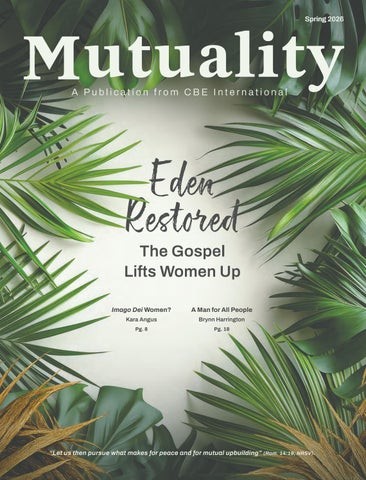
Spring 2026 2025
Eden Restored
The Gospel Lifts Women Up Imago Dei Women?
A Man for All People
Kara Angus
Brynn Harrington
Pg. 8
Pg. 18
“Let us then pursue what makes for peace and for mutual upbuilding” (Rom. 14:19, NRSV).
IN THIS ISSUE 4 Eve: The First Theologian Outside the Garden
Often remembered and blamed for that fatal day in the garden, there is more to Eve than her worst moment. By Jessica L.M. Jenkins
8 Imago Dei Women?
What does it mean for women to have been created in the image of God? By Kara Angus
13 Review: Redeeming Eden
Ingrid Faro’s new book, Redeeming Eden, brings some important insights to light. By Mayzie Mayfield
15
Beyond Financiers and Footwashers
Three New Testament Marys demonstrate God’s treatment of women as full participants and partners in the gospel. By Sarah Martin
Does Jesus’s incarnation as a man exclude women? By Brynn Harrington
We welcome your comments, article submissions, and advertisements. Visit cbe.today/mutuality. All Scripture quotations, unless otherwise indicated, are taken from the 2011 revision of the Holy Bible, New International Version®, NIV®. Copyright © 1973, 1978, 1984, 2011 by Biblica, Inc.™ Used by permission. All rights reserved worldwide.
2
Mutuality | Spring 2026
3 From the Editor Let Go of the Chains of Sin
22 President's Message Easter’s New Creation: Woman’s Identity Restored
24 Ministry News 25 Giving Opportunites
EDITORIAL STAFF Editor: Carrie Silveira Graphic Designer: Margaret Lawrence Publisher/President: Mimi Haddad Mutuality vol.33 no 1, Spring 2026 Cover design by Margaret Lawrence.
18 A Man for All People
Mutuality is published quarterly by CBE International, 122 W Franklin Ave, Suite 610, Minneapolis, MN 55404-2426.
DEPARTMENT
Mutuality (ISSN: 1533-2470) offers articles from diverse writers who share egalitarian theology and explore its impact on everyday life.
Advertising in Mutuality does not imply organizational endorsement. Please note that neither CBE International, nor the editor, nor the editorial team is responsible or legally liable for any content or any statements made by any author, but the legal responsibility is solely that author’s once an article appears in Mutuality. CBE grants permission for any original article (not a reprint) to be photocopied for local use provided no more than 1,000 copies are made, they are distributed for free, the author is acknowledged, and CBE is recognized as the source.
Mutuality wouldn't be possible without gifts from our generous donors. Scan the QR code to support CBE publications.
website: cbeinternational.org
From the Editor by Carrie Silveira
Let Go of the Chains of Sin A question every Christian must ask themselves, often more than once, is: “Do we truly believe in Easter?” Easter celebrates Jesus’s resurrection, but it also marks the ushering in of the Kingdom of God. Affirmed at Pentecost, those who believe are no longer condemned to live under sin, imprisoned by the sinful structures of the world. We have been given both the example of perfect obedience to God through Jesus and the ongoing presence of the Holy Spirit. Why, then, do so many insist on continuing to live according to the consequences of the Fall? Why hold so tightly to chains that have already been broken? Why do so many work to perpetuate sinful structures in the kingdom of God? That is just what hierarchical theology does; Whether between women and men or ethnicities, maintaining ontological hierarchies1 feeds the inequality that resulted from the Fall. In Genesis 1:26–31, God creates human beings in his own image, both male and female, gives them a joint commission to care for the world, and declares this to be good. Genesis 2:18–24 provides more detail as to how humanity was divided into two sexes, but it is not until sin enters the garden in Genesis 3 that any mention of hierarchy is made. From that point on, mutuality is disrupted. The Bible describes a turbulent and painful history fraught with inequality. Many of the expectations for the Messiah centered on relieving the oppression of the strong over the weak (Isa. 9:1–7, 61:1–7, Psa. 10:14). Jesus's treatment of women, the marginalized, and the weak throughout his ministry demonstrates what Paul later powerfully declared in no uncertain terms: "There is neither Jew nor Greek, neither slave nor free, nor is there male or female, for you are all one in Christ Jesus" (Gal. 3:28). The shackles of hierarchy are thrown off in the kingdom of God! Though sin is still abundant in the world, all Christians are called to live according to the kingdom of God, to “go and make disciples of all nations,” and to “teach them to obey everything [he] has commanded [us]” (Matt. 28 19–20). Christians are commissioned to be active agents
of Christ-like change, to live according to the gospel. This means letting go of the sinful patterns of this world and reorienting our hearts after Jesus’s example (Rom. 12:2). Over and over again, Jesus elevated women. He relied on them and their support throughout his ministry (Luke 8:3), included them alongside the twelve disciples in his teaching over and against cultural expectations (Luke 10:38–42), and entrusted them to be the first witnesses of his resurrection (Luke 24:1–7). Women were the first gospel preachers (Luke 24:9–10, John 4:39), early teachers, leaders (Acts 18:26, Rom. 16:1–2), even martyrs, shaping the world far beyond the first century.2 The articles in this issue are reflections on women beyond the garden. Consider a deeper understanding of Eve’s faith beyond that fatal day; women’s divine design as imago Dei from the first moments of creation; Jesus’s reliance on and inclusion of women in his ministry, and God’s transcendence above categories of sex and gender as Savior to all humankind. Each article presents strong evidence that helps identify and reframe patriarchy as a destructive pattern introduced after the Fall, a pattern undone by Jesus and which no longer binds us. Let us turn loose the chains of sin and live as God designed us: women and men, side by side, serving God together as equal partners. May we grow and fully embrace our freedom in Christ, following him according to our gifts and callings without reservation. The chains have been broken; sin and death have been conquered! He is risen! Notes 1.
2.
Ontological hierarchies, unlike hierarchies based on qualifications, refer to hierarchies based on unchangeable elements of people’s very nature, ranking men, women, certain ethnicities, etc., based solely on those aspects. Hierarchies based on qualifications refer to contextdependent authority: a surgeon has authority in the operating room because of her training and certifications; that same surgeon would not have the same authority in the kitchen of a 5-star restaurant. See Janet George, Still Side By Side (Minneapolis, MN: CBE Intl., 2009), 6. Lynn Cohick, Amy Brown Hughes, Christian Women in the Patristic World: Their Influence, Authority, and Legacy in the Second through Fifth Centuries (Ada, MI: Baker Academic, 2017).
Disclaimer: Final selection of all material published by CBE International in Mutuality is entirely up to the discretion of the publisher and editor. Please note that each author is solely and legally responsible for the content and the accuracy of facts, citations, references, and quotations rendered and properly attributed in the article appearing under his or her name. Neither CBE, nor the editor, nor the editorial team is responsible or legally liable for any statements made by any author, but the legal responsibility is solely that author's once an article appears in print in Mutuality. CBE is compliant with the Evangelical Council of Financial Accountability, earned the transparency certificate from Excellence in Giving, platinum award from GuideStar, and four-star rating from Charity Navigator.
bookstore: cbebookstore.org
Mutuality | Spring 2026 Eden Restored
3
Eve: The First Theologian Outside the Garden
For centuries, women have existed under the specter of "Eve's failure." Though both Adam and Eve failed in the garden, history has treated her particularly harshly. Her actions are thought to taint every female human. No matter how hard women have worked, no matter how faithful, educated, wise, intelligent, gentle, godly, or well-spoken, they will always be considered “daughters of Eve.” Accused alone, as if Adam wasn’t even there, Eve is often portrayed as foolish, easily deceivable, the bringer of sin into the world, the increaser of pain in childbearing. As women’s foremother, Eve’s sin became viewed by many as women’s generational inheritance and curse. It’s time that we return to a vision of Eve that sees beyond her failure to her faith.1 The Diminishment of Women I was just a teenager when I asked my pastor about 1 Timothy 2:14: “And Adam was not the one deceived; it was the woman who was deceived and became a sinner.” “Does this mean women are more easily deceived?”
Jessica L.M. Jenkins
He replied, “Yes, they likely are,” and used an example of how crooked salesmen specifically target older women for their schemes because “they fall for lies.” Case closed. Men are more trustworthy; women are easily deceived. Though today I could answer my childhood pastor with a clear, articulate explanation of why his teaching was steadfastly wrong, the plight of women in our churches has unquestioningly been harmed by this view of Eve.
4
Mutuality | Spring 2026
website: cbeinternational.org
When Eve’s failure is over-applied and her theological legacy is ignored, women are diminished. This horrendous (yet historical) take on Eve’s story only considers one moment of her life. My then-pastor and so many other theologians act as though Eve’s influence ended in the garden. Few see her faith as it held fast through the most heart-wrenching event a mother can imagine. Though Scripture treats her more honestly and graciously, scholars throughout all of church history have placed the burden for the fall of humanity on Eve’s back and used her failure as an excuse to oppress women.2 When Christian tradition is not blaming her for all that has gone wrong in the world, they steadfastly ignore the faith of the first mother of humanity. Verses like 1 Timothy 2:14 are used to say that, by their very nature, all women are more easily deceived than men. Many preachers and teachers see Eve’s actions in Genesis 3 not as a singular event by a specific person, but as an ontological truth applied to all women everywhere for all time! This belief system creates a gender-based hierarchy where the words of men are readily believed while the voices of women are ignored. You can imagine how damaging this is, especially in cases where women are wounded and the men in power refuse to heed their words. When Eve’s failure is over-applied and her theological legacy is ignored, women are diminished. Rather than being brought close as equal image bearers and priestly representatives before God, women are cast to the side. Wounded. Silenced. Abused. The Aloneness of Men Women aren’t the only victims. Eating the fruit in the garden brought not only spiritual and physical death, but also relational death between men and women. We were created for unity, needing the spiritual fullness and wisdom that both sexes provide. But this truth has been lost in many of our churches and in most of our world.
bookstore: cbebookstore.org
Unity between men and women has been homewrecked by lies peddling the intellectual superiority of men and a male pride that refuses to listen to women’s perspectives. One only needs to open any social media platform for a few minutes to find modern renditions of ancient misogyny3 weaponized against women and poisoning the hearts of men. Now, and throughout all of history, some men silo themselves away from feminine influence. They refuse to learn from spiritual mothers and sisters. They are left with only male thoughts and voices.4 This is antithetical not only to the creation of humanity, but also Jesus's creation of his church (Matt. 28:5–8; Luke 1:39–45; Rom. 16; 1 Cor. 12:12–26; 14:31–39). God declared this spiritual aloneness to be “not good,” (Gen. 2:18) then created woman specifically to partner with man in priestly duties.5 Men need women’s voices, wisdom, and insight in their spiritual spaces. Their souls have been damaged—their wholeness fractured—by spiritual systems that ignore women. Eve’s True Legacy Though many use the story of Eve and her failure as an excuse to deny women a voice in theological spaces, her legacy actually does the opposite. The heart of God for women in the story of Eve is far greater than what we have collectively imagined. Contrary to the usual rendering—where Eve is the brunt of the joke, the enemy, the failure, and an easily deceived buffoon—God ends her story in Genesis 4 by showcasing her steadfast endurance and faith in the face of suffering. The First Theologian Outside the Garden Genesis 4 begins with Eve’s faith. Adam has no recorded dialogue after the Fall; once they are expelled from the
Mutuality | Spring 2026 Eden Restored
5
It was not good for Adam to be alone; he needed a counterpart, a partner. He needed a theologian to point him back to God. garden, he fades off the scene. His last registered act is impregnating his wife (Gen. 4:1); God gives the final words in their story to Eve (Gen. 4:25). Eve. The one who answered the serpent, misquoted God, and was deceived—she is the first theologian outside the garden.6 In an uncertain place, surrounded by the threat of death, Eve interprets the promise of the Lord (Gen. 3:15), declaring hope for their future. She names her firstborn “Acquired” (Cain) as a recognition of the aid of the Lord on her behalf:7 “With the help of the LORD I have brought forth a man” (Gen. 4:1). The passage goes on to outline how Cain murders Abel without remorse or concern. The two babies she bore and raised, the sons in whom she delighted: one dead, the other a murderer. As a mother, my sanctified imagination allows my body to feel just a hint of Eve’s deep sorrow. Eve remembers their first steps, their first words, the sounds of their childlike laughter and joy. Now, one of her babies lies in a pool of his own blood. Every mother fears something happening to their children and especially being the cause of the harm. As Eve considers the murder of her child, she has to uniquely wrestle with self-blame. She first ate the fruit. She and Adam brought sin into the world. Together, they opened the door to death. Perhaps Eve felt that this tragedy really was her fault. Scripture does not describe Eve’s journey through grief. We do not see her grapple with disillusionment, anger, or despair. Yet, as she walks through the pain of death, she reaches back out to God for hope.8
6
Mutuality | Spring 2026
Weaving theology into her motherhood, Eve names her last recorded son “Granted” (Seth) because “God has granted me another child in place of Abel, since Cain killed him” (Gen. 4:25). This name functions as a prayer of thanksgiving and a recognition of God’s actions. As Jesus’s female disciples would do later, Eve heard the words of the Lord and worked out her theology accordingly. Eve’s utterances of faith echo through the chapter, opening and closing this traumatic episode with eyes lifted up to God. Her Location Matters Eve speaks these words as the first theologian outside the holy-of-holies of the cosmic temple of God.9 This location and timeline are necessary for us to consider as we evaluate Eve’s legacy. Adam named her “Eve” (Living) after God pronounced the curses on the serpent and the ground. While they were still in the garden, Adam thought about God’s actions and promises and recognized the particular part his wife would have in the future hope for humanity. Many of us can make theologically astute observations when we are surrounded by holy things in the presence of God. Yet when life falls apart and pain is our only companion—few are able to build theology then. However, here, outside the garden, outside the holy place, away from God’s full presence, when all seems lost and Adam is silent—Eve speaks truth and hope for the future. She clings to God’s promise and points others to do the same. Perhaps Eve’s teaching about God and her faith is why Seth and Enosh could call upon the name of the Lord in Genesis 4:26. As a woman, theologian,
website: cbeinternational.org
We have an opportunity to reclaim Eve’s legacy for her daughters.
and mother, Eve instigated movements of faith in the new reality of post-Fall creation as she interpreted the actions of God according to his promise. Conclusion Eve’s story begins with glory and ends with hope (Gen. 2, 4). She was created as the final piece of God’s beautiful world. She was not built to be a subservient helper, housekeeper, or incubator, but rather an equal ruler, image-bearer, voice, and presence. Though her story ushers in the darkness that consumes all of humanity, necessitating the coming of Jesus, it ends with the same hope that we carry forth today: hope that God provides and that God is faithful. Hope that the one who crushed the serpent will come again and make all things new.
4.
Eve’s true legacy is not her failure in the garden, but her faith outside of it. Jesus’s uplifting of all women began with the first woman. Though she participated with the man in bringing sin into the world, she chose to live, mourn, and hope through faith, clinging to her God. We have an opportunity to reclaim Eve’s legacy for her daughters. Eve, who failed—as we all do—yet who resolutely walked forward by faith, nurturing her family, and teaching them about her God. Women do bear her likeness. She was the first theologian outside the garden, and we today can walk in her footsteps. God is with us in all our suffering and exhaustion; As he was with Eve in her darkest moments, so he will be with us. Notes 1.
2.
3.
I have also written about Eve more thoroughly here: https:// wewhothirst.com/transforming- eves-legacy-in-genesis/, and spoken about Eve’s legacy here: https://womenofthebible. buzzsprout.com/2384822/episodes/15418594-001-women-incontext-eve-genesis-2-4. Ben Sirach claimed: “From a woman was sin’s beginning, and because of her, we all die” (Sir. 25:24). Tertullian said this regarding Eve, “You are the one who opened the door to the Devil. You are the one who first plucked the fruit of the forbidden tree, you are the first who deserted the divine law; you are the one who persuaded him whom the Devil was not strong enough to attack. All too easily you destroyed the image of God, namely, man” (Cult. fem. 1.1). Modern writers Rebecca McLaughlin in her book Confronting Christianity, claim that women will be in a “power struggle” against their husbands because their desire will be “to possess and master” (134). Aristotle claimed that women were ontologically inferior to men. He even went so far as to describe women as “mutilated” males.
bookstore: cbebookstore.org
5. 6. 7. 8.
9.
Whereas men are rational beings, women “lacked the capacity for true knowledge and, consequently, wisdom” (Katie McCoy, "Recovering the Communion of Persons,” eikon, issue 2, 44–59, see Aristotle, On the Generation of Animals, II.1 P732a; II.3 P25–29; IV. P15–26: IV.3 P5–24; Politics I.13 P7). The claim that women do not have the capacity for wisdom is a stark contrast to the book of Proverbs, where wisdom is personified as a woman. Consider Augustine’s words “One can also posit that the reason for her creation as helper had to do with the companionship she could provide for the man, if perhaps he got bored with his solitude. Yet for company and conversation, how much more agreeable it is for two male friends to dwell together than for a man and a woman! . . . I cannot think of any reason for woman’s being made as man’s helper, if we dismiss the reason of procreation. . . . Woman who was of small intelligence and who perhaps still lives more in accordance with the promptings of the inferior flesh than by the superior reason.” (Literal Commentary on Genesis, quoted in Judy Wu Domick, "How Some of the Early Church Fathers' View of Women Affect Us Today," Life Reconsidered, February 12, 2020, https://lifereconsidered. com/2020/02/12/how-some-of-the-early-church-fathers-viewson-women-affect-us-today/). See John Walton, The Lost World of Adam and Eve and Ingrid Faro, Redeeming Eden for more on the topic of the priestly duties in the garden. Ingrid Faro also discusses Eve’s faith and renewed legacy in her new book Redeeming Eden. K. A. Mathews, vol. 1A, The New American Commentary (Nashville: Broadman & Holman Publishers, 1996), 265. Jessica L.M. Jenkins, “001 Women in Context: Eve (Genesis 2-4),” in Women of the Bible in Context: Her God, Her Story, Her Voice, July 16, 2024, 45 min, 55 sec, https://womenofthebible. buzzsprout.com/2384822/episodes/15418594-001-women-incontext-eve-genesis-2-4. Walton, Ancient Near Eastern Thought, 127, 197; Heiser, Michael S. 2019. Unseen Realm: Recovering the Supernatural Worldview of the Bible. S.L.: Lexham Pr. 46-47; Johnson, “Genesis 1,” 190; John H. Walton, The Lost World of Adam and Eve: Genesis 2–3 and the Human Origins Debate (Downers Grove: InterVarsity Press, 2015), 104.
Jessica L.M. Jenkins holds an MA in Israel Studies and an advanced MDiv in Biblical Languages. Her research explores the historical context of the Bible, women of the Bible, and gender roles. Author of A Woman’s World: How God Champions Women through the Mosaic Law (IVP, forthcoming, tentative title). She was an Honorable Mention winner in CBE’s 2024 Writing Contest for her article: "Challenging Gender Norms: The Masculine Power of Proverbs 31’s Woman of Valor.”
Mutuality | Spring 2026 Eden Restored
7
Imago Dei Women? What Genesis 1–3 Means for Women Kara Angus
8
Mutuality | Spring 2026
website: cbeinternational.org
At a marriage conference I once attended, the speaker said, “Men are made in the image of God, and women are made for the husband and the glory of the husband.” He went on to make the following connections:1
theology. Women cry out, “This is not our birthright!” But we are muffled by many thought leaders who yell louder, “Obey or else!” as they superimpose gender roles on to our imago Dei and declare it “good.”
• A woman’s role is to obey her husband’s spiritual authority in all things with a gentle and quiet spirit. • She is to be silent in her critique of her husband unless he opens the door for communication. • The husband is the final word on all matters. • A woman’s only real value is found in relationship to her husband—in how much she responds, follows, and assists.
What exactly did God declare “good” when he created humans? Did God build leadership and authority into men while ensuring that following and submission were inherent in women’s DNA? Have men alone been assigned the unique task of being God’s representatives on earth, as the conference teacher taught?
There was no talk that weekend of a woman’s particular call to follow God or to embrace her own divine call and commission. There was no mention of the inherent worth a woman has because she is imago Dei, made in the image of God. No one asked why marriage was elevated to the highest order. I wondered to myself, “What about single people? Do we only fully bear God’s image when we are married? Is the image of God condensed down to gender roles, or might it be a much grander and glorious calling we have been given?”
Genesis 1
As I listened, I glanced cautiously around the room. No one else outwardly displayed the distress and agitation I felt running through my body. Unfortunately, this man’s words harmonize with the gross caricatures of women passed down from early church fathers. Many of those men wrote about women as defective types of creatures who could not bear the image of God on their own—cruel words which helped shape Christian
The Divine Call in Genesis 1 and Matthew 28
So God created humans in his image, in the image of God he created them; male and female he created them. . . . God saw everything that he had made, and indeed, it was very good. (Gen. 1:27, 31a NRSVue) Genesis 1 is where God starts humanity’s story with a divine call. God gave both man and woman a blessing, a commission to be fruitful and multiply, and they shared authority to rule and subdue the earth. They both had a holy call—to be God’s representatives as they were given creative leadership over creation. Psalm 8 testifies to the dignity and purpose God poured into humanity at creation: Yet you have made them a little lower than God and crowned them with glory and honor. You have
Have men alone been assigned the unique task of being God's representatives on earth?
bookstore: cbebookstore.org
Mutuality | Spring 2026 Eden Restored
9
Being made in the image of God, imago Dei, is a call to action with value and purpose built into our very DNA. given them dominion over the works of your hands; you have put all things under their feet. (Ps. 8:5–6) There are themes of mutuality, creative partner work, and specific purpose granted to both women and men together. Being made in the image of God, imago Dei, is a call to action with value and purpose built into our very DNA. Matthew 28 And Jesus came and said to them, “All authority in heaven and on earth has been given to me. Go therefore and make disciples of all nations, baptizing them in the name of the Father and of the Son and of the Holy Spirit and teaching them to obey everything I have commanded you. And remember, I am with you always, to the end of the age.” (Matt. 28:18–20) Similar to Genesis 1, in Matthew 28 Jesus leaves his image-bearers with a final Great Commission. In these New Testament verses, there is a familiar theme of bestowed authority, commission, the blessing of God’s presence, mutuality, and partnership. Women and men are given redemptive work again here in the middle of the story, just as they were in the beginning. Now Jesus calls us to fill the earth with God’s greatness. As redeemed representatives, we carry the message of the cross and grace as part of our call to worship.
"Throughout Scripture, 'bone of my bones and flesh of my flesh' identifies shared standing or kinship, never subordination."
10
Mutuality | Spring 2026
The first garden was the perfect sanctuary as humans daily walked in fellowship with God and led creative and productive lives. Kingdom work then and now is holy, commissioned leadership and partnership work. Divine Design in Genesis 2 Then the Lord God said, “It is not good that the man should be alone; I will make him a helper [ezer] as his partner [kenegdo]” (Gen. 2:18). Chapter two of Genesis reveals more of God’s dramatic and creative design plans. God anticipated man needed a strength (ezer) that corresponded to him. Ezer is a term used many times for God in the Old Testament,2 identifying God as a vitally important rescuer. Providing strength and protection are part of the character of God, and God uses this word to describe woman, too. The full phrase, ezer kenegdo, “strong rescue,” makes it clear that woman was man’s equal counterpart and partner. There is not a trace of inferiority in the name God, not man, gave woman. As man saw the woman God had formed, man joyfully declared, “This at last is bone of my bones and flesh of my flesh” (Gen. 2:23a). Phillip Payne writes that man’s exclamation “emphasizes the man’s recognition that man and woman share the same essence. Throughout Scripture ‘bone of my bones and flesh of my flesh’ identifies shared standing or kinship, never subordination.”3 Together, man and woman lived into their joint commission to be fruitful and multiply. Richard S. Hess notes that the command to share dominion is “the only authority given before the Fall.”4 God designed us as image bearers first. That should inform any other discussion on gender and roles. A focus on hierarchical ideology shifts us away from our true divine mission. Divine Dignity in Genesis 3 Therefore the Lord God sent them forth from the garden of Eden, to till the ground from which they were taken. (Gen. 3:23) website: cbeinternational.org
Hierarchy happens as sin enters the garden. Both humans feel the pain of brokenness as they are separated from the God they once fellowshipped with. Now they tend the rebellious earth with the effect of sin weighing down upon their dejected and decaying bodies.
Our divine dignity and value stay with us in spite of sin.
Man cries tears into the soil and brings forth food. Woman cries tears into the world and brings forth humanity. In a world of conflict, they struggle to live in harmony with one another. “God’s image bearers turned authority and ruling on one another instead of jointly pursuing God’s glory for the benefit of all creation.”5 Our divine dignity and value, however, stay with us in spite of sin. We find examples throughout the Bible of God lovingly pursuing us. Even in the misery of sin and evil, threads of grace and redemption glimmer with hope and point toward the gospel story until finally, “whatever we lost in Eden we find again in Jesus. . . . As God’s perfect image bearer, Jesus recaptures God’s original vision for us by embodying true image-bearer living.”6 The incarnation itself is proof of our image-bearing call. Denying Imago Dei We are fully formed human beings. When we crush women into rigid gender roles and refuse to allow them to deviate, we strip humanity away from God’s creation—creation which God already declared “very good.” We take human-created systems, baptize them in the name of the Father, Son, and Holy Spirit, and call them “very good.” We deny women God’s grace and redemption in their own life stories. We become like the conference speaker I saw who said the woman receives the grace of Christ only when her husband functions in his “headship” role. This takes God’s divine call, design, and dignity and shifts another human into the place reserved for Jesus—our mediator and intercessor. The woman is denied intrinsic value as her imago Dei is stripped away so that gender roles (with specific punishments for deviating) dictate what being a flourishing, “valuable” image bearer looks like for her. We leave women in the conflict of an old and familiar story rather than granting them the power to bring harmony to God’s beautiful and redemptive story. Most horrifically, we deny the Creator of life the movement and space to grow and shape a woman into God’s image. Imago Dei, Freed in Christ Whatever it means to bear God’s image is so much grander than stereotyped gender roles imprinted back onto the imago Dei. God is still calling for worshippers. bookstore: cbebookstore.org
God still expects us to be fruitful glory-bearers. And now we have the Holy Spirit at work transforming us into the image of God (2 Cor. 3:18). Being an image bearer means we care about what God cares about. We shudder over the ways things are and work toward the beauty of what will be. Did God declare women to be imago Dei? Did God declare women good? Yes. Then we must as well. We cannot continue to curse women with Eve’s body and deny them the freedom that comes from Mary’s body. Editor’s note: This is a CBE 2022 Writing Contest Honorable Mention. Notes 1.
2.
3. 4.
5. 6.
For more on how to understand difficult passages like this one, found in 1 Cor. 11, read Cynthia Westfall's article, "Difficult Passages and How to Understand Them," Mutuality Blog + Magazine, Oct. 5, 2023. https://www.cbeinternational.org/ resource/difficult-passages-in-the-new-testament-and-how-tounderstand-them/. Misinterpreting these passages can lead to the problematic and harmful assertions the speaker went on to make. The phrase is used sixteen times in reference to God as Israel’s rescuer: Exodus 18:4; Deut. 33:7, 26, 29; Psalms 20:2; 33:20; 70:5; 89:19 [translated “strength” in the NIV]; 115:9, 10, 11; 121:1–2; 124:8; 146:5; Hosea 13:9. Philip B. Payne, Man and Woman, One in Christ: An Exegetical and Theological Study of Paul’s Letters (Grand Rapids: Zondervan, 2009), 45. Richard S. Hess, “Equality With and Without Innocence: Genesis 1–3,” in Discovering Biblical Equality: Complementarity Without Hierarchy, eds. Ronald W. Pierce, Rebecca M. Groothuis, and Gordon D. Fee (Downers Grove, IL: IVP, 2005), 94. Carolyn C. James, Half the Church: Recapturing God’s Global Vision for Women (Grand Rapids: Zondervan, 2015), 165. James, Half the Church, 69.
Kara Angus is passionate about women claiming their voices and having a platform to declare their love for the God who always and forever loves them.
Mutuality | Spring 2026 Eden Restored
11
Review: Redeeming Eden Mayzie Mayfield
Ingrid Faro brings nearly three decades of biblical and theological study to bear in her latest book, Redeeming Eden: How Women in the Bible Advance the Story of Salvation, and her expertise shines throughout this spiritually uplifting, theologically sound work. Rather than writing an academically dense text, Faro has leveraged her skills as researcher and teacher to craft a readable, nuanced, and compelling study of women in the Old Testament. While the stories of women in the Bible are frequently portrayed as disconnected events, Faro endeavors to “trace a thread through Scripture . . . demonstrating that women initiate and advance key movements in redemptive history” (1). She does so, to great impact. The first three chapters of Redeeming Eden examine the beginning of Genesis, laying the theological foundation for how Faro analyzes the narratives in following chapters. In chapter 1, “Man and Woman as God’s Image,” Faro states that “the intended purpose for every human is to be royal children of God” (16). While her exegesis of the creation narrative in Genesis 1 is probably familiar ground for CBE readers, Faro’s emphasis on community within the Trinity, among people, and between God and creation (16, 23), offers a fresh perspective. It is a recurring theme throughout Redeeming Eden that I had
not noticed in Scripture before! Chapter 2 (“Man and Woman as Sacred Space”) and chapter 3 (“Redemption Hope Through the Woman”) are where the strongest aspect of Redeeming Eden shines—Faro’s ability to draw on language and cultural context guides readers in her exegetical process. For example, while discussion of the mistranslation of the word `ezer (“divine help,” 28) is commonplace, Faro also explains that the Hebrew word tsela` (often translated in English as "rib") more accurately means "side," such as the side of a frame or wall supporting a holy place (31). The implications of this translational choice underscore the emphasis on kinship and communal wellbeing that Faro explores in the remaining chapters. She also emphasizes the agency and moral dignity God affords Eve after the fall (42ff); this relationship between God and woman is another pillar of Faro’s argument that women in Scripture are vital to God’s redemptive movement. Chapters 4–12 consider women who influence Jesus’s lineage—Sarah, Tamar, the women of Exodus, Rahab, Deborah as well as Jael, Ruth, Hannah, Bathsheba, and Jehosheba, respectively. In each chapter, the readers’ attention is drawn back to the key themes: the bold, redemptive action of these women, their care for God’s
Faro’s ability to draw on language and cultural context guides readers in her exegetical process. bookstore: cbebookstore.org
Mutuality | Spring 2026 Eden Restored
13
Not only does Redeeming Eden exegete God's approach to women in scripture, but it also exemplifies what good exegesis looks like in a way lay-level readers can understand. people and their community, and their hopeful trust in an unfailing God. Chapter 6, “Women Who Instigate the Exodus,” was especially impactful. Faro’s description of Pharoah’s arrogance to overlook women as formidable opponents allowed them to help the “one right in front of them,” subversively giving, saving, and protecting life (80). Her word study of Deborah’s description, eshet lappidoth (commonly translated "wife of Lappidoth", while Faro advocates for "fiery woman"), in chapter 8 was delightful! Chapter 12, Jehosheba’s story, brought tears to my eyes as I reflected on how everyday acts of bravery can impact generations to come—to the point of preserving families. Faro excels at guiding readers through her exegetical process, providing enough linguistic and contextual information to build trust without bogging readers down in the details. Although I have studied biblical gender equality, I learned something new in each chapter. Faro demonstrates concern for the spiritual formation of her readers, recruiting a contributor, Joyce Koo Dalrymple, to provide a breath prayer1 and questions for reflection at the conclusion of each chapter. This indicates that Faro wants not only to disseminate information, but also to contribute to the spiritual formation of her readers. Faro also understands that her audience may contain skeptical readers and encourages them to read her work through a literary lens (10). She displays holistic care for her audience. Not only does Redeeming Eden exegete God’s approach to women in Scripture, but it also exemplifies what good exegesis looks like in a way lay-level readers can understand. Faro explains the tools she uses and provides substantive footnotes and endnotes to support her claims. Rather than feeling overwhelming, the
14
Mutuality | Spring 2026
guided experience of watching a skilled academic develop conclusions will foster trust with Faro as an author and perhaps embolden readers to dive deeper into biblical exegesis themselves. Although it can be read individually, Redeeming Eden will especially benefit those who read it in community. Streaming videos that further explore Redeeming Eden’s contents are available with purchase of the book, and the questions at the end of each chapter facilitate conversation. I would suggest reading it with a discussion group, especially because community is such a significant aspect of Faro’s thesis. However, I would not discourage anyone from reading Redeeming Eden on their own! I would comfortably recommend it to egalitarians and the egalitarian-curious alike. Redeeming Eden was written to showcase how women in the Old Testament have been part of God’s redemptive plan since the beginning. Faro weaves stories of bold action, love for other people, and “unpretentious tenacity” in faithfulness to God to prove that God’s use of women in God’s story are not isolated events. In a way that aligns with CBE’s values, Faro forms a compelling case for women’s biblical equality and dignity—one based on Scripture, history, language, and cultural context. Faro joins the tapestry of women who have participated in the redemption of Eden through the use of her God-given gifts. Notes 1.
“Breath prayers are short prayers that coincide with inhaling and exhaling.” Esther Shin Chuang, “How Breath Prayers Helped Me ‘Pray Continually’” Christianity Today, July 14, 2023, https:// www.christianitytoday.com/2023/07/breath-prayer-busy-momspiritual-disciplines/.
Mayzie Mayfield is Baltimore-based writer and seminarian whose work examines womanhood, justice, and Christian hope. She is married and has one daughter.
website: cbeinternational.org
Beyond Financiers and Foot Washers Jesus Restores Women in the Kingdom of God
Sarah Martin Eden was a place made for human flourishing. The creation narrative of Genesis 1–2 reveals the equality and mutuality of male and female. Made in the image of God, man and woman together represent the imago Dei. As image bearers, they have a shared identity and a shared purpose: “God blessed them and said to them, ‘Be fruitful and increase in number; fill the earth and subdue it. Rule over the fish in the sea and the birds in the sky and over every living creature that moves on the ground.’” (Gen. 1:28, emphasis added). John Mark Hicks explains that “God shares divine dominion with human beings and invites both male and female to participate in God’s mission.”1 So, why are women so often limited in today’s churches? Beth Allison Barr asks a similar question: “What if patriarchy isn’t divinely ordained but is the result of human sin? What if instead of being divinely bookstore: cbebookstore.org
created, patriarchy slithered into creation only after the fall?”2 Though complementarian theology gatekeeps the participation and influence of women, the person and work of Jesus restores in new creation that which God designed at the original creation. His life, death, and resurrection don’t just open the way to a nebulous idea of spiritual salvation; “salvation heals the divisions that have vandalized God’s creation and ripped human to human relationships to shreds.”3 Jesus restores the mutual relationship between men and women as was always part of God’s good design. While the Gospels demonstrate how Jesus overturned long-held beliefs and social norms in his interactions with a variety of women, let’s consider how Eden is restored in the lives of three specific women: Mary the mother of Jesus, Mary of Bethany, and Mary Magdalene.
Mutuality | Spring 2026 Eden Restored
15
From Eve to Mary, the Mother of Jesus
Mary of Bethany
Some assert that when the serpent spoke to Eve first, he was attempting to bypass some ordained hierarchy of male leadership. This idea appears nowhere in the text. God asks, “Have you eaten from the tree that I commanded you not to eat from?” (Gen. 3:11), not “Did you violate the creation order of male hierarchy?” This idea is also undermined by the fact that God addresses Adam and Eve individually, rather than just Adam. Furthermore, it is the seed of Eve that will crush the serpent’s head, a promise which comes to fruition through another woman, Mary, the mother of Jesus.
Mary of Bethany is first introduced in Luke 10:38–42. In this short account, Jesus and his disciples were welcomed into the home of Martha and her sister Mary. Mary sat listening at Jesus’s feet as he taught. Overwhelmed with all the preparations and work of hosting, Martha asked Jesus to tell Mary to help her. Jesus responds, “Martha, Martha, you are worried and troubled about many things. But one thing is needed, and Mary has chosen that good part, which will not be taken away from her.”6 The Lord does not condemn Martha for her devotion to her ministry, but he praises Mary for choosing that which is more important: listening and learning. In a time and culture where women were denied education, Jesus frees Mary to pursue knowledge and understanding of God’s word. And since women are free to learn, “they are also empowered to teach once they have learned.”7 Jesus's command to “go therefore and make disciples of all the nations”8 applies to all disciples for all time with no restrictions on who can teach or to whom they can teach. However, Mary goes on to embody more than the role of disciple.
Regarding Mary, contrary to what would be expected in a complementarian framework, the angel Gabriel spoke directly to her alone, rather than to her father or to her betrothed, Joseph.4 This lowly teenage girl with no connections or power was the first to receive the good news of the Christ. She was called to participate in a most crucial way in one of the most important parts of God’s redemptive plan. Only later was Joseph informed of God’s plan in a dream, reassuring him that he should take Mary as his wife and to follow her into this calling.5 Where Adam and Eve’s actions ushered in sin and death, Mary’s brought forth life. In the Gospel of John, Jesus gives seven I AM statements, three of which identify him with life: “I am the bread of life,” or “I am the living bread,” (John 6:35, 48, 51). “I am the resurrection and the life,” (John 11:25). “I am the way and the truth and the life,” (John 14:6). Mary symbolizes the new Eve. Through her, God brought forth his Son to overturn the consequences of the Fall and restore all things.
16
Mutuality | Spring 2026
The word “Messiah” is translated as “anointed one.” Although Jesus is eternally anointed before creation, he received public confirmation at his baptism when the Holy Spirit descended upon him like a dove (Matt. 3:16). He was physically anointed with oil on more than one occasion, each time by a woman (Matt. 26:6–13; Mark 14:1–9; Luke 7:36–50; John 12:1–11). The gospel accounts of Luke and John tell us that his feet were anointed, a moment which Jesus identifies as preparation for his burial (John 12:7). In John’s Gospel, the woman is identified as Mary of Bethany. Mary’s loving act was prophetic, pointing forward to Christ’s death. Matthew and Mark reveal that an unnamed woman anointed Jesus’s head. “An anointment,” according to Jennifer Powell McNutt, “is a weighty act that often carries a twofold purpose: (1) preparation for burial and (2) the coronation of kings. A sacred anointing is a priestly act.”9 In the Old Testament, kings, priests, and prophets received sacred anointings; Jesus embodies all three. Whether or not Mary of Bethany was the unnamed woman in either of these gospels, the act of anointing was of a priestly nature, a role specifically limited to men of the tribe of Levi under Jewish law. Jesus's ministry broke cultural barriers and made room for women in previously male-only places. Because of his sacrifice, we are all, both women and men, now part of a “royal priesthood” (1 Peter 2:9). website: cbeinternational.org
Mary Magdalene Mary Magdalene “is mentioned in the gospel accounts nearly as much as Jesus’s mother, Mary (Mary of Nazareth), and more than most of the disciples.”10 Luke introduces her as part of the entourage that followed along with Jesus and the twelve. A woman healed of seven demons, she is included in a list of other women who ministered to and financially supported the ministry of Jesus (Luke 8:1–3). The very nature of these women, Mary Magdalene among them, being included among Jesus's disciples represents a breaking of social and religious expectations of the first century. Still, Mary Magdalene's significance in the Gospels goes further. Matthew, Mark, and John each name specific women who remained at the cross during Jesus’s crucifixion. Mary Magdalene is the only woman consistently named in all three of these gospel accounts. Matthew and Mark also tell us that she, along with another Mary, followed along to see where Christ’s body was buried. It is Mary Magdalene and some other women who go to the tomb early on the first day of the week. They are surprised to find the stone rolled away and even more astonished to be told, by angels no less, that the Lord had risen. Mark recounts: “Now after He had risen early on the first day
What was fractured at the Fall—male-female relationships—is redeemed in the resurrection of Jesus Christ. Mary the mother of Jesus, Mary of Bethany, and Mary Magdalene are just three examples of how Jesus engaged with, elevated, and affirmed women throughout his ministry. Women were the first to hear of Christ’s birth, the ones to remain at the cross, and the first to be witness to and proclaim his resurrection. Women stood with Jesus from the cradle to the grave. In a patriarchal culture, his interactions with women proclaimed (to borrow from the popular series The Chosen): “Get used to different.” It’s questionable at best, antithetical to the gospel at worst, to teach that all participate fully in the salvation offered through Jesus Christ, but not all can participate fully in service to Christ and his church. I recently listened to a sermon on women’s roles within the church, the minister asserted that “women make beautiful welcome baskets.” To limit women to financiers and foot washers, basket makers, and cradle roll teachers is to deny the full image of the imago Dei as granted at creation. This isn’t how Jesus saw women. He saw them as disciples, priests, and preachers, and he released them to fully partner along with men in spreading the gospel and building his church. bookstore: cbebookstore.org
of the week, He first appeared to Mary Magdalene, from whom He had cast out seven demons” (Mark 16:9). In John’s account, “Jesus said to her, ‘Mary!’ She turned and said to Him in Hebrew, ‘Rabboni!’ (which means “teacher”). Jesus said to her, ‘Stop clinging to Me, for I have not yet ascended to the Father; but go to My brethren and say to them, “I ascend to My Father and your Father, and My God and your God.” Mary Magdalene came, announcing to the disciples, ‘I have seen the Lord,’ and that He had said these things to her,” (John 20:16–18). In John’s account, Mary had already told Peter and John that Jesus’s body was missing. Both men ran to the tomb to find it empty and, not understanding the Scriptures, returned to their homes. Only then did Jesus choose to reveal himself to Mary Magdalene. In a time when a woman’s witness was considered unreliable, it is remarkable that Jesus chose to place the news of his resurrection into the mouth of a woman. No wonder Thomas Aquinas called her the “apostle to the Apostles.” By authorizing Mary Magdalene to share the news of gospel resurrection with the male disciples, Jesus proclaims that women are partners in the Great Commission to “Go therefore and make disciples of all nations,” (Matt. 28:19). He acknowledges that their witness is trustworthy and necessary.
Notes 1. 2. 3.
4. 5. 6. 7. 8. 9. 10.
John Mark Hicks, Women Serving God (John Mark Hicks, 2020), 121. Beth Allison Barr, The Making of Biblical Womanhood (Brazos Press, 2021), 25. Bobby Valentine, “Christ’s Cosmic Gospel: It’s Not About Me, but It Includes Me,” Stoned Campbell Disciple, March 28, 2020, https://stonedcampbelldisciple.com/2020/03/28/christs-cosmicgospel-its-not-about-me-but-it-includes-me. Luke 1:26–33 Matthew 1:18–21 Luke 10:41–42 John Mark Hicks, Women Serving God (John Mark Hicks, 2020), 189 Matthew 28:19. Jennifer Powell McNutt, The Mary We Forgot (Brazos Press, 2024), 36. McNutt, The Mary We Forgot, 12.
Sarah Martin graduated from Faulkner University with a bachelor’s in Business Administration. She deeply enjoys studying theology. Sarah has been previously published in Christian Woman magazine as well as speaking at ladies events and the annual lectureship at Faulkner University.
Mutuality | Spring 2026 Eden Restored
17
A MAN FOR ALL PEOPLE Brynn Harrington
Many women have felt that the patriarchal overtones of Scripture exclude them from participating in God’s divine work: only men are to be the leaders, preachers, and teachers. They find the masculinity of Jesus limiting instead of liberating because they cannot relate to his male identity. Some go so far as to assert that Jesus’s maleness is proof that only men can take up those mantles.1 If Jesus as a man was the perfect human, how can women ever hope to measure up? The Gnostic Gospel of Thomas puts this approach into blaringly oppressive terms: Simon Peter said to him, “Let Mary leave us, for women are not worthy of life.” Jesus said, “I myself shall lead her in order to make her male, so that she too may become a living spirit resembling you males. For every woman who will make herself male will enter the kingdom of heaven.” (114) Thankfully, canonized Scripture disagrees with this attitude and says something entirely different. This was not the design of the garden of Eden or of the new kingdom of God. We should no longer be living under the old discord of hierarchical humanity. Instead, we must claim the new call to live to the fullest of our humanity, embrace the diversity of gifts in God’s kingdom, and liberate others to do the same.
18
Mutuality | Spring 2026
website: cbeinternational.org
This is a huge task. Where do we begin? Let’s look to Jesus. THE PARTICULARITY—AND UNIVERSALITY—OF JESUS’S PERSONHOOD Who was this man? Jesus’s human identity as a Jewish man served an important purpose for women and men alike, rectifying age-old wrongs between them. Contrary to what so many assume, when Scripture is read against the backdrop of the patriarchal context in which it was written, the actions of Jesus as a man elevate the marginalized and show us how to resist patriarchy and prejudice in our own lives. Our understanding of God is purely human and limited. The only way that we can know God is through God’s action and revelation to the world, which God generously demonstrates for us in ways that we can fathom. We would never have been able to conceive of a healthy, genderless human and therefore, when God was incarnate in Christ, God had a sex. God also had a sense of individuality and personality. It was possible for other people to know God, relate with God, and talk with God. We are reminded of Exodus: As a Hebrew, Moses would never have been able to get an audience with the Egyptian Pharaoh had he not
been raised as an Egyptian prince. Likewise, for Jesus to transform the old traditions and fulfill the laws of Israel, he had to become a part of those traditions. Jesus came with a specific voice that people would listen to, a voice that would give him the authority he would need in that culture. As a Jewish man, Jesus became the role model for a new social code and for right relationships between men and women, social classes, and ethnic groups.
will be made righteous.” For this purpose, it did not matter that Jesus was male; his sex had nothing to do with obedience or disobedience to God, and a female Christ would have accomplished the same salvific purposes. The importance here is that Jesus was 100 percent fully human who was 100 percent obedient to God.
If Jesus had come as a woman, a Gentile, a leper, or any other group segregated from the Jews during that time, he would have been quickly dismissed and the message would have been lost. Because the people of the Ancient Near East commonly associated women, in particular, with sexuality and temptation,2 God’s decision to send a son instead of a daughter was a practical one. Simply put, Jesus challenged his culture and elevated the oppressed to new extremes more effectively than if he had been born any other way.
This male Rabbi treated women differently than they had ever been treated before. There were many who remain unnamed in Scripture, such as the woman with the hemorrhage (Matt. 9:8–16) and the Samaritan woman at the well (John 4:1–26). The fact that women were often identified merely by their ethnicity, husband’s name, or occupation suggests that they were marginalized. Still, Jesus sought them out, referred to them by name, allowed them to speak when they were silenced by others, and looked on them with compassion.
While he was a fully human man, it was his perfect obedience to God that was the source of all human righteousness. Romans 5:19 states that “just as through the disobedience of the one man [anthropou: human being] the many were made sinners, so also through the obedience of the one man [henos, the one], the many
JESUS CHALLENGES THE CULTURAL STATUS QUO FOR WOMEN—AND MEN
He called the widow the greatest contributor to the public offering (Mark 12:41–44). The parable of the woman with the single lost coin is paralleled by the parable of the man with the single lost sheep (Luke 15:3–7; Luke 15:8–10). Similar comparisons are found throughout
IF JESUS HAD COME AS A WOMAN, A GENTILE, A LEPER, OR ANY OTHER GROUP SEGREGATED FROM THE JEWS DURING THAT TIME HE WOULD HAVE BEEN QUICKLY DISMISSED AND THE MESSAGE WOULD HAVE BEEN LOST.
bookstore: cbebookstore.org
Mutuality | Spring 2026 Eden Restored
19
GOD DOES NOT SKIMP ON GIFTS OR LIMIT CAPABILITY ACCORDING TO HUMAN STANDARDS. Jesus’s teachings and later in Paul’s (Matt. 13:49, 25:1–10; Luke 18:2– 8; Acts 2:17–21; 1 Cor. 7; 2 Tim. 1:5). Here, Scripture shows a new attitude of love for all people. Jesus not only acknowledged women, he also loved them. He called them sisters, mothers, daughters, disciples, and friends. Mary and Martha were intimate friends with Jesus who neglected household duties to walk and talk with him (Luke 10:38–42; John 11:5, 17–37). The woman at Bethany was invited to anoint him with her hair and her tears (Matt. 26:6–13). Mary Magdalene was the first to see the risen Lord (Matt. 28:1– 10). Jesus respected femininity and even described himself as a mother hen who longed to gather Jerusalem under her wings (Matt. 23:37).
publicly spoke to women caught in adultery, sex workers, and single, Gentile, and menstruating women (Matt. 5:38–48; 9:6, 14–15; 15:21–28; Mark 3:1–6, 20–29; Luke 7:48; John 8:3; 13:34). Truly, Jesus was a unique man in his day. He served instead of bullied. His power came through love instead of force. His actions as a man were catalysts for liberation. Through this, we see that if Jesus had not risked his reputation and behaved as typical men in his culture did, he would not have been radical for them, or for us, at all. OUR ONENESS IN CHRIST JESUS To be consistent with the claim that Jesus’s particular biology contributed to his perfection, we must also conclude that only Middle Eastern Jews born of virgins can hope to meet the standard—and so far, there’s only been one of those. None of us are inherently worthy to represent Christ.
Jesus’s maleness speaks to men as well. Some men do not feel that they fit the traditional male role; men, along with women, have experienced segregation, prejudice, and injustice based on appearance, ethnicity, social class, and countless other categories humans use to separate and limit each other.
Scripturally, women do not have any right to preach the gospel and neither do men. Any service we offer to God was first a gift from the One who forgave our sins, broke the curse, and enabled our offering (2 Tim. 2:2; 3:16–17). All people are blessed to share an identity as forgiven human beings whose call is ultimately to do as Christ does: love boundlessly. Philippians 2:2 says, “Make my joy complete by being like-minded, having the same love, and being one in spirit and purpose.”
At the same time, Jesus did not always fall under the category of a typical Jewish male role model: According to Scripture, he remained single and childfree, performed miracles on the Sabbath, rejoiced on fast days, forgave sins, cast out demons, commanded prayer for enemies, promoted love over law, illustrated servanthood as the highest form of leadership, and
We can rest assured that God does not skimp on gifts or limit capability according to human standards (1 Cor. 7:17–34; 12:8–10, 28–30; Eph. 4:7–11). Even in a world that categorizes and marginalizes according to sex, skin color, and body type, the Lord never does. God “does not look at the things human beings look at. People look at the
20
Mutuality | Spring 2026
outward appearance, but the Lord looks at the heart” (1 Sam. 16:7). Likewise, Galatians 3:28 reminds us that “there is no longer male or female for you are all one in Christ Jesus.” This verse makes it clear that, in following Jesus, we too are asked to abandon our biases. His death broke the division between men and women just as it united Jews and Gentiles. It provided the means for the prejudice and injustice of a fallen, broken, and sinful world to be redeemed and transformed. Under this redemption, we must seek to progress toward a balanced and diversity-loving Church of believers who are all equally free of the curse and unreservedly offered God’s grace. Editor’s Note: This article has been adapted and updated from the original, published March 5, 2006, under the name Brynn CameryHoggatt. Notes 1.
2.
Marc Cortez, ReSourcing Theological Anthropology: A Constructive Account of Humanity in the Light of Christ (Grand Rapids, MI: Zondervan Academic, 2018). Kenneth Bailey, Paul Through Mediterranean Eyes: Cultural Studies in 1 Corinthians (Lisle, IL: IVP Academic, 2011).
Rev. Brynn Harrington serves as the lead pastor of Anchor Bay Church in Beverly, Massachusetts where she lives with her husband, Aaron. A California native, she moved to New England to study theology and writing at Gordon College, then on to earn a Master of Divinity degree at Gordon-Conwell Theological Seminary. Brynn gets excited about seeing God's kingdom breaking in all over the community, encouraging others to live into their unique gifts, and throwing massive parties.
website: cbeinternational.org
Made Whole: Healing the Body of Christ August 6–9, 2026 | Chicago, IL
Crowne Plaza O’Hare Hotel & Conference Center
Carina Prestes
Ingrid Faro
Roy Ciampa
Mimi Haddad
Taffi Dollar
Israel Steinmetz
Andrew Bartlett
Flavio Prestes III
Beth Felker Jones
Doug Groothuis
Tara Korpi
Jo Anne Lyon
Joy J. Moore
Todd Korpi
Charles Read
Heidi I. Knapp
Patrick J. Knapp
Paige Cunningham
Sarah Ago
Kathy Myatt
Amber Burgess
Elizabeth Beyer
Join us in Chicago, August 6–9, 2026, as we gather to learn, heal, and grow as one body— women and men serving side by side as equal gospel partners. Through sessions on theology, pastoral care, church history, and more! We’ll explore women’s legacy of faithful leadership and seek healing from the wounds of theological patriarchy for both women and men. And, for the first time, we will offer introductory sessions on biblical equality for those who are new to the subject! Don’t miss this time of encouragement and renewal before the Lord.
In-Person Registration Includes: • • • • • • • • •
Access to keynotes, workshops, and devotions from Christian egalitarian leaders. Networking with scholars, speakers, students, and ministry professionals. Onsite CBE Bookstore featuring conference speakers and authors. An author reception where attendees will have the chance to meet renowned authors and scholars. Prayer room available for reflection and support. Conference workbook with schedule, maps, and speaker information. Two dinners for all attendees and breakfast for those staying onsite at the Crowne Plaza O’Hare Hotel. Free O’Hare airport shuttle for hotel guests staying onsite. Access to the mobile event app group—and more!
Visit cbe.today/chicago2026 or scan the QR code to learn more.
President's Message by Mimi Haddad
Easter’s New Creation: Woman’s Identity Restored Countless are the glories of springtime in Minnesota. As winter’s cold, dark days become warm and sunny, the thawing earth bursts with flowers, delighting the senses. These dazzling reminders of life out of death celebrate God’s faithfulness in Christ, speaking to our spirits that sin’s grip over all creation is ultimately doomed! Vividly, the events of Easter recorded in Scripture declare God’s conquest over sin. Both sin and redemption began in a garden: one was a paradise where sin and male-rule eventually distorted the mutuality God intended for Adam and Eve. The other garden was outside Christ’s tomb, where sin and male-rule were conquered on Calvary.1 Echoes of Eden Who has not been captivated by the glories of Eden? In God’s perfect world, man and woman are both clothed in flesh. Without shame, they stand side by side in God’s image. They share the same identity and calling. God calls both to care for the world as God’s representatives (Gen. 1:26–29). Neither Adam nor Eve has authority over the other. Their rule over Eden was mutual. In oneness of body and purpose, man and woman cared for the world in God’s image, with God’s character. And this, God said, was very good (Gen. 1:31). Tragically, the sinless harmony of Eden did not endure. Both Adam and Eve chose to defy God, and the consequences of sin have since distorted God’s perfect world (Gen. 3:1–7). Male dominance upends their shared governance, and male-rule disfigures women’s essential dignity and agency. Male authority defines women as men’s inferior rather than as God’s image-bearers and co-governors. Male-rule marginalizes women’s gifts and silences their voices. No longer is there a shared authority where men and women’s moral influence and leadership care for the world God entrusted to them. Without the oneness of male and female mutuality so vividly celebrated in Genesis, a sin-driven world presents woman not as a kindred image-bearer, but as one who should be ruled. Her diminishment as a strong rescue for Adam (Gen. 2:18) to one ruled by him (Gen. 3:16) has been the source of enormous abuse and trauma throughout human history. As patriarchy enforces gender roles, it also furthers systems of impunity, dominance, power, and an absence of empathy—essential qualities of abusive systems.2 In such a world, both men and women navigate
22
Mutuality | Spring 2026
the sinful perils of patriarchy. Even so, male dominance could not destroy God’s image and agency in women. Despite a patriarchal culture, women in the Bible served God as prophets, judges, and military and business leaders (Judg. 4:4–5, 17; 5:7; 1 Sam. 25). These examples are echoes of Eden—where Eve governed beside Adam as a strong rescue in a sinless world. Equally, they remind us that we await the promised Savior, the child who would crush sin on our behalf (Gen. 3:15). Easter’s Restoration In Jesus, we encounter the sinless man who welcomed women as God’s imager-bearers created for shared dominion. In Christ, women found healing from the shame and trauma of patriarchy. He opposed the demeaning of their bodies just as he challenged gender roles by including women as students and disciples (Luke 10:38–42), trusted witnesses, and apostles (John 20:11–18). What other teacher from antiquity (or even the modern era) went first to women at the margins? Christ honored the Samaritan woman shamed by many husbands (John 4:3–42); the Syrophoenician woman considered a dog (Mark 7:24–30); the bleeding woman excluded from the temple (Mark 5:24– 34); the woman caught in adultery (John 8:1–11); and the woman whose priestly anointing Christians have celebrated for more than two thousand years (Matt. 26:10). Through his life, death, and resurrection, Christ crushed the “head” of patriarchy, making visible women’s dignity, worth, and agency. We see this clearly after his death and resurrection when Christ appeared first to women and enlisted them as witnesses and evangelists, even and especially in a world where women’s experiences were ridiculed and deemed unreliable (Matt. 28:5–20). At the climax of human history, on Easter morning, women were the first to declare what all creation had longed for: God’s victory over sin and death! Yet, as the men struggled to believe the women’s encounter with the risen Christ outside the garden tomb, Christ appeared to them behind locked doors. What did Christ do? He breathed on all of them and said, “Shalom—Peace be with you! As the Father has sent me, I am sending you. . . Receive the Holy Spirit. If you forgive anyone’s sins, their sins are forgiven; if you do not forgive them, they are not forgiven” (John 20:21–23). Jesus gave his disciples, both website: cbeinternational.org
male and female, shared spiritual governance, just as God gave Adam and Eve shared governance in the first garden in Eden (Gen. 1:26–28).
church has depended on women’s witness and leadership on Easter morning and every day since. Thanks be to God. He is risen! We are restored! He has risen indeed! Alleluia!
The history of Christ’s redemption of sin and conquest over patriarchy is why we find women and men leading side by side in the early church. Many women served as Paul’s coworkers, planting and leading house churches, serving as teachers, deacons, prophets, evangelists, and apostles (Rom. 16:1–15). Throughout Christian history, women served Christ as preachers, Bible translators, missionaries, and martyrs. Women carried their crosses and declared Christ risen to every corner of the world. The strength of the
Notes 1. 2.
Many of my reflections here are inspired by N.T. Wright’s Surprised by Hope: Rethinking Heaven, the Resurrection, and the Mission of the Church (New York: HarperOne, 2008). See William Wan, “What Makes Some Men Sexual Harassers? Science Tries to Explain the Creeps of the World,” The Washington Post, 22 Dec 2017, https://www.washingtonpost. com/news/speaking-of-science/wp/2017/12/20/what-makessome-men-sexual-harassers-science-tries-to-explain-theharvey-weinsteins-of-the-world/.
Celebrate Women’s History Month with CBE!
Subscribe to our awardwinning journal and magazine for thoughtprovoking and insightful articles on biblical equality.
Sign your church or organization up as a member to receive special benefits.
Join or start a local chapter of CBE to connect with your community!
Join us in Chicago for three days of learning, encouragement, and digging deep at our next annual conference, Made Whole: Healing the Body of Christ.
Partner with us on our projects to challenge theological and social barriers to women's biblical equality.
Ministry News
Write for CBE International
Have a passion for biblical scholarship, thoughtful theology, and advancing women and men serving together in Christ? CBE International invites scholars, pastors, students, ministry leaders, and lay people to contribute to our publications. Whether you are developing academic research, writing for the church, or engaging cultural conversations, CBE provides trusted platforms to amplify your voice and serve a global audience committed to biblical equality.
Contribute to Priscilla Papers
Priscilla Papers is CBE’s peer-reviewed, award-winning academic journal. We welcome original scholarship in biblical studies, theology, church history, and related disciplines that explores the biblical foundation for women and men sharing authority and leadership in the home, church, and world.
Write for Mutuality Blog + Magazine
Mutuality Blog + Magazine offer accessible, thoughtful articles for church leaders and lay readers alike. We publish pieces on practical theology, discipleship, church leadership, relationships, and stories of women and men partnering together in ministry. Writers who can offer theological reflection, pastoral insight, biblical clarity, and gracious engagement with contemporary issues are especially encouraged to submit.
Become a Book Reviewer
Love reading and engaging new scholarship? CBE International regularly seeks thoughtful reviewers for books related to biblical studies, theology, church leadership, and women in ministry. Reviewers receive a complimentary copy of the book and the opportunity to serve readers by offering careful, fair, and insightful evaluations. Join a community of writers committed to truth, justice, and the flourishing of women and men in Christ’s church. Learn more about submission guidelines and upcoming themes on our website at cbe.today/write4cbe.
24
Mutuality | Spring 2026
website: cbeinternational.org
Giving Opportunities
Leave a Legacy of Biblical Truth and Mutuality Benefits of Gifts in a Will •
Satisfaction: Experience the joy of putting your resources to work for God's purposes.
•
Availability: Retain access to your God-given resources for the remainder of your lifetime, or for as long as you need them.
•
Flexibility: Change your mind at any time about how your charitable gifts are designated.
•
Capacity: Potentially give the largest gift you’ll ever have the ability to give.
•
Impact beyond your lifetime: Ensure that CBE continues to promote the biblical message that God calls and gifts women and men to serve and lead equally in the home, church, and world.
Language for Your Will I give to Christians for Biblical Equality, a nonprofit ministry with its principal offices located at 122 W. Franklin Ave., Suite 610, Minneapolis, MN [the sum of $ ___] OR [___% of the residue of my estate], to be used [for its general purposes] OR [designated purpose]. If, in its opinion, the need for funds for the designated purpose no longer exists, CBE is authorized to use these funds for a similar purpose.
bookstore: cbebookstore.org
Mutuality | Spring 2026 Eden Restored
25
Praise and Prayer
Praise
Prayer
•
•
• • • • •
CBE’s Conference registration that opened on January 1, 2026, for CBE’s 2026 International Conference—Made Whole: Healing the Body of Christ. A new database solution identified, purchased, and installed last year to make fundraising processes more effective for CBE staff. The impact of CBE Chapters as they work to advance Scripture’s message of mutuality, and as they distribute CBE’s resources in their local communities. The forward momentum of crucial projects, such as turning CBE’s eLearning courses into eBook study guides. A church using CBE's resources has decided to accept women to serve alongside men as elders. The generosity of donors and ministry partners around the world who freely give their time, talent, and treasure—may God richly bless each one of them!
Keep Mutuality in print! Scan to donate to our journals.
• •
•
•
•
CBE staff as they host CBE’s 2026 International Conference—Made Whole: Healing the Body of Christ, August 7–9, 2026, in Chicago. The plans and needed funding for the development of a mobile app that will expand access to CBE’s resources. New Partnerships—Ask God to open doors for collaboration with churches, ministries, organizations, institutions, and publishers to work with CBE and who are passionate to propel our mission. Mutuality Magazine and Priscilla Papers—For God’s direction in shaping upcoming issues, bringing in writers from diverse perspectives/ regions, and providing the necessary funding to continue publishing CBE's award-winning publications. Mutuality Matters Podcast—For growth in reach and impact of podcast sessions, and wisdom as we engage future guests to address biblical passages with clarity and grace. The Spanish translation of Created to Thrive and the audio book creation for three CBE books.
Would you be willing to pray regularly on behalf of CBE? Join our prayer team to receive a full list of prayer needs on a quarterly basis, plus occasional urgent prayer needs. Please email us at cbe@cbeinternational.org to sign up.
CBE Church and Organization Membership Receive up to 15% off. Become a member at cbe.today/orgsale today or scan the QR code!
CBE INTERNATIONAL (Christians for Biblical Equality) CBE International (CBE) is a nonprofit organization of Christian women and men who believe that the Bible, properly translated and interpreted, teaches the fundamental equality of women and men of all racial and ethnic groups, all economic classes, and all ages, based on the teachings of Scriptures such as Galatians 3:28: “There is neither Jew nor Gentile, neither slave nor free, nor is there male and female, for you are all one in Christ Jesus.” (NIV 2011).
MISSION STATEMENT CBE exists to promote the biblical message that God calls women and men of all cultures, races, and classes to share authority equally in service and leadership in the home, church, and world. CBE’s mission is to eliminate the power imbalance between men and women resulting from theological patriarchy. STATEMENT OF FAITH
• We believe in one God, creator and sustainer of the universe, eternally existing as three persons equal in power and glory. • We believe in the full deity and the full humanity of Jesus Christ. • We believe that eternal salvation and restored relationships are only possible through faith in Jesus Christ who died for us, rose from the dead, and is coming again. This salvation is offered to all people. • We believe the Holy Spirit equips us for service and sanctifies us from sin. • We believe the Bible is the inspired word of God, is reliable, and is the final authority for faith and practice. • We believe that women and men are equally created in God’s image and given equal authority and stewardship of God’s creation. • We believe that women and men are equally responsible for and distorted by sin, resulting in shattered relationships with God, self, and others. • Therefore, we lament that the sins of sexism and racism have been used to historically oppress and silence women throughout the life of the church. • We resolve to value and listen to the voices and lived experiences of women throughout the world who have been impacted by the sins of sexism and racism.
SUBSCRIBE Receive a year of print copies of Priscilla Papers, CBE’s academic journal, and Mutuality, CBE’s popular magazine. Subscriptions are available for individuals, churches, and libraries. Learn more at cbe.today/subscriptions.
CORE VALUES
• Scripture is our authoritative guide for faith, life, and practice. • Patriarchy (male dominance) is not a biblical ideal but a result of sin that manifests itself personally, relationally, and structurally. • Patriarchy is an abuse of power, taking from women and girls what God has given them: their dignity, freedom, and leadership, and often their very lives. • While the Bible reflects a patriarchal culture, the Bible does not teach patriarchy as God’s standard for human relationships. • Christ’s redemptive work frees all people from patriarchy, calling women and men to share authority equally in service and leadership. • God’s design for relationships includes faithful marriage between a woman and a man, celibate singleness, and mutual submission in Christian community. • The unrestricted use of women’s gifts is integral to the work of the Holy Spirit and essential for the advancement of the gospel worldwide. • Followers of Christ are to advance human flourishing by opposing injustice and patriarchal teachings and practices that demean, diminish, marginalize, dominate, abuse, enslave, or exploit women, or restrict women’s access to leadership in the home, church, and world.
CONNECT WITH CBE Connect with CBE online to learn more about us, enjoy the resources we offer, and take part in our ministry. Visit our website, cbeinternational.org, to find thousands of free resources—articles, book reviews, and video and audio recordings. Get news, updates, and free resources (cbe.today/news). Follow our blog (cbe.today/mutuality). Follow us on X @CBEInt (x.com/cbeint). Find us on Facebook (facebook.com/cbeint).
JOIN If your church, seminary, school, or nonprofit agrees with CBE’s Statement of Faith and Core Values, join CBE as an organizational member to receive publications, discounted conference registrations, and more. Visit cbe.today/orgmembers for more info.
Follow us on Instagram @cbeinternational (instagram.com/cbeinternational). Follow us on LinkedIn (linkedin.com/company/ christians-for-biblical-equality/). Find us on YouTube (youtube.com/@cbeinternational). Listen to us on Soundcloud (soundcloud.com/cbe-international).
CBE International | 122 W Franklin Ave, Suite 610, Minneapolis, MN 55404-2426 | (612) 872-6898
CBE International 122 West Franklin Ave, Suite 610 Minneapolis, MN 55404-2426
Non-Profit Org. U.S. POSTAGE PAID (St. Paul, MN) #26907
Forwarding Service Requested
New in CBE Bookstore
Reading Galatians (Cascade Companions) John Anthony Dunne “John Anthony Dunne has written an informative and energetic introduction to Galatians that teachers and students will treasure. A concise and readable summary of recent scholarship on the letter as well as a robust analysis of its setting, contents, and significance. An excellent resource for people delving into Paul’s most ferocious epistles.” —Michael F. Bird, Deputy Principal, Ridley College, Melbourne, Australia
Redeeming Eden: How Women in the Bible Advance the Story of Salvation
Twelve Stones of Grace: The Story of Dr. Aletta G. Bell Nicky McMaster
Ingrid Faro, Joyce Koo Dalrymple Far from being a mere collection of stories, Redeeming Eden challenges common misconceptions and brings Bible women to life within their cultural and canonical contexts, using linguistic, literary, and archaeological evidence. Through careful analysis and a readable style, the author not only sheds light on the inspiring stories of these women but also underscores God's attention to their courage and faithfulness.
cbeBookstore
Born in rural Canada in 1937, Aletta Grace Bell defied poverty, gender expectations, and her mother’s disapproval to become a doctor. A brief medical assignment in Arabia revealed her true calling: delivering medical aid to vulnerable women and children. A story of courage, faith, and resilience, Twelve Stones of Grace chronicles the extraordinary life of a woman who healed, educated, and empowered thousands of lives.
For more visit cbeb resources, ookstore .org
providing quality resources on biblical gender equality
Mutuality offers articles from diverse writers who explore egalitarian theology as it impacts everyday life.