
The Singing
DEMO
Concerto for Accordion and Orchestra
PIANO REDUCTION
PIANO SCORE BY SIMON PARKIN
DEMO
SALLY BEAMISH
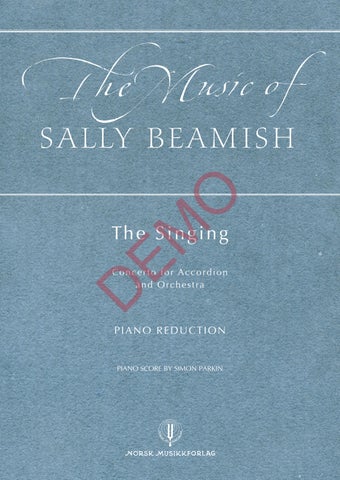
The Singing
Concerto for Accordion and Orchestra (2006)
PIANO REDUCTION
PIANO SCORE BY SIMON PARKIN
Publisher:
Norsk Musikforlag A/S Postboks 1499, Vika N-0116 Oslo
NORWAY
TEL 00-47-23 00 20 10 FAX 00-47 23 00 20 11 order@musikforlaget.no
Copyright © 2021 by Norsk Musikforlag A/S
Accordion part edited by James Crabb
Cover design/calligraphy: Christopher Haanes Printed by: Norsk Musikforlag A/S, Oslo
This work is published in the following editions:
Study Score (B4) ( N.M.O. 12677A / ISMN 979-0-065-11834-5) - on sale
Conductor´s Score (A3) (N.M.O. 12677B / ISMN 979-0-065-11835-2) - on hire Orchestral parts (N.M.O. 12677D / ISMN 979-0-065-11837-6) - on hire Piano reduction (N.M.O. 14796 / ISMN 979-0-065-16723-7) - on sale
DEMO
THE SINGING
Concerto for Accordion and Orchestra
Programme Note
Sally Beamish´s The Singing was commissioned by the Cheltenham Festival and the Melbourne Symphony Orchestra, generously supported by Beryl Calver-Jones and Gerry Mattock. The premiere was given at the Cheltenham Festival 2006 by James Crabb, with the Hallé Orchestra conducted by Martyn Brabbins. The first Australian performance was given by the Melbourne Symphony Orchestra, also with James Crabb and Martyn Brabbins, in September 2007. The Singing is dedicated to James Crabb.
The Highland Clearances began in the 1760s and continued for over a hundred years. The landowners, mainly clan chiefs who were related to their tenants, were pressured for various reasons to replace the struggling crofting communities with the new tough breeds of sheep. It was certainly the case that there was much more money to be made from the land through sheep than through tenant farming. But it was also felt by some landowners that the people, many of whom could barely scrape out an existence, would be better off moving to allotments on the shore, or emigrating to the New World. The reality was a brutal eviction of entire villages, and many deaths from starvation or drowning as people tried to accustom themselves to herring fishing. Many also died from disease on the boats across the Atlantic, or failed to eke out a living on the hard and frozen soil of Northern America. The Highland communities were decimated, and the landscape was altered forever.
Having recently completed, with the poet Donald Goodbrand Saunders, the stage musical Shenachie, which is set against a background of the Clearances, I have revisited the theme using the complete freedom of expression offered by a concert work. The idea of songs, blessings and prayer infusing every aspect of life, as was the case in 19th-century Highland communities, was also a strong influence.
DEMO
The first movement opens with rhythmic, pitch-less sounds on the accordion, which are gradually picked up by the orchestra. The central section is based on loom rhythms, and there is a sense of industry, of busy-ness. The whole movement is pervaded by Gaelic psalm the extraordinary music of the Scottish Free Church, which takes the form of a lead voice followed by endless variations and ornamentations from the congregation - and by Celtic working songs.
The second and third movements run together: a set of variations, comprising a slow movement with scherzo elements, and a finale. The opening ground begins as a pibroch - the heavily ornamented 'classical music' of the Highland bagpipes. Pibrochs are often based on laments, and this is the case here; the theme is varied and developed throughout the movement to express anger and defiance as well as loss. The abject grief eventually descends almost into silence, with the accordion simply 'breathing', notelessly. From this total passivity there emerges the finale: new influences trickle in, and the mood gradually alters to one of optimism, ending with the customary reprise of the pibroch theme, and a virtuosic coda.
The Singing is inspired by the playing of James Crabb, and by his extraordinary range of expression. The title refers not only to the wealth of Gaelic songs and psalm, but also to birdsong, and, in the sense of the Gaelic 'seinn' (singing, sounding or playing), to the voices of instruments and of the land itself.
Sally Beamish
DEMO
Solo Accordion
Piano
Andante
= 68 air only (Bellow-shakes)
The Singing
brush strings with fingertip
Beamish