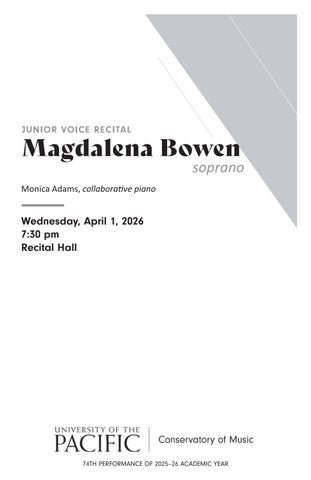
Magdalena Bowen
Monica Adams, collaborative piano
Wednesday, April 1, 2026
7:30 pm
Recital Hall
Piangerò la sorte mia, from Giulio Cesare (1724) George Frideric Handel (1685–1759)
Heidenröslein (c. 1860) Franz Schubert (1797–1828) 9′
Mondnacht (1840) Robert Schumann (1810–1856)
Mondnacht (2015) Kurt Erickson (b. 1970)
Après un rêve (c. 1877)
Gabriel Fauré (1845–1924) 3′ Pause
Weep You No More (c. 1905) Roger Quilter (1877–1953)
Love’s Philosophy (c. 1905) Quilter
When I Have Sung My Songs to You (1914) Ernest Charles (1895–1954)
PROGRAM NOTES
Notes by the performer
Schubert: Heidenröslein
Heidenröslein is a piece that explores the nature of love and unrequited love. A young impish boy is drawn to a beautiful rose that is personifying a young girl. He is quick to rush over and try to win her over, but the rose, being content on her own, warns him of the pain in choosing her will cause him. With stubborn intent, however, the boy picks the rose, and she inflicts pain on him with her thorns. The boy wanted terribly to love the rose and his feelings reciprocated but not yet acquainted with the heartbreak that comes with love, he was torn.
Fauré: Après un rêve
Après un rêve reminisces about a dream of love and longing. This piece captures the feeling of drifting into a dream-like-state and finally seeing a loved one again after experiencing the pain and loss of being without them. The character is enchanted by their love’s allure, and longs to slip away into the brighter heaven-like existence. As the dream gradually fades and drifts into reality, and as the character is awakened, a wave of sadness fills the heart once the realization rushes in that everything was just a dream.
Handel: Piangerò la sorte mia
Piangerò la sorte mia sì crudele e tanto ria finché vita in petto avrò.
Ma poi morta d'ogn'intorno il tiranno e notte e Giorno fatta spettro agiterò.
—Nicola Francesco Haym
Schubert: Heidenröslein
Sah ein Knab' ein Röslein stehn, Röslein auf der Heiden, War so jung und morgenschön, Lief er schnell es nah zu sehn, Sah's mit vielen Freuden.
Röslein, Röslein, Röslein rot, Röslein auf der Heiden.
Knabe sprach: ich breche dich, Röslein auf der Heiden!
Röslein sprach: ich steche dich, Daß du ewig denkst an mich, Und ich will's nicht leiden.
Röslein, Röslein, Röslein rot, Röslein auf der Heiden.
Und der wilde Knabe brach’s
Röslein auf der Heiden; Röslein wehrte sich und stach, Half ihr doch kein Weh und Ach, Mußt' es eben leiden.
Röslein, Röslein, Röslein rot, Röslein auf der Heiden.
—Johann Wolfgang von Goethe
I Shall Weep Over My Cruel Fate
I shall weep over my cruel fate so long as there remains life in my breast.
But once I have perished, I shall become a ghost and torment that tyrant from all directions, day and night.
—trans. Andrew Schneider
Wild Rose
Passing lad a rose blossom spied, Blossom on the heath growing, 'Twas so fair and of youthful pride, Raced he fast to be near its side, Saw it with joy o'erflowing.
Blossom, blossom, blossom red, Blossom on the heath growing.
Said the lad: I shall pick thee, Blossom on the heath growing! Blossom spoke: Then I'll prick thee, That thou shalt ever think of me, And I'll not be allowing. Blossom, blossom, blossom red, Blossom on the heath growing.
And the lusty lad did pick The blossom on the heath growing; Blossom, in defense, did prick, 'Twas, alas, but a harmless nick, Had to be allowing.
Blossom, blossom, blossom red, Blossom on the heath growing.
—trans. Walter Meyer
Schumann/Erickson: Mondnacht
Es war, als hätt der Himmel, Die Erde still geküßt, Daß sie im Blütenschimmer
Von ihm nun träumen müßt.
Die Luft ging durch die Felder, Die Ähren wogten sacht, Es rauschten leis die Wälder, So sternklar war die Nacht.
Und meine Seele spannte
Weit ihre Flügel aus,
Flog durch die stillen Lande, Als flöge sie nach Haus.
Joseph von Eichendorff
Fauré: Après un rêve
Dans un sommeil que charmait ton image
Je rêvais le bonheur, ardent mirage,
Tes yeux étaient plus doux, ta voix pure et sonore
Tu rayonnais comme un ciel éclairé par l'aurore;
Tu m'appelais et je quittais la terre
Pour m'enfuir avec toi vers la lumière, Les cieux pour nous entr'ouvraient leurs nues,
Splendeurs inconnues, lueurs divines entrevues.
Hélas! Hélas! triste réveil des songes
Je t'appelle, ô nuit, rends-moi tes mensonges,
Reviens, reviens radieuse, Reviens ô nuit mystérieuse!
—Romain Bussine
Moonlit Night
II think I've witnessed the heavens Bend low to kiss the earth
While she with newly budding blossoms
In loving dreams of birth.
Through fields warm breezes were a-blowing—
Soft waves were swelling the grain
And gentle rustles of the forest bright shone in starlit skies
Then soft my soul unfolded wings spreading open wide
Over the silent land soaring
To fly on home—on home . . .
—trans. Shula Keller
After a Dream
In a sleep charmed by your image, I dreamed of happiness, burning mirage.
Your eyes were milder, your voice pure and ringing, You shone like a sky lit by the aurora; You called to me and I left the earth
To flee with you toward the light. The heavens opened their clouds for us
Unknown splendors, divine glimmers met us
Alas! Alas! Sad awakening from dreams . . .
I demand of you, night, give back to me your lies,
Return, return in radiance, Return, mysterious night!
—trans. Shawn Thuris
Quilter: Weep You No More
Weep you no more, sad fountains; What need you flow so fast?
Look how the snowy mountains Heaven's sun doth gently waste! But my sun's heavenly eyes
View not your weeping, That now lies sleeping, Softly now, softly lies Sleeping.
Sleep is a reconciling, A rest that peace begets; Doth not the sun rise smiling When fair at e'en he sets?
Rest you, then, rest, sad eyes!
Melt not in weeping, While she lies sleeping, Softly now, softly lies Sleeping.
—Anonymous
Quilter: Love’s Philosophy
The fountains mingle with the River
And the Rivers with the Ocean, The winds of Heaven mix for ever
With a sweet emotion; Nothing in the world is single; All things by a law divine In one another's being mingle. Why not I with thine?
See the mountains kiss high Heaven And the waves clasp one another; No sister-flower would be forgiven If it disdained its brother; And the sunlight clasps the earth
And the moonbeams kiss the sea: What are all these kissings worth If thou kiss not me?
—Percy Bysshe Shelley
Charles: When I Have Sung My Songs
When I have sung my songs to you I'll sing no more T'would be a sacrilege to sing at another door We've worked so hard to hold our dreams just you and I I could not share them all again I'd rather die With just the thought that I had loved so well so true That I could never sing again
That I could never never sing again except to you!
—Ernest Charles
STUDENT BIOGRAPHY
This recital is presented as a degree requirement for a Bachelor of Music in music performance.
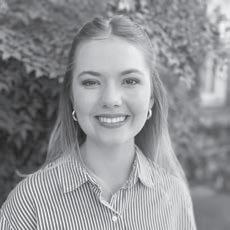
Magdalena Bowen is in her third year at University of Pacific, where she studies voice with Dr. Heidi Moss Erickson. She is also a member of the Pacific Singers ensemble.
Bowen has competed and placed in various singing competitions including the Sacramento Master Singers and the National Association of Teachers of Singing. Her performances at Pacific include roles in Handel’s Alcina, Rodgers and Hammerstein’s Carousel, Lerner and Loewe’s Camelot, and Menotti’s The Medium.
Every gift to the Conservatory from an alum, parent, or friend makes an impact on our students. Our students rely on your generosity to enable them to experience a superior education.
Please contact the Assistant Dean for Development at 209.932.2978 to make a gift today. You may also send a check payable to University of the Pacific: Conservatory of Music, University of the Pacific Attn: Assistant Dean for Development 3601 Pacific Avenue Stockton, CA 95211




To view our upcoming events, scan the QR code or visit Pacific.edu/MusicEvents.