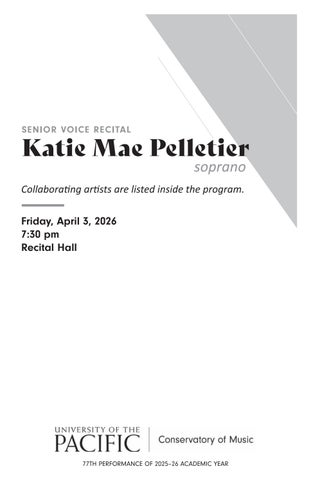
Katie Mae Pelletier
Collaborating artists are listed inside the program.
Friday, April 3, 2026
7:30 pm
Recital Hall
Ha, que l'absence est un cruel martir, from Produzioni armoniche (c. 1701)
Danny Guerrero, guitar
Solvejgs sang (Solveig’s Song) from Peer Gynt, op. 23 (1875)
Als die alte Mutter, from Zigeunermelodien, op. 55 (c. 1880)
Morgen! from 4 Lieder, op. 27 (1894)
Antonia Bembo (c. 1640–1720)
Edvard Grieg (1843–1907)
Antonín Dvořák (1841–1904)
Richard Strauss (1864–1949)
Autobús de Pasajeros, from Generación Perdida (2025) 8′
Carnaval de Tambobamba, from Cuatro Canciones Andinas (1999)
Jorge Sosa (b. 1976)
Gabriela Lena Frank (b. 1972)
Songs of Love and Justice (1992) Decisions Love
Monica Adams, piano
El Crucifijo de Piedra
La Charreada La Cigarra
Pause
Celestino Mederos Padilla APRIL 3, 2026, 7:30 PM
Adolphus C. Hailstork (b. 1941)
Roberto Cantoral García (1935–2010)
Antonio Cantoral García (1928–1964)
Raymundo Pérez y Soto (1908–1991)
Felipe Bermejo (1901–1989)
Jack Alorro
Melissa Mariel Bautista-Díaz
Samantha Bautista-Díaz
Yaretzi Castro Rios
Mia Gonzalez
Danny Guerrero
Aliyah Martinez
Julianna Ramirez
Chris Rangel
To Be Human (2026) (World premiere)
Katie Mae Pelletier (b. 2003)
Bermejo: La Charreada
La Charreada is a competitive event celebrating Mexico’s rodeo tradition. Its roots trace back to sixteenth century vaqueros (cowboys) who developed exceptional equestrian and cattle-handling skills. Master vaqueros later became known as charros, who combined expert horsemanship, cattle handling, and ornate, protective clothing to develop charrería, an artful and competitive sport that forms the foundation of La Charreada. Today, La Charreada serves as a cultural gathering where friends and families come together to enjoy traditional food, music, and the thrilling performances of charros (male riders) and escaramuzas (female riders). Participants demonstrate ten distinct events judged on execution and style, ranging from complex roping techniques and cattle handling to bull riding and highly coordinated horse maneuvers. La Charreada by Felipe Bermejo captures the excitement and grandeur of these gatherings, celebrating the bravery, skill, and artistry associated with charro tradition, a cherished element of Mexican cultural heritage.
— Katie Mae Pelletier
TEXTS AND TRANSLATIONS
Bembo: Ha, que l'absence est un cruel martire
Ha, que l’absence est un cruel martire, Lorsqu’on aime tendrement un objet tout charmant et qu’on ne l’ose dire. L’on se plaint, l’on soupire, l’on chéri le tourment, Et l’amour nous inspire de répéter souvent: Ha, que l’absence est un cruel martire, Lorsqu’on aime tendrement un objet tout charmant et qu’on ne l’ose dire. Ha, que l’absence est un cruel martire.
—Antonia Bembo
Ha, absence is a cruel agony
Ha! Absence is a cruel agony, When you love most tenderly someone who is charm itself although you dare not say so. You lament, and sigh, and cherish your torment, And love inspires the urge to repeat, frequently:
Ha! Absence is a cruel agony, When you love most tenderly someone who is charm itself although you dare not say so.
Ha! Absence is a cruel agony.
—trans. John Thornley
Grieg: Solvejgs sang
Kanske vil der gå både Vinter og Vår, Og næste Sommer med, og det hele År; Men engang vil du komme, det véd jeg visst; Og jeg skal nok vente, for det lovte jeg sidst.
Gud styrke dig, hvor du i Verden går! Gud glæde dig, hvis du for hans Fodskammel står!
Her skal jeg vente til du kommer igen; Og venter du histoppe, vi træffes der, min Ven!
—Henrik Ibsen
Dvořák: Als die alte Mutter
Als die alte Mutter mich noch lehrte singen, Tränen in den Wimpern gar so oft ihr hingen.
Jetzt wo ich die Kleinen selber üb im Sange, Rieselt's in den Bart oft, Rieselt's oft von der braunen Wange.
—Adolf Heyduk
Solveig’s Song
Perhaps both Winter and Spring will pass, And next Summer too, and the whole year; But one day you will come, I know for sure; And I will wait, for I promised that last time.
God strengthen you, wherever you go in the world!
God rejoice in you, if you stand at his footstool!
Here I will wait until you come again; And if you wait above, we will meet there, my friend!
—trans. unknown
Songs My Mother Taught Me
When my mother taught me to sing, Tears in her eyelashes so often hung. Now when I sing the little songs myself,
Tears trickle into my beard often, Tears trickle often from my brown cheeks. —trans. unknown
Strauss: Morgen!
Und morgen wird die Sonne wieder scheinen, Und auf dem Wege, den ich gehen werde, Wird uns, die Glücklichen, sie wieder einen, Inmitten dieser sonnenatmenden Erde. Und zu dem Strand, dem weiten, wogenblauen, Werden wir still und langsam niedersteigen.
Stumm werden wir uns in die Augen schauen, Und auf uns sinkt des Glückes stummes Schweigen.
—John
Henry Mackay
Tomorrow!
And tomorrow the sun will shine again, And on the path that I shall take, It will unite us, happy ones, again, Amid this same sun-breathing earth. And to the shore, broad, blue-waved, We shall quietly and slowly descend.
Speechless we shall gaze into each other’s eyes, And the speechless silence of bliss shall fall on us.
—trans. Richard Stokes
Sosa: Autobús
de pasajeros
En medio de la noche un autobús de pasajeros fue detenido en un retén por hombres armados.
Todos los hombres fueron obligados a bajar y enseñar sus identificaciones.
Después fueron obligados a subir a una camioneta de redilas que tomó brecha al monte.
El camión llegó a Nuevo Laredo sin veinticinco de sus pasajeros.
—Javier Moro Hernández
Passenger Bus
In the middle of the night a passenger bus was stopped at a checkpoint of armed men.
All of the men were forced to get off and show their identification. Then they were forced to get on a truck headed to unpaved roads. The bus arrived in Nuevo Laredo without twenty-five of its passengers.
—trans. Jesus Chavez Montes
Frank: Carnaval de Tambobamba
Un río de sangre ha arrastrado al joven Tambobambino. Él ha muerto.
Sólo su quena está flotando, Sólo su poncho está flotando,
Sólo su charango está flotando sobre la corriente.
Y la jovena que él amaba está llorando en las orillas. Su idolatrada amante llora en las orillas.
Su adorada está llorando.
¡Huífalitay, Huífala! ¡Huífalalálay, Huífala! ¡Huífala! Él ya no existe.
Un cóndor mira desde los cielos, dando vueltas.
Busca al joven tambobambino.
No lo encontrará jamás.
Un río de sangre, el río sangriente lo arrastró, lo envolvió.
Su adorada está llorando.
¡Huífalitay, Huífala! ¡Huífalalálay, Huífala! ¡Huífala!
Sólo su quena está flotando,
Sólo su poncho está flotando,
Sólo su charango está flotando sobre la corriente.
¡Huífalitay, Huífala! ¡Huífalalálay, Huífala! ¡Huífala!
—Quechua poetry collected and translated by José María Arguedas
Carnival of Tambobamba
A river of blood has dragged down the young man of Tambobamba. He has died.
Only his flute is floating, only his poncho is floating, Only his small guitar is floating along the current.
And the girl whom he loved is weeping along the banks. His idolized sweetheart weeps along the banks. His adored one is weeping.
¡Huífalitay, Huífala! ¡Huífalalálay, Huífala! ¡Huífala!
Now he does not exist.
A condor watches from the skies, wheeling around. He looks for the young man of Tambobamba. He will never find him.
A river of blood, a bloody river has dragged him down, enveloped him. His adored one is weeping.
¡Huífalitay, Huífala! ¡Huífalalálay, Huífala! ¡Huífala!
Only his flute is floating,
Only his poncho is floating, Only his small guitar is floating along the current.
¡Huífalitay, Huífala! ¡Huífalalálay, Huífala! ¡Huífala!
—trans. Ruth Walgreen Stephan
Hailstork: Decisions
Ev’ry man must decide whether he will walk in the light.
Ev’ry man must decide whether he will walk, Walk in the light of creative altruism, Or the darkness of destructive selfishness.
This is the judgement.
Life’s most persistent and urgent question. What are you doing?
What are you doing for others?
Ev’ry man must decide. What are you doing? —Martin Luther King
Hailstork: Love
Love is the only force. Love is the only force, Capable of transforming an enemy into a friend.
Love, love, love.
—Martin Luther King Jr.
García/García: El Crucifijo de Piedra
Cuando lo estaba queriendo, Cuando lo estaba sintiendo, Todito mío lo vi partir. Me juro que regresaba, Pero todo era mentira, Porque ya su alma no era de mi.
En la noche silenciosa, Nos miramos, Frente a frente sin hablar, Cuando me dijo de pronto, Que olvidara su cariño, Que no me quería engañar.
Fue bajo del crucifijo, De la torre de una iglesia, Cuando la luna nos alumbró, Yo lo estreché entre mis brazos, Con ganas de detenerlo, Pero el orgullo me lo impidió.
Ya sola frente a la iglesia, Y llorando,
Ante el Cristo fui a implorar, Al contemplar mi tristeza, El crucifijo de piedra, También se puso a llorar.
—Roberto Cantoral García/ Antonio Cantoral García
The Stone Crucifix
When I was loving him, When I was feeling him, He was all mine, I watched him leave. He swore he would come back, But everything was a lie, Because his soul was not of me.
In the silent night, We looked at each other, Face to face without speaking, When he told me suddenly, To forget his love, He did not want to deceive me.
It was under the crucifix, Of the tower of a church, When the moon illuminated us, I stretched out my arms, Wanting to stop him, But pride prevented me.
Now alone in front of the church, And crying, Before Christ I pleaded, Upon seeing my sorrows, The stone crucifix, Also began to cry.
—trans. Jesus Chavez Montes
Pérez y Soto: La Cigarra
Ya no me cantes cigarra, Que acabe tu sonsonete. Que tu canto aquí en el alma, Como un puñal se me mete, Sabiendo que cuando cantas, Pregonando vas tu muerte.
Marinero, marinero, Dime si es verdad que sabes, Porque distinguir no puedo, Si en el fondo de los mares, Hay otro color más negro, Que el color de mis pesares.
Aylarara!
Hay otro color mas negro, Que el color de mis pesares.
Un palomito al volar, Que llevaba el pecho herido. Ya casi para llorar, Me dijo muy afligido. Ya me canso de buscar, Un amor correspondido.
Bajo la sombra de un árbol, Y al compás de mi guitarra, Canto alegre este huapango, Porque la vida se acaba, Y quiero morir cantando, Como muere la cigarra.
Aylarara!
Y quiero morir cantando, Como muere la cigarra.
—Raymundo Pérez y Soto
The Cicada
Don’t sing to me cicada, Let your song end. For your song here in my soul, Stabs me like a dagger, Knowing that when you sing You are announcing your death.
Sailor, sailor, Tell me if what you know is true, Because I cannot distinguish, If in the depths of the seas, There is another color more black, Than the color of my sorrows.
There is another color more black, Than the color of my sorrows.
A little dove came flying, That bore a wounded breast. Almost crying, It said to me very afflicted: I am tired of searching for, A mutual love.
Under the shade of a tree, And to the beat of my guitar, I sing this huapango joyfully, Because my life will finish, And I want to die singing, Like the cicada dies. And I want to die singing, Like the cicada dies.
—trans. Jesus Chavez Montes
Bermejo: La Charreada
Ay, qué rechula es la fiesta, La fiesta charra, fiesta del Sol. Donde los charros valientes, Dan con sus cantos la evocación.
El Jaripeo es un festejo, Que huele a surco y a tradición.
Remedo de la faena, Más admirada de mi nación!
Bonito es el jaripeo, Y cuánto su animación.
Yo quiero montar un toro, Pa' que me mire mi amor.
Upa y upa iu!
Upa y upa iu!
Yo quiero montar un toro, Pa' que me mire mi amor.
Ya comenzó el jaripeo la gente aplaude con emoción, Y un toro viene rodado muy bien coleado por Don Nabor. Ya pretalaron un toro pa’ que lo monte Don Felimon, Y mientras sus lazadores florean la reata con grán primor.
Bonito es el jaripeo, Y cuánto su animación.
Yo quiero montar un toro, Pa' que me mire mi amor.
Upa y upa iu!
Upa y upa iu!
Yo quiero montar un toro, Pa' que me mire mi amor.
(Translation is not available)
—Felipe Bermejo
Pelletier: To Be Human
All the temples and palaces repainted in vibrancy, To hide the damages and stains left from the fires, the bloodshed, and rage. Beneath the flower beds in Syria, under the poppies on Flanders Field, Lay the ashes of sons and daughters, Just as you and me. Lay still to feed the greed.
Over again,
Oh, to be human.
As we grow we tell their stories, Hoping that our children will learn.
Through the streets she pulled her babies, Behind them disorder and unimaginable affliction. Trudging through waters and heat with blisters on her feet. When her kids grew tired she sang of safety. With her head held high for the land that’s made for you and me, The kids went to school and mom worked day and night for papers. But time ran long, the system would not wait, They were sent away in minutes losing the life they'd built again. And the house sat quiet and weeds grew over the flowerbeds.
Over again,
Oh, to be human.
As we grow we tell their stories, Hoping that our children will learn. There could be a day when we will learn.
Oh, to be human. United we love through disaster and pain. Fighting for peace, hungry for truth. You’ve never listened, but we come in numbers and more. Will you hear us now? Or will our children learn to fight? Oh, to be human. Do you hear us now?
—Katie Mae Pelletier
STUDENT BIOGRAPHY
This recital is presented as a degree requirement for a Bachelor of Music in music performance.
Versatile soprano Katie Mae Pelletier is dedicated to enriching musical experiences for diverse audiences. She is a senior at University of the Pacific pursuing a Bachelor of Music degree in music performance and a minor in music industry studies. She studies voice under the direction of Heidi Moss Erickson.
Utilizing the Michael Chekhov technique, Pelletier has portrayed characters across opera and musical theatre, including Carrie in Carousel, Monica in The Medium, and Lady Anne in Camelot. She is also a committed collaborator in new music, having worked with composers including Mary Denney '24 and with groups such as the San Francisco Contemporary Music Players and Mariachi Ocelotlán (University of the Pacific).

Currently, Pelletier performs with the Pacific Singers ensemble at University of the Pacific. Beyond the stage, she writes and produces evocative folk-pop music rooted in vivid storytelling.

Every gift to the Conservatory from an alum, parent, or friend makes an impact on our students. Our students rely on your generosity to enable them to experience a superior education.
Please contact the Assistant Dean for Development at 209.932.2978 to make a gift today. You may also send a check payable to University of the Pacific: Conservatory of Music, University of the Pacific Attn: Assistant Dean for Development 3601 Pacific Avenue Stockton, CA 95211




To view our upcoming events, scan the QR code or visit Pacific.edu/MusicEvents.