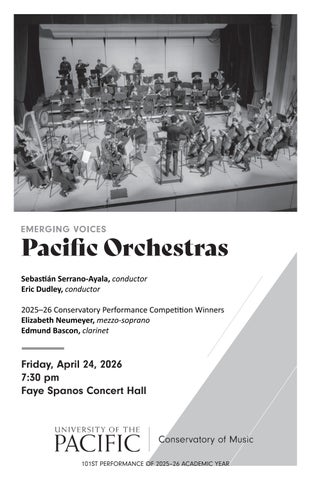

Pacific Orchestras
Sebastián Serrano-Ayala, conductor
Eric Dudley, conductor
2025–26 Conservatory Performance Competition Winners
Elizabeth Neumeyer, mezzo-soprano
Edmund Bascon, clarinet
Friday, April 24, 2026
7:30 pm
Faye Spanos Concert Hall
Marche gaie (1916/2012)
Nacqui all’affanno . . . Non più mesta, from La Cenerentola (1817)
Lili Boulanger (1893–1918) orch. Robert Orledge
Gioachino Rossini (1792–1868)
Elizabeth Neumeyer, mezzo-soprano
Eric Dudley, conductor
II Concerto (2012)
Andante
Presto
Edmund Bascon, clarinet
Óscar Navarro (b. 1981)
Pause
Symphony No. 1 in C major, op. 21 (1800)
Adagio molto—Allegro con brio
Andante cantabile con moto
Menuetto: Allegro molto e vivace
Finale: Adagio—Allegro molto e vivace
Ludwig van Beethoven (1770–1827)
PROGRAM NOTES
Programs
notes by Sebastián Serrano-Ayala
This program celebrates emergence in many forms: composers finding their voice, performers stepping into the spotlight, and an orchestra growing together through shared work.
Lili Boulanger and Ludwig van Beethoven appear here at early moments of artistic identity. Writing in her early twenties, Boulanger reveals a musical language already vivid in color and character. In his First Symphony, Beethoven works within the Classical tradition while beginning to stretch it in ways that would shape his future.
Rossini and Navarro bring that sense of emergence into the present. Both works feature winners of the 2025–26 Conservatory Performance Competition, placing individual artistry at the center of the program.
That sense of emergence extends beyond the composers and soloists to the full ensemble, especially to the graduating seniors we recognize tonight.
Boulanger: Marche gaie
Lili Boulanger (1893–1918) was one of the most remarkable musical voices of her generation, and the first woman to win the Paris Conservatory’s Prix de Rome in composition. One of several composers whose lives were cut short, she died at just 24, leaving behind a body of work that continues to resonate for its clarity and beauty. For many years, much of her music remained underrecognized, only in recent decades beginning to receive the attention it deserves. Marche gaie, written in 1916, reflects a composer already in full command of orchestral color and character.
The piece was dedicated to Jeanne Leygues and was long thought to be lost. It resurfaced in 2011 in a private collection in North Carolina and was later reconstructed and edited by British scholar Robert Orledge, bringing the work back into the repertoire after nearly a century.
Musically, the piece unfolds as a compact and energetic march, full of brightness and motion. One of its most charming details is Boulanger’s subtle nod to Mendelssohn’s famous Wedding March. Rather than quoting it directly, she weaves in a brief allusion, almost like a musical wink, connecting the work to its celebratory character.
Listen for the crisp rhythmic drive at the opening, with percussion setting a clear pulse, and for the interplay between winds and strings as the music
PROGRAM NOTES
moves forward with lightness and precision. Moments of elegance and humor appear throughout, balancing forward motion with refinement.
Though brief, Marche gaie offers a vivid portrait of a young composer with a distinct voice. It opens the program with energy and elegance, setting the stage for an evening centered on emerging voices.
Rossini: Nacqui all’affanno . . . Non più mesta
Gioachino Rossini (1792–1868) premiered La Cenerentola in 1817, a work that remains one of the defining examples of Italian comic opera. Unlike more familiar versions of the Cinderella story, Rossini’s treatment removes supernatural elements and focuses instead on character, resilience, and transformation.
The aria “Nacqui all’affanno…Non più mesta” comes at the end of the opera, as the heroine reflects on her past struggles and embraces her new life. The title itself translates roughly to “I was born to hardship and tears . . . no longer sad,” capturing the emotional arc of the piece.
Structurally, the aria follows the traditional bel canto format, beginning with a more lyrical and expressive opening section before moving into a fast and virtuosic cabaletta. The first section allows the singer to shape long, expressive lines, while the second demands agility, clarity, and brilliance through rapid passages, ornamentation, and high energy.
In this performance, Elizabeth Neumeyer brings both expressive depth and technical command to the role. The aria becomes not only a moment of operatic storytelling, but also a celebration of emerging artistry, where voice, character, and musical precision come together.
Navarro: II Concerto
Óscar Navarro (b. 1981), a Spanish composer and clarinetist, wrote his II Concerto for Clarinet and Orchestra between 2011 and 2012 on a commission from the Valencia Music Institute. Dedicated to clarinetist José FranchBallester, the work reflects Navarro’s deep understanding of the instrument, often treating the clarinet as an extension of the human voice. Although conceived as a larger continuous structure, the concerto moves through distinct contrasting sections. In tonight’s performance, we hear the opening and final movements, which frame the work with clarity and energy. The first movement introduces the clarinet in a highly expressive role, moving between long, singing lines and more rhythmically driven passages. At moments, the
PROGRAM NOTES
music takes on a cantabile quality, while later shifting into a more dance-like character influenced by Spanish traditions. Listen for the presence of clapping in the ensemble, an element drawn from flamenco practice, adding a physical sense of rhythm and momentum. The final movement brings a return to motion and brilliance. Fast-paced and rhythmically driven, it places significant technical demands on the soloist, with rapid articulation, wide leaps, and continuous dialogue between clarinet and orchestra. The energy is direct and propulsive, building toward a vibrant and decisive close.
Performed by Edmund Bascon, this work highlights both the expressive range and technical versatility of the clarinet. It also reflects the spirit of this program, placing an emerging solo voice at the center of a dynamic and collaborative musical experience.
Beethoven: Symphony No. 1 in C major
Ludwig van Beethoven (1770–1827) premiered his Symphony No. 1 in 1800, marking his entry into the symphonic tradition at a time when he was still establishing himself in Vienna. Known primarily as a pianist, he was already beginning to define a musical voice that would soon reshape the genre.
While the symphony is rooted in the Classical style of Haydn and Mozart, it contains subtle but important departures. The opening itself begins in an unexpected harmonic space, creating a sense of tension before resolving into the home key. Throughout the work, Beethoven plays with expectation, using dynamic contrast, rhythmic energy, and orchestral color to push beyond convention.
The second movement offers a more lyrical and flowing character, while the third movement, labeled a minuet, moves with a speed and intensity that anticipates the scherzos of Beethoven’s later works. The final movement begins with a playful and almost hesitant gesture, gradually building into a lively and confident conclusion.
As a whole, the symphony reflects a composer at the beginning of a transformative journey. It stands within the Classical tradition but already shows a voice beginning to push beyond it, with a sense of direction that would soon reshape the symphonic language.
Sebastián Serrano-Ayala is assistant professor of practice in orchestral conducting at University of the Pacific. Recognized for his inclusive leadership, international reach, and innovative, fresh programming, Colombian-born conductor Serrano-Ayala has led professional and student orchestras across the U.S., Latin America, the Philippines, and the Netherlands, blending cultural perspective with artistic excellence.

Serrano-Ayala is an active conductor and guest artist, with recent engagements including the Saratoga Orchestra and Skagit Symphony, and fellowships with Symphony Tacoma, Cabrillo Festival, the National Orchestral Institute, the Allentown Symphony, and the Mostly Modern Festival. He has premiered and recorded new works with the American Modern Ensemble in New York and served as cover conductor for the Seattle Youth Symphony and Yakima Symphony Orchestra.
At the University of New Mexico, he served as director of orchestral studies, conducting the UNM Symphony Orchestra and Sinfonia, teaching graduatelevel conducting, and facilitating guest residencies with Michael Sanderling, Colonel Jim Keene, Sérgio Azevedo, and others. He frequently collaborates with regional honor ensembles and educational programs across Washington and New Mexico.
Serrano-Ayala holds a Doctor of Musical Arts degree from University of Cincinnati College-Conservatory of Music and has trained with Marin Alsop, Mei-Ann Chen, and JoAnn Falletta. His competition honors include finalist distinctions from The American Prize and the Denver Philharmonic, and a semi-finalist award at the World Music Contest.
Eric Dudley joined University of the Pacific Conservatory of Music in 2019, following prior appointments at Mannes College and the San Francisco Conservatory of Music. At Pacific he serves as associate professor of voice and conductor/coach of Pacific Opera Theatre.
A conductor, composer, vocalist and pianist, Dudley is a two-time Grammy Award-winner as an original member of the vocal group Roomful of Teeth. He is currently artistic director and conductor of the San Francisco Contemporary Music Players, and has performed and conducted with leading ensembles worldwide, including the New York Philharmonic, Cincinnati Symphony Orchestra, BBC Symphony, Adelaide Symphony, and most recently the Los Angeles Philharmonic.

Dudley leads a multi-faceted career as a conductor, composer, vocalist and pianist immersed in the creation of music both past and present. As an original member of t vocal octet Roomful of Teeth, he toured worldwide with the group and appears extensively on their acclaimed recordings.
As a pianist and chamber musician, Dudley has performed with members of Novus New York and the Cincinnati and Princeton symphony orchestras. His own music has been premiered and recorded by Roomful of Teeth and Quey Percussion.
German American mezzo-soprano Elizabeth Neumeyer is a third-year student of Professor Daniel Ebbers at University of the Pacific where she is pursuing a Bachelor of Music degree in music performance. She also receives secondary instruction from soprano Christine Goerke.
Neumeyer is a winner of the 2025–26 Conservatory Performance Competition. She has most recently sung the roles of Bradamante in Händel’s Alcina, La Badessa in Puccini’s Suor Angelica, and Dritte Dame in Mozart’s Die Zauberflöte. In summer 2026, Neumeyer will perform in her second season with the Janiec Opera Company at Brevard Music Center, North Carolina.

In addition to her operatic endeavors, Neumeyer has musical theater experience, most recently portraying the role of Nettie in Rodgers and Hammerstein’s Carousel.
Edmund Bascon is a winner of the 2025–26 Conservatory Performance Competition. He began playing clarinet in middle school and has since developed a musical voice centered on expressive and heartfelt performance.
A junior at University of the Pacific pursuing degrees in music education and music composition, Bascon studies clarinet with Dr. Patricia Shands. He performs regularly with conservatory ensembles including the Pacific Wind Bands, Pacific Orchestras, and chamber groups. He has also appeared with church orchestras and as part of a performance with Puerto Rican artist Yandel. He has been invited to perform as a soloist with the BD Winds. In addition to his work as a clarinetist, Bascon is an active brass performer and has been a member of the Mandarins Drum and Bugle Corps. On campus, he performs with the Pacific Brass Society and Mariachi Ocelotlán.

As a composer, his works have been premiered by the Pacific Wind Bands, Ensemble Dal Niente, and the ~Nois Sax Quartet, among others. In the summer of 2026, he will collaborate with the Newfound Chamber Winds on the premiere of a new work for reed quintet.
A dedicated educator, Bascon has worked with the Stockton Youth Symphony, Amador Valley High School and Castro Valley High School marching bands, and the Immortal Winds.
PACIFIC ORCHESTRAS
The Pacific Orchestras perform an inclusive range of contemporary and historically significant works. The ensemble provides performers with a variety of sizes and settings to explore an exciting range of repertoire. Pacific faculty, students, and guest artists perform with the ensemble as concerto and aria soloists and as guest conductors. Participation in the ensemble is open to all Pacific students by audition.
Violins 1
Izzy Knittle, concertmaster w
Carissa Lee
Alizon Lopez
Christopher Thant
Alyssa Yen
Violins 2
Lizzie Mendoza, principal w
Kiersten Hogue
Rafael Marinas
Julianna Ramirez
Yaretzi Castro Rios
Violas
Erick Sariles, principal
Angela Arroyo
Gretchen
Edwalds-Gilbert††
Lindsey Liaw
Tom Pham
Cellos
Nicholas Trobaugh, principal w
Tyler Chang
Megan Chartier, faculty musician
Hope Lee
Jiangshuo Ma
Benedict Ventura
Double Basses
Elijah Atchley, principal
Victor Camacho
Emiko Hernandez
Wesley Shafer
Flutes
Riko Hirata **
Henrie Notley, piccolo
Ethan Williams *†‡
Oboes
Walker Austin ‡
Jayden Laumeister *†**
Elizabeth Ledesma
Clarinets
Audrey Ewing ‡**
Tommy Galvin †
Adrian Rodriguez
Mandujano
Bassoons
Enrique Valdez, principal
Kenny Wolaver
Horns
Ciera Alkhoury ‡
Marcelo Contreras
Jas Lopez
Don Parker †w
Lily Walter ***
Trumpets
Parker Deems *†‡w
Alayna Ontai †w
Trombones
William Giancaterino
Radley Rutledge †‡
Matt Young
Tuba
Alejandro Villalobos ‡
Percussion
Hunter Campbell
Ryan Eads
Casey Kim
Daegan Luster
Robert McCarl w
Snowden Snyder
Rei Vindiola
Harp
Jacquelyn Venter††
*principal, Boulanger
†principal, Rossini
‡principal, Navarro
**principal, Beethoven
††assisting musician wgraduating class
Faculty Coaches
Ann Miller, violin, viola
Megan Chartier, cello
Kathryn Schulmeister, double bass
Brittany Trotter, flute
Kyle Bruckmann, oboe
Patricia Shands, clarinet
Nicolasa Kuster, bassoon
Sadie Glass, horn
Alia Kuhnert, trumpet
Bruce Chrisp, trombone
Jonathan Seiberlich, tuba
Natsuki Fukasawa, piano
Jonathan Latta, percussion
Jonathan Latta, ensembles program director
Breanna Daley, ensemble librarian

Every gift to the Conservatory from an alum, parent, or friend makes an impact on our students. Our students rely on your generosity to enable them to experience a superior education.
Please contact the Assistant Dean for Development at 209.932.2978 to make a gift today. You may also send a check payable to University of the Pacific: Conservatory of Music, University of the Pacific Attn: Assistant Dean for Development 3601 Pacific Avenue Stockton, CA 95211

To view our upcoming events, scan the QR code or visit Pacific.edu/MusicEvents.