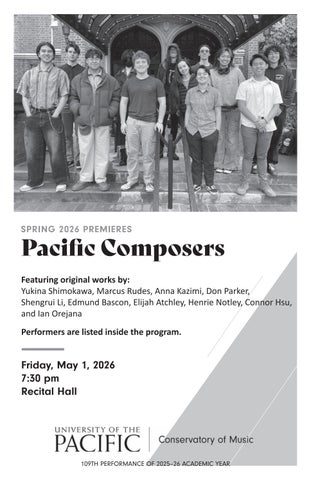
Pacific Composers
Featuring original works by: Yukina Shimokawa, Marcus Rudes, Anna Kazimi, Don Parker, Shengrui Li, Edmund Bascon, Elijah Atchley, Henrie Notley, Connor Hsu, and Ian Orejana
Performers are listed inside the program.
Friday, May 1, 2026
7:30 pm
Recital Hall



Artificial Nature (2026) Yukina Shimokawa (b. 2003)
Casey Kim, marimba
Riko Hirata, clave
Angel Camacho-Ibarra, electricpiano
Quintet for Percussion (2026) Intermezzo
Casey Kim, marimba
Marcus Rudes (b. 2005)
The Butterfly's Dance (2025)
Precontemplation (2026)
Ethan Williams, flute
Anna Kazimi (b. 2000)
Kazimi
Tommy Galvin, clarinet
Duet for Mandolin and Cello (2004)
Don Parker, mandolin
Benedict Ventura, cello
Don Parker (b. 2004)
Vesper Sylvia (2026)
Shengrui Li (b. 2005)
Antrell Gulley, soprano saxophone
Celine Chao, alto saxophone
Ray Cruz, tenor saxophone
Off-White Lies (2025) Edmund Bascon (b. 2003)
Izzy Knittle and Lizzie Mendoza, violins
Erick Sariles, viola
Benedict Ventura, cello
In Search of Beauty (2026)
Elijah Atchley (b. 2006)
Alayna Ontai and Amalia Silva, trumpets
Ciera Alkhoury, horn
Radley Rutledge, trombone
Seth Morris, tuba
Intermission
Hermance Verneuil (2026)
Shengrui Li, piano
Morning Song (2026)
End of Time (2026)
Landon Horstman, baritone
Nicholas Trobaugh, cello
Jade Anderson, piano
Henrie Notley (b. 2007)
Miranda Duarte and Ian Orejana, voice
Andrew Conklin, guitar
Connor Hsu, piano
girl, don't do it . . . (2026)
Miranda Duarte and Ian Orejana, voice
Connor Hsu (b. 2006)
Miranda Duarte, voice
Benedict Ventura, cello
Victor Camacho, bass guitar
Victor Cyrus-Franklin, cajon
Ian Orejana (b. 2003) Orejana
PROGRAM NOTES
Shimokawa: Artificial Nature
As the world of AI grows, we tend to forget the power of nature and its impact on society. Yukina Shimokawa, a Japanese musician, challenges the capacity of AI in nature through Artificial Nature. The AI robot is represented by an electric piano, which is surrounded by the marimba and claves, which are the woods, nature. As the robot ventures into the woods, it renders its habitat and downloads the data. However, it fails time and time again as nature is too vast for a robot to handle.
Rudes: Quintet for Percussion
The second movement of Quintet for Percussion presents a concentration in limited pitch material and destabilized meter. The opening is sparse and built from two pitches: C and B-flat. The two pitches are played across the marimba’s entire range and are separated by silences, allowing the resonance of the instrument to be felt. Gradually, the harmonic field expands to four pitches (A, B-flat, C, D), and a continuous rhythmic motive emerges. The new intervallic relationships bring a sense of unexpected warmth. Eventually, the collection is inverted, producing a new set of pitches (E, F-sharp, G-sharp, A). This marks the highest point of intensity because of the dramatic shift in color. In addition, accents are placed every five eighth notes within the 4/4 framework, creating tension in the perceived pulse. The movement closes by re-establishing the material with the original four pitches.
Kazimi: The Butterfly's Dance
The Butterfly's Dance was written to explore using music as a visual medium. In the piece, see if you can hear the moments where the butterfly flies away, swooping and spiraling on the wind, and the moments where it rests on flowers.
Kazimi: Precontemplation
This piece is titled precontemplation, and it is about the moments before you start contemplating making a change. Often, before you are ready to let go of a behavior or relationship that doesn't serve you anymore, there are moments where something seems off. There are other moments where the relationship or behavior feels familiar and safe. This piece is about the switch between these dialectical oppositions, and the existence of both ideas at the same time.
Parker: Duet for Mandolin and Cello
Duet for Mandolin and Cello is the final composition of my undergraduate Music Composition degree at Pacific. I took an entirely new approach to writing this piece: essentially from day one, I was working directly with the cellist, Benedict. Together we would bounce ideas off each other, experiment
PROGRAM NOTES
with techniques, try alternate versions of some sections, and improvise to fuel inspiration. Writing for mandolin was also a new experience for me. In doing so, I have gained a deeper understanding of the instrument and more experience using it in performance. The result is an energetic duet that showcases the capabilities of both instruments and is very fun to perform.
Li: Vesper Sylvia
The title is taken from the composer’s English name. Vesper means “evening,” Sylvia means “forest” — together, evening in the forest. Evening is the boundary of the day, between light and dark.
The work is in Baroque contrapuntal style, in G major, 4/4 time, with no sixteenth notes; the fastest rhythmic motion is the occasional triplet — like a slightly quicker step taken while strolling. The three voices are like three figures standing at the boundary, belonging to the woods at dusk — conversing unhurriedly, responding to one another. The three voices interlock with the precision of meshing gears, yet never compete. Baroque counterpoint here is not a source of tension, but the rhythm of three people walking side by side, their steps naturally falling apart and coming together.
Bascon: Off-White Lies
We all tell lies. We convince ourselves that deception is kinder than the truth – nothing but a harmless white lie to protect the dignity and happiness of those we care about. Being honest with ourselves, how often is our intention purely kind? Are we scared of hurting our loved ones, or are we scared of our loved ones knowing we hurt them? Is there a tinge in that perfect white?
Off-White Lies begins with the ‘lie’ motive, repeated ad nauseam throughout the ensemble. Recited so consistently, it begins to feel like the truth, and the music lives in a honeymoon phase for a moment. But as the rose-colored glasses begin to slip, the lie returns ever more insistent to conceal the sour reality. Desperate to return to a utopia that never was, it churns and balloons until something breaks. Sulking, the lie slowly rebuilds to reconstruct the facade. A strained happiness emerges, like a gentle smile through gritted teeth. Emboldened, the lie hammers through to the end, engulfing any notion of sincerity.
Atchley: In Search of Beauty
In Search of Beauty is a largely through composed piece taking you on a journey from beginning to end with little repetition. It is a piece supposed to represent the confusing, disorienting, and nonlinear progression one may go through in learning to accept themselves. This piece goes from places of reverence and deep introspection to sections that show humility and
PROGRAM NOTES
many places in between. This is supposed to represent the intense throws of emotions that one might experience on their personal journey. This is my first piece as a composer writing for brass quintet and I found it quite a challenge. Part of the inspiration for going to such different musical places was to experiment writing for brass.
Li: Verneuil
The title comes from the composer’s French name. “Hermance” traces back to the Greek Hermes, the god of boundaries and transitions—the one who moves between worlds. “Verneuil” comes from Old French, meaning “alder grove,” a tree associated with wet, marshy ground and known for wood that lasts for centuries.
That contrast sits at the heart of the variations. The piece doesn’t settle into a single style or mood; instead, it shifts between musical languages, reflects them against each other, and lets them interact. Beneath all the flux and transformation, however, there remains a stable core. Each variation is written in one of three styles—Classical, Romantic, or Baroque—each with its own sound world and emotional tone, but all built from and returning to the same original theme.
Notley: Morning Song
This piece, which draws from the quiet imagery of Eugene Field’s poem, Morning Song, focuses on atmosphere over narrative. The text describes a beautiful morning scene: the sun is rising and nature seems to call out the new day to the world. The high motif in the piano perfectly captures the stillness of the morning, while the rising vocal melody mirrors the ascent of the morning sun, carrying with it the hopeful promise that every fresh dawn brings.
Hsu: End of Time
This is my first singer songwriter piece. There's no specific inspiration for it, it just came from messing around in the practice rooms on the guitar. The song describes the longing for someone and the passage of time as they wait.
Orejana: girl, don't do it . . .
Miranda and I tell each other a lot of things . . . our many opinions. At the end of the day, we choose peace and love, but we advise otherwise (we may or may not listen). This is a *COMEDIC TAKE* at that part of our dynamic.
Orejana: 600 miles away
600 miles away comes from my concept album I premiered earlier this semester.
Notley: Morning Song
TEXTS
The eastern sky is streaked with red, The weary night is done, And from his distant ocean bed
Rolls up the morning sun.
The dew, like tiny silver beads
Bespread o'er velvet green, Is scattered on the wakeful meads
By angel hands unseen.
"Good-morrow, robin in the trees!"
The star-eyed daisy cries; "Good-morrow," sings the morning breeze
Unto the ruddy skies; "Good-morrow, every living thing!"
Kind Nature seems to say,
And all her works devoutly sing
A hymn to birth of day,
So, haste, without delay, Haste, fairy friends, on silver wing, And to your homes away!
—Eugene Field
Hsu: End of Time
I wave to you
But you don’t see me
I’ll wait right here
Patiently
I like your face
Do you like mine
I’ll wait for you
Till the end of time
Wind are flowing
Endlessly
Waves are crashing
So peacefully
Reminds me of the way you talk
Music to me
I just can’t stop
Thinking of you
Wondering when
Hoping that I’ll see you again
Flowers dancing
Petals floating by Leaves are falling
Orange sunset sky
I will stand here
Watching the endless blue
I’ll wait right here
Patient for you
Birds are singing
Soaring through the sky
Please consider, would you give it a try?
Darling won’t you
Offer your hand to me
I’ll adore you
Eternally
I wave to you, you wave back this time
I’ll hold you close
Till the end of time
—Connor Hsu
Pacific's Music Composition Program is a fully immersive and broad major which will position you well to navigate this ever-evolving field of music. You will spend extensive time writing works for a variety of ensembles, learning a broad range of compositional techniques and honing your own compositional voice. You will compose for solo instruments, small ensembles, voice, chorus, percussion, digital media and larger musical forces such as orchestra and band. Specialized studies in orchestration, contemporary performance techniques, electronic music and film scoring will add crucial skills to your creative tool kit.
Our graduates are positioned to succeed. Many have gone on to attend top graduate programs and have pursued successful careers in the commercial music and media industries, as well as in the fields of academia and education. Several have received major honors, including Emmy Awards, Guggenheim Fellowships and Fulbright Grants.
Composition Faculty
Andrew Conklin, program director Hendel Almetus
Eric Wood
SUPPORT OUR STUDENTS AND PROGRAMS
Every gift to the Conservatory from an alum, parent, or friend makes an impact on our students. Our students rely on your generosity to enable them to experience a superior education.
Please contact the Assistant Dean for Development at 209.932.2978 to make a gift today. You may also send a check payable to University of the Pacific:
Conservatory of Music, University of the Pacific
Attn: Assistant Dean for Development
3601 Pacific Avenue
Stockton, CA 95211