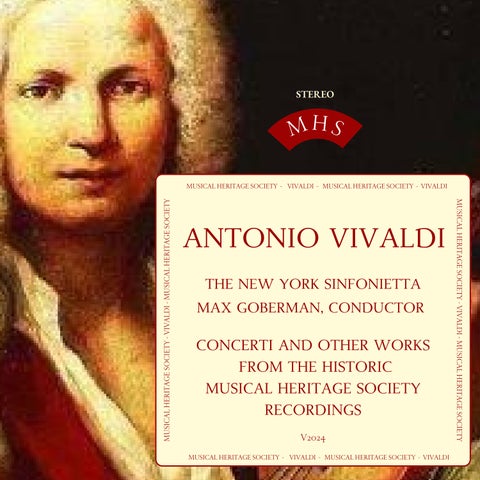
STEREO
H S M
ANTONIO VIVALDI THE NEW YORK SINFONIETTA MAX GOBERMAN, CONDUCTOR
CONCERTI AND OTHER WORKS FROM THE HISTORIC MUSICAL HERITAGE SOCIETY RECORDINGS V2024 MUSICAL HERITAGE SOCIETY - VIVALDI - MUSICAL HERITAGE SOCIETY - VIVALDI
MUSICAL HERITAGE SOCIETY - VIVALDI - MUSICAL HERITAGE SOCIETY
MUSICAL HERITAGE SOCIETY - VIVALDI - MUSICAL HERITAGE SOCIETY
MUSICAL HERITAGE SOCIETY - VIVALDI - MUSICAL HERITAGE SOCIETY - VIVALDI
ANTONIO VIVALDI The NEW YORK SINFONIETTA, Max GOBERMAN, conductor Concerto in C Major for 2 flutes, 2 oboes, bassoon, 2 violins, strings and harpsichord, RV 557 Allegro non molto Largo Allegro non molto
Concerto in D Minor for viola d'amore, strings and harpsichord, RV 394 Allegro Largo Allegro Viola d'amore - Walter Trampler
Flutes - Julius Baker and Harold Bennett Oboes - Leonard Arner and Harry Smyles Bassoon - Elias Carmen Violins - Paul Gershman and Fred Manzella Concerto in C Major "For The Feast of St. Lawrence" for 2 flutes, 2 oboes, 2 clarinets, 2 violins, strings and harpsichord, RV 556 Largo -- Allegro molto Largo e cantabile Allegro Flutes - Samuel Baron and Harold Jones Oboes - Leonard Arner and Harry Smyles Clarinets - Charles Paashaus and Walter Lewis Bassoon - Anthony Checchia Violins - Felix Galimir and Leonid Bolotine Harpsichord - Eugenia Earle
Trio Sonata in F Major for 2 violins and basso continuo, RV 68 Allegro Andante Allegro Violins - Max Goberman and Fred Manzella Harpsichord - Eugenia Earle Violoncello - Jean Schneider Concerto for Strings in A Major, RV 158 Allegro Andante Allegro Harpsichord - Eugenia Earle
Sonata in E-Flat Major, "al Santo Sepolcro" for Two Violins, Viola and Figured Bass, RV 130 Largo molto Allegro ma poco Violins - Max Goberman and Fred Manzella Viola - Betty Yokell Violoncello -Jean Schneider Harpsichord - Eugenia Earle Concerto for Strings in D Minor, 'Madrigalesco' RV 129 Adagio--Allegro Adagio (no tempo marking) Concerto in D Major for flute, oboe, violin, bassoon and basso continuo, "La pastorella", RV 95 Allegro Largo Allegro Flute - Julius Baker Oboe - Harry Shulman Violin - Max Goberman Bassoon - Anthony Checchia Violoncello - Jean Schneider
Trio Sonata in B-Flat Major, RV 77 Allegro Andante Allegro Violins - Max Goberman, Fred Manzella Violoncello - Jean Schneider Concerto for Strings in A Major, RV 159 Allegro Adagio Allegro Concerto in E-flat Major for bassoon, strings and harpsichord, RV 483 Presto Larghetto Allegro Bassoon - Frank Schwartz Concerto in D Major for flute, oboe, violin, bassoon and basso continuo, RV 94 Allegro Largo Allegro
Flute - Julius Baker Oboe - Harry Shulman Violin - Max Goberman Bassoon - Anthony Checchia Harpsichord - Eugenia Earle Violoncello - Jean Schneider Concerto in A Major for viola d'amore, strings and harpsichord, RV 396 Allegro Andante Allegro Viola d'amore - Walter Trampler Harpsichord - Eugenia Earle Trio Sonata in C minor, RV 83 Allegro Largo Allegro Violin - Felix Galimir Violoncello - Charles McCracken Harpsichord - Eugenia Earle Bassoon - Anthony Checchia
NOTES BY JOSEPH BRAUNSTEIN from the original MHS LP issues The circumstances of Antonio Vivaldi’s life and artistic career are still not fully clarified and only vaguely known in important points. We do not know when and where he was born. Marc Pincherle expresses himself in favor of 1678 whereas the Complete Edition gives 1675 (?) 1678. Vivaldi received his first musical training from his father, Giovanni Battista, an esteemed violinist and member of the Ducal chapel at St. Mark’s Cathedral since 1685. Through his father, Vivaldi also obtained a position at the Ducal chapel when he was very young. He studied for the priesthood and was ordained in 1703 though he soon forsook an ecclesiastical career. For nearly forty years, Vivaldi served as teacher, orchestra director, composer, violinist, and purchaser of instruments at the Seminario musicale dell ‘Ospitale della Pietà as well as pursuing his prolific career as theatrical-musician, impresario and virtuoso. Antonio Vivaldi died in Vienna in the parish of St. Stephen near the Kärntnertor and was buried on July 28, 1741, in a cemetery for indigents which has since disappeared.
The Pietà was one of four famous conservatories for women in Venice; the others being the Incurabili, the Mendicanti, and the Santi Giovanni e Paolo. These were charitable institutions for invalids and foundling girls to which music schools were added whose activities soon became dominant. Vivaldi’s prodigious output of oratories, concertos and other instrumental works derives from his composing for these girls. It is apparent from the difficulty of many of these works that several impressive talents were represented among the girls he taught.
The C Major Concerto, Tomo 90, RV 557, though cast in the three-movement pattern, typical of Vivaldi’s solo concertos, is actually a concerto grosso in which a pair of oboes and a pair of violins form the concertino. This unit is given a truly soloistic treatment which requires very proficient players
particularly for the oboe parts. Only the outer movements adhere to the principle of the concerto grosso while, like in the Dresden Concerto, only a few instruments are employed in the slow middle movement (Largo in E Minor in binary song form). Yet an interesting distinction will be noticed. The Largo of the Dresden Concerto is played by instruments used in the opening Allegro but new instruments (two flutes and one bassoon) are introducedinto the Largo of the C Major concerto. Their employment is limited to the Largo only which on account of its instrumental color, the simplicity of its texture and minor tonality is in marked contrast to the opening movement which is written in a more learned style. Note the imitatory entries of the main theme in the tutti sections. The finale, however, propelled by the dactylic rhythm of the chief idea, exhibits a dance like quality which clearly points to the Canary, a type to be found often in the works of Purcell, Lully and Couperin.
P. 290) and the one in C major under consideration. Although Saint Lawrence is not the patron-saint of the lagoon city, he is nevertheless very dear to Venetians.
The C Major Concerto, Tomo 54, RV 556 written “for the Feast of Saint Lawrence”; (per la Solennità di San Lorenzo) is a remarkable work. Vivaldi wrote three concertos for that festivity, one for strings in D major(not published yet, P. 169), one for violin (tomo 70,
The Largo is in marked contrast to the outer movements. The orchestra which has produced a powerful conclusion, is dismissed and a small sonata ensemble consisting of a violin, a violoncello and harpsichord enters the scene, the violoncello duplicating the left hand
The chronology of the three Saint Lawrence concertos has not yet been ascertained. Of the three, the present concerto is the most elaborate and festive one. The size of the wood wind section almost equals that of Haydn’s London symphonies. The employment of clarinets constitutes one of the first cases in the history of orchestral writing. The concerto displays features of both the concerto grosso and the solo concerto. As for the former, there is a variety of combinations for the concertino: two principal violins and bassoon, two oboes and bassoon, two flutes and violins, two violins and figured bass, two violins with accompaniment of violins and violas, oboe and violin using the technique of the bariolage, two principal violins and unisonally set ripieno violins.
of the harpsichord. The bass line is not harmonically conceived, however, and its “walking” quality gives it considerable weight and makes it a junior partner, so to speak, to the violin. It is interesting to note that the Largo constitutes another version of the middle movement (Andante cantabile) of the Concerto for Violin in G minor, tomo 175, F. I., no. 81, listed as 379 by Pincherle.
whích the flattened “b” was indicated by an accidental when needed. A G minor scale with a natural “e” shows the intervallic configuration of the Dorian scale. If a flattened “e” occurred the accidental was placed before the note (“e”). Thus the G minor key was indicated by one flat in the signature and the accidental for “e” was added whenever it was needed.
However, the first movement of the violin concerto as published in the Complete Works and the version as given by Pincherle differ substantially. Its Andante cantabile (though six measures longer) is by and large identical with the Largo of the St. Lawrence concerto whose setting it parallels by employing the ripieno violins in unison as the accompanying voice to the soloist.
The finale discloses four ripieno and three concertino (solo) sections. The favored instrument is the first of the solo violins which receives the lion’s share of the soloistic prominence and an additional chance in a cadenza which, interestingly enough, does not precede but is built into the concluding ritornello. The finale matches the first Allegro stylistically and discloses an orchestral treatment which presages the classical symphonic manner (measures 215, 235, 292) .
The piece is in G minor but the key signature indicates only one flat. The key was not always exactly defined until the middle of the eighteenth century. The minor keys frequently lacked one flat in the signature. This custom (also to be found in the works of Bach) is a remnant of the Dorian church mode in
It seems interesting to preface the discussion of the Concerto in D minor for Viola d’amore, Tomo 196, RV 394, with a few comments on this instrument made by both Berlioz and Gevaert, the authors of two classical works on the art of orchestration. Berlioz speaks in his Traité d’instrumentation (1844) of the viola
d’amore with the greatest affection and sincerely deplores its disappearance from musical practice. A revival seemed hopeless to him since at that time only one musician in Paris was capable of playing it. This notable exception was caused by a particular circumstance. Proficiency on the viola d’amour (French) was a must for at least one member of the orchestra of the Opéra since 1836 because Meyerbeer employed the instrument in Les Huguenots in a strictly soloistic fashion, and this opera was a mainstay of the repertory. One should assume that the delivery of the passage was the task of the leader of the viola section. But this was not the case. Chrétien Urhan, the concertmaster played it. Francois-Auguste Gevaert, the illustrious director of the Brussels Conservatory and musical scholar, who exercised great influence through his historic concerts, considered the viola d’amore worth mentioning in his Nouveau traité de l’Instrumentation (1885) only because it was in our time once employed in a very renowned opera. Coming from such a learned authority, this
statement seems very strange indeed, in víew of the fact that Johann Sebastian Bach demanded two viole d’amore in the Passion according to St. John (1723). To be sure these passages (nos. 31 and 32 of the scores) were mostly played on muted violas which is an insufficient replacement of the quality and instrumental timbre the composer visualized. Though Bach used the viola d’amore also in three other works (cantatas), Albert Schweitzer deplored in his famous book on Bach (1908) the “loss” of the viola d’amore only for the sake of the St. John’s Passion. Neither he nor Gevaert knew of Vivaldi’s eight concertos for the instrument yet Gevaert’s prediction that there was no probability whatsoever that the viola d’amore would ever regain its former position in Western musical practice has been disproved by subsequent developments. A host of musicians play the viola d’amore today and assure a performance of the St. John’s Passion and other Bach compositions faithful to the original, and Vivaldi’s concertos do not lack style-conscious and technically well-equipped Interpreters. The first movement of the work under examination duly conforms to the melodically
and harmonically well defined Vivaldian concerto pattern. It is comprised of four tutti and three solo sections. It will be noticed that there is a short tutti interjection in the third solo segment. However this passage has no thematic relevance and constitutes only an expanded and instrumentally and dynamically accentuated cadence to confirm the subdominant (G minor). Yet at the same time Vivaldi pulls a twofold surprise by jumping immediately into the tonic key with a melodic allusion to the first solo section. The solo part itself never refers to the material exposed in the opening ritornello and introduces always new ideas.
There are only two minor differences, namely a brief reference to the head motif in the first solo and the participation of the figured bass in the second. The closing ritornello, an exact replica of the opening statement, is preceded by a short cadenza of the soloist.
The solo passages disclose a two-part setting throughout the movement since violins and violas join in unison to provide the accompaniment. This set up suits the “silvery sound” of the viola d’amore very well and, in order to safeguard this quality in the lyrical Larghetto, Vivaldi silences the double bass. The solo part dominates this movement from the first to the last measure, and the task of the tutti is to provide the harmonic and rhythmic support. The finale matches the first movement in the overall design and detail.
In spite of its small dimensions (the threemovement piece runs through only 149 measures) it is a Creation of a consummate craftsman. What could be regarded as a violation of the spirit of the Baroque is the dispensing with the basso continuo at the discretion of the players. The figured bass was a vital element in the texture of any Baroque composition which employed instruments. The importance of the figured bass can hardly be better illustrated than by recalling that Hugo Riemann, the great German musicologist, called the time from 1600 to 1750 the
The Sonata in F Major, Tomo 57, RV 68, deviates considerably from other Vivaldian sonatas and is at the same time a far cry from the Baroque sonata as typified by Corelli, Bach and Handel. In the first place it is very short and secondly, the composer permits the execution without figured bass. The brevity should not deceive us.
Generalbass-Zeitalter the era of the basso continuo or figured bass. By leaving it to the performers to play this and three other sonatas. (for two violins) without the figured bass Vivaldi has violated the laws and spirit of the Baroque. But he could permit the players to do away with an essential of the performance practice of, the time if the piece was conceived and composed in a way which made the figured bass dispensable without nullifying the artistic value of the work completely. Solving this problem successfully, Vivaldi Wrote a customary trio sonata and created at the same time a perfect violin duo, a category which became popular later. We should assume that particular circumstances caused. Vivaldi to compose works of this kind. He wrote them probably for some proficient dilettanti and in order to make the violin parts self-sufficient he devised a very simple bass line without thematic importance. All movements adhere to the A-BA formula which is usually applied to the dance pieces of the sonata da camera. Although this sonata as well as the others of this group do lack real dance pieces, Vivaldi termed them none the less sonata da camera because they disclose a more serene quality and the light
manner which is usually associated with dance movements. The Concerto in A Major, Tomo 8, RV 168, is technically as well as aesthetically one of Vivaldi’s finest achievements in the category of the concerto for strings. It is in fact one of the earliest pre-classical symphonies for string orchestra. The Baroque concerto quality is completely “absent” and there is no alternation of a soloistically treated instrument (concertino) and the ripieno.
The opening motive (head-motive) of the first Allegro radiates a freshness and vitality that are so characteristic of the piece. The movement discloses four sections each of which is clearly defined by an entrance of the main theme. After the first statement in A major, the theme reappears in E major, C sharp minor, F minor and finally in the main key in the concluding section. We observe here the modulatory pattern of the classical sonata. Note also the appearance of a new musical idea in the minor key in the opening section (measure 9, 28 and 66). This too is an important stylistic feature of the pre-classical sonata and symphony.
The middle movement in A minor is a fine Emulations of the venerated edifice were to example of the “singing Andante”. This quality, sustain the recollections of those who saw it which is also characteristic of the early and stimulate the imagination of the countless classical style, is enhanced by the combination who did not, Vivaldi may have seen the Capella of the violin sections in unison. Supported by a del Santo Sepolcro in Florence, or the transparent accompaniment the violins imitation of the Holy Sepulchre attached to the dominate and sing from the first measure to Basilica di San Stefano in Bologna, or the the final chord. Santo Sepolcro in the Basilica of Aquileja which was closer to his Venetian home. The spirited finale (Allegro) built after the A-BA formula also discloses a clearly defined In the Middle Ages, the custom originated to sonata pattern. The first section (34 measures) build a Holy Sepulchre in the churches during modulates to the domíant (E major). The the Passion Week and provide musical modulatory middle section turns first to B offerings there. The laments of Maria and major and reaches the main key via C sharp Magdalena were sung in extended minor. The following portion in A major, monologues in recitative style in Italian marked by the re-entry of the main theme, churches. Elaborate dramatic presentations assumes the function of the recapitulation in took place in Vienna and led to the creation of the sonata sense. the Sepolcro, a kind of pompously staged oratorio, Vivaldi’s Sonata for strings was The Sonata à quattro, tomo 21, bears the title probably written for such a service in the Al Santo Sepolcro which indicates the church of La Piea, technically speaking, the devotional character of the composition. The sonata a quattro, is a category which closely entire Catholic world venerates the Holy approaches the string quartet. The dividing Sepulchre in Jerusalem but only a very few line is drawn by the figured bass. were fortunate enough to make the pilgrimage to the Holy Land and worship at the Holy Vivaldi’s piece was presumably also played by Sepulchre. The idea of reproducing the Holy a larger ensemble. It fully conforms to the Sepulchre in countries far off the sanctuary purpose and place for which it was created. It took firm root in the mind of the pious. displays fine craftsmanship and truly reflects
the sombre mood which engrosses the soul of the faithful who worship around the Holy Sepulchre. The D Minor Concerto for Strings, tomo 36, RV 129, bears the enigmatic title Madrigalesco. This surname is puzzling because the composition can hardly be linked to the renaissance madrigal unless one establishes a far-fetched connection by pointing to the contrapuntal style applied to this concerto. It seems that the motivation was probably known only to the Prete rosso and the well-sounding title must be attributed to his whim and inexhaustible fancy. Stylistically this composition differs completely from the other concerti a quattro presented thus far. The Madrigalesco has nothing in common with the Concertos in E major, A major, and in G major alla rustica. It is not a three-movement opera overture or symphony, it is rather a foursectional concerto da chiesa of the severest kind technically and spiritually. It is more serious than any church concerto by Corelli or Locatelli. The latter always included one or two movements in a vein less serious than those of the opening Largo and the following fugal or imitatory Allegro of this work. But in Madrigalesco there is no let-up in the serious .
mood which prevails from the beginning to the end. The opening Adagio displays bold chord progressions and a complex harmonic idiom instilled with chromaticism. The following Allegro conforming to the venerable tradition of the church sonata is treated fugally. Chromaticism is also an important element as we can observe in the chromatic scale motive of the counter subject. Both the second Adagio and the concluding Allegro fully conform to the first two sections. Thus the harmonic events appear once more as the important factor in the Adagio. Counterpoint and fugal technique govern the finale which, strangely enough, resorts to the hackneyed Picardian cliché in the conclusion. A final note: Madrigalesco is technically and spiritually closely related to the Sinfonia “al Santo Sepolcro”. Leaving aside the number of the respective sections (4:2), the only difference lies in the employment of the harpsichord in Madrigalesco. THE D MAJOR CONCERTO, Tomo 154, RV 95 for Wind Instruments, Violin and Figured Bass, is titled La Pastorella (The Shepherdess ). Its
virtues are charm, youthfulness, lightness and imaginative manipulation of the musical material. In spite of the fanciful title, the composition is by no means descriptive music. One doubts Vivaldi wanted to portray a certain shepherdess in this concerto since it is hardly probable that shepherds and shepherdesses figured in the circle of his acquaintances. He may have been inspired by a poem or, what is more likely, by the impressions he received in the countryside and in the fields of the Venetian plains. He was attached to nature and very fond of country life. Many of his compositions display a distinct rustic quality and also show a marked influence of folk music expressed so eloquently by his concerto cycle, The Four Seasons. “La Pastorella” breathes country air and reflects its directness and freshness. The score indicates that the parts of both the flute and oboe can also be played by violins. Though authorized by the composer, this casting can be considered only as a makeshift solution in an emergency case. The piece would loose its charm and appeal completely if played with three violins. The first Allegro is a typical concerto grosso
movement with five ripieno and four concertino passages, the latter being assigned mostly to the flute and bassoon. Shepherds and shepherdesses are simple people and, thus, this concerto is devoid of contrapuntal complexities. One characteristic feature of the setting is the sustained bass notes which stems from the drones of the bagpipe. They are matched, though, in a different instrumental color and register, by the long trills of the violin and flute. There is no display of virtuosity. Vivaldi’s practice of reducing the musical forces to a small unit in the middle movement is once more in evidence in the Larghetto which is a solo piece for flute with figured bass accompaniment. The solo part is devoid of melodic elaboration and coloratura work, and the bass line is of utmost simplicity and consists in the main of scales. The Larghetto is a typical siciliano and reminiscent of the Largo of the D major Concerto, called del gardellino, tomo 42. The third movement whose 12/8 meter suggest the derivation from the gigue foreshadows in its freshness and humorous quality the rondo-finale of Joseph Haydn. It discloses four tutti and three concertino passages.
The rondo pattern is obvious. Note the drones in the bass, and particularly the organ point on A in the coda, sustained through seventeen measures and contraposed by the chromatic scales of the flute and violin. This remarkable, delicate and witty passage which strikingly displays the imagination and resourcefulness of the Prete rosso brings about a very effective conclusion. The Trio Sonata in B-Flat Major, Tomo 24, RV 77, belongs to a group of four. While the manuscripts of the other three bear numbers, this sonata lacks the numbering from which only a relatively correct determination of the chronological sequence can be inferred.
It is curious that Vivaldi did not publish these charming pieces. They are written in a way which makes the figured bass (realized by harpsichord and violoncello) dispensable and the violin parts fully self-sufficient. This alone would have made these sonatas marketable aside from their considerable intrinsic value. These sonatas are short works. The item under discussion, comprised of three movements, only runs through 142 measures.
But, despite its brevity, it is the fruit of a consummate craftsman; a work of harmonious formal proportions and interesting musical ideas. These are not easy pieces. On the contrary, they require very proficient players and pose no less technical difficulties than Vivaldi’s violin concertos. Their formal design follows the A-B-A pattern generally applied to the dance pieces of the sonata de camera such as alle-menda, corrente, gavota and giga. Defined by a repeating mark, the first section functions as a kind of exposition. The second section is divided in a modulatory passage and the modified recapitulation of the opening section. Yet, Vivaldi’s restlessly working mind and his inclination to the unusual can be felt even in these small pieces, Note the rhythmical diversity and the energetic drive in the opening Allegro of our sonata. The first section (exposition) does not close in F major as one would expect but in the relative minor (G minor). The main key is reached without modulatory preparation. The Andante is studded with appoggiaturas, trills, wide skips and staccato passages which the fast finale discloses analogies to the harmonic treatment of the first movement.
In the small Concerto for Strings in A Major, Tomo 5, RV 159, Vivaldi reverts in a certain sense to the setting of the sonata a tre (trio sonata) in combining the violins in unison. Thus there are only three real voices in the string body which, however, produces an appealingly gentle sonority. The movement captivates the listener by its almost romantic sound and the charm of the main theme. The second movement (Adagio) is an interlude of a purely harmonic nature. Though lacking a distinct melodic idea, it shows, nevertheless, a certain dramatic quality. Concluding in C-sharp minor (dominant of F-sharp minor) the interlude keeps the listener in suspense. Now Vivaldi comes up with unexpected harmonic and dynamic effects. Witness the surprising entry of the finale in A minor. Also note the gentle beginning with three solo instruments (two violins playing in canon with a cello indicating the harmony) contrasted with the unison of the entire ensemble in A major. It is once more the alternating play of the concertino and the concerto grosso which is repeated four times.
tuttis and three extended solo sections. The Larghetto is a dialog between the motto-like figures in the orchestra and the rhapsodic bassoon part. The merry finale displays the regular pattern (four tutti and three solo passages) and closes with the shortened opening statement. According to Pincherle, Vivaldi wrote no less than 38 concertos for bassoon. This amazing total exceeds the number of Vivaldi’s concertos for any other wind instruments. Vivaldi was fully aware of the potentialities of the bassoon and his concertos undoubtedly met originally with immediate success which explains, at least to a considerable degree, his substantial production for “the clown of the orchestra.”
The Concerto in D Major for flute, oboe, violin, bassoon and figured bass, TOMO 144, RV 94 differs from most of the other works of this category in one respect. While for example, the concerto in D major Del Gardellino, (V/7) or the companion piece in the sane key, La Pastorella, (V/8) gives the flute a soloistic prominence, the concerto under consideration In the Concerto in E-Flat Major, TOMO 273, RV reveals a distinct preference for the violin, a 483 Vivaldi’s formal pattern is strictly observed. preference which only emphasizes the The first movement shows four short technical or virtuoso element and completely disregards the expressive side of
violin playing. Thus the violin part contains bassoon. The ingenious prete rosso did not need a large instrumental body to apply this broken chords in sixteenth-notes, arpeggios and double stops in profusion. The main theme device. He also practiced it within the of the first movement (five concerto grosso and framework of a small ensemble as in the piece four concertino sections) shows a folklike under discussion. The oboe and the figured quality which, of course, is absent from the bass are silenced and the other instruments virtuoso passages of the concertino and is carry on. Once more we encounter the device limited to the concerto grosso. The cantilena observed in the Allegro: the cantilena is given to which is denied to the violin appears though the flute while the violin provides a fluent only once, in the flute part contraposed by the accompaniment with arpeggios. The melody arpeggios of the violin. This is one of Vivaldi’s itself reveals a distinct relationship to the theme favorite devices. In effect, Vivaldi anticipates of the Largo in the “Winter” Concerto of The here an ingenious device employed by Four Seasons (V/ 10). Mendelssohn in the first movement of the violin concerto. Note the brevity of the closing tutti The finale matches the first Allegro in the which is limited to last six measures of the frequent alternation of tutti and soli and the predominance of the violin. The brilliant opening statement. character, as displayed in the violin’s opening A characteristic feature in Vivaldi’s passage, is maintained in the following tutti and orchestration is the reduction of the brushed aside only by the energetic unison instrumental forces to small ensembles in the statement which the subsequent developments middle movement (of the concertos ). Witness reveal as the very main theme of the movement. for example the F major concerto, tomo 43 It is restated in A major, F sharp minor and B (V/11), the G minor concerto, tomo 25 (V/3) minor and, preceded by a cadenza of the violin, where the comparatively large orchestra is it also forms the conclusion of the movement. dismissed with the exception of one oboe and one bassoon in the Largo, or consider the C Discussing the CONCERTO FOR VIOLA major Concerto, tomo 90, (V/3) where the slow D’AMORE IN A MAJOR, TOMO 189, RV 396 the movement is played by a trio of two flutes and a undersigned deems it expedient to refer the
listener to the notes on the concerto for viola Allegro consists of four tutti and three solo d’amore in D minor, tomo 196 (V/4). It was sections. The first and the last of the solo pointed out then that this instrument had passages reveal a thematic relationship to the disappeared completely from the musical material presented in the opening statement. practice in the first half of the 19th century and Note particularly the appearance of the main that Hector Berlioz saw no possibility of a theme in the last solo section which enters in revival since in the 1840's only one musician in the main key without a transition from the Paris was capable of playing it. Francois- relative minor. The songful and gentle Andante Auguste Gevaert, the illustrious director of the is an instrumental coloratura aria with a simple Brussels Conservatory and musical scholar, accompaniment while the finale (5 tutti and 4 considered the viola d’amore worth mentioning solo sections) gives the soloist sufficient in his Nouveau traité de l’Instrumentation (1885) opportunity to display his technical proficiency. only because “it was in our time once employed in a very renowned opera.” He was, of course, The Trio Sonata in C Minor, Tomo 20, RV 83 is alluding to Meyerbeer’s Les Huguenots. Vivaldi’s only sonata for these two instruments while in his vast concerto department this The viola d’amore has regained a position in the combination is represented by only three works. musical life of our time. Contemporary The trio sonatas not counted, he wrote 30 odd composers write for the instrument and it is violin sonatas and at least 9 for violoncello, but taught at important musical schools. The only this one for violin and violoncello. In this Austrian Federal Publishers brought out a very uniqueness the sonata is a companion piece to valuable School for Viola d‘amore by Karl that for flute and bassoon in A minor, tomo 18. Stumpf, Vienna 1957, which is written in three However, they differ greatly in one respect. languages (German, English and French). This seems to prove a wide-spread interest in this While the flute-bassoon sonata clings to the instrument. Its renaissance is general. Slow-Fast-Slow-Fast design of the church sonata to which nearly all of Vivaldi’s sonatas The A major concerto conforms in its overall adhere, the violin-violoncello piece upholds the design fully to the Vivaldian pattern. The first three-movement scheme of the Vivaldi
concerto. This important feature links the work under consideration to that group of four chamber sonatas for two violins, tomi 17, 24, 57 and 58. (MHS-V/9, V/8, V/5, V/6.) These pieces as well as the sonata for violin and violoncello were in all likelihood composed after the Opus 2 series (published 1700 in Venice and reissued c. 1712/13 in Amsterdam). Its multimovement organization conforms to the Corelli tradition, Although intent on creating novelties Vivaldi never foreswore this tradition in his sonata production. Even after the bold innovations and unusual devices of L‘estro armónico (the harmonic whim) and La strava ganza (The Eccentricity) had made the name Vivaldi known in musical circles outside of Italy, in about 1716 he saw fit to publish the Opus 5 series of six sonatas as ”the second part of Opus 2", and to number them accordingly (Nos. 13-18). The sonata for violin and violoncello, which is an item of the Mauro Foà Collection of the National Library in Turin, was chosen to be one of the first works to be published in the Complete Edition. It was clearly the intention of the editorial board to show the diversity of Vivaldi’s creative activity of which only the concertos had become known to the general public. In
spite of its small dimensions our sonata bears the stamp of artistic maturity. The violoncello is treated as an equal partner of the violin. The part of the former encompasses two octaves and a fifth (D-a 1 ) while that of the violin covers nearly three octaves (g-f 3 ). The first movement shows its dependence on the concerto pattern in the reappearance of the opening idea in the related keys, thus in G minor, and B-flat major. There is also an episode in E-flat major and one in F major whose syncopation contrasts rhythmically the broken chords of the chief idea. The Largo which follows the A-B-A 1 formula suggests a duet of a soprano and a tenor. The formal design of the last movement also shows the A-B-A 1 structure which had become an essential element of the sonata da camera.
E YTEICOS
SI U M T E H
R E I T H A L G A C
E S T. 19 6 0 All recordings ℗ 1962-2024 & © 2024 Heritage Music Royalties. Additional information about these recordings can be found at our website www.themusicalheritagesociety.com