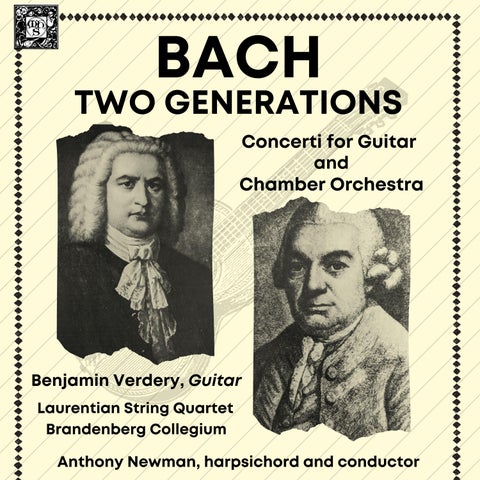
BACH
TWO GENERATIONS
CONCERTI FOR GUITAR AND CHAMBER ORCHESTRA Benjamin Verdery, Guitar Anthony Newman, harpsichord continuo, conductor
JOHANN SEBASTIAN BACH
CARL PHILIPP EMANUEL BACH
Concerto in D Minor, BWV 1052 (Originally for Harpsichord; Arranged by Benjamin Verdery)
Concerto in A Major (Originally for Flute, Cello or Harpsichord; Arranged by Benjamin Verdery)
1. Allegro 2. Adagio 3. Allegro
1. Allegro 2. Largo con sordini. Mesto 3. Allegro assai
Benjamin Verdery, Guitar
Benjamin Verdery, Guitar
Laurentian String Quartet Sung Rai Sohn, First violin Larry Watson, Second violin Joel Rudin, Viola Rolf Gilstein, Cello
Brandenburg Collegium Dennis Masuzzo, Bass Bruce Berg, First violin Dennis Masuzzo, Bass Joanna Jenner, Second violin Sarah Clarke, Viola Daniel Maclntosh, Cello
Anthony Newman, harpsichord continuo, conductor
Anthony Newman, harpsichord continuo, Conductor
TWO GENERATIONS
In 1723, Johann Sebastian Bach (16851750) became the cantor of St. Thomas’ church and school in Leipzig, one of the most important posts in Protestant Ger many. He directed music in the main churches and university there, and succeeded Georg Philipp Telemann as director of the Collegium Musicum, a society Telemann began in 1701. He conducted, composed, and arranged many great works for this society, including seven harpsichord concerti based on previous works by himself and other composers. Bach rewrote the D minor Concerto several times in his life, using the first movement for the Sinfonia of the Cantata "lch habe meine Zuversicht” (around 1730) with the harpsichord part played on the organ. The first two movements of the Concerto are also arranged in Can tata no. 146 of about 1740. It is thought to be one of Bach’s favorite concerti as he used the material so often. The original violin version, however, is lost and may
not have been by Bach himself anyway. Many passages from the harpsichord version appear to be originally for violin, as instances of open strings and arpeggiation seem more suited for violin than keyboard. One of Bach’s writing techniques was to put the solo violin part in the right hand of the keyboard, with the left hand reinforcing the bass. Most likely not satisfied with such a mechanical arrangement, he was to refine it until it was idiomatically suited for the harpsichord. One can see in the manuscript where the bass part was enriched and middle voices added in later versions. Today, the violin version has been reconstructed based on the three versions that survive, including one by the composer’s son Carl Philipp Emanuel. It seems fitting to be making an arrangement of this concerto for the guitar since it already existed in many instrumental versions in Bach’s lifetime.
Where keyboard instruments previously had been used in the roles of either continuo or solo, Bach created a new genre of concerto. This arrangement by Benjamin Verdery takes its cue artistically from Bach’s inventiveness to bring a new work into the guitar repertoire. The guitar combines the harmonic power of the harpsichord with the subtle melodic beauty of the violin to make anew this energetic work. Carl Philipp Emanuel Bach (1714-1788) was the fifth child of Johann Sebas tian, and perhaps one of the most talented of the four sons who became com posers. He studied law at Leipzig University and Frankfurt an der Oder, but his musical education came from his father. Afterwards, he began to support himself in Berlin with clavier instruction, composing, and conducting. At the age of 24 he was called to the service of the crown prince of Prussia, Friedrich, who was himself an accomplished flutist.
Two years later when Friedrich became king, Emanuel wrote in his autobiographical sketch that he "had the honor to accompany, alone at the harpsichord, the first flute solo that Friedrich played as a king." Among the 40 artists that served Friedrich along with Emanuel was the outstanding flutist and composer Johann Joachim Quantz, who was Friedrich's teacher and court composer. They both wrote important treatises on mid-18th century performance style. Emanuel's was named the "Essay on the True Art of Playing Keyboard Instruments," and today remains one of the most influential books on the musical thoughts and practices of the period. Carl Philipp Emanuel Bach remained in Berlin for 28 years. In 1768 he applied for and received the position that Georg Philipp Telemann (his godfather) had held as director of music in the five principal churches of Hamburg. His creativity flourished here, and most of
his choral and symphonic works came from this period, along with numerous keyboard works -over 200 in his lifetime. He also became quite wellknown for his lengthy improvisations, and could spend hours at the clavichord freely creating fantasies for his own enjoyment. This prolific composer wrote 38 concerti during the Berlin years. They were always in three movementsfast, slow, fast- with the solo and tutti sections being approximately equal in length. In the Concerto in A major, like many of the other concerti, the developmental sections are short, pointing to the gradual transition that was going on at the time, from the baroque concerto form to the new sonata form. The younger Bach was to be one of the composers to connect the baroque and classical periods with his distinct musical style. Although C.P.E. Bach treated the keyboard idiomatically, his style was not exclusively dependent on that
instrument. Indeed, some of his keyboard concerti exist in versions where the keyboard is replaced by a string or wind instrument. The baroque practice of freely exchanging instruments in solo pieces was still valid. With minor changes, Bach adapted the part of the main instrument to the changing media of strings and winds. At least two other keyboard concerti were done in three instrumental variations: one for flute, one for cello, and one for harpsichord. Given this knowledge, it is not too extreme a move to arrange this one for the guitar. This arrangement, also by Benjamin Verdery, draws on all three versions, thereby creating a new concerto for the guitar. It retains the graceful and elegant style that was Bach's signature, and which so influenced Joseph Haydn, Ludwig van Beethoven, and other composers in the new classical age. Rie Schmidt
Recorded at Holy Trinity Church, East 88 Street, New York, NY: January 6, 1984 (C.P.E. Bach); August 23, 1985 J.S. Bach) Produced by Christopher Lewis and David Hancock Engineering: David Hancock The guitars used on this recording were built by John Gilbert, California, and Thomas Humphrey, New York. Mr. Verdery performms exclusively on D’Addario Pro Arte Strings. Special thanks to Seymour Bernstein, James D’Addario, David Hancock, Christopher Lewis, Tony and Mary Jane Newman, Rie Schmidt, and Keith Underwood. This recording is dedicated in loving memory to John Duane Verdery. Mastering: Bill Kipper, Masterdisk Corp. Cover Art: (J.S. Bach left); C.P.E. Bach (courtesy New York Public Library) Originally released on LP as MHS 7397 and on CD as MHS 11184X.