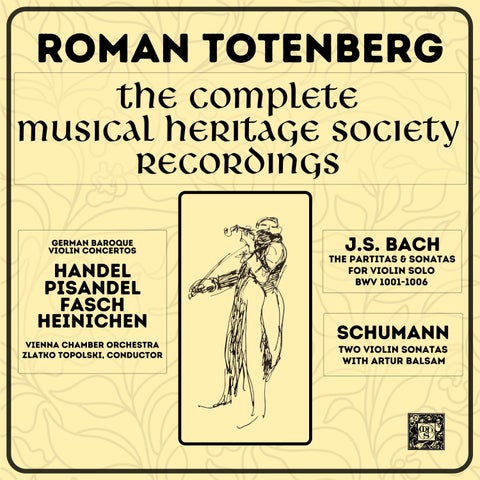
Mr. Totenberg was internationally recognized for his research in bowing and for his often featured “Bach Bow’’ which he adapted in collaboration with the California bow maker, John Bolander. He studied music history with Kurt Sachs and Max Seifert at the Berlin Academy of Music where he was a violin student of Carl Flesch. Further studies were in Paris with George Enesco and Pierre Monteux. In these recordings he performs on his “Ames” Stradivarius and François Tourte bow of the former Warburg collection.
JOHANN SEBASTIAN BACH SONATAS and PARTITAS for SOLO VIOLIN, BWV 1001-1006 Original LP: MHS 1460
SONATA in G MINOR, BWV 1001 I. Adagio - Fuga II. Siciliana III. Presto III. Presto
PARTITA in B MINOR, BWV 1002 I. Allemande II. Courante III. Sarabande IV. Tempo di Bourrée
Original LP: MHS 1461
SONATA in A MINOR, BWV 1003 I. Grave - Fuga II. Andante III. Allegro
PARTITA in D MINOR, BWV 1004 I. Allemande II. Courante III. Sarabande IV. Gigue V. Chaconne
JOHANN SEBASTIAN BACH SONATAS and PARTITAS for SOLO VIOLIN, BWV 1001-1006 Original LP: MHS 1462
SONATA in C MAJOR, BWV 1005
PARTITA in E MAJOR, BWV 1006
I. Adagio - Fuga: Alla Breve II. Largo III. Allegro assai
I. Allemande II. Loure III. Gavotte en Rondeau IV. Menuet I V. Menuet II VI. Bourrée VII. Gigue
ROBERT SCHUMANN TWO VIOLIN SONATAS Original LP: MHS 3414
VIOLIN SONATA NO. 1 in A MINOR, Op. 105
VIOLIN SONATA NO. 2 in D MINOR, Op. 121
I. Mit leidenschaftlichem Ausdruck II. Allegretto III. Lebhaft
I. Ziemlich langsam - Lebhaft II. Sehr lebhaft III. Leise, einfach IV. Bewegt
with ARTUR BALSAM, piano
GERMAN BAROQUE VIOLIN CONCERTOS Original LP: MHS 789
JOHANN DAVID HEINECHEN: VIOLIN CONCERTO IN D MAJOR I. Adagio - Fuga: Alla Breve II. Largo III. Allegro assai
GEORGE FREDERIC HANDEL: VIOLIN CONCERTO IN B-FLAT MAJOR I. Andante II. Adagio III. Allegro
JOHANN GEORG PISENDEL: VIOLIN CONCERTO IN G MINOR I. Largo - Allegro II. Largo III. Allegro
JOHANN FRIEDRICH FASCH VIOLIN CONCERTO IN D MAJOR VI. Bourrée VII. Gigue V. Menuet II
Vienna Chamber Orchestra ZLATKO TOPOLSKI, conductor HILDE LANGFORT, harpsichord
Original LP: MHS 789
Original LP: MHS 1460-2
Original LP: MHS 3414 A Musical Heritage Society Recording produced under the direction of Dr. Michael Naida.
A Musical Heritage Society Recording produced under the direction of Kurt List.
Cover Illustration: Barbara Remington
SOME THOUGHTS on PERFORMING the J. S. BACH SONATAS and PARTITAS for VIOLIN ALONE by ROMAN TOTENBERG
For many generations the six J. S, Bach Sonatas and Partitas for Violin Alone have been a paramount and unique source of study and musical enjoyment for violinists all over the world. Contrary to general belief, there were other outstanding baroque composers who wrote lovely music for unaccompanied violin. Among these were Pisendel, Geminiani, and Biber whose Pasacaglia may have been a prototype for Bach’s Ciaconne. It was Bach, however, who through the genius of his inventiveness and mastery of the idiom, was able to overcome the limitations of a melodic string instrument and thereby create the illusion of true polyphony. Musicological research has introduced much new understanding into performance practices of these compositions. This new insight has brought to light the element of
improvisation which we find in the earlier Italian com posers. Improvisatory practices were clearly explained in the English publication of Geminiani’s Art of Violin Playing (1751), and later we find a whole chapter de voted to ornamental techniques in Leopold Mozart’s School of Violin Playing (1756). Many essays on the art of playing viols, consorts, and violin have taught us the numerous possibilities of interpreting chords on string instruments. It is through such research that the standardized version of 19th century performances has become a thing of the past. The most significant difference can be noticed in the arpeggiation of chords which, in the 19th century, were broken regularly in a ratio of two to two, or three to one. While in baroque times there was an infinite variety of execution. Most of the chords in these recordings are arpeggiated from bottom to top, following the usage of Bach’s contemporaries as suggested by Christopher Simpson in The Division Viol. This practice is also employed by today’s baroque virtuosi of the viol da gamba. It is only occasionally
that the melodic line is so well established in the middle or lower voices that one is obliged to use another way of arpeggiating, as Geminiani recommends in his Art of Violin Playing. In these performances some ornamentations and arpeggiandos are improvised and are certainly not meant to be the “only right way.” Generally speaking, the use of improvisation helps the performer sustain a fresh and lively interpretation and gives him a chance to mold his own inspiration with that of the Composer. It would suffice to compare the original versions of the Partitas and Sonatas with subsequent arrangements which Bach made for keyboard instruments in order to see how he used small changes in ornamentation to vary his interpretation. Furthermore, we can take into con sideration that this music was written for Bach’s contemporaries who were fine violinists, familiar with al1 the intricacies of their instrument and contemporary musical idiom, so much of which concerned itself with
ornamentation and improvisatory practices. It is thought that the Sonatas and Partitas may have been written for Bach’s friend, the esteemed violinist and composer, Pisendel. Yet it is known that Bach did not completely trust his contemporaries in respect to ornamentation. Contrary to the practice of the great Italian composers, he wrote out the ornamentation for his slow movements, giving us a marvelous heritage and example of how this should be done. For this reason, these movements must sound improvised, although the performer adds very little of his own figurations except for a few traditional notes and trills. Accordingly, the rhythmic values in these movements are to be taken as approximate, and not in the sense of 19th century precision where the mathematically pure division of a quarter note into eighths, sixteenths, and thirty seconds was considered to be an absolute prerequisite of a good performance. While the Sonatas are in the form of church sonatas, the Partitas are sonatas
da camera, collections of dances. As such they demand a thorough knowledge of the historical development of the dance form of the period, indigenous particularly to France, Italy, Germany, and England. Naturally, in these dances tempi and rhythmical qualities are of prime importance. Dances under thc same title may have acquired quite different characteristics and speeds in different countries. For instance, the French courante and the Italian corrente evolved quite diversely. Bach had an extraordinary knowledge of the style of these countries, and he used this sophistication with masterly freedom. During Bach’s time the violin bow was not standardized. There was no one accepted norm for size, shape, or weight, and consequently an approximation of sound was all that could have been achieved. After extensive experimentation with Italian, French, and German baroque bows, it is my conclusion that the technique of playing baroque music, particularly the Solo Sonatas and Partitas, can be
adapted to modern instruments by the contemporary virtuoso, provided he is well versed in baroque practices, and has developed a taste for the sound and style of the time. Fortunately, we are in possession of a beautiful original manuscript of these works. This manuscript, beside giving a marvelously clear picture of voice leading, is very practically written, with all the page turns carefully arranged for the performer. It is living proof of Bach’s clear thinking and pragmatic approach to music making. Of course, there is much more to be said of the interpretation and performance of the Sonatas and Partitas which is too complex to entertain in this brief introduction. The fact remains that the fascination and revelation in performing and hearing this music lies in the artful use of the baroque tradition. In such a way one would hope for an end product which would sound not only beautiful, but also free and unstereotyped.
SCHUMANN: 2 VIOLIN SONATAS NOTES by DANIEL NIMETZ The Schumann of 1851 was a different man from the exuberant symphonist of ten years before. And this natural process of maturation reflects itself in his music. Where so much of his early work depends on some extra-musical stimulus – poetry, literature in general, personal events, even politics, if we are to take the composer at his word the later output relies rather consistently on purely musical, that is, abstract motivation. Thus, the programmatic, rela tively small-scale forms of the character piece give way to more classical, highly developed sonata structures. Fanciful titles, some of which Schumann actually suppressed in later editions of his early works (the E. and F. signatures of the Davidbündler Dances come immediately to mind), dis appear for the most part, to be replaced by sober
tempo markings. But this is not to suggest that Schumann became dull or that he lost his inspiration. On the contrary, with very few exceptions the works of the last period (after his move to Düsseldorf in 1850) reveal a happy balance of typically spontaneous Schumannesque ideas and carefully controlled compositional technique. And if one finds points to criticize for example, an occasional overworking of a favorite rhythmic figure – then it must also be admitted that such weaknesses exist in the early works too; only there they are perhaps less readily apparent because of the generally more excited, impassioned style of the youthful composer, which tends to sweep everything along in one remarkable romantic gesture. Op. 105, in three movements, is the more popular of the two sonatas, although “popular” is hardly appropriate since neither work receives much attention from today’s fiddlers, probably because Schumann subordinates virtuoso display to musical content with a resulting lack of especial brilliance. And just as his piano writing
always favored the middle register, so also his approach to the violin tended toward the low and mniddle timbres, thereby lending the violin-piano medium a particularly subdued quality, further emphasized by predominantly minor tonalities. The first movement is one of Schumann’s most impassioned and successful sonata-form movements. It is basically monothematic, the second subject existing, as often with Haydn, in a harmonic rather than melodic dimension. This movement is exceptionally concise; no romantic wanderings here. Schumann maintains a pulse of sixteenth-notes that subsides only during the second subject area. Even the finely worked-out development, which hasn’t one extraneous note, relies on the rhythmic propulsion of the opening for momentum. In short, here is a movement that must be considered a masterpiece. That it (regrettably) always seems over too soon serves as sufficient proof! An entirely different spirit informs the middle move ment. It recalls the world of Kinderszenen or one of the less complex Noveletten. Its simplicity--almost artlessness--contrasts
with the passionate drive of the first movement. We may detect here another possible cause of the sonata’s relative neglect: ensemble between piano and violin is particularly problematic; they must feel as one throughout. Sonata-form, perpetuo mobile style, returns in the finale. Sixteenth-notes again predominate, this time as basic melodic members. The scherzo of the Rhenish Symphony, written not long before, appears to have infiltrated Schumann’s thought process, for the main subject recalls a figure from that work. A final note: observe how Schumann incorporates this idea into both the more melodious third theme (introduced briefly in the development) and the cyclic reference to the first movement that ushers in the coda. Perfect evidence of the composer as master of his craft. Of Op. 121 Joseph Joachim wrote: “To me it is one of the finest creations of modern times, in the wonderful unity of its feeling and the significance of its themes. It is full of a noble passion – almost harsh and bitter in its expression – and the last
movement might almost remind one of a seascape, with its glorious waves of sound.” (It was in honor of the great violinist, Joachim, that Schumann, Brahms and Albert Dietrich together wrote the famous “F-A-E” Sonata. Schumann later added two further movements to his original two-movement contribution to make up a third sonata of his own; it was first published in 1956!) A slow introduction, recalling Bach’s mighty chaconne in the same key, prefaces the first movement. The primary motif, d-a-f-d, already appears here. Its countersubject, first heard after the introduction, plays a prominent role too. Schumann’s studies of Bach bore ripe fruit in his later works, most particularly in this sonata. As in the first sonata, a basic monothematic design obtains. In contrast to the A Minor Sonata, however, the present work’s development section exhibits a rather lengthy, contrapuntally complex organization. The second movement is a “hunting” scherzo. Two episodic trios give an overall
design of ABACA. Shortly before the end a brief chorale fragment appears: Gelobet seist du, Jesu Christ. This Mendelssohnian touch (cf. his Trio in C Minor, finale) has more than passing signifiance, for here the slow movement’s principal theme makes an early appearance. Let the critic of Schumann’s instrumental imagination hear the opening of the third movement. Nothing could be more effetive: pizzicato violin chords with una corda accompaniment in quasi canon. This movement consists of three variations on the chorale tune with a contrasting episode after the second that refers back to the scherzo. The coda, also scherzo-related in its triplet rhythm, closes in a quiet C Major. The finale returns to the mood and techniques of the hrst movement. It requires no special comment. Shouldn’t music finally especially when it is as beautiful as this be left to speak for itself?
GERMAN BAROQUE VIOLIN CONCERTOS NOTES by JOEL SHEVELOFF Although there are some notable exceptions, most of the Baroque violin concertos current in the repertoire are Italian. This is to be expected. After all, the solo concerto is an Italian invention, cultivated by a great number of Italian composers who turned them out in great numbers. When a nonItalian composed a violin concerto during the first third of the eighteenth century he was consciously imitating an Italian style, perhaps affecting an Italianate manner, and certainly working formally within the limits of an Italian medium. The German composers represented on this disc have nevertheless contributed much of their own dialectics and talents to these pieces. Of the composers whose works are included here, only Johann Georg Pisendel depended for his reputation on his virtuoso violin
playing; Johann Friedrich Fasch was best known as a composer of sacred music: Johann David Heinichen, though an important Kapellmeister and a respected violinist, was a versatile musician, as important as a theorist and composer of theatrical music as of Concerted instrumental music. None of these composers was as committed to the creation of violin concertos as were Vivaldi, Locatelli or Tartini. George Frideric Handel, in particular, composed in many different forms for a great variety of instruments. The “Concerto” in B-flat major on this record is most likely an arrangement by the composer of another earlier work, probably a sonata for violin and continuo. Variants of the first movement occur elsewhere in Handel’s works, e.g. in the Oboe Concerto No. Z in B-lat major (third movement) and the Chandos Anthem No. – “I will magnify thee’ (Overture). The forms of the works here are clear and simple enough so that any listener reasonably familiar with the Italian models .
will quickly become acquainted with their German counterparts. This recording is especially significant for another reason.In the eighteenth century, performers, like the jazz musicians of our own time, did not perform the music as it appeared on the page, but improvised upon it within the limits of the taste and style of the time. It is this feature of Baroque practice that is attempted here by Roman Totenberg, with Zlatko Topolski, Hilde Langfort and the Vienna Chamber Orchestra. In the eighteenth century all the players contributed to this collective improvisation characteristic of the Baroque chamber ensemble. The soloist was expected to add embellishing figures, trills, scales, arpeggios and imitative and developmental figurations with reckless abandon. The keyboard member of the continuo team was the soul of the accompaniment. Filling in empty places in the fabric, imitating the soloist, adding embellishments better fitted to the keyboard than the fingerboard kept him busy. To a lesser extent, the players in the orchestra were supposed to add ornaments and figural
variations (then called divisions) to the general mêlée. This was particularly true for the player of the bass part. Extensive treatises were written illustrating the manner in which the "division viol" player exercised his craft. The theoretical sources are unanimous not only about the existence of these practices, but about the necessity of their proper execution for the creation of a truly musical performance. Some writers criticize the excesses of performers, but these writers do not suggest the elimination of the practices, merely their control within the limits of good taste. It is this question of good taste that plagues any resurrection of these practices. It is clear that improvisation differed from time to time, place to place, composer to composer, and occasionally within the works of one composer, from style to style. We would not improvise in the St. Matthew Passion in precisely the same way as in a trio sonata. The courageous performers in this recording do not pretend to have solved all the problems of good taste. But if the spirit of free fantasy is as necessary to the vitality of these pieces as contemporary
writing suggests, then this recording has been an important step in the resuscitation of that spirit. The artists do not claim to have presented a definitive recording of these concertos. After all, there cannot be a definitive performance in a style where every performance must sound a good deal different from every other performance. It should be noted that successful recreation of this lost art requires more than good intentions; ideally, a group of musicians should study a style for many years, experimenting constantly in order to achieve the inner understanding of a style that is the only true basis for improvisation.
JOHANN DAVID HEINICHEN: Concerto in D Major, S. 224 Johann David Heinichen, one of the most creative composers of his time, was a pupil at the Thomas-Schule in Leipzig under Johann Schelle and Johann Kuhnau. He also studied law and actually practiced for a while in Weissenfels, but soon gave up this activity to devote himself entirely to music. He returned to Leipzig, composed some operas and published a treatise on con tinuo realization which, even today, is highly regarded as a source work on the interpretation of eighteenth century music. A wealthy patron enabled him to spend six years in Italy, mostly in Venice, Mr. Totenberg gratefully cites the help he where he was in close contact with received from Dr. Janet Knapp Byles, Vivaldi. In 1717 he settled in Dresden Professor of Music History at Boston having been appointed Court University, in the preparation of the music Kapellmeister to the Elector Augustus the performed on this record. Strong. He wrote a great number of works, among them operas, church music, cantatas, sonatas, concertos and sere nades. The manuscript of the concerto here recorded is extant in the Hessische Landes-und-Hochschulbibliothek in Darmstadt. The concerto is in the usual
three-movement form, typical of the JOHANN FRIEDRICH FASCH: Vivaldi concerto, and is scored for violin, Concerto in D Major, FWV L.D2 strings and continuo. Johann Friedrich Fasch, who, in later years, was to become a personal friend of JOHANN GEORG PISENDEL: Bach, gained his musical experience Concerto in G Minor, JunP I.1 successively as a choir boy in Johann Georg Pisendel was a well known Weissenfeis, as a pupil at the Thomasviolin virtuoso, who at one time studied Schule (under Kuhnau) and a student at with Vivaldi. The concerto recorded here the University of Leipzig, where he was probably written before 1720 and founded a Collegium musicum. Though he clearly reveals high baroque pathos. The had already written several operas and autograph, falsely attributed to Handel, is French Overtures in the style of extant in the Saxon State Library of Telemann, he went to Darmstadt in 1713 Dresden. The concerto is scored for solo for the formal study of composition under violin, strings and continuo. Graupner and. Grunewald. After several years spent in Bayreuth, Gera and GEORGE FRIDERIC HANDEL: Lucavetz (Bohemia), he accepted (in Concerto in B-Flat Major, HWV 288 1722) a position of Court Kapellmeister in "Sonata a 5" Zerbst (Anhalt), where he spent the rest This concerto, which originally was called of his life. He was a highly prolific ‘sonata” was written around 1710 and is composer and was, above all, well known the only violin concerto by Handel. It is for his church music. The autograph of scored for solo violin, strings and the present concerto is in the Hessische continuo, with oboes doubling the violins. Landes- und Hochschulbibliothek in It is published in Volume 21 of the Händel- Darmstadt. The work with its three Gesellschaft edition. movements shows clearly the influence of Vivaldi. It is scored for solo violin, strings and continuo. --FLORIAN GRASSMAYR