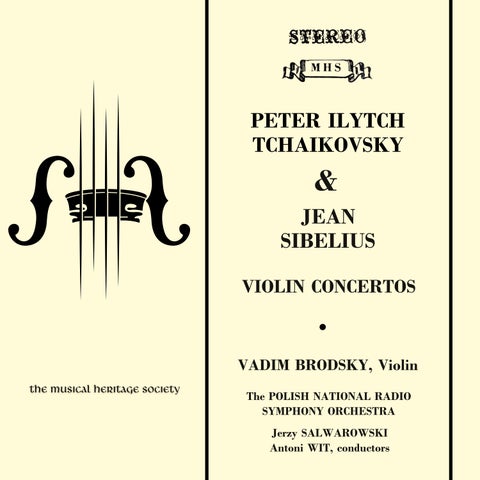
PETER ILYTCH TCHAIKOVSKY
& JEAN SIBELIUS VIOLIN CONCERTOS
VADIM BRODSKY, Violin The POLISH NATIONAL RADIO SYMPHONY ORCHESTRA Jerzy SALWAROWSKI Antoni WIT, conductors
JEAN SIBELIUS (1865-1957) VIOLIN CONCERTO in D minor, Op. 47 (1903) I: Allegro moderato II: Adagio da moderato Ill: Allegro ma non troppo PYOTR IL'YICH TCHAIKOVSKY (1840 -1893) VIOLIN CONCERTO in D major, Op. 35 (1878) I: Allegro moderato II: Canzonetta: Andante III: Allegro vivacissimo Vadim BRODSKY, violin THE POLISH RADIO NATIONAL SYMPHONY ORCHESTRA JERZY SALWAROWSKI (Sibelius) ANTONI WIT (Tchaikovsky) www.themusicalheritagesociety.com
Writing at some time prior to 1936, Donald Tovey remarked of the Sibelius Violin Concerto, "Perhaps (it) has not yet had time to become popular; but I see no reason why it should not soon take place with the Violin Concerto of Mendelssohn and the G minor Concerto of Max Bruch one of the three most attractive concertos ever written". The Word attractive is inportant here: Tovev does not mean (and he makes this quite clear) that the Sibelius, Mendelssohn, and Bruch C minor Concerti are the greatest ever written - they are simply, in his judgement, the three most "attractive". For greatness we are referred to Mozart, Beethoven and Brahms. 50 vears or more have passed since Tovey wrote his note (found in the third volume of his Essays in Musical Analysis), and the Sibelius Concerto has become popular, but not quite as Tovey anticipated. It does not companion Mendelssohn's naive but perfect work in our affections, nor does it seem possible that it ever will or should, and it commands a respect to which Bruch's G minor Concerto more and more clearly has no valid claim. Attractive no longer seems the word for it, for surely attractive carries the connotation "trivial", and there is nothing trivial in the Sibelius Violin Concerto. It is exactly proportioned and Brahms.
beautifully integrated; hence there is about it the quality of a serious and noble work. It is also, from the violinist's point of view, an extremely difficult one. Or should one say, it was an extremely difficult one? For the norms of technical difficulty, as distinguished from those of interpretive difficulty, are constantly being revised upwards. But though later works by Prokofiev and Bartók and Berg and Schoenberg require an even higher development of the violinists powers of control and co-ordination, the Sibelius Concerto today is by no means "an easy day for a lady". Its demands are not arbitrary, however. Sibelius himself was a violinist, and though his writing for the violin in this work disregards the convenience of the performer, it does not exceed either his capacity or the limitations of the instrument. Sibelius composed the Violin Concerto (his only concerto) in 1903. The original version unsatisfactory to him and he revised it. The revised version was completed in 1905 and was publicly performed for the first time in the same year, in October. The place was Berlin, and the violinist was Carl Halir. The
conductor was Richard Strauss - -and Tchaikovsky's works for a solo instrument Sibelius was much impressed by the fact with orchestral accompaniment consist of that Strauss devoted three rehearsals to three concerti and a fantasy for piano, a the preparation of the orchestral part. The concerto and two smaller pieces for position of the Concerto among Sibelius' violin, and a set of varations and one works is between the incidental music for smaller composition for cello. Perhaps the Pelleas et Mélisande, Op. 46, and (except most substantial and well-known of the for the intervening and unsuccessful lot are ncerto No. 1 in B flat minor, Op. 23 choral ballade The Captive Queen) the (1875) and the solo Violin Concerto in D symphonic poem Pohjola's Daughter, Op. major, Op. 35 (1878). Both of these 49. Among the symphonies, its position is monumental works shared a similar between the second and the third. rejection by thethe Piano Co two virtuosi whom Tchaikovsky originally had chosen The Concerto is in three movements. The to name in the dedications: Nicolai first is an Allegro moderato in 2/2 time. Rubinstein, pianist, and Leopold Auer, The solo instrument enters almost at once, violinist. The complaints by both above a tremolando accompaniment for performers dealt with the complicated divided and muted strings, with a nature of the works, which were statement of the principal subject. The summarised as unsuitable to the organisation of the movement is rhapsodic instruments of each soloist. rather than formal, but there is repetition and development of the thematic material, The dedication of the Piano Concerto in and the movement has, as a B flat was changed from Nicolai communication, a convincing logic. The Rubinstein to Hans von Bülow. Likewise, slow movement is a "competitive although Leopold Auer was less offensive romanza" in B flat, the finale - the crown in his resistance to performing the Violin of the work- a sombre yet propulsive rondo. Sibelius characterised it as a Concerto due to its lack of appeal and its "danse macabre", and it combines, as a great technical difficulties, Tchaikovsky dance of death should, grinness with erased Auer's name on the dedication levity, with an irresistible propulsion to an page and substituted Adolph Brodsky, another Russian violinist. who premiered inevitable end. the neglected work in Vienna on 4 December 1881. Hans Richter was the Edward Cushung conductor and Brodsky was the soloist
with the Vienna Philharmonic Society.
Concerto to his many students, who continued to triumph with the nowBrodsky wrote to Tchaikovsky before he popular work in Europe and concert halls tackled the Concerto, acknowledging the throughout the world. Just as the initially many dificulties, yet assuring him that rejected Piano Concerto in B flat survived once these were overcome, its gloriously, Tchaikovsky also lived to see extraordinary beauty would sustain its the captivating success of this existence in the standard repertoire, masterpiece. Unfortunately, the leading critics of Vienna write very badly of its premiere, especially Eduard Hanslick, the renowned Tchaikovsky produced his only Violin critic of the Neue tieie Presse. Concerto during a tragic period of his personal life, as he had just parted from The audience reaction was, reportedly, his wife, Antonina Milyukova, "a rather riotously mixed with enthusiastic pretty girl of spotless reputation... though supportive no longer very young"; she was in fact applause for Brodsky and hisses for the 28. According to Edward Lockspeiser in composition.Other reviews of this first his article Tchaikovsky, the Man', performance included such criticisms as: Antonina had developed her own "the wildest Russian nihilism" (Theodor idealised love for the composer and Helm); "the strangeness of the threatened to take her own Iife if he did composition mystified many" (Max not marry her. Tchaikovsky wrote to Kalbeck); and the unidentified Madame von Meck that "he felt no more "barbarously terrible". than sympathy and gratitude for her love", and a few days after the marriage told his brother, Anatol, that Antonina Although the Violin Concerto makes had become "physically absolutely tremendous demands on the soloist, repulsive" to him and that he was incorporating difficult double stops and suffering "ghastly spiritual torture". In harmonics especially in the first closing the same letter to Madame von movement's cadenza, even Auer changed Meck, Tchaikovsky writes about his his mind and later had a big success with difficult transition to a forced marriage: it. The famous teacher bequeathed his "One must think of the welfare and peace performance tradition of the D major of mind of the other person to whom
one's destiny is bound; all this is not very easy for a bachelor hardened in egoism". With this disastrous marriage, Tchaikovsky told Madame von Meck that "music, for the best part of me, has perished for ever", Yet he was already sketching the Concerto in March of 1878 at Clarens, an exquisite retreat on the shores of Lake Geneva, and completed its orchestration by late April of the same year. He had just written his Fourth Symphony and the opera Eugene Onegin. The formal structure of the Violin Concerto follows the standard threemovement format with the two outer movements, Allegro moderato and Allegro vivacissimo, separated by the shorter, slow Canzonetta (Andante), which replaced his original middle movement, later to be called Meditation in the set of three violin and piano pieces comprising Op. 42. Julie Jordan
© & ℗
H S M
J e f f r e y N i s s i m .
r &
a i rt e H 6 8 9 1
u c d e d o r b P y . s F e r i e t l d a e y r o i c R k c B i s a u s h M o e u g
www.themusicalheritagesociety.com