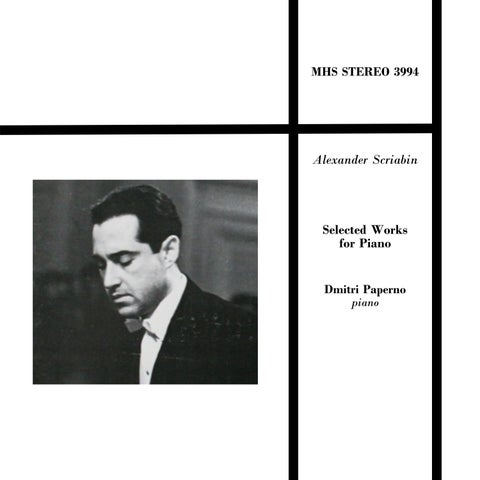
ALEXANDER SCRIABIN DMITRI PAPERNO, piano 1. Piano Sonata No. 2 ("Sonata Fantasy"), Op. 19 10:23 Two Poems, Op.32 2. No. 1 In F-sharp Major 3:03 3. No. 2 In D Major 1:19 4. Poem, "Vers La Flamme", Op. 72 4:55 Five Preludes, Op. 16 5. Prelude No. 1 in B Major 2:28 6. Prelude No. 2 in G-Sharp Minor 1:15 7. Prelude No. 3 in G-Flat Major 1:38 8. Prelude No. 4 in E-Flat Minor :48 9. Prelude No. 5 in F-Sharp Minor :27 10. Waltz, Op. 38 5:09 11. Piano Sonata No. 9, Op. 68 "Black Mass" 7:22
The music of Scriabin is the expression of an unrestrainable, deeply human yearning for happiness, freedom, for the joy of living. Fragility and refinement are combined in this amazing artist with grandoise flights of fancy and the universal dream of humanity. Scriabin was the authentic son of his time, not only in the domain of ”emotion,’” but also in that of philosophic-ethical inquiries and achievement. Precisely for that reason, his music so fully expressed the temper of a rather significant part of the Russian intelligentsia during one of the most interesting and contradictory periods in the history of Russia. Being a dedicated idealist with theosophic-mystical inclinations, Scriabin aspired to saturate his creations with philosophical ideas and association s, at times of an abstract-logical order: conflict, infinity, will, chaos, life, death. His creative course, which lasted little
more than twenty-five years, can be likened, in the intensity of its development, only with that of Beethoven. Scriabin’s work, like Beethoven’s, can be clearly divided into three periods: the early, (youthful), middle and late periods, and when one compares the early works with the later opuses, it is hard to believe that they were produced by the same composer. Scriabin’s youthful creations are marked by the influence of Chopin (and, in the case of his first two symphonies, to some degree of Wagner). It is astonishing that some Western musicians cannot, (or snobbishly do not wish to), even acknowledge in Scriabin’s early compositions his own shining individuality . One can point to several causes for this phenomenon—the undoubted kinship of melodic intonation, the commonality of genres (etudes, preludes, mazurkas), the captivating youthful purity of the music of these two poets of the fortepiano.
Nevertheless, some reviews and written commentaries in contemporary American editions of Scriabin can only evoke a smile. Be that as it may, beginning with the twentieth opuses, the composer speaks in his own inimitable tongue, opening new paths in music, many years ahead of his time. His bold innovation in the areas of form, melodic and harmonic language, the deep philosophical saturation of his music, its lofty humanism, also make him kin to Beethoven, although Beethoven’s music was not close to Scriabin. The genius of Scriabin is manifest also in that, while reflecting the aspirations and ideals of all humanity, he remained a profoundly nationalistic Russian composer, though of a totally different type than Tchaikovsky or Rachmaninoff. Serious analysis of Seriabin’s music discloses its nationalistic nature, those golden threads which bind elements of his melodies and harmony with Russian folk songs.
Alexander Nikolaevitch Scriabin was born in Moscow on Christmas Day, December 25, 1871—(the 7th of January 1872 according to the new calendar). He inherited his musical gifts from his mother, who graduated with honours from the Petersburg Conservatory in 1869, a piano pupil of the famous T. Leschetitsky. An early death took her at the age of twenty three, little overa year after the birth of her son. All the cares about the unusually gifted and fragile child were placed upon his grandmother and his aunt, both of whom adored him. Scriabin retained his passionate interest in, and tender love for, the piano from his earliest childhood and throughout the rest of his life. Having entered the Moscow Cadet Corps in 1882, Scriabin began to apply himself seriously to the study of the fortepiano in the same year. One of his first teachers was N.S. Zverev, from whose “preparatory’” school also
emerged A. Siloti, S. Rachmaninoff, J. Levin. From 1888, Scriabin was a student of the Moscow Conservatory, where his prominent teachers were V.I. Safonov (fortepiano) and S.I. Taneyev (composition of the “strict style’”). His next professor of “free composition,” A.S. Arensky, took a dislike to Scriabin and completely failed to appreciate his distinctive gifts. After a grave misunderstanding, Scriabin left his class, without completing the course in composition. In the fortepiano class, he graduated brilliantly from the conservatory in May, 1892, having received its highest possible honour— the gold medal. In 1893, four opuses of Scriabin’s piano pieces were published, and the first recital dedicated to his own works was held in Moscow in March of 1895. Although he was not possessed of the scope and technical brilliance of his friends Rachmaninoff and Levin,
Scriabin nevertheless captivated his audience with his refined and inspired performance. The distinctive features of his pianism were a winging imagination, a nobility of phrasing, mastery of articulation and pedalling. The most strenuous, painstaking work of composing took most of Scriabin’s time and strength. More than sixty opuses of piano compositions and five major works for orchestra—three symphonies, “Poem of Ecstasy,’” the first performance of which occurred, interestingly enough, in New York City on December 10, 1908, under the baton of Modeste Altschuler, and “Prometheus’”.-(“Poem of Fire”.) But in spite of this, Scriabin concertized extensively both in Russia and abroad (Germany, Belgium, France, Holland). From December 1907 to March, 1908, he toured the United States of America. Scriabin performed his piano concerto in Carnegie Hall, gave recitals in Mendelssohn Hall in New York City, as
well as in Chicago, Cincinnati and Detroit. In one of his letters to Russia, Scriabin spoke well of the musical responsiveness of American listeners. Ideas of struggle, faith in the creative power of the human spirit permeated all of Scriabin’s work. Together with the new musical idiom which he perfected, they gave birth to the conception of something of an artistic “Mystery,” which, according to the composer’s thought, would liberate the world from evil forces and bring spiritual harmony into being. The illusory nature of this tragic dream, the titanic exertion which consumed the composer, the Inescapable complications of life, by no means fortified his frail constitution. Nevertheless, Scriabin’s sudden death on April 27, 1915, at forty three years of age, deeply shocked the whole of Russia’s musical community. (A carbuncle on the lip led to general sepsis, followed within several days by
death.) Gone was this innovator of genius, who had given a most powerful impetus to the music of the twentieth century. One would like to end this brief review of Scriabin, that great Russian musician, that inspired and philosophically oriented artist. With his own words: “Music lives by Thought.”
Both sides of this record present the works of all three periods in the creative course of Scriabin. The two-part Sonata-Fantasie No. 2 (op. 19, 1897, Genoa-Crimea) is one of the most poetic creations of the young Scriabin. Mature in form, it nevertheless retains all the spontaneity of clear, youthful impressions of the majesty of the sea elements (majesty of the elemental sea). The beginning, as it were, questioning theme of the first part embodies a state of contemplative
tranquility and at the same time evokes a sense of indistinct yearnings for a mysterious summons. This short motif is like a call, an exclamation, which performs within the work the role of the principal image. The second theme, singing and broad, is as though “awash’’ by waves of rich, ornamental sound. The young composer’s mastery of polyphony and polyrhythm are astounding. According to Scriabin’s conception, the first part. (AndanteJ is a southern night at the seashore, the second, (Presto)—the violent spaciousness of the sea. This image of the finale forms the basis of this whole rising and falling, constantly moving mass of sound. Only for a moment does the human intonation of suffering arise (the second theme). But the elements carry everything off. .. II. Scriabin’s poems are free musical forms, disclosing the creative state of the human soul. The composer
understood this genre very broadly. (Had an expansive understanding of this genre.) The popular Two Poems, op. 32, can be seen as a cyclical whole, a diptych. In the first—fragility, refinement anda melting in the beauty of creation. In the second—rapturousness, joyous passion, proud pathos. The union of these two poems in one opus is typical of the stvle of Scriabin’s creativity. In certain of his poems, the composer embodied almost the whole of his philosophical system. Such is the dazzlingly impulsive, the last of Scriabin’s poems. ”Vers La Flamme,”” op. 72. The idea of the conquest of stagnation via the path of spiritual exaltation is here expressed with unusual clarity. A brief musical theme— an invocation, remaining unchanged in its structure, completely alters its expressive functions—from the dark depths of congealment and suffering to
ecstatic delight, a grandiose upward flight and disappearance in the flame. Five Preludes, op. 16. Beginning with the first opuses and ending with the final published composition, Scriabin creates small pieces under the heading “Preludes.” His youthful preludes are born under the strong, direct influence of the inspired preludes of Chopin. However, they are already sharply marked by the individuality of their author. One can easily convince oneself of this, recalling the famous collection of Twenty Four Preludes, op. 11, as well as ops. 13, 16, 17. The aspiration to say something significant, bright, within a small snippet of time, is one of the characteristic aspects of Scriabin’s creative method, which continued the tradition of the preludes and etudes of Chopin. The culmination of the prelude usually comes at the point of the golden section (the beginning of the
recapitulation)—a sign of the completion of the form. Prelude No. I (B major) A small, fragrant nocturne with a bright lift and a slowing down, as though lazily, to a drop in the last part. Prelude No. 2 (Gsharp minor) Pastoral, with the tune of the reed-pipe—the reflected image of the Russian landscape, and a dramatic, almost tragic conclusion. Prelude No. 3 (G-flat major) Interesting for its Russian coloration. The final supplement brings into the piece a special element of balance. In the mournful and very short (12 measures!) Prelude No. 4. (e-flat minor) the recitative even prevails somewhat over the melodiousness. The last in the cycle, Prelude No. 5. (F-sharp major) is light, graceful, a dream that is borne away in the distance. The most poetic, distinctive Valse, op. 38 (Scriabin himself associated it with a vision) is marked by the stamp of inspiration and mastery, generally characteristic of this period. One clearly
perceives the tendency to reject the genre of the waltz as a dance. The waltz prototype is here only a thin veil, gently surrounding the illusory object. All the expressive means convey the illusiveness of feelings, a mood of a somewhat ecstatic dream. The bright culmination at the beginning of the recapitulation and the uplifting completion of dissolution are characteristic. The brief, single-movement Sonata No. 9, op. 68, is one of the most profound and somber of Scriabin’s works. The eternal idea of struggle between good and evil, between purity and hellish nightmare, is here resolved by Scriabin with deep pessimism. The introductory and main themes personify dark, evil forces with their malevolent invocations and “mutterings.” The second theme: “A dozing saint, and around her wicked sorcery’” (Scriabin). The innocently dreaming image is destroyed by
-- instilling in it the ominous intonations of the main theme—there emerges a kind of process of “desecration’’ of its purity. The dark forces of the prologue and of the first theme are increasingly activated in their self-assertion. Ultimately, the second theme, under their onslaught, changes unrecognizably—it is turned into a witches sabbath. The ominous, grotesque march falls into the abyss, dissolving in menacing chaos. The composer himself called the 9th Sonata The Black Mass.” During its seven or eight minutes, thanks to his extraordinary skill in the area of form and ultimate contrasts, the composer was able to created a majestic picture of struggle, despair and defeat of the human spirit. --Dmitry Paperno (translated by Harriet Heifetz)