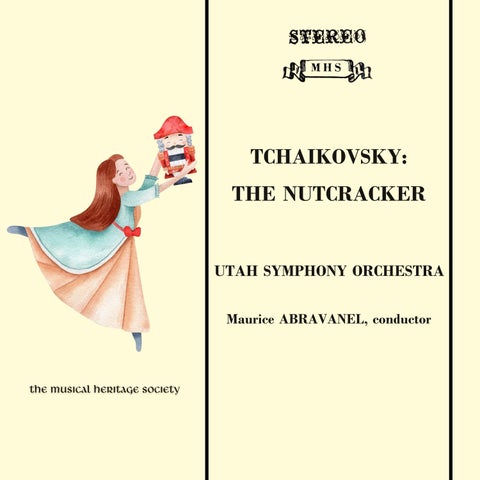
PETER ILYICH TCHAIKOVSKY THE NUTCRACKER, Op. 71 1. Overture ACT I, SCENE I
2. No. 1, The Christmas Tree 3. No. 2, March 4. No.3, Little Galop; Entrance of the Guests 5. No.4, Drosselmeyer' s entrance; Dance Scene; Distribution of Presents 6. No. 5 Scene; Grandfather's Dance 7. No. 6, Guests depart; Children retire to bed; Magic spell begins 8. No. 7, Battle between Nutcracker and Mouse King; Nutcracker wins batle and is transformned into a handsome Prince ACT I, SCENE II 9. No. 8, Fir Tree Forest in Winter 10. No. 9, Waltz of the Snowflakes ACT II 1. No. 10, The Castle, Kingdom of Sweets 2. No. 11, Clara and the Nutcracker appear; No. 12, Divertissement 3. Chocolate (Spanish Dance) 4.Coffee (Arabian Dance) 5. Yes(Chinese Dance) 6. Trepak (Russian Dance) 7. Dance of the Mirlitons (Reed Pipes) 8. Mother Gigogne and the Tumbler 9. No.13 Waltz of the Flowers 10. No. 14, Pas vde Deux 11. Variation I, Tarantella 12.Variation Il, Dance of the Sugar Plum Fairy 13. Coda 14. No. 15, Final Waltz and Apotheosis
Utah Symphony Orchestra Maurice Abravanel, conductor
Peter Ilyich Tchaikovsky (1840-93) wrote uncomplicated music, rich with entrancing melodies, even though he was personally deeply troubled. By 1890, the year Tchaikovsky received the commission for the Nutcracker, he had reached a pinnacle in his career but was plagued by severe depression. He had lost his close friend and patron, Mme. Nadezhda von Meck (a friendship purely based on correspondence) when she suddenly withdrew her financial support and stopped writing to him, and Tchaikovsky bitterly missed their correspondence. His opera The Queen of Spades was received with great acclaim, but was withdrawn after only 13 performances. The Imperial Opera in St. Petersburg commissioned him to write a one-act opera on a topic of his own choosing and a ballet based on E.T.A. Hoffmann's story The Nutcracker and the Mouse King, but he did not believe the work could yield a viable ballet. He wrote to his brother Modeste: "Is it wise to accept the offer of the Opera Directorate?...My brain is empty; I have not the least pleasure in work." He nonetheless accepted the commission and then asked the Imperial Opera to postpone the premiere from the 1891-92 season to the following year. He began work in February, 1891 and on March 19, 1892, Tchaikovsky led the famous Suite from the as yet incomplete Nutcracker ballet at a concert in St. Petersburg.
In a July letter to his adored nephew Vladimir Davidoy, Tchaikovsky wrote, "I finished the sketch of the ballet yesterday . ..It is far weaker than The Sleeping Beauty, no doubt about it." Tchaikovsky wrote of himself, The old man is breaking up..he loses bit by bit the capacity to do anything at all." But the Nutcracker stands out among his works for its entrancing loveliness and many moments of sheer joy. It was the last of his three great evening-long ballets, the others being Swan Lake (1875-76) and The Sleeping Beauty (1888--89). The Imperial Opera's two-fold commission for a ballet and an opera was finally realized at a performance in St. Petersburg at the Maryinsky Theatre on December 18, 1892. At this premiere of the complete ballet, the scenery and costumes were created by M. I. Botcharov & K. M. Ivanov; the choreography was by Marius Petipa and his assistant Leon lvanov. But neither the ballet nor the one-act opera were received with enthusiasm, and Tchaikovsky's depression subsequently deepened. The story of the Nutcracker, like that of the two preceding ballets, is a fantasy. In the Nutcracker, Tchaikovsky reveals a fine insight into the heart and mind of a child, the hopes and fears that can be so poignant. In Clara, the central child figure in the ballet,
Tchaikovsky created a true heroine. She weeps tenderly for her broken toy, courageously battles the evil Mouse King, and joins her Nutcracker Prince in a land of sweetness and joy. The scenario of the ballet was revised from F. T.A. Hoffmann's story and translated into French by Alexandre Dumas. Tchaikovsky's score comprises a total of fifteen musical numbers, with an overture, a first act of two scenes, and a secona act in the Kingdom of Sweets. THE STORY AND THE MUSIC OVERTURE Two themes give us, in germ form, the two kinds of music Tchaikovsky weaves together in the ballet. One theme is staccato, bright, transparent, hinting at toys and dolls, and the other is surgingly lyrical, hinting at love and noble emotions. ACT I, SCENE I It is Christrmas Eve at the home of Judge Silberhaus. A swirling melody 4/4, for strings, repeats four times, and on the fourth, the Judge. his wife and their guests begin ornamenting the Christmas tree (No.1). The melody is richly devel oped, a second theme rises in contrast to it, and then, with a change of mood, litle twittering phrases from the woodwinds hint at the magic
elements in the plot. A forte climax brings a change of tempo, to 6/8 time, and the children enter to lively woodwind music which dissolves into long harp runs as the Judge orders a march to take place. Accordingly a "toy march strikes up (No. 2), featuring trumpets, horns and clarinets. There is then a children's galop (No. 3) in 2/4 time, which in its course interweaves beautifully with a more pompous string melody in 3/4 time that signifies the entrance of the parents into the festivities. This all dissolves into a lively 6/8 dance featuring the tambourine. There is an abrupt change of mood as old Councillor Drosselmeyer enters (No. 4). S Mysterious muttering phrases from the violas, wind chords, and the Waltz of the Snowfakes (No. 9) follows. As in a "grand waltz," there is an extended introduction, delicately scored, and then the main melody rises, sung by a choru with the orchestra ornamnenting the lines. Little storm flurries (harp glissandos) shake the snowflakes. The tempo changes to Presto, 2/4, but the waltz melody and chorus are still heard in new rhythm, and a great climax ends the scene and act.
ACT II The curtain rises (No. 10) on a sumptuous celebration in the Kingdorm of Sweets, in a slow waltz of great beauty. The waltz melody continues, taken up by two solo violins playing in harmonics, as the Sugar Phum Fairy, queen of the land, appears with her court. To a descending melody from the flutes, over clarinets, celesta, harp and strings No. 11), Clara and the Nutcracker Prince appear. Pages come on the scene with torches, and the flutes and harp depict the flickering flames. The Nutcracker Prince tells of his dangers and rescue by Clara, and as his melody is taken up by the strings, the court applauds Clara for her bravery. A table is brought on, laden with everything good to eat, and the entertainment begins (No. 12). In succession come Chocolate (Spanish Dance), Coffee (Arabian Dance), Tea (Chinese Dance), the Trepak (Russian Dance), Les Mirlitons, or reed flutes with onion skin over the ends, and Mother Gigogne and the tumblers, which is a rousing example of Russian country fair music. The following famous Waltz of the Flowers (No. 13) is one of Tchaikovsky's grandest waltzes.
Then comes the Pas de Deux for the Sugar Plum Fairy and her Consort (No. 14), a splendid example of an exalted, slow dance with two variations: a fiery tarantella for the male dancer and the Dance of the Sugar Plum Fairy featuring the newly invented celesta. This is rounded out by a vivacious coda. The Finale (No. 15) is another great waltz in the grand manner, rising to an impressive climax for full orchestra, and then the apotheosis, which is also an "apotheosis" of the enchanting melody with which Act II had opened, ends the ballet.
1 6 9 1 ℗
y a l t i e .s
2 © 0 & 2 3 p u H o e r r G i t a c i g s e u M M u a s g i c e R m o O
H S M www.themusicalheritagesociety.com