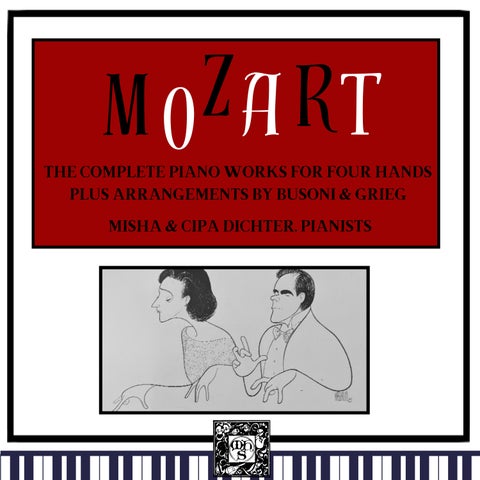
M O
Z
R A T
THE COMPLETE PIANO WORKS FOR FOUR HANDS PLUS ARRANGEMENTS BY BUSONI & GRIEG MISHA & CIPA DICHTER, PIANISTS
Sonata In D Major, K. 448 1.I. Allegro Con Spirito 08:02 2 II. Andante 09:28 3 III. Allegro Molto 06:14 4 Fugue In G Minor, K. 401 03:26 5 Variations In G Major, K. 501: Andante 07:57 Sonata In F Major, K. 497 6 I. Adagio - Allegro Molto 12:14 7. II. Andante 15:11 8. III. Allegro 07:16 9. Adagio & Fugue In C Minor, K. 426 06:56 Sonata In B-Flat Major, K. 358 10. I. Allegro 05:06 11. II. Adagio 07:19 12. III. Molto Presto 04:23
Sonata In C Major, K. 19D 13. I. Allegro 04:11 14. II. Menuetto-Trio 03:16 15. III. Allegretto; Adagio; Allegro 04:04 16 Fantasia In F Minor For Musical Clockwork, K. 608: Allegro-AndanteAllegro (arr. Busoni) 08:51 17 Fantasia In F Minor, K. 594: Adagio; Allegro; Adagio 08:37 Sonata In C Major, K. 521 18. I. Allegro 08:43 19. II. Andante 06:24 20. III. Allegretto 08:12 Sonata In D Major, K. 381 21. I. Allegro 05:12 22. II. Andante 08:15 23. III. Allegro Molto 04:14 Sonata In C Major, K. 545 (arr. by Edvard Grieg) 24. I. Allegro 04:23 25. II. Andante 06:17 26. III. Rondo - Allegretto 01:32
One of the few constants in Wolfgang Amadeus Mozart’s all-too-short life – other than the amazing stream of great music that poured from his mind-was his ongoing contact, mostly through correspondence, with his older sİster, Maria Anna. As children, whenever they were separated, usually so Wolfgang could go on tour with his father, the young genius would write long letters home. This continued even after brother and sister had grown up and this strong bond between them was probably forged by the musical tandem they were. As early as 1761, when Woltgang was five and Maria Anna, who he called Nannerl, was 10, the Mozart children were a musical duo, with Maria Anna playing the clavier and Wolfgang the violin. One can only imagine the quality of the music those two made as they were growing up. But Wolfgang also learned the clavier and was soon a greater keyboard artist than his older sister. She, however, by all reports, was an extraordinary artist and could have been a star performer. There is no question that early on brother and sister were playing together at the keyboard. It is tempting to try to imagine what those sessions were like! The first composition, written expressly for the duopianists, was composed while the family was on tour in London in 1765. While there, Wolfgang wrote the Sonata in C Major for Piano Four Hands. That work, listed as K. 19d, was the first in the series of great works that grace this recording. Though not all of these Sonatas were composed for his sister, they are all filled with his love of the form that he learned at such a young age.
One interesting aspect about their relationship that is clear from the letters was that Wolfgang between relied on his sister’s skill to ‘test-drive’ his compositions. In a letter written in Salzburg to her brother on tour in 1777, Nannerl wrote: “Thank you for sending the first Movement and the Andante from your Sonata which I have read through. The Andante requires great concentration and exactness in playing.” The wonder of the works on this recording is that they capture every part of Mozart’s quirky, intriguing personality, as if he were telling the story of his life through these pieces. This genre was one that Mozart continued to explore throughout his life, and every piece in this amazing set captures a different mood, emotion or style. The earliest piece, the Sonata in C, K.19d, was written with the Intent that Wolfgang and Nannerl would use it as a showpiece for their concerts. Of course, since it was composed by a nine-year-old boy, the wonder of the Mozart children could only be increased by such an astounding creation. By the time Mozart had reached his twenties and was traveling all over Europe in search of recognition and money, he found that the Sonatas for Piano Four Hands made wonderful teaching tools for his wealthy students. For example, the astounding and complex Sonata, K.448 was composed for Fraulein Josepha Auernhammer who went on to have a career as a concert pianist, and, using the name Frau Bessenig, continued to perform in public until 1813.
In 1787 Mozart dedicated the Sonata in C, K.521 to the sisters Babette and Marianne Natorp. In a leter about the work, Mozart wrote: “Please be so good as to give the sonata to your sister with my compliments and tell her to tackle it right away, for it is rather difficult.” How true! While all of the works contained in this Complete Piano Works for Four Hands are typically melodic and fun in a Mozartean way, the last work of this type he composed is particularly interesting. The Fantasia in F Minor, K.608, written just one year before he died, was intended as a piece for mechanical organ. It was a commission from a clock maker in Frankfurt Am Main. In a letter to his wife, who was in Vienna, he wrote “I have now made up my mind to compose the Adagio for the clockmaker and be able to send you a few ducats. And this I have done, but as it is the type of compositíon which I detest. I have not been able to finish it. I compose a bit every day—but I have to stop because I get bored. And indeed I would give the whole thing up, if l didn’t have such a good reason to continue. I still hope that I will be able to force myself to gradually finish it. If it were for a large instrument and the work would sound like an organ piece, then I might get some fun out of it. But, as it is, the work consists solely of little pipes, which sound too highpitched and too childish for my taste.” How ironic that something could sound too childish for Mozart, but this was the adult Mozart, and we are indeed lucky that the work was completed and later adapted for four hand piano, and the result is really magnificent and is the perfect exclamation point on
this amazing journey through this music that was very special to Mozart. As a special addition to this collection, the Dichters did a bit of digging and found two of Mozart’s works that had received input--some might call it meddling-from later composers. Busoni was a skilled arrangerhe may be best known for his demonic piano version of Bach’s Chaconne and, intrigued by Mozart’s brilliant Fantasy, K.608--the one originally for Mechanical Clock--he rescored the piece for two pianos. The result is astounding and shows how Mozart’s melodies can be adapted. But what may be the most unusual piece of all is the Sonata, K.545. This work was originally for one piano, but a century after Mozart composed it, Edvard Grieg decided to take this delicate piece and add a second piano part. Leaving the first piano exactly as Mozart had written it, Grieg added a second, independent part, played here by Misha Dichter. While this update is musically interesting, there are some pretty amusing moments. But what remains at the center is Mozart’s irrepressible genius and I am convinced that, if you listen carefully to the fiendishly tricky passages and intricate interplay between the parts, you can hear Mozart chuckling to himself. These are works of love and in these exceptional performances, the love, especially Mozart’s love for the piano. Shines through.
-Anthony Rudel
One of my earliest recollections of being a music student in the the mid-1960; is of inviting my future wife, Cipa, whom I had just met, to read through some piano four-hand works, While my motives at the time might have been suspect, it was, indeed, natural to get together with friends and read through this music for our own enjoyment, so it seemed innocent enough. How could we have guessed at the time that this would blossom into a long marriage and the continued exploration of these great works? We were blessed at the time to be studying at The Juilliard School with the great Rosina Lhevinne, who, with her husband, Joseph, had set the highest possible standards in this repertoire. During those years, she came to our concerts, always inspiring and encouraging us to continue making music together. We felt that she was seeing her and her husband’s own musical lives reflected in ours. Many of the works contained here are Mozart’s finest creations, and it has been a joy and privilege to carry on the great tradition of performing and recording this repertoire . Misha Dichter, New York, 2004
Cover llustration © Al Hirschfeld/Margo Feiden Galleries Ltd. New York. www.alhirschfeld.com
E YTEICOS
SI U M T E H
R E I T H A L G A C
E S T. 19 6 0 Produced and Engineered by Gregory K. Squires All recordings ℗ 1988 & © 2024 Heritage Music Royalties. Additional information about these recordings can be found at our website www.themusicalheritagesociety.com