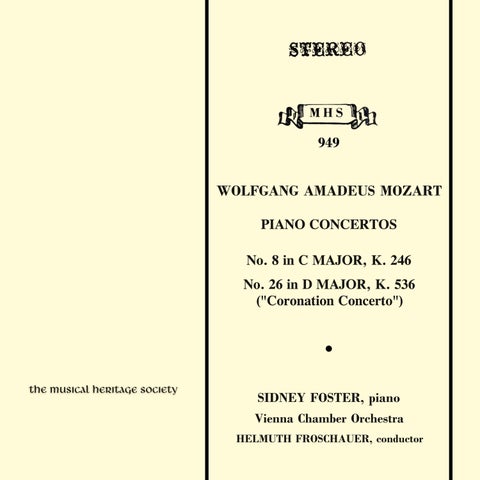
WOLFGANG AMADEUS MOZART PIANO CONCERTO NO. 8 IN C MAJOR, K. 246 I. Allegro aperto (cadenzas by Sidney Foster) 07:01 II. Andante (cadenzas by Sidney Foster) 06:50 III. Rondeau. Tempo di Minuetto (cadenzas by Sidney Foster) 07:02 PIANO CONCERTO NO. 26 IN D MAJOR, K. 537 "CORONATION" I. Allegro (cadenzas by Sidney Foster) 13:53 II. Larghetto (cadenzas by Sidney Foster) 06:15 III. Allegretto (cadenzas by Sidney Foster) 10:44
Sidney FOSTER, piano Helmuth FROSCHAUER, conductor VIENNA CHAMBER ORCHESTRA
Although twelve years separated the composition of the two concertos presented on this recording, a similar aspect of Mozart’s musical personality emerges in each of them. The CONCERTO IN C MAJOR, K. 246, composed in April, 1776, is the work of a young man of twenty. Musically, he was still influenced by the sonatas and concertos of older composers which he had played and studied. Some of these works served as the basis for his earliest concertos which were really arrangements of the keyboard sonatas by popular composers of the time. The musical idiom of these older composers the generation preceding Mozart’s own was predominantly the style galant. Containing graceful melodies and uncomplicated harmonies, this designed for entertainment. It was therefore rarely serious and rarely in a minor key. It was easy to play and easy to understand. The Concerto in C major is one of
Mozart’s earliest concertos not based on themes by other composers. It is, in fact, his fourth original concerto, and was written for Countess Antonia von Lützow, a pupil of Leopold Mozart’s. The Countess was an excellent pianist and Wolfgang could write for her as though for himself, without making concessions to technical limitations. Mozart thought highly enough of the concerto to write to his father in April, 1782, requesting that it be sent to him in Vienna, presumably for his use in a concert. There is an impersonal quality about this work which is also present in the two preceding concertos. The melodies are pleasant if not especially memorable and there are none of the sudden harmonic shifts from major to minor which became characteristic of the later concerti. The keyboard writing is generally not very complex scales and arpeggios abound in the right hand while the left hand is more or less relegated to a simple, non-contrapuntal
accompaniment. However, the piano/orchestra relationship does anticipate things to come: While there is little or no contrapuntal exchange between solo and orchestra, there is a considerable amount of dialogue between them. The second movement, Andante, begins with a characteristically “Mozartian’” melody which sets the mood for the entire movement. The last movement, a Tempo di minuetto, is a rondeau. The archaic spelling, a carry-over from the French rococo, is a further indication of the influence of the galant style on Mozart’s music. An interesting feature of this movement is the fact that Mozart out the cadenza rather than allow his noble patron to improvise one. In a letter to his father on January 17, 1778, Mozart, then living in Mannheim with friends, described how this concerto was played at sight by the composer-pianist Abbé Vogler. This letter also gives an idea of what Mozart valued most among performers: “I
should mention that before dinner he scrambled through my concerto at sight (the one which the daughter of the house plays written for the Countess Lützow). He took the first movement prestissimo, the Andante allegro and the Rondo even more prestissimo. He generally played the bass different!y from the way it was written, inventing now and then quite another harmony and melody. Nothing else is possible at that pace, for the eyes cannot see the music, nor the hands perform it. Well, what good is it? – that kind of sightreading . .. The listeners (I mean those who deserve the name) can only say that they have seen music and piano-playing. They hear, think and during the performance as the player himself. Well, you may feel as little easily imagine that it was unendurable. At the same time I could not bring myself to say to him Far too quick! Besides, it is much easier to play a thing quickly than slowly: in diffcult passages you can leave out a few notes without anyone noticing it. But is that beautiful music?"
It was stated above that although they were composed twelve years apart, the Concerto in C major, K. 246, and the Concerto in Dmajor, K. 537 have much in common. The earlier concerto, written in the galant style, is tuneful, easy to listen to and in general it makes a good if not a profound impression. The similarities between them are these: There is a great deal of the galant style in the later work; it is tuneful, easy to listen to, and moderately easy to play. There is nothing sad or deeply perceptive about it and it was quite obviously designed as a work to please an audience. The solo-orchestra relationship resembles that of the earlier concerto in that there is hardly any dialogue between them. Also, there is no contrapuntal texture between orchestra and solo as there is in the Concerto in C, K. 503, for instance. (On MHS 744 and 920). Even the melodies are simple. We also observe that in the only two places in the entire concerto where melodies begin in a minor key they almost immediately change to major.
Mozart appears to have composed the CONCERTO IN D MAJOR, K. 537 in a great hurry, as the entire work contains 906 measures, but the left-hand part has only 452. This presented no problem for his own purposes as the entire work was in his head and he could play what he had composed even if it were not yet com mitted to paper. The incompleted left-hand part was fnished by Johann André, the first publisher of the concerto and himself a good composer. It is this version which has come down to us today. At the Coronation festivities for Leopold II in Frankfurt on October 15, 1790, Mozart played two concertos: the Concerto in F, K. 459 (on MHS 701) and the present Concerto in D, K. 537. Therefore, strictly speaking, there are two “coronation” concertos. Mozart had hoped that, as Imperial Chamber Composer, he would be invited to go to Frankfurt in the entourage. Instead, Salieri and a now forgotten composer by the name of Ignaz Umlauf were
chosen, along with fifteen musicians.
In his diary for October 15, 1790, Count Ludwig von Bentheim Steinfurt wrote:
place at eleven o’clock this morning. It was a splendid success from the point of view of honor and glory, but a failure as far as money was concerned. Unfortunately some Prince was giving a big déjeuner and the Hessian troops were holding a grand maneuvre. But in any case some obstacle has arisen on every day during my stay here. . But In spite of all these difficulties I was in such good form and people were so delighted with me that they implored me to give another concert next Sunday.
concert in a letter to his wife, dated October 15, 1790: “My concert took
The Concerto in D major:, K. 537, and that in D minor, K. 466, became two of Mozart’s most popular concertos during the nineteenth century. Carl Reinecke, in his book “Concerning the Revival of Mozart’s Concertos,’” drew his musical examples from the “Coronation’” concerto, The second movement has a lyrical quality which is at once galant in its turn of phrase and romantic in its mood. It was this movement which conceivably influenced Chopin when he wrote the slow movement of his E minor
Mozart went to considerable trouble to raise funds to pay his own expenses, feeling that if he gave one or two successful concerts, the outlay would have been worth it. The Concerto in D made the better impression, although the Concerto in F is a finer and more personal work.
“At 11 o’clock in the morning there was a grand concert by Mozart in the auditorium of the National Playhouse ...Mozart played a Concerto [K. 459] composed by himself which was of an extraordinary prettiness and charm, he had a Forte Piano by Stein of Augsburg which must be supreme of its kind .. Monsieur Mozart is a small man of rather pleasant appearance; he had a coat of Brown marine satin nicely em broidered…” Mozart described the
Piano Concerto (No. 1) as it is in the same key and evokes a similar mood. --Douglas Townsend
MHS 10949
©
1 9 7 2 H e r i t a g e M u s i c .seitlayoR
ro c e r y t e i c o S e g a t i r e H l a c i s A u M
g id n
c e r t i i o d n e o h t f r D e r . d K n u a r d l e L c i s u t . d ℗ o r p &