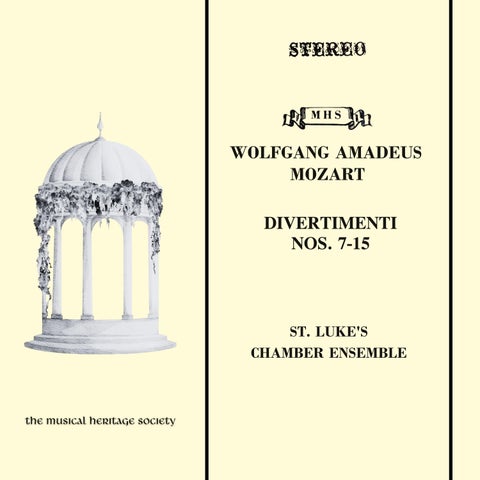
WOLFGANG AMADEUS MOZART Divertimento No. 7 In D Major, K. 205 I. Largo, allegro 06:40 II. Menuetto 02:33 III. Adagio 05:28 IV. Menuetto 02:40 V. Finale - Presto 03:30 Naoko Tanaka, violin Louise Schulman, viola Myron Lutzke, cello John T. Kulowitsch, bass Joseph Anderer, William Purvis, horns Divertimento No. 8 In F, K. 213 I. Allegro spiritoso 04:14 II. Andante 02:31 III. Menuetto 02:49 IV. Contredanse en Rondeau - Molto allegro 01:10 Stephen Taylor, Melanie Feld: oboes Dennis Godburn, Thomas Sefcovic, bassoons Joseph Anderer, horn Stewart Rose, horn
Divertimento No. 9 In B-flat Major, K. 240 I. Allegro 04:19 II. Andante grazioso 02:54 III. Menuetto 02:22 IV. Allegro 03:53 Stephen Taylor, Melanie Feld: oboes Dennis Godburn, Thomas Sefcovic, bassoons Joseph Anderer, horn William Purvis, horn Divertimento No. 10 in F Major, K. 247 I. Allegro 11:25 II. Andante grazioso 03:36 III. Menuetto 04:02 IV. Adagio 08:35 VI. Menuetto 03:12 VII. Andante 00:59 VIII. Allegro assai 05:05 Stewart Rose, William Purvis, horns Eriko Sato, Mayuki Fukuhara, violins Louise Schulman, viola Karl Bennion, cello John Kulowitsch, bass March In F, K 248 04:21
Divertimento No. 11 In D Major, K. 251 I. Marcia alla francese 02:19 II. Molto allegro 06:43 III. Menuetto 03:43 IV. Andantino 03:59 V. Menuetto - Tema con Variatzioni 00:35 VI. Variation I 01:10 VII. Variation II 01:12 VIII: Variation III 01:13 IX: Rondeau - Allegro assai 05:14 Stephen Taylor, oboe Joseph Anderer, William Purvis, horns Mayuki Fukuhara, Mitsuru Tsubota, violins Louise Schulman, viola Karl Bennion, cello John Kulowitch, bass Divertimento No. 12 in E-flat Major, K. 252 I. Andante 04:46 II. Menuetto 02:52 III. Polonaise - Andante 02:31 IV. Presto assai 01:20 Stephen Taylor, Melanie Feld: oboes Dennis Godburn, Thomas Sefcovic, bassoons Joseph Anderer, horn Stewart Rose, horn
Divertimento No. 13 in F Major, K. 253 I. Tema - Andante 01:15 II. Variation I 01:10 III. Variation II 01:14 IV. Variation III 01:13 V. Variation IV 01:12 VI. Variation V - Adagio 02:01 VII: Variation VI - it Tema, ma allegretto 01:08 VIII. Menuetto 02:45 IX. Allegro assai 01:59 Stephen Taylor, Melanie Feld: oboes Dennis Godburn, Thomas Sefcovic, bassoons William Purvis, horn Stewart Rose, horn Divertimento No. 14 in B-Flat Major, K. 270 I. Allegro molto 05:44 II. Andantino 01:53 III. Menuetto - Moderato 02:34 IV. Presto 01:33 Stephen Taylor, Melanie Feld: oboes Dennis Godburn, Thomas Sefcovic, bassoons William Purvis, horn Stewart Rose, horn
Divertimento No. 15 in B-Flat Major, K. 287 I. Allegro 08:47 II. Andante con variazioni 07:27 III. Menuetto 03:33 IV. Adagio 09:04 V. Menuetto 03:49 VI. Andante, allegro molto 07:01 Naoko Tanaka, Mitsuru Tsubota, violin Louise Schulman, viola Daire Fitzgerald, cello John T. Kulowitsch, bass William Purvis, Scott Temple, horns
There has been much recent discussion about just how and where to draw the line between high art and simple entertainment. All such talk becomes academic when we turn to the divertimenti of Wolfgang Amadeus Mozart. Here, unquestionably, is music that sets out purposefully to entertain (the New Grove Dictionary of Music and Musicians translates the word divertimento as “diversion,” “recreation” or “enjoyment”); yet it remains “art” by many standards I know – and a particularly high grade of art, at that. Mozart appropriated the divertimento form from his great friend and mentor Franz Joseph Haydn, who, however, gen erally favored a five-movement frame work. Mozart preferred to plot his diverti menti on a grand scale: most of them are in six movements or more. Here we have Mozart’s complete divertimenti, scored solely for oboes, bassoons and horns (clarinets were not
readily accessible in Mozart’s Salzburg, although the instrument can be found in some of the composer’s earlier exercisesin this genre). Until recently, a sixth divertimento for the same forces, in the key of E-flat, was accepted as Mozart’s and listed in the Köchel catalogue as K.289. Most scholars now doubt that this unprepossessing, loosely knit composition came in fact from Mozart’s pen, and it has been eliminated from this recording. “All Mozart’s music is basically entertainment music,” the English musicologist Stanley Sadie wrote in his succinct and invaluable study of the composer. “What distinguishes the material of this section from the rest is that it was not written for an audience to listen to, more or less attentively, but was designed as a pleas ant background to other activities. When we sit in a concert hall, listerning in solemn silence to an eighteenth-century serenade or divertimento, we should realize that the
music was never intended to bear such a weight of concentration. It was meant simply as a decorative addition to other plea sures – like talking, eating, drinking or love-making – of a highly sophisticated society.” A defense of “background music,” that much-disparaged concept? Well, in a word, yes. The New Grove Dictionary of Music and Musicians provides an apt defi nition of divertimento form. “Following its original Italian meaning, ‘divertimento is generally understood, first, to denote a work primarily designed for the entertain ment of the listeners and the players; it presupposes on the composer’s part a certain lightness of approach, though without excluding the possibility of high artistic achievement, such as is found in divertimentos by Haydn, Boccherini and Mozart.” The definition continues, “Second, a
divertimento could serve as background music for some social gathering such as a conversazione or a banquet. H.C. Koch
(1802) defined the divertimento as fol lows: “it normally had solo instrumentation; it was neither polyphonic nor extensively developed like the sonata; it was intended to please the ear rather than express dif ferent shades of emotion…” Mozart’s most famous essay in this genre is that preternaturally serene mas terpiece of his maturity, the Divertimento in E-flat (K.563) for violin, viola and ‘cello. None of his divertimenti for winds and strings can be said to be in the same league, but they remain delightful works fresh, inventive, expertly wrought fulfillments of a modest purpose: diversion, recreation and enjoyment, for player and listener. The two divertimenti on this recording date from Mozart’s late adolescence a productive (if, perhaps inevitably, person ally difficult) time for the young composer. K.205, in five movements, is the earlier and less grand of the two; Sadie believes it was written in Vienna,
although the New Grove Dictionary suggests that it was actually composed In Salzburg in 1773. Wherever it was written, this is an ele gant, cheerful and directly communicative work in D Major, with no pretensions to profound depth. Scored for two horns, bassoon and strings, it is noteworthy for its two irresistible minuets movements that more than one scholar have found reminiscent of Mozart’s great mentor, Franz Joseph Haydn. Wit is a rare commodity in music; this early “entertainment” has it aplenty.
The Divertimento in B-flat K.287 is considerably more ambitious, but it, too, ultimately charms, rather than overwhelms, the listener. Like the D Major divertimento, it is essentially chamber music, the parts are allotted to solo instruments rather than to sections of a small orchestra. (l have heard it performed in an augmented version, with limited success.) The scoring is for two violins, viola, double bass and two horns.
Although the emotional scope of K.287 with its two long, slow movements is grander than that of K.205, there is still a delightfully unpretentious quality to Mozart’s utterance. He makes free use of folk melodies (one suspects this compos er would have been impatient with our current- and sometimes seemingly arti ficial – divisions between “high” and “low music) and as the New Grove Dictionary so aptly put it, the divertimento includes “material of an almost rumbustiously pop ular character.” The Divertimento was composed in Salzburg in June 1777 and has long been a favorite work in the genre -Tim Page
li t e .s
u d o r P
© & 1 9 ℗ 9 . 2 s H e r i e u r i q t a S g y e r o M g u e s r i c G R y b o y d a e c