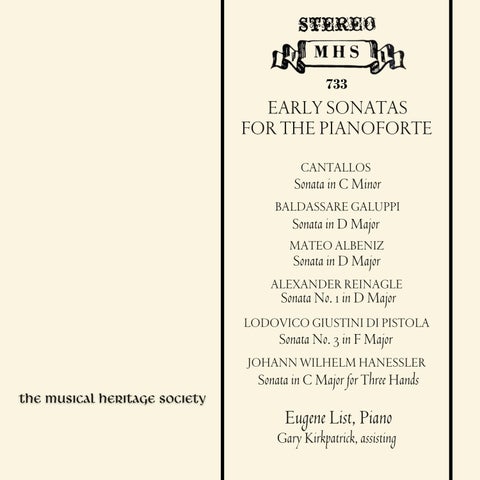
733
EARLY SONATAS FOR THE PIANOFORTE CANTALLOS
Sonata in C Minor BALDASSARE GALUPPI
Sonata in D Major MATEO ALBENIZ
Sonata in D Major
ALEXANDER REINAGLE
Sonata No. 1 in D Major
LODOVICO GIUSTINI DI PISTOLA
Sonata No. 3 in F Major
JOHANN WILHELM HANESSLER
Sonata in C Major for Three Hands
Eugene List, Piano
Gary Kirkpatrick, assisting
CATALLOS (c1760-????) Sonata in C Minor 1. Allegro scherzando
BALDSSARE GALUPPI (17061785) Sonata in D Major 1. Adagio 2. Allegro 3. Largo Maestoso 4. Gigue 5. quasi presto con Fuoco
MATEO ALBENIZ (1760?-1831) Sonata in D Major 1.Presto e gaio
ALEXANDER REINAGLE (17561809) Sonata No. 1 in D Major 1. Allegro con brio 2. Allegro
LODOVICO GUISTINI DI PISTOIA (Early 18th Cent.) Sonata No. 3 in F Major 1. Siciliana 2. Canzone 3. Andante ma non presto 4. Giga
JOHANN WILHELM HAESSLER (1747-1822)
Sonata in C Major for Three Hands 1. Allegro EUGENE LlST, piano GARY KIRKPATRICK, assisting
A Musical Heritage Society recording produced under the direction of DR. KURT LIST
The compositions recorded here are among the earliest keyboard compositions which may reasonably be assurned to have been written for the Hammerklavier. The Hammerklavier is distinguished from older instruments of its kind by its hammer mechanism. The sound is produced by a hammer struck against a string. This instrument, peculiarly suited to the requirements of the "galant" style of the early 18th century, was invented in 1709 by the Italian harpsichord maker Bartolomeo Cristofori. Since it enabled the player to produce soft as well as loud sounds, he called it gravicem balo col piano e forte"'. Early keyboard works reveal baroque conceptions of form, chiefly the suite. We encounter individual movements which are strict dances. But the limitation of each composition to only a few movements anticipates the
classical sonata form. Baldassare Galuppi (1706-1785) , a Venetian who studied with Lotti, was known mainly as an opera composer. He traveled widely and spent a long time in England, where he gained a great influence on English music. In 1748 he be came Maestro di Capella at St. Mark's in Venice. Mateo Albeniz (1760?-1831 ) was Maestro di Capella in Logrono. He was a prolific composer and highly esteemed by his contemporaries. His sonatas are modeled sornewhat on those of Scarlatti, employing the rhythm of the zapateado. Our edition is based on a nanuscript in the possession of Pere Nemesio Otano. Cantallos (born about 1760- date of death unknown). Unfortunately, nothing is known about his life, not even hfs fhrst name. He,
too, imitated Scarlatti's style, and States, he was greeted on his introduced the Spanish rhythm of arrival at Trenton with the chorus the zapateado. "Welcome, Mighty Chief", composed for occasion by Alexander Reinagle (1756-1809) Reinagle and dedicated "by was a composer of Austrian permission" to Mrs. Washington. parentage who spent most of his life in the United States. He was Lodovico Giustini di Pistoia. the first important composer of Nothing is known about this serious music in his country. The composer except that he four sonatas, of which the present published a volume of pianoforte recording is No. 1, are in sonatas in 1732. The sonata manuscript and are in the Music recorded here is from the col Collection of the Library of lection which carries the following Congress in Washington. No dates inscription: Sonate Da Cimbalo di appear in the manuscript, but it is piano, e forte detto volgarmente believed that the sonatas were de martelletti dedicate A Sua written in 1786-87. They are Altezza Reale II Serenissimo D. apparently the fhrst works Antonio Infante Di Portogallo e composed for the piano in the composte Da D. Lodovico Giustini United States. Reinagle performed di Pistoia Opera prima Firenze his piano sonatas several times MDCCXXXII. on "benefit" programs. George Washington attended the "benefit" Johann Wilbelm Hassler (1747concert on June 12, 1787, as 1822) was musical director of the recorded in his diary for that date. When Washington was elected President of the United
public concerts in Erfurt and organist at the Barfüsser Church. The original manuscript of this sonata is in the Prussian State Library. It was written for two play ers, of whom the second plays only a one-line melody. FLORIAN GRASSMAYR
e g a t i r e H l a c i s u M A
ta g e M u ics R o y a l t i e .s
c o S
c e t r i i o d n e o h f t D r e r . d K n u u r t d e L c i s u t . d ℗ o r p & g © n i 1 d r 9 o 6 c 6 e r H y e t ri ei