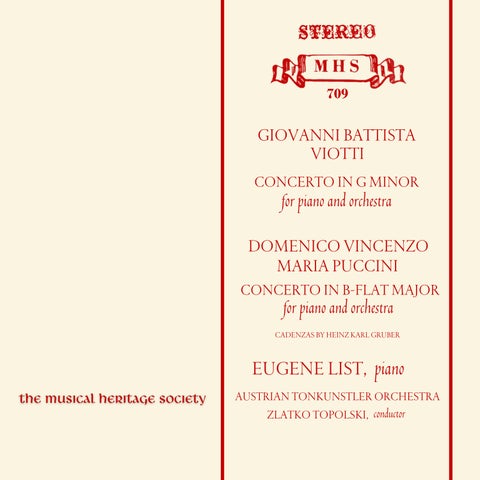
709
GIOVANNI BATTISTA VIOTTI CONCERTO IN G MINOR
for piano and orchestra
DOMENICO VINCENZO MARIA PUCCINI CONCERTO IN B-FLAT MAJOR
for piano and orchestra
CADENZAS BY HEINZ KARL GRUBER
EUGENE LIST, piano AUSTRIAN TONKUNSTLER ORCHESTRA ZLATKO TOPOLSKI, conductor
GIOVANNI BATTISTA VIOTTI (1753-1824) CONCERTO in G minor for piano & orchestra 1. Allegro maestoso 2. Adagio non troppo 3. Rondo DOMENICO VINCENZO MARIA PUCCINI (1771-1815) CONCERTO in B-flat major for piano & orchestra 1. Allegretto 2. Adagio 3. Adagio non presto (cadenzas by Heinz Karl Gruber) EUGENE LIST, piano AUSTRIAN TONKUNSTLER ORCHESTRA, VIENNA ZLATKO TOPOLSKI, conductor
Giovanni Battista Viotti, represented on this record by a piano concerto, was best known in hfs lifetime as a violinvirtuoso. In fact, he is considered the father of modern violin playing", and his violin concerti, respected for their technical mastery, still affordbasic training for violinists. Although he was Italian, born in Piedmont, the settingof his musical activity was mainly Paris to which virtuosi (including Mozart) gravitated, from every part of Europe in the eighteenth century, to have their works played in public at the famous Concerts Spirituels founded there in 1725. Be cause of his long sojourn in Paris, Viotti's first names are often transformed into Jean Baptiste. Prior to coming to France, Viotti studied with the violinist Pugnani and toured Germany and Russia with him in 1780. From 1782 to 1792, his home was Paris where he played at the Concerts Spirituels, led the band of the Prince of Soubise,
conducted at the Italian Opera in the Tuileries, directed what was known later as the Theatre Feydeau, and served on occasion as the accompanist of Marie Antoinette. Cherubini assisted Viotti in adapting Italian opera to French taste. The French Revolution drove him from France to extensive concert tours and finally to London where he engaged in some commercial ventures. which ended disas trously. He returned to France to become the director of the Opera between the years 1819 to 1822. Dogged by financial failure, he was forced to return to London where he died shortly afterwards. In Paris, Viotti with his violin pupils Rode, Baillot, and Kreutzer established a Paris school of violin playing which gave the Italian violin concerto a characteristic French style - conservatively classical, noble and rather cold and minus the Romantic
subjective clements which were just beginning to come into their own. Viottiand his schoorforma bridge between the great violin school (Geminiani, Locatelli, Vivaldi) and the pyrotechnics of Paganini and Spohr. In addition to twenty-nine violin concertos, Viotti composed an impressive number of string quartets and trios, two concertanti for two violins, some fifty violin duets, and also ten piano concertos. The piano concerto presented here was begun in Paris in 1792 and finished in London in 1794. It also exists in a transcription for violin by Viotti. Part of the concerto was first published in Paris in 1792, In thisoriginal edition, it carried the following inscription: "This concerto was composed for the pianoforte and not for the violin; it can be played with or without accompaniment on the old pianoforte or on the modern pianoforte with an extended keyboard." The
present performance is based on the original publication and has been edited and brought up to date with.the addition of parts found in London by Dr. Kurt List. The orchestra consists of two flutes, two oboes, two clarinets,two bassoons, two horns, two trumpets, tympani, and the customary strings. The work follows the classical three-movement form, and the cadenzas are by Viotti himself. DOMENICO PUCCINI, the grandfather of the composer of La Bobeme,was the third of five generations of distinguished composers in the Puccini family, descending in unbroken line from the first Giacomo, maestro di cappella, born in 1712, to the popular opera composer, another Giacomo, who died in 1924. They lived in Lucca for the most part, and through the centuries composed mainly sacred music and operas for its churches and opera house. Domenico Puccini, like the others,
composed masses, motets, psalms and hymns for local consumption, and also numerous operas, for which last he received instruction from Paisiello in Naples. The manuscript of the piano concerto, upon which this performance is based is preserved in the Liceo Musicale in Lucca, The work is the standard piano concerto form with threemovements following each other withoutpause. The orchestra is for two oboes, two horns, and the customarystrings. The cadenza was written especially for Eugene List by the Austrian composer, Heinz Karl Gruber. This work, like Viotti's, is an example of the piano concertos written outside of Germany and Austria, in the period that followed the French Revolution - a period in which the spotlight tends to fall more usually on Mozart recently dead, and on the young Beethoven. FLORIAN GRASSMAYR
A
I ts
d o r u p c e g d n i u d r n o d c e e r R t h y e t e d i i c r e o c S t i e o g n a t o i r f e D H r . l K a c a i r s lL u M
709