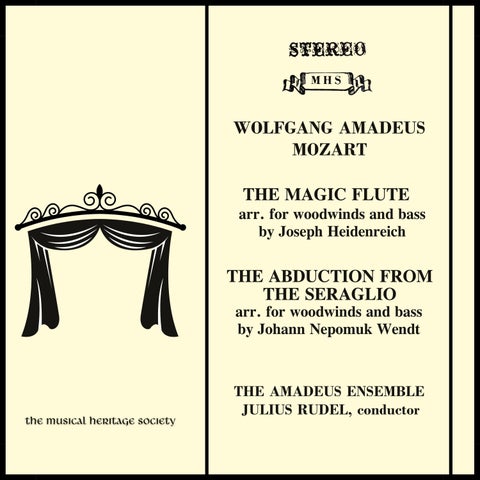
WOLFGANG AMADEUS MOZART DIE ZAUBERFLÖTE (arr. for woodwinds and bass by Joseph Heidenreich)
1. Overture 04:59 2. Der Vogelfänger bin ich ja 01:58 3. Hm! Hm! Hm! Hm! 04:08 4. Dies Bildnis ist bezaubernd schön 03:35 5. Bei Männern, welche Liebe fühlen 02:59 6. Das klinget so herrlich 01:38 7. Alles fühlt der Liebe Freuden 01:28 8. Ein Mädchen oder Weibchen wünscht Papageno sich 03:37 9. O Isis Und Osiris 02:34 10. Pa-Pa-Pa-Papageno 02:01
DIE ENTFÜHRUNG AUS DEM SERAIL (arr. for woodwinds and bass by Johann Nepomuk Wendt)
1. Overture 01:40 2. Hier soll ich dich denn sehen 02:48 3. Ich gehe doch rate ich dir 03:05 4. Durch Zärtlichkeit und Schmeicheln 03:22 5. Wenn der Freude Tränen fliessen 03:46 6. O wie will ich triumphieren02:23 7. Welche Wonne, welche Lust 02:37 8. Vivat Bacchus! Bacchus lebe! 01:51
The AMADEUS ENSEMBLE JULIUS RUDEL, conductor
Die Zauberflöte and Die Entführung aus dem Serail
This recording features Harmonie known other than that he lived from arrange ments of two Mozart operas 1753 to 1821. From what can be that, although written nearly a decade reconstructed, Heidenreich wasted no apart, were similar in many ways. The time in taking advantage of Die most obvious similarity is that both Zauberflöte’s popularity; within four librettos were written in German, the months of the opera’s premiere he language of the “people,” whereas was advertising the availability of the Mozart’s other major operas are in Harmonie arrangement of Mozart’s Italian, the language of the Court. In last opera. addition, both operas blend the comic element of characters such as The arrangement of Die Entführung Papageno and Osmin with the aus dem Serail is somewhat of a cerebral profundity of characters mystery. Even though Johann Such as Sarastro and Pasha Selin. Nepomuk Wendt (who also arranged Le Nozze di Fígaro) is given credit for In this recording conductor Julius the Harmonie arrangement of Die Rudel hae edited the 19th-century Entführung aus dem Serail, there is arrangements and on occasion added reason to believe that the notes, contained in Mozart’s original arrangement is actually by Mozart operas which had been inexplicably himself. On July 20, 1782, Mozart left out. Thus, Die Zauberflöte is a wrote to his father: “l am up to my cornbination of Mozart, Rudel, and eyes in work for I have to arrange my the original arranger, Joseph opera (Die Entführung aus dem Heidenreich, about whom very little is Serail) for wind instruments.” Not
unaware of the potential of such a work, Mozart went on to write: “If I don’t, someone else will anticipate me and gain the profits.” In any event, the resulting Harmonie arrangerment is most certainly among the finest of any opera arrangements, and it makes a delightfully entertaining eight-movement suite, a lovely arrangement of Mozart’s Turkish delight. --Anthony J. Rudel
THE AMADEUS ENSEMBLE: Leonard Arner, Robert Botti, oboes John Moses, Mitchell Estrin, clarinets Stewart Rose, Debra Poole, horns Frank Morelli, Harry Searing, bassoons Jack Kulowitsch, Alvin Brehm, Richard Frederickson, double bass JULIUS RUDEL, Conductor Leonard Arner, Director
Recorded in Rye, NY, 1985 Produced by Gregory K. Squires for Tonino Productions, Inc. Mastering: Bill Kipper, Masterdisc Corp.