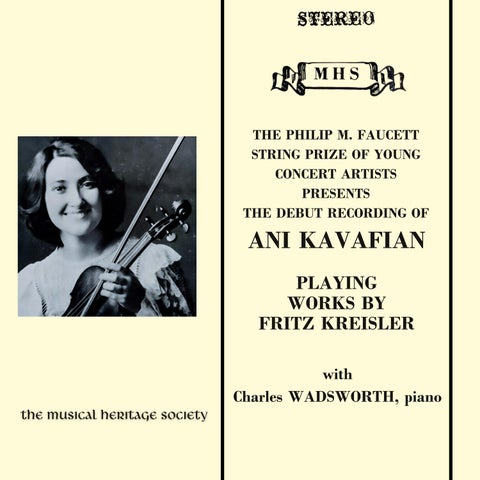
THE PHILIP M. FAUCETT STRING PRIZE OF YOUNG CONCERT ARTISTS PRESENTS THE DEBUT RECORDING OF
ANI KAVAFIAN PLAYING WORKS BY FRITZ KREISLER with Charles WADSWORTH, piano
THE PHILIP M. FAUCETT STRING PRIZE OF YOUNG CONCERT ARTISTS
presents
ANI KAVAFIAN, violinist with CHARLES WADSWORTH, pianist
MUSIC 0F FRITZ KREISLER 1. Tempo di Minuetto (Gaetano Pugnani) 2. La Giltana Arabo (Spanish Gypsy Song of the 18th Century) 3. Liebesleid (Love's Sorrow) 4. Mazurka in A Minor (Frederic Chopin) 5. Aubade Provencale (In the Style of Louis Couperin 6. Siclano and Rigaudon (Francois Franceur) 7. Recltativo and Bcherzo, Op. 6 (for Violin Alone 8. Melodie (Christoph Willald Gluck) 9. Al I'll 0lgreto (In the Style of Bocaherinl) 10. Tango sac Albeniz, 11. La Campanela (Noco Paganiti, Op.T 12. Fasquta (Franz Lehar)
FRITZ KREISLER [1875-1962] It is impossible to discuss the music of Fritz Kreisler without appreciating Fritz Kreisler the man. Fritz Kreisler the complete violinist was also Fritz Kreisler the complete man - a humanitarian, philosopher, and lover of learning. Here was an artist whose performances swiftly transcended the mechanics of musicianship and spoke directly to the heart and soul. Kreisler loved to play the violin. In his many concerts, he is remembered as having bounded onto the stage - his handsome, smooth face framed by a shock of abundant, sometimes unruly hair, a disarming smile expressing his sense of pure joy at the pleasure of performing. The violin in his hands sang with an indescribably mellow voice - his phrasing at once sensitive, graceful and alive. When Kreisler played the violin, questions of technique were superseded. He often said that sincerity and personality were the main essentials of the concert violinist and "l don't believe that any artist is truly a master of his instrument unless his control of it is an Integral part of a whole," he once said. "One feels deeply in one's heart, and one transfers that meaning to tone. To rely on muscular habit, which so many do, is futile. A little nervousness, a muscle bewildered, and where are you?'" . Fritz Kreisler mastered the violin early in life, following a precocious route. His father, a Viennese doctor of modest means but abundart love of music,
first exposed litle Fritz to music through frequent, informal string quartet performances at home. Fritz, at only 32 years of age, was so disturbed by the sour notes emanating at times from the living room that he fashioned for himself a small violin from a cigar box and 4 strings and set about singing to himself the correct pitches and phrasing. His father responded by initiating Fritz into the basic mysteries of violin playing, and was soon so outdistanced by his son's remarkable progress that Kreisler påre put aside his violin for the cello. Interestingly, his second son Hugo's artistry on the cello soon prompted the father to seek refuge and pleasure in the viola. By 7, Fritz Kreisler's astonishing talents earned him unprecedently youthful acceptance to the Vienna Conservatory, where 3 years later, he won the first prize Gold Medal for violinists. Kreisler then enrolled in the Paris Conservatory where, in 1887 at the age of 12, he was awarded the Premier Premier Prix, "" (first of all the violinists honored). There, he studied compos ition with Delibes and violin with Massart, whose appraisal of Kreisler's potential proved prophetic: I have been the teacher of Wieniawski and many others, but little Fritz will be the greatest of them all. These studies were the last formal music lessons of Kreisler's life. But he never grew artistically complacent and constantly sought fresh musical insights. He could learn from the most celebrated ( really believe that hearing Joachim and Anton Rubinstein play was a greater event in my life and did
more for me than 5 years of study'") or the most unassuming (*" always listen to street fiddlers. They may screech and scratch, but if | wait long enough, there is a beautiful tone or a novel turn of phrase which has made it worthwhile to linger on.'"') In 1888, when he was only 13, Kreisler embarked on a triumphant concert tour of the United States with pianist Moriz Rosenthal. Once back in Vienna, he auditioned for a second violin stand in the Vienna Philharmonic. Curiously, perhaps because of his individual musical style, he was not accepted. For the next 6 years, Fritz Krelsler did not touch a violin. He spent the time absorbing politics, philosophy, mathematics and languages at the Plaristen Gymnasium (High School), studied pre-medicine at the University, and then served 2 years in the Imperial Austrian Army. These broad studies formed the basis of the enormously rich intellectual pursuits that characterized his long life. He was fluent in 7 languagss - German, English, French, Spanlsh, Italian, Latin and Greek - was an expert chess and bridge player, and a passionate collector of rare books. His diverse interests suggested a future that was not singlemindedly devoted to the violin. "In my youthful days," he noted many years later with amusement, "I had some very weird thoughts about my future career. I envisioned myself operating on a patient in the morning, playing chess in the afternoon, giving a concert in the evening, and in anticipation of a glorious military career, winning a battle at midnight." Ultimately, of course, the violin prevailed. Kreisler's return to serious concertizing occurred after an 8
-week stint to polish up his technique, cuiminating shortly thereafter with acclaimed performances of Bruch's Concerto No. 1 with the Vienna Philharmonic under Hans Richter in 1898, and of the Mendelssohn Concerto with the Berlin Philharmonic under the baton of Arthur Nikisch in 1899. A return tour to the United States in 1900-01 proved crucial, not only for his growing reputation, but almost more significantly, for his fateful meeting on the cruise back to Europe with a beautiful, red-haired divorcee from New York named Harriet Lies. Their intensely happy marriage began a year later and lasted 60 years until Kreisler's death in 1962. Harriet took command of the previously bohemian life in which Kreisler might have squandered his formidable talents. She hovered backstage through every performance, oversaw details of dress, diet and daily existence and generally brought order and discipline to Kreisler's life. Without Harriet Kreisler, many close friends affirmed, there would have been no legendary Fritz Kreisler. When World War l broke out, Kreisler fought briefly in the Imperial Austrian Army at the Russian front, a hip wound causing him to be declared unfit for further service. The Kreislers decided to go to America, where anticipation of possible antagonism to his Austrian military record prompted Kreisler to perform only for charitable causes until after the Armistice. In the years of peace that followed, Fritz Kreisler's international fame grew spectacularly. News of his appearances had only to be posted to ensure sold-out Concerts. Fritz Kreisler was known to every
household; his records were essential items in even the most modest phonograph collections, and his name was cited as a universal standard of excellence for any field. Yet, Kreisler throughout his life maintained a basic warmth and humility that earned him the treasured friendship of many. He loved humanity both in the mass and individually, and refused to value people for social station alone. A famous anecdote tells of a social doyenne who asked Kreisler to perform at a select private party for a fee of $3,000. 'But,'" she warned, "you are not to mingle with the guests." “In that case:, Kreisler rejoined, "the fee will be $2,000." Kreisler's immense impact on the world of music extends further than the memory of his brilliant concerts or the precious heritage of his records. He enriched the violin repertoire by more than 200 compositions and transcriptions. In the salad days of his career, almost all musicians dabbled at composing, and Kreisler soon employed his pen to attacking the then-current dilemma of the limited violin repertoire acceptable for concert programs. Young violinists who assayed the great Beethoven sonatas were considered presumptuous. One was thought to need a celebrated pianist as collaborator, and the major pianists would not deign to appear with an unknown violinist. Like other aspiring violinists, Kreisler's concerts predictably presented works like Bach's '"Chaconne'' or the 'Devil's Trill'" of Tartini, or sonatas by Corelli, Veracini and Geminiani, with other small pieces like Wieniawski's 'Mazurka'" and Vieuxternps' "'Ballade. '" Facing this dearth of programmable works, Kreisler resolved to create his
own. He composed short works in various styles and, fancying it arrogant to repeat his name endlessly on programs, he ascribed some to himself and described others as works by then little-known 17th, 18th and early 19th century composers. Kreisler explained vaguely that he had found them while rummaging through the library of a French monastery. The public was captivated, though at times the critics cavilled. Some grumbled that Kreisler's adaptations were not true to the originals, and one even complained that Kreisler's temperament and maturity were not equal to the works' artistic heights. Kreisler's publishers listed his works in 3 main categories: Original Compositions, Works of the Great Masters (transcriptions of known works by Bach, Mozart and others), and Classical Manuscripts. In the last group, there figured Kreisler's little deceptions. For 35 years, this situation prevailed, until Olin Downes of the New York Times, researching a lecture program to be performed by Mr. Downes and Yehudi Menuhin which included several of these "transcriptions," was unable to locate a copy of the original manuscript for Pugnani's "Praeludium and Allegro." Downes appealed to Kreisler for clarification. This was the first time that Kreisler had been directly questioned, and he immediately confessed the whole truth. Music lovers and most critics, including Mr. Downes, received the story with amusement and sportsmanship, but Ernest Newman in the London Times engaged Kreisler in a vitriolic public exchange
of letters. Kreisler defended himself from Newman's harsh accusations of a lack of ethics: "| did not write the pieces in question as a young man in the hope of tripping up the eminent oritic 35 years later. I simply wrote them in order to enlarge my programs, where they figured modestly, 'in the style of Pugnani, Cartier, etc., etc."' The debate abated, and the works have survived to lovingly fill a portion of the violin repertoire that is suffused with grace and charm. Once, reminiscing about his early days in turn-of-thecentury Vienna, when Kreisler would pass stimulating hours at the Grunstedtl Cafe discussing music and life with such other artistic personalities as the young Hugo Wolf, poet Hugo von Hofmannsthal, writer Arthur Schnitzler and, at times, Johannes Brahms, Kreisler remarked: "We knew then a wine of the spirit. We were preoccupied with beauty. And thank God, the spell did not wear off." Judith Kurz THE PHILIP M. FAUCETT STRING PRIZE OF YOUNG CONCERT ARTISTS is awarded biennially to an outstanding violinist, violist, cellist or string quartet on the roster of Young Concert Artists, Inc., the nonprofit management. The Prize consists of a recital at Alice Tully Hall at Lincoln Center in New York, and a recording contract. Recipients are selected by a special panel on the basis of superior career achievement. Young Concert Artists was founded in 1961 as a non-profit organization dedicated to promoting the careers of exceptional young artists.
ANI KAVAFIAN'S special artistry has won the enthusiasm of audiences and critics alike. Since winning the 1973 Young Concert Artists International Auditions, her numerous performances as recitalist, as soloist with orchestra and in chamber music throughout the United States and abroad have earned her a secure place in the international concert scene. "Ani Kavafian is a superb artist, easily capable of holding her own in the company of the world's top violinists,"" wrote Paul Hume in the Washington Post. In 1977, Miss Kavafian was honored as recipient of the First Philip M. Faucett String Prize of Young Concert Artists. The Faucett Prize awarded Miss Kavafian this recording debut, as well as an Alice Tully Hall recital at New York's Lincoln Center on March 21, 1978. Miss Kavafian's previous prizes include the Avery Fisher Prize in 1976 which brought her an acclaimed solo appearance with the New York Philharmonic. Born in Istanbul, Turkey of Armenian parentage, Miss Kavafian moved with her family to Detroit, Michigan at an early age. She received her Master's Degree from the Juilliard School in New York, where she studied with Ivan Galamian. CHARLES WADSWORTH'S talents and exuberant personality have been in the forefront of an international resurgence of enthusiasm for chamber music.
i t r a e g H e M 3 2 u 0 s i 2 c R © o & y a 8 l t 7 i e 9 1 s . ℗
H S M
www.themusicalheritagesociety.com