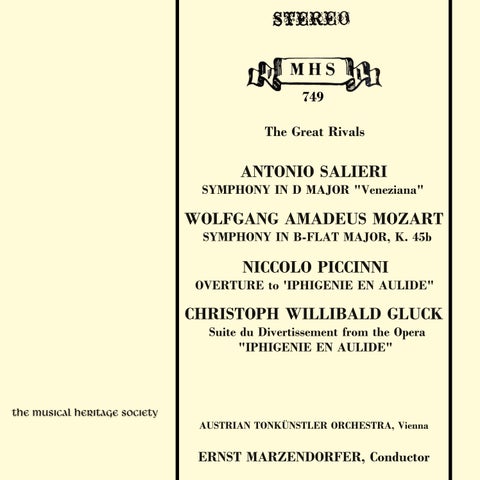
749 The Great Rivals
ANTONIO SALIERI SYMPHONY IN D MAJOR "Veneziana"
WOLFGANG AMADEUS MOZART SYMPHONY IN B-FLAT MAJOR, K. 45b
NICCOLO PICCINNI OVERTURE to 'IPHIGENIE EN AULIDE"
CHRISTOPH WILLIBALD GLUCK Suite du Divertissement from the Opera "IPHIGENIE EN AULIDE"
AUSTRIAN TONKÜNSTLER ORCHESTRA, Vienna
ERNST MARZENDORFER, Conductor
THE GREAT RIVALS AUSTRIAN TONKÜNSTLER ORCHESTRA, VIENNA ERNST MÄRZENDORFER, conductor Antonio Salieri (1750-1825) Symphony ín D Major (Veneziana) 1. Allegro assai 2. Andantino grazioso, Presto Wolfgang Amadeus Mozart (1756-1791) Symphony No. 55 in B-flat Major, K. 45b 1. Allegro 2. Andante 3. Minuet 4. Allegro Niccolò Piccinni (1728-1800) Overture to Iphigénie en Tauride Christoph Willibald Gluck (1714-1787) Suite du divertissement from Iphigénie en Aulide
Stories of jealousy and intrigue among composers or their adherents are probably as old as music itself. But two rivalries have become famous, though undoubtedly exaggerated by legend and myth. Antonio Salieri (1750-1825) was the fifth son of an Italian merchant and his wife. He studied violin and harpsichord with his brother Francesco, a pupil of Tartini, and violin with Giuseppe Simoni, organist of Legnago. When Salieri was orphaned in 1765, his father's friend, Guiseppe Sirnoni, took him to Venice where he studied counterpoint and singing.
Salieri went to Vienna while still a student in 1766, where he later became the emperor's favorite opera composer and was appointed court Kapellmeister in 1788. There is no doubt that Wolfgang A. Mozart (1756-1791) felt slighted when Salieri arrived at the court. The son of
the Austrian composer, Leopold, Mozart was a child prodigy and his early fame and experiences left their mark on his character. Mozart's letters from the last years of his life descríbe his unfortunate situation at this time. Both he and his wife, Constanze, had been ill, he suffered financial difficulties, and their daughter, Anna, died the same day she was born. Mozart's position deteriorated still further when Joseph II died in 1790 and was succeeded by his brother, Leopold, who took very little interest in Mozart. It seems rather certain that Salieri plotted against Mozart, and the mysterious circumstances of Mozart's death probably lent weight to the legend that Salieri had poisoned Mozart. A considerable literature has grown out of this assumption, and there is even an opera by Rimsky-Korsakov on the subject, based on Pushkin's play. (Musicologists and medical authorities
have long since concluded that the legend Piccinni was a reformer. He freed opera has no basis in fact.) from the static clichés of an earlier period and, although he had no command of The rivalry between the partisans of French when he composed his first opera Piccinni and Gluck was far more to a French libretto, he was careful to give spectacular. the text its due in his music. Although Niccolo Piccinni (1728-1800) was born into a family of musicians, he originally was intended for the church. His musical talent, however, was too great to
Christoph Willibald Gluck (1714-1787) was the first surviving child of Alexander Gluck, a huntsman and forester, and his wife Maria. It is likely that he went to school in Reichstadt and there had his first music lessons in violin and voice. His father tried to discourage his son's interest in music, but Gluck settled the question by running away from home at the age of 13 or 14. After earning a living for himself in Prague, Gluck later became reconciled with his father. He continued his study of music and was primarily self-taught.
escape notice. From 1742 until 1754, Piccinni is said to have been at the S Onofrio Conservatory in Naples, where he studied with Leo and Durante. Piccinni had achieved considerable fame as an opera composer in Italy, mainly in Rome, when he went to Paris in 1776. There his operas were much admired by a certain group of amateurs, who, with much noise, proclaimed their superiority over those of Today the rivalry between Gluck and Pic Gluck, who was then active in Paris. cinni (which was not of their own making, in any case) is difficult to understand,
because both composers had the same aim: to create operas which, at the same time, make sense as drama. On this recording are typical examples of the work by the two pairs of rivals, not in order to demonstrate the obvious fact that Mozart and Gluck were the superior composers, but to show, aside from the musical merits of the respective works, the similarity of approach in both cases. Though formally less developed, Salieri's symphony resembles that of Mozart in thematic material. It is scored for oboes, horns, and strings. The date of composition is unknown. This recording is based on the parts printed during Salieri's lifetime and now kept in the archives of the Gesellschaft der Musikfreunde in Vienna. The Mozart symphony (formerly K. Anh. 214) was probably composed in Vienna early in 1768. It is scored for the same instruments as the Salieri symphony, but it
is formally more elaborate, having one additional movement, a minuet. Piccinni's Overture to Iphigénie en Tauride was composed in 1781. It is a typical Italian overture with two fast outer movements and a slow middle movement. It is scored for flutes, oboes, bassoons, trumpets, timpani, and strings. Christoph
Willibald
Gluck's
Suite
du
divertissement from the opera Iphigénie en Aulide is a dance sequence from the opera, written in 1774, i.e., seven years earlier than the Piccinni overture. It is scored for oboes, horns, and strings. The difference between the two works is quite marked, and this may also indicate the difference between the two composers. The Piccinni overture is a robust piece, whereas Gluck's suite is full of musical finesse and delicacy. Although neither composer was of French origin, Gluck's style approaches the French concept of music to a far greater degree. Florian Grassmayr
Pr o
Mastering: Bill Kip per, Ma ste rdi sk Co
. rp
st i L t r u K r. D y b d e c u d
749