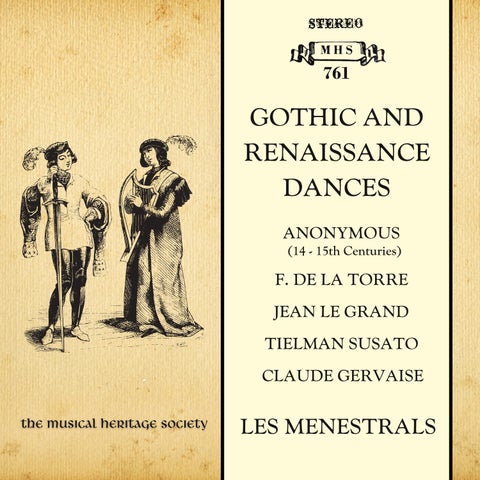
761
GOTHIC AND RENAISSANCE DANCES ANONYMOUS (14 - 15th Centuries)
F. DE LA TORRE JEAN LE GRAND TIELMAN SUSATO CLAUDE GERVAISE
LES MENESTRALS
ANONYMOUS: 7 PIECES 1. Trotto (14th Century) (rebec, tenor violin, lute, sopranino recorder, busine, drum, tambourin) 2. Nota (14th Century) (rebec, lute, busine) 3. Lamento di Tristan ( 14th Century) (pardessus de viole, tenor violin, sopranino recorder, drums) 4. Stantipes (14th Cent) (rebec, tenor violin, lute, bass krummhorn, glockenspiel) 5. Saltarello (14th Century) (soprano recorder, drum) 6. Istampita Ghaetta (14th Century) (rebec, tenor violin, shawm, tenor krummhorn, bass krummhorn, soprano recorder, small drum, triangle) 7. Molendinum de Paris (15th Century) (lute, pardessus de viole, tenor violin) 8. F. DE LA TORRE: ALTA DANZA (15th Century) (sopranino recorder, shawm, tromba da tirarsi) 9. JEAN LE GRAND: ENTRE VOUS (15th Century) (pardessus de viole, lute, tenor violin, drum) TIELMAN SUSATO (c. 1490 - c. 1560) 10. Pavane –The Battle (pardessus de viole, viola da gamba, soprano and alto cornetts ) 11. Allemande (1:51) (pardessus de viole, tenor and bass krummhorns, viola da gamba) ANONYMOUS: 3 PIECES for LUTE (16th Century) 12. Allemande 13. Pavane 14. Galliarde 15. CLAUDE GERVAISE: DANCES (C. 1550) Allemande (alto cornett, pardessus de viole, lute, viola da gamba, drum) Pavane-Passamezzo (tenor recorder, pardessus de viole, lute, viola da gamba, drum) Galliarde (schalmey, alto cornett, pardessus de viole, viola da gamba, lute) Bransles de Bourgogne a--soprano recorder, Gothic violin, pardessus de viole, viola da gamba b--schalmey, pardessus de viole, alto cornett, viola da gamba c--schalmey, soprano recorder, pardessus de viole, soprano cornett, shawm, viola da gamba Bransles de Champagne a--tenor recorder, pardessus de viole, viola da gamba b--shawm, tenor and bass krummhorns, dulcian c--tenor krummhorns, pardessus de viole, viola da gamba, dulcian d--alto cornett, soprano recorder, pardessus de viole, viola da gamba, dulcian, bass krummhorn
LES MENESTRALS Klaus WALTER -- Lute, Soprano Cornett, Tenor and Bass Krummhorns, Pardes sus de Viole, Tenor Recorder, Drum, Triangle, and Tambouri Michel WALTER -- Alto Cornett, Tromba da Tirarsi, Shawm, Tenor and Bass Krummhorns, Busine, Drum, and Glockenspiel Eleanor SLOANE -- Rebec Gothic Violin and Pardessus de Viole Gerald SONNECK -- Tenor Violin, Viola da Gamba Ernst KOELZ -- Sopranino, Soprano, and Tenor Recorders; Tenor Krummhorn, and Drum Alfred HERTEL – Schalmey, Dulcian, Shawm, and Drum
Between 1300 and 1600, secular instrumental music came into being by way of the many dances that flourished among the folk despite the Church's opposition. This music, often sung at the same time as it was danced, was so attractive that it was appropriated by royalty in the 14th century. In the process, dances sometimes changed their character and became formalized; they were also freely exchanged for others of neighboring countries. Abandoning the freely flowing rhythms of plainsong, they took on what we consider to be elements basic to music -- steady rhythms, contrast, repetition, variation, balance of phrases. Eventually in the early 17th century, sets of these dances, arranged in a kind of international potpourri of contrasting rhythms, became the instrumental suites which in turn laid the basis for movements of the sonata and symphony. No such suites appear on this record, however, for the Gothic and Renaissance musicians played these dances singly or at most in certain pairs of which mention will be made later. Therefore, any succession of dances on this record is to be thought of as unconnected compositions having no formal relation to each other. Names of dances often give clues as to their basic nature and country of origin. Thus important basse danse (1450-1550) of the Burgundian court as a "low'" dance in that the feet were not lifted far from the floor: a
danse haute or alta danza would be high" in that it contained a leaping movement as in the galliarde or volta, both deemed quite daring because the lady was swung high in the air by her cavalier. The gliding basse danse, serious and stately, generally had two beats to the measure; so did the pavane, allemande, passamezzo, chaconne, sarabande, and bransle. Dances with three beats to the measure were livelier to varying degrees: the galliarde, courante, saltarello, gigue, sarabande, passepied, etc. As had been said, Gothic and Renaissance dances derived from different countries. From Italy came the pavane, galliarde, volia, passacaglia, passamezzo, and saltarello. Spain gets Credit for the chaconne, sarabande, and perhaps the pavane. From the British Isles came the jig (gigue), hornpipe, haye (hey), and the country dance. But France easily leads with the istampita, courante, bransle, basse danse, allemande, bouree, passepied, gavotte, rigaudon, loure, and minuet. Numerical superiority and inventiveness from troubadour days through the reign of Louis XV placed France early in the position of setting styles and providing terminology in the widening field of the dance. A brief description of the dances heard on this recording should be helpful. The istampita (stantipes) rates first place because of its
antiquity, popularity in medieval life and long life (12th - 15th centuries). It was a dance-song invented by the troubadours of Provence, resembling a rondeau with a repeated refrain, Dominating the 16th century was the pavane, supposedly deriving its name from Padua, although it is sometimes attributed to Spain. It was a slow and majestic processional dance for which the participants dressed in elaborately rich costumes (hence it is sometimes derived from "pavo'", the Latin for "peacock", It had two beats to a measure and was very soon paired with the rapid galliarde which had three beats to a measure. In France, the latter was called cinguepace because it consisted of five steps taken to six beats; on the fifth beat, the lady was whirled high in the air. ...Two other popular dances of the 16th century were eventually paired -- the passamezzo with two beats to a measure and the saltarello, a jumping dance, with three. The passamezzo resembled the pavane quite closely but it tended to be less solemn. By 1600 - 1650, the allemande -- courante combination was especially favored. Allemande means literally German", but the dance seems to be Burgundian. This serious dance in binary form had two long beats or four short ones to a measure. It was teamed with the "running” courante which was in triple time with dotted rhythms. It was the courante that the
aristocracy of Louis XIV’s time danced. In time, this combination was superseded by minuet— gavotte. Throughout the 16th and 17th centuries, the bransle (branle; brawl)in many forms and places maintained its popularity. It was a kind of basse danse in duple time with the dancers following a leader. The name itself derives from a French verb meaning “to sway". It was customary to open a ball with a bransle. From this charming dance, the minuet was ultimately derived. Dances of the remote past were naturally played on instruments that are largely unfamiliar. It is not difficult to sort these out, however, as early forms of instruments of today. As they were of restricted tonal range, each was made in 4 to 8 sizes which, complementing each other, could play from the highest to the lowest register. The smaller the instrument, the higher the pitch; the longer or larger it was, the lower the notes it was able to produce. It is wrong to assume, once one has matched the names of the older instruments with their modern descendants, that the sound produced by the two is identical or even similar; older instruments tend to sing more softly. The family of viols was fated to be eclipsed by the violins. The member to survive longest was the viola da gamba the bass voice of a consort
or chest of viols. Going from the highest to the lowest pitch, such a consort included descants, trebles, tenors, altos, and bass viols. Unlike violins, they had sloping shoulders, six strings rather than four, a pale rather than a full and round sound, and they were all, large and small, played as "gambas" i.e. held downwards between the knees or legs of the player and bowed with the hand under not over the bow. Violins, on the other hand, are "arm'" or "da bracchia'" instruments -- held upwards. The pardessus de viole was a descant viol highest in pitch and smallest in size. The familiar violin family includes violins, violas, cellos, and the double bass (actually a double bass viol). Before the heyday of violin-making (1600-1750), there existed an old form called the rebec and an intermediate form (between the viola and cello as regards pitch) known as the tenor violin. This latter instrument was in use mainly between 1650 and 1700. Early woodwinds make one acutely aware of their antiquity; names, shapes, functions, tone colors are all strange. Of these, recorders are most familiar although they have not been part of an orchestra since Handel's day. The family includes sopranino, descant, treble, alto, tenor, and bass recorders. They are wooden endblown flutes -- forerunners of the transverse flute. . .. Early oboes were known as
shawms. Those in the upper registers, schalmey and descant shawms, were described as "haut bois" (high wood), whence the modern oboe; lower pitched shawms (alto, tenor, and bass pommers) were "bas son", whence our bassoon.... A woodwind of the 15th and 16th centuries was the cornett (two t's to distinguish it from the 19th century trumpet-like instrument). It was like a recorder in that it was usually a wooden pipe; unlike it, in that it could be slightly curved, was encased in leather, and the sound was made by the lips of the player applied to a hollow, cup-shaped mouthpiece as if it were a brass instrument. Cornetts came in graded sizes -- small, treble, great (a long S-shape), tenor and the giant curved “serpent”. Except for the last, cornetts had gentle tones which blended well with the organ, strings, or voices; they were often used for church or operatic music…The krummhorn, too, was a strange compound. It had an oboe’s double reed and a clarinet’s cylindrical tube, also a pierced wind cap which covered the reed so that the lips did not touch it. Its tone was soft and dark but unchanging like that of an organ pipe; it has survived as a clarinet like organ stop. The name comes from the German "Krummhorn" (bent horn). . . . Finally, the dulcian -- an early bassoon, whose soothing timbre accounts for sweet and soft in its name. To make it more compact, its long tube was bent back on itself, first rising then descending.
The sole examples of brass on this record are the busine and the tromba da tirarsi. The former (buccina -'cow's horn" in Latin) was a slide trombone of the 15th century whose small bell produced soft sounds that combined well with strings. Like the cornett, it was much used by church composers. The name survives today in the German word for trombone -- Posaune. ... Tromba da tirarsi was a slide trumpet of the 17th century. Because of the difficulty of securing correct intonation on it, it was discarded with relief when the valve trumpet came into being early in the 19th century. An early percussion instrument was the tambourin -- an oblong and narrow tabor or drum of Provençal origin. It is not to be confused with the jingling tambourine although in German and Italian SCores, tambourin and tamburino are used to mean either "tabor" or " tambourine". Available manuscripts do not indicate the instrumentation of the dances because it was the practice to combine whatever instruments seemed suitable and were available. Klaus Walter, one of the instrumentalists on this record, is responsible for the research that was necessary to devise combinations that would be in harmony with then prevailing canons of taste. To provide authentic sound, reconstructed antique instruments were used or expert modern reproductions. FLORIAN GRASSMAYR
E YTEICOS
Mu sic al A
SI U M T E H
R E I T H A L G A C
IST tL ur K
o d r u p c g e d n i u d r n o d c er th e R y e t e i d c i r o ect S e i o g n a t i o r f e H
E S T. 19 6 0 ℗ 1967 & © 2024 Heritage Music Royalties. Additional information about these recordings can be found at our website www.themusicalheritagesociety.com