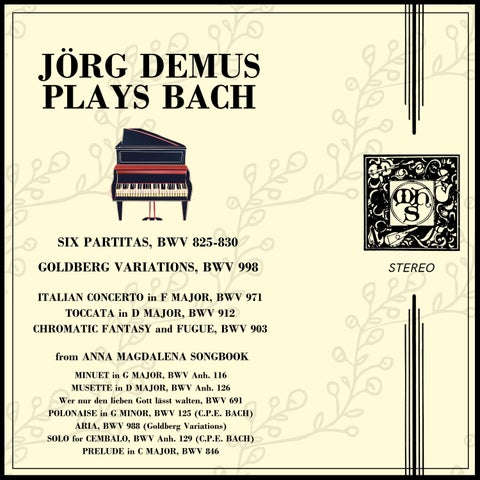
JOHANN SEBASTIAN BACH SIX PARTITAS, BWV 825-830 Partita No. 1 In B Flat Major, BWV 825
Partita No. 3 In A Minor, BWV 827
Partita No. 5 In G Major, BWV 829
I. Preludium 01:55 II. Allemande 03:15 III. Courante 02:37 IV. Sarabande 05:37 V. Menuetto I & VI. Menuetto II 03:37 VII. Gigue 02:18
I. Fantasia 02:08 II. Allemande 03:42 III. Corrente 02:40 IV. Sarabande 04:05 V. Burlesca 02:03 VI. Scherzo 00:58 VI. Gigue 03:11
I. Preambulum 02:15 II. Allemande 04:33 III. Courante 01:55 IV. Sarabande 04:22 V. Tempo di Minuetto 01:51 VI. Passepied 02:22 VII. Gigue 04:05
Partita No. 2 In C Minor, BWV 826
Partita No. 4 In D Major, BWV 828
Partita No. 6 In E Minor, BWV 830
I. Sinfonia 04:31 II. Allemande 04:28 III. Courante 02:23 IV. Sarabande 03:03 V. Rondeau 01:27 VI. Capriccio 04:09
I. Ouverture 03:13 II. Allemande 03:36 III. Courante 06:30 IV. Aria 09:34 V. Sarabande 05:46 VI. Menuett 01:36 VII. Gigue 03:26
I. Toccata 07:04 II. Allemande 04:01 III. Corrente 04:57 IV. Air 01:56 V. Sarabande 07:00 VI. Tempo di Gavotta 02:02 VII. Gigue 06:16
JOHANN SEBASTIAN BACH GOLDBERG VARIATIONS, BWV 988 Aria 02:14 Variation I 02:02 Variation II 01:58 Variation III - Canone all'Unisono 02:40 Variation IV 01:04 Variation V 01:25 Variation VI - Canone all Seconda 02:07 Variation VII 02:04 Variation VIII 01:56 Variation IX - Canone all Terza 02:22 Variation X - Fughetta 02:02 Variation XI 01:49 Variation XII - Canone all Quarta 03:51 Variation XIII 05:24 Variation XIV 02:09 Variation XV - Canone alla Quinta in moto contrario 02:39
Variation XVI - Ouverture 02:15 Variation XVII 02:09 Variation XVIII - Canone alla Sesta 01:38 Variation XIX 01:52 Variation XX 02:03 Variation XXI - Canone alla Settina 01:46 Variation XXII - Alla breve 01:30 Variation XXIII 02:14 Variation XXIV - Canone all'Ottava 04:02 Variation XXV 03:36 Variation XXVI 02:06 Variation XXVII - Canone alla Nona 01:56 Variation XXVIII 02:30 Variation XXIX 02:13 Variation XXX - Quodlibet 01:59 Aria da capo 02:14
JOHANN SEBASTIAN BACH ITALIAN CONCERTO IN F MAJOR, BWV 971 I. (without tempo designation) 04:13 II. Andante 05:05 III. Presto 03:31 TOCCATA IN D MAJOR, BWV 912 11:01
CHROMATIC FANTASIA AND FUGUE IN D MINOR, BWV 903 I. Fantasia 07:25 II. Fugue 05:04 NOTEBOOK FOR ANNA MAGDELENA BACH Minuet in G Major, BWV Anh. 116 02:13 Musette in D major, BWV Anh.126 00:59 Wer nur den lieben Gott lässt walten, BWV 691 (performed on piano) 02:36 Polonaise in G Minor (BWV Anh. 125) 01:32 Goldberg Variations, BWV 988: Variatio 26. a 2 Clav. 04:12 Solo per il Cembalo, H.16 02:55 Prelude in C major, BWV 846 02:13
JOHANN SEBASTIAN BACH
“In his judgment of works he was, as regards harmony, very severe, but otherwise he valued everything that was really good, and gave it his acclaim even if it contained human weaknesses. With his many activities he hardly had time for the most necessary correspondence, and accordingly would not indulge in lengthy written exchanges. But he had the more opportunity to talk personally to good people as his house was like a beehive, and just as full of life. Association with him was pleasant for evetyone, and often very edifying. Since he-never wrote down anything about his life, the gaps are unavoidable.” These are the words with which Emanuel Bach described his father in a letter to Forkel, Johann Sebastian Bach’s first biographer. It is sometimes difficult, in the mid-twentieth century, to realize that the men and women whom we now regard
as immortal once had their own family life, their own financial pressures and headaches, and, in brief, a life of their own. It also frequently comes as a surprise to realize that many of those keyboard works which we regard as masterpieces and models of their kind, were primarily written as exercises or studies for the composers’ students, whether they are the sonatas of Mozart or the two and three-part Inventions’” of Bach. In the case of the former composer, teaching was generally regarded as something of a chore, which he did not particularly enjoy. (Some of Mozart’s comments regarding teaching are reprinted in the notes on MHS 1013). With Bach, however, the situation was quite different. There is abundant evidence to indicate that he not only did a great deal of teaching, but he seems to have enjoyed it. Many of his keyboard works which are most popular today, including the "Inventions mentioned above, some of his Partitas’”
both hands, with constant regard to the production of a clean, clear tone. Over a period of some months, no pupil was excused from these exercises, and ac Cording to his firm opinion, they should be continued for six to twelve months at least. But if he found that anyone, after some months of practice, began to lose Bach’s method of teaching the patience, he was so considerate as to harpsichord is well-documented in the write little connecting pieces, in which letters and memoirs of his students and these Gxercises were linked together. contemporaries, as well as by the To this type belong the six little existence of two "Clavier Büchlein’” Preludes for beginners, and still more, (Little Clavier Books) which he compiled the fifteen two part Inventions. He for the benefit of his eldest son, Wilhelm wrote down both during the hours of Friedemann, and his second wife, Anna teaching, and, in so doing, attended to Magdalena. Forkel, basing his the immediate require ment of the description on information supplied by pupil; afterwards, he transformed these Emanuel Bach, describes Bach’s pieces into beautiful and expressive method of teaching the clavier thus: little works of art. With the finer training “The first thing he did was to teach his was combined the practice of all the pupils his peculiar mode of touching the ornaments in both hands. After this he keyboard. For this purpose he made set his pupils to the task of studying his them practice for months nothing but own greater compositions, which, as he isolated exercises for all the fingers of well knew, would give the best means and “French Suites” and, in fact, all the com positions on this recording, with the exception of the CHROMATIC FANTASY AND FUGUE and the TOCCATA IN D, were originally composed with the student and musical amateur in mind.
of exercising their powers. In order to lessen the difficulties, he made use of an excellent method; this was to play to them the whole piece which they were to study first, saying: ‘This is how it must sound’.” Further examples of Bach’s teaching methods may be gained from the “Clavier-Büchlein’” written for nine-year-old wilhelm Friedemann. On the first page he explains the notes of the diatonic (no sharps or fats ) scale as they appear in the treble clef, He then explains each of the five clefs in general use at the time, with a passing reference to the less often used versions of the bass clef. Then come explanations (explication) of the ornamentation (trills) in general use. On page 2 we have the first application of most of the information previously mentioned in the form of a little com position in the key of C complete ith fngering. Each of the successive compositions in the volume is arranged
systematical ly in terms of diffhculty and key the first works being in the key of C major and A minor (no sharps or fats ), Dminor and G minor (to explain key signatures in terms of church modes) and F major (one flat) etc. Beginning with number 32 we have the The original title page of the volume including Bach's ITALIAN CONCERTO (which was published in 1733) clearly indicates its didactic nature: "Second Part/of the/Keyboard Practice/consisting in / a Concerto after the Italian Taste / and / an Overture after the French Manner/for a/Harpsichord with Two Manuals/Composed for Music Lovers, to Refresh Their Spirits by. . On December 22, 1739, J. A. Scheibe, composer, conductor, and music critic, more than made amends for the harsh things he had said about Bach's music two years previous by writir popular two-part Inventions which Bach
originally arranged in terms of key signatures, i.e., no sharps or flats, 1 sharp or flat, etc. On December 22, 1739, J. A. Scheibe, composer, conductor, and music critic, more than made amends for the harsh things he had said about Bach’s music two years previous by writing: preeminent among published musical works is a clavier concerto of which the author is the famous Bach in Leipzig and which is in the key of F major. Since this piece is arranged in the best possible fashion for this kind of work, I believe that it will doubtless be familiar to all great com posers and experienced clavier players, as well as to amateurs of the clavier and music in general. Who is there who will not admit at once that this clavier concerto is to be regarded as a perfect model of a well-designed solo concerto? But at the present time we shall be able to name as yet very few
or practically no concertos of such excellent qualities and such welldesigned execution. It would take as great a master of music as Mr. Bach, who has almost alone taken possession of the clavier, and with whom we an certainly defy foreign nations, to provide us with such a piece in this form of com position – a piece which deserves emulation by all our great composers and which will be imitated all in vain by foreigners. In this work Bach attempted to write a composition in the same a style as the violin concerti of Vivaldi (whose works he admired) but for the harpsichord alone. In doing this Bach devised his com position in such a fashion that the tutti and solo parts are clearly defined even though they are played on one instrument. This is one of the few works Bach wrote with the harpsichord speciically in mind, indicating by means of “forte’” or “’piano’ which of the two manuals should be played. There are even
several instances in this work where Bach indicated that one hand was to play “forte’” while “’piano” was played by the other. The TocCATA IN D MA JOR Was composed between 1700 and 1708. Lt has certain features in common with the later ITALIAN CONCERTO, particularly in the first allegro (which is preceded by a brief introduction) which has many of the elements of a concerto movement. It is possible in this movement to hear an orchestral tutti as well as parts for a solo instrument. After the allegro there is an instrumental recitative which leads to a fugue on two subjects. The first beginning in the bass, the second in the treble. Another recitative leads to a lively fugue which is virtually a perpetual motion. Bach’s first wife died in 1720, leaving him with four children. Aged 12, 10, 6, and 5. In 1721 he married Anna Maria Wilcken. The daughter of a court trumpeter and
herself an excellent pro fessional singer. Anna Magdelena, who was then 20, must have been at least ocasionally slightly overwhelmed by suddenly fnding herself the wife of a man sixteen years her senior and the center of a busy household. In order to show his affection for his wife. Bach compiled a CLAVIER-BüCHLEIN for her in 1722 and a second in 1725. On the title page of the first volume he wrote the note: “Anti Calrinismus und/Christen Schule item/Anti Melancholicus/ von D. Pfeifern.” (Dr. August Pfeifern was a theological writer of the 1 7th century, several of whose works Bach admired and had on his book shelves. ) According to Bach’s biographer, Spitta, Bach intended the CLAVIER-BüCHLEIN to be to some extent the musical counterpart to Pfeifern’s works. Although Bach’s words are playful, Spitta Continues, their intent was serious: .to oppose that day’s Calvinistic doctrine, inimical to all art, which
reigned in Cöthen, and to counteract . more of a family album than the earlier all the sorrow and bitter experiences of collection. There are several short works life – the School of the Christian’ all by Bach himself as well as music which gloomy thoughts and dismal moods.” It he admired by his con temporaries, such is not without interest, therefore, to as Couperin, Stölzel, Böhm, and others. note that although there are no chorales Most important, however, with regard to in the volume of 1722, there are many in the intimate nature of the collection, are the later volume, Several of these were several compositions by the 11-year-old probably intended for Anna’s spiritual Emanuel Bach, and a poem (which might nourishment as well as for moral have been written by Sebastian himself ) support, both of which were doubtless with two different settings. Ever the needed from time to time in a house thorough teacher., Bach also intended to noisy with children and busy with her include in the volume of 1722 rules on husband’s professional activities. thorough bass. After the 15th rule, however, he wrote: “The other Since Anna Magdalena was an precautions that must be observed will accomplished singer it was not explain themselves better in oral necessary to explain the rudiments of instruction than in writing.” All of the music to her. Instead, in the volume of works from the CLAVIER-BüCHLEIN On 1722, Bach included several moderately this recording are from the volume of advanced key board works in it, 1725. Numbers 1, 2, and 4 are, as the including the first versions of some of titles indicate, dances, and are by Bach the “French Suites,’” and in the volume himself. Number 3 is a setting of one of of 1725 some of the Partitas, “ The later his own Chorales which was originally volume of the CLAVIER-BüCHLEIN is com posed for organ in 1717 but refined
and polished for inclusion in the CLAVIER-BüCHLEIN of 1725. Number 5 was later used by Bach as the subject for a set of variations now known as “The Goldberg Variations.’” Number 6 is the first movement of a short “Sonata” by young Emanuel Bach, who also composed the “Polo naise”” (No. 4). Number 7 represents the original version of the first “Prelude’” from the “Well-tempered Clavier,” Part 1, which also became famous as the basis for Gounod’s setting of the “Ave Maria.” DOUGLAS TOWNSEND