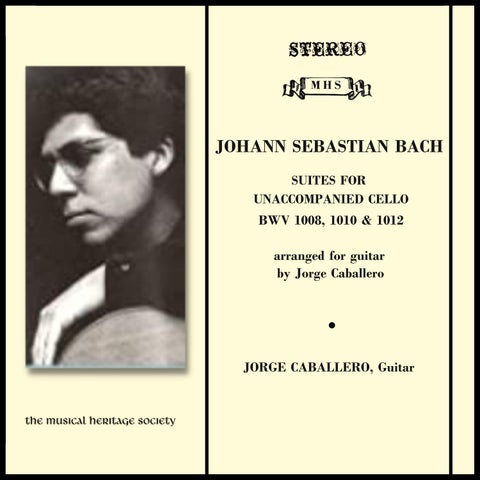
JOHANN SEBASTIAN BACH SUITES FOR UNACCOMPANIED CELLO
BWV 1008, 1010 & 1012 arranged for guitar by Jorge Caballero
JORGE CABALLERO, Guitar
JOHANN SEBASTIAN BACH (1685-1750) SUITES FOR VIOLONCELLO SOLO (ARR. FOR GUITAR BY CABALLERO) JORGE CABALLERO, Guitar Cello Suite No. 6 In D Major, BWV 1012 1 I. Prelude 04:47 2 II. Allemande 07:05 3 III. Courante 03:09 4 IV. Sarabande 03:51 5 V. Gavottes I & II 03:25 6 VI. Gigue 03:19 Cello Suite No. 2 In D Minor (A Minor), BWV 1008 7 I. Prelude 03:53 8 II. Allemande02:51 9 III. Courante 01:44 10 IV. Sarabande 04:14 11 V. Menuetts I & II 02:51 12 VI. Gigue 02:11 Cello Suite No. 4 In E-Flat Major (C Major), BWV 1010 13 I. Prelude 04:08 14 II. Allemande 03:30 15 III. Courante 02:53 16 IV. Sarabande 03:41 17 V. Bourree I & II 04:06 18 VI. Gigue 02:18
Suites for Violoncello Solo, a personal note. When one listens to the Bach 'Cello Suites, a magical dichotomy can be appreciated. At first instance, Bach's writ ing style has been reduced to a minimum, since writing for the 'cello has dispos sessed him of the polyphonic flexibilities that keyboard instruments, or the violin, for that matter, can provide. Therefore, Bach has no other choice than to express through the cello his musical ideas at their core. This primary appreciation, how ever, ought not to imply lack of dramatic content on Bach's part, because, although stylisticaly similar (the organization of the dances foliows a conventional pattern of the baroque suite: an opening prelude, followed by four dances: Allemande, Courante, Sarabande and Gigue, with one additional dance Bach incorporated in each suite), each one of the suites pre sents to the listener a different type of dramatic range, from the lively and extro verted Suite No. 6 to the depths of inner reflection of the 2nd Suite. This contrast is what makes the 'Cello Suites so fascinating, that the emotion of
the musical content is expressed in the essentials, thus producing a magical resultmusic which gives an allusion of simplicity, and yet, to have it designed so as to contain within itself the dramatic character and intensity typical of Bach's music; music where the power and energy emanating from the written page is matched brilliantly by that of the notes left implied, unwritten. It is necessary to remind oneself of these notions of economical writing when transcribing these suites to a more versatile instrument, such as the guitar, as there is a constant risk of "over-layering" the musical texture, and consequently losing the sense of ambiguity of these pieces, so to speak. In fact, some may say that Bach may have very well set upon himself this same idea when rear ranging his own compositions for other instruments, which can be observed in the many pieces that he re-transcribed. As an example, the 5th 'Cello Suite (BWV 1011) is an arrangement of the 3rd so-called Lute Suite (BWV 995). Regardless of which version originated the other (not any source could verify accurately whether the 'Cello suite was written prior to the Lute suite, or vice .
versa), the listener may notice that it was aconcern of Bach to avoid the excessive textures in either instrument, so as to allow the musical discourse to speak freely. This notion was, personally, my most immediate concern: to resist the temptation of adding too many layers of music to the original, and instead, to allow the music to speak for itself In the Prelude of the 6th Suite, Bach uses an interesting open string pedal technique (perhaps much easier to play on Viola Pomposa, a 5-string instrument for which this suite was originally written). and a forte-piano echo effect, which can be associated with church music and, also, with Concerto Grosso writing style (during this time, Bach was employed by Prince Leopold in Cothen, where he was most concerned with the production of instrumental and chamber music). It mav be more likely that the latter was the main implication, since the ensuing movements present this idea in one way or another. The unusually slow Allemande is a com pletely free and timeless flow of a single line (it is impossible to perceive the meter of the dance), with occasional appear- ances of the bass. In contrast, the Courante is very straightforward, filled with virtuosic scale
passages. The Sarabande is very soft and quiet, and in character, it is reminiscent of the Allemande. The two Gavotte movements bring back the essential sense of the straightforward dance displayed earlier in the Courante, and sets the stage for the final Gigue, climactic and difficult. In contrast, from the beginning of the 2nd Suite, we can predict the introspective, sorrowful character of the piece, The Prelude acts up the stage for the desolate, lonely mood of the piece, which becomes more agitated and restless in the Allemande and Courante, respectively, until reaching a magnificent anticlimax in the Sarabande, where the piece is at its darkest. The Menuet moves the Suite into a final Gigue, whose motive contains dramatic interval jumps of 5ths and 6ths. A very interesting twist of harmony occurs in the Prelude of the 4th Suite: the tonic/dominant (1st and 5th degrees of the scale) relation is seldom present, and instead, the 3rd degree functions as a dominant, in a way. When it does reach the true dominant, however, it is only briefly, as if an illusion. In addition, the harmonic modulations are almost delusional, as if conceived unconsciously, all the while they are controlled by very simple 8th note
arpeggio patterns, which are the controlling pulse of the movement. The Allemande that follows presents a seemingly endless flow of a melody, by way of the abundant scales that flow throughout the movement. This motion is contrasted by a decisive Courante, which states very clearly its ternary nature. The Sarabande is reminiscent of the prelude, because of its ethereal quality and slow moving melody. The following dances, Bourrée and Gigue, are displayed in such basic harmonies that they would almost sound silly, if it wasn't for the characteristic sense of unity that is present in every piece Bach wrote. Jorge Caballero
g e a t M i r u e s H i c 6 R 9 o 9 1 y a l © t i e & s . ℗