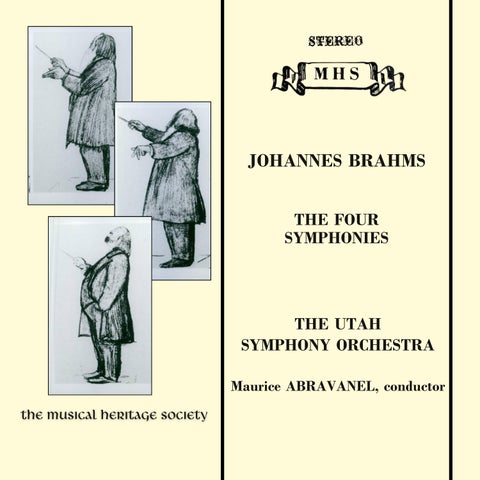
JOHANNES BRAHMS THE FOUR SYMPHONIES
THE UTAH SYMPHONY ORCHESTRA Maurice ABRAVANEL, conductor
JOHANNES BRAHMS SYMPHONY NO 1 IN G MINOR , OP. 68 1.Un Poco Sostenuto - Allegro - Meno Allegro 12:15 2.Andante Sostenuto 8:14 3.Un Poco Allegretto E Grazioso 4:56 4.Adagio - Piu Andante - Allegro Non Troppo Ma Con Brio - Piu Allegro 15:48
SYMPHONY NO 2 IN D MAJOR , OP. 73 1 Allegro Non Troppo - 14:03 2. Adagio Non Troppo / L'istesso Tempo, Ma Grazioso - 8:08 3. Allegretto Grazioso (Quasi Andantino) - Presto Ma Non Assai - Tempo I - 5:26 4. Allegro Con Spirito - 8:27
SYMPHONY NO 4 IN E MINOR , OP. 98 1 Allegro Non Troppo 11:49 2 Andante Moderato 10:40 3 Allegro Giocoso - Poco Meno Presto - Tempo I 6:03 4 Allegro Energico E Passionato - Piu Allegro 9:21
SYMPHONY NO 3 IN F MAJOR , OP. 90 1 Allegro Con Brio - Un Poco Sostenuto - Tempo I - 8:59 2 Andante 7:39 3 Poco Allegretto 6:08 4 Allegro - Un Poco Sostenuto 8:12
THE UTAH SYMPHONY ORCHESTRA Maurice ABRAVANEL, conductor
Johannes Brahms: The 4 Symphonies Symphony No. I Brahms was by nature the most self-critical of composers. His tendency in this case was fed by a formidable knowledge of the music of the past, unusual in a creative artist. And when he was only 20, Schumann's celebrated article of Neue Bahnen (New Paths), hailing him in Messianic terms as the rising composer of the day, must have reinforced the propensity with an added sense of responsibility to publicly aroused expectations. String quartet and symphony were the two spheres in which he felt the inhibition most powerfully, precisely because they were the two that evoked for him with special vividness the supremacy of Beethoven. It was another 20 years before he felt confident enough, in 1873, to release his own String Quartet No. I to the public (by which time he had already destroyed more than a dozen works in the genre), and a further three before he allowed his Symphony No. I in C Minor, Op. 68 to be performed. One characteristic piece of Brahmsian motivic development is to be found in the development section of the first movement, when the strings in full-toned, sweeping phrases proclaim a sustained hymn-like theme that sounds quite new. On closer examination, however, it turns out to an extension of a taut little three-note figure-one step up, and one down againheard much earlier, about one-third of the way through the exposition, where it crisply articulated by the woodwinds. Nor is the first movement the end of this particular line of development. It has important consequences much later in the chorale theme of the introduction to the Finale, again in the famous main theme of that movement's Allegro, and lastly in the exultant octave-unison of violins, violas, and cellos just before the end of the symphony, where in turn it takes wing in a soaring figure that can be traced back, to its
first appearance in the violins a little way into the slow movement. Sonata form is not only, no even necessity mostly, a matter of thematic structure. At a more fundamental level, it is concerned with tonal organization, with the interplay and conflict of keys and the eventual resolution of that conflict. In the First Symphony the form-building potential of tonality is deployed with all of Brahms's habitual farsightedness. His individual approach can be mostly readily seen in the tonal relations of each movement to its neighbors. In Haydn, Mozart, and Beethoven, slow movements tend in general to be pitched either a fifth above or a fifth below the home tonics of major-key works. Brahms preferred to move up or down a third. When the home key is minor, the precedents are more complicated. Yet nowhere is there a close precedent for the overall key-scheme of this symphony, in which C minor gives place in the slow movement to the distant key, a major third up, of E major; in which the next movement is pitched another major third up, in A-flat major ( =G sharp) and in which the Finale competes the circle of major thirds by moving up again to the home of C minor eventually major. One striking modification Brahms effected during his long labor over the symphony was the addition of the first-movement introduction; when Clara Schumann wrote to Joseph Joachim about the work in 1862 the movement still began with the brusque octaveunison C that launches in Allegro. As the work now stands, the first and last movements begin with the only slow introductions to be found in Brahms's symphonies, not really slow, by the way, in case of the first movement, but only Un poco sostenuto, or "somewhat sustained." The circumstance underlines the gravity with which Brahms approached the challenge of a first
symphony. Yet with all its seriousness, there are Nevertheless, for all its easy birth and sunny abundant touches too of color an even picturesqueness disposition, the work in no way falls short of the in the scoring: romantic horn solos in the first movement, stringent logic of No. I. The device with which the in the Andante sostenuto (coupled with the only violin earlier work began-the superimposition of two solo in Brahm's orchestral oeuvre), and in the themes that tend in opposite directions--is found introduction to the Finale; limpid clarinet writing in the again at the beginning of the Adagio non troppo. first and third movements; soft low trumpets used to Here, in a solemn B major (characteristically, a third telling purpose in the recapitulation of the Finale theme; away from home tonic D), the cellos' descending and in the introduction to that movement again, some melody is pitted against another on the bassoons spin-chilling sustained tones on the contrabassoon. The that strives with persevering seriousness upwards. trombones, too, are used with great imagination-sparingly and, until near the end, mostly softly--as Schubert has used them in his Ninth Symphony. Brahms' But then, the entire symphony goes still further, that first symphony doesn't sound like a beginner's work in predecessor in rigorously related all its thematic because it is, of course, that of a very experienced material to a germinal motif of only three notes. This composer. figure--D, C#, D--is heard at the outset in the cellos and basses. It permeates the textures of four Brahms movements, and even generates (in inversion) the Symphony No. 2 main theme of the third (and right way up again) to the fourth. Within movements, too, though the ear is The creation of the Symphony No. 2 in D Major, Op. 72 regaled with an inexhaustible variety of phrase and was as swift and apparently trouble-free as the creation color, the traditional sharp contrast between of the First Symphony had been long and difficult. By the thematic groups is modified by a subtle underlying late 1870s Brahms had established a routine of visits to unity. Thus the opening of the Finale's theme is, Italy in the spring and to resorts in Austria, Switzerland, once more, inverted to furnish the subsidiary theme; or Germany in the summer and autumn that could only and in the first movement, the glorious second loosely be termed vacations in view of their musical theme introduced, cantando, by cellos with violas fruitfulness. It was on one of his Austrian trips--to playing in thirds below them traces, in its fourth and Portschach, on the idyllic Worther Sen in the Carinthian fifth measures, an identical melodic line to one heard Alps-- that work on the piece began in the summer of in the horns at their second entry every near the 1877, and it was completed at the Lichtenthal near start. It is hard to know which to admire more in Baden-Baden by October. Hans Richter gave the first these ingenious derivations: their strict economy, or performance with the Vienna Philharmonic on December the prodigality of theme that Brahms's dazzling 30, and the symphony was an immediate success. Clara variety of treatment suggests. Schumann had predicted that, being "so genial in mood and so skillfully worked out," the Second Symphony More remarkable even than the Symphony's would please the public even more than the First, and thematic interplay is the boldness and originality of indeed, at many of its early performances, it aroused its rhythmic language. Rhythm is the sphere in which such enthusiasm that the third movement in particular Brahms is most consistently and daringly innovative. had to be repeated. Establishing a new equilibrium between regularity of
pulse and the elements in music that pull against it, he Brahms sometimes varies the beat pattern no more drastically Symphony No, 3 than Beethoven was accustomed to do, and at other times dissolves it so thoroughly that the unaided ear Like its predecessor six years earlier, Brahms's cannon, over a precisely defined stretch of music, tell Symphony No, 3 in F Major, Op, 90 was given its first where the bar-line is. Both techniques abound in the performance (on December 2, 1883) by Hans Richter Second Symphony, especially in its first and last and the Vienna Philharmonic, The composition had movements. Toward the end of the first-movement been completed that summer at Wiesbaden, and exposition is a passage where the balance between followed a symphonic gap filled with major projects pulse and line changes so radically that the ear is in several other media--among them the Violin beguiled or downright deceived, into thinking that them Concerto (1878), the First Violin Sonata (1879), the main measure of rhythmic demarcation has shifted. Second Piano Concerto (1881), and the C-Major Preparing the ground with subversive syncopations, piano Trio and First String Quintet (1882), as well as Brahms presents a thematic outgrowth of the two impressive choral works (Nanie and the Gesang symphony's opening material, rephrasing it so decisively der Parzen), more then a dozen songs, and the two across the bar-line that few listeners, hearing this overtures of 1880, surging imitation between lower strings (with bassoons) and violins for the first time, could be expected to know The Third Symphony is a sharp gathering-in of where in the measure they were. Exhilarating passages resources, It was a heroic brightness of tone that like this--and the equally teasing one in the Finale that helps to explain its immediate success with its early phrases across the 2/2 bar-line first in groups of five audiences, but it is probably its sheer economy and half-beats and then in threes--culminate in a sense of directness of expression that strike the listener most regained security when the fragments gather themselves forcibly on initial acquaintance, especially in the first again in a clear-cut re-emphasis of the pulse. three movements. The opening Allegro con brio for example, strides in only 36 measures to its Organic integrity and unflagging vigor, then distinguish subordinate theme--a stage at the first two this extraordinary symphony, along with a sense of symphonies had taken twice as long to reach, Such dispelled tension in almost explicit reaction from the decisive motion gains time for the composer so that, wound-up emotions of No. I. The new relaxation has its when the Finale is reached, its relative spaciousness expression too in the orchestral coloring of the work, full has all the more effect. as it is of radiantly soaring strings, singing woodwind detail, and a wealth of solos that makes it as happy a In its handling of the orchestra, its rhythmic hunting-ground for a principal hornist as Mahler's Ninth. language, and its melodic idiom, the Third Symphony takes its natural place as a station along the path of Brahms's stylistic growth, developing some ideas heard in earlier works and at other points indicating lines of thought that reach intensified expression in No, 4. The independence of the winds is carried a
stage further--they have the beginnings of the first two following and its consequences of Schubertian movements to themselves, and more important thematic minor-major contrast. The sequence F-A-F had, work elsewhere besides--and, in addition to the vital incidentally, a specially significance for Brahms: as roles allotted at many junctures of the musical argument Frei aber Froh (Free but joyful), he had adopted it as to the clarinets, the luxuriant lead-back to the a kind of signature-tune in response to his friend recapitulation in the first movement is among Brahms's Joachim’s motto F-A-E--Frei aber einsam (Free but most potent evocations of the solo horn's essentially alone or lonely). In the Third Symphony, however, these elaborations of explicit thematic interrelations romantic character. on a broader scale. But as in other spheres, Brahms Rhythmically, this same movement is remarkable for the subsidizes all he touches. The transformation of the way its basic meter undergoes displacements no less symphony's opening theme at the end of the Finale, violent than those of the Second Symphony, and equally while clearly perceptible at first hearing, has the subversive to the listener's expectations. At the end of character of magical allusion rather than prosaic the exposition, the accent on the last quarter note of cross-reference; and even the more literal reuse of almost every measure easily overrides the regular 6/4 the crudity of similar devices in Franck's Symphony pattern. The ear finds it nearly impossible to shift its and Tchaikovsky's Fifth. perception of the pulse forward by one-quarter note, and the return to metrical normality a little way into the Brahms development section administers a further jolt with the Symphony NO. 4 insertion of what by now sounds like an extra note, The Tragic Overture's long series of dotted rhythms are again It was on two summer visits to Murzuschlag in Styria, in evidence in the Finale of the symphony, where again in 1884 and 1885, that Brahms composed his last their effect is of heroic determination, Melodically, symphony, and he conducted its first performance several passages--most emphatically, the last big climax with Hans von Bulow's Meiningen orchestra on of the first movement--expound the motif of falling thirds October 25, 1885. Unlike the crisply purposeful Third that is a fingerprint of Brahmsian style: it will provide the Symphony, the Fourth presents an expansive, almost prodigal parade of themes--more than a half a dozen entire thematic substructure of the Fourth Symphony. of them in the exposition of the first movement But in at least two important respects the Third departs alone, making nonsense of the "first subject"/ from Brahms's typical symphonic practice. One of these "second subject" terminology conventionally used in is its mode of musical argument. In the quest for organic discussions of sonata form. unity the Third Symphony admittedly draws as pervasively as its companion works on techniques of There are deeper differences, too. The Fourth is a intricate motivic development. The three-note rising strange symphony, standing somewhat apart from figure F-A flat-F, of the very first three measures the other three in essential character more than in provides its most fundamental term of cross-fertilization, surface detail. It is a picturesque piece, and Brahms together with the A flat/A natural oscillation immediately is almost never picturesque. There is an atmosphere
in it of the far away and the long ago, a scent of fable, a six rising thirds. Arnold Schoenberg was apparently knightly, castellated quality. This is particularly true of the first observer to point out the expansion of this the middle movements. Both of them--the bardic, ballad- basic idea in the penultimate variation of the Finale, like Andante moderate with its stylized grandeur, and the where the series is stretched to eleven falling thirds mighty jollification of the Finale is the more searing in its with only a single octave transposition in the middle. turning from romanticism back to reality. Yet the influence of this one figure is more pervasive still: it can be traced in the accompaniment to the This last movement is also a heightened instance of the passionate B-minor subordinate theme in the first sense of the musical past that Brahms had already movement, through variants in the development shown in works like the Variations on a Theme by Haydn. section and in the third movement, to the cadential Of unprecedented form for a symphonic movement, it is phrases of the fourth and seventh variations in the cast as a passacaglia, or set of variations on a regularly Finale. Beyond this, the interval of a third pervades repeated ground bass. There are 30 variations and a the harmonic texture of the entire work, and once coda, and the variations preserve with remarkable again, as in the First Symphony, determines the faithfulness the shape of the bass, which is a modified tonal relations of the various movements: the slow version of a theme from Bach's Cantata BWV 150 (Nach movement, before settling down in the tonic major dir, Herr, verlanget mich), expanded from 5 measures to key of E, makes a feint C major (a major third down 8 and colored by a chromatic addition at its fifth note. from E), and that turns out to be the actually key of Brahms had long contemplated basing a symphonic the third movement. movement on Bach's theme, but he had remarked some years earlier to Bulow that "it would have to be Taut though it is in formal organization and serious, chromatically altered in some way" if it was to bear the even tragic, in expressive bent, the Fourth burden of a symphonic argument. Symphony still finds room for an abundance of arresting instrumental effects. Clarinets, horns, and Ingeniously--indeed, subtly enough that you may listen cellos again are favored, as in the entire wind choir attentively to the work several times before you notice in many passages of the slow movement. The the point--the theme of the passacaglia is adumbrated as timpani have marvelously imaginative touches in far as the fifth note a movement before the end of the both this movement and the Finale, and in the eighth preceding Allegro con brio. But with this exception variation of the latter open-string into the generally Brahms turns away here from the device of more or less sober surroundings of an irreverent triangle, which literal thematic cross-reference that he had used in the makes its appearance in the Allegro con brio-a Third Symphony, and concentrates instead on the kind resounding contrast to the other movements, and of unity that results from the saturating the texture with the closet thing to a traditional scherzo that Brahms the outgrowths of a time generating figure. The germinal (who then had preferred a very personal kind of motif in the Fourth Symphony is the falling third. The restrained intermezzo) ever included in a symphony. melodic line in the violins at the start of the opening This he proclaims once more, in his last work genre, Allegro non troppo consists of seven successive falling the essence of the symphonic idea, which is neither thirds, and this statement is then answered by a series of unity nor variety in isolation, but variety in unity, each enhancing the other. Liner Notes by Bernard Jacobsen
H S M
www.themusicalheritagesociety.com
S o l o m o n
y S e y m o ru
s u M a g e m O 5 6 9 1 ℗
ic
s i u c M R o e y g a a t l i t r i e e s H . P 3 r 2 o 0 d 2 u c © e d & b