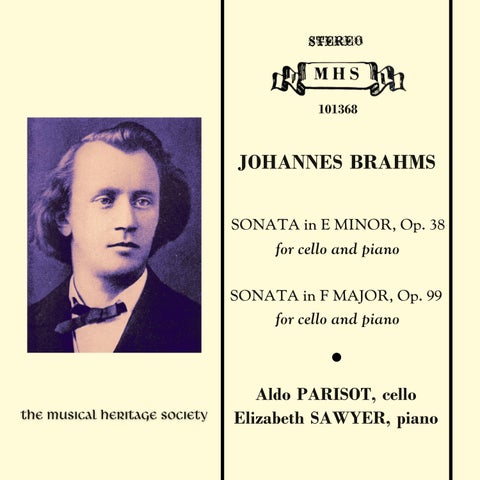
101368
JOHANNES BRAHMS SONATA in E MINOR, Op. 38
for cello and piano SONATA in F MAJOR, Op. 99
for cello and piano
Aldo PARISOT, cello Elizabeth SAWYER, piano
JOHANNES BRAHMS TWO SONATAS for CELLO and PIANO
SONATA in E MINOR, Op. 38 Allegro non troppo Allegretto quasi Menuetto Allegro SONATA in F MAJOR, Op. 99 Allegro vivace Adagio affettuoso Allegro passionato Allegro molto ALDO PARISOT, Cello ELIZABETH SAWYER, Piano
The fruit of Brahms’ creativity, like that of his great Symphonies call for a repeat, and so do many of the forebears Bach, Haydn, Mozart and Beethoven, often larger ouevre for chamber ensemble). tended to grow in clusters. The evidence to support such a contention is both abundant and conclusive: Brahms composed his first Cello/Piano Sonata in The three early Sonatas for Piano, Opp. 1, 2 and 5; 1862 when he was twenty-nine years old and full of two Piano Quartets, Opp. 25 and 26; two Clarinet fire; the second sonata, on the other hand, is the Sonatas,Op. 120; the first two String Quartets, Op. 51 product of a staid, or at least thoroughly seasoned and the last two Sonatas for Violin and Piano (both of Master of fifty-three –a celebrity who, from all which were obviously sequels to the first, in G Major, accounts, was aged beyond his years and had all four written six years earlier ). symphonies, and many other triumphs as well, already behind him. Oddly enough, the earlier E Minor work is A generality which does not apply to the two the one most recognizably tinged with that autumnal compositions here recorded. Brahms Sonatas for introspection usually associated with the composer’s Cello and Piano are separated in his chronology by Indian-summer period. The F Major, by contrast, is a more than twenty years, and though the two works relatively extroverted affair -- full of ardour and thrust. are often, ashere, juxtaposed for reasons of Whatever the raison d’etre of the paradox, the E convenience, each is a loner a self-sufficient and Minor Sonata is stylistically sibling in many respects contained entity unto itself with an aesthetic to the much later Fourth Symphony (also incidentally, personality all its own. Before pondering the many in the same E Minor tonality). dissimilarities between the twodiverging masterpieces, let us note the few particulars common The opening Allegro non troppo unfolds with a sureto both: each is, of course, masterfully scored for its handed tough measured momentum. Its mood is two instruments -- bonafide duos in which neither the somber, autumnal very much like its counterpart in cello nor the piano predominates. Then too, as so the symphony. Too often in performance, the music of often is the case with Brahms, the emotional burden this section assumes a dirge-like tread and its really is unevenly distributed. In the E Minor Sonata, the quite cogent sonata-allegro structuring is all but lost. focal point is contained in the last movement, while In contrast to the symphony which works up to an the F Major work reverses the situation with a unrelieved tragic impact, the sonata satz for all its pleasing, almost too carefree finale which can easily occasional anguish, remains fundamentally gentle sound anticlimactic in performance after and introspective, even resolving at the end to a theemotionally draining first three movements. celestial major mode. The second section Allegretto Finally, Brahms, in each work, specifies a repetition of quasi Menuetto serves in place of the missing slow the first movement exposition -- the only of this movement (much to the chagrin of all those gloomy composer's mature sonatas to do so. (One must “interpreters”; who insist upon playing all of Brahms not, however, infer that Brahms looked unkindly to slowly). This intermezzo is a Ländler in the best the double bar of classical tradition -- three of his four Viennese tradition. Its lilting grace flows freely into
the mildly contrasting trio section introduced by the piano in broken octaves. The analogy to the last Symphony is again apparent in the Allegro finale. In both instances Brams crowns the musical proceedings with a magnificent homage to Baroque decorum. The Symphony, of course, transforms the old Passacaglia or ground bass form into a monumental symphonic utterance; the writing in the finale of the E Minor Sonata is at times reminiscent in style to the mirror fugues of Bach’s Kunst der Fuge, but for all its contrapuntal correctness, his “fugue”; is really a completely balanced sonata-allegro with requisite development and key-relation, and even two contrasted thematic subjects.
movement of the third symphony) returns in true da cabo tradition. The jaunty, even rather casual optimism of the last movement, inappropriately marked Allegro molto and usually played slower (understandably so, I feel), brings us back to the schoolboyish brio of the Academic Festival Overture. There is in the Sonata even an allusion to the student song “Ich hab mich ergeben” that also appears more outspokenly in the earlier orchestral work. Although the two Sonatas, so different in outlook, are about on a par in quality (both are outstanding achievements), the Op. 99 is the more daring and adventurous of the pair. Not only in the innovative key relationships discussed above, but also in regard to instrumental writing as well. In the E Minor Sonata, the idiomatic cello line rarely transcended its familiar, mellow-sounding tenor register; in the later composition, the music darts about from one clef to another, often with disconcerting rapidity. And a rarity in Brahms’ lattermost efforts-- there is in the F Major Sonata, more than a touch of the craggy defiance and audacious self-confidence unabashedly displayed in youthful creations like the D Minor Piano Concerto.
The F Major Sonata, in sharp contrast to the gentle breeze of the E Minor work, takes to the stage like a full-fledged twister. The music of this taxing and difficult Allegro vivace is energized by a constant obsessive tremolando. The piano has it at first, but the cello soon follows suit (or rather, in hot pursuit). In many aspects, this seemingly conventional sonataform structure is a departure from orthodoxy. In place of the usual tonic-dominant key relationships, three rather unrelated tonalities-- the home key of F Major, its parallel minor, and the remote F-sharp Major-- are Notes by HARRIS GOLDSMITH played off, one against the other. In the Adagio affettuoso, a different rhythmic pattern rather portentous pizzicato ostinato -- unifies the writing. Here, incidentally, two of the aforementioned keys, F-sharp Major and F Minor, are again juxtaposed but this time it is the distant major mode which dominates. The Allegro passionato is a ferocious, galloping scherzo. Its turbulent antics subside long enough to introduce a noble typically Brahmsian chorale-like trio section. Then the original material (a theme somewhat similar to that in the last
ALDO PARISOT, cellist Aldo Parisot needs no introduction. Ever since bis sensational debut in 1948, the musical world has counted him as one of its foremost string players. Mr. Parisot‘s artistry is a rare compendum of singing tone, aristocratic line and incredible virtuosity, He has performed more than a dozen times with the New York Philharmonic not to mention the orchestras of Chicago, Los Angeles, Pittsburgh, London, Paris, Berlin, Munich, Vienna, Amsterdam etc.
Villa Lobos’ Second Concerto was written for and premiered by Mr. Parisot with the New York Philharmonic, and many subsequent works from the pens of such noted contemporary composers as Quincy Porter, Camargo Guarnieri, Mel Powell and Claudio Santoro have similarly dedicated works to the Brazilian-born virtuoso. Aldo Parisot created a sensation when he introduced Donald Martino's formidably difficult “Parisonatina ”Dodecafonia” at the Tanglewood Festival. Writing of the event in the Boston Globe, Michael Steinberg said, -- “There is probably no cellist that can equal Parisot’s dazzling achievement” In March of 1971 after his Tully Hall recital Harold Schonberg “A very strong technician with a sweet tone and impeccable intonation, he is altogether a superior instrumentalist and musician. Mr. Parisot serves on the faculty at Yale University School of Music. His cello was made by Antonio Stradivari in 1730 and is called the ex-Feuermann.
ELIZABETH SAWYER, pianist By the time she was sixteen, Elizabeth Sawyer had received numerous musical honors, including the coveted Edgar Stillman Kelly Award. An alumnus of Yale University, Miss Sawyer has been appearing with growing acclaim in the concert halls of the world in sonata recitals with her husband, Aldo Parisot. Critics in London, Washington, Dallas, and New York, to mention but a few, have called the young pianist an ensemble player of rare perception and artistry.
i t r a e g e H M 3 2 u 0 s i 2 c R © o n g i , d r p & o r y o c d e a r u 2 c l y t 7 t e i e d e 9 i 1 oc b s.
℗ eS
a rti e H l a c i s u M A
g
H S M
M i c h a e l N a i d .a
yD r.