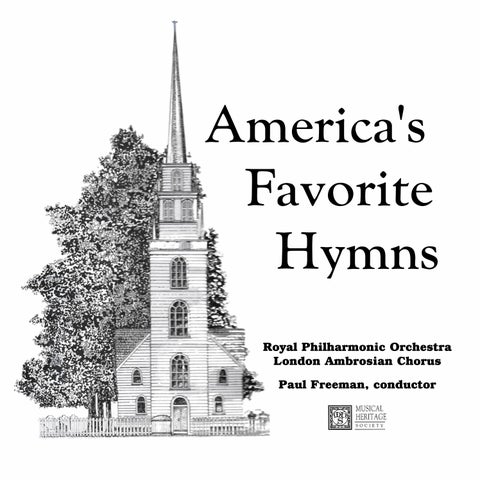
America's Favorite Hymns Royal Philharmonic Orchestra London Ambrosian Chorus Paul Freeman, conductor
1. Doxology 2. Amazing Grace 3. Rock of Ages 4. Onward Christian Soldiers 5. Hallelujah Chorus (Handel) 6. A Mighty Fortress is our God 7. Abide with Me 8. America the Beautiful 9. Nearer my God to Thee 10. Battle Hymn of the Republic (arr. Wilhousky) Royal Philharmonic Orchestra London Ambrosian Chorus Paul Freeman, Conductor All arrangements [excluding No. 5] by Hale Smith Produced by Anthony Hodgson Engineered by Robert Auger Recorded in Henry Wood Hall in London Cover drawing: Walter J. Olinda
In southwestern Georgia, ten miles past Americus, is a little village that might have remained as anonymous in the future as it has been in the past. Passing motorists, not using the impersonal interstate highway, may have continued to joke about a settlement so small that one is past it before digesting the data on that first official signthe name of the town, a three-digit population count, and the year when it was founded. Americans have tended to be very city--oriented in the past, assuming greatness is nurtured only in the coastal megapolis or, in the larger island cities.
This particular settlement was not on my road map when I drove down from Atlanta that beige-gray February day in 1977. A few signs had recently been erected pointing the way, once Americus had been found, to Plains. It was area in the throes of a dramatically new life, one in which American-style tourism would soon move peanuts to second place. It was obvious Plains could never be the same, nor would Georgia, or the South. Remember those selfcaricaturing souvenirs which predicted that the South would rise again? So it has, but no one in the past would have guessed the manner of this resurrection, and certainly not the site for that event. Without considering the ultimate historical verdict on the presidency of Jimmy Carter, assurance is felt everywhere that even the potential of greatness can still be produced from such environs-a settling that is, in all truth, very "country.'"
Central to the lives of most rural folk is the church: prayer meetings in midweek, choir rehearsals and youth group meetings as the weekend nears, and then Sundays filled with handshakes and hugs, new clothes being worn for he first time, thoughts of a chicken dinner in few hours (complete with fresh vegetables and iced tea, perhaps also homemade pie or ice cream), and-of course-the pastor's exhortations that ways be mended and charity be extended. It is not that different at the Plains Baptist Church. The cars drive up and park right in front of the church, on bare red dirt. The edifice itself is calvinistically simple, constructed with a modest flourish of brick but, in the main, of white painted wood. The graphic arts are gently represented by uncomplicated stained glass, free either from iconography or brilliant colors. So it is also with the music. The church songs are contained in the hymnal, located along with the Bible and a fan (courtesy of the local funeral home) in the racks on the back of each hard wooden pew. These hymns of praise consist of several verses, all designed for congregational singing. Harmonically , rhythmically and texturally there are no complications, and they are sung without any adornment--certainly a far cry from the performance practices one might hear down the road, where the Black worshippers congregate. Even when the hymns are sung by the small volunteer choir alone, the singing is not unlike the straight simplicity of the architecture.
While there may appear to be a certain sameness about many of the hymns, there are more than a few whose melodic directness justifies the popularity they have secured, not only within the Baptist communities but around the world. Ten of these are presented in this recording. The oldest is "A Mighty Fortress is our God,"" one of thirteen hymns actually composed by Martin Luther himself, and first published in 1529, although the "Doxology'" appeared a few years later, in 1554. The remainder come from the last century or so, such as "The Battle Hymn of the Republic, " written by William Steffe in 1852 as a camp-meeting song which, with a new text, became a favorite during the Civil War. To take these hymns out of Protestant music history and from the hymnal used by the congregation in Plains is an act of tribute. To qualify them by the colors of Hale Smith's orchestrational imagination, to place them before British instrumentalists and choristers under the versatile baton of Paul Freeman is an assurance of acculturation. Dominique-Rene de Lerma Professor of Music Morgan State University
www.themusicalheritagesociety.com
g e a M t i r u e s i H c 7 R 7 oyal 9 1 t © i es. & ℗
H M S