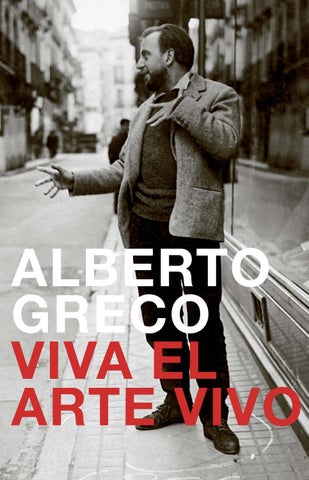
Alberto Greco, Manifesto dito dell’arte vivo, Genoa, July 24, 1962 Montserrat Santamaría, Alberto Greco in Piedralaves, 1963
The exhibition Alberto Greco: Viva el arte vivo reflects a cultural commitment to revive and highlight key figures in contemporary art who for decades have been left out of official and institutional narratives due to their experimental and disruptive nature or their place on the margins. Despite his short life and brief career, Alberto Greco was one of the most unique, provocative, and visionary artists of his time, and he is now considered a pioneer of conceptual art in both Latin America and Spain. Although Greco lived his life between cities such as Buenos Aires, Paris, Rome, and New York, much of his most daring, challenging, and defining work was made during his stay in Spain in the early 1960s. This was a time and place in which experimental art and avant-garde projects were neither embraced nor given much space or recognition. Bringing these works and actions into the present from a contemporary perspective allows us to restore a key figure from the early days of conceptual art in Spain. It also opens up a space in which to critically reflect on the career of a transgressive artist who defied repression and censorship. To extensively reconstruct Greco’s artistic practice, the exhibition and this accompanying publication bring together paintings, photographs, collages, documents, letters, and texts corresponding to his various creative stages. These materials are structured according to curator Fernando Davis’s careful and politically and socially aware reading, based on a queer perspective that highlights Greco’s rebellious, dynamic, peripheral nature. This approach reaffirms the Museo Reina Sofía’s commitment to establishing connections and generating dialogue among various disciplines, periods, geographies, identities, and sensibilities. Ernest Urtasun Domènech Minister of Culture
In 1963, Alberto Greco (Buenos Aires, 1931–Barcelona, 1965) turned the entire town of Piedralaves into a work of art, proclaiming the small rural community in the province of Ávila to be the “International Capital of Greco’s Art.” By the time he turned thirty, Greco had been working on his radical and unclassifiable artistic project for more than a decade. From his native Argentina, he had drifted from informalism to happenings, conceptual art, and writing. His audacious, provocative, and intelligent practice defied convenient labels. In Piedralaves, Greco unfurled a roll of paper almost one hundred meters long in the streets, and, together with the inhabitants, covered it with drawings, doodles, random phrases, reflections, and all kinds of notes. He invited the local children to walk on the paper and the townspeople to write, draw, or simply participate. The result was a large, living, collective surface combining photographs, advertisements, lyrics of popular songs, personal anecdotes, police reports, and fragments of letters. Afterward, with the help of the residents, he symbolically wrapped the roll around the town to designate Piedralaves itself as a work of art. Also in Piedralaves, Greco singled out people, animals, objects, and everyday scenes and marked them with signs on which he had signed his name or written phrases such as “Work of art signed by Alberto Greco” or “This is an Alberto Greco.” Thus, a woman interrupted while hanging out freshly washed sheets, a donkey wandering down the street, or the facade of a house became identifiable as “art” by means of the gesture of pointing, which was central to Greco’s practice. These actions in Piedralaves were, in fact, a radical implementation of Greco’s Manifesto dito dell’arte vivo (1962), published a year earlier, which proclaimed that the artist should “not teach us to see with his picture, but with his
finger.” He argued that art should leave the museums and galleries and return to the streets and to the immediacy of the elements that make up human experience: “movement, time, people, conversations, smells, rumors, places, situations.” It was a kind of art that did not seek to endure or to be bought by collectors, but rather to be experienced in the moment. Greco’s idea of arte vivo was a radical break with traditional notions of artwork, authorship, and exhibition. The exhibition Alberto Greco: Viva el arte vivo, organized by the Museo Reina Sofía, reviews Greco’s life and work without attempting to crystallize or define it, exploring this unclassifiable figure instead. The show looks at Greco from a perspective that its curator, Fernando Davis, describes as “queer detour,” “stumble,” “misstep,” and “poor handwriting.” Through photographs, paintings, drawings, collages, writings, letters, and countless documents, we follow Greco’s wanderings through Argentina, Brazil, Italy, France, and Spain, a journey in which life and art become so intertwined that they are sometimes indistinguishable. The first few rooms of the exhibition, dedicated to Greco’s informalist period in Argentina during the second half of the 1950s, brings together pieces that exemplify the gestural energy of his paintings. Next, the photographs taken by Sameer Makarius in Buenos Aires in November 1961 reflect a radical break with the painting format. In the photographs, the slogans printed on the posters that Greco pasted all over the city—“Alberto Greco. How Great You Are!!” and “America’s Most Important Informalist Painter”— anticipate the founding of arte vivo (living art) in Italy the following year. Later, Paris and Rome became the setting for a series of street interventions in which Greco’s practice turned more decisively toward direct action. A notable series of photographs by Claudio Abate shows Greco interrupting traffic and attracting the attention of passers-by while
writing the words arte vivo on the street, a few meters from an art gallery. These and other photographs, including an image of Greco drawing a circle around Argentine artist Alberto Heredia—who is holding a sign that reads, “Première exposition arte vivo de A. Greco”—capture a kind of expanding graffiti that spread through the city with each new intervention. Greco’s public appearances, sometimes steeped in scandal or confusion, did not go unnoticed, sparking praise and criticism in equal measure. For example, some press clippings included in this exhibition capture the uproar in Italy in response to the premiere of his play Cristo 63: Omaggio a James Joyce (1963), a “camp” staging of the crucifixion of Christ. The opening was interrupted by the police on the night of its premiere, and Greco was forced to leave Italy. The exhibition also includes photographs and other documents that bear witness to the vivo-dito Viaje de pie en metro de Sol a Lavapiés (A trip on the Metro standing up from Sol to Lavapiés, 1963) in Spain. Greco also miraculously emerged unscathed from this action after the police broke up the gathering of almost one hundred people, first in a Madrid Metro carriage and later in the Lavapiés neighborhood, where the crowd was invited to paint a huge canvas that was then burned. As well as presenting a range of materials documenting Greco’s provocative actions, the exhibition also showcases his artistic work produced in Spain: drawings and paintings in which writing is incorporated into the painting surface. An example is the Gran manifiesto-rollo arte vivo-dito created in Piedralaves, which, accompanied by Montserrat Santamaría’s photographs, bears witness to the time he spent in this rural Spanish town. Finally, the exhibition addresses Greco’s artistic work prior to his untimely death, through his collages, objets vivants (in which he outlined the shapes of ordinary people on his canvases), and self-
promotion. It also explores his foray into the Madrid art scene: the gallery he opened on Avenida Manzanares, his exhibitions in various Madrid galleries (such as Galería Juana Mordó and Galería Edurne), and his collaborations with Manolo Millares and Antonio Saura, with whom he created a work entitled Crucifixiones y asesinatos sobre la muerte con motivo del asesinato de J. F. Kennedy (Crucifixions and assassinations on death on the occasion of the assassination of J. F. Kennedy, 1963). All in all, this show is the story of a short but prolific artistic career in which various media and formats are woven together and art and literature intersect: a fertile ground for blurring the boundaries between reality and fiction. Throughout the exhibition, Greco’s handwriting is everywhere, ceaselessly jumping from his vivo-ditos on the streets onto paper. At each stage we find elements of a body of literature—manifestos, correspondence, stories, notebooks, and a novel—emerging from his restless, bold, and provocative writing, where fiction, urban chronicles, and autobiographical accounts converge and intermingle. In keeping with this, this catalog also includes a selection of fragments written by Greco, sourced from publications such as Fiesta (1950), Cuaderno Roma (Rome notebook, 1962), Bloc de Madrid (Madrid notebook, 1963), and Besos brujos (Bewitching kisses, 1965), among others. This body of texts is evidence that writing was a fundamental part of Greco’s oeuvre, from his earliest creations to his final act. Added to this are essays by Fernando Davis, María Amalia García, and Sandra Santana, which, together with the materials gathered in this publication, allow us to review and travel the path that shaped the career of this singular artist right up to his death, when, after ingesting barbiturates, he wrote the word FIN (the end) in ink on his left hand.
To return to Alberto Greco today is also to adopt a perspective from the margins. As an artist, he does not fit the mold or follow the canon, remaining on the edges of the institution and embracing the discomfort of a gesture that neither conforms nor seeks to be assimilated. The exhibition Alberto Greco: Viva el arte vivo and this catalog are not just a retrospective but also an invitation to think about the fact that art is not necessarily found in the places where we have been told to look for it. Manuel Segade Director of the Museo Reina Sofía
Unknown author, vivo-dito action in Madrid, 1963
ALBERTO GRECO VIVA EL ARTE VIVO 13
49
97
213
311
383
RAVELING AGAINST THE FLOW FERNANDO DAVIS
SELECTION OF TEXTS BY ALBERTO GRECO
A ROVING ARTIST MARÍA AMALIA GARCÍA
A FINGER POINTING TO LIFE SANDRA SANTANA
LONG LIVE ARTE VIVO FERNANDO DAVIS
LIST OF WORKS
Sara Facio, portraits of Alberto Greco, 1957–1958
10
11
Translation Note: The term arte vivo, coined by Alberto Greco to refer to a type of artwork or artistic intervention, is deliberately not translated in this catalog so as to preserve its etymological associations. Greco’s use of the Italian vivo-dito is also untranslated.
RAVELING AGAINST THE FLOW FERNANDO DAVIS
THE EVOLUTION OF THE EXPERIMENTAL AVANTGARDE IS GENERALLY DEPICTED as a progression
in which art overflows its institutional bounds and expands into everyday life. But in Alberto Greco’s case, this process followed a somewhat crooked course, moving against the flow rather than in a straight line: more like a queer detour, a misstep, a disorientation, or a wrong move than the stable and orderly trajectory of a directed aesthetic program.
Greco—who was born in Buenos Aires in 1931 and died in Barcelona in 1965 from an overdose of pills—took a bumpy road, encountering detours and surprises, outbursts and about-turns, in which the fleeting movement of life unfolding became the raw material for art.1 He was an informalist painter and an organizer of roving exhibitions and fairground raffles, a poet and actor, and the “first pop novelist.”2 He was also the instigator of arte vivo and founder of an order that brought together like-minded people who saw art as a nonconformist way of life. He was a “lumpen dandy” and a 15
faggot flaneur, a “genius of self-promotion” and a “brash conceptualist.”3 He turned the public exhibition of his own life into a space of aesthetic invention, negotiating its contours between histrionic posturing and media events, between autofiction and street gossip, between camp affectation and inopportune performance.4 Greco’s public appearances, some of which were marked by scandal or bewilderment, did not go unnoticed. As the writer Manuel Mujica Lainez observes, “he stirred up a flurry of comments wherever he went,” drawing enthusiastic support and angry criticism in equal measure.5 Fans and followers accompanied him in his arte vivo actions in Buenos Aires and Madrid: “No one questioned his status as the leader or inspirer of the boldest groups.”6 From the early 1960s, by which time Greco had gained a certain reputation in an art scene that described him as both a “visionary” and a “charlatan,”7 the printed press referred to him first as a “painterspectacle,”8 then an “exhibitionist,”9 and then a “phony,”10 a series of terms highlighting Greco’s inappropriateness, his failure to fit in, his disconformity. The implied point of comparison was less the 16
eccentricities of avant-garde artists and their provocative challenges to tradition— although these qualities were also attributed to Greco. Rather, the press’s comments about aspects of his work (and life) appear to be encoded in terms of “imposture,” excessive artifice or farce; that is, a semantic repertoire combining aesthetics and moral accusation, the inauthentic violation of institutional forms of art and breaches of social norms. Greco’s work (and life) is a multiple semiotic machine that brings together the idler and the mythomaniac, the dandy and the queer, the swindler and the vagrant. “Compulsive, fickle,” in Greco’s early days in the art world, Francisco Rivas recounts, “we witnessed his failure as an actor, his promising debut as a poet, we saw him perform as a storyteller who frequented design and painting studios.”11 In the second half of the 1940s, after abandoning his studies at the Escuela Nacional de Bellas Artes Manuel Belgrano—an art school he had attended for only a few months—and while he was briefly working with various theater companies, Greco began to frequent some of the writers’ and artists’ circles that were active at the 17
time, such as the Jockey Club café and, later, the Juan Cristóbal bookshop. At the same time, he wrote his first poems and short stories, designed fabrics, and attended painting workshops led by Cecilia Marcovich, Tomás Maldonado, and Lidy Prati.12 At the Juan Cristóbal bookshop, Greco organized a “university”—apparently short-lived—with courses in literature, painting, theater, and women’s art.13 He also presented his book of poems Fiesta, published in a handmade edition, as part of what the press would later describe as his “first happening,” which was interrupted by police “on charges of ‘communism and subversive activities.’”14 In his early poems and stories, Greco mobilizes a series of “minority” sensibilities and aesthetic inflections associated with the childish, fantastical, and kitsch. In a short story he wrote in response to a questionnaire by photographer Sameer Makarius [pp. 222–227] for a book on Argentine painters, he relays a naive fable about his friendship—at the age of two or three—with a bird (he imagines a pheasant) that his Aunt Ursulina had brought him as a gift from Japan.15 In contrast to the linear time of the questionnaire’s retrospective 18
overview of an artistic career, Greco’s short story introduces an extemporaneous digression, a divergence at odds with the heterocentric and adult-centric narrative of the avant-garde—represented as a straight line—through a parable about queer childhood, in which the child’s emotional bond with the pheasant supports forms of subjectivation associated with the development of a nonnormative aesthetic sensibility.16 In June 1954, Greco set sail for Paris, where he visited the studios of Fernand Léger and Pablo Picasso, attended art-history courses at the Louvre, and took engraving classes with Johnny Friedlaender. To make ends meet, he sold his drawings and paintings in cafés and bars in Saint-Germain-des-Prés—like so many other young artists who sought out a Bohemian life in Paris—painted murals in cabarets in Montmartre and the Place Pigalle, created textile designs (some used by Christian Dior), worked as a prostitute and a clairvoyant, acted in the 1957 film Funny Face (1957)—probably after meeting actress Audrey Hepburn— and unsuccessfully tried to sell Creole empanadas, a typical Argentine dish. In 19
Paris, he also held his first solo exhibition, at La Roue gallery in March 1955, where he presented nonfigurative tempera paintings not unlike the lyrical and tachist explorations of abstraction. This trip to Paris, a city to which Greco would return in late 1961, set him on a migratory course: from Buenos Aires to São Paulo and Rio de Janeiro; from Genoa and Rome to Madrid and Piedralaves; from New York to Ibiza. Arte vivo art is inseparable from the decentered movement mapped by this journey—especially in terms of the queer and nomadic roaming, which connected forms of poetic experimentation and neo-avant-garde critique with a series of popular aesthetics, vernacular traditions, and camp sensibilities that contradict the canonical narratives of modern art and the avant-garde.17 From his earliest texts, Greco’s queer lens focused on indolent aesthetics, affective modulation, and anachronistic fictions that move against the flow and put time out of joint: entanglements and imbalances that had been codified by modernity as backward or dissonant. Greco’s paintings, notebooks, and drawings contain a mix of abject sexualities, solvent stains, and imagined 20
eschatological forms: decomposing or eroded urban debris; bizarre chronicles in public toilets; mixtures of paint, urine, and soot in informalist paintings; the account of several days of constipation—“with the hard, eternal shit inside”—and the “unnatural” fiction of his own birth (he described himself as having being “shat out,” rather than given birth to, by his mother).18 The chalk circle he drew on roads or pavements, in the middle of his arte vivo actions, opens like a sphincter through which he negotiates and passes sensitive bodies and economies, gossip and poetry, rubbish and avant-garde.19 From the gay teteras to the streets and traditional fairs, from readymades to kitsch souvenirs, from self-promotion to pop collage and his notebook of obscenities.20 Between sphincter-like backlighting and the low life, Greco’s arte vivo assembles heterotopic deviations and decentered constellations.21
21
NOTES 1. I use about-turn [contramarcha in the original Spanish—Trans.] not to suggest a retreat or reversal but rather a change, twist, or deviation from the usual or expected course. l 2. Silvia Rudni, “Escritores: El primer novelista pop,” Primera plana (Buenos Aires), no. 254 (November 7, 1967): 60–61. The title of Rudni’s essay is a reference to Greco’s novel Besos brujos (1965). l 3. Diego Trerotola, “El pintor de los baños,” Página/12, July 29, 2011, “Soy” supplement, https://www.pagina12.com.ar/diario/suplementos/ soy/1-2068-2011-07-29.html; Ernesto Schoo, “Alberto Greco no existe,” El Hogar (Buenos Aires) 53, no. 2450 (November 2, 1956): 40; and Rafael Cippolini, “Alberto Greco: Del espectáculo de sí al conceptualismo atolondrado,” in Alberto Greco: ¡Qué grande sos!, exh. cat., ed. Marcelo E. Pacheco and María Amalia García (Museo de Arte Moderno, 2016), 113. l 4. While biography and fiction, life and art, come together in Greco’s work to the point of becoming, at times, indistinguishable, my aim here is not to substantiate the undocumented episodes of his career. On the contrary, I am interested in how these episodes, regardless of whether they can be substantiated, form part of the autofiction that Greco builds up as an intrinsic aspect of his work—and how, at the same time, these episodes make possible the discovery of some of the anxiety, discomfort, and fascination that Greco inspired in his contemporaries. l 5. Manuel Mujica Lainez, Los porteños (Ediciones Librería La Ciudad, 1979), 112. l 6. Lainez, 111. l 7. Schoo, “Alberto Greco no existe,” 40. l 8. “Visual artists had hitherto stayed away from frivolities, rejecting television and its disastrous consequences.” Dora de la Torre, “Alberto Greco: ¿Pintor o espectáculo?,” Mundo gráfico, no. 2 (October 1961): n.p. l 9. Luis de la Barca, “Escándalo en Roma por una representación teatral blasfema y pornográfica,” Ya (Madrid), January 1963, 8. l 10. Alfredo Amestoy, “El primer farsante de la temporada: Alberto Greco, inventor del vivo-dito,” press clipping, 1963, in Museo Reina Sofía. l 11. Francisco Rivas, “Alberto Greco (1931–1965): La novela de su vida y el sentido de su muerte,” in Alberto Greco, exh. cat. (IVAM Centre Julio González, 1991), 172. l 12. At meetings of a literary and experimental theater group organized by Sara Reboul, and on his frequent visits to the Jockey Club café, Greco met José María “Pepe” Fernández, Ramón Gómez de la Serna, Lainez, Schoo, Grete Stern, María Elena Walsh, and Juan Rodolfo Wilcock, among others. He also joined the theater companies of Esteban Serrador, Guillermo Marín, and Joseph Buloff. l 13. See Hugo Bonanni, “Greco informalista,” París en América 14, no. 52 (1960): 32–33, 73–74. l 14. Rudni,“Escritores.” l 15. “Aunt Ursulina” refers to
22
Ursulina Pertica, a fictional character and kind of alter ego for Greco. l 16. A diverse fauna fills part of Greco’s work: birds, chickens, a snail named Pirlimpín, a cricket, fish, mice, and a crab louse. Bonanni notes that, at the age of six, Greco wrote “short plays for chickens, which were performed with a great ‘premiere’ in the chicken coop at his grandparents’ house in the country.” See Bonanni, “Greco informalista.” The snail was his favorite animal in his stories. Rivas recounts that Greco, like a snail, “left a slime trail wherever he passed and carried his house, his belongings, on his back. Although in his case they were pockets rather than spirals, and the most absurd things could be found in their spirals. A gooey world of provisions and utensils.” Rivas, “Alberto Greco (1931– 1965),” 174. l 17. I use the word decentered following the ideas proposed by Ana Longoni in addressing “pop affinities” in the Latin American avant-garde in the 1960s: “With the term ‘decentered’, I refer not only to a position shifted from the center, but also to a center that no longer recognizes itself as such, an estranged, disturbed and skewed center that no longer takes things for granted.” See Ana Longoni, “¿Afinidades pop?,” in Andy Warhol: Mr. America (Malba, 2009), 56. l 18. Alberto Greco, Gran manifiesto-rollo arte vivodito, 1963, in Museo Reina Sofía; and Jorge Carrol, “Alberto Greco: Un tiro al aire,” http://www.palabravirtual.com/index. php?ir=ensayo.php&id=14&p=Alberto+Greco&am p;t=un+tiro+al+aire. l 19. The idea of the chalk circle in arte vivo being like a sphincter or anus was suggested by Diego Trerotola during a series of research and discussion sessions entitled “Archivo queer e imaginación política,” which I organized in 2015 at the Faculty of Arts of the Universidad Nacional de La Plata, Argentina. l 20. In gay slang, tetera refers to a public toilet that is used as a place for casual sexual encounters. l 21. Michel Foucault defines heterotopias as “other spaces” or “counter-spaces” that can bring together several otherwise contradictory or incompatible spaces. See Michel Foucault, “Of Other Spaces: Utopias and Heterotopias,” in Rethinking Architecture: A Reader in Cultural Theory (Routledge, 1997), 330–36.
23
26
28
29
30
34
35
36
37
39
40
41
42
43
44
45
46
[pp. 24–25] Unknown author, Alberto Greco in front of a truck used for the Exposiciones culturales rodantes [Touring cultural exhibitions] commemorating the 150th anniversary of the May Revolution, ca. 1960– 1961. [p. 26 (top)] Invitation to the exhibition Alberto Greco: Tachismo, Museu de Arte Moderna, São Paulo, 1958. [p. 26 (bottom)] Unknown author, exhibition Alberto Greco: Tachismo, Museu de Arte Moderna, São Paulo, 1958. [p. 27] Unknown author, Alberto Greco and poet and playwright Renata Pallottini next to one of the artist’s works at the Museu de Arte Moderna, São Paulo, 1958. [pp. 28–29] Untitled, 1957. [p. 30] Abstracción [Abstraction], 1959. [p. 31] Untitled, 1959. [p. 32] Sin título: Pintura Nº 12 [Untitled: Painting no. 12], 1960. [p. 33] Untitled, 1959. [pp. 34–35] Untitled, 1960. [p. 36] Collage, 1961. [p. 37] Untitled or Pintura hombre [Man painting], 1960. [p. 39] Jorge Roiger, untitled, n.d. Photograph included in the folder or silk screen prints Alberto Greco (April 1960). [pp. 40–41] Silk screen prints from Alberto Greco, April 1960. [pp. 42–43] Posters of the exhibtion Las monjas [The nuns], Galería Pizarro, Buenos Aires, 1961. [p. 44] Invitation to the exhibition Las monjas, Galería Pizarro, Buenos Aires, 1961. [p. 45] Pendant of horseshoe nails, 1961. [pp. 46–47] Sameer Makarius, portrait of Alberto Greco, 1961.
48
A ROVING ARTIST MARÍA AMALIA GARCÍA
“I FEEL LIKE ZAMPANÒ, TRAVELING THROUGH AN ARGENTINE LA STRADA.”1 In a truck full of paintings and sculptures, Alberto Greco—along with the driver of the vehicle—set out on a road trip through Argentina to present the Exposiciones culturales rodantes (Roving cultural exhibitions) of Argentine art in more than twenty towns. Greco was participating in a government program of exhibitions that aimed to bring the nation’s artistic heritage to towns, libraries, and public squares in various regions as part of the celebrations for the 150th anniversary of the May Revolution. As in Federico Fellini’s film La Strada, from November 1960, Greco traveled around the country presenting his road show. Travel was central to Greco’s life, and each trip resulted in new ways of understanding the art object. The discontinuous nature of travel—movement that is both geographic and symbolic—allowed him to reconfigure and invent new ways of making art.2 In July 1954 he arrived in Paris, where he earned a living selling tachist gouaches, which were in vogue in the French capital 51
at the time. He also sold masks and ponchos that he had brought back from his travels in northern Argentina (his first journey, which marked the beginning of his nomadic wanderings). In Paris, he frequented the print workshop of Johnny Friedlaender, and in March 1955 he held an exhibition of his gouaches at La Roue gallery, an exhibition that apparently later traveled to London. At the same time, he designed prints for fabrics and painted and decorated boîtes (nightclubs) in exchange for meals. During his nocturnal wanderings, he reportedly engaged in exhibitionist behavior and prostitution and wrote his “Greco puto” graffiti.3 Although being a homosexual man in Europe in the 1950s was probably not much different from being one in Buenos Aires, Europe was where he embraced his homosexuality.4 Greco returned to Buenos Aires in late September 1956. A month later, he organized an exhibition at Galeria Antígona exploring the experience of travel as a catalyst for the transformation of the art object. The exhibition was held in the midst of a dispute with the gallery owners. Two days before the 52
opening, Greco turned up with six pieces of cardboard framed between glass. Mabel Castellano, the owner of the gallery, thought he was “making fun of me”: “I got a bit angry . . . I didn’t see the humor in it then . . . I was inexperienced. Now I would have let him do whatever he wanted. At the time I asked him to bring the works he’d made earlier, and he did so.”5 Although he was upset by their argument, Greco exhibited the tachist paintings he had made during his stay in Paris. Greco may or may not have seen Yves Klein’s Propositions Monochromes exhibition at the Galerie Colette Allendy in February and March 1956, but in any case the monochrome phenomenon had begun to appear regularly in the international art world of the 1950s as a way of testing the limits of painting. The single-color surface emerged as an end in itself—as the culmination of the evolution of painting. However, Greco’s embrace of monochrome painting implied not just a radical questioning of modern painting but also a revival of Marcel Duchamp’s strategy of the readymade, combined with local tradition. The pieces of cardboard Greco wanted to show at 53
Galeria Antígona are inextricable from what Ricardo Martín-Crosa describes as semiotic models based on primary school education.6 In Argentina, a country marked by significant migration processes, schooling played a crucial role in shaping civic education from the nineteenth century onward. Martín-Crosa argues that the primary school model of education that was incorporated into the mediated consciousness of Argentine artists is characterized by a tendency toward manual skills, a taste for collage, and the use of iconographies related to childhood and school reading primers. Greco is one of the artists who draws on the visual experiences of school and on the world of childhood both in his artworks and in his writing; for example, the poetry collection Fiesta (1950) [pp. 216–221].7 The pieces of cardboard he wanted to exhibit at Galeria Antígona are not the only materials that harken back to school. As Marcelo E. Pacheco points out, so does the chalk Greco used to outline and sign his vivo-ditos, as well as the mix of phrases, crossings-out, and scribbles 54
that abound in his drawings.8 Likewise, with regard to the incorporation of local elements, Pacheco points out that Greco, who was well-versed in existentialism, combined philosophical existentialism with the popular expressions of unease, anguish, and emptiness that recur in the tango music of Buenos Aires, especially in the works of his favorite composer, Enrique Santos Discépolo.9 The tango mood, which is present in all of Greco’s letters, can also be perceived in the ink drawings he made after 1962. These and other aspects of his work support the idea that Greco’s practice embraced the artistic devices of the postwar international art scene from the perspective of local, Indigenous, Creole experiences specific to Buenos Aires. His use of monochrome, readymades, and self-promotion strategies was mediated by a vernacular assimilation. In the summer of 1956–1957, after the exhibition at Antígona, Greco embarked on a trip to Brazil. Travel again became a means of escaping the normativity of a predetermined life. At the time, Brazil was emerging as a scene open to experimentation. On the one hand, its 55
major cities had boasted a reinvigorated and inviting art scene since the late 1940s thanks to the establishment of modern art museums and the São Paulo Biennial, as well as a pioneering artistic avant-garde supported by public institutions.10 On the other hand, social life in São Paulo and Rio de Janeiro was less conservative than in Buenos Aires and more open to relationships and sexual practices outside the prevailing norm. In Brazil, Greco also experimented with ways of transforming the artistic process. Accompanied by artist Norberto Nicola, he threw eggs filled with paint onto paper, and the resulting work— smudges and drips on an elongated format—was exhibited at the Museu de Arte Moderna de São Paulo in mid1958, accompanied by artist lectures.11 Before returning to Buenos Aires, Greco assembled works by the artists he had been in touch with (Manabu Mabe and Tomie Ohtake, among others) and organized the exhibition 9 artistas de San Pablo (9 artists from São Paulo) at Galeria Antígona in November 1958.12 Once returned to Buenos Aires and his roving life, Greco grew disappointed by 56
the art scene. Writing from Tupungato to his close friend and confidante Lila Mora y Araujo, Greco complained, When I returned from Brazil, my dream was to form an incredible, strong, aggressive informalist movement, against public morals and stuffiness. But the worst side of Informalism prevailed: the decorative, obvious side that does not withstand a second viewing. I’ve been told by knowledgeable sources that the House of Dior in Paris is planning to open a branch in Galería Bonino, which they consider the best fashion house in Buenos Aires. To hell with the floweriness! When will this stop?13 As Greco notes, the Argentinean scene was partly dominated by arte pituco (posh art): “a pretentious and polite art of so-called elegance; art that is bland and lacking in originality.”14 In response to this scene, Greco’s radicalism intensified: in May 1960, he exhibited the series Pinturas negras (Black paintings) at the Galería Pizarro. In creating these sensual, impasto monochromes, Greco 57
was directly “in contact with the material and played with it following his instincts, marking it with the palette knife, his hands, his feet, or any other medium that served to mold, coil, drip, scratch, agglutinate or elevate it as a material in itself, not as a representation of something else.”15 The physical dimension of the process of executing the works is central in both the oral accounts and the photographs showing him working on the pieces.16 [p. 39] According to the annals of Argentine art, Greco would place his paintings “outside on the balcony, so that they would be imbued with the power of the night, the wind, the city soot and the rain.”17 In addition, he urinated on his paintings— and invited his friends to do the same— arguing that this method caused organic reactions in the materials, enriching them with unexpected results. In the introduction to his work for the 150 años de arte argentino (150 years of Argentine art) exhibition at the Museo Nacional de Bellas Artes in 1960, Greco describes the technique as “oil with small branches, sand, and another unusual process.”18 58
These cascades of matter in shades of brown—which are perceived as a dull black—burst forth with the vitality of chance, liberating painting, which had been doomed to preplanned status since concrete art a decade earlier. In monochromatic works, the painting—as a composition of elements on a surface—is cancelled, and thus its objectual dimension regains importance.19 To the extent that internal relations and the problems of composition on the pictorial plane are purged from the painting, the external conditions take center stage: the painting as object, its exhibition on a wall, and its physical and performative dimension. Greco’s Pinturas negras are situated “in-between”—they are both an end and a beginning. Viewed retrospectively, they are heirs to modern formulations, emerging as remnants of the last gasp of painting. Their sticky black surface contains the entire course of twentieth-century painting: they encapsulate, better than most objects, the crisis of the pictorial plane’s quest for autonomy, which turns into a contingency that is full of life. 59
Forever moving, Greco climbed aboard the truck full of paintings, and travel once again proved to be transformative. The truck was part of a project organized by the General Directorate of Culture, led by Rafael Squirru, to take the cultural heritage of the Museo Nacional de Bellas Artes to regional areas. The initiative consisted of five routes. [pp. 24–25] Greco traveled through Argentine provinces in the region of Cuyo: in November, he left Buenos Aires and headed north, continuing on to La Pampa, Río Negro, Neuquén, Mendoza, San Juan, and San Luis. A corpus of correspondence with Lila Mora y Araujo captures his intimate thoughts and perceptions during this trip. The diversity of the landscape, the idiosyncrasies and traditions of the inhabitants, the socialization, and the collective experience all had a profound impact on him. His trip to northwestern Argentina with artist Marta Gavensky in 1950 had initially aroused Greco’s interest in Indigenous and popular culture, which he shared with writer María Elena Walsh and singer Leda Valladares. In a 1960 letter to Lila composed while in Villa Regina (in the province of Río Negro), he wrote, 60
I also visited Puelches (population 120, no electricity or running water). Such wonderful people! So much love! Such joie de vivre! . . . The teacher . . . is etched in my memory. . . . She has the most beautiful, Indian-looking face, with no lipstick and natural eyebrows. She wears a starched nurse’s smock, which comes up to her neck. We chatted for quite a while. She was intelligent, full of love. It pains her to be forgotten by the world, with her tiny godforsaken village, but she smiles. . . . I was right to come here. I’m learning a lot as a human, I feel more grown up, more wholesome. It’s a wonderful experience. To be reunited with mankind in its pure state.20 Greco felt that he was part of the experience of community life, not just with the teacher but also with the owner of the local cinema, the waiter at the restaurant, the mayor. On his travels through the villages, his strong empathy shaped his interactions with communities: “I organized a painting 61
competition for children (400 participated. A boy called Montevechio won . . ., his mother and siblings were moved to tears). I, the visiting painter, pointed him out as a great future painter (I am both a Di Tella and any old Venturi).”21 Greco was an agitator of networks, practices, and spaces for collective exchange. He was a nomadic artist who generated community as he moved around. These networks embraced the breadth of his interests and motivations. In Argentina’s prudish society, he was a pioneer in tearing down the patriarchal structure and activating queer social spaces. In the 1950s, he established a gay social connection with writers in the literary scene (rather than visual artists), through his friendship with Manuel Mujica Lainez, Ernesto Schoo, and Héctor Bianciotti.22 In his commitment to popular culture, he did not succumb to noncritical idealization: in a letter he wrote to Lila from his truck, he told her that he felt far from the homosocial practices ingrained in Argentine culture: “On Sunday there was a big barbecue . . . but I didn’t go. Meals with a whole lot of men on their own annoy me. It seems like a return to idiocy, devoid of any magic.”23 62
His performativity not only distanced itself from normative socialization but also challenged gender norms. While traveling through Argentina, struck by the arid landscape and its people, Greco began to develop his next project, an exhibition he would hold back in Buenos Aires. “There are many people in mourning imprisoned in the houses. . . . The people dressed in black—in mourning—move me as much as nuns. They will have a place in my painting.”24 In October 1961, Greco presented Las monjas (The nuns) [pp.42– 44], again at Galería Pizarro. This time, he promised Lila that, unlike the previous year’s exhibition, he would not give in to gallery owner Josefina Pizarro’s urgings that he use smaller formats, which were easier to sell.25 “I will make them [the paintings] large—huge, like bats seen through a magnifying glass.”26 With characteristic heretical sarcasm, Greco revisited aspects of Catholicism as part of his world of influences. Not only did he turn to nuns and their habits (which he continued to work with in Italy in 1962), but he also embraced Christological passion as part of his sense of identity.27 63
“I am happy with the nuns. If Josefina does not object, I would like to exhibit only two large oil paintings, one on each wall: a nun’s head in the background and La monja desnuda en la vidriera (The naked nun in the display case), an homage to the two Gs, from Greco to Goya.”28 Greco’s work references the Black Paintings that Francisco de Goya produced at the Quinta del Sordo in the first decade of the nineteenth century. In this series, Goya abandoned academic conventions in favor free brushstrokes, strong contrasts between dark and light, and portrayals of human pathos through highly dramatic mythological and everyday scenes. We do not know whether the reversal of chronological order in Greco’s “homage from Greco to Goya” was a (characteristic) gesture of self-proclamation or whether he was placing himself into a genealogy of Spanish artists, from El Greco—the Cretan-born painter representative of late Renaissance Spanish art—to Goya. According to press reports, Greco’s exhibition at Galería Pizarro featured four to six works. While some chroniclers claim that the canvases were completely 64
black, others note a certain figuration: “wretched, dreadfully miserable figures.”29 Shock and distress were the general responses to the show. Greco had painted the works a few days before the opening—some were still wet at the vernissage—in a bathtub filled with pitch, tar, and paste at his studio at the Hotel Lepanto.30 Among the works was La monja asesinada (The murdered nun), consisting of a paint-stained shirt (oil paint, synthetic paint, tar?) with its sleeves hanging outside the frame. Once again, Greco radically transformed the artistic device. However, Greco’s strategies went beyond monochromy and readymades. The exhibition also included masks, appearing to be of African origin, and staffs and scepters that resembled Polynesian wood carvings.31 Greco appropriated various cultural objects that he may have acquired during his travels in Europe, where such ethnographic pieces were widely available. In addition, a series of pendants and brooches made by Greco out of metal sheets and horseshoe nails were displayed on shelves and were apparently the most-sold items in the exhibition. 65
The display cases featured more necklaces, some with square and rectangular metal pendants, some with rounded ends, and others with nails or wooden pendants. Up to now, they have been conceptualized as jewelry, in line with the notion of the uniqueness of artistic production. However, unlike the one-off crown and jewels (necklace and brooch) that he made for the coronation of his friend Mora y Araujo in October 1960, Greco likely reworked these items during his travels through provincial fairs and markets before relaunching them as handicrafts. In any case, travel again allowed him to reconfigure the artistic device. In Las monjas, he placed handcrafted elements alongside his artworks based on “international languages” and introduced them into the art circuit. This proliferation of items should not be seen as jewelry (unique and exclusive creations) but rather as popular artifacts (more costume jewelry than precious metals) made predominantly through artisanry and repetition.32 The gesture of bringing handicrafts into the realm of “high culture” not only questioned the categories used in the art world; it also transformed the artistic device and the circulation of art. 66
Building on Las monjas, in November 1961 Greco came up with a new intervention that involved pasting posters on Avenida Corriente in Buenos Aires. It was his first documented urban action.33 Many artists in the 1960s experimented with mass media and advertising strategies to break the limited art circuit and address a vast anonymous audience. Greco’s posters, which proclaim his greatness and declare him America’s most important informalist, feature the phrase “Alberto Greco. ¡¡Qué grande sos!!” (Alberto Greco. How great you are!). In the Argentine context, the declaration was a direct reference to the Peronist March and was made at a time when the Peronist Party was banned, following the self-designated “Revolución libertadora” (Liberating revolution) that overthrew the government of Juan Domingo Perón in 1955. Once again, Greco used a neo-avant-garde strategy and applied it locally. This allows us, contra those scholars who have not considered Greco in the context of the activist poetics of the 1960s, to resituate his work within the framework of political action.34 67
After this intervention, Greco embarked on a second trip to Europe and, after passing through Italy (not uneventfully), he settle in Spain. In the vivo-ditos that he started making in 1962—another turn in the transformation of the artistic device— Greco openly took to the streets, chalk in hand. In reality, though, he had always been on the streets, roving in the open air, like Zampanò in an Argentine La Strada.
68
NOTES 1. Alberto Greco to Lila Mora y Araujo, Malargüe, December 6, 1960, in Laura Buccellato Archive. I thank Paula Pellejero for her collaboration and information on Lila Mora y Araujo’s archive. l 2. Fernando Davis, “Tráficos y torsiones queer/cuir en el arte: Cuerpos, contraescrituras,” ERRATA#, no. 12 (January–June 2014): 22. l 3. “In 1954, I signed walls, objects, streets, and bathrooms in Paris accompanied by [Alicia] Penalba.” Gran manifiesto-rollo arte vivo-dito, roll 1, 1963, in Museo Reina Sofía. See also Francisco Rivas, “Alberto Greco (1931–1965): La novela de su vida y el sentido de su muerte,” in Alberto Greco, exh. cat. (IVAM Centre Julio González, 1991), 182. l 4. Ayelen Pagnanelli, “Dissident Abstractions: Gender and Sexuality in Art (Buenos Aires, 1937–1963)” (Ph.D. thesis, National University of San Martín, 2023). l 5. Vanina Greco, interview by Mabel Castellanos, 1991, in Vanina Greco archive. See also Rivas, “Alberto Greco (1931–1965),” 272. In Alberto Greco: ¡Qué grande sos!, the phrase “blind” episodes refers to key scenes in Greco’s artistic development for which no visual record exists. See Marcelo E. Pacheco and María Amalia García, Alberto Greco: ¡Qué grande sos!, exh. cat. (Museo de Arte Moderno de Buenos Aires, 2016), 23. l 6. Ricardo Martín-Crosa, “Escuelismo (Modelos semióticos escolares en la pintura argentina),” in Arte múltiple, year 2, no. 4, May 1978, reprinted in Marcelo E. Pacheco, ed., Escuelismo: Arte argentino de los años 90, exh. cat. (Malba, 2009). See also Marcelo E. Pacheco, “Alberto Greco, pliegues de un ADN porteño,” in Alberto Greco: ¡Qué grande sos!, 27–43. l 7. See Mario Cámara, “El mejor escritor del mundo: Los trazos y las palabras de Alberto Greco,” in Alberto Greco: ¡Qué grande sos!, 243–48. l 8. See Pacheco, “Alberto Greco, pliegues de un ADN porteño”; and Objets vivants, exh. cat. (Galería Juana Mordó Gallery, 1964). l 9. Pacheco. l 10. See María Amalia García, El arte abstracto: Intercambios culturales entre Argentina y Brasil (Siglo XXI, 2013). l 11. Aracy Amaral, “Nos anos 50: Alberto Greco em São Paulo,” in Textos do Trópico de Capricórnio: Artigos e ensaios (1980–2005), vol. 1 (Editora 34, 2006), 205; and Rivas, “Alberto Greco (1931–1965),” 188. See also “Alberto Greco,” Habitat, no. 49 (July–August 1958): 63. l 12. María Amalia García, “A sus anchas en su piel de hombre: Alberto Greco y el ocaso de la pintura,” in Alberto Greco: ¡Qué grande sos!,
69
45–53. l 13. Alberto Greco to Lila Mora y Araujo, Tupungato, November 30, 1960, in Laura Buccellato Archive. l 14. Marcelo E. Pacheco picks up this concept coined by Aldo Pellegrini. It serves as a backdrop against which to see the work of artists such as Greco, Jorge de la Vega, Luis Felipe Noé, and Marta Minujín. See Marcelo E. Pacheco, “Arte pituco y arte post-histórico: Argentina 1957–1965,” in Heterotopías: Medio siglo sin-lugar 1918–1968 (Museo Reina Sofía, 2000), 183–91. l 15. HAP [Hugo Parpagnoli], “Alberto Greco,” La Prensa, May 16, 1960, in Pizarro Archive, Centro de Estudios Espigas (UNSAM). l 16. For a photograph of Greco working on a painting with his foot, see “Greco informalista 1960,” París en América 14, no. 52 (1960). l 17. Jorge López Anaya, El arte en un tiempo sin dioses (Almagesto, 1989), 151. l 18. “150 años de arte argentino,” exhibition label, 1960, in Curatorial archive, Museo Nacional de Bellas Artes, Buenos Aires. l 19. See Benjamin H.D. Buchloh, Formalism and Historicity: Models and Methods in Twentieth-Century Art (MIT Press, 2015), 226. l 20. Alberto Greco to Lila Mora y Araujo, Villa Regina, November 19, 1960, in Laura Buccellato Archive. l 21. Alberto Greco to Lila Mora y Araujo, Santa Rosa, La Pampa, November 11, 1960, in Laura Buccellato Archive. l 22. See Pagnanelli, “Dissident Abstractions.” l 23. Alberto Greco to Lila Mora y Araujo, January 16, 1961, in Laura Buccellato Archive. l 24. Greco to Mora y Araujo. l 25. Alberto Greco to Lila Mora y Araujo, February 7, 1961, in Laura Buccellato Archive. l 26. Greco to Mora y Araujo. l 27. “I hope you had a chill start to 1964 and that you thought of me on the 14th, the day-creator of my 33 years of crucifixions [sic], somnambulism, magic, martyrdom and innocence. The day from nappy to cross, which I celebrated here in my new and enormous apartment with all my recent friends and friends of others.” Alberto Greco to Lila Mora y Araujo, Madrid, January 1964, in La aventura de lo real: Escritos de Alberto Greco, ed. Paula Pellejero and Eduardo Pellejero (Ediciones Julián Mizrahi, 2020), 252. l 28. Alberto Greco to Lila Mora y Araujo, Tupungato, December 30, 1960, in Laura Buccellato Archive. l 29. Dora de la Torre, “Alberto Greco: ¿Pintor o espectáculo?,” Mundo gráfico, no. 2 (October 1961): n.p., in Galería Pizarro Archive, Centro de Estudios Espigas (UNSAM) ; and HAP [Hugo Parpagnoli], “Alberto Greco.” l 30. HAP; and Francisco Rivas, “Alberto Greco (1931–1965),” 282. l 31. I thank María Alba Bovisio for pointing out references and for our conversations
70
on the subject. l 32. See María Alba Bovisio, Algo más sobre una vieja cuestión: “Arte” ¿vs? “artesanías” (FIAARTelefónica, 2002). l 33. See García, “A sus anchas.” l 34. See Inés Katzenstein, “Verborragia e imaginación discursiva en la escena pública: Alberto Greco, Jorge Bonino y Federico Manuel Peralta Ramos,” Caiana: Revista de historia del arte y cultura visual del Centro Argentino de Investigadores de Arte (CAIA), no. 4 (2014), https://caiana.caiana.com.ar/ dossier/2014-1-04-d10/.
71
75
76
77
78
80
83
84
86
87
88
90
91
92
94
95
[pp. 72–75] Sameer Makarius, Alberto Greco. ¡¡Qué grande sos!! [Alberto Greco. You’re so great!], Buenos Aires, 1961. [pp. 76–77] Alberto Greco, letter to Lila Mora y Araujo (Italy, 1962), pp. 8, 1. [p. 78] Unknown author, Alberto Greco, Lourdes Castro, and René Bertholo, 1962. [p. 79] René Bertholo, Alberto Greco with Alberto Heredia during the Première exposition arte vivo de A. Greco [First exhibition of arte vivo by A. Greco], Paris, March 1962. [pp. 80–85] Claudio Abate, vivo-dito actions in Rome, 1962. [pp. 86–87] Claudio Abate, Albertus Grecus XXXII, Rome, December 8, 1962. [p. 88] Claudio Abate, the theatrical arte vivo show Cristo 63: Homenaje a James Joyce [Christ 63: Tribute to James Joyce], Teatro Laboratorio, Rome, January 4, 1963. [p. 89] Poster for the theatrical arte-vivo show Cristo 63: Homenaje a James Joyce, Teatro Laboratorio, Rome, January 1963. [pp. 90–91] Claudio Abate, the theatrical arte vivo show Cristo 63: Homenaje a James Joyce, Teatro Laboratorio, Rome, January 4, 1963. [pp. 92–93] Claudio Abate, vivo-dito action in Rome, 1962. [p. 94 (top)] Homenaje al santo [. . .] mi mamá [Tribute to the saint . . . my mom], 1962. [p. 94 (bottom)] ¡Cuba: vení para acá! [Cuba: Come here!], 1962. [p. 95] Untitled, 1962.
96
LONG LIVE ARTE VIVO FERNANDO DAVIS
AMERICA’S MOST IMPORTANT INFORMALIST PAINTER
In November 1961, Alberto Greco covered the walls of downtown Buenos Aires with posters printed with his name and accompanied by the phrases “¡¡Qué grande sos!!” (How great you are!) and “El pintor informalista más importante de América” (America’s most important informalist painter) in large letters. [pp. 72–75] This intervention, which he carried out a few days before his exhibition Las monjas (The nuns) at the Galería Pizarro, marked a radical departure from the traditional format of the painting and its means of dissemination and reception through the art institution. Instead, it turned its back on art spaces and adopted the strategies and formats of street propaganda and advertising slogans.1 Greco had shifted from challenging the limits of painting to acting upon reality, anticipating the series of ruptures and artistic-critical interventions that shaped the Argentine avant-garde scene of the 1960s, such as pop art, media art, and conceptual strategies. Years earlier, in São Paulo and Buenos Aires, Greco had exhibited rusted 99
metal sheets and a felled and partially charred tree trunk—a kind of informalist readymade. What interested Greco was the transformed matter (and the fact that its transformation was not determined by artistic processes), as well as the accidental, unplanned encounter with objects found on his “countless rambles through the city,” which were often spontaneous.2 This interest in the uncalculated transformation of matter was also a characteristic of Greco’s informalist paintings—almost monochrome panels in which successive layers of oil paint are mixed with materials having different viscosities, such as tar and industrial enamel, sawdust and urine, as well as being exposed to wind, rain, or city soot. [pp. 30–37] By promoting himself as “America’s most important informalist painter,” Greco’s urban action became an extension and radicalization of informalism, while at the same time challenging its institutional channels. It was no longer about modifying the body of paint or placing a found object in the museum. Rather, the living, moving matter that the artist named (and “signed”) as art was both the artist himself and the city of Buenos Aires. Greco—who was 100
described as a “spectacle” painter around this time—chose to carry out his action in downtown Buenos Aires, on Lavalle Street where numerous cinemas were located. He thus placed himself on the same level as the city’s cabaret dancers, showgirls, and comedians, such as Ámbar La Fox, Dorys del Valle, and Juan Verdaguer. Photographs taken by Sameer Makarius show Greco a few meters from the Trocadero cinema, with his posters sharing the same walls as those advertising the show Mis bellas damas (My beautiful ladies) at the Maipo Theater and a performance by popular Spanish cuplé singer Lilián de Celis. Embedded in the street, Greco’s action converges with the paths of bodies and images, libidinal flows and urban consumption. In late December that year, he made his second trip to Paris, where he met up with Marta Minujín and Alicia Penalba. He also visited Argentine surrealist painter Leonor Fini and befriended René Bertholo and Lourdes Castro [p. 78], two Portuguese artists who had been publishing the experimental magazine KWY in Paris since 1958—later with João Vieira, José Escada, Gonçalo 101
Duarte, Jan Voss, and Christo—to which Greco contributed on two occasions.3 With Minujín, Greco frequented the Galerie J, founded by critic Pierre Restany and Jeannine de Goldschmidt, where the nouveaux réalistes (a group cofounded by Restany himself) exhibited their work. Minujín recounts the impact that their first visit to the gallery had on both her and Greco: “When we walked in, we couldn’t believe our eyes—such audacity. I thought I was bold, with my boxes, and Greco with his posters on the street saying ‘long live me too’ . . .; the people exhibiting in this gallery are incredible.”4 Probably because, according to this account, Greco felt that his own choices as an artist were validated by the gallery’s “audacious” approach, he proposed holding an exhibition with “living people”—specifically a group of clochards (vagabonds) whose unplanned actions would be visible from the street through the gallery window. However, the project was rejected by Restany, and Greco had to wait to present his arte vivo in a group exhibition at the Galerie Creuze a few months later.5 With the participation of thirty Argentine artists of the nouvelle génération, as the catalog put it, the Galerie Creuze exhibition 102
was organized by critic Germaine Derbecq and opened in parallel with a selection of sculptures by Pablo Curatella Manes, from his Paris period. Greco arrived minutes before the opening with his arte vivo: a glass container with thirty white rats eating a loaf of bread that became a “sculpted” work.6 “I chose wonderfully shaped loaves of bread and the rats created fabulous mazes,” Greco wrote later. “I have fulfilled my dream of working in a team! . . . I plan to exhibit the bread sculptures.”7 However, the incorporation of arte vivo in the gallery did not last long. Two days after the opening, Greco was forced to remove the work due to the smell of the excrement of the mice, which made it unbearable to spend time in the space. Having been unable to carry out his idea of exhibiting clochards, and after his short-lived participation in the Galerie Creuze, Greco’s next move was to exhibit himself as an artwork. In March 1962, he attended the exhibition Antagonismes 2: L’objet, curated by François Mathey at the Musée des Arts Décoratifs, wearing a sandwich board emblazoned with the phrase “Alberto Greco, off-catalog.” 103
Through this exhibition he met Yves Klein, who lent him his pen to sign two works of arte vivo: a beggar and a duchess.8 By signing his name—in his “off-catalog” action—in an exhibition to which he had not been invited, Greco was continuing the strategy he had begun months earlier with the self-promotion posters in downtown Buenos Aires. At the same time, in a reverse maneuver, he was bringing the forms of address of street advertising into the exhibition space. His body became the medium and the vehicle for an advertising poster: an advertisement walking against the flow of the circulation of bodies organized by the disciplinary architecture of the museum. His “off-catalog” sandwich board resonated with the exceptional character of the one-off artist and the off-track, out-of-place nature of an inappropriate action in an exhibition to which he had not been invited. It also alluded to the off-circuit, obsolete, or outof-print object and to its radical status as an unclassified, “offbeat” work. As in Greco’s 1961 street intervention, this action encapsulated and activated a series of countercurrent tensions between commodity, desire, and consumption. 104
ARTE VIVO IS THE ART OF THE FUTURE
A few days after the opening of Antagonismes 2: L’objet, Bertholo photographed Greco crouching on the ground, drawing a chalk circle around Argentine artist Alberto Heredia, and carrying an improvised sign that read, in a mixture of French and Spanish: “Première EXPOSITION Arte VIVO de A. GRECO” (First living art exhibition by A. Greco). [p. 79]). The action continued with the “pointing out” of antique shops and the Les Halles market, which Greco “signed” with a flourish of his index finger in the air. In a letter to his friend Lila Mora y Araujo, he dates the start of arte vivo to that first street “exhibition”: I will return with the triumph of “Arte Vivo.” For the record: In Paris, on 12 March 1962, Alberto Greco founded arte vivo for everyone. . . . Against abstract and figurative painting, against juries biennials galleries. . . . Long live arte vivo. It’s the art of the future.9 105
During a short trip to Genoa, Greco published the “Manifesto dito dell’arte vivo” in Italian [p. 241]—dated 11:30 a.m., July 24, 1962—on printed posters that he pasted on the walls of the city. In the manifesto, he argues that arte vivo (or vivo-dito art, the term he used after disseminating the manifesto on posters) is the “adventure of the real,” “contemplation and direct communication,” which is called upon to make direct contact with “the living elements of our reality: movement, time, people, conversations, smells, rumors, places, situations.”10 A “lazy” version of Marcel Duchamp’s readymade, arte vivo seeks to capture or hold, for a fleeting moment, an instant of life as it is happening, pointing out and classifying as art “something or somebody immersed in their daily life”—people, animals, markets, vehicles—through a gesture that is both ephemeral and impossible to pin down: a line of chalk drawn on the ground or a signature “written” in the air, cutting through space.11 In a letter to Rafael Squirru, director of the Museo de Arte Moderno de Buenos Aires around this time, Greco argues that arte vivo “is life, it is a stroll down the street . . ., a kind of 106
painting theater literature that is neither painting, nor theater, nor literature.”12 Described as “an artistic attitude rather than a set of aesthetic rules,” living art calls for the disruption of normalized paths.13 Somewhere between traveling exhibition and street theater, between the twisting of the body and the course of writing, arte vivo introduced unproductive walking and digression as gestures that run counter to the disciplined movement of bodies, objects, images, and texts. It is about going out into the street, Greco says, and not seeing it “as a means of transport, as though everything were a commercial object, or a streetcar that takes us from one place to another.”14 In 1963, Greco gave a retrospective fictional account of arte vivo in a concise handwritten note—included in the Gran manifiesto-rollo arte vivo-dito—in which he lists a series of actions. Some of these predate its first naming a year earlier, such as the aforementioned intervention in the streets of Buenos Aires in 1961 and the “signing” of public toilets in Paris in 1954, where he wrote obscene graffiti and the words “Greco puto” (Greco faggot) on the 107
walls and toilets.15 In the Cuaderno París (Paris notebook) or Cuaderno centurión (Centurion notebook), a collection of stories written by Greco around that time, the streets, bars, and public toilets of Paris are landmarks in a queer map drawn by bodies in the slow time of the gay hustle, in the drawn-out time between the waiting and the night-time wandering through parks and dark laneways, scanning shadows in search of casual sexual encounters. “I kept walking slowly, extremely slowly, noticing every moment of the naked night over Paris, but also with the expectation of a quick encounter, of unknown sexual consequences, in any dark place,” Greco writes.16 In various stories he recounts moments of furtive sex—“hurried encounters, full of fear, ready to flee, in a lift, between floors, in an entryway, on buses, in all-night cinemas or in the toilets of underground stations”—but also situations in which his desire was not reciprocated: “This love should be called ‘homofrustrism.’”17 In notebooks and school exercise books, Greco experimented with a restless style of writing in which stories, urban chronicles, and autobiographical 108
accounts merge and become indistinguishable. In one of his texts on vivo-dito art, he defends the idea of “literature as a living document” and writes, “These days, I am more interested in any ordinary person talking about their life on the street or in a streetcar than in any polished, technical account by a writer. . . . I believe in painting without painters and in literature without writers.”18 Thus, in the Cuaderno Roma (Rome notebook) [pp. 246–251]—a kind of “literary counterpart of Vivo-Dito art”—Greco assembled a collage of conversations in Italian; fragments of dialogues overheard (or, more likely, imagined) on the street; first-person stories of addicts, prostitutes, and other marginalized people who hung around the Piazza di Spagna; and other written materials, such as the transcription (in English) of the first verses of Allen Ginsberg’s Howl.19 Also in Rome, accompanied by photographer Claudio Abate, Greco wrote ephemeral graffiti in colored chalk on streets and walls: “Arte vivo-dito di Alberto Greco” (Vivo-dito art by Alberto Greco), “L’arte vivo è l’avventura del 109
reale” (Living art is the adventure of the real), and “La pittura è finita” (Painting is finished). [pp. 82–85] “I have written on all the walls of Rome. A huge scandal. For some reason they consider me a genius of propaganda here,” he wrote to Mora y Araujo.20 A series of photographs shows him interrupting traffic and commanding the attention of passers-by as he writes the words ARTE VIVO on the street, a few meters from an art gallery. [pp. 80–81] Greco turned the historic center of Rome into an expanded medium for his nomadic and ephemeral writing. Two overlapping Vs (a visual translation of “Viva el arte vivo” [Long live living art]), along with the various slogans, form a kind of encrypted writing or ritual stamp. The graphic symbols, possibly evoking the Orden de Greco (Greco’s order)—which he had founded years earlier in Buenos Aires—and his interest in the occult are scattered through the city like a sign or countersign intended for a community of followers. Greco’s signature itself, multiplied on streets and walls, suggests various meanings, ranging from the ritual implications of the mystical seal to a reference to popular genres such as riddles, and the desiring variations of brands and advertising. 110
LA PITTURA È FINITA
In December 1962, coinciding with the Feast of the Immaculate Conception of Mary, Abate photographed Greco wearing a nun’s habit. [pp. 86–87] A sign written in block letters situates the action in the context of the Second Vatican Council, convened by Pope John XXIII. The first session of this ecumenical council had begun in October, the month in which Greco’s exhibition Las monjas had opened at the Galería Pizarro in Buenos Aires a year earlier. CITTA DEL VATICANO CONCILIUN ECUMENICUN VATICANUN II ALBERTUS GRECUS XXXII APOSTOLUS SACRUS INFORMALIS VIRGINUS ET MARTIR DE ARTIS VIVUS-DITUS 1961—8 DEC.—1962 PRIMUS ANUS EXPOSITION LAS MONJAS CONMEMORATUM CLERIS “Virginus et martir” is an abbreviation of the phrase “virgin in front, martyr behind,” which Greco wrote in his Rome 111
Notebook along with bawdy invocations and homoerotic connotations. Through the references it brings into play, Greco’s vivo-dito shifts the informalist painting’s gesture of excess—the canvas unsettled by the uncontrolled alteration of matter, or by its swirls and drips—toward a performative miseen-scène in which the iconography of Catholic pastoralism meets and merges with drag queens shows. Greco left Rome a month after the premiere (and abrupt closing) of the experimental play and “spettacolo Arte Vivo” Cristo 63: Omaggio a James Joyce (Christ 63: Homage to James Joyce) [pp. 88–91], organized in collaboration with actor and director Carmelo Bene and musician Giuseppe Lenti. In an excerpt from the Gran manifestorollo arte vivo-dito, Greco refers to this episode in thirty-four numbered pictures, like comic-strip panels or the frames of a film, in which the story unfolds in sequence. In it, he mentions his initial proposal that the play, as a work of arte vivo, should take place “in the middle of the street or inside a streetcar or on a subway platform,” 112
without professional actors, and “incorporating the unforeseen” into its structure. Also, the public could “act whenever they please and tell a story, all the better if it is their own.” However, without a municipal permit, the idea of staging the show in the street or at any other unconventional location was ruled out. Cristo 63 premiered on January 4, 1963, at the Teatro Laboratorio, an independent theater run by Bene in the garage of an old mansion in the Trastevere neighborhood. The play—which includes references to scenes from the Gospel accounts of the Passion of Christ, excerpts from James Joyce’s Ulysses, and a text by Jean Genet—consists of a series of improvised actions, without a unified plot.21 The press described it as “somewhere between farce, pastiche and allegorical representation.”22 A mountain of found objects, “of things abandoned by stallholders of the Trastevere market and local residents,” had been placed at the back of the stage. Objects were piled up to no particular end: “Carmelo really hates things that serve a purpose. I do too.”23 113
In Cristo 63, the apostles throw cream pies at each other during a Last Supper that includes spaghetti, fancy dress, and dancing. Christ (Bene) nails himself to the cross, tired of waiting for the “master of shit” (the sewer worker from Piazza di San Cosimato), who arrives “with a mouth full of nails, looking at his watch” and calls off the crucifixion because “he’s running late and his food is getting cold.”24 Dressed in a velvet tunic, John the Apostle (Greco) kisses two other apostles. Shortly afterward, halfnaked, with his tunic raised, he urinates on the stage or in the stalls (according to accounts of the performance). In Greco’s account, the sequence of actions unfolds in a carnivalesque and orgiastic atmosphere.25 Meanwhile all the “other” drunks from the “supper,” some dressed as apostles and others as queers, throw cream pies at each other like in silent films. They rip off their vampy wigs, kiss each other, fucking each other in the arse, while Christ dies. We hear a very loud factory whistle. Suddenly, John, half-dressed, goes up to 114
the cross and begins to cry and scream, very like a six o’clock radio drama. . . . And a grand improvised finale with the whole company. Suddenly, without anyone noticing, Christ disappears and one of the exhausted can-cantwist dancers falls asleep on the cross.26 The Cristo 63 carnival of camp was stopped by the police on the very night of its premiere. Bene and Greco were accused of obscene acts against public morality, and the theater was closed down. In the press, the play was described as a “deceitful and offensive performance” and an “insult to modesty,” with a “bizarre symbolism” typical of the kind of characters classified as “exhibitionists in psychopathological treatises.”27 The horrified reactions to Cristo 63 were picked up by the Spanish tabloid press: a Madrid newspaper repeated the diagnosis of the actors as “exhibitionists” and “depraved” and described the work as “disgusting, typical of a nudist camp,” an “outrageous staged orgy,” and a “blasphemous and pornographic” 115
performance.28 The media condemnation of Cristo 63 combined moral vigilance and clinical diagnosis, criminalization and biopolitical pathologization, in an accusation of a double violation of civic standards and sexual normality. As a result, Greco was forced to leave Italy. Recounting his last days in Rome sometime later, he described a cinematic escape through the window of a nun’s hospital—where, he said, he had been confined after the show, in a straitjacket—and appearing, half-naked, on the front page of a newspaper.29 After a brief stopover in Paris, Greco arrived in Madrid almost penniless and with an infected foot as a result of having stepped on a nail during the performance of Cristo 63. In the context of a play about the Passion of Christ, the wound in his foot evoked the stigmata of the crucifixion. But for Greco, this was a sign not of devotion or mystical connection but a sacrilegious mark and a bastard reversal—the result of a misstep in the midst of the ecstatic, carnivalesque heresy of arte vivo at the Teatro Laboratorio.30 116
BETWEEN MADRID AND THE “GREQUISSIMO PIEDRALAVES”
In the Spanish capital, Greco settled in a guesthouse near the home of his friend Adolfo Estrada, an Argentine artist who had been living in Spain since 1962. At night, Greco worked in his studio, experimenting with sudden associations or making drawings and collages with all kinds of images and texts that he arranged like messy drafts in a notebook. Paso doble and tango lyrics, references to urban advertising, and mass media—comics, romance novels, and films—are interspersed with notes on the vivo-dito and snippets of conversations, with clippings of newspaper headlines, mentions of Enrique Santos Discépolo and Groucho Marx, and space-race fantasies. At times, the whimsical montage seems to echo the accumulation of objects in Madrid’s El Rastro flea market, or in street markets and shop windows. Indecipherable text, frenzied and illegible handwriting, smudges and scribbles are entangled in a cramped script. “Poor handwriting” betrays the proper calligraphy that takes 117
shape through the disciplinary education of the body and the hand. Its flow— inconsistent, disharmonious, twisted— obeys the intensities of the body, the experience of wandering through the city. Teratological and pornographic elements are also intertwined in images and phrases alluding to the obscene graffiti on the walls of public toilets. Greco smears his drawings with an unseemly trade in the symbols of a promiscuous sexuality—deemed shameful—which is negotiated in the semi-clandestinity of the public toilet.31 He mixes “low” or “plebeian” processes, aesthetics, and representations from the domestic, popular, and queer domains: urban waste and school handicrafts, Río de la Plata lunfardo or slang and gossip, religious feasts, and street markets. Despite having always lived in precarious conditions, and sometimes on the brink of destitution, Greco managed to get by in Madrid. Following Estrada’s suggestion, he took some of his drawings to the Galería Biosca, hoping to earn some money. There he met art critic José Ayllón and, through him, contacted some of the members of the recently disbanded 118
El Paso group, of which Ayllón had been a member: Antonio Saura, Manolo Millares, and Manuel Viola. He subsequently came up with the idea of organizing a group exhibition with works by Eduardo Arroyo, Jorge Castillo, Millares, Saura, and himself, at the Museo de Arte Moderno de Buenos Aires and in Europe, but the project never came to fruition.32 In April 1963, Greco moved to Piedralaves, a village in the province of Ávila, which he referred to in his letters as the “international capital of Grequismo” and the “Grequissimo Piedralaves.” He used this term, for example, as the sender of a letter to Fluxus artist Ben Vautier, naming him successor to the “Grequísimo, Vivant”: “I have no doubt that you are a genius of Arte Vivo-Dito,”33 he wrote, probably in reference to the action in which Vautier “signed” the French city of Nice in July of that same year, declaring it an “oeuvre d’art ouverte.” In Piedralaves, Greco composed his Gran manifiesto-rollo arte vivo-dito [pp. 252–281], which he thought of as “manifesto no. 2.”34 It was a long roll of paper on which, continuing in the same vein as the ink drawings and collages he made in Madrid, 119
he mixed photographs and advertising images, drawings, autobiographical stories, letters, recipes, and transcripts of police reports. He incorporated discontinuities, gaps, surprises, and anachronisms among its fragments and remnants. One of the texts announces, “Buy the Gran Manifiesto Anti-Manifiesto Vivo-Dito with: (colon) / Greco clarifies and explains his performance in Cristo 63 / Tombola / Tangos / Crime / Comics / Recipes / Family correspondence / Buy it today / And always a confession.”35 The manifesto also mentions Vautier’s anointment as “successor no. 6” to arte vivo-dito in the world: “Moi el Grequísimo, je signe a Ben como continuador n.º 6 del Arte Vivo-Dito en el mundo.”36 Like a kind of portable, street-based archive-inprogress, the roll records and multiplies the experience of the journey resulting from the occasions on which Greco unfurled it and spread it out on the streets of Piedralaves [pp. 150–163]—random marks on the ground superimposed over his texts and drawings—but also in the sense of channeling the flow of its component materials. Greco became a kind of “cultural 120
agitator” in Piedralaves, participating in the town’s social life: He organized an exhibition at the school and a puppet theater for the children, he was a member of the selection jury for the Miss Piedralaves competition, and he helped to promote the town as the site of a future “International Artists’ Center.”37 On the streets, he carried out his vivo-ditos with the roll and signs bearing his signature, which he either held himself or gave to locals whom he declared or designated as artworks. “I signed my name to a whole town here, with all its people,” he wrote.38 If arte vivo was the art of the future, as Greco had declared a year earlier, Piedralaves was the place he had chosen for the creation of his counterheterotopia. From a peripheral rural community in Spain, vivo-dito experimented with a fugitive, decentralized cartography.
A VIVO-DITO MOMENT AND PAINTINGSPECTACLE
After his sojourn in Piedralaves, Greco returned to Madrid. In the city’s streets, he “signed” people, drawing chalk circles around them. In October he organized 121
a “vivo-dito moment” in the metro, on the route from Sol station to the market at Lavapiés.39 According to press reports, around one hundred people gathered on the Sol station platform: “Greco’s impromptu ‘fans’ hounded him. They made it almost impossible for him to move.”40 Later, in the Plaza de Lavapiés, Greco spread out a large canvas and handed out buckets of paint. The vivo-dito moment ended with the burning of the group painting in a courtyard: “the crowd had grown because the entourage absorbed every curious onlooker who came out of the bars to see what was happening,” Estrada recounts. “Greco miraculously emerged unscathed after the grises turned up, put out the fire, and dispersed the stragglers.”41 A photograph shows Greco, accompanied by the group and holding a sign with the Manifesto of Arte Vivo, about to feed a wooden frame into the fire. [p. 193] In an enthusiastic letter to his friends Bertholo and Castro, he recounts the event as follows: The thing at the metro was amazing and it even ended with fire. . . . The best parts were the giant poster122
canvas, painted with the VivoDito and then rolled up along with all the sticks and paint tins, and then running like crazy, carrying it all, dripping red paint all over the streets. . . . I did a lap of honor, with what looked like a dripping, muddy corpse. The shouting kept getting louder. One on-looker said to another: this is the twist, but with paint. . . . When the fire had gone out, I took an unburnt piece of canvas and wrote: YOU ARE THE VIVO-DITO, WE ARE THE VIVODITO, THIS IS THE VIVO-DITO, and I signed the whole group together, drawing a circle around them. I signed the crowd, then I left.42 Greco’s action called for the creation of other paths, for the interruption of everyday life in the city, in order to open it up to other forms of collective occupation, at a time when public space was regulated and controlled by Francisco Franco’s dictatorship. No plan structured the action, which had no direction and no purpose. On the contrary, Greco insisted on “the unforeseen,” on approaching the work as “a total adventure, without 123
knowing what is going to happen.”43 It was an event that served no purpose and could not be calculated or measured: a call for participation whose outcome was unforeseen. The event brought together the festive and the carnivalesque, unproductive time and extravagance, excess and folly, in moments of “group eruption” against the rigid values of civility and the control of bodies imposed by the dictatorship.44 In the face of a repressive order that was being normalized, on a micropolitical scale, through the surveillance and self-surveillance of bodies and behaviors shaped by the militarization of everyday life and the deactivation of alternative forms of desire and dissident imagination, Greco’s action was an invitation to create a new collective body, experienced in the joyful dérive of the crowd. With an intense social life, Greco quickly made a name for himself in Madrid’s art scene and was soon back in the press again, almost always in connection with his provocative actions. Toward the end of 1963, in an apartment on the sixth floor at number 106 Avenida Manzanares—where he had settled with 124
the financial support of surrealist poet Laurence Iché, wife of Viola—Greco founded the Galería Privada, a studio and venue for exhibitions and parties. Attendees included figures from arts and entertainment, such as Andalusian flamenco singer José Menese, singer Antonio Prieto, and twins Pili and Mili (Pilar Bayona and Emilia Bayona), popular actresses who had starred in the film Como dos gotas de agua (Like two peas in a pod) earlier that year. The first exhibition (probably in March 1964) featured works by Bertholo, Castro, and Christo.45 Greco also embarked on some collaborative projects with Millares and Saura. With the former, he created objects from rickety armchairs bought at El Rastro flea market.46 With Saura he worked on a piece that he described as “barbaric, disgusting, revolting,” entitled Crucifixiones y asesinatos sobre la muerte con motivo del asesinato de J.F. Kennedy (Crucifixions and assassinations on death on the occasion of the assassination of J.F. Kennedy).47 [pp. 332–341] Among other events at the Galería Privada, in May 1964 theater director William Layton, founder of the Teatro Estudio de Madrid, staged a one-off performance 125
of Edward Albee’s play The Zoo Story [p. 366 (bottom)], which had premiered a few months earlier at the Teatro ValleInclán after a lengthy censorship process due to references to homosexuality in the text.48 The gallery was also where Greco created his first objets vivants, which involved the “incorporation of living characters into the canvas” [pp. 198– 201]. He presented them in a solo show at the Galería Juana Mordó, also in May 1964, where, on large canvases, he traced the outlines of a street vendor selling lottery tickets and a pipe seller with her basket of pipes, as the gallery audience watched. “One of the paintings ran away and the other arrived late,” one newspaper quipped.49 Greco also exhibited paintings, drawings, and a series of collages created from magazine pages on which his name formed part of the advertising slogans for products such as washing powder, cigarettes, cider, and deodorant: “I’ve also switched to Greco”; “Greco has naturally won me over”; “Greco ice cream is perfect for the best occasions”; “Now! Your skin stays fresh all day long with Greco”; and, “Greco, the active deodorant.”50 [pp. 205–207] An organ grinder and costumed children 126
accompanied by their parents also went to the opening at the Galería Juana Mordó, in response to an advertisement placed by one of Greco’s friends in the classified section of a newspaper. A “festive atmosphere” disrupted the conventions of the art vernissage.51 Greco visited several Spanish cities in the course of 1964, traveling to Bilbao, Vitoria, Santiago de Compostela, Cuenca, Burguillos, and Las Palmas de Gran Canaria. In December, during a short trip to Buenos Aires, he presented his objets vivants once more at the Galería Bonino, as part of the exhibition Mi Madrid querido (My beloved Madrid), in which Spanish dancer Antonio Gades also took part52 [pp. 368–375]. Greco arrived dressed as an admiral or ambassador, wearing a black, wide-brimmed hat trimmed with colored feathers. Escorted by some of the young, mask-wearing pop fans who were waiting for him, Greco handed out carnations and pennants bearing the image of popular Argentine singer Palito Ortega. In the midst of the audience that crowded around him, he read, in a “nasal, tremulous voice,” a manifesto that “brought together fifty 127
obscenities and swear words.”53 In the gallery, he painted the outlines of two shoe shiners on two canvases. But the massive turnout exceeded the capacity of the room, and the event spilled out onto the street. Followed by an excited crowd, Greco made his way to Plaza San Martín. There, at the foot of the equestrian monument to José de San Martín, the “Liberator,” he drew the shape of Gades, while the dancer, accompanied by guitarist Esteban de Sanlúcar, danced a fandanguillo.
BESOS BRUJOS (BEWITCHING KISSES)
After what he called the “pandemonium of the century”54 at the Galería Bonino and a party organized in his honor by actress and vedette Egle Martin—the “collage party” attended by Minujín and David Lamelas, among others—Greco left for New York. There, he organized an event at the studio of artists José Antonio Fernández-Muro and Sarah Grilo, where he talked to one of the attendees, Leo Castelli, about a possible exhibition at the art dealer’s gallery, which never materialized. He also made Duchamp’s acquaintance in a meeting arranged by artist Zulema 128
Damianovich at the Pierre Matisse Gallery. According to Andrés Monreal, Greco arrived half an hour late, dressed in a long cotton toga, from whose sleeves he pulled a crumpled sheet of paper with some drawings on it, addressing Duchamp and ordering him to “Écrivez ici, vive Greco et signez” (Write here, long live Greco, and sign). Apparently, “Duchamp obeyed without batting an eyelid.”55 On March 13, 1965, Greco participated in the Artists’ Key Club, a kind of lottery organized by Arman, Robert Filliou, and Daniel Spoerri in which artworks were placed in lockers at Penn Station.56 “Marcel Duchamps [sic] wrote high praise about me, and it was read by his excellency Romero Brest. On Saturday, I’m doing a Vivo-Dito with the best artists here. . . . There’s a chance I might have an exhibition in October with Leo Castelli,” Greco reported in a letter during his time in New York.57 The vivo-dito mentioned probably refers to the Penn Station project, which he later renamed the Rifa vivo-dito (Vivo-dito raffle). Also in New York, Greco was reunited with Claudio Badal, a Chilean writer and former lover whom he had met during 129
his first trip to Paris and with whom he returned to Madrid in late April 1965. The following month, Greco exhibited with Millares and Zaj (Juan Hidalgo and Walter Marchetti) at the Galería Edurne, which had been founded a year earlier by Margarita de Lucas and Antonio Navascués. For this show, he brought a group of chickens into the gallery and displayed three erotic ink drawings mounted on a deep-red tapestry, creating a kind of altar, while Millares exhibited three Artefactos al 25 (Artifacts at 25), and Zaj presented two etcéteras.58 [pp. 376–377] As de Lucas later recounted, on the day of the opening Greco arrived late, took one of the bells that Hidalgo was handing out as part of an etcétera, and tied it to the button of his fly.59 Shortly after the exhibition at the Galería Edurne, Greco traveled to Ibiza with Badal. He began writing the novel Besos brujos (Bewitching kisses) [pp. 292–307] on the island’s beaches, finishing it at a table in the Café Gijón in Madrid. In the novel’s 130 pages of text, Greco develops a camp device that weaves together autobiographical accounts with references to popular culture and the 130
cultural industry: fragments of tangos, boleros, and pop songs, horoscopes, sentimental letters from Fans magazine, articles on Luigi Tenco and Sylvie Vartan, and mentions of the Beatles, Sarita Montiel, Elvira Ríos, and Rita Pavone, as well as other popular singers such as Gardel, Ortega, Lita Torelló, Mina, and De Raymond. The story is interspersed with “drawings, graphic elements, smudges, and residues of the food and drink consumed in the bar, in an overwhelming flood that seeks to blur the distinctions between what was seen, heard, written, and experienced.”60 Besos brujos takes its title from a 1937 film directed by José Agustín Ferreyra—an Afro-Argentine director and pioneer of sound films in Argentina— and starring actress and tango singer Libertad Lamarque.61 Greco reimagined the heterosexual pattern of this melodrama in the form of a queer story about his conflictive relationship with Badal, full of morbid jealousy, deceit, misunderstandings, and moments of despair. In several passages, the text includes stage directions addressed to Greco—as though he were a film or 131
theater actor—who appears “playing some tear-jerking song and wearing a summer outfit, as if he were in a musical of the time.”62 The novel superimposes and decenters various narrative levels and genres, introducing breaks in the linear progression of the plot— structured around the drama between Greco and Badal during the time they spent in Ibiza—with heterogeneous text fragments, unconnected to the central story, ranging from popular songs to comics, from autofiction to children’s stories, from private diaries and erotic tales to westerns and spy novels.63 A “sentimental machine,” Besos brujos brings together discourses and representations that shaped “models of sensitivity,” affective modulation, and political technologies for the construction of gender, sexuality, and desire throughout the 1960s.64 At the same time, it opens these up to queer twists and staged reversions. In October 1965, in a final gesture that brought his life to a close, Greco used ink to write on his left hand the word FIN (The end)—the same three-letter word with which he had concluded one of 132
the pages (though not the last) of Besos brujos [p. 305]. First, though, he took an overdose of barbiturates in the Barcelona hotel room where he was staying. It was a dramatic ending that brought down the curtain on a precipitous life characterized by an understanding of art as a multiple territory for generating new creative and experiential spaces. Since its founding, vivo-dito art had been about being in direct contact with life, its continuous movement, and its transformative possibilities. Greco considered it an “art of the future”—not in terms of an aesthetic program geared toward ongoing consummation but as an “adventure” open to the unforeseen, an inopportune and fleeting gesture, a bumpy crossing in which life and art were bound to get mixed up, to go off the rails amid urban dérives and queer impostures, plebian writings, and nomadic heterotopias.
133
NOTES 1. The popular slogan “Alberto Greco. ¡¡Qué grande sos!!” (How great you are!) is from a line in the “Marcha Peronista” (Peronist march). Peronism had been banned in Argentina since the overthrow of the constitutional government of Juan Domingo Perón—who was in exile in Spain—following the civil-military coup on September 16, 1955. l 2. Kenneth Kemble, “Dishcloth Framer Finds a Tree,” Buenos Aires Herald, September 12, 1960. Kemble highlights the participation of the informalists in the 6th Salón Anual de Arte Nuevo, held in 1960 at the Museo de Artes Plásticas Eduardo Sívori in Buenos Aires, where Greco exhibited the trunk, along with two framed dishcloths. l 3. Published until 1963, the twelve issues of KWY disseminated some manifestations of the neo-avant-garde, such as lettrism, Neo-Dadaism, Fluxus, nouveau réalisme, and kinetic art. l 4. Marta Minujín, Tres inviernos en París: Diarios íntimos (1961–1964) (Reservoir Books, 2018), 56. l 5. Greco mentions this episode in the Gran manifiesto-rollo arte vivo-dito, 1963, in Museo Reina Sofía [also in the present volume, pp. 252–281]. l 6. H. Galy-Carles, “Trente Argentins de la nouvelle génération,” Aujourd’hui: Art et architecture, no. 36 (April 1962). The exhibition, entitled 30 Argentins de la nouvelle génération: Peintures. Sculptures. Objets, also featured Martha Boto, Jorge de la Vega, Magda Frank, Horacio García Rossi, Alberto Heredia, Krasno (Rodolfo Krasnopolsky), Julio Le Parc, Minujín, Luis Felipe Noé, Francisco Sobrino, Luis Tomasello, Towas (Tomás Monteleone), and Gregorio Vardanega, among others. The selected works encompassed the various developments of abstraction, along with neofigurative, kinetic, and objectbased movements. l 7. Alberto Greco to Lila Mora y Araujo, 1962, quoted in Francisco Rivas, “Alberto Greco (1931–1965): La novela de su vida y el sentido de su muerte,” in Alberto Greco, exh. cat. (IVAM Center Julio González; Fundación Cultural Mapfre Vida, 1991), 204. According to Minujín, at one of the preparatory meetings for the exhibition Greco proposed exhibiting chickens or cats. See Minujín, Tres inviernos en París, 77. l 8. Rivas recounts that Arman photographed the encounter between Klein, Greco, and the sandwich man. See Rivas, “Alberto Greco (1931–1965),” 206. l 9. Alberto Greco to Lila Mora y Araujo, 1962, in Lila Mora y Araujo Archive, Centro de Estudios Espigas (UNSAM). l 10. Alberto Greco, “Manifesto dito dell’arte vivo,” Genoa, 1962, in Museo Reina Sofía. In an interview, Greco explained the meaning of the term vivo-dito: “‘Vivo’ as in life, and ‘Dito’ as in finger, the act of pointing, of showing.” See Marius, “Greco, San Andrés y el vivo-dito,”
134
El Ferrol, December 8, 1963 [also in the present volume, p. 196]. l 11. Inés Katzenstein, “Verborragia e imaginación discursiva en la escena pública; Alberto Greco, Jorge Bonino and Federico Manuel Peralta Ramos,” Caiana: Revista de historia del arte y cultura visual del Centro Argentino de Investigadores de Arte (CAIA), no. 4 (2014), https://caiana. caiana.com.ar/dossier/2014-1-04-d10/; and Ana Longoni, Vanguardia y revolución: Arte e izquierdas en la Argentina de los sesenta-setenta (Ariel, 2014), 32. Longoni notes the connection between Greco’s actions and the idea of the readymade and talks of arte vivo as a “reversal” of it: “instead of removing an ordinary or industrial object from its usual context and negating its purpose by ironically turning it into a ‘work of art,’” Greco points out the object in its usual location. l 12. Alberto Greco to Rafael Squirru, Paris, 1962, in Rafael Squirru Collection, Archivo IIAC, Universidad Nacional de Tres de Febrero. See also Paula Pellejero and Eduardo Pellejero, eds., La aventura de lo real: Escritos de Alberto Greco (Ediciones Julián Mizrahi, 2020), 269. l 13. Marius, “Greco, San Andrés.” l 14. Alberto Greco, “Vivo-dito” (ca. 1962), in Museo Reina Sofía [also in the present volume, pp. 242–245]. l 15. See Rivas, “Alberto Greco (1931– 1965),” 182. The reference to readymades again seems relevant. In contrast to Duchamp’s gesture of placing a urinal in an art exhibition space, Greco’s action consisted of signing his name to the bathroom, its walls, and various objects in it. l 16. Alberto Greco, “Los pisotteer” [sic], in Cuaderno París or Cuaderno Centurión (Paris, 1961–1962), in Museo Reina Sofía [also in the present volume, pp. 228–237]. l 17. Alberto Greco, “Violación paga,” in Cuaderno París; and Alberto Greco to Ernesto Schoo, Paris, July 21, 1954, quoted in Rivas, “Alberto Greco (1931–1965),” 184. See also Pellejero and Pellejero, La aventura de lo real, 25–28. l 18. Greco, “Vivo-dito.” l 19. Pellejero and Pellejero, La aventura de lo real, 15; and Alberto Greco, Cuaderno Roma (Rome, 1962), in Museo Reina Sofía [also in the present volume, pp. 246–251]. l 20. Greco to Mora y Araujo, 1962, quoted in Rivas, “Alberto Greco (1931–1965),” 208. l 21. “It is not even an original text; Carmelo Bene combined some beautiful pages from James Joyce’s Ulysses with other rather obscene ones by French novelist [Jean] Genet.” See the Italian Communist Party publication “Teatro chiuso per oscenità,” L’unità 40, no. 5 (January 6, 1963): 5. l 22. See “Un attore e il capocomico denunciati per atti osceni,” Il messaggero, January 6, 1963, 6 l 23. Greco, Gran manifesto-rollo arte vivo-dito. l 24. Greco. l 25. Marta Marchetti, “Cristo ’63 di Carmelo Bene: Omaggio a Joyce,” Acting Archives Review 8,
135
no. 16 (November 2018): 58, https://www.actingarchives.it/review/ archivio-numeri/27-anno-viii-numero-16-novembre-2018/188 -cristo-63-di-carmelo-bene-omaggio-a-joyce.html. l 26. Greco’s Gran manifesto-rollo arte vivo-dito was filmed with two cameras by filmmaker Alberto Grifi, but the footage has been lost. l 27. See “Un attore e il capocomico,” 6. l 28. Luis de la Barca, “Escándalo en Roma por una representación teatral blasfema y pornográfica,” Ya (Madrid), January 1963, 8. The scandal was so great that, several years later, a Buenos Aires weekly magazine described Cristo ’63 as a show where “thirty homosexuals stripped naked on stage.” See Silvia Rudni, “Escritores: El primer novelista pop,” Primera plana (Buenos Aires), no. 254 (November 7, 1967): 60. l 29. Alberto Greco to Lila Mora y Araujo, Madrid, February 12, 1963, in Pellejero and Pellejero, La aventura de lo real, 248. Greco’s photograph, accompanied by the title “Disgusto” (Disgust), was published in Telesera: Quotidiano indipendente (Rome), January 5–6, 1963, 1. Meanwhile, Bene told the press that the image created by Greco’s nude “was one of absolute purity, comparable to that of the sublime Saint John painted by Michelangelo on the ceiling of the Sistine Chapel.” See Ruggiero Guarini, “L’autore-regista di ‘Cristo ’63’ afferma di aspirare alla ‘purezza,’” Il messaggero, January 7, 1963, 9. l 30. I am grateful to Ana Longoni for drawing my attention to the wound on the foot as a “‘Christ-like’—albeit sacrilegious and bastard—act.” l 31. See Fernando Davis, La mala letra: Papeles de Alberto Greco, exh. cat. (Galería del Infinito, 2019), 2–4. l 32. Greco first mentions this project, under the title “Destrucción del mito,” in a letter to Rafael Squirru, Madrid, April 5, 1963, in Rafael Squirru Collection, Archivo IIAC, Universidad Nacional de Tres de Febrero. See also Pellejero and Pellejero, La aventura de lo real, 270. Partly in response to Greco’s urging, the Museo de Arte Moderno held solo exhibitions of work by Saura and Millares in 1963 and 1964 respectively. l 33. Alberto Greco to Ben Vautier, Piedralaves, 1963, in private collection, Madrid. l 34. Alberto Greco to René Bertholo and Lourdes Castro, September 23, 1963, in Pellejero and Pellejero, La aventura de lo real, 255. l 35. Greco, Gran manifiesto-rollo arte vivo-dito. l 36. Greco. In an interview in December, during a trip to Ferrol, Greco referred to the “‘vivo-dito’ movement” and mentioned Castro, Minujín, Mimmo Rotella, and “Pierre Restany’s circle.” See Marius, “Greco, San Andrés.” l 37. Nuria Enguita Mayo, “La ‘aventura de lo real’ en la obra de Alberto Greco,” in ¿La guerra ha terminado? Arte en un mundo dividido (1945–1968) (Museo Reina Sofía, 2010), 179; and Francisco Fernández, “Piedralaves, sede extraordinaria para un Centro Internacional de Artistas,” El diario de Ávila, August 17, 1963. l 38. Greco to Bertholo and Castro, September 23, 1963, in Pellejero and Pellejero, La aventura de lo
136
real, 255. l 39. One version of the invitation warns of the “unknown duration” of the action. Rivas notes that Greco delivered the invitations by post and by hand, adding to some of them phrases such as “If I go to prison, I will sign police officers.” Rivas, “Alberto Greco (1931–1965),” 226. A few months earlier, in Rome, Greco had suggested a Metro station platform as a possible venue for Cristo ’63, his “spettacolo Arte Vivo.” l 40. “Sin precedentes: La fiesta de presentación del vivo-dito se hizo en un vagón del Metro,” Pueblo (Madrid), October 19, 1963, 11. l 41. Adolfo Estrada, untitled, in Alberto Greco en Piedralaves (Del Centro Editores, 2009), 4. Grises refers to the Armed Police Corps established by Francisco Franco’s dictatorship. l 42. Alberto Greco to René Bertholo and Lourdes Castro, 1963, quoted in Rivas, “Alberto Greco (1931–1965),” 226. l 43. Greco, “Vivo-dito.” l 44. Enquita Mayo, “La ‘aventura de lo real,’” 174. l 45. Greco also planned to include works by Samuel Buri, Minujín, and Jan Voss (whether these artists participated in the exhibition is unknown). See Alberto Greco to René Bertholo and Lourdes Castro, Madrid, February 26, 1964, quoted in Rivas, “Alberto Greco (1931– 1965),” 232. Rivas mentions sculptor Pablo Serrano as another of the artists exhibiting at the Galería Privada. My overview of the Galería Privada, which was established by Greco and is poorly documented, draws on the information collected by Rivas (232). l 46. Mentioned by Elvireta Escobio, quoted in Rivas, 232. l 47. Alberto Greco to Lila Mora y Araujo, Madrid, 1964, quoted in Rivas, “Alberto Greco (1931–1965),” 232. The assassination of the U.S. president is the subject of a series of paintings and collages by Greco, and also of his detective story “Guillotine murió guillotinado,” written in 1963 (the year Andy Warhol made his silk screen prints of Jackie Kennedy). In this manuscript, the montage of episodes and superimposition of levels of fiction introduce breaks and discontinuities in the plot, which revolves around anecdotes about Greco’s adventures in Madrid and references to the writing process itself. The intended detective story is repeatedly interrupted by his unfamiliarity with the genre but also by his laziness, jadedness, and short attention span. l 48. See Agnieszka Lisowska, “Del Teatro Estudio de Madrid (TEM) al teatro experimental independiente (TEI): La independencia del actor” (Ph.D. thesis, Universidad Autónoma de Madrid, Faculty of Philosophy and Letters, Department of Spanish Philology, 2014), https://repositorio.uam.es/handle/10486/660736. Lisowska notes that one of the actors in the play, Juan Margallo, remembers a performance “at the house of a painter
137
whose name was El Greco [sic]” (82). l 49. “Alberto Greco (creador del ‘vivo ditto [sic]’) expone en Madrid,” Pueblo (Madrid), May 8, 1964, 14. l 50. A strategy also used in the Gran manifiesto-rollo arte vivo-dito: “Greco is better and produces more. You can look high and low, you won’t find anyone better.” For more on self-promotion strategies in relation to performing the dandy, Gloria G. Durán mentions that Oscar Wilde went so far as to “compare himself to a topselling brand of soap.” Gloria G. Durán, Dandysmo y contragénero (Cendeac, 2010), 25. l 51. Luis Figuerola-Ferreti, “Alberto Greco y sus cosas,” Arriba (Madrid), April 26, 1964. A few months earlier, in September, Greco had taken part in the group exhibition Buenos Aires 64 at the Pepsi-Cola Exhibition Gallery in New York. In a letter to the director of the Museo de Arte Moderno de Buenos Aires—which was in charge of the selection—Greco proposed sending a painting from the “self-promotion series” and two objets vivants: “two large outlines of people, of the kind in which people are incorporated into the canvas. If I’m in N. York, I’d put people in them, which is what matters most to me and what I consider most interesting.” See Alberto Greco to Hugo Parpagnoli, Burguillos, July 1964, in Library of the Museo de Arte Moderno de Buenos Aires. l 52. The name of the exhibition is a reference to the title of the tango “Mi Buenos Aires querido” by Alfredo Le Pera and Carlos Gardel. l 53. Rudni, “Escritores,” 61. l 54. Alberto Greco to Adolfo Estrada, Buenos Aires, 1964, in private collection, Madrid. l 55. Rivas, “Alberto Greco (1931–1965),” 245. l 56. Ay-O, George Brecht, Christo, William Copley, Niki de Saint Phalle, Allan Kaprow, Roy Lichtenstein, Dieter Roth, and Warhol also participated. For more on this, see Burt Chernow, Christo and Jeanne-Claude: A Biography (St. Martin’s Press, 2002), 155–57. l 57. Alberto Greco to Lila Mora y Araujo, New York, ca. 1965, in Lila Mora y Araujo archive, Centro de Estudios Espigas (UNSAM). Greco described another vivo-dito that would have consisted in signing his name on Jackie Kennedy’s back by simply gesturing with his finger when he saw her walking down Fifth Avenue. See Rivas, “Alberto Greco (1931–1965),” 246. In a letter sent to the Millares, Greco also mentions making a film, although nothing further is known about this project (244). l 58. In 1964, Millares had begun his Artefactos al 25 or Artefactos para la paz (Artifacts for peace), sculptures made of wood and burlap, as a critique of the celebrations marking the twenty-fifth anniversary of the end of the Spanish Civil War, an observance the Franco dictatorship was promoting under the slogan
138
“Twenty-Five Years of Peace.” This reference also appears in a drawing and collage by Greco, also dating from 1964. l 59. See Rivas, “Alberto Greco (1931–1965),” 248. l 60. Graciela Speranza, Fuera de campo: Literatura y arte argentinos después de Duchamp (Anagrama, 2006), 338. l 61. At the film’s narrative climax, Lamarque performs the tango “Besos brujos,” composed by Alfredo Malerba and Rodolfo Sciammeralle. l 62. Adriana Lauría, Besos brujos: Homenaje a Alberto Greco, exh. cat. (Fundación Federico Jorge Klemm, 2015), n.p. l 63. For example, some passages quote excerpts from the graphic novel Los espías mueren solos, the first issue of the series Espionaje, published by Ediciones Toray in Barcelona since 1965. l 64. Mario Cámara, “El mejor escritor del mundo: Los trazos y las palabras de Alberto Greco,” in Alberto Greco: ¡Qué grande sos!, ed. Marcelo E. Pacheco and María Amalia García (Museo de Arte Moderno de Buenos Aires, 2016), 247.
139
142
144
145
146
147
149
150
151
153
156
157
158
159
160
162
165
166
167
168
169
170
171
172
173
174
175
176
177
178
179
180
181
182
184
185
189
192
193
194
195
196
197
198
199
200
201
202
203
204
205
206
207
209
[pp. 140–141] Unknown author, portrait of Alberto Greco at Adolfo Estrada’s studio, Madrid, 1963. [p. 142] Untitled, ca. 1962–1963. [p. 143 (top)] Untitled, ca. 1962–1963. [p. 143 (bottom)] Untitled, ca. 1962–1963. [pp. 144–145] Alberto Greco, Eduardo Arroyo, and Adolfo Estrada, untitled, 1963. [p. 146] El decapitado [Beheaded], ca. 1963. [pp. 147– 149] Unknown author, vivo-dito actions in Madrid, 1963. [pp. 150–151, 154–163] Montserrat Santamaría, vivo-dito actions in Piedralaves, 1963. [p. 152] Alberto Greco, letter to Ben Vautier (Piedralaves, 1963). [p. 153 (top)] Ben Vautier, Je soussigné Ben Vautier déclare authentique œuvre d’art tout ce que ne fera pas Greco [Ben Vautier, the
210
undersigned, declare as an authentic artwork anything that is not made by Greco], July 4, 1964. [p. 153 (bottom)] Ben Vautier, letter to Alberto Greco (1963). [pp. 164–165] 25 años de paz [25 years of peace], 1964. [pp. 166–167] La ragazza del regime [The girl of the regime], 1963. [p. 168 (top)] Untitled, 1963. [p. 168 (bottom)] El nascimiento de Camilo Estrada [The birth of Camilo Estrada], 1963. [p. 169 (top)] Untitled, 1963– 1964. [p. 169 (bottom)] Untitled, 1963–1964. [pp. 170–171] Soldadito español [Little Spanish soldier], 1964. [pp. 172–173] Diario de un astronauta [The diary of an astronaut], 1964. [pp. 174–175] Composición [Composition], ca. 1963–1964. [pp. 176–177] Untitled, 1964. [p. 178]
211
Madre hay una sola [Mother, you have only one], 1963. [p. 179] Untitled or Señora embajadora de la paz [Lady ambassador of peace], ca. 1963. [p. 180] Untitled (Mi tía Ursulina) [My aunt Ursulina], 1963–1964. [pp. 181–183] Juan Dolcet, Alberto Greco working on the series España tómbola [Spain raffle], Madrid, 1963. [p. 184 (top)] Juan Dolcet, envelopes from the series España tómbola, Madrid, 1963. [p. 184 (bottom)] Untitled, ca. 1963–1964. [p. 185 (top)] AL, ca. 1963. [p. 185 (bottom)] Homenaje al trolebús de Quinquela [Tribute to Quinquinela’s trolley bus], ca. 1963–1964. [pp. 186–187, 192–193] Unknown author, vivodito moment in Lavapiés (Viaje de pie en metro de Sol a Lavapiés) [A trip on the Metro standing up from Sol to Lavapiés], October 18, 1963. [pp. 189– 191] César Lucas, vivo-dito moment in Lavapiés (Viaje de pie en metro de Sol a Lavapiés), October 18, 1963. [p. 194 (detail)] “Un nuevo ‘arte’ en Madrid” [A new “art” in Madrid], in Pueblo (Madrid), October 19, 1963. [p. 195] “El primer farsante de la temporada: Alberto Greco, inventor del vivo-dito” [This season’s first charlatan: Alberto Greco, the inventor of vivodito], in Caras y Caretas, 1963. [p. 196] “Greco, San Andrés y el ‘vivo-dito’” [Greco, Saint Andrews, and vivo-dito], in El Ferrol, December 8, 1963. [p. 197 (top and center)] Invitations to vivo-dito moment in Lavapiés (Viaje de pie en metro de Sol a Lavapiés), October 1963. [p. 197 (bottom)] “Sin precedentes: La fiesta presentación del vivo-dito se hizo en un vagón del metro” [Unprecedented: The vivo-dito was presented at a subway car], in Pueblo (Madrid), October 19, 1963 [pp. 198–201] Juan Dolcet, Incorporación de personajes vivos a la tela (Encarnación Heredia, mujer sufriente) [Incorporation of live figures to the fabric (Encarnación Heredia, suffering woman)], Galería Privada, 1963. [p. 202] “Alberto Greco (creador del ‘vivo dito’) expone en Madrid” [Alberto Greco (the inventor of “vivo-dito”) opens a show in Madrid], in Pueblo (Madrid), May 1964. [p. 203] Unknown author, Incorporación de personajes vivos a la tela (Patrocinio) [Incorporation of live figures to the fabric (Patrocinio)], Juana Mordó Gallery, Madrid, May 5, 1964. [p. 204] Catalog of the exhibition Obras recientes de Alberto Greco [Recent work by Alberto Greco], Galería Juana Mordó, Madrid, May 1964. [p. 205] Cuando calienta el sol [When the sun shines], 1964. [p. 206] Claro que me ha conquistado [Of course he seduced me], 1963. [p. 207 (top left)] Greco helado es estupendo en las mejores ocasiones [Iced Greco is perfect for special occasions], ca. 1964. [p. 207 (bottom left)] Yo también me he cambiado a Greco (Greco d’aujourd’hui) [I switched to Greco, too (Greco of today)], 1964. [p. 207 (right)] Greco el desodorante activo [Greco, the active deodorant], ca. 1964. [pp. 208–209] ¿Qué vachaché? [What Are You Goin’ To Do?], 1963. [pp. 210–211] R. Bonache, inaugural exhibition of Galería Juana Mordó, Madrid. Installation view including works by Alberto Greco, Martín Chirino, Alejandro Reino, Antonio Saura, and Eduardo Chillida, March 1964.
212
SELECTION OF TEXTS BY ALBERTO GRECO
EDITORIAL NOTE In editing this body of texts, we opted to alter as little as possible so as to preserve the improvised, broken, and at times chaotic nature of Alberto Greco’s writing, which was (un)done on the fly in his (bad) handwriting. Accordingly, the spelling and grammatical errors of the original have been retained as far as possible, as have other stylistic elements, such as capitalization, the absence of punctuation marks, and the use of characters such as X and —, which Greco included at the end of some sentences and paragraphs. Where visual structure is inherent to the nature of the material, the layout of the text has also been preserved, including line and section breaks. Explanatory notes have been added where necessary to reduce ambiguity. Where French and Italian terms are written incorrectly, we preserve the incorrect use, deeming it part of the “migrant writing” of Greco’s compositions. In these cases, translations have been added as footnotes to shed light on their etymology. Notes on terms specific to Rioplatense Lunfardo (slang) or Buenos Aires vesre (back slang, or reversal of the order of syllables in certain words) have also been added. Similarly, parts of the texts that were crossed out and rewritten or underlined by Greco in the original are here also crossed out and underlined. Words that could not be transcribed due to Greco’s illegible handwriting are indicated in square brackets, as are some omitted words that may aid in the reading. Certain passages may be offensive in the contemporary context. These types of comments reflect a widespread tolerance at the time the author was writing.
.
.
1 FIESTA, 1950 2 ALBERTO GRECO QUESTIONNAIRE, 1961 3 PARIS NOTEBOOK OR CENTURION NOTEBOOK, 1961–1962 4 M A N I F E STO D I TO DELL’ARTE VIVO, 1962 5 VIVO-DITO, 1962 6 ROME NOTEBOOK, CA. 1962 7 LARGE VIVO-DITO ART MANIFESTO-ROLL, 1963 8 MADRID NOTEPAD, 1963 9 BEWITCHING KISSES, 1965
..
. .
.
. .
[one] Human creature: / Toward you, who are like the plants: you cry with the rain // I run, stirring up, / the threshold of leaves and birds. / Going in through short corridors. / I enter an abandoned park. / The benches are empty. // With goldfish, / I awaken the fountain’s water. [two] I carry your name. / It’s like having all the keys in the world, / even those of dreams and children’s gardens. // Your voice grows, cool and calm, / like the shadow of an apple tree at midday. [three] Come closer, / you will find me flanked by horizons. / They bear your name, carved out /on each edge by a mellow silence. // You are still of the air. It is true. You cannot pick a fruit / with your hands, / your waist collapsing / you would become an empty space. // You are of the air, with a blaze / of light for balance. [four] your body, your face, shine transparent / as if the rooftops / or the rivers / or the ferns / or any old cricket / had created you from six raindrops // Soar my adolescence! / Like a comet. [five] Time blooms / no matter what season you arrive, / with your first seed. // I would love you with countless apprentice stars. [six] The fiesta of a snail / awakened by the rain / is in my heart. // A hollow and dark fiesta / is in my heart. // The fiesta / of a fish and wave is in my heart. [seven] I would love you as only summer / can love the freshness of oranges // A fiesta of a boy on wooden stilts is in my heart! / Alberto Greco.
FIESTA, 1950
Of this first edition of Fiesta 150 copies, numbered from 0 to 149, have been printed over Alberto Greco’s original handwriting, as well as three copies on Ingres Fabriano paper under the names: BIRD / LEAF / WIND all are illustrated with an etching by Raúl Veroni. each copy bears the signature of its author and illustrator. printed at p.i.c., cortejarena 136, santos lugares, june 1950, Year of the Liberator General San Martín, no. 20
218
219
220
221
ALBERTO GRECO QUESTIONNAIRE, 1961
First Question: Place and date of birth Second Question: When and why did you start painting? Third Question: Explanation of your work.
ALBERTO GRECO’S ANSWERS Eight years after my older brother Jorge Julio, and four years before Edgardo, Alberto Tomás Greco (I, myself) was born in Buenos Aires. I am writing it like this in order to give it an air of importance and also to make the questionnaire less boring. According to some accounts, I am the son of Ursulina,1 my beloved maternal aunt. This is not true, because on 14 January 1931, my aunt Ursulina had already been in Tokyo for two years, together with my uncle Matías, having initially gone there to participate in a kite competition and then staying until the winter of 33. But I can say it anyway, because I want to and because I like the idea of being the son of aunt Ursulina rather than the son of Ana Victoria Disolina Ferraris, as stated on my odious identification document. 224
When aunt Ursulina returned from Japan, I remember that she brought back countless fabulous objects, and that I was not allowed to touch them in case I dirtied them, or to see them in case I got excited about them. Aunt Ursulina brought the gift with my name on it to my bedroom (I was two or two-and-a-half or already three years old). It was wrapped in kite paper of an odd color, somewhere between tan and violet. Naturally, I immediately tore the paper, as Ursulina looked on and smiled, and I found a cage inside (I think it was made of wicker). The bird (I imagine a pheasant) was as scared as I was. “Give it a name, and you can be friends,” said aunt That night I slept with the cage and the pheasant next to my bed. Scared to death. Francisco José, my father, worked at the Bank of Italy, at the time and until he retired. I hardly ever saw him, and the only gifts he ever gave me were some copying pencils that he used to steal from the bank, and rubber bands for packages that he also took from there. During the siesta hours, which my relatives would spend dying for a bit, I used to play, in the hall and in the large courtyard, with the pheasant (I’m not sure that’s what it was) and with the pencils. I can say, with a little remorse (just a little), that not a single tile in the courtyard escaped my scribbles. When the pencils got blunt, I sharpened them myself by scraping them against the wall. Meanwhile, the pheasant appeared to be having quite a good time with me. 225
When my mother woke up from her nap, the others would drink mate and I would drink chocolate with a lot of milk so that I wouldn’t get hives. Under the sun’s rays, the scribbles on the tiles glowed a bit silvery, but they were hardly noticeable. The grownups didn’t find them, so they didn’t say anything to me, but on rainy days when the water wet the drawings, the walls, the shutters, and all the tiles turned violet. The first beatings were for drawing. At first, the pheasant didn’t want to eat. It was as if he were too embarrassed to eat in front of someone else, so I would hide in my parents’ bedroom and spy on him through the window lattice. But then he grew more confident, following me around the house (which was huge), through the courtyards and the bedrooms and the kitchen. One day, during the siesta, he himself, without my permission, decided to go ahead and climb the back staircase leading to the attic. So I kind of became him, and I followed him quietly, as a sign of complicity, wanting him to feel accompanied in his curiosity, as he had accompanied me in mine. Before reaching the highest part of the staircase which turned onto a kind of balcony, I fell. I rolled down. All I remember is the pheasant’s fright and his fluttering wings, as if he wanted to fly toward me to save me. Of course, I spent many months in bed. I lost my speech, and Jorge Julio took some pleasure in calling me “the mute” and bringing his friends home to look at me. They thought I would never speak again but that didn’t make me lose heart, on the contrary, I liked it. 226
They made me do strange exercises, placing buttons under my tongue. I never saw the pheasant again. I found out that aunt Ursulina had taken it to her country house. But she didn’t take the wicker cage, which was still hanging in the kitchen. Later, my mother told my other aunts, thinking that I no longer remembered or cared about him, that the pheasant had been pecked to death by two roosters that had managed to jump over the chicken coop fence in the country house. By then, I was no longer interested in the copying pencils that my father brought home from the bank. I had discovered something better: colors. Perhaps because they reminded me a little of the pheasant. I would paint on any bit of paper, running my fingers wet with saliva over those round watercolors stuck on white cardboard shaped like a painter’s palette. I painted all the time, with my fingers. They were very strange smudges. Jorge Julio would insist that I explain the meaning of those colored smudges to him. What they meant. Why I had made them. What I was thinking as I was making them. He wanted an explanation at all costs. But I never knew how to answer him and I wished to remain mute for the rest of my life so that I would never have to give explanations. And also deaf so I would not have to hear them.
1. A fictional character who appears in several of Greco’s texts.
227
PARIS NOTEBOOK OR CENTURION NOTEBOOK, 1961–1962
230
231
THE PISOTTEER 1 At that hour there was no one around on the night streets. Some group of South Americans came out, I could tell that’s what they were from afar because they spoke loudly, shouting and in a tone [illegible text] that was more strident than others. Slowly with my hands in my pockets, I examined the generally boring shop windows displaying cheap items on Boulevard Saint Michelle. Sometimes I would reach the Seine and turn toward Notre Dame, which was a few steps away nearby. But I’d turn back, I had never met anyone there, except for the flic2 escorting some accident victim or a North African of the kind who late at night unleash their rage against a Paris that denies them work and lash out at a wooden table in a café, knocking over glasses of cloudy warm, flat beer. Those dives huddled together on the Rue Dragon. I would keep walking slowly exceedingly slowly, a little happy, pausing moment after moment in the naked night over that city Paris, but also in the expectation of a quick encounter, with immediate sexual consequences in some arse dark place. I would also turn I would make my way back along Rue Vaugirard and reach the Luxembourg park where I would look through the bars of the railings at all that endless snow-covered greenery and the sculptures rising up in their silent, petrified, but intense dialogue, alone. But one was, standing on the outside [illegible 232
text], one felt caged in. And also, like small seeds scattered around [illegible text] the city, snail-shaped iron silhouettes with legs and Rafael advertisements, the public toilets on the pavement, the pisottiers that at that time looked very different sadder than during the day. The one on Vaugirard street, opposite the gardens and the Comédie Française was known by all the pedals3 of Paris as Head quarters, but it was removed closed down before I arrived. And there it stood, like the ghost of some famous general’s widow. Dark. Motionless. In the other one, there was usually always was one of the most [illegible text] someone, or else you would walk up and down the pavement across the road, taking note of whether anyone who was going in that direction went in. Then you would look closely at their ankles and shoes, which were the only things visible from the outside, and if they took too long it was a sign that they were waiting, and then I would go over as if to urinate. Entering, with surrounded [by] that terrible, strong smell of urine and the fallen bits of bread [illegible text]. The other’s eyes bright, fixed on one. If I resisted the gaze between then that already frightened gaze, as if questioning, would suddenly soften and express itself in the hand that in [the] arm and hand nervous and at the same time selfconfident that slowly reached out toward my fly. Without exchanging a word and not moving our bodies from the normal position of two people urinating, in case someone came in. I would let 233
myself be masturbated taken by that arm that seemed [illegible text] on that figure in profile, trying not to stain my trousers. Some of them were too familiar “the habitues.” They would spend the whole night in there, in the middle, strategically positioned to observe of the the entrance on both sides with their made-up faces. Restless [illegible text], but turning their heads back to keep a watch on the street through small squares cut into the curved iron wall. Of course they were ugly, submissive, smiling, fearful, jumpy, restless, disjointed like snakes, their teeth and molars in bad shape. With painted eyelashes. Sensitive, hysterical, and capable of believing anything a foreigner said. They were almost the only people hanging around the there at that time of night. Sometimes, like a fisherman who moves to a different pier when the fish aren’t biting, they tried went they would head toward the one in Saint Germain called the Branch Office. These were the cheap [illegible text], who neither paid nor charged. Emergency service. Later I heard the story One of them told me why they had closed boarded up Headquarters. It was the most famous urinal, because no one goes to that corner of the Jardin d’Luxembourg except those who want to do something other than urinate. Besides, everyone knew its reputation, so they preferred to go to the one first on the other, opposite Luxembourg metro station. [He said] Headquarters was all the rage, everyone used to go there but one 234
morning they found a 17-year-old boy fallen dying inside the pisottier, his head split open by a blow. I also asked him something that intrigued me, which was the reason for those pieces of bread, which lying on the ground, swollen with urine, which people inevitably urinated on. One of them explained: —Some old guys put them there and then they come back to collect them, or send their servants to drive over and get them. They’re rich old guys, the kind who like their faces shat on. They exist! They get off on that, they like the smell of those urine-soaked pieces of bread, sometimes they bring them wrapped up, or put them in little boxes right on the edge of the grates, where people urinate. After smelling them, they eat them. Sometimes (in the afternoons, before dinner) those who were inside spent forever in there and you had to wait stay outside on the curb [illegible text], all queueing up happily, with an air of complicity due to the obvious reason for the delay, no one saying anything. It was what they was considered “a good day.” A “lucky” day. “Good fishing”. Those of us already in line exchanged glances, rejecting, agreeing in an instant over what would happen next. When the North-Africans with their dark faces and terrible glassy, yellow black eyes, the eyes of animals branded with fire, savages hung around there selling lambskins and silver bracelets I would leave, I was afraid of them, they did it, but they were known to do it, silver in hand. They were thieves. 235
They were dangerous, the death of the boy in Headquarters —Hey, hurry up. Well? Hurry up! In the meantime people were rushing back and forth, as evening fell, so oblivious to all of this. One street vendor was selling silk scarves that he kept inside a large open umbrella, another with a ginger beard and long hair, wearing a faded knitted jumper, used colored chalk to draw [illegible text] on the pavement in front of Notre Dame Cathedral: landscapes of the French countryside, which, when done on the pavement with square paving stones looked like vitritraux, while people rushing by glanced at the work for a second, then threw a few coins—10 or 20 francs—into the poor old redhead’s tin and continued on their way. And behind them, [illegible text] the sweets stall right on the corner of the church of Saint Germain (the “Branch Office” pisottier is on the same avenue and on the same pavement as the church, but to the side of the entrance). It was all there, balloons for sale. The noise of motorbikes. Clochars taking each other for walks. And? That’s enough of that! There’s no exaggerate. Anyway, let’s not exaggerate, mon vieux! inside a pram. Both of them completely drunk. With a woman’s feather hat fallen over his forehead. And we were there, in line, waiting, restless, almost amused, in complicity with each new arrival. Trying to distract ourselves by looking at the spectacle of the street. Long minutes without moving, waiting while no one came out of there. 236
—Well? Alors! The boy’s death inside the other pisottier was recent, and some one of them were was joking about it: and you my dear, when are you getting killed? Then, the other one, grave, still shaken, announced some date when they would all go together to Headquarters, to leave some flowers. We have to do it! Poor guy! I left and came back. The queue had moved forward quite a bit. They were still joking with each other, loudly, pleased to be amusing the others, with their lady-like airs and comments caricaturing ladies queuing at the fish stall at the Market. I went in I entered: as always, the pieces of bread were there, swollen like white toads. At first, we tried to urinate for real. This confused the person in the next stall who was there first [illegible text]. Hey! That’s enough! Hurry! Hurry! —Tomorrow, I’ll bring the fabric! —Aunt Eloisa, watch out for the murderer! —Alors!
*Editor’s note: transcription from “Los Pissotteers,” in Paris Notebook or Centurión Notebook (Paris, 1961–1962), pp. 33–41. 1. In French, pissottières: public urinals. 2. French: police officer. 3. Greco probably means the French pédés: queers.
237
MANIFESTO DITO DELL’ARTE VIVO, 1962
ARTE VIVO DITO MANIFESTO Arte vivo is the adventure of the real. The artist will teach us to see not with his picture but with his finger. He will teach us to see anew what is happening on the streets. Arte vivo seeks objects, but leaves the found objects where they are: he does not transform or improve them, he does not put them in art galleries. Arte vivo is contemplation and direct communication. It seeks to do away with the premeditation implied by galleries and exhibitions. We must come into direct contact with the living elements in our reality: movement, time, people, conversations, smells, rumors, places, and situations. Arte vivo, Dito Movement. Alberto Greco. 24 July 1962. Time: 11.30 a.m. 241
VIVO-DITO, CA. 1962
VIVO-DITO VIVO-DITO art is the adventure of the real, the urgent document, direct and total contact with things, places, people, creating situations, creating the unexpected. It means showing and encountering the object in its own place. Totally in accord with cinema, reportage and literature as a living document. Reality without touch ups or artistic transformations. Today I am more interested in anyone at all recounting their life on the street or in a tram than in any polished, technical account by a writer. So I believe in painting without painters and in literature without writers. This explains why, in recent years, the visual arts have consciously turned to classifying chance. It is a way of discovering the other side of reason. All our conscious thought, all our reason limits us, and we fall, very easily, into elementary and limited structures. “Always go in the direction opposite to the one you should. It’s the only way to get somewhere.” I find that stupendous. I don’t know if I said this before, but we must go out into the street and not see it as a means of transport, as though everything were a commercial object, or a tram that takes us from one place to another. Every death, or rather, every corpse—direct or indirect, of course—has its killer. Although this is not the time to cast blame on anyone as it would be too childish, too basic, I believe art dealers have greatly contributed to the demise of painting by turning it into a domestic and commercial object. 244
The footprints I make on the way from my house to the gallery are more important than the canvases on view there. I don’t know who said that, but I totally agree. A work has meaning as long as it is made as a total adventure, without knowing what is going to happen. Once it’s finished, it doesn’t matter anymore, it has become a corpse. So let them be. Today’s artists have lost their sense of eternity. The passivity of the public should also come to an end. The audience, as audience, should cease to exist. They all know too much, that is, they know their own lives. And how else can one being move another except by recounting his life? So I hope that in manifestations of Vivo-Dito art, the artist will point out and the people will speak. We must not forget that Vivo-Dito is above all the adventure of the real and of direct contact with things. Art galleries are opaque brothels that have fallen into decline, compared to butcher shops, bakeries, markets, tailor shops, theaters, metros, morgues, streets, and brothels themselves. Dialogue in a lift, looking at scratches on the wood. —What’s better? This or doing this? —This. —To take him to see it or to bring them to look? —To bring them to look.
245
ROME NOTEBOOK, 1962
[. . .] Here in P. di Spagna1 they’re all busybodie . . . gossip spreads from doorway to doorway in an hour -. above all, it is [illegible text] B. who meddles and causes trouble . . . she’s a real terror . . . they’re like hens here, an egg is laid and they all start screaming . . . they sleep with someone and immediately start telling everyone . . . they have one-night stands and rarely love until now only Ricardo and Mario have been together for two years and they love each other but it is very unusual. [. . .] 248
classic type of reports a jumble. . . from the usual suspects at P. di Spagna. . . do they talk about everything religion politics art bedroom. . . food. . . soldi2 [?] people in the Piazza — Favorite color. favorite actor [. . .]
*Editor’s note: Transcription from Rome Notebook (Rome, 1962), n.p. 1. Piazza di Spagna, in Rome. 2. Italian: money.
249
250
251
LARGE VIVO-DITO ART MANIFESTOROLL, 1963
[. . .] Suddenly, I rEALIZED THAT I AM DESPERATE 19 AUGUST 63 I HAVEN’T TAKEN A SHIT IN 8 DAYS [. . .] While I was writing I had a sense of wanting to shit SHIT on that WC with the broken wood paiNTED RED that I removED TIRED OF SQUEEZING MY ARSE X— THE BATHROOM, if you can call it that, is like a DEAD MAN’S pocket small and COLD X I SPEND HOURS TRYING TO SHIT BUTT I CANT’T— [illegible text] As if my ARSE HAD BEEN ERASED X— THEN FED UP in from the hairs of my beard that are DIRTY due to a lack of HOT WATER TO THE ABSURD LITTLE CURLS AROUND MY COCK and my BALLS I stare at my belly button with a face like a Cat’s bum, almost always dirty for some unknown reason, and the various layers of white and STUPID belly. Like the bedcovers in the ROOM UPSTAIRS. AND I STAY LIKE THIS, staring at a CEILING that I DIDN’T FINISH PAINTING. PISSING SOMETIMES WITH WITHOUT PERMISION —LIKE A GIRL— AND ANGRY, because I think that IF I PISS, ALL THE HARD AND ETERNAL SHIT WILL REMAIN INISIDE— AND I STAY LIKE THIS, WITH THE HOPE OF SHITTING A LITTLE X— AND I GET THE URGE TO GER JERK OFF X BECAUSE I THINK maybe I can’t 256
do a shit because I haven’t FUCKED in so many days. AND I ALSO THINK THATT I AM POISONED FROM SOME MUCH FILTH— SO LONG WITHOUT A BATH X YESTERDAY I TRIED WITH THE yellow BUCKET that I WON IN THE TOMBOLA, but it was impossible, because it’s made of plastic and it buckled until I fell on the floor and the worst thing is I told PEDRO and he didn’t believe me, he said you can’t go eight days without shitting, that I should be DEAD, eating the way I KEEP EATING — He didn’t take it seriously and ended up sayng : —YOU PROBABLY SHIT AT NIGHT WHILE SLEEPWALKING, WITHOUT REALIZING IT.
I felt forced into a corner, even though I KNEW that THIS WAS NOT THE CASE and I replied: NO, NO, that’s not possible because at NIGHT they turn off the water. X—then, he spoke again, brushing it oFF then go and see a THE DOCTOR, AFTER EIGHT ALTHOUGH TODAT THERE WERE A LOT OF ROAD ACCIDENTS X— —Of course, you’re right. . . I’ll go to the DOCTOR. I said it with a little not much conviction because I REALIZED that I DIDN’T HAVE MONEY TO PAY HIM BUT MAYBE HE DOESN’T CHARGE. I DON’T KNOW x BUT ANYWAY what does A DOCTOR who I don’t even KNOW have TO DO with me X— I thought I was going to shit a little bit SHIT A LITTLE BIT, because I felt some rumbles in 257
the upper part of my belly nEAR my navel- But Just wishful thinking: two farts like two blasts from the horn of the moron at the bakery across the street and THAT WAS IT X I KEPT LOOKING TO SEE IF I COULD FIND ANY MORE LICE STUCK TO SiDE of my balls X I found, one, it felt wrong to bother it. Harassing it seemed like a breach of trust, especially during SIESTA time. BUT NOT ALMOST AUTOMATICALLY I POUNCED TOWARD IT, a bit worried that it might be a mole, by then I was happy to find it was a CRAB LOUSE and to CREATE A SITUATION WITH IT. SHE WAS DIFFICULT TO PICK UP, because I had NO FINGERNAILS left X. THEN I LOOKED UP to see what was on the shelf, but there was only a cardboard roll with no paper PAPER left on it, a bar of soap so SO DRY it had several cracks down the side and one two TOOTHBRUSHES X WI I STUCK ONE UP MY ARSE YESTERDAY TO SEE IF IT WOULD HELP ME SHIT A LITTLE. I ran out of toothpaste so I could have used them both X— Sometimes I brush the hairs hairs on my belly a little just to do SOMETHING — FINALLY I managed to pull it out and I threw it on the drops of water around the labatory drain. IT DID SOMETHING—as the TANGO says—to change its destiny X Although I don’t know what exactly X— I still couldn’t shit, I felt like the aztec flower, one bloom ALONE amONG A PILE OF JUNK— Already bored, I decided to contiNUE THE letter to Dolores, of course I would not write about any of this, especially because the bit I hadn’t written yet had to do with my love for SOFÍA — 258
Almost without noticing, I WIPED MY ARSE. I THOUGHT: SUCH a MEANINGLESS social LIFE. And I went bacK to the letter, I had lost my place and the desire to add anything else. I added in pencil TELL SOFÍA THAT I LOVE HER MORE THAN EVER X KNOWING IN ADVANCE that SOFÍA WOULD BE PISSED OFF that I hadn’t written more X— I went to send the letter when thinking that I really do love SOFÍA more than EVER. AT LEAST I THINK I DO. I CAME BACK Here, dying for a cup of tea. I don’t like MATE, but I don’t have any TEA X I THOUGHT: LOVING WITHOUT BEING LOVED is like wiping your arse WITHOUT FIRST SHITTING [. . .] painting is finished follow GRECO STEAL IDEAS FROM ME? TAKE THE VIVO DIVO DITO? HA, HA. . .! I’LL SIGN WHOEVER DARES A LEPER VISITS that city X— I hope these coloRS CURE YOUR “BLUES” Kisses to all the FOOLS Greco [. . .] 259
in the event of my death I ask that I be paraded PARADED in my everyday clothes of course, on a darkish donkey ALL OVER PIEDRALAVES I LEAVE this roll to RENE BERThOLLO AND HIS WIFE LOURDES DE CASTRO Rue 71 Saint Pêres 5me ETAGE PARIS 6
Bury me RIGHT here, try to burn me and WINE for those who VISIT ME. As a tombstone EPITAPH AN ANGEL that SAYS: But!. . . IT SEEMED LIKE BUNK! [. . .] Buy THE GRAN MANIFIESTO ANTIMANIFIESTO-VIVO VIVO-DITO with: (colon) Greco sheds light on and EXplains his performance in Cristo 63 TÓMBOLAS TANGOS CRIME COMIC STRIPS RECIPES FAMILY CORRESPONDENCE Buy IT TODAY And always A CONFESSION. [. . .] I STILL haven’t pooped [. . .] 260
LONG LIVE FIDEL. Castro THIS THING never ends and wORST OF ALL IT HASN’T STARTED YET [. . .] The big Act comes at the END GRAND FINALE VIVO-DITO — [. . .] I want to do total improvisation theater Without actors, the unforeseen The audience acting creating SITUATIONS, therefore NO AUDIENCE The total adventure for example, the whole adventure of a show, the entire process, until it TAKES SHAPE. When it is “done” end IT, For example the “rehearsals” “so-called” for example an ordinary theater show, would have to be seen, every day, even on another side X And it would End ON THE DAY OF THE PREMIERE. Everything IN REVERSE to how it has been done to date due to an absurd sense of PERFECTION and of FINISHED WORK. THE ONLY WORK OF ART IS MAN based on adventure. [. . .] It’s always the SAME: WHEN YOU LEAST EXPECT IT A GATECRASHER COMES ALONG 261
I received an invitATION from NICE where they are going to DO what one has done for years and is doing: they steal EVERYTHING X— EVERYTHING X— And you keep being the same suCKER. THERE IS ALWAYS A PUCCIARELLI1 HIDING IN SOME CORNER X I will write to Bertholo to see if he will DEIGN with his sense of justice to devote some pages to those VIVO-DITO ART AND THE LIVING GRECOISTS.WITH ALL THE LATEST AND THE PREVIOUS
LET’S HOPE that this will come abouT. As always, One fights and BLEEDS FOR THE FAITH that makes him stubborn2 X— TEXT of the letter and the photo to BEN 32 RUE TANDUTTE DE L’ESCARENE NICE.3 ASIDE 1954 I SIGNED WALLS OBJECTS STREETS AND TOILETS OF PARIS in the company of PENALVA LERCHUNDI.4 1961 I SIGN THE CITY OF BUENOS AIRES. 1962 March February, I exhibit LIVE RATS SALA BALSAC GALERIE KRAUSE.5 1962 MODERN ART MUSEUM PARIS I consecrate myself and DISPLAY MYSELF AS A WORK OF ART6 264
June - 1962 MANIFESTO DITO (FINGER) of ARTE VIVO published in GENOA ITALY L.A. is the adventure of the real The artist teACHES US TO SEE NOT WITH HIS PICTURE BUT, WITH HIS FINGER L.A. DITO is direct contact, it must take place in the street ITSELF PEOPLE, MULTITUDES RUMORS - SITUATIONS 1962 AUGUST - PARIS 1st MANIFESTATION of VIVO-DITO A. intended for K.W.Y.7 consisted of SIGNING OLD WOMEN, AND ANTIQUE SHOPS 1962 I SIGN 32 heads with of lambs slaughTERED IN LEALLE MARKET IN PARIS X— I SIGN the MARKET moving a finger in the AIR, IN THE comPANY of one painter and another, a theater director from Montevideo, both famous X— OF COURSE THEY LAUGHED They had never considered man, in action as the only WORK OF ART 1963 — Also incorporation of OBJETS VIVANTS (PEOPLE) INTO THE CANVASES — I continue, letter to BEN in reply TO HIS BEN: I STOPPED LIVING IN MADRID THREE MONTHS AGO. I FOUND YOUR INVITATION BY CHANCE THREE DAYS AGO X I AM DESPERATE TO FIND people, who arE DOING THE SAME thing as ME, AFTER SO LONG X I HAVEs NO doubt that YOU ARE A GENIUS OF VIVO-DITO ART — AS SUCH 265
I ANOINT YOU, CONTINUER OF GRECOISM, VIVANT. THE FESTIVAL D’ART TOTAL IS THE ONLY SENSIBLE AND BRILLIANT THING OF THE ALL TIME X— BUT IT MUST BE EXPANDED AND CONTINUED IN PARIS AND THEN EUROPE X THE AND THEN THE ENTIRE WORLD I HOPE TO BE IN NICE IN ONE or TWO MONTHS TIME BRINGING YOU ALL THE LATEST OF RECENT TIMES. WILL YOU BE IN NICE AT THAT TIME? — SEND URGENT REPLY TO: EL GREQUISSIMO PIEDRALAVES Province of Ávila. SPAIN TELL ME HOW EVERYTHING TURNED OUT PLEASE ASK ARMAND8 TO SEND ME THE PHOTO: ALBERTO GRECO WORK OF ART MARCH 1962 THAT HE TOOK OF ME WITH KLINE9 AT THE MUSEUM OF MODERN ART — PARIS10 IF YOU COME HERE, YOU CAN LIVE IN EL GREQUISSIMO — GRECO. TEXT BEHIND THE PHOTO, GRECO POSITIONING A WOIMAN TO CREATE THE LIVING SPACE IN THE PAINTING ON THE CANVAS E H11 can be removed, when she wishes MOI EL GREQUISIMO. JE SIGNE A BEN AS CONTINUER No. 6 of the VIVO-DITO A. IN THE WORLD PHOTO: EL GREQUISSIMO using QUICKDRYING SORALC ACETATE to glue ENCARNACIÓN HEREDIA: ON THE CANVAS ENTITLED ENCARNACION HEREDIA SUFFERING WOMAN. 266
Two years ago, I went to see IRIS CLERC to propose doing ARTE VIVO, to exhibit people. she replied: but YOU CANnot SELL THIS I WENT TO GALERIA J the next day and TOLD HER thAT I wanted to EXHIBIT CLOCHARS.12 FILL IT WITH CLOCHARS and close the dooR PEOPLE LOOKING in through the WINDOWS The clochars as LIVING people, can do whatever they want EAT, SHIT, FUCK, FIGHT ExTxC. ExCxTx. they replied: —IMPOSSIBLE, THE SALVATION ARMY IS ACROSS THE ROAD AND THEY WOULD TAKE THEM ALL AWAY. 28 DECEMBER 61 PARIS France [. . .] Christ 63 All talk and no action In a Vivo-DITO Art show, often course the aUdience can intervene whenever they want and tell a STORY. IF IT’S THEIR OWN STORY, BETTER STILL X—X preferably not professional actors, or amateur ones either X For Cristo 63 Carmelo BENE took on anyone who wanted to act, except actors XX— He explained that THE SHOW was in three days time, and tHAT THIS WAS NOT LONG ENOUGH TO TRY TO MAKE THEM FORGET WHAT THEY HAD LEARNT SO FAR WHILE WE WERE HANDING OUT FLYERS ON 267
THE STREET, WE RAN INTO LUCHINO VISCONTI WITH SOME ACTORS CONSIDERED HEADLINERS — OPPOSITE THE CAFÉ: GRECO GLANCED QUICKLY AT THE FLYER, AS IF WORRIED HIS WALLET MIGHT BE STOLEN: THEN HE ASKED US about the SHOW —How what’s it like? Carmelo answered, GESTURING TO THE STREET AND THE PAVEMENT OPPISITE —IT’S LIKE THAT IF IT HAD TO BE “LIKE THIS” AND IN THE MIDDLE OF THE STREET I DEFENDED THE VIVO-DITO IDEA OF DOING IT — IN THE MIDDLE OF THE STREET OR INSIDE A TRAM OR ON A METRO STATION PLATFORM and in the various PLACES that SUBSEQUENTLY TURNED UP — WITH ALL THE ADVENTURE OF THE TEAL incorporating WITH THE UNFORESEEN But Carmelo had already tried a week earlier and they had PUT HIM IN JAIL FOR FAILURE TO OBTAIN MUNICIPAL PERMITS — And it was better not to try to obtain the permits x due to lack of REGULATION — IN ANY CASE EVen IF IT WERE “INDOORS” AND IN A “QUIET PLACE”, and with the a PASSIVE AUDIENCE SITTING DOWN, WE WERE GOING TO DO THE FIRST VIVO-DITO ART SHOW — the name I gave to the movement a year earlier in Paris X— In the way Carmelo and I planned to Do it, in THAT SPIRIT — J. Lenti was AGAINST IT X but according to CarMELO there were very few of us, NO ONE wanted to intervene and about LENTI, that it was extremely important that he WORKED — for and that he played a TANGO ON STAGE. OUTRAGED 268
the day before the premiere, Carmelo’s wife went back to her parents house with her son, saying that she was a Christian and could not tolerate it —I AM A CHRISTIAN and CANNOT TOLERATE IT, PERVERTS who LAUGH at C What she did not understand understand was that by creating while playing we were not laughing at C., but in a sense the exact opposite. EVERY EVENING WE WOULD GET TOGETHER TO TALK ABOUT THE SHOW. . . BUT WE ALWAYS TALKED ABOUT SOMETHING ELSE. . . WE ATE . . . WE MADE POSTERS ASIDE FROM THE PRINTED ONES WE MADE MANY BY HAND AND IN THE END EXHAUSTED, we SEVEN WENT TO SLEEP X — AS WE LEFT CARMELO WOULD YELL AT US: PORCA MISERIA! —TOMORROW COME TO THE THEATER EARLY X because we HAVE TO PREPARE THE TEXT — BUT THE NEXT DAY THE SAME THING WOULD HAPPEN AGAIN. TICKET SALES —WHICH PAID FOR OUR FOOD THEN OR DIRECTLY ALLOWED US TO LIVE the wonderful curiosity of what was going to happeN — THIS CONTINUED UNTIL THE PREMIERE: for the copione13 — WE HAVE TO WRITE THE TEXT — We did not know then that the text should not be written and that we would not write it: NEVER NEVER NEVER EVEN THINK [ILLEGIBLE TEXT] EVER a plot XXX or [illegible text] mark out the SCENES — Without a premeditated set but CARMELO wanted a BIG CROSS on STAGE At all costs — Since we did not have any WOOD, he broke 269
all the frames OF THE ALL THE DRESSING ROOMS — OUT OF THOSE HUGE PIECES OF WOOD HE made the CROSS himself X— THERE WERE SEVEN FEW OF US LENTI who would after the NIGHT that when Carmelo’s wife left with their son and the KEY TO THE GUESTHOUSE, CARMELO who had NOWHERE TO SLEEP, Lenti left him on in the early hours that NIGHT because he was SLEEPY X THEREFORE. (in CRISTO 63) Judas betrays CHRIST because he wants to sleep OUT OF SLEEPINESS X— MARY MADG MAGDALENE WAS WOULD BE PLAYED BY LENTI’S FRIEND THE NORTH AMERICAN HIGH-CLASS PROSTITUTE, THE ONE THEY TELEPHONED at FOUR IN THE MORNING, TO ASK IF CARMELO COULD GO THERE TO SLEEP — BUT THIS THIS MARY MAGDALENE DOESN’T CARE ABOUT CHRIST OR OR ANYONE ELSE, and when he shouted at her: WHORE, SLUT she hung up on him – Therefore —M. Mag. does not appear. A long monologhe on the phone with Lenti —Judas and me, John, in which he suspects that I am HOMOsexual, so he doesn’t comE to sleep in a wardrobe in his Hotel room XXX But I stay with him the whole night walking X I play SAN GIOVANNI without C knowing X— my intentions X— One of the actors, who left at the BEGINNING, the classic MENEFREGISTA,14 who neVER never NEVER KNOWS WHAT’S GOING ON BECAUSE HE DOESN’T CARE: PILATE IN THE END Carmelo, decides TO GO TO SLEEP, UTTERLY EXHAUSTED, AT THE THEATER, WHERE IT IS TERRIBLY COLD: That theater, 270
which was threatened with clauSURE EVERY DAY FOR NON-PAYMENT OF RENT. Lenti jokes: that the debtors are going to cloSE THE THEATER with Carmelo inside: —YOU’LL DIE AMAZATTO.15 —“MAGARI.”16 The same thrEAT EVERY DAY, WHICH IS NOT CARRIED OUT — in Cristo 63, at some point a kind fat man entERS, with his mouth full of nails looking at his watch, a little agitated and tells him: take your clothes off and hurry up because I’ve come to crucify you X THE character must be likeable and comical — Meanwhile Carmelo Begins to undress slowly — Once he is completely naked — The shit man, as the character was named, because the man who played him worked in the seWERS of AN THAT SAME SANTICOSIMATOS SQUARE.17 BUT HE NEVER ENDS UP “NAILING” HIM TO THE CROSS because it’s getting late and his food is getting cold and he leaves it “FOR THE NEXT DAY.” So it’s always the same scene, UNTIL repeated over and over again UNTIL in the end, Cx, fed up waiting for them to let him die, without KILLING HIM, GOES ON HIS OWN GOES ON HIS OWN AND COMMITS SUICIDE TO THE CROSS and nails himself X the while all the “others” from the the drunks from the “supper” dressed up SOME AS APOSTLES AND OTHERS AS FAGGOTS. They throw cream pies at each OtHER, like in silent films. RIPPING OFF THEIR VAMPY WIGS — kissing each other, srewing each other fucking one another in the arse X JOHN while Christ dies. A factory whistle is heard extremely loudly — 271
Suddenly partly in costume JOHN runs GOES TO THE CROSS AND STARTS CRYING AND SCREAMING VERY LOUDLY IN THE STYLE OF 6PM RADIO DRAMAS X. CHRIST RECOUNTS EVERYTHING THAT HAPPENED that happened LA “SERATA”18 without the keys the keys laughing like a lunatic and GRAN-CAN-CAN AND A GRAND IMPROVISED FINALE WITH THE ENTIRE COMPANY — Suddenly and without anyone noticing Christ disappears — and one of the CANCAN-TWIST dancers, exhausted goes to sleep on the cross. THE END A moment before, the only TEXTS ON THE PIANO THE BIBLE AND THE A TELEPHONE DIRECTORY. [. . .] GRECO IS BETTER AND OUTPERFORMS THE REST You won’t find better NO MATTER try as you might [. . .] what I won with the lucky dip at the Piedralaves tombola San Roque 1963 1 yellow plastic bucket 24 plastic jars 1 cinnamon, paprika, etc. 5 pots 5 saucepans 1 white plastic dog 1 black plastic bull 272
2 green plastic bowls 1 light tan leather wallet 1 blue and white striped milk jug 1 enamel bowl 1 white enam. jug 1 square bowl 1 en saucepan for milk 1 enam. saucepan f/ eggs 1 enam. type mug 1 plast. skimmer 1 red plast. basket white flower 1 plast. butter dish 1 red plast. juicer with glass 1 transp. plast. juicer 1 glass 1 shallower enam. bowl 1 plast. doll 1 PLAST. PEPPER SHAKER 1 red plast. lamp holder 1 skimm. with handle 1 ladle w/ handle 1 plast. sugar bowl 1 plast. sweet dish 1 plast. basket [illegible text] 1 flask 1 BLANKET 1 dressed doll [. . .] Here TOMBOLAS ARE A NATIONAL MONUMENT 273
[. . .] Christ ends the play by saying to his drunken disciples: WE HAVE TO WRITE THE TEXT. CHRIST ENDS BY SAYING THE SAME PHRASE AS ON THE PREVIOUS NIGHTS: WE HAVE TO WRITE THE TEXT. the idea was to abolish the dressing rooms, — but without thinking about it— EVERYTHING HAD TO HAPPEN THERE, ATTEMPTING also to put an end to the possibility of the audience in relation to us X Ending up in a kind of round bed on stage. all TOGETHER. THE real Judas was the audience that did not want to come up. Not a sexsual round bed BUT ONE THAT WAS ALIVE, which could become sexual OR NOT. [. . .] THE MOST IMPORTANT THING: THE ESSENTIAL THING (for the show) is. . . well, nothing is essential except the desire to PLAY, WITHOUT SHAME OR STUPIDITY. U. Pertica. [. . .] SAYINGS ARE THE FARTS OF INTELLIGENCE URSULINA PERTICA [. . .] We knew that what we needed most WAS TO FILL THE PLACE-STAGE WITH EVERYTHING WE HAD, 274
that THE TROUBLE IS WAS THAT WHAT WE HAD WAS NOT MUCH and with not much diversity AMONG THOSE THINGS. in the theater. I PUT EVERYTHING I FOUND ON THE BACK RAILING SOME VELVET COSTUMES —from PINOCCHIO— and others MADE OF PAINTED CANVAS. OPPOSITE THE THEATER, in what I later FOUND OUT from the NEWSPAPERS haD BEEN A GARAGE — I COLLECTED A WHOLE HEAP OF THINGS ABANDONED BY STALL HOLDERS FROM THE TRASTEVERE MARKET and by LOCALS. Mainly broken pots and pans up to a halfbicycle, SABRES-WARDROBE-TABLES AND CHILDREN’S GAMES X WITH ALL OF THIS WE BUILT A BIG MOUNTAIN AT THE BACK X WE PERCEIVED IT AS THE TRUE TEXT—ANECDOTE FOR . . . NO IDEA whaT IT WAS about. Or what “use” it would be. As some people asked X Carmelo was IS on the warpath against THINGS that ARE USEFUL WERE ARE USEFUL for SOMETHING X SO AM I. today I was going to write SOMETHING AND AND I FORGOt. what was it? I ALREADY WROTE IT: ABOUT THE HEAP OF things on the stage itself — Each of us had KNEW we could COULD take PUT ON whatever clothes we felt like wearing at that moment and change clothes as many times times as we wanted on the STAGE itself. A work makes sense while it is being made, as a total adventure —without knowing what is 275
going to happen. ONCE it is oVER IT NO LONGER MATTERS. IN THE BEST CASE SCENARIO IT HAS BECOME X A SACRED CORPSE so let us burn them and leave them in peace — Corpses are things that belong to THE DEAD The idea began —although WE ARE againsts ideas as premeditation— as a RESULT of a gathering eating spaghetti I don’t know where, or WHO with, with CARMELO — WE WERE INTRODUCED BY LENTI, who later played Judas. I don’t remember his name X It’s like the story of death by KNIVES. This is the LEAST INTERESTING part, but I can’t leave it out. RATHER, it WENT LIKE THIS: at one point the someone in the audience shouted: SEÑOR CARMELO BENE, that has already been done: to which Carmelo replied, not very calmly: I don’t care, it’s the first time I have done it. X Bring me BRING ME whatever you want, EVEN IF IT’S JUST AA A FLY BUT ALIVE X at no point did we consider doing something against the Church, or for the Church either. It was irrelevant X It did not cross our minds X We were coming at it from a different side X The bad eggs always come out on top DON’T EAT EGGS on stage everyone spoke spoke their mind. IN A SENSE, IT ALL UNFOLDED DIFFERENTLY FOR EACH OF US, PRECISELY BECAUSE THERE WAS A NO AUTHOR 276
[. . .] Your mouth is full of spikes like a fork Poor girl, what have you done wrong? For LIFE to treat you like THIS You spread destiny as you walk down the streets like a forgotten carnival. . . Poor GIRL! you do not even inspiring inspire the desire to make people laugh Poor GIRL! Consoling yourself listening on the radio to what no one has the guts TO TELL YOU. POOR GIRL! you remain yoked to life for a fantasy like a donkey who has a carrot dangled before it so it will get to the END this is the only tango I ever wrote purely out of a desire to write a Gotan.19 It’s called: POOR GIRL, and it’s dedicated to my MOTHER. MY BROTHER’S MOTHER What do you think, maestro, the artistic part is sloppy, right? 277
—No, no, I’m not talking about the tango, I’m talking about the ROLL X I DON’T KNOW WHO THE OTHER TANGO IS BY X20 [. . .] Only WHAT WE MAKE UP IS true REAL Ursulina PertiCA [. . .] Presented by GReCO PRESENTED every day at this time on the next occasion better do something more print-like extra [. . .] Where will this drawing and I end up?
278
*Editor’s note: Transcription from Gran Manifiesto rolloarte vivo-dito (Piedralaves, 1963) n.p. 1. A reference to Argentine painter Mario Pucciarelli, who, together with Greco and other artists, participated in exhibitions of the informalist movement in Buenos Aires in 1959. 2. Lyrics from the tango “Uno” (1943) by Enrique Santos Discépolo: “Sabe que la lucha es cruel y es mucha, / pero lucha y se desangra / por la fe que lo empecina” (One knows that the struggle is cruel and tough / but he fights and bleeds / for the faith that makes him stubborn). 3. The correct name of the street in Nice appears to be rue Tonduti de l’escarene. 4. Probably a reference to Argentine sculptor Alicia Penalba. She had settled in Paris in 1948, and Greco spent time with her on his trips to the city in 1954 and 1962. 5. A reference to the Galerie Creuze (Salle Balzac) and the exhibition 30 Argentins de la nouvelle génération: Peintures. Sculptures. Objets. 6. The action took place at the Musée des Arts Décoratifs in Paris, as part of the exhibition Antagonismes 2: L’objet. 7. Issue 10 of the experimental magazine mentioned by Greco features a section of silk
screen print collages that Bertholo titled “découpages.” The section includes a photograph of an arte vivo action in Paris, along with an excerpt from the manifesto published in Genoa. 8. A reference to Arman (Armand Pierre Fernández). 9. A reference to Yves Klein. 10. Greco’s meeting with Arman and Klein took place at the Musée des Arts Décoratifs in Paris. 11. Encarnación Heredia, a woman who took part in the first objets vivants or “incorporations of characters into the canvas,” which Greco created in 1963. 12. In French, clochards: vagabonds, beggars. 13. Italian: script. 14. In Argentina, the word menefreguismo (derived from the Italian menefreghismo) refers to an attitude of indifference or contempt toward one’s surroundings. 15. In Italian, ammazzato: murdered. 16. Italian: hopefully or perhaps. 17. The Piazza di San Cosimato. 18. Italian: evening. 19. Back slang: tango. 20. The other tango is probably “Arrabal amargo” (1935), composed by Carlos Gardel, with lyrics by Alfredo Le Pera. Greco partially transcribed the lyrics, with some errors, on the roll.
279
MADRID NOTEPAD, 1963
[illegible text] this notepad is falling apart before I start writing. . . [. . .] I’ll end up believing that what that piantada1 Sandra said is right. . . but today is 23 November. I still haven’t committed the crime, but apparently others are committing it for me, in a big way. Before I continue with yesterday’s memorable crime, let me say [for]once and for all that the idea was as follows: a writer named Guillon embodied by Torrente. . . no. . . A painter goes to the home of a crime writer and decides to write a detective story to test his patience2 asking Torrente to illustrate it before reading the story — they’re garchando3 — he says okay and draws a little guillonite: the title of the story will be Gillotin Died Guillotined, although Torrente thinks a much better title would be Guillotin Did Not Die Guillotined or Guillotin Died By Poison or simply Guillotin or some other influenced obscure title such as Guillotin on the Burning Edge of the Blade. In the end, Torrente plagiarizes the story and the painter kills him, not for the plagiarism, but in order to get his hands on his wife, and he is never found out because in the plagiarized story everything happened in such a way as to emphasize his obsession with suicide. . . then other more complicated things happened I think it is best to continuE with yesterday 22 November 1963 —late in the day— This is how K’s murderer was caught. 284
[. . .] ALBERTO, THE ALLEGED ASSASSIN, ASSASSINATED The President’s REMAINS taken to the Capitol twenty black soldiers escorted the gun carriage DALLAS, 25. Lee H. Oswald, accused of assassinating the president, has died as a result of a gunshot, official sources have confirmed X As he was leaving the police station, Lee H. Oswald was wounded during his transfer from the police station to the county jail, located a hundred meters from where the assassination of the the president was assassinated last Friday. The attack took place at 6:10 p.m. (Spanish time) yesterday. (Sofia just called me at the Café Gijón, she can go to hell). Some fifty journalists and police officers had been waiting in the basement of the police station, for two hours, for Oswald to be transferred. He had undergone further questioning earlier. A shot rang out. The president alleged assassin of the President and his guards took a lift directly down to the basement. I feel so sorry for him! They were at the door (this is the kind of poetry that must be written now, call that a civilized country, the crime was so gratuitous that it has pissed everyone off. . . why wasn’t he moved to Spain. . . . it’s a serialized novel the world is experiencing chapter by chapter. . . this has been going on in Argentina for years. . . but it could be true. . . you can imagine a guy with a criminal record. . . I’m fed up. . . I’m sick 285
and tired. . . but I’m starting to feel better. . . Sofia just called me here at the café again. . . she talked through her tears like in a tango. . . the coffee is for you. . . did you order coffee with milk [?]. . . oh no, oh no, why? I kept saying: I don’t want anything to do with you ever again and I hung up —. . . I would like to have a peasant’s face: that’s from the film Morir a Madrid4 isn’t it?. . . I’m sick of this café. . . [. . .] I don’t know what to do anymore at least, until yesterday I felt like writing a detective story or committing a crime. . . now I couldn’t care less. . . I’ve listened to this record more often than La cumparsita5 or A media luz6 both of them together. . . The phone rang but it’s for Señor Corberó. . . Suddenly. . . say again, say again. . . many endings one two three to infinity — A series of endings. . . only endings. . . Stacks of endings. . . And she left him: oh, my love THE END. And they walked down the stairs together. The lift was out of order THE END — Suck my ear, my love THE END. It was pointless to kill Torrente. THE END [. . .] Everyone had thought of doing it. . . but the idea of killing the President had only occurred to me and Oswald. . . Suddenly one of the detectives stood out from the group: a short man, wearing a black hat and a brown threepiece suit. Alberto was a couple of meters away from the camera at the time and this guy, bending his knees, lunged and pressed his gun against Alberto’s stomach. There was a flash and the alleged assassin of the President fell to the ground, letting out a death rattle. There was only a single shot. 286
ARTIFICIAL RESPIRATION Numerous police officers quickly pounced on the attacker, while others, guns in hand, made sure no one entered or left the basement. For a few minutes, the journalists who were there waited, without moving. A few minutes after the attack, an ambulance arrived and Alberto was placed inside, on a stretcher. There was no sign of blood on his clothes. A police officer had previously tried to perform artificial respiration on him. Among the journalists. The attack on Alberto was premeditated by the assailant, a man named Gonzalo Torrent. When the investigation began, he regularly mingled with the journalists and police officers. This morning despite the strict security measures that had been put in place, he managed to gain admission to the prison and he was on the path that Alberto was to walk along. THE ASSAILANT IS ARRESTED. The assailant was immediately arrested by the law enforcement officers and taken into the police station, “stuttering”. Alberto had been shot from a distance of one and a half meters. A POLICE OFFICER IS INJURED. Reports indicate that the shots fired at Alberto by the assailant also hit one of the police officers who were escorting the prisoner. IDENTIFICATION — The assailant (a.) “Torrentita”, 48, is single, short, slightly built and balding. Torrente moved to Dallas from Chicago and has been involved in show business, as well as writing articles on criime. 287
In addition to owning a nightclub, he is the owner of another club in Las Vegas. X SEEN ON TV. The shooting scene was witnessed by millions of people who were watching the television program. Most television networks were tuned in to broadcast the alleged assassin of the President leaving the police station. The announcement that Alberto had been shot but caused a stir in the White House. The scene, broadcast on television screens, was watched by White House staff, about half an hour before the funeral procession carrying the President’s mortal remains to the Capital. The government is in constant contact with Dallas. JUST A FEW STEPS. Alberto was to have been transferred to the county jail in an armored vehicle especially set aside for the transfer of prisoners. Having been unable to drive down the ramp the ramp to the basement, because it exceeded height restrictions, the vehicle was waiting at the entrance tunnel. Between the door that Alberto walked out of and the vehicle he had to. . . and leave a pretty girl, you can’t be serious!. . . well. . . I mean. . . I’m outraged! Cover a distance of about fifty meters, Alberto only had time to take a few steps before the attack. BLOOD TRANSFUSIONS — Alberto was immediately taken to PARKland Hospital, where the president had been treated. Alberto underwent several blood transfusions. —Luck of the draw, my friends. He was treated by 12 doctors who were on duty at the hospital or who were called in with the utmost urgency. 288
ATTEMPT TO SAVE HIS LIFE. Alberto’s heart stopped beating and the doctors performed vigorous cardiac massage. Dr Shires Estrada, chief surgeon at Pantikland Hospital, stated that Alberto’s condition was “extremely critical.” He underwent a surgery. Reports confirm that Alberto suffered a single gunshot wound to his left side. He received three blood transfusions, and the doctors performed a direct heart massage to stimulate blood circulation. DIES ON THE OPERATING TABLE Albert has died at last! on the operating table at 1:07 p.m. (local time); that is, 8:07 p.m. (Spanish time) time as announced by Dr. Shires Estrada. Alberto’s death occurred almost exactly forty-eight hours after that of the President, in an adjacent room in the same hospital, and in the presence of almost the same doctors and assistants. BULLET TO THE HEART Dr Shires Estrada stated that efforts to save Alberto were in vain because the bullet pierced his heart. “He died,” added Dr Shires Estrada, “from a very serious wound to his vital organs resulting in massive blood loss.” The bullet was removed after Alberto’s death and appeared to be .38 caliber. At this rate, they might end up burying me with the President. Laugh, Sofía! Go on! How I long to cry, on this grey afternoon. . . Whistle it, and I’ll sing it to you. . . Of course, now: at last! I’m phenomenal once and for all. Completely Happy —Alberto thought. If 289
he could he would whistle La Cumparsita while and read the afternoon headlines: THE MAN WHO KILLED ALBERTO: THE END again. LAST MOMENT THE END. Estrada just called me at the Café Gijón, I gave him a piece of my mind for disclosing my whereabouts to Sofia7, I also told him that I had hung up, but he wa I could hear his breathing was terribly agitated as soon as he could, get out8 of there now, clear out, don’t waste a minute: Sofia told the dorima9 everything and he is on his way to find you. He’s going with a his buffosso10 — I’ll meet you at puerta del Sol, at Olga Ramos’s feca.11 True THE END, even if it seems far-fetched.
290
Editor’s note: Transcription from Madrid Notepad (Madrid, 1963), pp. 1, 4, 14ff. 1. River Plate slang: crazy woman. 2. In the original: “jorobar la paciencia.” 3. In River Plate slang, garchar: to have sexual relations. 4. A reference to Mourir à Madrid (To die in Madrid, 1963), a French documentary about the Spanish Civil War directed by Frédéric Rossif. 5. “La cumparsita” (1917) is a tango composed by Gerardo Matos Rodríguez. It was part of the repertoire of Carlos Gardel, among others. 6. A reference to the tango “A media luz” (1925), composed by Edgardo Donato with lyrics by Carlos César Lenzi. 7. In the original: “batir la cana.” River Plate slang (Lunfardo): to betray or inform on one’s accomplices. 8. In the original: “raja” and “picátelas.” Argentine slang: “get out of here, go away.” 9. Back slang for marido: husband. 10. River Plate slang (Lunfardo), bufo or bufoso: handgun. 11. Back slang for café.
291
BEWITCHING KISSES, 1965
294
295
[. . .] At last, Claudio was alone and at home. We got back early. We both lay down in the study. I wasn’t planning on making love to him, we’d already done it during the siesta the day before and I know he doesn’t want to do it every day. I do, I want to do it all the time, because I love him. But he put his arm around my shoulder so we could sleep pressed together, despite the heat. . . and I couldn’t help myself, I started kissing him all over his body. Even his arse, I kissed his arse with my whole mouth, for long, long moments. Half asleep, he was saying no: —I want to sleep, Greco. In the end I was so insistent that he finally got aroused too, and we made love. The same frustrating love as always. Where no one enters anyone. With his head turned to one side, biting the pillow and coming in English. I always feel like I’m married to a sleepwalker and other times, most of the time, to someone who is paralyzed. In the morning, he put on one of my shirts and he left, with his own shirt left lying on the bathroom floor like a fallen guerrilla. He said that he would get his luggage and come back. I stayed, half asleep, standing in front of the bathroom window, kissing the yellowish, smelly shirt, so like him, these last few days. Why does he come in English? Who is he thinking of? Maybe he comes in German and I think it’s English because I can’t understand either language. My back hurts and I just want to die. Take the pills, about eighty of them, and swallow them in the bathroom like [illegible text] and then get into bed and hug him and die. 296
Palito Ortega sings: and you go. . . you go to heaven dressed as a bride and a very sad choir of angels cries along with the wedding march.1 [. . .] LIBERTAD LAMARQUE SINGS: It was the story of a love like there has been no other, where I learnt all the good and all the evil. . . 2 To be continued. [. . .] I knew that Claudio wasn’t coming back and that his dirty shirt would remain in the laundry basket like one last skin he had shed. But I keep waiting, even though I suspect he won’t come this afternoon either. Greco sings: CAE LA NIEVE Original: ADAMO 3 Authorized edition by Ediciones Armonico, BARCELONA. on LPs, by Lita Torello, SANTY, Jose Guardiola, Los Latinos, D. Raimond the snow is FALLING you won’t come tonight. The snow is falling my heart is in mourning. It’s like a procession of white tears and the bird sings the soul’s sorrows you won’t come tonight I cry out in despair 297
but the snow is falling and you won’t be coming to me la, la, la, la, la, la, la, la, la, la, la, la. This uncertainty the cold and the absence the hateful silence immense sorrow. You won’t come tonight I cry out in despair but the snow falls and you won’t be by my side (BIS) la, la, la, la, la, la, la, la, la, la, la, la. I fear he will never come back again. [. . .] If successful, after Cae la nieve, GRECO will sing again and his second song will be: HE SABIDO QUE TE AMABA, original by L. Tenco. Authorized edition by Radio Record IBERICA. I realized that I love you when you were running late and I felt my indifference vanish fearing that you would never return I realize that I LOVE YOU when you speak and look at me with passion and soothe with tender words the wariness that is still in my heart. I remembered 298
a few days ago saying to my friends: I don’t believe in love! And I don’t want to have any more dreams and to see how they mock mock a poor dreamer Who hopes for LOVE! I REALIZED that I love you but it’s too late to turn back I tried to BE indifferent for a moment but I know I won’t stop loving you. . . ever again. . . la, la, la Greco crying: I know you won’t come back. Claudio, my Claudio. (violins) I am SAD. VERY SAD AND SWELTERING, EATING PLUMS. Today I MY DAY HAS BEEN LIKE THE DAY OF A MADMAN STARING AT A WALL FOR HOURS AND HOURS. HOWEVER, YESTERDAY WAS DIFFERENT. TANGY AND NICOLE went back to PARIS. Before leaving, they demanded that I pay them the 640 pesetas I owed them, they demanded them so rudely that I don’t want anything to do with either of them ever again. It was all very gratuitous because I, was planning to pay them. I didn’t ask for their address, because I refuse to go and see them. It seems that here the summer season starts on 15 July, which is in about 10 days. That doesn’t appeal to me I must say, it’s very middle-of-the-road or 300
velvet. The women tourists with their little round watches and the men with their gold tooth. Anyway, I can already hot feel the heat on the back of my neck. And they still haven’t come to fix the shower or the fridge handle. Pancho is living here with me now. But the fun happened yesterday: As I was depressed, I didn’t plan to leave the house. Nicole had demanded the money and the truth is I didn’t know how I could pay her. But I was able to borrow it and I took it around to them at the last moment. They left me a box with oil, onions, cocoa and other things. On my way out, I saw that Claudio’s German was walking down the path in the opposite direction. As usual, he have me a big smile, as if he wanted to talk, and I wondered if it was him or if he was greeting another German who is always hanging around here with a fat woman. I recognize Claudio’s German because his teeth are slightly rotten. All of them. As if he’d been drinking dog water all his life. I was crossing the street, but even though I was already halfway, I turned back so that he could cross over to meet me. And he did. Then I invited him for a drink, and since he accepted, we went to a café near here, in Figueretas. In reality we couldn’t talk much because he doesn’t speak Spanish, which is my language, and I don’t speak German, which is his. He also speaks English. But I don’t speak a word; just a few here and there. I asked him about Claudio, and he told me he was at his house in San José. 301
All this time, I had thought of nothing else but that attractive, fascinating German who was unattainable to Claudio, causing him to suffer to the point of despair. That unattainability and suffering might have been Pancho’s version to console me, but Eduardo had confirmed it: there’s no point trying anything with this German, “he’s not one of us” and it’s a shame because he’s very handsome; I adore him. Finally face to face with the “unattainable beauty”. He told me that he’s not Finnish German, but Finnish and instead of being 17, as we thought, he was 23. he wanted to hitchhike to San José, so I told him that maybe a friend of mine with a car could take him. He agreed right away; he didn’t seem to be in a hurry. When we left the café, we headed home. —Come up,—I told him,— you can have a cool drink, while we see if we can get the car. —Okay. As soon as we arrived, I felt the need to draw him. To draw him naked to the waist. I would have liked to draw him completely naked, but I was afraid to suggest it, lest he smash my jaw like the German with the rotten grape did to Joaquín. Of course, when I saw him without his shirt on —his chest was nice, but not too nice— I got him to loosen his belt, and with his fly half open, I started to draw him. But that as it didn’t look great, I asked him, still cautiously, to open his fly completely. So almost all of his cock was visible, without sticking out. I asked him between our impossible languages what he called it —his genitalss— in Finnish. 302
—“Casita” —Casita? —Yes. I asked him to write it on the drawing —Casita [little house] for Claudio—I said laughing. —Oh, of course! Yes! Of course! A big casita for Claudio, the unattainable male answered, in fits of laughter. And he wrote in terribly messy handwriting, some upper case and some lower case letters: CHAZITAE CONE CLAUDIO. As he had written it to one side, to avoid covering the figure, I added a long arrow pointing to the balls and cock. So there could be no mistake. Then I decided to draw him again, but lying on the bed, in a masturbating pose. He asked me if I was a student, and I said no I’m a teacher. I’d grown bored with the blue jeans barely covering, I decided to pull them down to his knees. And while he kept still, without changing the pose, I started to arrange the cock and balls so that thy would look artistic-sculptural in the drawing. But having his balls so close made me feel like one of the family. In a And suddenly visitors arrived. The head of his cock wasn’t very pretty —important detail—, pink pinkish and with an UGLY MOUTH. With the mouth twisted to the side like those guarangas4 who pick at their teeth with their tongue. And I was so close, so close, so close now to everything. That it would be best to start with kisses, like with mum’s visitors. But I didn’t. 303
[. . .] I took the arm of the unattainable male, which was behind him, and put it around my neck. As soon as I took his arm, he went crazy. He started hugging and kissing me, with his SOUL AND LIFE IN HIS MOUTH. With his mouth open, full of saliva, and his powerful tongue entering my mouth. He started kissing and biting my whole body. When his head reached my cock, he started kissing all around it. I couldn’t take the arousal any more and I forced him, hitting him hard on the head, to put the whole thing in his mouth and suck me off all the way, while I stuck two fingers in his arse, and bit his neck deliberately wanting to leave a mark. His the buttocks were rough, terribly rough, as if he’d been to the beach and his entire bum was covered in sand. He kept sucking me off, although AT ONE POINT he tried to cheat by masturbating me, keeping his mouth close but without touching it with his lips, despite making a strange noise with his tongue, so that I would think he was sucking my cock. But I hit him again, he sucked me again, until I came inside his mouth. Then I bit him [illegible text]. Not only did I come in his mouth, but after a few short franelas5 and big hugs, I was going to fuck him again, but that arse that I had thought was full of sandy was actually covered of small pimples, like an infection almost up to the waist, but only on his back. It was impossible for me to fuck him like that, and I stopped trying. I wanted to draw him again, but the ink ran out, so we went out for a drink. 304
[. . .] BEWITCHED KISSES Those kisses that he never wanted to give me. And when they happened, they were small, barely open, without ripening into full splendor, ever. This, made me mad with rage, with jealousy, with envy. It turned into the deepest torture of my soul, into hell itself, thinking constantly, every minute of the day, ABOUT THAT mouth opening, and opening incredibly wide and passionately for other lips that WERE NOT mine. FOR OTHER LIPSWHOSE OWNERS I ONLY HEARD KNEW OF FROM COMMENTS MADE BY FRIENDS WHO HAD EXISTED SOMEWHERE IN SOME OTHER PLACE. [. . .] Editor’s note: transcriptions from Bewitching Kisses (Ibiza and Madrid, 1965), p. 51ff. 1. Excerpt from the song “Vestida de novia” (1964), by Palito Ortega and Dino Ramos. 2. Greco has made some changes to the bolero “Historia de un amor” (1955), by Panamanian songwriter Carlos Eleta Almarán: “Es la historia de un amor como no habrá otro igual / Que me hizo comprender todo el bien, todo el mal” (It’s the story of a love like no other / That made me understand all the good, all the evil]. 3. “CAE LA NIEVE” is the Spanish translation of “Tome la neige” (The snow is falling), by Italian-Belgian singersongwriter Salvatore Adamo. 4. Slobs. 5. In River Plate slang (Lunfardo), franelar refers to touching, caressing, and kissing for the purpose of sexual arousal.
307
Unknown author, Alberto Greco in Ibiza, 1965
A FINGER POINTING TO LIFE SANDRA SANTANA
This text is the result of research linked to: ESCON – Writings in Contact: Intermedia Writing Networks in the Era of Analogue Globalization (1962–1991), PID2024-159610NB-I00, funded by MICIU/AEI/10.13039/501100011033/FEDER, EU.
“I BELIEVE IN PAINTING WITHOUT PAINTERS AND IN LITERATURE WITHOUT WRITERS,”
Alberto Greco writes in the “Vivo-Dito” manifestos.1 The idea that the vivo-dito, in its desire to blur the boundaries of art, was not just about images but also a problem affecting writing is supported by the chronology of Greco’s work. Around 1962, when he began to point to and sign arte vivo—such as homeless people, sheep’s heads, and antique stores— on the streets of Paris, Greco’s “bad handwriting” entered his artistic practice, spreading across his notebooks, diaries, and experimental novels and eventually becoming a backdrop engulfing many of his drawings.2 Writing also fills the collages dating from this period, which he perhaps made in such profusion because, since the early avant-garde, the compositional technique of collage with various materials had broken down the self-sufficiency of pictorial representation by incorporating “directly into the work an actual fragment of the referent.”3 While early avantgarde collages use newspaper cuttings as a means to present a material and 313
narrative reality beyond the canvas, Greco’s handwriting draws attention to the writer’s own hand and his life story. His work was influenced by the new relationship with the space beyond the artwork. That relationship began taking shape in the early decades of the twentieth century and eventually undermined the boundaries established by frames in painting, plinths in sculpture, and pages in writing. The gradual blurring of the lines between representational and real spaces enabled art in the 1960s to become not just signs within a representational space but also the act of literally “signaling”— pointing to or marking things that were already there. This signaling could be directed not just at an object but also at a person or place.4 The early twentieth-century avantgarde artists, forerunners of Greco’s spirit, were already dreaming of a literature that did not need to be written but could instead serve as a gateway to the bustle of modern life. While Pablo Picasso’s and Georges Braque’s collages were incorporating fragments of everyday life into painting, Blaise Cendrars was declaring that the “windows of my poetry are wide open on the boulevards.”5 The early avant-garde movements’ use of long strips of paper connects them to Greco’s 314
neo-avant-garde practices. In Cendrars and Sonia Delaunay’s “simultaneous poem” La prose du Transsibérien et de la petite Jehanne de France (Prose of the Trans-Siberian and of Little Jehanne of France, 1913), for example, paint and words descend side-by-side down a long piece of paper. In Yves Klein’s Store poème (Scroll poem, 1962), the words of Claude Pascal and Pierre Restany are interspersed and overlaid with Klein’s anthropometric impressions and Arman’s interventions.6 Finally, Greco’s Gran manifiesto-rollo arte vivo-dito (Large vivo-dito art manifestoroll, 1963 [pp. 252–281], a nearly onehundred-meter continuum of photographs, drawings, and fragments of his and other people’s writings, was used to line the streets of Piedralaves, in the province of Ávila [pp. 150–151, 154–163], as though the representational space that once sought to contain the world had become so overcrowded in the fifty years between Cendrars’s and Greco’s writings that literature could no longer be separated from life. The homosexual milieu of Paris (Centurion Notebook) [pp. 228–237] and the murmured conversations of the marginal characters in the Piazza di Spagna (Rome Notebook) [pp. 246–251] slipped in through 315
the windows of the writing with which Greco sought to present “reality without touch-ups or artistic transformation.”7 Naturally, any reality that finds its way into literature is fiction by default, but for Greco fiction seemed to be the one and only true reality. As Ursulina Pertica, the aunt who is a mother figure in Greco’s fictional biography, argues, “All that is real, for now, is what we make up.”8 Taken to the absurd, this statement implies the fictitious nature of the account of Greco’s life or at least a blurring of the line that separates it from fiction. This ambiguity strikes us on reading the novel Guillotine murió guillotinado (Guillotine died in the guillotine, 1963) [pp. 350–351], which Greco wrote during his stay at the home of the writer Gonzalo Torrente Malvido and which continues in the notebook known as Bloc de Madrid [pp. 282–291]. The thread that tenuously holds together the fragmentary units of the plot, which is full of conversations and biographical anecdotes, is Greco’s inability to finish the novel and kill off the character Torrente, who is accused (within the framework of the novel) of plagiarizing the story he is writing. This Cervantesque mix of metafictional elements invokes the origins of the novel form, challenging its status as a realist genre by turning the author into a creation of his own 316
work. Like his alter egos in the narrative— Joseph Ignace Guillotine, who, according to popular legend, was the victim of his own lethal invention, and Lee Harvey Oswald, who was killed by a policeman before standing trial for the assassination of John F. Kennedy9— the author (“Alberto, murdered alleged murderer”) suffers the consequences of his infernal machin/e/ations: the living Greco dies at the hands of his creation, becoming a victim of the character he invented.10 This emphasis on blurring the line between reality and fiction takes on a more sophisticated form in Besos brujos (Bewitching kisses, 1965) [pp. 292–307], for which Greco adopted a “camp” approach to the cultural products of the industrial age. The theatricalization of experience, which was all the rage at the time, seemed to be the sincerest form of personal expression.11 Like the chorus of one of the many songs that make up the soundtrack of this singular novel, the phrase “Tear up that flyer, sheriff: you know what it says is false,” is repeated seven times—as if Greco wanted to keep reminding himself and his readers that reality is nothing more than a jumble of overlapping stories and public masks concealing the secret void of identity. The account of his stay 317
in Ibiza and of his difficult relationship with Claudio Badal (the great love of Greco’s life) is interspersed with bullfighting and soccer news, interviews with popular music stars, crosswords, demographic data, horoscopes, and a chronicle of the discovery of America. Greco wove his own story into the fabric of other “hyper-standardized” stories12 (fairy tales, spy novels, and westerns) and seems to have used the saccharine sentimentality or melodrama of song lyrics by Libertad Lamarque, Lita Torelló, Adamo, Sylvie Vartan, and Palito Ortega to represent authentic romantic experience. Greco insisted on writing by hand in the 1960s, when he could easily have acquired a typewriter on which to write his notebooks and novels. He no doubt recognized that handwriting, unlike printed or typed text, is an expression of a unique personality, revealed through the movements of the hand. However, his constant mixing of fiction and biography turned this supposed authenticity into an imposture. And even though drawing and painting continued to punctuate his stories in works such as Besos brujos, from 1962 (a key year in the origins of the vivo-dito), Greco’s paintings, drawings, and collages are also full of calligraphic 318
annotations. The incorporation of text into the space of pictorial representation tends to flatten it, turning it into a wall or piece of paper—a mere medium for arbitrary signs. Many painters have used calligraphy in their practice. For instance, in the Paris art scene of the 1950s, where Greco reached creative maturity, a kind of abstraction influenced by Asian ideographs and surrealism was the order of the day. The works of Henri Michaux, Christian Dotremont, and André Masson, as well as Georges Mathieu’s eccentric murals, share an interest in emphasizing the graphological gesture that can also be found in Greco’s late work.13 But for Greco, who had publicly declared the end of painting, writing was not merely about gestural marks made on a canvas, nor did it aspire to become an image.14 Instead, he approached it as a “diary of additions and superimpositions” in which random smudges and decontextualized figures coexist with all kinds of crossings-out and annotations.15 These works, in which drawings and written words occupy a space lacking the coordinates of a space of illusion, are reminiscent of “the free use of space of prehistoric petroglyphs and pictorial art.”16 But also, closer to our 319
own time, of the walls of any public toilet: surfaces such as those in 1950s Parisian establishments where one could read the phrase “Greco puto” and traces of other words added by their users.17 Greco and Ben Vautier may have argued over the originality of the arte vivo project, but in the art scene of the time the idea of blurring the boundaries between art and life by signing a name or making a mark was very much in the air.18 As an artist capable of catalyzing the most representative trends of the time, Greco’s key intuition may have been to christen it vivo-dito art—the art of the “living finger.” The idea was to strip art back to reveal its essence: a finger that had taken on a life of its own. Various studies show that toddlers begin to point at around one year old, before any serious language acquisition has begun.19 Although this may not be universal, it occurs so widely in different cultures as to suggest that the act of pointing is the central element of the gestural communication that precedes the encoding of speech (a kind of “degree zero”). Human beings point “to direct the attention of a recipient spatially to something in the immediate perceptual 320
environment,” a capacity that relies on our natural tendency to follow the gaze direction of other human beings.20 “Arte vivo is the adventure of the real. The artist will not teach us to see with his picture but with his finger. He will teach us to see again what is happening on the streets.”21 To represent something, to make it present in the imagination, to bring attention back to something that has passed fleetingly before a person’s eyes—these need neither words nor images but only a finger, a sign, a gesture. Greco’s signaling sometimes includes a circle drawn in chalk or an autographed sign beside the object being pointed to. But these inherently ephemeral elements leave the found objects unchanged. His gesture “doesn’t transform or improve them, he doesn’t put them in art galleries.”22 Dating from the same period as the vivo-dito works, Greco’s “incorporations of living characters into the canvas”—which involved tracing the outlines of real people, blackening the outside with paint, and leaving a blank space where the person had been [pp. 198–201]—were another step toward reaffirming his artistic project of leaving life unaltered. The fact that Greco talked of his canvases “breaking an ankle” or “being late for the opening” 321
shows that for him the true artwork was the living body that leaves, not the inert painting that remains.23 On the other hand, by describing these outlined figures as “characters,” Greco emphasized the theatrical, fictional nature of life—an attitude that distanced him both from the empty abstraction of Piero Manzoni’s “magic bases” and the industrial spirit of the readymade. With his “living finger” art, Greco embarked on the utopian task of reducing the distance between the eye and the artwork, between the artwork and the world. Some have suggested that Greco’s process of opening up to reality, which led him to create vivo-dito, had already begun in the informalist 1959 paintings in which he “mixed oil paint with tar and urine, then exposed his canvases and panels to wind and rain.”24 However, before incorporating organic remains into the canvas or taking tree trunks found in a public park into the gallery, and long before developing arte vivo, Greco was involved in an incident that Francisco Rivas dubs the “monochrome affair” (broma monocroma).25 In October 1956, shortly after arriving in Buenos 322
Aires, Greco proposed exhibiting six framed pieces of cardboard at Galería Antígona, although the owners considered it a bad joke and so the works were eventually replaced by a selection of tachist-style gouaches.26 Greco’s proposal might have been influenced by Klein (whose “monochrome proposals” had been unveiled at Galerie Colette Allendy earlier that year), especially in light of the French artist’s early “joke”: Klein had published two small booklets containing commercially printed papers, rather than photographs, as plates. These monochrome pages, which were supposedly reproductions of paintings that did not exist, “blur the distinction between reproduction and work of art, signifier and signified, fiction and reality,” erasing the boundary between these categories.27 The presence of Marcel Duchamp’s readymades also hovers over this work, both in the industrial dyes replacing manufactured colors and in Klein’s use of a pseudonym (Haguenault), which, like Duchamp’s R. Mutt, casts doubt on the authenticity of authorship. As Greco acknowledged to Lila Mora y Araujo in 1961, his encounter with Klein had been key to discovering a new path for painting or, rather, a new path for transcending it: 323
“I am convinced that Yves Klein’s blue picture marked the end of an era for painting. And also for art dealers, critics and galleries.”28 What Greco appears to have inherited from Klein, aside from his “capacity to live an imaginary life,” is a deep conviction both that “man is the only thing that matters, and that a painter is nothing more than a man who paints,” and that painting will thus “disappear as soon as, through total experience, painters no longer need to admire and to be admired.”29 Like other major artistic expressions of the time (from the situationists to John Cage’s active listening and the Fluxus movement), vivo-dito art, in its pursuit of “direct contact with things,” saw everyday life as inauthentic and artistic experience as having the potential for renewal—even if restoring authenticity seemed to once again involve presenting life as a great farce and artists as mere performers.30 From the beginning of Greco’s creative adventure, writing established a radical lack: the inability of symbols to contain the experience of reality. In a curious short story entitled “Ni tonto ni holgazán” (Neither foolish nor lazy, 1956), Greco 324
places Claudio Badal—protagonist of the stormy love affair in Besos brujos—at the center of a fantastical biography. As he had already done for himself, the Argentine artist crafted a kind of origin myth for his lover in which “his eyes are open in a world dominated by blindness.”31 Faced with a conservative father who wants him to become a man of substance, Claudio’s character defends the legitimacy of being idle, so as to give his life “the most beautiful and sacred meaning that a human being can have during their time on earth: contemplation.”32 Insects, wildflowers, birds, the color of the soil, and a forgotten raindrop in an empty snail shell are the main character’s true teachers. This simple knowledge of the world convinces the witch in the story to give Claudio the magic water that will save his father. In a departure from Greco’s characteristic attitude—which was often scathing and mocking—this story, like his first collection of poems, Fiesta (1950) [pp. 216–221], reveals a strong nostalgia for the freshness and innocence of childhood (“I carry your name. / It is as if I had all the keys / to the world, including / the keys to dreams and / to children’s gardens”). This pure way of looking, which lies beyond words, is both 325
refuge and ultimate salvation: “The best thing about this marvel that we call world, and everything in it, cannot be explained in words, because we always seem to get it wrong, and to move further away from God.”33 In late 1963 or early 1964, in the house Greco had rented on Avenida Manzanares, a working session with Antonio Saura resulted in the creation of a painting that Greco himself described as “barbaric.”34 Its central element is a crucified figure—with brooms for arms and an unfurled roll of toilet paper for a tongue—of which only a few photographs by Juan Dolcet remain, showing Saura and Greco celebrating a kind of mock mass in front of it.35 [pp. 332–341] This work, painted on the back of the canvas, with the stretcher bars visible, incorporates many of the elements that characterize Greco’s work during his time in Madrid in the early 1960s: Collage, painting, deformed figures, and fragments of writing are superimposed, creating weightless, nonhierarchical spaces. With the redundant title Crucifixiones y asesinatos sobre la muerte con motivo del asesinato de J.F. Kennedy (Crucifixions and assassinations on death on the occasion of the assassination of J.F. Kennedy), the painting alludes both to Kennedy’s death 326
and to the staging of the crucifixion, which was a recurring motif for both Saura and Greco.36 In a gesture typical of Greco, the words “God is here” are written on the upper left corner of the painting, where the deictic expression “here” marks the place that should be occupied by the impossible figure of God. This detail, buried in a whirl of signatures, drawings, and photographs, is nevertheless significant: a defiant and sacrilegious ecce deux through which Greco reverses the relationship between God and His creature. Instead of God extending His index finger to inject a spark of life into a human being, the artist (the “human creature”) points toward God and compels his presence in the painting.37 The image recalls the mysterious figure of St. John the Baptist looking directly at us from Leonardo da Vinci’s painting in the Louvre. Scholars note that “mystery to Leonardo was a smile, a shadow, and a finger pointing into darkness.”38 But for Greco, who sought salvation in religious faith a few days before committing suicide, the mystery was in life itself— but in a life that belonged, passionately and tragically, at the very heart of the frame of a fiction that ends, as so many stories do, with the words “The End.”39 327
NOTES 1. Alberto Greco, “Vivo-dito” (ca. 1962), in La aventura de lo real: Escritos de Alberto Greco, ed. Paula Pellejero and Eduardo Pellejero (Ediciones Julián Mizrahi, 2020), 134. l 2. In a letter to his friend Lila Mora y Araujo, Greco apologizes for his messy writing and draws a parallel between the shortcomings of his longhand and his aesthetic project: “Forgive my handwriting and the smudges—I’m an informalist—as well as illiterate.” See Francisco Rivas, “Alberto Greco (1931–1965): La novela de su vida y el sentido de su muerte,” in Alberto Greco, exh. cat. (IVAM Centre Julio González, 1991), 282. Fernando Davis uses the expression “bad handwriting” in reference to the drawings and writings from Greco’s Madrid period. See La mala letra: Papeles de Alberto Greco, exh. cat. (Galería del Infinito, 2019). I thank Davis for his suggestions and comments, which are reflected in several of this essay’s notes. l 3. Marjorie Perloff, The Futurist Moment: Avant-Garde, Avant Guerre, and the Language of Rupture (University of Chicago Press, 2003), xviii. l 4. In her classic study “Sculpture in the Expanded Field,” Rosalind Krauss describes this process as a gradual fading of the “logic of the monument” that led modern sculpture to a sitelessness, ultimately resulting in a purely negative practice that turned many of the works of Robert Smithson, Michael Heizer, Dennis Oppenheim, and others into “marked sites.” Although in English there is no terminological equivalence between Krauss’s “marked sites” and Greco’s vivo-dito [because of the double meaning of the word señalados, the Spanish translation of Krauss’s “marked sites” means sites that both “marked” and literally “pointed at”— Trans.], Greco’s marking/pointing can still be regarded as an example of this expansion of the field of sculpture. See Rosalind E. Krauss, The Originality of the Avant-Garde and Other Modernist Myths (MIT Press, 1986). l 5. For a contextualization of Cendrars’s poem and his literary project, see Perloff, The Futurist Moment, 59ff. Greco’s work could be counted among the “disillusioned” versions of futurism in the second half of the twentieth century that Perloff refers to, in an expanded reading of the term that includes Smithson’s No-Places and John Cage’s Empty Words. l 6. This work was first shown in Antagonismes 2: L’objet, an “anti-functionalist” group exhibition held at the Musée des Arts Décoratifs in Paris, where Klein also presented his Pneumatic Rocket prototype. Through this exhibition, Klein and Greco met on March 13, 1962, the day after Greco’s First Live Art Exhibition. Apparently, Greco approached Klein and asked to borrow his pen, presumably to sign two live art works: a beggar and a duchess. For more on this encounter between Klein and Greco, see Rivas, “Alberto Greco (1931–1965),” 290. For information on Store poème, see Sidra Stich, Yves Klein, exh. cat. (Cantz
328
Verlag, 1994), 245, a monograph published in conjunction with the exhibition Yves Klein, held at several museums, including the Museo Reina Sofía. l 7. Greco, “Vivo-dito.” The erratic handwriting in the notes in the “Rome Notebook” (1962), in La aventura de lo real, 53–77, reflects the testimonial, documentary nature of the annotated conversations. l 8. Alberto Greco, Gran manifiesto-rollo arte vivo-dito (1963), in La aventura de lo real, 149. A similar formulation can be found in the “River Notebook”: “Perhaps what is most real in us is what we invent.” Alberto Greco, “River Notebook,” in La aventura de lo real, 101. Aunt Ursulina is a character who appears throughout Greco’s writings and notes. “A product of his imagination, but a real and benevolent presence throughout his life.” Rivas, “Alberto Greco (1931–1965),” 256. In the text “Tía Ursulina, la pintura y yo,” Aunt Ursulina plays a key role in Greco’s account of the origin of his artistic vocation (261). l 9. Kennedy’s death (which appears as a motif in various collages and works from this period) seemed to fascinate Greco precisely because of its unreal nature: “The world is like a serialized novel.” La aventura de lo real, 91. l 10. This intersection of fiction and reality almost inevitably brings to mind Jorge Luis Borges’s “Pierre Menard, autor del Quijote” and the literary existentialism of Miguel de Unamuno, who would probably have categorized Greco’s novels within the “nivolistic” genre. l 11. Greco wrote Besos brujos (1965) just one year after Susan Sontag published “Notes on ‘Camp,’” Partisan Review 31, no. 4 (Autumn 1964). While Greco was not necessarily familiar with Sontag’s text, her description of a sensibility that was widespread at the time and her defense of taking a serious approach to certain cultural products traditionally considered “frivolous” were completely in line with Greco’s literary device. He shared the idea of the “metaphor of life as theatre,” the “love of exaggeration,” and “things-being-what-they-are-not” that Sontag describes as having an affinity with “homosexual taste.” See Susan Sontag, Against Interpretation (Farrar, Straus and Giroux, 1966). l 12. Mario Cámara, “El mejor escritor del mundo: Los trazos y las palabras de Alberto Greco,” in Alberto Greco: ¡Qué grande sos!, ed. Marcelo E. Pacheco and María Amalia García (Museo de Arte Moderno, 2016), 247. l 13. An interesting study of some of these can be found in Aránzazu Romero González’s doctoral thesis “Tensiones gráficas: Escritura, corporalidad e ideograma a través de la obra de Henri Michaux, Christian Dotremont y Brion Gysin Madrid” (Ph.D. diss., Complutense University of Madrid, 2021). l 14. In 1962, he covered the walls of the historic center of Rome with the graffiti: “LA PINTURA È FINITA. VIVA EL ARTE VIVO-DITO.” See Rivas, “Alberto Greco (1931–1965),” 292. l 15. See Antonio Saura, “Glosa con cuatro recuerdos,” in Alberto Greco (1991), 18.
329
l 16. See Saura, 21. l 17. Greco wrote obscene graffiti and his
tag “GRECO PUTO” in public urinals and washrooms in the places he frequented. Rivas notes that years later Greco claimed that this graffiti had artistic intent and included it among the precursors of vivo-dito art. See Rivas, “Alberto Greco (1931–1965),” 266. l 18. Rivas, 304. l 19. Michael Tomasello, The Origins of Human Communication (MIT Press, 2008), 87. l 20. See Tomasello, 54. l 21. See Alberto Greco, “Manifiesto dito dell’arte vivo” (1962), in La aventura de lo real, 133. l 22. See Greco, 133. l 23. As recounted by María Amalia García, “A sus anchas en su piel de hombre: Alberto Greco y el ocaso de la pintura,” in Alberto Greco: ¡Qué grande sos!, 51. l 24. Marcelo E. Pacheco, “From the Modern to the Contemporary: Shifts in Argentine Art, 1956–1965,” in Listen Here Now, Argentine Art of the 1960s: Writings in the Avantgarde, ed. Inés Katzenstein (Museum of Modern Art, 2004), 20. l 25. See Rivas, “Alberto Greco (1931–1965),” 272. Rivas notes the link with Klein’s monochromes, but he does not mention the relationship with the artist’s book Yves Peintures (1954), discussed below. l 26. The owners were two sisters, Isabel Castellano (drawing and painting teacher) and María Castellano (ceramicist), who founded the gallery in 1954. l 27. Stich, Yves Klein, 45. Two versions of this work exist: Yves Peintures, in which a caption under the plate identifies Klein’s name, together with the names of various cities and a year; and Haguenault: Peintures, in which Klein’s name is replaced by the pseudonym Haguenault. l 28. Alberto Greco to Lila Mora y Araujo, February 12, 1963, in La aventura de lo real, 249. l 29. Greco to Mora y Araujo. These words by Greco— which have to do with the “adventure of the real” at the heart of vivo-dito—echo Klein’s statements about his “monochrome adventure”: “I will feel myself to be a ‘painter,’ a true one, precisely because I won’t paint or at least to all appearances. The fact that I ‘exist’ as a painter will be my most ‘formidable’ pictorial work of the present age.” Yves Klein, “The Monochrome Adventure: The Monochrome Epic,” in Klaus Ottmann, Yves Klein: Works, Writings (Polígrafa, 2010), 139–40. Greco chose the word adventure to describe his vivo-dito: “Arte vivo is the adventure of the real.” The statement about Klein’s “capacity to live” is by Bernadette Alain, quoted in Thomas McEvilley, “Yves Klein conquistador del vacío,” 3ZU: Revista d’arquitectura, no. 2 (1994): 15. l 30. This theatricalization of life brings to mind Christ 63 (1963), the show Greco staged in Rome together with Carmelo Bene and Giuseppe Lenti. In his Gran manifiesto-rollo arte vivo dito, Greco recounts that it was conceived as an entirely improvised vivo-dito art show, open to audience participation. “An artwork has meaning as long as
330
it is made, like a total adventure, without knowing what is going to happen.” See Rivas, “Alberto Greco (1931–1965),” 286. l 31. Paula Pellejero and Eduardo Pellejero, “Introduction,” in La aventura de lo real, 112. l 32. Alberto Greco, “Ni tonto ni holgazán,” in La aventura de lo real, 120. l 33. Greco, 119. l 34. See Rivas, “Alberto Greco (1931–1965),” 316. Rivas dates this work to 1964, but various authors date it to 1962 or 1963 (it cannot predate Kennedy’s death, which took place in November 1963). See Alberto Greco: ¡Qué grande sos!, 204, 210. As well as hosting legendary parties, the house on Avenida Manzanares, Madrid, later became an actual art gallery run by Greco himself. Rivas, “Alberto Greco (1931–1965),” 316–18. l 35. The painting has been preserved but contains an empty space in the center with the shape of the aforementioned figure; it is thus similar to Greco’s works incorporating characters into the canvas, in which the empty outline remains. l 36. “Greco had always played with the name and image of Christ. Many accounts agree on this. He liked to dress up as Christ. One of his most popular gags consisted in rolling his eyes back and holding a plate behind his head like a halo of holiness.” See Rivas, “Alberto Greco (1931–1965),” 310. For more on the motif of the crucifixion in Saura’s work, see Antonio Saura, Note Book (Memoria del tiempo) (Colegio Oficial de Aparejadores y Arquitectos Técnicos de Murcia, 1992), 38–41. l 37. “Criatura humana” (Human creature, 1949) is the title of an early typewritten version of Fiesta and is also one of the poems in the collection. The expression also appears in Cuaderno centurión, in La aventura de lo real, 38. l 38. According to Kenneth Clark, the figure identified as St. John the Baptist could be an angel of the Annunciation. From the Virgin’s point of view, he would be pointing outside the frame, symbolizing the arrival of Grace. See Kenneth Clark, Leonardo da Vinci (Cambridge University Press, 1986), 130. l 39. “There is no answer other than to believe in God or kill oneself,” Greco confessed to the owners of Galería Edurne shortly before committing suicide. See Rivas, “Alberto Greco (1931–1965),” 338. In his description of Greco’s death, Claudio Badal recalls finding him in a hotel room in Barcelona “naked to the waist, barely breathing, his arms outstretched, and the word ‘Fin’ (the end) written in ink on the palm of each hand” (338).
331
332
333
335
336
337
340
341
342
343
344
345
346
347
348
349
350
351
352
353
354
355
356
357
359
360
361
363
364
365
366
367
368
370
371
372
373
374
375
376
377
378
379
[pp. 332–339] Juan Dolcet, Alberto Greco and Antonio Saura in front of their work Crucifixiones y asesinatos sobre la muerte con motivo del asesinato de J.F. Kennedy [Crucifixions and murders about death on occasion of the assassination of J.F. Kennedy], Madrid, 1963. [pp. 340–341] Front: Alberto Greco, canvas resulting from the action Incorporación de personajes vivos a la tela (Encarnación Heredia, mujer sufriente) [Incorporation of live figures to the fabric (Encarnación Heredia, suffering woman)], 1963. Back: Alberto Greco and Antonio Saura, Crucifixiones y asesinatos sobre la muerte con motivo del asesinato de J.F. Kennedy, 1963. [p. 342] Hugo Parpagnoli, letter to Alberto Greco (Buenos Aires, June 15, 1963). [p. 343] Antonio Saura, letter to Alberto Greco (Cuenca, August 1963). [p. 344] Untitled, ca. 1963–1964. [p. 345] Greco en Toledo [Greco in Toledo], 1963. [pp. 346–347] Back and Front: Untitled, 1963. [p. 348] Asesinato de Kennedy [Assassination of John F. Kennedy], 1963–1964. [p. 349] Untitled (con motivo del asesinato de John F. Kennedy) [On occasion of John F. Kennedy’s assassination], 1964. [pp. 350–351] Guillotine murió guillotinado: Relato policial [Guillotine died at the guillotine: Crime story], 1963. [pp. 352–353] Oswald 55, 1963. [pp. 354–355] Alberto Greco, letter to Lila Mora y Araujo (New York, March 1965). [p. 356] Untitled, 1963–1964 [p. 357] Homenaje a Rafael y Saura [Tribute to Raphael and Saura], 1963. [p. 359] Untitled (a drawing after a doll given to Camilo Estrada as a gift by Alberto Greco). [pp. 360–361] No tengo edad para amarte [I’m not old enough to love you], 1964. [pp. 362–363] Querida amiga Eugenia [My dear friend Eugenia], 1963–1964. [p. 364] Untitled, 1964. [p. 365] Untitled, 1964. [p. 366 (top)] Galería Privada’s card, Madrid, ca. 1964. [p. 366 (bottom)] Invitation to the play Historia del zoo [History of the zoo], Galería Privada, Madrid, 1964. [p. 367] Unknown author, “Fiesta del collage” [Collage party] honoring Alberto Greco (left Alberto Greco, centre Marta Minujín), Buenos Aires, 1964. [p. 368] Invitation to the exhibition Mi Madrid querido, Galería Bonino, Buenos Aires, 1964. [p. 369] Oscar Bony, Alberto Greco at the exhibition Mi Madrid querido, Galería Bonino, Buenos Aires, December 9, 1964. [pp. 370–371] Unknown author, exhibition Mi Madrid querido [My beloved Madrid], Galería Bonino, Buenos Aires, December 9, 1964. [pp. 372–373] Oscar Bony, Alberto Greco running through Maipú Street during Mi Madrid querido, Buenos Aires, December 9, 1964. [p. 374] Oscar Bony, Antonio Gades at San Martín Square toward the end of vivo-dito Mi Madrid querido, Buenos Aires, December 9, 1964. [p. 375] Mi Madrid querido (vivo-dito de Antonio Gades) [My beloved Madrid (Vivo-dito of Antonio Gades)], 1964. [p. 376 (top)] Invitation to the exhibition ZAJ, Galería Edurne, Madrid, May 18, 1965. [pp. 376–377 (bottom)] Invitation to the collective exhibition by Antonio Millares, Alberto Greco, Juan Hidalgo, and Walter Marchetti, Galería Edurne, Madrid, May 18, 1965. [p. 377 (top)] Unknown author, Juan Hidalgo, Alberto Greco, and Walter Marchetti, Galería Edurne, Madrid, May 18, 1965. [pp. 378–379] Todo de todo [Everything of everything], 1964. [p. 381] Unknown author, vivo-dito actions in Madrid, 1963. [p. 382] Claudio Abate, vivo-dito action in Rome, 1962.
380
LIST OF WORKS Except as noted, all works are by Alberto Greco. Ni tonto ni holgazán [Neither stupid nor slothful], 1956 A tale by Alberto Greco read by the artist on Argentinian national radio Audio, 12 min. Digital file provided by Vanina Greco Untitled, 1957 Mixed media on paper 18 × 25 cm Collection David Pelayes, Buenos Aires pp. 28–29 Abstracción [Abstraction], 1959 Oil and pitch on canvas 81 × 60 cm Private collection p. 30
Untitled, 1959 Mixed media on canvas 147 × 84 cm Private collection p. 31 Untitled, 1959 Mixed media on canvas 147 × 84 cm Collection Vanina Greco, Buenos Aires p. 33 Untitled, ca. 1960 Oil on burlap fabric 81 × 60 cm Collection David Pelayes, Buenos Aires Untitled, 1960 Mixed media on fabric 120 × 200 cm Collection Alejandro Bengolea. Courtesy Collection AMALITA, Buenos Aires pp. 34–35
Untitled, 1960 Paper, ink, and asphalt on particleboard 151 × 121 cm Collection Museo de Arte Moderno de Buenos Aires Untitled, 1960 Collage, paper, ink, and asphalt on particleboard 209 × 145 cm Collection Museo de Arte Moderno de Buenos Aires Untitled or Pintura hombre [Man painting], 1960 Oil and industrial enamel on fabric 170 × 120 cm Collection Museo de Arte Moderno de Buenos Aires p. 37
383
Sin título: Pintura Nº 12 [Untitled: Painting no. 12], 1960 Oil and pitch on canvas 146 × 84 cm Balanz Collection p. 32 Alberto Greco, April 1960 Folder of 6 silk screen prints, plus text by Rafael Squirru and a photograph by Jorge Roiger Edited by Museo de Arte Moderno de Buenos Aires, 1/100 50 × 35 cm each Collection / Archive Galería del Infinito pp. 39–41 Collage, 1961 Mixed media and collage on canvas 95 × 70 cm Contemporary Art Collection Association. Museo Patio Herreriano, Valladolid p. 36 Untitled, 1961 Oil on canvas 147 × 116 cm Contemporary Art Collection Association. Museo Patio Herreriano, Valladolid Untitled, 1961 Mixed media and
384
collage, oil, paper, and nails on canvas 105 × 75 cm Private collection Pendant of horseshoe nails, 1961 Iron nails and silver solder 9 × 8 × 2 cm Collection / Archive Galería del Infinito Pendant of horseshoe nails, 1961 Iron nails, silver solder, and leather 12 × 12 cm Brodersohn Collection, Buenos Aires p. 45 ¡Cuba: vení para acá! [Cuba: Come here!], 1962 Ink on paper 50 × 70 cm Collection Archive Claudio Abate © Archivio Claudio Abate p. 94 (bottom) Homenaje al santo [. . .] mi mamá [Tribute to the saint . . . my mom], 1962 Ink on paper 50 × 70 cm Collection Archive Claudio Abate © Archivio Claudio Abate p. 94 (top)
Hotel Edén tango ni para revolver tiene uno [Hotel Edén Tango, I don’t even have anything to stir], 1962 Ink on paper 49 × 69 cm Collection Archive Claudio Abate © Archivio Claudio Abate Untitled, 1962 Ink on paper 41 × 57 cm Private collection, Buenos Aires p. 95 Décou-pages [Clippings] Silk screen print from the magazine KWY (Paris), no. 10 (Fall 1962) 30 × 21 cm Collection Archivo Lafuente. Museo Nacional Centro de Arte Reina Sofía Untitled, ca. 1962–1963 Ink on paper 40 × 32 cm Brodersohn Collection, Buenos Aires p. 142 Untitled, ca. 1962–1963 Ink on paper 38 × 29 cm
Brodersohn Collection, Buenos Aires p. 143 (bottom) Untitled, ca. 1962–1963 Ink on paper 31 × 40 cm Brodersohn Collection, Buenos Aires Untitled, ca. 1962–1963 Ink on paper 39 × 31 cm Brodersohn Collection, Buenos Aires p. 143 (top) AL, ca. 1963 Black india ink and red ink on cardboard 29 × 28 cm Private collection, Madrid p. 185 (top) El decapitado [Beheaded], ca. 1963 Ink on paper 28 × 22 cm Brodersohn Collection, Buenos Aires p. 146 Puto Greco [Queer Greco], ca. 1963 Ink on paper 17 × 22 cm Collection David Pelayes, Buenos Aires
Tickets for Tómbola Madrid [Madrid raffle], ca. 1963 2 tickets, ink on paper 5 × 8 cm each Museo Nacional Centro de Arte Reina Sofía Untitled or Señora embajadora de la paz [Lady ambassador of peace], ca. 1963 Ink on paper 63 × 50 cm Collection David Pelayes, Buenos Aires p. 179 Busco guita y un lugar para siempre [I’m looking for cash and for a place for good], 1963 Ink on paper 38 × 49 cm Museo Nacional Centro de Arte Reina Sofía. Collection José Mª Lafuente, 2022 Cambalache [Barter], 1963 Mixed media on canvas 160 × 200 cm Collection Museo de Arte Contemporáneo Helga de Alvear, Cáceres Cardboard sign for vivo-dito actions in Piedralaves, 1963 Black india ink on
cardboard 18 × 36 cm Private collection, Madrid Back cover diptych (inside) Claro que me ha conquistado [Of course he seduced me], 1963 Ink and collage on magazine clipping 36 × 27 cm Museo Nacional Centro de Arte Reina Sofía p. 206, dust jacket El nascimiento de Camilo Estrada [The birth of Camilo Estrada], 1963 Ink on paper on hardboard 70 × 100 cm Collection Rubén Espósito and Paula Tassara p. 168 (bottom) “El primer farsante de la temporad: Alberto Greco, inventor del vivo-dito” (This season’s first charlatan: Alberto Greco, the inventor of vivo-dito), in Caras y Caretas, 1963 Ink on a clipping from the journal 56 × 40 cm Collection Elvireta Escobio p. 195
385
Greco en Toledo [Greco in Toledo], 1963 Collage and photomechanical print on canvas 52 × 64 cm Museo Nacional Centro de Arte Reina Sofía. Collection Millares Family longterm loan, 2010 p. 345
on cardboard 50 × 70 cm Private collection, Madrid pp. 352–353
ca. 1963–1964 Ink on paper 12 × 16 cm Collection Elvireta Escobio
Untitled, 1963 Ink and collage on canvas 46 × 38 cm Guillermo de Osma Gallery, Madrid pp. 346–347
Homenaje a Rafael y Saura [Tribute to Raphael and Saura], 1963 Mixed media on paper 70 × 49 cm Balanz Collection p. 357
Untitled, 1963 Ink on paper 32 × 67 cm Collection Julián Mizrahi
Homenaje al trolebús de Quinquela [Tribute to Quinquinela’s trolley bus], ca. 1963–1964 Ink on paper 40 × 43 cm Private collection p. 185 (bottom)
La ragazza del regime [The girl of the regime], 1963 Ink and collage on paper 70 × 100 cm Collection Museo de Arte Contemporáneo Helga de Alvear, Cáceres pp. 166–167 Madre hay una sola [Mother, you have only one], 1963 India ink on cardboard 25 × 20 cm Private collection, Madrid p. 178 Oswald 55, 1963 India ink and collage
386
Untitled, 1963 Ink on paper 70 × 100 cm Private collection p. 168 (top) Untitled (portrait and drawing), 1963 Ink on paper, two-sided 35 × 50 cm Collection / Archive Galería del Infinito Composición [Composition], ca. 1963–1964 Ink on paper 37 × 54 cm Collection Muñoz Avia pp. 174–175 Dedicado a la alcoba de los señores Millares [Dedicated to the bed of the Millareses],
Untitled, ca. 1963–1964 Ink on paper 48 × 66 cm Collection / Archive Galería del Infinito Untitled, ca. 1963–1964 Ink on paper 42 × 64 cm Collection Elvireta Escobio Untitled, ca. 1963–1964 Mixed media, collage on paper and fabric 46 × 54 cm Collection Isabel de Azcárate p. 344 Untitled, ca. 1963–1964 Ink on paper 36 × 55 cm Collection Patrimonio Círculo de Bellas
Artes de Madrid p. 184 (bottom) Asesinato de Kennedy [Assassination of John F. Kennedy], 1963–1964 Collage, photographic printing, ink, and gouache on canvas and paper 63 × 54 cm Museo Nacional Centro de Arte Reina Sofía. Long-term loan from Fundación Museo Reina Sofía, 2018. Donated by Silvia Gold, Pilar Lladó, Juan Antonio Pérez Simón, Vicente Quilis, and Hugo Sigman p. 348 Querida amiga Eugenia [My dear friend Eugenia], 1963–1964 Mixed media on canvas 54 × 65 cm Collection Museo de Arte Contemporáneo Helga de Alvear, Cáceres pp. 362–363 Untitled, 1963–1964 Ink and collage on paper 70 × 100 cm Collection Estela Gismero p. 169 (top)
Untitled, 1963–1964 Ink on paper 70 × 100 cm Cherñajovsky Collection p. 169 (bottom) Untitled, 1963–1964 Ink and collage on paper 70 × 50 cm Private collection p. 356 Greco el desodorante activo [Greco, the active deodorant], ca. 1964 Ink and collage on magazine clipping 36 × 14 cm Private collection, Madrid p. 207 (right) Greco helado es estupendo en las mejores ocasiones [Iced Greco is perfect for special occasions], ca. 1964 Ink and collage on magazine clipping 32 × 23 cm Private collection, Madrid p. 207 (top left) 25 años de paz [25 years of peace], 1964 Mixed media and collage on paper 50 × 65 cm IVAM Institut Valencià d’Art Modern,
Generalitat pp. 164–165 Cuando calienta el sol [When the sun shines], 1964 Collage on paper 36 × 27 cm Museo Nacional Centro de Arte Reina Sofía p. 205 Diario de un astronauta [The diary of an astronaut], 1964 Ink on paper 70 × 100 cm Collection Sergio Baur pp. 172–173 Drawings from the series Bloc de Madrid [Madrid’s notepad], 1964 6 works. Ink on paper 17 × 24 cm Brodersohn Collection, Buenos Aires Mi Madrid querido (vivo-dito de Antonio Gades) [My beloved Madrid (Vivo-dito of Antonio Gades)], 1964 Acrylic paint, charcoal, and organic material on canvas 199 × 150 cm IVAM Institut Valencià d’Art Modern,
387
Generalitat p. 375 No tengo edad para amarte [I’m not old enough to love you], 1964 Mixed media and collage on canvas 140 × 200 cm Contemporary Art Collection Association. Museo Patio Herreriano, Valladolid pp. 360–361 No te vayas sin pagar que el amo viene detrás [Don’t leave without paying: The owner comes after you], 1964 Ink and collage on paper 38 × 28 cm Brodersohn Collection, Buenos Aires Sacacorchos [Corkscrews], 1964 Ink on paper 50 × 65 cm Collection Museo de Arte Contemporáneo Helga de Alvear, Cáceres Dust jacket Soldadito español [Little Spanish soldier], 1964 Ink and collage on paper 69 × 100 cm
388
Brodersohn Collection, Buenos Aires pp. 170–171 Todo de todo [Everything of everything], 1964 Paper collage on plywood 70 × 100 cm IVAM Institut Valencià d’Art Modern, Generalitat pp. 378–379, dust jacket Untitled, 1964 Ink on paper, two-sided 50 × 70 cm Collection KLEMM Foundation, Buenos Aires pp. 176–177 Untitled, 1964 Collage on paper 34 × 71 cm Cherñajovsky Collection, Buenos Aires Untitled, 1964 Oil, ink, and collage on canvas 197 × 139 cm Ella Fontanals Cisneros Collection, Miami p. 364 Untitled, 1964 Oil on canvas 197 × 158 cm Ella Fontanals
Cisneros Collection, Miami p. 365 Untitled (con motivo del asesinato de John F. Kennedy) [On occasion of John F. Kennedy’s assassination], 1964 Collage, ink, pencil, graphite, and oil on canvas 180 × 159 cm Museo Nacional Centro de Arte Reina Sofía p. 349 Yo también me he cambiado a Greco (Greco d’aujourd’hui) [I switched to Greco, too (Greco of today)], 1964 Ink and collage on magazine clipping 32 × 24 cm Private collection, Madrid p. 207 (bottom left) Alberto Greco and Antonio Saura Crucifixiones y asesinatos sobre la muerte con motivo del asesinato de J.F. Kennedy [Crucifixions and assassinations on death on occasion of the assassination of J.F. Kennedy], 1963 Oil and collage on canvas, two-sided. The front of this piece,
authored by Alberto Greco exclusively, is the canvas resulting from the action Incorporación de personajes vivos a la tela (Encarnación Heredia, mujer sufriente) [Incorporation of live figures to the fabric (Encarnación Heredia, suffering woman)], 1963 178 × 158 cm (half the original piece, which measured approx. 178 × 316 cm) Private collection pp. 340–341(front and back)
Vautier déclare authentique œuvre d’art tout ce que ne fera pas Greco [Ben Vautier, the undersigned, declare as an authentic artwork anything that is not made by Greco], July 4, 1964 Felt-tip pen on printed paper 11 × 21 cm Private collection, Madrid p. 153 (top)
Alberto Greco, Eduardo Arroyo, and Adolfo Estrada Untitled, 1963 Mixed media on paper 72 × 101 cm Collection Isabel de Azcárate pp. 144–145
Criatura humana [Human creature], 1949 Typed poem Cover and 30 pages, varied sizes Collection Lila Mora y Araujo (000013.1_3.1.1). Centro de Estudios Espigas (UNSAM)
Alberto Greco, Ernesto Deira, José Antonio Pratt, Rodolfo Prayón, and Pablo Suárez Les agarró la velocidá [They were caught by the speed], 1964 Ink, tempera, and collage on paper 47 × 54 cm Private collection Ben Vautier Je soussigné Ben
TEXTS BY ALBERTO GRECO
Fiesta, 1950 Artist’s book with poems, including a print by Raúl Veroni. Copy 20/150 16 × 18 cm Museo Nacional Centro de Arte Reina Sofía. Biblioteca y Centro de Documentación pp. 216–221 Cuaderno París or Cuaderno Centurión
[Paris notepad or Centurion notepad], 1961–1962 Handwritten notepad 22 × 18 cm Museo Nacional Centro de Arte Reina Sofía pp. 228–237 Cuaderno Roma [Rome notepad], 1962 Handwritten notepad 21 × 16 cm Museo Nacional Centro de Arte Reina Sofía pp. 246–251 MANIFESTOS Manifesto dito dell’arte vivo [Arte vivo dito manifesto], Genoa, July 24, 1962 Print on paper 50 × 35 cm Museo Nacional Centro de Arte Reina Sofía Front cover diptych (side A), pp. 238–241 Manifiesto dito del arte vivo [Arte vivo dito manifesto], ca. 1962 Typing on paper 32 × 22 cm Museo Nacional Centro de Arte Reina Sofía Manifiesto vivo del arte dito [Arte dito vivo
389
manifesto], ca. 1962 Typing on paper 32 × 22 cm Museo Nacional Centro de Arte Reina Sofía Manifiesto vivo del arte dito [Arte dito vivo manifesto], 1963 Carbon copy and ink on paper 31 × 21 cm Museum of Modern Art, New York. Latin American and Caribbean Fund, 2016 Handwritten notes about the artist’s second period in Paris, ca. 1962–1963 Ink on notepad sheets, several pages 21 × 15 cm each Museo Nacional Centro de Arte Reina Sofía Bloc de Madrid [Madrid’s notepad], 1963 Handwritten notepad, 39 pages. Ink and graphite pencil on paper 22 × 16 cm Brodersohn Collection, Buenos Aires pp. 282–291 Guillotine murió guillotinado: Relato policial [Guillotine died at the guillotine: Crime story], 1963
390
Handwriting, ink, and colored pencils, 57 pages 22 × 16 cm Brodersohn Collection, Buenos Aires pp. 350–351 Gran manifiestorollo arte vivo-dito [Large vivo-dito art scroll-manifesto], Piedralaves, 1963 Two scrolls. Mixed media on paper 9 × 4800 cm, 9 × 3260 cm Museo Nacional Centro de Arte Reina Sofía pp. 252–281, dust jacket Besos brujos [Bewitching kisses], 1965 Selection of 17 sheets. Unbound artist’s book with ink, colored ink, ballpoint pen, felt-tip pen, watercolor, and cutand-pasted colored paper on 34 folded double-sided sheets of paper 25 × 35 cm each (folded) Museum of Modern Art, New York. Latin American and Caribbean Fund and Agnes Gund, 2018 pp. 292–307
PHOTOGRAPHS Unknown author Portrait of Alberto Greco holding a vessel for maté, n.d./2026 Reproduction: Fondo Lila Mora y Araujo (000013.1_3.18.2). Centro de Estudios Espigas (UNSAM) Sara Facio Portraits of Alberto Greco, 1957–1958 4 contact prints 5 × 5 cm each Collection Vanina Greco, Buenos Aires pp. 10–11 Unknown author Exhibition Alberto Greco: Tachismo, Museu de Arte Moderna de São Paulo, 1958/2026 2 photographs Reproductions: Fundação Bienal de São Paulo/ Arquivo Histórico Wanda Svevo pp. 26 (bottom)–27 Unknown author Alberto Greco painting a mural, Buenos Aires, April or May 1960/2026 Reproductions: Fondo Galería Pizarro (f00086). Centro de Estudios Espigas (UNSAM)
Unknown author Alberto Greco in front of a truck used for the Exposiciones culturales rodantes [Touring cultural exhibitions] commemorating the 150th anniversary of the May Revolution, ca. 1960–1961/2026 Reproduction: Fondo Lila Mora y Araujo (000013.1_3.18.4). Centro de Estudios Espigas (UNSAM) pp. 24–25 Sameer Makarius Alberto Greco. ¡¡Qué grande sos!! [Alberto Greco. You’re so great!], Buenos Aires, 1961/2012 9 photographic digital prints, 1/10 21 × 30 cm or 30 × 21 cm each Museo Nacional Centro de Arte Reina Sofía pp. 72–75 Sameer Makarius Portrait of Alberto Greco, 1961/2012 Photographic digital print, 1/10 30 × 21 cm Museo Nacional Centro de Arte Reina Sofía pp. 46–47 Unknown author Alberto Greco in Paris,
1962 Gelatin silver print 24 × 18 cm Museo Nacional Centro de Arte Reina Sofía. Library and Documentation Centre Unknown author Alberto Greco, Lourdes Castro, and René Bertholo, 1962/2026 Reproduction: Collection Nuno de Castro Brazão, legacy of Lourdes Castro René Bertholo p. 78 René Bertholo Alberto Greco with Alberto Heredia during the Première exposition arte vivo de A. Greco [First exhibition of arte vivo by A. Greco], Paris, March 1962/2026 Reproduction: Collection Nuno de Castro Brazão, legacy of Lourdes Castro René Bertholo p. 79 Claudio Abate Vivo-dito action in Rome, 1962/2020 13 photographs. Gelatin silver print on fiber paper, 1/5 30 × 30 cm each Collection / Archive Galería del Infinito pp. 80–85, 92–93, 382
Claudio Abate Albertus Grecus XXXII, Rome, December 8, 1962/2020 2 photographs. Gelatin silver print on fiber paper, 1/5 30 × 30 cm each Collection / Archive Galería del Infinito pp. 86–87 Claudio Abate The theatrical arte vivo show Cristo 63: Homenaje a James Joyce [Christ 63: Tribute to James Joyce], Teatro Laboratorio, Rome, January 4, 1963/2020 10 photographs. Gelatin silver print on fiber paper, 1/5 24 × 24 cm each Collection / Archive Galería del Infinito pp. 88, 90–91 Unknown author Alberto Greco at a festival in Madrid, ca. 1963 Gelatin silver print 9 × 7 cm Museo Nacional Centro de Arte Reina Sofía Colophon Unknown author Alberto Greco painting at Adolfo Estrada’s studio, Madrid, 1963 4 photographs. Gelatin silver print
391
9 × 6 cm each Private collection, Madrid Unknown author Portrait of Alberto Greco at Adolfo Estrada’s studio, Madrid, 1963 Gelatin silver print 18 × 24 cm Private collection, Madrid pp. 140–141 Montserrat Santamaría Vivo-dito actions in Piedralaves, 1963 Gelatin silver print 10 × 13 cm Collection / Archive Galería del Infinito 26 photographs (1963/2003). Gelatin silver print, 2/5+PA 24 × 30 cm or 30 × 24 cm each Collection / Archive Galería del Infinito Front cover diptych (inside), pp. 150– 151, 154–156 (top and center), 57–160 (top), 161–163 4 photographs. Gelatin silver print 16 × 24 cm or 24 × 16 cm each Museo Nacional Centro de Arte
392
Reina Sofía pp. 156 (bottom), 160 (center and bottom)
18 × 24 cm Private collection, Madrid pp. 189–191
Unknown author Vivo-dito actions in Madrid, 1963
Unknown author Vivo-dito moment in Lavapiés (Viaje de pie en metro de Sol a Lavapiés), October 18, 1963 3 photographs. Gelatin silver print 24 × 18 cm or 18 × 24 cm each Museo Nacional Centro de Arte Reina Sofía pp. 186–187, 192– 193
1 contact sheet and 1 contact. Gelatin silver print and traces of red marker 24 × 18 cm; 11 × 11 cm Private collection, Madrid pp. 8, 381 (details), back cover diptych (side A), dust jacket Nº: 048, 049, 050 2 photographs and 1 contact sheet. Gelatin silver print 18 × 12 cm; 23 × 18 cm Museo Nacional Centro de Arte Reina Sofía pp. 147–149, dust jacket César Lucas Vivo-dito moment in Lavapiés (Viaje de pie en metro de Sol a Lavapiés) [A trip on the Metro standing up from Sol to Lavapiés] October 18, 1963 2 photographs. Gelatin silver print 24 × 18 cm;
Juan Dolcet Alberto Greco working on the series España tómbola [Spain raffle], Madrid, 1963 3 photographs. Gelatin silver print 24 × 18 cm; 10 × 11 cm; 11 × 11 cm Biblioteca y Centro de documentación, Museo de Arte Moderno de Buenos Aires pp. 181–183 Juan Dolcet Envelopes from the series España tómbola [Spain raffle], Madrid, 1963 2 photographs. Gelatin silver print
11 × 11 cm; 24 × 19 cm Private collection, Madrid p. 184 (top) Juan Dolcet Alberto Greco and Antonio Saura in front of their work Crucifixiones y asesinatos sobre la muerte con motivo del asesinato de J. F. Kennedy, Madrid, 1963 Gelatin silver print 29 × 23 cm Private collection, Madrid p. 337 Reproduction, 2026: Fondation Archives Antonio Saura, Geneva pp. 338–339 Gelatin silver print 29 × 23 cm Museo Nacional Centro de Arte Reina Sofía p. 335 Reproduction, 2026: Museo Universidad de Navarra pp. 332–333, 336 Juan Dolcet Incorporación de personajes vivos a la tela
(Encarnación Heredia, mujer sufriente ) [Incorporation of live figures to the fabric (Encarnación Heredia, suffering woman)], Galería Privada (Alberto Greco’s studio in Madrid), 1963 4 photographs. Gelatin silver print 23 × 18 cm or 17 × 14 cm Museo Nacional Centro de Arte Reina Sofía pp. 198–201 Unknown author Alberto Greco in conversation with Lucio Muñoz and Amalia Avia, ca. 1963–64 Gelatin silver print 13 × 18 cm Museo Nacional Centro de Arte Reina Sofía R. Bonache Inaugural exhibition of Galería Juana Mordó, Madrid. Installation view including works by Alberto Greco, Martín Chirino, Alejandro Reino, Antonio Saura, and Eduardo Chillida, March 1964 18 × 24 cm Museo Nacional Centro de Arte Reina Sofía.
Biblioteca y Centro de Documentación pp. 210–211 Unknown author Incorporación de personajes vivos a la tela (Patrocinio) [Incorporation of live figures to the fabric (Patrocinio)], Juana Mordó Gallery, Madrid, May 5, 1964 Gelatin silver print 24 × 15 cm Museo Nacional Centro de Arte Reina Sofía p. 203 Unknown author “Fiesta del collage” [Collage party] honoring Alberto Greco and attended by Marta Minujín, David Lamelas, and Egle Martin, Buenos Aires, 1964 2 photographs. Gelatin silver print 11 × 18 cm each Collection David Pelayes, Buenos Aires p. 367 Oscar Bony Alberto Greco at the exhibition Mi Madrid querido [My beloved Madrid], Galería Bonino, Buenos Aires, December 9, 1964 Gelatin silver print 33 × 22 cm Collection Eduardo
393
and Cecilia Mallea p. 369 Unknown author Alberto Greco in Ibiza, 1965 Gelatin silver print 7 × 11 cm Private collection, Madrid pp. 308–309 CORRESPONDENCE Alberto Greco and Marta Minujín, letter to Lila Mora y Araujo (Paris, 1962) Fondo Lila Mora y Araujo (000013.1_3.8 / 000013.1_3.8.1). Centro de Estudios Espigas (UNSAM) Alberto Greco, letter to Lila Mora y Araujo (Italy, 1962) Fondo Lila Mora y Araujo (000013.1_3.9.2). Centro de Estudios Espigas (UNSAM) pp. 76–77 Alberto Greco, letter to Lourdes Castro and René Bertholo (Madrid, October 1963) Private collection, Madrid Alberto Greco, letter to Ben Vautier (Piedralaves, 1963)
394
Private collection, Madrid p. 152, dust jacket Alberto Greco, letter to Laurence Iché (Piedralaves, 1963) Collection / Archive Galería del Infinito Alberto Greco, letter to Juana Mordó (Madrid, ca. 1964) Museo Nacional Centro de Arte Reina Sofía. Biblioteca y Centro de Documentación Alberto Greco, letter to Adolfo Estrada (Buenos Aires, December 10, 1964) Private collection, Madrid Ben Vautier, letter to Alberto Greco (1963) Museo Nacional Centro de Arte Reina Sofía p. 153 (bottom) Hugo Parpagnoli, letter to Alberto Greco (Buenos Aires, June 15, 1963) Museo Nacional Centro de Arte Reina Sofía p. 342 Antonio Saura, letter to Alberto Greco (Cuenca, August 1963)
Museo Nacional Centro de Arte Reina Sofía p. 343 Lourdes Castro, postcard to Alberto Greco (Paris, October 4, 1963) Museo Nacional Centro de Arte Reina Sofía EPHEMERA, PRESS CLIPPINGS, AND OTHER DOCUMENTS Invitation to the exhibition 12 témperas de Alberto Greco, Galería Rubbers, 1956 Ink on printed cardboard 22 × 14 cm Collection / Archive Galería del Infinito Invitation to the exhibition Alberto Greco: Tachismo, Museu de Arte Moderna, São Paulo, 1958 Reproduction: Fundação Bienal de São Paulo / Arquivo Histórico Wanda Svevo p. 26 (top) Invitation to the exhibition Las monjas [The nuns], Galería
Pizarro, Buenos Aires, 1961 Ballpoint pen on printed cardboard 8 × 12 cm Collection / Archive Galería del Infinito p. 44 Posters of the exhibition Las monjas [The nuns], Galería Pizarro, Buenos Aires, 1961 2 posters. Collage on paper 63 × 51 cm each Collection Rubén Espósito and Paula Tassara pp. 42–43 Catalog of the collective exhibition Exposition d’art Latino-Américain à Paris, Musée d’Art moderne de la Ville de Paris, August 1962 21 × 16 cm Museo Nacional Centro de Arte Reina Sofía Poster for the theatrical arte-vivo show Cristo 63: Homenaje a James Joyce [Christ 63: Tribute to James Joyce], Teatro Laboratorio, Rome, January 1963 Offset print 35 × 25 cm
Museo Nacional Centro de Arte Reina Sofía p. 89, dust jacket Invitations to vivodito moment in Lavapiés (Viaje de pie en metro de Sol a Lavapiés), October 1963 2 invitations. Printed paper and printed card 8 × 32 cm; 9 × 18 cm Museo Nacional Centro de Arte Reina Sofía p. 197 (top and center) “Un nuevo ‘arte’ en Madrid” [A new “art” in Madrid] and “Sin precedentes: La fiesta presentación del vivo-dito se hizo en un vagón del metro” [Unprecedented: The vivo-dito was presented at a subway car], in Pueblo (Madrid), October 19, 1963 Press clipping: cover and inside page Museo Nacional Centro de Arte Reina Sofía pp. 194, 197 (bottom), dust jacket “Greco, San Andrés y el ‘vivo-dito’” [Greco, Saint Andrews,
and “vivo-dito”], in El Ferrol, December 8, 1963 Press clipping Museo Nacional Centro de Arte Reina Sofía p. 196 Galería Privada’s card, Madrid, ca. 1964 Printed card 9 × 7 cm Collection / Archive Galería del Infinito p. 366 (top) “Alberto Greco (creador del ‘vivo dito’) expone en Madrid” [Alberto Greco (the inventor of “vivo-dito”) opens a show in Madrid], in Pueblo (Madrid), May 1964 Press clipping Museo Nacional Centro de Arte Reina Sofía p. 202 Catalog of the exhibition Obras recientes de Alberto Greco (Recent work by Alberto Greco), Galería Juana Mordó, Madrid, May 1964 33 × 22 cm Museo Nacional Centro de Arte Reina Sofía p. 204, back cover diptych
395
Invitation to the opening of the exhibition Obras recientes de Alberto Greco [Recent work by Alberto Greco], Galería Juana Mordó, Madrid, May 5, 1964 Printed card 12 × 16 cm Museo Nacional Centro de Arte Reina Sofía Catalog of the collective show Buenos Aires 64, the Pepsi-Cola Exhibition Gallery, New York, September 1964 Museo Nacional Centro de Arte Reina Sofía. Biblioteca y Centro de Documentación OTHER WORKS REPRODUCED Oscar Bony Alberto Greco running through Maipú Street during the vivo-dito Mi Madrid querido, Buenos Aires, December 9, 1964 Gelatin silver print 17.8 × 23.8 cm Fondo Galería Bonino Nueva York (549). Centro de Estudios Espigas (UNSAM) pp. 372–373
396
Oscar Bony Antonio Gades at San Martín Square toward the end of vivo-dito Mi Madrid querido, Buenos Aires, December 9, 1964 Gelatin silver print 23.8 × 17.8 cm Fondo Galería Bonino Nueva York (550). Centro de Estudios Espigas (UNSAM) p. 374 Cuestionario de Alberto Greco [Alberto Greco’s questionnaire], 1961 Originally published in Makarius: Retratos/ Portraits (Vasari, 2007). Transcription of the handwritten version by Alberto Greco, Laura Buccellato Archive pp. 222–227 ¿Qué vachaché? [What Are You Goin’ To Do?], 1963 Mixed media on canvas 159.5 × 200 cm Colección Museo de Arte Contemporáneo Helga de Alvear, Cáceres pp. 208– 209 Vivo-dito, ca. 1962 Typing on paper 31.5 × 21.5 cm Museo Nacional
Centro de Arte Reina Sofía pp. 242–245 Untitled (a drawing after a doll given to Camilo Estrada as a gift by Alberto Greco), 1963 Ink on paper 53 × 43 cm Collection Camilo Estrada, Madrid p. 359 Untitled (Mi tía Ursulina) [My aunt Ursulina], 1963–1964 Ink and pencil on paper 36 × 49 cm Luis Felipe Noé collection, Buenos Aires p. 180 Alberto Greco, letter to Lila Mora y Araujo (New York, March 1965) Two handwritten pages. Black ink 25.1 × 20.4 cm each Fondo Lila Mora y Araujo (AR_UNSAM_ IIPC_CEE.000013). Centro de Estudios Espigas (UNSAM) pp. 354–355 Unknown author Alberto Greco with a dog called Catalina, Las Palmas, 1964 Photograph Dust jacket
Unknown author Exhibition Mi Madrid querido, Galería Bonino, Buenos Aires, December 9, 1964 35 mm 18 × 24 cm Museo Nacional Centro de Arte Reina Sofía. Biblioteca y Centro de Documentación pp. 370–371 Unknown author Juan Hidalgo, Alberto Greco, and Walter Marchetti, Galería Edurne, Madrid, May 18, 1965 Unique vintage copy 11.7 × 18 cm Julián Mizrahi collection p. 377 (top) INVITATIONS Exhibition Mi Madrid querido, Galería Bonino, Buenos Aires, 1964 Collage and ink on printed cardstock 11.7 × 28.8 cm Julián Mizrahi collection p. 368
Historia del zoo [History of the zoo], theatrical play, Galería Privada, Madrid, 1964 Handwritten postcard, n/d. Ink on cardstock 8.5 × 18.3 cm Elvireta Escobio collection p. 366 (bottom) Collective exhibition by Antonio Millares, Alberto Greco, Juan Hidalgo, and Walter Marchetti, Galería Edurne, Madrid, May 18, 1965 Printed on paper 21 × 44.5 cm Museo Nacional Centro de Arte Reina Sofía pp. 376–377 (bottom) Exhibition ZAJ (“ZAJ presenta 2 etcéteras” [ZAJ presents two et ceteras]), Galería Edurne, Madrid, May 18, 1965 Printed on cardstock 16 × 12 cm Museo Nacional Centro de Arte Reina Sofía p. 374 (top)
397
CHAIRMAN OF MUSEO NACIONAL CENTRO DE ARTE REINA SOFÍA Minister of Culture Ernest Urtasun Domènech DIRECTOR OF THE MUSEUM
Manuel Segade Lodeiro ROYAL BOARD OF TRUSTEES
Honorary Presidency Their Majesties the King and Queen of Spain President Ángeles González-Sinde Reig Vice President Beatriz Corredor Sierra Ex Officio Trustees Jordi Martí Grau (Secretary of State for Culture) María del Carmen Páez Soria (Undersecretary for Culture) María José Gualda Romero (State Secretary for Budgets and Expenditure) María Ángeles Albert de León (Director General of Cultural Heritage and Fine Arts) Manuel Segade Lodeiro (Museum Director) Julián González Cid (Museum Deputy Managing Director) Tomasa Hernández Martín (Regional Minister of Presidency, Home Affairs, and Culture of the Government of Aragón) Carmen Teresa Olmedo Pedroche (Regional Deputy Minister of Culture and Sports of the Government of Castilla-La Mancha)
Horacio Umpierrez Sánchez (Regional Deputy Minister of Culture and Cultural Heritage of the Government of the Canary Islands) Pilar Lladó Arburúa (President of Fundación Amigos del Museo Reina Sofía) Elective Trustees Pedro Argüelles Salaverría Ignacio Garralda Ruiz de Velasco (Fundación Mutua Madrileña) Juan-Miguel Hernández León Antonio Huertas Mejías
Manuel Segade Lodeiro (Director of the Museum) Julián González Cid (Museum Deputy Managing Director) Ignacio Garralda Ruiz de Velasco (Mutua Madrileña Foundation) Rafael Mateu de Ros (Ramón y Cajal Lawyers) Rocío Ruiz Vara (Secretary of Board of Trustees)
(FUNDACIÓN MAPFRE)
Carlos Lamela de Vargas Rafael Mateu de Ros Marta Ortega Pérez (Inditex) Suhanya Raffel María Eugenia Rodríguez Palop Joan Subirats Humet Ana María Pilar Vallés Blasco Honorary Trustees Pilar Citoler Carilla Guillermo de la Dehesa Óscar Fanjul Martín Carmen Giménez Martín Ricardo Martí-Fluxá Claude Ruiz Picasso † Carlos Solchaga Catalán Secretary of Board of Trustees Rocío Ruiz Vara Standing Commission Ángeles González-Sinde Reig (President of Board of Trustees) Beatriz Corredor Sierra (Vice President of Board of Trustees) Jordi Martí Grau (Secretary of State of Culture) María del Carmen Páez Soria (Under Secretary of Culture)
ADVISORY COMMITTE
María de Corral João Fernandes Inés Katzenstein Chus Martínez Gloria Moure Vicente Todolí ARCHITECTURE ADVISORY COMMITTE
Juan Herreros Andrés Jaque Marina Otero Verzier
MUSEO NACIONAL CENTRO DE ARTE REINA SOFÍA
MANAGEMENT
Director Manuel Segade Lodeiro DEPUTY ARTISTIC MANAGEMENT
Head of the Support and Transparency Unit Rocío Ruiz Vara Techical Adviser Javier Andrés Pérez
Deputy Artistic Director Amanda de la Garza Mata
Head of Architecture, Sustainable Development and General Services Francisco Holguín Aguilera
Head of Exhibitions Teresa Velázquez Cortés
Head of IT Mónica Rodríguez Escribano
Head of Collections Rosario Peiró Carrasco Head of Restoration Jorge García Gómez-Tejedor Head of the Office of the Registrar Maria Aranzazu Borraz de Pedro Head of Editorial Activities Pamela Sepúlveda Arancibia
Head of the Economic Department Beatriz Guijarro Alonso Head of Human Resources María Paloma Herrero Motrel Head of Security Juan Pedro Aparicio Durán INSTITUTIONAL CABINET MANAGEMENT
Head of Education Fran MM Cabeza de Vaca
Director of the Institutional Cabinet Carlos Urroz Arancibia
STUDIES MANAGEMENT
Head of Public Activity Policy Francisca Gámez Lomeña
Director of Studies Julia Morandeira Arrizabalaga Head of the Study Centre Ana Beatriz Vidal González Head of Film and New Media Chema González DEPUTY MANAGEMENT
Deputy Managing Director Julián González Cid Deputy Assistant Director Sara Horganero Gómez
Head of Institutional Relations Carlota Álvarez Basso COMMUNICATIONS MANAGEMENT
Director of Communication Diana Lara Requena Head of Digital Projects and Website Olga Sevillano Pintado
This publication is produced on the occasion of the exhibition Alberto Greco: Viva el arte vivo, organized by the Museo Nacional Centro de Arte Reina Sofía from February 11 to June 8, 2026. EXHIBITION
PUBLICATION
Curator Fernando Davis
Publication edited by the Editorial Activities Department of Museo Reina Sofía
Project Director Teresa Velázquez Cortés Coordination Beatriz Sánchez Beatriz Velázquez
Head of Editorial Activities Pamela Sepúlveda Arancibia
Management Natalia Guaza
Editorial coordination Jone Aranzabal Itoiz
Administrative Support Nieves Fernández
Translations Nuria Rodríguez Riestra
Conservation Virginia Uriarte (Head of Restoration) Paula Ercilla Orbañanos Belén González Hernández Eugenia Gimeno Pascual Ana Iruretagoyena Virginia Uriarte Padró Mikel Rotaeche González de Ubieta Design Antonio Marín Installation Intervento, S.L. Lighting Toni Rueda Urbia Services Shipping SIT Grupo Empresarial, S.L. Insurance Helvetia Compañía Suiza S.A. de Seguros y Reaseguros
Copyediting and Proofreading Christopher Davey Graphic Design tipos móviles Production Management Mercedes Pineda Plates Museoteca Printing and Binding Willing Press
Of this edition, © Museo Nacional Centro de Arte Reina Sofía, 2026 Of the essays, BY-NC-ND 4.0 International Of the works, their authors © Archivio Claudio Abate © Photo Claudio Abate © René Bertholo © Oscar Bony Estate © Juan Dolcet, Museo Universidad de Navarra, VEGAP, Madrid, 2025 © Sara Facio – Fundación Walsh Facio © Courtesy of Alberto Greco, rightful owner © César Lucas, VEGAP, Madrid, 2025 © Sameer Makarius © Jorge Dante Roiger / SAVA, Buenos Aires © Ben Vautier / VEGAP, 2025 © Monserrat Santamaría © Succession Antonio Saura / www.antoniosaura.org / VEGAP, Madrid, 2025 We are committed to respecting the intellectual property rights of others. While all reasonable efforts have been made to state copyright holders of material used in this work, any oversight will be corrected in future editions, provided the editors have been duly informed. Published by: Museo Reina Sofía ISBN: 978-84-8026-674-1 NIPO: 194-25-011-4 D.L.: M-22963-2025 Catalog of Official Publications of the General State Administration https://cpage.mpr.gob.es This book was printed on: Dust-jacket: Nautilus 70 gr Front and back cover diptych: Nautilus Classic 250 gr Inside: Nautilus Classic 135 gr Woodstock Cipria 110 gr Woodstock Camoscio 140 gr Materica Kraft 120 gr 404 pp. 12 ×18 cm
PHOTOGRAPHIC CREDITS © 2026 Digital image, The Museum of Modern Art, New York/Scala, Firenze: pp. 294–295, 299, 305–306. l © Nicolás Beraza, courtesy KLEMM Archive: pp. 176–177. l © Juan Dolcet. Fondation Archives Antonio Saura, Geneva: pp. 338–339. l © Institut Valencià d’Art Modern, IVAM (Ph: Juan García Rosell, IVAM): pp. 164–165, 375, 378–379, dust-jacket. l Archive Galería del Infinito: pp. 39–41, 44. l Archive Oscar Bony Estate: p. 369. l Biblioteca y Centro de Documentación, Museo de Arte Moderno de Buenos Aires: pp. 181–183. l Collection David Pelayes, Buenos Aires: pp. 28–29, 179, 367. l Collection Ella Fontanals-Cisneros, Miami: pp. 364–365. l Collection Elvireta Escobio. Photograph Joaquín Cortés: pp. 195, 366 (bottom). l Collection Estela Gismero: front cover diptych (inside), pp. 150–151, 154–155, 156 (top, center), 157–160 (top), 161–163, 169 (top). l Collection Julián Mizrahi: pp. 80–88, 90–93, 366 (top), 368, 377 (top), 382. l Collection Muñoz Avia. Photograph Fernando Cova del Pino: pp. 174–175. l Collection Nuno de Castro Brazão. Legacy of Lourdes Castro – René Bertholo: pp. 78–79. l Collection Rubén Espósito and Paula Tassara: pp. 42–43, 168 (bottom). l Collection Sergio Baur. Photograph Gustavo Sosa Pinilla: pp. 172–173. l Courtesy Museo Helga de Alvear, Cáceres: pp. 166–167, 2208–209 // Photograph Joaquín Cortés: pp. 3362–363, dust jacket. l Courtesy of Alberto Greco, rightful owner: p. 33. l Estudio Roth. Archivo Fundación Luis Felipe Noé: pp. 168 (top), 180. l Fondo Galería Bonino Nueva York (549). Centro de Estudios Espigas (UNSAM): pp. 372–373. l Fondo Galería Bonino Nueva York (550). Centro de Estudios Espigas (UNSAM): p. 374. l Fondo Lila Mora y Araujo (000013.1_3.18.4). Centro de Estudios Espigas (UNSAM): pp. 24–25. l Fondo Lila Mora y Araujo (000013.1_3.9.2). Centro de Estudios Espigas (UNSAM): pp. 76–77. l Fondo Lila Mora y Araujo (AR_UNSAM_IIPC_CEE.000013). Centro de Estudios Espigas (UNSAM): pp. 354–355. l Fundação Bienal de São Paulo / Arquivo Histórico Wanda Svevo: pp. 26–27. l Ignacio Iasparra. Courtesy Cosmocosa: p. 169 (bottom). l Legacy of Juana Mordó. Heritage of the Círculo de Bellas Artes (Madrid): p. 184 (bottom). l Museo Reina Sofía, Joaquín Cortés / Román Llores: front cover diptych (side A), pp. 46–47, 72–75, 89, 147–149, 153 (bottom), 156 (bottom), 160 (center, bottom), 186–187, 192–194, 196–206, 210–211, 218–221, 230–231, 248–251, 254–255, 262–263, 280–281, 335, 342–343, 345, 348–349, 370–371, 376 (top)–377 (bottom), colophon, back cover diptych (side D), dust jacket. l Museo Universidad de Navarra: pp. 332–333, 336. l Guillermo de Osma Gallery, Madrid: pp. 346–347. l Photograph Daniele Ragazzi, Collection Archivio Claudio Abate, © Archivio Claudio Abate: p. 94 l Photograph Fabián Cañas. Brodersohn Collection: pp. 45, 142–143, 146, 170–171, 350–351. l Photograph Gabriel Valansi. Courtesy Balanz Collection: p. 32. l Photograph of Work. Courtesy Colección Balanz: p. 357. l Photograph Pablo Messil. Courtesy Collection AMALITA, Buenos Aires: pp. 34–35. l Photograph Sara Facio, Courtesy of Alberto Greco, rightful owner: pp. 10–11. l Photograph Viviana Gil. Courtesy Museo de Arte Moderno de Buenos Aires: p. 37. l Photographic Archive Contemporary Art Collection Association. Museo Patio Herreriano, Valladolid: pp. 36, 360–361. l Private collection: p. 356. l Private collection, Buenos Aires: p. 95. l Private collection, Madrid. Photograph Fernando Cova del Pino: pp. 8 (detail), 140–141, 152–156 (top), 178, 184 (top), 185 (top), 189–191, 207, 308–309, 337, 352–353, 359, 381, back cover diptych (side A, inside), dust jacket. l Private collection. Photograph Gustavo Lowry: pp. 340–341. l Private collection. Photograph Joaquín Cortés: pp. 144–145, 344. l Private collection. Photograph Viviana Gil: pp. 30–31, 185 (bottom).
ACKNOWLEDGMENTS The Museo Nacional Centro de Arte Reina Sofía expresses its deep gratitude to Fernando Davis, curator of the exhibition, for his determination and dedication, as well as to Galería del Infinito for its ongoing support of the exhibition and publishing project. We also express our gratitude to the lenders who have entrusted us with their works for the exhibition: Archivio Claudio Abate, Contemporary Art Collection Association, Museo Patio Herreriano (Valladolid), Isabel de Azcárate, Balanz Collection, Sergio Baur, Alejandro Bengolea, Brodersohn Collection (Buenos Aires), Centro de Estudios Espigas (UNSAM), Círculo de Bellas Artes, Elvireta Escobio, Rubén Espósito and Paula Tassara, Cherñajovsky Collection, Ella FontanalsCisneros Collection (Miami), Guillermo de Osma Gallery (Madrid), Estela Gismero, Vanina Greco, Institut Valencià d’Art Modern (IVAM), KLEMM Foundation (Buenos Aires), Eduardo and Cecilia Mallea, Julián Mizrahi, Collection Muñoz Avia, Museo de Arte Moderno de Buenos Aires, Museo
de Arte Contemporáneo Helga de Alvear (Cáceres), The Museum of Modern Art (New York), David Pelayes, and all those who have chosen to remain anonymous. We also thank those institutions and individuals who have collaborated in various ways in the research and implementation of the project: Collection AMALITA (Buenos Aires), Manuel Borja Villel, Jesús Carrillo, Nuno de Castro Brazão, Fondation Archives Antonio Saura (Geneva), Fundação Bienal de São Paulo/ Arquivo Histórico Wanda Svevo, Espigas Foundation, Luis Felipe Noé Collection, Cosmocosa Gallery, Galería Vasari, Ana Longoni, Guillermo and Leonor de Osma, Paula Pellejero, Miriam Sainz de la Maza, Pedro Marín, Miguel Madueño; and to the members of the research team Desajustes sexuales a la historia del arte desde el sur: Tecnologías de archivo, visualidades críticas y temporalidades queer, directed by Fernando Davis at the Faculty of Arts of the Universidad Nacional de La Plata from 2020 to 2024.
Long live vivo-dito! Printed in Madrid, February 2026
Unknown author, vivo-dito action in Madrid, 1963 Cardboard sign for vivo-dito actions in Piedralaves, 1963 Back cover from the catalog of the exhibition Obras recientes de Alberto Greco [Recent works by Alberto Greco], Galería Juana Mordó, Madrid, May 1964
405