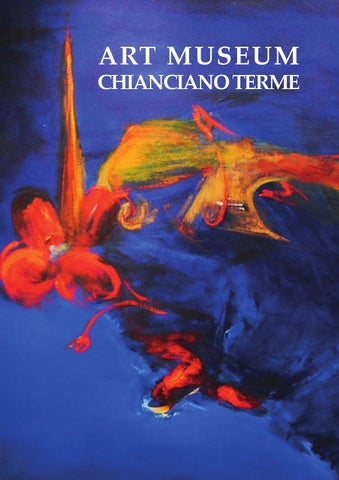
ART MUSEUM
CHIANCIANO TERME
Front Cover / Copertina Detail of “Promontoire“ by Tom Nash, Oil on canvas
MUSEO D’ARTE
CHIANCIANO TERME
Edited by | A cura di International Confederation of Art Critics
1
Chianciano Art Museum
2
INTRODUCTION ~ INTRODUZIONE
The Chianciano Art Museum hosts a series of collections ranging from Neolithic and Asiatic to Contemporary art. There are approximately one thousand works on display. Visitors can view paintings and sculptures by artists such as Sir Henry Moore, Tom Nash, Francis Turner, Mario Schifano, Damien Hirst, Brian Willsher Marco Lodola, and Albert Louden, drawings by the likes of Magritte, Guttuso and Munch, historical works from Royal Collections and original etchings by masters such as Dürer and Rembrandt. The museum is known for organizing annual international events, including the Chianciano International Art Award and the Chianciano Biennale.
Il Museo d’Arte di Chianciano Terme ospita una serie di collezioni d’arte che variano dal Neolitico all’arte orientale, fino ad opere contemporanee. Il museo vanta approssimativamente mille capolavori. I visitatori possono ammirare dipinti e sculture realizzate da artisti quali Sir Henry Moore, Tom Nash, Frances Turner, Mario Schifano, Damien Hirst, Brian Willsher, Marco Lodola ed Albert Louden; disegni di Magritte, Guttuso e Munch; opere storiche provenienti dalle Collezioni Reali ed acqueforti originali di grandi maestri come Dürer e Rembrandt. Il Museo è noto per l’organizzazione di eventi annuali di portata internazionale: per citarne alcuni, Il Chianciano International Art Award e la Biennale di Chianciano.
3
4
5
MASTER DRAWINGS
6
DISEGNI
7
Eithne Healy
“Roberto Gagliardi, founder of the Art Museum of Chianciano Terme” Bronze
8
ART MUSEUM ~ MUSEO D’ARTE
The Art Museum is a landmark in the medieval spa town of Chianciano Terme and represents its artistic renaissance. The gallery is a 3000 square metre structure and the result of the total refurbishment of one of the oldest and most iconic hotels in the area.
Il Museo d’Arte, simbolo della rinascita artistica della cittadina medievale di Chianciano Terme, si sviluppa su una superficie di 3000 metri quadrati che sono oggi il risultato di una completa ristrutturazione di uno dei più antichi e rappresentativi alberghi della zona.
The Museum offers a unique experience. Visitors will be taken on a stimulating journey from artefacts dating back 5000 years, up to an exemplary collection of today’s contemporary art, offering a glimpse into what the future holds.
Il Museo offre al visitatore un’esperienza unica: un viaggio emozionante da rari reperti risalenti a 5000 anni addietro, passando per una significativa raccolta di arte contemporanea, fino ad uno sguardo su ciò che ci riserverà il futuro.
Founded in 2009, the museum is directed with great passion by a team of young curators and art historians who are selected every year among many applicants to participate and enjoy this challenging and fulfilling experience.
Fondato nel 2009, il Museo è tutt’ora gestito con grande passione ed entusiasmo da un team di giovani curatori e storici d’arte che ogni anno vengono selezionati tra i numerosi candidati che desiderano gioire di questa avventura.
The Chianciano Art Museum has become very popular amongst art lovers and collectors all over the world thanks to its prestigious collections, exhibitions and the international events it hosts.
Grazie alle sue importanti collezioni e mostre internazionali, il museo gode di grande popolarità e attrae appassionati d’arte e collezionisti provenienti dal mondo intero.
9
10
P R E FA C E ~ PREFAZIONE
Art connects people. Languages are not global, languages are different thus reflecting cultures and civilisations.
L’arte unisce i popoli. Le lingue non sono globalmente comprensibili, sono differenti, rispecchiano culture e civiltà diverse.
Words are often incomprehensible sounds. Vocal cords emanate vibrations that are in many instances unfamiliar and void of all meaning. Art, by contrast, is universal.
Le parole sono a volte semplici suoni. Dalla bocca dell’interlocutore escono vibrazioni che rimangono tali, senza alcun senso, senza nessuna familiarità. L’arte, al contrario, è la lingua universale.
It is my wish to explore what art has given to mankind over millennia. However, I will not approach this issue academically by describing artistic movements in any particular order, in fact, my desire is to fall back on what I have seen in museums, my thoughts and what I have learned during my studies. Art is not only a path that concerns beauty and aesthetics, it also gives insight and allows us to better understand mankind and the inner nature of humanity. I remember, for example, an interesting quote by Pliny the Elder who described an ancient Roman Painting as so realistic that a bird attempted to eat the grapes depicted.
In questa prefazione desidero parlare a braccio, descrivendo ciò che l’arte ci ha regalato nei millenni. Non in ordine di movimenti o epoche bensì ritornando con la memoria a ciò che ho studiato, alle opere che ho visto nei musei, a ciò che in fondo mi ha dato la consapevolezza che l’arte è un passaporto per capire non solo la bellezza e l’estetica ma anche per entrare nella storia e nella cultura, per comprendere meglio l’uomo, ciò che egli percepisce e ciò che possiede interiormente. Ricordo, ad esempio, un’interessante citazione di Plinio il Vecchio il quale descrivendo un quadro romano disse che l’opera era talmente realista da indurre un uccello che la vide a cercare di beccare l’uva rappresentata nel dipinto.
Opposite: Eduardo Torassa
“The feminist”, Oil on canvas
11
Frances Turner (1965 - 2003)
“Study for Matador� Pencil and charcoal on paper
12
P R E FA C E ~ PREFAZIONE
We are reminded by such references that, even two thousand years ago, there was already artistic excellence through the search for form, light and colour to reproduce and capture reality. I believe that art serves as a mirror into our being: it represents beauty when we admire Botticelli’s “Venus” emerging from the ocean and it reminds us of cruelty in the masterpiece “Judith Beheading Holofernes” by Artemisia Gentileschi, noteworthy follower of Caravaggio and daughter of Orazio Gentileschi. Works such as “The battle of San Romano” by Paolo Uccello, a painting on three panels exhibited respectively in the National Gallery in London, the Louvre in Paris and the Uffizzi in Florence, encapsu- late war and mass bloodshed. We see man’s eternal conflict, once on horseback and now with tanks and missiles. In Munch’s “Scream” we understand anguish and, in the Pinacoteca Comunale di Sansepolcro, we see joy and serenity in the eyes of the Madonna painted by Piero della Francesca.
Ciò dimostra che più di duemila anni fa esisteva già una grande capacità artistica, uno studio delle forme, una riproduzione perfetta della realtà. L’arte rappresenta tutto: rappresenta la bellezza quando ammiriamo la “Venere” di Botticelli che esce dalle acque; rappresenta la crudeltà quando osserviamo Artemisia Gentileschi, la nota artista caravaggesca figlia di Orazio Gentileschi, nella sua grande creazione “Giuditta decapita Oloferne”. In opere come “La battaglia di San Romano” di Paolo Uccello, i cui tre pannelli sono esposti rispettivamente presso la National Gallery di Londra, il Louvre di Parigi e gli Uffizi di Firenze, osserviamo la guerra ed i cavalieri. L’espressione dell’eterno conflitto dell’uomo, ieri a cavallo e oggi con carri armati e missili. Nell’arte osserviamo angoscia e paura, come nell’Urlo di Munch, nonché gioia e serenità nella rappresentazione della Madonna di Piero della Francesca conservata nella Pinacoteca Comunale di Sansepolcro.
13
Afro Basaldella
“Untitled� Mixed media on paper 1951
14
P R E FA C E ~ PREFAZIONE The world can be analysed through art, its past and possibly its future. We are told a story without words but with colours, lines and harmony. A visual message that is more direct than the written word but that requires time and study in the never ending search for meaning. Finally, Contemporary Art must invent, but it must also represent all the magic moments of the past, revisited, analysed and expanded by today’s creative talents. An observer could easily pose the question “Where does abstract art come from?”. The answer is complex, possibly spanning over countless years, but as one dives into the fantastic skies painted by Turner or Constable, we see a reflection of our souls. The abstract form of these artworks is evident and the perceptions of the individual viewer are potentially infinite, if not totally unique. I could continue my brief analysis, venturing further into the realms of the contemporary, but I fear that I would condition rather than aid the reader, who must view this publication with care, free from prejudice and at liberty with one’s intellect.
L’arte in definitiva riproduce il mondo, con il suo passato e il suo futuro. Non è altro che un racconto, fatto non di simboli e scrittura ma di colori, linee e armonie. E’ più immediata della parola eppure allo stesso tempo ci chiede di scoprirla meglio, di cercare di capire cosa davvero l’autore voleva esprimere. L’arte contemporanea rappresenta tutti i magici momenti del passato, rivisitati e ripensati dagli artisti di oggi. Un osservatore potrebbe facilmente arguire: “Dove possiamo trovare l’arte astratta nei tempi remoti?”. La risposta è facile. Ci possiamo tuffare nei fantastici cieli di Turner e di Constable nei quali si vede un’immagine in cui l’anima dell’uomo si specchia. L’astrazione è palese, la percezione che riceviamo dai colori è infinita seppure sempre diversa da osservatore a osservatore. Potrei continuare la mia analisi parlando ulteriormente dell’arte contemporanea, dell’arte di oggi, ma sono certo che disturberei l’analisi dello spettatore, il quale deve invece guardare a questa interessante pubblicazione con occhio attento e svincolato da pregiudizi per giungere infine ad una conclusione unica e personale che possa spaziare libera nel suo intelletto.
Timothy Warrington
International Confederation of Art Critics
15
16
17
18
CONTEMPORARY ART ~ ARTE CONTEMPORANEA
The Chianciano Art Museum exhibits a vast collection of contemporary artworks. Many pieces on display are by artists present in the most famous museum collections in the world: from London’s Victoria & Albert Museum, National Portrait Gallery and Tate Gallery to the Museum of Contemporary Art, Rio de Janeiro, the National Museum, Wales and the Guggenheim collection.
Il Museo d’Arte di Chianciano presenta una vasta collezione d’arte contemporanea. Molti dei lavori esposti sono stati eseguiti da artisti presenti nei più importanti musei del mondo: dal Victoria & Albert Museum, National Portrait Gallery e Tate Gallery di Londra al Museo di Arte Contemporanea di Rio De Janeiro; dal Museo Nazionale del Galles alla collezione Guggenheim.
Opposite: Sir Henry Moore (1898-1986) “Head” - Bronze Sculpture
19
CONTEMPORARY ART
Frances Turner (1965 - 2003) “Foreigner” Oil on panel
Opposite: Jacques Grégoire
“The Naked Photographer” Oil on canvas
20
ARTE CONTEMPORANEA
21
CONTEMPORARY ART
22
ARTE CONTEMPORANEA
Sir Robin Darwin (1910-1974)
“Reflection” Oil on canvas
Opposite: Silvya Harris (1920-2012) “Self-portrait” Oil on canvas
23
Frances Turner (1965 - 2003) “Father and Child II” Oil on panel
Opposite: Eduardo Torassa
“The folds of time” Oil on canvas
24
ARTE CONTEMPORANEA
25
CONTEMPORARY ART
Thomas John Nash was born in 1931 in Ammanford, Wales. He studied at the Swansea College of Art. In 1959 he was elected member of the Royal Cumbrian Academy and later became member of the Société des Artists Humanités de France. His prestigious artworks can be found in many public collections such as the National Museum of Wales, the Arts Council of Britain and the B.P. of London. Image S.tes Marie de la Mer was exhibited at the Victoria & Albert Museum in London and is a refined creation that denotes a profound ability to use colours to highlight incredibly evocative atmospheres.
Tom Nash
“Image S.tes Maries de la Mer” Oil on canvas
Tom Nash è nato nel 1931 a Ammanford in Galles e si è formato al Swansea College of Art. Nel 1959 è stato eletto socio della Royal Cumbrian Academy e successivamente membro della Société Artistes de Humanités de France. I suoi lavori sono conservati in prestigiose collezioni pubbliche, come il Museo Nazionale del Galles, il Museo Calman in Argentina ed il Pembroke and Churchill Colleges a Cambridge. Quest’opera è stata esposta al Victoria & Albert Museum di Londra ed è un elegante creazione che mostra notevoli virtuosismi cromatici.
Jeanne Modigliani (1918-1984) Jeanne Modigliani was born in Nice and she was the daughter of the famous Italian painter Amedeo Modigliani and Jeanne Hébuterne, a French artist and Modigliani’s muse. After the tragic death of her parents when she was only fourteen months old, she devoted her life to scrupulous and passionate research to write the biography of her father, Amedeo Modigliani, published in 1958: “Modigliani, man and myth”. Jeanne Modigliani nacque a Nizza, figlia del celebre pittore Amedeo Modigliani e dell’artista Jeanne Hébuterne, musa del grande Modigliani. Dopo la tragica morte dei genitori, Jeanne dedicò la sua vita allo studio e alla raccolta di tutta la documentazione necessaria per la pubblicazione di una completa biografia del padre, pubblicata nel 1958: “Modigliani, l’uomo e il mito”.
26
“Untitled” Oil pastel on paper
ARTE CONTEMPORANEA
Mario Schifano (1934-1998)
“Untitled” - Oil on canvas
Mario Schifano was born in Homs, Libya, and moved to Rome shortly after World War II. In 1962 he visited the United States for the first time and met artists such as Warhol, Rothko, Jasper Johns and Gregory Corso. He is considered to be one of most significant and pre-eminent artists of Italian postmodernism as well as the most important Italian Pop Artist. On his return to Italy he became part of the core group of artists called “La Scuola Romana”. Schifano is reputed as an exuberant and eclectic artist, in fact he ranges from painting to cinema and music. In 1964 he is invited for the first time to the Venice Biennale. He also exhibits at the National Museum of Modern Art in Tokyo, among others. In the following years he has works on show in all the major museums around Italy and the world. In 1989 he was protagonist of the Italian 20th Century Art exhibition at the Royal Academy of Art, London. In 1993 the Venice Biennale offered` him a personal hall dedicated exclusively to his work.
Mario Schifano nacque a Homs in Libia e si trasferì a Roma poco dopo la seconda guerra mondiale. Nel 1962 si reca negli Stati Uniti per la prima volta e incontra artisti come Warhol, Rothko, Jasper Johns e Gregory Corso. Schifano è considerato uno degli artisti più significativi del postmodernismo in Italia, nonché il più importante artista Pop italiano. Al suo ritorno in Italia entra a far parte del gruppo di artisti definito “La Scuola Romana”. Artista esuberante, prolifico ed eclettico, Schifano spazia dalla pittura, al cinema, alla musica. Nel 1964 è invitato per la prima volta alla Biennale di Venezia. Espone poi presso il Museo Nazionale di Arte Moderna di Tokyo e negli anni seguenti ha opere in mostra in tutti i principali musei d’Italia e del mondo. Nel 1989 è protagonista della mostra Arte Italiana del XX secolo presso la Royal Academy of Art di Londra. Nel 1993 la Biennale di Venezia organizza un’esibizione personale dedicata esclusivamente al suo lavoro.
27
CONTEMPORARY ART
Jincheng Liu
“Moonlight disappeared” Oil on canvas
28
ARTE CONTEMPORANEA
Frances Turner (1965 - 2003)
“Suspicion” Oil on panel
29
30
31
CONTEMPORARY ART
“The art museum is one of the places that represents the most refined achievements of man” “Il museo d’arte è uno dei luoghi che danno l’idea più elevata dell’uomo” André Malraux - 1947
Opposite: Albert Louden
“Untitled figure and children” Oil on canvas
32
ARTE CONTEMPORANEA
33
ARTE CONTEMPORANEA
34
ARTE CONTEMPORANEA
Opposite: Plamen Kapitanski “Untitled” Oil on canvas
Above: Brian Willsher (1930-2010) “Sorrow” Bronze
35
CONTEMPORARY ART
36
Norman Adams (1997-2005) “Tensions of the Dance” Oil on canvas
37
ARTE CONTEMPORANEA ARTE CONTEMPORANEA
38
ARTE CONTEMPORANEA
Above: Eduardo Torassa “Dream of a Prince” Oil on canvas
Opposite: Jincheng Liu “Last Night of Summer” Oil on canvas
39
Aelita Andre
“Untitled” Acrylic on canvas
40
ARTE CONTEMPORANEA
Nigel Mullins “The Chase” Oil on canvas
41
Marco Lodola “Dancers” Acrylic on canvas
42
CONTEMPORARY ART
Frances Turner (1965-2003) “The Breathing Machine” Charcoal and pencil on paper
43
44
45
46
ASIAN ART ~ ARTE ORIENTALE
The collection of Oriental Art consists of important artefacts that originate from the most prestigious and ancient dynasties. Beautiful and interesting relics that after thousands of years still transmit the art, tradition and talent of these great populations with grace and harmony. The permanent exhibition includes 200 works that span from the Neolithic period to the great Qui, Han and Tang dynasties.
La collezione d’arte orientale comprende manufatti provenienti dalle più potenti ed antiche dinastie d’Oriente. Affascinanti reperti che dopo migliaia di anni trasmettono ancora, con la loro grazia ed armonia, la perizia artistica, la tradizione e la cultura di questi grandi popoli. L’esposizione permanente include 200 artefatti che vanno dal periodo Neolitico fino alle grandi dinastie dei Qi, Han e Tang.
Opposite: Ox
Northern QI, China 5th Century A.D. - Pottery
47
ASIAN ART
China, Tang Dynasty 7th Century A.D.
48
Afghanistan, Hadda Culture 4th Century A.D.
49
ASIAN ART
Tang Dynasty
7th Century A.D. Terracotta Bactrian Camels
50
ARTE ORIENTALE
These two terracotta camels belong to the Tang Dynasty who reigned in China from 618 to 907 A.D. during one of the most intensely interesting periods for Chinese art and culture. After the occupation of Korea, the Tang Empire widened its boundaries extensively and established fruitful commercial relationships with Japan and India. The production of precious porcelain began and consequently the creation of magnificent sculptures characterised by marked three-dimensional features and a strong influence from the Far East. An emblematic example can be seen in this pair of Bactrian camels. In Middle and Far Eastern cultures, the camel had a symbolic meaning. In Arabia it represented beauty and fortune, while in China it represented humility.
Questi due cammelli in terracotta sono stati realizzati durante il dominio della Dinastia Tang che regnò in Cina tra il 618 e il 907 A.D., uno dei periodi più floridi della storia culturale cinese. Dopo la conquista della Corea, l’impero Tang raggiunse notevoli dimensioni ed instauró proficui rapporti commerciali con Giappone ed India. Proprio in questo periodo ebbe inizio la produzione della preziosa porcellana e si intensificò la creazione di sculture caratterizzate da una spiccata tridimensionalità e dal gusto derivante dal rapporto diretto con l’estremo oriente. Un emblematico esempio è rappresentato proprio dalla coppia di cammelli battriani: questo animale assunse grande valore simbolico nella cultura orientale. In Arabia, ad esempio, esso simboleggia bellezza e fortuna; in Cina invece, è sinonimo di umiltà.
51
Pottery Stick Figures Han Dinasty 1st Century B.C. - Pottery
Opposite: Mosque Door
52
Northern Afghanistan 17th Century
ARTE ORIENTALE ASIAN ART
53
ASIAN ART
2nd Century B.C. Han Dinasty Bowl Pottery
54
11th Century A.D.
Nishapur Pitcher and Bowl Turquoise Terracotta
ARTE ORIENTALE
3000 B.C.
Neolithic red Pottery Amphora Yangshao Culture
This amphora, carbon dated 3000 B.C., was found during the 1953 discovery of the Banpo archaeological site in the Yellow River Valley at Xian, in the Shaanxi Province. Over 10,000 stone tools and artefacts, 250 tombs, 6 large kilns, storage pits, and almost 100 foundations of buildings were discovered. It was the first large-scale archaeological operation of the People’s Republic of China. Banpo is one of the most significant Neolithic sites in the world and an exceptional example of matrilineal society in which women were cheiftains and men subordinates.The remains of these ancient ceramic artefacts, each shaped by hand and fired, suggest that they were mainly used for daily purposes. The decorations on this amphora are typical of the Yangshao culture and were made by weaving ropes around the artefact to leave an impression on the ceramic in a predefined scheme. Many other works discovered in the Banpo excavation were decorated with symbols whose meaning is still unknown to researchers and linguists today. Quest’anfora, secondo la più recente datazione al carbonio è stata creata nel 5000 B.C. ed è stata rinvenuta nel 1953 con la scoperta del sito archeologico Banpo nella valle del Fiume Giallo a Xian, nella provincia dello Shaanxi. Sono stati ritrovati più di 10.000 utensili e manufatti in pietra, 250 tombe, 6 grandi forni, pozzi di stoccaggio, e quasi 100 fondamenta di edifici. Fu la prima operazione archeologica su larga scala della Repubblica popolare cinese. Banpo è uno dei più importanti siti archeologici del Neolitico ed è un esempio eccezionale di società matriarcale. I resti di questi antichi manufatti ceramici, ognuno dei quali decorato a mano e successivamente cotto, suggeriscono che si tratta per lo più di oggetti di uso quotidiano. Le decorazioni in questa anfora sono tipiche della cultura Yangshao e venivano realizzate mediante corde intrecciate attorno al manufatto con lo scopo di lasciare un preciso ornamento artistico seguendo uno schema ben definito. Molte altre opere scoperte nello scavo a Banpo sono decorate con simboli il cui significato è oggi ancora sconosciuto per ricercatori e linguisti.
55
ASIAN ART
Qing Dinasty 17th Century A.D. Buddha, Bronze
Naga is the sacred name of the mythical serpent in Southeast Asian culture. In Thailand, the figure has deeply influenced aspects of Thai traditional arts, especially in architecture and sculpture. Here, the indigenous ethnic groups believe that the serpent is the creator of nature and life. The serpent is also supposed to have assisted people in establishing the city-states and citadels by bestowing prosperity and richness. The animist serpent cult of the Siam peninsular was found ever since the Metal Age. According to Thai mythology, the Nagas had so faithfully served the Buddha’s truth that they were given key positions in and on Buddhist temples under various forms. The Nagas usually appear on finials, gable boards, arches, balustrades, along the tiers of temple roofs, and especially on skillfully carved stairs leading to the main shrine. They are the most popular statues to be worshipped in Thai temples, especially in temples in the North and the Northeast of Thailand where the belief of the Naga is predominant. This example of ironrich underglazed Naga comes from the Sawankhalok region and dates back to the 15th century A.D.
56
ARTE ORIENTALE
Thai Naga 15th Century A.D. Thailand, Ceramic
Il Naga è il mitologico serpente sacro presente nella tradizione culturale del Sud-Est asiatico. Questa potente figura del mito ha profondamente influenzato l’arte tradizionale thailandese, soprattutto in architettura e in scultura. Qui, i primi gruppi etnici indigeni credono che il serpente sia il creatore stesso della natura e della vita. Si pensa anche che il serpente sacro abbia aiutato i popoli a stabilirsi in Città-Stato, fondando le prime cittadelle e donando prosperità e ricchezza. Il culto animista del serpente nella penisola del Siam è radicato fin dall’Età del Ferro. Secondo la mitologia thailandese, i Naga avevano così fedelmente servito la verità del Buddha che quest’ultimo aveva assicurato loro una posizione chiave, sotto varie forme, sia dentro che sopra i templi buddisti. I Naga quindi appaiono sui pinnacoli, sui timpani, sugli archi, sulle balaustre e lungo i diversi livelli dei tetti dei templi, ma soprattutto sulle scale magistralmente scolpite che conducono al santuario principale. Esse sono le statue più popolari e adorate nei templi thailandesi, soprattutto nel Nord-Est della Thailandia, dove la credenza animista è quella predominante. Questo esempio di Naga smaltato proviene dalla regione Sawankhalok e risale al XV secolo A.D.
57
ASIAN ART
58
ARTE ORIENTALE
6th Century B.C.
Cart with Oxes Terracotta
59
60
61
62
ETCHINGS & ENGRAVINGS ~ ACQUEFORTI & INCISIONI
Many artists, among the greatest in Europe, such as Albrecht Dürer, Rembrandt, Salvator Rosa, Eugène Delacroix, Anthony Van Dyck and Piranesi were passionate printmakers. At that time, their international reputation was mainly due to their prints, because the use of etchings and engravings was commonly in use to promote the work of the artist. The Museum hosts a vast collection of about 100 works, original etchings and engravings that date back to the 16th century. These works were acquired from institutions and museums of international fame such as the Cincinnati Art Museum, the New York Metropolitan Museum and the private collection of Count Antoine Seilern.
Molti tra i più grandi artisti europei, come Albrecht Dürer, Rembrandt, Salvator Rosa, Eugène Delacroix, Anthony Van Dyck e Piranesi furono anche grandi e stimati incisori. All’epoca, acqueforti e incisioni erano comunemente utilizzate per promuovere e diffondere il lavoro di un’artista e la fama dei grandi maestri si era internazionalizzata proprio grazie ad esse. Il Museo ospita una vasta collezione di circa 100 tra originali acqueforti ed incisioni, risalenti al XVI secolo. Questi lavori provengono da istituzioni e musei di fama internazionale, quali il Museo d’Arte di Cincinnati, il Metropolitan Museum di New York e la collezione privata del conte Antoine Seilern.
Opposite: Anthony van Dyck (1599-1641) “Lucas Vorstermans” Original etching
63
ETCHINGS & ENGRAVINGS
Albrecht Dürer was a famous German painter, printmaker, mathematician and writer. He was born in Nuremberg. Dürer revolutionised the art of printing and elevated it to a totally independent form of art. Dürer’s introduction of classical motifs into Northern art through his deep knowledge of Italian artists such as Bellini and Leonardo is what made Dürer one of the most eminent and important figures of Northern Renaissance. In fact, as we can see, “Gioacchino and the Angel” immediately reminds us of Michelangelo. Through a perfect compositional balance the artist represents a supernatural event in a purely naturalistic manner with impressive skill, paying particular attention to a detailed landscape in the perfect Flemish tradition.
Albrecht Dürer (1471–1528)
Albrecht Dürer fu un famoso pittore, incisore, matematico e trattatista tedesco, nato a Norimberga. Dürer rivoluzionò l’arte della stampa, elevandola a forma artistica totalmente indipendente. Dürer dimostrò un grande interesse per l’arte italiana, in particolare per Bellini e Leonardo da Vinci, e introdusse motivi classici nella tradizione artistica nord-europea. Nell’incisione conservata al Museo di Chianciano la posizione della figura di Gioacchino è una tipica dimostrazione del concetto di contrapposto alla michelangiolesca. Con un perfetto equilibrio compositivo, l’artista raffigura con grande abilità un evento sovrannaturale in modo naturalistico, prestando particolare attenzione agli elementi paesaggistici, come da protocollo tipico fiammingo.
“Gioacchino and the Angel” - Original engraving Provenance: Cincinnati Art Museum
Salvator Rosa was an extraordinary Italian Baroque painter, printmaker, engraver, poet and one of the most unconventional artists of seventeenth century Italy. His interest in art started at a very early age and he pursued this passion even against his father’s will. He studied in Naples under Francanzano, Aniello and Ribera. His controversial attitude led him to travel a lot between Rome and Florence where he produced masterpieces of exceptional beauty for Cardinal Francesco Maria Brancaccio and Cardinal Gian Carlo de’ Medici. Salvator Rosa greatly influenced British Romantics. In the etching “Soldiers sitting with helmet, spear and sword” the careful study to represent a true-to-life and monumental anatomy is evident and fills the composition with a most expressive simplicity. Salvator Rosa fu un pittore, incisore e poeta napoletano di straordinario talento, uno degli artisti meno convenzionali del XVII secolo in Italia. Sin dalla tenera età manifestò da subito un forte interesse per l’arte, apprendendone i primi rudimenti, prima presso la bottega di uno zio materno, poi da Fracanzano, Aniello e Ribera. La sua attitudine eccentrica lo condusse a viaggiare molto tra Roma e Firenze, dove produsse capolavori di grande bellezza per i Cardinali Francesco Maria Brancaccio e Gian Carlo de’ Medici. Salvator Rosa ebbe una grande influenza sul Romanticismo inglese. Nell’acquaforte “Soldati seduti con elmo, lancia e spada“, l’equilibrata composizione evidenzia l’attento studio delle monumentali anatomie, realizzate con pochi ma significativi ed espressivi tratti.
64
Salvator Rosa (1615-1673)
“Soldiers sitting with helmet, spear and sword” Original etching
ACQUEFORTI E INCISIONI
Eugène Delacroix (1798-1863)
“Lionne Déchirant la Poitrine d’un Arabe” Original engraving
Eugène Delacroix was born in Paris and studied under Neoclassical artist Pierre Guérin. Delacroix was regarded as the leader of the French Romantic school. As a painter and muralist, Delacroix’s use of expressive brushstrokes and his study of the optical effects of colour profoundly shaped the work of Impressionists such as Renoir, Manet and Degas, while his passion for the exotic inspired artists from the Symbolist movement. Delacroix was also a fine lithographer and illustrated works of William Shakespeare, Walter Scott, Lord Byron and Johann Wolfgang von Goethe. He drew inspiration from Rubens and from painters of the Venetian Renaissance, with a predominant emphasis on colour and movement rather than clarity of outline and carefully modelled form. Eugène was also a very talented printmaker and as we can see in this “Lionne déchirant la poitrine d’un Arabe” in which the perfect realistic anatomical rendering of the figures makes it a masterpiece in itself.
Eugène Delacroix nacque a Parigi e si formò sotto la guida del pittore neoclassico Pierre Guérin. Delacroix viene considerato il leader della Scuola Romantica francese. I suoi dipinti e affreschi mostrano un utilizzo della pennellata e uno studio degli effetti ottici del colore che influenzerà profondamente l’opera di impressionisti come Renoir, Manet e Degas, mentre la sua passione per l’esotico ispirerà gli artisti del movimento simbolista. Abile litografo, Delacroix ha illustrato svariati lavori di William Shakespeare, Walter Scott, Lord Byron e Johann Wolfgang von Goethe. Delacroix ha uno sguardo puntato su Rubens e sui pittori del Rinascimento veneziano, con un’enfasi predominante sul colore e sul movimento piuttosto che sulla nitidezza dei profili e delle forme. Eugène fu anche un talentuoso incisore come possiamo ammirare nell’opera conservata a Chianciano “Lionne déchirant la poitrine d’un arabe”, in cui la perfetta resa anatomica e realistica delle figure lo rende un grande capolavoro.
65
ETCHINGS & ENGRAVINGS
Above: Albrecht Dürer (1471–1528)
“St. Thomas” - Original engraving Provenance: The Count Antoine Seilern Collection
Opposite: Giovanni Battista Piranesi (1720-1778)
“The Roman Antiquities” Original etching
66
ACQUEFORTI E INCISIONI
67
ETCHINGS & ENGRAVINGS
Above: Rembrandt Harmenszoon Van Rijn (1606-1669) “Joseph tells his dreams” Original etching
Opposite: Albrecht Dürer (1471–1528)
“The Presentation of the Virgin in the Temple” From “The Life of the Virgin” - Original woodcut, 1503 Provenance: The Count Antoine Seilern Collection
68
ACQUEFORTI E INCISIONI
69
ETCHINGS & ENGRAVINGS
Above: Albrecht Dürer (1471–1528)
“The Deposition from the Cross” - Original engraving on wood Provenance: Cincinnati Art Museum
Opposite: Rembrandt Harmenszoon Van Rijn (1606-1669) “Untitled” Original etching
70
ACQUEFORTI E INCISIONI
71
72
73
74
HISTORICAL EUROPE ~ OPERE STORICHE
The historical Europe section presents works that have been obtained directly from the most important Royal families in Europe. There are works that come from the Collections of the Royal families of England, France, Italy and Belgium.
“Portrait of Umberto II King of Italy”- Oil on canvas Provenance: The Royal House of Savoy Collection
La sezione dedicata ai lavori storici presenta opere che sono state acquisite direttamente dalle Case Reali più importanti d’Europa. Sono esposti lavori provenienti dalle Collezioni della Casa Reale inglese, francese, italiana e belga.
75
HISTORICAL EUROPE
Elizabeth This gesso bust depicts Vladimir Barjansky, Russian painter and illustrator specialised in costumes and scenery for films and theater. Vladimir worked a lot between Paris, Brussels and Nice. In 1938 the French police accused him of being a spy for the Soviet regime, so he was forced to escape to Hollywood, USA, where he worked on sets and costumes for films such as “Destination Tokyo”. This Bust of V. Barjansky of comes from the collection of Princess Maria Gabriella of Savoy, daughter of Maria Jose. This gesso is one of the most interesting examples of art produced by Queen Elizabeth of Belgium.
Il busto raffigura Vladimir Barjansky, pittore ed illustratore russo specializzato nella realizzazione di costumi e di scenografie per cinema e teatro. Vladimir ebbe un’attività lavorativa molto frenetica tra Parigi, Bruxelles e Nizza. Nel 1938 la polizia francese lo accusó di spionaggio al servizio del regime sovietico e fu pertanto obbligato a riparare ad Hollywood, negli Stati Uniti, dove si occupó di scenografie e costumi per film come “Destinazione Tokyo”. L’opera, presente al Museo di Chianciano Terme, proviene dalla Collezione di Maria Gabriella di Savoia, figlia di Maria José. Questo bronzo è uno dei piú interessanti esempi dell’arte prodotta dalla regina Elisabetta del Belgio.
Elizabeth, Queen of Belgium (1876-1965)
76
“Bust of V. Barjansky” - Gesso Provenance: The Maria Gabriella of Savoy Collection
OPERE STORICHE
Queen of Belgium Elizabeth of Bavaria, nicknamed “The Red Queen” for her socialist sympathies, was Queen of Belgium from 1909 to 1934 as consort of King Albert I. Elizabeth used to surround herself with philosophers and artists. She was anti-fascist and she acted as a volunteer during World War I. She was passionate about art and music and she instituted the Queen Elisabeth International Competition dedicated to young musicians. Her passion for art is proven also by the creation of the Queen Elizabeth Egyptological Foundation and by numerous artworks she made herself. This bust represents her daughter Maria José of Belgium, Queen of Italy. This work comes from the collection of Princess Maria Gabriella of Savoy, Maria José of Belgium’s daughter.
Elisabetta, detta “Regina Rossa” per le sue simpatie socialiste, fu regina del Belgio dal 1909 al 1934 accanto a Re Alberto I. Elisabetta era solita circondarsi di filosofi ed artisti, si dichiarò antifascista e si occupó di volontariato durante la Prima Guerra Mondiale. Appassionata d’arte e di musica, istituì il Concorso Internazionale Regina Elisabetta dedicato a giovani musicisti. La sua passione per l’arte è confermata anche dalla costituzione della Fondazione egittologica Regina Elisabetta e dalle numerose opere da lei realizzate. Il busto raffigura Maria José del Belgio, Regina d’Italia e figlia di Elisabetta. L’opera proviene dalla Collezione di Maria Gabriella di Savoia, figlia di Maria José del Belgio.
Elizabeth, Queen of Belgium (1876-1965) “Bust of Maria José, Queen of Italy”- Bronze Provenance: The Maria Gabriella of Savoy Collection
77
HISTORICAL EUROPE
Emperor Napoleon III of France
“A team of artillerymen preparing a field gun” - Original drawing
Mario buccellati
Icon donated and blessed by Pope Pius XII to H.R.H Princess Margaret, 1949
78
OPERE STORICHE
Iacopo Negretti know as Palma il Giovane
“Portrait of the Pope Pius V” - Oil on canvas In the 16th century this painting was owned by the Cervini Family, Counts of Siena, later purchased by the Bellanti Family, Counts of Siena.
79
HISTORICAL EUROPE
80
OPERE STORICHE
Russian Realism Oil on canvas
81
82
83
84
MASTER DRAWINGS ~ DISEGNI
Drawings are probably the purest and most harmonic form of art. The artist only uses lines; colour is rarely used. Greys and chiaroscuro are the means by which and artist communicates and conveys emotion. The collection includes works that originate from the 16th century to the great Russian masters of the 20th century. Visitors will be able to admire the difference in techniques developed in the last 500 years. The most important drawings include works by Giovanni Domenico Tiepolo, Luca Giordano, Giovanni Barbieri called Guercino, Paolo Caliari called Veronese and artists from the 19th and 20th centuries such as Edvard Munch, René Magritte, George Grosz and Renato Guttuso.
Il disegno è probabilmente la più pura ed armoniosa tra le espressioni artistiche. Solo di rado il colore viene utilizzato e l’artista si esprime mediante semplici ma efficaci linee. Le sfumature dei grigi e i chiaroscuri sono i mezzi tramite i quali l’artista emoziona e stupisce. La collezione include lavori eseguiti dal XVI secolo fino ai disegni dei grandi maestri russi del Novecento. Il visitatore potrà ammirare le diverse tecniche sviluppate negli ultimi 500 anni e avvicinarsi ad una disciplina ormai quasi in disuso. I disegni più importanti includono lavori di Giovanni Domenico Tiepolo, Luca Giordano, Giovanni Barbieri detto il Guercino, Paolo Caliari detto il Veronese ed artisti del XIX e XX secolo come Edvard Munch, René Magritte, Renato Guttuso e George Grosz.
Opposite: Antonio Pacitti (1924-2009) “Harman” - Ink and Charcoal
85
MASTER DRAWINGS
Pietro Annigoni (1910 – 1988) was an Italian painter influenced by the Italian Renaissance, in contrast to the modernist and post-modernist artistic currents that dominated the middle and late twentieth century. He became world famous after painting Queen Elizabeth II in 1956. The portrait is at the National Portrait Gallery of London. He also realised portraits of Pope John XXIII, US Presidents John F. Kennedy and Lyndon B. Johnson, the Shah and Empress of Iran, Princess Margaret and several other members of the British Royal Family. Annigoni’s works are housed in museums worldwide, from San Francisco to Indianapolis, from New York to the Vatican Museums.
Pietro Annigoni “Untitled” Original drawing
86
Pietro Annigoni (1910 – 1988) fu un pittore italiano il cui stile evidenzia una forte influenza del Rinascimento e della tradizione classica. Annigoni si pone in diretto contrasto con gli stili ritrattistici propri del Modernismo e Postmodernismo in auge negli anni della sua attività e ottiene una fama globale con il celebre ritratto della Regina Elisabetta II nel 1956, conservato nella National Portrait Gallery di Londra. Annigoni ha inoltre realizzato i ritratti di Papa Giovanni XXIII, John F. Kennedy, dello Shah e dell’Imperatrice dell’Iran, della Principessa Margaret e di molti altri membri della famiglia reale inglese. I capolavori di Annigoni sono esposti nei musei di tutto il mondo, da San Francisco e New York ai Musei Vaticani.
DISEGNI
Born in Volos, Greece, to a Genovese mother and a Sicilian father De Chirico studied art in Athens and Florence, moving to Germany in 1906 where he enrolled at the Academy of Fine Arts, Munich. In the years prior to World War I, De Chirico founded the art movement called “Scuola Metafisica” which profoundly influenced the Surrealists. Moving to Florence in 1910, De Chirico painted the first of his ‘Metaphysical Town Square’ series. In Paris, De Chirico met the writer Guillaume Apollinaire, who helped to introduce his work to artistic circles. Other Surrealists who acknowledged De Chirico’s influence include Max Ernst, Salvador Dalí and René Magritte. De Chirico remained extremely active even as he approached his 90th year and in 1974 he was elected to the French Académie des Beaux-Arts.
Giorgio De Chirico (1888-1978) “My left hand” - Original drawing
Nato a Volos, in Grecia, da madre genovese e padre siciliano, De Chirico ha studiato arte ad Atene e a Firenze, fino al trasferimento in Germania nel 1906 dove si iscrisse all’Accademia di Belle Arti a Monaco di Baviera. Negli anni precedenti la prima guerra mondiale, De Chirico fonda il movimento artistico chiamato “Scuola Metafisica”, che influenzerà profondamente i surrealisti. Trasferitosi a Firenze nel 1910, De Chirico dipinge la prima opera della celebre serie ‘Piazze Metafisiche’. A Parigi, incontra poi lo scrittore Guillaume Apollinaire, che contribuirà a presentare il suo lavoro ai futuri surrealisti. Celebri artisti ispirati da De Chirico sono Max Ernst, Salvador Dalí e René Magritte. De Chirico è stato creativamente attivo e prolifico fino al novantesimo anno d’età e nel 1974 è stato eletto professore alla Académie des Beaux-Arts in Francia.
Giorgio De Chirico (1888-1978) “My right hand” - Original drawing
87
MASTER DRAWINGS
Repin Academy
Academy Drawings
88
DISEGNI
89
MASTER DRAWINGS
Giovanni Francesco Barbieri (1591-1666), known as Il Guercino, was a Baroque artist. He was mainly self-taught and the meeting with Ludovico Carracci encouraged him to pursue his career as a painter. The vigorous naturalism of his early manner reminds us of Caravaggio. His many drawings are noted for their luminosity and lively style. In 1642, following the death of Guido Reni, Guercino moved his busy workshop to Bologna and become the city’s principal painter. Il Guercino was a prolific draftsman and his production includes many drawings, usually in ink, washed ink, or red chalk. Guercino’s drawings are known for their fluent style in which rapid, calligraphic pen strokes combined with dots, dashes, and parallel hatching lines describe the forms.
Giovanni Barbieri know as Guercino “Elijah fed by the ravens” - Original drawing
Giovanni Francesco Barbieri (1591-1666), noto come Il Guercino, fu un artista barocco, principalmente autodidatta. L’incontro con Ludovico Carracci lo incoraggiò a proseguire la sua carriera come pittore. Il naturalismo vigoroso della sua prima maniera ricorda Caravaggio, mentre i suoi numerosi disegni sono noti per la luminosità e stile vivace. Nel 1642, dopo la morte di Guido Reni, Guercino trasferì il suo laboratorio a Bologna e divenne il pittore più in voga in città. Fu un disegnatore prolifico e la sua produzione comprende molti disegni ad inchiostro, acquerello o sanguigna, caratterizzati da uno stile fluente in cui rapidi tratti di penna si combinano a punti, trattini e linee parallele che descrivono le morbide forme, come possiamo ammirare nello splendido “Elia nutrito dai corvi”.
Bartolomeo Passerotti (1529-1592) was an Italian Mannerist painter influenced by the works of Correggio and Parmigianino. Passerotti combined the chromatic delicacy and the monumental Classicism typical of Correggio with the sinuous figures of Parmigianino. After spending much of his early career in Rome he settled in his native Bologna, where he had a large studio that became the focal point of the city’s artistic life and would later play a role in the rise of the Baroque. Annibale Carracci was influenced by Passerotti’s genre scenes. Passerotti is known as a portrait and caricaturist painter, showing a stylistic similarity to Dürer as seen in this beautiful untitled male face. Bartolomeo Passerotti (1529-1592) è stato un pittore manierista italiano influenzato dalle opere di Correggio e Parmigianino. Passerotti unisce la delicatezza cromatica e il classicismo monumentale di Correggio con le sinuose figure del Parmigianino. Dopo aver trascorso gran parte della sua carriera a Roma, si stabilì nella sua nativa Bologna, dove il suo studio divenne punto focale della vita artistica della città e determinante per lo sviluppo del Barocco. Annibale Carracci stesso è stato influenzato da Passerotti nelle scene di genere. Passerotti è noto come ritrattista e caricaturista, stilisticamente simile a Dürer, come traspare da questo bel volto maschile.
90
Bartolomeo Passerotti (1529-1592)
“Untitled” - Original drawing
DISEGNI
Giovanni Domenico Tiepolo (1727-1804)
“Group of alarmed spectators” - Original drawing This drawing was exhibited at the Royal Academy of Art, London and at the National Gallery of Canada, in Ottawa
Paolo Veronese (1528-1588)
“Christ on the cross” - Original drawing
Luca Giordano (1634-1705)
“Untitled” - Original drawing
91
92
93
94
A CULTURAL MEETING POINT ~ UN MEETING POINT CULTURALE The belief that the management and fruition of museums is solely based on the principle that they are custodians of heritage artworks is still widely sedimented today. The Chianciano Art Museum breaks the traditional idea that museums and their collections are a “foreign body” to the community and are inherently complacent. Ever since the 1900s, Filippo Tommaso Marinetti, spokesman of Italian Futurism, felt the need to disavow museums, defined as “Cemeteries! [...], public dormitories in which one rests forever next to hated or unknown beings”, static places, ancient, and in contrast with the elation of the modernity of the Futurist movement. A school of thought that was intolerant towards the concept of art as elitist or to be confined in museums or other traditionally accepted institutions. The Chianciano Art Museum was obviously born to conserve and catalogue masterpieces of art, albeit as a “tool” that intertwines art and museum competence, tradition and modernity. The Museum becomes a bridge between different generations and cultures, between creative mastery and passion for art.
La convizione che nell’istituzione museale i criteri di carattere fruitivo e gestionale siano basati solo sul principio della custodia di un patrimonio è ancora oggi largamente sedimentata. Il Museo d’Arte di Chianciano vuole uscire dagli schemi che alimentano questo approccio alla raccolta museale come “corpo estraneo” alla comunità. Filippo Tommaso Marinetti, portavoce del Futurismo, già nei primi del ‘900 sente la necessità di ripudiare i musei, definiti “Cimiteri! [...], dormitori pubblici in cui si riposa per sempre accanto ad esseri odiati o ignoti”, luoghi statici, antiquati e in contrasto con l’esaltazione della modernità del movimento futurista, cosi insofferente al concetto di un’arte élitaria, confinata nei musei e negli spazi della cultura aulica. Il Museo d’Arte di Chianciano nasce, sì, per conservare e catalogare capolavori artistici ma vuole essere anche “strumento” che intreccia arte e fruizione museale, tradizione e apertura alla modernità. Il Museo diventa ponte tra generazioni e confluenza di saperi, maestrie e passione per l’espressione artistica.
Opposite: Gelindo Baron “Green Landscape“ Oil on canvas
95
96
A CULTURAL MEETING POINT ~ UN MEETING POINT CULTURALE
The Museum is perfectly integrated into society and contemporary art, embracing cultural events of all kinds, with the sole aim to involve and enrich visitors. An ever evolving collection in which continuous events, performances and shows take place. The Museum of Art is famous for the organisation of annual international events, among which the International Chianciano Art Award and the Chianciano Biennale. During the Biennale, the Museum hosts a vast array of contemporary art coming from all over the world. In 2015 the Museum gathered more than 120 artists from 40 di erent countries in its 3000 square meters of space. Masterpieces by the best international talents, both famous and emerging. The Biennale takes place all over the town, in its Medieval centre and historical houses, giving visitors a charming imprint of art and beauty.
Il Museo si integra perfettamente con la società e con l’arte contemporanea, abbracciando eventi culturali di ogni genere, con l’unico scopo di coinvolgere e arricchire il visitatore. Una raccolta in divenire in cui ogni anno prendono vita nuove collezioni e in cui fioriscono continui eventi, performance e spettacoli. Il Museo d’Arte è noto infatti per organizzare annualmente eventi internazionali, tra cui il Premio Internazionale Chianciano Arte e la Biennale di Chianciano. Durante la Biennale ospita una vasta gamma di arte contemporanea proveniente da tutto il mondo. Nel 2015 il Museo ha accolto 120 artisti provenienti da 40 paesi, per un totale di 3000 metri quadri di opere d’arte selezionate tra i migliori talenti internazionali, sia affermati che emergenti. La Biennale si sviluppa nell’intera città, con il suo borgo medievale e le sue storiche dimore, dando al visitatore una suggestiva impronta di arte e di bellezza.
Opposite: Daniela Grifoni “Magmatism II“ Oil on canvas
97
98
A CULTURAL MEETING POINT ~ UN MEETING POINT CULTURALE
Experimenting and planning new ideas are the foundations that enable a museum to keep up to speed with the times, with the ultimate aim of become a meeting place for the whole community and not only for collectors and art specialists.
Sperimentazione e progettazione di nuove idee: questi i capisaldi che permettono ad un museo di stare al passo con i tempi, nell’obiettivo ultimo di diventare luogo di incontro per l’intera comunità, non solo per collezionisti o addetti ai lavori.
This creates an increasing virtuous circle that translates into always new and encouraging proposals for the cultural life of the community. Therefore, instead of being just a container of culture, the museum becomes creator of culture and opens up to intellectual formation and enrichment of society. The museum also becomes a center where new professional roles are involved in order to implement constructive collaborations with the younger generations and to finally be open and accessible.
Questo crea un crescente circolo virtuoso nella proposta di offerte sempre innovative e incoraggianti per la vita culturale. Il museo quindi, da contenitore di cultura, si apre alla creazione di un sapere, alla formazione intellettuale e all’arricchimento della società. Il museo diventa anche occasione per impegnare nuove figure professionali, per mettere in pratica costruttive collaborazioni con i giovani e per essere finalmente un luogo aperto e accessibile.
From a static place to a crossroads of culture in which artists from all over the world can meet to express themselves and interact. The Chianciano Art Museum comes from century-old foundations, lives in the present and turns its glance towards future generations.
Da luogo statico a crocevia di produzione culturale, in cui artisti da tutto il mondo si incontrano per esprimersi e interagire tra loro. Il Museo d’Arte di Chianciano poggia su fondamenta secolari, vive nel presente e ha uno sguardo puntato alle generazioni future. Elena Foschi
International Confederation of Art Critics
Opposite: Victor Majdandžić “September 1989“ Acrylic on board
99
Larisa Davatz
“Two girls with flowers“ Oil on canvas
100
OXFORD UNIVERSITY GROUP A LITTLE BIT OF OXFORD IN THE HEART OF TUSCANY
~ GRUPPO DELL’UNIVERSITÀ DI OXFORD
UNA PARTE DI OXFORD NEL CUORE DELLA TOSCANA
The Oxford Alumni of Tuscany is based at the Chianciano Art Museum and offers the international network of Oxford Alumni a chance to meet and remain involved with the University. The Society also welcomes Oxonian tourists and travellers in the area. On showing their alumni card, Oxford Alumni benefit from free entry into the Chianciano Museum of Art to see the permanent collections and to all forums and conferences. Alumni are also offered help in finding accommodation in the area, and are entitled to considerable discounts for all courses offered at the Chianciano Art Museum.
Il Gruppo Toscano degli Alumni di Oxford, ovvero il gruppo degli ex studenti della prestigiosa Università inglese, ha sede presso il Museo d’Arte di Chianciano, il quale offre loro un network internazionale che gli permette di incontrarsi e rimanere in contatto con l’Università. Tale organizzazione accoglie anche i turisti e i viaggiatori oxfordiani nella zona. Mostrando la loro carta Alunni, gli Alumni di Oxford beneficiano dell’ingresso gratuito al Museo d’Arte di Chianciano per ammirare le collezioni permanenti e per partecipare a tutti i forum e conferenze organizzate nella sede museale. Agli Alumni è offerto anche un eventuale aiuto per trovare alloggio nella zona e possono usufruire di notevoli sconti in tutti i corsi proposti nel Museo d’Arte.
101
102
Ercolina Visca “Concert” Oil on canvas
103
104
INDEX INDICE
Introduction | Introduzione
3
Art Museum | Museo d’Arte
9
Preface | Prefazione
11
Contemporary Art | Arte Contemporanea
19
Asian Art | Arte Orientale
49
Etchings and Engravings | Acqueforti e Incisioni
65
Historical Europe | Opere Storiche
77
Master Drawings | Disegni
85
A Cultural Meeting Point | Un Meeting Point Culturale
95
Oxford University Group | Gruppo dell’Università di Oxford
103
105
List of Works Indice Opere Description Tom Nash “Promontoire” Oil on canvas
Page Cover
Contemporary Art 1. Eithne Healy “Roberto Gagliardi, founder of the Art Museum of Chianciano Terme” Bronze
8
12. Tom Nash “Image S.tes Maries de la Mer” Oil on canvas
26
25. Marco Lodola “Dancers” Acrylic on canvas
42
13. Jeanne Modigliani “Untitled” Oil pastel on paper
26
26. Frances Turner “The Breathing Machine” Charcoal and pencil on paper
43
14. Mario Schifano “Untitled” Oil on canvas
27
Asian Art
2. Eduardo Torassa “The feminist” Oil on canvas
10
15. Jincheng Liu “The moonlight disappeared” Oil on canvas
28
1. Ox - Northern QI, China 5th Century A.D. Pottery
46
3. Frances Turner “Study for Matador” Pencil and charcoal on paper
12
16. Frances Turner “Suspicion” Oil on panel
29
2. Head, tang dynasty China, 7th Century A.D. Terracotta
48
4. Afro Basaldella “Untitled” Mixed media on paper, 1951
14
17. Albert Louden “Untitled figure and children” Oil on canvas
33
3. Hadda Head Afghanistan, 4th Century a.d. Terracotta
49
5. Sir Henry Moore “Head” Bronze Sculpture
18
18. Plamen Kapitanski “Untitled” Oil on canvas
34
6. Frances Turner “Foreigner” Oil on panel
20
19. Brian Willsher “Sorrow” Bronze
35
7. Jacques Grégoire “The Naked Photographer” Oil on canvas
21
20. Norman Adams “Tensions of the Dance” Oil on canvas
36-7
8. Silvya Harris “Self-portrait” Oil on canvas
22
21. Jincheng Liu “Last Night of Summer” Oil on canvas
38
9. Sir Robin Darwin “Reflection” Oil on canvas
23
22. Eduardo Torassa “Dream of a Prince” Oil on canvas
10. Frances Turner “Father and Child II” Oil on panel
24
11. Eduardo Torassa “Walk of Life” Oil on canvas
25
106
4. Bactrian Camels Tang Dinasty - China 7th Century A.D. Terracotta
50-1
5. Stick Figures Han Dinasty 1st Century B.C. Pottery
52
6. Mosque Door Northern Afghanistan 17th Century
53
7. Bowl - Han Dinasty 2nd Century B.C., Pottery
54
39
8. Nishapur Pitcher and Bowl, 11th Century A.D. Turquoise Terracotta
54
23. Aelita Andre “Untitled” Acrylic on canvas
40
55
24. Nigel Mullins “The Chase” Oil on canvas
41
9. Neolithic Amphora, Yangshao Culture 3000 B.C. Red Pottery 10. Buddha - Qing Dinasty 17th Century A.D., Bronze
56
List of Works Indice Opere
11. Thai Naga 15th Century A.D. Thailand - Ceramic 12. Cart with Oxes 6th Century B.C. Qi Dinasty, China Terracotta
57
58-9
Etchings and Engravings
10.Rembrandt Harmenszoon Van Rijn “Untitled” Original etching
71
Historical Europe
3.Giorgio De Chirico “My left hand”, Original drawing
87
4. Giorgio De Chirico “My right hand”, Original drawing
87
1. Anonymous “Portrait of Umberto II King of Italy” Oil on canvas
74
5. Repin Academy “Academy Drawings“
90
2. Elizabeth, Queen of Belgium “Bust of V. Barjansky” Gesso
76
6. Giovanni Barbieri know as Guercino “Elijah fed by the ravens” Original drawing
90
3. Elizabeth, Queen of Belgium “Bust of Maria José, Queen of Italy” Bronze
77
7. Bartolomeo Passarotti “Untitled”, Original drawing
91
78
8. Giovanni Domenico Tiepolo “Group of alarmed spectators” Original drawing 9. Paolo Veronese “Christ on the cross” Original drawing
91
10. Luca Giordano “Untitled”, Original drawing
91
1. Anthony van Dyck “Lucas Vorstermans” Original etching
62
2. Albrecht Dürer “Gioacchino and the Angel” Original engraving
64
3. Salvator Rosa “Soldiers sitting with helmet, spear and sword” Original etching
64
4. Eugène Delacroix “Lionne Déchirant la Poitrine d’un Arabe” Original engraving
65
4. Emperor Napoleon III of France “A team of artillerymen preparing a field gun” Original drawing
78
5. Albrecht Dürer “St. Thomas” Original engraving
66
5. Mario buccellati Icon Donated by Pope Pius XII to H.R.H Princess Margaret 1949
79
6. Giovanni Battista Piranesi “The Roman Antiquities” Original etching
67
6. Iacopo Negretti know as Palma il Giovane “Portrait of the Pope Pius V” Oil on canvas
7. Rembrandt Harmenszoon Van Rijn “Joseph tells his dreams” Original etching
68
8. Albrecht Dürer “The Presentation of the Virgin in the Temple” Original woodcut, 1503
69
9. Albrecht Dürer “The Deposition from the Cross” Original engraving on wood
70
7. Russian Realism Oil on canvas
88-9
A Cultural Meeting Point
80-1
Master Drawings 1. Antonio Pacitti “Harman” Ink and Charcoal
84
2. Pietro Annigoni “Untitled” Original drawing
86
1. Gelindo Baron “Green Landscape”, Oil on canvas
94
2. Daniela Grifoni “Magmatism II”, Oil on canvas
96
3. Victor Majdandžić “September 1989“, Acrylic on board
98
4. Larisa Davatz “Two girls with flowers“ Oil on canvas
100
5. Ercolina Visca “Concert”, Oil on canvas
102-3
107
Museo d’Arte di Chianciano Terme Viale della libertà 280 Chianciano Terme www.museodarte.org edited and published by
International Confederation of Art Critics Copyright © 2016 International Confederation of Art Critics www.international-confederation-art-critics.org
Museo
110
d ’A rt e d i C h i a n c i a n o T e r m e www.museodarte.org