Working together for commissioning for vulnerable populations
Well People, Resilient Communities across the
Murrumbidgee
Acknowledgements
MPHN pay respect to past, present and future Elders of this land: the Wiradjuri, Yorta Yorta, Baraba Baraba, Wemba Wemba and Nari Nari peoples.
Murrumbidgee Primary Health Network would like to acknowledge James Lamerton for his contribution to this work. We also gratefully acknowledge the contributions of Capital Health Network (ACT PHN), Western NSW PHN, North Queensland PHN and Mick Reid.
Murrumbidgee Primary Health Network gratefully acknowledges the financial and other support from the Australian Government Department of Health. The Primary Health Networks Programme is an Australian Government Initiative.
Murrumbidgee PHN March 2018
Background
The concept of health inequity in acute and primary care has been well documented over the last more than half a century. (Rasanathan, Montensinos et al. 2010, Friel and Marmot 2011) The World Health Organisation established the global Commission on Social Determinants of Health (CSDH) in 2005 to further globally address the issues of inequity in health care and outcomes the continue to exist. (Friel and Marmot 2011, WHO 2008) Further in 2008 the CSDH recommended that health systems be based on primary health care and needed to be able to take action on the social determinants of health. (Baum, Legge et al. 2013)
Baum et.al., in 2009 defined inequity as unjust and avoidable inequalities. Baum and her colleagues, following the lead of the Commission on Social Determinants of Health, define social determinants as the social, political, economic and political conditions in which people live and work. (Baum, Begin et al. 2009) Evidence of inequitable access to and quality of health care has resulted in poor outcomes across numerous clinical areas including cancer screening and has been labelled the ‘inverse care law’. The inverse care law reflects that those with the highest health care needs will receive the lowest levels of health care service. (Baum, Begin et al. 2009, Ward 2009)
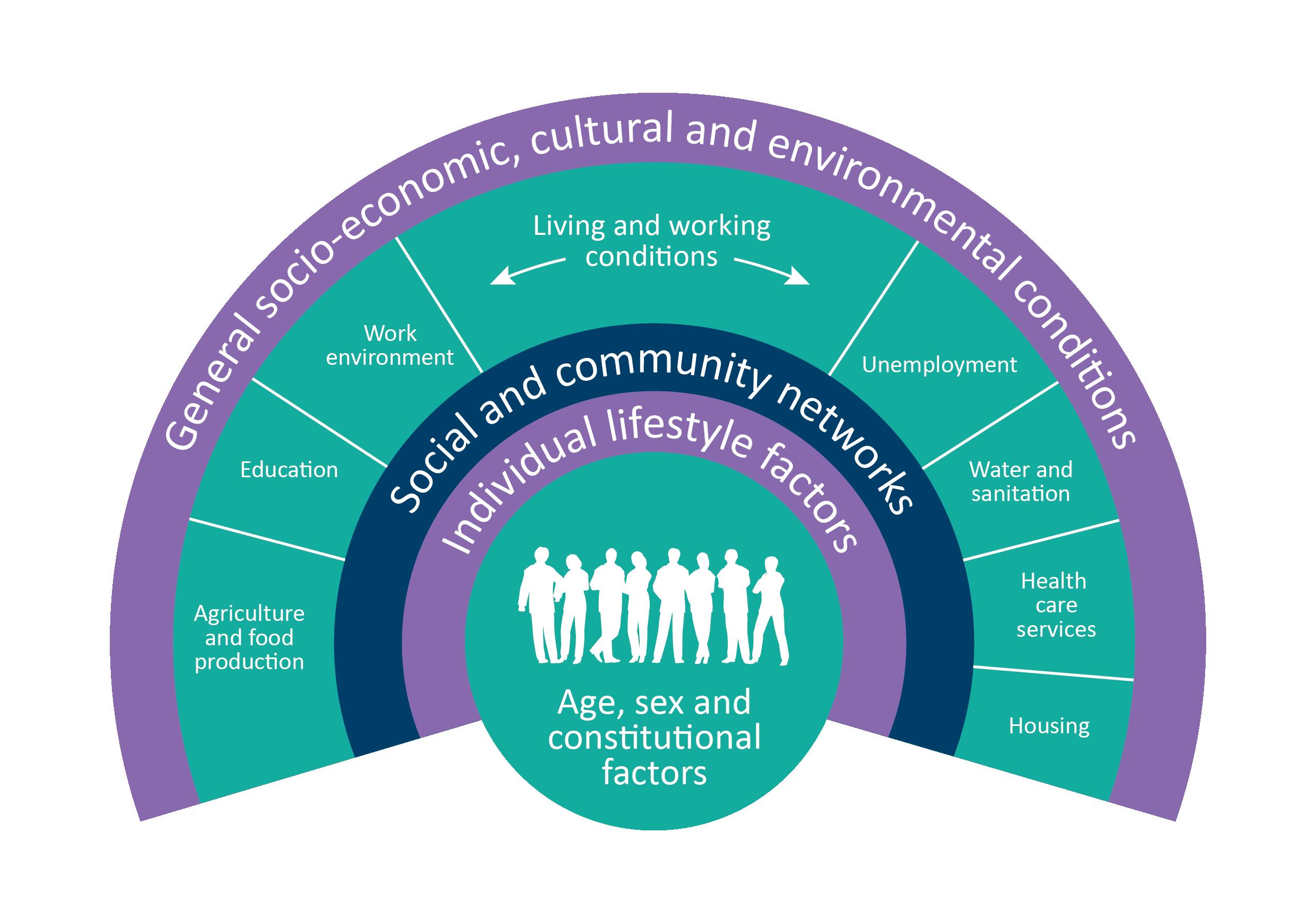
Social determinants are likely to occur in relation to maldistribution of power; wide disparities in income; lack of access to health, education, housing and goods and services (Beckfield, Bambra et al 2015) It has been reported that up to 80% of the factors that directly influence an individual’s health lie outside the health system. (Baum, Freeman et al. 2016) In Australia’s Health 2016: in brief it is noted that for Aboriginal people, 31% of their health disadvantage is based on socioeconomic factors such as meaningful employment and education; 11% on biomedical factors; 15% on a combination of the foregoing factors; and, 43% on ‘other factors’. (Australia’s Health 2016) These factors are depicted below.
Social disadvantage and vulnerable people in the rural context
According to the National Rural Health Alliance there is a decline of socioeconomic status that corresponds to remoteness. This decline is partially explained by the higher prevalence of Aboriginal and Torres Strait Islander people and poorer access to health services in more remote areas of Australia. It is further suggested that this is compounded when consideration is given to the higher levels of unemployment and lower levels of participation in education. Occupation also contributes to this disparity with the types of available employment in rural and remote Australia often being in industries that are less well remunerated than the available employment in major cities.
These health effects of income and educational disadvantage can be additionally compounded in rural and remote communities by poor access to a range of goods and services including affordable healthy food, high-speed broadband, mobile phone coverage and public transport. Despite these negative influences on health, it is acknowledged that benefits of living in rural and remote communities exist and can have a positive effect on the health of people. (National Rural Health Alliance 2018).
Vulnerable people in primary health care
In 2009, Ward suggested an association between preventative care and improved health, stating that countries with stronger primary health care services have healthier populations especially if they are supported by policy. In the United States increased access to primary health care was associated with a decrease in avoidable hospitalisations. (Ward 2009) Baum et.al., report that life expectancy has been linked more to improvements in living conditions than to improvements in health care services. (Baum, Begin et al. 2009).
Primary Health Network Principles
According to the 2016 Primary Health Network (PHN) Programme Guidelines the key objectives of the PHN programme are;
• increasing the efficiency and effectiveness of medical services for patients, particularly those at risk of poor health outcomes; and
• improving coordination of care to ensure patients receive the right care in the right place at the right time.
PHNs were expected to achieve these objectives by analysis and planning locally, provision of practice support including quality improvement, using eHealth systems and commissioning services for local groups with most need. As a component of Primary Mental Health core funding and evaluation of the Healthy Communities Initiative Pilot the concept of engagement with ‘hard to reach’ populations was brought to the forefront. Evidence suggests that those at risk of poorer health outcomes will be people with most need, least access and likely to be part of a hard to reach population.
Social disadvantage and vulnerable people in the MPHN
The Index of Relative Socio-Economic Disadvantage (IRSED) ranks geographical areas in terms of their relative socio-economic disadvantage across Australia. The index focuses on low-income earners, relatively lower educational attainment, high unemployment, and dwellings without motor vehicles. Low index values represent areas of most disadvantage and high vales represent areas of least disadvantage. The mean score for Australia is 1000.
IRSEO is an Indigenous specific index derived that reflects relative advantage or disadvantage at the Indigenous Area level, where a score of one represents the most advantaged area and a score of 100 represents the most disadvantaged area. There are approximately 400 Indigenous areas in Australia.
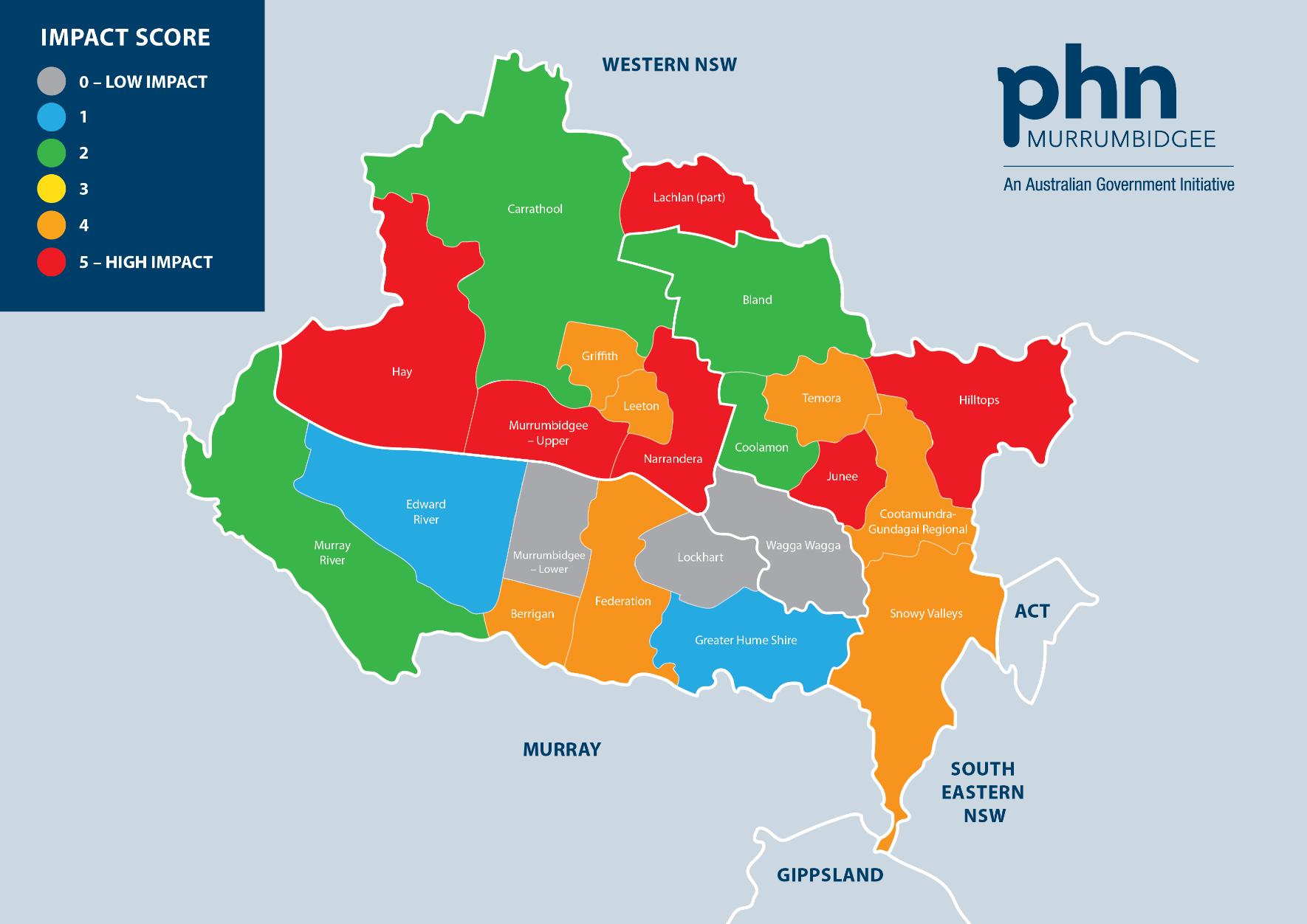
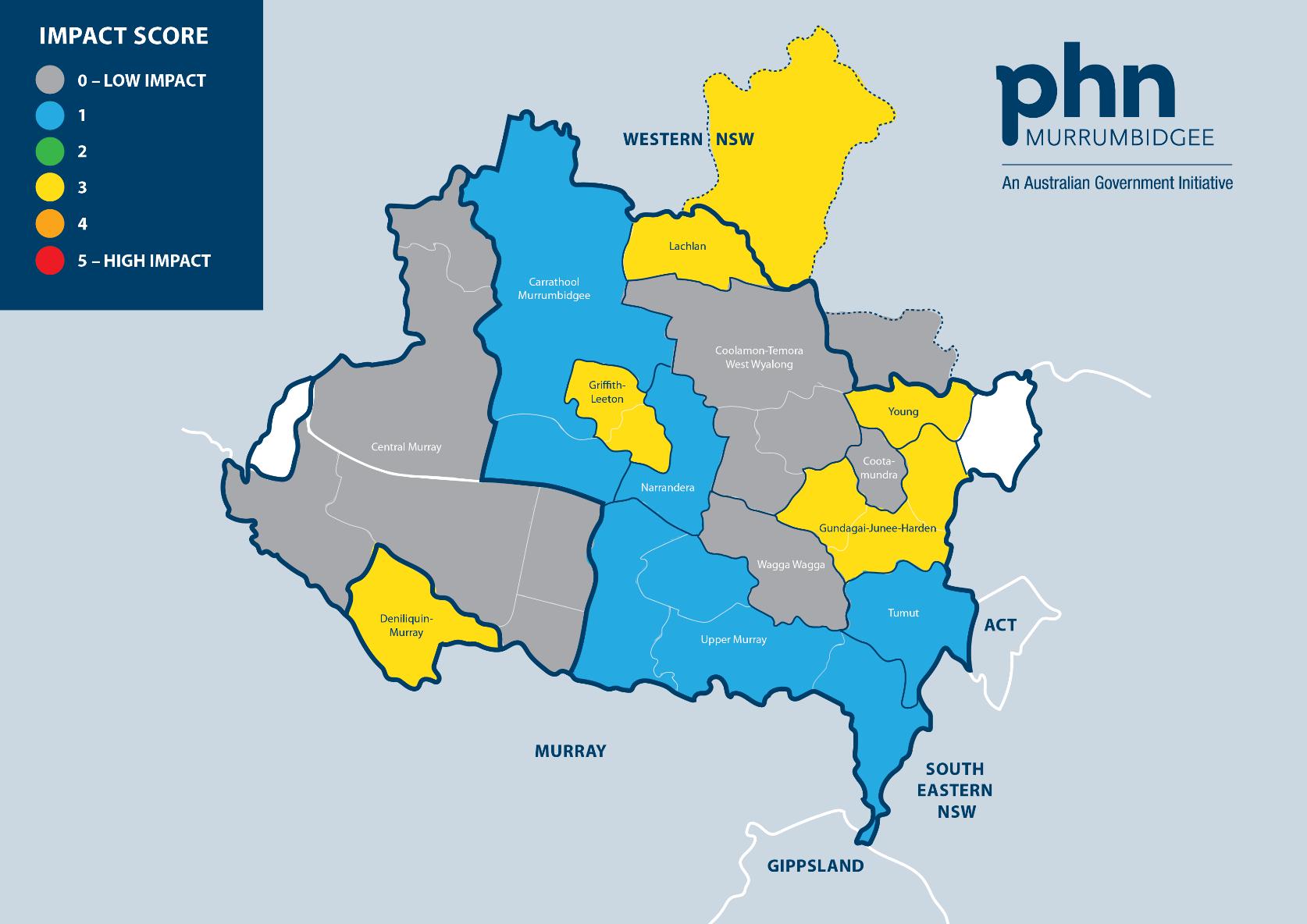
Standardisation in the MPHN to allow comparisons between LGAs is achieved by applying a scoring system that measures how the LGA compares to the state of NSW average and the Murrumbidgee PHN average. Scores are assigned based on differences to these two benchmarks and combined to give a total impact score. Table 1 explains the scoring system, Table 2 provides the impact score key used in the following two maps. Map 1 Highlights the SEIFA scores for the 21 LGAs within MPHN and Map 2 highlights scores specifically for Aboriginal or Torres Strait Islander people.
MPHN has six local governments with an overall SEIFA score that has a high impact in relation to socioeconomic status; Hay, Hilltops (including Young, Harden and Boorowa), Junee, Lachlan (specifically Lake Cargelligo), Murrumbidgee Upper (including Darlington Point) and Narrandera (including Barellan).
There are a further seven LGAs with the second highest impact score; Berrigan (including Barooga, Finley and Tocumwal), Federation (including Howlong, Mulwala, Corowa and Urana), Griffith (including Yenda), Gundagai (including Stockinbingal and Cootamundra), Leeton (including Yanco), Snowy Valleys (Including Batlow, Adelong, Tumut and Tumbarumba) and Temora.
In the remaining eight LGAs that have an impact score of less than 2, there are some suburb level areas where the SEIFA score is lower than the PHN and State averages, including Kooringal, Ashmont, Mount Austin and Tolland in Wagga Wagga. Overall though these suburbs are masked in an average for the town that has low impact.
Indigenous socioeconomic status impact scores differ within the LGA to IARE, higher rates of disadvantage are located in Young, Lachlan, Gundagai and Griffith which are all similar to the relevant LGAs. The exception is Deniliquin where the LGA has a relatively low impact SEIFA compared to the higher impact IRSEO score. Indigenous populations with lower impact IRSEO scores such as Wagga Wagga, Central Murray and Coolamon also have low impact LGA SEIFA scores. Indigenous people living in Narrandera, Upper Murray, Tumut and Cootamundra report lower impact IRSEO scores despite their LGA counterpart SEIFA scores being higher impact.
Table 1: Matrix Scoring System
Map 1: SEIFA impact scores by 21 LGAs within Murrumbidgee PHN
Map 2: SEIFA impact scores by Indigenous Area level regions within Murrumbidgee PHN
Our response to social disadvantage
In October of 2017 the MPHN Board endorsed a recommended set of principles to underpin and support the organisation’s efforts to address social disadvantage in communities across the Murrumbidgee region. As a result we have strong commitment to applying a lens to commissioning activities that identifies and addresses the needs of socially disadvantaged people in the MPHN and will incorporate the following set of principles to support this emphasis.
MPHN Social Disadvantage Principles
Addressing inequality
We will work to address inequality through raising awareness and increase access through developing the capacity and capability of our staff and our providers.
Evidence and consultation
Through our Health Needs Assessment (HNA) process we consult with health professionals, Government Agencies, Community based organisation and community member to better understand the health and social needs of our population. We will identify, quantify and geographically locate areas of social disadvantage. The HNA process includes a systematic analysis of data and information on demographic, health and service usage across the region and more importantly consultation with community members and health care professionals. This approach will inform planning to address identified needs in particular for those with social disadvantage.
Identification of vulnerable populations
We will ensure through our HNA and HNA Live process we identify vulnerable populations such as Aboriginal and Torres Strait Islanders, Culturally and Linguistically Diverse, Lesbian, Gay, Bisexual, Transgender and/or Intersex, homeless people, mentally unwell people, elderly isolated people, veterans and those exiting the justice system. We will work to ensure that the above people are not marginalised and excluded from accessing services.
Local responses
Through our work with local communities we will identify local and emerging issues associated with social disadvantage and address specific local needs through co-design.
Integrated care across the sectors
We will commit to ‘wrap-around’ care and support ensuring that a person is at the centre of their care and through commissioning will encourage innovative programs across the health and social sectors.
The early years response
We will foster cooperative relationships to ensure that all children across the region have access to the building-blocks of a self-defining and self- fulfilling life.
Policy Level
We will collaborate with other organisations to establish broad inter-sectoral support to advocate for public policies that address current socio-environmental issues that have impact upon the health of individuals and communities in our region
Sustainability
We will create viable and sustainable programs that address the needs and aspirations of our communities.
Delivering on our principles
In order to address social disadvantage we will take a structured and planned approach that demonstrates our commitment. This approach will be based on our health needs assessment and will be largely informed by the community and health care professional’s voices through the HNA Live. HNA Live captures in real time the issues that community and health care professionals face locally This approach means that we will take action that results in measurable outcomes for our communities in line with our principles. Whilst the commitment to addressing social disadvantage is made from the Board and Executive of the MPHN, the community and health care professionals will provide the evidence that keeps us accountable for making improvements in this vulnerable population.
Appendix one includes the Social Disadvantage action plan based on our principles.
Principle 1 - Addressing inequality
To support this principle we will endorse a culture of change in our staff and providers that involves identification and provision of services for vulnerable people of the Murrumbidgee. This will include increasing the capability of staff and commissioned providers to better understand social factors that drive inequality for marginalised people in our region.
We will ensure that governance of is reflective of the approach through its Board, four Clinical Councils and Community Advisory Committee.
Further to this, we will develop and implement a vulnerable population’s framework which outlines how the organisation and commissioned service providers will provide care to disadvantaged people of the region. The framework will contain tools which allow commissioned providers to evidence meeting criteria for social disadvantaged driven care.
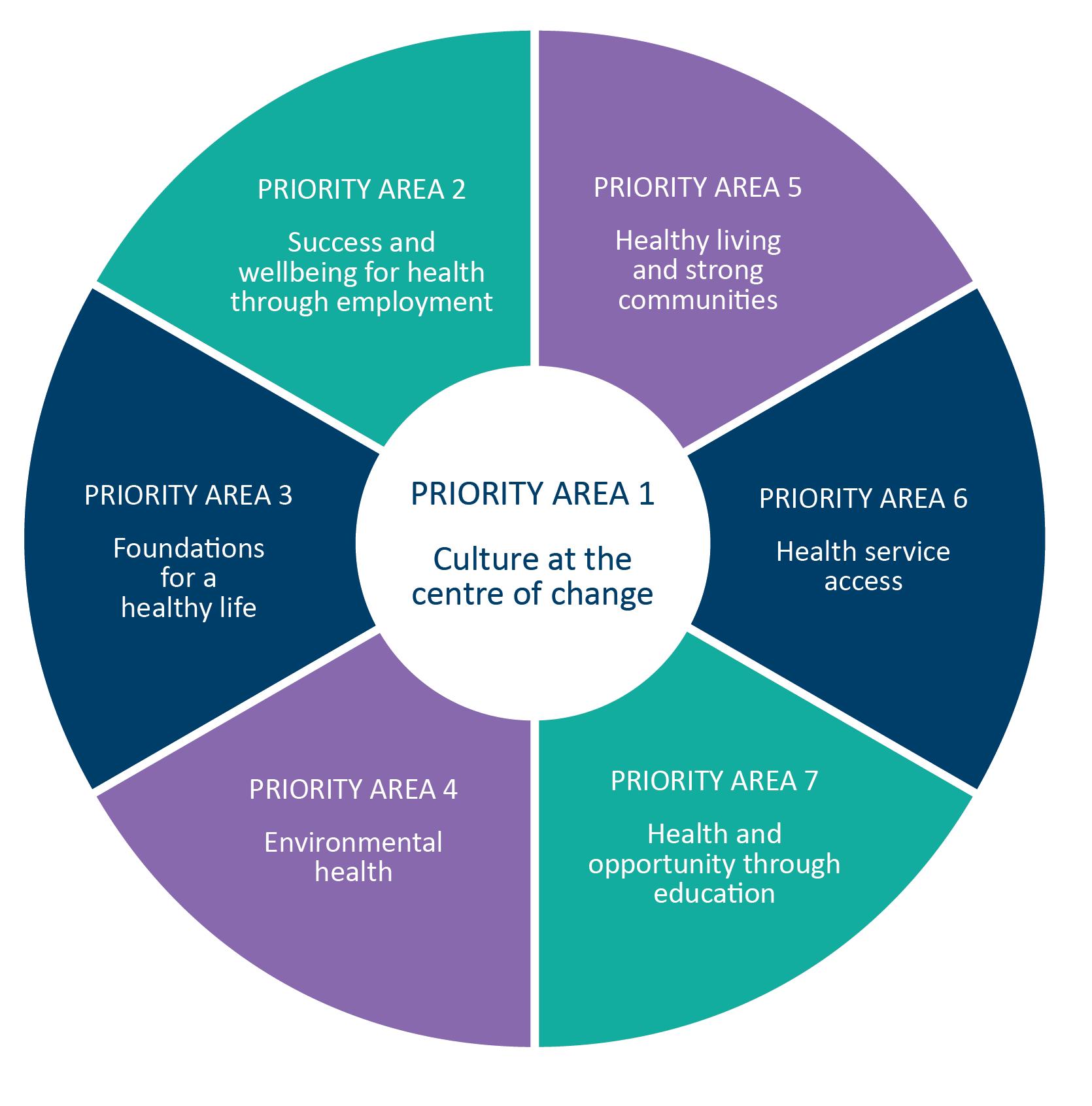
In December 2017, the Commonwealth Government released My Life My Lead, a report which summarises opportunities to improve the social factors relating to health. (Commonwealth of Australia 2017) The priority areas identified through the report are applicable to the broader community.
Source: My Life My Lead 2017, Figure 2
We will incorporate these priority areas in its vulnerable population’s framework and aim to have this framework in place by June 2018.
Principle 2 – Evidence and Consultation
The Health Needs Assessment completed in November 2017 adopted a new person centred lifespan approach acknowledging the importance of social factors that influence health across the population groups. These groups include;
• Social disadvantage
• Aboriginal and Torres Strait Islander
• Maternal and Child
• Youth
• Older Persons
• Populations
This HNA highlighted the inadequacy of an approach that focusses specifically on health conditions and consequently a new approach was developed reframing the focus to one that takes into account people across the lifespan. Needs identified were largely informed by health enquiries of publicly available statistics, consultations with communities through Local Health Advisory Committees and locally available statistics. Data on the socioeconomic factors of Murrumbidgee communities was obtained to describe the geography of the region. A region wide matrix was developed to standardise social and demographic factors allowing a more sophisticated ranking of areas to highlight where health may be affected by the surrounding environment.
In developing the activity work plans that provide a summary of the work MPHN intends to implement over the coming two-year period consultation with the HNA guided locations of the planned services. It is anticipated that as the HNA becomes more sophisticated in the coming years planning will also evolve and target specifically those disadvantaged people who would benefit most from primary health care addressing identified needs.
We will continue to work with the Aboriginal Health Consortium to review and implement its regional plan targeted at addressing priority needs for the Aboriginal community. We will launch HNA Live, which will promote stronger engagement at a community and individual level giving voice to people who may not be formally involved with the work of the PHN. Opportunistic use of iPads to capture snapshots of community member’s experience of local health services or identified needs will complement and provide necessary expansion to the current HNA process. It is hoped that this approach will be more representative of our diverse community and allow those who may be vulnerable or at risk to express their need or those of their community.
The summary of the MPHN HNA with the refocussed person centred lifespan approach is attached as an appendix to this brief as is a copy of the MPHN matrix.
Principle 3 - Identification of vulnerable populations
Through the collection of publicly available data our HNA will be informed of the needs of vulnerable populations. MPHN will additionally ensure that its own data collection methodology from commissioned service providers includes sufficient information to describe the populations being serviced. For example the minimum datasets for commissioned providers will include data on Aboriginality, Health and Veteran card holder status and English speaking proficiency. MPHN will additionally consult with peak bodies and local experts for vulnerable populations such as “acon” for Lesbian, Gay, Bisexual, Transgender and/or Intersex people and local specialist women’s health services in relation to family violence. Further MPHN will actively listen and promote feedback mechanisms to all people of the region, specifically those who have previously not had a voice in relation to their needs.
Principle 4 – Local responses
We will ensure that responses to innovation projects target local communities who are most a need given their socio-economic profiles and provide opportunity to address these emerging needs. Our partnership with Murrumbidgee Local Health District will ensure that services are not duplicated and are complimentary through the primary health care sector and the tertiary health sector. This partnership will also ensure that quality and efficient services are available to those that most need them.
Principle 5 – Integrated care across the sectors
In the design and delivery of our programs we work to create connection between health care providers. In its current planning cycle we have made provision for innovation projects with community organisations and lead to engagement and positive outcomes for those marginalised or disadvantaged in our community. We will work to broaden referral pathways and develop linkages with other community-based programs. We will identify opportunities for data sharing to better understand the needs of people in our communities and to measure the effectiveness of commissioned healthcare.
Principle 6 - The early year’s response
We have a commitment to make sure that the social disadvantaged approach is driven from the earliest age. We will commission a Maternal and Child Health Strategy that incorporates the social disadvantaged approach within the next two years and work in partnership with Murrumbidgee Local Health District to address needs.
Principle 7 – Policy Level
We have involvement in several consortia that support the lifespan population groups that form the focus of the HNA and activity workplans. Our CEO, Executive and Senior management have made an undertaking to ensure that representation for all population groups occurs and that those groups broadly reflect the many sectors that could provide integrated care to socially disadvantaged people. We will continue to participate in the PHN Social Disadvantage working group, formed to provide a lead role for all PHNs in taking a social disadvantage approach to primary health care. This group has an additional role to provide advocacy to Government relating to the need to integrate sectors such as health, education, justice, social services and other relevant bodies in addressing the social disadvantage response.
Principle 8 - Sustainability
We will achieve sustainability by adhering to our principles and by planning and implementing activities through our work and the work of our providers.
APPENDIX ONE: MPHN Social Disadvantage action plan
Objective
Address social disadvantage in communities across the Murrumbidgee region. Apply a lens to commissioning activities that identifies and addresses the needs of socially disadvantaged people in the MPHN.
Principle Action Principal responsibility
Principle 1Addressing inequality
Increase capability of staff and commissioned providers to better understand social factors that drive inequality for marginalised people
Governance reflective of the social disadvantage approach through its Board, four Clinical Councils and Community Advisory Committee
Develop and implement vulnerable populations framework
Data Analyst and Commissioning Manager December 2018 Workshop materials Time release of staff to attend workshops
Development of workshops for commissioning for vulnerable population groups
(Process measures)
Number of staff and commissioned providers attending workshops for commissioning for vulnerable population groups
MPHN Board and Executive Ongoing Nil
Data Analyst and Commissioning Manager June 2018 Time to develop and implement framework
Decision making aligns with social disadvantage principles
Minutes of governance groups reflect decisions making in line with SD principles
Framework provides evidence of competence in commissioned providers for vulnerable populations
Use of vulnerable populations framework by commissioned providers
Principle 2 –Evidence and Consultation
Ensure HNA takes an evidence and consultative approach to identify social disadvantage
Data Analyst November 2018 Data, information and consultation
Principle 3Identification of vulnerable populations
Ensure the HNA uses a minimum data set (MDS) to ensure collection of social disadvantage populations use of services in appropriate areas of disadvantage
Data Analyst November 2018 Commissioned service data –individual and with inbuilt MDS
HNA reflects social disadvantage and identifies needs for this vulnerable population
MPHN Matrix identifies areas of social disadvantage
Use of HNA Live to capture consultation with community and healthcare professionals
Evidence of service use by target vulnerable population
Commissioned service MDS reflects target group for service delivery achieved
Objective
Address social disadvantage in communities across the Murrumbidgee region. Apply a lens to commissioning activities that identifies and addresses the needs of socially disadvantaged people in the MPHN.
Principle Action Principal responsibility Due date Resources required Outcome Evaluation (Process measures)
Principle 4 –Local responses
Ensure commissioned services are co designed and available to vulnerable populations where possible with the Murrumbidgee Local Health District (MLHD)
Commissioning Manager Ongoing Collaborative approach to commissioned services Effective commissioned services, complimentary to MLHD services
Number of co designed commissioned services
Use of services by those in vulnerable populations
Reduction of duplicated services
Reduction of gaps in primary healthcare
Principle 5 –Integrated care across the sectors
Principle 6 - The early year’s response
Ensure that referral pathways are clear between primary and tertiary health care service providers and available to vulnerable populations
Develop and implement a maternal and child (MCH) strategy that is reflective of social factors of vulnerable populations
Commissioning Manager Ongoing Development of referral pathways
Consultant MPHN collaborative group (with MPHN group sponsor)
Clear referral pathway for vulnerable populations between healthcare sectors
December 2018 Consultant to develop approach MCH strategy that addresses issues of social disadvantage
Use of referral pathways by vulnerable populations
Implementation of MCH strategy Evaluation of MCH strategy
Objective
Address social disadvantage in communities across the Murrumbidgee region. Apply a lens to commissioning activities that identifies and addresses the needs of socially disadvantaged people in the MPHN.
Principle Action
Principle 7 –Policy Level
Continue to engage with existing Consortia specifically with vulnerable populations
Ensure where possible advocacy for interventions and services to improve the health of vulnerable populations
Principle 8Sustainability
Adopt reflective practice of commitment to social justice
Executive and Senior Managers
Ongoing Participation in Consortia Consortia have representation from MPH with strong advocacy for vulnerable populations
Evaluation (Process measures)
Minutes of Consortia
Activities arising from Consortia
Ensure commitment to commissioning for vulnerable populations is at the forefront of any decisions for service delivery
Board, Executive, Senior Managers, All staff
Ongoing Active commitment Improved knowledge of importance of the need to address health issues for vulnerable populations
Board, Executive, Senior Managers, All staff Ongoing Nil Up-to-date knowledge of social factors that influence health of vulnerable populations
Board, Executive, Senior Managers, All staff
Ongoing Nil Commissioned services are targeted at vulnerable populations
Minuted activity of all advocacy opportunities
Evidence of reflective practice
Review of commissioned service delivery
References
Australian Institute of Health and Welfare 2016. Australia’s health 2016: in brief. Cat. no. AUS 201. Canberra:
Baum, F. E., et al. (2009). "Changes Not for the Fainthearted: Reorientating Health Care Systems Toward Health Equity Through Action on the Social Determinants of Health." American Journal of Public Health 99(11): 1967-1974.
Baum, F. e., et al. (2013). "The potential for multi-disciplinary primary health care services to take action on the social determinants of health: actions and constraints." BMC Public Health 13: 460.
Baum, F. Freeman, T, Sanders, D. Labont, R. Lawless, A. Javanparast, S. 2016. ‘Comprehensive primary health care under neo-liberalism in Australia’ Social Science & Medicine 168 (2016) 43-52
Beckfield, J. Bambra, C. Eikemo, T A, Huijts, T, McNamara, C and Wendt, C. 2015. ‘An Institutional theory of welfare state effects on the distribution of population health.’ Social Theory & Health Vol. 13, 3/4, 227–244
Commonwealth of Australia, Department of Health 2017 My Life My Lead - Opportunities for strengthening approaches to the social determinants and cultural determinants of Indigenous health: Report on the national consultations December 2017 Friel, S. and M. G. Marmot (2011).
"Action on the Social Determinants of Health and Health Inequities Goes Global." Annual Review of Public Health 32: 225-236.
National Rural Health Alliance 2018 http://ruralhealth.org.au/advocacy/current-focus-areas/socialdeterminants-health Accessed 30/01/2018
Primary Health Network Grant Programme Guidelines 2016 http://www.health.gov.au/internet/main/publishing.nsf/Content/PHN-Program_Guidelines Accessed 12/02/2018
Rasanathan, K., et al. (2010). "Primary health care and the social determinants of health: essential and complementary approaches for reducing inequities in health." Journal of Epidemiology and Community Health: Online.
Ward, P. R. (2009). "The relevance of equity in health care for primary care: creating and sustaining a 'fair go, for a fair innings'." Quality in Primary Care 17: 49-54.
WHO Commission on the Social Determinants of Health. 2008. Closing the gap in a generation: health equity through action on the social determinants of health. WHO publications, Geneva.