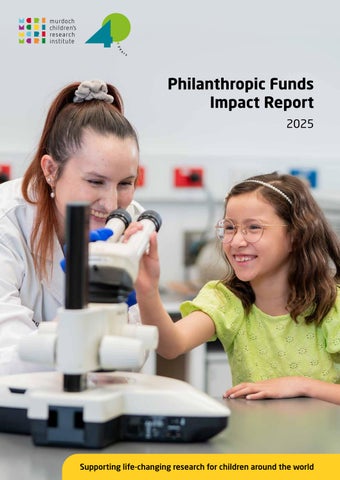
Philanthopic Funds Impact Report 2025

Page 1


Murdoch Children’s Research Institute acknowledges the Wurundjeri people as the Traditional Owners of the land on which MCRI is located. We pay our respects to their Elders, past and present.

PHOTO CREDIT: PETER GLENANE, HIVIS PICTURES

Thank you from the Director

On behalf of our researchers and the families we work with, thank you for your generous support of Murdoch Children’s Research Institute (MCRI). Your contribution helps address urgent challenges in child health today.

Now in our 40th year, your generosity ensures that children benefit from better care, earlier interventions and healthier futures.

Through MCRI’s Philanthropic Funds, you provide essential funding that supports talented researchers, strengthens responses to emerging health challenges and sustains child

health research for the long term. This support allows researchers to act earlier, reduce the impact of disease and improve outcomes for children and families. Your commitment provides the stability and resources they need to make meaningful progress.

At MCRI, researchers, clinicians and innovators are dedicated to improving child health by translating research into real world impact. Turning discovery into change requires investment. Your generosity directly funds this work and helps drive advances that improve the health and wellbeing of children in Australia and around the world.

This impact report shares some of the progress made possible through your support and highlights several projects that have been strengthened by our Philanthropic Funds. Thank you for helping our researchers continue their important work for all children and families.

Creating better futures for children

A shared purpose connects our supporters and our researchers. We want all children to have the opportunity to live a healthy and fulfilled life. This purpose offers hope to families who are seeking answers.

The impact of your partnership can be seen in the progress researchers are making across many areas of child health. Their work is driven by curiosity, compassion and a deep commitment to improving outcomes for children in Australia and around the world.

MCRI’s Philanthropic Funds turn this shared belief into practical support for research that improves children’s lives.

Philanthropic Funds

Brilliant Minds Fund

Contributions to the Brilliant Minds Fund help attract and retain exceptional talent in child health research. Researchers receive the support they need to stay focused on creating life changing treatments and giving families hope.

Director’s Fund

The Director’s Fund provides Professor Kathryn North AC with flexible resources to address urgent and important research priorities. It enables teams to respond quickly to immediate needs in child health and ensures that critical work can progress without delay.

Discovery Fund

Support for the Discovery Fund invests directly in early stage research. It provides seed funding for bold ideas and high potential projects that can transform child health and redefine what is possible.

Future Fund

The Future Fund supports the long term sustainability of child health research. It strengthens pioneering discoveries and enables lasting advancements that can improve health outcomes for generations to come.

Measuring your impact

Philanthropic support enables researchers to focus on what matters most: improving health outcomes for children and families.

Your support makes a meaningful difference by:

Fuelling research across more than 150 childhood diseases and conditions

Helping early research take its first steps towards real solutions for children.

Strengthening projects so they are competitive for grants and partnerships.

Leveraging philanthropic investment by 10x across all programs.

Supporting research that is cited 6x more than the global average.

Attracting and supporting talented researchers from around the world.

Enabling collaboration across more than 120 countries.

Your generosity also strengthens MCRI’s position as one of the top three child health research institutes worldwide for research quality and impact.*

Most importantly, your support gives all children the chance to grow, thrive and reach their full potential.

*Clarivate Performance analysis and MCRI benchmarking report, November 2023

Brilliant Minds Fund

In 2025, the Brilliant Minds Fund invested in exceptional researchers committed to improving health outcomes for children.

Meet Dr Valerie Sung

Dr Valerie Sung has spent her career asking one clear question: how can Australia ensure that every deaf or hard of hearing child has the chance to grow, learn and thrive?

In her work as a paediatrician and Associate Professor at MCRI , Dr Sung leads work that is reshaping how hearing loss is understood and supported across the country. She sees the challenges that families face every day. Many children who are deaf or hard of hearing still experience delays in communication and learning, even when hearing loss is identified early. Care is often delivered across separate services, and outcomes vary widely.

To address this, Dr Sung is leading the Australian National Child Hearing Health Outcomes Registry (ANCHOR). ANCHOR will be Australia’s first national system to track how children are identified, treated and supported from screening through to long-term development. Its purpose is simple –to give every child the chance to learn and thrive, and to reduce inequities for Deaf communities, culturally and linguistically diverse families and Aboriginal and Torres Strait Islander peoples.

“We have astonishing technologies, but hearing loss continues to impact children’s life chances. We need better, equitable systems to close the gap.”
— Dr Valerie Sung

Children with mild or one-sided hearing loss make up about half of all diagnoses. These children often face similar challenges as children with more severe hearing loss, yet far less is known about the support they need. This research will help clinicians understand what works best and where care can be improved.

Importantly, the program is being shaped by children and families with lived experience. Almost 100 organisations offering more than 300 hearing-health services across Australia are now involved.

Dr Sung’s team is also working to make two important tests available at diagnosis. The first is a genomic test that is now available through Medicare following her team’s research. The second is a simple saliva test for congenital cytomegalovirus (cCMV), a common cause of infant hearing loss, with the aim of giving families clear guidance as early as possible.

For Dr Sung, the aim is clear. Every child should have the chance to reach their full potential, and every family should feel confident that their child is being heard.

Meet Nara

Nara was born deaf in one ear. With early intervention and the right support, she is now thriving – dancing, making music and confidently finding her own rhythm.

Research programs like ANCHOR and Screen cCMV help ensure more children like Nara are identified early and supported to reach their full potential.

Scan to read the full story.

Meet Dr John Hart

For Dr John Hart, improving child survival in some of the world’s highest-risk settings is not just a research focus. It is a responsibility.

Working with clinical and research partners in Malawi and Mozambique, Dr Hart is a Senior Research Fellow in the Infection, Immunity and Global Health research area at MCRI. In his role he is addressing the urgent challenge of preventable deaths among some of the highest-risk children globally.

“I was drawn to this field after seeing how practical solutions, delivered at scale, can lead to major improvements in health,” he said. “I am motivated by working with local clinicians, researchers and communities to answer questions that matter.”

Dr Hart’s work focuses on two groups of children who face a dangerous period of vulnerability. This includes children with malnutrition and those who have recently left hospital. Although these children may look stable, they remain at greatly increased risk of severe infections and death.

John explained that this period offers an important chance to intervene.

“We can act at the moment they need support the most, using evidencebased and achievable approaches.”

In 2025, support from the Brilliant Minds Fund played a central role in maintaining the momentum of this work during a demanding planning and development phase. The funding helped advance complex, multi- country research efforts, strengthening international collaborations and allowing study plans to be refined in close partnership with local teams.

“It allowed me to work closely with our collaborators and ensure our plans reflect local priorities,” he said.

This support has also helped create new scientific opportunities. These include stronger laboratory and social science partnerships, and opportunities to support early career researchers in Africa. As John and his colleagues prepare for the next stage, he is energised by the potential impact. This includes evidence that could change clinical guidelines, reduce repeated hospital admissions and help protect the most vulnerable children from severe infections.

“Philanthropic support provides something important and increasingly difficult to secure. It gives early and mid-career researchers the time and stability to focus on their main areas of interest. It helps turn ideas into studies, and studies into policy change and improved health care.”
— Dr John Hart

Meet Professor Margarita Moreno-Betancur

Every improvement in child health begins with strong evidence. Researchers rely on high-quality data to understand what affects children’s health and how to improve it.

At MCRI, Professor Margarita Moreno-Betancur is helping to strengthen this foundation so that every study can lead to better outcomes for children. She is the Co-Group Leader of the Clinical Epidemiology and Biostatistics Unit (CEBU). Her work focuses on better ways to understand cause and effect in health research. This helps researchers see what works to enhance children’s health and wellbeing.

Professor Moreno-Betancur’s passion for this work started early. She always loved mathematics and problem solving, but she wanted to use those skills to help people. “I discovered statistics, which I think of as a science of science,” she said.

“It allowed me to combine my passions while contributing to better scientific studies on human health.”

She is also helping to build the next generation of experts by training biostatisticians and other researchers across MCRI and beyond. This support ensures strong evidence continues to guide the health of children for years to come.

There is a growing need for experts who can guide researchers through complex data and help them plan studies that produce reliable evidence. Professor MorenoBetancur’s team supports researchers to design studies well, use data responsibly and interpret results with confidence. This leads to stronger evidence behind treatments, programs and policies that support children and their families. She is especially excited about new methods that help researchers make sense of very large and complex datasets. These methods help reveal clearer answers to complex questions, ensuring findings are reliable and meaningful.

In 2025, Professor Moreno-Betancur received the prestigious Moran Medal from the Australian Academy of Science. This award recognises her invaluable contribution to statistics and highlights how vital this work is for improving the evidence that shapes children’s health.

“Biostatistics is critical, yet underappreciated. Support like this makes a real difference.”
– Professor Margarita Moreno-Betancur

What is biostatistics?

Biostatistics uses mathematics to understand health data. It helps researchers study large amounts of information, spot patterns, and measure the effect of treatments, policies and other interventions. This evidence informs better care and supports healthier outcomes for children.

Discovery Fund

In 2025, the Discovery Fund supported promising research projects with the potential for major advancements in medical research.

Safer cancer treatments for children

Cancer treatments can save a child’s life, but many children experience serious side effects. Most children now reach remission, but many still experience adverse reactions during treatment.

Researchers at MCRI are working to reduce these harms so children can stay well during treatment and grow into healthy adults. This work is led by Professor Rachel Conyers, a paediatric oncologist who studies how a child’s genetic profile affects the way their body processes medicines. This approach is called pharmacogenomics. It helps doctors choose safer treatment options and adjust doses so children can receive the care they need with fewer risks.

Donations made to the Discovery Fund allowed the team to explore this new approach at an early stage, helping researchers collect the first evidence that personalised dosing could reduce drug toxicity. This progress created momentum for national change.

The work has since been strengthened through a $3 million Medical Research Future Fund (MRFF) Genomics Health Futures grant, which is now helping to build the Australian Pharmacogenetic Paediatric Oncology Network for Drug Safety (AUSPOND). This national network links hospital teams so they can identify children who are more likely to experience side effects before treatment begins.

The team also currently leads adaptive clinical trials in paediatric bone marrow transplantation. These trials are testing safer treatment pathways for children who need complex therapies. They aim to reduce damage to the heart or reproductive system so children can recover with fewer long-term effects.

As Professor Conyers explained, “Pharmacogenomics is like having a personalised instruction manual for each child’s body, telling doctors which medications will work best and which doses will be safest.”

Professor Rachel Conyers, Cancer Therapies Group Leader

A $3 million grant is now helping to build a national network for safer cancer treatments.

Meet Marco

Marco was sixteen when he was diagnosed with leukaemia soon after returning from a family holiday. He began treatment immediately. The therapies helped him reach remission, but he experienced severe side effects. He lost weight and strength and was unable to play music, which had always supported him during difficult times.

Within three weeks, Marco had pharmacogenomic testing. This helped his doctors tailor his medicines, so he avoided dangerous reactions and continued treatment without breaks. His strength has since returned, and he is back playing in the school band. Music has brought confidence and joy back into his life.

Scan to read the full story.

Marco playing his keyboard during a hospital stay

Mapping environments to build healthier futures

Where children live matters. Air quality, heat, greenspace, safe streets and access to services all shape everyday health.

For Principal Research Fellow Dr Suzanne Mavoa, understanding children’s health begins with understanding the places where they live, learn and play. “We cannot get away from our environments, and we know they have such an important role in supporting health,” she said.

Dr Mavoa has a background in geography and early memories of designing wellbeing focused cities in SimCity. She has dedicated her career to understanding how place shapes development from early childhood through adolescence.

Her climate and health research has been strengthened through support from the Discovery Fund. This funding helped her advance the work that underpins MCRI’s new Climate and Health Community of Practice. It has brought organisations together to build national partnerships and create a strong network focused on environmental challenges that affect children’s health. It also enabled her team to complete early research, publish findings and secure seed funding for future climate and health projects.

A major achievement has been the development of detailed environmental indicators for every address in Victoria, including air pollution, green space, heat and local food environments. This information now

forms part of a growing digital lab (My Geosome) that can link neighbourhood conditions to studies like GenV (Generation Victoria), the state’s largest child and parent health study. This resource is helping researchers identify practical changes that support children’s health, such as planting more street trees, improving cooling in schools, choosing reflective building materials and designing buildings that protect children during extreme heat.

Early findings show why this work matters. In Melbourne, researchers have found that higher early life exposure to air pollution is linked to a greater risk of peanut allergy throughout childhood. This evidence can guide cleaner air policies and support families to reduce exposure.

Reflecting on the impact of donor support, Dr Mavoa said, “Without this funding I simply would not have had the capacity to advance this work. It

“Environmental indicators have been created for every address in Victoria, helping researchers design healthier neighbourhoods for children.”
— Dr Suzanne Mavoa
Dr Suzanne Mavoa,
Environmental Health Lead

Generation Victoria (GenV) is one of the world’s largest and most inclusive long term child and parent research projects. It brings together almost 125,000 participants across Victoria to help improve health, development and wellbeing. By following families over time, GenV is supporting more than 200 research projects that are shaping better services, policies and outcomes for children and families everywhere.

Ending the diagnostic odyssey

For many families, the search for answers about their child’s health can stretch across years.

Rare mitochondrial disorders are especially difficult to diagnose, often involving multiple tests and lengthy periods of uncertainty. Researchers at MCRI are changing this experience by bringing cutting edge genomics and multiomic testing directly into clinical care.

Professor David Thorburn, who co-leads the Brain and Mitochondrial Research group, explained why this work matters. “We can document that at least one in 5,000 births will give rise to a child with mitochondrial disease … collectively rare, individually ultra-rare.” For each family, a diagnosis means clarity, options and hope.

Professor Thorburn’s team was one of the first groups in the world to use new gene sequencing tools to study these rare conditions. Their work has found more than 30 new disease genes and given genetic answers to more than 800 Australian children. It has also helped many hundreds to thousands of children around the world. These discoveries are giving families faster answers and helping specialists plan more targeted care.

Recent research shows that more than half of children with suspected mitochondrial disease can now receive a diagnosis through genomic sequencing of a blood sample.

Professor David Thorburn, Brain & Mitochondrial Research Co-Lead

This reduces the need for invasive procedures and helps families understand treatment options sooner. It also supports important reproductive decision-making during future pregnancies.

Professor Thorburn said these advances are transforming what is possible. “These conditions are individually rare, but their impact on families is profound. Faster and more accurate diagnosis changes the path ahead.”

Philanthropic support at MCRI has played a vital role in accelerating this progress. The Discovery Fund’s

investment in early stage ideas has helped bring precision genomic testing to children with ultra-rare disease, shortening the diagnostic journey and giving families the information they need at a critical time.

Children and families who once waited years for answers are now receiving them in months or even days. This shift is improving care across Australia and giving families renewed hope as they navigate rare disease.

“These conditions are individually rare, but their impact on families is profound. Faster and more accurate diagnosis changes the path ahead.”
— Professor David Thorburn

More than 50 per cent of suspected mitochondrial disease cases can now be diagnosed through genomic sequencing.

The Director’s Fund

In 2025, the Director’s Fund provided flexible support for urgent and important research priorities throughout MCRI.

Making child health care smarter and fairer

Families across Australia depend on a child health system that is struggling to meet growing demand. Many face high costs, long waits and complex pathways when trying to support their children.

Professor Kim Dalziel leads research that is changing how child health investments are made - ensuring every dollar invested in child health delivers real value for families.

Professor Dalziel is a health economist who studies how health services support children and families. Her work identifies where the system is working well and where changes could make access to care simpler, fairer and more effective. This is why her research was selected as a priority area for funding. The Director’s Fund supports time critical work, and her findings are already helping to guide decisions in areas that matter most to families.

Listening to families

Understanding the daily experiences of families is central. This includes out of pocket costs, caregiver stress and how easy it is to navigate the health system.

Professor Dalziel said, “I look at ways we can add new interventions and programs that increase outcomes and equity.” Her work ensures

that recommendations reflect what children and caregivers say they need.

Improving mental health care

Mental health is one of the areas where families are seeking better support. The team found that children who received what is considered “minimally adequate” mental health treatment did not show better outcomes than children receiving less care. This reveals that current standards do not always meet children’s needs.

The research supports routine outcome monitoring. This means checking in with children during treatment to understand if care is helping. It has the potential to shape mental health pathways that lead to more meaningful improvements.

Professor Kim Dalziel, Health Economics Co-Lead

More than $19 million in new research grant funding secured.

Fair access to genomic testing

Genomic testing can give families faster answers about rare or complex conditions. By studying how publicly funded testing is accessed across Australia, the team found important gaps. These findings are informing policy discussions about how testing can be funded and used more fairly, so children receive accurate diagnoses sooner and families can plan with greater confidence.

Bringing children’s voices into care

Patient reported outcome measures (PROMs) help children and caregivers share how they are feeling. These short questionnaires capture information that may not be visible in medical tests. When PROMs were used in outpatient clinics, clinicians found that conversations became more personal and follow up care

became more targeted. Professor Dalziel said, “We are working with children and families to make sure this work features aspects most important to them.”

Strengthening health economics at MCRI

Professor Dalziel shared, “Without this support, it is difficult to keep up with the number of projects across MCRI that need health economics guidance.” The team has helped secure more than $19 million in new research funding, supported students and trainees, and built many collaborations across the institute.

By combining health economics with child health research, we can ensure that every dollar invested delivers meaningful impact, giving all children the best chance to thrive.

“This work has enormous potential for improving how children receive care.”
— Professor Kim Dalziel

Thank you to our 2025 Philanthropic Funds Supporters

Antoinette Albert

Anthem Co Pty Ltd

APS Foundation

Balcon Group

Jillian and Stuart Bales

Maureen Barden

Dr David Barton and Anne Barton

Ashley Batchelor

Norma Beaconsfield

Janet Bell

Maree Browne

Cameron Foundation

The Canaccord Australia Foundation Care Trading Trust

Suzi and Barry Carp

Trevor S Cohen AM and Heather Cohen

Associate Professor John Collins am and Mandy Collins

Andrew and Abigail Cox

N. Crux and L. Healey

Gerry Davies and Jessica Mariani

Charles Day and Elise Everest

David and Veronica de la Coeur

Will and Natalie Deague

The Honourable Linda Dessau ac cvo and Anthony Howard am kc

Annette Domanti

Timothy Faulkner

Joan Fell

Dhevine Fernando

John and Diana Frew

The Honourable Josh Frydenberg and Aimee Frydenberg

Gandel Foundation

John and Gaye Gaylard

Andrew and Bev Gelbart

Sonia Gilderdale

Melissa Goode and Christopher Archibald

Corporate Supporters

Gourlay Charitable Trust

Gras Foundation Trust

Benjamin Gray

Adam Gregory and Eve McKinnon

Peter Griffin and Terry Swann Foundation

Raymond Hemphill

John Henwood

Heather Henderson

Marcus Higgins

Hing Yeung Li

James and Eliza Hoppe

Tim Hovey

Illabarook pty ltd

The Isabel & John Gilbertson Charitable Trust

James Richardson Group

Jollys Auto Parts

James Kennedy

Ian Kennedy am and Dr Sandra Hacker ao

Brian Kilmeade

Dean Koutsoumidis

Yvonne Le Fort

Diana Lempriere

Linda McNaughton Family Trust

Brian Little

Nanette Lord

Jonathon Lovell

Andrew R McCann

Christine and Denis McConnell

The McKenzie Family

McMeckan Family Foundation

McNamara Foundation

The McPhee Charitable Fund

Philip Myles Neri

Geoffrey J Nicholson

The Pratt Foundation

Redlich Foundation

Stephen Redman and Tynaya Groves

Judy Roach, Richard Roach and Sally Gough

Judith Robinson

Simon Ryan and Adriana Colaneri

Dr Michael Shearer and Rita Shearer

Leon Skaliotis

Jan and Colin Smith

Carl and Mandy Soderlund

Solomon Family Foundation

Patricia Spencer

Grant and Terri Stephenson

The Stocks Family Foundation

The Sunraysia Foundation

Celia Swales

Robin Syme

Mary Tallis

Debbie and Peter Thomas

Tony and Judy Van Bergen

Sarah Vaughan

Kelvin Wearn

Phillip Weston, in memory of Julie Weston

Kaaren M Whyte

Mandy and Edward Yencken

Anonymous (15)

Donations received of $1,000 or more to MCRI’s Philanthropic Funds

With heartfelt appreciation, we thank the following for their thoughtful and generous bequests, which have supported our Philanthropic Funds.

Estate of William Gordon Angus

Estate of Nance Elizabeth Creaton

Estate of William Thomas Penrose

We extend our thanks to the children and MCRI researchers who participated in the Children at the Heart photo shoot, with images featured throughout this report.

Join us in making a difference

For 40 years, MCRI has been advancing child health. Today, your gift to MCRI’s Philanthropic Funds helps create a healthier future for all children by giving researchers the resources they need to discover new treatments and improve the lives of children in Australia and around the world.

You can help children thrive today and in the future.

Donate

today

Murdoch Children’s Research Institute

The Royal Children’s Hospital 50 Flemington Road, Parkville Victoria, 3052 Australia

Engagement and Philanthropy

t +61 3 9936 6769

e philanthropy@mcri.edu.au

w donate.mcri.edu.au

Turn static files into dynamic content formats.

Create a flipbook