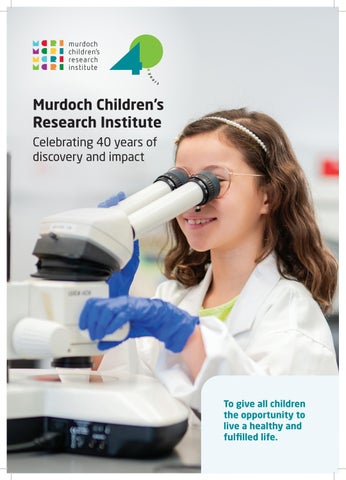
Murdoch Children’s Research Institute Celebrating 40 years of discovery and impact
To give all children the opportunity to live a healthy and fulfilled life.
One of the
top three child health research institutes worldwide for research quality and impact*
1,800+ world-leading researchers working across more than
150 diseases World-class facilities, laboratories, and research equipment unlocking new frontiers of discovery and innovation
*Clarivate Performance analysis and MCRI benchmarking report, November 2023
Image: Melbourne’s biomedical precinct located on Wurundjeri land Credit: Peter Glenane, HiVis Pictures
2
Located within a globally renowned biomedical precinct of 48,000+ employees and 40+ biomedical organisations in Melbourne, Australia Publications cited
6x more
than the global average Philanthropic investment
leveraged 10x across all programs
Collaborating across
120+ countries
A message from our Director At Murdoch Children’s Research Institute (MCRI), we have been at the forefront of advances in medical research since our inception 40 years ago. The visionary thinking and innovation of our researchers, combined with cutting-edge technology, have shaped a healthier future for children across Australia, in our region and around the world. MCRI was founded in 1986 by a pioneer in clinical genetics, Professor David Danks AO, with the invaluable support of Dame Elisabeth Murdoch AC DBE and a community of visionary philanthropists, who shared a common belief in the value of transforming children’s health. In the 21st century, the pace of medical discovery is faster than ever, powered by new and stillemerging technologies such as
next-generation sequencing, gene editing and stem cell technologies, artificial intelligence, high-powered computing and population-scale data linkage. The ability to leverage these opportunities has never been more important. Our research teams are laser-focused on solving the challenges that affect children, families and communities today, and anticipating those of tomorrow. By investing now, we can shape the future of child health on a global scale, ensuring better outcomes for all children. Today, the spirit of generosity and forward-thinking demonstrated by Dame Elisabeth and Professor Danks continues to propel MCRI as a global leader in child health research. Thanks to support from the Commonwealth and Victorian Governments and our community’s ongoing support, MCRI is proud to be ranked among the top three child health research institutes in the world.
Together, we will have an indelible impact on the lives of children everywhere, for decades to come.
Professor Kathryn North AC Director Murdoch Children’s Research Institute
Murdoch Children’s Research Institute acknowledges the Wurundjeri people as the Traditional Owners of the land on which MCRI is located. We pay our respects to their Elders, past and present. 3
Our story Our story began in 1986 when paediatrician Professor David Danks AO established the original Murdoch Institute with the support of Dame Elisabeth Murdoch AC DBE, her family, and other visionary philanthropists, including the late Sir Jack Brockhoff, Scobie and Claire MacKinnon Trust and the Miller family. Professor Danks’ vision for an independent genetic research institute expanded from a handful of researchers to become a world class centre for genetics research and clinical genetics services. The formation of the Institute crystallises a rich history of child and adolescent health research on the campus, dating back to 1936 when the first Medical Research Committee was formed within The Royal Children’s Hospital. In the early 2000s, under the leadership of Chair, Mr Laurie Cox AO, and Director, Professor Bob Williamson AO, the Murdoch Institute and The Royal Children’s Hospital Research Institute merged to form Murdoch Children’s Research Institute, with a broader focus on child health research, including public health and clinical research.
4
Murdoch Children’s Research Institute
Dame Elisabeth Murdoch AC DBE As a founding member of the Institute in 1986, Dame Elisabeth Murdoch’s unparalleled generosity has empowered the Institute to enhance the health and wellbeing of children worldwide. Alongside Professor David Danks, Dame Elisabeth stands at the heart of MCRI. Until her passing in 2012, Dame Elisabeth played a pivotal role in overseeing the Institute, contributing as a generous philanthropist and esteemed patron. Her influence reached people from all walks of life – from politicians and business leaders to families and children – inspiring them to discover the joy of giving and championing the importance of medical research. She possessed the foresight to recognise the significance of investing in and developing genetic research, even during the early stages of this field. Image: Co-founders Dame Elisabeth Murdoch AC DBE and Professor David Danks AO at The Murdoch Institute for Research in Birth Defects
“When I was young, conditions like polio and small pox were the big health issues, now you hardly hear of them thanks to tremendous advances in medical research. Today, the health of children is challenged by issues such as obesity, diabetes, cancer and depression. Medical research is vital to solve not only these problems, but emerging problems we will face tomorrow and many years from now.” Dame Elisabeth Murdoch AC DBE Co-Founder, Murdoch Children’s Research Institute 5
World-leading research changing the lives of children around the globe Shaping policy and clinical care nationally and internationally Established 25 LifeCourse longitudinal cohorts with 80,000 participants spanning conception to adulthood, building our understanding of the burden, causes and consequences of health and disease from early life.
Life-changing dwarfism treatments Helped children with severe dwarfism grow at typical rates and successfully trialled drugs to reduce sudden death risk.
6
Murdoch Children’s Research Institute
World-first mini kidneys grown from stem cells
Blood stem cell breakthrough
Pioneered growing mini kidneys from stem cells, revolutionising kidney disease research and treatment discovery.
Engineered world-first blood stem cells that closely resemble those in the human body which could transform bone marrow treatments for children and adults.
Groundbreaking rotavirus discovery Discovered human rotavirus, enabling development of a vaccine to protect millions of children against deadly gastroenteritis. Licensed a new rotavirus vaccine for newborns, extending this protection to their most vulnerable stage.
Global leader in concussion research Spearheaded concussion guidelines and developed the Concussion Essentials (HeadCheck) app for better diagnosis and recovery management.
Addressing complex issues facing children and families today 150,000 Australians helping researchers to discover and test better prediction, prevention and treatment through Generation Australia.
Life-saving allergy interventions Made peanut oral immunotherapy standard care for children to increase remission rates.
Advanced AI epilepsy tool Developed an advanced AI tool that can detect tiny brain lesions that cause severe epilepsy, enabling targeted surgery which helps children live seizure free.
Elimination of disease on a national scale Reduced scabies prevalence in Solomon Islands, Fiji and Kiribati, through our World Scabies Program, improving quality of life, school attendance and future health outcomes.
7
The future of child health Children are not ‘little adults.’ They have distinct physiological and developmental needs that require consideration of the genetic, biological, environmental and social factors affecting their health and wellbeing.
We believe the future of child health lies in fully integrating the genetic, biological, environmental and social factors affecting child health into healthcare systems. We envision a future where we can prevent diseases before they develop, remove trial and error from treatment and ensure that clinicians have seamless access to the data needed to treat each child as a unique individual. The future of child heath will be where: • Genomic sequencing enables tailored health plans from birth • Gene and cell therapies become routine first-line treatments
8
Murdoch Children’s Research Institute
• Most care is delivered outside the hospital supported by digital innovation and community health care services • Partnerships achieve global targets to reduce the incidence of preventable disease worldwide. Through it all, we aim to remain a global leader in advancing knowledge, driving innovation and redefining what is possible, to deliver on our purpose – to give
all children the opportunity to live a healthy and fulfilled life.
One in four
We know discoveries alone are not enough. Discoveries should be scalable and shared, so every child has access to tomorrow’s health solutions, not just a privileged few.
children are overweight or obese, with increased risk of diabetes and cardiovascular disease.*
Achieving impact at scale demands collaboration. We listen to the voices of children, families and communities and work together with clinicians and policymakers.
One in seven
The impact of our research has never been greater, and yet we know there is much more to be done. We look ahead with fresh resolve, knowing the future of child health depends on what we do today.
children have mental health issues.*
One in 10
We invite you to join us in transforming the future of child health - for every child, everywhere.
children in the poorest countries die before the age of five years.
The future of child health is at a pivotal crossroads. Children today are facing unprecedented challenges, from rising mental health issues to chronic diseases, social inequalities and environmental changes that will shape their futures. The stakes are high and the need for action is urgent. At MCRI, we are harnessing groundbreaking technologies, advanced data systems and the brightest research talent to lead this transformation.
One in 12 babies are born with a ‘rare’ genetic disease.
One in five children grow up in a disadvantaged environment and start school with two or more developmental difficulties.*
But we cannot do it alone. To revolutionise child health we need bold investments to ensure that the solutions we uncover today will shape the future of healthcare for generations to come. Government support is the catalyst for this change.
One in 10 children have serious food allergies.*
Children can’t wait * Australian data
9
Our themes To achieve our purpose, our research is organised into five specialist research areas. Our dedicated researchers work closely with the patients, families, and communities, ensuring our research and discoveries translate to better health outcomes that are affordable and accessible in Australia and around the world.
Image below: Making functional muscle models. Credit: Dr Callum Dark and Dr Tabitha Cree
Genomic Medicine
Stem Cell Medicine
Harnessing genomic technologies for families affected by rare disorders.
Developing a new generation of transformative stem cell therapies.
Professor John Christodoulou Theme Director
Professor Enzo Porrello Theme Director
Story of discovery and impact
Story of discovery and impact
Genomic sequencing is transforming the diagnosis of mitochondrial disease (a group of inherited genetic disorders), offering hope to families and driving medical breakthroughs. Our world-first study revealed that over half of cases can now be identified through a simple blood test. This advance spares patients from invasive procedures and provides faster answers.
Each year in Australia, one in every 100 babies is born with a childhood heart disease.
Scan the QR code to read the full story:
10
Murdoch Children’s Research Institute
MCRI researchers are striving to give these patients more options. We have established a global partnership with Gladstone Institutes in the USA to create the Decoding Broken Hearts program. Scan the QR code to read the full story:
Clinical Sciences
Infection, Immunity and Global Health
Population Health
Accelerating innovative and translatable discoveries into clinical care.
Addressing childhood infections and inequities.
Advancing policy and practice for equitable healthy populations.
Professor Vicki Anderson Theme Director
Professor Andrew Steer Theme Director
Professor Sharon Goldfeld AM Theme Director
Story of discovery and impact
Story of discovery and impact
Story of discovery and impact
A new study from MCRI reveals that cutting-edge AI technology can significantly aid in the early detection of cerebral palsy by analysing baby movement videos submitted by parents on their phones.
MCRI is partnering with 12 countries in the Pacific and Southeast Asia under to improve child and adolescent health across the region through the Australian Government’s Partnerships for a Healthy Region Initiative.
A study by MCRI found the Decode Mental Health and Wellbeing Program significantly improved mental health literacy and reduced stigma among students.
The study analysed 484 videos from 327 infants aged 12 to 18 weeks, identifying abnormal movements in 41 babies. Scan the QR code to read the full story:
The initiative will strengthen resilience in public health systems and engage with youth leaders and local communities to improve the health of all young people. Scan the QR code to read the full story:
The program, using entertaining videos featuring relatable stories, was trialled in five Victorian schools. Results showed 67 per cent of students and 86 per cent of teachers had positive engagement, with mental health literacy increasing by 7 per cent and stigma decreasing by 19 per cent. Scan the QR code to read the full story:
11
Contact us To learn more, please contact: Dino Asproloupos Government Relations E govtrelations@mcri.edu.au T +61 412 137 360 Murdoch Children’s Research Institute The Royal Children’s Hospital 50 Flemington Road, Parkville Victoria, 3052 Australia We would like to extend our sincere thanks to the children who took part in the Children at the Heart photo shoot, whose images are featured throughout this publication.
mcri.edu.au