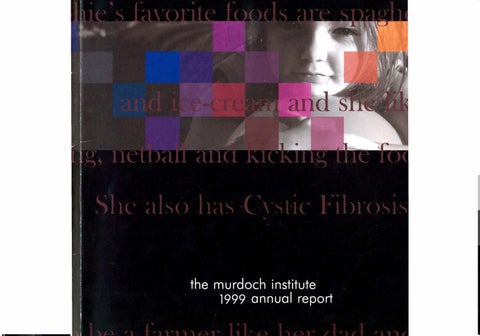
r
I-
t'
if-
1999 annual report
-‘i:
m Ik. |r f t
i
i
:f ■
i
■
f
.1
•'i
-i
;;
% ■f
\ I'
our aim is to help every child to be born healthy and with normal abilities
s
t
1-
■f
The Murdoch Institute Royal Children's Hospital Flemington Road Parkville 3052 Victoria Australia
■
L;
.iv
&
I
-a *T3 -O
:?g 0,S
^ ”0
wcrttnw^w
-i'sI Is ff I S Os.
—
OOOO^Ox5?=5<®=’
Q_
ro02?D?^Q-??roS'lnO;.n ^ §'o3‘<<®-®=*^“s‘~'n°3go S y-.o5-^:3n^(DOQf;^m3x n
a. 5=§ 9"
i§ s- l<s To ^ “n 70
CO
O
O
°‘ ICD
3 c CL O
o
CL
8- s
Z3
^ &
53-
n D-
Q
<D
Q
O
Q-
° 3 o g’cg ^
CD Q
i
>>. <rt
D
i
§.> O >
Q 3
o
-D ~0 -D g a s
3 5 3 3" r cT w w O O
cr
(fl O
3
CD cT S- ^ ^ ^ ^ o
^ z ?^ CD^ oQ_ o
-^i.
o D
7^ O CO C Q (Q
CD
rri^^ §1 w 9. $ 5
Z1 o TO c>o Q_
>
o
3
CD D
3
CD
CD O CD
3 D
;d
LO
M
m 1
mm S
*
^A
• k
V«l Donation
• • •
The new Murdoch Childrens Research Institute is an independent, non-profit organisation affiliated with the University of Melbourne and located at the Royal Children's Hospital. The institute is committed to researching conditions and diseases that affect babies, children and adolescents. You can help us achieve our goal of helping every child to be born healthy and live a healthy life. There are a number of ways you can support our research - with a Bequest, Donation, Annual Pledge or Named Scholarship.
W'l
f
H V Szoke D and BB M Villani Damien Whelan Woodard Solicitors
In Memory of Mary Crockett Mr & Mrs G Butts Mr Ross & Kathy Cruickshanks Mrs J Egan Mr and Mrs Graham Guilieri Mrs A Howard Mrs P Hunter Mr & Mrs R Johnstone Mrs Joan Morieson Mrs Joyce Rodgers
Dame Elisabeth Murdoch
Founders
Dame Elisabeth Murdoch Mr Rupert Murdoch Mrs Helen Handbury Mrs Anne Kantor Mrs Janet Calvert-Jones The late Sir Jack Brockhoff The Brockhoff Foundation The Scobie and Claire Mackinnon Trust
Benefactors
Donation
4
The Miller Foundation The Helen M Schutt Trust C & K Aguis Mr and Mrs L Barbieri Miss Katherine Behrend Beta Sigma Phi (Ballarat) Mr Charles Bright Janet Calvert-Jones Camcord Ltd Cystic Fibrosis Association of Queensland, Far North Branch Mr Michael Clemenger Professor David Danks Jennifer Dudley - Outback Aboriginal Art G P Embelton and Co Pty Ltd Friedrech Ataxia Association (Vic) - May Day Ball Friedreich Ataxia Association ( Vic) Friedreich Ataxia Association, (NSW) Friedreich Ataxia Support Group (Qld) Inc Amanda Fish
Donation
Mrs Neilma Gantner Mr S F and Mrs M G Gooley Mr and Mrs John Gough Mr P and Mrs A Gramaconi Mr Peter Griffin Mrs Erick Grimwade CW and U Hall Mr Geoffrey Heeley Mr Peter Hodgson Anne Kantor Julie Kantor Kingswood College Lions Club International Mrs Lily E Liardet Mr George and Mrs Janet Limb Mr and Mrs J K Little Dame Patricia Mackinnon Masonic Ladies Auxiliary MI7 - Shelley Beach Classic Mr LR and Mrs RW Mills Mrs J Morris Mr and Mrs Baillieu Myer Mr David and Mrs Cynthia O'Keefe Mr Ken Porter Progroup Agnes T Robertson Estate Mrs Joan Roxburgh M J Russell Ms Kathleen Saffin A Shearer Short Statured People of Australia Inc Mrs Donne Simpson Mr and Mrs Grant Stephenson
In Memory of Michael Fama CSIRO Patricia and Vincent Hart Dr Robert Moyle Mamre Association Edith and Annette Power Maxine Parsons In Memory of Carol Ibbotson Catherine Gower In Memory Shaun Nicholas Martin Mrs Valerie Walsh In Memory of James Niven J Collins David and Michele J and P De Jong S and K Every M and G Hanna S and R Hayles G J Joyce Janet and Erick J S Lang Mrs B Liston J Moran W Maugher Niven Family W and T Perricott S Stuart Sharon A&M Williams The Williams Family
#
%
4
i
iC
The Murdoch Institute expresses its gratitude to all our supporters in 1999 ... Patron
i
■ k-m
In Memory of Rodney Blake Mr Rodney and Mrs Leeann Blake
to a our suDDorters
f
f
I
In Memory of Emma Ritchie J W & F C Capes Robyna Calisthenic College Trusts and Foundations The William Angliss (Victoria) Charitable Fund Pierce Armstrong Foundation Pty Ltd Ronald Geoffrey Arnott Foundation The Jack Brockhoff Foundation Garnett Passe and Rodney Williams Memorial Foundation Kimberley Foundation The Miller Foundation Ltd National Ataxia Foundation The Pratt Foundation Clive and Vera Ramaciotti Foundation The Scobie and Claire Mackinnon Trust The A W Tyree Foundation J B Were and Son Charitable Fund Corporate Sponsors Amersham Ansett Australia Australian Football League Channel 7 Dysons Coaches Herald Sun Marfan Association Nuline Charters Olympus Private Bus Association of Victoria Qiagen Quest Apartment Accommodation Victoria Dock Bus Company P/L Annual Report
Canberra Press (Theo Hnarakis and Robert Preece)
All donations are used to directly support the institute's research. For further information please contact: Professor Bob Williamson Murdoch Childrens Research Institute Royal Children's Hospital Flemington Road Parkville 3052 Victoria Australia Phone: (61)3 83416200 (61) 3 9348 1391 Fax: Website: http://murdoch.unimelb.edu.au All donations over two dollars are tax deductable. 5
making sick chi greh
T-
■ ,
Many our groups published major papers during 1999, of whifch ,ndy Choo's work on neocentromeres is particularly notewc thy. Andy's team produced a paradigm shift in the way we loo at human chromosomes. They showed that the very ^jcompl^ centromere could be replaced by a very simple sequence in some cells which carry a minute chromosome fragment. This should provide the basis for better and simpler gene therapy in the future. The Murdoch, however, is not only interested in laboratory research. We are the home of a major Ethics Unit which dur ing 1999 edited a special edition of the Journal of Medical Ethics looking at challenges posed by human genetics. We also have five staff working on education. We believe that the community has a right to be well informed and to participate in decision-making on genetic ethical issues.
These developments meet the recommendations of the Wills Report (the Federal Health and Medical Research Strategic Review) and the Victorian State recommendations, and should be facilitated by infrastructure funding to our new Institute. We have to note, however, that to date remarkably little money has been made available by the Government in Victoria compared to the generous funding provided by Queensland.
A particularly special event during 1999, was our celebration of Dame Elisabeth Murdoch's 90th Birthday, at which we were able to present a true human star with her own celestial star as a gift (through the Royal Observatory). Exciting new initiatives included "DNA Dreaming", an exhibition of Aboriginal Art in the Institute, and our "Goals for Genes" day, which helped to raise funds for our research. A fantastic level of support was achieved again by our friends the M.1.7 for the "Shelley Beach Classic" tennis competition and by the FA association for the
We expect that exciting new research energy and synergy will be created through the merger, especially in bringing together the two major drivers in biomedical research today - human genetics and public health. The Murdoch Childrens Research Institute will be the only major biomedical research Institute in Australia that brings these two fields together at the highest level. They will be linked by a first rate clinical service for all Victorian children and by strong ethics and education depart ments. All of these changes will help us to achieve our goal of "making sick children better".
from the
chairman and director K'r
Every year bringl'ijs own challenges and opportunities, and no year illustrated this, better than 1999. When it comes to research, we had some great successes. We also continued to offer one of the best clinical and diagnostic services in human genetics in the world.? We are here to make sick children better, to guarantee the best possible health for the future. In 1 999, the Murdoch Institute made further advances towards this goal through our research into genes that cause deafness, birth defects, Down syndrome, mitochondrial disorders, ataxia, eczema, cystic fibrosis, thalassaemia and allergy. We also started a program on behav ioural genetics, particularly genes that predispose adolescents to addictive behaviour. Our research leads to greater under standing and improved clinical care for babies, children and adolescents. This has been achieved through best practice in genetic diagnosis and counselling, offered throughout Melbourne and country Victoria, ensuring everyone in the community benefits. 6
"May Day Ball". The biggest challenge in 1999 was accommodating a major change in our structure. Towards the end of 1999, the Murdoch Institute merged with the Royal Children's Hospital Research Institute to form the Murdoch Childrens Research Institute. The Murdoch Institute has been a model for the integration of genetics research, medical care, diagnosis, ethics and educa tion, so why merge? The merger was driven, in part, by the need for critical mass for research efficiency and the prospect of additional funding to facilitate our research. The new Institute will eventually be located on four adjacent floors of the Royal Children's Hospital, once redevelopments have been completed. The merger will help our expansion plans, while the increased breadth of scientific and clinical research will help us to attract the best scientists and doctors.
The new Murdoch Childrens Research Institute will be well placed to take part in the biotechnology revolution. This is an increasingly important role for the Institute. The development of new technology, bioinformatics tools, gene chips and diag nostics will bring extra research funding, will bring jobs in sci ence and technology to Melbourne and will ensure our patients and community are among the first to benefit from new dis coveries. We hope to have several small biotechnology research programs under way by this time next year, provided that adequate government funding is made available for new laboratories on the 7th, 8th and 9th floors. The Murdoch Institute has always taken pride in being one of Australia's few block funded Institutes, with guaranteed funding each year from the NHMRC (Commonwealth). During 1999, we learned that the block grant funding system is to end. The
six prestigious institutes that have been supported in this way will join a new and more flexible NHMRC grants system. This should allow us to win program grants for our most promising younger research scientists.
.q ''fi
One of tb|!%iggest problems with this leap into the dark is that we are trading a reasonably good system (which has given us the Walter and Eliza Hall, Baker, Florey, Garvan and Murdoch Institutes) for a new system, which has not yet been defined. Great medical research in Australiq depends on the establish ment of a new NHMRC structure that can really support an effi cient and forward-looking biomedical research environment. A society is judged by how much it cares about the health of its children. All areas of medical research - cancer, heart disease, obesity and dementia - are important, ^t we argue that our children deserve the very best! That is why the new Murdoch Childrens Research Institute will focus its research efforts on the health of babies, children and adolescents. And that is why we still need your generous support at every
level!
Laurie Cox Chairman
Bob Williamson Executive Director
7
S mmmi
the murdoch institute staff
EXECUTIVE DIRECTOR Robert Williamson, PhD, FRC Path, Hon MRCP, Hon MD (Turku), FRS GENERAL MANAGER Anne Cronin, BSc, BBus (Acc), ASA, CPA
!
3 3
I
LABORATORY MANAGERS Barry Holt, BAppSci (MT), MBA, MAIMS Andrew Grimes, BAppSc SENIOR SCIENTISTS KH Andy Choo, BSc (Hons), PhD, PRF Hans-Henrik Dahl, LicScient (Denmark), PhD, PRF Susan Forrest, BSc (Hons), DPhil (Oxon), BBus (BusAdmin) Jane Halliday, BSc (Hons), PhD Panos loannou, BSc (Hons), PhD Donald Newgreen, BSc (Hons), PhD David Thorburn, BSc (Hons), PhD POSTDOCTORAL FELLOWS Jeffrey Craig, BSc (Hons), PhD Michelle de Silva, BSc (Hons), PhD Kate Elliott, BSc (Hons), PhD Peter Farlie, BSc (Hons), PhD Paul Kalitsis, BSc, PhD Sharon Lewis, BSc (Hons), PhD Michael Lynch, BSc (Hons), PhD Dianna Magliano, BAppSci (Hons), PhD Adrian McCall, BSc (Hons), PhD Michael Nefedov, MBBS, PhD Craig Olsson, BSc (Hons), PhD Michael Orford, BSc (Hons), PhD Richard Saffery, BSc (Hons), PhD, GradDipIPLaw Karin Sitte, BSc (Hons), PhD Paul Thomas, BSc (Hons), PhD Jim Vadolas, BAppSci, MSc, PhD Stephen Wilcox, BSc (Hons), PhD Lee Hwa Wong, BSc (Hons), PhD SCIENTIFIC OFFICERS AND RESEARCH ASSISTANTS Melissa Bateman, BSc (Hons) Sherry Cook, BSc (Hons) 8
Marjorie Crawford, ARMIT Elaine Doherty, BSc (Hons) Elizabeth Earle, AAIMLS Elizabeth Fitzpatrick, BSc (Hons) Kerry Fowler, MAppSci, MSc, GradDipEd Belinda Griffiths, BSc (Hons) Angela Hassett, BSc Linda Hii, BSc, MSc Timothy Holloway, BSc (Hons) Wendy Hutchison, BAppSci (AppBiol) Danielle Irvine, BSc (Hons) Therese Kelly, BSc (Hons), GradDipAudiol Melanie Knight, BSc (Hons) Lingli Li, BAppSc, MSc Geraldine McDonald, SRN, GradDipWomHealth, MPH Joseph Minichiello,BSc (Hons),MSc Erin Oldaker, BAppSci Amelia Osborn, BAppSci Janet Shaw, BSc (Hons) Mandy Sibson, BSc (Hons) Tiffany Symes, BSc (Hons) Rosemary Warren,SRN, RM, BA, GradDipSoc Carole Webley, BSc, GradDipComputing, MPH Eaten Zaibak, BSc (Hons) PhD SCHOLARS Katie Allen, BMedSc, MB, BS Alyssa Barry, BSc (Hons) Damien Bates, MB, BS Veronica Collins, BSc, GradDipEd, MSc Ayan Dasvarma, BBiotech (Hons) Martin Delatycki, MB, BS, FRACP Jan Fullerton, BSc (Hons) Sara Hasson, BSc (Hons) Catherine Hearn, BSc (Hons) Emily Howman, BMedLabSci Damien Hudson, BSc (Hons) Natalie Jones, BSc (Hons) Maria Kamarinos, BSc (Hons) Denise Kirby, BSc (Hons) Anthony Lo, BMedSc, MB, ChB Andrew MacDonald, BSc (Hons) Kumaran Narayanan, BSc (Hons)
Ainsley Newson,BSc (Hons) Alka Saxena, MBBS Iswari Setianingsih, MD Tom Van Agtmael, BBiol, LicBiochem (Belgium) Louise Wangerek, BAgSci Sarah White, BSc (Hons) MASTERS STUDENT Jo Tilkeridis, BAppSc (MedLabSci), GradDipGeneticCounselling HONOURS STUDENTS Sarah Chan, BSc, LLB Trevor Cameron, BSc Lisa Di Nezza, BSc Susan Harvey, BSc Christine Latif, BSc Samara Lewis, BSc Candice Reid, BSc Huseyin Sumer, BSc Ricardo Villain, BSc TECHNICAL ASSISTANTS Roseanna Bhagwandas Alison Blake, CertAppSc Blanche Dekker Verity Fisher Sophie Gazeas, AssocDipAppSci (Animal Technology) Jodi Ladhams Matthew Newman, AssocDipLabTechniques Anick Sylvain, DipAppSci (Animal Technology) TRAINEE RESEARCH ASSISTANTS Zoe Anderson, AssocDipAppSci Taryn Dale Lisa Ingersoll EDUCATION UNIT MaryAnne Aitken, BSc (Hons), PhD, SRN, GradDipGenetic Counselling Fiona Cunningham, BSc, GradDipEd Eilis Hughes, BSc, GradDipGeneticCounselling Sylvia Metcalfe, BSc (Hons), PhD KateTrusler, BSc, GradDipAppSci (MedLabSci) Angela Wallace
ethics unit Julian Savulescu, BMedSci (Hons), MB, BSc (Hons), PhD Lynn Gillam, BA (Hons), MA (Oxon), PhD
Jacinto Kerin, BSc (Hons) David McCarthy, BA, MA, PhD Joanna Hill, BA, GradDipWomHealth ADMINISTRATION Accountant Personnel Assistant Exec. Assisi Administra is Reception
ctor its
Kyli#WS#if#?A Debbie Davis Colleen King Vicki Hirt Fiona Keltie;
DEVELOPMENT AND PUBLIC RELATIONS^L Narelle Curtis, BSc (Hons), PhD Kirsten Downie (July/August 1 999) Julie Foletta, BEd Bronwyn Lewis, AssocDipArts, BA, MA (Admin) PHOTOGRAPHY/GRAPHIC DESIGN Voula Boukouvalas, BA Michele Winsor, DiplllPhot COMPUTER SUPPORT Shilpa Shah, DipElectronicEng David Johns, BA DIETITIAN Dorothy Francis, APD MEDICAL OFFICER - POSSUM PROJECT Catherine Rose, MB, BS HONORARY RESEARCH FELLOW James Camakaris, BSc (Hons), PhD VISITING RESEARCH FELLOW Daniela Skladal, MD VOLUNTEERS Margarete Steffens Edwina Sahhar VISITING STUDENTS Karin Ackema Richard Graham Ralph Warring
9
m --
■r-
€
%
n
. p-^----iS
fe-'
1.^ ttr
Fr»'.ifa
. 1»
«
’»«
k
-t
\
mm iSs»rf ,SI
I
j
s
Til
M
1 lff',.,.J '"im
i
i
Victorian clinical genetic services stai CLINICAL DIRECTOR Stephen Kahler, AB, MD, EAAP, EACMG (CG,BG) EXECUTIVE DIRECTOR Robert Williamson, PhD, FRCPath, Hon MRCP, Hon MD (Turku), FRS CLINICAL GENETICISTS Kristiina Aittomdki, MD, PhD Agnes Bankier, MBBS, FRACP, HGSA Cert Clinical Geneticist Jan Craig, MBBS, MSc Genetic Counselling, FRACP, HGSA Cert Clinical Geneticist Martin Delatycki, MBBS, FRACP, HGSA Cert Clinical Geneticist Mac Gardner, MB, ChB, MSc, FCCMG, FRACP, HGSA Cert Clinical Geneticist John Rogers, MBBS, DCH, FRACP, GradDip Mental Health Science, HGSA Cert Clinical Geneticist Les Sheffield, BMedSci, MBBS, MSc, DCH, FRACP, HGSA Cert Clinical Geneticist Ravi Savarirayan, MBBS, FRACP, HGSA Cert Clinical Geneticist METABOLIC PHYSICIAN Avihu Boneh, MD, PhD, FRACP METABOLIC DIETITIAN Dorothy Francis, APD CLINICAL FELLOWS David Amor, MBBS, FRACP Judith Meehan, MB, BCH, NUI Stephen Robertson, MB, ChB, FRACP, HGSA Cert Clinical Geneticist Mark Rogers, MBBS Meow-Keong Thong, MBBS, MPaed SOCIAL WORKERS Maureen Crawford, BA, DipSocStuds, DipEd, MPS, MAASW Margaret Sahhar, BA, DipSocStuds Ros Tassicker, BSW (Hons)
10
CYTOGENETICS - Head GENETIC COUNSELLORS Susan Eawcett, BSc, GradDipGeneticCounselling Howard Slater, BSc (Hons), PhD, DipRCPath, HGSACC Lara Eitzgerald, BSc (Hons), GradDipGeneticCounselling Anne Glynn, BSW, GradDipGeneticCounselling CYTOGENETICS - Scientists Ivan Macciocca, BSc, DipEd, GradDipGeneticCounselling Trent Burgess, BSc (Hons), HGSAAC Michael Cronin, BSc (Hons) Michelle Mourik, BSc, GradDipGeneticCounselling Margaret Olsen, DipAppBiol, DipEd, HGSA Cert Genetic Counsello Melissa Curtis, BSc, HGSAAC Tracy Eleming, BSc (Hons) Ann C Robertson, RN, Cert Midwifery, HGSA Cert Genetic David Francis, BSc (Hons), MSc, HGSAAC Counsellor Tie Lan Han, MD, PhD Edith Sheffield, BA, DipEd, GradDipGeneticCounselling Samantha Wake, BSc (Hons), PhD, HGSA Cert Genetic Counsellor Lee Harrison, BSc (Hons) Louise Hills, BSc, HGSAAC Linda Warwick, BSc, RN, Cert Genetic Counselling Mary-Anne Young, RN, Cert Midwifery, Cert Neonatal ICU, HGSA Sara Nouri, BSc (Hons) Ralph Oertel, BSc, HGSAAC Cert Genetic Counsellor Vida Petrovic, BSc, HGSACC Vladimir Pupko, BScAgr Cancer Genetics Unit Anne StC Robertson, BSc, HGSACC Clara Gaff, BSc (Hons), PhD, HGSA Cert Genetic Counsellor Lynne Ryan, BSc, DipEd Lisette Curnow, BSc, GradDipGeneticCounselling Marie Thorpe, BSc (Hons), DipEd Cathryn Vaux, BSc, GradDipGeneticCounselling, HGSAAC Metabolic Services Unit Lucille Voullaire, MSc, HGSACC Sue Casanelia, BN, GradDipCommHealth, Cert Genetic Lorna Webber, BSc (Hons), PhD, HGSACC Counselling Helen Upton, BN, RM, GradDipMatChildHealth, SCREENING LABORATORY - Head GradDipGeneticCounselling Ivan Francis, BSc, DipCompSci Genetic Support Network Caroline Bowditch, BA (Educ), GradDipGeneticCounselling SCREENING LABORATORY - Scientists Leonard Bonacquisto, BSc (Hons), DipCompSci Mona El-Masri, BAppSc (MedLabSci) DNA DIAGNOSIS - Head Manal Ibrahim, BSc Desiree du Sart, BSc, PhD Nelia Napolitano, BAppSci (MedLabSci) Nick Tzanakos, BAppChem DNA DIAGNOSIS - Scientists Janice Brasch, BSc (Hons), MSc technical assistants Shannon Cowie, BSc (Hons) Simon Benedetti, AssDipAppSci (LabTech) Ellen Craig, BSc Ian Brooks, DipHealth (MedLab) Karina Forshaw, BappSci (MLS) Wali Drummond, DipBasicMedSci Steven Nasioulas, BSc (Hons) Dylan Humphries Melanie Smith, BSc (Hons) Bozena Jezierski, DipEd Narelle Tunstall, BSc (Hons) Gregoria Luna, BChemEng
Thomas M^^ff^^BDcDipAppSci (LabTech) Lynda Phi 11 ps Patricia Sn rll Laura Spajow, BSc-] Paul Yao, DipMedLabTech MATERNAL SERUM SCREENING jrtj Robin Forbes, Program Co-ordintetE—Julie McChristie, RN, GradDipGeneticCounselling, DipEmergNsg GENERAL MANAGER Anne Cronin, BSc, BBus (Acc), ASA, CPA ADMINISTRATIVE SERVICES MANAGER Margaret Harris GENETIC CLINIC CO-ORDINATORS Sharon Vandersluis
Jo Wells ADMINISTRATIVE ASSISTANTS Debbie Davis Rosie Castwood (at Monash Medical Centre) Michelle Francazio Christine Keenan Lorraine White
n
;L
amelia ost)5
andy choo
|t[ow io chromosomes and cells divide? is hej3ci of the Chromosome Research Laboratory. His iai Werest is the centromere - a special part of the chromo it |that iS crucial for replication and division. Andy's expertise in led to the publication of an entire book on the centrome ate// Ahdy has had a prolific career, reflected in over 1 00 publications, many in prestigious journals
li
i '■
Counselling people with a family history of cance
«!«
Rioted from the Department of Genetics, University of Melbourne. His PhD earned him a C J Martin Fellowship and a iJncle Bob's Scholarship which took him to Oxford where he was involved in cloning a gene responsible for haemophilia B. This § work and subsequent studies led to many publications, including '“v'two in Nature. Andy then spent a year at the Howard Hughes Medical Research Institute at the University of San Francisco. When he returned to Melbourne and rejoined Professor David Dqbks in the then Department of Genetics at the Royal Children's Hospiikil, he began the challenging road of establishing his own laboratory and research interest. Research in Andy's laboratory led to the discovery that centromeres do not qlwoys form from the same DNA, but can be made from many different types of DNA scattered throughout the human genome. This djscovery of "neocentromeres" was published in 1997 in Nature Genetics, the highest-ranking biomedical journal in the world. .Ar>dy‘s laboratory is also actively contributing to new knowledge on how centromere proteins work and has discovered a number of new proteins that bind to the centromere. ;
Knowing how chromosomes and cells divide provides a major cornerstone for the understanding of cytogenetic problems (such as Down syndrome), control of programmed cell death (apoptosis), cancer, and developmental problems (eg pregnancy miscarriage). Andy hopes to direct his future research to address some of these issues. He will continue his current strong push in a special area of work that has received generous funding support from AMRAD Corporafon and The Department of Industry, Science and Tourism to construct human artifcial chromosomes for use as a gene-delivery system in human gene therapy. What does he hope to achieve in the next tew years? . . . to enjoy, do, and promote good research. I 12
C
Clara is a fully qualified genetic counsellor working full time at i VCGS and Royal Melbourne Hospital. Her particular interest is Cancer Genetics. Her responsibilities include counselling familie! regarding their personal or family history of cancer, liaising with other team members of the VCGS and RMH and interacting with laboratory staff providing genetic testing. She is also involved \r\ education and research supervision activities within the VCGS.
on with a bent on research Clara was not always a genetic counsellor - she first joined the Murdoch Institute as a postdoctoral scientist with Andy Choc's group. Her interest in clinical genetics led her to undertake the I Damien hails from Sydney and is halfway through his surgical genetic counselling course at the Murdoch Insftute, becoming antraining. His main interest is plasfc and reconstructive surgery. Associate Genefc Counsellor in 1 994. ' particularly limb reconstrucfve surgery for children born with birth detects. V\/ith greater awareness of genetic disorders and the growing availability of genetic services there is a corresponding increase ' To further his study he was awarded a Surgeon/Scientist Research in demand for geriefic counselling and clinical services. :j Scholarship from the Royal Australasian College of Surgeons tor a An increasing number of families with familial genetic predisposi-PhD under the supervision of Don Newgreen (Senior Embryologist) to diseases, such as cancer, are seeking professional advice and Ian Taylor (Royal Melbourne Hospital). Damien's research is and testing to gain information about their possible future health examining Neurovascular Patterning in the Forelimb of the outcomes. The launch of the Department of Human Services Vertebrate Embryo. In his first year he has already developed an initiative, the Victorian Family Cancer Genetic Services has exciting new technique which allows peripheral nerves and blood provided funding for a statewide service. Clara has made a vessels to be simultaneously visualised in a developing embryo significant contribution to the establishment of the Victorian using confocal microscopy and 3D computer modelling. This has Family Cancer Genetics Services program. enabled him to define (for the first time) the normal sequence of ; neurovascular development in the forelimb of a vertebrate. He is Clara is interested in further extending the Genetic Services and ^ow exploring how this relationship develops, and its significance counselling in Victoria. Her main challenge this year will be thei m regard to conditions such as radial club hand, establishment of adult genetic services at the Royal Melbourne Hospital in collaboration with the VCGS. She hopes that, in the Damien will continue to pursue a combined Surgical and Research next few years, this service will expand beyond cancer genetics arqualification. He hopes to enhance his knowledge, and later to neurogenetics, as the genetic basis of other complex common develop the necessary skills for surgical procedures in children, diseases becomes better understood. especially in regard to forelimb reconstruction and regeneration.
Researching the genetic causes of deafness Amelia works in Henrik Dahl’s group on the discovery of gene mutations implicated in childhood hearing loss. She has had several years experience in medical research after graduating from RMIT in 1990, with a Bachelor of Applied Science in Medical Laboratory Science, majoring in haematology. I* Prelingual hearing loss occurs in 1 in 1000 live births of which r " 60% are due to genetic causes. Many different genes can cause hearing loss. The Dahl group is studying the gene found.on chromosome 13, coding for Connexin 26 (Cx26), which is involved in intercellular communication. Several different mutations of Cx26 have been described in hearing-impaired patients, but one particular mutation has been found in 80% of , these individuals. Curiously, this mutation gives a charactenstic high frequency hearing loss, irrespective of the severity of deafness.
f' | ...
Amelia is working in coffaborafiori with audiologists to recruit families from the Paediatric Hearing Loss Investigation Clinic ‘ (PHLIC). The group has acquired audiometric data and performed i ::, molecular analysis of the Cx26i:gene in .TTQ'PHLI.C families. . Amelia hopes to make a contribution’to the knowledge and understanding of the underlying causes of deafness, and the. potential for gene and drug therapies iri the future. In addition, . she will pursue further investigations into progressive hearing irnpairment in the elderly and possible prevention strategies. 13
/
ainsley newson
Tildren's Hospital and the Murdoch Insti nildren's HospitqLj
■a
n orTto'resTOrJ and hegaHvflt th&
A lifetime in science Elizabeth's career life has revolved around scientific research. Her association with the Royal Children's Hospital spans more than 30 years and she has been a key member of Andy Choo's chromosome research team for 15 years. Elizabeth's knowledge, experience and dependability have been critical to the success and welfare of many students and post-doctoral fellows.
I
}
5
Elizabeth began her long association with the hospital in 1 968 in the Virology Department, which in those days shared facilities with Professor David Danks and his Genetic Research Group. She also worked in the Royal Children's Hospital Research Foundation and the Cytogenetics Department, before joining Andy Choo's laboratory as a Scientific Officer in 1 985. Over the years, her research has mainly focused on the DNA of the centromere - the region of a chromosome that is critical for equal segregation during cell division. Faults in this process can lead to cytogenetic problems such as Down syndrome, in which cells have three copies of chromosome 21, rather than two copies. Several years of Elizabeth's research have involved the mapping of the first described neocentromere. This work was later published in Nature Genetics. The group is currently using this information to engineer a human artificial chromosome, which may be used in the future to facilitate gene therapy. Elizabeth's ongoing research interests include centromere-binding proteins and their roles in chromosome segregation and cell division. 14
■
hstitute. After a successful two and a half years with six ns, she returned to the Cytogenetics Laboratory to introecular techniques and DNA testing for the Fragile X
A clinical geneticist for the 21 sf century Martin has undertaken extensive clinial training, specialising in both Paediatrics and Clinical Genwcs. Eager to further his j | research skills, he then tackled a lafc®itory-based PhD studyingj Friedreich ataxia.
v:
.'fei
4
Martin's research has contributed to a better understanding ©|h|\ .r Friedreich ataxia, a genetic disorder of the central and ppriph^il ---------nervoussystem, affects people. Furthermore,, he hasithade a significant contribution in this field, by demonstrating that there I is an increase in iron in mitochondria (the energy-producing uni|s in cells), which appeafstd be the underlying problem in Friedreifl -Si ataxia. Martin is currently collaborating with an international group in the trial of the drug Idebenone for the treatment of Friedreich ataxia
;he joined Andy Choo's group qt the Murdoch Institute to JC f PpD, working on the DNA structure of the human fe. This Was a very successful cqhdidature, that earned At |first author publication in Nature Genetics on a functional^, locentrgmere (an ordinq.ry DNA sequence ti ■ >-to Ik t •- ''r-r\nn r~x • x ' > K . ' ' W ig)nnere).;';tn 1998, Desiree was owa vMmmendotion for Medical Rese
... join the VCGS ns Head of the DNA_ | invitOTy .Her |roup leads the way in DNA genetic |||atest number of diagnostic services for ali'As i rMkDesiree's combined background in a and Tasma® In his role as a Clinical Geneticist Martin has interests in three Genetics and a broad overview of the Tics and Molea main areas; MS her with valuable perspicacity to Martin hopes to increase the scope of our clinical genetic diagn^-^^ygl tholbgy fields p Ss^ecular DictgnoS and counselling services and to further pursue his special interes
mi
.-A?
neurogenetics, and in particular Friedreich ataxia. I Providing preventative screening tests for Toy Sachs disease in Jewish communities. This condition, which results in a child dyir 3j|^ prior to their fifth birthday, affects 1:2500 in the Ashkenazi Jewis i' * community, but only 1:250,000 in the general population. j The study of population screening for genetic Haemochromatosil, a preventable disorder of iron absorption, which to date is knowfi to be the most common single gene condition. j
i
mms
Behavioural genetics research and ethical implications Ainsley has been interested in genetics and ethics since high school. These interests led her to undertake a combined Science/Law degree. Ainsley first joined the Murdoch Institute as an Honours student in Andy Choo's laboratory. Her project earned her a place in the Dean's Honours list and an Australian Postgraduate Research Award to undertake a PhD studying the ethical implications of behavioural genetics. Ethics involves posing a question about a particular issue, and then attempting to answer it using a moral argument. Ainsley's thesis is considering issues such as the impact of genetic information from the Human Genome Project, the potential for enhancement of intelligence and the ethical challenges posed by genetic engineering.
-.A
lat^es thot we have rl||| ly moved further toy^M ^d’genetic screening, rati k thqn just testing thos «ial%bnetic inheritance. our compietwapn^ ■q^d the human genome mai g ale'}# give every couple much rr^ e information about geh||}c disease''. Her group is cu ^ ntly working on severis in populotion based screening for
In 1 999 Ainsley was awarded a Postgraduate Overseas Research Experience Award which will enable her to travel to Oxford as a Visiting Scholar at the Centre for Ethics and Communication in Health'. Ainsley hopes to forge a career around the legal, ethical and scientific aspects of genetic technology. 15
discovery Sue Forrest Kate Elliott Michael Lynch Michelle de Silva Craig Olsson Jan Fullerton
Group Leader Postdoctoral Fellow Postdoctoral Fellow Postdoctoral Fellow (joint with Henrik Dahl) Postdoctoral Fellow (part time) PhD Scholar
Tom Van Agtmael Iswari Setianingsih Melanie Knight Libby Fitzpatrick Elaine Doherty Trevor Cameron Alvin Chong Jack Green
PhD Scholar PhD Scholar PhD Scholar/Research Assistant Research Assistant Research Assistant BSc Fionours Student Clinical Fellow (part time) Clinical Fellow (part time)
/iduals, particularly the older age group. In collaboration with Anne Skvorak in the USA, we have determined the genetic structure of a candidate gene and are currently analysing a col ection of familial Meniere's patients for mutations in this gene. The corresponding plant form of this gene is involved in the regulation of fluid pressure in plant cells in response to drought conditions. The human counterpart may have a similar role in parts of the human ear. Our Honours student, Trevor Cameron is working on this project under the supervision of Michael Lynch.
The gene discovery group has two main areas of research. The first involves studying neurological and neurodegenerative disorders with the aim of determining the underlying genetic defects and understanding PhD Projects how this results in disease. Secondly, we have a growing interest in the more common diseases and aim Jan Fullerton has continued her analysis of Tasmanian patients to find predisposing genes to develop better treatment strategies. with keratoconus, a disease of the cornea that accounts for a significant proportion of corneal transplants. She has used a
Behavioural Disorders In conjunction with Henrik Dahl's laboratory, we have contin ued work on a behavioural disorder. Attention Deficit Hyperactivity-like Disorder (ADHD). In the family we have stud ied, a chromosome inversion has been shown to segregate with this condition. This project is funded by the Cooperative Research Centre for the Discovery of Genes for Common Human Diseases. The identification of genes located at the breakpoints of the inversion has proven difficult but exciting progress has led to the identification of a gene at one break point. Having this as an anchor should rapidly facilitate the cloning of the other inversion breakpoint. This year we initiated a project in collaboration with the Centre for Adolescent Health looking at identifying genes that predis pose to smoking or alcohol abuse. The Centre has been in charge of a longitudinal study to investigate the health and well being of adolescents and has a cohort of about 2000 children under study. Our project will focus on the psychosocial, envi-
18
novel minimalistic approach to define a locus of interest. Jan's work was chosen for a platform presentation at the American ronmental and genetic factors that predispose to tobacco o Society for Human Genetics meeting in San Francisco. Tom alcohol dependence. Van Agtmael continues his challenging project to identify a Eczema
Paul Thomas Sherry Cook
NHMRC Florey Fellow Research Assistant
Most children who are born with pituitary gland detects fail to thrive, and many have severe symptoms which are potentially fatal if not treated by hormone replacement. Sometimes pituitary defects occur in multiple family members, indicating that a mutation has occurred in a gene that is important for formation of the pituitary gland. The aim of our research is to identify these pituitary disorder genes, and to use mouse models to understand their role in pituitary development.
gene for left handedness. Melanie Knight has completed some
interesting work identifying mutations associated with move Being members of the CRC for the Discovery of Genes fot ment disorders (ie ataxias) Common Human Diseases has meant we have been fortunate to have access to a number of different strategies for the chal- Collaborations lenging task of defining the genes involved in common dis Our collaborator, Eileen Treacy presented our joint findings at eases such as eczema. Kate Elliott and Libby Fitzpatrick have the first international meeting on trimethylaminuria organised continued to collect and analyse data from families with earl) by the NIH in March this year. Melanie Knight has identified onset eczema in collaboration with Dr David Hill at the Allerg) and fully characterised the first gene deletion in the FM03 Centre of the Royal Children's Hospital. Additional families are g®ne, defects in which result in trimethylaminuria. With Rod now being added to the study from the departments of derma, (Department of Dermatology, St Vincent's Hospital), tology and immunology.
pituitary developmen
In 1999 we completed a collaboration with our colleagues in London, investigating the role of the HESXl gene in pituitary disorders, and the mechanisms by which this gene controls pituitary development in both mice and men. This work will be funded by the Ramaciotti Foundation who awarded us a biomedical research grant in November of this year, Other research projects include collaboration with collegues in Lucknow, India, involving identification of a novel mutation in
Alvin Chong and Jack Green, we have been investigating dif-
members of a large Indian family with a severe childhood pitu-
ferent syndromes associated with hair loss.
ita'7 disorder and investigation with Sue Forrest and Garry
Meniere's disease
Warne into a large Australian family with an unusual pituitary
Meniere's disease is a common disorder characterised by ver tigo, tinnitus and deafness. It affects a large number of indi-
disorder which only affects male family members.
19
gene expression Henrik Dahl Stephen Wilcox Sharon Lewis Michelle De Silva Sarah White Maria Kamarinos Louise Wangarek Denise Kirby Ayan Dasvarma
Group Leader Helen M Schutt Trust Postdoctoral Fellow Helen M Schutt Trust Postdoctoral Fellow Postdoctoral Fellow (jointly with Sue Forrest) PhD Scholar/Postdoctoral Fellow PhD Scholar PhD Scholar (jointly with Sue Forrest) PhD Scholar (jointly with David Thorburn) PhD Scholar (jointly with David Thorburn)
Amelia Osborn Wendy Hutchison Christine Latif Lisa Di Nezza Therese Kelly
Research Assistant Scientific Officer BSc Honours Student BSc Honours Student Research Assistant (part-time)
As we enter year 2000 it is obvious that this century will be characterised by major developments in our understanding of the biology of living organisms. The genetic blueprints from a number of organisms are already known in full and the sequence of the human genome will be finished in a couple of years.
Genetic causes of deafness than 20,000 Australians have had hearing impairment early childhood. Added to this nurnber are those who
Our group is well situated to make a contribution in the areas of energy deficiency disorders, hearing impairment and an attention deficit hyperactivity-like disorder. Although these disorders might not be seer social interactions and educational development. In the as common disorders, they are certainly not infrequent. Because they are genetically relatively simple, we I majority of people the underlying factors are genetic. We have are likely to make significant progress in the understanding and treatment of these disorders and thereby : continued our study of the genetic causes of hearing impairmake the essential developments needed to tackle the more common, but complex disorders. collaboration with Kerryn Saundei^ and Julia Wunderlich (Monash Medical Centre), Barbara ConeWesson (The Bionic Ear institute) and Patricia Mutton (New Children's Hospital, Sydney). Mitochondrial disorders We have a special interest in finding the nuclear encoded genes that affect the respiratory chain complexes I and IV, and replication of the mitochondrial DNA. This research was done by Sarah White, Wendy Hutchison, Lisa Di Nezza (who received a 1st class Honours result) and Sharon Lewis and in close collaborations with David Thorburn (MCRI), Dominic Thyagarajan (St Vincent's Hospital, Melbourne) and members of their research groups. We performed linkage analysis in a number of suitable families. This was followed by detailed 20
molecular studies of candidate genes, including searching fc possible mutations. Despite being very challenging, thes projects have progressed well in 1999. We also study disorders caused by mutations in mitochondric DNA. We are investigating possible treatment options for peo pie with mitochondrial disease by studying our mouse models Sharon Lewis is looking at the use of PNAs (protein nucleii acids) as modes of targeting the mutant mitochondrial DN/ and inhibit its replication.
Linkage studies in families with dominant non-syndromic deaf ness are on-going. Maria Kamarinos is investigating candidate loci and we hope that this will lead to the identification of new "deafness" genes and to further understanding of the hearing process. Mutations in the connexin 26 gene cause 10-20% of oil genetic sensorineural hearing loss. Amelia Osborn, Stephen Wilcox and Therese Kelly continued the molecular and oudiological analysis of children with deafness caused by con nexin 26 mutations.
Deafness research has been assisted by a grant from the Garnett Passe and Rodney Williams Memorial Foundation. Behavioural disorders We are investigating a family in which many members have an Attention Deficit Hyperactivity Disorder (ADHD) -like condition. Co-segregating with the ADHD-like condition is a chromosome inversion. We are identifying genes at the chromosome break points, assuming that disruption of one of these genes causes the behavioural phenotype. This is a joint project with Sue Forrest (CRC for the Discovery of Genes for Common Human Diseases). Michelle De Silva is the senior investigator on this project, which also formed the central research work in Christine Latif's Honours project.
21
cell and gene therapy Panos loannou Jim Vadolas Adrian McCall Karin Sitte Mikhail Nefedov Katie Allen Martin Delatycki Kumaran Narayanan
Group Leader Postdoctoral Fellow Postdoctoral Fellow Postdoctoral Fellow Postdoctoral Fellow Clinical PhD Scholar Clinical PhD Scholar PhD Scholar
Louise Wangerek Tim Ftolloway Lingli Li Faten Zaibak Ricardo Villain Ralph Warring Karin Ackema Richard Graham
PhD Scholar Research Assistant Research Assistant Research Assistant BSc Honours Student Visiting Student (Holland) Visiting Student (Holland) Medical Elective Student (UK)
Serious genetic disorders often manifest at birth or in early childhood and cause severe problems before premature death. Examples include cystic fibrosis, thalassaemia, Friedreich ataxia and muscular dystrophy. These conditions affect the patients and their families, medical practice and society. While prenatal diagnosis offers a solution to some at-risk families, many are uneasy with this option. There is an obligation to develop effective treatment for these disorders.
The CAGT Research Group is pioneering novel approaches for the therapy of genetic diseases that integrate the new resources and knowledge from the Human Genome Project. Our long term objective is gene therapy via direct delivery of intact func tional genes to stem cells both ex vivo and in vivo. Our short term objectives are based on two hypotheses: I That it should be possible to modify the expression of spe cific genes with pharmacological agents that target the mech anisms underlying tissue and locus specificity in gene expres sion. ■ That multiple layers of interaction and redundancy exist between genes, and that a phenotype caused by defect in any one gene may be complemented or suppressed by modifying pharmacologically the expression of other interacting gene(s). 22
■ Normal and modified genomic loci are used to transfect cell lines and develop physiologically relevant assays for agents that can modify the expression of the gene of interest in a tissue -specific manner. Normal and modified DNA fragments are also used to create accurate transgenic mouse models to allow in vivo evaluation of potential therapeutic agents. ■ The development of effective non-viral DNA delivery tech niques to facilitate safe delivery of intact functional loci into patient stem cell types. The delivery of intact normal loci either as artificial minichromosomes or by targeted integration into chromosomes is most likely to provide the most effective approach for gene therapy in the future.
A mouse transplantation model has been established to allow the evaluation of gene therapy approaches to bone marrow stem cells for thalassaemia and other haematological abnor malities. Work is in progress to optimise delivery of the intact I beta globin locus to haemopoietic stem cells using non-viral Thalassaemia, the most common abnormality in haemoglobii approaches. At the same time, the most common splicing production, is being studied as an example of a haemopoieti mutation causing thalassaemia, and a number of other modidisease, Friedreich ataxia, the most common recessive ataxid fications have been introduced into the beta globin locus using is being targeted as an example of a neurological disorder "GET recombination", a novel inducible homologous recombiWilsons and Menkes diseases are also being targeted in co) nation system developed in by Kumaran Narayanan. These laboration with Julian Mercer as examples of liver diseases resources will greatly facilitate the creation of accurate mouse For each disease, research is being pursued in three mail models for specific disease-causing mutations and the evaluadirections: tion of pharmacological approaches that may reverse the I effects of such mutations. ■ The cloning, isolation and functional evaluation of largi fragments of human DNA, to identify fragments that carry full Since a knockout mutation in the frataxin gene has been found functional and regulated normal loci. Disease-causing muta by Dr M Koenig (France) to cause embryonic lethality in mice, tions and other modifications are then introduced into such ( we have focused on developing a viable Friedreich ataxia fragment to facilitate the testing of agents that may be able t( mouse model and also to create transgenic mice carrying the overcome or suppress the effects of such mutations. GAA expansion in the human locus. With the recent discovery
of the roll ______ _ mitochondrial iron as the key underlying factor for pathology in this disease, a drug trial has also been initiated for antioxidants and iron chelators that may rescue or delay embryonic lethality in the mouse knockout model. The results of these studies should complement a NIH-sponsored trial of idebenone in which we are participating, hopefully lead ing to novel therapeutic approaches for patients with Friedreich Ataxia. ^
approach has been pursued by Katie Allen for Successful engraftment has been demonstrattransplantation in a mouse model of Wilson to assess whether it is possible to
genetically modify liver cells before transplantation, and whether cells are able to selectively repopulate and prevent dis ease in the liver. Katie was awarded a Fellowship by the Department of Science and Technology of the Victorian Government and will use the Fellowship to travel to New York and Chicago next year for 3 months to continue collaborative work on Liver Cell Transplantation and the establishment of a Liver Cell Bank at the Royal Children's Hospital. PAC/BAC Resource Centre The main objectives of the PAC/BAC Resource Centre are; Access for Australian researchers to the PAC/BAC genomic libraries for use in human, mouse and other genome sequenc ing projects; Creation of a novel genomic library to facilitate functional evaluation of human genes after the completion of the sequencing project; Creation of novel genomic libraries from organisms that are of high economic value and / or unique to Australia; Developing the technologies for library construction, modification of BAC clones and creation of arti ficial minichromosomes in E coli. 23
I-,-
embryology Don Newgreen Peter Farlie Damien Bates Catherine Hearn
Group Leader Postdoctoral Scholar PhD Scholar PhD Scholar
Joseph Minichiello Tiffany Symes Natalie Jones Samara Lewis Candice Reid
Research Assistant Research Assistant BSc Honours Student BSc Honours Student BSc Honours Student
Embryos literally restructure themselves while they grow, a process called morphogenesis. The immensely complex structure of the full-term fetus must be created from an almost featureless collection of cells. Early embryonic development (the first twelve weeb of pregnancy is so complex that it is not surprising that errors are common, and relatively small errors at this stage may be magnified later a tissues and organs develop. Over 3% of live births bear malformations due to errors in morphogenesis.
DGL-1: A Candidate Gene for DiGeorge Syndrome DiGeorge and Velo-Cardio-Facial Syndromes affect the for mation of the face, neck and heart outflow tract and involve deletion of the same or overlapping parts of chromosome 22. The region most often deleted is very large and may contain 50-100 genes, so identifying which gene or genes are causative is not simple. Because of the nature of these syn dromes, the gene(s) whose function is impaired must be active at a specific stage in the early embryonic branchial arches, at a stage which is similar in all vertebrates. The branchial arch es are embryonic structures in all vertebrate animals which give rise to tissues affected in these syndromes. Thus, a candidate gene(s) for involvement in CATCff-22 would have to be locat ed in the deleted region of chromosome 22 and be active in the branchial arches at an appropriate stage. In addition, it should be highly conserved evolutionarily. A search with Steven Wilcox from Henrik Dahl's group has revealed a new gene which we have named DGL-1. This gene has the correct 24
chromosomal localisation since we have closely mapped it i^ormation of nerves in the intestine: roles in Hirschsprung's humans using PACs and BACs, and by FISH analysis. In siti^'®®°se hybridisation has shown that the gene is expressed in th^^eural crest cells migrate into the oral end of the gastro -intesbranchial arches of appropriately staged mouse embryos, an' inal tract and then spread as a wave to the anal end during this expression decreases later in development. The mousi ,'Oi'ly development (weeks 5-12 in humans). These cells then and quail homo ogues of the gene have also been cloned am orm the nerve cells which control intestinal function. In sequenced, and show extraordinary conservation; the quallirschsprung's disease, nerve cells are absent from the anal predicted amino acid sequence is identical to human despiti snd of the bowel Loss of the GDNF(gene-derived neumore than 200 million years evolutionary separation. DGL- '°f''ophic factor) and ET-3 (endothelin) growth factor systems IS therefore a candidate for involvement in DiGeorge and Velo give the Hirschsprung's disease phenotype, but how this occurs Cardio-Facial Syndromes; identification of a genes involved las not been clear. We have shown previously that GDNF this syndrome would improve diagnosis of those patients whc ransiently induces nerve precursor cells in the intestine to are at present not able to be accurately assessed by identifica divide, but then stimulates their differentiation into nerve cells tion of the major deletion. '^hich cannot divide. ET-3 has a subtle effect: while not a growth factor itself, it potentiates cell division and reduces the lerve cell differentiation induced by GDNF.
Recently, with Paul Thomas and Heather Young (Anatomy and Cell Biology at Melbourne University), we have shown that GDNF has an additional function. In cell culture assays GDNF has a role in movement of the migratory neural precursor cells. Interestingly, only intestinal nerve cell precursors are attracted, and nerve cell precursors from other regions of the body are not attracted. We propose that in Hirschsprung's disease, loss of GDNF directly reduces nerve cell precursor cell division and later nerve cell differentiation, but also interferes with the directed migration of these cells. The combined interference with these basic processes leads to the failure of intestinal nerve cells to form in the distal intestine.
25
I
disease models Kerry Fowler Sophie Gazeas Mandy Sibson Anick Sylvain Jodi Ladhams
Senior Research Officer Senior Technical Officer Research Assistant Technical Assistant (part-time) Technical Assistant (part-time)
ethics Julian Savulescu Lynn Gillam David McCarthy Ainsley Newson Jacinta Kerin Joanna Hill
Unit Head Research Fellow, Murdoch Institute and University of Melbourne Research Fellow, Murdoch Institute and University of Melbourne *®fp PhD Scholar Research Assistant Research Assistant
Transgenesis, the ability to introduce new genetic material into an organism, continues to be a powerful The objectives of the Ethics Unit are to conduct research into the ethical implications of new technologies, tool that enables scientists to create mouse models of human disease for the purposes of understanding [to promote public and professional discussion of ethical issues and to provide education, advice and fora gene function and testing new gene strategies. In 1999, the demand for mice continued to rise to related to ethics, approximately 10,000 stretching the available resources. This led to a review of animal usage at RCH, and subsequent offsiting of 75% of projects using mice to other nearby animal laboratories.
Our group have been studying mice which are unable to pro duce centromere proteins A, B and Incenp. Andy Choo's group has been looking for chromosomal problems associated with cell division and growth. Deficiency in Cenpa or Incenp results in early death of embryos due to the failure of chromosomes to function properly. Mice deficient in Cenpb have small testis and uteri. Female mice tend to develop severe reproductive problems with age due to an abnormality in their uterine epithelium. We published four major papers on these studies and our work was featured on the front covers of Human Molecular Genetics and Genome Research. We are also exploring whether CENPB mutations may be responsible for reproductive problems associated with defective uterine epithe lium in humans.
Our major research directions are examining the goals of clin ical genetics and genetic counselling, the impact of predictive genetic testing, cloning and embryonic stem cell technology. Work continued on mapping mouse centromere protein gen genetically modified foods, genetic discrimination, preimplanThe mouse Bub3 gene was mapped to mouse chromosome lotion genetic diagnosis, eugenics, the value of non-medical in a region of homology with human chromosome 10q2 information, the use of tissue and information for genetic q26. This region is deleted in association with a number of c research, research ethics, public health, resource allocation, ferent cancers in humans suggesting that Bub3 may be ectogenesis, abortion, genetic kinship, maternal-foetal relatumour suppressor gene. We also continued with the ge lions, moral philosophy and its application, therapy group injecting Bacterial Artificial Chromosome glol The Ethics Unit has been very productive with publications and frataxin transgenes into mouse embryos. related to cloning, embryonic stem ceil technology, the nature The disease model unit has also collaborated with Gal of the doctor-patient relationship, predictive genetic testing, Warne (Centre for Hormone Research) and Jeffrey Zajac (Ro) snd of life decision-making, genetic discrimination, the future Melbourne Hospital), on a mouse model of Kennedy Diseai of assisted reproduction, among others, and with John Hutson (Royal Children's Hospital Reseat In 1999 Julian Savulescu and Bob Williamson co-edited a speInstitute) on genes involved in male sterility. cial double issue of the Journal of Medical Ethics devoted to ethics and the new genetics. Both authored a number of arti cles in that issue. Julian's article on sex selection sparked an mportant national debate on the use of new technology for non-medical reasons. The Unit also provided over 60 confer ence papers to various groups including National Conferences, Royal Melbourne Hospital, Monash Medical
26
Centre, Austin Hospital, Alfred Hospital, Royal Children's Hospital, Peter MacCallum Hospital, Royal Women's Hospital and the University of Melbourne. The Unit provided undergraduate ethics teaching in the Medical Faculty, University of Melbourne. Lynn Gillam and David McCarthy were responsible tor designing and imple menting a successful Master and Graduate Diploma in Health Ethics and Lynn designed problem-oriented, multimedia ethics teaching in the new medical curriculum at the University of Melbourne. The Unit was involved in teaching at a number of other institutions including the University of Oxford, Monash University a number of secondary schools. The ethics colloquia, designed to stimulate ethical debate about genetics amongst secondary school students, were particularly success ful. The Unit was also actively involved in the training and sup port of members of research ethics committees. We continue to provide ethical expertise to a number of Ethics Committees, the Department of Human Services and other professional and government agencies.
27
f
L
successful workshops in Queensland, Victoria and New So ^ales on 'Ethics of the New Genetics' for Institutional Etf Committee members.
education
Sylvia Metcalfe coordinates the teaching of genetics within undergraduate
medical
curriculum
at the
Fiona Cunningham
Bills Hughes Sylvia Metcalfe Joanna Tilkeridis
or cystic fibrosis to ask why they may or may not have accessed genetic services. This information is important to help guide us in
University
Melbourne, which has implemented a new 'problem-bas curriculum in 2000. She is continuing to develop a multin dia program to be used in the curriculum, and has presen-
MaryAnne Aitken
V'eronica Collins' PhD project has also utilised this link as she makes contact with parents of children born with Down syndrome
Tertiary and Postgraduate Education
the provision of services for families after the birth of a baby with a genetic problem.
fine Halliday aspects of this program at a number of conferences for oti faronica CpHins educators of medical genetics. The unit also contributes to Lgrold WfeKley teaching of postgraduate courses at Melbourne, Monash o Geraldine McDonald Deakin Universities. olemary Warren efry Haynes The Murdoch Institute is involved with an innovative new Cl(osa Bili
Community Education and Outreach, Murdoch Institute |||||||||BM Education Officer, CoopeTOwW^W Centre for the Discovery of Genesjttt Common Human Diseases (The Gene CRC) Administration Assistant, University of Melbourne and Murdoch Institute Senior Lecturer in Medical Genetics, University of Melbourne alth Sciences student Mq; lunselling)
Group Leader Research Officer/PhD Scholar Research Officer Research Officer Research Assistant Masters of Public Health Student Masters of Public Health Student
scheme designed to give undergraduate science students opportunity to participate in a biomedical research project, part of the UROP (Undergraduate Research Opportunit pidemiology is the branch of medical Program), second and third year science students are invited 'ssearch involved with the study of the join a research team for at least 8 hours a week, contributi jlistribution and determinants of disease and to a project specifically designed for them within a laboratoi
Community Education
IS
We are involved in both thp Great Australian Science Show and Medical Research Week and our stands attract many visi tors. The unit has contrillbfed to the "Biotech and Beyond" exhibit which opens in the bew Melbourne Museum in October 2000. The unit is also:jhlolved in the orodagon of genetic information brochures apd conducts^orksho^'^ancf^aiiittMrs for community organisations ao^We' general public Professional Education
m
tal diagnostic test, are now being analysed to provide statistics on the number of women who choose not to have a test and why they make this decision.
"hands on" workshops for gifted primary school students, in| into two Department of Education science videos and liv|-arole Webley has again produced the Annual Report debates at our ethics colloquia for secondary school studer|etailing all 1998 Victorian prenatal diagnostic tests. We Students from around Victoria were given an insight into '|jire indebted to the testing laboratories tor their collaboworld of human genetics during a Career Orientation we ijcltion in this effort and to He Perinatal Data Collection held during their June vacation. 1 999 also saw the launchIjlnit (PDCU) in the Department of Human Services (where an annual "Genethics competition" where students were invilane Halliday is half-time Manager) as we are able to to present their opinions on a particular issue involving hurr lionitor trends in this rapidly changing area of pregnan-
anxiety and contribute to a better health outcome.
genetics. Karl Kruszelnicki and Bernie Hobbs, hosted the fin
1
(18 hospitals) is due to the efforts of Geraldine McDonald and Rosemary Warren. The 469 questionnaires completed by preg nant women aged 37 years and over, who had not had a prena
The Anti-Cancer Council of Victoria is funding our study of the impact of genetic testing for hereditary non polyposis colorectal cancer (HNPCC). We are also involved in another study on pre dictive testing for another form of bowel cancer (Familial Adenomatous Polyposis). By looking at how a genetic test result
services. The 1999 report has shown a change in the m and Sir Gustav Nossal, chair of the judging panel, presen- jy'attern of use of the diagnostic tests, probably due to an
aiWi*
achievement of 1999 has been the completion of
data collection for the study of women's knowledge of and atti tudes to prenatal diagnosis of birth defects funded by VicHealth (1997 to 1999). The success of this challenging multi-centre study
lealth in populations. The Epidemiology Unit s involved with research on health outcomes elated to genetics in the Victorian population. Schools Several activities for schools were conducted in 1999 includi A major area of interest is the public health the development of a VCE biology resource, the production ispect of prenatal diagnosis and screening for a genetics education kit for primary and secondary levf )irth defects. research portfolio.
To promote genetics awareness and education to all members of the community, to enable people to make informed decisions.about genetic issues and technologies.
A significant
first prize to a Queensland student, Charlotte Webb.
alters one's attitude to surveillance for bowel cancer, we will gain a better understanding of the ability of genetic testing to alleviate
In a further study we are looking at the causes of cerebral palsy (CP) which are not yet well understood. We are undertaking the project in collaboration with Dinah Reddihough, Henry Ekert and Michael Ditchfield (Royal Children's Hospital) and Keith Byron (Royal Melbourne Hospital), to look at possible associations between mutations in thrombophilia genes (involved with blood clotting) and CP. A pilot study of 60 babies diagnosed with hemi plegic CP showed an increased prevalence of mutations in two of
icreased uptake on non-invasive prenatal screening 3Sts.
these genes in affected children compared with the general popu
t Southern HealthcaraANetwork's Thaiassqenjia: GP; education |i project. Our links |vith pharmacists continue as we provide
Joanna Tilkeridis has begun a project as a Masters studghe link with the PDCU has also facilitated other studies. researching; "The presentation of genetic information to |Ve have combined information from the prenatal diag Igeneral public: assessing the most effective means". Sylnosis database with the birth defects register (PDCU) to
1,: genetics update sheets in their monthly newsletters. IniCotlaboi ration with the Gen^^RC, we have implemented a riumber of
iJane Halliday has been on the Australian Health Ethics Committee (AHEC) in 1998 and 1999 to prepare the National Statement on Ethical Conduct in Research Involving Humans, and on a working party to produce an Information Paper on Ethical Aspects of
jof general practitioners in genetics.
We have made a major towards educating general prac titioners (GPs) about tl^#ddvances in medical genetics in qssoI ciation with the College of General Practitioners and also the
28
I
mI I
lation.
Research
Metcalfe has been funded to study the attitudes and knowlec xamine pregnancy outcome after diagnosis of a chro ■•osome abnormality.
Human Genetic Testing. 29
IR rn \i7 POSSUM
mitochondrial research
tissue cu ture iillp jl-rFPiiEp
David Thorburn Daniela Skladal Denise Kirby Ayan Dasvarma Susan Harvey
Group Leader Visiting Research Fellow Research Officer/PhD Scholar PhD Scholar BSc Honours Student
Each year in Australia, about 50 babies are born with mitochondrial respiratory chain defects, which prevent them generating sufficient energy from the foods they eat. The children with the most severe cases die in infancy, while others may develop neurodegenerative disease in childhood or muscle weakness, diabetes, deafness, blindness, or strokes in adult life.
Hundreds of genes are needed for our mitochondrial power plants to operate normally, and some are located on a unique mitochondrial chromosome that we inherit exclusively from our mother. Our main research efforts are directed at identifying the nuclear gene defects causing respiratory chain dysfunction, clarifying the genetics of mitochondrial DNA (mtDNA) inheri tance, and understanding the disease mechanisms involved. This year has seen a landmark achievement in the area of genetic counselling and prenatal diagnosis tor mtDNA muta tions. Five years ago we diagnosed a pathogenic mtDNA mutation in a family who had three children affected by Leigh syndrome. Subsequently, in conjunction with Debra Gook (Royal Women's Hospital) and Henrik Dahl, we had a unique opportunity to study individual oocytes from the mother. This led us to study the issues of prenatal diagnosis and predicting recurrence risks. Sarah White, with the help of Veronica 30
Agnes Bankier Catherine Rose Verity Fisher Anne Cronin
Collins and Rory Wolfe (RCH Epidemiology and Biostatistics Unit), developed the first empirical approach to genetic coun selling and prenatal diagnosis for mtDNA mutations. This paper, together with studies from the UK, prompted an inter national workshop this year (sponsored by the European NeuroMuscular Centre). David Thorburn was an invited speaker. The meeting produced a consensus document very much along the lines we proposed - a major advance for fam ilies with mtDNA mutations.
Marjorie Crawford Zoe Anderson ,
Alison Blake
SuperviiiiS lil Trainee Research Assistant Trainee Research Assistant Trainee Research Assistant Technical Assistant
Three other areas of research this year include: Respiratory chain complex IV deficiency, in which we identified a common mutation and founder effect in Australians of British background. Ayan Dasvarma is using linkage and somatic cell genetic approaches to locate a novel gene defect in patients of Middle-Eastern background.
POSSUM (Pictures of Standard Syndromes and Undiagnosed Malformations) has provided reference information and images to clinical geneticists worldwide since 1986. POSSUM has become a standard reference for teaching hospitals and the new version is more affordable and accessible.
Respiratory chain complex I deficiency, in which Denise Kirby has commenced defining how many nuclear genes are involved using complementation analysis. This approach will provide valuable information that should enable us to map the mutant genes by linkage analysis or using microcell-mediated chromosome transfer. Susan Harvey completed a large amount of developmental work on the latter approach this year. Pathogenesis of respiratory chain defects involves inadequate production of ATP, but excess production of free radicals is also important in some cases. Daniela Skladal has developed and applied methods for measuring free radical generation in patient cell lines. Excess mitochondrial free radicals cause disease in Friedreich ataxia and milder defects may well be a risk factor in the general community for development of common adult-onset diseases such as diabetes, heart disease and
The information technology explosion has placed unprece dented pressures on medical practitioners to keep abreast of medical trends. POSSUM's recent transition to digital CD, with the future ability to receive updates via the internet, has made it a far more versatile, accessible and portable tool. This tran sition has also allowed a reduction in cost to users.
,, H
These enhancements of the software were made possible by Meriton's investment in a Venture Capital project with Interim Technology (formerly Computer Power Group). The wide spread use of the Internet is expected to expand the potential audience for POSSUM. Data and images will be updated con tinuously and will be available to subscribers on-line.
The Tissue Culture Laboratory provides a service to the various research groups of the Murdoch Institute. We provide training in sterile techniques, advice to those new to cell culture and a media making service. We are also responsible for maintain ing stores of cell lines in liquid nitrogen. We are currently hold ing more than 6000 different cell lines. Another of our responsibilities is the establishment and storage of new cell lines from patient samples. We receive two main types of sample. Skin biopsies are used to establish fibroblast cell lines from patients, a process that takes approximately 4 to 6 weeks before we have sufficient cells for further studies. Blood samples are used to establish continuous lymphocyte cultures. This procedure takes about 3 to 4 weeks. The facil ity continues to be a high usage area with more than 30 peo ple from various groups utilising the Tissue Culture facility. Our space problem was relieved to some extent by the pur chase of two new C02 incubators late in the year.
, I'll
i!!'
illSI
Find out more about POSSUM on the website http://murdoch.rch.unimelb.edu.au/possum.htm
Parkinson's disease. 31 I'l
mitochondrial research
POSSUM
tissue cu ture
David Thorburn Daniela Skladal Denise Kirby Ayan Dasvarma Susan Harvey
Agnes Bankier Catherine Rose Verity Fisher Anne Cronin
Marjorie Crawford Zoe Anderson ^ Lisa Ingersoll Taryn Dale
POSSUM (Pictures of Standard Syndromes and Undiagnosed Malformations) has provided reference information and images to clinical geneticists worldwide since 1986. POSSUM has become a standard reference for feaching hospifals and the new version is more affordable and accessible.
The Tissue Culture Laboratory provides a service to the various research groups of the Murdoch Institute. We provide training in sterile techniques, advice to those new to cell culture and a media making service. We are also responsible for maintain ing stores of cell lines in liquid nitrogen. We are currently hold ing more than 6000 different cell lines.
r Group Leader Visiting Research Fellow Research Officer/PhD Scholar PhD Scholar BSc Honours Student
Each year in Australia, about 50 babies are born with mitochondrial respiratory chain defects, which prevent them generating sufficient energy from the foods they eat. The children with the most severe cases die in infancy, while others may develop neurodegenerative disease in childhood or muscle weakness, diabetes, deafness, blindness, or strokes in adult life.
Collins and Rory Wolfe (RCH Epidemiology and Biostafistics Unif), developed the first empirical approach to genetic coun selling and prenatal diagnosis for mfDNA mutations. This paper, together with studies from the UK, prompted an inter national workshop this year (sponsored by the European NeuroMuscular Centre). David Thorburn was an invited speaker. The meeting produced a consensus document very much along the lines we proposed - a major advance for fam ilies wifh mfDNA mutations.
Trainee Research Assistant Trainee Research Assistant Trainee Research Assistant Technical Assistant
Three other areas of research this year include: Respiratory chain complex IV deficiency, in which we identified a common mutation and founder effect in Australians of British background. Ayan Dasvarma is using linkage and somatic cell genetic approaches to locate a novel gene defect in patients of Middle-Eastern background.
Hundreds of genes are needed for our mitochondrial power plants to operate normally, and some are located on a unique mitochondrial chromosome that we inherit exclusively from our mother. Our main research efforts are directed at identifying the nuclear gene defects causing respiratory chain dysfunction, clarifying the genetics of mitochondrial DNA (mtDNA) inheri tance, and understanding the disease mechanisms involved.
Respiratory chain complex I deficiency, in which Denise Kirby has commenced defining how many nuclear genes are involved using complementation analysis. This approach will provide valuable information that should enable us to map the mutant genes by linkage analysis or using microcell-mediated chromosome transfer. Susan Harvey completed a large amount of developmental work on the latter approach this year.
This year has seen a landmark achievement in the area of genefic counselling and prenatal diagnosis for mtDNA muta tions. Five years ago we diagnosed a pathogenic mtDNA mutation in a family who had fhree children affecfed by Leigh syndrome. Subsequently, in conjunction with Debra Gook (Royal Women's Hospital) and Henrik Dahl, we had a unique opportunity to study individual oocytes from the mother. This led us to study the issues of prenatal diagnosis and predicting recurrence risks. Sarah White, with the help of Veronica
Pathogenesis of respiratory chain defects involves inadequate production of ATP, but excess production of free radicals is also important in some cases. Daniela Skladal has developed and applied methods for measuring free radical generation in patient cell lines. Excess mitochondrial free radicals cause dis ease in Friedreich ataxia and milder defects may well be a risk factor in the general community for development of common adult-onset diseases such as diabetes, heart disease and Parkinson's disease.
The information technology explosion has placed unprece dented pressures on medical practitioners to keep abreast of medical frends. POSSUM's recent transition to digital CD, with the future ability to receive updates via the internet, has made it a far more versatile, accessible and portable tool. This tran sition has also allowed a reduction in cost to users. These enhancements of fhe soffware were made possible by Merifon's investment in a Venture Capital project with Interim Technology (formerly Compufer Power Group). The wide spread use of the Internet is expected to expand the potential audience for POSSUM. Data and images will be updated con tinuously and will be available to subscribers on-line.
Another of our responsibilities is the establishment and storage of new cell lines from patient samples. We receive two main types of sample. Skin biopsies are used to establish fibroblast cell lines from patients, a process that takes approximately 4 to 6 weeks before we have sufficient cells for further studies. Blood samples are used to establish continuous lymphocyte cultures. This procedure takes about 3 to 4 weeks. The facil ity continues to be a high usage area with more than 30 peo ple from various groups ufilising fhe Tissue Culfure facility. Our space problem was relieved to some extent by the pur chase of fwo new C02 incubators late in the year.
Find out more about POSSUM on the website http://murdoch.rch.unimelb.edu.au/possum.htm
31
30
1
Victorian c inica genetics services Stephen Kohler
Clinical Director
Robin Forbes
Kristiina Aittomdki Agnes Bankier Jan Craig Martin Delatycki Mac Gardner John Rogers Les Sheffield Ravi Savarirayan
Clinical Geneticist Clinical Geneticist Clinical Geneticist Clinical Geneticist Clinical Geneticist Clinical Geneticist Clinical Geneticist Clinical Geneticist
Julie McChristie
Avihu Boneh
Metabolic Physician
Dorothy Francis
Metabolic Dietitian
David Amor Judith Meehan Stephen Robertson Mark Rogers Meow-Keong Thong
Clinical Fellow Clinical Fellow Clinical Fellow Clinical Fellow Clinical Fellow
Program Co-ordinator, Maternal Serum Screening Genetic Counsellor, Maternal Serum Screening
Margaret Harris
Administrative Services Manager
Sharon Vandersluis Jo Wells
Genetic Clinic Co-ordinator Genetic Clinic Co-ordinator
Debbie Davis Rosie Castwood
Administrative Assistant Administrative Assistant (at Monash Medical Centre) Administrative Assistant Administrative Assistant Administrative Assistant
Michelle Francazio Christine Keenan Lorraine White
1999 has been a year of growth in the VCGS. We are helping more patients and families than ever, in more locations than before. This report will highlight some of the important areas of growth and activities of the VCGS.
Neurogenetics Services Neurogenetics (clinical genetics relating to diseases of the nervous system) is a rapidly expanding area. The ability to diagnose disease today by a genetic test opens the way for more accurate diagnosis and predictive testing (tests tor "atrisk" families to predict their likelihood of getting a neurogenetic condition). Our services have expanded and we now conduct regular adult neurogenetics clinics at six city and met ropolitan hospitals attended by medical geneticists Mac Gardner and Martin Delatycki, genetic counsellors Margaret Olsen and Lara Fitzgerald and neurologists from these hospi tals. Connected to the neurogenetics service is a Huntington Disease predictive testing and counselling program conducted by Ros Tassicker. Metabolic Services
Familial Cancer Services The Familial Cancer Service program has rapidly expanded during the past two years under the guidance of Kristiina Aittomaki, Clara Gaff, and Mac Gardner. Agnes Bankier, Les Sheffield, Mark Rogers, Ann Glynn, MaryAnne Young, Linda Warwick, Janine Furmedge and Lisette Curnow have also been part of this program. Clinics are held at the Royal Children's 32
Hospital, Royal Melbourne Hospital, Peter McCallum Cancer Institute, and Monash Medical Centre. Increased funding by the Department of Human Services will lead to an increase in clinical and laboratory services available at these centres, including recruitment of a second cancer geneticist.
The metabolic disease services, led by Avihu Boneh, continues to grow with about 250 patients from Victorian and Tasmania. Phenylketonuria (PKU), the commonest inborn error, is now under 50% of metabolic diseases, as our ability to diagnose other disorders increases. This year Helen LJpton, nurse and associate genetic counsellor, joined Sue Casanelia, and Linda Warwick moved to the cancer service at the Peter McCallum Cancer Institute. Dorothy Francis continues to supervise the complicated metabolic diets of our patients.
Our plans to develop a metabolic service next year at Monash Medical Centre for adults are progressing and Gisela Wilcox, an endocrinologist, will spend much of the next year training with us. An increasing recognition that metabolic disorders are silent until adult life, and the ability of new diagnostic tests to help delineate their causes, means that the metabolic service will play an increasing role at adult hospitals in Melbourne, in conjunction with Susan Sawyer (Centre for Adolescent Health), the Metabolic Service is planning to provide an adult service for our paediatric patients who have become adults, for newly diagnosed adults and for carriers of metabolic disorders. In a collaborative study with the Psychology and Radiology Departments of the Royal Children's Hospital, we are looking into the possible correlation between life-time plasma pheny lalanine levels, MRI changes of the brain and neuropsycholog ical performance. Avihu Boneh has been appointed principal investigator for Australia and New Zealand in an international study funded by the NIH (US), on the effect of Lovastatin on X-Linked Adrenoleukodystrophy. The study will be coordinated at the VCGS, Murdoch Institute, and includes our neurogeneticists Mac Gardner and Martin Delatycki.
33
Toy Sachs Disease Prevention Program
Consultants and Fellows
Recruitment
VCGS Outreach Clinics
Babies with/Tay Sachs, disease are; bo apparently healthy, but from around six months undergo a slow decline in the function of the central nervous system and die before five years of age. The disease is more common in the Ashkenazi Jewish commu nity. Carrier testing is possible by a blood test. Generous sup port from the Pratt Foundation and Dorevitch laboratories for the VCGS Toy Sachs Disease Prevention Program means that we are now able to offer testing and genetic counselling to members of the Jewish community. Year 11 students at Jewish day schools are offered testing following education about this disease. The program is run by Martin Delatycki in conjunction with Agnes Bankier. Sponsorship by the Pratt Foundation has allowed us to employ Edith Sheffield as the genetic counsellor for the program. In 2000 we plan to commence a University program and to expand education and testing in the commu nity-
pan Craig and Steve Robertson have finished their genetics fellow jtraining this year and Steve has commenced a PhD program at [Oxford. Two visiting senior clinical fellows chose to spend their jthird year with the VCGS. Mark Rogers came from Cardiff, jWales in exchange for Sharon Keeling, ffe made a special con tribution to the adult-oriented areas of neurology and familial [cancer. MK Thong will soon return to Malaysia to become their [first clinical geneticist. The increasing importance of medical genetics is leading to the creation of new genetics programs in many countries. The development of the Royal Children's Hospital International (RCHI) program will provide further oppor tunities for international training and collaboration. Each year we train two paediatricians in genetics for an intensive six months. Judith Meehan from Ireland and Edwina Montgomery from Melbourne spent several productive months with us.
VVe welcomed back Ravi Savarirayan as a senior staff member after his year of overseas training. He has revitalised our bone dysplasia clinic, setting up a collaborative arrangement with orthopaedics and John Bateman's Bone Research Group and is setting up an Australian Bone Dysplasia Centre, for clinical and laboratory assessment of patients. This centre will collab orate with others in Australia, and have a close working rela tionship jA/ith other world centres.
We have added Frankston, Ballarat, Bendigo and Shepparton to our previously established outreach genetics clinics in the LaTrobe Valley, Warrnambool, Geelong, and AlburyWodonga. We hope to add Mildura to the list soon. Over the past three years the number of non-metropolitan clinics has doubled, and the number of patients seen has tripled. The expansion of the regional clinics, which has been funded specifically by the DHS, involved many staff, especially Mac Gardner and Ivan Macciocca. These clinics provide services closer to home (a great convenience for patients); allow us to assess patients before they come to a Melbourne clinic for more detailed investigations; provide follow-up for patients who have been seen first in Melbourne; and an educational opportunity for us to work with local physicians. We have also negotiated a funding contract to support the Tasmanian Genetics Services started by John Rogers more than 20 years ago.
I
I
I
Martin Delatycki, who has completed his PhD studies in Friedreich ataxia, is joining the full-time clinical staff. He will continue this work and also expand our network of neuroge netics clinics in Melbourne, in collaboration with Mac Gardner and specialist neurologists. I j
Training
Support Staff
The VCGS provides training programs for clinical genetics fel lows and genetic counsellors. The VCGS is also involved in the medical curriculum at both Melbourne and Monash Universities and collaborating with the Murdoch Education Unit in the production of teaching videos and computer programs. The VCGS provides speakers for many talks to health profes sional groups such as nurses, audiologists, postgraduate courses and laboratory scientists.
Increased VCGS activity leads to increased paperwork, despite the widespread use of computers as word processors by staff members. Under the guidance of Margaret Harris we have max imised efficiency with existing staff Debbie Davis, Michelle Francazio and Lorraine White. We were very sorry when Jo Wells (senior manager of the clinic and records) retired. Sharon Vandersluis has capably taken over the RCH clinic. Fiona Keltie and Vicki Hirt continue as the main receptionists, handling phone calls and greeting our visitors.
.. I I
Jan Craig is also joining the senior staff after training with us, bringing her special interests and skills in prenatal genetics including a major program in reproductive biology at Melbourne IVF. Jan was also awarded a travel scholarship to London for an intensive course in perinatal genetics. Jan will be also working in clinics at the Royal Women's Hospital and the Mercy Hospital for Women, joining genetic counsellor Lisa Gomes.
Maternal Serum Screening Our Maternal Serum Screening Program continues to test more than 10,000 pregnant women each year. Our quarter ly newsletter for health professionals has received a very pos itive response.
1
lii
35
ii
mm
^
rc^ogenefics fcward Slater Trent Burgess ii^ichael Cronin Melissa Curtis Tracy Fleming David Francis Lee Harrison Tie Lan Han Louise Hills Sara Nouri Ralph Oertel Vida Petrovic Vladimir Pupko Anne Robertson Lynne Ryan Marie Thorpe Lorna Webber Cathryn Vaux Lucille Voullaire Ian Brooks Simon Benedetti fc Wall Drummond 1; Bo Jezierski B Lynda Phillips ■itPaul Yao
Geneticist in Charge Medical Scientist Medical Scientist Medical Scientist Medical Scientist Medical Scientist Medical Scientist Medical Scientist Medical Scientist Medical Scientist Medical Scientist Medical Scientist Medical Scientist Medical Scientist Medical Scientist Medical Scientist Medical Scientist Medical Scientist Medical Scientist Technical Assistant Technical Assistant Technical Assistant Technical Assistant Technical Assistant Technical Assistant
DNA diagnostic Clinical cytogenetics is the specialised area of pathology concerned with the detection of abnormalities in chromosome structure. Chromosomes contain DNA, which directs the synthesis of all the proteins required for normal functioning. Changes in chromosome structure usually indicate a disruption of genetic information and therefore, it is not surprising that these often cause clinical problems. The technical name for these changes is mutation and cytogenetics is mainly concerned with mutations which are so large that they can be observed using the light microscope. Our colleagues in the diagnostic DNA laboratory concentrate on sub-microscopic mutations using a variety of molecular genetics techniques.
For more than 30 years the cytogenetics laboratory has performed tests for clinical geneticists, paediatricians, neurologists, oncolo gists, general practitioners, obstetricians, ultrasound specialists and pathologists. Mutation detection and new technology have drawn the research groups, cytogenetics and diagnostic DNA services together. In the next five years we envisage that further technological advances will remove any distinction between molecular- and cyto-genetics and the VCGS wants to be at the cutting edge of this change. Cytogenetics laboratory test referrals have had their biggest increase in nine years, this year increasing from 6800 to 8000.Of our nine wide-ranging diagnostic publications for this year, the most noteworthy are two by Lucille Voullaire. Lucille has collabo rated with Melbourne IVF over the last few years to develop a tech nique called comparative genomic hybridisation (CGH) to identi fy abnormalities in early embryos prior to IVF implantation.
fev;:besiree'du^Sart Jan Brasch ‘v. Steven Nasioulas Melanie Smith Karina Forshaw Shannon Cowie Ellen Craig Narelle Tunstall Janet Shaw Thomas Milovac Fiona Keltie I Les Sheffield
Head of Laboratory Medical Scientist Medical Scientist Medical Scientist Medical Scientist Medical Scientist mm Medical Scientist Medical Scientist Research Assistant Technical Assistant Administrative Assistant Liaison Clinical Geneticist
m
At present about 40% of the at-risk relatives have been tested, generating a cost saving in excess of $610,000.00 for cancer sur veillance. The success of this pilot program directed the Victorian Department of Human Services to allocate $1.5 million towards a Family Cancer Program for Victorian families with inherited can cer. The DNA Laboratory has also set up a corresponding firstrate service for families with Hereditary Non-polyposis Colon Cancer (HNPCC). Though this service is still at the beginning stages, we have a genetic test available for about 15% of HNPCC families and have already generated a huge cost saving for can cer surveillance for HNPCC.
The VCGS DNA Diagnostic Laboratory provides diagnostic genetic testing, carrier testing, prenatal diagnosis and predictive testing for a large number of genetic disorders for all of Victoria and Tasmania. The workload in the laboratory increased from about 1600 samples in 1998 to almost 3000 samples for 1999. This is due mostly to introducing tests for a number of new genetic disorders and partly due to incorporating the genetic tests previously performed at the Monash VCGS DNA laboratory into our laboratory.
The introduction of screening for intragenic deletions by fluores cence in situ hybridisation (FISH) and Southern Blot analysis in patients with colon cancer has led to a major advancement in characterising the causative genetic change. We are continuing to develop our range of probes to reduce the time taken to deter mining the causative change in affected patients, with the aim of developing a diagnostic kit protocol for both FAP and HNPCC colon cancers. There has been an extension of the neuromuscular DNA testing service. We now provide an urgent DNA testing service to Paediatric Neurology Departments to avoid urgent muscle biopsy procedures for diagnosis of some of the neuromuscular disorders in neonates and infants. The genetic testing for Duchenne Muscular Dystrophy (DMD) has been expanded and the assay is being optimised to include carrier detection for DMD.
The pilot program in colorectal cancer genetics set up by the Victorian Department of Human Services, the VCGS, ACCV and Royal Melbourne Hospital is drawing to a close. It has been a first-rate collaborative service for families with Familial Adenomatous Polyposis (FAP) colon cancer. The DNA Diagnostic Laboratory has performed the genetic testing for this pilot cancer genetics service. As
As well as providing the DNA diagnostic service, laboratory staff members are involved in a number of fruitful collaborative research projects with other hospital departments. These include projects with the RCH Thoracic Department, the RCH Neurology Department, the Monash Medical Centre Thoracic Department and the Clinical Department of the VCGS.
a result of this testing, there is a genetic test available to over 86% of the FAP families.
37
r».
__ i
iii
11
metabolic laboratory David Thorburn Ivan Francis Avihu Boneh Denise Kirby Erin Oldaker
Scientist-in-Charge, Enzymology Scientist-in-Charge, Metabolism Metabolic Physician Research Officer Research Assistant
Several hundred different metabolic diseases result from enzyme defects affecting the breakdown and re-utilisation of sugars, fats or protein. Diagnosis is usually based on either testing for abnormal levels of compounds in body fluids or by measuring the activity of the suspected enzyme directly. The VCGS Metabolic Laboratory uses quantitative amino acid analysis of plasma, urine and cerebrospinal fluid to investigate children suspected of a disorder of amino acid metabolism.
accurately, because of the wide clinical and genetic diversity, and the fact that most centres do not have complete coverage of a substantial geographic region. Visiting Research Fellow Dr Daniela Skladal performed a retrospective analysis of children we had investigated for a possible respiratory chain defect who were born in NSW, Victoria or South Australia between 1987 and 1996. The estimated minimum birth prevalence of 1:16,000 births. This figure only includes children with disease onset by four years of age, but combined with data from English colleagues who have done a similar study with adults, they indicate that a value of 1:5,000 births is a realistic esti mate for birth prevalence of these disorders.
This method is also used to monitor over 100 children with confirmed disorders from around Victoria to ensure that diet and drug therapy is maintaining their amino acids at an appro priate level. The other main type of diagnostic testing we pro vide is measurement of enzymes in children suspected of dis orders of energy generation, for which we act as the Australasian referral centre.
The metabolic screening services provided by the Royal Children's Hospital Biochemistry Department are in the process of being transferred to the VCGS, and we are delighted to wel come James Pitt's team. This arrangement means that all the core biochemical genetics laboratory services will now be pro vided by one organisation, the VCGS, which should simplify management and increase efficiency. A new amino acid analyser, spectrophotometer and fluorometer have been installed this year.
Disorders of mitochondrial energy generation are among the most common types of inborn errors of metabolism. The actu al incidence of these disorders has never been estimated
38
newborn screening
Ivan Francis Nick Tzanakos Len Bonacquisto Nella Napolitano Mona el Masri Manal Ibrahim Laura Sparrow Gregorio Luna Patricia Snell
Scientist-in-Charge Senior Scientist, Newborn Screening Senior Scientist, Maternal Serum Screening Medical Scientist Medical Scientist Medical Scientist Technical Assistant Laboratory Technician Laboratory Assistant
The Newborn Screening Laboratory of the VCGS, has been testing babies since 1965. Currently, every baby born in Victoria has blood collected from a heel-prick shortly after birth. The blood is sent to the laboratory where it is tested for phenylketonuria (PKU) and congenital hypothyroidism, which ensures early effective treatment in affected infants, thereby preventing the severe effects of these conditions if left untreat ed. The blood is also tested for cystic fibrosis (CF), where early intervention is important to provide the best possible outcome.
genetic counse ing training
Margaret Sahhar Les Sheffield
Convenor Co-Ordinator Genetics
Another successful year has been completed, with again a large number of well qualified applicants for the year 2000. When interviewing applicants, academic results, an under standing of the role and issues in genetic counselling, and a demonstrated interest through relevant volunteer and work experience in disability related areas, are the criteria applied. Two Masters students (part-time) are enrolled, supervised in the Education Unit (Murdoch Institute) and at Peter McCallum Familial Cancer Centre. The course convenors are responsive to detailed evaluations from students. It is a means of ensuring the high quality of teaching and satisfaction of the students. Changes to the course this year included more Clinic Obsenrations and a writ ten assessed record of an observed interview. Tutorials on eth ical issues and cultural issues were increased, responding to the increasing complexity of counselling issues due to the expanding genetic technology and new predictive testing pro grams, in a multi-cultural society.
39
genetic counselling
social work and support social work
Clara Gaff Ann C Robertson Samantha Wake Mary-Anne Young Sue Casanelia Lisette Curnow Susan Fawcett Lara Fitzgerald
Genetic Counsellor Genetic Counsellor Genetic Counsellor Genetic Counsellor Associate Genetic Counsellor Associate Genetic Counsellor Associate Genetic Counsellor Associate Genetic Counsellor
Genetic Counsellors work as part of a multidisciplinary team to provide information, counselling and support to families at risk of, or affected by, a genetic condition. Associate Genetic Counsellors are iin the process of becoming certified by the Human Genetics Society. There are now four Genetic Counsellors and 12 Associate Genetic Counsellors working with the VCGS. These counsellors work in all areas of genet ics and are based on-site at the RCH, at other major teaching hospitals throughout Melbourne and in regional centres. In 1999, we welcomed Anne Glynn, Lisette Curnow and Edith Sheffield to new positions and congratulate Ann Robertson and Mary-Anne Young on achieving full certification. In 1999, genetic counsellors were involved in a diverse range of activities including the development of new and established clinical genetics services, teaching and education activities. This included training of Graduate Diploma of Genetic Counselling students, nurses (Cancer Genetic Resource Certificate) and medical students. Community Education con40
Anne Glynn Ivan Macciocca Michelle Mourik Margaret Olsen Edith Sheffield ffelen Upton Linda Warwick
Associate Genetic Counsellor Associate Genetic Counsellor Associate Genetic Counsellor Associate Genetic Counsellor Associate Genetic Counsellor Associate Genetic Counsellor Associate Genetic Counsellor
tinued to be a focus with counsellors participating in the What's in your genes" workshop as well as speaking at numerous workshops and support group meetings, Counsellors also presented work at national and international conferences. Increasingly, genetic counsellors are becoming involved in research activities and are recognised for their specific skills. Genetic counsellors' roles in research ranged from counselling participants entering a research project regarding genetic implications, to involvement in research design and recruitment of patients into studies examining the impact of genetic testing. The genetic counsellors have a commitment to promotion of the profession and were active in preparation of the Australasian Society of Genetic Counsellors conference to be held in Melbourne in 2000.
Margaret Sahhar Maureen Crawford Ros Tassicker
Senior Social Worker Metabolic Diseases ffuntington Disease
genetic support network of victoria (GSNV) Caroline Bowditch
The social workers continue to provide a counselling service in the specific areas of Metabolics, Huntington Disease, Bone Dysplasia, Mucopolysaccharidosis (MRS) and Genetics. Social Workers at the VCGS are supervisors for the associate genetic counsellors who are completing their training for Part II certification. We are now offering individual and group super vision and meet regularly to discuss specific cases and coun selling issues There is continuing collaboration with: ■ The University of Melbourne and RMIT Schools of Social Work - Lectures, fieldwork and student supervision ■ The Ethics Unit - Joint professional presentations ■ The Education Unit - Production of counselling videos for medical students ■ The Social Work Department (RCH) - Participation in Senior Managerhent Team ■ Huntington Disease Register - Ongoing research on uptake of predictive testing
GSNV co-ordinator
In July 1999 the then Victorian Minister for Health, the Honourable Rob Knowles launched the GSNV, the first peak body for genetic support groups in Victoria. The GSNV is co ordinated by genetic counsellor Caroline Bowditch and locat ed at the VCGS. The network is committed to promoting the interests and well being of people affected by genetic conditions and is funded by the Department of Health and Community Services.
In 1999 Maureen Crawford was awarded the Masters degree in Psychoanalytic Studies. Ros Tassicker is continuing her Masters degree in Social Work through Melbourne University. These qualifications enrich the quality of counselling available to families who come to the VCGS, and the educational activ ities of the VCGS. 41
Li
publications .!
Published and accepted for publication since 1998 report Ahmad, A, S Kahler, P Kishnani, M Artigas-Lopez, AS Pappa, R Steiner, DS Millington, and JL Van ffove. Treatment of pyruvate carboxylase deficiency with high doses of citrate and aspartate. Amer J Med Genet 87: 331-338,1999.
isis: is
Altmann, AE, JL ffalliday, and GG Giles. Associations between congenital malformations and childhood cancer. A register-based casecontrol study. British Journal pf (Sancer 78:, no. 9 1244-1249, 1998.
mmi
f.'
' i
I
. ‘
f
il
rSw, GW, ancfDI^Thorburn. Morgho^cal correlates of mito^ nSdrial dysfunction in children. Human Reproduction (in press).
=■)»
^4
'
Blunt, J, J Savulescu, and A Watson. Meeting the challenges facing research ethics committees: Some practical suggestions. British Medical Journal 316: 58-61,1998. Boneh, A, and SH Kahler. “Metabolic Conditions." In Paediatric Handbook,6th ed, Blackwell Scientific, (in press). I.I
■■ Delatycki, MB, R Williamson, and SM Forrest. Friedreich ataxia: An overview. J. Med. Genet, (in press). Doyle, L, C Morley, and J Holliday. Survival rates for infants less than 33 weeks. British Medical Journal (in press).
’
:i Idu Sart, D, and KHA Choo. “Simultaneous fluorescence in situ hybridi-
\ iHumana Press. Dahl,Jd-MM, DR Thorburn, and S White. Towards reliable prenatal diagnosis of mtDNA point mutati|ns: Studies of nt8993 mutations in , du Sort, D, E Earle, and KHA Choo. The technique of in situ hybridizaoocytes, fetql tissues, childfen anS adults. Human Reproduction (in f tion - Principles and applications. Translated by . Edited by R Rapley press). ’ and JM Walker, Molecular Biomethods Handbook. Totowa, NJ, USA: * ‘ Humana Press, 1998. ■: Dahl; :H-HM, AH Osborn, WM Hutchison, DR Thorburn, and LJ ,1 Sheffield. Late diagnosis of maternal PKU in a family segregating an arylsulphatase E mutation causing symmetrical chondrodysplasia I puncfrta. Mol. .Genet, and Metab. 68: 503-506, 1999.
jLode, E, A Saxena, A MacDonald, DF Hudson, LG Shaffer, R Saffery, Cancilla, SM Cutts, E Howman, and KHA Choo. Poly (ADP-ribose) Ipolymerase at active centromeres and neocentromeres. Hum. Molec. ■ Genet, (in press). de Crespigny, 1, J Savulescu, and L Sheffield. More on the rhanage- A choroid plexus cysts in the mid-trimester fetus. Aust NZ J^^Bparlie, PG, R Kerr, P Thomas, T Symes, J Minichiello, CJ Hearn, and ment Obstet ijSyneaecol 39: 454-457, 1999. Newgreen. A paraxial exclusion zone creates patterned cranial neu, , f ^Hral crest cell outgrowth adjacent to rhombomeres 3 and 5. |)e Leo, AA, N Guedelha, R Toder, L Voullaire, MA Ferguson-Smitf^^BDevelopmental Biology 213: 70-84, 1999.
Jmouse DNA as yeast artificial chromosomes by transformation-assofciated recombination (TAR). Mammalian Genome 9: 157-159, 11998.
I^M O'Briln, and JAM Graves. Comparative chromosome paintirt^H ||tween marsupial orders: relationships with a 2n = 14 ancestrfl)'F*|' FitzPatrick, DR, A Hill, JL Tolmie, DR Thorburn, and J Christodoulou. Srsupial karyotype. Chromosome Research 7: 509-517, 1999, The molecular basis of malonyl-CoA decarboxylase deficiency. Am. J. » ." • Hum. Genet. 65: 318-326, 1999.
'.rm
Oelatycki, MB, M Knight, M Kpipig, M Cossee, R Williamson, angHy -orrest. G1 BOV a common FREjA point mutation appears to hgy j'n.fro#t a cQtnmon founder. Human Genetics 10® 343-6
I,
■
....... :.................................‘
Siii
* T
RCormier^aire, V,*R Savarirayan et al.fDuplicate Calcaneum: an ■'Isation and anti-centromere antibody staining of normal and i:, unusual 'developtpental defect observe^ in specific skeletal dys- J"stretched" metaphase chromosomes." In Molecular Biotechniques, ^ Radiol (in press). ' Fiedited by R. Rapley and J.M. Walker, (in press). Totowa, NJ, USA:
1*
■ /
■
' tion. 1999 26. 749:51, 1999.
i detoxication. Drug Metab Dispos (in press). Barry, AE, f Bateman, EV; Howman„;iMR Candila, KM Tainton, DV M Irvine, R S( eryj_ andfKHA Choo The ^ 0q25 ri^centromere and Castoldi, E, M Kalafatis, B Lunghi, P Simioni, PA loannou, M Petio, A 1 inactive pr )|}ifor hpve idintical primary nucleotide sequence: fur- J Girolami, KG Mann, and F Bernard!. Molecular bases of pseudo■■ ' ther evider ifeep!|eneticmodificaffbn. Genqme Res (in press).' homozygous APC resistance: the compound heterozygosity for FV Beattie, JH Aid Wood, AM Newmfii, I Bremper, KHA Choo, AE R506Q and a FV null mutation results in the exclusive presence of FV ■ Michalska, 1 liuncan, and P Trayhurn. Obesit|3|nd hyperleptiinaemia ^ Leiden molecules in plasma. Thromb Haemost 80: 403-6, 1998. 42
■
Drousiotou, A, P loannou, T Georgiou, E Mavrikiou, G Christopoulos, T Kyriakides, M Voyasianos, A Argyriou, and L Middleton. Neonatal ''■'i .Jscreening for Duchenne muscular dystrophy: A novel semiquantitative Cooper, HM, JM G|d, and SL Keeltng. Tideleted ihi colorectal can- ■application of fhe bioluminescence test for creatine kinase in a pilot , cer netringuidantSystem: a molecular spitegy for neuronal naviga- ^national program in Cyprus. Genetic Testing 2: 55-60, 1999.
Bankier, 7v''"Syndrome identification/ Jn Atlas of Pediatric-Orcti Cashman, JR, BR Akerman, SM Forrest, and EP Treacy. PopulationMedicine and Oral Patholdgy., (in press): Chbpjlian-Hall ^specific polymorphisms of the human FM03 gene: Significance for
;
w
illiamson. Parents experiCgf§|,s. VT J Hapida'i S Kahler, arid encei with genetic counseling after the birtb. of d baby wifh p genetic (in L disorder: an exploratory study. Journal Oti 3enetic Counseling f ■press). ■■ 'V" ■■
Amor, and CG Wood^P^dotrisomy IBssyndrome in siblings. .Bruno, C, DM Kirby, Y Koga, B Garavaglia, G Duran, FM Santorelli, Clinical |ysn9orphology (i|press). y ^ JlK Shield, W Xia, S Shanske, JD Goldstein, R Iwanaga, Y Akita, F i*. " i ^Carrara, A Davis, M Zeviani, DR Thorburn, and S DiMauro. The mitoBamshai^, T Le, WS Wgtki^ME Dixon, |E gamer, AD Roeder, I^chondrial DNA C3303T point mutation can cause cardiomyopathy Carey JCIS Root, Schinzel |k,TTan,Jylaldergem, RJM Gardner, RC Jand/or skeletal myopathy. Journal of Pediatrics 135: 197-202, r Lin, CE Sadiman, JG Seidrnqn,^Wallerstein, | Moran, R Sutphen,£E..,,.. 11999. Campbell; Snd Jorde LB. The mectrum of mitta^ns in TBX3: geTO-"^J ; type/phe«ype relationships Inw^mamnpry^yndrome. Am. J.SCanciila, MR, J Graves, LE Matesic, RH Reeves, KM Tainton, KHA Hum. GeSti.64: 1550-156 99r' jChoo, MA Resnick, VL Larionov, and NY Kouprina. Rapid cloning of
I
'
iris, J Ho|tdc^ R Warren, and l^viiliamson. Assessment of tofiop-and c^un^ing offered by a f*®li'al colorecfal cancer clinfcl Pn Genet,
866-8B9, 1999. |Brand-Arpon, V, S Rouquier, H Massa, PJ de Jong, C Ferraz, PA ■^ il - ■ I’fi ML Demaille, BJ Trask, and D Giorgi. A genomic region Amor, [M,|:Savarirayan, ASScnrieider, and Apafll^r. A new case ci , ^encompassing a cluster of olfactory receptor genes and a myosin in Cole-Ccf5efersyndrome*%erican Journal #Medical Genetics (ip illight chain kinase (MYLK) gene is duplicated on human chromosome press). 5 " :r J3ql3-21 and 3pl 3. Genomics 56: 98-110, 1999.
Bankier, ’“Genetic counselling/In'^linicatPqjrtiatric Surgery., (i : press): Blackwells. ' ; * 4 'b;
Delatycki, MB, L Voullaire, D Francis, V Petrovic, A Robertson, LM Webber, and HR Slater. Directly inherited partial trisomy of chromosome 6p identified in a father and daughter by chromosome microdissection. J. Med. Genet 36: 335-338, 1999.
Ihristoddulpu, K, Mtsingis, C Stavrou, Ajteftheriou, P Papapavlou, C Patsalfs, P l|>ar^ou, and A Pieridli‘i*^€onstantinou Deltas C: 'CfflWhospme 1 ' localization of a ^ne foF autosomal dominant ""mi! ullary cystic kidney disease. Hum^ftL^inet 7: 9Q5-11, 1998.
^ Sm|k.^gb frequency of ^Biros, I, and SM Forrest. Duplex PCR for autosomal dominant spin-
Amor, DJ, M Delatycki, M sman, E Casey, T Nash, G Warne, and J Hutson. 46,XX/46,XY at amniocentesis in a fetus with true hermaph-
%
•■***>
■■m
Biegler, P, C Stewart, J Savulescu, and L Skene. Determining the valid ity of advance directives. Medical Journal of Australia (in press).
Amor, DJ, L de Crespigny, and RJM Gardner. "Urinary tract defects and chromosomal disorders." In The genetics of renal disease, edited by F Flinter, E Maher and A Saggar-Malik. Oxford: Oxford University Press (in press).
Delatycki, MB, D Paris, RJM Gardner, K Forshaw, GA Nicholson, N Nassis, R Williamson, and SM Forrest. Sperm DNA analysis in a Friedreich ataxia premutation carrier suggests both meiotic and mitot ic expansion in the FRDA gene. Journal of Medical Genetics 35: 713716, 1998.
L; in situ hybridisation.
franslated^by : Epycibpedia of Life Scienci^;.
2;^P^MWdhood acTOB^phMBstic leui^^^j^tected by RT- i^ocerebeilar ataxia testing: a nonradioactive rapid screening method, lic'' PCR. Pgth^lpgy 30: 381^,1998. “Molecular Diagnosis 3: 223-228,1998.
if
'ft'
^'^6, KHA, AWf L&>^SM Cutts, and f Cl R
Ben-Ya'acov, A, J Minichiello, and A Boneh. Perturbation of PKC-subtype activation in X-ALD fibroblasts: possible involvement of PKC in the pathogenesis of adrenoleukodystrophy. J. Inherit. Metab. Disease (in press).
Allen, K, and R Williamson. A justification for community screening for haemochromatosis. Journal of Medical Ethics 25: 209-214, 1999.
^,
fiology (in press).
Zljoo, KHA. Cenferf^isation. Trends in Ci
Behrens, F, U Claussen, LM Iyer, EE Green, B Horsthemke, R Williamson, C Huxley, and C Coutelle. Isolation of DNA from the centromere of human chromosome 7 by microdissection. Chromosome Research (in press).
Akerman, BR, S Forrest, L Chow, R Youil, M Knight, and EP Treacy. Two novel mutations of the FM03 gene in a proband with trimethy laminuria. Ftuman Mutation 13:, no. 5 376-379, 1999.
Delatycki, MB, D Paris, RJM Gardner, GA Nicholson, N Massif, E Storey, JC MacMillan, V Collins, R Williamson, and SM Forrest. A clin ical and genetic study of Friedreich ataxia in an Australian population. Am J Med Genet. 87: 168-174,1999.
< KHA. Centromeres. Translated by : Encyclopedia of Life ; S^pces. , "
in metallothionein (-1 and -II) null mice. Proc. Natl. Acad. Sci. 95: 358-363, 1998.
yi I
J
11
Forrest, S, K Dunn, K Elliott, E Fitzpatrick, J Khan, M McCarthy, J Brown, D Hill , and R Williamson. Identifying genes predisposing fo atopic eczema. J. Allergy Clin. Immunol. 104: 1066-70, 1999. 43
msm
m ■1 ■'
m
I
M ■I
Fom Y^g, N
ight, MB Delatycki, D Paris, R Williamson, J King, L sif, and GA Nicholson. The correlation of clinical pheICTift^reidreich ataxia with the site of point mutations in the FRDA g'etie. Neurogenetics 1: 253-257,
m
Gillam, L. Pre-natal diagnosis and discrimination against the disabled. Journal of Medical Ethics (in press). Halliday, J, D Reddihough, K Byron, H Ekert, and M Ditchfield. Hemiplegic cerebral palsy and the factor V Leiden mutation. Journal of Medical Genetics (in press).
Fowler, KJ, DF Hudson, LAJalc^tan
sen, SR Edmondson, E Earle, MC Sibson, and KHA Chg/p. ^ jne dysfunction and genetic modifiers in centromere pratei -deficAnf mice. Genome Research (in press). Fowlarf, ij. ahhar, and RJ Tassicker. Exploring the bond: Genetic counsi ngT^or cat and dog owners and breeders - managing th‘ emotional impact. Javma (in press).
i
h
mV
m.,
Fowler, KJ. What can mice teach us about c 1998. ^
f
Feline Fo
7,
Fowler, KJ, P Kalitsis, and KHA Ch| luse mitotic spindle checkpoint Bub3 gene maps to the ilMIJion of chromosome 7 by interspecific backcross analysis. O fnetics & Cell Genetics 87: 91-92, J999.
t
pi^lIgS^D^ine, HE Trowell, and KHA Choo. Mouse cen-
Mer, mere ^ (Cenpf) gene maps to the distal region of ^phromosome 1 by interspecific backcross analysis. Cytogenetics Cell genetics 82: 180-181,1998. ' Fowler, KJ, R Saffery, BT Kile, DV Irvine, Q|; HuUsonJ^Hsl'rowell, and KHA Choo. Genetic mapping of mouSi centromere protein (Incenp and Cenpe) genes. Cytogenetics Cell Genetics 82: 67-70, 1998. Jl-
Franks, S, N Gharani, D Waterwofth, S Batty, D White, R Williamson, and M McCarthy. Current developments in the molecular genetics of polycystic ^r^yndrome. Trends in Endocrinology and Metabolism (in press).
\ 4 Francis, D. Diet and management problems of young children with wtood ollergy. Focus Upon Food Allergy in Childhood lir24, 1999, Furihata, K, A Drousiotou, Y Hara, G Christopouli Anastasiadou, I Ueno, and P loannou. A novel sp IVS8nt5 of HEXB responsible for a Greek-Cypric disease. Human Mutation 13: 38-43, 1999.
GSl
lidou, W siteftuWion at
tefijf s»hoff
Gardner, RJ, CL Gaff, et al. E-cadherin unlikely to be a common low penetrance gen^^r colorec ncer. American Journal of Medical Genetics 84: 1 71, 199 ledeon.
^ll^#R Jamieson, EM Thompson, J Rogc , JC Mulley, and J Gecz. Identification jUtohe X-linked spondyloepiphyseal dysplgsjataf GMetics 22: 400-404,1999. ^
:e, d
Georgas, K, L Burridge, K Smith, GP Hpimes, G Che^i ncffPA loannou, and MH Little. Ai fof the human Ifc h3Rologue SLIT2 to human chromosof 4pl5.2. Cytogen^ Cell: Genet 86: 246-7,1999. JIT 44
$
1
if
I
Hargest, R, and R Williamson. "Gene therapy for familial adenoma tous polyposis - prolonged expression of the APC gene after lipofection into mouse colon in vivo." In Plenum Press, edited by Walden et al, 385-391. New York, 1998. Hauser, SEP, and A Boneh. Severe clinical course with recurrent hyperpyrexia in a patient with glutaric aciduria type 1. Neuropediatrics 30: 51-52, 1999. Hauser, SE, JM Chemke, and A Bankier. Pelvis-shoulder dysplasia. Ped. Radiology (in press). Hearn, CJ, H Young, D Ciampoli, A Lomax, and D Newgreen. Catenary cultures of embryonic gastro-intestinal tract support organ morphogenesis, cell differentiation and neural crest cell migration. Dev. Dynamics 214: 293-247,1999. Hill, DJ, RG Heine, DJS Cameron, DEM Francis, and JE Bines. The natural history of intolerance to soy and extensively hydrolyzed fo rmula in infants with multiple food protein intolerance. The Journal of Pediatrics 135: 118-21, 1999. Hope, RA, and J Savulescu. "Ethical issues in human research." In Clinical Trials in Neurology, edited by RJ Guiloff, Springer Verlag (in press). Howman, E, KJ Fowler, S Redward, A Newson, A MacDonald, P Kalitsis, and KHA Choo. Early disruption of centromeric chromatin organisation in centromere protein A (Cenpa) null mice. Proc. Natl. Acad. Sci. USA (in press). Hoy, J, A Venn, J Halliday, G Kovacs, and K Waalwyk. Perinatal and obstetric outcomes of donor insemination using cryopreserved seme in Victoria, Australia. Human Reproduction 14:, no. 7 1760-1764 1999.
Hudson, D, KJ Fowler, E Earle, R Saffery, P Kalitsis, H Trowell, J Hill, NG Wreford, DM de Kretser, MR Concilia, E Howman, L Hii, SM Cutts, DV Irvine, and KHA Choo. Centromere protein B null mice are Jmitoticaily and meiotically normal but have lower body and testis 1 weights. J. Cell Biol. 141: 309-319, 1998. ■ loannou, P, and R Williamson. Non-viral approaches for gene thera py. Cancer Forum 23: 94-97, 1999. Jones, NC, PG Farlie, J Minichiello, and DF Newgreen. Detection of an appropriate kinase activity in branchial arches I and II that coin cides with peak expression of the Treacher Collins syndrome gene product, treacle. Human Molecular Genetics 8: 2239-2245, 1999.
Kahler, S. Galactosaemia in China Child Health 35: 339-340|l999.
(editorial comment). J Paediatr
^^^'Neonatal metabolic disorders." In The Epilepsies, edited igal and HO Luders, 479-490. San Diego: Academic Press,
Minichiello, J, A Ben-Ya'acov, CJ Hearn, B Needham, and DF Newgreen. Epithelio-mesenchymal transformation of quail embryonic neural cells is induced by inhibition of a typical protein kinase-C. Cell Tis. Res. 295: 195-206,1999. McCarthy, D. Persons and their copies. Journal of Medical Ethics 25: 98-104, 1999.
Kirby, BJ, DM Danks, GJF Legge, and JFB Mercer. Analysis of the dis tribution of Cu, Fe and Zn and other elements in brindled mouse kid ney using a scanning proton microprobe. J. Inorg. Biochem. 71: 189-197, 1998. Kirby, DM, SG Kahler, M-L Freckmann, D Reddihough, and DR Thorburn. Leigh disease caused by the mitochondrial DNA G14459A mutation in two unrelated families. Annals of Neurology (in press). La Fontaine, S, SD Firth, J Camakaris, A Englezou, MB Theophilos, MJ Petris, PJ Lockhart, M Greenough, H Brooks, RR Reddel, and JFB Mercer. Correction of the copper transport defect of Menkes patient fibroblast s by expression of the Menkes and Wilson ATPases. J. Biol. Chem. 273: 31375-31380, 1998. . ^ La Fontaine, S, SD Firth, PJ Lockhart, H Brooks, J Ci®ak^^0ra^q, Mercer. Intracellular localization and loss of coo^r rl|p(Wsiveness of Mnk, the murine homologue of the Menkes ^otein,‘*in cells from blotchy (Moblo) and brin(T[p# (Mobr^pouse mutants. Human Molecular Genetics 8: 1 ObmlOZ^I §99. :h(J, J Camakaris, H Brooks, RG La Fontaine, S, SD Firth, PJ Parton, and JFB Mercer. Functronal analysis and intracellular location of the hu^^Menkes disease protein (MNK) stably expressed from a cDNA construct in Chinese hamster ovary cells (CHO-Kl). Human Molecular Genetics 7: 1293-1300, 1998. La Fontaine, S, SD Firth, P Lockhart, JA Paynter, and JFB Mercer. Low copy number plasmid vectors for eukaryotic gene expresion: transient expression of the Menkes protein. Plasmid 39: 245-251, 1998. Lo, A.W.I., G. C. Liao, M.l^cchio, and K.H.A. Choo. Extreme reduc
McCarthy, D. Actions, beliefs, and consequences. Philosophical Studies 90: 57-77, 1998. Newgreen, DF, and M Murphy, eds. Neural crest cell outgrowth cul tures and the analysis of cell migration. Edited by RS Tuan and CW Lo. Vol. 137 (III), Developmental Biology Protocols: Humana Press, Towata, NJ: 201-211, 1999. Newson, A, and R Williamson. Should we undertake genetic research on intelligence? Bio Ethics 13: 327-342, 1999. O'Keefe, MA, SA Metcalfe, CP Cunningham, and ID Walker . Sheeo CD4(-I-) alphabeta T cells express novel members of the T19 multi gene family. Immunogenetics 49:, no. 1 45-55, 1999. Olsen, CB, K Tangchaitrong, I Chippendale, HK Graham, and H-HM Dahl, JR Stockigt. Tooth root resorption associated with a generalised bone dysplasia: two case reports. Pediatric Dentistry 21: 363-367, 1999.
Patsalis, PC, C Sismani, S Stylianou, P loannou, G Joseph, P Manoli, JJ Holden, and JA Hettinger. Genetic variation and intergenerational FMRl CGG-repeat stability in 100 unrelated three-generation fami lies from the normal population. Am J Med Genet 28: 217-20, 1999. Peters, HL, and SG Kahler. "Inherited metabolic diseases with dys morphic features." In Rudolph's Pediatrics, 21st Edition, Philadelphia: McGraw-Hill, (in press).
tion of chromosome-specific alpha-satellite array is unusually com mon in human chromosome 21. Genome Res. (in press).
Peters, HL, and SG Kahler. "Inherited metabolic diseases with dys morphic features." In Rudolph's Pediatrics, 21st Edition, (in press).
Lockhart, PJ, SA Wilcox, H-HM Dahl, and JFB Mercer. Cloning, map ping and expression analysis of the sheep Wilson disease gene hom^^ logue. Biochem. Biophys. Acta, (in press).
Peters, H, M Cleary, and A Boneh. Succinic semialdehyde dehydro genase deficiency in siblings; Clinical heterogeneity and response to early treatment. J. Inherited Metabolic Disease 22: 198-199, 1999.
Mercer, JFB. Menkes disease and animal models. Am. Nutritions: 1022s-1028s, 1998.
Petris, MJ, J Camakaris, M Greenough, S LaFontaine, and JFB Mercer. A C-terminal di-leucine is required for localization of the Menkes protein in the trans-Golgi network. Human Molecular Genetics 7: 2063-2071, 1998.
Marwan, MM, CA Scerri, SO Zarroag, A Caq M Kleanthous, loan^u, M Angast Comparative in ^yo expressiog^g Hemoglobin 23: 1-9, 1999.
Kyrri, E Kalogirou, I and AE Felice, plassemia alleles.
V Petris, MJ, and JFB Mercer. The menkes protein (ATP7A; MNK) cycles via the plasma membrane both in basal and elevated extracellular copper using a C-terminal di-leucine endocytic signal. Human iMolecular Genetics 8: 2107-2115, 1999.
45
'
I /lacDonald, R Watling, BJ Clarke, J Barnes, L Robe^sorlf'
F WKita, G S. Laing, E Weetch, K Holliday? D :F|3ncis,, M ,,aa mentally retarded male with Longer mesomelic dysplasia. J Med Netting, and CWall A ^Orvey of feeding practices in infbnfefvith (in press). ■’■^^^henylketbnwriii.* Journal of Human Nutrition,and Dietetics l5: 287* ' | * 1^92,-1999 . * ^ Robertson, SP, R Dickens, R Savarirayanm, and JG Rogers. A domi' ' ‘ ■ r' »i ■ nant or X-linked osteodysplastic disorder with severe cervical involve.? Puechbert^,;J; A-M Laurent,Sfeitnehez, A Billault, M-E Bfu#Laurent, ";ment. Am J Med Genet 83: 17-22, 1999. t"? , A:Gate'hda,,:8'f9l£jrcais, G PradeC P loannou, YYurov, and G Roizes? “ Genetic and physical analy^s of the centromeric and pericentromerRobertson, S, and D Simmons. Determinants of infant adiposity in eth ic regions of human chrcsmosoririe 6: Recomblngtion across Seen. , *nic groups with a high prevalence of NIDDM: a prospective study. Genomics 56; 274-287, 1999. ; Diab Res Clin Pract. 40: 137-143,1998.
•'
' ^
........................
jt,
■■
1
AS
Riley, BP, MW Lin, M Mogudi-Carter, T Jenkins, RWVilliamson, Savarirayan, R, V Cormier-daire, S Unger, RS Lachman, PJ Roughley, *|Pbwetl^:l3;|2oU:ier, and RMUfray. FailureTo exclude a possible schizO'f-*SF Wagner, and Rimoin DL. Oto-paloto-digital syndrome, type II: I phrenia susceptibility loeuspn chromosome 18q. •• 1 :q32 in SOuthOrru .'report of three cases with further delineation of chondro-osseous mor.............................................................................................||phology. Am J Med Genet (in press). fcSavarirayan, R, V Cormier-Daire, DL Rimoin, and RS Lachman. ySchmid Type Metaphyseal Chondrodysplasia: A Spondylo-metaphyJseal Dysplasia Identical to the "Japanese Type". Pediatr Radiol (in y press). gSavarirayan, R, S Freddi, and JB Bateman. Detection of COL2A1 *Premature Termination Mutations in Stickler Syndrome by the Protein ||Truncation Test. Am J Med Genet (in press). 4, V- “T 'Savarirayan, R et al. New mesomelic dysplasia with absent fibulae and -<*-99 "i ...5,,^ w.y ^j.ogers. An outoso|triangular tibiae, (in press), iql dominant Or x-llr)ked osteodyspla’Sticlisorder with severe cerVfcol " j fi^lvement,^4^fciaji Journal of Mecfiml .Genetits 83: 17-322, iSavarirayan, R, V Cormier-Daire, and DL Rimoin, "Achondroplasia" 141
1998.■3'
, ' , ’9 [entry in ENCYLOPEDIA OF GENETICS. Edited by Sydney Brenner and • ' (Jeffrey H Miller. New York: Academic Press (in press), ug, and JG biers.,Cerebrospinal fluid shunts in , 9 rfe (MPS 111) fEuhU. Pediatrics T57: 653-655, Savarirayan, R, V Cormier-Daire, and DL Rimoin, Brachydactyly" entry
?L.
in ENCYLOPEDIA OF GENETICS. New York: Academic Press press).
(in
‘Robertson, S, R Martin, M Zacharin, and C Jones. Fdniii|pL,bilateral pboeochromocytoma due to a mutation in the gene for von Hippel- ‘ Savarirayan, R. Common phenotype and etiology in warfarin embry|:|ndau disease. JournaLof Pediatrics (in press). s 3: opathy and x-linked chondrodysplasia punctata (CDPX). Pediatr
Iff
' , ' Radiol 29: 322, 1999. Robertson, SR, R Savarirayan, A Bankier; and JG Rogers. Variable' ■3 * expression of campomelic dysplasio In a father and his 46,XY daughter. J Med Genet (,n press). '
ilill
m
iii
...L
Savulescu, J, and J Kerin. The geneticisation of disease stigma. The , Lancet 2000 354: SIV16, 1999.
„
■
^
‘
Savulescu, J. Ethical review of record-linkage studies. Australian Epidemiologist 6: 6-7, 1999.
'
•i Ifavulescu, J. "Fairness and targe clinical trials." In Proceedings of the
Savulescu, J. What is good applied philosophy? Vision 9: 1999.
fFburth National Conference of the Australian Association for professional and Applied Ethics, (in press). %
I Ralph, A/ F Scott, C Tiernan, M (^aubfere, S Kollegger, J Junio, C fSato, M, MD Apostolova, M Hamaya, J Yamaki, M Hamaya, KHA Roberts, K Ewen, and HR Slater. Maternartinipdrental isodisomy for ; |Choo, AE Michalska, N Kodama, and C Tohyama. Susceptibility of ’chromosome 14 detected prenatally. Prenatal Diagnosis 19; 681- fmetallothionein-null mice to paraquat. Environ. Toxicol. Pharmacol. ,^84,1999. „ (in press). 4 ■ali lornus, SJ, SM Forrest, D Pitt, and RGH &ttoh'. Genotype and intelSavarirayan, R, RJM Gardner, R Sinclair, M McDowell, and JE
11:
Savulescu, J. Reproductive technology, efficiency and equality. LMedicalJournal of Australia 171; 668-70, 1999.
®SaVulescu, J, and E Dahl. Sex selection and preimplantation genetic fdiagnosis; A response fo the ethics committee of the American Society ypf Reproductive Medicine. Human Reproduction (in press)
'I
‘ lectuql phenotype in untreated phenylketonWg patients;, iyidenceior :|iCleaver. Rough skin, brittle hair and photosensitivity: a mild phenoa modifying gene, Pediatrics Research 45: 474»48'l, 1999. £V %ypic variant of trichothiodystrophy. J Med Genet (in press).
i: r
|B%::Javarirayan, R, EM Thompson, KJ Abbott, and MH Moore. Cerebral f * . -. Sotficql dysplasia and digital constriction rings in Adams-Oliver syn-■ _drome. Am J Med Genet 86: 15-19,1999.
■'i
iiMpguz, S, C Hobbs; E; Yague, PA loannou, FSA/^dtsb, and M Antoniou. . ^Rogers, JG. "Practical paediatrics." In 4th Edition: Chapter 7: Genetic Muscle-specifid ifecus control region activity, associated with the Icounselling, edited by D Roberton and M Robinson, 57-61. ,buman dqsmin gene. Dev Biol 201; 26-42, 1998. ' Edinburgh: Churchill Livingstone, 1998.
Savulescu, J. Sex selection - the case for. Medical Journal of Australia 1:171: 373-5, 1999.
Savariraydri', R,"and A iankief: Simpson-Golabi-Behmel syndrome f fnd attention deficit hyperactivity disorder in two brothers. J Med I, Genet 36: 574-576,1999.
Robertson, SP, R Savarirayan et al. Homozygous deletion of SHOX in
25-6,
Savulescu, J. Research ethics; -The place of clinical trials in the '.Ueukodystrodhies. JourniqP of Molecdiqr and Chemical llJjeLfropathology (in press). % . "■ ..
T Setianingsih, I, R Williamson, D Daud, A Harahap, S Marzuki, and S Forrest. Phenotypic variability of Filipino Beta(o)-thalassemia/HbE : patients in Indonesia. American Journal of Hematology 62: 7-12, "£-1999.
Ifavulescu, J. The prelent-afn|_ theory: A subrnpximizirrg theory of rationality? Australasian Journal of Philosophy£76;r22g-243, 1998.
Sheffield, L. “Prenatal diagnosis." In Practical Paediatrics, edited by Robinson, 1998.
%
p^lescif, J, and D bickenSoni The lime frame of prefirences, dis- ■ Shore, EM, JG Rogers, R Smith, FH Gannon, M Delatycki, JM Ositions and the validity of advance directives for the mentally ill. * Connor, JA Urtizberea, J Triffitt, M Le Merrer, and FS Kaplan. Philosophy, Psychiotty and Psychology 5. 225-46, T998,f ::, " “Fibrodysplasia ossificans progressiva." In The genetic aspects of » . ^ * ^osteoporosis and metabolic bone disease, edited by M.J. Econs, (in a’vu le'sc% JfThe "cOsfof refisiqg treatmenf'and equality of outcome. ?#* press), ourhal gf Medical "Ethics 24: 231 -6, 1998, f', M ’ , ^Sitte, K, R Warring, and R Williamson. Gene therapy: is it real? Will it •S" ^Savulesc#^3. Consequentidism, reasons, value and justice. Bioethids fchappen? Today's Life Science 22-26, 1999. fg. 212-*,^1998. ; --......— ^ .... ■■ — * ?; r : , 1 1, '■ '=1, I’ 3:: .J^^Slater, H, S Nouri, E Earle, AWI Lo, LG Hale, and KHA Choo. 9,t # Neocentromere formation in a stable ring Ip32-p36.1 chromosome. brlds Opart: Religion" dnd ethics. Journal of J. Med. Genet. 36: 914-918,1999. 382.4,1998.
mn
■%{
vajescu,’3. oarety-bf participants 6f non-therapeutic research must .jSSIater, H, V Hurley, and L de Crespigny. Prenatal testing using FISH increasing the options. Obstetrics and Gynaecology 1;, 106-111, insured. British Medical Journql 16: 891 -2, ] 998 iil *9*9., m ^.., 1999. , i Savulescu, J. "Allowing competent people to commit suicigte is ethi-^ Small, R, J Yelland, J Lumley, PL Rice, V Cotronei, and R Warren. f ^ cai." In EgendorffLK Assisted Suicide, 30-6. San Diego: Greenhaven Cross-cultural research: trying to do it better - 2, Enhancing data r Press, 1998. " S'. ^ .9 . ... SjS:S quality. Journal of Public Health 23;, 390-395, 1999. :; ;; Savulescu, ;J, Public must be warped glyveak evidienceTor risk of seri-■ . ous harm. Irffish Medical Journal 317: 677,1998. 3: Smith, A, A Jauch, H Slater, L Robson, and T Sandanam. Syndromal obesity due to paternal duplication 6(q24.3-q27). American Journal ,,, J Savulescu, J, R Marsden, T Hope, M Saunders, R Carlyle, P Gough, ' of Medical Genetics 84: 125-131, 1999. ; [ and GJ Annas. Ethical debate: Sex, drugs, and the invasion of priva- ■: Sowter, B, LW Doyle, A Altmann, and J Halliday. Is sudden infant cy: Respect for privacy and the case of Mr K. BMJ 316: 921-924, f death syndrome still more common in very low birthweight infants in 1998. biik ,A % the 1 990s? Medical Journal of Australia 171: 411 -413, 1999.
IM
'1 m\_ ’
Savulescu, J, R Crisp, K Fulford, and T Hope. Teaching medi.cal ethics: Evaluating ethics.competence in medical education. Journai of.,, M,8icolE*cs 25: 367-374,1999. ^
T
J#
t' .
,,
fWi.
”3.
tmm
^ ''■-'■TT-, 9.
47
^
......................-'“‘1.
Mis
Starr, DA, R Saffery, Z Li, AE Simpson, KHA Choo, T Yen, and ML Goldberg. HZWINT-1, a novel human kinetochore component that interacts with HZWIO. J. Cell Sci. (in press).
*:a
B"
In press previous report, now published
M' I
Stone, J, J Holliday, J Lumley, and S Brennecke. Vaginal births after caesarean (VABAC): a population study. Paediatric and Perinatal Epidemiology (in press).
Warne, GL, P Dabadghao, and A Boneh. "Endocrinology of the newborn." In Brook C and Hindmarsh P: Clinical paediatric Endocrinology, 4th Edition (in press).
Strdusak, D, S La Fontaine, J Hill, SD Firth, PJ Lockhart, and JFB Mercer. The role of GMxCxxC metal binding sites in the copperinduced redistribution of the menkes protein (MNK or ATP7A). Journal of Biological Chemistry 274: (in press).
Watson, M, L Watson, R Bell, J Halliday, N Burford, and S Brennecke. A randomised community intervention trial to increase awareness and knowledge of the role of periconceptional folate in women of child bearing age. Health Expectations 2: 255-265, 1999.
Tan, JAMA, SF Yap, KL Tan, and MK Thong. The use of the amplifi cation refractory mutation system (ARMS) as an effective economical tool for prenatal diagnosis of b-thalassaemia in Malaysian subjects. International Medical research Journal 2: 65-68, 1999.
White, SL, S Shanske, I Biros, L Warwick, H-HM Dahl, DR Thorburn, and S DiMauro. Two cases of prenatal diagnosis for the pathogenic T to G substitution at nucleotide 8993 in mitochondrial DMA. Prenatal Diagnosis 19: 1165-1168,1999.
Thompson, EM, EA Haan, and U Sheffield. Autosomal dominant klippel feil anomaly. Clinical Dysmorphology 7: 1 1-15, 1998. Thong, MK, Z Rudzki, J Hall, Tan JAMA, LL Chan, and SF Yap. A sin gle large deletion accounts for all b-globin gene mutations in twenty families in Sabah (north Borneo), Malaysia. Human Mutations 13: 413, 1999.
Thong, MK, EM Thompson, R Keenan, K Simmer, M Harbord, G Davidson, and E Haan. A child with hemimegalencephaly, hemihypertrophy, macrocephaly, cutaneous vascular malformation, psychomotor retardation and intestinal lymphangiectasia - a diagnostic dilemma. Clinical Dysmorphology 8: 283-6, 1999. Thong, MK, Z Rudzki, J Hall, SF Yap, KL Tan, and JAMA Tan. Screening for undetected b-globin gene mutations using a chemical cleavage of mutation method in patients registered with the Thalassaemia Registry, University Hospital Hula Lumpur. Asia-Pacific Journal of Molecular Biology and Biotechnology 7: 39-45, 1999. Thorburn, DR. Practical problems in detecting abnormal mitochondr ial function and genomes. Human Reproduction (in press). Yagg, L, M Riley, and J Halliday. Validation of the Victorian perinatal morbidity statistics form. Health Information Management (in press). Van Hove, JLK, F Lazeyras, SH Zeisel, T Bottiglieri, K Hyldr^, C Charles, L Gray, J Jaeken, and SG Kohler. One-methyl gr|)ug metab olism in non-ketotic hyperglycinemia: mildly elevatdd' cferdbrospinal fluid homocysteine levels. J Inher Metab Dis 21: 799-841, 1998. Van Hove, JLK, PS Kishnani, P Demaere Kahler, C Miller, J Jaeken, and SC Rutledge. Acute, Irocephalus in non-ketotic hyperglycinemia. Neurology 54: r75|, 1 999. Voullaire, L, L Wilton, H Slater,%pd R Williamson. Detection of aneuploidy in single cells using comparative genomic hybridization. Prenatal Diagnoses 19: 846-851, 1999. Voullaire, "later, R Williamson, and L Wilton. Chromosome analysis o astomeres from human embryos using comparative genomic hybridisation. Human Genetics (in press).
48 A
Barry, A E, E V Howma R Concilia, R Saffery, and K H A Choo. Sequence analysis o^n 80 kb human neocentromere. Human Molecular Genetics 217-22|| 1999.
%
Robertson, S, and A Bankier. Sotos syndrome and cutis laxa. Medical Genetics 36: 51-56,1999.
Robertson, S, E Kirk, F Bernier, J Brereton, A Turner, and A Bankier. I, JF, S Freddi, SR Lc ^fide, P Byers, S Nasioulas, J Douglas, |fc Congenital hypertrichosis, osteochondrodysplasia and cardiomegaly: CW^y, M^ohonen-CoriW, E Edkins, and S Forrest. Reliable and |i^Cantu syndrome. American Journal of Medical Genetics 85: 395nsitive diction of premwure term^tion mutations using a protein * 402, 1999. trunc^lDn te^^signgjd to overcojfc..,|)rbbiems of nonsense-medi^d mRNAjnsfa an Mutl^i 13: 311-317, )9m. Saffery, R, E Earle, DV Irvine, P Kalitsis, and KHA Choo. Conservation of centromere proteins in vertebrates. Chrom. Res. 7: 261-265, Biros, I, Fgt^est. Spinal muscular atrophy: u ngling the knot? 1999. MediM^enetif^; 1-8,1999. item I
■I'
ii,
I
Saffery, R, DV Irvine, BT Kile, DF Hudson, SM Cutts, and KHA Choo. Cloning, expression, and promoter structure of a mammalian inner centromere protein (INCENP). Mammal Genome 10: 415-418, 1999.
Cutts, SM,
White, SL, VR Collins, R Wolfe, MA Cleary, S Shanske, S DiMauro, HHM Dahl, and DR Thorburn. Genetic counseling and prenatal diag nosis for the mitochondrial DMA mutations at nucleotide 8993. Am. J. Hum. Genet. 65: 474-482, 1999.
f Fowler, BT Kile, Li 1, RA O'Dowd, Hudson DF, R Saffery, P^lalitsis, E Earle, and k Choo. Defective chromosomal segregation, microtubule bundling and nuclear bridging in inner cen tromere protete ge ncenp)-disrupted mice. Human Molecular Genetics 8: 1144JJIf5, 1999.
t
White, SL, S Shanske, JJ McGill, H Mountain, M Geraghty, S Di Mauro, H-HM Dahl, and DR Thorburn. Mitochondrial DMA mutations at nucleotide 8993 show a lack of tissue- or age-related variation. J. Inher. Metab. Dis. 22: 899-914, 1999. Wilcox, SA, K Saunders, J Wunderlich, RJM Gardner, T Kelly, V Collins, AH Osborn, A Arnold, LJ Wilcox, B Cone-Wesson, R Williamson, and H-H Dahl. High frequency hearing loss correlated with mutations in the connexin 26 gene. Lancet (in press). Wilcox, SA, AH Osborn, and H-HM Dahl. A simple PCR test to detect the common 35delG mutation in the connexin 26 gene. Molecular Diagnosis (in press).
A
Savarirayan, R, P Tomlinson, and EM Thompson. Baller-Gerold syn drome associated with congenital portal venous malformation. Journal Medical Genetics 35: 767-769, 1998.
Dahl, HH W W Hutchison. "Analysis of in vivo DNA methylation." In Transcffption Factor Protocols, edited by Martin J Tymms, 47-57: Humana Press, 1999.
Savulescu, J. Should we clone human beings? Cloning as a source of tissue for transplantation. Journal of Medical Ethics 25: 87-95, 1999.
,, Delatycki, MB, J Camakaris, H Brooks, T Evans-Whipp, DR Thorburn, R Williamson, and SM Forrest. Direct evidence that mitochondrial iron < accumulation oa in Friedreich ataxia. Annals of Neurology 45: 673-675, ,1999.
Savulescu, J. Should doctors intentionally do less than the best? Journal of Medical Ethics 25: 121-6, 1999. Sheffield, U, MP Knauert, AJ Pakstis, H Zhao, and KK Kidd. Analyses of the COGA data set in one ethnic group with examinations of alter native definitions of alcoholism. Supl to Genetic Epidemiology 1 7 (SuppI): 5319-5324,1999.
I-.'"':! h
f
LWillil ison. Indigenous people and the morality of Dodson, M, a Ijrf'the human gel^nil dilersity project. J Med Ethics 25: 204-208, 1999. ^ . *
Williamson, R. Does clinical chemistry have a future? Clin Chem Lab Med 36: 509-510, 1998. Williamson, R. Gene diagnosis and gene therapy - directions for the future. Pediatric and Developmental Pathology 1: 566-567, 1998. Williamson, R. Healthy genes in a healthy body. World Health 51st Year 2: 28-29,1998. Williamson, R. Reproductive cloning of humans is unethical because it undermines autonomy. J Med Ethics 25: 96-97, 1999.
M.A. Cleary, H.-H.M. Dahl, X Dennett, and D^. Thorburn. Respiratory chain complex I deficiency: An underdiag nosed energy generation disorder. Neurology 52; 1255-1264, 1999.
Smith, MJ, RJM Gardner, M Knight, SJ Forrest, K Beyreuther, E Storey, CA McLean, RGH Cotton, R Cappai, and CL Masters. Early-onset Alzheimer's disease caused by a novel mutation at codon 219 of the ,& presenilin-1 gene. NeuroReport 10: 503-507, 1999.
io, AWI, and KHA Choo. Fluorescence in situ hybridisation (FISH) ■% greening of frozen cells in lorge numbers. Biotechniques 26: 408^4*2,1999.
Storey, E, SM Forrest, JH Shaw, P Mitchell, and RJM Gardner. Spinocerebellar ataxia type 2: clinical features of a pedigree display ing prominent frontal/executive dysfunction. Arch Neurol 56; 1 4350,1999.
Mowat, jP, DM Kirby, KR Kamath, A Kan, DR Thorburn, and J I. Respiratory chain complex Ilf deficiency with pruritus: vil in responsive clinical feature. Journal of Pediatrics 134:
A fVoullaire, L, R Saffery, J Davies, E Earle, P Kalitsis, H Slater, DV Irvine, ( and KHA Choo. Trisomy 20p resulting from inverted duplication and : neocentromere formation. Am. J. Med. Genet. 85: 403-408,1999.
, 1999. Williamson, R. What's 'new' about' genetics'? J Med Ethics 25: 75-76, 1999.
i Narayanan, ^ K, R Williamson, K Zhang, A.F. Stewart, and P.A. loannou.ifffl^nt and precise engineering of a 200kb beta-globin sf human/b^e%l artificial chromosome in E. coli DHIOB using an :;: inducible h^oTbgous r^ombination systbm. Gene Therapy 6: 442447, 1999.
Williamson, R. The new genetics: What are the everyday clinical appli cations? Australian Family Physician 28: 995-999, 1999.
I
r..
I
O'Neill, M^fl S Forrest, aR
wer, C jPtornley, D Copolov, G Warne, A Sinclair, /illiamson. The Kallmann syndrome gene (KAL-X) is not mutatedfi ciizophrenia. American Journal of Medical Genetics 88: 34-37#f999.
Wilcox, S.A., A.H. Osborn, D.R. Allen-Powell, M.A. Maw, H.-H. Dahl, (and R.J.M. Gardner. Connexin 26 deafness in several interconnected ^families. Journal of Medical Genetics 36: 383-385, 1999. fWilliamson, R. Genetics' Changing Role. O&G, Journal of the Royal (Australian and New Zealand College of Obstetricians and Gynaecologists 1: 56-62, 1999 | (Zhao, H, LJ Sheffield, AJ Pakstis, MP Knauert, and KK Kidd. A more powerful method to evaluate P-values in GENEHUNTER. SuppI to Genetic Epidemiology 17: 5415-5420, 1999.
49
J
murdoch institute
financial report 31st december 1999
I I The Murdoch Institute ACN 006 566 972 and its controlled entity. This is presented in abridged form: the complete financial report is available . on request.
50
51
the murdoch institute and its controlled entity Balance Sheets as at 31 December 1 999
Profit and Loss Statements for the year ended 31 December 1999 Consolidated
CURRENT ASSETS Cash Receivables Investments TOTAL CURRENT ASSETS
The Company
Consolidated
1999 $
1998 $
1999 $
1998 $
379,816 1,487,200 195,342
637,447 1,344,916 2,940,841 4,923,204
129,731 241,400
381,247 213,798 2,764,886
371,131
3,359,931
2,062,358
NON-CURRENT ASSETS Receivables Investments Property, plant & equipment TOTAL NON-CURRENT ASSETS
725,000 21,058,108 2,319,170 24,102,278
797,500 17,311,155 2.475,525 20,584,180
725,000 20,958,108 2.178.523 23,861,631
797,500 17,208,451 2.381.014 20,386,965
TOTAL ASSETS
26,164,636
25,507,384
24,232,762
23,746,896
CURRENT LIABILITIES Accounts payable Provisions TOTAL CURRENT LIABILITIES
1,568,954 1.303.290 2,872,244
1,771,248 1.108.747 2,879,995
1,026,747 662.200 1,688,947
903,440 584.709 1,488,149
136,369 273,903 410,272
181,886 239,391 421,227
65,717 102,656 168,373
94,571 70,519 165,090
TOTAL LIABILITIES
3,282,516
3,301,272
1,857,320
1,653,239
NET ASSETS
22,882,120
22,206,112
22,375,442
22,093,657
MEMBERS' FUNDS Accumulated funds Reserves TOTAL MEMBERS' FUNDS
22,482,120 400,000 22,882,120
21,806,112 400.000 22,206,112
21,975,442 400,000 22,375,442
21,693,657 400,000 22,093,657
NON-CURRENT LIABILITIES Accounts payable Provisions TOTAL NON-CURRENT LIABILITIES
52
The Company
1999 $
1998 $
1999 $
1998 $
676,008
5,038,664
281,785
5,037,468
Accumulated funds at beginning of the financial year
21,806,112
16,767,448
21,693,657
16,656,189
Accumulated funds at financial year end
22,482,120
21,806,112
21,975,442
21,693,657
Operating profit
53
clinical services education & ethics operating development & fundraising POSSUM research groups senrice labs
Statements of Cash Flows tor the year ended 31 December 1999 The Company
Consolidated
CASHFLOWS FROM OPERATING ACTIVITIES Payments to suppliers and employees Government grants received Donations received Other receipts Interest received Patient fees received
1999 $
1998 $
1999 $
1998 $
(11,097,857) 4,980,301 830,580 1,866,326 26,123 1,595,926
(10,496,497) 4,831,398 6,135,458 1,919,862 46,105 1,238,656
(6,538,028) 1,912,107 830,580 1,875,439 14,465 45,851
(5,954,981) 1,918,425 6,135,458 1,395,247 26,794 45,851
(1,798,601)
3,674,982
(1,859,586)
3,566,794
18 NET CASH PROVIDED/(USED) BY OPERATING ACTIVITIES
c/)
CASH FLOWS FROM INVESTING ACTIVITIES Interest received Proceeds on sale of investments Payment tor investments and amounts reinvested Payment tor property, plant and equipment
c o 249,695 19,851,996 (21,099,782) (205,364)
2,067,650 9,845,886 (13,740,509) (1,525,128)
233,612 19,573,337 (23,322,944) (138,865)
2,050,552 9,673,466 (13,564,554) (1,170,272)
NET CASH PROVIDED BY/(USED) INVESTING ACTIVITIES
(1,203,455)
(3,352,101)
(1,156,816)
(3,010,808)
NET INCREASE/(DECREASE) IN CASH HELD
(3,002,056)
322,882
(3,016,402)
555,986
CASH AT BEGINNING OF THE FINANCIAL YEAR
3,402,333
3,079,452
3,146,133
2,590,147
j.
16 14 12 10 8
Operating Revenue
if
ill Ills
6 4 2 0
piS ilsi 1993
1994
1995
1996
1997
1998
1999
operating year
i
14 1
Operating Expenditure
12 ■ CASH AT END OF THE REPORTING PERIOD
400,277
3,402,333
129,731
3,146,133
10 ■ 8 ■
1
.2 ■j I
■
:■
£,
6 ■ 4 ■
fee-
2 0
M 1993
1994
ulU 1995
1996
1997
1998
1999
operating year
Within the accumulated funds is incorporated a donation of $250,000 from the H.M. Schutt Trust to support a fellowship. The value of this donation, based on actual returns, is approximately $281,339 54
55