Il-Musbieœ
MALTA NURSING AND MIDWIFERY JOURNAL Malta Union of Midwives and Nurses
Numru 112 - Settembru 2026
Awguri MUMN
30 Anniversarju 1996 - 2026
the heartbeat of healthcare
www.mumn.org Tel: 2144 8542 E-mail: administrator@mumn.org
2
Il-Musbieħ - NUMRU 112
contents
Ħarġa nru 112
Settembru 2026 - Editorial - President’s message
pages 4-5
- Catholic Church’s history on health care
pages 14-15
- From our diary
pages 22-23
Group Committees - Chairpersons & Secretaries Mater Dei Hospital: Chris Camilleri, Chairperson: 99407812; Johann Cutajar, Chairperson: 99447377 SVP: Nicholas Curmi, Chairperson: 79061636; Mario Galdes, Secretary: 79449324 RHKG: Graziella Buttigieg, Chairperson: 79275872; Chantelle Camilleri, Secretary: 79953686 Health Centres: Roseanne Bajada, Chairperson: 79671910 MCH: Roderick Gatt, Chairperson: 99018268; Azaim Austin, Secretary: 77146624 SAMOC: Charles Galea: 79651430; Mark Mifsud: 99868033 GGH: Joseph Camilleri: 79485693; Anthony Zammit: 79617531; Jennifer Vella: 79277030 ECG Technicians: Alex Genovese, Chairperson: 79860571; Kevin Bonnici, Secretary: 79853013 Physiotherapists: Pauline Fenech, Chairperson: 79491366; Daren Stilato, Secretary: 77222999 Midwives Group Committee: Luciana Xuereb, Chairperson: 79538562; Marie Claire, Secretary: 99827852 MUMN Council Members Paul Pace - President: 79033033 Colin Galea - General Secretary: 79425718 Alex Manche’ - Vice-President: 77678038 George Saliba - Financial Secretary: 79231283 Alexander Lautier: 99478982 Geoffrey Axiak: 99822288 William Grech: 79011981 Claire Zerafa: 99217063 Joseph Aquilina: 99467687 Alexandra Abela Fiorentino: 79642163 MUMN Office: 21448542 Editorial Board Joseph Camilleri (Editor) CN M1 MDH William Grech: 79011981 Alexander Lautier: 99478982
Pubblikat: Malta Union of Midwives and Nurses
Warner Complex, MUMN, Triq il-Vitorja, Qormi QRM 2508 • Tel/Fax: 2144 8542 • Website: www.mumn.org • E-mail: administrator@mumn.org Il-fehmiet li jidhru f’dan il-æurnal mhux ilneçessarjament jirriflettu l-fehma jew il-policy tal-MUMN.
Il-bord editorjali jiggarantixxi d-dritt tar-riservatezza fuq l-indirizzi ta’ kull min jirçievi dan il-æurnal.
L-MUMN ma tistax tinÿamm responsabbli gœal xi œsara jew konsegwenzi oœra li jiæu kkawÿati meta tintuÿa informazzjoni minn dan il-æurnal.
Kull bdil fl-indirizzi gœandu jiæi kkomunikat mas-Segretarja mill-aktar fis possibbli.
L-ebda parti mill-æurnal ma tista’ tiæi riprodotta mingœajr il-permess bil-miktub tal-MUMN. Çirkulazzjoni: 5,000 kopja.
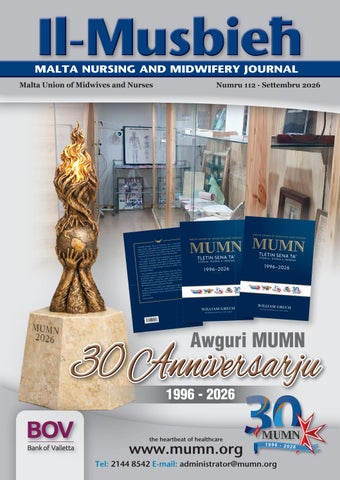
Front photos MUMN in collaboration with the Government will be launching a new Monument that represents the Health Care Professionals.
Il-Musbieœ jiæi ppubblikat 4 darbiet f’sena.
On the 30th Anniversary MUMN published the History of the Union from the initial stages till recent times.
Dan il-æurnal jitqassam b’xejn lill-membri kollha u lill-entitajiet oœra, li l-bord editorjali flimkien mad-direzzjoni tal-MUMN jiddeçiedi fuqhom.
Professionals in the same premises of the union. Il-Musbieħ - SETTEMBRU 2026
MUMN also inaugurated a new Museum for the Health Care
3
Editorial
Thirty Years of MUMN A Legacy Worth Defending This September, the Malta Union of Midwives and Nurses (MUMN) marks thirty years as the recognised union representing nurses and midwives in Malta. Since broadening its membership in 1996, MUMN has played a significant role in shaping the professions and strengthening the voice of healthcare workers.
In this environment, MUMN remains as relevant as ever. Its value extends beyond collective agreements and industrial action. Its true importance lies in ensuring that nurses and midwives have a strong, independent voice when decisions affecting healthcare services are made. A sustainable healthcare system cannot exist without effective professional advocacy.
Over three decades, MUMN has been at the forefront of discussions on salaries, working conditions, professional recognition, career development, staffing and workplace safety. It has often spoken out when healthcare professionals felt unheard and challenged decisions that affected the quality of care and the welfare of staff. Whatever one’s views on specific positions taken by the union, there is little doubt that nursing and midwifery are stronger and more visible today because of its efforts.
The future, however, will bring new challenges. Artificial intelligence, ageing populations, workforce shortages and international competition for healthcare professionals will require foresight and leadership. MUMN’s continued relevance will depend on its ability to evolve with these changing realities.
Healthcare in 2026 is very different from that of 1996. Patients are more complex, technology has advanced rapidly and services face constant pressure. At the same time, nursing shortages, recruitment difficulties, retention challenges, burnout and increasing workloads continue to test the profession both locally and internationally.
4
As MUMN celebrates its thirtieth anniversary, it deserves recognition for its contribution to healthcare in Malta. Yet the greatest tribute to those who founded the organisation is not simply to celebrate its past, but to ensure that future generations inherit a profession that is respected, properly resourced and prepared for the challenges ahead. Thirty years ago, healthcare professionals created a stronger collective voice. Ensuring that voice continues to be heard remains a responsibility shared by all who care about the future of nursing and midwifery in Malta.
Il-Musbieħ - NUMRU 112
President’s message
MUMN will not tolerate racism, abuse or violence against our members The Malta Union of Midwives and Nurses (MUMN) will not tolerate racism, abuse, intimidation or violence against nurses — whether they are Malteseor EU nurses or Third Country National (TCN) nurses. MUMN is increasingly concerned that the nursing management structure within elderly institutions, particularly St Vincent de Paul (SVP) and Karen Grech Hospital (KGH), is failing to create an environment where nurses feel genuinely supported and protected when reporting racism, abuse and violence. The hostile environment in SVP and KGH results that many TCN nurses and in some cases even Maltese nurses are to afraid to report harassment and abuse due to lack of support form the direct superiors. TCN nurses are to afraid to speak up and report abusive or racist behaviour. The Charge Nurses and the SNMs, who are responsible of the ward and section, should be proactive and report such abuse but this is never the case. These two grades should assist more their staff with the aggressive patient and relatives. A nurse should never be made to feel that reporting an abuse will result in further problems, isolation or repercussions. Every nurse, midwife and all other employees have the right to work in an environment where complaints are taken seriously, investigated properly and acted upon. MUMN is particularly concerned when Charge Nurses and Senior Nursing Managers (SNMs) claim that they were unaware of what was happening in their wards. Being unaware cannot become an excuse for failing to manage a ward. Charge Nurses and SNMs have a responsibility to know what is happening within their areas of responsibility. They are expected to identify problems, address unacceptable behaviour and ensure that nurses are protected. It is not acceptable for CNMs, SNMs or Charge Nurses to hide behind the argument that they were not aware of the facts when serious incidents are taking place under their management. Accountability must follow responsibility. If abuse, racism or violence is taking place repeatedly within a ward, responsibility cannot simply be transferred onto the individual nurse who eventually reports it.
TCN nurses need support, protection and proper management intervention. Unfortunately, MUMN believes that this is currently not happening adequately within our elderly institutions. And once again, the TCN nurses and Maltese (EU) nurses are the ones paying the price. DDA CUPBOARDS CANNOT BE TAKEN LIGHTLY MUMN is also warning nurses and nursing management that the security and management of Dangerous Drugs Act (DDA) cupboards must never be treated lightly. Any missing medication from a DDA cupboard is a serious and potentially dangerous matter. It can have significant consequences for nurses, the Charge Nurse and the wider nursing management structure. A Charge Nurse cannot simply be exonerated because they were too busy or did not have sufficient time to attend to the DDA cupboard. The police will not necessarily accept workload or lack of time as an excuse when investigating missing controlled medication. The consequences can be severe and may potentially include disciplinary action and loss of employment for those found responsible. However, MUMN stresses that responsibility cannot automatically rest solely with the Charge Nurse. The SNM also has a responsibility to ensure that safe practices are being followed within the ward and that nurses are adhering to the established procedures governing DDA medication. If unsafe practices are taking place repeatedly and the senior management structure fails to identify, address or correct them, responsibility cannot simply stop at the Charge Nurse. The SNM is senior to the Charge Nurse and therefore has managerial responsibilities that must also be recognised. You cannot demand accountability from the Charge Nurse while simultaneously ignoring the accountability of those above the Charge Nurse. A NEW CHAPTER FOR NURSES AND MIDWIVES Next year will be an important year for nurses and midwives, with negotiations for the new Nurses and Midwives Sectoral Agreement. MUMN makes it
clear that these negotiations will not be limited to financial improvements. Changes will be required to properly reflect the responsibilities, accountability and realities faced by nurses and midwives on a daily basis. MUMN will be putting forward proposals that address the realities of today’s nursing profession and the responsibilities actually being carried by nurses and midwives in wards and departments. Unfortunately, there are grades within the system that are not sufficiently working in the interests of nurses and midwives. There are also grades which, despite their managerial responsibilities, appear to become virtually non-existent when it comes to certain hospital SOPs and accountability. This cannot continue. Nurses and Charge Nurses cannot continue to carry the majority of the legal, professional and disciplinary consequences while the corresponding managerial responsibilities are not equally recognised. The nurses on the ward are often the first line of defence — and consequently the first to be placed in the line of fire. But responsibility must reflect authority. If a Charge Nurse is expected to be accountable for what happens on a ward, then the Charge Nurse must be properly supported and the responsibilities of the SNM and other levels of management must also be clearly defined and enforced. MUMN will be insisting that this imbalance is addressed. Nurses cannot be expected to carry responsibility without authority, accountability without support, and disciplinary consequences without a management structure that accepts its own responsibilities. Racism, abuse and violence against nurses must stop. Unsafe practices must be addressed. DDA procedures must be taken seriously. And managerial accountability must finally reflect what is actually happening on the wards and departments. MUMN will be raising these issues forcefully during the forthcoming sectoral agreement negotiations.
Il-Musbieħ - SETTEMBRU 2026
Paul Pace President
5
Kelmtejn
mis-Segretarju Æenerali Gœeÿieÿ œbieb u kollegi, Is-Sajf veru sabiœ imma s-sœana esaæerata mhix tajba gœal œadd. Dan BBQ u mhux Sajf! Nispera li qed issibu œin biex tmorru l-baœar però importanti li nsegwu twissijiet kollha maœruæa millawtorijtajiet kompetenti. Gœandna Ministru ædid. Anzi biex inkun eÿatt irrid ngœid li œadna promotion gœax gœandna Deputat Prim Ministru (DPM). Biex ngœid kollox, aœna konna drajna li jkollna Deputat Prim Ministru gœaliex taœt l-On. Chris Fearne gœamilna snin mhux œaÿin bœala DPM imbagœad œassejna ruœna strambi li waqajna lura gœal Ministru. Emnuni meta ngœidilkom li d-differenza mhux qegœda biss fl-isem. Il-kariga fiha l-piÿ speçjalment meta jiæu biex jittieœdu çertu deçiÿjonijiet importanti. Issa ræajna lura gœal œatra ta’ DPM. Però l-isem tal-œatra mhux kollox. Lil hemm mill-œatra, huwa importanti l-karattru u l-metodu ta’ xogœol li jiæi addottat. Taœt l-On. Ian Borg qegœdin naraw organizzazjoni kbira u rispett sœiœ kemm lejn in-nursing kif ukoll lejn l-MUMN. Veru hawn min jista’ jgœid li gœax gœadu l-bidu però fl-istess waqt wieœed jista’ jargumenta li x-xemx minn filgœodu turik. Li hemm tajjeb huwa li din issistema ta’ xogœol li qed tiæi adottata, hija sinonima ma’ kull Ministeru li kien responsabbli gœalih l-On. Ian Borg. IlMinisteru tas-Saœœa kien nieqes sew minn din l-organizzazjoni tant li konna spiççajna b’çertu postijiet tax-xogœol jimxu bl-automatic, mingœajr direzzjoni, kulœadd jagœmel dak li jœoss. Hekk jibda l-chaos. In-nuqqas ta’ leadership kienet bdiet tinœass sew. Illum mhux biss gœandna leadership imma kulœadd gœandu direzzjoni fejn irridu mmorru. Meta l-affarjiet ikunu organizzati, ilœajja ta’ kulœadd tkun eœfef u l-aktar importanti huwa li s-servizz lejn il-pazjent jitjieb. Barra minn hekk qed ikollna œafna aktar laqgœat mal-awtoritajiet u f’dawn l-istess laqgœat, b’mod æenwin, qed tinstab soluzzjoni li tkun tajba gœal kulœadd. Kompromessi jsiru dejjem gœax dik hija l-œajja. B’hekk tinœoloq aktar fiduçja bejn iÿ-ÿewæ partijiet. Dan ix-xahar huwa importanti œafna gœall-MUMN peress li fid19 ta’ Settembru se nagœlqu t-30 anniversarju. Sabiex nikkomemoraw dan l-avveniment, se jiæi inawgurat Muÿew tan-Nurses u Professjonijiet
6
oœra tas-saœœa, ser jiæi ppubblikat ktieb dwar l-Istorja tal-MUMN kif ukoll se ssir preÿentazzjoni ta’ Monument ædid li se jiæi inawgurat matul is-sena talanniversarju. Dawn huma tlett materji ta’ legat importanti li dan il-Kunsill se jœalli warajh. L-ewwel nett – Muÿew tal-Istorja – dan il-pass ma kienx façli. L-ewwel sfida kienet biex jitœejja il-post. Wara œafna ppjanar sibna post addattat fl-istess kwartieri tal-union biex b’hekk kollox ikun magœqud flimkien. Il-mutur ta’ dan il-proæett kien il-Viçi-President Alex Manchè li œadem qatih kemm biex il-post kien lest strutturalment kif ukoll biex akkwistajna oææetti u materjal addattat gœal dan il-Muÿew. It-tieni oææettiv – L-Istorja tal-MUMN – Konna ilna nœossu l-bÿonn li nibdew naœsbu bis-serjetà biex niktbu l-istorja ta’ dawn it-tletin sena tal-union. Bdejna nœossu li ÿ-ÿmien gœaddej u wasal sew il-waqt li nibdew niktbu l-istorja talunion. Bœal ma jiæri sikwit, biex xogœol kontinwu tal-union, dejjem tispiçça tipposponi sakemm fl-aœœar id-Deputat Segretarju Æenerali William Grech infurmani li huwa lest biex jidœol gœal dan l-inkarigu. Ovvjament jien wegœdtu l-gœajnuna kollha tiegœi speçjalment li ilni fix-xena jien wkoll gœal dawn ittletin sena sœaœ u gœalhekk niftakar dak kollu li sar u seœœ mill-viçin. It-tielet materjal – Monument Ædid – Fissena 2011 hawn Malta æiet organizzata l-Konferenza tal-International Council of Nurses fejn madwar erbat’elef nurse mid-dinja kollha ÿaru pajjiÿna. Il-Gvern Malti immexxi mill-On. Prim Ministru
Il-Musbieħ - NUMRU 112
Lawrence Gonzi kien ta l-gœajnuna tiegœu kollha possibli biex isir Monument biex tiæi mfakkra din l-okkaÿjoni. Dan il-Monument kien twaqqaf fi Ænien Ganado l-Furjana jœares lejn ilPort il-Kbir peress li Malta kienet œadet l-isem ta’ Nurse of the Meditterrean kemm minœabba l-ælieda ta’ Galipoli kif ukoll dak iÿ-ÿmien fl-gœajnuna li Malta tat lill-poplu Libjan proprju fi ÿmien li l-On. Gonzi kien Prim Ministru. Ma nistax nikteb dan l-artiklu mingœajr ma nagœti æieh lil ÿewæ persuni li kieku ma kienux huma ma kien isir xejn, l-anqas il-Konferenza. Dawn huma l-Onor. John Dalli li dak iÿ-ÿmien kien il-Ministru tasSaœœa u s-sur Edgar Galea Curmi li kien il-Kap tas-Segretarjat tal-Prim Ministru. Issa, dan il-Monument, wara 15-il sena, kemm minœabba l-elementi tan-natura kif ukoll minn xi atti ta’ vandaliÿmu, spiçça fix-xejn. Dan il-Kunsill œass li din hija parti importanti mill-istorja tal-union kif ukoll ta’ pajjiÿna u gœalhekk kellna laqgœat mall-Gvern u æie deçiÿ li jsir Monument ieœor fl-istess post. Il-bravu skultur Antonio Mifsud, li wkoll huwa nurse, aççetta li jidœol gœal din il-biçça xogœol importanti. Tinsewx li Antonio huwa wkoll l-iskultur tal-Monument l-ieœor li gœandna fil-ænien ta’ San Anton biswit il-Palazz Presidenzjali. Kif tistgœu taraw, dawn huma tlett materji li mhux biss ser jitgawdew millmembri tal-union li gœandna llum, imma wkoll mill-æenerazzjonijiet li æejjin. Dan huwa legat b’saœœtu œafna u nawguraw li nkomplu nibnu fuqu. Fil-faççata ta’ din il-œaræa tal-Musbieœ tistgœu tieœdu idea ta’ dawn it-tlett fatturi. Fil-æranet li æejjin sejrin niffirmaw ÿewæ Ftehim Settorali li jaffettwaw tlett kategoriji ta’ œaddiema – Phelbotomists, Dental Surgery Assistants u Decontamination Sterile Technicians. Se jkunu l-ewwel Ftehim Settorali li ser jiæu ffirmati mal-Ministru tas-Saœœa l-ædid. Aœna kuntenti œafna bil-kontenut tagœhom. Nawguraw li jkollna aktar iffirmar ta’ Ftehim Settorali mal-On. Ian Borg. Gœal-lum ser nieqfu hawn. Nawguralkom li tkomplu tgawdu l-aœœar æimgœat tasSajf. Tislijiet mill-qalb, Colin Galea Segretarju Æenerali MUMN
Opinjoni
Gœaliex niççelebraw il-Jum Internazzjonali tal-Infermiera? Kitba ta’ Joe Camilleri, C.N. Fit-12 ta’ Mejju li gœadda u ta’ kull sena mad-dinja kollha, icçelebrajna l-Jum Internazzjonali tal-Infermiera. Smajna d-diskorsi tas-soltu, rajna ÿjarat uffiçjali fiç-çentri tas-saœœa, u qrajna messaææi sbieœ tadDirettorat fuq il-midja soçjali dwar il-vokazzjoni, il-kompassjoni, u s-sagrifiççji li jsiru. Iÿda meta jintfew id-dwal ta’ din il-æurnata ta’ tifkira, x’jibqa’ gœall-infermiera Maltin u dawk barranin li jaœdmu f’pajjiÿna? Jinbidel xi œaæa? Meta nieœdu l-kuntest globali, fid-dinja hemm mal-5 u s-6 miljun defiçit finnumru ta’ nurses. Dan minnu nnifsu huwa sfida enormi. In-nurses jgœoddu naqra aktar minn nofs it-total ta’ œaddiema fil-qasam tas-saœœa fid-dinja kollha. L-ICN fl-2026 iffukat fuq dawn ilpunti: In-nuqqas ta’ nurses u l-inekwità; id-distibuzzjoni, fejn gœandek aktar minn 80% tan-nurses jaœdmu f’pajjiÿi li jirrappreÿentaw in-nofs tal-popolazzjoni globali; il-burnout u l-benesseri tagœna; u s-sigurtà u l-vjolenza fuq il-post taxxogœol. Malta, ikkumparata ma pajjiÿi oœra qegœda f’faxxa moderata, jiæifieri 8.2 nurse ma’ kull 1,000 ruœ (2023). Kollox ma kollox, leœen in-nurse f’din ilæurnata jrid jibqa’ jinstema’ mad-dinja kollha. L-infermiera huma s-sinsla tas-sistema tas-saœœa tagœna. Minn Mater Dei sattaqsima tal-Kura Primarja, mill-Isptar Monte Carmeli sal-gÿira t’Gœawdex, huma dawn il-professjonisti li jqattgœu l-aktar œin mal-pazjent. Huma dejjem preÿenti fl-isbaœ mumenti tal-œajja, iÿda aktar u aktar, fl-aktar mumenti vulnerabbli u diffiçli. Madankollu, l-ammirazzjoni bil-kliem ma tœallasx l-impatt fuq saœœitna, fuq il-well-being u lanqas ma tnaqqas l-gœejja ta’ xiftijiet twal. Dan kollu f’kuntest ta’ nuqqas serju ta’ riÿorsi umani, iffullar ta’ pazjenti fl-isptarijiet u overpopulation esagerat. Huwa inutli li nfaœœru l-wirt ta’ Florence Nightingale jekk ma nindirizzawx ir-realtajiet iebsa tal-lum. Fl-aœœar xhur u snin, rajna lillMalta Union of Midwives and Nurses (MUMN) tesprimi tœassib serju dwar kwistjonijiet li jolqtu l-kundizzjonijiet
tax-xogœol tagœna dwar l-gœoti talvacation leave, il-mandat ta’ inibizzjoni mill-Ministeru tas-Saœœa biex jitwaqqfu d-direttivi, il-kwistjonijiet ma jaqtgœu qatt dwar il-constant watches u anke fl-isptar t’Gœawdex. Meta l-infermiera jœossuhom li mhumiex rispettati jew protetti mil-liæi u mis-sistema bl-istess mod bœall-professjonisti oœra, il-moral bilfors jonqos u l-hekk imsejœa ‘vokazzjoni’ gœal dax-xogœol tgœib u tnemnem. Gœaliex l-infermiera m’avvanzawx awtomatikament gœal Salary Scale 5 u 6 mingœajr sejœa kompetittiva? Gœaliex aœna bqajna mwaœœlin fi Scale 7, minkejja talbiet simili li kienu æew miçœuda bœala “non-negotiable”. Dan mhu xejn œlief tradiment lejn il-professjoni tagœna. Gœaliex kellek infermier b’esperjenza kbira mal-morda, li kellu jitkarrab fuq facebook waqt il-kampanja gœallelezzjoni æenerali li gœaddiet, biex issir æustizzja miegœu fuq promozzjoni mistœoqqa? Fejn huma dawk l-infermiera involuti fil-politika, li b’xi mod kienu jagœtu palata fid-deçiÿjonijiet li verament jaffettwaw ir-realtajiet tan-nursing f’Malta. Donnhom dawn sparixxew! Jekk mhux se nindirizzaw dan is-settur tant fraæli ta’ œaddiema, long term mhux se jibqa’ sostenibbli. Jekk mhux
se nindirizzaw l-evidenzi u t-trends dwar dak li qed jiæi mistœarreæ u jidher biççar, fid-dinja tal-impjiegi tan-nursing, se nirrankaw. Jekk mhux œa nindirizzaw ilpolicies li jinœtieæu b’mod uræenti, jew jekk mhux se jsir investiment kif xieraq versu n-nursing, jew jekk mhux œa nagœtu l-valur miÿjud lejn il-professjoni tagœna, œa mmorru l-baœar. Is-sistema tas-saœœa preÿenti, li tiddependi fuq is-sagrifiççju kontinwu tal-infermiera, mhijiex sostenibbli, imma hija sistema fi kriÿi. Forsi mhux kulœadd jaqbel mat-ton tiegœi, imma jekk l-infermiera mhumiex se jibqgœu jiæu appoææjati kif suppost, ilkollass jista’ jkun inevitabbli. U bilœaqq, gœaliex il-famuÿi ‘frantlajn werkers’ (miktuba hekk apposta) mhumiex se jiæu kkumpensati bi Ð8,000 tax-xogœol tagœhom waqt il-pandemija Covid-19, bœalma se jiæu kkumpensati l-œaddiema tax-xatt? Din l-istorja rrepetiet ruœha darbtejn, darba fl-2020 meta unjon flEmeræenza rat kif firdet lilna n-nurses, u anke dis-sena. Makkjavelliÿmu fl-aqwa tiegœu. Tqanna’ biÿ-ÿewæ ewro munita maœruæa mill-Bank Çentrali ta’ Malta, Infermier!
ikompli f’paæna 9
Il-Musbieħ - SETTEMBRU 2026
7
8
Il-Musbieħ - NUMRU 112
Jum Internazzjonali tal-Infermiera ikompli minn paæna 7 Il-futur tal-kura tas-saœœa f’Malta jiddependi direttament minn kemm kapaçi nattiraw u nÿommu infermiera kwalifikati. L-Università ta’ Malta u l-MCAST qed jagœmlu xogœol siewi biex iœarræu lill-istudenti t’gœada, iÿda jekk l-ambjent tax-xogœol jibqa’ wieœed ta’ stress qawwi, kultant tossiku, b’pagi li ma jirriflettux ir-responsabbiltà kbira tagœna, u b’sptar li ma baqax sostenibbli, œafna se jagœÿlu li jew jitilqu mill-professjoni jew ifittxu opportunitajiet barra minn xtutna, kif diæa gœamlu. Wieœed isaqsi wkoll il-gœaliex il-pagi tagœna bœala nurses baqgœu mwaœœlin taœt il-medja tal-pajjiÿi tal-Unjoni Ewropea? Il-messaææ ta’ dan l-artiklu huwa çar: Billi nfaœœru l-infermiera u l-qwiebel mhux biÿÿejjed, l-infermiera m’gœandhomx bÿonn biss æurnata waœda ta’ ringrazzjament f’Mejju. L-infermiera gœandhom bÿonn investiment strutturali s-sena kollha u reviÿjoni gœat-tul fis-salarju tagœhom. L-infermiera gœandhom bÿonn li l-Gvern u l-awtoritajiet tas-saœœa jpoææu madwar mejda b’rieda sinçiera biex itejbu l-kundizzjonijiet finanzjarji, u jiggarantixxu ambjent san fejn l-infermiera jkunu jistgœu jipprattikaw il-professjoni tagœhom b’dinjità. Gœaliex gœadna nistennew il-canteen gœall-istaff f’Mater Dei? Fejn hu l-gym imwiegœed gœall-istaff f’Mater Dei? Fejn hemm post speçjalizzat gœall-pazjenti vjolenti f’Mater Dei? Gœaliex œa nibqgœu naœdmu f’sistema ta’ sptar æenerali wieœed b’popolazzjoni li splodiet? Gœaliex ilwaiting time æewwa l-Emeræenza gœadu viçin it-12-il siegœa? Ma ndunajniex li Mater Dei m’gœadux umanament ‘manageable’ kif inhu issa? Gœaliex m’aœniex flessibli fir-rosters tagœna? Fejn huma t-tlett sptarijiet æodda? Meta æej lura l-HR u s-sezzjoni tas-salarji tagœna f’Mater Dei? Meta œa neœilsu minn nies arroganti magœna li jgœamlulna œajjitna miÿerja? Meta se jispiççaw l-iÿbalji li jsiru fil-komputazzjoni tas-salarji tagœna? Fejn huma t-teambuilding sessions gœall-œaddiema. Gœall-anqas beda x-xogœol tal-Acute Mental Health Unit (façilità psikjatrika) wara assenza ta’ 6 snin mingœajr Psychiatric Short Stay f’Mater Dei u wegœdi fierœa ta’ sptarijiet psikjatriçi fl-akkwata. Is-saœœa u l-kwalità tal-œajja tal-poplu Malti kollu huma marbuta direttament
mal-gœaÿliet politiçi u finanzjarji li nagœmlu llum biex nassiguraw ilbenesseri, id-dinjità u s-sigurtà talinfermiera tagœna. Jekk ma nieœdux œsieb lil dawk li jfejquna, is-sistema kollha tas-saœœa f’pajjiÿna tikkollassa. Jekk se nibqgœu niççelebraw dan iljum billi nqassmu l-cupcakes, nagœtu xi bookmark, niftœu xi beræa u nifqgœu l-facebook b’ritratti kollha poÿi, waqt li s-sistema ftit ftit qed titlef lil dawk li tassew iÿommuha wieqfa, allura gœalxejn infakkruh. U propju gœalhekk huwa importanti dan il-jum. Jien li ili f’dal mestier, illum nista’ nifhem gœaliex æejna fiex æejna. Inœobb ilprofessjoni tiegœi, u rrid li l-istandards of care jitjiebu. Kultant irrabjat gœaliex irrid li n-nurses jieœdu d-deçiÿjonijiet huma fuq livell politiku u mhux œaddieœor. Il-frustazzjoni li gœandhom in-nurses illum ma tissarrafx fiç-çelebrazzjonijiet tal-International Nurses’ Day; hemm wisq limitazzjonijiet sistematiçi. Gœadni ma nistax nimmaæina kif se jkunu l-isptarijiet tagœna 20, 30 sena oœra jekk is-saœœa tan-nurse se tkun dgœajfa. Irrabjat gœaliex donnu anke fil-Malta Vision 2050, aœna n-nurses m’aœna rrapreÿentati mkien f’policymaking strateæiku. U propja dan imur kontra l-istess tema ta’ dan il-jum kif dikjarat mill-ICN: “Our Nurses. Our Future.” Kollox barra empowerement gœannurses. Œaæa waœda ngœid jien, li kieku l-infermiera u qwiebel Maltin mhumiex reÿiljenti minn natura tagœhom, li kieku jieqfu jaœdmu meta jkunu taœt pressjoni, li kieku ma jerfgœux ir-responsabbiltajiet kbar tagœhom, ta’ spiss b’riÿorsi limitati, kieku l-qasam tas-saœœa jiddgœajjef ferm. Ejja ma niddependux iÿÿejjed fuq l-isforzi personali tan-nurses. Insejna li bis-saœœa tan-nurses Maltin, kull meta kellna kriÿijiet kbar f’pajjiÿna bœal gwerer, epidemiji, kunflitti industrijali fl-isptarijiet, kriÿijiet politiçi jaœarqu, ittaqtigœa gœall-professjonalità tagœna, il-ælidied gœall-kundizzjonijiet tagœna u l-pandemija nnifisha, ÿammejna l-isptarijiet afloat?
Anke l-landscape tas-swali tagœna nbidel drastikament. Minn sptar li kien ikollok xi sodod vojta gœall-admissions, gœal sptar iffullat dejjem, sajf jew xitwa. Minn sptar li b’xi mod kien ilaœœaq mallisti tal-operazzjonijiet gœall-backlogs kiruræiçi. Minn swali li tradizzjonalment kienu joperaw fl-ispeçjalizzazzjoni tagœhom gœal swali makeshift biex intaffu l-iffullar. Minn sptar li kellna biÿÿejjed isolation rooms, gœal sptar li ma nafux fejn se nammettu pazjenti blinfezzjonijiet. Minn kultura fejn pazjent anzjan kien isib ‘il xi œadd biex ikellmu bil-Malti, gœal æranet sœaœ fejn gœandek workforce multikulturali biss. Minn swali fejn bœala œaddiem kont titkellem billingwa materna tiegœek minn fil-gœodu sa flgœaxija sa swali li ssir espert kif titkellem bil-lingwa Ingliÿa. Jekk naœsbu li f’dan li qed nikteb ma jaffettwax ilkomunikazzjoni minœabba l-lingwa, ma jikkawÿax stress, u ma jkunx hemm medical errors, allura ÿbaljati. Jinœtieæ œafna aktar kultura ta’ inklussività, œafna aktar edukazzjoni dwar it-tolleranza, lill-pazjenti stess, u œafna aktar taœriæ emozzjonali lin-nurses tagœna. Hemm pazjenti u qrabathom hemm barra li gœandhom preæudizzju çar speçjalment dak razzjali: Kemm preæudizzju espliçitu (bil-miftuœ) u anke dak impliçitu (sterjotipar mingœajr ma jindunaw). Mhux l-ewwel darba li tisma: ‘Irrid nurse Maltija’ ‘Sic! As if’. Tirrispondi telefon u l-ewwel œaæa li jgœidlek min içempel jgœidlek: ‘Malti?’. Dan kollu jimpatta fuqna n-nurses fl-aœœar mill-aœœar. Il-burnout tagœna œadd mhu jagœti kasa u l-benesseri tagœna huwa biss filperiferija. Gœalhekk niççelebraw il-jum internazzjonali tal-Infermiera.
Viva l-jum internazzjonali tal-Infermiera
Il-Musbieħ - SETTEMBRU 2026
9
10
Il-Musbieħ - NUMRU Il-Musbieœ NUMRU 111 112
Ethics & Health Care by Marisa Galea Vella
Green Nursing When we think of nursing we typically think of assessing, charting, treatment administration and providing compassionate care. However, there is a growing shift that is adding green to hospitals and clinics. It’s called Green Nursing with the term referring to exactly what it sounds like, the importance of providing healthcare while ensuring environmental sustainability. Simply put, we cannot have healthy people living on a sick planet.
photo | nursing.upenn.edu
Hospitals and clinics are places of healing, but they also require an incredible amount of energy and generate significant amounts of waste. Many items are available as singleuse plastics, lighting and temperature control are constantly required hence the healthcare sector leaves a heavy ecological footprint. Nurses are at the centre of providing patient care. They spend the most time with patients and manage day-to-day bedside care, hospital wards and clinics placing them in the ideal position to lead ecofriendly change. Green nursing is about finding smarter, cleaner ways to deliver quality care to our patients. Here are a few ways nurses are driving change everyday: ensure proper recycling of plastics, glass, and cardboard, and advocate for safe, reusable alternatives wherever possible; turning off lights, computers, and medical equipment in empty treatment rooms or offices saves a notable amount of energy; supporting
the implementation and transition to fully electronic health records reduces the need for physical printing; educate patients about how their environment affects their well-being. One might ask, can one nurse really make a difference? Yes, without a doubt. When a nurse promotes sustainable practices, it creates a ripple effect. Colleagues become aware, it will hopefully inspire hospital leadership to review organisational practices, and it can potentially encourage patients to follow healthy, sustainable approaches too. In addition, green nursing connects climate change to public health, where actively working to reduce the environmental footprint generated by healthcare can contribute to the prevention of respiratory and heat-related illnesses. Green nursing also addresses climate justice and health equity, highlighting how environmental degradation affects vulnerable communities first and most
significantly. Green nurses can bridge this gap when providing care beyond the bedside. Nurses can screen their patients for environmental hazards, assess climate risks and advocate for public policies that demand improved air quality, more green spaces, and disaster preparedness. Linking climate action to social equity highlights how green nursing can incorporate sustainability into public health practice to promote human rights. Green nursing proves that sustainability and high-quality healthcare can go together. Nursing is about promoting holistic wellness. By taking care of the environment, nurses are simply extending their circle of compassion to what nurses have always done, protect human life. By safeguarding the health of our planet, nurses safeguard the future of every patient. Are you ready to be a green nurse? Marisa Galea Vella
Il-Musbieħ Il-Musbieœ - SETTEMBRU - ÆUNJU 2026
11
12
Il-Musbieħ - NUMRU 112
Proposti li nixtieq nara fil-qasam tas-saœœa bœala fiÿjoterapista b’24 sena esperjenza u bœala rappreÿentanta tal-Fiÿjoterapisti fi œdan l-MUMN gœal dawn l-aœœar 13-il sena 1. Regolizzazzjoni sura ta’ nies talprofessjonisti kollha marbutin massaœœa u “wellbeing’’ taç-çittadini tagœna. Kemm dawk li jaqgœu taœt il-kunsill tal-professjonisti kumplimentari tas-saœœa u kemm le. Gœandna nies li qed jitœallew jikkuraw pazjenti, klijenti, atleti mingœajr kwalifiçi meœtieæa, jsiru diversi rapporti lill-public health u passi mhux qed jittieœdu. 2. Tibdil fil-liæi tal-health professions act li ilha ma tinbidel sa mill-2006. L-unika upgrades li saru huwa biex jkompli jipproteæu lill-professjoni tat-tobba biss. Hemm bÿonn li mhux it-titlu tal-professjoni biss jkun protett imma anke ix-xogœol kollu li nagœmlu per se; kemm min hu fiÿjoterapista, nutritionist, podiatrist etç. L-uniku professjonisti li x-xogœol tagœhom huwa protett bil-liæi huma t-tobba, dentisti, spiÿjara, infermiera u qwiebel. Il-kumplament m’humiex u gœalhekk meta qed insibu nies li qed jippratikaw ix-xogœljiet tagœna, jew partjiet mix-xogœljiet, mhux qed jitwaqqfu gœax hemm diversi loopholes fil-liæi. 3. Professjonisti tas-saœœa li m’humiex tobba, mhux qed ikollhom inçentiv li jkomplu jiÿviluppaw flispeçjalizzazzjonijiet tagœhom, gœax sa issa m’hemmx œsieb li tkun rikonoxxuta din, kemm fil-qasam pubbliku u kemm dak privat. Ma hemm xejn li jiddistingwixxi bejn wieœed gœadu jilœaq u wieœed espert fil-qasam, speçjalment fissettur privat.
5. L-awtonomija tal-professjonisti tas-saœœa trid tkun parti integrali mill-qafas tas-saœœa kemm privat kif ukoll pubbliku. Il-æerarkija dipendenti fuq it-tobba biss qed toœloq stennija ÿejda gœal testjiet, pathways gœall-kura li qed tieœu œafna passi ÿejda u inutli, bi spejjeÿ ÿejda u dewmin, meta çertu assessments, djanjoÿi u testijiet oœra jistgœu jiæu ordnati u jsiru millpractice health professionals (nurse, midwife, allied health professionals fil-qasam tas-saœœa skala 6 ’il fuq u fil-privat min gœandu esperjenza tal-ispeçjalizzazjoni gœal 10 snin u masters fil-qasam) 6. Li tiæbed ÿagœÿagœ lejn professjonijiet tas-saœœa b’inçentivi ta’ stipendju biss mhux biÿÿejjed. Illum wieœed jara kif jista’ jikber u jiÿviluppa filkarriera tiegœu mingœajr ma jœossu limitat, kemm fil-qasam pubbliku u kemm privat. Œafna professjonisti jitilqu proprju gœalhekk gœax m’hemmx fejn tikber, u gœandu management ikkankrat f’poÿizzjoni gœal œajtu kollha. Rari jilœaqq tabib u jœalli l-professjoni imma ssib œafna infermiera u allied health professions li jitilqu wara ftit snin. Ilqasam privat staænat ukoll fil-career progression - m’hemmx forma ta’ protezzjoni lejn minn hu impjegat full-time jew taœt contractual type work. Hemm abbuÿi minn employers li jimpjegaw full-time self employed.
7. Hemm bÿonn ukoll li studenti jikkontribwixxu lura fil-qasam tassaœœa gœal çertu ammont ta’ snin wara li jilœqu - eÿç 3 snin. La wieœed jkun œa l-istudju b’xejn u jitœallas ukoll stipendju tajjeb, hemm bÿonn li jaœdem fil-professjoni li jkun gradwa minnha. Sa issa wieœed jista’ jilœaqq u jsiefer jew jmur jaœdem fil-privat mal-ewwel mingœajr ma qed jikkontribwixxi lejn is-servizz pubbliku. 8. Il-kors tal-mediçina qed jkun brain drain ta’ professjonijiet oœra tassaœœa. Li tilœaq professjoni A u imbagœad tuÿa dak iç-çertifikat biex tidœol fil-kors tal-mediçina qed jnaqqar mill-professjoni oriæinali. Din trid tiæi limitata jew imwaqqfa. Il-qasam tas-saœœa ma jistax jibqa’ jaæevola lit-tobba biss. 9. Sptar ta’ riabilitazzjoni li ilna nistennew 25 sena. 10. Pensjoni ma tkunx capped 2/3 fi skala 10 imma skond l-iskala li tkun temmejt il-karriera fiha. 11. Possibiltà ta’ irtirar kmieni gœal min jkun gœamel 25 sena servizz malpazjenti (mhux fuq skrivanija). Pauline Fenech Rappreÿentanta tal-Fiÿjoterapisti MUMN
photo | atwtyresandmags.com.au
4. Rikonoxximent ta’ union b’rappreÿentazzjoni minorili, kif titlob il-liæi diæà, kull œaddiem jew grupp ta’ œaddiema gœandhom dritt jkunu membri ta’ union talgœaÿla tagœhom, u li din tkun tista’ titkellem kollettivament f’isimhom.
Il-Musbieħ - SETTEMBRU 2026
13
Certain historical highlights of the Catholic Church’s history on health care Rarely do I choose such a long title to capture the kernel of my God-given articles. Yet, this time, I had to explicitly resort to such a verbose title in order not to give the impression that I am going to tackle the history of the Catholic Church’s contribution within the health care sector by simply put it all there in the subsequent short article. Thus, as this title rightly suggests, I am going to mention some historical highlights of the Catholic Church’s precious assistance to the sick throughout its different epochs of its evolving history. While trailing the following historical roadmap I cannot not appreciate John A. Dicamilo’s description regarding the three landmarks of Catholic healthcare, namely “to walk, to build, to profess Jesus Christ crucified.” Out of honest fairness it should be acknowledged from the start of our discussion that the Roman Catholic Church is practically the largest nongovernment provider of health care services throughout the planet. Some 18, 000 clinics, 16, 000 homes for the elderly and those with special needs, 5,500 hospitals, the majority of which are operative in developing countries, are all under the tutelage of this Universal Church. According to the Pontifical Council for Pastoral Assistance to Health Care Workers, the Catholic Church manages 26 percent of health care facilities in the world. One must appreciate that the Catholic Church’s historical roots within the health care field go back to two millenia. Jesus Christ, the founder of the Church, taught his disciples that one of the signs that will accompany those who believe in Him is that in his name “they will lay their hands on the sick, and they will recover” (Mark 16:18). The early Christians scrupulously followed their noble mission of caring of the sick and infirm. This they did not only by attending to their physical needs but also, and most of all, by caring for their psychological and spiritual needs. Suffice to mention the great passage from the letter of James which gives ample evidence of how they did so.
14
“Is any among you sick? Let him call for the elders of the church, and let them pray over him, anointing him with oil in the name of the Lord; and the prayer of faith will save the sick man, and the Lord will raise him up; and if he has committed sins, he will be forgiven. Therefore confess your sins to one another, and pray for one another, that you may be healed. The prayer of a righteous man has great power in its effects” (James 5:14-16). Drawing on Jesus’ word that “as you did it to one of the least of these my brethren, you did it to me” (Matt. 25:40.45) the continual Christian insistence regarding practical charity evolved in the advancement of systematic nursing and hospitals. Deacons were entrusted with the mission of giving alms. By 250 AD the Church had developed a comprehensive charitable mission since wealthy converts started helping the poor. It is generally held that the first church hospitals were built in the East and then the Latin West followed. In the age of the Emperor Constantine at Constantinople a hospital was erected by St Zoticus. This Eastern Saint is called Orphanotrophos, meaning “Cherisher of Orphans”. This is so since in later years a large orphanage was added to the leprosarium. The orphanage incorporated a general hospital and a home for the aged. The Saint was honored in the whole Byzantine history as the patron of the orphanage. Basil of Caesarea, also known in Church Patristics as Saint Basil the Great, the famous Greek Bishop of Caesarea Mazaca in Cappadocia, Asia Minor (modern-day Turkey) built a celebrated hospital at the city where he was bishop. Of this hospital it was said that it “had the dimensions of a city”. In the West a famous nurse and a Roman matron of rank of the company of noble, named Fabiola, also erected a fine hospital at Rome around the year 400. The great Church father St Jerome, under whose influence Fabiola abandoned all her earthly pleasures and committed herself wholeheartedly to the service of God and her needy neighbour, wrote that she founded a hospital and “assembled all the sick from the streets and
Il-Musbieħ - NUMRU 112
highways” and “personally tended the unhappy and impoverished victims of hunger and disease... washed the pus from sores that others could not even behold”. Even within the religious orders themselves caring for the sick is not merely a principal duty to be fulfilled but, furthermore, it is the royal road of following Jesus Christ. For instance, in the Benedictine Rule, Chapter 36, we come across an entire chapter dedicated to the Sick Brethren. It says: “Before and above all things, care must be taken of the sick, that they be served in very truth as Christ is served; because He hath said, ‘I was sick and you visited Me’ (Mt 25:36). And ‘As long as you did it to one of these My least brethren, you did it to Me” (Mt 25:40). But let the sick themselves also consider that they are served for the honor of God, and let them not grieve their brethren who serve them by unnecessary demands. These must, however, be patiently borne with, because from such as these a more bountiful reward is gained. Let the Abbot’s greatest concern, therefore, be that they suffer no neglect. Let a cell be set apart for the sick brethren, and a God-fearing, diligent, and careful attendant be appointed to serve them. Let the use of the bath be offered to the sick as often as it is useful, but let it be granted more rarely to the healthy and especially the young. Thus also let the use of meat be granted to the sick and to the very weak for their recovery. But when they have been restored let them all abstain from meat in the usual manner. But let the Abbot exercise the utmost care that the sick are not neglected by the Cellarer or the attendants, because whatever his disciples do amiss falleth back on him”. Likewise, in the Franciscan rule, precisely in chapter 4 and 6, we find a direct reference as to how the sick brothers are to be treated within their respective fraternity. When speaking about the brothers that they should not accept money Saint Francis shows great mercy towards the sick brethren. In fact, he says: “Nevertheless, the ministers and custodians can work through spiritual
Catholic Church’s history on health care
photo | publisher-ncreg
friends to care for the sick and clothe the brothers, according to place, season and climate, as necessity may seem to demand”. In addition, in chapter 6, concerning the sick brothers Saint Francis says that the fraternity should act as their caring mother. “And let them securely make their needs known to one another, for if a mother loves and cares for her carnal son, how much more should one love and care for his spiritual son? And if one of them should become ill, let the other brothers serve him as they themselves would like to be served”. By being faithful to the Benedictine rule that the care of the sick is to be placed over all other duties monasteries were the main medical care providers before 1300. Many monasteries provided shelter for pilgrims as well as an infirmary for sick monks. They also establised hospitals for the public. The Benedictine order was well-known for instituiting hospitals and infirmaries and becoming the leading medical care givers of their districts. The Franciscan Capuchin brothers revived Saint Francis of Assisi’s ideals by providing care after the plague that was struck at Camerino in 1523. Up to
this day they offer spiritual care with the sick in many hospitals, including Mater Dei and Sir Anthony Mamo in Malta. With the increase of Universities the Middle Ages produced a host of Catholic scientists, the majority of them being clergymen. Thanks to their committed work great discoveries were made. And, as time and experience showed, these discoveries were certainly pivotal to the devolpment of modern day science and medicine. Saint Hildegard of Bingen, doctor of the Church, was among the most distinguished of Medieval Catholic women scientists. She wrote Physica, a text which deals with natural sciences and Causae et Curae. Hildegard was famous for her healing powers which involve practical application of tinctures, herbs, and precious stones. Saint Albert the Great (1206–1280) was also an outstanding pioneer in the biological field research. Crusader orders instituted many new traditions of Catholic medical care. The acclaimed Knights Hospitaller became a group of individuals connected with an Amalfitan hospital in Jerusalem, which was built to give care for poor, sick or injured pilgrims to the Holy Land. After the seizing of the city by Crusaders
the order ended up being a military and infirmarian order. The Knights of Saint John of Jerusalem were later known as the Knights of Malta. Also the Knights Templar and Teutonic Knights instituted hospitals both around the Mediterranean and Germanic lands. From the Renaissance to modern period one encounters Desiderius Erasmus (1466-1536) who brought back to life knowledge of Greek medicine. Great Catholic artists like Michelangelo furthered the knowledge of study of anatomy through sketching cadavers. The Jesuit polymath Athanasius Kircher (1602–1680), who was the first to hypothesize that living beings enter and exist in the blood. He was a pioneer of germ theory. Gregor Mendel, (18221884), the Augustinian friar, was the first scientist who developed theories about genetics. Catholic orders, religious and even lay people instituted health care centres around the world. For instance, women’s religious orders like the Sisters of Charity, Sisters of Mercy and Sisters of Saint Francis opened and
continued on page 19
Il-Musbieħ - SETTEMBRU 2026
15
16
Il-Musbieħ - NUMRU 112
Il-Musbieħ - SETTEMBRU 2026
17
18
Il-Musbieħ - NUMRU 112
Catholic Church’s history on health care continued from page 15 conducted some of the first modern general hospitals. We also find the Brothers Hospitallers of St. John of God, founded by the Portuguese Saint John of God (d. 1550) whose mission is that of caring for the sick and afflicted. In 1898 John was declared patron of the dying and all hospitals by Pope Leo XIII. Saint Camillus de Lellis, the patron saint of nurses, from a gambler and soldier converted and became a nurse and then director of Hospital of Incurables in Rome.
Catherine of Alexandria, Saint John of God, Saint Margaret of Antioch and Raphael the Archangel. This sip into the glorious past regarding certain historical highlights of the Catholic Church’s history on health care makes me sing with the psalmist: “What shall I render to the Lord fall his
bounty to me? I will lift up the cup of salvation and call on the name of the Lord, I will pay my vows to the Lord in the presence of all his people” (Psalm 116:12-14). With the author of the Te Deum, an early Christian hymn of praise, I sing: “O Lord, let thy mercy lighten upon us: as our trust is in thee ... Amen”.
In 1584 Camillus founded the Camillians to care for the plaguestricken. The Irishwoman, Catherine McAuley, instituted the Sisters of Mercy in Dublin in 1831. Her congregation flourished and established schools and hospitals around the globe. Saint Jeanne Jugan founded the Little Sisters of the Poor who modelled their lifestyle on the Rule of Saint Agustine. The aim of this congregation was that of helping the distressed elderly of the streets of France in the mid-nineteenth century. This congregation too was destined to spread worldwide. Finally and more recently to our times Blessed Mother Teresa instituted the Missionaries of Charity in the slums of Calcutta in 1948. Her aim was that of working among the poorest of the poor”. First she founded a school. Then he assembled other sisters who “rescued new-born babies abandoned on rubbish heaps; they sought out the sick; they took in lepers, the unemployed, and the mentally ill. Teresa attained fame in the 1960’s and started to found convents around the globle. By the time sister death approached her in 1997 the religious congregation she establised numbered more than 450 centres in about over 100 countries. All this success was always attended by the constant powerful intrecession of specific saints in front of God’s Heavenly Throne. Hence, the patron saints for physicians, Saint Luke the Evangelist, Saints Cosmas and Damian, Saint Pantaleon and the Archangel Raphael continually assist the physicians in their important job. The same can be said of the patron saints for surgeons like Saint Luke the Evangelist, Saints Cosmas and Damian, Saint Quentin, Saint Foillan and Saint Roch. Last and not the least on the list are the Catholic patron saints of nursing such as Saint Agatha, Saint Alexius, Saint Camillus of Lellis, Saint
Il-Musbieħ - SETTEMBRU 2026
19
Non-suicidal self-injury and mentalisation-based therapy Non-suicidal self-injury (NSSI) remains one of the most challenging issues in mental health care today. Whilst it is commonly associated with adolescence, prevalence rates reach almost 23 per cent in young people. NSSI does not disappear with age, it actually continues to affect approximately 1 in 20 adults. For both general and psychiatric nurses working in inpatient wards both at MDH and MCH, community nurses, and psychotherapy services, NSSI is something we encounter regularly, and its management remains a source of clinical concern and uncertainty. For the purpose of this article, NSSI can be defined as any act of intentional selfpoisoning or self-injury regardless of the motivation behind it or the degree of suicidal intent involved. Furthermore, NSSI refers to the deliberate, direct destruction or alteration of one’s own body tissue without suicidal intent, meaning that the individual is not trying to tend their life but is engaging in the behaviour for other reasons (emotional dysregulation, coping, communication of distress, self-punishment etc.,). Furthermore, one must not treat NSSI as a lesser concern simply because someone says they did not intend to end their life. NSSI is strongly associated with a range of mental health difficulties, but it is particularly prevalent among those diagnosed with emotionally unstable
20
personality disorder (EUPD). Research shows that up to 95% of adolescents and 90% of adults with EUPD who inpatients are report a history of self-harm, and more than half have experienced 25 or more episodes. For many of the people we care for, NSSI is not an isolated crisis event, but a recurring feature of their lived experience. Given how common and how serious this issue is, finding effective, evidencebased treatments is essential. However, when it comes to evidence, the picture so far has been mixed. Broad meta-analytic reviews of self-harm interventions have generally found only small effects, and even well-established approaches like Dialectical Behaviour Therapy (DBT) show only small-to-moderate benefits in reducing self-harm.
One approach that continues to generate interest is MentalizationBased Therapy (MBT), developed by Bateman and Fonagy. MBT is a form of psychotherapy recommended for the treatment of BPD. Its central aim is to help people strengthen their capacity
Il-Musbieħ - NUMRU 112
by Sharon Cuschieri
to mentalize: to understand and reflect on their own thoughts and feelings, and those of others, particularly in moments of emotional intensity. The theory behind MBT is compelling. Difficulties with emotional regulation and interpersonal relationships both closely linked to BPD and self-harm — are thought to emerge when a person’s capacity to mentalize breaks down, often under stress or within close relationships. Strengthening this capacity is not just a therapeutic addon; it is considered a prerequisite for other therapeutic work to be effective at all. The relevance of this event is further underscored by current developments within local clinical practice. Nurses within the Mental Health Services are presently undertaking a two-day intensive course in MentalizationBased Therapy, delivered by Dr. Dan Warrender himself. This initiative represents a significant investment in the specialist skill set of frontline mental health nursing staff and reflects a broader recognition, both locally and internationally, of the clinical utility of mentalization-informed approaches in the management of personality disorder and associated risk behaviours, including NSSI. For the nursing workforce at Mount Carmel Hospital, this training holds considerable professional value. It
continued on page 21
King’s nephew Peter Phillips marries NHS nurse Princess Royal’son, Peter Phillips married NHS nurse Harriet Sperling during a private ceremony at All Saints Church in Kemble, Gloucestershire, on Saturday, and chose the venue because Sperling lived in the village when the couple met. The King and Queen joined members of the royal family, including the Prince and Princess of Wales, Zara and Mike Tindall and the Duke and Duchess of Edinburgh. Princesses Eugenie and Beatrice were pictured arriving, alongside their husbands, Jack Brooksbank and Edoardo Mapelli Mozzi. The pair announced their engagement last year. Members of the public from all over the world travelled to the event and cheered loudly as Prince William and Catherine arrived at All Saints Church. Metal barriers, forming two pens for the media and public, were erected around the church and road closures were in place. There were shouts of “hip hip hooray” as bride Sperling arrived along with her three bridesmaids, Phillips’ children Savannah, 15, and Isla, 14, as well as Sperling’s teenage daughter Georgina. Phillips and Sperling began dating in 2024 after he split with his first wife, Autumn Kelly, in 2020. The
pair’s engagement was announced in August 2025. The wedding falls on the same day as the Epsom Derby. The Telegraph reported that the King and Queen took a helicopter after the ceremony for the 100-mile dash from Gloucestershire to Surrey, arriving at the racecourse in time to present the winner’s trophy. It is the first time since
2019 that a monarch has attended. Many people arrived at the church to watch the royals attend Son of Princess Anne and Captain Mark Phillips, the 48year-old is 19th in the line of succession to the British throne. All Saints Church, with its tall spire and quaint brickwork, sits in the heart of the rural village.
Non-suicidal self-injury and mentalisation-based therapy continued from page 20 offers a structured, evidence-informed framework through which to understand and respond to the interpersonal and emotional dysregulation frequently observed in patients diagnosed with personality disorders, moving beyond purely risk-averse or reactive models of care towards an approach grounded in curiosity, reflective engagement, and the restoration of mentalizing capacity. That this training is delivered directly by Dr. Dan Warrender, a clinicianacademic with both direct clinical experience and doctoral-level research expertise in crisis presentations
associated with borderline personality disorder, lends the initiative particular credibility and coherence with contemporary theoretical and empirical developments in the field. Self-harm remains one of the most complex challenges facing mental health nursing today, particularly in the care of individuals diagnosed with borderline personality disorder. MentalizationBased Therapy offers a valuable lens through which to understand and respond to these presentations, not by managing behaviour alone, but by addressing the emotional and relational difficulties that so often drive it.
The fact that MBT training is being introduced in the Maltese Mental Health Services, shows its growing relevance within local practices. It is this same expertise that MAPN is proud to bring to the wider profession through our forthcoming keynote event. As our understanding of personality disorder and self-harm continues to evolve, so must our practice. Sharon Cuschieri Senior Psychiatric Mental Health Nurse MAPN Council Member
Il-Musbieħ - SETTEMBRU 2026
21
from our
diary MUMN Administration was involved in a meeting at OPM to g MDH discuss certain matters involvin
MUMN signed two Sectoral Agr eements for the Phlebotomists, Dental Surg ical Assistants and Decontamination Sterile Tec hnicians with the new Hon. Deputy Prime Min ister Ian Borg
Once again MUMN participated in a Career Fair to attract students and youths to the profession
New Logo published to celebrate the 30 Years Anniversary of MUMN – 1996~2026
introductory MUMN Administration had an iamentary Parl . Hon meeting with the new Debattista Deo ing Age ve Acti for y etar Secr
MUMN in collaboration with the Nursing Directorate and GGH organised 3 Well Being Seminars in Gozo.
The Institute for the Healthcare e the Professionals continues to organis ises monthly seminars at MUMN prem
24
Il-Musbieħ - NUMRU 112
SRN No.1 Ethel Gordon Fenwick Kitba ta’ Joe Camilleri, C.N. Ethel Gordon Fenwick (nee Manson) tibqa’ figura çentrali fl-istorja tal-infermiera, mhux biss fir-Renju Unit iÿda wkoll fuq livell internazzjonali. Magœrufa bœala l-ewwel infermiera li æiet irreæistrata uffiçjalment bœala ‘State Registered Nurse No.1’, il-kontribut tagœha wassal gœallbidla fundamentali fil-mod kif il-professjoni tal-infermiera tiæi rikonoxxuta u regolata. B’œidma li damet madwar tletin sena, Fenwick œadmet bla waqfien biex tinkiseb reæistrazzjoni statali tal-infermiera u biex tiæi stabbilita struttura professjonali bbaÿata fuq standards uniformi u akkontabbli. Imwielda fl-26 ta’ Jannar 1857 f’Morayshire, l-Iskozja, Ethel Manson – kif kienet magœrufa qabel iÿ-ÿwieæ, kibret f’ambjent privileææjat, b’edukazzjoni u kultura li ppermettewlha tiÿviluppa kapaçitajiet intellettwali u komunikattivi notevoli. Minkejja l-aspettattivi soçjali
ta’ ÿmienha, li nisa tal-klassi gœolja ma jaœdmux, hija gœaÿlet li tidœol fil-qasam tal-infermiera, deçiÿjoni li kienet turi kuraææ u determinazzjoni
straordinarja. Fl-1878 bdiet it-taœriæ tagœha u malajr wriet kapaçità kbira fit-tmexxija u fil-prattika klinika, fejn il-wards tagœha kienu magœrufa gœallorganizzazzjoni, l-effiçjenza u l-livell gœoli ta’ kura lejn il-pazjenti. Il-karriera tagœha kompliet tikber meta nœatret bœala matron fl-Isptar St Bartholomew’s f’Londra. F’din ilpoÿizzjoni, Fenwick introduçiet riformi importanti, fosthom li tawwlet ittaœriæ gœall-infermiera minn sentejn gœal tliet snin u l-introduzzjoni ta’ komponent teoretiku strutturat. Dawn il-miÿuri kienu pass kruçjali lejn ilprofessjonalizzazzjoni tal-infermiera, billi enfasizzaw li l-infermiera gœandhom œiliet u gœarfien distinti, u mhux sempliçiment rwol subordinat gœall-mediçina.
Fenwick bœala matron æewwa s-St Bartholomew’s Hospital fl-aœœar tad-dsatax-il seklu, ritratt meœud minn https://www.historyhit.com/ who-was-ethel-gordon-fenwickthe-first-nurse/
Wara ÿ-ÿwieæ tagœha ma’ Dr Bedford Fenwick fl-1887, kienet obbligata tirreÿenja mill-kariga tagœha, riflessjoni tar-restrizzjonijiet soçjali fuq in-nisa f’dak iÿ-ÿmien. Madankollu, din ilbidla ma waqqfitx l-impenn tagœha. Minflok, bdiet kampanja attiva favur ir-reæistrazzjoni tal-infermiera, filwaqt li fl-1888 waqqfet il-British Nurses’ Association. Din l-organizzazzjoni, li aktar tard saret ir-Royal British Nurses’
ikompli f’paæna 27
Il-Musbieħ - SETTEMBRU 2026
25
BioGaia Protectis, a powerful strain of L. reuteri in colic, constipation and regurgitation Probiotics, defined as live strains of bacteria with documented health effects, have become a wellrecognized option to support the composition of a beneficial microbiota in infants and children. Different strains of a specific species have different probiotic properties and effects. Hence the benefits of one specific strain cannot be extrapolated to the effects of other probiotics. Limosilactobacillus reuteri Protectis is special Limosilactobacillus reuteri Protectis (L. reuteri DSM 17938) is indigenous to the human digestive tract and one of few probiotics that have co-evolved with humans since beginning of time. L. reuteri Protectis temporary colonize both the stomach and the small intestine. The probiotic exerts its effects, or mode of actions, in many different ways. It has been proven that L. reuteri Protectis influences gut motility and may also reduce visceral pain by the release of neuromodulating molecules. Moreover it influences the intestinal microbiota by releasing reuterin, lactic acid and acetic acid, which help promote the growth of other good bacteria, and inhibit pathogens. L. reuteri Protectis may also strengthen mucosal integrity by tightening the epithelial barrier and improve immune response. Scientific evidence Numerous trials have shown the safety and significant effects of L. reuteri Protectis on functional gastrointestinal disorders and protection of infections in infants and children. Clinical guidelines support the use of L. reuteri Protectis The use of L. reuteri Protectis in paediatrics is supported by a number of international guidelines. Indications with a recommendation are infantile colic, functional abdominal pain, treatment of acute gastroenteritis, as adjunct to oral rehydration solution and prevention of common infections.
26
Il-Musbieħ - NUMRU 112
Clinical effects of L. reuteri Protectis in infants with colic, constipation and regurgitation include reduction in crying time, increase in bowel movements and reduced number of regurgitations in both breast-fed and formula-fed infants. BioGaia Protectis baby drops can be given from birth and do not affect breast-feeding or the taste of food. References: - Reuter G. The Lactobacillus and Bifidobacterium microflora of the human intestine: composition and succession. Curr Issues Intest Microbiol 2001;2:43-53. - Valeur et al. Colonization and Immunomodulation by Lactobacillus reuteri Protectis in the Human Gastrointestinal Tract Applied and environmental microbiology. 2004;1176-1181. - Chung TC et al. In vitro studies on reuterin synthesis by Lactobacillus reuteri. Microb Ecol Health Dis, 1989;2:137-144. - Hojsak I et al. Guidance on the use of probiotics in clinical practice in children with selected clinical conditions and in specific vulnerable groups. (EPA/ UNEPSA) Acta Paediatr. 2018;107:927-937. - WGO: World Gastroenterology Organisation Global Guidelines Probiotics and Prebiotics. Review team: Guarner F et al. Feb. 2017.
SRN No.1
Ritratt, Nursing Times
ikompli minn paæna 25 Association, kellha rwol ewlieni fittœeææiæ ta’ standards professjonali u fil-promozzjoni tad-drittijiet talinfermiera, inkluÿ il-parteçipazzjoni tagœhom fil-œajja pubblika u politika. Il-œidma tagœha ma kinitx mingœajr oppoÿizzjoni. Personalitajiet prominenti bœal Florence Nightingale esprimew tœassib dwar l-impatt potenzjali tar-reæistrazzjoni fuq aççessibbiltà gœall-professjoni, partikolarment gœal nisa minn sfondi soçjali aktar baxxi. Minkejja dan, Fenwick baqgœet soda fil-prinçipji tagœha, u baqgœet temmen li standards konsistenti kienu essenzjali biex jiæi ÿgurat livell gœoli ta’ kura, u biex il-professjoni tikseb rispett u rikonoxximent.
personali, iÿda wkoll milestone storiku gœall-professjoni kollha, li finalment æiet rikonoxxuta bœala entità regolata u professjonali. Anke wara din il-kisba, Fenwick kompliet taœdem biex ittejjeb it-taœriæ u s-sistemi tad-dœul fil-professjoni, inkluÿ li tipproponi sistema aktar æusta u unifikata. Meta mietet fl-1947, œalliet warajha wirt li gœadu jinœass sal-lum: infermiera aktar b’saœœithom, aktar organizzati u b’identità professjonali çara.
Il-œajja u l-œidma ta’ Ethel Gordon Fenwick joffru lezzjoni mportanti gœall-infermiera kontemporanji. Hija wriet li l-bidla fil-professjoni teœtieæ mhux biss kompetenza klinika, iÿda wkoll kuraææ, viÿjoni u impenn lejn il-valuri tal-æustizzja u l-eççellenza. F’kuntest modern, fejn l-infermiera qed jiffaççjaw sfidi relatati ma’ riÿorsi, rikonoxximent u kundizzjonijiet taxxogœol, l-eÿempju tagœha jibqa’ sors
ikompli f’paæna 29
Tul is-snin, hija waqqfet u mexxiet diversi organizzazzjonijiet oœra, fosthom ilMatrons’ Council u n-National Council of Nurses, u kienet ukoll president tal-International Council of Nurses. Dawn il-poÿizzjonijiet ippermettewlha tippromwovi l-viÿjoni tagœha fuq skala internazzjonali u ssaœœaœ ilmoviment favur regolamentazzjoni u standardizzazzjoni tal-infermiera. Il-kisba ewlenija tagœha waslet fl-1919 bil-kisba tan-Nurses Registration Act, li formalment stabbilixxa reæistru statali gœall-infermiera. Fenwick kienet preÿenti fil-House of Commons meta æiet adottata l-liæi, u isimha kien l-ewwel li deher fuq ir-reæistru. Dan il-mument ma kienx biss suççess
Sister Aldigonda Farrugia, l-ewwel SRN f’Malta, ritratt meœud minn artiklu tal-istess awtur, Œaræa nu. 15 ta’ Il-Musbieœ, Diçembru 2001
Il-Musbieħ - SETTEMBRU 2026
27
28
Il-Musbieħ - NUMRU 112
SRN No.1
Il-badge u l-bokkla tal-SRN, ritratt fb Maria Schembri, 29 May 2022
ikompli minn paæna 27 ta’ ispirazzjoni qawwija gœall-avvanz u d-difiÿa tal-professjoni. Fl-1938, Il-Gvernatur Ingliÿ ta’ Malta flimkien mal-General Nursing Council for England and Wales ftehmu biex grupp pijunier ta’ 12-il xebba jsiefru l-Ingilterra gœal taœriæ formali biex
L-applikazzjoni gœall-passaport b’ No.32219, t’Ottubru 1946, ta’ waœda minn Nurses li telgœu r-Renju Unit biex isiru SRNs. Din kienet Maria Stella Scicluna, minn Tas-Sliema u kienet taœdem l-Isptar tal-Imtarfa. Çertu Dr.M.Grech, li kienet taœdem l-Isptar tal-Verdala, æewwa l-Buskett kienet iffirmatilha. Ritratt, fb National Archives of Malta, MFA01 dated 18th, 19th, and 21st October 1946
isiru State Registered Nurses (SRNs). Din l-inizzjattiva stabbiliet f’Malta edukazzjoni moderna u standardizzata fin-nursing. Skont il-FINE Europe flistess sena twaqqfet l-ewwel skola tan-Nurses taœt it-tmexxija ta’ Ms. M.L. Doherty, sister tutor Ingliÿa, fejn l-ewwel studenti kienu 6 sorijiet ÿgœaÿagœ tal-Ordni ta’ San Vinçenz de Paoli. Minœabba li faqqgœet il-gwerra tœarbtu l-pjanijiet gœall-edukazzjoni tan-nursing f’pajjiÿna, imma t-taœriæ flIngilterra kompla wara bœala pjanijiet biex jinfetaœ l-isptar il-ædid ta’ San Luqa. Sal-1947, soru tas-Sorijiet tal-Karità ta’ St Jean Antide (Sr. Aldegonda
Rita Ebejer, l-ewwel Midwife ikkwalifikata f’Malta, ritratt miæjub minn Rose Extase, Mother’s Day. (May 2017). When the midwife calls. The Malta Independent on Sunday, pp. 4-5.
Farrugia) ikkwalifikat bœala Sister Tutor f’Londra u waslet Malta biex tmexxi l-modernizzazzjoni tas-St. Luke’s Training School of Nurses. Skont Dr. John Rizzo Naudi f’artiklu li kien kiteb fil-Malta Journal of Health Sciences, kiteb li: “Sister Aldegonda was the first Registered Nurse in Malta and the first Maltese Nursing Tutor”. Wara dawn l-avvenimenti telgœu aktar gruppi f’numri ÿgœir, ta’ xebbiet u sorijiet, biex jitœarræu l-Ingilterra. Uffiçjalment, sal1952 il-GNC irrikonoxxa uffiçjalment ilkors lokali æewwa San Luqa u magœha r-Registration. Fil-qasam tal-Midwifery æara l-istess, fil-bidu tal-1950, meta Rita Ebejer saret l-ewwel mara Maltija li kkwalifikat bœala qabla mœarræa.
Sorsi C. Savona-Ventur (2008), The Hospitaller Activities of the Sisters of Charity of St Joan Antide in the Maltese Islands, Università ta’ Malta Ethel Gordon Fenwick, S.R.N.: A short outline of her life and work. (1947). The British Journal of Nursing: Incorporated with The Nursing Record, 95(2145) Hallett, C., & Cooke, H. (2011). Historical investigations into the professional selfregulation of nursing and midwifery: 1860-1998 (Vol. 1: Nursing). Nursing and Midwifery Council History of Nursing. (2014). The Nursing Times McGann, S. (2004). Fenwick [née Manson], Ethel Gordon (1857–1947). In Oxford Dictionary of National Biography. Oxford University Press The Battle for the bill. (2014). The Independent Nurse Rizzo Naudi, John, Institute of Health Care-Faculty of Health Sciences (1987-2013): A Celebration, Malta Journal of Health Sciences, Faculty of Health Sciences,University of Malta, Msida, Malta http://www.um.edu.mt/healthsciences/mjhs Helmstadter, Carol (2014), Why did Florence Nightingale oppose the British Nurses’ Association? Tavistock Books Camilleri, Joe (2001), Joe Camilleri Jintervista lil Sr. Aldigonda Farrugia, Il-Musbieœ, Œaræa Nu 15 https://www.fine-europe.eu/wp-content/uploads/2025/01/6_Michelle-Camilleri_ Roberta-Sammut_The-evolution-of-pre-registration-education-in-Malta.pdf facebook, 29 May 2022, Maria Schembri
Il-Musbieħ - SETTEMBRU 2026
29
30
Il-Musbieħ - NUMRU 112
“L-MUMN - Tletin sena ta’ storja, œidma u impenn (1996-2026)” William Grech, Deputat Segretarju Æenerali tal-MUMN Hemm mumenti li ma jiæux spiss fil-œajja ta’ organizzazzjoni. Mumenti li ma jfissrux biss çelebrazzjoni, iÿda wkoll riflessjoni, gratitudni u responsabbiltà. Ilpubblikazzjoni tal-ktieb “L-MUMN – Tletin Sena ta’ Storja, Œidma u Impenn (1996–2026)” hu wieœed minn dawn il-mumenti. Mhijiex sempliçement it-tnedija ta’ ktieb, iÿda l-konservazzjoni ta’ tletin sena ta’ memorja kollettiva, ta’ ærajjiet li sawru mhux biss lill-MUMN, iÿda wkoll lill-professjonijiet talinfermiera, il-qwiebel u, aktar tard, professjonijiet oœra fil-qasam tassaœœa f’Malta. Ktieb storiku gœandu valur li jmur ferm lil hinn mill-paæni tiegœu. Huwa dokument li jœalli xhieda ta’ dak li nkiseb, iÿda wkoll ta’ dak li kellu jingœeleb biex dawk il-kisbiet isiru realtà. Kull organizzazzjoni gœandha l-istorja tagœha, iÿda ftit huma dawk li jieœdu l-œin biex jiæbruha, jiddokumentawha u jippreservawha gœall-æenerazzjonijiet futuri. Din kienet waœda mir-raæunijiet ewlenin gœaliex œassejt li dan il-proæett kellu jitwettaq. Dan il-ktieb twieled minn xewqa sempliçi iÿda importanti: li ma nœallux l-istorja tintesa. Organizzazzjonijiet bœall-MUMN ma jinbnewx f’æurnata. Jinbnew fuq eluf ta’ sigœat ta’ xogœol volontarju, fuq deçiÿjonijiet diffiçli, fuq negozjati twal, fuq rebœiet u kultant ukoll fuq sfidi li jidhru impossibbli biex jingœelbu. Jinbnew ukoll fuq ilfiduçja tal-membri, fuq il-kuraææ ta’ dawk li jieœdu deçiÿjonijiet f’mumenti delikati u fuq il-œidma ta’ œafna persuni li œafna drabi jibqgœu jaœdmu fisskiet. Jekk dawn l-esperjenzi ma jiæux dokumentati, maÿ-ÿmien jintilfu u magœhom tintilef parti importanti millidentità tagœna. Meta s-Segretarju Æenerali Colin Galea qasam ix-xewqa li l-istorja talMUMN tiæi miæbura fi ktieb, fhimt minnufih li din kienet responsabbiltà kbira. Kien proæett li kien jitlob œafna aktar minn sempliçi kitba. Kien jeœtieæ riçerka estensiva, verifika ta’ fatti, æbir ta’ dokumentazzjoni, u, fuq kollox,
impenn biex l-istorja tkun irrakkuntata b’mod æust, bilançjat u rispettat. Tul il-proçess kollu saret œidma intensiva biex jinæabru dokumenti, minuti, ftehimiet kollettivi, korrispondenza, artikli, u ritratti li jkopru tliet deçennji ta’ storja. Œafna mill-informazzjoni inæabret mill-Musbieœ (il-æurnal tal-MUMN). Dan fisser sigœat twal ta’ tfittxija, qari u verifika biex kull informazzjoni tkun kemm jista’ jkun preçiÿa. Kull paæna nkitbet b’gœan wieœed: li tippreÿenta l-verità storika kif ærat, filwaqt li tingœata l-æieœ mistœoqq lil dawk kollha li taw sehemhom. Dan il-ktieb mhuwiex biss kronoloæija ta’ avvenimenti. Huwa r-rakkont ta’ kif union ÿgœira, imwaqqfa fid-19 ta’ Settembru 1996, kibret sabiex illum saret l-akbar union fis-settur tas-saœœa u waœda mill-aktar unions influwenti f’Malta. Huwa wkoll rakkont ta’ nies li emmnu fil-valuri tal-gœaqda, talæustizzja soçjali u tas-servizz lejn ilmembri. Matul dawn it-tletin sena, il-MUMN kienet protagonista f’gœadd ta’ kisbiet li biddlu l-œajja professjonali ta’ eluf ta’ œaddiema. Minn titjib fil-kundizzjonijiet tax-xogœol, salarji u allowances, gœal progress fil-karrieri professjonali, edukazzjoni kontinwa, leæiÿlazzjoni u rikonoxximent professjonali. Fl-istess œin, il-œidma tagœha dejjem kellha gœan wieœed, dak li l-professjonisti jkunu jistgœu jaœdmu f’ambjent li jagœtihom dinjità, rispett u l-gœodod meœtieæa biex joffru l-aqwa kura possibbli lillpazjenti. Iÿda l-istorja tal-MUMN mhijiex magœmula biss minn rebœiet. Kien hemm ukoll ÿminijiet diffiçli li talbu kuraææ, paçenzja u determinazzjoni. Kien hemm negozjati twal, azzjonijiet industrijali, sfidi politiçi u amministrattivi, tibdil fis-sistemi tas-saœœa u deçiÿjonijiet li mhux dejjem kienu popolari iÿda kienu meœtieæa biex jiæu protetti l-membri u l-professjoni. Dawn il-mumenti huma wkoll parti essenzjali mill-identità talunion u gœalhekk gœandhom posthom f’dan il-ktieb. Gœax storja li tirrakkonta biss is-suççessi ma tkunx storja sœiœa; hija l-isfida li tagœti aktar valur lir-rebœa.
Dan il-ktieb jagœti rikonoxximent lillPresidenti, segretarju æenerali, uffiçjali, membri tal-Kunsill, rappreÿentanti, delegati u eluf ta’ membri li tul is-snin taw il-œin u l-eneræija tagœhom biex l-union tibqa’ tikber. Dan il-ktieb huwa wkoll ta’ æieœ lill-fundaturi tal-MUMN. Kienu huma li kellhom il-kuraææ jieœdu pass li dak iÿ-ÿmien seta’ deher diffiçli jew saœansitra riskjuÿ. Kienu huma li emmnu li l-infermiera u l-qwiebel kellhom ikollhom union li tassew titkellem f’isimhom u tiddefendi l-interessi tagœhom. Illum, tletin sena wara, nistgœu napprezzaw kemm dik id-deçiÿjoni kienet waœda storika u viÿjonarja. Il-valur ewlieni ta’ din il-pubblikazzjoni jinsab fil-fatt li se tibqa’ bœala wirt storiku. Æenerazzjonijiet futuri ta’ infermiera, qwiebel u professjonisti oœra fis-settur tas-saœœa se jkunu jistgœu jifhmu kif wasalna fejn ninsabu llum. Œafna mid-drittijiet li llum jidhru naturali nkisbu wara snin ta’ œidma, diskussjoni u sagrifiççju. Din l-istorja gœandha tibqa’ magœrufa biex tkompli tispira lil dawk li gœad iridu jmexxu l-professjoni ‘l quddiem. Naturalment, dan il-proæett ma kienx ikun possibbli mingœajr il-kontribut ta’ œafna persuni. Nirringrazzja lil Colin Galea tal-fiduçja li wera fija u tal-viÿjoni tiegœu biex din l-istorja tiæi dokumentata. Nirringrazzja wkoll lil Paul Pace, Alex Manchè u George Saliba tal-appoææ u l-kontribut tagœhom matul il-proçess kollu. Grazzi lil Chantelle Muscat u lill-Kunsill kollu tal-MUMN gœall-gœajnuna tagœhom, kif ukoll lit-tim ta’ Horizons gœad-disinn professjonali tal-ktieb u lil Paul Abdilla gœall-qari tal-provi. Ringrazzjament speçjali jmur ukoll lillfamilja tiegœi. Lil marti Stephanie u littfal tiegœi, li b’paçenzja kbira aççettaw il-œin twil li dan il-proæett talab minni. Œafna mill-œin li stajt nqatta’ magœhom intuÿa biex nirriçerka, nikteb jew nivverifika informazzjoni. Gœalhekk, dan il-ktieb huwa wkoll frott tal-paçenzja u l-appoææ tagœhom.
ikompli f’paæna 33
Il-Musbieħ - SETTEMBRU 2026
31
32
Il-Musbieħ - NUMRU 112
European Semester Country Report for Malta 2026 Report overview 2026: Life expectancy at birth in Malta was one of the highest in the EU in 2024. In 2023, spending on prevention in Malta accounted for just 0.9% of total health spending, much lower than the EU average of 3.7%. This share has been falling over the last decade, contrary to the EU-wide trend. Despite this, In 2023, the largest share of health spending went on outpatient care, although health spending per inhabitant was lower than the EU average. Malta maintains fewer hospital beds and discharges than EU averages but with higher bed occupancy and avoidable admissions. Malta makes efforts to ensure continuity between primary and outpatient care, but persistent public-private fragmentation and the absence of a patient registration system contribute to the challenge. Moreover, Malta has among the highest consumption of antibiotics in the EU. Malta’s health workforce has expanded in recent years through targeted recruitment and retention efforts, yet persistent gaps remain. The nurses density per 1000 population is 7.9, just above the EU average 7.6. However,
the number of nursing graduates, has fallen since the pandemic and lags further behind, at 16.5 per 100 000 (versus the EU’s 31). This is due to Malta’s unique challenges as a small nation: a brain drain of specialised staff to larger EU and UK markets offering better pay and conditions; heavy reliance on foreign nurses, particularly in hospitals; and heightened demographic pressures from fasterthan-average ageing. Health workforce retention is undermined by high workloads. Moreover, high living costs, restrictive policies on family reunification, limited awareness of rights among foreign staff, and uncertainty over access to social benefits lead to limited retention of foreign health workers. To address health workforce challenges, Malta launched its first National Health Workforce Strategy in 2022. The RRP supports the development of a policy framework emphasising recruitment, retention and planning as part of broader system resilience and sustainability reforms. Long-term care is characterised by fragmentation and capacity constraints. Provision is largely dominated by private
and church-based operators, and public funding rose in 2023 above the EU average (1.86% of GDP vs EU: 1.7%). The regulatory and quality frameworks are still incomplete. The system continues to prioritise residential care (89.5% of public spending vs EU: 46.2% in 2022) over home- and communitybased services. Working conditions in the sector are often poor, characterised by low pay (in 2022, gross hourly wages stood at 67.7% of the average for the whole economy, vs EU: 89.2%); a high reliance on third country nationals and women; overqualified workers; and limited collective bargaining coverage (65.8% vs EU: 82.4% in 2022). The share of people accessing their personal health records online in Malta is higher than the EU average (41.6 in 2024 vs 27.6). Recent advances include: establishing a telemedicine centre; remote monitoring (e.g. diabetes) and shared records; and developing a the Digital Health Strategic Roadmap supporting the National Health Systems Strategy with improved interoperability, a digital clinical platform and expanded telemedicine. In addition, investments under the RRP and cohesion policy aim to boost the digital transformation of the healthcare sector in Malta.
Link EFN SOLP: Growth of Health & Cohesion Policies
The country has increased its expenditure on healthcare, and in parallel, has also put in place reforms to foster the efficiency of healthcare delivery.
The European Pillar of Social Rights
The country has been implementing the European Pillar of Social Rights, at least in those indicators that could relate to healthcare, but challenges remain.
The nursing workforce
Malta is very reliant on foreign nurses, however it struggles to retain both domestically trained and foreign trained nurses.
Strengthening primary & LT care
Long-term care is characterised by fragmentation and capacity constraints. Primary care in Malta is severely limited, but unmet healthcare needs are reportedly low.
Tletin sena ta’ storja, œidma u impenn ikompli minn paæna 31 Ninsab konvint li din il-pubblikazzjoni se ssir referenza storika importanti mhux biss gœall-membri tal-MUMN, iÿda wkoll gœal studenti, riçerkaturi, akkademiçi u dawk kollha li gœandhom interess fl-istorja tat-trejdunjoniÿmu u tal-professjonijiet tas-saœœa f’Malta. Aktar ma jgœaddi ÿ-ÿmien, aktar il-valur tagœha se jikber. Fl-aœœar nett, dan il-ktieb huwa rigal lillMUMN. Wara tletin sena li matulhom
il-union tat tant lill-membri tagœha u lis-soçjetà Maltija, illum qed nagœtu lura parti ÿgœira minn dak il-wirt billi nippreservaw l-istorja tagœha gœallæenerazzjonijiet futuri. L-istorja tal-MUMN gœadha qed tinkiteb kuljum. Kull membru ædid, kull kisba ædida u kull sfida ædida se ÿÿid paæna oœra ma’ din il-mixja. Dan il-ktieb jagœlaq l-ewwel tletin sena, iÿda fl-istess œin jiftaœ kapitlu ædid. Nittamaw li dawk li jiæu warajna jkomplu jiktbu din l-istorja bl-istess
kuraææ, integrità u impenn li wrew dawk li æew qabilhom. Grazzi lill-fundaturi li kellhom il-kuraææ jibdew din il-mixja. Grazzi lil kull President, Segretarju Æenerali, uffiçjal, membru tal-Kunsill, rappreÿentant u membru li b’xi mod ta sehem biex l-MUMN tkun dak li hi llum. Grazzi MUMN gœal tletin sena ta’ storja, œidma u impenn. William Grech Deputat Segretarju Æenerali tal-MUMN
Il-Musbieħ - SETTEMBRU 2026
33
RCN Magazine
4 ways to talk to patients about strike action How to explain why you’re prepared to join the picket lines 1. Explain: we’re striking to protect patients We know that patient safety has motivated you and other members to vote in favour of strike action. Current conditions mean you can’t always provide the level of care you want to. Last year, we asked nursing staff about the working conditions on their last shift. A huge 80% told us there weren’t enough nursing staff to meet all patient needs safely and effectively. Only 18% said they had enough time to provide the level of care they’d like. Members of the public recognise this too. In our recent public poll, 79% said they believe there aren’t enough nursing staff to provide safe care. Explain to your patients: taking strike action is a chance for nursing staff to advocate on behalf of patients and their safety.
2. Reassure: we can strike safely Members at the majority of NHS employers across the UK have voted in favour of strike action, but before that can happen, we take crucial steps to make sure any strike is safe and legal. Part of that process is organising “derogations”: these are exemptions
34
provided to a member or service from taking part in industrial action, allowing us to maintain safe staffing levels during strike action. Any RCN industrial action must follow the life-preserving care model, so derogations will allow staff in safety critical roles to continue working. In some places, this might look like a traditional Christmas Day service – this could be a helpful way of explaining what a strike-day nursing service will look like that patients will understand. Our historic industrial action in December and January showed that nursing staff can go on strike without risking patient safety.
3. Say: this is our last resort Nursing staff know what is best for the profession and best for patients. There are now nearly 50,000 nursing vacancies across the UK, thousands of burned-out and underpaid staff members have left the profession in the past year, and the UK government has no plan to improve the situation. Yet, ministers have so far refused to listen to us. We feel that strike action is the best way to make ourselves heard and effectively campaign for patient
Il-Musbieħ - NUMRU 112
safety, the NHS, and the long-term future of the nursing profession. On top of that, thousands of nursing staff across the UK are struggling financially. It’s not right that highly skilled, compassionate professionals, who work on average an extra day unpaid overtime every week, are having to resort to food banks and charities just to survive.
4. Ask: will you support us? Explain to your patients that it means a lot to have their support. We want to show patients that everything we’re doing is to protect the NHS and improve patient safety. Members of the public can visit the RCN strike hub to print posters to display in their window or workplace and download resources to use on social media. When RCN members took historic strike action in December and January, we were overwhelmed by the public support, with patients bringing food and drink, and cheering us on. Patients can support us by signing our open letter to the Prime Minister, speaking to their friends and loved ones about the strike, and even visiting picket lines to support us while we’re taking strike action.
Why Community Matters More Than Ever in Healthcare by Dr. Dylan Attard, CEO and Co-founder, MedTech World Healthcare is often described as a system. We talk about hospitals, clinics, technologies, policies, funding, and infrastructure. But behind every one of these elements are people: professionals caring for patients, researchers looking for answers, innovators developing new solutions, policymakers making difficult decisions, and communities supporting one another. At its heart, healthcare is therefore not simply a system. It is a community. For nurses and midwives, community has always been part of the profession. It can be found in the colleague who steps in during a difficult shift, the mentor who shares experience with someone just starting their career, or the multidisciplinary team that comes together around a patient. These connections may not always appear in policies or performance indicators, but they are fundamental to how healthcare works. As pressures on healthcare professionals increase, we need to recognise that no individual should be expected to navigate these challenges alone. HEALTHCARE IS A SHARED RESPONSIBILITY The challenges in healthcare today are too complex for any single profession, organisation or sector to solve independently. An ageing population, workforce pressures, rising demand, increasing costs and the rapid development of digital health technologies are creating new questions about how care should be delivered. At the same time, patients are becoming more informed and more involved in decisions about their own health. Addressing these challenges requires people to come together and, importantly, to listen to one another. A nurse may identify a problem that an engineer has never encountered. A patient may highlight an issue that a technology developer had not considered. An entrepreneur may bring a new approach that could improve a process, while a clinician can determine whether that solution will actually work in a real-world setting. This is why community is not simply about networking. It is about creating an environment where different perspectives can meet and contribute to better outcomes. BREAKING DOWN THE WALLS BETWEEN HEALTHCARE AND INNOVATION Innovation can only be meaningful when it addresses a real need. Yet there can sometimes be a gap between those developing solutions and those using them. The people closest to the patient need to have a voice in the innovation process from the beginning, rather than being brought into the conversation at the end. This is especially important for professionals on site in a healthcare setting. They understand the realities of patient care, clinical workflows, and the pressures that can exist behind the scenes. Their experience can help innovators distinguish between
technology that looks impressive on paper and technology that genuinely makes a difference when a life is at stake in real time. The same principle applies to patients. If we want healthcare to become more patient-centred, patients need to be part of the conversations that determine how healthcare evolves. When clinicians, patients, innovators, investors, researchers, and policymakers sit around the same table, the conversation becomes broader, and often, more practical. Different experiences challenge assumptions, reveal gaps and can lead to ideas that would not have emerged within one profession or sector alone. CREATING SPACES FOR MEANINGFUL CONVERSATIONS A community does not happen automatically. It needs spaces where people can meet, exchange ideas, and build relationships. This is one of the reasons we created MedTech World. From the beginning, our ambition has been to bring different parts of the healthcare ecosystem into the same conversation. We believe some of the most valuable ideas emerge when people who would not normally meet are given the opportunity to do so. Our Malta edition is a reflection of that philosophy. From 11 to 13 November 2026, MedTech World Europe will return to the Mediterranean Conference Centre in Valletta, bringing together healthcare leaders, clinicians, innovators, startups, investors and other stakeholders from Malta and around the world. But what happens in Malta is about more than three days of keynotes, presentations and panel discussions. It is about the conversations between sessions, the introductions made over coffee, the questions asked after a panel, and the relationships that continue long after people leave Valletta. That is where that community becomes tangible. MALTA AS A MEETING POINT It feels right to bring this conversation back to Malta, where MedTech World began five years ago. Our country has a strong healthcare community, a growing interest in health technology, and a unique position connecting Europe and the wider Mediterranean region. Returning to Malta each year after our other flagship conferences in the Middle East, North America, and Asia, gives us an opportunity to bring the wider international community into our home. The Mediterranean Conference Centre itself provides a fitting setting. Originally built as a hospital, it carries a connection to Malta’s healthcare heritage while now serving as a meeting place for conversations across sectors. At MedTech World, we want those conversations to include the people who deliver care every day. Bringing clinical voices into the broader healthtech discussion is essen-
tial if innovation is to remain connected to the realities of healthcare practice. This is also why collaboration with organisations representing healthcare professionals matters. Nurses and midwives should not simply be viewed as recipients of innovation. They are contributors to it, bringing knowledge and experience that can help ensure new technologies respond to genuine needs. WE NEED EACH OTHER Perhaps the most important lesson is a simple one: healthcare cannot progress in isolation. Innovation needs clinical insight. Clinicians need the right tools and support. Entrepreneurs need access to expertise. Investors need to understand real healthcare needs. Policymakers need to hear from people working on the frontline. And patients need all of these groups to work together in their interests. This is why community matters. As we prepare to welcome the healthcare and MedTech community to Malta from 11–13 November, I hope we can look beyond the individual conversations and see the bigger picture. Every introduction, every exchange of ideas, and every collaboration have the potential to contribute to a stronger healthcare ecosystem. For me, that is what MedTech World is ultimately about. Yes, it is about innovation, investment, technology, and new ideas. But underneath all of that is the opportunity to bring people together. Because the best healthcare communities are not defined simply by who is in the room. They are defined by how willing we are to listen, learn from one another, and work together. And if there is one thing healthcare has taught us, it is that we are stronger when we do exactly that.
Il-Musbieħ - SETTEMBRU 2026
35
Vicarious trauma
spotting the signs and taking action Worrying excessively, bystander guilt and exhaustion can all be symptoms of this second-hand trauma. Here’s what nursing staff need to know. What is vicarious trauma? Vicarious trauma is a process of change resulting from engaging with those who’ve suffered trauma – essentially secondary traumatic stress.
What are the signs?
What coping strategies might help?
Nursing staff often treat patients who are going through difficult periods in their lives. As such, it’s normal to feel anxious, stressed, and sad for your patient. However, if those feelings are particularly intense or last for a long time, it could be a sign of vicarious trauma. The following symptoms can be self-identified, but you can also look out for them in your colleagues.
There are several wellbeing practices to help in your day-to-day life and help you identify when you need to seek professional services. ❚
❚ As nursing staff, you spend your days taking care of other people and are routinely exposed to your patients’ experiences. The culmination of these experiences can have a negative effect on your mental health. If not mitigated against, it can get worse and even lead to post-traumatic stress disorder. There are some factors that make people more vulnerable to vicarious trauma, such as previous traumatic experience, longterm exposure to trauma, and limited opportunities to share and communicate your feelings with others.
❚ ❚ ❚
❚ ❚ ❚ ❚ ❚ ❚
Feelings of guilt, hopeless about the future, or emotional numbness. Losing meaning in what you do. Bystander guilt – when a person feels bad about what happened to someone else or wishes they’d done more. Thinking about patients outside of work. Having problems managing personal boundaries. Worrying excessively. Intrusive thoughts or imagery. Fatigue, exhaustion and problems with sleep. General symptoms of trauma: flashbacks, panic attacks, and dissociation.
What is dissociation? When an experience is overwhelming, the mind can dissociate as a coping mechanism. Symptoms may include feeling numb or detached from your body and the world around you, feeling like you are floating or spaced out. Even if the experience is out of sight, it’s not always out of mind. People can go on to experience symptoms at any time in their lives.You cannot predict when you might encounter trauma in patients
❚
❚
❚ ❚
❚
Is it preventable? ❚ Due to the nature of the roles of nursing staff, you cannot predict when you might encounter trauma in patients, or when that experience goes from being manageable to being detrimental to your However, there are steps you can take to make sure you keep on top of your wellbeing, to help reduce the likelihood of being traumatised.
36
Il-Musbieħ - NUMRU 112
❚
Acknowledge the symptoms. The first step to recovery or preventing adverse effects of vicarious trauma is to acknowledge the presenting symptoms. Be prepared (if you can). Depending on your area of practice, you can mentally prepare yourself if you think you might encounter an upsetting or graphic experience. Communicate. To feel less alone, it helps to talk to people you trust. This doesn’t have to be a serious, planned discussion, but have someone to talk to about your day, and what’s on your mind. Implement a mentor or buddy system. This can be especially helpful for new starters and students, but all staff can benefit from having a point of contact where they feel safe to express themselves and keep an eye out for each other. Prioritise physical health. Take breaks, stay hydrated, and eat wellbalanced meals to keep energised. Give yourself downtime. Allow yourself to disconnect and rest, whatever this means to you. From turning on your favourite reality TV programme to having a bath, discover activities that allow you to switch off and recharge. Create a sleep routine. Perhaps your shift patterns often change, but try to go to bed consistently at the same time if possible and stay away from screens an hour before sleeping. Practice self-care. Listen to music, cook something new, or go for a walk to make sure there’s a divide between your professional and home life. Seek further help. If you experience symptoms of vicarious trauma that don’t go away, speak to your GP or seek out support in your workplace. If you feel comfortable, speak to your line manager or occupational health.
ICN calls for urgent action on maldistribution of nurses between hospital vs community settings ICN CEO’s keynote speech exposes gaps between global health policy and community nursing realities Geneva, Switzerland, 23 June 2026 - Howard Catton, International Council of Nurses (ICN) CEO, delivered the keynote address at the International Home Care Nurses Organization’s (IHCNO) 5th Global Conference, 17–19 June 2026 in London, with the theme Caring Beyond Walls: The Power of Nursing in Homes, Communities, and Primary Care Settings. IHCNO is an ICN affiliate member. Speaking to a global audience of home care nurses, educators, leaders and researchers, Mr Catton drew on the WHO State of the World’s Nursing (SOWN) 2025 report, which ICN co-chaired, along with global workforce data and policy. He delivered a clear and urgent message: the maldistribution of nurses between hospital and community settings must be urgently addressed and we must empower nurses as the backbone of the preventive, person-centred and primary health care our world needs if we are to achieve the global health ambitions of health for all and the SDGs. Mr Catton told attendees that the global nursing shortage of 5.8 million is compounded by overlooked inequities in distribution. He said: “The issue is not only how many nurses the world has, but also where they are. We often discuss unequal concentrations of nurses in high-resource vs. low-resource regions and urban vs. rural areas, but there is another major imbalance that deserves our attention. Nursing workforces remain concentrated in hospital settings (in many countries at least 60–65%), with too few in the communities, homes and clinics that are the foundation of primary health care. For example, in England, where we are meeting today, worrying data suggests that just 12% of NHS nurses are in dedicated community services, while important community nursing workforces like district nurses, health visitors, and school nurses are shrinking. ‘These global patterns represent a serious misalignment with the direction set by health policy. SOWN 2025 calls explicitly
for systems to be reoriented toward people-centred primary health care, while the WHO Global Strategic Directions for Nursing and Midwifery, which all member states have committed to, and which ICN advocated strongly for, call for us to plan and educate nurses for community and primary care, working to the full extent of their education.” Mr Catton challenged outdated perceptions of community nursing, contrasting nostalgic stereotypes, such as the image of the district nurse cycling through the English countryside, familiar from television dramas like the BBC’s The District Nurse, with the complex, multidimensional realities of the role today. He said: “Today’s community nurses administer chemotherapy and manage complex drug regimes in patients’ homes. They are responsible for vascular access lines and devices, oversee specialized wound management and support end of life care in the place that the overwhelming majority of people would want to spend their remaining days. Much of this care would previously have required a hospital admission. In addition, they navigate the intricate clinical and social needs of people living with multiple long-term conditions. And critically, they are the coordinators of care, the professionals who hold the whole picture of a patient’s health and connect them across services, and who provide health education and preventive care for entire communities. This is highly skilled, clinically complex nursing and leadership, which should be recognized, valued and resourced.” Mr Catton discussed the vital importance of nursing within primary health care, which is central to achieving global commitments such as the Sustainable Development Goals (SDGs) and Universal Health Coverage (UHC). He highlighted the urgency of enabling nurses in order to transform health systems to meet growing health demands, changing population needs, and complex health and geopolitical environments. He offered a direct challenge to the global health community, saying: “Health for all cannot mean care only for those who can make it to a hospital. Universal health coverage is about reaching every person no matter
where they live and nurses as both the largest group of health professions with unrivalled reach deep into our communities are the key to ensuring that no one is left behind. Mr Catton connected the value of community nursing with ICN’s new framework of nursing powers, set out in ICN’s International Nurses Day 2026 report, Empowered Nurses Save Lives. He said: “This year’s evidence-based International Nurses Day report moves the world’s understanding of nursing from monochrome to multicolour, with our model of seven nursing powers: the power of trust, the professional, numbers, practice, care, proximity and peace. Every single one of these powers is evident in community and home nursing. ‘Nurses are the largest, most trusted segment of the health workforce, with rigorous ethics and education, and the professionals closest to patients and communities, with a clear impact on every health outcome. Nurses have the power to bring solutions to our world’s most pressing health issues: challenges such as aging populations, increased noncommunicable diseases, rising conflicts and health and climate crises will not be solved in hospitals alone, but in homes, clinics, and communities. ‘It is time to structurally empower the nursing workforce to enable their full impact, which must include action to correct the persistent imbalance of nurses between hospital and community and PHC settings.” Mr Catton called for systemic change to build and sustain the community nursing workforce, including embedding meaningful community placements within undergraduate nurse education so that students experience the breadth of community practice from the outset; creating clear career pathways that allow nurses to enter community and home care roles at the beginning of their careers; and ensuring that pay and progression frameworks genuinely reflect the complexity, clinical skill and professional responsibility that community and home care nursing demands.
Il-Musbieħ - SETTEMBRU 2026
37
38
Il-Musbieħ - NUMRU 112
from the archives
Il-Musbieħ - SETTEMBRU 2026
39
40
Il-Musbieħ - NUMRU 112
Il-Musbieħ - SETTEMBRU 2026
41
Perimenopause
“I woke one morning with a gripping anxiety” Mental health nurse Teresa believes education is key to understanding hormonal shifts Despite being a registered mental health nurse and former chief nursing officer with more than 25 years’ experience, Teresa Barker believes she’s never had training on hormone health and how it can drastically affect women’s mental wellbeing. Menopause is the point a woman hasn’t had a period for a year, ending her reproductive years; leading up to this, hormones fluctuate and change. This time is commonly referred to as perimenopause and can begin several years before actual menopause. As well as physical symptoms including irregular periods, itchy skin and joint and muscle pain, mental health is also commonly affected for someone going through perimenopause.
with hot flushes and 76% with reduced sex drive. And a separate study found the first diagnosis of bipolar disorder is more than twice as high in the four years leading to menopause compared with the period six to 10 years before, and the incidence of clinical depression is around 30% higher. Hormonal and physical changes associated with menopause may also trigger or lead to a relapse of eating disorders. Suicide rates are also higher among women of menopausal age.
Lack of understanding Teresa describes her own experience of perimenopause as terrifying. “I woke up one morning with a gripping anxiety so acute and so unlike anything I’d ever experienced before,” she says. “I was discussing what happened to a colleague who told me I’d been ‘hit with perimenopause’.” Perimenopause can start in a woman’s mid-30s, maybe earlier.
“If you’d asked me three years ago what perimenopause was, I wouldn’t have known,” says Teresa. “After my symptoms began, I did my own research and realised the lack of knowledge and understanding around perimenopause is a systemic societal issue.”
Emotional toll
I’d always associated menopause with hot flushes According to a poll commissioned by the Royal College of Psychiatrists, only 28% of women know a new mental illness can be associated with menopause. Yet, 93% of women associate menopause
Teresa discovered more about perimenopause through the British Menopause Society and uses a menopause app to track symptoms. She says: “My advice for anyone going through these changes is to get educated. I found the more I read and
42
Il-Musbieħ - NUMRU 112
researched, the more I could advocate for myself. “When I went to the GP, having tracked my symptoms and understood what was happening, I was armed with information. There still seems to be a stigma when it comes to perimenopause and advocating for what you need.” Working in a physically demanding space can amplify feelings of overwhelm The average age of a registered nurse in the UK is 44, and with more than 80% of the profession made up of women, nursing staff will be more affected by perimenopause symptoms. Perimenopause also happens at a time when someone may still be caring for young children or caring for older relatives, which can add to mental overload. For nursing staff who’ve always been relied upon, sometimes for many years in their role, even mild symptoms can be frightening. “Long shifts, night work, high stress and the emotional toll of nursing means hormone fluctuations can really have an effect,” says Teresa. “Physical symptoms – heavy, irregular bleeding, migraine, and palpitations – coupled with working on a hot ward where you might struggle to go to the toilet, and working in a physically demanding place, can all amplify feelings of overwhelm.”
Il-Musbieħ - SETTEMBRU 2026
43