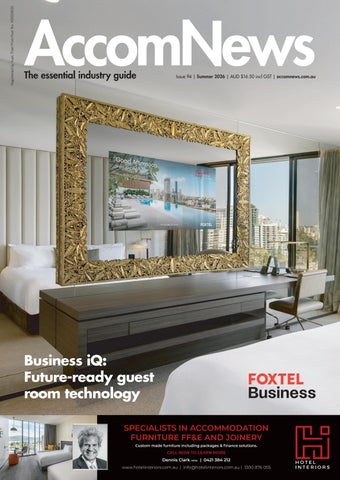
AccomNews, Summer 2026

Page 1


AccomNews is distributed quarterly to hotel, motel, resort and caravan parks throughout Australia by Multimedia Publications Pty Limited.

The views and images expressed in AccomNews do not necessarily reflect the views of the publisher. The information contained in AccomNews is intended to act as a guide only, the publisher, authors and editors expressly disclaim all liability for the results of action taken or not taken on the basis of information contained herein. We recommend professional advice is sought before making important business decisions.

Advertising Conditions

The publisher reserves the right to refuse to publish or to republish without any explanation for such action. The publisher, its employees and agents will endeavour to place and reproduce advertisements as requested but takes no responsibility for omission, delay, error in transmission, production deficiency, alteration of misplacement. The advertiser must notify the publisher of any errors as soon as they appear, otherwise the publisher accepts no responsibility for republishing such advertisements. If advertising copy does not arrive by the copy deadline the publisher reserves the right to repeat existing material.

Disclaimer

Any mention of a product, service or supplier in editorial is not indicative of any endorsement by the author, editor or publisher. Although the publisher, editor and authors do all they can to ensure accuracy in all editorial content, readers are advised to fact check for themselves, any opinion or statement made by a reporter, editor, columnist, contributor, interviewee, supplier or any other entity involved before making judgements or decisions based on the materials contained herein.

AccomNews its publisher, editor and sta , is not responsible for and does not accept liability for any damages, defamation or other consequences (including but not limited to revenue and/or profit loss) claimed to have occurred as the result of anything contained within this publication, to the extent permitted by law.

Advertisers and Advertising Agents warrant to the publisher that any advertising material placed is in no way an infringement of any copyright or other right and does not breach confidence, is not defamatory, libellous or unlawful, does not slander title, does not contain anything obscene or indecent and does not infringe the Consumer Guarantees Act or other laws, regulations or statutes. Moreover, advertisers or advertising agents agree to indemnify the publisher and its agents against any claims, demands, proceedings, damages, costs including legal costs or other costs or expenses properly incurred, penalties, judgements, occasioned to the publisher in consequence of any breach of the above warranties.

© 2026 Multimedia Publications Pty Limited. It is an infringement of copyright to reproduce in any way all or part of this publication without the written consent of the publisher.

10

PO Box 2652, New Farm, Qld 4005, Australia Phone: +61 (07) 5440 5322 mail@accomnews.com.au www.accomnews.com.au

EDITOR

Gemma Easton editor@accomnews.com.au

INDUSTRY REPORTERS

Sarah Davison, Naomii Seah and Milly Fullick

PRODUCTION

Richard McGill, production@accomnews.com.au

ADVERTISING

Stewart Shimmin, s.shimmin@accomnews.com.au

SERVICE/SUBSCRIPTIONS subscriptions@accomnews.com.au

CONTRIBUTORS

James Goodwin, Stephen Ferguson, Stuart Lamont, Peter Shelley, Kerry Williams, Dennis Tocknell and Chris de Closey.

Inside our Summer issue

Starting the year on a high

Happy new year and welcome to 2026— though it feels as though we are already well into the year!

As we go to print with the Summer edition of AccomNews, many of you will still be in the thick of a very busy trading time, with school holidays, international sporting events, touring musicians and other cultural events keeping accommodation in high demand.

As our industry-leading columnists discuss in these pages, the hospitality, tourism and accommodation sectors are performing well.

Caravan parks saw record December occupancy across all accommodation types in Australia, highlighting the strong domestic and international appetite for travel.

Accommodation Australia gave the accommodation sector an A- in its end-of-year report card. CEO James Goodwin said this was driven by international sporting and cultural events, world-class performers, and festivals, coupled with renewed confidence in business events and corporate travel.

Despite the growth and the recovery, which ATEC Managing Director Peter Shelley warns is even, rather than strong, a shortage of skilled workers

continues to impact some sectors across hospitality and accommodation. Policy reforms may be needed to correct some of these difficulties, and our industry leaders plan to advocate for this.

Essential for the smooth operation of your accommodation property is a strong housekeeping team.

Fortune Ezebuike, Housekeeping Manager at Hotel Indigo Litt le Collins and Holiday Inn Bourke Street, is working to inspire the next generation of housekeeping staff with patience, positivity, and passion. Honoured at the Accommodation Australia (Vic) Excellence Awards, I spoke to Fortune about how he became so passionate about housekeeping, what motivates him to achieve high standards, and the impact he hopes to have on his team and the housekeeping profession more broadly.

Also in this edition, we look at ways to embed green choices and sustainable practices into your property in authentic ways, rather than greenwashing or token gestures—refillable bathroom amenities, water dispensers and using biodegradable packaging are all useful measures. Your green plan could also include smarter energy solutions, which will save you money and protect the environment. We discuss this on page 60.

When you get a moment to relax, I hope you enjoy reading this edition of AccomNews And with temperatures around the country hitt ing 45 degrees and above as I write this, I hope you are all staying cool and hydrated.

Best wishes, Gemma Editor, AccomNews

Addressing the chef shortage

The Australian Hotels Association and Accommodation

Australia have really hit the ground running in 2026—we are now in the process of finalising pre-budget submissions, which will be handed down in May.

Of course, one of our key priorities will be the chronic shortage of skilled workers aff ecting the hospitality sector, including the need for apprentice incentives.

As many of you are all too aware, Australia’s hospitality industry is experiencing a critical shortage of chefs. SEEK currently lists 5246 chef vacancies and 4824 cook vacancies.

Many establishments rely on temporary skilled migrants to simply maintain kitchen operations. However, continued dependence on skilled migration is not a sustainable or complete solution in and of itself—especially given the current political climate.

Despite improvements in workplace conditions, including higher wages and stronger work health and safety regulations, the industry continues to struggle with high att rition rates and insufficient local chef training pipelines.

Over the past fi ve years there has been a reduction in chef apprentices in training of 26.1 percent, and a reduction in chef apprentice commencements of 50.1 percent.

Australia’s hospitality industry is experiencing a critical shortage of chefs

One of the largest barriers to increasing apprentice chef commencements is the cost to the employer in the first year. The costs of supervision, particularly in that first year —and in a sector which works 24/7—is a major barrier to employers committ ing to hiring an apprentice chef.

A new apprentice knows litt le about operations in the kitchen, their productive output is low and supervisory costs high— they are learning on the job so to speak.

These costs are even higher in hospitality due to the 24/7 nature of the industry and the rostering complexities of ensuring adequate supervision for the apprentice.

A stronger, incentivised apprenticeship model is essential to att ract and retain aspiring chefs, ensuring a skilled workforce which meets industry demand. By reducing the financial burden

on apprentices and providing targeted employer support, the federal government can improve retention rates, strengthen local employment and promote long-term industry growth.

Everyone wins.

The capacity of hospitality businesses to take on apprentice chefs was not helped by the government’s recent announcement that employer incentives in the first year for taking on an apprentice chef will reduce from $5000 to $2500. This is despite employers still being required to pay into the Skilling Australia Fund.

The AHA and AA are proposing to the government that the current incentives to both the employer and the apprentice be increased over the term of the apprenticeship to $15,000 for each, with the employer incentives concentrated on year one, where productivity of the apprentice is low and supervisory costs are high.

The proposed incentive structure would provide $15,000 each to the apprentice and employer over four years. For the employer, the weighting of the incentive would be weighted to $8000 over the first year, with the remaining $7000 over the remainder of the apprenticeship.

By adopting this structured financial incentive model, the government can help hospitality businesses increase apprentice chef commencements, reduce apprentice dropout rates, encourage more young Australians to pursue culinary careers, support industry growth while easing cost pressures on businesses, and reduce dependency on skilled migration.

It’s important to get this right, and the AHA (and AA) will be working hard this year on behalf of members down in Canberra to ensure we do all we can to ease the chronic worker shortage.

Hotel occupancy end of year report card: Strong A-

It’s good to report the accommodation sector is heading into 2026 in a lot better shape than it was a year ago.

Back then I recall hoping for good things for the sector when I penned this column, and I can report that the nation’s accommodation sector has scored an A- in Accommodation Australia’s hotel occupancy end-of-year report card.

Occupancy figures show an improved performance overall, with Perth leading the way followed by Sydney, Hobart and then Adelaide.

The report card shows strong figures across most capital cities.

A good mix of international sporting and cultural events, world class performers and festivals across the year definitely contributed to the results, as well as renewed confidence in business events and corporate travel.

The score would have been even higher if we had managed to see more international tourists throughout the year, with overseas arrivals still just below 2019 figures and extreme weather putt ing a dent in Gold Coast occupancy.

I must say the drive for the overseas dollar is certainly a focus in 2026 with hopes of a return to consistent, strong numbers throughout the year.

We start the year on a good note, with a record result for New Year's Eve in Sydney providing a sense of optimism heading into 2026.

But wait, as they say, there’s more.

The good news is almost all of Australia’s capital cities experienced an increase in average occupancy rates over 2025— with only Brisbane seeing a very slight fall of 0.6 percent and the Gold Coast down 2.8 percent.

The second half year performance also saw increases in the average daily rate to just over $230 with Sydney, Brisbane, Perth and Hobart all experiencing rises in line with inflation.

Adelaide scored particularly well too.

Adelaide’s strong second six months had it ending the year with a 5 percent increase in occupancy rates, only beaten by Sydney CBD which saw a 5.2 percent increase to an average of 83.6 percent for 2025.

It’s important to note the AA report card for 2025 also reveals the impact of outside events, like tours or weather on hotel room occupancy.

The Gold Coast and Brisbane

average occupancy for example did not completely recover the lost ground from the fall due to the cyclone in March— almost a year ago now.

That said, as the Chair of Accommodation Australia David Mansfield noted recently: “The sector has a positive outlook for the year ahead.”

David was spot on when he commented “there is a strong sense that we can improve demand by working together as a sector with governments and other tourism stakeholders for sustainable growth.”

I look forward to working closely with David and our Board throughout 2026 to deliver concrete results for our members in what we hope will be a great year.

Keep an eye out for Accommodation Australia releasing its next mid year-report card at the end of June 2026.

James Goodwin CEO of Accommodation Australia

Australia’s recovery is progressing but real growth needs support

As we head into 2026, Australia’s tourism recovery continues to strengthen, but the trajectory remains steadier than many had hoped.

The industry is not in decline, but it is also not yet on the kind of accelerated growth path needed to regain market share in an increasingly competitive global environment. The sentiment across ATEC member forums over the past six months is remarkably consistent— recovery is happening, but it is slow, uneven and heavily concentrated in a handful of markets and regions.

The even, rather than strong, growth profile reflects the reality that Australia is rebuilding in the face of structural barriers that didn’t exist ten years ago. International travel patterns have shifted, major competitor destinations have returned aggressively to market, and the cost pressures facing both travellers and tourism businesses are significantly higher. For Australia to compete, we must be highly visible, offer affordable access and be capable of delivering on a dream.

One of the most significant challenges sits with Tourism Australia (TA). The expense of global media marketing and its complexity has transformed the cost of destination marketing. In many of our key markets, particularly across North America, Europe and emerging

Recovery is happening, but it is slow, uneven and heavily concentrated

Asia, the cost of achieving the same reach and frequency that Australia enjoyed a decade ago has increased markedly. Maintaining visibility, let alone growing it, now requires a scale of investment that simply hasn’t kept pace with government investment. TA is still delivering exceptional work but is having to try and do more in more markets, using dollars that have less impact each year.

The same challenge is being felt across industry businesses. For operators and ITOs, the cost of trade engagement, attendance at global trade events,

marketing and reconnecting with distribution networks has risen sharply for all businesses, particularly in regional Australia, finding the cost of re-entering global distribution almost prohibitive. Without sustained trade activity, Australia loses not only immediate bookings but long-term relationships that underpin yield, dispersal and inbound tourism growth.

Encouragingly, demand signals are improving with forward bookings strengthening and sentiment growing, while the recovery of inbound aviation capacity is gradually expanding

competitiveness. There is every indication that Australia’s brand remains strong globally, but that momentum alone will not carry us into a new phase of growth.

This is where modest, strategic investment can shift the trajectory. Ensuring TA can maintain competitive visibility; reducing friction in the visa system; rebuilding distribution channels; and supporting industry capability, including the growth of Aboriginal and Torres Strait Islander tourism, are all critical components of a modern export tourism strategy. These measures are not large, but they can be powerful.

The recovery to date shows what the industry can achieve when returning from a devastating setback. With the support of settings that fully engage growth, Australia can move from slow recovery to strong, sustainable expansion, which we know delivers benefits not just for tourism businesses but for the many regional community economies that rely on them.

Welcome everyone, lose no one:

The business case for inclusion training

The welcome at check-in, the tone on the phone, and the calm competence when something unexpected pops up.

For accommodation operators, the case for inclusion training is both human and commercial. Tourism Research Australia research cited by ATDW shows travellers with accessibility requirements accounted for 70.5 million trips and $29.2 billion in visitor spend in the last year, around 22 percent of all trips in Australia. That’s not a niche; it’s a core market you’re already hosting. Yet many guest frustrations aren’t about ramps or room dimensions: they’re about moments:

• A staff member who panics when a guest discloses an assistance animal and asks about where it can go.

• A reservation agent who can’t describe an accessible room clearly.

Many guest frustrations aren’t about ramps or room dimensions: they’re about moments

• A well-meaning team member who makes assumptions, uses clumsy language, or speaks to a companion instead of the guest with a disability, assuming they are non-verbal.

From real guest experiences:

"The reservations lady said, 'We only have normal rooms available.' It stung. I am normal, I just need an accessible room."

"Why do staff always think they need to talk loudly to me? I am blind, but I can hear just fine."

"I used accessible parking, but staff questioned why I needed it. MS means some days I can walk, other days I cannot. Having to explain myself was humiliating."

Training turns “I’m not sure what to do” into confident, consistent service. For your team, that means practical skills such as asking the right questions, off ering options (not opinions), and problem-solving quickly without making the guest feel like the problem.

It also means widening the lens beyond disability. Inclusion includes marginalised

communities such as LGBTIQ+ travellers, where safety and belonging can shape choices—from booking to breakfast. Welcome With Pride positions training as the first step to credible inclusion, requiring hosts to build staff capability in inclusive language and understanding LGBTIQ+ experiences (so it’s not “pink washing”).

Crucially, demand from operators has made one thing clear: businesses want true, practical training written for real-world accommodation sett ings—not generic content.

In response, Welcome With Pride and Accessible Accommodation launched an online accessibility and LGBTIQ+ inclusion training program, written specifically for accommodation operators and designed to translate inclusion into everyday service behaviours across reservations, front office, housekeeping, and management.

The program draws on realworld feedback from their audiences and translates it into on-the-floor behaviours—so

inclusion isn’t theoretical; it’s operational. If you need a measurable reason to act, tourism-specific learning data is hard to ignore. That program notes that 21.4 percent of Australians live with disability (and 19 percent of the New Zealand population) and reports that 88 percent of LGBTIQ+ travellers and 75 percent of disability travellers say staff training is essential.

ATEC’s Accessible and Inclusive Host program is a three-module pathway designed to upskill operators to welcome guests from all backgrounds and abilities. Regional and state tourism organisations are also blunt about the priority: “staff training” sits at the top of accessible tourism toolkits— alongside clear communication and digital accessibility, such as Tourism North-East’s toolkits.

If you’re deciding where to start, aim for fi ve outcomes: fewer service failures, faster problem-solving, clearer prearrival information, consistent welcomes across all staff encounters, and a stronger reputation with high-value segments that reward genuine inclusion with loyalty.

Inclusion training protects your brand, boosts revenue, and builds culture and staff confidence. Most importantly, it’s how you make sure every guest experience matches the promise on your website—no matter who walks through the door.

Packed parks:

Unprecedented December demand

December 2025 was a landmark month for Australian caravan holiday parks.

New data from our association shows record December occupancy across all accommodation types, highlighting just how popular caravan holiday parks have become.

In December 2025:

• National cabin occupancy hit a record 64 percent, up one percentage point on December 2024.

• Powered site occupancy rose to 49 percent, up two points year-on-year, while unpowered sites reached 26 percent occupancy— both December highs.

• Regionally, the Gold Coast led cabin occupancy at 87 percent, followed by the Sunshine Coast (83 percent) and NSW Central Coast (80 percent). Perth recorded the highest powered site occupancy at 85 percent, ahead of the Sunshine Coast and Gold Coast (both 77 percent).

The December quarter of 2025 (three months to December 31) also set new Q4 benchmarks across all categories, with national cabin occupancy averaging 67 percent, up three

points from the previous year.

These numbers aren’t just statistics—they’re evidence of the growing appetite among Australians for caravanning and camping experiences that connect them to our unique landscapes and communities.

A major driver of this surge has been our Road to a Million campaign, launched in early October 2025. Promoting nearly 1300 caravan holiday parks nationwide, the

campaign offers a simple but powerful incentive—every night stayed in a participating park earns an entry into the draw to play for $1 million.

The further you travel, the more entries you receive, encouraging caravanning consumers to enjoy the delights of a caravanning and camping holiday while pumping money into regional communities.

So far, more than 74,000 Australians have entered

Road to a Million, generating over 400,000 booked nights and strengthening longterm engagement with the camping lifestyle.

Real-time survey results show the campaign’s impact, with over 60 percent of entrants saying it put caravanning and camping front of mind. Over 35 percent said it influenced them to choose caravan holiday parks over hotels or apartments, while one in five said they would pick camping instead of an overseas holiday. Families like Tania Mitchell’s are at the heart of the story.

“Caravanning has given our family the chance to spend quality time together and explore parts of Australia we’d never otherwise see,” Tania explained.

“It’s great to see campaigns like Road to a Million getting more families out on the road and supporting regional communities.”

While the grand prize certainly grabs attention, Road to a Million is really about reacquainting Australians with a holiday activity that is quintessentially Australian, creating lasting memories and supporting regional economies in the process.

As CEO of the peak national body, I couldn’t be prouder of our industry.

The December records and ongoing engagement with Road to a Million highlight not only the strength of caravanning and camping but also its role in shaping how Australians holiday and explore their own backyard.

The data referenced in this column was first published in Caravan Industry Association of Australia’s Accommodation Insights – December 2025 report.

Stuart Lamont CEO, Caravan Industry Association of Australia
The Mitchell family with Sam Mac as part of Road to a Million's hero activation with the Seven Network’s Sunrise program. Image supplied.

Business iQ continues to evolve: Foxtel announces new agreement

After nearly 20 years at Foxtel, Scott Wiedemann has witnessed the transformation of in-room entertainment from pay-TV to fully integrated digital guest platforms. As National Manager – Accommodation, he is now leading the next phase of that evolution through major upgrades to the Business iQ platform and an exciting new partnership.

Mr Wiedemann says the future is about personalisation, connectivity and creating meaningful revenue opportunities for accommodation operators, speaking exclusively with AccomNews about the roadmap for Business iQ and the new collaboration with eero, an Amazon company.

Foxtel has been steadily evolving Business iQ. What major improvements have been made to the platform over the past year?

Over the past 12 months, our product team has been enormously productive delivering 100+ enhancements to Business iQ over two stages. Our first phase released in September provided more personalised On-Demand experiences, additional 4K content, enhanced security, wifi 6e support and automated fallback to IP during satellite rain-fade ensuring greater performance.

The second phase, arriving early in the new year, will deliver several high-impact improvements including embedded Hotel

It has taught us as a business to be agile and to continually innovate

Loyalty Apps, video promos on the welcome screen, QR code engagement analytics, centralised content management across multiple properties and an AI-powered chatbot for self-troubleshooting.

Complementing the new features, we have created a Business Class Support Team to assist sites with the set up and ongoing management of their digital concierge and compendiums to fully leverage the platform, optimise the guest experience and maximise revenue generation opportunities.

Speaking of Business iQ’s evolution, what can you tell us about the future roadmap?

2026 will see us elevate our product development to deliver Business iQ as an app-based soft ware solution. In response to increasing uncertainty in hardware solutions and with Chromecast approaching

end of life, we are excited to transition towards a truly future-proof soft ware-led platform. This will significantly reduce reliance on expensive cabling, eliminate multiple hardware points of failure and vastly reduce installation times.

We are actively collaborating with a number of technology partners to ensure compatibility across many leading television brands.

Also planned are expanded content, sustainability improvements, deeper partnerships for greater cohesive operations and additional revenue generating streams. Our continued growth enables ongoing reinvestment, ensuring Business iQ continues to evolve and remain as Australia’s leading in-room entertainment and technology platform.

Scott Wiedemann

Foxtel is also announcing a new agreement with eero, an Amazon company. Can you tell us about this collaboration?

Foxtel has finalised an exciting agreement with eero, an Amazon company, to deliver commercial grade wifi solutions to our accommodation subscribers. eero has an impeccable global reputation in delivering wifi via their proprietary TrueMesh™ technology across 24 countries, we couldn’t be prouder working with such a formidable team.

The agreement with eero strongly aligns with our long-term strategy of delivering reliable, simple and secure wifi infrastructure to our subscribers.

Bundled with our Business iQ platform, it will provide a leading and allencompassing technology solution for our commercial customers.

The agreement will be multilayered with further exciting announcements coming soon.

What are the key benefits of the collaboration with eero for guests, and what advantages will operators see on their side?

eero, an Amazon company, will be offered alongside our Business iQ technology to deliver exceptional mesh networks for commercial environments. Importantly, there will be options available with no

upfront costs enabling hotels to deploy Business iQ with eero’s wifi hardware. eero meets the highest quality standards and operates with seamless connectivity to provide a fast and reliable network even under heavy demand. eero TrueRoam technology provides uninterrupted connectivity as guests move throughout the property providing a consistent superior guest experience.

Additionally, every eero device comes with world-class encryption, security protocols and unmatched testing to ensure enterprise grade security and reliability.

You’ve overseen major developments in your role. What achievement has been most rewarding for you?

During my 18+ years at Foxtel, there has certainly been significant change. But with constant change comes adaptability. It has taught us as a business to be agile and to continually innovate, but in a considered and disciplined way.

Many companies have entered and exited the market over the years, and with Foxtel celebrating our 30-year anniversary in 2025, we have endured and flourished through several eras of technology. I think in a moment of reflection of the journey, that is a key reminder.

And now to be under an exciting global ownership of DAZN and forming agreements with leading global brands like eero, Foxtel is well-positioned for an exhilarating and truly limitless future.

Here’s how it works:

Add your own channels

Diversity, sustainability and a long-term Sunshine Coast legacy

Visitors to the Sunshine Coast are spoiled for choice when planning how to fill their days— shimmering waters on the pristine beaches, and the rich, lush bushland of the hinterland are both within easy reach.

Perfectly placed to capitalise on this is Sixty6 Acres. As the name suggests, the property

is set on 66 picturesque acres in Woombye, halfway between the bush and the sea. Blending farm life and a range of accommodation options, the property offers the ultimate rural-luxe experience.

Andrew and Jo Pitcher are the property owners, and Woombye locals. “The vision was always about creating an amazing destination close to the beaches of the Sunshine Coast, that combined quality accommodation, livestock,

and fresh produce, anchored in a game changing hospitality offering,” Andrew said.

The couple purchased the property 13 years ago. At the time, it was a run-down cane farm. Hard work, and a clear vision have helped bring the property back to life. Now Sixty6 Acres boasts a mix of luxury cottages, and 93 large, powered sites, along with crops including sugar cane, pineapples, strawberries and citrus, and a stable of furry friends like

sheep, miniature English donkeys, and chickens. Horses also agist on the property.

Complementing the accommodation and scenic surrounds, is The Farmhouse Restaurant and Bar, showcasing local produce, businesses and brewers. Seven outdoor magnesium plunge pools offer guests the perfect place to relax. All of the property’s facilities are for the exclusive use of Sixty6 Acres’ guests, keeping the space private.

Images courtesy of Sixty6 Acres

Having a long association with the region, Andrew and Jo were eager to provide an exceptional experience for their guests, while honouring the property’s past and ensuring its legacy.

“This is home for us,” Andrew said. “We both grew up within four kilometres of Sixty6 Acres. We believe in the region, we believe in the growth prospects, and we believe in the local produce.”

An experience destination

Andrew and Jo made a deliberate decision to make Sixty6 Acres more than just accommodation. “Guests are looking for experiences rather than just somewhere to stay. That means they are looking for destinations to stay at—expectations are really high. That’s why we have accommodation, farm experiences, recreation facilities and hospitality combined into one great guest experience.”

Agritourism has helped Andrew and Jo introduce extra income streams to help support the business. “Diversification is very important for increasing the share of wallet you are taking from each guest,” Andrew said. “We’re always looking for more opportunities.

“At the moment, we generate income from accommodation, hospitality, crops, the farm shop and animal agistment. But the absolute key to our viability is the accommodation revenue.”

This means blending different activities and opportunities, and appealing to a broad range of holiday makers is vital. The recent addition of 93 powered sites and heated magnesium pools were part of the property’s master plan, in line with ensuring Sixty6 Acres continues its

growth and prosperity. “The pools are part of our leisure and wellness activities, which we will expand over time. They have been fantastically well received. The powered sites open up our farm to a much wider audience and range of budgets, and allow us to deliver accommodation that is very much self-service.

“We now have a much broader guest base than before. It does mean that some activities need more supervision and the risk of damage is higher, but we

are aware of that. We have had to add to our ‘rules of entry’ to ensure the property remains in great condition, which is nonnegotiable from our perspective.”

Sustainability as a focus

Andrew and Jo take their roles as stewards of Sixty6 Acres’ land and the surrounding landscape seriously. Sustainability is embedded into their culture and work ethos, and is always a key objective, during daily operations as well as during expansions and future planning.

Images courtesy of Sixty6 Acres

“We use solar energy, we treat our own wastewater onsite, we are on tank water, and we irrigate from our own springfed lake. We have significantly re-greened the property as well, revegetated a five-metre buffer along our creek line, removed weed species and planted more than 25,000 trees.

“We would argue that the property is significantly enhanced with the use we are making of it, and will continue to improve. The species of bird life that we

have attracted back to the property has increased 10-fold.”

Looking ahead

On the long-term legacy of Sixty6 Acres, Andrew hopes the property and the business will benefit the whole region. “I want us to be an innovative contributor to the local economy, building scale over time, and working closely in partnership with other tourism businesses.

“We would also like to be seen

as a leader in agritourism nationally, helping to keep the Sunshine Coast on the map.”

Reflecting on lessons learnt during their time at Sixty6 Acres, Andrew said it is important to remember that not every guest comes to a property or holiday destination looking for the same thing. “Some are interested in agriculture, some the hospitality, some in recreation, and some just want to chill out in their accommodation. And there are some that want to experience all of it!”

There are plans for further expansion at the property, though Andrew said nothing is slated for the near future.

“While we add to our guest experience over time, we believe that a ‘flight to quality’ is underway, and we aim to differentiate on that.

“We don’t focus on price — instead we focus on the quality of what we offer, and we are blessed to be located in the centre of the beautiful Sunshine Coast.”

Images courtesy of Sixty6 Acres

Augusta Golf Cars leading the way in eco-friendly transport solutions

For more than two decades, Augusta Golf Cars has been at the forefront of innovation in light transportation, redefining how businesses and communities move.

With a steadfast commitment to research and development, the company has continually sought the most environmentally friendly and cost-e ective ways to deliver alternate transport options. This dedication has positioned Augusta Golf Cars as a trusted partner for organisations striving to meet their environmental and operational goals.

At the heart of Augusta Golf Cars’ philosophy lies a simple yet powerful idea: vehicles should be fi t for purpose. Whether it’s a resort needing e cient sta transport, a retirement village requiring quiet, reliable passenger carriage, or a factory seeking durable utility vehicles, Augusta Golf Cars ensures every model is “fi t for purpose.” This focus on tailored solutions has driven the company’s success and earned it a reputation for excellence across multiple industries.

Today, Augusta Golf Cars proudly serves a diverse commercial portfolio that includes retirement villages, airports, factories, holiday parks, and hotels. Each sector presents unique challenges, and Augusta Golf Cars meets them with an extensive range of vehicles and accessories designed to perform in any environment.

From the world-renowned E-Z-GO and Cushman brands to the innovative Lion and Atlas models, the company o ers a comprehensive selection that caters to every need.

Complementing these vehicles are high-quality parts and accessories from trusted names such as Pace Technology, Nivel, and Roy Pow,

ensuring customers receive complete, reliable solutions from one source.

Innovation has always been the driving force behind Augusta Golf Cars, and the company continues to push boundaries with its latest advancements in sustainable technology. Recognising the growing importance of environmental responsibility, Augusta Golf Cars has developed a solar powered system to complement the eco-friendly lithium ba ery systems it already o ers, representing continual leaps forward in the segment. Solar allows customers to harness renewable energy, reducing both operational costs and carbon footprints. For park management teams and environmentally conscious businesses, this innovation provides a practical way to align daily operations with sustainability objectives.

Augusta Golf Cars’ technical team has been instrumental in introducing lithium technology to the Australian

market, leading the transition with the E-Z-GO Elite range of vehicles. Their deep understanding of lithium systems has paved the way for further advancements, including the development of solar solutions tailored to the needs of energyconscious clients. This combination of experience and forward-thinking design ensures that every Augusta Golf Cars product delivers superior performance, e ciency, and longevity.

Luke Orton, Park Manager at Ingenia Middle Rock Holidays said: “In September 2025, Ingenia Holidays Middle Rock in One Mile, NSW, invested in two solarpowered Augusta Golf Cars to enhance operational e ciency and sustainability. Since their arrival, these vehicles have operated exclusively on solar energy, eliminating the need for mains charging and significantly reducing environmental impact. The Augusta Golf Cars have proven to be exceptional in both quality and functionality, delivering reliable

performance across the park’s daily operations. Sta feedback has been overwhelmingly positive, with team members praising the ease of use, durability, and innovative design. This initiative refl ects our commitment to adopting ecofriendly solutions while maintaining high standards of service and convenience for our guests and sta .”

Beyond technology, Augusta Golf Cars is defined by its commitment to customer satisfaction. Our team understands that choosing the right vehicle can be a complex decision, especially with so many options available. That’s why Augusta Golf Cars provides expert guidance and personalised service, helping clients identify the best solutions for their specific requirements. Whether it’s a single vehicle or a fl eet, customers can trust that every Augusta Golf Cars product is backed by quality, reliability, and ongoing support.

As the demand for sustainable transport continues to grow, Augusta Golf Cars remains dedicated to leading the industry with innovation, integrity, and environmental awareness. The company’s vision extends beyond simply selling vehicles—it’s about creating smarter, cleaner, and more e cient ways to move people and goods. With over 20 years of experience, a proven track record of technological leadership, and a passion for sustainability, Augusta Golf Cars stands as the clear choice for businesses seeking to modernise their transport solutions.

For those searching for the perfect balance of performance, sustainability, and value, the answer is clear. Augusta Golf Cars continues to set the standard for environmentally responsible mobility, o ering vehicles and technologies that not only meet today’s needs but also pave the way for a greener tomorrow.

Lion Solar Carrymax at Ingenia One Mile. Image courtesy of Augusta Golf Cars Pty Ltd.

Going green for a gold-star

As climate change continues to make headlines, sustainability remains top of mind for both accommodation providers and guests.

In 2023, Chief Executive of Ecotourism Australia, Elissa Keenan, said “sustainability is no longer recognised as a unique selling point, but a minimum standard expected of accommodation.”

In Australia, state and federal laws and regulations mean hospitality businesses must take certain measures to protect the environment. But beyond these minimum requirements, accommodation providers can also earn best practice certifications with relevant industry bodies.

Not only do these certifications ensure accommodation providers are meeting environmental and sustainability goals, but they are also a visible way to assure customers of the accommodation’s green standards.

Prioritising sustainability is important in today’s market. In 2023, a study from the World Travel & Tourism Council (WTTC), Trip.com Group, and

Deloitte found that 69 percent of travellers are looking for sustainable accommodation options. This is backed up by a 2024 YouGov survey which found more than two in five Australians would spend more for an eco-friendly hotel.

As an accommodation provider, minimising environmental impact makes sense from multiple perspectives. Not only are providers doing good for the planet, sustainable solutions could also enhance guest experience and improve satisfaction, strengthen brand identity and reputation, and even reduce operational costs by implementing energy efficient systems.

If sustainability is a goal or a value that is incorporated into an accommodation provider’s brand, then providers should take meaningful action to implement sustainable practices throughout all systems and processes, including at the guest interface. This ensures that guest experience aligns with the brand identity, strengthening trust, loyalty, satisfaction and reputation.

Making sustainable goals and values visibly reinforces brand identity for the guest, and helps to assure guests that sustainability is a core value that is integrated into operations.

So how should providers ensure that sustainable practices are

visible to guests? One easy and high impact way is to incorporate sustainable practices into guestrooms and amenities.

Reuse, refill, recycle

The accommodation industry can produce a lot of waste, especially when guest amenities are composed of, or wrapped in, single-use plastics. Once upon a time there was little alternative for providers, but now there are a wealth of refillable, reusable and biodegradable solutions.

Amy Fernance, National Sales & Operations Manager, Tri Nature said: “With guests increasingly looking for sustainable and eco-friendly practices, hospitality providers can no longer rely on traditional toiletries and amenities in single-use plastic packaging to meet their guests’ expectations. Instead, providers need to seek eco-alternatives while still providing high quality and maintaining brand image.

“Eco-friendly amenities that are biodegradable, grey water and septic tank safe (less pollution), with recyclable and reusable packaging (less waste), and made with sustainable materials not only improve provider sustainability but also enhance the guest experience by aligning with guests’ environmental values, helping to boost the accommodation’s appeal.” P22

Image courtesy of Tri Nature

Rolling ahead with smarter hotel trolleys

As hotels look ahead, many are reflecting on the assets that quietly support daily operations. Hotel trolleys and carts, long viewed as purely functional, are increasingly recognised as essential contributors to service efficiency, staff wellbeing and the overall guest experience.

In modern hospitality environments, mobile equipment is expected to do more than ever.

Quiet, smooth-rolling wheels, durable construction and well-considered layouts allow teams to move e ciently through high-occupancy periods, while refined finishes ensure backof-house activity sits comfortably alongside guest-facing spaces.

The right trolley can reduce manual strain, improve room turnover

times and bring a sense of order to even the busiest shi s.

Locally designed solutions, built to perform

On home soil, Wagen continues to lead with locally designed hospitality trolleys that support a wide range of operational needs, from housekeeping and luggage handling to food service applications. Known for their strength, reliability and adaptability, Wagen trolleys are built to perform in demanding hotel

environments while maintaining a polished, considered appearance.

Global innovation setting new benchmarks

Internationally, brands such as Ascolia are also se ing new benchmarks, o ering design-led, highly engineered trolley solutions developed to support modern hotel workflows.

With a strong focus on ergonomics, durability, sustainability and mobility, these solutions reflect a broader shi towards smarter, more considered operational design.

Supporting teams into the future

With sta wellbeing, e ciency and retention firmly in focus across the industry, upgrading tired or outdated trolleys is increasingly viewed as a practical way to support teams and improve daily operational flow.

As hotels plan for the year ahead, now is an ideal time to consider whether existing equipment is truly keeping pace with the demands of modern service.

Hyde Melbourne Place Wagen Bellboy Trolley.
Ascolia Housekeeping Cart. Images courtesy of Swisstrade

P20

Refillable amenities are an easy, practical and convenient way to progress on sustainability goals by reducing waste. Many providers offer dispensing solutions such as bottles in lockable wall brackets, or permanent wall-mounted dispensers.

As a bonus, these bottles and dispensers can enhance the look of bathroom interiors and may represent long-term savings as refills can be bought in bulk. Additionally, larger dispensers mean fewer refills or restocks needed between guests, saving operational and personnel costs.

Providers should also consider the ingredients of bathroom supplies, as well as their origin. Locally made products may potentially have a lower carbon footprint due to lowered travel and shipping emissions. Ingredients should also be sustainably used and managed as renewable resources.

There are also sustainable options available for other amenities such as toothbrushes, combs, and shower caps. Plastic is no longer the default— packaging and products can be made from biodegradable materials like paper, bamboo and cellulose. Reusable amenities provide guests with a souvenir of their stay as well as reducing waste.

Jenna Szymanski, Head of Sales & Marketing at Swisstrade noted: “We’re now at a point where almost every guest touch point in a hotel room has a

credible alternative to singleuse plastics. In bathrooms, compostable accessories in FSC-certified packaging and fully recyclable dispensers are becoming standard, offering a cleaner and more responsible approach without compromising the look or feel of the space.”

Ms Fernance added there are many ways to reduce plastic waste, including refillable dispensers for liquids, using products with paper or compostable packaging and selecting sustainable materials, for example, bamboo toothbrushes.

“When selecting between these options, providers should consider factors like Australian made, quality, cost, guest satisfaction, environmental impact, and ease of implementation.

“For example, implementing a refillable dispenser system for liquid toiletries, like shampoo and body wash, will significantly reduce single-use plastic waste and can be very economical. Refillable dispensers also have higher guest satisfaction compared to other options like soap bars but may require a little more effort as staff will need to refill the bottles.

“Ultimately, taking a balanced approach, combining convenience and sustainability, ensures a positive experience for both guests and the planet.”

Waste-less water

Filtered water dispensers are quickly becoming a popular

feature in guestrooms, and make a great pairing with reusable amenities like drink bottles. Including thoughtfully crafted and durable drinkware can be a nice touch, while reducing single-use plastic bottles and elevating the guest experience.

Plumbed still- and sparklingwater systems both add value to guests’ stay and help further sustainability goals by encouraging the use of refillable water bottles.

Bradly Stephenson, Business Development Director at Civiq said that plumbed-in systems can elevate the guest experience by showing care, convenience and quality.

“Guests enjoy access to fresh, filtered water, eliminating the need for single-use plastics. At the same time, providers can reduce operating costs, minimise waste, and support broader ESG commitments.”

Refillable drinking stations are also a valuable amenity to include in shared guest areas, such as lounges, waiting areas, spas, pools and gyms. Plumbedin systems eliminate the need for clunky plastic refills, which can save costs in the long term, and reduce the use of plastic.

“As a bonus, plumbed-in systems can look infinitely sleeker, and are less obtrusive than bulky plastic refills," Mr Stephenson said.

“Offering refillable drinking stations with built in fountains in key areas can also cut down a surprising amount of waste, as traditional water cooler

systems with disposable cups attached can encourage singleuse consumption patterns. Eliminating the option completely can align with sustainability goals, improve the aesthetic of shared spaces, reduce operating costs, and the volume of rubbish going to landfill.”

Mr Stephenson noted that refillable water stations meet a growing expectation for visible sustainability.

“According to Booking.com, 76 percent of travellers want to see sustainable practices in action. A single station can displace over 30,000 plastic bottles annually, reducing waste and labour.”

Lobbies and fitness centres see the highest usage based on installation data, as they are spaces where guests naturally pause and often need hydration, added Mr Stephenson.

“Additional high-impact placements include pool decks and conference breakouts, where usage spikes and bottled alternatives are common.

“Effective placement means meeting guests at their moment of need without disrupting their experience.”

When considering available models, Mr Stephenson recommends looking for “touch-free activation, built in filtration, and antimicrobial materials. These features improve hygiene and user experience.

“It's also important to choose a design that complements the space and can be maintained easily by staff.

“A good hydration station doesn't just meet functional needs, it reflects a property's overall commitment to health, comfort and sustainability.”

Sustainability at every turn

Guestrooms can have other sustainable features apart from amenities, such as environmentally friendly bedding. Mattresses made from renewable and biodegradable materials, and manufactured in sustainable ways, can bolster the guest experience and provide unparalleled comfort. There are also many sustainable options for pillows and sheets to align with brand goals and values.

Image courtesy of Swisstrade

Accommodation providers looking for premium options with a sustainable focus can also find luxe materials made from renewable, energy efficient materials such as linen. Technological improvements in manufacturing processes mean affordable recycled options are available too, such as recycled and reclaimed polyester.

Ms Szymanski said that certifications remain the most reliable way for accommodation providers to assess the sustainability of bedding. They offer clarity on fibre integrity, environmental impact and the manufacturing processes behind each product. But materials matter, too.

"Organic cotton, linen and bamboo viscose offer lowerimpact alternatives to conventional textiles, while recycled-fibre fills help reduce reliance on virgin polyester in duvets and pillows. Production methods such as reduced water usage, low-impact dyes and closed-loop manufacturing all contribute to a more responsible final product.”

Ms Szymanski added durability

should also be considered, as high-quality bedding often lasts longer and reduces waste.

"End-of-life considerations, such as recyclability or compostability, help hotels minimise their overall environmental footprint. These attributes give operators a clear framework for selecting bedding that supports both guest comfort and responsible environmental practice.”

Beyond the bed, sustainability can extend to every corner of the guestroom, said Ms Szymanski.

“Across the minibar and wardrobe, operators are turning to lowwattage appliances, filtered water dispensers instead of plastic bottles, responsibly sourced tea and coffee formats, compostable slippers and robes made from recycled fibres. Many properties are also paying

closer attention to the smaller details; switching to wooden key cards and wooden coat hangers, and replacing traditional plastic-based items with more sustainable alternatives wherever possible," she said.

“These small but considered choices help create guest environments that feel modern, intentional and environmentally conscious.”

Image courtesy of Civiq

The minibar is dying. Is your profit dying with it?

The humble minibar used to be a quiet little earner. Now it feels more like a complaint generator.

Guests walk in with a reusable bottle in hand. They see the $6 plastic bottle in the fridge, roll their eyes and later share the story in reviews.

Recent research from Booking. com shows that many Australian travellers care about travelling more sustainably and want to see real action from hotels, not just words.

When water looks wasteful or overpriced, they notice. At the same time, your costs keep climbing.

Bottled water takes up storage space, housekeeping time and bin space. You pay to bring plastic in. You pay again to get it out.

Policy is shifting, too. The National Plastics Plan and Australia’s 2025 packaging targets both push businesses away from unnecessary single-use plastic and toward reusable or recyclable options.

NSW’s Plastics Plan 2.0 adds extra pressure, with new reuse rules that pull cafes, bars and hotels into refill and return systems over the next few years.

That leaves you with a product that:

1. Annoys guests

2. Eats time and storage

3. Adds plastic to your waste numbers

4. Sits in the path of current and future bans

It does not have to stay this way. Our accommodation experts know you are not stuck with this model. Here is how refill stations turn minibar water from a headache into an upgrade that cuts plastic and saves time.

Why water breaks the old minibar model

Water is the easiest part of the minibar to change. Guests need it from the moment they arrive, and they use it all day.

Most now bring their own bottle and expect to refill it at no extra cost in the hotel. A marked up plastic bottle in a fridge feels out of touch with that habit.

Water also drives a lot of plastic and handling. Every bottle has to be bought, stored, moved, chilled and thrown out. Each step costs money and staff effort.

Switching to a refill first approach removes the minibar item guests like least. It also removes the one that costs you the most time and plastic.

A modern refill station on a guest floor or in a shared space becomes a simple, visible action that a plastic bottle cannot match.

How refill stations fit your hotel

Refill stations do more than swap out a bottle. They reshape how water works for guests, staff and your brand.

Smooth guest hydration

Many guests now travel with their own bottle and already think about waste.

When they see a clear refill point in a handy spot, water feels like part of the welcome, not a trick in the fridge.

Topping up becomes quick, regular and straightforward instead of a reason to complain.

Design that fits your space

You put care into how your spaces look. Plastic bottles and bulky coolers pull attention away from that work. Modern refill stations sit within walls or joinery. Corridors and lobbies stay open, calm and consistent with your interior design. The hydration point feels like it belongs there.

Easy for every guest

Water should work for everyone who checks in.

Refill points at a comfortable height make it easier for more guests to fill their bottles, including families and guests using mobility aids.

Clear, open refill areas also cut down on spills and awkward bending into low fridges. Small wins that feel big in a busy day.

In tune with guest flow

Guests move in steady patterns. Room to lift. Lift to lobby. Lobby to street, gym or meeting room.

Placed near lifts or shared spaces, refill stations sit on paths guests already use.

Topping up becomes a quick pause on the way past, not another task or a call to the front desk for more bottles.

Lighter load for your team

Behind the scenes, bottles mean pallets, boxes, stocktakes and extra bins. Every step takes time and space.

Refill stations move that effort to simple wiping, quick checks and planned filter changes. Staff lift less, track less and spend more time on service that guests actually notice.

Your plastic story on show

Refill stations turn plastic reduction from a line on a website into something guests can see and use. They notice the station each time they fill a bottle. Many stations also show the estimated number of bottles saved, so people can watch the impact grow over time. Your message about cutting waste starts to feel real at every refill.

Ready to rethink minibar water

Minibar water feels small, yet it touches your reviews, your costs, your staff and your plastic targets every single day.

Modern refill stations give you a simple way to move with your guests, with policy and with your own brand promise.

If you would like to see what this could look like in your hotel, you can talk to our team at Civiq. We help accommodation providers replace plastic bottled water with refill points that work for guests, spaces and budgets.

Small Touches, Big Impact:

Elevating guest experience through pamper packs

Hospitality is changing — and fast. Guests are no longer satisfied with simply having a clean room, working Wi-Fi and crisp bed linen. They want to feel something. Comfort. Care. A moment of pause. A sense of being looked after, not processed. In an industry where rooms often look similar, the properties winning hearts are the ones delivering emotional experience, not just accommodation.

This is where Hotel Products Direct, founded by Andrew and Judy Kloester, has carved out a quiet but powerful niche. What began as a supplier of traditional hotel necessities has evolved into a business shaping one of hospitality’s most influential new trends: guest indulgence through Pamper Packs.

From boutique hotels to coastal cabins, serviced apartments and B&Bs, operators are turning to small luxuries to leave lasting impressions — and HPD’s pamperpack range is leading that movement.

Why pamper packs work: The psychology of feeling welcomed

Picture a late-arriving guest — tired, stiff, perhaps frustrated from travel delays or long travels. They unlock the door expecting the basics. Instead, they find something gentle: a neatly presented pamper pack waiting beside the basin or bath. Inside, bath salts and body lotion encourage relaxation. A fragrant soap hints at something special. A face or foot mask promises recovery.

It is a moment that requires no words. Hospitality is delivered silently. That emotional shift — from routine stay to cared-for experience — is where pamper packs create value. A gesture costing only a few dollars can feel like a premium upgrade, because hospitality is measured not by price, but by how it feels.

Cleaning Pack is one of the most popular packs for short stays – with kitchen and bathroom cleaning.

A range built for atmosphere, identity and personal connection

Just as no two properties are identical, HPD’s pamper packs are not one-style-fits-all. The Kloesters have built a collection with sensory personality — allowing operators to match amenities to the mood of their brand choice.

• Ancient Earth — classic Verbena extract.

• Saville Row White Gardenia — refined, luxurious, elegantly understated.

• The Beach House — summery, relaxed, coastal holiday energy.

• ECO Harmonie — biodegradable and aligned with environmentally conscious operators.

These varieties allow a rainforest lodge to offer natural calm, a penthouse suite to lean into sophistication, a seaside Airbnb to deliver light breezy notes, and a country retreat to nurture guests with a slow-living feel.

Andrew and Judy ensured one more key factor: accessibility. Packs are affordable, compact, easy to store — and available in practical quantities.

Boutique operators, motels and short-stay hosts can now offer boutique-style indulgence without luxury-hotel procurement costs.

Not just amenity — an opportunity

For accommodation providers, the benefits extend well beyond presentation.

• Experience turns into reviews

Guests often photograph or mention pamper packs in feedback — and reviews drive bookings.

• A new revenue stream

Many venues upsell pamper packs as minibar items, upgrade bundles or retail gifts.

• Operational efficiency

Pre-packed units save housekeeping labour and ensure room-to-room consistency.

• Brand identity is strengthened

Properties offering thoughtful amenities feel intentional — not generic. A pamper pack becomes a handshake, a welcome, a farewell — a physical expression of hospitality values. It tells the guest you’re not just here — you’re looked after.

Where guest comfort is heading

The Kloesters believe the future of accommodation lies in sensory experience, not just service delivery. Guests today want the chance to unwind, unplug and slow down — even briefly. A warm bath, soothing salts, the scent of gardenia or coconut — these are the details guests remember. Hotel Products Direct is helping properties deliver those moments effortlessly.

Smaller item. Bigger reaction. Longer memory.

People don’t come back for buildings — they come back for how a stay made them feel. And sometimes, that feeling is wrapped neatly in a little Pamper Pack.

Shop Online & Earn Reward Points Visit hotelproductsdirect.com.au

Cleaning Pack
Saville Row White Gardenia
Ancient Earth

If you’re reading a guest review, it’s already too late

Because the best way to manage reviews isn’t reacting to them — it’s preventing the bad ones from being written in the first place.

The tourism industry is increasingly turning to Pulsi to capture real time feedback from guests, helping to improve their guest experience and public reviews.

Today’s guests are always connected and increasingly comfortable sharing experiences through Google and Tripadvisor, but far less inclined to raise a concern in person. This creates a blind spot in the tourism sector, where staff often don’t know about a problem until it is too late to rectify.

Pulsi is designed to make it effortless for guests to share their experience and opinions, good or bad, directly with you, while they are still a guest. This gives you the opportunity to take corrective action during their stay —ultimately minimising the chance of a negative review being posted later on.

Simple for guests, powerful for business

Pulsi uses low-cost patented beacons, that can be branded to your business. Beacons are placed in guestrooms and shared areas such as reception, restaurants or gyms. Guests provide feedback by simply tapping their phone on a beacon. There’s no app, no login, no need for instructions. Within seconds their device becomes their feedback tool, enabling them to share an opinion or provide feedback by answering questions set by you and tailored to a particular location or experience.

If guest feedback raises an issue, Pulsi can send real-time alerts via email and SMS to nominated team members, allowing your team to respond immediately before a minor issue becomes a lasting impression.

Tailored to your property and your guests

No two properties are the same, and Pulsi adapts to suit any property type, brand or service style.

Some clients use Pulsi to simply solicit guest feedback. Others use it to personalise and enhance communication with guests, providing a deeper engagement experience.

Scenic Rim operator introduced Pulsi as a guest feedback tool, and it quickly became an integral part of their guest experience. Guests are now able to upload images of their stay, report issues to management and access key resort information.

Malcolm Darling, the General Manager at Mount French Lodge says of Pulsi:

‘We needed a solution where guests could be supported by

our team when needed. Pulsi has enabled us to offer a way for our guests to give feedback and to inform us if there is any shortfall in their experience.’

For Malcolm the key benefit was the real time alerts that he and the team receive from Pulsi when requests are made or an issue is reported.

‘For us, the alerts are a gamechanger, we’re able to be responsive yet discreet. We can now provide solutions when the guests are still here rather than hearing about it later, ensuring that we maintain our five-star review rating’

Mount French have even started using the Pulsi video feature for post-stay surveys. A personal message is sent by the team to thank guests for their stay whilst soliciting feedback and inviting a future booking, taking the personalised experience to the next level.

Simple or customised — How would you use Pulsi?

At its most simple, Pulsi provides a non-intrusive way for guests to give real-time feedback. At a more customised level it enables a richer, more personalised engagement with guests.

The question isn’t whether guests have feedback — it’s whether they have a simple, efficient and private way to share it at a time when you can do something about it.

Designed for businesses great and small

Pulsi is cost effective and takes just a few minutes to get started. And for those who are time poor, the team at Pulsi can help with initial setup and configuration.

Where online reviews heavily influence bookings, Pulsi provides something critical: visibility. For less than $2 per day, Pulsi enables you to stay informed, responsive, and in control of the guest experience.

Find out more at pulsi.co.

One

Don’t let a bad review ruin your business

Online reviews have a significant

impact on future bookings.

Intercepting bad reviews and turning them into good ones is

great for business.

How it works:

Pulsi is easy to setup and simple for phone obsessed guests to tap their own device. Simply place beacons where your guests are (guest rooms, restaurants, reception etc).

Guest taps beacon

Real time alerts sent to key team members Guest responds to your pulse Your informed team resolves any issues

A problem resolved is no problem at all, so after your guests check out you’re not blindsided by a bad review on Google or TripAdvisor.

Getting guest wifi right across every corner of your property

Reliable, high-speed wifi has shifted from a ‘nice to have’ amenity to one of the most influential factors shaping guest satisfaction and booking decisions.

Industry research consistently shows that connectivity is now viewed as a core expectation, on par with fundamentals such as cleanliness and location, for business and leisure travellers alike.

The modern guest typically travels with three or more connected devices, including smartphones, laptops, tablets, and wearables such as smart watches, and expects them to work seamlessly from the carpark to the pool deck. Poor coverage or slow speeds can quickly translate into frustration, negative feedback and lost repeat business.

Conversely, dependable connectivity enables properties to promote in-room entertainment,

Connectivity strategies are most successful when aligned with longterm operational goals

contactless check-in and personalised offers, opening new revenue opportunities while reducing pressure on front-of-house teams.

Yet delivering that experience across an entire hotel, resort or caravan park is far from simple. Many properties were built long before wireless connectivity was even imagined, leaving operators to retrofit networks into existing structures, sprawling outdoor areas and high-interference environments. As guest usage patterns evolve, particularly with the rise of streaming and video conferencing, the challenge has moved beyond raw speed to questions of capacity, security and intelligent bandwidth management.

To explore how accommodation providers can meet these demands, AccomNews spoke with David Plummer, Managing Director, ANZ, RUCKUS Networks, about the common pitfalls he sees in hospitality wifi deployments and the practical steps operators can take to deliver a consistent, guest-first experience across every corner of a property.

Why does delivering consistent, high-speed wifi across an entire property—including outdoor and transitional spaces—remain a challenge for accommodation providers, and what common mistakes do you see operators making?

Delivering consistent wifi across an entire property

remains challenging largely because many accommodation environments were not originally designed with pervasive connectivity in mind. Outdoor areas, transitional spaces such as corridors and lifts, and shared amenities are often added or upgraded over time, creating uneven coverage and performance gaps. These spaces also introduce complex RF conditions that behave very differently from guestrooms.

A common mistake is treating wifi as a one-off deployment rather than an evolving system. Many operators rely on legacy designs, insufficient density, or infrastructure not suited to outdoor or high-interference environments. Just as importantly, networks are often planned around static floor plans rather than how guests actually move through a property, leading to inconsistent experiences as users transition between spaces.

Across hospitality environments, the properties that perform best revisit network design regularly as part of broader refurbishment or service upgrades. They validate performance in transitional and outdoor spaces

Image courtesy of RUCKUS Networks

during peak usage—not just at commissioning—and treat connectivity as an operational asset that evolves alongside the guest experience.

As guest expectations and device numbers continue to rise, how are high-density environments changing the way accommodation operators need to think about network infrastructure?

High-density usage has become the norm rather than the exception. Guests routinely travel with multiple devices and expect seamless connectivity for work, entertainment and communication, often all at once. In high-occupancy environments, this places sustained pressure on networks that were historically designed for lighter, intermittent use.

As a result, accommodation providers need to think beyond headline speeds and focus instead on capacity, interference management and how the network behaves when hundreds or thousands of users are connected simultaneously. Visibility into usage patterns and the ability to manage performance dynamically during peak periods are now essential to maintaining a consistent guest experience.

Operators are increasingly encouraged to design networks for “worst normal days” rather than rare edge cases. Planning around predictable peak scenarios—such as full occupancy, events and evening streaming—delivers more reliable outcomes than overengineering for theoretical maximums that rarely reflect real guest behaviour.

With growing concerns around data privacy, how can accommodation providers balance ease of guest access with security?

Guests expect wifi access to be fast and frictionless, but this does not remove the need for strong security behind the scenes. Accommodation providers must support large volumes of transient users while protecting sensitive operational systems and staff networks from exposure.

The most effective approaches focus on clear separation between guest, staff and

operational traffic, supported by consistent policies across the property. Minimising the amount of personal data required for access and embedding security into the network architecture allows providers to protect users without complicating the guest experience.

Experience across properties adopting mobile check-in, digital room access and connected building systems shows that security failures often stem from inconsistent policy enforcement across sites. Operators that standardise access policies property-wide, rather than managing them manually, are far better positioned to maintain security as services and guest volumes scale.

How is the growth of streaming, casting and app-based in-room entertainment reshaping bandwidth management strategies in hotels and resorts, particularly during peak occupancy periods?

Streaming and casting have shifted in-room entertainment from occasional usage to sustained, high-bandwidth demand. During peak occupancy—particularly in the evenings—simultaneous streaming across hundreds of rooms can place significant strain on networks not designed for continuous load. This shift has made intelligent bandwidth management increasingly important. Accommodation providers need to ensure fair access across guests, prioritise critical services and prevent individual users or devices from degrading performance for others, especially during high-demand periods.

Across hospitality environments, evening usage patterns are remarkably consistent. Operators who align bandwidth policies to these predictable rhythms experience fewer performance issues and reduce the need for manual intervention during peak hours.

Reliable connectivity has become a baseline expectation for guests, influencing satisfaction, reviews and loyalty even when it operates quietly in the background. As accommodation providers

continue to digitise services and expand guest experiences beyond the room, wifi is increasingly foundational to how properties operate and compete.

As a final observation, connectivity strategies are most successful when aligned with long-term operational goals rather than short-term fixes. Properties that treat wifi as core infrastructure are better equipped to meet rising expectations without increasing complexity for onsite teams.

BUILT FOR HOSPITALITY

WI-FI DESIGNED TO EVOLVE WITH YOUR PROPERTY

Guest expectations have changed, properties have evolved, and connectivity now underpins the modern hotel experience, both for guests and hotel operations.

For more than 20 years, RUCKUS Networks has designed Wi-Fi as long-term infrastructure for hotels and resorts, supporting consistent performance as environments grow and change.

For new properties or existing environments, explore what a hospitality-ready Wi-Fi design could look like.

Image courtesy of RUCKUS Networks

Meeting modern guest expectations at check-in

Automated and contactless technology is playing an increasingly central role in the hotel arrival experience, particularly for properties managing late-night checkins, limited front desk coverage or 24/7 operations.

As guest expectations evolve and operational models diversify, accommodation providers are integrating self-service solutions to deliver faster and more flexible arrival processes, while maintaining consistency across different property types and operating models.

The scale of this change is reflected in market growth. The global self-service kiosk sector is forecast to expand by approximately $25 billion between 2022 and 2028, underlining the pace at which these technologies are being adopted across the sector.

Guest data reinforces this momentum. Research published by Oracle Hospitality found that around 73 percent of travellers would prefer to stay at a hotel offering self-service technology, particularly when it helps simplify the arrival process. A survey conducted by PlayUSA found that 84 percent of travellers value self-service kiosks for their convenience and efficiency, while 71 percent believe kiosks save time during transactions. Notably, 60 percent of respondents said they preferred self-service options because they reduce the need for social interaction. However, the research also points to a more nuanced picture. While many travellers welcome automation, a smaller but still significant proportion expressed hesitation about fully automated interactions, highlighting the continued

importance of access to staff when needed.

Taken together, the data suggests that automated arrival technology is most effective when it offers guests greater choice. Travellers want the option to navigate check-in quickly and independently, while retaining the reassurance of human support when required.

Reimagining the arrival experience

Self-service kiosks have become a cornerstone of modern arrival

strategies. Available in wallmounted, counter-based or free-standing formats, kiosks allow guests to check in and out at any time without reliance on front desk availability.

For guests, kiosks provide greater control over the arrival experience, making them particularly appealing for late arrivals or frequent travellers. For operators, they reduce queues, ease pressure on reception teams and help ensure arrivals remain smooth during peak periods or overnight hours.

As self check-in becomes more commonplace, design and usability are playing an increasingly important role in guest satisfaction. Intuitive design, the availability of multiple language options and clear prompts help ensure technology supports the arrival experience rather than disrupts it. Visual integration is equally important. Hotels are favouring sleek, discreet kiosk designs that align with their interiors and brand identity, reinforcing a sense of quality and professionalism.

Automation behind the scenes

After-hours check-ins remain one of the strongest use cases for automated arrival technology. Contactless systems allow guests to arrive at any time, complete verification independently and access their room without delay. For properties where overnight reception is not practical, automation ensures continuity of service without additional staffing costs.

The SmartStay kiosk at the Mercure in Sydney. Image courtesy of ASSA ABLOY
The Tank Stream Kiosk. Image courtesy of ASSA ABLOY

Behind the scenes, seamless arrivals depend on robust integration between kiosks, access systems, payment processing and property management soft ware, enabling real-time coordination across multiple operational touchpoints.

While many travellers value speed and independence, technology is most eff ective when it supports, rather than replaces, human service. By removing friction from repetitive tasks, self-service kiosks allow staff to focus on engagement and more personalised guest interactions.

73 percent of travellers would prefer to stay at a hotel offering selfservice technology

For accommodation providers, the opportunity lies in this balance. By combining well-designed, contactless technology with thoughtful service delivery, hotels can off er arrivals that are efficient, secure and genuinely welcoming, meeting modern expectations while preserving the essence of true hospitality.

While technology is reshaping arrivals across the sector, its impact is best understood in practice. Litt le National Hotel Sydney and Rydges Melbourne share how automated and contactless arrival solutions are working on the ground, and what the shift has meant for both guests and operations.

Rydges Melbourne

Lee Davey, State General Manager | Victoria & Tasmania, Hotels & Resorts; General Manager, Rydges Melbourne

At Rydges Melbourne, the introduction of self-service kiosks has elevated the arrival experience while supporting the way our team works day

to day. Guests appreciate the speed and ease of checkin, particularly during busy periods, and our team gains more time to focus on genuine, personalised service. The result is a smoother, more flexible arrival that reflects our modern approach, focused on delivering a great guest experience.

Litt le National Hotel Sydney

Sandra Bellamy, General Manager

Litt le National Hotel Sydney (LNS), which opened in 2020, is an upscale contemporary property delivering aff ordable style. LNS was the first property to seamlessly operate with a high-tech influence, allowing guests the choice to interact with guest services or use technology throughout their stay.

Our journey began in Canberra with the introduction of kiosks for the Litt le National brand within the DOMA Group. We wanted to create an easy check-in experience for guests, similar to that of airports.

We prefer to give guests choice: they can opt for a technology-led experience or personalised service for arrival and departure. Guests have embraced the tech experience and regularly choose to use the kiosks. It is fast, efficient and, for returning guests, a breeze.

Having the kiosks takes pressure off staff and allows them to act as ambassadors, engaging with guests on the floor rather than from behind the desk.

Working with ASSA ABLOY has been a journey to bring the kiosks to where they are today. The tech team has been professional to work with and understands both the technical perspective, presentation, and ease of use we were aiming for in the guest experience. Ongoing, we continue to work with ASSA ABLOY to upgrade and enhance the kiosks, and to develop new ways to improve pre-arrival processes and guest interactions.

Image courtesy of DOMA Group
A SmartStay kiosk Pullman Auckland Airport. Image courtesy of ASSA ABLOY
SmartStay Kiosks - Pullman Auckland Airport. Image courtesy of ASSA ABLOY

How Smart Check-In is rewriting the guest arrival experience

Imagine arriving at a hotel at 2am, bleary-eyed from travel, and breezing past the check-in desk entirely. That’s the quiet power of digital check-in, keyless entry, and smart-lock systems powered by Vingcard – ASSA ABLOY and Liverton SmartStay.

They flip the script: instead of waiting for staff to appear, guests can check-in via a self check-in kiosk or using their phone before they even arrive at the hotel. Choose a room, scan an ID, settle the bill, tap the door with your phone’s wallet key, and you’re in.

For hotels struggling to staff late night shifts or across unpredictable guest arrivals, this isn’t a convenience feature, it’s a safety net.

These tools mean guests aren’t stranded outside or stuck in a queue; they can easily move through the process on their own terms.

Behind the scenes, it gets even smarter. SOC2 certification, integrated loyalty programs, dynamic upsells, and additional features like guest services and digital food ordering all sit within one unified platform, freeing staff to focus on what actually needs a human touch: helping, hosting, problem-solving. It doesn’t change the role of the front desk, it simply shifts the focus from admin to experience.

Vingcard Locks - Wallet Key
SmartStay Kiosks - Pullman Auckland Airport

The Vingcard Solution

Complete and Modular Approach to PropTech

Introducing a complete portfolio of property technologies – The Vingcard Solution. From access control to room amenities and equipment, each offering is designed to streamline daily operations and elevate guest experience. Over 42,000 hotels in 160+ countries already trust Vingcard.

Could now be your turn?

Are you prepared to save a life?

Accommodation providers help turn guests’ dreams into reality, from providing the perfect honeymoon destination to being the ideal base for a bucket list trip. When accidents happen, however, they also become the first line of defence in stopping a dream holiday from becoming a nightmare.

Injuries can occur at any time; when they happen in accommodation, guests are most likely to turn to staff for help. Those staff are of course also at risk of accident and injury; nearly 8000 accommodation and food service workers were hurt at work in Australia in 2024.

To manage risk, all accommodation businesses must legally provide access to first aid kits for guests and staff. The contents of kits are not mandated, but Safe Work Australia (SWA) suggests that included equipment should be based on risk assessment for the type of workplace and provide ways to deal with common injuries like cuts, broken bones, bleeding, eye injuries, and shock.

SWA also recommends having an Automated External Defibrillator, known as a defib or AED. AEDs are used to deliver electric shocks to people who have had sudden cardiac arrests, which can help to normalise their heartbeat; this can be lifesaving while waiting for professional help to arrive. They are designed to be used by anyone, even people without training.

General

Manager, Pulse Defibs said, there are some important considerations accommodation providers should make before purchasing an AED.

“With so many AEDs on the market, choosing the right device isn’t easy. Unfortunately, not all defibrillators are made equal, and selecting the wrong one can be costly—both financially and in terms of safety.

“Accommodation providers should prioritise some key features to ensure they select a device that operates effectively, is economical to maintain, and is future-proof, remaining rescue-ready and compliant for years to come,” Mr Vuko said.

“These include ease of use with clear CPR feedback, an adequate shock output (200 joules), and long-life pads and batteries (five years). Also consider compliance with current and future regulations,

strong supplier support and a minimum seven-year manufacturer warranty.”

First aid kits and AEDs should be placed in reachable, prominent positions where both staff and the public can get to them in case of emergency. Their locations should be clearly marked, for access and for the peace of mind and safety of guests and staff. Clear signage with a first aid symbol makes them easy to find and ensures that language is not a barrier to access.

“For best access, AEDs should be placed in a central, highly visible location,” Mr Vuko said, “ideally on the ground floor near reception, dining areas, gyms, lift lobbies, or other hightraffic zones. Devices should be wall-mounted in an alarmed cabinet and ideally accessible within three minutes from anywhere on the property.”

Image courtesy of Pulse Defibs

First aid equipment should also form part of routine property checks and maintenance; first aid kits should be checked for expiration dates and restocked as items are used, and AEDs need professional checks.

“It’s not enough to install an AED, tick a box, and forget about it,” Mr Vuko said.

“Defibrillators must be tested and tagged every 12 months by a reputable service provider. Testing not only helps to ensure devices are kept in working order, but it also plays a crucial role in compliance and protecting businesses from potential liability that could arise if devices are needed and found to be inoperable.”

To ensure staff and guest safety in emergency situations, it’s important that staff are trained in first aid, including using equipment found onsite. A wide range of courses are available in a variety of formats, including inperson, online and hybrid. Many providers also off er first aid courses which have industryspecific elements for hospitality to ensure staff are trained for

the most likely situations to arise in an industry sett ing.

Regular refreshers are also needed to keep skills up to date. A first aid certificate is valid for three years, though CPR training must be refreshed every 12 months. The Australian Resuscitation Council recommends more frequent, short practices and online video reviews a few times a year to keep learning fresh. This could include videos on how to use an AED, Mr Vuko said.

“AEDs are designed to be used by anyone, even without prior training. However, providing staff with basic CPR and AED familiarisation training can be highly beneficial for boosting confidence and reducing hesitation in an emergency.

“An eff ective way to provide training to both staff and guests is through a QR code linked to a short video tutorial of the device. This QR code can be included in guest welcome packs, staff onboarding, and displayed alongside the AED itself.”

Saving a life – the ultimate five-star service

Sudden Cardiac Arrest affects 30,000 Australians every year – that’s 82 people every single day! Alarmingly, a large majority of these incidents occur in accommodation settings. Is your venue prepared?

Pulse Defibs delivers complete defibrillator solutions designed specifically for the accommodation industry. We’re more than an online store – we handle everything so accommodation managers can focus on what they do best.

Whilst it is not legally required for every member of staff to be first aid trained, there should be adequate numbers to ensure a good coverage; how this looks will depend partly on the size of the site and how many guests, visitors and staff are likely to be there at any given time.

For large sites, parks and situations where there are other concessions or venues on the same site, resources like first aiders and AEDs can be shared

for efficiency. SWA recommends that trained first aiders should be easily identifiable, such as by providing their names and contact information publicly at first aid stations. Planning for an emergency is done in the hopes that it will never arise. But, by investing in the right equipment and training staff to use it, if the worst happens, it can make all the diff erence.

Our services include: supplying top-quality devices, professional installation, on-site demonstrations for sta , and ongoing annual maintenance to ensure your defibrillators are compliant and ready when it ma ers most.

Contact our team today to discuss a complete defibrillator solution for your accommodation venue. Saving a guest’s life is the ultimate 5-star service.

For more information please contact: (02) 8488 52221, email info@pulsedefibs.com.au, or visit www.pulsedefibs.com.au

Pulse Defibs delivers expert guidance and complete defibrillator solutions designed specifically for the accommodation industry
Image courtesy of Pulse Defibs

The new era of data-led hotel demand generation Forecasting meets foresight:

For decades, hotel marketing and revenue teams have worked toward the shared goal of driving bookings and maximising profit, often without access to the same data. When forecast demand looks soft, the most common response is for revenue managers to request the launch of a promotional campaign. But without clear data depicting why demand is low, or whether it can even be influenced, these campaigns can easily be mistimed or ineffective. This lack of coordination and foresight can be costly. Marketing budgets are under pressure, operational costs are rising and customer acquisition is more expensive than ever. The hospitality industry has reached a point where instinct and gut intuition are not enough. Data needs to be the foundation of business strategy.

The challenge: Guesswork in demand generation

Revenue management systems (RMS) have transformed how hotels price and forecast demand. Yet these predictive insights rarely reach marketing teams in a timely way. As a result, marketing decisions are often made without understanding a demand period’s level of influenceability. For instance, a promotional campaign might be launched during a low-demand period (such as Christmas Eve) where no amount of advertising can influence travellers to book. Conversely, a promotional campaign during high season where a large portion of room inventory is booked out months in advance is unlikely to improve revenue performance. While these examples are on the easier to avoid extreme end of the spectrum, without clarity and insights into specific booking periods, hotels risk wasting valuable marketing resources and missing opportunities to stimulate the right kind of demand.

From forecasting to foresight

This is where the next generation of datadriven tools is changing the conversation. Today, the latest innovations in revenue

The hospitality industry has reached a point where instinct and gut intuition are not enough.

management go beyond simply projecting demand. They now have the ability to provide intelligence on how sensitive that demand is to marketing activity.

In practical terms, that means a hotel can not only see when occupancy will likely be low but also why, and whether targeted campaigns are likely to shift guest behaviour. Some low-demand periods are simply not influenceable while others can deliver an outsized return on investment with the right promotion. The ability to distinguish between the two is what separates reactive hotels from proactive ones.

New solutions such as IDeaS Spotlight are designed to bring this level of intelligence into play. Built on advanced forecasting and price sensitivity analysis, Spotlight connects revenue and marketing functions to help teams understand when and where marketing spend can generate measurable results. Instead of running campaigns based on assumptions, hotels can now prioritise those that will truly impact revenue.

Aligning commercial teams

Beyond its analytical power, this new approach is reshaping how commercial teams work together. For too long, revenue management and marketing have operated in silos, each with their own KPIs, systems and timelines. By providing a shared view of demand, forecasting platforms can help align these teams with a single source of truth. In practice, this means revenue managers gain visibility into how marketing activity can influence demand curves and pricing strategies, while marketers gain confidence that their campaigns are

informed by sophisticated forecast data. This integration fosters more efficient communication, faster decision making and a unified commercial strategy that treats revenue generation as a shared responsibility.

A new mindset for modern hoteliers

The convergence of marketing and revenue data enables hotels not only to respond efficiently to demand, but also to generate it more effectively. Advanced analytics and AI are providing a level of visibility that was once out of reach. Hotels can now forecast both occupancy and elasticity, analysing how guests may respond to price changes, promotions or seasonal factors. They can model what-if scenarios to predict outcomes before committing spend, measuring the real impact of campaigns in financial terms and improving marketing and revenue performance.

From data to action

The goal for hoteliers in an age of big data is not to simply collect more information but to utilise it. The most forward-thinking hotels are those using data to inform every stage of the commercial cycle, from identifying upcoming periods of opportunity to optimising campaign timing and tracking how efforts translate into incremental revenue. This shift is also cultural. It requires a mindset where data is shared across departments, where teams collaborate around shared objectives to achieve hotel performance goals and where technology supports rather than replaces strategic decision-making. While tools like Spotlight are helping make that possible, it is important that these capabilities and approaches are supported by training and senior leadership buy-in.

The future of revenue optimisation

In a volatile travel market, the ability to respond quickly and intelligently to changing demand conditions is a competitive advantage. With better data, smarter forecasting and stronger alignment between revenue and marketing, hotels can ensure that every campaign, every dollar spent and every decision is being made with purpose.

For more information, please visit: www.ideas.com

Set. Price. Done.

If you run an independent accommodation business, you already wear a lot of hats. Guest experience, staff rosters, maintenance, marketing… the list goes on. The one job that quietly eats time (and can cost you real money if you miss a shift in demand!) is pricing.

That’s why more owneroperators are turning to revenue automation that still gives them control. Think of it like a reliable pricing co-pilot: It watches demand around the clock, updates your rates when the market moves, and lets you step in anytime with your local know-how. You set the strategy. It does the heavy lifting.

Why “always-on” pricing matters when you’re off doing real work

Demand doesn’t wait for your office hours. Markets heat up when an event is announced, a competitor sells out, or your pickup spikes. Automated pricing means your rates respond in the moment, so you don’t leave money on the table because you were in a staff meeting or on the school run. At the same time, when things soften, your prices ease back to stay competitive and keep bookings flowing. That’s revenue you can count on, without doing more work.

Keep control with simple, humanfriendly tools

Accommodation operators often worry that software will “take over.” The best systems do the opposite: they’re transparent, easy to understand, and built for real-world use. You can run hands-off most days, then jump in to steer when you need to—adjusting for local events, operational realities, or just your own strategy. Clear explanations show how each

price is calculated, so there’s no black-box guesswork. You’re always in the driver’s seat.

Three small settings that make a big revenue difference

Surge protection: Big weekend? Local festival? A good system flags unusual demand so you don’t miss a spike. You can raise rates with confidence and review length-of-stay or distribution to protect your highest-value nights.

Dynamic pricing: rates adjust continuously based on demand signals like pickup, occupancy and market position. When demand rises, you capture more revenue; when it softens, you stay competitive to keep rooms filled.

Minimum stays: On peak dates, require two- or threenight stays to increase booking value and reduce churn. Automating this lets you react instantly when demand thresholds are hit, so you move from reactive to proactive.

(And yes, all of this works beyond “traditional” hotels! Holiday parks, cabins, and niche stays benefit too, especially when you manage different categories with different demand patterns.)

“What should I actually watch each week?”

If you’re short on time (who isn’t?), a simple weekly rhythm keeps you confident:

• Pickup: the clearest sign of real demand right now.

• Pace vs. last year: are you filling faster or slower than usual?

• Upcoming occupancy (by room/cabin type): small tweaks per category add up.

• RevPAR: proof you’re growing revenue, not just occupancy.

These four give you a clean read on whether pricing is working, no spreadsheet marathon required.

For multi-property owners: protect the long game

Running pricing manually across several properties?

It’s easy to lose the long-lead opportunities while you’re busy with your day-to-day. Automation monitors each property against its strategy 24/7, so you don’t miss those early spikes, and you can still step in anytime with your expertise.

Why RoomPriceGenie?

RoomPriceGenie was purpose-built for independent accommodation businesses that want results without the complexity. It’s fast to set up, easy to use, and completely transparent, so you can stay focused on guests while the system keeps your prices right, every night. If you prefer handsoff, it works as an always-on pricing manager. If you want to steer, you can change a price in seconds. And when you need help, you’ll talk to revenue people who speak hotel, not tech.

Oh, and one more thing we’re proud of: RoomPriceGenie was named “Best Revenue Management Tool of 2026.” That recognition reflects what our customers tell us every day: Automation that’s simple, supportive and effective.

Ready to see what you could be

making?

Most owner/operators start by checking their potential ROI. From there, a short demo shows how automation would work for your exact property, and how much time you’ll get back each week. Scan to calculate your potential ROI and book a quick walk-through.

Leveraging data for smarter revenue management

Technology, data intelligence and automation are transforming revenue management in the accommodation sector.

Accommodation providers can benefit from innovations such as predictive analytics and demand forecasting, AI-powered pricing tools and performance optimisation platforms. A Revenue Management System (RMS) offering these features, coupled with human oversight and staff training, can ensure your property is always at maximum occupancy and performing strongly financially.

The latest technology

Your property may already have an RMS. Technology, though, has evolved faster and faster in recent years, meaning it might be time to reevaluate your system. Consider if your current system provides all the features you need, or if you

might be paying for features you don’t use. Speak with your RMS provider to see if there is training you could undertake to make sure you are using the technology to its full potential.

Chris de Closey, Director at Switch Hotel Solutions, said revenue management tools have developed significantly in recent years. “The introduction of features such as automatic yielding, forecasting and competitive set analysis tools allows revenue managers to save

time in their decisions. It also allows the operator to automate large portions of their work.

“A revenue management system analyses huge volumes of data including past performance, current pickup, market demand, competitor pricing, seasonality, events, booking windows, and more. It then converts it into clear, actionable insights,” Mr de Closey said. “Instead of a manager manually crunching numbers or adjusting rates based on gut

feel, the system continuously monitors conditions and recommends the optimal price at any given moment. It’s like having a revenue analyst working round the clock.

“The speed at which systems can update, and the number of overall updates it can do, far exceed that of human capability. The introduction of these tools has created amazing revenue growth for hotels, and this will continue to trend upwards as the tools continue to develop.”

Data-backed price adjustments

A RMS an help ensure you always get the best price for your rooms. By analysing market trends, competitor rates, guest demands and historical data, a RMS provides datainformed price adjustments.

Hayley Armstrong, Senior Revenue Manager, APAC, at RoomPriceGenie said a RMS that offers both automatic rate adjustments and manual control gives operators the strongest

Images courtesy of RoomPriceGenie

and most flexible pricing strategy.

“Automation updates rates whenever demand changes, ensuring you never miss revenue opportunities because you were busy, not in the office, or unaware of sudden market shifts. It saves time, reduces human error, and keeps pricing consistently aligned with real time demand.

“Manual adjustments allow accommodation operators to apply their own knowledge, such as local events, operational considerations, and strategic experience, and override automation whenever needed. This provides users with confidence, transparency, and the flexibility to tailor pricing to their specific business goals. Working together, you have the efficiency and precision of an algorithm, with the reassurance and expertise of human oversight.”

Lightening the load

Manual data entry and analysis can be time consuming and repetitive. You or your accounts and finance team might need to spend hours each day observing trends and crunching numbers to ensure your property remains

Embrace technology and use it to your advantage

competitive. Even then, humans make mistakes, which could end up costing your business money.

Matt Rose, Commercial Director, APAC at RoomPriceGenie said technology is great at doing the heavy lifting of manual repetitive tasks, and is exactly what it should be doing. “In the case of a RMS, a system should be able to look at and analyse internal sales performance data. A system should also be able to look at and measure market movements.

“Where the human element comes in, is to advise or guide the system by way of parameter settings based on your knowledge around seasonality, and demand drivers for your particular property and location. Essentially, you should control the strategy, and allow

an automated pricing system to work its magic to achieve the outcomes you define.”

Automation, Mr Rose said, can help eliminate human error, and ensure accommodation providers are always getting the best room rates. “When manually adjusting rates under pressure, the pricing that operators put out to market is often incorrect, as they’ve not taken sufficient time to truly understand what is going on within the market. For example, if an event is announced creating a need to increase prices, either they’ll increase their pricing but by not enough, therefore leaving money on the table, or too much, potentially turning off demand for their property all together.”

Integration is key

An integrated RMS, Mr de Closey said, is essential. “Don't just have something that runs alongside your existing property management system, it needs to live and breathe the same data and make the updates in real time. Ensure you select the tech that offers integration to your systems to make your life easier.

“A well-integrated revenue management system will give you the clarity, confidence and control you need to stay ahead of the curve. The right system will provide real-time visibility, forecasting accuracy, and automated alerts, allowing properties to react immediately to changes in demand. This means opportunities aren't missed, revenue isn’t lost and pricing always reflects true market value.”

Mr de Closey’s final piece of advice is to embrace technology, and use it to your advantage. “Don’t get caught up thinking you can outperform technology, it is here to support you and make smarter, faster and more efficient revenue management decisions.”

Smart strategies: Cutting-edge techniques and tools for optimising revenue management

Revenue management used to be a dark art, often left up to the numbers person who knew it all like the back of their hand.

Some revenue managers used to use a few spreadsheets, a competitor check once a week, and a gut feel based on “how it went last year.” If occupancy looked healthy and rates seemed okay, you were doing alright.

This approach doesn’t cut it anymore in the modern day.

The landscape has changed. Guest behaviour is more dynamic and unpredictable, booking windows are shorter, distribution channels are multiplying by the day, and the ease of Online Travel Agents (OTA) means you’re always being compared to your competitors.

Revenue optimisation today is about your systems, the trends or signals you pick up, and speed to update.

We manage over 130 properties' revenue management for them, and watch what actually moves the needle. This article isn’t theory. It’s what works now.

1. Stop pricing in isolation

One of the biggest mistakes I still see is pricing decisions being made in a vacuum.

“We increased rates because demand feels strong.”

“We dropped prices because bookings slowed.”

That’s not revenue management, its simply reaction.

Modern revenue optimisation starts with market awareness. You need to understand:

• Where you sit in the competition set (not just price, but value).

• How competitors are moving right now, not last week.

• What’s happening in your destination (events, flight capacity, school holidays, weather).

Cutt ing-edge revenue teams monitor this daily. They track:

• Bottom-of-market vs topof-market positioning.

• Refundable vs nonrefundable rates.

• Minimum stay strategies across competitors.

The goal isn’t to match prices, its to ensure you own your position in the market.

2. Dynamic pricing isn’t optional anymore

Static pricing is the killer of revenue for all accommodation providers.

If your rates don’t move regularly, you’re either:

• Leaving money on the table during high demand, or

• discounting too early during soft periods.

Dynamic pricing doesn’t mean constant chaos. It means having clear guidelines:

• Floor rates (or can be called minimum rates) that protect profi tability.

• Ceiling rates that reflect true peak demand.

• Incremental increases as pickup accelerates.

The smartest operators adjust pricing based on:

• Pickup velocity (how fast rooms are selling).

• Remaining inventory vs days to arrival.

• Channel mix (direct vs OTA).

If your pricing only changes once a week, you’re already behind.

3. Distribution strategy matters more than ever

Revenue optimisation isn’t just about how much you charge, it’s about where you sell.

OTAs are powerful, but they’re not neutral. Each channel has:

• Diff erent guest types.

• Diff erent booking behaviours.

• Diff erent cost structures. Smart revenue strategies actively manage:

• Channel mix by season.

• Rate parity (and when to break it strategically).

• Direct booking incentives that don’t destroy Average Daily Rate (ADR).

This doesn’t mean “OTAs are bad, direct is good.” It means intentional distribution and a clear understanding of the levers to pull.

If 70 percent of your bookings are coming from one channel, you’re exposed.

Chris de Closey Director, Switch Hotel Solutions

Diversification isn’t just a finance concept, it’s a revenue one.

4. Tech is a tool you need to use

There’s no shortage of revenue management soft ware, pricing tools, dashboards, and automation platforms. Some are excellent. Some… less so.

Here’s the truth: Tech doesn’t replace strategy nor does it replace a human—it amplifies it.

The best tools do three things well:

1. Centralise data (no more spreadsheets saved in a million diff erent places).

2. View your insights quickly (not buried in a number of diff erent filters).

3. Enable faster decisions.

Dashboards that show:

• Daily pickup vs forecast,

• revenue by channel,

• ADR vs comp set, and

• booking window shift s are infinitely more valuable than complex systems no one checks.

Technology should support human judgement, not override it.

5. Revenue management is a team effort

One of the most overlooked elements of revenue optimisation is alignment.

Revenue doesn’t sit in a silo. It’s influenced by:

• Marketing campaigns,

• sales initiatives,

• guest experience, and

• operations and housekeeping capacity.

If revenue is pushing aggressive pricing while marketing is discounting, you’re leaking value. If ops can’t support high-value bookings, you’re damaging reputation.

Everyone understands the goal. Everyone plays their part.

6. Measure what actually matters

Occupancy alone is vanity. ADR without context is misleading. Revenue without profi tability is dangerous.

Smart operators track:

• Revenue per available room (RevPAR).

• Net revenue after commission.

• Booking value by channel.

• Lead time trends.

• Cancellation behaviour.

The question isn’t “did we fill rooms?” It’s “did we maximise the value of the demand we had?”

Revenue is never “set and forget”

Revenue management is not a one-off project. It’s a living system.

Markets shift . Guests evolve. Channels change. What worked last year might quietly underperform this year and you won’t notice unless you’re looking.

The operators who win aren’t guessing. They’re watching, testing, adjusting, and moving faster than the market.

And the best part?

Once the system is in place, it makes life easier, not harder.

More clarity. Better decisions. Stronger results.

Not sure where to start?

Switch can help with a tailored revenue solution for every client, we get the results you are looking for.

If you’d rather do it yourself and are looking for some great Revenue Management Systems, we are big believers of RoomPriceGenie, recently voted #1 revenue management system. Easy to use and makes your life easier.

If your budget allows, pair this with some market insights tools like Lighthouse & STR.

Whatever you do, tech is here to make your life easier! Ensure you take advantage of the onboarding support any company gives you.

Shared memories and satisfied guests can be built around the barbecue

The tradition of cooking outdoors stretches back centuries, when people gathered around open fires to share a meal and stories beneath the open sky.

Today, this tradition continues, with barbecues remaining an enduring part of Australian life, bringing friends and families together to enjoy a meal in the great outdoors. From flipping snags with mates to relaxed family lunches near the playground, the barbecue has always been more than just a cooking facility.

Instead, a well-designed barbecue area acts as a social hub, encouraging guests to step

away from screens and everyday stress while connecting with loved ones and even striking up conversations with new friends in a relaxed outdoor setting.

But what makes a great barbecue space, and how can you make yours stand out?

AccomNews spoke with Andrew Taylor from DA Christie for some expert tips and advice.

What trends are you seeing in how accommodation providers are redesigning their outdoor barbecue areas to enhance both functionality and the guest experience?

Across holiday parks, we’re seeing much more thoughtful design around how outdoor cooking spaces are positioned and equipped to support different styles of guest use. In larger communal camp

kitchens, multiple centrally located cooktops have become a priority to better manage peak mealtimes and reduce wait times for guests. These areas are now being paired with generous bench space, practical food-prep zones and complementary appliances such as fridges and microwaves, creating a more complete and higheramenity culinary experience.

At the same time, there’s growing demand for more private, resort-style cooking options. Many parks are now adding built-in cooktops on cabin balconies and decks, particularly within premium or higher-priced accommodation tiers. These spaces support seamless indoor–outdoor dining and offer guests a more elevated and contemporary

self-contained experience.

Accessibility is a vital consideration in the design of modern holiday park facilities. Parks are increasingly committed to providing fully inclusive cooking spaces, with barbecue cabinets, benchtops, circulation areas and appliances designed to be safely and comfortably used by guests of all abilities. Beyond meeting accessibility obligations, this approach ensures that communal areas are genuinely welcoming, practical and enjoyable for everyone, strengthening the overall guest experience.

When selecting equipment for high-use communal barbecue areas, what should operators prioritise?

Operators should prioritise equipment that delivers reliability, durability and consistent cooking performance. These zones often experience heavy usage and harsh environments, so the barbecues need to withstand all weather and environmental conditions along with frequent use, while delivering high quality cooking performance, safety, dependability.

Equally important is ease of use. Clear, simple operating controls and instructions positioned within immediate view help ensure guests can start cooking confidently. This not only improves the guest experience but also reduces misuse and operational issues.

Images courtesy of DA Christie
Christie Barbecue A Series Point Nepean National Park Quarantine Station - Discovery Tents Campgrounds (Victoria)

Cleanliness and maintenance efficiency are also critical considerations. With high guest usage and minimal downtime between uses, barbecue equipment must be designed for fast, effective cleaning. Features such as seamless and curved surfaces, selfdraining hotplates and materials engineered for easy wash-down help staff reset the area quickly and maintain excellent hygiene. Selecting cooktops constructed specifically to support these cleaning efficiencies ensures a consistently high user experience and keeps communal spaces operating smoothly throughout the day.

What design elements most effectively transform a simple barbecue space into a social hub that encourages guests to gather and stay longer?

Design elements that transform a basic barbecue area into a vibrant social hub start with thoughtful layout and flow. The placement and spacing of cooktops is critical—not only to ensure safety, but also to provide guests with enough room to prepare food, move comfortably and cook without feeling crowded. Adequate shading, whether through roofing, pergolas or tree canopy, greatly enhances comfort and encourages guests to linger longer.

Capacity also plays a major role. Offering a sufficient number of cooktops to meet the needs of the park— often achieved by providing multiple camp kitchens across different zones—helps reduce

congestion and ensures guests can cook when they want, without long waits.

Reliable access to essential services further elevates the space. Providing ample power and water supply allows for efficient cleaning,

of the surrounding seating and communal zones. Spaces that accommodate multiple groups simultaneously, while still giving each group a sense of personal space, create a relaxed atmosphere where guests naturally stay and socialise. Thoughtful lighting, durable furniture, clear sightlines and inviting landscaping all contribute to a barbecue area that feels welcoming, practical and inherently social.

Final thoughts and advice to operators?

As guest expectations continue to evolve, creating barbecue spaces that are well designed, inclusive and genuinely enjoyable is becoming a core part of delivering a great holiday park experience.

For parks looking to upgrade or expand their outdoor cooking facilities, working with suppliers who truly understand the demands of high-use communal environments can make all the difference. It’s important to engage with companies who have long specialised in purpose-built commercial barbecue systems for public and holiday-park settings, designed around reliability, safety and ease of maintenance.

supports additional appliances, and improves the overall functionality and maintenance of the area. Well-positioned taps, sinks and power points make both guest use and staff upkeep significantly easier.

Equally important is the design

Whether planning a full campkitchen redesign or simply refining existing spaces, partnering with experienced industry specialists helps ensure your barbecue areas remain welcoming, resilient and ready to meet the needs of every guest who enters your park.

Images courtesy of DA Christie

Why grab-and-go snacks are becoming a hotel essential

Across hotels, motels and holiday parks, food and beverage offerings are being rethought as guest routines continue to shift . Late arrivals, early departures and flexible travel patterns are changing when, how and what guests choose to eat during their stay.

Research shows that snacking is on the rise as the traditional boundaries between meals and snacks continue to blur for the modern-day consumer. This shift is driving demand for better-for-you snack options, with guests seeking choices that feel more like a light meal and less like an indulgent treat. Eating patterns are also changing, with people consuming food more frequently at nonstandard times, and snacks now accounting for more than half of eating occasions among younger generations.

This change reflects broader shift s in daily routines. With more flexible work patterns and fewer commutes anchoring the start and end of the day, eating habits have become increasingly fragmented. As a result, travellers are now less likely to follow conventional breakfast, lunch and dinner schedules, instead opting for smaller, more frequent food choices throughout the day and night.

For accommodation providers, this shift has clear implications for food and beverage off erings. Grab-andgo snacks that are satisfying, portable and nutritionally balanced are filling the role once occupied by traditional meals, particularly for guests arriving late, departing early or moving between activities.

With this in mind, snack off erings are often judged by guests on quality, choice and relevance to diff erent dietary preferences.

Health-conscious options such as nuts, protein-rich snacks, low-sugar products and fresh or minimally processed items are sitt ing alongside more indulgent snacks, reflecting a desire for balance rather than restriction.

Premium and locally sourced brands are also a popular choice, adding a sense of place and intentionality to grab-and-go selections.

Portability has become just as important as nutrition. Guests with full itineraries want snacks that are easy to take with them, consume quickly and store without fuss.

Technology is also playing a significant role in enabling these expectations. Smart vending machines and selfserve snack stations allow accommodation providers to off er consistent, round-

the-clock access without the staffing costs associated with extended food service hours. Cashless payments, inventory tracking and remote monitoring help maintain availability while reducing waste and manual handling.

Micro-markets, in particular, are reshaping how guests interact with food off erings. Positioned in lobbies or high-traffic areas, these formats increase visibility and capture impulse purchases during late-night arrivals or early-morning departures.

Images courtesy of PepsiCo

Snacks as an ancillary revenue opportunity

Beyond boosting guest satisfaction, grab-andgo snacks present a clear opportunity to increase ancillary revenue. With relatively low operational overheads and constant availability, snack off erings can capture spend that might otherwise leave the property, especially in regional locations or destinations with limited after-hours dining.

However, product selection plays a critical role in revenue performance. Snacks that function as meal replacements, such as protein bars, tend to command higher price points than traditional confectionery. When paired with beverages or bundled into breakfast or late-night snack packs, they can further lift average transaction values.

Impulse behaviour also works strongly in favour of snack sales. Clear labelling, att ractive presentation and convenient access increase the likelihood of purchase, particularly for timepoor guests. Design-led displays that align with a property’s overall aesthetic help elevate perception and encourage

engagement, ensuring snacks feel like a considered part of the guest off ering rather than an afterthought.

Inclusivity is another important factor. Health-focused snacks

often align with a range of dietary requirements, including gluten-free, vegan and lowsugar preferences. By off ering a mix that caters to diff erent needs, accommodation providers can ensure more guests feel catered to.

As snacking continues to replace traditional meal patterns, accommodation providers that adapt their food and beverage strategies accordingly are better positioned to meet evolving guest expectations. By viewing snacks not as a ‘nice to have’, but as a core extension of the food and beverage off ering, operators can better meet the needs of the modern-day guest while driving additional revenue.

Tim Corbett , National Account Executive – Licensed at PepsiCo, shared his insights on evolving guest preferences and the growing role of grab-andgo snacks, in driving both satisfaction and revenue.

How can curated snack selections enhance the guest experience?

Curated snack selections add convenience, variety, and quality. By off ering options that suit diff erent guest profiles, such as better for you options, indulgent treats, or

local specialties, a minibar or grab-and-go area can become a memorable part of the stay.

How important is it for hoteliers to off er 24/7 food options?

24/7 access is essential. Guests arrive at all hours, and having snacks available anytime enhances convenience, satisfaction, and overall perception of service. These are perfect “gap fills” outside of meal occasions.

What should operators keep in mind when designing or refreshing a grab-and-go off ering?

Focus on variety, clear presentation, regular stock rotation, guest preferences, and balancing popular items with those that drive satisfaction. Stocking market leading brands helps support turnover and profi ts.

Are there any emerging trends in guest snack preferences?

Guests are looking for variety. This can be an indulgent treat or better for you and functional options. Premium and local brands, more sustainable packaging, shareable packs, and convenient single-serve formats are also relevant.

Images courtesy of PepsiCo

Key trading partnerships with national Distributors in each capital city and regional locations.

Tailored minibar ranging options for core and premium product o ers.

Convenient “Grab & Go” POS solutions for Lobby areas and bespoke display options for F&B spaces.

Vending machine solutions through preferred partners.

Preferred and exclusive partnerships across national chains and banners.

SALTED NUTS BRAND

Exceptional housekeeping takes positivity, patience and passion

One of the largest departments in a hotel, the housekeeping team work tirelessly to ensure every guest enjoys a clean, wellpresented room. It’s fast paced, physically demanding work, and it needs to be executed to the highest standard.

Housekeeping Manager Fortune Ezebuike — winner of Housekeeper Employee of the Year at the 2025 Accommodation Australia (Vic) Excellence Awards — says positivity, patience, and passion are essential to thrive in the industry.

Speaking with Fortune, I can see that he has all three in abundance — he’s calm, happy, and constantly smiling. His energy is infectious, and it’s clear that he would make a great manager and mentor. When he talks about his role, his team and the industry, he is enthusiastic, and optimistic.

I asked Fortune how it felt to be honoured at the Excellence Awards.

“It was surreal,” he said. “I just couldn’t believe it. This is the first thing I’ve ever won in my life!

“It was a wonderful moment, but it also made me really proud. It’s a highlight of my career, because I’m happy that my work has got to a standard where other people can see it, and it’s being recognised.”

Patience, he said, is a key strength he brings to his role, leading the housekeeping team at Hotel Indigo Little Collins and Holiday Inn Bourke Street. “I think everyone I work with can see that I am very, very patient. It’s a big team, and I really want to understand what everyone has to say, and work out how we can work together across different departments to provide that guest experience.

“I want everyone to feel valued.”

Becoming a leader

Fortune’s hospitality career began in Canberra in 2017. At the time he was a student, and started working in the industry in an entry-

level role. When he finished studying, and was thinking about his next career steps, he realised that he really liked the work he was doing and the challenge that it gave him.

“I hate dust,” he laughs. “It’s the one thing I can’t stand. So when I see dust, I just want to get rid of it. I really like cleaning.

“I think my attention to detail from the start stood out.”

When he moved to Melbourne in 2018, Fortune became a Housekeeping Supervisor, and shortly after during COVID, he was promoted to Housekeeping Manager. “I worked hard until I was able to step up in that capacity. And then I think my boss saw that, okay, well, maybe I can do the job.

“I realised then that my love for cleaning had shifted to wanting to help other people achieve the same level of detail. I wanted to help my staff members be proud of the service they provide. I want to mentor and guide them, and make sure that when they clean a room for a guest, they’re happy that they’ve created a guest experience that is exceptional.”

Now, Fortune is based at Hotel Indigo Melbourne Little Collins and Holiday Inn Bourke Street, moving from another IHG property, Hotel Indigo Melbourne on Flinders. He says it is often his team members that are setting the standard for him. “They go above and beyond. When I see the way they work and the things they achieve, it motivates me a lot to want to be better.”

Fortune Ezebuike
Hotel Indigo Melbourne on Flinders. Image Supplied.

Hybrid Housekeeping Labour ull-Service ybrid Housek eping

Outsourcing usekeeping

Hire

He is quick to recognise the contribution his team made in helping him achieve Housekeeper of the Year. “They are an amazing team. Without them, I wouldn’t have this award. They deserve it with me, because they are the ones who are there every day, making sure the standards are consistently high.”

A different housekeeping model

Fortune is employed by ahs hospitality, an outsourced housekeeping service. A great advantage of this model, he says, is the opportunity to learn from other housekeeping managers and teams at diff erent properties throughout the ahs network.

“If we have a problem, we can reach out to other housekeeping managers who have had the same issues, and find out what they did to solve the problem. It’s that sharing of knowledge and experience.

“ahs has a very good program where housekeeping managers go to diff erent hotels to learn. The program is something I sort of initiated, because I kept telling my boss, we need to have this exchange program because I want to learn how other managers do this, or do that.”

Hotels using ahs’ services also benefi t from resource sharing. If a property is short staff ed, the housekeeping manager can check the ahs system to find properties that might be able to provide extra staff for the day. “Because we’ve all been trained by ahs in the same way, and use the same systems, it’s very efficient,” Fortune says.

With passion, you can go anywhere

Leading with passion

Fortune doesn’t plan to leave hospitality, or housekeeping, any time soon.

“I love this industry,” he says. “It might be tough, but I want to get people excited about housekeeping.”

Staff turnover, he says, is a challenge for the sector. The work is physically demanding, and many people new to the profession aren’t prepared for the pressure. Passion and drive, though, will help any housekeeper excel.

“We employ a lot of students, and many of them say they have never cleaned a room in their life,” Fortune says.

This makes the ahs training programs important, as they teach the right skills, standards, and mindset from day one.

“If people come to this job and think, oh it’s just a job and I need to have a job, they won’t go far in this industry. But if they hold themselves to a high standard, and have passion, then they will have a great career.

“You just have to have passion. With passion, you can go anywhere.”

It’s here that Fortune is truly leading by example. “People are always saying to me, why are you so happy? I’ll be like, oh my God, did you see Anastascia’s

rooms? They are so impressive. Those moments are what make me happy.”

Fortune has worked hard to foster a strong, supportive team culture, where everyone is encouraged to recognise and celebrate the good work of their peers. “The most important thing is daily encouragement, and acknowledgement of hard work. If it’s not done daily, the staff might feel like they’re working so hard, but no one is seeing it.

“The work we do each day is already impressive. It should be impossible to clean a room, to such a high standard, in the time that we do.

“I tell my team, if someone has made the perfect bed, take a picture and share it in our group chat. If a room attendant or housekeeper has put in an extra effort to make the best guest experience, let other people know.

“As leaders in the industry, we’re responsible for the future, so let’s get people talking about housekeeping, and get people passionate about it.

“I get excited when I talk about it,” he says, smiling.

From our conversation, it is clear to me that he certainly does.

Hotel Indigo Melbourne on Flinders. Image Supplied.

Cooler sleep, engineered to perform year-round

Sleep Cooler

This Summer

The King Koil Platinum Experience features premium stretch knit fabric with Adaptive® temperature regulating technology for enhanced comfort.

Layers of luxury:

How smart bed presentation elevates every guestroom

Whether accommodation is used as a pampering getaway, remote work location or a base for all-day adventuring, most travellers agree that the quality of their bed is among the most important factors in their stay.

A 2019 survey found that the comfort of the bed was one of the top priorities for most guests, with quality pillows and linens being

some of the key contributors to sleep satisfaction.

However, long before guests get a chance to lie down, their impressions of the bed are being formed; the colour scheme, choice of fabrics and accents all influence how the comfort and luxury of the bed are likely to be perceived.

In fact, the entire impression of a room can be altered by the appearance of the bed, making smart design choices not only aesthetically pleasing, but also a fantastic opportunity to signal a high standard that will set the tone for the rest of the stay.

Getting it right requires thoughtful styling, with consideration to fabric, layers, colour and longevity needed. Bedding and accents are naturally some of the most important choices when it comes to a bed’s look, but consideration should go beyond choosing linens in matching colours. Complementary fabrics and textures can be an easy way to elevate an aesthetic.

Vicki Lugg from Jason Commercial said building on a monochrome base could add instant style.

“Start with classic white or neutral bed linen and add colour and texture with bed runners and cushions. This will add sophisticated layering, and give your guests a striking and memorable first impression as they enter their room.”

A great place to start is by considering what you already have; it’s worth taking the time to consider the features of the property and its rooms to make sure all the elements are cohesive and appealing to guests. This could

include the existing furniture and fittings, but also the environment and surrounds of the accommodation.

For example, beachside properties might lean into a coastal aesthetic, whereas urban ones might consider striking contrasts for a modern look. First assess what you want to keep, then consider how this can be built on.

“Take inspiration from existing elements in your property and rooms, and rejuvenate the décor with modern, new soft furnishings. Don’t be frightened to experiment and create unique and innovative design schemes—put a new spin on old classics,” Ms Lugg said.

Appearance is important, but it’s only part of the story.

Helen Hurst from Australian Linen Supply said there are many factors to consider when choosing bedding.

“Accommodation providers should work to balance guest comfort, durability, hygiene, and operational efficiency. The first priority is comfort and

Image courtesy of Australian Linen Supply

sleep quality—offering support that suits a broader range of guest preferences, like medium to firm pillows, or all season weighted quilts or duvets.

“Then, there’s durability—offer commercial grade quality items, products that are designed to withstand frequent laundering and high turnovers. Choose commercial-grade fabrics which are engineered to tolerate high wash temperatures, chemicals, and repeated cycles. Tighter weaves, stronger yarns, and quality stitching can help to prevent tearing, pilling and seam failure,” Ms Hurst said.

“Prioritise fibre performance by offering excellent durability, faster drying times, and strong shape retention, in fabrics such as polyester or a poly-blend fills and fabrics. Shape and loft retention is important in pillows and quilts or duvets; they should hold form to avoid a flat or tired appearance.

“Evaluate total cost, not just price—a product that looks good after many washes is more valuable than one that looks great for the first few washes. Consider replacement rates alongside upfront costs.”

Ms Lugg added: “Bedding which pairs the feel of natural materials with the performance of human-made fibres can also be worth the investment.

“Choosing good quality bedding and linen that comes with easy-care washing and drying instructions will give you the most sustainable outcome. A blend of natural and manmade fibres is the

most effective, offering luxury as well as durability.

“Polar fleece and micro fleece blankets have been an Australian favourite for decades. Housekeeping staff will have their jobs cut down by half, as these blankets take a minimal amount of time to launder and dry,” Ms Lugg said.

The lifespan of bedding varies widely on quality, guest turnover and stock levels kept, but with linens generally needing replacement every one to three years, consideration can easily be given to trends in colour and consumer taste. Currently, warmer and neutral tones are popular; earthy tones are in, with a focus on a calm, relaxing environment.

Ms Lugg said this trend comes across into material choices, too. “Heading into 2026, the emphasis is on breathable, organic materials such as cotton and bamboo, which deliver sustainability without sacrificing softness and durability.

“Additionally, the prominent current and future focus is on bedding products made from recycled fibre. This theme is not only trending here in Australia, but internationally as well.”

Time and consideration should also be given to other elements of bed design, Ms Hurst said.

“Accommodation providers can elevate the guest experience and differentiate their rooms by incorporating comfort-forward additions that feel thoughtful, premium, and personal, while still being practical for highturnover environments.

“High-quality protectors can improve hygiene and extend asset life while remaining undetectable to the guest. Ensure comfort isn’t compromised by noise or heat retention. Mattress toppers can also add a plush, luxury feel without the cost of mattress replacement.”

Ultimately, there are many ways to elevate rooms, and therefore guests’ stays, through thoughtful bed design. The right combination of bedding, linens and accents can create a cohesive, premium feel that sets accommodation apart.

One final important consideration, Ms Hurst said, is to create a consistent experience.

“Consistency across all rooms ensures every guest receives the same elevated sleep experience. Sustainable comfort features like recycled or responsibly sourced fills and fabrics add value for eco-conscious travellers without compromising performance. Communicating this with a small in-room card or directory note can personalise the story behind the product choice.”

Image courtesy of Jason Commercial

Solar and battery storage for accommodation providers:

How to avoid summer electricity price spikes

Summer is typically the busiest season for accommodation providers - and it’s also when wholesale electricity costs are prone to volatility.

While Australia’s boom in solar capacity drives down prices during the day, the additional pressure from air conditioning, pool pumping, extended laundry cycles and busy kitchens can lead to periods of extreme demand on the grid. This is most common as solar generation tapers o toward the evening, which can lead to wholesale price spikes.

For hotels, resorts, motels and holiday parks, those spikes can drive higher bills and even cause supply disruptions in extreme events. That’s why more businesses are investing in smart solar and ba ery storage to help protect their businesses from price volatility throughout the summer months.

How solar and batteries tame summer price volatility

Solar generation is at its peak during the middle of the day, which helps drive down costs for daytime operations at hotels and resorts. However, for many accommodation providers, operating during the evening and through the night leads to the biggest increase in electricity costs.

Adding a ba ery to your existing solar system, or as a standalone asset, lets your business capture that cheap, clean energy during the day and use it later when it’s needed.

• Charge when energy is cheap and abundant: ba eries fill up during peak solar hours or at times when wholesale prices dip.

• Discharge when grid prices spike: use stored energy during peak demand windows (typically late a ernoon to early evening in summer) to avoid high prices on the grid.

• Smooth demand: ba eries shave short-term spikes in your site’s power draw that a ract high demand

charges from your network bill. That’s especially useful for large hotels with big simultaneous loads.

Real benefits for accommodation providers

1. Lower, more predictable bills

Air conditioning, laundry and kitchen equipment require significant amounts of energy to run. A ba ery, configured to your business’ operational needs, lets you run those loads from stored energy during the most expensive hours, cu ing the portion of your bill that’s exposed to volatile wholesale prices. Over the course of a hot season, small operational changes combined with ba ery dispatch can produce meaningful savings.

2. Reliable guest experience during outages

Summer heatwaves increase the risk of network strain and outages. Ba eries can provide backup power for critical systems, like lighting, security, refrigeration and cooling, keeping guests comfortable and protecting perishables and equipment. In regional locations especially, that reliability is a major competitive advantage.

3. Maximise value from existing solar

If you already have roo op solar, a ba ery turns exported low-value solar into on-site value. Rather than

selling excess energy to the grid at low feed-in rates, you can store it and use it during high-price windows, increasing self-consumption and improving the ROI on your solar investment.

4. Lower demand charges

Many commercial electricity bills include demand charges based on short windows of peak usage. Ba eries can be programmed to cut those peaks, smoothing your load profile and reducing charges that can otherwise balloon a er a single high-draw event.

5. Stronger sustainability credentials

Guests increasingly choose accommodation with clear sustainability credentials. Using stored renewable energy reduces your emissions and can support sustainability targets.

Considerations for business solar and batteries

• Size it to match your loads: the right ba ery capacity and power rating depends on which systems you want to cover (AC, refrigeration, kitchen, etc.) and how long you need backup.

• Choose smart controls: intelligent energy management systems can automatically charge the ba ery when prices are low and dispatch

it when savings are highest, with no manual switching required.

• Pair with the right retail contract: wholesale-linked retail plans (like Flow Power’s wholesale o erings) reward you for shi ing energy use to cheaper, greener times. Combining a ba ery with a plan that exposes you to wholesale prices maximises your savings potential.

• Plan for operations: set priorities for what the ba ery will support during an outage (guest comfort systems first, then non-critical loads) and work with your installer on maintenance and safety protocols.

Ready for a smart solar storage solution?

For accommodation providers, ba ery storage paired with solar and a wholesale-linked retail plan is a practical, proven way to reduce exposure to summer price spikes, increase resilience and enhance sustainability credentials.

Flow Power’s specialists can assess your site, model the savings and recommend a tailored solution that keeps guests comfortable while driving down costs.

Talk to a Flow Power energy specialist today on 1300 08 06 08 or visit www.flowpower.com.au.

Helping hotels save on electricity

Wholesale pricing

Go beyond traditional peak and off-peak contracts by accessing cheaper, cleaner energy available during daytime hours.

Smart technology

Demand response

Shift energy-intensive operations to times of low electricity prices. Small changes can lead to significant savings

The

power play:

Cutting energy costs through smarter solutions

Energy has become one of the most significant and volatile operating costs for Australia’s tourism and hospitality sector. Hotels, resorts and holiday parks rely heavily on both electricity and gas to power core functions such as heating and cooling, lighting, refrigeration and commercial kitchens.

While this reliance is not new, the scale of recent price increases is. Utilities now account for an estimated six to ten percent of total operating costs, and even more for venues operating around the clock, with some operators reporting energy bill increases of up to 30 percent in recent years.

For accommodation providers operating on tight margins, this volatility has sharpened focus on how and when energy is used. Rising power costs are no longer just an overhead but a key factor influencing operational

Energy strategies are expanding beyond wholesale prices alone to consider the full cost of energy

decisions, budgeting and longterm planning across the sector.

At the same time, expectations around sustainability are continuing to grow. Guests are increasingly aware of environmental impacts, while investors and partners are placing greater emphasis on emissions reduction and efficiency. For many hospitality businesses, the combined pressure of rising energy costs

and sustainability expectations is driving a reassessment of how energy is sourced, managed and integrated into day-to-day operations.

For insights from industry leaders, AccomNews spoke with Travis MacLachlan, Commercial Solutions Manager at Flow Power, and Amitay Smirra, Head of Project Management at Zeus Renewables about how the changing energy market is aff ecting accommodation operators.

How has the energy market changed over the past year?

Travis MacLachlan: Over the past year, average wholesale electricity prices have increased across much of the National Electricity Market. Contributing factors include coal generator outages as ageing units approach retirement, transmission constraints and broader economic pressures. Energy aff ordability has become a prominent public and political issue, particularly in the lead-up to this year's state election.

For tourism and hospitality operators, where electricity can represent one of the largest operating expenses, this environment has driven growing interest in wholesalelinked electricity plans that reward flexibility. Businesses are increasingly examining how shift ing energy use to lower-priced periods, often during the day when renewable generation is high, can improve price outcomes.

Over the last 12 months, adoption of enabling technologies such as demand response systems, energy monitoring tools and battery storage has accelerated. These tools are supporting a move away from traditional longterm, fi xed electricity contracts towards more dynamic, wholeof-business energy strategies aligned with market conditions and operational needs.

How is this changing energy market aff ecting tourism and hospitality businesses, and what should operators be paying attention to?

Travis MacLachlan: Rising volatility has increased cost uncertainty, particularly for energy-intensive operations such as hotels, resorts and large venues. At the same time, the transition in the energy market is creating opportunities for businesses able to respond more flexibly to market conditions. Advances in energy technology are playing a growing role in helping operators manage risk, improve cost control and align energy use with sustainability expectations.

Tools such as real-time market monitoring, demand response systems and renewable energy integration are increasingly being adopted to mitigate exposure to price spikes. These approaches allow businesses to better understand when and how electricity is used and, in some cases, reduce total energy costs while improving operational resilience.

How do accommodation operators benefit from partnering with energy companies that specialise in commercial operations?

Amitay Smirra: Accommodation operators sit in an awkward middle ground: they have commercial-sized energy bills and complex loads (HVAC, hot water, laundry and kitchens), but they rarely have the time or appetite to become energy-market experts. Partnering with an energy company that specialises in commercial operations helps turn those moving parts into a managed outcome.

Using interval data, specialist teams can pinpoint what’s driving costs (especially peak demand and time-of-use charges), recommend practical operational tweaks that don’t compromise guest comfort, and scope upgrades such as behind-the-meter batteries or smarter controls that reduce exposure to price spikes and improve backup resilience. The best partnerships also simplify delivery: they handle approvals, installation and ongoing optimisation, and provide transparent reporting so savings are verifiable. Increasingly, this comes via an electricity-as-a-service model that avoids large capital outlay.

What role do solar batteries have in reshaping cost efficiency and backup resilience?

Travis MacLachan: While not new, battery storage is emerging as an increasingly influential technology in the commercial and industrial energy market.

Recent favourable pricing shifts have positioned batteries as a game-changing technology, with the potential to significantly influence electricity prices and reshape how businesses manage their energy. Batteries are no longer just a backup solution. They are becoming a critical enabler of energy flexibility and optimisation.

A notable development has been the use of AI-driven optimisation platforms that integrate batteries with other energy assets. These systems use real-time data to support

multiple functions, including managing exposure to price volatility, reducing peak demand, arbitraging wholesale prices and participating in ancillary grid services.

When combined with automated energy management and real-time monitoring, these technologies allow businesses to align energy use more closely with the realities of a renewable-heavy grid. This is especially critical as Australia transitions to a grid with higher renewable penetration, where flexibility and adaptability will be key to success.

The future belongs to businesses that embrace innovative, sustainable and technology-driven solutions. By adopting these energy strategies, businesses can reduce costs, manage risks and position themselves strongly in an evolving energy landscape driven by renewables.

Amitay Smirra: Solar batteries are transforming the residential and commercial energy landscape by shifting from a niche product to a mainstream, "future-ready" investment that provides 80 to 100 percent reduction in grid dependency. By storing excess rooftop solar energy produced during the day for use in the evening, these systems combat high electricity tariffs and provide essential backup during grid failures.

Additionally, solar batteries allow for high powered Electric Vehicle Infrastructure to operate with minimal grid impact, and a worthwhile

investment for companies that are emission conscious.

EV use is rising around the country, and accommodation operators are in a prime position to capitalise on this, with EV charging stations onsite. What management options do providers have for EV charging solutions?

Amitay Smirra: Accommodation operators have two primary approaches to managing electric vehicle infrastructure (EVI) on their premises: selfmanagement or engaging a third-party provider. Each model comes with distinct benefits and cons, and the choice depends on the operator’s priorities.

In a self-managed model, the accommodation operator is responsible for purchasing, installing, and managing the EVI. This includes overseeing payment systems for guests and

handling ongoing maintenance. The primary advantage of this approach is the level of control it affords: operators can tailor the system to their needs, set higher profit margins and increase the property’s value as an “EV-ready” asset. However, these benefits come with higher upfront costs and require technical expertise, as well as a commitment to ongoing management and maintenance.

Alternatively, operators can partner with an external company to own, install, and manage the EVI. In this arrangement, the third-party handles everything from installation, maintenance, network management and payment processing. Operators typically agree to a revenuesharing model. The main advantages of this option are: minimal upfront investment, potentially increasing the size of the EVI, the benefit of having an experienced team manage the assets, eliminating the need for in-house technical knowledge or day-to-day oversight. The trade-off is reduced control over the charging infrastructure and lower profit margins, as a portion of the revenue goes to the managing company.

Ultimately, the decision between self-managed and third-party managed EV charging solutions requires an evaluation of the operator’s resources, desired level of involvement, and longterm business goals. Each approach offers a balance between cost, control, and convenience, and the best choice will vary case by case.

Image courtesy of Stake Energy

Elevate your guest experience with a DC Fast Charger at zero cost to your complex

Electric vehicle drivers are shaping the future of travel, and they’re choosing accommodation that supports their lifestyle.

The adoption of EVs across Australia is accelerating rapidly. In the past six months alone, Australians purchased more than 72,000 electric vehicles — a remarkable 24 per cent increase compared to the previous year. EVs now represent over 12 per cent of all new vehicle sales, and with this growing momentum, the national fleet is projected to reach one million electric vehicles by 2027.

A quiet shift is underway in how people move, and it begins with the need for a fast, meaningful charge that fi ts seamlessly into their day. EV drivers aren’t

• Design and engineering

• Approvals & compliance

• Installation & commissioning

• Analytics reporting Zeus Renewables covers the entire process:

plugging in wherever they can; they’re choosing destinations that deliver reliability, speed and value. When part of that charge is free, it becomes more than convenience; it becomes habit.

A subtle transformation is occurring in how people move, driven by the demand for a fast charge that perfectly fi ts into their day.

Instead of merely seeking any available charging point, drivers are prioritising destinations that off er reliability, speed, value; and quickly becomes a habit.

• Ongoing maintenance

• 24/7 monitoring & support

A testimonial from our Katoomba Fast-Charging Site: “we charged at a 120kW DC fast charger for about 10 minutes at 120kWh, totalling 20kWh at $15.63, happy days”.

By hosting a DC Fast Charger at your property, you unlock a powerful new amenity that att racts high value EV guests, boosts on site spending, and positions your brand as a sustainability leader — all without spending a cent.

Imagine off ering guests rapid, reliable EV charging experience, while creating a brand new

revenue stream. Our model is simple and transparent: Zeus Renewables installs and operates the charger. You share in the revenue. It’s a long term, low eff ort way to join a World Class Charging Network backed by NSW Government’s support. Every Zeus charger operates on 100% Renewable Energy, ensuring your sustainability commitments are not just stated — they’re demonstrated. Your team stays focused on hospitality while we handle the infrastructure.

Become an EV destination

Hosting a Zeus Renewables DC Fast Charger transforms your property into a preferred stop for the rapidly growing EV market — with no capital spend, no operational burden, and clear financial upside.

HOST A DC FAST CHARGER AT YOUR PROPERTY

Create a new revenue stream and attract EV guests – without capital spend.

We are estabilishing a world-class network of public DC charging stations, under the NSW Government grant, and you have the opportunity to be a part of it.

Zero cost to you: ZEUS handles design, approvals, installation, maintenance and 24/7 monitoring/support.

100% Renewable energy: Verified Green Power.

Partnership model: revenue share between ZEUS and the landlord.

Proven operator: 100+ DC stations operating globally, successfully NSW round 1 applicant, and live sites in NSW.

Operational certainty: Fully insured sites and complete project management.

Expert rollout: Partnered with NSW’s most experienced installers.

LIMITED SITES REMAINING. SCAN TO PARTNER WITH US.

Commercial and industrial asset owners turn to battery storage to cut energy costs

As electricity prices continue to rise across Australia, commercial and industrial asset owners and tenants are increasingly seeking ways to reduce their electricity expenditure.

For many commercial and industrial sites, behind-the-meter battery storage is emerging as a practical and immediate solution - delivering measurable savings without the complexity traditionally associated with energy infrastructure upgrades.

Recognising this shift, a growing number of asset owners and tenants have partnered with Stake Energy to deploy on-site battery systems tailored to their load profiles and network tariffs. The appeal of Stake Energy’s model is clear - no capital expenditure required by the

customer, electricity bill savings of approximately 10 to 20 percent from day one and a delivery model designed to minimise disruption to building owners or tenants.

Stake Energy structures its projects so customers can benefit from battery storage without owning, financing or

maintaining the battery. “Our focus is on removing barriers for asset owners,” said Michael Weiner, co-founder of Stake Energy. “We fund, install, and operate the battery system, allowing customers to realise immediate savings while we optimise the performance of the battery.”

For hotel owner group Equeva, the decision to engage Stake Energy was driven by a need to reduce energy costs across its portfolio without the need for capital expenditure or operational complexity.

“We were looking for a solution that delivered savings immediately, without capital expenditure or disruption to our hotels,” said Aviad Panta, Managing Director of Equeva. “Stake Energy stood out because they took care of everything - from system design through to installation and ongoing operation. The batteries have delivered

significant savings from day one and we couldn’t be happier.”

Battery systems are typically installed alongside existing electrical infrastructure, with works typically taking a few hours and planned to avoid interruptions to tenants or core business activities. Once operational, the batteries reduce peak demand and optimise energy usage automatically, without requiring any changes to how the site operates day-to-day.

With energy volatility expected to persist, battery storage is increasingly being viewed as a commercial decision rather than a valuable sustainability initiative alone. “For commercial and industrial asset owners, this is about cost certainty and risk management,” Mr Weiner said. “Battery storage is now a straightforward way to reduce energy bills from day one, without capital outlay or operational disruption.”

Paint and wallpaper tips & trends

Dirty walls, chipped paint work, and faded and peeling wallpaper don’t exactly scream luxury.

With hundreds or thousands of guests visiting your hotel, resort or holiday park each year, paintwork and wall coverings will get a thorough work out. Battered and bashed by suitcases, rubbed by sticky children’s hands, exposed to food and drink spills as well as environmental factors, your walls and other painted surfaces can quickly show signs of wear and tear. Dirty and poorly maintained areas can lower the standard of your entire property.

Similarly, outdated wall finishes can age your property. Decadesold colour schemes, out-offashion wall textures and faded wallpaper can make spaces feel more shabby than chic. Rather than instagrammable moments to share with friends, guests might snap less favourable photos of your property to go with a negative Google or Facebook review.

Strategic paint choices, highperformance wallcoverings and contemporary decorative finishes can elevate the ambience of guestrooms throughout your property. Proper planning and smart choices will mean your walls and other surfaces stay fresh and welcoming, whatever your guests throw at them.

Preparation makes perfect

If surfaces aren’t prepared properly, your paint work and

wallpaper will soon suffer. While the exact preparation steps might depend on your wall surface and type of paint or wallpaper you are using, some general guidelines apply to all projects.

First, check the area to be painted for any damage or flaking paint, and ensure it is removed or repaired. Even small holes or cracks will need to be filled.

Next, deep clean the area to remove dirt and grease. This might include sanding to even out surfaces and dusting to remove small particles. If you find mould, work out if it is a surface problem, or a larger problem inside the wall that needs professional attention.

A primer should be applied to walls before painting. This will ensure the longevity of your paintwork, and help to prevent

flaking, peeling and bubbling. Make sure you use the right primer for your surface.

Ensure the area is properly secured to prevent guests or staff entering your work zone. The space should also be well ventilated while paint or wallpaper is being applied so guests can breathe easy.

Many low VOC or zero/no added VOC paint options are now available. These paints contain significantly fewer harmful chemicals than regular paint varieties, and produce less indoor pollution and odours. This makes them a healthier choice for you and your guests, and will more closely align with your green goals.

Durability for longevity

Commercial settings including hotels, motels, resorts and holiday parks, must be finished

with robust, commercial grade materials that can withstand the rough and tumble of an accommodation property.

High traffic areas in particular should be treated with commercial-grade coatings that can withstand scuffs and marks. Look for paints that can be washed or wiped down to remove marks. Mould-resistant paint is best for humid or wet areas.

Your colour selections will also ensure longevity of your paintwork. Choose colours that complement your existing colour palette, and maintain a consistent feel throughout your property. You might like to take inspiration from your surroundings—rich forest greens and earthy tones might suit a bushland setting, while cool blues could work well near the beach.

Images courtesy of Grafico

A popular option for accommodation providers is to focus on neutral tones which lend spaces a calm, relaxed feeling. Pops of colour or texture can be added on feature walls, architraves or cornices. This keeps your colours in style and on trend, without having to repaint the entire property.

Consider, as well, colour options to minimise the appearance of minor scuff s and marks. Bright white walls might not be best in an eating area, for example, where sticky spills might happen.

Wallpaper for wow factor

Feature walls in solid colours can make your spaces interesting, but wallpaper provides the ultimate elevation.

Damian Corney, Founder and Creative Director at Grafico said you can’t go past the visual impact of wallpaper.

“Many hotels opt for a simple feature wall behind the bedhead, however applying a smaller area of wallpaper, for

example behind the suitcase or wardrobe area as a decorative strip, is also popular. This has the added function of protecting the wall which can be prone to damage in that area.

“Similarly, corridors are often susceptible to damage, and there are some fantastic very durable wallpaper products out there which are quick to install allowing hotels to not worry about their guests damaging key features.”

Mr Corney highlighted some key trending design categories. “One of my favourites is

‘Australiana’, featuring patterns and murals of Australian flora and fauna. Think simple etched illustrations and vintage botanical drawings. Light sage greens and hues of bark coupled with linen textured backgrounds create stunning visual identity whilst connecting guests back to the country they are staying in.

“Another is classic patterns and textures—pinstripes, stripes of all shapes and sizes, gingham check, houndstooth to name a few. They are iconic, timeless and always a great feature for hotel rooms. If

patterns aren’t the look you want, then grasscloth and simple textures like linen are making a big comeback.

“Latest ink technology allows printers to print now with zero VOC inks, and all inks are generally water-based. Coupled with digital technology this means short print runs, and sampling is easy. This enables wallpapers to be produced quickly and customised to the project’s needs. It also means minimal waste and product to landfill as wallpapers are printed to order.”

Image courtesy of Grafico

Managing hotels with multiple owners involves complex financial structures and strict compliance requirements.

That’s why SIHOT.TRUST was developed – a specialised tool within the SIHOT hotel management

platform, designed specifically to support properties with multiple ownership models.

It automates revenue distribution, manages owner agreements, and ensures your operation remains fully compliant in every Australian state.

Turn static files into dynamic content formats.

Create a flipbook
Issuu converts static files into: digital portfolios, online yearbooks, online catalogs, digital photo albums and more. Sign up and create your flipbook.