AccomNews is distributed quarterly to hotel, motel, resort and caravan parks throughout Australia by Multimedia Publications Pty Limited.
The views and images expressed in AccomNews do not necessarily reflect the views of the publisher. The information contained in AccomNews is intended to act as a guide only, the publisher, authors and editors expressly disclaim all liability for the results of action taken or not taken on the basis of information contained herein. We recommend professional advice is sought before making important business decisions.
Advertising Conditions
The publisher reserves the right to refuse to publish or to republish without any explanation for such action. The publisher, its employees and agents will endeavour to place and reproduce advertisements as requested but takes no responsibility for omission, delay, error in transmission, production deficiency, alteration of misplacement. The advertiser must notify the publisher of any errors as soon as they appear, otherwise the publisher accepts no responsibility for republishing such advertisements. If advertising copy does not arrive by the copy deadline the publisher reserves the right to repeat existing material.
Disclaimer
Any mention of a product, service or supplier in editorial is not indicative of any endorsement by the author, editor or publisher. Although the publisher, editor and authors do all they can to ensure accuracy in all editorial content, readers are advised to fact check for themselves, any opinion or statement made by a reporter, editor, columnist, contributor, interviewee, supplier or any other entity involved before making judgements or decisions based on the materials contained herein.
AccomNews its publisher, editor and staff, is not responsible for and does not accept liability for any damages, defamation or other consequences (including but not limited to revenue and/or profit loss) claimed to have occurred as the result of anything contained within this publication, to the extent permitted by law.
Advertisers and Advertising Agents warrant to the publisher that any advertising material placed is in no way an infringement of any copyright or other right and does not breach confidence, is not defamatory, libellous or unlawful, does not slander title, does not contain anything obscene or indecent and does not infringe the Consumer Guarantees Act or other laws, regulations or statutes. Moreover, advertisers or advertising agents agree to indemnify the publisher and its agents against any claims, demands, proceedings, damages, costs including legal costs or other costs or expenses properly incurred, penalties, judgements, occasioned to the publisher in consequence of any breach of the above warranties.
PO Box 2652, New Farm, Qld 4005, Australia Phone: +61 (07) 5440 5322 mail@accomnews.com.au www.accomnews.com.au
EDITOR
Gemma Easton
editor@accomnews.com.au
INDUSTRY REPORTERS
Sarah Davison and Milly Fullick
PRODUCTION
Richard McGill, production@accomnews.com.au
ADVERTISING
Stewart Shimmin, s.shimmin@accomnews.com.au
SERVICE/SUBSCRIPTIONS
subscriptions@accomnews.com.au
CONTRIBUTORS
James Goodwin, Peter Shelley, Stephen Ferguson, Stuart Lamont, Kerry Williams and Brendon Granger.
08
Inside our Autumn issue
Navigating uncertain times
With the industry still on the long road to recovery from the COVID pandemic, recent global events have led to fresh instability and uncertainty. For many operators, the Easter long weekend was not what they had hoped for, and the school holidays did not deliver the desired occupancy either.
In brighter news, though, the accommodation and hospitality sectors have strong advocates who are not afraid to hold power to account and tell governments what the sector needs. In these pages, our industry voices share the steps they are taking to support the industry and keep hardships to
operators, both big and small, to a minimum. This continued advocacy remains a shining light in uncertain times.
Sustainability takes the spotlight in this edition, with multiple features on how to save energy and reduce waste while still delivering an exceptional service for visitors. One example is Aloft Perth’s partnership with Civiq to install water bottle refill
stations throughout the hotel, eliminating the need for bottled water to be provided in-room. This has significantly reduced waste from single-use plastic bottles, and improved efficiency, with bottled water no longer needing to be transported, stored, and dispensed by staff.
Nesuto Docklands has also made strides on sustainability goals, implementing an energy management system with ASSA ABLOY. Smart technology keeps utilities like air conditioning and lights only running as needed, saving energy and decreasing the property’s carbon footprint.
Many operators are also rethinking in-room amenities to help meet sustainability targets. Replacing single-use amenities with refillable dispensers can save time, money and the planet. Units can be both practical
and blend with the design aesthetic of your guestrooms.
With the weather cooling down, we investigate what’s trending in keeping warm. From comfortable, professional uniforms for staff, to cosy blankets and robes for guest beds, we ask the experts what to look out for this season. If your property needs a refresh, we share tips for guestroom design to keep your property looking fresh and on trend.
When faced with unpredictability, what stands out in this industry is people’s willingness to help and support each other. We all hope that calmer times are not far away, but until then, it is comforting to know that the industry stands together. Help and support are never far away.
Best wishes, Gemma Editor, AccomNews
What the Middle East conflict means for hotels
James Goodwin CEO of Accommodation Australia
Like for many around the world, the situation in the Middle East has been a major focus for us in the past few weeks. It is hard to fathom the personal toll on those directly aff ected and our support goes out to everyone caught up in the violence.
But as an Association we have also been working hard to understand what it all means for the accommodation sector here in Australia.
Travel and accommodation continue to be disrupted, and we have already seen significant cancellations. However, at this stage occupancy has largely remained stable.
In the early days of the hostilities, we had existing guests needing to extend nights, people already here needing urgent accommodation, and airline flight crews who were grounded in Australia and needing help.
I would like to acknowledge our members for the calm and efficient way they responded to the crisis. Despite the disruptions, their values shone through.
I was heartened by stories of care packages being handed to many guests needing that extra support.
But as events in the region continue to widen, our focus has turned to what this means in
We are doing everything we can to support our industry during this tough time
the more medium and longerterm for Australian tourism. It’s important we’re on the front foot to brief the government and other stakeholders about how it is aff ecting our sector.
The data and anecdotal feedback our member hotels have been providing has been invaluable. I have also worked to brief ministers and government departments.
Our concerns are broadly about people’s confidence to travel, particularly to long haul destinations like Australia.
We have already seen airfares rise and aviation capacity reduced. And the most insidious issue we face is traveller uncertainty.
We saw first-hand during the long, stop-start recovery from the global pandemic that confidence is easily lost and very hard to get back.
When you add into the mix the cost-of-living pressures felt in many parts of the world, a holiday starts to look like a risky, expensive gamble better left until times are quieter.
As I mentioned earlier, most major capitals have seen no huge change in occupancy yet. Figures to mid-March show Sydney up about two percent on this time last year, which could be mainly due to people extending their stays, while Melbourne was up about four percent with the welcome boost from a successful Formula One. Perth has had a good start to the month, up about fi ve percent, while Adelaide and Hobart were mostly steady.
But, really, these figures are misleading.
It is far too early to tell how this will play out and the figures from the Easter weekend will probably be the first real test of how this will aff ect us here and how much damage has been done to the travelling public’s confidence.
Without being too pessimistic, I expect the situation will get worse before it gets better.
I hope the uncertainty will be over in a few weeks rather than a few months, but at the time of writing it seems unlikely.
We all understand that world events—or the actions of certain world leaders—can have a huge eff ect on tourism and our businesses here. These are things out of our control.
But the uncertainty is easier to live with when you focus on what we can control. And as an Association, we are in our strongest position yet.
Our members' are employing more people and contributing more to the economy than we ever have.
We are working tirelessly behind the scenes to make sure our members views are known in the halls of power, and we are doing everything we can to support our industry during this tough time.
When global events remind us how exposed tourism really is
Over recent weeks I’ve been speaking with many of our inbound tourism businesses about how global events are starting to influence travel to Australia.
Geopolitical tensions in the Middle East are being felt across the world, particularly through rising fuel prices and growing uncertainty. For Australia’s tourism businesses, the impacts were felt quickly, with aviation networks shifting and booking patterns changing as travellers and the inbound industry responded to the situation.
ATEC surveyed inbound tour operators to get a sense of how this is playing out on the ground. The feedback shows disruption flowing through the international distribution system.
Around seventy percent of operators reported some level of booking disruption, with cancellations or postponements affecting mostly UK/ European group and leisure travel. Now, a few weeks on, while the cancellations and re-routing of travel have been managed and travel arrangements have stabilised, there remains a significant level of travel hesitancy.
Australia sits at the far end of global aviation networks, so events thousands of kilometres away can quickly influence people's plans to travel here. It is something our industry has long understood. Tourism
Tourism operates in a dynamic global environment
is incredibly resilient, but it is also highly sensitive to global conditions. And all of this is happening as the industry continues the long-term process of rebuilding international markets after the pandemic.
In general, global demand for Australia is returning, and the long-term outlook remains positive, but recovery across tourism export businesses is still uneven as operators work to rebuild their international distribution networks in what is now a much more competitive global market.
The latest ABS Overseas Arrivals and Departures data shows there is still ground to recover. Holiday arrivals in January 2026 reached around eighty-four percent of the level recorded in January 2020. That is roughly where the sector has been sitting for much of the past year, suggesting that consistently surpassing pre-pandemic levels is still some time away.
At the same time, businesses across the sector are dealing with rising costs—labour, insurance, aviation and energy prices have all increased. Many operators are also investing heavily to reconnect with international wholesalers and rebuild the inbound sales channels that were disrupted during the border closures.
Tourism also operates very differently from many other sectors of the economy. Unlike industries where economic activity is concentrated in a relatively small number of companies, tourism’s value is spread across the country. International visitor spending flows through accommodation providers, tour operators, attractions, restaurants, transport businesses and retailers in communities right across Australia.
In total the sector supports around 700,000 Australian jobs and more than 360,000
businesses, generating billions of dollars in government revenue through GST, company tax, income tax and aviation charges. But tourism ultimately succeeds when Australia converts global interest into actual visitation.
That means strong aviation connectivity, efficient visa processing and sustained international marketing that keeps Australia visible in an increasingly competitive global travel market.
Maintaining the strength of Australia’s national tourism marketing capability will be particularly important as destinations around the world intensify their efforts to attract visitors. Ensuring Tourism Australia remains well-resourced to compete globally will be critical in turning demand for Australia into real economic activity.
Situations like the current Middle East tensions are a reminder that tourism operates in a dynamic global environment. The more resilient and competitive we make the sector, the better placed Australia will be to navigate global shocks and capture the long-term growth opportunity that international travel continues to present.
Peter Shelley Managing Director, Australian Tourism Export Council
Migration equals productivity
Stephen Ferguson CEO, Australian Hotels Association
Labour shortages in hospitality are nothing new.
Ask any hotel operator what their number one challenge is, and they’ll say getting and retaining staff.
Actually, these days they’ll probably say skyrocketing fuel prices.
But I suspect that long after the latest conflict in the Middle East has simmered down, the labour shortages will remain a major issue.
While labour shortages in parts of our industry have eased a bit compared with the darkest days of the pandemic, we are a long way from out of the woods.
There are more than 30,000 vacancies in the accommodation and food service sector at the moment. Key occupations such as chef, cook, and hotel and restaurant managers are proving near impossible to find.
And if it seems hard to find baristas, kitchen hands, housekeepers, bartenders and chefs now, things are only going to get harder. Our sector is predicted to grow by 33,400 jobs or 3.5 percent over the five years to May 2030. That’s an additional 92,400 jobs in the ten years to May 2035.
The old adage of ‘needing the right skills, in the right place at the right time’ exactly describes our industry’s workforce challenge now. There is no single, quick way to fix these shortages.
Of course, hiring Australian workers is always the priority for us. Australian workers are the
There simply isn’t enough home-grown talent available and willing to work
most reliable and sustainable solution to workforce shortages. But at the moment, there simply isn’t enough home-grown talent available and willing to work.
When Australian workers cannot be found, our sector has to rely on skilled and unskilled workers from overseas—and we need governmental help with that.
The problem is any talk about migration can get bogged down in arguments based more on emotion than fact. But if we take the emotion and the politics out of it, I think our arguments are convincing.
The simple fact is local training won’t solve the challenges we face and if we can’t get people with these skills, all other jobs are at risk.
The accommodation and food service sector employs more than 980,000 people in this country. And everyone who runs a pub, or works in a business like a hotel, is at risk if they have no one to cook the steaks or pour the beers.
A question I often hear about overseas workers is: do they share our values?
Hotels are part of the Australian community and hotels want employees who share its values.
Visa holders are supported by local owners, managers and supervisors and can add vibrancy to the Australian communities they live and work in. Employersponsored migration can actually help ensure community values are part of the migration application process.
Another criticism I hear, particularly from those that live in Sydney or Melbourne— or those discussing the lack of housing—is the country can’t fit in any more people.
But almost one third of our jobs are outside of the capital cities, with this figure rising to over 40 percent if surrounding regions such as the Central Coast are included in regional.
In fact, Tasmania and Queensland stand out in terms of regional employment, with over
half of the accommodation and food service workforce outside of the greater capital city region.
We think the visa system needs to be responsive to the needs of business and the Australian people.
Occupations such as nurses, aged care workers, mechanics, chefs, cooks, housekeepers and abattoir workers are all in need and there are some actions the government can take.
‘Employer-sponsored’ visa applicants should be given preference over ‘independent’ visa applicants by broadening the number of skilled occupations eligible for employer sponsorship and further limiting the occupations for independent migration.
We should also limit graduate visas to jobs where there is a legitimate need, such as the kitchen trades.
Visa hopping is detrimental to the integrity of the visa system and should be curtailed.
Visa hopping just encourages applicants to hang around without the real prospect of a proper job fulfilling a legitimate need.
We also think the visa system should recognise the value of working holiday makers and legitimate international students. This is especially important for regional and seasonal areas.
Christie Barbecues
CC2 Electric Cooktops
Self-contained outdoor cooking appliance
A Series Cabinet
Meeting all Disability Discrimination Act (DDA) guidelines
Meet rising guest expectations
Guest expectations in holiday parks continue to climb. Clean, well-equipped communal areas now play a big role in how people rate their stay and whether they return. Parks that invest in these spaces see stronger reviews and repeat bookings. The Christie CC2 cooktop helps make that upgrade simple. It is easy to use, dependable in public settings, and designed to keep shared cooking areas performing.
Fuel supply update
Stuart Lamont CEO, Caravan Industry Association of Australia
Recently, Caravan Industry Association of Australia (CIAA) CEO Stuart Lamont was in Canberra meeting with ministers and key departments to ensure the industry remains front of mind as fuel supply challenges escalate. Stuart and CIAA shared this update.
We are actively communicating industry priorities to the Federal Government through our participation in the Austrade Visitor Economy Stakeholder Forum and direct engagement with the Department of Infrastructure, Transport, Regional Development, Communications, Sport and the Arts.
This work ensures decisionmakers understand the real impacts on industry businesses, travellers and the broader tourism and manufacturing supply chain.
What we’re hearing
The latest intelligence from weekly Federal Government updates and the Australian Chamber of Commerce and Industry's fuel briefings points to a tightening outlook.
• Supply remains stable, for now.
• Demand is outpacing supply into fuel stations.
• A potential supply gap is emerging from May, due to reduced oil flows to Asian refineries.
• Australia is not expected to run out of fuel, but:
○ We will likely pay more to secure supply.
○ Cost pressures will increase across the economy.
Government response
The Federal Government has announced short-term relief measures, including:
• Fuel excise on petrol and diesel halved (April 1 to June 30).
• Heavy Vehicle Road User Charge reduced to zero for the next three months, with the next scheduled increase deferred by a further six months.
• Agreement and release of a National Fuel Security Plan.
Support for small businesses
In addition to the above, the Federal Treasurer has also announced targeted relief for small businesses, including:
• ATO relief: Flexible payment plans, interest/ penalty waivers and PAYG support for affected small businesses.
• A dedicated small business channel for access to relief provisions.
• The Small Business Responsible Lending obligation exemption has been extended for a further 10 years to improve access to faster and easier credit.
As we receive more detail on the specifics of these announcements, we will share them with you.
What's next
We are engaging with the Fuel Security Taskforce to ensure our industry is recognised as 'critical' should conditions escalate.
Our focus is on ensuring the taskforce fully understands the industry's importance across tourism, manufacturing, housing and regional infrastructure.
We will continue to monitor the situation closely, advocate on your behalf and keep you updated as further developments arise.
CIAA’s National Conference returns to the Gold Coast this May
The caravan and camping sector’s biggest annual gathering is set to return this May, as Caravan Industry Association of Australia brings its 2026 National Conference back to RACV Royal Pines Resort on the Gold Coast from May 13 to 15.
Known for blending industry insight with genuine connection, the conference will once again bring together operators, suppliers and sector leaders for a packed program of keynote speakers, breakout sessions, workshops, masterclasses and a major trade exhibition. The social calendar is also expected to be a standout, with favourites including Golf Day, the Welcome Function, Rockaoke, an off-site dinner at Paradise Country, and the Gala Dinner and Industry Awards on Friday night.
This year’s gala will have a Masquerade Ball theme, adding extra flair to one of the industry’s biggest nights of celebration. The conference will also continue its support of Pankind, with CIAA naming Pancreatic Cancer Australia as its official charity partner for 2026 and setting a fundraising goal of $100,000 for early detection research.
With professional development, networking and plenty of industry celebration on the agenda, CIAA’s 2026 National Conference is again shaping up as a key event on the caravan and camping calendar.
For more information, visit caravanconference.com.au.
Images from the 2025 Conference. License Caravan Industry Association of Australia
Your event space is excluding guests – and you may not even know it
Weddings, conferences, milestone birthdays, corporate retreats— event spaces are one of the most powerful revenue drivers an accommodation property can have. And right now, there is a significant and largely untapped opportunity sitting in plain sight: the accessible events market.
With 21 percent of Australians living with a disability and 17 percent aged 65 and over, nearly every event has guests with access needs. The venues that recognise this—and act on it—are winning bookings and filling rooms. The ones that do not are losing business they never even knew they were being considered for.
The good news is that most of the changes required are surprisingly simple. But simple
does not mean obvious. I attended a disability conference recently, of all events, where the catering team had set up rows of high-top cocktail tables for the networking session. I watched as wheelchair users were quietly sidelined, unable to reach the surface, unable to engage at eye level with their peers. It was unintentional. The impact was not.
If it can happen at a disability conference, it can happen anywhere. Here is how to make sure it does not happen at yours.
Think about it from a bride's perspective. She has a hundred
guests on her list. Statistically, several of those guests will have a disability, and a number will be older relatives who find steps, dim lighting, and cramped spaces genuinely difficult to navigate. She is not going to book a venue that cannot accommodate her grandmother's wheelchair or her colleague's low vision. She will find one that can—and she will book her room block there too.
Kalinya Estate is a wonderful example of well-considered event and accommodation space catering to accessibility needs. Accessibility is not a niche consideration for
a wedding planner; it is a condition of the booking.
For accommodation providers, there is a compelling multiplier effect at play. When an accessible, well-considered event space attracts a wedding, a conference, or a family reunion, attendees need somewhere to stay. Guests with disabilities, older guests, and their carers do not book in isolation—they bring their group with them.
Get the event space right, and you fill your rooms. Get it wrong, and you lose the booking entirely, often without the organiser ever explaining why.
Kerry Williams Founder, Accessible Accommodation
Kalinya Estate Bargo, New South Wales. Images courtesy of Accessible Accommodation
Step-free access and an accessible bathroom are the baseline. They are the minimum, not the finish line. Here are five practical, often overlooked ways to make your event space genuinely inclusive.
Five
tips to make your event space truly accessible
1. Ditch the high-top tables
This is the single most common and most easily avoided mistake I see. High-top tables are stylish, yes, but they exclude wheelchair users completely, and they are uncomfortable for shorter guests, older guests, and anyone with fatigue or balance issues. Standard height tables allow everyone to sit together, at the same level, as equals. If you want visual variety, mix heights thoughtfully and ensure accessible seating is never segregated into a separate corner.
2. Invest in task lighting
Mood lighting sets a beautiful atmosphere, but it is the enemy of guests with low vision, cognitive disabilities, or older
Get the event space right, and you fill your rooms
eyes. Ensure menus, signage, and table surfaces are adequately lit. Task lighting does not need to ruin your aesthetic—wellplaced warm lighting at table level can be both atmospheric and functional. Your guests should be able to read a menu without using their phone torch.
3. Offer large-font menus as standard
A minimum 14-point font on menus is a simple, zero-cost adjustment that makes an enormous difference to guests with low vision, dyslexia, or agerelated vision changes. Consider also offering a digital version guests can access on their phones and zoom as needed. While you are at it, review the contrast ratio of your printed materials—pale grey text on white is a common culprit.
4. Create clear, unobstructed pathways throughout the space
Event setups often create obstacle courses of chairs, cabling, floral arrangements, and catering equipment. For wheelchair users, scooter users, people with guide dogs, and guests with visual impairments, this is not an inconvenience, it is a barrier. Build your floor plan with a minimum 900mm clear pathway in mind, and brief your event staff to maintain those pathways throughout the event, not just at setup.
5. Train your event staff, not just your facilities team
The most beautifully accessible room can be undone by a staff member who does not know how to assist a guest with a disability with dignity and confidence. Inclusion training does not need
to be lengthy or expensive. Even a one-hour session covering disability etiquette, how to offer assistance without assuming, and awareness of hidden disabilities will transform the guest experience. The people your guests encounter matter as much as the physical environment.
The opportunity is right in front of you
Event organisers—particularly those planning weddings, corporate conferences, and community gatherings—are increasingly asking about accessibility before they sign a contract. They are asking on behalf of a grandmother in a wheelchair, a colleague with low vision, a friend with chronic fatigue. When your venue can answer those questions with confidence, you win the booking. When you cannot, they move on. The economic benefits of the accessible market are well documented. But the human case is just as compelling. Nobody should attend a conference, a wedding, or a work event and feel like an afterthought. Especially not at a disability conference.
Your “free” bottled water is costing more than you think
Offering bottled water feels like a generous touch.
But those bottles keep costing you long after your guests have checked out.
You pay for the bottle.
You pay to freight it in.
You pay to store it, chill it, restock it and throw it out.
Meanwhile, more guests arrive with their own reusable bottles and expect easy ways to refill.
Booking.com’s Australian research found 54 per cent of travellers care about travelling more sustainably, and 67 per cent say seeing sustainable practices on a trip inspires them to act more sustainably themselves.
That shift matters. Bottled water is no longer just a nice extra. Now it can look wasteful, overpriced and out of step with what guests want.
Some hotels have already cut plastic waste by 15 to 30 per cent just by removing bottled water and switching to refillable options.
The savings can stack up fast.
Take a mid-sized hotel with 120 rooms, two bottles per room, 78% occupancy and a landed bottle cost of $2.50
That adds up to 68,328 bottles a year and $170,820 just on bottled water. That does not even include staff time, storage, fridge space or waste handling.
That is where the numbers matter. A simple calculator can turn a broad sustainability goal into a real business case.
Ready to see how your hotel compares?
Try our bottle impact calculator at civiq.com.au/hotel-calculator
Refill stations: simple, visible impact
Water is the simplest part of the minibar to change. Guests need it from the moment they arrive and use it all day.
A refill station on the guest floor, near the gym or in shared areas cuts out plastic waste
and gives guests something they actually value.
It also makes your sustainability story easy to see.
At the Adelaide Marriott Hotel, refill stations were installed as part of a broader push to remove single-use bottled water without compromising design, hygiene or guest experience.
Early results showed more than 45,000 bottles already saved from landfill, against an original forecast of about 110,000 bottles a year. The hotel also reported fewer housekeeping logistics tied to bottled water.
Making water changes that matter
Policy is moving the same way. Australia’s packaging targets call for all packaging to be reusable, recyclable or compostable, plus the phase-out of problematic and unnecessary single-use plastic packaging.
For hotels, that does not mean in-room bottled water disappears overnight. It does mean the market is moving towards refill and reuse, not more disposable packaging.
For operators, the benefits go beyond cutting plastic. Refill stations can reduce purchasing, free up storage, lower waste handling and make life easier for housekeeping.
They also change how guests see your hotel. Instead of a plastic bottle in the fridge, guests find a practical service that matches how they already travel.
If you want to see what the switch could look like in your own property, book a free hydration review with Civiq.
We can help you map your current bottled water use, spot quick wins and show where refill stations could cut plastic, save time and reduce cost.
Less plastic. Less spend. Better guest hydration.
That is a strong place to start.
For more information contact 1300 600 300, email sales@civiq.com.au or visit civiq.com.au/accom
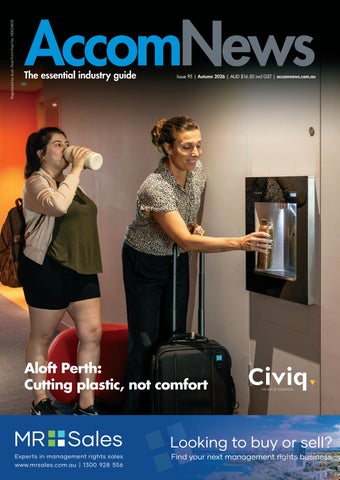
Aloft Perth:
Cutting plastic, not comfort
By Gemma Easton, Editor
With easy access to Perth airport and the vibrant CBD, Aloft Perth welcomes a steady mix of business and leisure travellers, from solo guests to families and large groups. The 220-plus room hotel is Green Star Australia Certified, and sustainability remains a priority.
Looking to address the large volume of plastic waste from in-room bott led water, Aloft Perth partnered with Civiq. The hotel had Elkay Liv Pro in-wall bott le filling stations installed on each guest floor.
Supporting sustainability and ESG goals
Rhiannon Osborne, Marketing & Communications Manager, Aloft Perth, said the key focus was sustainability.
“The Elkay Liv Pro off ered the quality, reliability, and environmental benefi ts we were looking for, particularly the ability to significantly reduce single-use plastic bott les and landfill waste. The units also came highly recommended by another Marriott International property, which gave us added confidence in the product.
“We wanted to introduce a more sustainable solution to replace bott led water, that didn’t compromise guest experience or quality,” Rhiannon said. “The Elkay units stood out for their durability, ease of use, hygienic design, and their ability to provide guests with filtered, great tasting water on demand.”
Bradly, Business Development Director at Civiq, said hydration is one of the quickest ways for hotels to make progress on ESG goals.
“By swapping single-use bott les for refill stations, hotels remove a steady stream of plastic from rooms, bars and event spaces. Many see a 15 to 30 percent drop in plastic waste just by changing how they provide drinking water. Unlike other sustainability actions that can take months or years, hydration stations deliver visible waste reduction within weeks. This helps hotels make fast progress while planning bigger changes.
“Providing refill stations also means you avoid the freight, storage and waste handling that come with bott led water,” Bradly said. “Hotels can save several
staff hours each week by reducing the time spent restocking rooms and dealing with plastic waste.
“Lower purchasing and less waste collection can cut bott led water costs by 20 to 40 percent each year, depending on the hotel. This also lowers transport emissions and reduces landfill or recycling.”
Stand-out features and benefits
Elkay Liv Pro units help hotels in three key ways. First, the systems fi t neatly into the wall with a clean glass front. The units blend into modern corridors and public spaces instead of looking like back-of-house equipment.
Second, they use sensors and built-in filters. Guests simply place their bott le in the fill area and the water starts automatically, usually within a second. “The whole process takes less than 10 seconds, with no buttons or extra steps. This makes refilling fast, simple and hygienic,” Bradly said.
Third, the Green Ticker on the front shows a live count of plastic bott les saved with every refill. “This gives the hotel an easy way to show impact to guests, owners and brand teams. The data can also be used in ESG reporting, making it simple to track and share progress on sustainability goals,” Bradly said.
Image courtesy of Civiq
Providing form and function
Balancing aesthetics, durability, and practicality is important for hotel operators. Aloft Perth is a 4.5-star hotel, and high-end finishes must be maintained throughout the property. Civiq’s hotel hydration stations are built for constant use in public space, and designed to blend seamlessly with hotel surroundings.
“The slimline design and clean finish help the stations fi t in with hotel joinery, lighting and artwork, so they support the interior instead of standing out,”
Bradly said. “The in-wall design keeps the footprint small and protects the unit. The front panel and bott le area are smooth and easy to wipe, so housekeeping can clean them during regular rounds.”
Beyond regular wipe-down, minimal ongoing maintenance is required, and can be done during regular housekeeping.
Filters usually need changing every six to twelve months, depending on use.
Clear lights on the units show the filter status so staff can stay ahead of filter replacement needs.
Minimum disruption, maximum benefit
For the team at Aloft , installation of the units occurred with minimal disruption to guests, with all noisy work scheduled during business hours to minimise impact and inconvenience. Units are set into existing walls, and usually finished within a day.
Rhiannon said: “We selected placements that were convenient for guests while also providing suitable access to existing water supply and drainage. This ensured both practicality and minimal structural impact.”
Accessibility and ease of use were also key considerations when installing the Liv Pro units. “We worked closely with Civiq to position the stations in locations that were convenient for guests, including those with accessibility needs,” Rhiannon said.
Effective, measurable results
Both staff and guests have responded positively to the new hydration stations. “Guests appreciate the convenience, and we’ve seen a significant environmental benefi t, and estimated reduction of around 150,000 plastic bott les per year from going into landfill,” Rhiannon said. “It has also improved staff efficiency, as there is no longer a need to restock in-room bott led water.”
Evaluating the eff ectiveness of the Elkay Liv Pro units, Rhiannon said the measurable drop in single-use plastic bott les going to landfill supports Aloft Perth’s commitment to sustainability and lowering its environmental footprint. “While this project represents just one
Images courtesy of Civiq
“Guests appreciate the convenience, and we’ve seen an estimated reduction of around 150,000 plastic bottles per year.”
element of our broader sustainability approach, it plays an important role in helping Aloft Perth deliver responsible, guest-centric solutions that align with Marriott’s global sustainability framework.”
The tangible, real-world impact of Civiq water stations help guests see that the hotel is serious about sustainability,
Bradly said. “People can see and use the change for themselves. Features like bott le counters give a simple estimate of bott les saved, which can be used in ESG reporting and help clients see the impact.
“You get less plastic, lower ongoing costs and a clear action that supports your sustainability and ESG goals.”
Smarter water solutions for modern properties Guest hydration reimagined:
By Gemma Easton, Editor
We’ve all heard the advice: adults should drink about two litres, or eight cups of water each day, even more if it’s a hot day or you’re exercising.
Water is essential for our bodies to work properly. It helps us to digest food and absorb nutrients, regulate body temperature and move well. Even slight dehydration can lead to irritability, fatigue and headaches.
An easy way to remind yourself to drink water regularly is to carry a reusable bottle. In the past, accommodation sites provided in-room bottled water for guests, which was replaced as necessary. And while recycling plastic bottles has long been the standard for businesses and individuals, with even sharper focus on sustainable practices, this is no longer good enough.
To keep pace with shifting consumer preferences, accommodation providers need
to think about how they offer water to guests. A move away from bottled water, though, shouldn’t mean your guests go thirsty. Water refill stations can be installed at your property to offer guests fast, convenient access to drinking water.
Bradly, Business Development Director at Civiq, said moving away from single use bottles helps hotels in three ways.
“First, it removes a recurring
cost. You are not paying for crates of bottled water, storage and waste collection.
“Second, it cuts plastic at the source. You are not just recycling more. You are bringing less plastic onto the property in the first place.
“Third, it changes how guests see you. A refill station on the floor feels more in line with what today’s travellers want from a sustainable stay than a plastic bottle in the fridge. It positions the hotel as a partner in their values, not just a place to sleep.”
Water refill stations and in-room taps are helping accommodation providers rethink how they offer water to guests, keeping them happy, hydrated and healthy.
Designer convenience
Providing fast, convenient water options for guests doesn’t mean installing ugly, cumbersome infrastructure. A range of sleek units are available to blend with your property’s aesthetic.
“Design is a big factor for accommodation. Hydration has to work with the look and feel of the property,” Bradly said.
“In-wall units give hotels a slimline option that sits within existing walls or joinery, so the station becomes part of the fit out. Surrounding walls can carry finishes or graphics that match the hotel vibe, from calm luxury to bold and playful.
“For outdoor or poolside areas, freestanding stations offer another option. Hotels and resorts often choose custom art panels with their own branding, colours or messages. Guests see a consistent visual story, and the team gets reliable access to drinking water in every key zone of the property.”
Refill stations can be installed throughout your property in places that it would be impractical to provide bottled water. This provides added convenience for your guests without creating extra work for staff.
Install refill stations in high-traffic areas like reception areas and guest floors, so they are easily accessible—the more visible they are, the more likely guests are to use them. Areas where guests may need extra hydration
are also good installation points, for example, in the gym.
Guests enjoying your property’s outdoor amenities like the pool or playground might need some extra hydration, so consider installing units outside.
Outdoor units can be combined with a bubbler so guests can grab a drink even if they don’t have their water bottle with them. If your accommodation property is pet friendly, consider including water bowls for pets.
Filtered taps can be installed in guestrooms or large spaces like conference rooms, offering chilled or unchilled, hot, and sparkling water on demand.
Quality control
The taste and quality of tap water can vary, which makes bottled water a reliable choice. However, refill stations come with a variety of features which can make tap water more palatable and consistent.
“Filtration improves the taste and quality of the water, making it more appealing for guests,”
Bradly said. “Many systems now include lead-reducing filters and antimicrobial features, which address common concerns about safety and purity.
Highlighting these features helps guests feel confident that the hotel cares about their wellbeing.
“Touch-free sensor activation reduces contact points, which guests appreciate. Timed shut off helps prevent spills and puddles.
“For staff, clear filter status indicators and simple access panels make it easy to keep the units in good condition, which supports safe drinking water over the long term.”
The last drop
Guest hydration is evolving from a basic amenity into a visible marker of sustainability, operational efficiency and guest expectation. As more accommodation providers phase out single-use plastics and respond to rising environmental awareness, refillable water stations, in-room filtered taps and premium dispensing systems are becoming part of the standard offering.
Drinking water is essential for guests, and now, providing it doesn’t need to cost the earth.
The new role of digital compendiums Connected stays:
By Sarah Davison, Industry Reporter
Traditionally a printed folder, often out of date before it reached the bedside table and prone to wear, the in-room compendium is being transformed into an interactive digital platform.
For accommodation providers, this shift isn’t just about swapping paper for screens. It’s about creating something even more useful: a simple, intuitive way for guests to access information, connect with services, and move through their stay with ease.
At the same time, the operational benefits are hard to ignore. Content can be updated instantly across rooms or entire properties, removing the need for constant reprints and manual checks by staff.
Front desk teams are also required to answer fewer routine enquiries, as guests can quickly access answers themselves or submit requests digitally. The result is a more streamlined operation, where staff have more time to focus on meaningful guest interactions rather than repetitive questions.
What’s really driving this evolution, however, is how these platforms are starting to connect with the broader
hotel ecosystem. Digital compendiums are linking with property management systems and customer relationship management systems, in-room entertainment, and other guestfacing technology to create more tailored experiences.
A guest might browse dining options, watch their favourite television show or communicate with hotel staff, all within the same environment.
There’s also a clear opportunity here when it comes to revenue, but in a way that feels considered rather than pushy. When done well, digital compendiums can highlight in-house dining options or experiences that
genuinely add to the stay, rather than interrupt it.
Of course, with this shift comes a growing focus on how content is managed, how systems are secured, and how guest data is handled. As more properties adopt cloudbased platforms, getting that balance right is essential.
What’s clear is that digital compendiums are no longer just a replacement for the old inroom folder. They’re becoming a key part of how properties communicate and engage with guests, quietly reshaping the experience in the process.
Scott Wiedemann, National Manager-Accommodation, at Foxtel shared his thoughts on the rise of digital compendiums.
Image courtesy of Foxtel
How are in-room TV platforms evolving beyond entertainment to support guest communication and information sharing?
These platforms are now powerful guest engagement hubs. Beyond delivering content, today’s platforms act as interactive communication centres that promote hotel services, provide realtime updates and guest messaging. Guests can request services, explore off ers and local att ractions.
Integration with property management systems also enables personalised welcome messages and targeted promotions, transforming the television into a dynamic touchpoint throughout the stay.
This shift positions the TV as more than a screen, it becomes a central part of the hotel’s connection to their guests. For operators, the benefi ts extend beyond guest satisfaction to operational efficiency, datadriven insights and new revenue opportunities. The modern inroom platform is not just about entertainment, it’s a strategic tool for communication, engagement and a more premium guest experience.
What role can custom welcome screens and digital messaging play in shaping the overall guest experience?
Custom welcome screens and digital messaging play a powerful role in shaping the emotional tone and perceived quality of a guest’s stay.
A personalised welcome screen immediately signals recognition and care. Displaying the guest’s name, loyalty status, or delivering a personalised message transforms the TV from a generic device into a curated experience. It reinforces brand identity, creates an emotional connection and sets expectations for service. For repeat guests, personalised messaging can strengthen loyalty. For first-time visitors, it establishes professionalism and warmth from the outset.
A simple, intuitive way for guests to access information, connect with services, and move through their stay with ease
Beyond first impressions, digital messaging becomes an ongoing engagement tool throughout the stay leading to impulse purchases. Targeted promotions, event reminders, dining specials and late checkout off ers can be delivered in the right moments. This not only provides convenience for the guest but also drives incremental revenue for the property. Real-time updates from weather alerts to flight and transfer information further positions the hotel as proactive and attentive.
How can integrated in-room technology help accommodation providers streamline common guest enquiries
and improve operational flow?
Integrated in-room technology shift s routine interactions to intuitive self-service platforms. When TVs, wifi portals and smart room controls connect with the property management system, guests can quickly access information without contacting reception. Service requests from extra
towels to late checkout can be submitted digitally and routed directly to the relevant team, reducing call volumes and manual coordination.
Beyond convenience, integration improves operational flow and visibility. Staff can track and prioritise requests in real time, automate guest messaging and identify demand patterns to optimise staffing resources. Replacing disjointed platforms with structured, data-driven systems, properties enhance efficiency while delivering a faster, more seamless guest experience.
What are the advantages of cloudbased updates for accommodation operators?
Cloud-based updates give accommodation operators the ability to manage in-room technology remotely, ensuring all systems are up to date with the latest features and security enhancements. This provides a consistent guest experience while eliminating the need for onsite-works with costly manual labour.
For operators managing multiple properties, cloudbased platforms enable updates to be rolled out centrally across an entire portfolio. This makes it far more efficient to maintain brand consistency, deploy new services, and ensure every property is aligned with the latest off ering.
Centralised cloud management also allows operators to deploy new content, promotions and service information instantly, respond quickly to operational changes, monitor system performance, and engage guests in real time.
Importantly, cloud-based technology allows the platform to continuously evolve without the need for major hardware upgrades every few years. As the technology provider keeps pace with global trends and innovation, operators benefi t from ongoing improvements without additional capital investment.
Overall, this reduces manual maintenance and downtime, lowers operational costs, and ensures the in-room experience remains modern, relevant and future-ready.
Image courtesy of Foxtel
Your most consistent guest touchpoint is evolving
What if every screen in your hotel could drive revenue, reduce workload and create a better guest experience at the same time?
For many properties, the in-room TV is still seen as a passive amenity. Something expected, but rarely maximised. Yet it is one of the few touchpoints every guest interacts with, often multiple times a day. That makes it one of the most underutilised assets in the room.
The shift is already happening. Leading hotels are transforming the television into a central hub for communication, engagement and service delivery, not just entertainment. This is where Foxtel’s Business iQ is changing the game.
From passive viewing to active engagement
Guests already use the TV. The opportunity is to make that interaction work harder for your property. With Business iQ, the in-room screen becomes a dynamic platform that brings together premium entertainment, property information and guest services in one place. Instead of relying on printed collateral, front desk queries or separate apps, everything is accessible through a familiar interface.
From the moment a guest turns on the TV, you have a direct and consistent way to communicate with them.
More ways to connect with guests
New platform capabilities are focused on helping properties showcase what they offer and make it easier for guests to engage. Carousel welcome screens allow you to rotate multiple messages on the first screen guests see. Promote dining venues, highlight amenities, feature seasonal offers or drive awareness of on-site amenities, all through a screen guests are already using.
The introduction of third-party app integration also creates a more seamless experience. Guests can access supported services such as loyalty programmes or hotel apps directly through the TV, without needing to download anything or search elsewhere.
Creating measurable revenue opportunities
One of the ongoing challenges in hospitality is understanding what actually drives guest spend.
With QR code integration and analytics, you can track how guests interact with on-screen promotions, whether that is booking a table, ordering room service or exploring experiences. This turns the TV into a measurable upsell channel, not just a communication tool. It also provides valuable insight into guest behaviour, helping you refine offers and maximise revenue per stay.
Supporting consistency and operational control
For multi-property operators, consistency across rooms and locations is critical.
Business iQ allows content, messaging and promotions to be managed centrally while still enabling property-level customisation. This helps ensure brand consistency without increasing the workload on site teams.
Within the Business iQ management portal, an AI-powered support chatbot is also available to help teams quickly find answers and troubleshoot common issues.
This provides a faster, self-service way to manage the platform without relying on external support.
A smarter way to use every screen
The in-room TV is no longer just an entertainment feature. It is a communication channel, a marketing platform and a service tool, all in one.
See how Business iQ can enhance your guest experience and support your operations at www.foxtel.com.au/biq or speak to a Foxtel Business specialist on 1300 138 898 to book a demo.
Foxtel Business iQ:
The end of missed calls and lost revenue:
Streamlining operations with AI
AI CONCIERGE:
Hope
you're enjoying your stay! We're sad to see you go. We'd love for you to relax longer and stay an extra night for only $99. Let us know if you are interested.
Brendon Granger Director, Technology 4 Hotels
For hoteliers and moteliers, a ringing phone that goes unanswered is a direct hit to the bottom line.
It’s 6:00pm. The front desk is busy with check-ins. As a queue forms in the lobby, a high-value corporate lead calls to book fi ve rooms. Because the team is occupied, the phone rings
out, eventually hitt ing a generic voicemail. By 6:05pm, that lead is gone—already booked with the competitor down the street.
The gap between a query and a confirmed booking is now measured in seconds. With labour shortages persisting and OTA commissions eating into margins, artificial intelligence (AI) has become a practical tool for plugging these revenue leaks and giving staff their time back.
Understanding the technology
Before looking at how this works on-property, it helps to define what "artificial intelligence" actually does. In simple terms, AI is soft ware capable of performing tasks that usually require human thought. Unlike older systems that follow a rigid "if this, then that" script, modern AI uses machine learning. The system analyses massive amounts of data to
GUEST:
Yes, we'd love to extend our stay!
recognise patterns and make decisions based on context. It learns from every interaction. If a guest asks about parking in an unusual way, the AI identifies the intent behind the words rather than just searching for a specific keyword. This results in a system that becomes faster and more natural with every conversation.
What AI means for your property
Implementing this technology doesn't mean replacing your team. It means providing them with a digital assistant to handle high-volume, repetitive tasks so they can focus on the guests standing in front of them.
• Round-the-clock responsiveness: AI doesn't sleep or take shift breaks. Whether a guest reaches out at 2:00pm or 2:00am, they receive an immediate, accurate response.
• Consistency: AI stays on brand regardless of the situation. It won’t get stressed during a busy check-in period or forget to mention an available room upgrade.
• Efficiency: By automating answers to the most common 50 questions, your team is no longer a "broken record," allowing them to handle high-touch service where it counts.
Capturing leads with AI voice
A busy signal is a lost opportunity. Industry data suggests up to 40 percent of hotel calls go unanswered during peak periods or shift changes. When a caller reaches voicemail, they rarely leave a message; they simply call the next listing on Google.
Modern AI voice systems act as a tireless extension of the front desk. These aren't the frustrating "press one for reservations" menus of the past. Today’s AI is conversational. It can book rooms, modify stays, and answer specific questions about property policies or local att ractions. By serving as the first line of defence, it ensures every call is answered, only transferring to a staff member when a complex situation requires a human.
The digital concierge
Modern travellers rely on their smartphones and expect answers instantly. If a guest messages a property asking for a wifi password or breakfast hours and has to wait 30 minutes for a reply, the guest experience has already suff ered. AI guest messaging handles over 80 percent of routine inquiries in seconds.
• Language support: Current systems can communicate in over 100 languages. This makes international guests feel welcome without requiring a multilingual staff member on every shift .
The gap between a query and a confirmed booking is now measured in seconds
• Revenue moments: AI identifies opportunities to increase spend. If a guest asks about the pool, the AI can suggest a poolside drink voucher or a late check-out fee, turning a standard query into an immediate sale.
Converting website traffic
Your website is your most profi table channel because it is commission-free. However, it only works if it converts browsers into bookers. Many travellers visit a property website to find a specific detail not listed on an OTA, such as exact parking dimensions or pet policies. If they can’t find that answer quickly, they leave.
AI webchat acts as a virtual guest services agent on
your homepage. It provides instant answers rather than just links. By guiding visitors through the booking process and answering questions in real-time, it reduces "website abandonment" and drives more direct bookings.
Finding the balance: Pros and cons
Efficiency is vital, but hospitality remains a business built on human connection. Success requires the right mix of technology and personal service.
The benefi ts: AI takes over the repetitive tasks that lead to staff burnout. When your team isn't answering "What time is check-in?" for the twentieth time that day, they are more engaged. AI also provides data, showing exactly what guests
ask for most, which helps you make better decisions about amenities and staffing.
The risks: Over-automation can feel clinical. AI should support your team, not hide them. Moments like handling a guest complaint or celebrating a guest's anniversary require empathy and creativity that only a human can provide. The goal is to use technology for the routine, so your staff are free to create the experiences that guests actually write reviews about.
Moving forward
You don’t need a massive budget to begin. Most properties see the fastest return by identifying their biggest "leak"—whether that’s missed phone calls, slow response times to guests' SMS, or high OTA dependency.
As we move through 2026, the window for a competitive advantage is narrowing. The properties that thrive will be those that use AI to stay "always open," ensuring no guest is left waiting, and no revenue is left on the table.
The most expensive guest feedback is the feedback you never receive
Why the growing trend for real-time feedback is becoming essential for Australian accommodation providers.
In accommodation, problems aren’t the biggest threat to your business — silence is.
Research shows 96% of unhappy customers never complain. They don’t visit reception or raise concerns during their stay — they simply leave. And later, many share their experience publicly, where it can influence countless future bookings.
By the time you’re reading that review, the damage is already done.
A single negative review doesn’t just refl ect one guest’s stay — it shapes perception, impacts booking decisions, and a ects revenue. In fact, a one-star increase in review ratings can li revenue by 5–9%, underlining just how valuable your reputation really is. For properties operating on tight margins, even small shi s in rating can translate into significant gains or losses over time.
The shift toward realtime feedback
Forward-thinking accommodation providers are closing this gap by capturing feedback during the stay, not a er it. The results are significant:
• 15% higher guest satisfaction scores
• 18% increases in revenue
• 32% higher guest retention rates
And when issues are resolved in the moment, 89% of guests say they would recommend the property.
The takeaway is simple: when you act in real time, you don’t just fi x problems — you build loyalty, strengthen relationships, and create experiences worth sharing for the right reasons.
Making feedback effortless for guests
One of the biggest barriers to in-stay feedback has always been friction. Guests don’t want to download apps, wait on hold, or go out of their way to report an issue.
Pulsi addresses this with small, discreet beacons placed in guest rooms and shared areas. Guests simply tap their phone to instantly open a short “pulse” — a mini survey. No app, no login, no hassle. If a guest flags a concern, sta receive immediate alerts via SMS or email, including exactly where the feedback came from. This allows teams to act quickly and resolve issues before they escalate into something more serious.
Importantly, feedback stays private — giving guests a safe, low-e ort way to speak up without turning to public platforms, where the impact is far more di cult to control.
Why timing changes everything
There’s a well-known concept in hospitality — the service recovery paradox — where resolving a problem well can actually leave a guest more satisfied than if nothing had gone wrong.
But this only works if you know about the issue in time.
A minor issue fi xed quickly is o en forgo en. The same issue ignored can become a permanent online review, influencing future guests long a er the original stay has ended. Timing isn’t just important — it’s everything.
Test real-time alerts without the commitment
Pulsi has introduced a Starter Kit designed to make real-time feedback easy to trial, without long-term commitment. At $119, it’s a simple, low-cost way to test receiving real-time alerts from
Pulsi beacons, placed across guest rooms or key touchpoints. Quickly see where improvements can be made and discover the value of intercepting and resolving poor guest experiences.
A er the trial, providers can continue from $19 per month and expand as needed — or walk away without any obligation.
The bigger picture
Today’s guests expect to be heard — 78% say the opportunity to off er real-time feedback improves their experience, and many prefer mobilebased options that are quick and convenient. For accommodation providers, the opportunity is clear:
• Protect your review ratings
• Increase repeat bookings
• Improve operational visibility
• Resolve issues before they escalate
Because in today’s market, the real cost isn’t a bad experience — it’s not knowing about it until it’s too late.
Get started today... visit pulsi.co
4 months access unrestricted (worth $76)
5 Pulsi beacons (worth $95)
5 Pulsi strut cards (worth $20) Zero commitments (option to choose a plan later)
Energy management for enhanced profits Smart rooms, smart savings:
By Milly Fullick, Industry Reporter
Energy management is now a significant consideration for accommodation providers—it's no longer enough just to switch off lights and air conditioning when a room is not in use.
Environmental, social and governance (ESG) reporting is now part of the regular cycle of accommodation management, with providers looking for ways to integrate energy savings into daily operations.
The range of available options for access control, room automation and building systems off er substantial opportunities, but deciding where to start or continue on an energy management pathway can be difficult. Starting with a focus on the guestroom can help to narrow the scope while delivering significant impacts.
Removing the guesswork
Previously, one of the most potentially frustrating aspects of energy savings was the lack of insight the accommodation provider had over not-inuse but occupied rooms.
Now, occupancy-based control takes the guesswork out of the equation. This can work in several ways, from simpler motion sensors to detect movement to more complex room status setups that combine motion and other data to provide a property management system (PMS) with real-time information on room occupancy.
HVAC systems account for around 40 percent of the total hotel energy use
The potential savings of an intelligent system are substantial, said ASSA ABLOY Managing Director Michael Benikos.
“Heating and cooling are among the largest expenses
in hospitality and in many hotels HVAC systems account for around 40 percent of the total hotel energy use.
“For hotels, the challenge is how the rooms are used, as each room behaves diff erently
depending on occupancy, guest habits, the season and outdoor temperatures.
“So, when HVAC systems are not aware of these factors, they often run longer and harder than necessary. Over time, this brings higher costs and inefficient energy use.
“Energy management systems (EMS) solve these issues by giving hotels better control at guestroom level. The system will adjust HVAC sett ings based on room occupancy and predefined comfort ranges.
“When a room is unoccupied, heating and cooling are reduced within controlled limits and when the guest returns the system brings the room back to comfort smoothly and efficiently.”
All-round wins
Technology developments mean that many energy-saving measures now off er double the benefi t; as well as helping to meet sustainability goals and off ering operational cost savings, guests have positive perceptions of modern, easyto-use systems that off er them convenience and control.
Digital room locks can operate on key cards or via mobile apps, and door sensors can be paired with a range of inroom systems from HVAC to lighting and even curtains or blinds to respond to guests entering or leaving a room.
These intelligent energy responses give guestrooms an instantly tech-forward, premium feel that guests are sure to notice. While overall guest impressions are not necessarily the main priority for these additions, they are a welcome benefi t.
Image courtesy of ASSA ABLOY
New or retrofitted?
Sometimes, full-scale renovation will naturally be the best option. However, there are usually ways to retrofit and renovate to incorporate intelligent features without breaking the bank.
Guestroom doors and locks can be easily fitted in place of manual or older handles, and movement sensors are an add-on that can be fitted into inconspicuous places.
Before making any decisions about upgrading versus replacing, it’s best to speak to a specialist who can tailor options to suit your setting and needs; there may be options you hadn’t considered, or technical reasons one approach would work better than the other.
Gathering data
Another benefit of intelligent systems is the data that they provide. Granular information from EMS can highlight maintenance or refurbishment needs and help accommodation providers to plan accordingly for the busiest times.
Mr Benikos said EMS data can be invaluable. "With this real time and historical data, hoteliers can easily spot rooms that are not performing efficiently and rectify the issue by either adjusting settings or addressing maintenance issues.
“With the increased visibility, HVAC performance is more consistent across the property and guest complaints less likely.”
Detailed data about the relationships between occupancy and energy usage also helps with improved stakeholder and investor transparency; having comprehensive information at managers’ fingertips saves time and helps ensure reporting obligations aren’t too burdensome.
For accommodations seeking an energy efficiency or carbon neutral National Australian Built Environment Rating System (NABERS) rating, this data can provide invaluable insights into energy usage and provide indications about where to go next.
The power of communication
Rooms are one component of the whole accommodation ecosystem, so it’s important that their systems can communicate with wider operations.
Building management systems (BMS) and GRMS can be integrated to work together, with multiple benefits. First, there is the obvious advantage of at-a-glance control, rather than having to toggle between multiple systems. Then, there is the potential for enhanced efficiency and energy saving from having them communicate, said Mr Benikos.
“Most EMS systems can also integrate with hotel door locking systems, building management systems, property management systems and housekeeping
systems. Integration provides additional benefits for the hotel such as: online locks; preconditioning rooms with lighting welcome scenes; increased savings by providing the BMS with in room HVAC data; and the housekeeping systems with occupancy data for more efficient room cleaning, as they know which rooms are vacant and which rooms are Do Not Disturb.”
Power at your fingertips
Utilising technology for energy savings can seem like a tall order, with multiple moving parts and options to consider. However, the initial time, effort and financial investment can pay off in an impressively short time, helping to futureproof accommodation businesses against a backdrop of uncertainty.
Images courtesy of ASSA ABLOY
Nesuto Docklands Apartment Hotel:
By Milly Fullick, Industry Reporter
At Nesuto Docklands
Apartment Hotel in Melbourne, the inroom thermostats and door locks are the only guest-facing hints at the intelligent energy management system running day and night in the background to save energy, time and money.
Matthew Abrahams, Development Manager for Nesuto, said the ASSA ABLOY system provided centralised control over heating, cooling, lighting and other in-room power functions across all guestrooms.
“It allows us to set defined temperature ranges and lighting parameters based on room status, such as whether a room is occupied or vacant.
“The system also automatically manages how long heating and cooling remain active after a guest leaves the room, helping to minimise unnecessary energy use while maintaining guest comfort.
“Similar controls apply to lighting, ensuring efficient operation without impacting the guest experience.”
The parts guests see, the locks and thermostats, were carefully chosen for form and function, said ASSA ABLOY Managing Director Michael Benikos.
“The lock chosen was the Signature RFID model, which is capable of online network connectivity and card use, but also ready for mobile phone keys in the future. The reader is slim and easy for guests to know where to badge their card while still fitting into the hotel decor.
“The other item was the inroom thermostat. The version chosen was a slimline, sleek version but still easy to use for the guest. The display is a
good size and it’s easy for the guest to work out how to use.”
However, there is far more to the system than what guests can see, Mr Benikos said. “We also integrated the system to the building management system which controls the chillers and boilers, so we could provide that system with accurate data on what the rooms are doing to optimise the chiller and boiler usage to save more money.
“As part of the setup process, we also visited previous projects with Nesuto to show how the system was installed and setup so they could use that information when setting up their system.”
That wrap-around support was important from beginning to end, Mr Benikos said. “We worked on the best settings for the site to get the highest energy savings without affecting guest comfort. We also integrated
the system with the door locks to give them an online door locking system using the energy management system network.”
As well as the levels of provided support, working with ASSA ABLOY was a considered choice to meet Nesuto’s sustainability goals, Mr Abrahams said.
“Nesuto has a strong corporate responsibility to operate in an environmentally responsible way and to be a good steward of the planet.
“The intention behind installing the energy management system was to significantly improve energy efficiency while ensuring there was no negative impact on guest comfort or experience.
“ASSA ABLOY was chosen as a partner due to their proven expertise in delivering reliable, intelligent energy solutions that align with Nesuto’s sustainability
objectives. As a result, energy efficiency has become an essential and integral component of all new Nesuto developments.”
Feedback from guests has been positive, said Mr Abrahams, and the ASSA ABLOY energy management system continues to deliver.
"Both staff and guests benefit from a consistently comfortable, seamless in-room environment with intuitive controls that are easy to use.
“Over the longer term, guests appreciate knowing that their stay supports more sustainable operations, while staff benefit from improved efficiency and reduced operational waste, all without any compromise to comfort or service quality.
“Guests enjoy a consistently comfortable room environment without being consciously aware of the energy management technology at work. Its real strength lies in being unobtrusive—optimising energy use without restricting guest control or comfort—so the experience feels natural while still supporting more sustainable operations.”
Image courtesy of ASSA ABLOY
The Vingcard Solution
Complete and Modular Approach to PropTech
Trends, tones and tailoring for the perfect 2026 guestroom
By Milly Fullick, Industry Reporter
There is so much to consider when refurbishing guestrooms. Alongside the practical considerations of guests, housekeeping and maintenance needs, the aesthetics of the space are arguably more important now than ever.
Tracey Candido from Montague said how guestrooms are viewed has changed, becoming more nuanced over time.
“Guest expectations have evolved dramatically in recent years, and the modern guestroom has followed. What was once a purely functional space is now an extension of a property’s brand identity—a place where the guest experience truly begins.”
Choosing flooring from the ground up
Carpeting should be considered in terms of aesthetic and practicality. Generally, rooms need to be repainted more frequently than carpets need to be replaced, so choosing neutral flooring gives you more options when it’s time to redecorate. If the room needs a pop of colour on the floor to balance its aesthetics, this can be achieved with rugs, or even by choosing chairs and tables with contrasting or colourful legs.
Current trends are focused on nature-inspired elements, from earth tones to wool blends and woven or looped textures. Luckily, these are all classics that promise to age well.
Getting wallpaper and paint covered
2026 is set to be the year of prints, texture and vintage styling for wallpaper. Any of these features add instant luxury to a room. For smaller spaces that
might be overwhelmed by busy wallpaper, consider a feature wall to keep the balance.
For paint, the colour of the year is blue in all its forms, from powder to navy. Choose a blue that works for your setting; coastal venues could choose soft blues for a timeless look, or a bold sea glass blue-green for something edgier. Urban accommodation
could evoke some drama with moodier navies and indigoes paired with low lighting options for maximum impact.
Artwork in building a visual identity
Walls and flooring are, of course, not the only design elements to consider. Artwork can be seen as a finishing touch, but to elevate
a guestroom to unforgettable, it needs to be planned and curated.
Sophie Vander from Curatorial+Co. said the role of art in accommodation goes far beyond the surface.
“Choosing artwork for a hotel is not just an aesthetic decision— it’s a strategic one that directly impacts brand perception, guest experience, and long-term value.
Image courtesy of Montague
Image courtesy of Curatorial+Co.
“Consider what story you are trying to tell. Is the property rooted in local culture, or is it a more globally positioned brand? Is the tone playful, refined, immersive, or understated?
“Defining this early ensures the artwork feels intentional rather than just decorative. And focusing on integration with the interior design and architecture means the artwork should not be an afterthought; it should be embedded in the spatial experience,” she said.
“Finally, procurement timelines and logistics must align with construction and fitout programs. Engaging an art consultant early ensures feasibility and avoids delays.”
Ms Vander said that choosing the right pieces can substantially impact guests’ impressions throughout an accommodation’s settings.
“Strategically placed statement pieces can anchor key moments within the hotel. A dramatic lobby installation can create a strong first impression and set the tone on arrival.
“In bars and social spaces, artwork can introduce energy, colour, and texture, supporting a vibrant, social atmosphere. In contrast, quieter areas such as corridors or private dining rooms can feature more contemplative works that slow the pace and create moments of retreat.
“In many cases, a single, memorable artwork can become a defining feature of
the property, something guests associate with the brand long after their stay. Engaging local artists further strengthens this narrative by grounding the experience in place. It introduces authenticity, connects the hotel to its cultural context, and creates a more meaningful and distinctive guest experience.
“Ultimately, art transforms a hotel from a designed space into a story-led environment—one that guests don’t just stay in, but connect with and remember.”
The finishing touches
Elements such as lighting, rugs and throws are small in size but should not be underestimated. These finishing touches are a crucial design component, said Montague’s Tracey Candido.
“Accessories play a vital role in bringing that story to life. While major furnishings provide the
form and structure, accessories introduce the warmth, personality, and visual balance that make a room feel complete.
“Carefully chosen cushions, throws, artwork, mirrors, and accent pieces offer texture and richness while creating an inviting atmosphere. They also give operators the flexibility to refresh spaces with subtle updates that keep designs feeling current, without the cost or disruption of a full-scale refurbishment.”
Lighting is often overlooked but could make or break a room’s design, said Ms Candido.
“Lighting is one of the most powerful yet often underestimated components of guestroom design. Effective lighting enhances comfort, functionality, and emotional impact, helping rooms effortlessly shift between work, relaxation, and rest.
“A layered lighting approach that balances task and ambient light can completely change how materials, colours, and finishes are perceived. Conversely, poor lighting flattens even the most beautifully designed interiors. Thoughtful placement, warmth, and light quality contribute to a calm, refined environment that supports guest wellbeing and elevates the entire experience.
“Together, bespoke design, accessories, and carefully crafted lighting create guestrooms that not only look exceptional but genuinely resonate with today’s travellers.”
The final word on
tailoring spaces
With so many elements to balance, working with professionals can ensure your guestrooms and other areas of your property maintain a cohesive style and deliver some wow factor. Ms Candido said that custom design is a way to stand out from the crowd.
“Increasingly, accommodation providers are turning to bespoke design to ensure their rooms feel distinctive, memorable, and aligned with their market. Custom furniture and tailored solutions allow operators to incorporate the specific practicalities of their region and clientele while maintaining a cohesive design vision.
“As travellers continue to share their stays online, a thoughtfully curated room becomes part of the story, strengthening brand presence and supporting repeat visitation.”
Image courtesy of Curatorial+Co.
Image courtesy of Montague
Montague, where unique custom furniture design meets the highest standards of craftsmanship and artistic elegance, crafted solely for the hospitality industry. We transform spaces into luxurious, welcoming environments that leave a lasting impression on your guests, setting your venue apart from the competition.
DIFFERENTIATORS
• Factories: 5 dedicated factories in HCM VN producing custom case goods, millwork and soft furnishings materials; custom veneers, solid timber species, metalwork, stone, glass, resin, hydrographic transfer & custom lighting.
• Logistics: Our own partner, with exhaustive experience in shipping throughout the world.
• CAD: A team of 7, furniture design affiliates, 6 project managers and a dedicated QC team.
PERFORMANCE
• 4830 hotel projects produced and delivered since 2000.
• 64 hotel projects delivered in 2024 valued at over $61 million AUD.
• Factories capability 300 x 40’HQ containers per month.
• Funding backing by our owners Getz Bros. We able to produce more than $100 million USD per annum.
Images: Ritz Carlton Cayman
Smart fridge, smart choice
By Gemma Easton, Editor
The minibar is a staple of hotel and motel rooms.
Providing hungry holiday makers with a convenient snack or relaxing end-of-day drink, it is unrivalled in its capacity for grab-and-go, on demand convenience. Until now.
Smart fridges are revolutionising the way accommodation operators provide drinks, snacks and even meals to their guests. One smart fridge can replace multiple inroom minibars, resulting in time saving for housekeeping staff, energy savings for your property, and more choice for your guests.
Antony Dutton, Managing Director, The Vend Shop and Paul Kozlovsky, Lead Smart Fridge Technician, The Vend Shop, have both seen first hand the benefits of smart fridges for both operators and guests. They shared their insights with AccomNews.
How do you see smart fridges transforming the in-room minibar experience for hotel guests, particularly around personalisation and convenience?
The product range is much broader than a traditional minibar
Paul: The RSA licensing requirement is an important consideration here—a smart fridge doesn't hold an RSA licence on its own for a traditional minibar setup.
Antony: However, integrating the guest's room key provides a potential practical solution. The room key can control access to the fridge, and the smart fridge has the technology to support that. Once that's in place, the personalised in-room experience becomes very achievable.
Traditional minibars are notoriously labour-intensive to stock and manage. How does smart fridge technology reduce that operational burden for hotel staff ?
Antony: First and foremost,
there are far fewer units to manage. Rather than a minibar in every room, you might have one smart fridge per floor or positioned in the foyer or basement. The software also gives real-time visibility into stock levels, so replenishment is driven by actual demand rather than guesswork. Staff receive essentially a shopping list— they know exactly what to bring before they leave the storeroom, which dramatically cuts down on labour time.
Paul: Because the software tracks inventory, there's also far less chance of theft or shrinkage— every item is accounted for. You can also see expiry dates in the system, which helps with stock rotation and reduces waste.
Antony: On top of that, if stock is nearing its expiry date, the software allows operators to dynamically adjust the pricing of those items in the fridge, which helps shift product and reduce waste at the same time.
With the rise of short-stay rentals putting pressure on hotels to differentiate, how does a smart fridge help hotels deliver a standout guest experience?
Antony: The key point is that the smart fridge isn't in every individual room. It's positioned in a shared corridor or communal space accessible to all guests on that level. This creates a shared, elevated experience that guests notice.
Paul: And the product range is much broader than a traditional minibar. We're talking ambient products, toiletries, health and medical items, drinks, snacks, fresh food and ready-made meals, all available 24 hours a day, seven days a week. For hotels that cater to shift workers, for example, a guest arriving at 2am can still grab a hot meal. It's genuine round-the-clock convenience at very little additional cost to the hotel.
Image courtesy of The Vend Shop
Antony: Frozen smart fridge options are also available, with items like ice creams and frozen meals, which extends product shelf life considerably and broadens the offering even further. What kind of consumption data can smart fridges capture, and how can hotel operators use that data to make smarter decisions?
Paul: Each fridge is set up with a planogram—a structured layout of the products the operator wants to stock. The backend software then tracks what's selling and what isn't, so the product mix can be continually adjusted to match what guests actually want. You're not locked in—you can stock almost anything in a smart fridge, and the data tells you what to keep and what to swap out.
Can the smart fridge integrate with existing hotel management systems, such as a PMS or loyalty platforms, and what does that unlock for operators?
Paul: Yes, absolutely. Integration with hotel loyalty programs opens up a number of possibilities. Guests could pay using loyalty points, receive member discounts, or access meal deals tied to their status. It's a meaningful touchpoint for driving guest engagement and encouraging repeat stays.
Sustainability is a growing priority for accommodation providers. How can smart fridges contribute to reducing food waste or energy consumption?
Antony: On the food waste side, the smart fridge software monitors expiry dates and
uses historical sales data to forecast demand. This means operators aren’t just guessing, they’re predicting what's likely to sell and stocking accordingly. That significantly reduces the amount of product that goes to waste.
Paul: From an energy
perspective, one smart fridge consumes the same power as a single traditional minibar, but it replaces anywhere from ten to a hundred minibars depending on the size of the unit and the hotel. This means the energy saving across a whole property is substantial.
Images courtesy of The Vend Shop
The next generation of utility vehicles Driving positive change:
By Milly Fullick, Industry Reporter
With more choice than ever, selecting new utility vehicles can seem like a daunting task. There are many factors to weigh, from intended use to power type, and of course, cost is always a consideration.
It’s easy to assume that these concepts would all be competing with one another, and that a positive choice in one area would have drawbacks in others. However, with some research and planning, it’s possible to find an option that ticks all the right boxes.
Planning energy needs
If you’re thinking of changing your fleet’s energy system or increasing the use of electric vehicles, infrastructure should be at the forefront of planning. Consider where vehicles will be charged and ensure that sheds and garages have sufficient power outlets and capacity.
Many homeowners, business managers and accommodation operators are increasingly thinking about where their power comes from, too. With under half of Australia’s electricity coming from renewable sources, operators looking to reduce their carbon footprint could make huge impacts by changing how they get their power—utility vehicles can be a great entry point for this.
Coupling electric vehicles with a solar array and battery on a vehicle shed roof, for example, could provide a manageable but significant renewable energy contribution, with the backup of mains electricity for cloudy days.
Purpose-built design
Whether you’re thinking of expanding, replacing or buying utility vehicles for the first time, choosing the right type is important. If you have several in your fleet, look at which are used the most frequently and consider why. Speak to staff about the disadvantages and advantages of each, as well as any frequent issues that come up.
Of course, each class of utility vehicle comes with special features, and within them there are different options. For moving people, for example, think about your average group sizes and luggage needs when choosing a six-seater over a four-seater with a rear tray.
Housekeeping vehicles are essential over bigger sites, with a large capacity for laundry and
anything else that needs to be moved, but typically this space comes at the cost of seating.
Specialist food and beverage carts may not be the right fit for every setting, but they can be invaluable for moving consumables in a clean, safe and efficient manner.
Maximising productivity
It can be tempting to choose one vehicle for multiple purposes, but this can be a false economy both for convenience and productivity, Graham Janson from Augusta Golf Cars Pty Ltd said.
“Purpose-built vehicles also drive productivity in day-to-day operations. Anyone who works with tools knows the right tool turns a difficult job into a quick one; the same applies to transport across a property.
“Vehicles designed for housekeeping, maintenance, grounds or luggage transfers— with appropriate trays, towing capacity, turning circles and safety features—reduce repeat trips, simplify loading and unloading, and cut delays.
“That translates directly into labour efficiency, better service levels and less energy consumed per task.”
Considering the total cost
Purchasing new vehicles is always a significant financial outlay, making it even more important to carefully consider what you’re buying. It can be tempting to save some money by choosing a more entrylevel model, picking petrol over electric, or shopping around for less well-known
Image courtesy of Augusta Golf Cars
brands. However, the upfront price isn’t the only factor in total cost of ownership (TCO), Mr Janson said.
“When evaluating total cost of ownership, accommodation providers should look beyond purchase price to energy costs, battery chemistry and warranty, service intervals, tyre and brake wear, downtime risk, parts availability, residual value, and the operational fi t of the vehicle.”
While electric carts can be more expensive initially, their fuel and maintenance costs are generally much lower, making them a worthwhile consideration.
“Lithium vehicles off er a
strong TCO case,” Mr Janson said. “A slightly higher upfront investment in the correct, efficient product can deliver a stronger return over time through lower running costs and longer usable life.”
Safety at the forefront
Many utility vehicles now have automatic parking brakes, and some have hill hold, which makes working across large resort sites with varying terrain easier. Other features including split windshields, horns and reversing beepers make operation simpler and safer for teams; noise-making features are especially important on
quiet, electric vehicles.
Keep staff training up to date, record all services and maintenance on your vehicles and check local regulations around on- and off-road use to ensure compliance, and utility vehicles should be an investment that keeps paying off.
Sustainability in action
There are more options than ever for those looking to boost their eco-credentials when it comes to utility vehicles.
Mr Janson said utility vehicles were a great way to contribute to sustainability goals. “For
accommodation providers, the next generation of utility vehicles can be a practical lever for meeting sustainability goals—provided fleet decisions are made with whole-of-life performance in mind.
“Lithium batteries have proven to be an obvious starting point, having been engineered for efficiency.
Lithium off ers faster charge acceptance, longer service life and fewer maintenance touchpoints,” he said.
“Couple this with other innovations like solar, and it is easy to see how accommodation provider sustainability goals are being achieved.”
For sustainability and efficiency, Mr Janson said choosing who to buy from can be as important as picking the vehicles.
“Buying through a reputable distributorship ensures the fleet is supported with the right parts, diagnostic tools and technical know-how, which is critical for uptime and for keeping vehicles operating at peak efficiency over years, not months.
“Long established and reputable service providers off er a full range of fi t-for-purpose options and the backing to execute and maintain the most sustainable configurations available across varied site conditions.”
Whatever your needs or goals, it’s worth discussing options with specialists to ensure that for the utility vehicles you choose, the short-term time investment translates into sustained, long-term benefi ts.
Images courtesy of Augusta Golf Cars
Autumn pricing without the panic
How accommodation operators can protect their rates, stay competitive & prepare for a stronger season
Autumn can bring a familiar kind of uncertainty for accommodation operators. The summer peak and Easter holidays are over, booking patterns can start to feel less predictable and it becomes tempting to react at the first sign of softer demand. Why dropping rates too quickly can backfire
For many hotels, this instinct is understandable: If bookings slow down, it makes sense for some to drop rates and try to protect occupancy. But discounting too early or too broadly can do more harm than good. It can chip away at your revenue, make it harder to rebuild your rate later, and leave you wondering if you gave away more than you needed to.
The good news is, protecting your rates doesn’t mean standing still. It means staying responsive without panicking, and making calm pricing decisions that reflect real market demand.
What’s really happening in your market?
Demand shifts for all sorts of reasons: Booking windows change, local events affect pace, competitors move around, and guests take longer to commit. A short slowdown is not always a sign that your rates are wrong.
Before changing your strategy, it’s worth asking a few simple questions. Is demand truly soft, or are guests just booking later? Is this a marketwide trend, or something specific to your property? Are you seeing a dip in all segments, or only on certain nights? Often, the smarter approach is a targeted one: Adjust where needed, hold where you can, and avoid training guests to expect lower prices by default.
Guests compare value too
Just as importantly, guests do not compare price alone; they also compare value. They look at your property alongside others in the market and decide what feels worth booking. That means your goal is not simply to be cheaper. It is to be competitive, credible, and attractive for the right guest at the right time.
For operators, that can be a helpful mindset shift. Protecting rate is not about pushing prices up regardless of what is happening around you. It’s about avoiding unnecessary discounting when your offer still holds value. In many cases, the strongest pricing strategy is not the lowest one. It is the one that
reflects demand, market conditions, and what your property can realistically command.
Why pricing becomes harder in uncertain periods
This is where pricing becomes difficult to manage manually, especially in periods of uncertainty. When the market feels changeable, many operators end up spending more time checking competitors, second-guessing their rates, and making reactive changes. This creates extra work and stress, but does not always produce better decisions.
What operators really need in moments like this is confidence and clarity. They need to know they’re not leaving money on the table, but also not pricing themselves out of the market. Most importantly, they need a way to stay in control without spending hours buried in spreadsheets or constant rate checks.
Most operators we speak to are looking for pricing solutions that are simple to use, easy to trust, and built to support better decisions every night. The best systems don’t take control away from the hotelier - they do the opposite. They give operators a clearer view of where their rates should be, reduce the need for manual guesswork, and make it easier to respond to changing conditions without overreacting.
Balancing automation with control
In an uncertain market, that balance matters. You want pricing that keeps you competitive, but you also want transparency. You want automation, but not a black box. You want support, but you still want the final say.
That combination helps operators protect both their rate and their peace of mind.
Stay calm, stay competitive
Autumn does not have to mean panic pricing. In fact, it is often the season when calm, consistent pricing decisions matter most. The operators who perform best are not always the ones who move fastest or discount hardest. They are often the ones who stay close to the market, trust the data in front of them, and make deliberate choices instead of emotional ones.
No one can remove uncertainty from the market altogether. But accommodation operators can make it easier to navigate with pricing that is responsive, transparent, and easy to trust. This Autumn, the goal is not to chase every booking at any price. It is to protect your value, stay competitive, and rely on a pricing approach that helps you drive revenue with confidence.
About RoomPriceGenie:
RoomPriceGenie is the easiest way to ensure that your rooms are priced right, every night. Purpose-built for the independent hotels, holiday parks and small groups, RoomPriceGenie is fast to implement, intuitive to use and simple to understand. In an uncertain world, it’s revenue you can count on.
See RoomPriceGenie in action: Book your personalised call through the QR code on the following page or visit our website at www.roompricegenie.com.
Image courtesy of RoomPriceGenie
#1 RMS — 2026
The easiest way to ensure your rooms are priced right, every night.
Automated pricing, min-stay controls, group quotes, yielding reporting, and forecasting — all in one place. Built for independent properties and growing groups.
How it works
1
Worry-free setup
Leave the setup to your dedicated Genie. Expertguided onboarding means you see value in days, not months.
Let’s get started.
Scan the QR code, add your details in, and pick a time.
We’ll give you a quick call and set up your free 2 week trial, no obligations or credit card required.
2 3
Transparency & 100% control
Understand every price suggestion. Override or adjust anytime: You're always in control.
Local support for Australia & New Zealand
Backed by multilingual revenue experts who've worked in hotels and managed room rates. Regular strategy reviews included.
Rethinking revenue strategy in APAC hotels From full rooms to real profit:
By IDeaS
For owners and GMs, an RMS shouldn’t be thought of as simply a specialist tool – it’s a commercial decision engine that informs staffing, investment timing, and asset performance. Recent global research confirms this. In a survey of hotel investors undertaken by IDeaS, 83% of hoteliers using revenue management technology described the return on investment (ROI) as “high” (62%) or “very high” (21%).
In an environment defined by demand volatility, rising costs and increasingly price-sensitive travellers, relying on static pricing or manual decision-making is no longer enough. Today’s leading operators are using advanced revenue management technology not just to set room rates, but to make smarter decisions across pricing, distribution, operations and overall profitability.
Attract the Right Guest and Optimise Profit
Not all business is good business, and a full hotel doesn’t always equal a profitable hotel. Without an RMS in place, hotels and resorts can easily fall into the trap of selling out to lower value business, thereby leaving money on the table from higher value business opportunities. While this approach may still turn a profit in the short term, the missed opportunity to optimise room revenue can cut into the financial padding needed to cover lower-demand periods. To identify guests that offer the greatest long-term revenue potential to a property, hoteliers need revenue and pricing systems in place that take a holistic view of their total revenue spend, not just their room revenue.
Data from transaction systems should be integrated to provide an accurate picture of a guest’s preferred activities and their overall value, considering all ancillary spend from online reservations to check-out, food service to spa services, guest rooms to gift shop, and more. In addition to making more profitable decisions, this data allows hoteliers to make more informed decisions about promotions, service offerings, and inventory levels. For example, during periods of high demand, a resort may limit one-night, discount-driven
“Not all business is good business, and a full hotel doesn’t always equal a profitable hotel.”
OTA bookings in favour of fewer, higher-value guests who stay longer and spend more on dining, experiences and on-property services. While occupancy may be slightly lower, overall profitability is stronger. An advanced RMS helps identify and prioritise these opportunities by assessing demand, pricing and total guest value together, enabling operators to make confident, profit-focused decisions rather than simply filling rooms.
Make Smarter Pricing and Inventory Decisions
Revenue management technology allows hotel owners to implement accurate pricing strategies that outperform less dynamic seasonal adjustments. By automatically analysing real-time demand, booking pace, local events, and competitor activity, an effective RMS sets optimal prices and inventory decisions across all room types and distribution channels. This is particularly important in markets like Australia, where tourism peaks can shift rapidly and online travel agency (OTA) driven price competition can be fierce. Unlike tools that simply react to demand signals, advanced RMS platforms forecast demand uncertainty and optimise decisions across multiple profit levers simultaneously—and in real time. This ability to intelligently adapt to market changes is critical for gaining a competitive edge.
Improved pricing and inventory decisions fuelled by an RMS enables hotels to achieve higher revenue per available room (RevPAR). Importantly, research amongst hoteliers found that 27% of investors using RMS tools report a 10%+ increase in RevPAR, while another 24% report a 4–6% lift. For hotels operating in thin-margin environments, this difference can define the success of an entire quarter.
An RMS Can Help Manage Operations and Costs
An RMS doesn’t just optimise pricing it allows a hotel to better manage its operations and costs. Through detailed and accurate forecasting, an RMS allows hotel management teams to plan staffing, housekeeping,
and food and beverage operations more efficiently. For example, when forecast data indicates a weekend surge in occupancy, hotels can schedule higher levels of frontdesk staff and housekeepers to maximise the guest experience. Whereas days with softer booking levels can be managed with reduced rosters, helping turn unnecessary wage costs into savings which contribute directly to the hotel’s bottom line.
Improve Cash Flow and Capital Growth
Cash flow is the lifeblood of hotel operations and a critical driver of property valuation. By leveraging an RMS to optimise revenue and help control costs, hotels can increase the amount of cash available after expenses. This surplus can then be reinvested into property upgrades, enhancements to the guest experience or used to secure more favourable lending terms.
Recent research supports the bottom-line benefits of revenue management technology, with 25% of surveyed investors reporting a 10%+ increase in net operating income after implementing an RMS, while another 19% report a 4–9% uplift. This kind of financial momentum powers a positive cycle where stronger cash flow leads to reinvestment, which supports asset appreciation.
Turning insight into competitive advantage
Revenue management is becoming less about reacting to demand and more about shaping it. Hotels that embrace this shift will be better positioned to protect margins, unlock new value and make more confident decisions across the business. For operators focused on long-term profitability, the question is no longer whether to invest, but how quickly they can embed these capabilities into their commercial strategy.
For more information on how revenue technology can help improve commercial outcomes for your hotel, please visit: www.ideas.com
Winter uniforms for polished professionalism
By Sarah Davison, Industry Reporter
Cooler temperatures tend to bring a shift in what uniforms need to do day to day.
Winter uniforms must keep staff warm and comfortable, support movement during a busy shift, and still maintain a consistent and professional look across the property.
Teams are often moving between indoor and outdoor environments, working long hours and taking on physically demanding roles. A front desk team member, a hospitality worker and housekeeping staff will all have very different needs, but they still need to feel part of the same team. Uniforms also carry meaning beyond their practical use. They help signal roles, set expectations for guests and communicate something about the brand itself. Now, uniforms are being approached less as standard workwear and more as part of a broader design conversation, influenced not only by functionality, but also by brand positioning and, in some cases, wider fashion trends.
There is also a growing body of research pointing to the broader role uniforms play in hospitality settings. A 2017 study, The Impact of Employee Uniforms on Job Satisfaction in the Hospitality Industry, found that uniforms can influence both staff behaviour and guest perceptions, while also contributing to a sense
of belonging within a team. Comfort, fit and functionality were identified as key factors shaping how staff feel in their role, with flow-on effects for confidence and performance.
In practice, this is where winter design becomes more considered. Rather than relying on heavier, bulkier garments, many operators are moving towards more flexible uniform systems that allow for layering and adjustment throughout the day. This not only improves comfort, but also helps maintain a consistent look across different roles and environments, without the need for completely separate uniform sets.
At the same time, durability and ease of care remain front of mind. Hospitality uniforms are subject to heavy wear and frequent laundering, so fabrics and construction need to hold their colour and structure over time. For operators managing multiple departments or sites, consistency and ease of replacement are also key considerations.
Images courtesy of Cargo Crew
The foundation of modern winter uniforms
Winter uniforms often focus on what sits on top - coats, knits and outer layers. Yet the garment worn every day, across every shift, is often overlooked. Well-designed pants don’t simply complete a uniform; they influence how it performs, moves and presents throughout the day.
Chinos o er a considered middle ground. More polished than denim, yet less rigid than traditional tailoring, they provide a modern foundation suited to front-of-house, corporate and service environments alike. Creating a refined silhoue e, they maintain a professional appearance, while stretch fabrication supports comfort and ease of movement across long shi s.
This balance becomes particularly valuable in winter, when teams
transition between indoor and outdoor se ings and uniforms need to adapt accordingly. A reliable base enables thoughtful layering, from shirting to knitwear to outerwear, without compromising cohesion or brand presentation.
Cargo Crew recently showcased its Jamie Chino across members of
its own HQ team, illustrating how a modern work pant can flex across roles and personal styling preferences. The result demonstrates how a single, well-considered foundation piece can support a consistent look while still allowing individuality, an increasingly important consideration for contemporary uniform programs.
There is also a growing focus on how uniforms contribute to brand expression. Colour palettes, textures and styling details are being used more deliberately to create a cohesive look across departments, while still allowing for role-specific functionality.
In this feature, AccomNews looks at how winter uniform programs are evolving and the current industry trends, with Cargo Crew Founder and Chief Creative Officer, Felicity Rodgers.
What role do layering and fabric choice play in ensuring staff comfort?
Layering is at the core of a welldesigned winter uniform. It allows teams to adjust throughout their shift without compromising presentation, whether they’re moving between indoor and outdoor environments or transitioning between tasks.
Fabric is where this really comes to life. The focus is
on materials that are built for purpose, breathable, durable and able to hold their shape and colour through repeated wear and washing.
Operators are looking for garments that work harder: lightweight base layers for comfort, mid-layers for warmth, and outer layers that maintain a polished, structured look. When these elements are designed to work together, it creates a system that supports staff from the start to the end of a shift, not just in comfort, but in confidence as well.
How can uniform programs be used to reinforce brand identity while still meeting the practical demands of day-to-day operations?
Uniforms are one of the most immediate ways a hotel brings its brand to life. Your team is often the first point of contact for guests, so what they wear plays a big role in shaping that first impression.
The most effective programs start with the brand, understanding the look, feel and positioning of the hotel, then translating that into wearable, functional pieces. That might come through in colour palette, silhouette or styling details, but it needs to be consistent across every role.
At the same time, uniforms have to perform. The strongest outcomes come when design and functionality are considered together, where garments are not only aligned to the brand visually, but are also comfortable, durable and easy to wear day in, day out.
When that balance is right, uniforms do more than dress a team, they help create a cohesive guest experience.
What practical considerations should operators prioritise when selecting winter uniforms for hospitality staff ?
There are a few key priorities we consistently see across the sector.
Built for purpose: Uniforms need to perform in real
working environments. That means fabrics and construction that can handle long shifts, movement and the demands of different roles.
Durability and washability: Hotel uniforms go through frequent laundering, so it’s critical they maintain colour, shape and quality over time.
Comfort and wearability: If staff feel good in what they’re wearing, it shows. Comfort, fit and ease of movement all play a big role in team confidence and performance.
Consistency across the team: A well-designed program ensures every department feels connected, while still allowing for role-specific functionality.
Ease of management: Operators are increasingly looking for uniform solutions that are easy to roll out, reorder and scale as their team evolves.
Ultimately, the goal is to create uniforms that staff actually want to wear. When that happens, everything else follows.
Images courtesy of Cargo Crew
MAN-SIZE HOTEL SLIPPERS NOW AVAILABLE
Bigger fit. Better comfort. A smarter touch for men’s guest amenities.Give your guests a warmer, more refined experience with our Large Men’s Waffle Slippers. Soft, elegant and generously sized at 32cm x 12cm, they feature a closed-toe design, non-slip PVC sole and a thick 5mm base for added comfort and support. Ideal for boutique accommodation, hotels, motels, serviced apartments and premium guest suites, these slippers add a polished spa-style finish that makes guests feel cared for, welcomed and relaxed from the moment they put them on.
C Hotel Products Direct P 1300 651 355 E sales@hotelproductsdirect.com.au W hotelproductsdirect.com.au
UPGRADE YOUR HOTEL MINIBAR WITH MATCHA AND ICED COFFEE
The hotel minibar is evolving beyond traditional coffee. As iced matcha, flavoured lattes and ready-to-drink beverages gain momentum across cafés, these same expectations are moving into the guest room. Melbourne-based ST. ALi Coffee Roasters is bringing this shift in-room with a range designed for modern minibar moments. From Strawberry Iced Matcha to Double Shot Iced Lattes, plus ceremonialgrade Matcha Capsules and indulgent Hot Chocolate Capsules, the offering reflects changing guest preferences toward lighter, more considered beverages. Available through Swisstrade, the range offers hotels an easy way to refresh their in-room experience with minimal operational change. Visit swisstrade.com.au to learn more.
C Swisstrade P 02 9979 1500
E sales@swisstrade.com.au W swisstrade.com.au
BETTER ACCESS. BETTER EXPERIENCE.
Christie’s A-Series and ICON accessible barbecue cabinets are designed to allow seated users to reach the cooktop comfortably. Controls and indicator lights sit above the benchtop, making them easy to see and operate. Guests using wheelchairs, mobility aids, or supervising children can safely and independently use the barbecue. These cabinets are designed to align with national accessibility requirements, helping park operators provide facilities that work for more people. Accessible infrastructure is simply better infrastructure. It improves usability, supports guest satisfaction, and helps create outdoor spaces where everyone can join in.
C Christie Barbecues P 03 9708 2999 E sales@dachristie.com W dachristie.com
Purpose built beds and mattresses for well-rested travellers
By Gemma Easton, Editor
Whether it’s a whirlwind overnight business trip, a jam-packed week away with the family, or a drop and flop weekend with friends, there is one thing all travellers want—a great night’s sleep.
Sleep quality directly impacts physical and emotional wellbeing, as well as cognitive processing and emotional regulation. Put simply, a restless night in an uncomfortable bed can ruin a holiday. Grumpy guests will be unlikely to rebook at your property, and might leave a negative review, impacting your property’s reputation.
It’s not uncommon for travellers to have some difficulty sleeping on their first night away. The unfamiliar environment coupled
with the excitement of the fun to be had on the days ahead can cause restlessness. However, the tossing and turning should not be the result of an uncomfortable guestroom bed.
Purpose-built for comfort and durability
For accommodation businesses, domestic mattresses won’t cut it. Sarah Aslan, Group Marketing Manager at A.H. Beard, said accommodation providers should consider commercialgrade mattresses specifically designed for hospitality environments, as the demands placed on these products differ significantly from those in a residential setting.
“In hotels and accommodation venues, mattresses are used far more frequently, by a wide variety of guests with different body types, sleep preferences, and expectations.
"Durability, consistency, hygiene and long-term performance are critical considerations that standard residential mattresses are not always designed to accommodate.
“Commercial-grade mattresses are typically engineered with robust support systems, reinforced edge stability, and materials designed to maintain comfort and performance over time,” Ms Aslan said. “This helps accommodation providers reduce replacement cycles, maintain consistent guest experiences, and minimise operational disruptions.”
The linen on hospitality beds is changed regularly, and in a short timeframe. Purposebuilt beds and mattresses can ensure staff can turn rooms over quickly and safely. A mattress can weigh between 25kg and 70kg, depending on the size and material it is made from.
Importantly, hospitality beds may have systems to safely lift mattresses, and tuck sheets in firmly, built into the design.
Appealing to many
Of course, there are a range of variables in mattress design, and guest preferences won’t always align. Hospitality beds are designed with key features to appeal to a broad section of weary travellers.
“When it comes to what makes a great mattress in a hospitality environment, balance is key,” Ms Aslan said. “A mattress that offers medium comfort with supportive construction is often the most universally accepted option, as it caters to a broad range of sleeping preferences. Support systems that promote proper spinal alignment, combined with comfort layers that relieve pressure, can help reduce guest discomfort and improve sleep quality.
Image courtesy of A.H. Beard Commercial
“Temperature regulation has also become an increasingly important factor. Travellers often arrive from different climates and environments, and a mattress that promotes airflow and breathability can help accommodate a wide range of comfort preferences. Materials designed to enhance airflow, reduce heat retention, and maintain a more neutral sleep surface can contribute to a more comfortable and restorative sleep experience,” Ms Aslan said.
“Features such as pressurerelieving comfort layers, responsive support systems, and breathable materials can elevate the overall sleep experience and contribute to improved guest satisfaction.”
For even greater guest comfort, consider the construction of the bed itself. Make sure it is at an appropriate height for people of different abilities to get in and out of. Size and room placement is important, too. Guests should be able to move around the bed without walking into it, particularly in the dark. A bruised shin or stubbed toe will be as poorly reviewed as a bad night’s sleep.
If necessary, choose beds and mattresses that give your guestrooms flexibility. Roll away beds and foldout sofa beds can add extra sleeping space without taking up floor space. Zip beds that can be stored in a central location and set
up in rooms as necessary are another great choice. These flexible options can help to maximise room occupancy, particularly during busy seasons like school holidays.
Sustainable sleep practices
Around 1.8 million mattresses are disposed of in Australia each year, creating almost 50,000 tonnes of landfill waste. In landfill, mattresses take up around one cubic metre of space, can cause subsidence
and fires, and take more than 100 years to break down. This means sustainability and lifecycle planning for your mattresses is important.
Mattresses that can be easily stripped into separate parts, and that are made from recyclable materials will help to divert waste from landfill. Several companies offer recycling of hospitality mattresses and will collect mattresses from your property.
Mattresses and beds in reasonable condition can also
be donated to shelters and charities. There are specific organisations devoted to connecting accommodation operators with people in need.
Design innovations, too, are creating more sustainable bed and mattress options. Look for mattresses containing recycled materials, for example plastic bottles can be used to manufacture mattresses, and recycled timber and metal can be used to produce bed frames.
Meeting expectations
The hospitality bed is a central element of the guest experience and a strategic investment that influences satisfaction, reviews and repeat bookings. As traveller expectations continue to rise, operators are reassessing how sleep quality, room flexibility and visual presentation contribute to overall property performance.
“Today’s travellers are more aware of sleep quality and its impact on wellbeing,” Ms Aslan said. “A comfortable night's sleep often plays a significant role in guest reviews, repeat bookings, and overall perception of the accommodation provider.
“Ultimately, selecting purposebuilt commercial mattresses allows accommodation providers to deliver a consistent, comfortable sleep experience across their rooms, while also ensuring durability, operational efficiency, and long-term value.”
Image courtesy of A.H. Beard Commercial
Rise to better sleep
Meet Origins Rise — the sustainable commercial mattress delivering premium comfort, natural breathability and recyclable design to help hotels elevate guest sleep while supporting ESG goals.
Premium guest sleep and responsible design no longer need to be a trade-off. With the introduction of A.H. Beard Origins Rise, hotels can confidently deliver both.
Part of Australia’s first truly sustainable commercial mattress collection, Origins Rise combines naturally breathable Tencel® and organic cotton with blended Australian wool and eco-latex to create a cooler, healthier sleep environment for guests.
At its core is the recyclable QuadCore® support system, engineered to provide consistent posture support while helping properties progress toward circular sustainability goals. The mattress also features thousands of Comfort Coils that gently conform to the body, helping to relieve pressure and minimise partner disturbance — critical for quality hotel sleep.
Origins Rise is designed with both guest experience and operational performance in mind. Fire-retardant compliance, globally recognised sustainable materials and durable commercial construction make it a smart long-term investment for accommodation providers.
Manufactured in Australia by the family-owned A.H. Beard business, the Origins collection reflects more than a century of bedding craftsmanship focused on what matters most: deeper, more restorative sleep.
For hotels looking to elevate comfort while supporting environmental targets, Origins Rise represents the next generation of Premium Sleep.
For more information please contact: A.H. Beard Commercial AU: 1300 654 000 NZ: 0800 242 327 commercial@ahbeard.com ahbeardcommercial.com
Guests want year-round comfort, which means bedding is becoming a more considered part of the accommodation experience. It’s no longer just about additional warmth in winter, but about creating a sleep environment that meets guest expectations across all seasons.
For operators, this means rethinking traditional approaches to quilts and blankets, with a move towards layered systems that can adapt to
different climates and guest preferences. At the same time, durability and sustainability remain key considerations in a commercial setting.
For advice on building the best bed linen system, AccomNews spoke to industry experts at Swisstrade and Australian Linen Supply.
As guest expectations shift towards year-round comfort, how can operators use layering to deliver warmth while maintaining breathability?
Helen Hurst, National Sales & Marketing Manager, Australian Linen Supply: Layered blanket systems provide a cost-effective way to deliver hotel-grade sleep comfort year-round,
particularly for multi-property groups managing consistency across varied climates.
Rather than increasing quilt weight during winter, consider maintaining an all-season quilt as your standard and introducing a medium-weight plush microfibre blanket during the cooler months. This approach allows guests to personalise their comfort, adding the blanket when needed, without compromising breathability or overheating the bed.
For operators focused on sustainability targets, selecting GRS-certified recycled polyester blanket options can further support environmental reporting goals. This demonstrates measurable progress in reducing virgin plastic use while maintaining commercial durability and performance.
Harsh Chugani, Linen/Bedding Expert and NSW/ACT Account Manager, Swisstrade: Guest expectations have shifted toward year-round comfort, with bedding expected to perform across varying climates and sleep preferences. This is driving a move away from heavy, heat-retaining constructions toward breathable quilt inserts and layered bedding systems.
TENCEL™, Lyocell, bamboo blends and advanced downalternative fills offer improved moisture-wicking and thermal regulation compared to traditional polyester. These materials help maintain warmth while allowing airflow, reducing the risk of overheating.
Layering is also key. Lightweight quilts paired with breathable blankets, coverlets or throws allow guests to adjust comfort intuitively while maintaining a full, premium presentation. When combined with well-fitted sheets, protectors and toppers, bedding performs as a system rather than individual components.
Fit also plays a critical role, incorrect proportions may restrict airflow or add unnecessary weight. A fit-andmeasure approach ensures each layer works together, supporting both guest comfort and operational consistency.
How are blankets evolving in terms of design, texture and finish, and what trends are you seeing?
Helen Hurst: When it comes to selecting hotel blankets, three key factors help guide the right decision: comfort, performance and cost. The ideal solution is a careful balance of all three.
Images courtesy of Swisstrade
Hotels are increasingly seeking textures that look and feel elevated, yet remain cost-effective to produce. Subtle woven finishes, softtouch surfaces and refined hems can enhance guest perception without significantly increasing unit pricing.
For price-driven markets, plush microfibre or polyester continues to dominate. It offers reliable warmth, durability under commercial laundering and strong value for money, making it a practical choice for high-volume operators.
At the same time, recycled microfibre options, such as GRScertified recycled polyester, are gaining traction. These products can remain commercially competitive while supporting sustainability targets and environmental reporting goals.
Harsh Chugani: Quilts are evolving toward higher fill power down and premium downalternative inserts that deliver loft and volume without added weight. This creates the cloudlike aesthetic guests expect while improving breathability and reducing heat retention.
Percale cotton casings are also increasingly specified, allowing greater airflow through bedding layers compared to heavier sateen finishes, while maintaining a crisp, premium feel.
Styling is becoming more relaxed and layered, with traditional heavy bedspreads replaced by blankets, coverlets and textured throws. This creates visual depth without adding heat, while improving flexibility for guests and practicality for housekeeping.
What should accommodation providers consider when selecting blankets and bedding for durability and performance in a commercial environment?
Helen Hurst: Operators need to balance guest comfort with operational efficiency. Durability and performance are critical in a commercial environment, where frequent laundering, high guest turnover and varying climate conditions place heavy demands on bedding. Choosing fibres that retain their softness and structure after repeated commercial washing is essential to maintain both
comfort and appearance.
Ultimately, modern blanket decisions are less about luxury versus budget and more about achieving the right combination of guest comfort, operational durability and commercial viability.
Harsh Chugani: Durability under frequent industrial laundering remains critical. Long-staple cotton helps prevent thinning and pilling, maintaining both appearance and comfort across repeated wash cycles.
Combed, ring-spun cotton yarns are particularly suited to hospitality environments. The longer fibres help fabrics retain their finish and resist breakdown under hightemperature washing and mechanical finishing. Open-end yarns may reduce upfront cost, but they typically lose softness and structure more quickly.
Construction details also matter. Reinforced hems, higher stitch counts and appropriate fabric weight help bedding withstand commercial processing, including ironers and folders operating at speed. These features directly influence product lifespan and operational efficiency.
What key shifts are you observing in sustainability and how are these influencing industry standards?
Helen Hurst: In commercial bedding, there are noticeable shifts in materials and fibres toward more sustainable and responsibly sourced options. These changes are being driven not only by growing guest expectations around environmental responsibility, but also by hotel operators’ increasing commitment to reducing their environmental impact and meeting their corporate sustainability goals.
The biggest changes include the increased use of recycled materials, such as rPET from post-consumer plastics, reclaimed cotton and other recycled fibres. Some advanced fibres now blend recycled textile waste with recycled PET to create certified filling fibres for pillows and duvets, reducing carbon footprint without sacrificing performance.
Organic cotton is gaining traction as a sustainable
bedding material due to its lower environmental impact, including reduced pesticide use, lower water consumption and biodegradability.
Harsh Chugani: Sustainability in hospitality bedding is shifting toward lifecycle performance. Recycled polyester fills are becoming more common in quilt inserts and pillows, alongside plant-based fibres such as TENCEL™ and bamboo.
Durability is also becoming
a sustainability metric, with longer-lasting sheets, quilts and protectors reducing replacement frequency and operational waste.
End-of-life management is another growing focus, with more operators implementing linen repurposing programs rather than sending retired bedding to landfill. Certification standards such as OEKO-TEX® and Global Recycled Standard (GRS) are also becoming baseline requirements across hospitality bedding.
Image courtesy of Australian Linen Supply
The sheets guests remember
In accommodation,
there are certain details guests notice immediately, and others they only notice when they are missing. Bed linen is both.
A room can have beautiful styling, thoughtful amenities and a warm welcome, but when a guest finally slips into bed, the sheets become the true test of comfort. That is where the experience either feels ordinary, or memorable.
At Hotel Products Direct, we have been supplying the accommodation industry for over 24 years, serving more than 24,000 customers Australia-wide. Over that time, we have learned a simple truth: Operators do not just need bed linen that looks good on day one. They need linen that keeps performing, wash after wash, guest after guest, room after room.
That is the story behind the Elegance Collection
Elegance was created for accommodation providers
who want that crisp, fresh, professional hotel feel without the constant frustration of short-lived retail sheets. Designed specifically for the hospitality industry, these sheets are made from a durable 50/50 poly-cotton blend with a commercial percale weave and a true 175 GSM weight. The result is a sheet that feels clean, smooth and substantial, while being practical enough for the demands of real commercial use.
For a busy hotel, motel, Airbnb, or serviced apartment, performance matters just as much as presentation. Elegance Sheets are built for heavy commercial laundries and can handle approximately 700 + washes. That kind of durability makes a real difference to operating costs. Less replacement. Less waste. Less hassle. Better value over time.
Housekeeping teams appreciate them too. Because of the polycotton construction, they require
little to no ironing and can often go straight back onto the bed looking crisp and guest-ready. In an industry where speed, labour efficiency and presentation all matter, that is a major advantage.
Then there is the guest experience.
Elegance Sheets are breathable, comfortable and designed to maintain their quality. They resist the pilling and balling that can make lesser sheets feel tired and cheap. Instead, they continue to deliver the clean, professional finish that guests associate with well-run accommodation.
Too often, buyers are distracted by thread count alone. But experienced operators know that true commercial quality comes from a combination of fabric weight, weave, strength, breathability and longevity
Elegance Sheets are built around those qualities. They are not designed to impress only on the packaging. They are designed to perform in the real world.
As an exclusive brand from Hotel Products Direct, Elegance also gives buyers confidence that they are purchasing direct from a trusted Australian-owned supplier with decades of industry experience. We understand accommodation because we have spent years working with the people who run it.
The Elegance Collection is more than a sheet range. It is an investment in presentation, practicality and reputation. It helps properties create a bed that looks inviting, feels comfortable and stands up to the daily realities of hospitality life.
Guests may not always ask what brand of sheet they slept on. But they remember the feeling of a great night’s sleep. They remember a bed that felt fresh, crisp and cared for. And those quiet details often shape how they remember the entire stay.
That is the difference Elegance is designed to make.
Elegance Collection by Hotel Products Direct
Commercial hotel linen trusted by accommodation providers across Australia.
www.hotelproductsdirect.com.au 1300 651 355
sales@hotelproductsdirect.com.au
Quality, sustainability and design in bathroom amenities
By Sarah Davison, Industry Reporter
Dispensers have become a standard feature across accommodation settings, reflecting a broader shift away from single-use plastics and towards more streamlined, sustainable solutions.
What was once seen as a costsaving measure is now being approached more holistically, with operators considering how dispensers can enhance both the guest experience and day-to-day operations. Modern systems are designed to balance practicality with presentation. Wall-mounted and refillable formats help reduce clutter in the bathroom while maintaining a clean, consistent look. At the same time, improvements in pump quality, sealing and tamper-resistant features have addressed
many of the early concerns around hygiene and usability.
For housekeeping teams, dispensers offer clear efficiency gains. Highcapacity or refillable systems reduce the need for constant restocking, while controlled dispensing helps minimise product waste. This can be particularly valuable in highoccupancy properties, where time savings and consistency across rooms are key.
From a guest perspective, expectations have also evolved. Dispensers are no longer considered a lesser option, provided the design is well executed and the product quality is high. Formulations, fragrances and overall presentation all contribute to how the system is perceived.
As a result, dispensers are progressively more being treated as part of the overall bathroom design, rather than a purely functional addition. For operators, the focus is
on finding systems and product formulas that balance sustainability and guest expectations, while aligning with the property’s broader brand and operational goals. Some leaders in guestroom amenity dispensers shared their perspectives with AccomNews
What should operators consider when selecting amenity dispenser systems for guest bathrooms?
Andrew Kloester, Company Director, Hotel Products Direct: Operators should approach dispenser systems as a balance between practicality, presentation and long-term reliability. It is important to choose a system that suits the style and positioning of the property, while also being durable, easy to refill and simple for housekeeping staff to maintain.
Mounting method is another key consideration, as dispensers need to be secure, neat in appearance and unlikely to fail over time. The quality of the pump mechanism also matters, as guests quickly notice if a dispenser is difficult to use or dispenses inconsistently.
Operators should also consider whether the system supports broader sustainability goals by reducing single-use plastic and unnecessary waste.
Peter Weingartner, Director, Swisstrade: There is now an abundance of amenity dispensers for hotel operators to choose from when making the switch, so the decision generally comes down to balancing environmental considerations with guest experience and operational efficiency.
Tamper- and pilfer-proof designs remain essential, alongside systems that are easy to install, maintain and replenish. Equally important are premium, sustainable formulations and well-designed bottles that feel intentional within the bathroom rather than purely functional.
Dispensers are now available across recognised spa and lifestyle brands, as well as bespoke collections developed specifically for hotels. This has shifted the conversation from simply removing singleuse plastics to creating a more considered, designled amenity experience.
Images courtesy of Hotel Products Direct
Sealed cartridge systems help reduce product waste, minimise plastic consumption and improve consistency across rooms, while newer refillable platforms off er closed-loop solutions that further reduce packaging while maintaining hygiene and ease of servicing.
We always recommend sampling diff erent dispenser formats before rollout. Testing installation, replenishment speed and day-to-day servicing helps identify the most operationally efficient option, before selecting the brand and formulation that best aligns with the guest experience.
Particularly post-pandemic, hygiene and cleanliness are top of mind for both guests and staff. How have newer dispenser designs improved hygiene?
Andrew Kloester: Newer dispenser designs have better sealing, tamper-resistant features and more controlled dispensing methods, all of which improve hygiene. Many modern systems are designed to minimise contamination by keeping the product enclosed and protected during use and refilling.
Sealed cartridge systems, in particular, can reduce handling
and help maintain product integrity. Wall-mounted designs also keep bott les off wet shower floors and vanity benches, making bathrooms easier to clean and reducing clutter.
Overall, newer systems tend to create a cleaner, more orderly environment, contributing to both hygiene and guest confidence.
Tobias Lord, Head of Brand, Weatherdon: Sealed and tamper-resistant systems have improved consistency across rooms while reducing the risk of contamination. Closed systems help maintain product integrity and minimise handling, which
is particularly important in higher-volume properties.
Peter Weingartner: Modern dispensers are designed for simple cleaning and minimal handling, helping maintain presentation while supporting housekeeping workflows.
Operationally, faster replacement times have become a key advantage. Select newer systems allow bott les to be swapped in seconds, which is considerably quicker than traditional refillable formats. This can reduce servicing time while improving consistency across rooms.
Images courtesy of Swisstrade
Closed systems also maintain formulation integrity and remove the variability that can occur with manual refilling, particularly across larger properties.
Housekeeping teams must work to tight timeframes, and turn rooms over quickly. In what ways can amenity systems help improve efficiency for housekeeping teams while still delivering a high-quality guest experience?
Andrew Kloester: Amenity systems can save considerable time for housekeeping teams by reducing the need to replace multiple small bott les after each stay. Refillable or highcapacity dispensers allow staff to top up product levels more efficiently and simplify inventory handling. They also reduce the volume of packaging waste that needs to be collected and disposed of during room turns.
From the guest’s perspective, a well-chosen dispenser system can still feel premium, provided the design is att ractive, the product dispenses smoothly and the formulations are pleasant to use. When done well, dispenser systems can combine operational efficiency with a more modern and environmentally responsible guest experience.
Tobias Lord: Dispensers help streamline housekeeping workflows by simplifying replenishment. Bulk formats reduce the need for constant restocking, while controlled dispensing minimises waste and handling. Over time, this can significantly reduce labour requirements and allow teams to focus on other operational priorities.
Peter Weingartner: Efficiency gains for housekeeping teams are one of the main drivers behind the shift to sealed dispenser systems. Quick-swap bott le formats significantly reduce servicing time compared to manual refilling, while also minimising spills and handling. This supports standardisation and simplifies training for housekeeping teams.
Bulk formats also reduce restocking frequency and packaging waste, while controlled dispensing improves product management. These efficiencies become
particularly noticeable across larger properties.
Refillable programs are also evolving this space further, combining refillable formats with tamper-resistant designs. This allows properties to reduce plastic use while maintaining efficiency, hygiene and presentation standards.
An accommodation property bathroom can be a site of relaxation and indulgence for travellers. What role do the liquid formulations themselves play in the guest experience, and what should operators consider when selecting them?
Andrew Kloester: The liquid itself plays an important role in the overall guest impression. Guests may not always remember the dispenser unit, but they will
What should operators look for when balancing sustainability with cost and guest experience?
Tobias Lord: While reducing plastic waste remains a priority, operators also need solutions that are financially viable in the long term. Dispensers help achieve this balance by reducing waste and allowing guests to use only what they need, supporting both cost control and sustainability outcomes.
There is also a growing demand for formulations that align with guest values, including vegan, cruelty-free and responsibly sourced options. Many suppliers are responding with plant-based and traceable formulations that support both guest expectations and broader sustainability goals.
Guests expect amenity dispensers to be both easy to use and visually appealing. How important are dispenser styles, finishes and presentation to the overall bathroom experience?
remember how the shampoo, conditioner, hand wash or body wash felt, along with the fragrance and overall quality.
Operators should look for formulations that are pleasant to use, consistent in quality and suited to a broad guest demographic. Fragrance selection is particularly important, as it should feel clean and appealing, while aligning with the property’s brand identity without being overpowering. Ingredient quality, skin sensitivity and alignment with guest expectations should also be considered.
A good dispenser paired with a poor-quality liquid can fall short, whereas a quality formulation can elevate the guest experience significantly.
Peter Weingartner: Dispenser systems are increasingly being considered as part of the overall bathroom design rather than purely functional accessories. A wide range of finishes, bott le shapes and mounting options now allow properties to align amenities with their interior palette and brand positioning. Some hotels are opting for wallmounted shower dispensers that create a clean, uncluttered presentation, paired with refillable basin bott les to maintain a more residential and premium feel. This combination is becoming more common, particularly across lifestyle and upscale properties.
Branded spa collections and bespoke hotel ranges also allow amenities to contribute to the storytelling of the space. Consistency across shampoo, conditioner and body wash enhances visual cohesion and reinforces a considered guest experience.
Extending the range into retail allows guests to take the experience home, deepening brand connection while unlocking an additional revenue stream and increasing the lifetime value of each guest.
Images courtesy of Weatherdon
Efficient washer and dryer solutions Space saving, cost saving, planet saving:
By Milly Fullick, Industry Reporter
Guest laundry facilities are a must-have for many hotel, motel, resort and holiday park guests, so getting them right is essential no matter your accommodation type.
Commonly, accommodation providers have limited space for laundry facilities. This can be a problem from the smallest, boutique venues, where every room is accounted for, up to large holiday parks which need enough washers and dryers for substantial numbers of guests.
Using space wisely
Making the most of a guest laundry room starts with planning for the available space. Sometimes, the simplest answers are the best ones; stacking washers and dryers is a popular choice in homes and businesses across
Australia for a reason.
Nick Jones from Laundry Solutions Australia said going vertical is the ultimate space saving solution. “The best way that accommodation owners and managers can make use of smaller spaces is to utilise stacked washer/dryers instead of side by side. This instantly halves your equipment footprint to allow space for other items if required.”
Modular washer/dryers can be a useful choice for accommodation providers considering stacked units. These units give the immediate space-saving benefit, with safety concerns addressed, and no need to do the heavy lifting.
Slimline machines can also be a good option, especially in short-stay facilities where guests aren’t likely to need to process large amounts of washing. Consider who will be using the facilities and what their needs are likely to be to
help make an informed choice.
Once the laundry room is set up, it can pay to use it as if you were a guest, to check that there is enough space to use the machines and manoeuvre around the room with a laundry bag or basket. This will mean you can make adjustments before issues arise with guests.
Sustainable, affordable choices
Washers and dryers are a great example of sustainability and affordability working together; making good initial choices in laundry equipment can be both eco-friendly and long-term cost saving.
When looking for sustainable washers, consider water saving machines as well as ones that offer efficient cold cycles. Some have additional eco-friendly technologies including weighing loads to ensure appropriate water levels, or adding gases to make
cold washes more powerful.
Mr Jones said choosing the right equipment for the job was the most effective sustainability choice.
“Ensure that the equipment you use has low requirements but is still able to achieve the ideal outcome. For washers, you want to go with a lower water usage which can be found in front loaders, and for dryers you want to make sure that their power requirements are suitable for the dry time and performance they offer.”
Modern, commercial dryers also generally dry much faster than older models, so can help pay for themselves more quickly, he said.
“A commercial dryer can achieve a dry time of approximately 45 minutes with a 4kW power supply, whereas a domestic machine will use a similar power supply or less but can take 90 minutes or more.”
Image courtesy of Laundry Solutions Australia
Varied payment options
Machine payment options have evolved in recent years; alongside the traditional coin operation, card and app payments are becoming more common.
The best choice of payment options might diff er depending on your sett ing, Mr Jones said.
“Make sure your payment options suit what your guests would expect to pay with to get their laundry done. Are these guests likely to prefer coin, card, or perhaps both? Get feedback from your guests about their payment preferences and work with them to ensure you meet their expectations.”
The practical aspects of each method may also aff ect this decision. For coin operated machines, have a plan for guests who need to change notes, whether this is keeping a good float on hand or even installing a change machine in the laundry room. Staff should be confident in how card or app payments work to help guests with troubleshooting as needed.
Guest usability
Guests will expect a smooth, hassle free experience when using laundry facilities.
Mr Jones said there were a number of ways to achieve a good guest user experience.
“First and foremost is to make sure you have working
equipment, as no one likes to walk into a laundry and realise that, of the two machines available, one is in use and the other is out of order. Make sure you stay on top of your equipment’s
service and maintenance requirements, so people always have working options.
“The second way is to make sure you have enough equipment available to match the number
Making the most of a guest laundry room starts with planning
of guests likely to use the laundry equipment. One stacked washer dryer might be enough for nine guests, but double that and then you might end up with complaints about the washer or dryer never being available. Keep note and ensure you have space available to expand if you think it may be needed down the track.”
Durability and maintenance
It can be tempting to choose a residential-grade washer or dryer for initial cost reasons, particularly in smaller accommodation venues with lower guest numbers.
However, this is likely to be a false economy. Commercialgrade machines are built to more rugged specifications, so can better withstand the wear and tear of frequent use.
To remain in best working order, even commercial machines need regular servicing and maintenance. Staying on top of the maintenance cycle can be the most cost-eff ective option in the long run, as small issues can be rectified before they become big ones.
Finding the right solutions for your accommodation’s guest laundry can take some time and careful thought, but conscientious planning at the beginning can save time, money and headaches in the longer run.
Image courtesy of Laundry Solutions Australia
Shiva Poudel:
Improving personally, mentoring his team
By Gemma Easton, Editor
Executive Housekeeper
Shiva Poudel takes great pride in his work, and in his team.
Shiva firmly believes that a strong team dynamic, excellent, open communication, and a personal commitment to excellence are key to a successful housekeeping department and exceptional guest experience.
Professional journey
Employed by LUXXE Outsourced Hotel Services and currently based at Crowne Plaza Canberra, Shiva has more than nine years of professional experience within the hospitality industry, with a strong focus on housekeeping operations, team leadership and service excellence.
“My career began in operational housekeeping roles, where I developed a deep
understanding of cleaning standards, time management, and the importance of consistency in delivering a high-quality guest experience,” Shiva said. From here, he progressed into supervisory and management roles, and then onto executive housekeeper manager roles across wellknown, high-end Canberra properties, including Ovolo Nishi and Doma Hotels.
Shiva’s experience is vast, spanning multiple operational disciplines. “Throughout my career, I’ve managed large and diverse teams, overseen high-volume operations, and ensured compliance with brand standards, WHS regulations, and the Hospitality Industry General Award (HIGA).”
Complementing his hands-on, practical experience, Shiva has worked to strengthen his leadership capability through formal education in accounting, business administration, and human resources management.
“This combination of practical experience and academic knowledge allows me to approach housekeeping not only operationally, but also strategically, focusing on efficiency, people development, and long-term sustainability.”
Shiva’s multi-faceted approach to his ongoing training and development underscore the complex nature of modern housekeeping. Much more than just cleaning a room, Shiva’s role sees him manage administrative responsibilities like payroll approvals, reporting, stock control and compliance documentation.
Fostering a strong team
Importantly, people management and customer
service remain core responsibilities, both of which Shiva sees as essential to his role. “Early in my career, I worked with leaders who emphasised accountability, structure, and consistency, which helped me build a strong operational foundation,” Shiva said. “Over time, I recognised that equally important is the ability to support, motivate, and develop people.”
Leading from the front, Shiva sets the example for his team, maintaining high standards in both work ethic and professionalism. “I believe that when leaders demonstrate consistency, fairness, and commitment, it sets the tone for the entire team and drives overall performance.”
Image courtesy of LUXXE Outsourced Hotel Services
Shiva Poudel. Image courtesy of LUXXE Outsourced Hotel Services
His day begins with a detailed review of occupancy levels, arrivals, departures, VP requirements and staffing availability. And while the managerial and administrative load is wide-ranging, Shiva said regular, open communication with his team is a priority.
“I make sure I am visible and accessible to the team, providing guidance, resolving issues, and supporting staff where needed,” he said. “I also focus on coaching and mentoring, ensuring team members continue to develop their skills and confidence.”
Industry recognition
In late 2025, Shiva’s outstanding work performance was recognised, taking out the AHA ACT Housekeeper of the Year.
“It was truly a very special moment. To be recognised by the industry in this way is really quite humbling, especially knowing how many talented and dedicated people work in housekeeping across Australia,” he said. “It was definitely a surprise on the night and particularly as I was feeling unwell that day and wasn’t even sure I would make the event.”
And while Shiva cites the win as a professional highlight, he said the achievement he is most proud of is the strong teams he has led and built throughout his career. “Seeing team members develop, gain confidence, and succeed in their roles is something I consider one of my most meaningful achievements.”
Operational insights
All accommodation operators know that guest expectations are constantly evolving.
Shiva said today’s guests expect a higher level of detail, comfort, and presentation.
“Cleanliness is no longer the only benchmark—rooms must be perfectly prepared, visually appealing, and aligned with brand standards to create a strong first impression.”
Technology, too, has improved operational efficiency. Digital systems for room allocation, reporting and communication have streamlined workflows and improved accuracy. In some instances, productivity has been improved with the introduction of advanced equipment.
“However, while technology enhances efficiency, the human element remains
critical,” Shiva said. “Attention to detail, consistency, and team engagement are still the key drivers of quality in housekeeping.”
Shiva and his team are employed by outsourced housekeeping service LUXXE. LUXXE provides ongoing, consistent training and development for the team, meaning hotel management can focus on the broader guest experience.
“Housekeeping is a highly operational discipline that requires strong processes, training systems, and safety management. A company like LUXXE focuses entirely on these areas, which means hotels benefi t from refined systems, experienced leadership, and consistent service standards,” Shiva said.
“When housekeeping operations are well supported with training, systems, and leadership, the quality and consistency of rooms improves significantly. Guests may not always see the work behind the scenes, but they feel the results the moment they enter their room. A well-prepared room creates confidence, comfort, and trust in the hotel.”
Looking ahead
Shiva’s career journey and personal work ethos demonstrate his commitment to housekeeping and to developing those around him. Looking ahead, his focus remains on continuing to grow both professionally and as a leader within the hospitality industry. In particular, he is interested in contributing to training and development initiatives, to help build future leaders within housekeeping. Longer term, he hopes to take on broader responsibilities across multiple properties, or at a regional level. “I want to contribute strategically to operational improvement, team development, and the ongoing evolution of housekeeping standards.”
For those starting out in the industry, Shiva off ers this advice. “Housekeeping off ers many opportunities to learn and grow. If you stay committed and open to listening and learning, you can build a very rewarding career.
“Be patient, work hard, and take pride in what you do.”