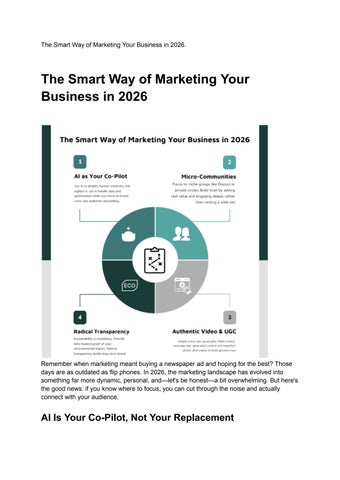
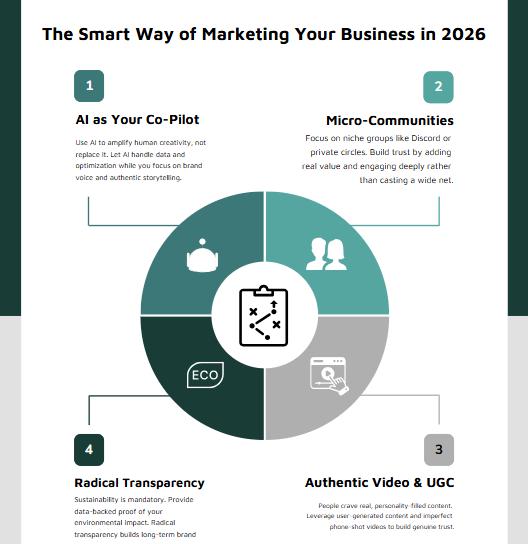
The Smart Way of Marketing Your Business in 2026
Remember when marketing meant buying a newspaper ad and hoping for the best? Those days are as outdated as flip phones In 2026, the marketing landscape has evolved into something far more dynamic, personal, and let's be honest a bit overwhelming But here's the good news: if you know where to focus, you can cut through the noise and actually connect with your audience. AI Is Your Co-Pilot, Not Your Replacement
Let's address the elephant in the room: artificial intelligence By now, you've probably seen AI-generated content everywhere on the internet. But here's what the smartest marketers have figured out AI works best when it amplifies human creativity, not replaces it.
Use AI to handle the grunt work: analyzing customer data, optimizing email send times, and personalizing product recommendations at scale. But when it comes to your brand voice, your stories, your authentic connection with customers? That's all you Your audience can spot generic AI content from a mile away, and they're craving real human insight more than ever
The sweet spot is using AI to free up your time so you can focus on strategy and genuine relationship-building Think of it as having a really efficient assistant who never sleeps
Micro-Communities Over Mass Markets
The era of casting the widest possible net is over In 2026, it's all about finding your people and going deep rather than wide Whether it's a Discord server, a private Circle community, or a niche subreddit, your ideal customers are gathering in tight-knit groups where they actually want to engage.
The brands winning right now aren't shouting into the void of mainstream social media they're becoming valuable members of these micro-communities They're answering questions, sharing expertise, and yes, occasionally mentioning their products, but only when it's genuinely helpful
This approach requires patience and authenticity. You can't fake your way into a community. But when you show up consistently and add real value, you'll build trust that no billboard ever could
Video Content (But Make It Real)
Here's a stat that should grab your attention: video content generates 1200% more shares than text and images combined But before you rush out to hire a film crew, understand this the videos performing best in 2026 aren't the polished, corporate productions of yesterday.
People want authenticity They want to see the person behind the brand Those slightly imperfect, personality-filled videos shot on your phone? They're outperforming expensive productions because they feel real.
Short-form video is still king, but we're seeing a shift toward longer formats too People are tired of being fed endless 15-second clips They're hungry for substance A well-crafted 3-5 minute video that actually teaches something or tells a compelling story? That's marketing gold
Sustainability Isn't Optional Anymore
Let's be blunt: if you're not talking about your environmental and social impact in 2026, you're already behind. But here's the catch Gen Z and younger millennials have finely tuned greenwashing detectors.
They don't want vague promises about being "eco-friendly" They want transparency, data, and proof. What's your carbon footprint? How are you treating workers in your supply chain? What percentage of your packaging is actually recyclable?
The smart marketers are getting ahead of these questions with radical transparency They're sharing the good, the bad, and the "we're working on it." Authenticity around sustainability builds trust Vague green claims destroy it
The Revival of Email (Yes, Really)
While everyone's obsessing over the latest social platform, email marketing is experiencing a renaissance Why? Because you own your email list The algorithm can't take it away from you The platform can't suddenly disappear
But 2026 email marketing looks nothing like the promotional blasts of old. It's personal, segmented, and valuable Your subscribers should genuinely look forward to your emails because they know they'll get something useful whether that's entertainment, education, or exclusive access
Think of your email list as your VIP club Treat those members accordingly
User-Generated Content Is Your Secret Weapon
Your customers are creating content about your brand, whether you're encouraging it or not. The question is: are you leveraging it?
Smart brands in 2026 have made user-generated content (UGC) a cornerstone of their marketing strategy. They're featuring customer photos, sharing testimonials, reposting reviews, and turning their happiest customers into brand ambassadors
Why does this work so well? Because people trust other people way more than they trust brands. A genuine review from someone who actually used your product is worth more than any ad you could create
Make it easy for customers to share. Create a branded hashtag. Run contests. Feature customer stories prominently And always, always credit the creator
The Bottom Line
Marketing in 2026 isn't about having the biggest budget or shouting the loudest It's about being smart, authentic, and genuinely useful to your audience. It's about meeting people where they are, respecting their intelligence, and building real relationships
The tools and platforms will keep changing that's inevitable But the fundamentals remain: know your audience deeply, provide real value, and never stop being authentically human.
The businesses thriving right now aren't the ones following every trend They're the ones who've figured out which strategies align with their values and their audience, and they're executing them brilliantly.
So stop trying to do everything Pick the strategies that make sense for your business, commit to them fully, and watch what happens when you market smarter instead of harder
One QUORA QUESTION:
How is digital marketing important for business?
Digital marketing is essential for businesses because it converts modern attention patterns and measurable tech into growth, efficiency, and competitive advantage The importance breaks down into practical capabilities that directly affect revenue, costs, and customer relationships
Why it matters
● Reach customers where they spend time: people now live online search engines, social platforms, video, messaging, and apps Digital marketing places your brand in those channels, with targeting impossible in traditional media.
● Cost-effective scaling: compared with broad offline advertising, digital allows testing at a low cost
● Precise targeting and personalization: demographics, interests, behavior, purchase intent, and first-party data let you show the right message to the right person at the right time
● Measurable outcomes and continuous optimization: every click, conversion, impression, and cost is trackable.
● Faster feedback loops and product-market fit: digital campaigns reveal demand signals quickly, guiding pricing, features, messaging, and channel priorities
● Lower customer acquisition and higher lifetime value: by optimizing funnels, remarketing, and retention tactics (email, SMS, content), businesses reduce churn and increase per-customer revenue.
● Competitive parity and defensibility: absence from digital channels cedes discovery to competitors. Building first-party audiences (email lists, CRM) becomes a defensible asset
● Global reach with local control: you can run geo-targeted campaigns to enter new markets without physical presence, then localize once traction exists.
Concrete functions of digital marketing perform.
● Customer acquisition: SEO, SEM/PPC, social ads, influencer marketing.
● Lead generation and nurturing: content marketing, gated assets, automated email sequences
● Conversion optimization: landing page testing, UX improvements, retargeting
● Brand building and awareness: content, social strategy, PR amplification, video.
● Retention and growth: CRM segmentation, lifecycle campaigns, loyalty programs
● Insights and intelligence: web analytics, cohort analysis, churn prediction, attribution modeling.
High-level implementation roadmap
1 Define business objectives and unit economics (target CPA, LTV, churn)
2. Map the customer journey and prioritize channels where the target audience spends time.
3. Set up measurement (analytics, attribution, conversion tracking, GDPR/CALOP compliance)
4 Run small experiments (ads, content formats, landing pages), measure, iterate
5. Scale winning tactics, automate retention, and build first-party data assets.
6 Continually optimize with cohort analysis, creative refreshes, and channel diversification
Common pitfalls to avoid
● Chasing vanity metrics (impressions, likes) without tracking revenue impact
● Neglecting analytics setup and attribution produces misleading decisions.
● Over-reliance on a single paid channel; risk when platforms change rules.
● Ignoring privacy/regulatory changes and first-party data strategy.
● Poor creative or misaligned messaging wastes efficient targeting
Bottom line
Digital marketing converts modern attention and data into predictable growth channels. It reduces customer acquisition waste, accelerates product-market fit, and builds lasting assets making it indispensable for sustainable business success in today’s market.