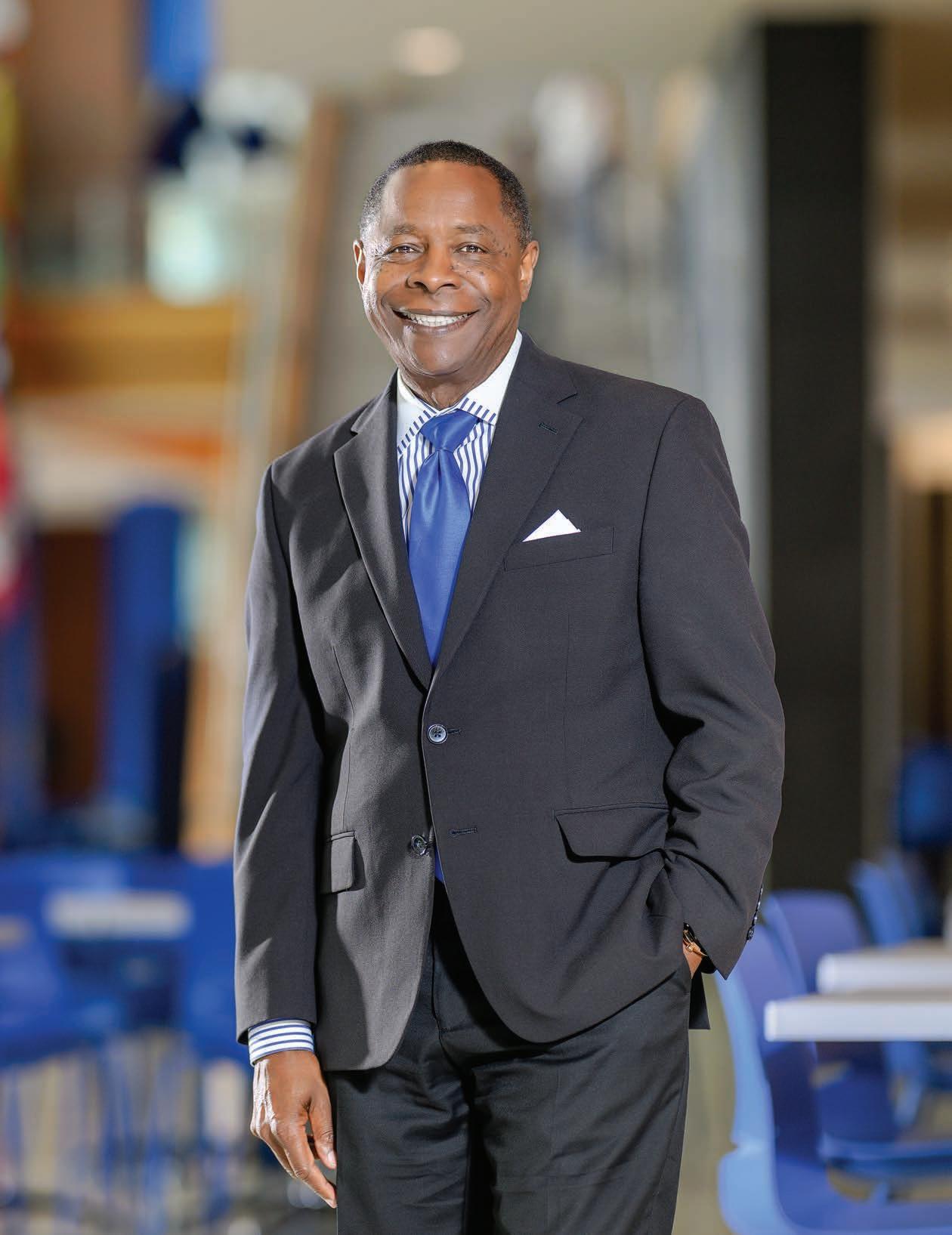
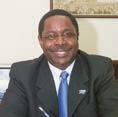
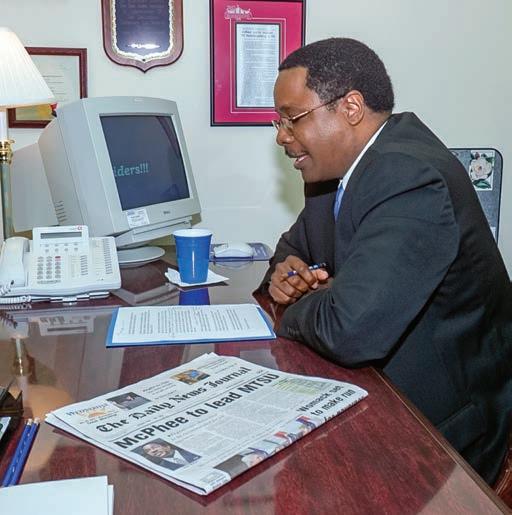
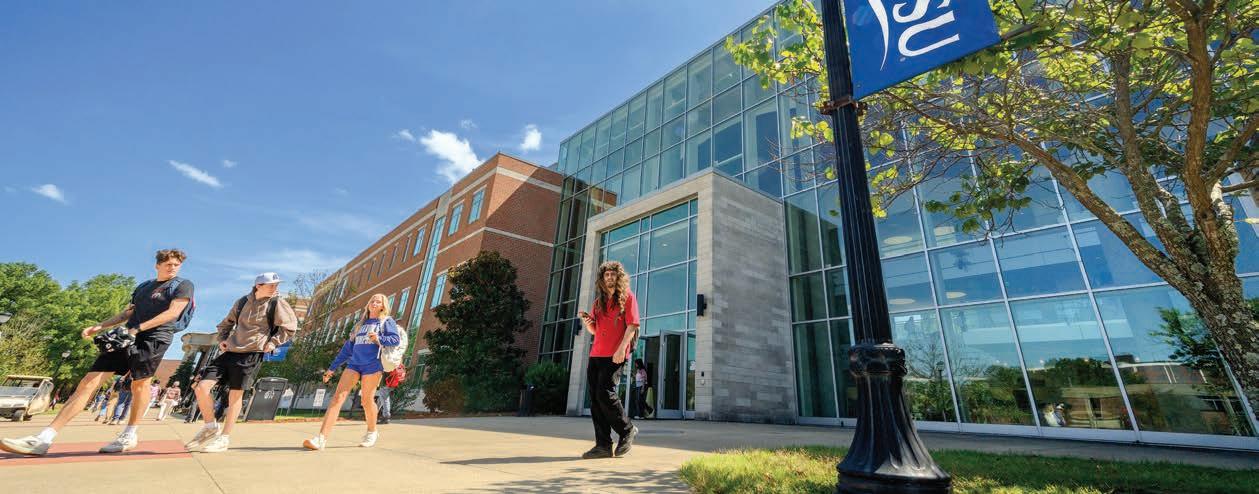
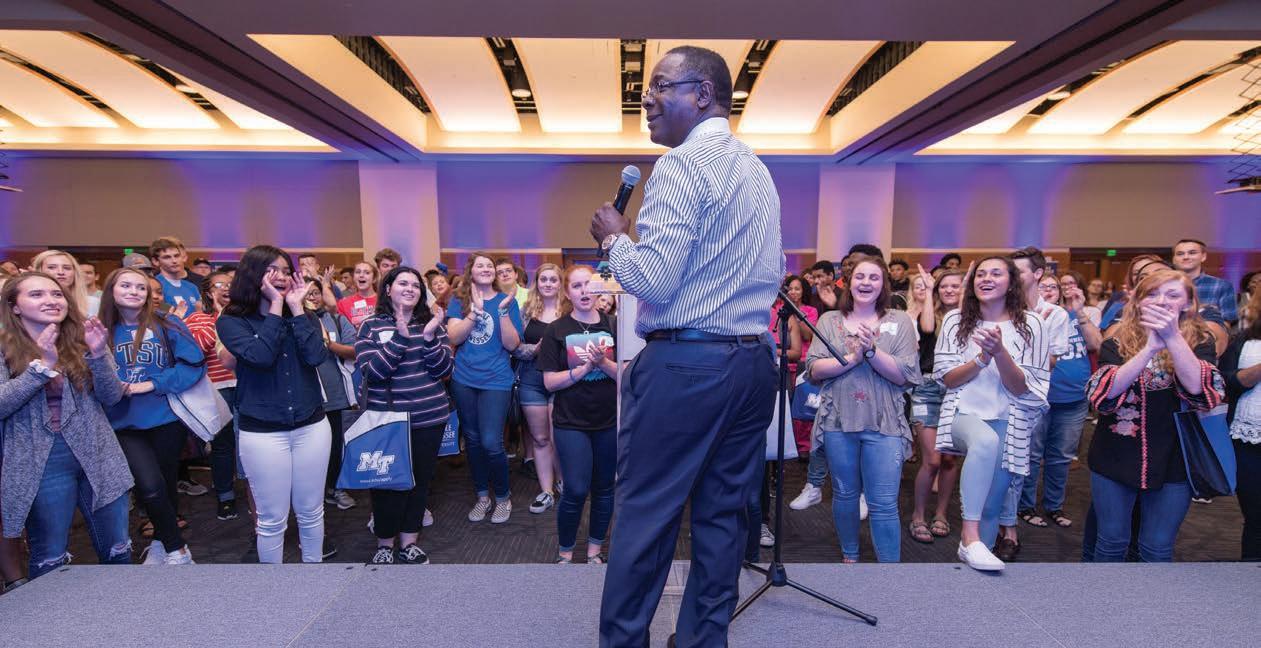
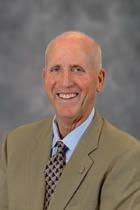
Retiring President Sidney A. McPhee reflects on a quarter century as MTSU’s chief executive officer
Middle Tennessee State University
Summer 2026, Vol. 30 No. 2
University President
Sidney A. McPhee
University Provost
Mark Byrnes
Vice President for University Advancement
Joe Bales
Vice President for Marketing and Communications
Andrew Oppmann
Senior Editor Drew Ruble
Associate Editor
Carol Stuart
Director of Creative and Visual Services
Kristy D. O'Neal
Designers
Darrell Callis Burks, Brian Evans, Micah Loyed, Brittany Stokes
Contributing Editor
Nancy Broden
Contributing Writers
Nancy DeGennaro, Jimmy Hart, DeAnn Hays, Brian Hudgins, Bill Lewis, Stephanie Wagner, and Randy Weiler
University Photographers
James Cessna, Andy Heidt, J. Intintoli, Cat Curtis Murphy
Special thanks to Lynn Adams, Brian Delaney, Ginger Freeman, Matt Posey, and Mary Purdom
Address changes should be sent to Advancement Services, MTSU Box 109, Murfreesboro, TN 37132; alumni@mtsu.edu.
O ther correspondence goes to MTSU magazine, Drew Ruble, 1 301 E. Main St., MTSU Box 49, Murfreesboro, TN 37132. F or online content, visit mtsunews.com. 137,380 copies
printed at Courier Printing, Smyrna, Tennessee.
D esigned by MTSU Creative and Visual Services.
Ceremonial Honors
0326-9158 / Middle Tennessee State University does not discriminate against students, employees, or applicants for admission or employment on the basis of race, color, religion, creed, national origin, sex, sexual orientation, disability, age, status as a protected veteran, genetic information, or any other legally protected class with respect to all employment, programs, and activities sponsored by MTSU. The Assistant to the President for Civil Rights Compliance has been designated to handle inquiries regarding the non-discrimination policies and can be reached at Cope Administration Building 116, 1301 East Main Street, Murfreesboro, TN 37132; Christy.Sigler@mtsu.edu; or 615-8982185. Also see crc.mtsu.edu.
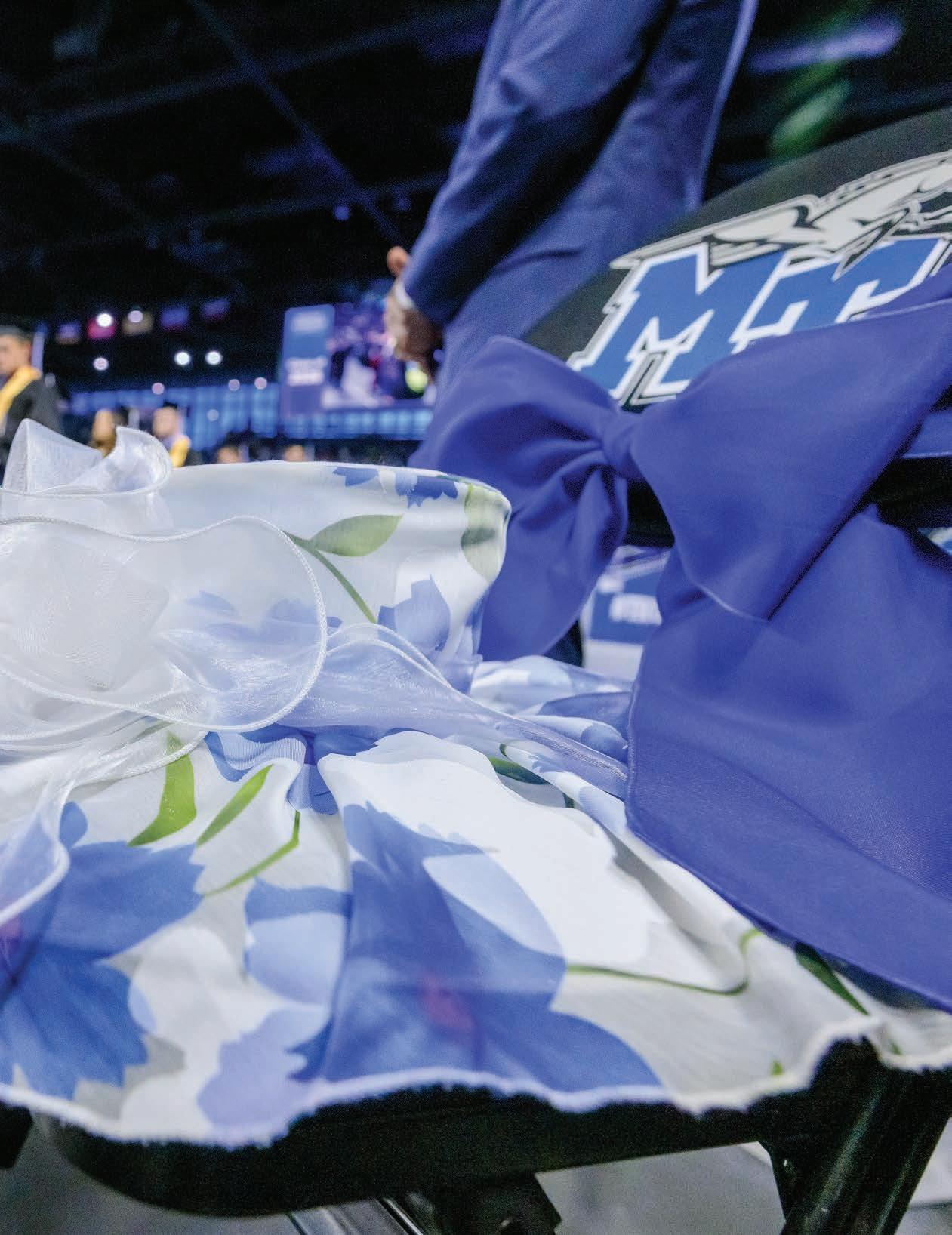
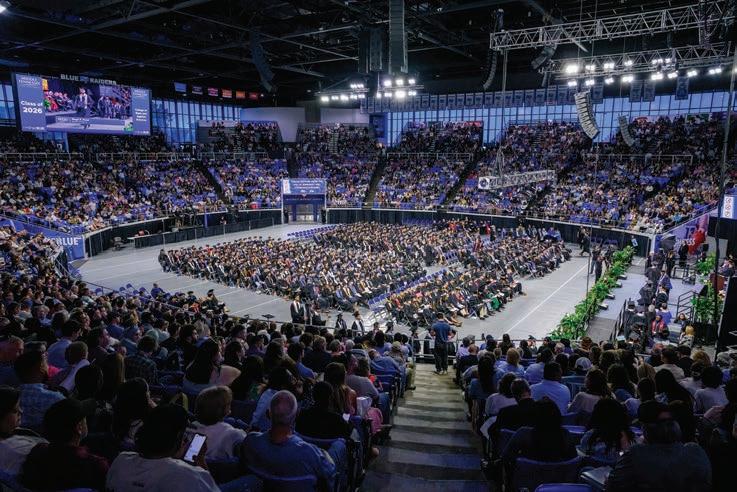
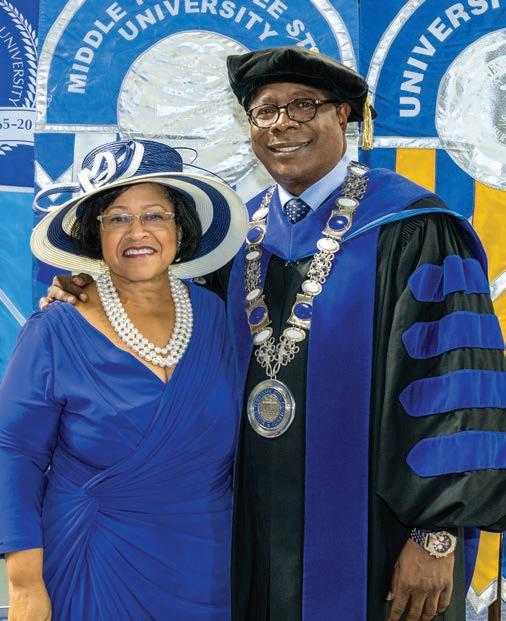
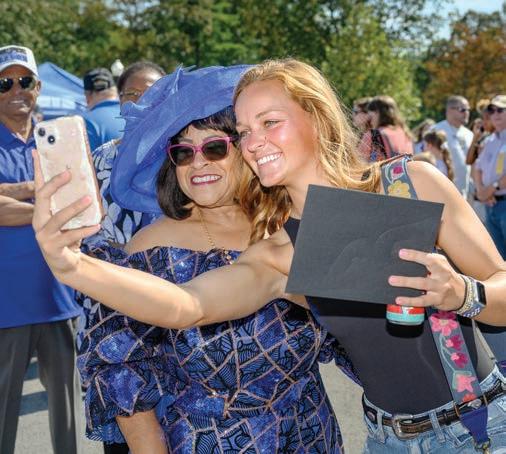
One of the signature hats of the late Elizabeth “Liz” McPhee, MTSU’s longtime first lady, rests on her traditional seat at spring Commencement (related article on page 14 ). MTSU sent another 2,566 graduates into the workplace after ceremonies featuring alumna and state Sen. Dawn White; Stuart McWhorter, deputy governor and Economic and Community Development commissioner; and music guru Scott Borchetta, who now shares his name with MTSU’s Scott Borchetta College of Media and Entertainment.
Photos by Andy Heidt
Cover photo by J. Intintoli
The MTSU community came together during True Blue Give with
• 1,600+ gifts
• supporters across 33 states Alumni, faculty, staff, students, and friends united to raise over $1.2 million in support of our students and programs. Your #trueblue impact at work:
• Scholarships are funded.
• Academic programs are strengthened.
• Student-athletes are supported.
• Critical resources remain available for students in need. Learn more about
Generation Next
Nashville music executive Scott Borchetta launched independent record label Big Machine Records in 2005. He did so with the signing of a 15-year-old female artist who had been turned down by every major record label on Music Row: the now-ubiquitous Taylor Swift.
A major financial gift Borchetta recently gave to MTSU’s storied College of Media and Entertainment—home to one of America’s top music business schools—has resulted in its renaming to the Scott Borchetta College of Media and Entertainment.
Borchetta’s donation promises to amplify MTSU’s critical role in supplying the media and entertainment industries with ready-to-work graduates and future leaders.
“When you look at how many music executives have come out of MTSU, and how many great artists and engineers and songwriters, not to mention media and production professionals, I felt it was a great place to really lift it up and make sure that the industry knows how important MTSU is to the industry,” Borchetta said, emphasizing that the college also prepares students for careers in film, television, journalism, public relations, photography, and beyond.
Asked what Borchetta saw in Taylor Swift that everyone else missed, he highlighted her clean image and stark differences from everyone else in the genre.
Such forward thinking is an essential trait of the entrepreneur, according to Borchetta.
“I think, when we’re doing this right, we’re the agents of next,” he said. “The next big thing isn’t going to be something we already have.”
Borchetta tells the story of his father, Mike Borchetta, who moved to Southern California in 1959 at the age of 19 with the promise of a job in the record business. When he got there, the job no longer existed.
Mike Borchetta knocked on every door in Los Angeles, determined to find his way into the record business. He did. Decades later, he came to Nashville as an independent promoter, then legendary record executive Mike Curb hired him in 1989.
Scott Borchetta, who imparted wisdom to graduates at one of the spring Commencement ceremonies, sees a lot of his father’s story of struggling to break into the music business playing out in MTSU students today.
“It’s still a challenge and now a challenge we can help with,” he said.
Borchetta’s career and financial commitment to MTSU are worthy of having his name forever attached to the college. But don’t expect Borchetta to get caught up in the legacy he’s creating for himself.
“That’s for other people to ponder,” Borchetta said. “I just do the work.”
—Drew Ruble
Retiring MTSU President Sidney A. McPhee reflects on a quarter century as the institution’s chief executive officer in his own words
Interview conducted by Drew Ruble
As you prepare to retire in December, how would you describe the state of the University?
After all these years leading this remarkable institution, I believe MTSU is well positioned for its next chapter, grounded in a strong mission and a clear sense of purpose. With the dedication of our faculty and staff, and the aspirations of generations of students, we have guided MTSU through an extraordinary transformation. We have strengthened our academic mission, focused on student success, significantly enhanced our campus facilities, elevated research and creative activity, and affirmed our responsibility as Tennessee’s largest locally governed university to serve the public good.
Serving as president of Middle Tennessee State University has been the great honor of my professional life. My family and I have been steadfast over the last quarter century in our love for MTSU and this community and are deeply proud of our students, alumni, faculty, and staff.
The past 25 years has awarded me and my colleagues the opportunity to guide the University through an era of incredible progress and success.
I’m extremely proud of the institution that MTSU has become.
We’ve expanded our capabilities with:
• New and innovative academic programs
• A growing research agenda that led our campus to receiving an R2 research designation—the largest public R2 university in the state and a recognition earned by only 3% of colleges and universities nationwide
• Educational partnerships across the United States and around the world
We built a service-centered educational model that’s focused on each student’s success—providing them with high-quality education and the skills they need to prosper in their chosen field.
The campus footprint has been enhanced, with more than $2 billion in state-of-the-art new and renovated facilities.
We have done so with the highest level of efficiency among higher education peers in the state of Tennessee.
In addition, the MTSU Foundation’s endowment stood at $18.4 million when I arrived. Today, total funds invested for the University have risen to $162.4 million.
These accomplishments would not have been possible without the many administrators, faculty, and staff— colleagues who have given their time and their talents over the years to strengthen and sustain our institution. Our work speaks for itself.
I especially want to thank my executive team for their leadership and their wise counsel during my tenure.
I’m also grateful for the commitment and dedication of all of our employees; the tireless support of our alumni; and especially our amazing students we have on this campus.
It has been, indeed, an incredible 25 years.
What about MTSU today makes you the proudest?
Every president of every college and university in America believes their institution is special and among the best choices for degree seekers.
I’m proud to say I can back up that claim with proof.
Our University was again included on the Forbes list of the 500 top colleges in the U.S., one of only four public institutions in the state to make the 2026 ranking, determined using 2025 data.
MTSU was also recently among 391 colleges and universities recognized among the nation’s best by
The Princeton Review, one of the nation’s leading education services companies. Only two public universities in Tennessee—MTSU and the University of Tennessee in Knoxville—made the list. Selected colleges recognized constitute only about 15% of America’s nearly 2,400 fouryear institutions. We are proud that MTSU has now made this prestigious list for the seventh consecutive year.
In addition, the Wall Street Journal recognized MTSU for the first time on its 2025 list of America’s Best Colleges— and again in 2026.
Rankings such as these have elevated MTSU’s profile across the nation and around the world. But what truly matters is what such rankings reveal: our unrelenting commitment to the individual success of each and every student in our True Blue family.
Speaking of that, I’m especially proud of MTSU’s reputation as a place where the life trajectories of our students and their families are improved.
With a total enrollment approaching 21,000 students— more than half of whom are eligible for Pell aid—MTSU’s
March 2002
Construction initiated after $2 million match met for Martin Honors Building
August 2001
McPhee becomes MTSU's 10th president
November 2002
First Ph.D. degrees approved in conversion from D.A. programs
August 2002
Convocation started as new academic year tradition
August 2004
Federal funds secured for Middle Tennessee Boulevard gateway
January 2003
Tennessee Miller Coliseum and Horse Science Center open
January 2005
Department of Art and Design and Gore Center move into renovated Todd Hall
standing as a destination of choice for first-generation students is well established, as is its long success in helping low-income students who meet admission standards overcome obstacles often posed by tuition and fees.
By doing this, the University has created generational change. U.S. News and World Report consistently ranks MTSU among the top 100 in the nation for Social Mobility—a measure of the movement of individuals or groups up or down the socioeconomic ladder, relative to their parents, or over their own lifetime, involving changes in income, education, occupation, and social class.
What do you believe is the most significant academic achievement of your tenure?
When I arrived as the 10th president of MTSU in 2001, MTSU was already a well-respected regional institution. It also held untapped potential for growth in academic excellence, innovation, and community impact.
Since then, MTSU has grown to become a nationally recognized academic leader in many areas.
My presidency has focused on purpose, not just growth. Each new building, expanded program, and strategic partnership I hope and believe have demonstrated my belief in higher education’s transformative power and in MTSU’s power to transform the Nashville area for the better.
The University has grown to include seven academic colleges, along with the Honors College and College of Graduate Studies. MTSU now offers more than 200 undergraduate majors and concentrations, over 100 master’s and specialist degree programs, and nine doctorates across 38 departments and schools. The University has raised admission standards, increased enrollment of high-ability students, and introduced more than 50 academic programs, two new colleges, and 20 institutes and centers.
June 2005
500-acre Guy James Farm purchased for agriculture programs
July 2007
University College creates pioneering adult degree program
January 2007
$5.5 million expansion of Cason-Kennedy Nursing Building completed
August 2008
August 2009
Ranked 57th and only Tennessee university in Forbes’ top 100 public institutions
$20 million expansion to Rec Center includes student health clinic
August 2011
“I am True Blue” pledge and core values initiated
August 2010
College of Behavioral and Health Sciences created for service disciplines
One major change that occurred during my tenure was the rise of online education. MTSU Online now offers more than 80 fully online degree options. These programs respond directly to workforce needs and provide new opportunities for students seeking flexible pathways to advance their education and careers.
When I get a chance to personally meet prospective students, I am confident in telling them that if they come to MTSU, they will get the attention of faculty and staff that they will need to be successful in college.
I strongly believe in the value of applied knowledge— merging classroom knowledge with real-world work environments through experiential learning initiatives.
A classroom for MTSU students may be behind a camera at Bonnaroo, adjusting a robot at the Nissan manufacturing facility, helping patients on an underwater treadmill, combing an archaeological dig, or assisting veterans with equestrian therapy.
Our commitment was always to provide students with an education that is rigorous and relevant. Student success has always been my No. 1 priority. And through the years,
I am proud to say that we have established a number of proven strategies to boost our students’ ability to persist to graduation.
Talk about the tremendous growth of campus over the past quarter century.
With major investments in capital improvements during my tenure, MTSU is better positioned to meet middle Tennessee’s workforce needs.
Take as just one example: The University’s new $74.8 million Applied Engineering Building opened on campus in 2025. Explosive growth in programs, especially Mechatronics Engineering, was central to MTSU’s decision to build the 89,000-square-foot engineering building. It sits next to the School of Concrete and Construction Management, a $40.1 million, 54,000-square-foot facility that opened three years previously.
This state-of-the-art engineering facility—equipped with millions of dollars’ worth of advanced technology—will forever change the way our students learn and our faculty teach. More than just a new building, it represents an investment in Tennessee’s future workforce and a
(continued on page 12)
Sept. 11, 2011
University celebrates century of service
September 2011
$30
September 2012
$65 million, 211,000-square-foot Student Union opens
April 2013 Former
July 2013
MT Athletics joins Conference USA after winning 5th straight Sun Belt all-sports trophy
October 2013 Quest for Student Success initiative launched, resulting in higher retention and graduation rates
Stephen B. Smith, MTSU Board of Trustees chair, thanks President Sidney A. McPhee in his
own words
Dr. McPhee is MTSU’s longest-serving chief executive. He presided over $2 billion in new construction, renovations, and improvements. The campus we enjoy was shaped by his team’s vision and persistence.
Perhaps the most transformative of all of those is the Science Corridor of Innovation anchored by the renowned Science Building and supported by the complete renovation of two nearby science buildings, plus construction of new facilities for Construction and Concrete Management and Engineering Technology. Not to mention the $73 million expansion project under way in Shelbyville for our state-of-the-art Aerospace program.
And that’s just the tip of the iceberg.
Academically, he’s overseen the creation of almost 50 new graduate and undergraduate programs, two new colleges, and more than 20 institutes and centers.
He’s led our University through many challenges, including COVID, where we were viewed as a model for operational safety and caring for our students.
During the hard budget years, he readjusted University priorities to meet the biggest challenges caused by declines in appropriations.
He deftly navigated the creation of free community college in Tennessee. What could have been a disaster was really just a little chop on the water as we pivoted to transfer student recruitment and other enrollment strategies.
We currently graduate more students for less money per graduate than any other public university. That doesn’t just happen. It happens because you had a leader at the top making sure that the building was square.
We’re still the largest institution among Tennessee’s LGIs (locally governed institutions). We’re the No. 1 provider of college grads in the greater Nashville-area economy. We’re a top choice for first-generation college students, transfer students, and adult learners, of which I myself was one.
Through the creation of the Charlie and Hazel Daniels Veterans and Military Family Center, we’re well known and highly recognized nationally for our service to military-connected students.
Our devotion to student success—advising, as well as increasing persistence and progress of our students toward graduation—is a national model.
We’re also on the top tier in the nation of both public and private universities for our graduation rate of studentathletes, which is a remarkable achievement, all done because he made it a priority.
Sidney and his late wife, Liz—they’ve given so much to our school over the past quarter of a century.
We’re grateful for his devotion.
March 2014
$16 million Student Services and Admissions Center opens
November 2015
Veterans and Military Family Center opens (later named for Charlie and Hazel Daniels)
August 2014
250,000-square-foot Science Building opens as centerpiece of $147 million in new and renovated science facilities
March 2016
Blue Raiders upset No. 2 seed Michigan State in NCAA tourney
February 2016
$105 million final tally for Centennial Campaign
December 2018
Regional Scholarship Program extended to 8 bordering states
April 2017
MTSU Board of Trustees installed under new local governance
commitment to innovation in engineering, technology, and advanced manufacturing.
Clearly, we are committed to providing our students with the latest, cutting-edge technology and resources to ensure they’re well prepared for the in-demand jobs this facility will train them to do.
As another example, in 2021, MTSU announced plans to relocate its flight training program from the landlocked Murfreesboro airport to Shelbyville, where significantly more space is available for growth. The project officially broke ground in 2025 with a total anticipated cost of about $130 million for all phases. By the time the project is completed in 2028, MTSU’s Aerospace facilities will span approximately 16 acres at the Shelbyville airport, marking a significant milestone for the University’s aviation program.
How has MTSU helped transform the Nashville-area economy?
Students enrolled at MTSU today represent the future workforce for the regional economy.
MTSU today produces more graduates than any other local university—close to 5,000 each year. One in every six college-educated individuals in the greater Nashville area holds an MTSU degree, making us the No. 1 provider to the region’s workforce.
In all, MTSU has more than 70,000 alumni across greater Nashville. Our alumni run companies. They teach our children. They win Grammys! They cure diseases. They create, innovate, and succeed.
MTSU alumni, including alumni-owned businesses, generated more than $15.2 billion in business revenue in the state over the course of a year, as measured in 2024. Rutherford County alone recorded over $4.1 billion, the highest among all counties. The Nashville metropolitan statistical area (MSA) had a total of $11.3 billion. These findings underscore the tremendous and positive, multibillion-dollar economic impact made by our alumni in Tennessee. Most of our graduates remain in our state,
adding to the workforce, paying taxes, starting businesses, and contributing to our communities.
I’m proud of our many degree programs developed with industry partnerships or in response to workforce needs. But let me also state that we are equally proud of the broad-based education we provide our students in the arts, humanities, and sciences. MTSU values the worth and benefit in helping Tennesseans think critically, broaden their horizons, understand different cultures, and appreciate the beauty, elegance, and nuances of the world beyond a specific vocation. As such, we prepare careerready graduates who also can reflect, analyze, compare, and understand—and, in doing so, become engaged citizens of our state.
Give us your final thoughts on your tenure at MTSU.
I most certainly didn’t do it alone. I want to thank all of the supporters of MTSU for their tireless efforts through the years. By working together, we created opportunities that benefited everyone, from students and alumni to local businesses and residents.
I would also be remiss if I didn’t mention that I never could have had the success or happiness in my years at MTSU if it wasn’t for the presence of my wife, Liz McPhee, who sadly passed on Jan. 8, 2026, following a brief illness. The first lady was beloved by our University community. Her devotion to MTSU over the last quarter century, combined with her career as an educator and her tremendous impact as a volunteer for numerous charitable causes, enhanced the lives of thousands in our city, state, and beyond. I am beyond grateful to the MTSU family for making our lives together so wonderful and so meaningful. We are the ones who are truly indebted to all of them for their kindness and friendships throughout the many years.
Oh, and one last thing. If you see me on campus, please come up to me and say hello! I will be a faculty member in the College of Education as a tenured professor after a two-semester sabbatical to retool.
August 2019
March 2020
University shifts to remote learning to manage COVID-19 pandemic
August 2020
Ranked in Princeton Review’s Best Colleges in U.S. for 1st time
January 2022
Elevated to Carnegie elite R2 status (high research activity)
$39.6 million Academic Classroom Building opens; MTSU resumes in-person operations
November 2022
1st students from MTSU-Meharry early acceptance program reach medical school
October 2022
$40.1 million Concrete and Construction Management Building opens
September 2023
$73.4 million Aerospace initial project announced for Shelbyville airport
March 2025
M.S. in Legal Studies announced in partnership with Nashville School of Law
August 2024
First cohort graduates from Physician Assistant Studies master’s program
August 2025
Major financial gift leads to renaming as the Scott Borchetta College of Media and Entertainment
July–August 2025
$74.8 million Applied Engineering Building and $66 million Stephen and Denise Smith Student-Athlete Performance Center open
April 2026
Construction begins on new public-private housing complex and parking garage
November 2025
World-class center launched for Quantum Research, Interdisciplinary Science, and Education
July 2026
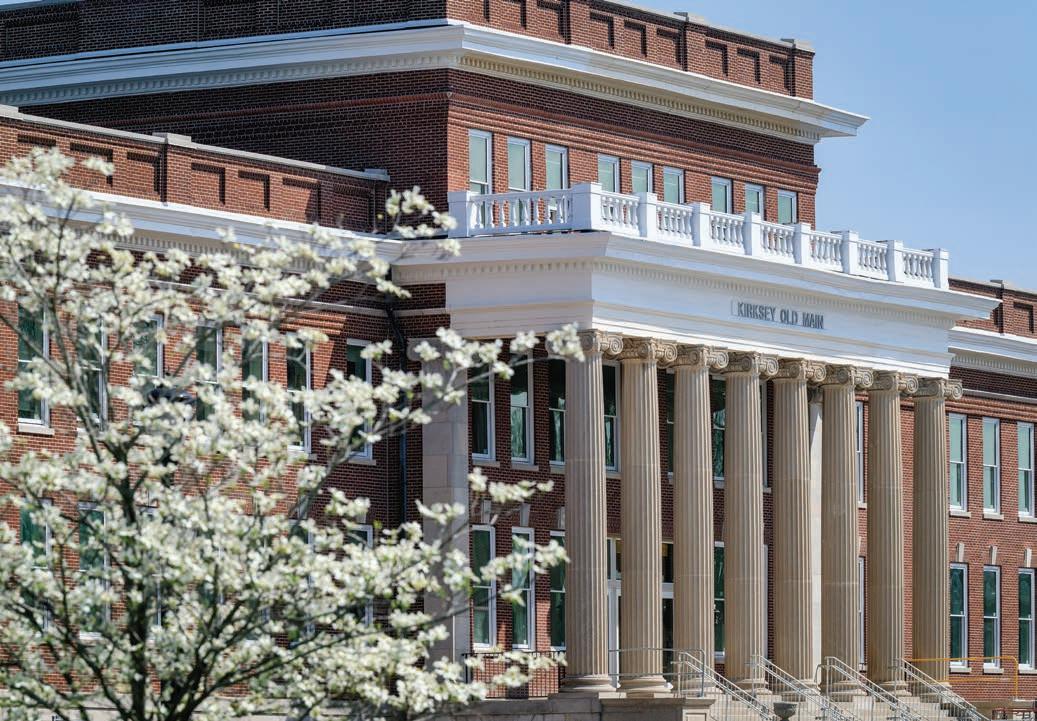
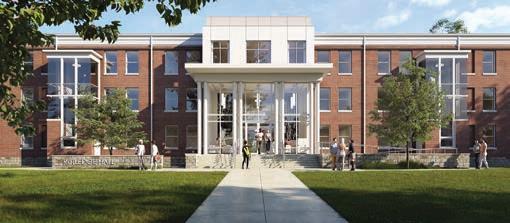
Renovations completed on two original buildings, Kirksey Old Main and Rutledge Hall
The late first lady of MTSU, Liz McPhee, was living proof that “behind every great man is a great woman”
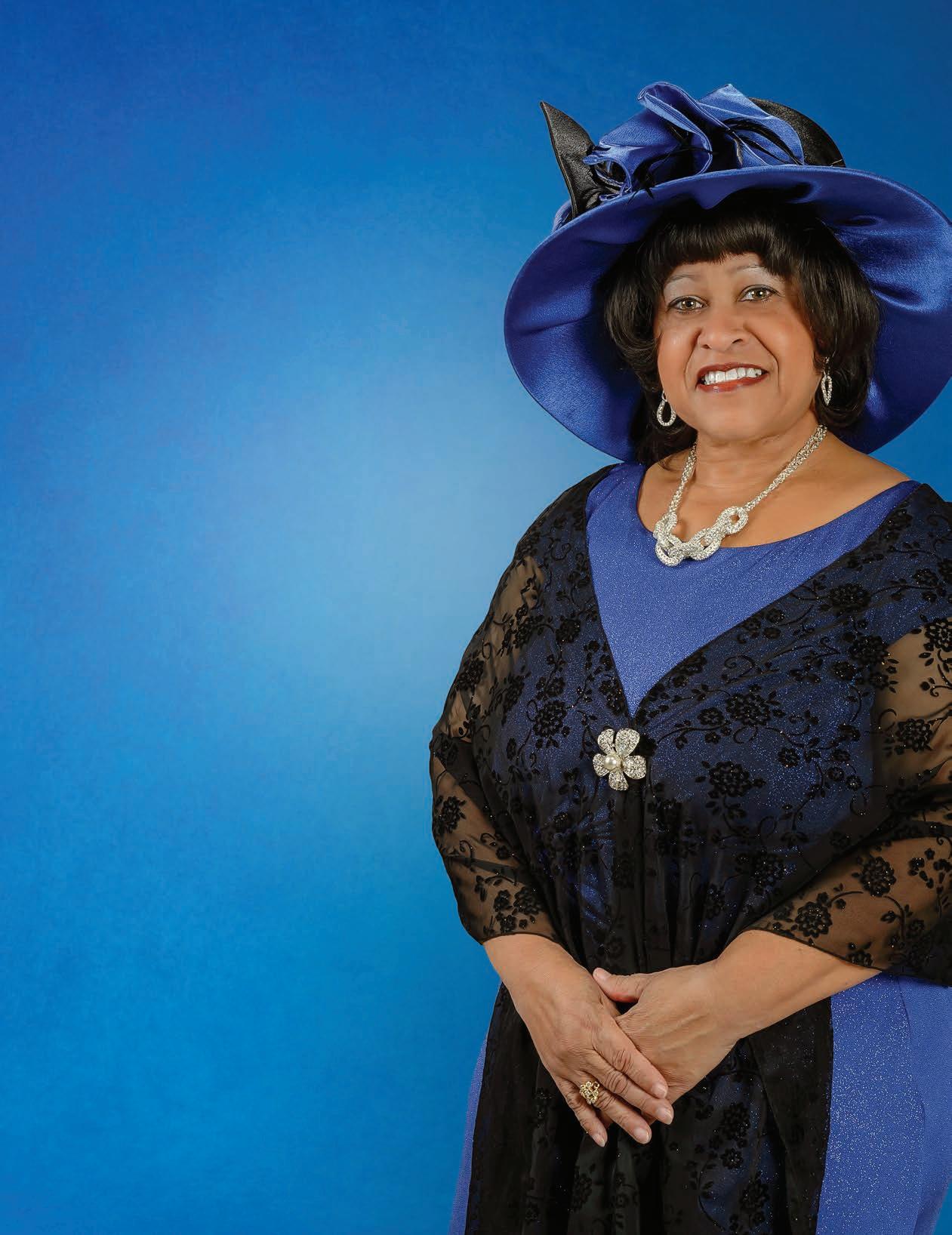
Elizabeth Lorenza “Liz” McPhee, the late first lady of MTSU, was known for her tireless work as an educator, volunteer, and fundraiser for charitable causes.
Working alongside her husband of 45 years, Sidney, throughout his quarter century as MTSU’s president starting in 2001, she was an advocate, supporter, and mentor to generations of University students, faculty, and staff. She died Jan. 8, 2026, at age 72 following a brief illness.
Known for her fashion sense and love of stylish hats, the MTSU first lady was highly visible and strongly engaged on the Murfreesboro campus, often serving as the patron and planner for activities, fundraisers, and events at the University, and with her sorority, Alpha Kappa Alpha.
Born on Feb. 22, 1953, McPhee was the fourth child of four children born to the late Antone and Alice Cooke in Houston. She graduated from Prairie View A&M University in Texas, where she met her husband, earning a Bachelor of Arts degree in Education with a minor in Art. She later completed graduate work at Oklahoma State University and the University of Louisville.
McPhee was loved and admired by scores of elementary students she taught during her almost 40 years as an educator in public schools in four different states. She retired in May 2014 after serving as a third-grade teacher for Reeves-Rogers/Discovery School in Murfreesboro.
She once told VIP Murfreesboro that she considered her work at MTSU as first lady part of her life’s plan.
“People used to ask me how I was able to teach full time, often being the first one to the school in the morning, and attend all of the dinners and late-night meetings with Sidney,” she said. “I’d say that’s just part of the plan.”
President McPhee said his wife accomplished so many other initiatives behind the scenes that never got attention. As just one example, he cited the dining etiquette training classes she routinely helped conduct for local elementary school students, underprivileged high school students, sorority members, and others. According to the MTSU president, it was not uncommon for him to come home
after a long day in the office only to find his house and dinner table full of children or young adults learning social graces from his wife.
“She really had a greater social impact on this community than I did,” he said.
The Bradley Academy Museum and Cultural Center honored McPhee as an exceptional elementary school teacher, while Delta Sigma Theta’s Rutherford County Alumnae Chapter recognized her for her international travels and outreach. She and her husband were honored by the Murfreesboro City Schools Foundation at its 2014 Excellence in Education Celebration and by the NAACP Murfreesboro chapter with its 2022 President’s Award.
In addition to her work with Alpha Kappa Alpha and Delta Kappa Gamma, McPhee attended Belle Aire Baptist Church and was actively involved with Murfreesboro’s Dr. Martin Luther King Jr. Scholarship Board; Ascension Saint Thomas Rutherford Foundation Board; and the Murfreesboro City Schools Foundation Board. She also served on the boards of the Murfreesboro Domestic Violence Center and the Arts Center of Cannon County.
Blue Raider Athletics in 2024 presented her with its first Blue Raider Impact Award in recognition of her work and advocacy for student-athletes. On the day she died, the first lady was working on a charitable event she was planning for MTSU women’s golf and soccer.
Most recently, the American Association of University Women Murfreesboro selected McPhee for its 2026 Tempest award, given for addressing systemic barriers to equity for women and girls. This award and the MTSU Student Government Association’s Generosity Charge Award both have been renamed in her honor.
Her hat collection was her signature style. She once told the Murfreesboro Post that it all began when her husband took her to meet his mother in his native Bahamas.
“He told me I needed to buy a hat to wear to church. He said his mama wouldn’t approve of me going to church without a hat. So I bought a hat. Then I decided to buy another one in case that one wasn’t right,” she said.
McPhee is also survived in her immediate family by her son, Dr. Sidney-Anthony McPhee, and daughter, Dr. Seneca Ann McPhee, who both earned degrees at MTSU; adopted son, Trantell “Tweety” Knight; and grandchildren, Asiah Ray Menke, Langston Anthony McPhee, Naomi Grace McPhee, and Nyla Jade McPhee.
Elizabeth “Liz” McPhee 1953–2026
the Way
MTSU’s talented corps of research professors
quash stereotypes
by Brian Hudgins, Drew Ruble, and Stephanie Wagner
Say “academia” and people conjure tweed-jacketed, graying professors musing stodgily in their ivory towers.
Think again.
Professors today, and specifically at MTSU, come from diverse backgrounds bearing unique inspirations and life experiences.
Profiled here are just a few current MTSU faculty members who defy the professorial trope.
That their scholarship and research positively influence Tennesseans and improve the overall image of higher education, well, that’s just icing on the cake.
Serving It Up
Liz Barnes traveled an unlikely path from Denny’s waitress to a national role in demystifying science
Liz Barnes, an associate professor of Biology, dropped out of high school and moved away from home at 16 years old. Her mother was a single teenager when Barnes was born—and Barnes’ mother later struggled with addiction to prescription painkillers.
Barnes took a full-time job as a waitress at a local Denny’s to financially support herself during her own teenage years.
“But a couple of years after that, I knew I wanted to do something different than wait tables,” Barnes said.
She discovered she could enroll at Glendale Community College in Arizona without a high school diploma or even an equivalency.
That’s where she discovered her affinity for science.
Considering her childhood had been chaotic and lacked structure, Barnes said science gave her a path to make sense of the world.
“I felt like I could know some things with a level of certainty, whereas before, I felt like there wasn’t a lot of truth in my life,” she said.
Barnes achieved excellent grades, eventually transferred to Arizona State University, and completed her undergraduate, graduate, and doctoral studies.
During that time, she landed a prestigious National Science Foundation (NSF) graduate research fellowship (early CAREER grant), one of the most well-known and highly sought-after grants for pre-tenured faculty across the country. Awarded to Barnes in 2023, it amounted to a five-year, $1 million grant to pursue research—a dream come true that Barnes said she never could have imagined earning as a high school dropout.
Upon completion of her doctorate, Barnes joined MTSU because of the presence of Michael Rutledge, a prominent evolution education researcher, on the Biology faculty. Tennessee’s rich history in evolution education also intrigued Barnes. The State of Tennessee v. John Thomas Scopes, better known as the 1925 Scopes Monkey Trial, centered on Scopes’ being accused of violating state law by teaching evolution.
Barnes’ background is an inspiration to her students. Similar to Barnes, MTSU’s student population is made up of many first-generation and low socioeconomic status students.
Barnes’ ability to relate connects well to her research specialty on science communication.
Barnes is fast becoming a national expert on efforts to remove heavy jargon that makes science feel mysterious, complicated, or out of reach and to bridge the gap between scientists and society, thereby building trust in science.
According to Barnes, the scientific community can’t expect the public to deeply engage with critical yet contentious science issues like climate change or vaccine safety if they have to first overcome an insensitive or condescending delivery.
Barnes recently earned a $75,000 NSF grant to help develop a national Science Communication Education Research Network. (In all, Barnes’ ever-expanding catalog of research totals over $3 million in funding from multiple prestigious grants.)
It’s an impressive résumé for a high school dropout.
—Brian Hudgins, Drew Ruble, and Stephanie Wagner
Where Worlds Collide
Hanna Terletska leads MTSU’s Big Blue push into quantum physics
When MTSU Associate Professor Hanna Terletska was growing up in the town of Drohobych in rural west Ukraine, physics piqued her interest early, leading her to pursue an undergraduate degree in the field at the local university. That served as her introduction to a distinct new world she would go on to spend immense hours pondering—where a quantum particle has properties of both a solid and a liquid simultaneously.
The first-generation college student—no one in her family was particularly good in physics or went to college—is now a nationally recognized quantum scientist.
At MTSU, Terletska’s quantum computing research is funded by $5.5 million from the National Science Foundation (NSF) and Department of Energy (DOE). And she collaborates with scholars from places like Carnegie Mellon University, Oak Ridge National Laboratory, and Augsburg University in Germany, using access to the world’s most powerful computers to research quantum materials that hold the promise of new-generation technologies that mimic time travel—or, at least, particles reacting simultaneously in two places at once.
Terletska describes the discovery of new materials as “a cornerstone of human civilization and development.”
This includes quantum computers capable of solving complex problems in minutes, problems that currently take years to solve, as well as highly efficient solar cells and roomtemperature superconductors that would generate, transmit, and store electricity with almost no loss. Hence, conquering the behavior of quantum materials can, among other benefits, bolster economies, advance quality of life, and address the unprecedented growth in global energy needs.
Getting from science fiction and fantasy to this new reality requires reinterpreting the math and learning new physics. It also requires teaching it to a new generation of scholars.
That’s another area where Terletska and MTSU are excelling: the need to educate people on how to use this new type of science—the basic rules of quantum mechanics that lead us to be able to do this kind of processing.
To bring about this needed change in curriculum, MTSU in 2023 launched the MTSU Quantum Science Initiative, which focuses on scientific research but also educating a future workforce ready to tackle the new realities of futuristic computing and becoming a leader at “training the trainers” so other institutions can fast-track the teaching of this new-age thinking.
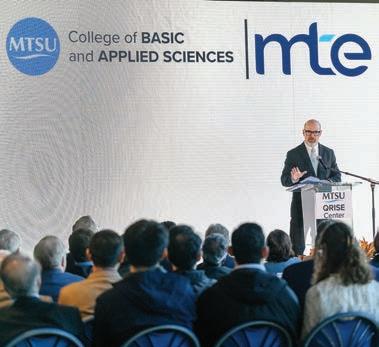
Most recently, Terletska’s presence and MTSU’s dedication to quantum education resulted in the creation of MTSU’s Quantum Research, Interdisciplinary Science, and Education (QRISE) Center, a world-class hub for advancing quantum discovery, innovation, education, workforce development, and economic growth, consolidating MTSU’s quantum efforts.
With Terletska leading the charge, MTSU has in a short period of time made a quantum leap in quantum science.
Brian Hudgins and Drew Ruble
Small Town, Big Dreams
Chaney Mosley wields a lifetime of experience to help farmers
In high school, Chaney Mosley’s senior class consisted of 32 students.
That small-class environment in Rutherford County was the first step in a journey that now sees Mosley, associate professor in the MTSU School of Agriculture, mentor agriculture students who often pursue careers in wide-open spaces.
As a student at MTSU, Mosley’s penchant for varied interests extended beyond the classroom.
He served as a captain for the University cheer team in 1999–2000, which enabled him to witness the student experience in numerous sports arenas throughout the South and beyond.
President of the Student Ambassadors, as well as president of the MTSU Agricultural Council, Mosley earned MTSU’s most prestigious student award, the President’s Award, given to a student recognized as a campus leader and who has made significant contributions to the University community.
“I loved this place as an undergraduate,” Mosley said.
After graduation, Mosley secured a high school teaching job. But following the 9/11 attacks in September 2001, Mosley felt called to duty. When the school year ended, he joined the U.S. Army.
“I didn’t tell anyone. I just did it without anyone knowing it,” Mosley said, describing his reasoning as “a lot of patriotism, a lot of passion.”
Mosley spent the next two years on active duty before returning to MTSU to finish his master’s degree, which he did in 2004. (In all, Mosley served 15 years in the military, including many years in the Tennessee Army National Guard.)
He next pursued a doctorate in agriculture education at Virginia Tech University, completing that degree in 2012. That led him to a job at the Tennessee Department of Education that involved working in career and technical education (CTE), courses offering specific academic and technical skills to better prepare students for work in hands-on careers such as agriculture.
He’d found his calling. Since then, Mosley has gone on to become a national leader on career and technical education— involved in the funding, research, and publication of over 45 articles on CTE and workforce development.
He returned to teach at his alma mater, MTSU, in 2017.
Mosley’s research includes studies of mental health and stress in the rural or agricultural community.
“Of the top 10 career fields with the greatest risk of suicide ideation or contemplating death by suicide, veterinarians and farmers are in there,” Mosley said. “There’s also a negative stigma associated with mental health and suicide that persists in rural areas. . . . Farmers, farmworkers, and families who are experiencing a crisis might refuse to seek help because of that stigma. That is another aspect—another layer—that is not associated with every career field.”
Brian Hudgins and Drew Ruble
Block by Block
Kevin Bicker is building potential drug compounds to battle deadly infections
Seventeen years of organized soccer—from youth leagues to his college senior year—had Kevin Bicker on track to become an orthopedic surgeon.
“I had a lot of experience with orthopedic surgeons,” Bicker said. “I was an athlete. Seeing the doctor due to injuries, I enjoyed the sort of work they were doing. So I connected with a surgeon.”
Bicker shadowed some orthopedic operations for an occupation he considered the “construction worker of the medical field.” During his junior and senior years of high school, Bicker was fascinated by knee and shoulder surgeries. He even sat in on his mother’s carpal tunnel surgery.
An advisor at Bluffton University in Ohio, a small Mennonite school where Bicker competed in college soccer, offered a new plan. Bicker could double-major in biology and chemistry. He would have all the electives he needed for pre-med, but he could do a lot of different things if he changed his mind.
“Then I got into organic chemistry, and I fell in love—which doesn’t happen for a lot of people,” Bicker said. “I realized . . . I really wanted to be a professor and teach.”
As a graduate student at the University of South Carolina, Bicker’s initial research revolved around peptide libraries— collections of similar molecules.
Bicker likens such libraries in chemistry to Lego towers, changing out some molecules in the chemical group being similar to changing colors in a stack of the building blocks for different combinations.
Bicker’s early work centered on coming up with either cancer treatments or diagnostics.
He followed up grad school by moving to south Florida to take a postdoc position at the Wertheim UF Scripps Institute, now part of the University of Florida system. There he studied enzymes—proteins responsible for various body functions.
Bicker’s top focus was enzymes that are related to body inflammation or autoimmune diseases.
“I was working on developing molecules that could block the activity of those enzymes,” Bicker said. “They shut down things such as rheumatoid arthritis, cancer, and lupus.”
Once hired at MTSU, he set up a lab and started working on trying to develop anti-infective peptides—combating infections caused by things like bacteria, a fungus, or a virus.
Bicker’s lab can create 50,000 to 100,000 peptide molecules per day. Manually testing that many is impossible. So how does the lab prevent a massive gap between molecule production and testing? Enter high-throughput screening.
“Screening or interrogating these libraries in a quick way— we developed a technique,” Bicker said.
The high-throughput screening technology developed in Bicker’s lab is patented for use specifically by MTSU. It is not something every pharmaceutical company has in their respective laboratories.
Over the next three to five years, Bicker hopes to have some leads on new medicines to treat nasty infections out in trials.
Odds are good Bicker will eventually score his goal.
—Brian Hudgins
Winding Down
Karen Tan explores the dark side of vacations
Karen Tan, an assistant professor in MTSU’s Tourism and Hospitality Management program, grew up in Singapore and worked professionally in tourism and hospitality for a decade.
“Singapore is a tropical island close to the equator. It has two seasons—hot and hotter,” Tan joked. “I have used up my entire lifetime quota of hot temperature. My favorite season now is actually winter.”
After Tan earned her bachelor’s degree at the Nanyang Technological University in Singapore, she embarked on a career that called upon her to handle consultancy projects all over Asia-Pacific.
The travel and living requirements took her to exotic locations in China, Indonesia, and Japan, among other countries. She experienced diverse cultures and enjoyed interacting with diverse people.
But after she received her doctoral degree from Temple University in Philadelphia in 2022 and became a professor, Tan began conducting what might best be described as counterintuitive academic research on travel.
Most existing research emphasized a similar theme—the positive psychology, experiences, and restoration of travel.
Tan wondered about a different aspect of travel and tourism . . . the difficult moments.
“When you are a tourist, you still experience negative emotions when traveling,” Tan said. “Like when you experience plane turbulence or when you experience bad service. . . . I was actually surprised there was very little research on the dark side of travel—negative emotions in tourism and hospitality.”
Tan’s research has also centered on the sizable number of employees who feel they do not dare take paid time off for vacations, even though it is a job benefit they have earned.
Surveys conducted by the Robert Walters Group, a global talent solutions provider, found that 74% of U.S. professionals experience feelings of anxiety when using their personal time off (PTO), diminishing the down time.
To help lessen their anxiety, 66% of U.S. workers engage in “firefighting” tactics—doing tasks such as checking work emails—to help reduce the backlog they face upon returning to work, and 28% do so to stay on top of urgent matters.
Tan warns that the consequences of overworking are not confined to anxiety and feelings of letting the team down.
Karoshi, a term tied to overwork in Japan, refers to death from overwork. Strokes, heart attacks, and mental health struggles leading to suicide are a few ways a high-stress work environment can lead to fatal outcomes.
For those employees who do break away, what is Tan’s advice for ultimately breaking the cycle of vacation anxiety?
Tan said it comes down to a very raw and personal decision in terms of what you want as an individual.
“Do you want that recognition at work, or would you rather have the strong mental health with family time with loved ones? The choice is really yours.”
—Brian Hudgins and Drew Ruble
Jan. 30–Feb. 1
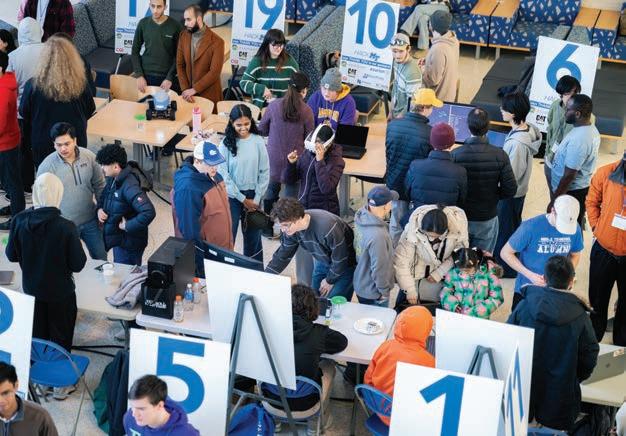
Techie takeover setting record at 11th HackMT
March 6–7
Dazzlin’ display of horseback skills at Lone Star Rodeo
Feb. 4
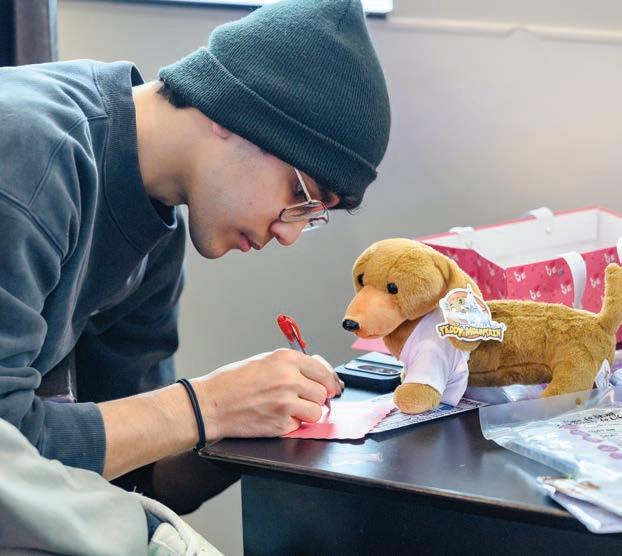
Building a basket at stuffed animal station for Valentine’s
April 29
GloRilla gives “Glorious” concert for students
Feb. 26-March 1
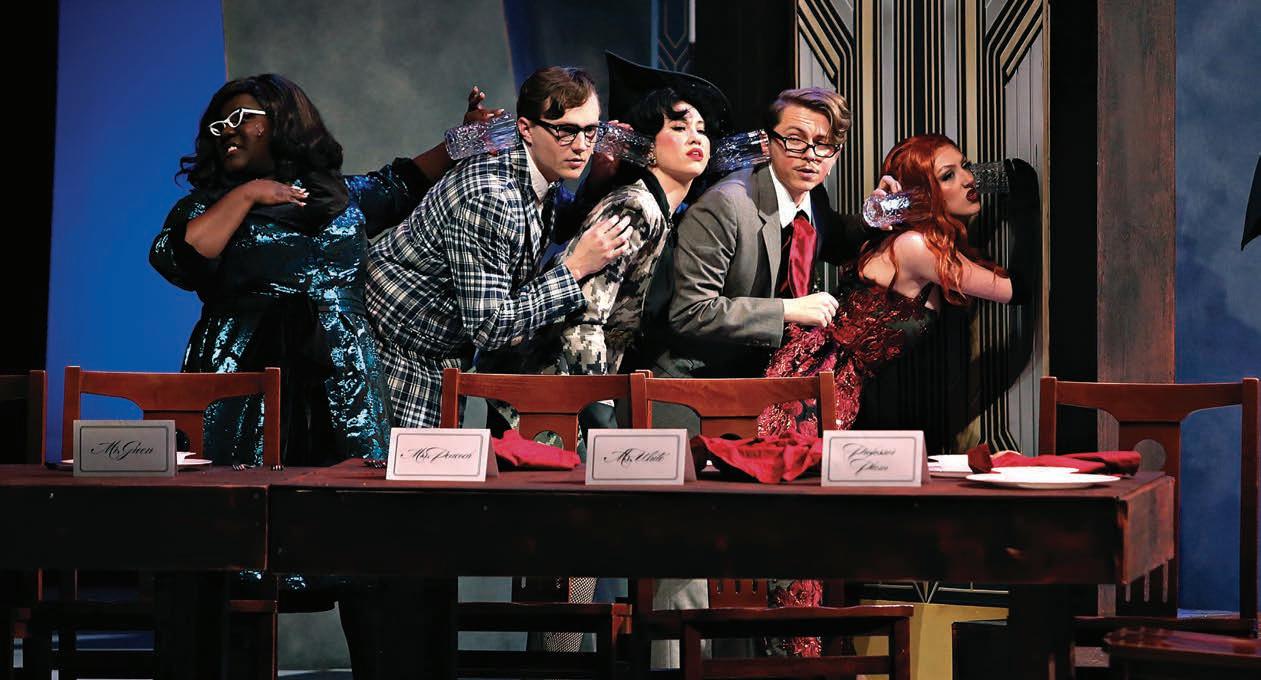
Murder mystery gametime with Clue: On Stage
Feb. 20
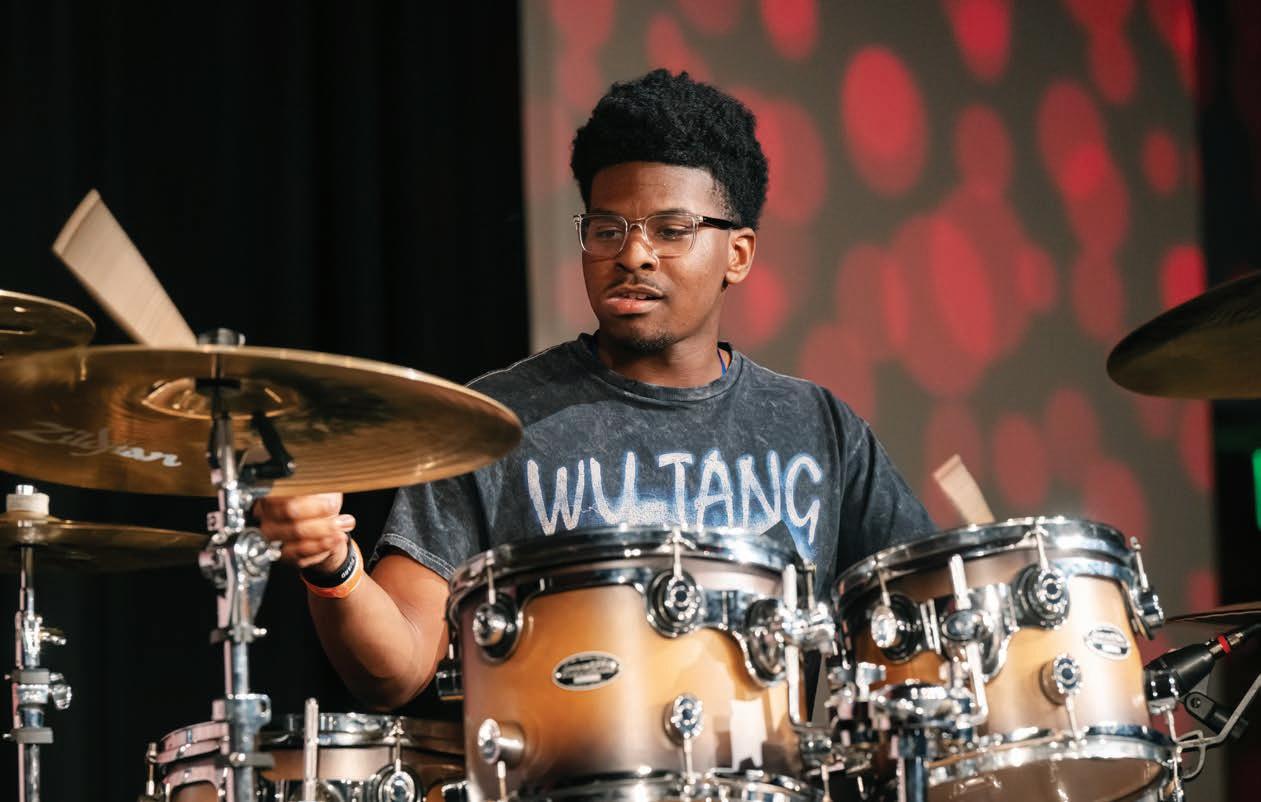
Keeping the beat for Showtime at the Apollo
May 7
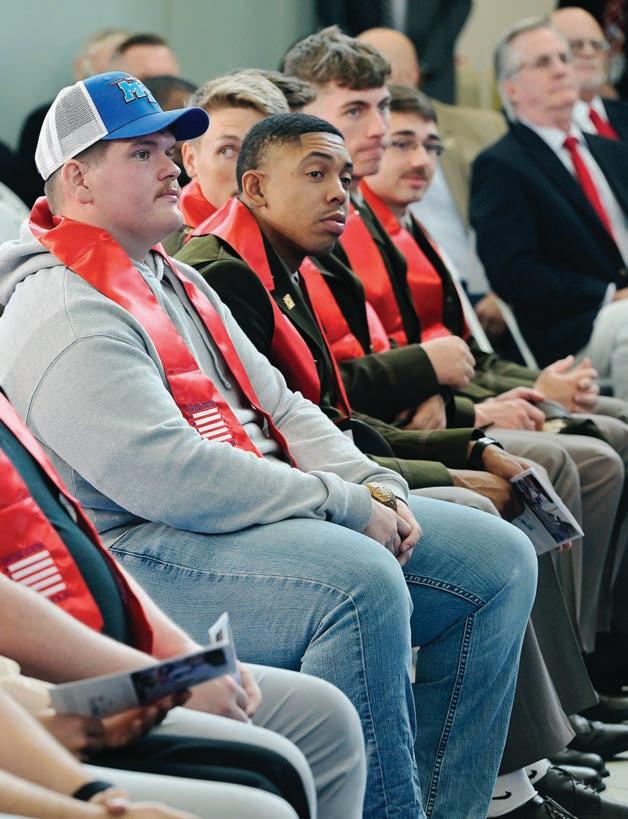
Graduating student veterans awarded stoles
April 13
March 29
Hoppin’ happenings at Panhellenic Easter Egg Hunt
Conservationist Doug Tallamy bringing nature home for Earth Month
Events Calendar
Mark your calendar for upcoming events around campus
Sept. 8–Oct. 3
Todd Art Gallery
“Biennial Exhibition 2026: Faculty Practices in Art and Design”
Sept. 19
Various locations
Salute to Veterans and Armed Forces, including MTSU football vs. Nevada
Oct. 6, 7 p.m.
Hinton Hall, Wright Music Building
MTSU Symphonic Band and Chamber Winds
Oct. 20–21
Student Union Ballroom
Tennessee Biodiversity
Summit inaugural event
Nov. 7
Various locations
Homecoming events,
MTSU football vs. Western Kentucky
Nov. 28
Floyd Stadium
MTSU football vs. New Mexico State
Aug. 8–29
Todd Art Gallery
“Artistic Expressions: Stories That Shape Us”
Sept. 5
Floyd Stadium
MTSU football vs. Murray State
Sept. 17, 2:40 p.m.
Tucker Theatre
Constitution Day: Sheryll Cashin, Georgetown University law professor and author, “What Would the Founding Fathers Think about Today's Supreme Court?”
Oct. 1–4
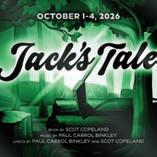
Tucker Theatre
Jack’s Tale, a musical blending myth and history
Oct. 8, 7:30 p.m.
Hinton Hall, Wright Music Building
Soprano-Alto Chorale, Tenor-Bass Chorale, and Schola Cantorum
Nov. 5–8
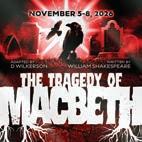
Tucker Theatre
The Tragedy of Macbeth, a chilling reimagining of Shakespeare’s classic
Nov. 19–21
Tucker Theatre
Fall Dance Concert
November 6–7
Join in the tradition that brings us together to celebrate your Blue Raiders for a memorable Homecoming weekend!
• Golden Raiders Reunion (Class of 1976)
• Alumni Awards
• Mixer on Middle
• Homecoming Parade
• Alumni Tailgate
• MTSU Football vs. WKU
To find updated information, visit mtalumni.com/homecoming, email alumni@mtsu.edu, or call 615-898-2922 .
Online Options
MTSU continues expanding services to nontraditional and other students through online offerings, making higher education more accessible. Online enrollment ranks at an all-time high by student credit hours and has increased for several consecutive years. MTSU Online keeps seeing rises in the number of online courses, student credit hours, sections, and fully online students.
mtsu.edu/online
3,000+ fully online students fully online programs*
47% of all graduate hours from online courses
57% MTSU students taking at least one online course
29% of all credit hours from online courses
Source: MTSU Online, from Fall 2025 enrollment 28
83 new online programs added in past year 15 full-time faculty who focus on online teaching instructional designers who train/coach faculty 4 *majors, concentrations, and certificates live subject tutoring as part of other key student services 24/7
What are your memories at KOM, from first classes to final walks?
MTSU’s original Kirksey Old Main just enjoyed a refresh—bringing in 21st-century classrooms and adding a rear accessible lobby, while preserving those iconic front columns. Alumni share memorable moments at KOM:
Delanie McDonald Hollingsworth (’20, ’21)
My proposal was at the KOM!
Shamara Myers (’09)
Doing Math homework and eating lunch on the side of the steps. Some of the best conversations I ever had at MTSU were on those steps between classes.
Elizabeth Athena Anderson (’98)
Sharon Edwards (’13)
That beautiful tree in the front corner of the KOM blazing orange in autumn. I used to stare out the window at it from my voice lessons on the second floor in SFA.
LeAnn Sensing
So many, but I’d have to say when George Bush came to speak.
Hanna Witherspoon (’64)
Meeting with Dean Keathley.
Ron Casey (’74)
Passing a Political Science class.
Mandy Gannon (’00)
Pete Jackson (’72)
Having a class on the top floor when it had to be at least 150 degrees during the summer
After dinner at Corlew, my friends and I would always walk over to the KOM to check our email at the computer lab. I still remember what it smelled like in there. Those days, it was the only way I had to stay in touch with my high school buddies who moved away to other states for college.
Tanya Bullard Lane (’94, ’97)
My mom graduated on the steps of the KOM and I met my husband there during graduate school
Chad Lloyd (’01, ’03, ’06)
As a GTA I shared an office on the 4th floor “crow ’s nest” with other GTAs. I made lifelong friends and got my exercise getting up there multiple times a day!
Al Frazier (’70)
I climbed on the roof and What a view of our campus.
Sandy Neely McIntyre (’89)
One of my favorite buildings. I had Accounting and COBOL in that building. Most of my other classes were in the business building when it was in the back of KOM.
Brenda Cowan Francis (’73)
Sitting on the steps on a gorgeous spring day in 1970.
Kristen Crawford Keene (’01, ’16)
History lecture in the big classroom at the top!
More Than Words
MTSU’s solemn pledge “I am True Blue” turns 15 years old
by Drew Ruble
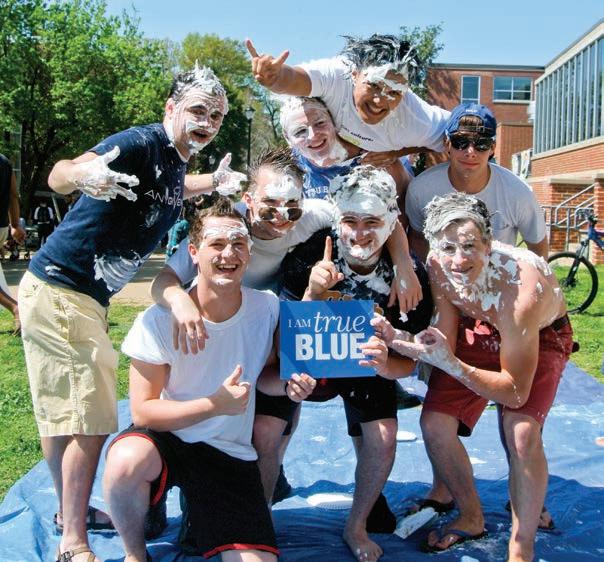
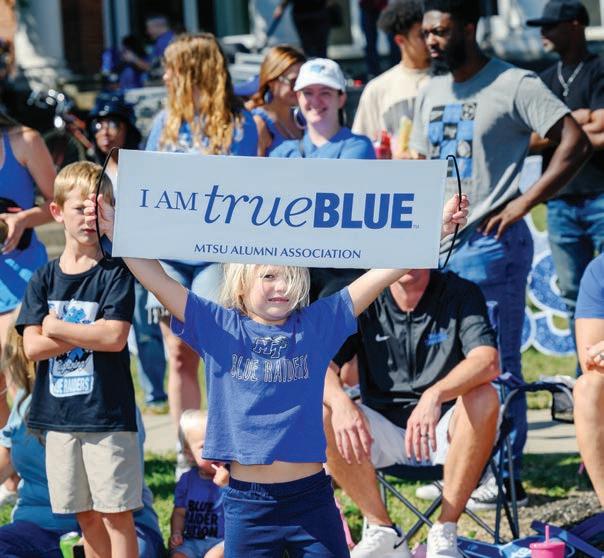
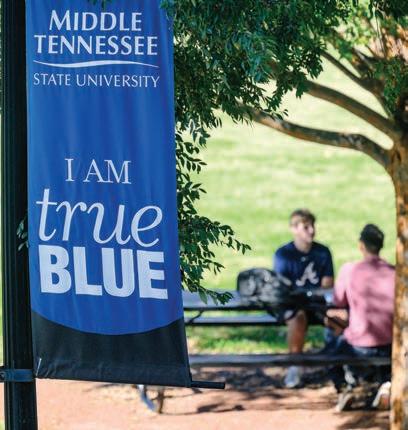
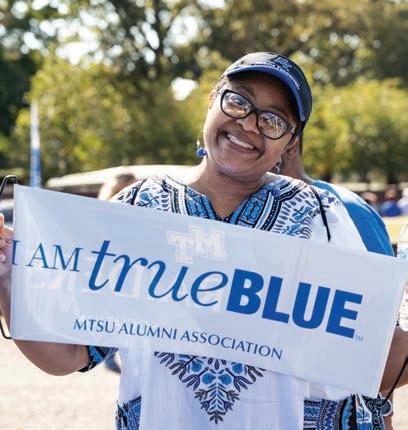
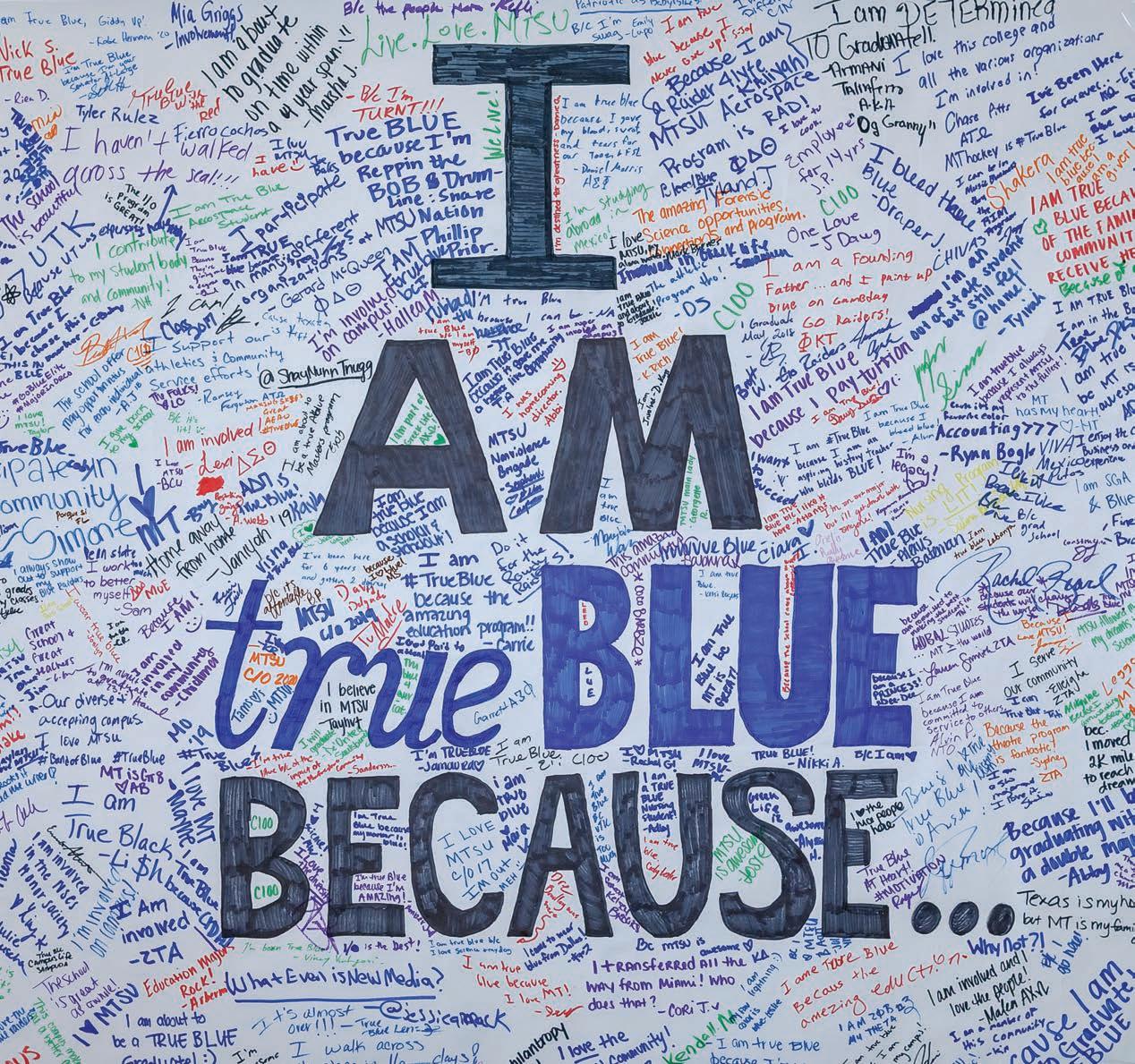
Stand almost anywhere on the MTSU campus, and you’ll likely see the phrase “I am True Blue” at least once on a nearby sign, light pole banner, or garment.
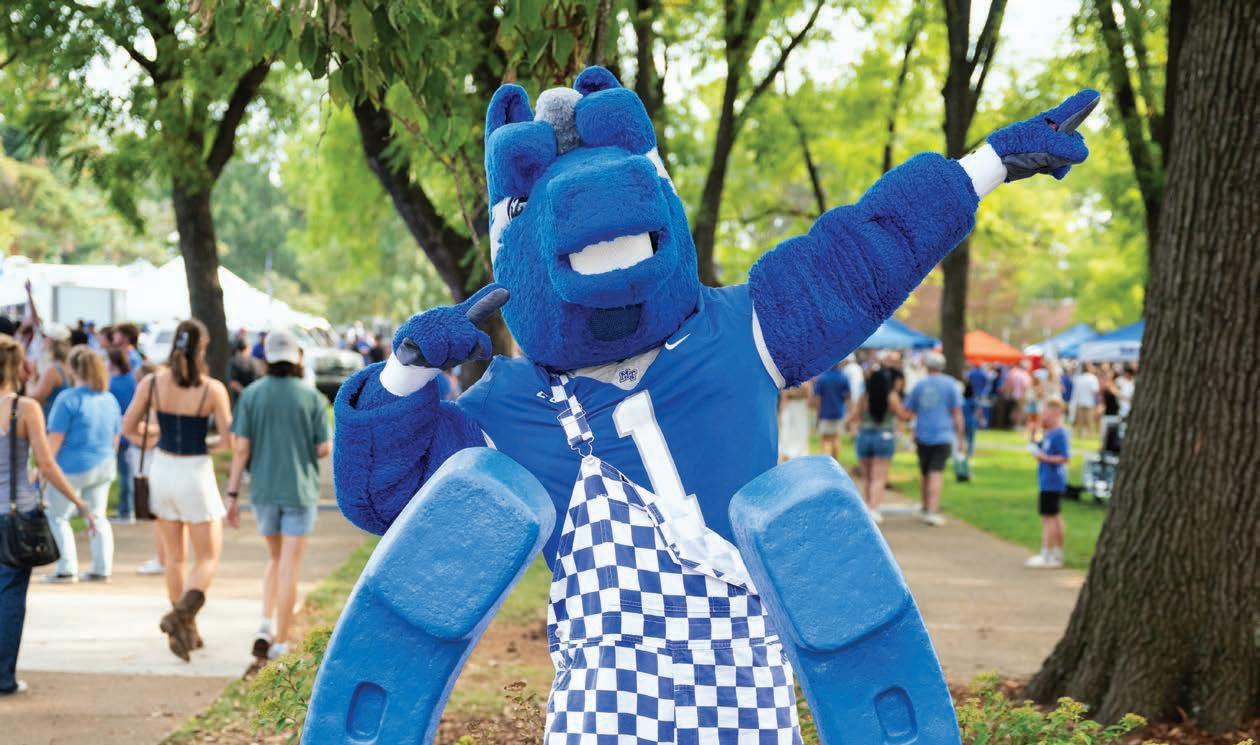
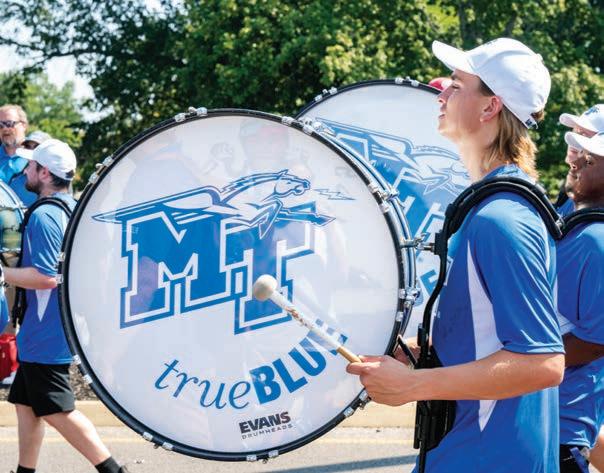
It’s printed on every student and staff ID card. It’s part of the name of several campus services and initiatives, including True Blue Core, True Blue Fusion, the annual True Blue Tour recruitment effort, and True Blue TV. Major campus awards, such as the True Blue Citations of Distinction for distinguished alumni and the True Blue President’s Award recognizing the year’s top male and female student-athletes, riff on the phrase. The MT Athletics department in particular embraces it. “I am True Blue” is displayed on the playing fields of most athletic venues, including the turf in Floyd Stadium and the hardwood floor in Murphy Center.
Simply put, it’s everywhere. And it has been for the past 15 years.
“I am True Blue,” though, is not just a marketing slogan. It has become an identity, one born out of tragedy, that succinctly expresses the MTSU community’s core values of honesty and integrity, respect for diversity, engagement in the community, and a commitment to nonviolence.
The Origins
On March 3, 2011, MTSU President Sidney A. McPhee found himself addressing a grief-stricken assembly in MTSU’s Murphy Center, all mourning an almost unspeakable tragedy.
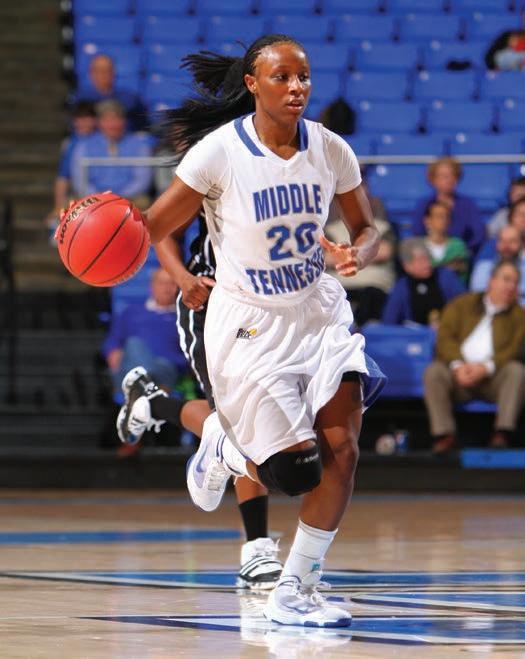
“The anguish I feel cannot be adequately expressed,” McPhee said of the death of Tina Stewart, a Lady Raider basketball player. Stewart was killed the day before, after an argument in her off-campus apartment with her roommate, also an MTSU student.
McPhee and his late wife, Liz McPhee, had a close, personal relationship with Stewart and her boyfriend, who was a member of the men’s basketball team. They’d even shared Thanksgiving dinner together at the McPhee household the previous holiday because Stewart couldn’t make it home to Memphis.
“The death of a student is always a grievous loss on a campus. In this case, the loss is particularly senseless and appalling,” the president told the mourners. “Tina’s death must have the effect of making us all more tolerant and more kind to each other.”
Days after the memorial service, McPhee reflected on the tragedy with Dwight Lewis, then editorial page editor of The Tennessean newspaper in Nashville. In their conversation, an idea emerged for MTSU to teach and encourage nonviolent conflict resolution as a core value.
Later that month, McPhee appointed a President’s Task Force on Nonviolence and Conflict Resolution. The panel was charged with establishing a comprehensive and ongoing plan to encourage teaching, training, programming, and research related to nonviolence and conflict resolution between students, faculty, staff, alumni, and friends of MTSU.
The task force, made up of faculty, staff, and students, went to work. As part of its efforts, it developed a pledge that captured the spirit of the core values McPhee emphasized. Honors College Dean John Vile and Vincent Windrow, then associate vice provost for student success, were key authors. Andrew Oppmann, MTSU’s vice president of marketing and communications, and thenmarketing specialist Rob Janson later infused the phrase “I am True Blue” to the pledge. The True Blue Pledge was born.
I am True Blue.
As a member of this diverse community, I am a valuable contributor to its progress and success.
I am engaged in the life of this community.
I am a recipient and a giver.
I am a listener and a speaker.
I am honest in word and deed.
I am committed to reason, not violence.
I am a learner now and forever.
I am a BLUE RAIDER.
True Blue!
At the time, McPhee called the True Blue Pledge “an affirmation of what we want a Blue Raider to represent.”
Forging a New Tradition
The pledge was formally introduced at MTSU’s very next Convocation ceremony, Aug. 28, 2011, alongside the set of four core values (see sidebar on next page)
To this day, a decade and a half later, the pledge remains a central part of campus life.
The Student Government Association (SGA) quickly adopted it as its official motto and redesigned its seal to emphasize True Blue. The pledge was incorporated into numerous student and civic events as a reflection of school pride and values.
R.J. Ware, the 2025–26 SGA president, has continued and reinforced the tradition by student government to weave the True Blue Pledge into all of its major functions and activities.
“At its core, True Blue is about how we treat people,” Ware said. “It shows up in the way students support one another, get involved, and take pride in being part of something larger than themselves. That’s why it continues to resonate. It’s not just a campaign. It’s a standard that students still strive to live out every day.”
Each year, the student body president still leads the incoming class of freshmen and transfer students in reading the True Blue Pledge at Convocation. The University will formally celebrate the 15th anniversary of “I am True Blue” at the 2026 Convocation in August.
Basketball player Tina Stewart, who died in 2011
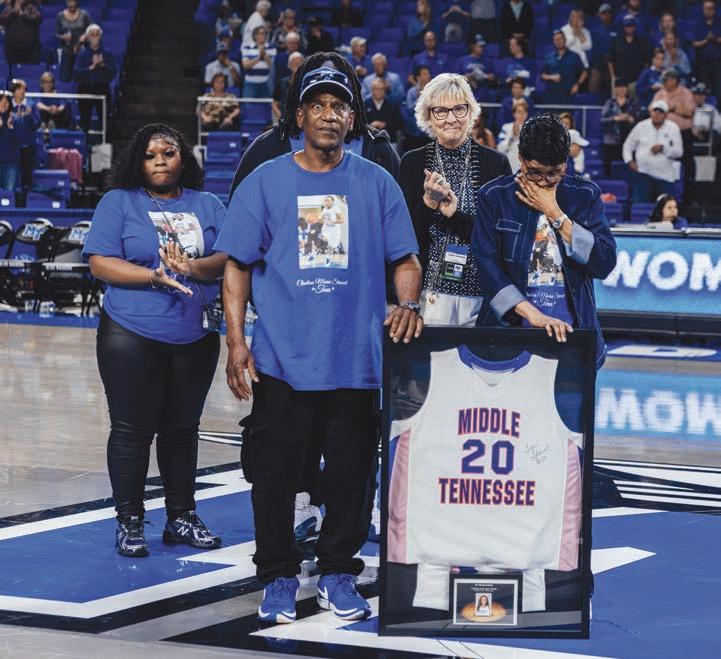
Stewart’s jersey returned to her family by a donor in 2026
“It’s always great beginning our new academic year by introducing our new students to what it means to really be True Blue, as well as reminding those of us already here,” McPhee said. “This pledge represents an expression of universal values that binds our Blue Raider campus together with a commitment to bring our better selves to the academy and to each new community of scholars arriving each year.”
For a decade and a half, “I
am True Blue” has been everywhere you look on the MTSU campus.
The Campus Nonviolence Committee also remains vigilant, working hard each semester to keep the True Blue Pledge top of mind by hosting speakers, activities, and remembrances including at the International Day of Nonviolence and the Martin Luther King Jr. Celebration and Candlelight Vigil. Most recently, the committee held a contest for student groups to submit videos that show True Blue Spirit. Activities are funded through the Tina Stewart Nonviolence Fund, which constitutionalized the $5,000 SGA receives annually to allot to the nonviolence campaigns.
Through the years, these early initiatives have remained a constant while new ones have been added. “True Blue” later became the focus of a comprehensive University marketing plan.
Casting a Long Shadow
That the phrase, and the message, of “I am True Blue” has had such staying power is a source of comfort to the Stewart family.
Deputy Athletics Director Diane Turnham, who has stayed in touch with the Stewart family over the years and hosts them on campus frequently, said the pledge’s continued use as part of the University brand makes the Stewarts proud and emotional to think that their daughter’s tragic death led to something lasting and meaningful.
As a high-ranking college athletics administrator for many decades, Turnham was trained to deal with death of a studentathlete. It didn’t make it any easier when it happened.
“It’s truly one of the worst experiences ever in an athletic program, because you feel like 300 families have entrusted you with their children, and you’re going to take care of them, and you’re going to make them better,” she said. “Along with head coach Rick Insell and the rest of the MT Athletics staff, our main focus was ‘How do we help these young athletes be able to feel their feelings, and express their feelings, and move forward?’ ”
Turnham said to see these young people, some of whom had not experienced grief of this magnitude, lose someone their own age was devastating.
“It was the most difficult week of our lives. But seeing them go through all that, they developed a resilience that I was so proud of,” she said.
The True Blue Pledge, Turnham said, became a prescription for healing.
“We made a promise to her parents that her life would never be forgotten, and that she would make an impact every day,” said Turnham, who helped write the pledge as part of the nonviolence committee. “I have a picture of Tina in my office, and I look at it every morning, and I just say, ‘Today, we’re going to be better.’ And to me, that’s what the True Blue Pledge is all about. We’re going to make it better. We’re going to do better. We’re going to be a part of a community. And we’re going to support each other.”
Stewart’s parents still attend at least one home game each year. At a recent game, the athletics program surprised them with the gift of their daughter’s pink, game-worn jersey from a breast cancer awareness promotion years ago. A donor who had purchased the jersey at auction contacted the athletics department wanting to return it into the hands of the Stewart family.
“They loved it,” Turnham said of the Stewarts and the gift. “They still embrace us, we still embrace them, and we’re just there for each other.”
You’re not just expressing school spirit; you’re connecting yourself to a community and a set of values that transcend any single graduating class.
Nowhere on campus does the messaging of True Blue permeate more than within the women’s basketball program. It’s been a point of emphasis for now-retired Coach Insell since the day of its inception. A door in the women’s basketball locker room that separates a lobby area from the dressing room prominently features the True Blue Pledge. According to Turnham, the Stewart family loves taking their picture with that poster.
“They know that Tina’s death, as hard as it was, helped make all of us a little better, or make us think a little more
about who we are, and what we need to do, and how we need to do it,” she said. “They are very connected to the True Blue Pledge. They take great pride in that.”
Turnham makes a point of educating new student-athletes about Tina Stewart and the story of the True Blue Pledge.
“I don’t want people to forget,” she said. “Not that we ever want to dwell on it, but we don’t ever want to forget. . . . I like to tell people why it came about. . . . It’s hard, but it’s also therapeutic.”
A Lasting Impact
For a decade and a half, “I am True Blue” has been everywhere you look on the MTSU campus and on University marketing materials.
It’s become synonymous with campus life, especially on game days.
What began as a way to deal with grief has become an ever-present call to action for the MTSU community to bond around common values and desired outcomes.
“I am True Blue” has become a philosophy that reflects the University’s identity as a diverse, welcoming, and tolerant place of learning and personal and community progress.
Jeremy Poynter, SGA president at the time of the creation of the True Blue Pledge, and now a partner in the Nashville law office of Holland & Knight, said he believes the “I am True Blue” culture has endured through time because it represents something bigger than any one moment in time.
“When you say those words, you’re not just expressing school spirit; you’re connecting yourself to a community and a set of values that transcend any single graduating class,” he said. “Phrases that let people see themselves in the words—that give them ownership—those become part of the culture’s DNA. Fifteen years later, when I hear ‘I am True Blue,’ it still resonates with me because it captures something authentic about what it means to be part of the MTSU family. That sense of belonging doesn’t expire with your diploma.”
The definition of true blue is someone who is genuinely, unwaveringly loyal, faithful, and staunch in their beliefs or commitments. It signifies absolute reliability or honesty, often describing a person who stands by another in all situations.
As an institution of higher education, MTSU exists to teach young people lessons with lifetime implications. In fulfilling that mission, could there be an instructional effort more noble than encouragement to become True Blue? MTSU
Core Values
In addition to the True Blue Pledge, the nonviolence task force that MTSU President Sidney A. McPhee turned to in spring 2011 after Tina Stewart’s death also called for peaceful conflict-resolution tactics to be included in classroom lessons and orientation sessions. The task force’s work was introduced to the campus in the fall of that year and continues to be a part of the campus protocols.
Specifically, the task force recommended a curriculum to stimulate effective problem-solving and conflict resolution, teach civility in dispute resolution, and promote a positive campus environment that celebrates diversity. The committee authored a statement of commitment as the foundation for a new campuswide campaign. It stated: MTSU is committed to developing and nurturing a community devoted to learning, growth and service. Each person who joins or affiliates with the community does so freely and accepts and practices the following core values and expectations:
Honesty and Integrity: The notions of personal and academic honesty and integrity are central to the existence of the MTSU community. All members of the community will strive to achieve and maintain the highest standards of academic achievement in the classroom and personal and social responsibility on- and off-campus.
Respect for Diversity: The MTSU community is composed of individuals representing different races, ethnicities, sexual orientations, cultures, and ways of thinking. We respect individual differences and unique perspectives and acknowledge our commonalities.
Engagement in the Community: All members of the community are encouraged to participate in educationally
purposeful activities that support and enhance the MTSU experience. Active involvement and personal investment in the classroom and throughout the community are hallmarks of an engaged citizen.
Commitment to Nonviolence: MTSU is committed to the principles of nonviolence and peaceful conflict resolution. Community members will freely express their ideas and resolve differences using reason and persuasion.
Those standards and expectations were then infused across MTSU. Chief among the initiatives were:
• adding a general introduction to all student orientation programs regarding MTSU community standards and expectations, with separate presentations targeting students and their family members
• adding a teaching module focused on civility and nonviolent conflict resolution to leadership-training programs for student leaders, resident assistants in residence halls, student-athletes, the Student G overnment Association, and fraternity and sorority members
• i ncluding a teaching module in University 1010 classes each semester that focuses on civility and n onviolent conflict
• adding a general introduction to the MTSU
C ommunity Standards and Expectations to all f reshman orientation programs
• having faculty who teach COMM 2200—the only general education course required of all students at MTSU—be c ommitted to incorporating principles of nonviolent c onflict resolution into their regular curriculum
All of this is still in place to this day. True Blue!
MIDPOINTS
A look at recent awards, events, and accomplishments at MTSU
compiled by Nancy DeGennaro, Jimmy Hart, DeAnn Hays, Drew Ruble, Stephanie Wagner, and Randy Weiler
AI Expertise
MTSU’s interdisciplinary Data Science program launched a forward-looking undergraduate certificate, Using Artificial Intelligence. Designed for MTSU students and working professionals alike eager to explore the transformative power of AI, this 10-credit-hour program is designed to provide students with foundational knowledge and the ability to implement AI ethically and responsibly. The certificate courses are currently a mix of on-ground and online, with potential for a fully online option in the near future.
Hardcore Acquisition
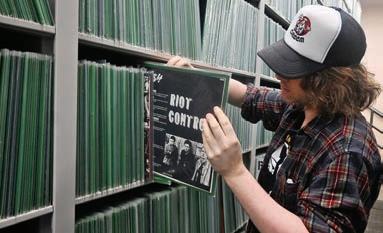
The world’s largest collection of punk records officially arrived at MTSU in April, marking the beginning of a major archival project at the University’s famed Center for Popular Music. The Maximum Rocknroll archive, long associated with the influential underground punk magazine of the same name, was relocated from California and includes more than 50,000 vinyl records along with business papers and other ephemera documenting punk’s evolution.
Classroom Champions
MTSU, along with Cincinnati, Maryland, Northwestern, Notre Dame, Pittsburgh, and Temple, earned the American Football Coaches Association’s 2025 Academic Achievement Award. All seven schools shared the highest graduation rate for members of their 2018 freshman football student-athlete classes (based on a six-year graduation window for student-athletes.) The Blue Raiders outranked the other Football Bowl Subdivision schools in the state—Vanderbilt, Memphis, and Tennessee.
A Fresh Look
The homepage of MTSU.edu has a refreshed look. After months of research into industry best practices, reviewing peer university websites, and collaboration with Information Technology, Marketing and Communications, and Admissions, the University launched the new design in early 2026. While the website serves many internal and external communities, the primary focus of this update is to make the homepage more compelling and targeted to prospective students. MTSU.edu is the University’s largest tool to promote the image and brand of the University.
Quantum Leaping
MTSU’s QRISE Center and Middle Tennessee Electric teamed up to form the Middle Tennessee Quantum Technology Hub, also known as the MT-QuTech Hub, to advance quantum research and infrastructure in the Midstate. The effort leverages MTSU’s millions of dollars in active federal research awards with MTE’s real-world infrastructure that serves 750,000 Tennesseans across 11 counties—the second largest electric cooperative in the country. It is spearheaded by Hanna Terletska, director of QRISE (Quantum Research, Interdisciplinary Science, and Education); John Villanova, QRISE associate director; and MTE Chief Operating Officer Brad Gibson. The QRISE Center exists to serve as a catalyst for innovation by connecting academia, industry, and government to strengthen Tennessee’s role in the national quantum ecosystem, expand economic opportunity, and position MTSU as a driving force of scientific and technological progress.
Returning to Roots
MTSU’s College of Education received a $150,000 grant from the Truist Charitable Fund to boost support for students in the Tennessee Teach Back Initiative, an MTSU program helping prepare and inspire future teachers to serve in their own hometowns across the state. Created to address the statewide teacher shortage, the initiative focuses on developing licensed educators who return to teach where they grew up, helping strengthen local schools and communities.
Healthy Outcomes
Century of Service
The University’s student-run media platform, Sidelines , celebrated 100 years of serving campus and the community through award-winning journalism. Originally a printed newspaper, Sidelines has evolved into a news website and email newsletter while remaining true to its mission as a student-led news organization that has provided scores of student journalists with an opportunity to put their classroom knowledge to use.
The College of Behavioral and Health Sciences (CBHS) has undergone a significant reorganization, effective July 1. The degree programs from the now-dissolved departments of Health and Human Performance and of Human Sciences are realigned into three new academic departments: Kinesiology and Sports Medicine; Health Sciences; and Sport and Hospitality Management. Additionally, the Department of Criminal Justice Administration will become the Department of Criminal Justice. The Textiles, Merchandising, and Design degree program is now renamed Fashion Studies and will be directly served by the CBHS Dean’s Office as a temporary measure to maintain its unique focus and to facilitate growth. The Human Development and Family Science undergraduate degree program moved to the College of Education, and Interior Architecture relocated to the College of Basic and Applied Sciences as part of the School of Concrete and Construction Management.
Green Campus
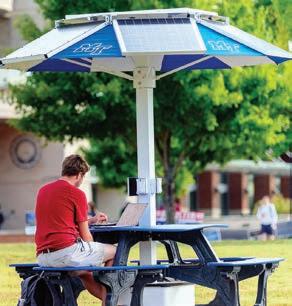
For the last two decades, MTSU students have done more than talk about energy sustainability—they’ve funded it. Since 2006, MTSU’s Sustainable Campus Fee program has invested more than $7.6 million in renewable energy, conservation, and campus improvement projects, all supported by a per-semester fee and voted on by students. For the 2025–26 cycle, students allocated more than $256,000 for 26 projects and the purchase of renewable energy.
A Decade of Duty
The Charlie and Hazel Daniels Veterans and Military Family Center celebrated a decade of service in 2025 after opening Nov. 5, 2015. Now a major expansion is underway that will combine first- and third-floor spaces (bringing together all but one member of the Daniels Center’s staff, a career counselor who is embedded in the Career Center and is charged with assisting militaryconnected students). It also will create new space for growth, increasing the center’s square footage from 3,200 to 4,079 square feet. Construction will conclude this summer in time for the start of school. The Charlie Daniels Legacy Wall has already been installed at the front entrance. The University has a long tradition of aiding veterans in the transition from military to civilian life. Student enrollment now surpasses 1,200 regularly. Everything a student veteran needs to succeed is available through the center, from getting advice on courses and completing government paperwork to getting questions answered about benefits and employment opportunities. But the Daniels Center can assist any military-connected person—no MTSU affiliation is necessary. There is no charge, either.
The Grammy Factory
MTSU students, faculty, and administrators again traveled to Southern California for the music industry’s biggest weekend in February, celebrating former students whose work was nominated in the 68th Grammy Awards. President Sidney A. McPhee, Provost Mark Byrnes, and Beverly Keel, dean of the Scott Borchetta College of Media and Entertainment, joined six students, led by faculty, as they visited recording industry firms and went behind the scenes at studios before attending the Grammy ceremonies. The University has held events at the Grammys since 2014. While MTSU alumni didn’t capture a coveted trophy this year, MTSU hosted alumni, former students, and music industry officials during its annual pre-Grammy celebration over the weekend, held at The Godfrey Hotel in Hollywood. MTSU alums, former or current students, and faculty from across the University have been a part of almost 180 Grammy Award nominations in the last two decades. The number of MTSU-connected Grammy winners since 2001 currently stands at more than 20 people, collecting nearly 50 Grammys, including several repeat recipients, in categories from classical to pop to rock to country to gospel and rap.
Bringing into Focus
The Tennessee Higher Education Commission recently approved a restructuring for the College of Education to ensure that academic programs are housed within departments that reflect their primary disciplinary and professional focus. The new structure will enhance academic coherence, streamline oversight, and better position the college to meet the evolving needs of Tennessee’s PreK–20 education workforce—particularly in high-demand areas such as teacher preparation and school leadership. In addition, the Department of Elementary and Special Education has been renamed the Womack Department of Teaching, Learning, and Innovation, and the Womack Department of Educational Leadership became the Department of Leadership, Development, and Educational Systems. Majors, minors, and certificates will be moved to the appropriate department homes.
Campus Expansion
Facilities growth represents an investment in areas of study that will solve problems, improve the social good, and supply a skilled regional workforce.
In 2025, MTSU opened a new $74.8 million Applied Engineering Building and the $66 million Stephen and Denise Smith Student-Athlete Performance Center. The University also celebrated the groundbreaking for the $73 million-plus first phase of the Aerospace Shelbyville project.
Here are the most recent updates on ongoing capital projects: Renovations to Kirksey Old Main (KOM) and Rutledge Hall
• $54.3 million total project cost
• Reopening August 2026
• Both original buildings dating back to the institution’s founding in 1911, with KOM the first building on campus
• KOM to house Mathematics, Computer Science, Data Science, and Actuarial Science; Rutledge being converted from a residence hall into an office/classroom building for University College/University Studies
• Preserves KOM’s iconic columns and front steps
New Campus Housing
• Broke ground in April on Womack Commons, MTSU’s first new student housing complex in more than 25 years
• $83 million-plus project that includes an adjacent parking garage aimed at greatly enhancing the overall student educational experience
• Estimated completion: Fall 2027
• Public-private partnership between MTSU and developer The Annex Group
• Replaces the outdated and razed Womack Lane apartments
• Five-story student housing building to contain 150 units and 554 beds to serve the growing demand for student housing on MTSU’s campus
• Located at the corner of Blue Raider Drive and Homecoming Circle, a natural threshold into campus, which represents the opportunity to connect academics, student life programs, and recreation and wellness hubs
New Parking Structure
• $27 million cost (part of the overall $83 million project)
• 182,000 square feet
• Estimated completion: Spring 2027
• Construction of a parking garage with 541 spaces, plus an adjacent surface lot with 52 spaces, on a portion of the existing Womack Lane housing site
Additions and Renovations to Murphy Center
• $119 million total project cost
• Estimated completion: Summer 2029
• Addresses a range of facility needs, including athletic program improvements, event and performance space enhancements, updated classroom spaces, dance studio enhancements, and more
• Includes construction of a new addition to provide a new, primary entry and lobby space to serve Murphy Center
Renovations to Floyd Stadium
• $16.5 million total project cost
• Estimated completion: Summer 2027
• Renovation and replacement of a portion of the west grandstand bleachers, providing new steel support structure and aluminum bleachers for these sections to match the remainder of the seating at Floyd Stadium
On-Campus Hotel
• Negotiations continuing for the previously announced construction of a four-story, on-campus hotel with 120 guestrooms at the corner of Greenland Drive and Middle Tennessee Boulevard
• Public-private partnership to serve as a real-world learning lab for Tourism and Hospitality Management students while also serving academic visitors, athletics families, attendees of Murphy Center events, and conference guests
• Would offer typical front-of-house and back-of-house hotel programming, outdoor pool and lawn, fitness center, meeting space, anchor restaurant, corner café, game room, and sky deck
• Interior finishes to follow brand standards with custom features tying back to MTSU themes
Striking Lightning
Seeking to capitalize upon these many multimillion-dollar investments in new campus facilities and future renovations at and around Greenland Drive and Middle Tennessee Boulevard in particular, MTSU President Sidney A. McPhee unveiled plans in 2025 to develop this area into an entertainment and sports district for not only students but also local residents and visitors from throughout the region.
The long-term vision is to create what could be called The Lightning Zone, where students could walk from their residence halls or nearby off-campus apartments to performances or games at Murphy Center or Floyd Stadium as well as stop for a meal at a favorite restaurant and meet family and friends. The area would draw community members and visitors not only for tournaments, conferences, and games, but also for an occasional night out—supporting local businesses and generating revenue for the city and county.
MTSUNEWS.COM
M.F.A. in Film and TV
MTSU launched a new Master of Fine Arts in Film and Television, set to begin in Fall 2026. The 60-credit-hour program is the first and only M.F.A. of its kind at a public university in Tennessee. The University is also in the p rocess of creating a new graduate degree program in Health Care Administration.
Samuel Haruna, an MTSU associate professor of Soil Science and associate dean for academic programs in the College of Basic and Applied Sciences, was named the 2026 recipient of the prestigious John Pleas Faculty Award, recognizing his excellence in teaching, research, and service. The Nigerian native, who earned MTSU’s 2025 Outstanding Teaching Award, has been part of more than $ 6 million in external funding.
The Nashville Area Chamber of Commerce and MTSU’s Business and Economic Research Center partnered to launch the region’s first Business Confidence Index—a quarterly index informed by a survey that will measure the confidence and sentiment of regional business leaders about the local economy.
MTSU’s expanded Board of Trustees welcomed its three newest members: John Floyd of Murfreesboro, founder and owner of Ole South Properties; Jimmy Granbery of Nashville, chair and CEO of H.G. Hill Realty; and Chad White of Murfreesboro, executive vice president, general counsel, and secretary at Brookdale Senior Living. J.B. Baker and Tom Boyd also were recently reappointed to the board.
The family of one of MTSU’s most iconic coaches—the legendary Dean Hayes—adds to his legacy with a major donation
by Bill Lewis, Drew Ruble, and Randy Weiler
The family of legendary MTSU track and field coach Dean A. Hayes recently established a permanent scholarship to honor the philosophy of their iconic patriarch and the nine original Blue Raider Pioneers of the athletic department of the late 1960s and early 1970s.
Over nearly six decades at MTSU, Hayes became one of the most accomplished and respected figures in collegiate athletics as well as in national and international track and field.
But his impact extended far beyond the track.
In fact, he single-handedly forged the path for integrating MTSU’s athletic department, famously awarding Jerry Singleton the first varsity scholarship to go to a Black athlete at the University. Singleton was one of the original Pioneers, along with Art Polk, Lonnell Poole, Terry Scott, J.W. Harper, Raymond Bonner, Ed Miller, Mary “Beanie” Secrest, and Willie Brown.
“Dean Hayes wasn’t just a coach—he was a mentor, an educator, and a trailblazer,” MTSU President Sidney A. McPhee said. “This endowment embodies his lifelong commitment to providing access to education to all and opening doors to success in life, and we’re honored his family and friends have chosen to continue his legacy in this meaningful way.”
Hayes, the Blue Raiders’ legendary track coach of 57 years, died in January 2022 at age 84.
The endowment was made possible through a generous gift from his beloved wife and daughters—Janice C. Hayes, also a former faculty member at MTSU, and their children, Kara L. Hayes and Erin E. Hayes.
“Our father poured his heart into MTSU and believed deeply in education, community, and opportunity,” Kara and Erin Hayes said in announcing the gift.
This new endowment supports awards for student-athletes and their families affiliated with MTSU’s Blue Raider athletic program, with a particular focus on former athletes returning to complete their degrees.
Additional awards may support graduate study, athletic competition on the international stage, and emergency grants to student-athletes facing unforeseen financial hardships.
“Words can’t express what Dean Hayes has meant to MTSU, the MTSU track and field program, international track and field, and the thousands of people whose lives he has impacted through his work,” Director of Athletics Chris Massaro said.
A Sporting Legend
Hayes earned his Bachelor of Arts degree at Lake Forest College in Illinois, where he competed in the 800 meters, the long jump, and the triple jump. He was an NCAA qualifier in the triple jump.
After earning his master’s degree in education at Northern Illinois, Hayes began his coaching career at the high school level in Chicago, where he coached for three years followed by one year in Minneapolis.
He then jumped to the collegiate ranks at his alma mater, Lake Forest, before coming to MTSU in 1965.
Hayes initially served as the head coach of MTSU’s men’s track and field and cross country teams before also taking on leadership of the women’s program in 1978.
Throughout the recent history of MTSU track and field, there were two constants—Hayes and a legacy of championship performances.
Hayes guided the programs to 11 Conference USA championships, 29 Ohio Valley Conference titles, 19 Sun Belt Conference championships, and 21 NCAA Top 25 finishes.
He earned 34 Coach of the Year honors—four in CUSA, 15 in the Sun Belt, and 15 in the OVC, which included 10 in a row from 1977 to 1986.
Following the 1981 season, the Division I Track and Field Coaches Association (TFCA) voted Hayes the NCAA Outdoor Coach of the Year. Hayes then served as TFCA national president in 1982–83.
Hayes held leadership roles in U.S. national and international athletics, including the Olympic Games and World Championships, and served as a coach for Team Ghana. He has been inducted into the Blue Raider Sports Hall of Fame, Illinois Sports Hall of Fame, and Tennessee Sports Hall of Fame.
Fifty-two of his student-athletes earned a total of 125 AllAmerica honors. Five became national champions six times, and 24 competed internationally in the Olympic Games, World University Games, World Championships, Goodwill Games, Pan-American Games, and African Championships.
Hayes’ most successful student-athletes competed in the NCAA triple jump, an event in which Hayes specialized. He coached NCAA champions Tommy Haynes (1974) and Barry McClure (1972, ’73), as well as NCAA high hurdle champion Dionne Rose (1994). In 2003, he coached national champion Mardy Scales, who won the 100-meter dash. His most recent national champion was Kigen Chemadi, who captured the 3000-meter steeplechase in 2021.
Because of Hayes’ international success, numerous international athletes over the years sought out MTSU as their college of choice.
Top middle: Tommy Haynes (l) and Barry McClure; top right: Jerry Singleton
A Champion for Change
MTSU’s track and soccer stadium is named for Hayes, but the greatest monument to his accomplishments is not a structure; it’s the diversity of the students who come to the University.
When Hayes first stepped onto the campus in 1965, almost all of the 5,500 students enrolled were white.
Olivia Woods, the University’s first Black student, had graduated. A few Black athletes played sports, but no scholarship athlete competing on a varsity team was Black.
The campus offered no Black fraternities or social organizations. A plaque with a likeness of Confederate general Nathan Bedford Forrest, the first grand wizard of the Ku Klux Klan, still stood on campus.
As he took on the task of recruiting the best athletes possible, Hayes unconsciously took on another role—as an agent of social change who participated in breaking the color barrier.
“When I got down here [from Chicago], they were still fighting the Civil War,” Hayes recalled during a 2003 interview for the MTSU Oral History Collection, archived at the Gore Center. “I blundered through it,” he said of the process of integrating his teams. “It wasn’t much of an issue for me.”
Decades later, the campus looks like America. More than 15% of students at MTSU are Black. Others are Hispanic, Asian, Native American, or members of other minority or ethnic groups.
It all started with a phone call Hayes made soon after being hired as MTSU’s track coach.
The young man who answered the phone, Jerry Singleton, became the first Black varsity scholarship athlete at MTSU.
Others followed as their quietly competitive coach made more phone calls.
When those athletes arrived on campus, so did their girlfriends, sisters, brothers, and friends.
“I never thought much about it because I didn’t do it on purpose, but it changed the complexion because it allowed minorities to have acceptance on campus,” Hayes once told MTSU magazine. “It has consequences you don’t think about.”
Hayes’ reputation for competitiveness (he was known for throwing away second-place trophies) and fairness attracted other Black athletes to MTSU.
Black athletes felt welcome in Murfreesboro, but trips to events deeper into the post-Jim Crow South revealed a different reality.
Before road trips with his teams, Haynes, who retired as a major after a distinguished career in the U.S. Army, mapped out restaurants and motels that were known not to discriminate.
Meanwhile, times were changing with the arrival of more Black students on campus. Kappa Alpha Psi, a Greek letter fraternity with predominantly Black membership, began a chapter at MTSU.
Hayes was the fraternity’s first advisor, a fact that commonly confused later pledges who had to memorize the original members’ names. They wondered whether the white coach was really one of the chapter’s founders.
As time passed, a hound dog named Ole Blue replaced a Forrest lookalike on horseback as the University’s mascot. And one day, then-President Sam Ingram walked out of his office and took down the plaque.
“If you didn’t live through those times, I don’t know how much you’d appreciate it,” Hayes previously told MTSU magazine.
What is appreciated is Hayes’ seminal role in making MTSU the diverse environment it is today.
The new Dean A. Hayes Family Pioneers Endowment cements that legacy. MTSU
Honoring Coach Dean Hayes
“He was a champion in so many ways: as a father, mentor and role model, a world-class recruiter, and a winning coach at the highest echelons. Dean was a living legend.”
— MTSU President Sidney A. McPhee
“This endowment will ensure doors continue to open for the next generation of Blue Raider Pioneers.”
— daughters Kara and Erin Hayes
“He is on the Mount Rushmore of Middle Tennessee, and not just athletics. Coach Hayes was a pioneer and an institution at MTSU.”
— Chris Massaro, MTSU director of athletics
To contribute to the Dean A. Hayes Family Pioneers Endowment or learn more, contact the MTSU Development Office at 615-898-2502 or visit mtsu.edu/give
CLASS NOTES
1960s
Faye (Blue) Haag (’72), Florence, Alabama, was named the 100th member of the MTSU Band of Blue Hall of Fame. Haag has had a prolific career as a choral director, music instructor, and private vocal and piano teacher.
Paul Matheny Jr. (’76), Fayetteville, who writes under the pen name Doug Metteneye, completed his fourth book, The Third Chance, about a Catholic altar boy who attends MTSU during the early 2000s.
Randy O’Brien (’76), Nashville, released his new novel, Ribbon of Dreams, a coming-of-age novel set in 1970s Tennessee. Other books by O’Brien include Gettysburg by Morning and The Farm. O’Brien was news director of WMOTFM for three decades, taught writing at MTSU and Watkins School of Art and Design, and is the former president of the Tennessee Screenwriting Association.
David Monks (’77), Raleigh, North Carolina, was named associate dean and director of N.C. State Extension by the College of Agriculture and Life Sciences of N.C. State University.
Debra Collins Simpson (’77), Murfreesboro, was given the award for Faculty Excellence 2024–25 at a recent Motlow State Community College
commencement ceremony. Simpson has since retired from Motlow and now serves as an adjunct professor in the MTSU College of Education.
Edward Ronny Arnold (’78, ’82), Nashville, released an academic work, Institution-to-Institution Mutual Exchange —the first marketing model created for higher education based on Diversity Education Units. Arnold presented his marketing model virtually at the 2024 International Conference on Sustainability, Global Diversity, Inclusion, and Culture: Interdisciplinary Perspectives in West Bengal, India, and at the 2022 International Conference on Education, Research, and Innovation (ICERI) in Seville, Spain. The model received an award from Michigan State University’s AGEP Student Success Conference.
1980s
Lis Henry (’83), Springfield, a flight nurse practitioner for Vanderbilt LifeFlight, received the prestigious L. Gale Allen President’s Leadership Award at the Mid-Winter Conference for the Tennessee Ambulance Service Association.
Gregory D. Smith (’85), Clarksville, testified before the United States
Logan Kilgore
Kilgore (’13), a former Blue Raiders quarterback, was named the quarterback coach for the NFL’s Denver Broncos after serving three years as an offensive quality control coach. Signed as an undrafted free agent by the New Orleans Saints, Kilgore also played in the Canadian Football League (2015–19). As a coach, he worked at Bakersfield College, Arkansas State University, and the University of Texas before joining the Broncos.
Sentencing Commission (USSC) in March at the Federal Judicial Center in Washington, D.C., regarding proposed modifications to the U.S. Sentencing Guidelines. The guidelines set punishment policies for all federal criminal cases. Among the issues addressed by the USSC in March were human trafficking, career offenders, and resolving a conflict between federal appellate courts over how to sentence federal drug cases. Smith, a municipal judge in Pleasant View since 1997, also sits on multiple Native American Tribal Supreme Courts, teaches Federal Indian
Law online for the Lincoln Memorial University School of Law, and is a member of the Tribal Issues Advisory Group, one of five standing committees to the USSC. L. Craig Johnson (’86), Manchester, was hired as chief legal officer for Java Medical Group, a leading hospital management company that partners with rural hospitals nationwide to ensure quality patient care and improve financial performance. He brings more than three decades of judicial and legal experience to the role, serving as Tennessee 14th Judicial District circuit judge before his retirement in 2021.
Isaac Odugbesan (Oba Femi)
Odugbesan, a non-degreed alum, is a Nigerian professional wrestler and former shot putter. He is signed to WWE, where he performs under the ring name Oba Femi. Odugbesan attended MTSU in 2017 on a track and field scholarship, being named Conference USA Male Freshman of the Year and an outdoor first-team All-USA selection.
Donna Holt-Pollard (’86, ’91), Bon Aqua, retired in July 2025 from the Dickson County School District after 37 years as an educator and 31 years as a school counselor.
Dan Clark (’87, ’88, ’89), Oviedo, Florida, published Zoomie Pig Odyssey, a memoir of his years as an Air Force security police officer in Texas and the Philippines. First written in 1985 while he was living in Smith Hall at MTSU, Clark set the manuscript aside for 39 years before reviving it during his personal battle with cancer in 2024. Clark is donating all proceeds from the book to cancer research.
Byron Peery (’89, ’94), Culleoka, was named Tennessee Farm Bureau Federation Agriculture in the Classroom mobile
poetry collection, We the People: Confessions of a Caucasian Southerner, named the 2024 Book of the Year by the Alabama State Poetry Society. Steven Stone (’96), Strasburg, Colorado, was hired as area sales manager for North and South Dakota for BioZyme Inc. Stone has an extensive background in the livestock business.
2000s
Kim Brooks (’00), Hendersonville, director of communications for Servpro Industries LLC in Gallatin, was named SERVPRO Women’s Initiative Woman of the Year. The company made a $1,000 donation to Grace Place Ministry, a nonprofit supporting single mothers in the Gallatin community, in honor of Brooks.
experience coordinator, providing coordination for the new Exploring Tennessee Agriculture Mobile Classroom as well as the AgSimulator and other related projects.
1990s
Roy Gifford (’92), Villa Hills, Kentucky, who serves as vice president and chief marketing and communications officer at Cleveland State University in Ohio, was recently recognized as a “Game Changer” in the 17th edition of Who’s Who Black Cleveland
April Norris (’92), Winchester, was promoted to director of Tullahoma City Schools. Norris spent the last six years as the district’s deputy director of schools. Harry Moore (’95), Decatur, Alabama, had his latest
Melanie Commander (’97, ’03), Ooltewah, was appointed principal of Rivermont Elementary School in Hamilton County. Ollie N. Edwards (’98), Winchester, was named president of Auto Glass Now. He most recently served as regional vice president of operations for Glass America.
Edward Salo (’98, ’09), Jonesboro, Arkansas, a professor of history at Arkansas State University, was selected as a civilian aide to the secretary of the Army for the state of Arkansas. Salo also hosts “Sea Control Podcast” for the Center for International Maritime Security, serves on New America's Nuclear Security Futures Group, and is a research fellow for the Modern War Institute at West Point and the Joint Special Operations University.
Courtney Genosi Caputo (’99), Arlington, Virginia, was appointed chair of the Epilepsy Foundation of America’s national board of directors.
Derek E. Hyde (’00), Old Hickory, a battalion chief with 23 years of experience, was appointed deputy fire chief of the Brentwood Fire and Rescue Department.
Mat Leffler-Schulman (’00), Baltimore, has worked with Warner Bros. Records, Discovery Channel, and the Kennedy Center, as well as co-founded, operated, and produced records at Mobtown Studios, a recording studio in Baltimore, for 15 years. He has worked with such artists as Jon Batiste, Blondie, Ice Cube, Teen Mortgage, Lower Dens, Future Islands, Beach House, Dan Deacon, Jackson Dean, Mon Laferte, and many others. He was the mastering engineer for an album nominated for a Grammy earlier this year and has had multiple No. 1 singles on Billboard
Jane Snyder (’00), Spanish Fort, Alabama, was appointed vice president of finance for Mid-Atlantic Christian University.
Julie Lawrence Wolaver (’00, ’16), Mount Pleasant, was promoted to principal
Susan Cummings
Universal Orlando recently opened the nation’s first new major theme park in more than two decades. Cummings (’90) serves as executive producer for the Super Nintendo World section of the new Epic Universe park.
of J.E. Woodard Elementary School.
Michael D. Gooch (’01), Franklin, was honored with the 2025 Distinguished Certified Flight Registered Nurse Award by the Board of Certification for Emergency Nursing. Gooch joined Vanderbilt Health in 2001 as a registered nurse in the Emergency Department before transitioning into the role of flight nurse, eventually advancing in the role of flight nurse practitioner. Gooch also teaches Certified Emergency Nurse and Certified Flight Registered Nurse exam review courses to prepare and inspire other flight and emergency nurses for board certification.
as the Mid-Cumberland Superintendent of the Year by the Tennessee Organization of School Superintendents.
Jacob Sherman (’03, ’05), Loganville, Georgia, was named territory business manager for Merlo America, which specializes in highperformance, innovative tele-handlers, tracked carriers, and self-loading concrete mixers.
the new vice president of enrollment and advancement at Bethel University in McKenzie. Bishop has more than 18 years of experience in higher education, most recently as director of web and video strategy at Belmont University.
Rob Patterson (’01, ’04), Murfreesboro, was presented by the Collegiate Information and Visitor Services Association with the Nick Kovalakides Outstanding Member Award, named in honor of CIVSA’s first national director.
Alana Owen Ward (’01), Clarksville, owner and president of Baggett Heating and Cooling, was selected as one of the 2024 Top Women in HVAC by ACHR NEWS.
Laura Sandrell (’02), Columbia, was appointed principal at Mt. Pleasant Elementary School.
Trey Duke (’03, ’07, ’21), Murfreesboro, director of Murfreesboro City Schools since 2021, was honored
Sarah Stockton (’03), Murfreesboro, joined BHA Strategy, a Tennesseebased public affairs and strategic communications firm, as senior vice president of strategic communication. Stockton’s previous roles included communications director for the Tennessee Department of Health and the Division of TennCare.
Corinne Gould (’04), Smyrna, was hired by the Tennessee Municipal League as senior director of communications, responsible for a wide range of communications platforms, including serving as editor of Tennessee Town and City.
Steve Jackson (’04), Ellendale, joined Bank of America as vice president of business banking. Based in the Memphis area, Jackson brings 25 years of financial services experience to the new role, previously working as a vice president and commercial lender at BankTennessee.
Lougan Bishop (’05), Madison, was appointed
Stacy Blythe (’05), Nashville, was named co-president of Big Loud Records on Music Row. Blythe, who joined the company in 2015 and most recently served as executive vice president of promotion, has been instrumental in building the label from startup to global powerhouse.
Jonathan Hawk (’06), Wichita, Kansas, a turnaround manager at HF Sinclair Corp., was included in Marquis Who’s Who in America. Established in 1898, Marquis endeavors to profile leaders of American society who are influencing the nation’s development.
Elizabeth Hurst (’06), McKinney, Texas, was promoted to vice president of communications for Dairy MAX, a dairy council representing 700 dairy farmers.
Brian Clifford (’07), Franklin, was appointed deputy commissioner of the Tennessee Department of Environment and Conservation. Clifford served most recently as the inaugural director of the Office of Outdoor Recreation.
Matthew Holton (’07), Nashville, joined Bandit Lites as marketing and media coordinator, bringing over a decade of professional experience in video production, motion graphics, storytelling, and client relations.
Christopher Saunders (’07, ’14), Murfreesboro, formerly manager of airline affairs and air service development, has been promoted to director of airline affairs in a career that spans more 17 years with Metropolitan Nashville Airport Authority.
Ryan King (’08), Franklin, was appointed deputy commissioner for the Tennessee Department of Agriculture. He has spent nearly two decades advancing priorities that benefit rural Tennessee and the business community, most recently at the Tennessee Electric Cooperative Association, championing energy, broadband, and infrastructure initiatives that drive economic growth in rural and suburban Tennessee. Prior to that, as vice president of government affairs at the Tennessee Chamber of Commerce, he led public policy strategy and built coalitions to strengthen the state’s business climate and workforce. He also held vital roles with the Tennessee Farmers Cooperative and the Tennessee Farm Bureau Federation.
Scott McAnally (’08), Nashville, was promoted to assistant commissioner of the Tennessee Department of Commerce and Insurance. He formerly served as director of insurance.
Josh Powell (’08), Hermitage, who joined the Metropolitan Nashville Airport Authority in 2008, was recently promoted to vice president of airline and government relations.
Spring Brindley (’09), Flintville, was recognized as the 2024–25 Supervisor of the Year for Lincoln County Schools.
Ashley Kraft (’09), Manchester, was named Mrs. Tennessee 2026 by the national pageant organization Miss United Crown of America. Kraft will represent Tennessee in the national competition in September.
Scott Andrew Vick (’09), Franklin, joined FirstBank, serving the middle Tennessee market as its relationship manager.
2010s
Derrick Griffey (’10), Rainbow City, Alabama, was appointed dean of academic programs and services at Gadsden State Community College. Griffey will oversee the college’s largest instructional division and multiple academic support units.
Zack Barnes (’10, ’18), Clarksville, recently received tenure and was
promoted to associate professor of literacy at Austin Peay State University.
Chris Buie (’10), Columbia, was named Tennessee Farm Bureau Federation treasurer. A certified public accountant, Buie has been a key member of the organization for the past 15 years, serving as the technology systems manager before being named operations manager in 2021.
Joe Dan Cornett (’10), Goodlettsville, joined North Chapel Music as creative director, bringing more than a decade of publishing experience to his new role. Cornett has helped shape more than 600 published songs, including in gospel, contemporary Christian music/worship, country, bluegrass, Americana, and film and TV.
Joshua Etheridge (’10), Nolensville, joined Affinity Technology Partners, an IT solutions company, as senior account executive.
Allyson Gelnett (’11), Nashville, was elevated to national director of promotion and strategic initiatives at Curb Records.
Sierra Lowry (’11), Smyrna, was promoted to director of finance for the town of Smyrna.
Matt Pih (’11), Knoxville, has been elevated to partner and president of Futureshirts and senior vice president of artist services, where he leads multiple
key departments including artist relations, business development, global touring, e-commerce, and retail and licensing.
Paul Wydra (’11), Murfreesboro, joined Alive as its major gifts officer. Alive is the only nonprofit hospice in middle Tennessee, providing personalized care to nearly 5,000 patients and their families annually and grief support services for more than 700 adults and children.
Daniella Beckman (’12), Shelbyville, was named principal of Liberty School.
Matthew Deist (’12), Cowan, is serving as agriculture extension agent, leading the UT–TSU Extension Office in Bedford County.
Travis Ledford (’12), Tullahoma, was promoted to lieutenant with the Murfreesboro Police Department, where he started in 2011. He joined the Special Investigations Section as a narcotics detective in 2018, was promoted to sergeant in 2021, and later supervised the Violent Crimes Unit in the Criminal Investigations Division.
Tosha Price (’12), Murfreesboro, was the winner of the 2025 Young Professional ATHENA Award presented by Rutherford CABLE. She was nominated by her employer, Ascend Federal Credit Union, where she serves as the business development manager.
Hayley Benson Sulfridge (’12), La Vergne, was promoted to GivingMatters manager at the Community Foundation of Middle Tennessee. In this role, Sulfridge supports nonprofit organizations and philanthropic partners in utilizing GivingMatters to advance informed philanthropy across middle Tennessee.
Heather Adkins (’13), Hendersonville, is a new curator and archivist with the Alabama State Black Archives, Research Center, and Museum at Alabama A&M University.
Jessica Darnell (’13), Arrington, was appointed chief nursing officer of Ascension Saint Thomas Rutherford Hospital.
Sean Patrick Garrison (’13), Rockvale, was promoted to lieutenant with the Murfreesboro Police Department. Garrison joined MPD in 2004, and past roles included sergeant over the Violent Crimes Unit.
Petar Angelov (’14), Nashville, an attorney with Bradley Arant’s Construction Practice Group, was promoted to partner.
Bradley Knuckles (’14), Irondale, Alabama, works for Eternal Word Television Network as part of the TV production crew. He recently traveled to Italy to cover the interregnum and papal conclave, working as the audio tech for the English language coverage.
Cedrick Nkulu (’15), Pulaski, was named chief information officer of Athens State University. Most recently he served as chief technology and information security officer at the University of Tennessee–Southern.
Evan Michael Lester (’16, ’19), Smyrna, was named executive director of the Smyrna Airport. Lester most recently worked for Tennessee Department of Transportation Aeronautics Division, where he managed the Airport Planning and Environmental section.
Holly West Logan (’18), Manchester, a PreK–5 English language learner teacher at Westwood Elementary School, received a national Milken Educator Award and a $25,000 cash prize. Along with the financial prize, recipients join the national Milken Educator Network, a group of more than 3,000 pioneering professionals across diverse roles and disciplines working to shape the future of education.
Andrew Caleb Smith (’18), Knoxville, now serves as band director for Farragut High School.
Chris Bergeron (’19), Clarksville, was selected as an assistant principal at Rossview Middle School.
Ashley Nite (’19), Brentwood, joined Kobalt’s Nashville office as creative director. She most recently served as head of A&R at Eastside Avenue Publishing, where she spearheaded strategy and worked
alongside company founder Andrew DeRoberts to help writers secure cuts with Justin Timberlake, Tate McRae, Blake Shelton, Alexandra Kay, Hudson Westbrook, The Fray, Kip Moore, and more.
2020s
Erin P. Davenport (’20), Minneapolis, joined Elior North America as associate general counsel. Previously she served as the associate general counsel for Johnson Brothers Liquor Co.
Caleb Douglas (’20, ’21), Hermitage, was promoted to director of operations planning and project coordination for the Metropolitan Nashville Airport Authority. Douglas joined MNAA in 2021 as an operations specialist and later served as senior operations specialist, terminal operations supervisor, and operations construction manager.
London McAllister (’20, ’21), Ennis, Texas, is a human resources generalist for Freshpet. Formerly he was with Contour Aviation and Foresight Asset Management.
Caroline Alexandria Haynes (’21), Lebanon, joined MTSU as the director of development for the College of Education. She spent the last three years as the alumni relations coordinator and fundraiser for Cumberland University.
Ian Milke (’22), Thompson Station, was recently hired as a marketing specialist for
Local 3 in Chattanooga.
Sarah Oppmann (’23), Knoxville, multimedia journalist for WBIR 10News, won the Overall Excellence/ Rising Star Award in the inaugural MMJane Awards, which recognized the work of female television journalists across the nation.
Daren Swenson (’24), Brentwood, was promoted to senior vice president of operations and chief corrections officer for CoreCivic, responsible for CoreCivic safety, health services, and core services.
Stephanie Tinnell (’24), Columbia, was promoted to principal at Joseph Brown Elementary School, where she previously served as vice principal.
William “Calvin” White (’24), Lebanon, was promoted to one of five regional sports editor positions with Main Street Media of Tennessee. White will oversee sports coverage for Main Street’s Northwest region.
Kathlyn Jeffords (’25), Franklin, joined Neon Coast as management assistant. In this role, Jeffords will work with the company’s roster of managers and artists, which includes Kane Brown, Restless Road, Randall King, Julia Cole, Dylan Schneider, Kat Luna, and Alyssa Flaherty.
Anna Leach (’25), Woodbury, was hired as a fourth-grade teacher at Northfield Elementary.
1940s
Eva Davis Alford (’47)
1950s
Jo Ann Lanning Appleton (’54)
Ed “Browning” Barlow Sr. (’59)
C. Roger Blackwood (’58)
Gerald D. Branham (’59)
James E. Caldwell (’59)
Martha Whitehurst Carden (’57, ’74)
John Hadley Carter (’50)
Duane P. Clark (’50)
Margaret Grime Cook (’52)
Bobbye Whitlock Davis (’54, ’60, ’75)
William “Billy” Clyde Denney (’58)
Joe Smith Evans (’54)
Thomas “Don” Farmer (’58)
Johnnie Duff “Jack” Gambill Jr. (’56, ’58)
Martin A. Garrett (’55)
Anna Belle Grove (’53)
Betty Guermonprez Hedrick (’55, ’84, ’86)
Ella “Dolly” Tittsworth Jolly (’55, ’72)
Jimmy Alden Jones (’55)
James “Jim” Ward Lee (’56)
Carolyn Gonce LeRoy (’58)
Bobby Richard Locke (’58, ’77)
William Lloyd Luna (’55)
Lewis M. Meeks (’58)
Charles P. McKnight (’58)
Martha Elizabeth “Libby” Blair Mitchell (’59)
Nancy Kennedy Page (’56)
Philip H. Paul (’55)
Delton H. Payne Jr. (’51)
Gene F. Porter (’54, ’58)
Jerry Morton Prince (’58, ’59)
Doris Wells Russell (’59)
Roy Allen Russell (’55)
Albert Trice Sampson (’59)
James “Jim” William Tate (’59, ’63)
Stephen Sharp Underwood (’56, ’61)
Katherine “Kay” Shannon Woodfin (’59)
1960s
Ronald Earl Adkerson (’64, ’72)
Glenn “Sonny” Apple (’62)
Betty Fults Armstrong (’63)
Ben Starnes Arnette Jr. (’61)
Bennie Robert Arp (’68)
Nancy Drake Ashline (’63)
Pittman Kenneth Baker (’65)
Carolyn Scales Barham (’65, ’71, ’84)
Marilyn Ramsey Barnes (’69, ’94)
Lila Eanes Maybrey Bearden (’69)
Mary Hill Stone Beeham (’65)
Rebecca “Becky” Shires Bennett (’67, ’78)
Patsy Ann Brady (’63)
Charles Sutton Brandon (’67)
Jerry Neal Brown (’66)
Franklin “Frank” Lewis Burton (’68)
Betty Winters Campbell (’65)
Jackie Farrell Carver (’69)
Carolyn Forte Casey (’69)
Edward “Chip” Webb Chappell Jr. (’69)
David L. Clifton (’65)
Anne Voorhis Cole (’68)
William “Bill” Cornes (’69)
Ronald “Ronnie” Terry Davis (’68, ’81)
Gloria Ables Ditmore (’63)
James “Jimmy” Thomas Duggin (’69)
Andre Duhaime (’62)
Layton G. Dunbar (’68)
Dorothy “Dot” Jean Ellis (’61)
Mary Jane Erwin (’62)
Helen Harris Froyen (’61)
Carolyn “Carrie” Eller Fuqua (’62)
Wayne Elliott Gensemer (’67)
Kathy Baxter Grimes (’68)
Elois Kaye Gobble Grindle (’67)
Alfred “Joe” Guntherberg Jr. (’69)
Gloria J. Wright Austin Hamilton (’68, ’70)
James “Tom” Hamner (’61)
Ronnie Dale Hays (’69)
Nancy Dugger Hollis (’62)
Jerry Lee Howse (’69)
Bonnie Earline Hudgens (’61)
Bobbie Jean Hunt (’65)
Larry Dale James (’69)
Jimmy Ray Jones (’68)
John Hodge Jones (’64)
Patricia Fecel Kirby (’69)
John William “Billy” Lynch (’68, ’78)
Carolyn Simmons Matusek (’65, ’69)
Jerry Hilton Mayo (’69)
Thomas S. McFerrin IV (’64)
W. Bruce Meriwether (’67)
Barbara Wright Misenhimer (’69)
Charles Thomas Mitchell (’62)
Bobby Delano Modrall (’60, ’75)
John Paul Montgomery (’65)
Michael W. Moores (’67, ’00)
James “Jim” Burkett Neel (’64)
William “Joe” Alton Parker Jr. (’68)
Jack B. Painter II (’66)
Ralph L. Peebles (’61)
E. Ray Phillips (’66)
William Nance Price (’60)
Laura Chastain Raulston (’63, ’74)
Charles H. Reese III (’62)
David John Rohde (’68)
Paul Thomas Ross (’69)
Linda Sue Russell (’63)
Raymond Scheidegg (’67)
Herbert Leon Sharber (’67)
Nancy Williams McDonald Smith (’69)
Barbara E. Stallings (’61)
William “Bill” W. Thompson (’65, ’69)
Elizabeth Howell Tiller (’65, ’72, ’75)
Sara June Knight Tomlinson (’68, ’77)
Ronald Travis (’61)
Robert “Quenton” Tubb (’61)
James “Jim” Aubrey Tune Jr. (’69, ’75)
Johnny R. Tune (’64)
Randell “Randy” L. Tyree (’66)
Phillip Vallandingham (’64)
Carolyn Williams (’64)
John Curtis Worley Jr. (’69)
J. Randall Wyatt Jr. (’64)
Donald “Smokey” Wyrick (’69)
Howard Miller Yates Jr. (’69)
1970s
Elizabeth “Betsy” Lett Adams (’75)
Cloyd “Allen” Adcox Jr. (’72)
James “Jimmy” Vaughn Andrews (’73)
Richard Linn Baker (’73)
Marie Murphy Bates (’76)
Louise Hawkins Jordan Beauchamp (’75)
Betty Ferrell Bowling (’72)
Robert “Bob” Bradley Jr. (’75)
Barbara Blackwell Brannon (’78)
Betty Steele Brittian (’78)
Richard William Brower (’71)
Emma Eller Brown (’71)
Wayne Stewart Bryant (’72)
Albert “Al” William Buckley Jr. (’70, ’71)
Gerry McClain Carney (’72)
Sammy “Sam” E. Clyatt (’72)
Carolyn Johnson Cole (’72, ’73)
Barbara Jean Conrad (’79)
Alex Consagra (’77)
Alfred Harold Cripps (’74, ’75)
Gerald “Jerry” Cunningham (’72)
Joel M. Daniel (’78)
Barbara Gourley Davenport (’76)
Freeda Ann Davis (’74)
Jo Ellan Grant Davis (’76, ’80)
James “Jim” Andrew Delozier (’77, ’82)
Robert W. Downing III (’73)
Tim Jack Dutton (’75)
Gary Allen Ellis (’79)
Alton Selton Fisher Jr. (’70)
Stanley Don Fleming (’72)
Charles Lindsey Foster (’76)
Edward Prince Foster (’70)
Terry Lee Franklin (’77)
Theodore Charles Franklin (’71)
Dennes Roy Frederick (’72)
Sandra Caplinger Gentry (’75)
Jerry D. Gibbs (’70)
Robert Fredrick “Fred” Goodwin (’74)
William David Goss (’74)
Jean Norment Gould (’72)
John Frank Gregory III (’72)
Thomas Wayne Hall (’74)
Mary Irwin Hargis (’77)
James Robert “Bob” Harlan (’79)
Thomas Larry Helton (’72)
Charles “Charlie” William Holt Jr. (’73)
William “Bill” A. Hooten (’77)
Danny “Dan” Glen Jennings (’70)
Gary Johnson (’76)
Dorothy Jarman Jordan (’75)
Patricia Skinner Kerr (’75)
Marvin “Tony” Kessinger (’71)
Carl Vance “Pete” Kinser (’72, ’79)
Donald Ray Knight (’77)
Joseph Max Knose (’79)
Charlene McCoin Johnson Kozy (’70, ’83)
Patricia Victory Ladnier (’77)
Donald Brian Levine (’79)
Richard Patrick Lightner (’75)
Daniel “Dan” Scott May (’74)
Andrew “Andy” Frazier McClarney (’78)
Debora Nolen McHenry (’74)
Edward Wayne McNeal (’71)
Charlie Wood “Woody” Neely Jr. (’75)
James Aldon Nichols (’70)
Pamela Shumaker Nichols (’71)
Thomas “Tommy” Powell Noland (’77)
David Randolph Paige (’71)
Marvin Rodney Painter (’73)
Austin Dean Parker (’73)
David Brittain Parker (’78)
Harold William Patterson (’72)
Sharon Morgan Patton (’75)
Barnett Payne (’75)
Philip Heindel “Del” Pedlow Jr. (’79)
Lucile Starks Phillips (’71)
Gerald “Jerry” R. Pickel (’71)
Harry Martin Preston (’71)
Sarah Elizabeth “Libby” Reed (’70)
Edward “Drew” Rhodes (’70)
William Hutton Richter (’71)
Bradford D. Roberts (’78)
Earl Wayne Rowan (’79)
John “Jock” Richardson Rucker Jr. (’75)
James “Jim” Hamilton Scott (’72)
Connie Darlene Shrum (’77, ’80, ’94)
John Burns Smiley (’74)
Beverly Phillips Smith (’72, ’77)
Carolyn Mae Smith (’70)
Mary Batey Smith (’72)
Wendell Vinson Stephens (’70)
Benjamin Lorenzo Stox (’73)
James Michael “Mike” Stroud Sr. (’78)
Ulyses “Buddy” Sullivan (’70)
Gloria Crosby Taylor (’74)
James “Keith” Thacker (’70, ’73)
Donna Lee Thurman (’72)
Helen Mann Upchurch (’71)
Wanda Clevenger Vincent (’78)
Jennie Arnold Warren (’70)
Steven Eugene Wengryn (’77)
William “Bill” A. Williams (’73)
Cyrus “Cy” Wymer Wiser Jr. (’73)
Jerry Ronald Wright (’73)
Leighton Wayne “Doc” Wood (’75)
James “Larry” Woodard (’72)
1980s
Jeffrey Scott Adrian (’82)
Christopher “Chris” Harris Arrington (’87)
William “Michael” Bensinger (’88)
William Lee “Bill” Boger (’83)
John Matthew Bonner (’82)
Linda Finney Boven (’85, ’92)
John “Jack” Vernon Carney Jr. (’82)
James “Morgan” Cummings (’81)
Norman DeVasure (’85)
Martin Phillip Dworkin (’84)
Patricia Kay James Edwards (’80)
William “Butch” Franklin Hamby (’83)
John William Hayes (’81)
Nancy Mason Hill (’82)
Jane Trump Hohn (’87)
James Boyd Jones Jr. (’83)
Howard Andrew “Andy” Lane II (’86)
Eric Douglas Leach (’85)
Georgia “Anne” Cassidy McCraw (’81, ’88)
Deborah Elaine Moore (’89)
Kathilu Rader Mote (’85)
Marsha “Sha Sha” Sanford Murray (’80)
Jeffrey Wade Musgrove (’84)
Joan G. Nagy (’83)
Jeffrey J. Phillips (’85)
Mary Margaret Rice (’83)
Tracy Carol Chandley Rives (’88)
Deena Kaye Roark Ryan (’85)
Kaaren Marie Froberg Saylor (’89)
Bertrum “Bert” Ray Scott Jr. (’84)
Michael Kane Scott (’86)
Leonard Douglas Spicer (’87)
Margaret “Peggy” Lyn Walker Teasley (’80)
Gary Alner Toliver (’87)
Richard “Ricky” Reeves Turney Jr. (’81)
Jennifer Metcalf Waller (’80)
William G. “Bill” Welsch (’82)
Fred Foster Wiles Jr. (’88)
Wanda Ann Witherspoon (’85)
1990s
Tara L. Cannon Beverly (’98)
Emma “Lisa” Bigger (’93)
Herbert Clayton Bollinger Jr. (’93)
Marc Jeffrey Bullard (’95)
Gary Curtis Creech (’98)
Kenneth William Davies (’93)
Robert Dale Duffey (’95)
Delbert L. Fann (’94, ’99)
Patricia Anne Thompson Farrar (’91)
Regina E. Forsythe (’93)
Kenneth H. Fountain Jr. (’97)
Donna Renee Gaines (’97)
Kathy Elmer Ganus (’90)
Patrica Sue Gernt (’97)
Michelle Danie Goring (’97)
Allen D. Hale (’92)
Dolores D. Hancock-Sparks (’95)
Gregory Dale Ireland (’90)
Lance B. Jennings (’95)
Christopher Brian Jones (’98)
Angel Mullins Kent (’95)
Tom David Knight (’94)
Michael V. Lathrop (’98)
Dana Lynn Snyder Luna (’97)
Daniel Luther McMurtry (’92)
H. Darwin Zahedy Saleh (’94)
Tammy Lacy Sandlin (’95)
Theron Coleman Simmons (’97)
Christy Leann Smith (’90)
George Ann Smith (’93)
Phyllis E. Taylor (’91, ’95)
Billy Joe Thomas (’93)
Amy Leigh Tucker (’95)
Linda Jean Valentine (’91)
Halsey “Hal” Ewing Werlein (’93)
Jerry Wayne Williams (’95)
Benjamin “Ben” Joseph Wood (’95)
2000s
James Allen Austin III (’09)
Jonathan Brett Barton (’03)
Helen “Marie” Soyster Huff Brown (’02)
Lonnie “Skip” Gene Cauthorn Jr. (’00)
Richard Craig Cherry (’05)
Dana Shontele Scott Craft (’03)
Katherine Ann Eadler (’03)
Nelson Flanigen Glenn (’08)
Mary Christine Grigg (’02)
Clyde “Dwayne” Hampton (’08, ’10)
Rachel Kelly Hawes (’07)
Matthew Phillip Hollis (’03)
Toni Lee Horne (’08)
Jacob William Hosmer (’02)
Tara N. Kelley (’04)
Richard “Richie” Kent Kelton Jr. (’02)
Aditya Pramod Mahajan (’09)
Kimberly Marie Mays (’04)
Larry R. Newlon Jr. (’05)
Vicki Jean Jamison Norton (’08)
Teri Lenee’ Patton (’08, ’09)
Eric Anthony Ramirez (’09)
Heather Capps Seay (’06)
Jerry K. Spiess (’01, ’04)
Cheryl Leanne Thompson (’02)
Jodi Renee Venier (’00)
Lucille Garrett Wilcox (’07, ’11)
Shannon Lyons Woodruff (’01)
Where Every Note Counts
The School of Music Scholarship Campaign
2010s
Nona Jolene Batts (’13)
Brian Roy Burritt (’17)
Huijuk Choe (’19)
Tammy Marie Copeland (’10)
Eric Christopher Davis (’12)
Brandon Bell Gladish Sr. (’16)
Shannon Janetta Harris (’17)
Keith Matthew Herndon (’12)
Richard C. Hooper (’15)
Jackson Nave Hunter (’15)
Angela Dawn Loupe (’14)
Melynda Jo Meeks (’16)
Michael “Dain” McNabb (’13)
Heather Lee McQuistion (’10)
Arlen Dene Oneida (’15)
Gerald Joseph Stanley Jr. (’16)
Matthew Hollis Strickland (’11)
Lindsey Brooke Marshall Terry (’11)
2020s
Quinn Cunningham (’20, ’23)
Derek Tyler Green (’24)
Hayley A. Huffaker (’23)
Isabelle Adora Tate (’25)
Brett Alan Vargason (’23)
Where
Every Note Counts
MTSU Music students dedicate countless hours to practicing, rehearsing, and performing. Scholarships give these students the freedom to focus on their craft, participate in ensembles, and prepare for careers in music and music education. Every gift helps provide scholarships, attract talented students, and support the next generation of musicians and educators.
Through the Where Every Note Counts campaign, two new endowed scholarships have been created to support students in the School of Music and Band of Blue. • School of Music Excellence Scholarship • Band of Blue Excellence Scholarship A sustainable pledge at one of the following levels will provide a foundation of support for our students that will last forever:
01 Oliver Davis Schwartz born Jan. 18, 2024 to Jonathan (’16) and Destiny Schwartz (’19) of Murfreesboro
02 John “Rhodes” Burdette born Dec. 6, 2024 to Chase and Ellie Dunavant Burdette (’20) of Selmer
03 Ari Nash Thal born May 19, 2025 to David and Brooke Grimsley Thal (’15) of Murfreesboro
04 Wesley Keith Lutz born June 12, 2025 to Kyle (’18) and Tiffani Colvin Lutz (’18) of Spring Hill
05 Sophia Wren Sparks born July 17, 2025 to Chris Sparks (’07) and Jessica Bradford (’07) of Murfreesboro
06 Sloane Bree Huffman born September 26, 2025 to Blaine (’03) and Shannon Moore Huffman (’03) of Murfreesboro
07 RellAnne Hilligrass born September 30, 2025 to Daniel and Abbigail Burgess Hilligrass (’08) of Rogers, Arkansas
08
Bennett Wayne Rymer born Feb. 17, 2026 to Nathan and Rachel Dorris Rymer (’21) of Shelbyville
09 Eleanor Rose Lebarts born March 3, 2026 to Zach (’16) and Anna Lebarts of Smyrna
10 Ellison Mikaine Smith born March 26, 2026 to Brandon Smith and Presley Jones (’25) of Murfreesboro
A Winning Tradition
Women’s basketball coach Rick Insell retires after 506 wins and is succeeded by his son
No coach in MTSU women’s basketball history produced more success than Rick Insell. During 21 seasons at his alma mater, Insell became the nation’s only coach to surpass the 500-win mark at both the Division I college and high school levels. He guided the Blue Raiders to 12 NCAA Tournaments among 20 overall postseason berths.
Insell, who previously won 775 games and 10 state championships at Shelbyville High School, announced his retirement during the team’s WNIT Super 16 run. He passes the torch to another MTSU graduate—his youngest son, Matt, a former Ole Miss head coach and Kentucky assistant, who was hired to take over after eight years assisting his dad.
“When we hired Rick, we knew we were bringing in one of the most respected and accomplished coaches in the game, but what he has built here has exceeded even those high expectations,” said Chris Massaro, MTSU’s director of athletics.
Already a member of the Women’s Basketball Hall of Fame, Insell ended his career as the winningest basketball coach in school history with 506 victories.
“We’re so emotional because we love him so much, and it hurts me to know I won’t get to play another game with him as the head coach,” said freshman Blair Baugus, a Wayne County product.
Insisting the MTSU program ranks top 30 nationally, Insell even hinted he might “slide into practice” in a voluntary role next year.
Bringing the team to national prominence, Insell became the only coach to produce three consecutive NCAA scoring champions. He coached seven All-Americans, developed five WNBA draft picks, and captured 20 conference regularseason and tournament titles.
A proven recruiter known for his ability to develop guards, Matt Insell (’07) helped MTSU put together one of its best seasons in 2023–24, including 30 victories, an NCAA second-round appearance, and a No. 23 national ranking.
“No coach has shaped Middle Tennessee women’s basketball more than my dad, Rick Insell,” the new head coach said. “I’m honored for the opportunity to continue the tradition he built.”
His mom, Deb Insell, told Sidelines’ Brett Walker she might have to move her seats from behind the MTSU bench: “I have a lot of coaches that sit behind me, and I don’t mind them talking about Rick, because he chose that profession a long time ago, but I birthed that other one.” MTSU