Life shou L d n ot be a journey to the grave with the intention of arriving safe L y i n a pretty and we L l p reserved body, but rather to skid in broadside in a cloud of smoke, thoroughly used up, total L y w orn out, and L o ud L y p roc L a iming
“ w o w! w h at a r i de!”
Hunter S. Thompson
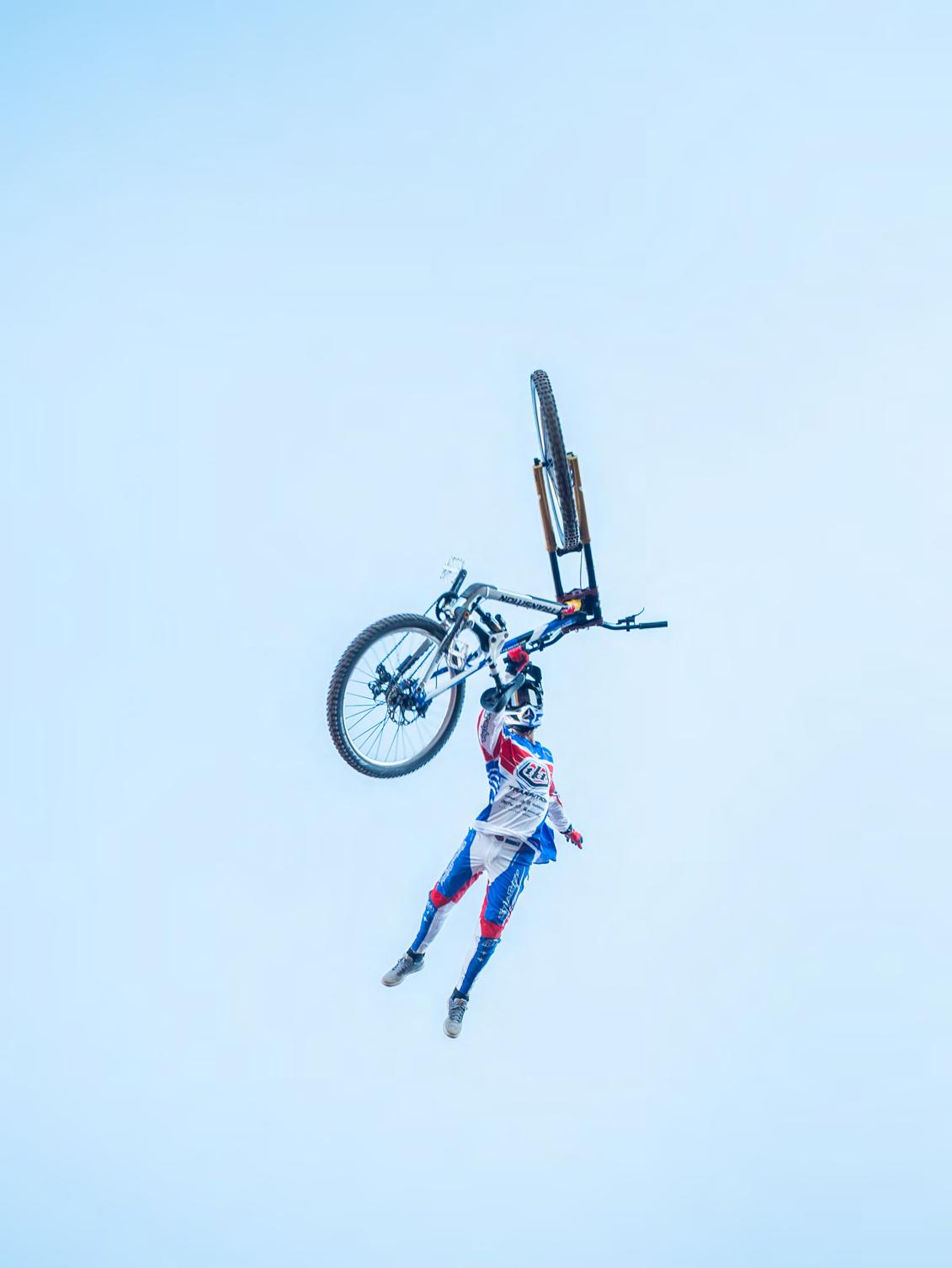
Photo: Remi Krupinski
Editor-in-Chief
Lincoln Roch
Managing Editor
Xavier Michnewicz
Sarah Taylor
Assistant Editor
Myra Kirk
Baylan Wysuph
Photo Director
Brody Rector
Art Directors
Mia Pendergast
Emma Taylor
Ingrid Pehrson
Words
Lila Nuttle
Isaac Sterling
Photos
Remi Krupinski
Scott Tan
TJ Zirkman
Annabelle Payne
Kara Liguori
It would be infeasible to count the number of times that thought has crossed my mind since a conversation last April. Managing editor Xavier Michwenicz and I were complaining about the limited variety of student publications at our university. Eventually we settled on a solution and said fuck it, let’s make a magazine.
Turns out that’s easier said than done. I’d say it’s a miracle that we pulled it off — but it’s not. A small but mighty staff worked tirelessly for months to put together this first issue. I could not be more proud of them and what they accomplished.
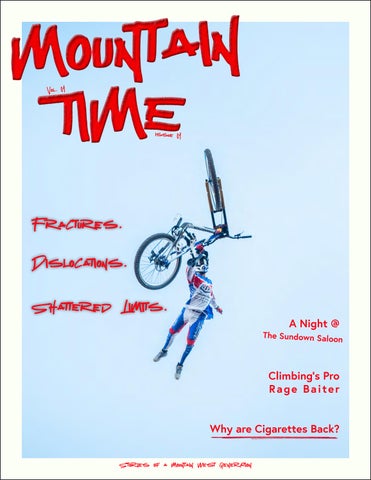
On the first page of this magazine is a quote from the late Hunter S. Thompson. I believe it perfectly encapsulates an overarching theme for the 52 pages that lie ahead. People living on the edge. People living life to the fullest.
Special Thanks To
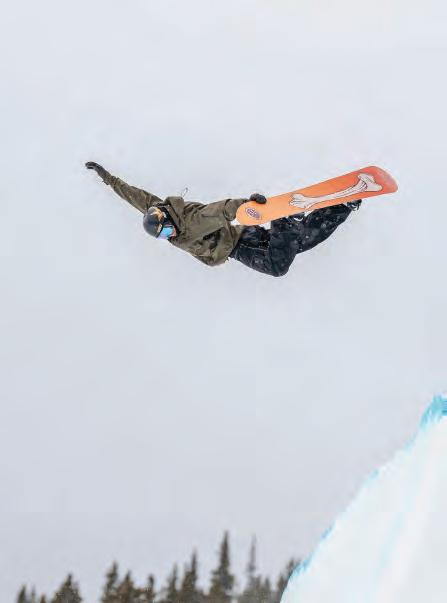
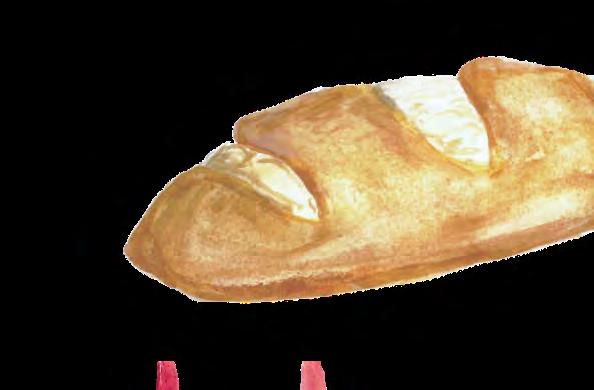
There’s the 20 year old who reached the pinnacle of freeride skiing. The free soloist who has Instagram convinced that he has a death wish. The women who did not disappoint at the world’s gnarliest mountain biking event. The man who found his calling in baking gluten free sourdough bread.
There’s also stories about the complications of life. Couples eloping to avoid the costs of weddings. A girl fighting an eating disorder perpetuated by “health” culture. Two men caught up in the new age of nicotine addition.
This publication’s mission is to provide a raw glimpse into the lives of Colorado twentysomethings and the world they live in. To our faculty advisor Chuck Plunkett and everyone who has helped us live up to it: thank you.
Lincoln Roch, Editor-in-Chief
John Leach, Jeff Inman, Ben Reed, Amanda Favazza, Haley Forstot, Alexia Bailey, Ainsley Coogan, aPrints printing and the University of Colorado Center for Student Involvement.
a night at the DOWNER
Words & Photos: Myra Kirk Design: Ingrid Pehrson
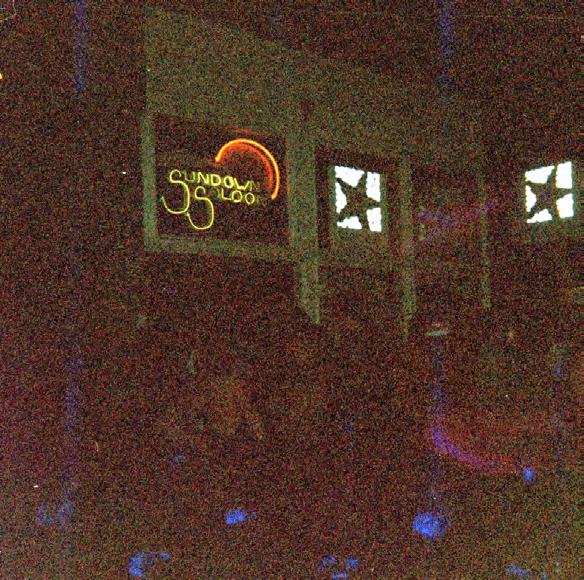
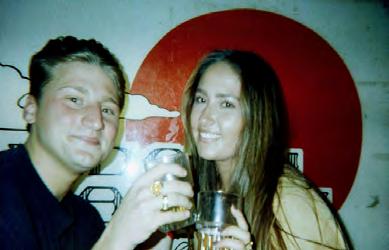
Tucked between a strip club and a sandwich shop lies The Sundown Saloon — affectionately known as The Downer — established in 1982 and touted by many as the crown jewel of Boulder’s bar scene. As a newly-minted 21-year-old, it only felt right to make my inaugural visit there as a rite of passage to my ever-growing affinity for beer, partying and the like.
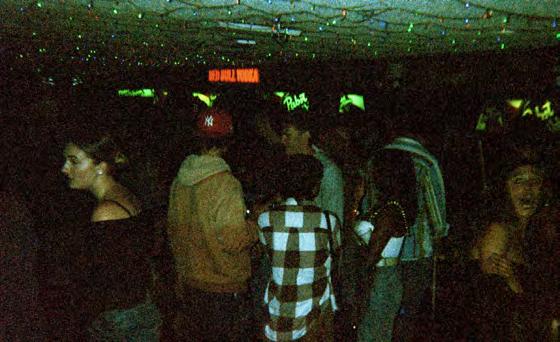
To get inside, I quite literally had to submerge myself into the experience. Upon the descent down the stairs, I was met with the bar’s dim amber glow.
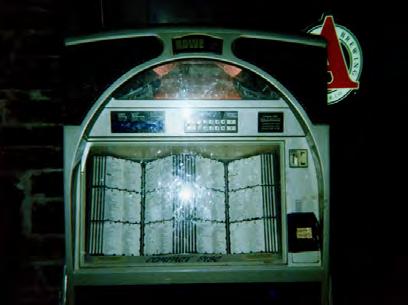
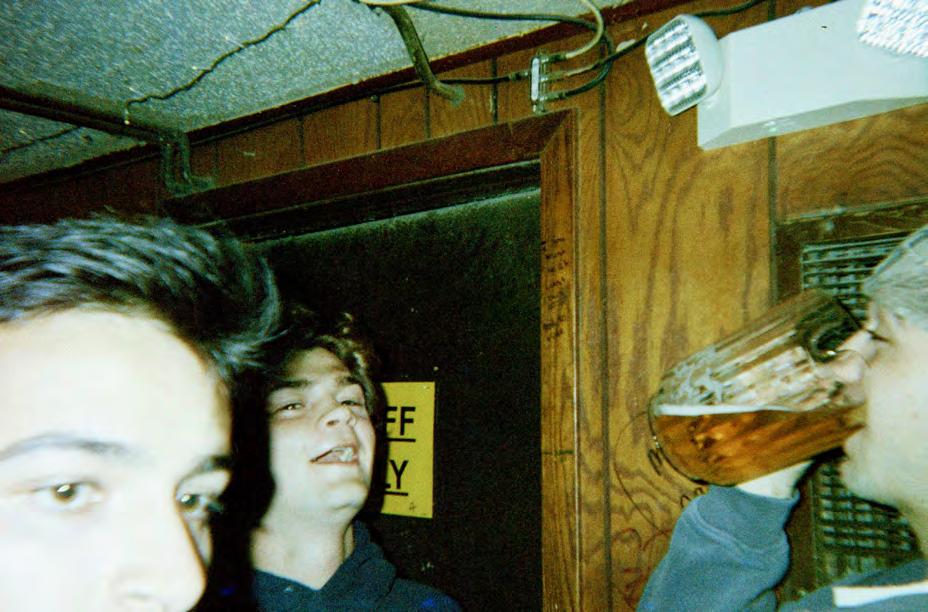
The Downer waged a visual skirmish with the sterile and garishly modern bars that I grew accustomed to. Adorned with tricolored string lights, a jukebox and seating areas fit for a caucus, I felt I found a sanctuary. No longer did I carry the sentiment that I was “too young.” The renegation of the “no-chairs-everyonejust-huddle-awkwardly” policy met me where I was: a university student who can’t bargain for a seat.
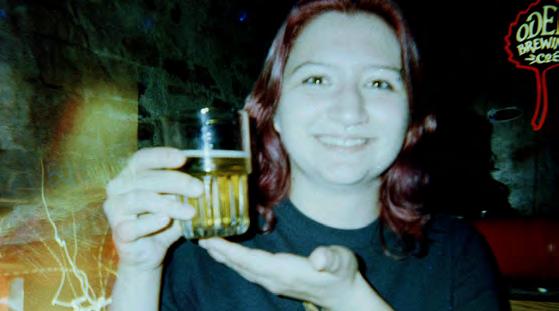
I could almost guzzle the froth of its beloved PBR pitchers just from standing there alone. I smelled an olfactory handshake between their beer and the kind of musk that feels ordained for a saloon. Just my language — pitcher please!
Upon “breaking the seal,” I decided I had the gall to investigate further. What do people really think of The Sundown Saloon, and why are they here anyway?
The answers came fast and loud, as if everyone had been waiting for someone to ask.
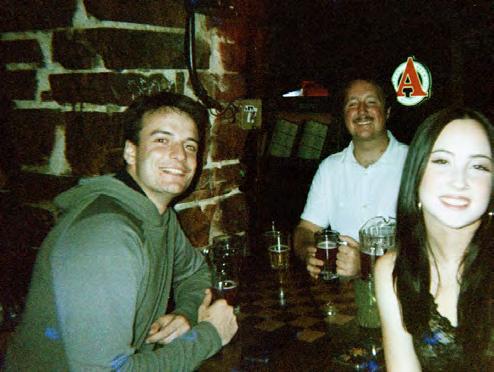
“The Downer is in the top three places on planet Earth,” Liam Dutka, a 21-year-old student at the University of Colorado Boulder said. “Nowhere else will you find every person you know, whether it’s happy, sad or both. This is the living waterhole for the
liamdutka inthemiddle
Similar sentiments were shared by girls convening at the literal waterhole: an orange canister of water beside the graffitied bathrooms. As portended by the great heavens above, it seems you are cosmically bound to see someone you know. The people I didn’t happen to know, however, had a unique way of making me feel like I should.
“It’s always been a place where people can come and find their friends, even though they don’t necessarily text their friends,” owner Sarah Downs said. “You can just come in, run into someone that you know and have a fun night.”
Downs also pointed to one of the small, deliberate choices that helps shape the bar’s character.
“We’ve always tried to instill consistency in always having a jukebox and not having TouchTunes, or
neilandart playingpool
music that people can just play off of their phones,” she said.
As a result, I observed that few patrons were glued to their screens. Still, some of those drawn in were only passing through.
Juliette Nanney, for instance, was on a short-lived return to Boulder from North Dakota. That very night she planned to rekindle an ex-fling, or in more modern prose, an ex-situationship.
Per her Notes app — and streamlined reviews of guys she had gone under the sheets with — he had far surpassed the near two-out-of-five-star average of her past partners’ sexual performances. To pass the time while he was at a concert, in hopes of off-roading with him the following day, she drank and sat at a clustered
of their late stay at the bar proved to be fecund with promises of tours around the city.
In other conversations, it was unanimous that the cheap beer might be part of the traction factor. But praise for The Downer’s cheap beer doesn’t cut the sentimentality and nostalgia that some feel for the
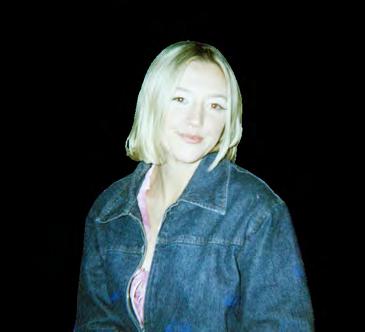
Sara “Coco” Moore, a CU senior who began her college years visiting the bar with friends, said The originally owned the place and is in the pictures on the
The throngs of laughter and clatter of glasses droned around her, grounding visitors into a night that felt lived-in and authentic. I decided to drift onward.
Elsewhere in the bar, Niel Mondava and Art O’Kelly struck gold at the near-damp pool table. O’Kelly had nearly forfeited, but Mondava’s sound judgment convinced him to stay for a winning game. O’Kelly and Mondava were visiting Boulder on a work trip for an outdoor brand that they work for, but wouldn’t name. Mondava considered the prospect of moving to the city in January for the same company. The rest
“I want a piece of The Downer with me to remind me of the best parts about being home,” Elliot said.
With the rest of the night living in blurred absentia, in my day-old mascara and clothes, I can say that The Downer reaches far and wide.
Whether it’s the foosball, darts, pool, shuffleboard, cigarettes for sale or craft beer that disarms every wanderer who meets the bar, I know a latent home-like quality hums beneath it all. The Downer beckons like an ale-soaked cottage in the Holy Roman Empire.
akasaracoco
juliettenanney
Words & Photos: Issac Sterling Design: Ingrid Pehrson
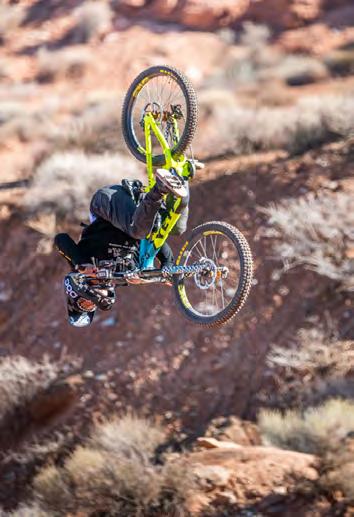
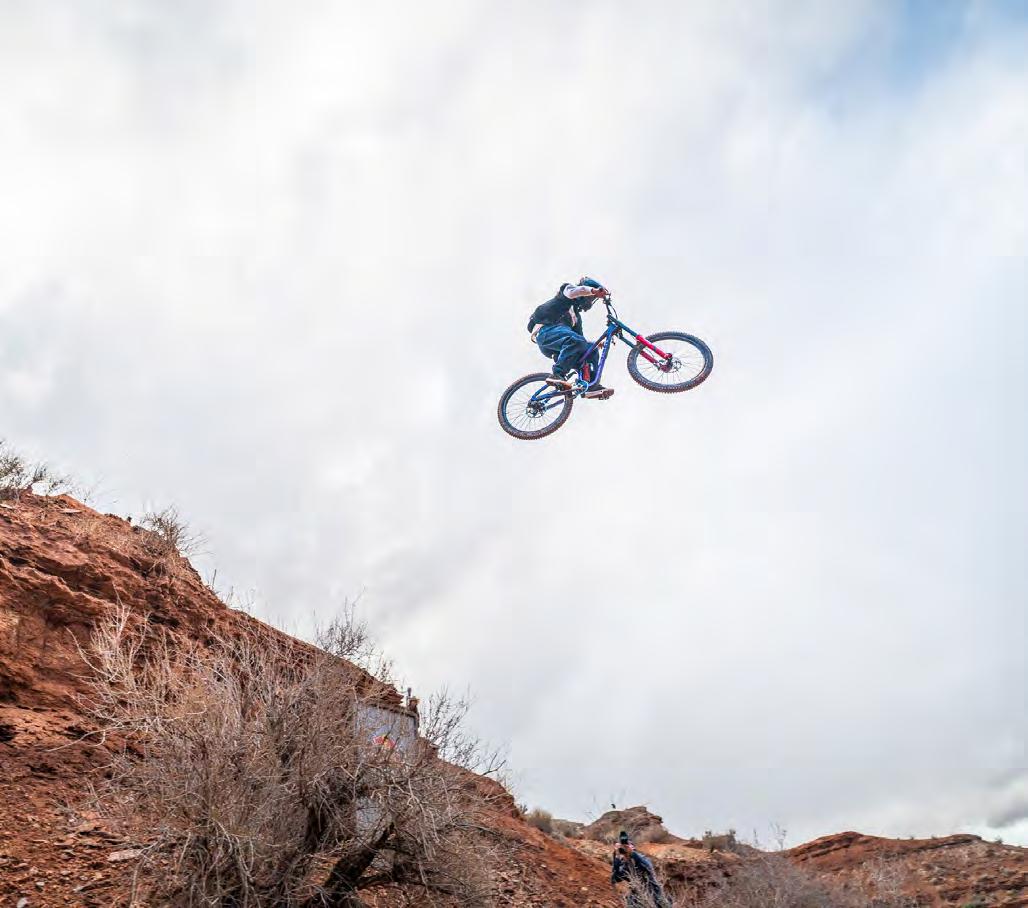
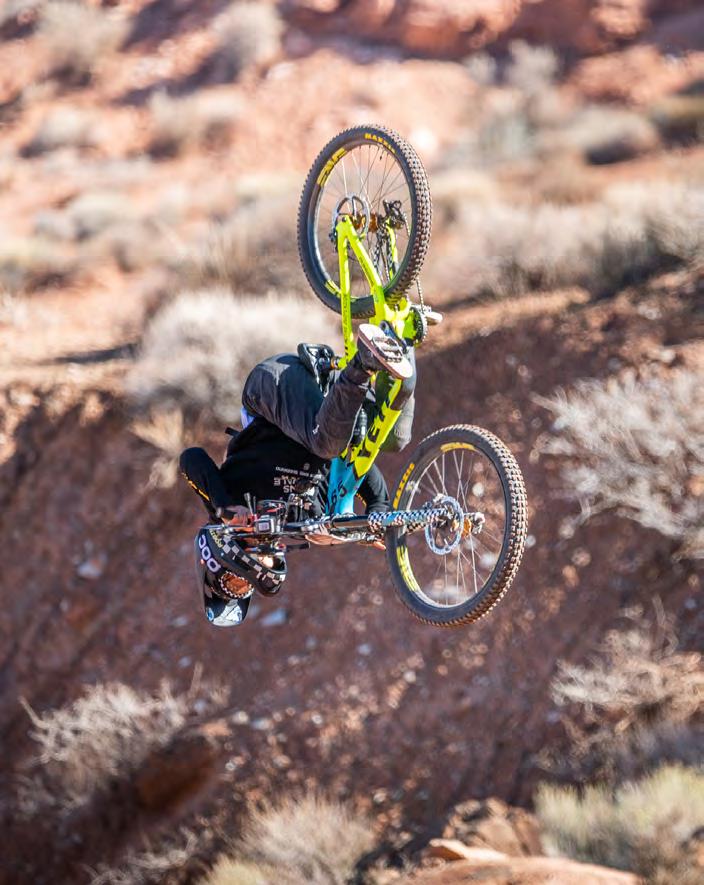
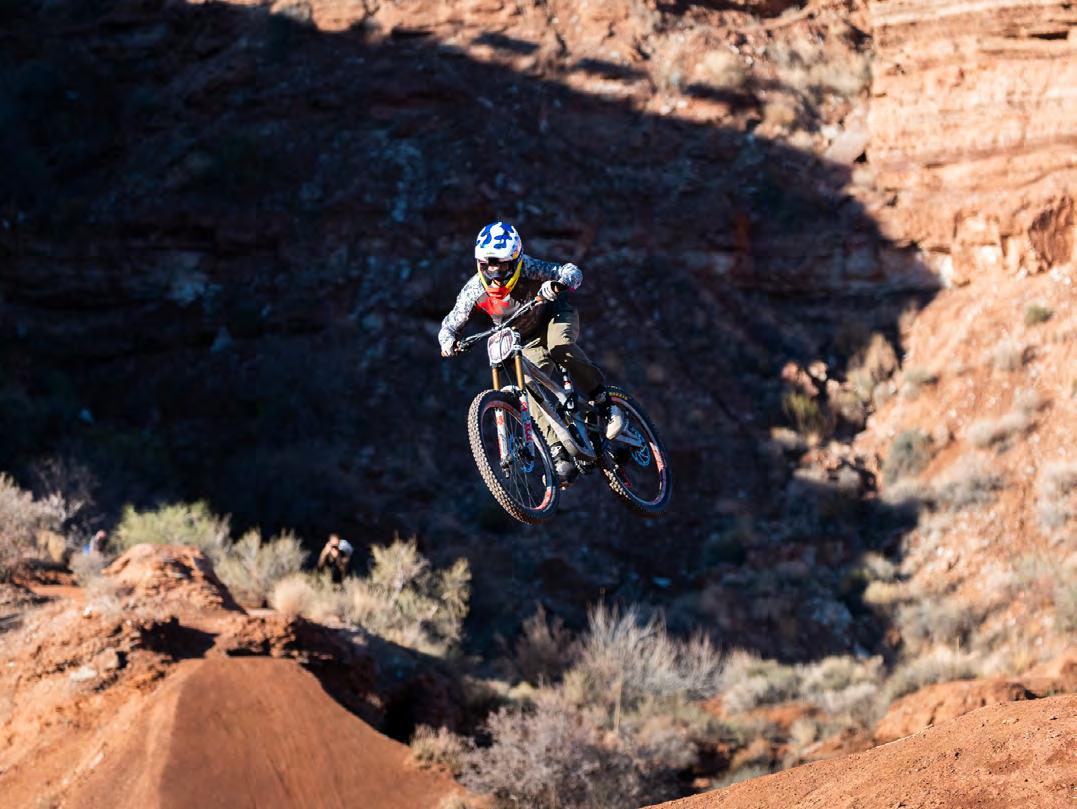
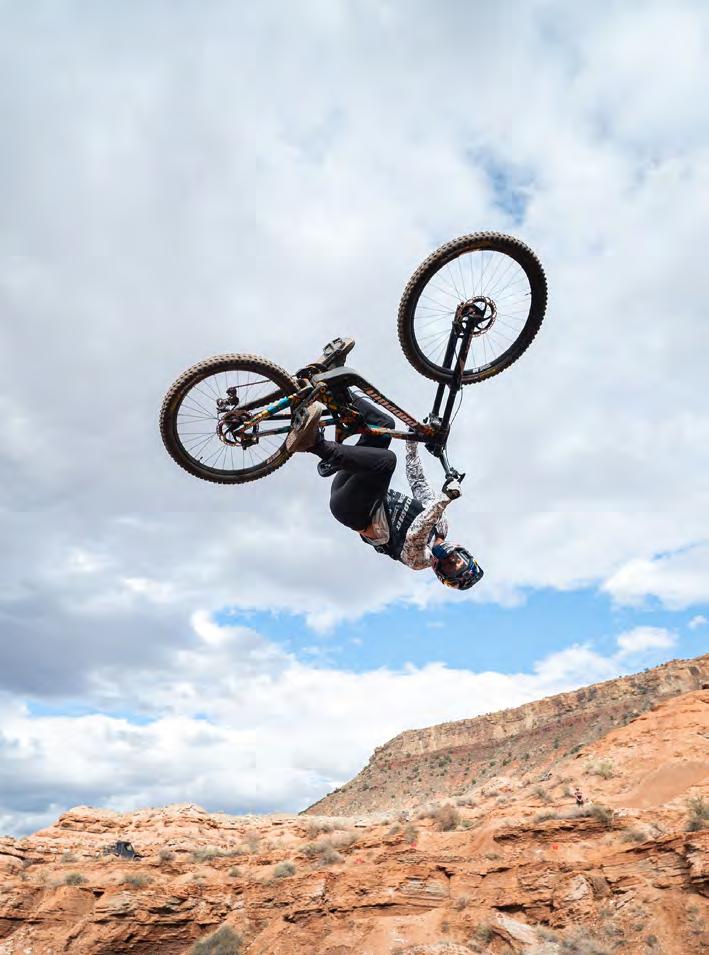
For a quarter-century, Virgin, Utah has served as the Mecca of the mountain biking world.
Each October, devout fans make the annual pilgrimage to the 670-person town bordering Zion National Park to witness some of the sport’s best athletes push boundaries and break records. Thousands more tune in to the online broadcast.
In one week, the mountain is transformed from a blank canvas into each rider’s own masterpiece. Since its inception in 2001, the event has brought colossal attention to the sport, inspiring new riders and fans across the globe.
Ten days before the competition, the riders stand at the bottom of a jagged mountain, scoping the gnarliest route down. In the following days, dig teams work tirelessly to transform the landscape into some of the hardest riding in the world.
This year, they were faced with the challenge of weather. Rain and mud made it not only difficult to build, but even harder to ride. Two athletes walked away with gold medals. Three left on an airlift.
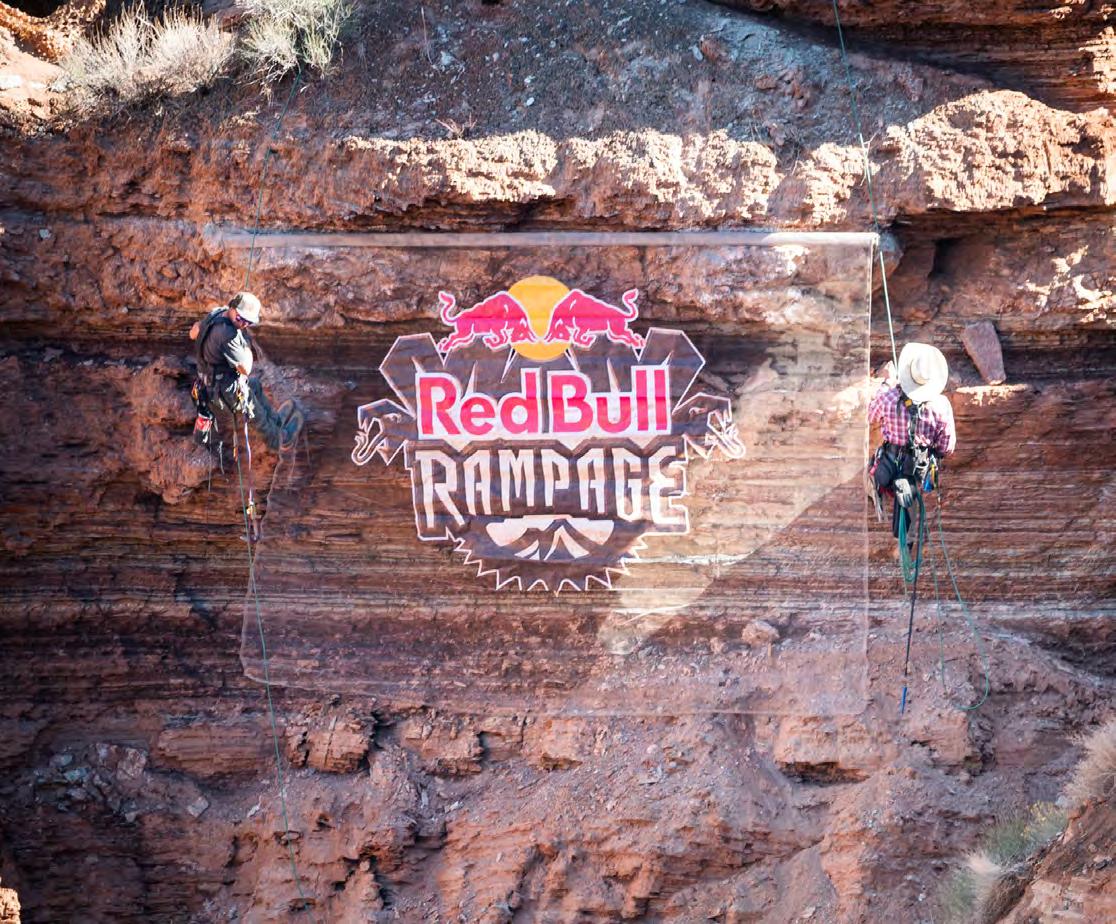
Two workers add the final sponsorship logos before competition day.
Janelle Soukup is currently enrolled as a full-time student at the University of Colorado Denver, where she is studying mechanical engineering. While at Rampage, she celebrated her 20th birthday surrounded by massive drops and lots of red dirt. As a rookie and the youngest rider, she felt the pressure coming in.
“You see all the girls drop in front of you, and they’re so composed and so locked in,” Soukup said. “I was like, ‘Holy crap, I don’t know what I’m doing up here.’”
Janelle Soukup practicing her bottom drop after the rain cleared.
Robin
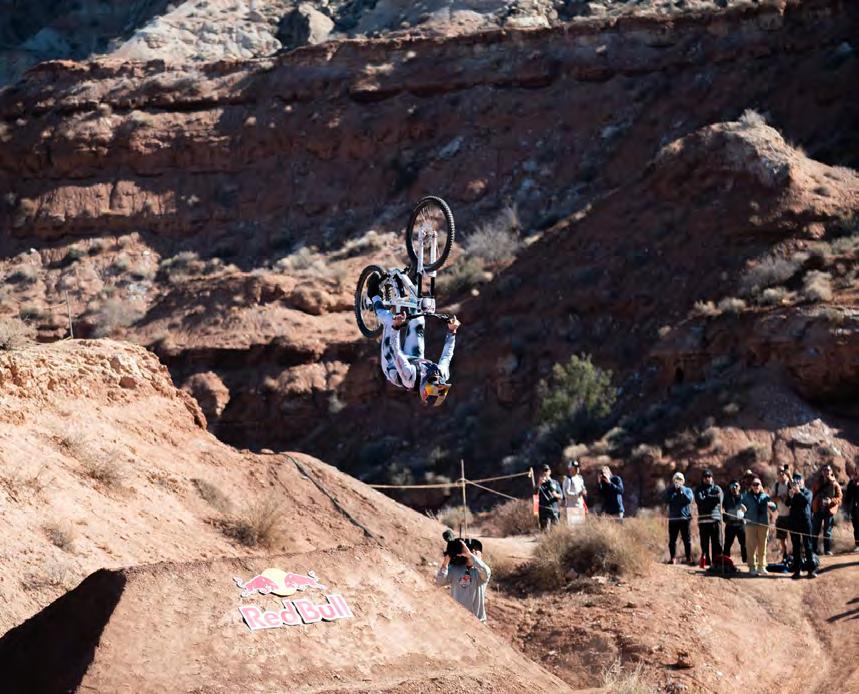
With the debut of Women’s Rampage in 2024, there was immense excitement to see the progression that happened in one year. The women did not disappoint, throwing down crazy lines, with some adding in tricks and flips.
At the podium ceremony, signs were out. Kaylee Taylor traveled from Bend, Oregon, to show her support, holding a sign that read, “Girls just want to send big.”
hits a backflip on day two of the competition.
launching off a jump.
Kirsten Van Horne prepares to land after
Goomes
Back-to-back winner Robin Goomes threw down two backflips among a long list of tricks to give her the win over Hannah Bergemann by 0.17 points. Finishing out the podium was Georgia Astle. Goomes walked away with $100,000 and a 2025 Ford Raptor Ranger.
Rampage is a brutal event that is not forgiving. Mistakes can mean dire consequences. Despite dislocating her elbow in practice two days prior, Cami Nogueira dominated her line for a well-earned fourth place. The strength and determination to not let her injury keep her away from competing resulted in her walking away with the toughness award.
Hannah
Bergemann, Robin Goomes
and Georgia Astle do a shoey to celebrate.
Cami Nogueira receives the toughness award two days after her accident.
After missing last year due to a torn Achilles tendon, Bergemann did not let Goomes take an easy win. She threw down her own series of suicide no-handers and a massive backflip at the bottom of her run.
Hannah Bergemann throws a backflip on the bottom trick jump.
The men threw down. They tried a wide range of tricks toward the bottom of the venue with massive drops in the range of 40 to 70 feet, canyon gaps and gnarly ridge lines. Although the men’s competition started in 2001, every year the caliber of riding increases.
Aiden Parish made a 67-foot diagonal step-down that he sent for 92-feet in practice. Two days later, he ended the step-down a little short, getting launched off his bike and breaking his femur and helmet.
Two more injuries came on competition day. While Adolf Silva attempted a double backflip on his second run, he under-rotated and flew over the handlebars, ragdolling down the landing. He was quickly airlifted to St. George Regional Hospital, where he was diagnosed with a spinal injury that left him with no feeling from the chest down.
Just minutes after the competition resumed, Emil Johansson crashed on the opening trick of his run. He was thrown off a narrow ridgeline towards a sheer cliff. He stopped short but severely dislocated his hip, requiring a technical extraction and pausing the competition for over an hour.
Carson Storch throws down a massive cork.
Climbing’s
Design: Mia Pendergast, Emm
Words:LincolnRoch aTaylor
Rage-Baiter
With video series like “Free Soloing a Harder Route Every Day
Until I Fall,” Lincoln Knowles has earned a cult following and a
series in June titled “Free Soloing, a Harder Route Every Day Until I Fall.” He’s been described in his videos’ comment sections as “suicidal,” “dangerous,” “an idiot”
brick walls that lack any of the necessary holds of a traditional climbing route. So he’d have to chimney climb for 15 stories.
“It was like a leg extension. A 500rep leg extension,” said Lincoln Knowles, the 21-year-old climber crazy enough to do it.
The July video ended with a view of Boulder from the roof and no arrest.
Knowles’s Instagram account exploded in popularity this summer thanks to his controversial free soloing videos, complete with captions and antics that embrace absurdity and rage bait. His rise to stardom started with a
World-renowned free soloer Alex Honnold, whose ascent of El Capitan in Yosemite National Park was the subject of the Oscarwinning documentary “Free Solo,” might have been his most famous critic.
“This is like everything I hate about influencer culture,” Honnal told Climbing magazine after watching one of Knowles’s videos in August. He’d eventually have a change of heart and appear in Knowles content.
But with 90,000 followers and counting, Knowles has tapped into an audience that has surpassed the climbing community, propelling him into the Gen Z zeitgeist.
While it may appear that he is a maniac with no sense of personal safety, everything’s going to plan.
Behind the videos is a calculated content creator, pushing his limits to new heights, with no intention to fall.
Raised in Kansas City, Knowles didn’t have access to the mountains of Utah and Colorado, where many free soloers get exposed to the sport. What he did have was an urban environment and a climbing gym. So he got creative.
“I used to solo buildings and stuff as a kid. Like abandoned buildings, unfinished houses and stuff, just for fun,” Knowles said. “Then eventually I became a free soloist outside.”
When it came time for college, he was faced with a decision: choose a school for the academics or the University of Utah for its access to the outdoors.
“I was just like, fuck it. I’m going to go to Utah and just chill,” he said.
The summer before his junior year, he started a YouTube channel. He began to skip classes, spending time in the library editing videos and climbing on the weekends. While he was making no money and getting an abysmal number of
views, he treated his channel as a full-time job.
After getting caught cheating at the end of the school year, he decided to drop out. It was a wake-up call. He abandoned his pursuit of a computer science degree and went all in on his videos.
Then on June 6, as he was brainstorming ideas for the title of his latest free soloing video for Instagram, it came to him: “Day One of Me Free Soloing a Harder Route Until I Fall.” It spread like wildfire.
“I honestly cooked with that one,” Knowles said. “At that point, I was soloing harder by myself, and I had some soloing goals, so it kind of made sense to start that challenge. And then on day two, I was like, ‘This is low-key a fire challenge.’”
While many are convinced that Knowles is reckless and will eventually die in pursuit of the challenge, he’s meticulous. While he pushes his limits, he knows them too.
“The goal is to never have a solo feel like you’re rolling the dice or that this is lowering my chance of living,” Knowles said.
When Knowles was in high school, he struggled with depression and grappled with whether life was worth it. So while others may see Knowles as gambling with death, one of the biggest reasons he continues to push himself is for his own survival. He believes that if you never face real fear and danger, you can’t truly appreciate your existence on Earth.
“It frames life as something that is great and that you have to work towards, and that it’s awesome,” Knowles said. “Life is worth living.”
Words: Baylan Wysuph
Design: Mia Pendergast
Photos: Emma Taylor
Shrouded across the street from one of Boulder’s most infamous restaurants, The Sink, is a tiny Asian street food spot. While The Sink might have the fame — it’s played host to the likes of Guy Fieri and Barack Obama — you won’t find it in the Michelin Guide.
What started as a food truck in 2016 is coming off three years of recognition from the culinary world’s highest authority, with its Boulder satellite only serving takeout.
Head chef Natascha Hess fell in love with Asian food during her time at the University of Wisconsin. While she played Division I hockey over the winter, she spent her summers studying abroad in China for three years where she fell in love with Asian cuisine.
“She’s always been a super taster,” Wade Bendsole, the director of operations, said about Hess. “Her heart’s always been with authentic Asian food.”
Hess and her husband Steve launched The Ginger Pig in 2016 and quickly gained attention in Boulder. It was named Westword’s best food truck of 2018, and Hess earned spots on both Food
Network’s “Chopped” and “Beat Bobby Flay.”
The couple opened a Denver sitdown restaurant, keeping the same name, in 2020. Their small corner shop opened up on Boulder’s University Hill in October 2023. What was conceived as a ghost kitchen, just focusing on delivery, has transformed into a walk-up, takeout eatery.
“We realized we had to cater to a lot more foot traffic, which means we’ve changed the menu a few times over the last two years,” Bendsole said.
The Ginger Pig staff describes their food as delicious, gourmet dishes at an affordable price. That sentiment led them to a Michelin Bib Gourmand in 2023. They’ve received one every year since.
While a full Michelin star is more associated with high-end establishments, a Bib Gourmand is given to restaurants with the most value to their meals, offering the highest quality at the lowest price.
“It was pretty awesome to me,” Andrew Edwards, a co-owner, said about the honor. “It meant we were doing what we were supposed to. It’s good food. It’s real food. It’s at a good price with a cool vibe.”
Although Hess was the original
mind to the menu, Edwards does a lot of designing to the recipes himself. Staying true to authentic Asian street food, the Denver location represents the tastes of Singapore and Hong Kong while the Boulder location additionally highlights
more Japanese, Chinese and Thai flavors. To keep the selection innovative, Hess still visits Asia every year and brings back the culture within the menu.
“We’ve taken it and added some more customizable options,” Bendsole said about their newest menu update last September. “We’re just constantly coming up
Takeout window at Ginger Pig
ways to lower the price point.”
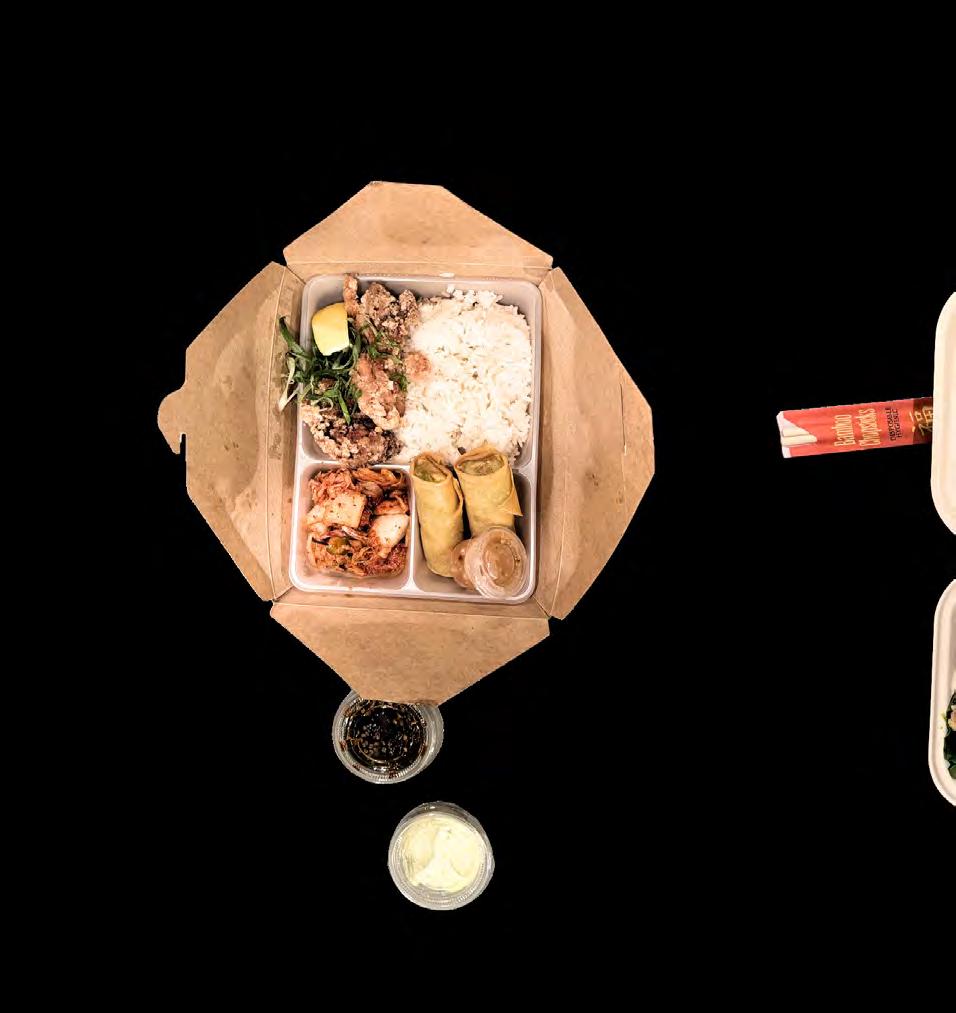
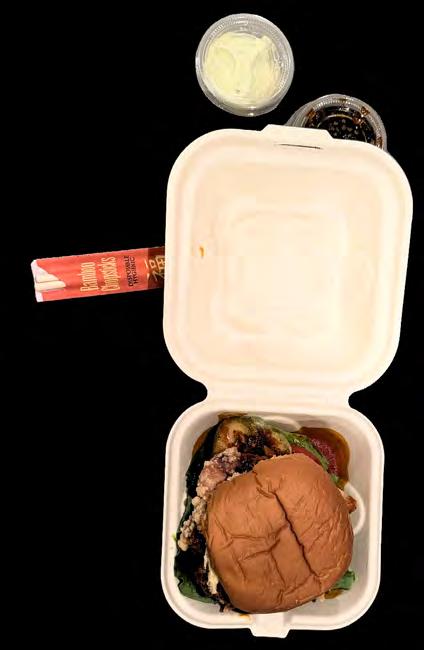
Everything on the menu besides bread, including various glutenfree options, is made in the kitchen from scratch. The kra pao burger and char sui Chinese barbecue pork are crowd favorites, both under $15. There are cherished sweet options to tag on as well, like a kaya coconut jam and mixed berry jam French toast.
“Just always add on a French toast to your order,” Edwards said. “Even though it says French toast, it’s not what you’re used to and you can’t find it anywhere else.”
The Ginger Pig is continuing to make updates to their menu, bringing consistent authentic Asian street food to anyone that stops by.
“We’re going to give you delicious food [and] we’re going to give it to you quickly. We’re going to give it to you at a good price,” Bendsole said.
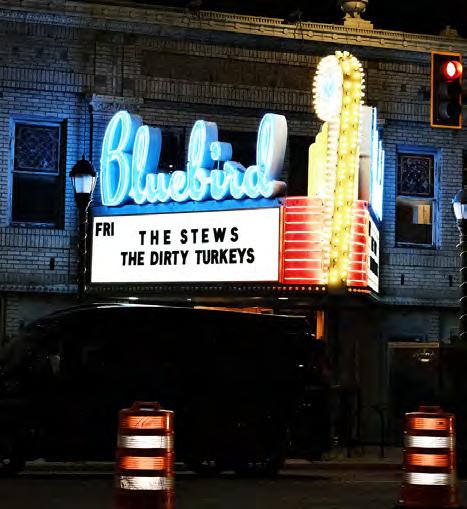
Coldplay, the Talking Heads, Phish and a band with 7,000 monthly listeners have something in common. They all formed in college.
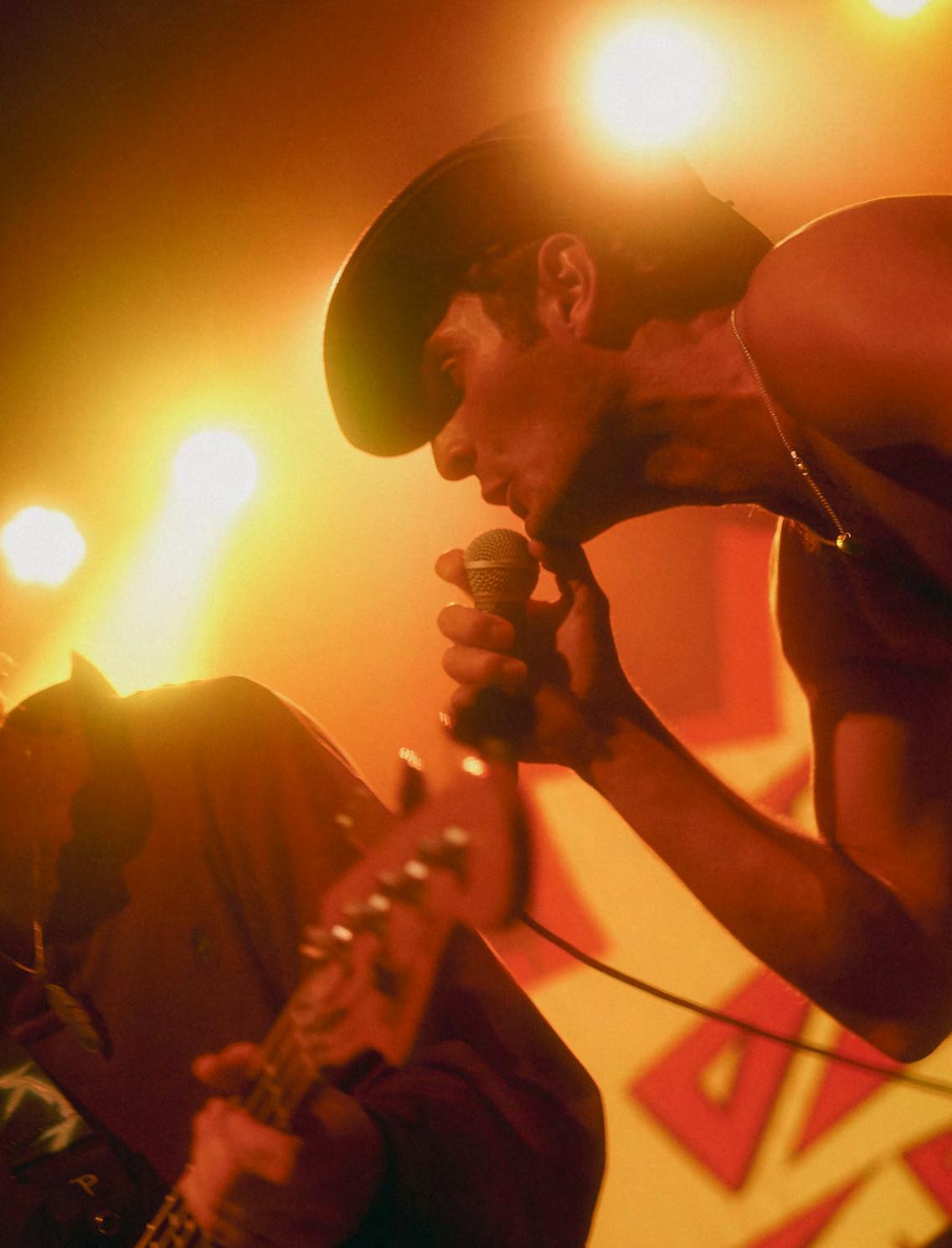
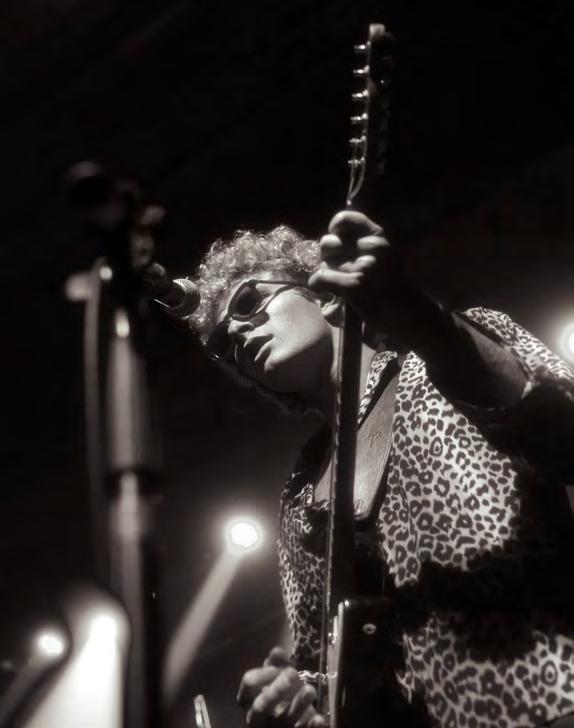
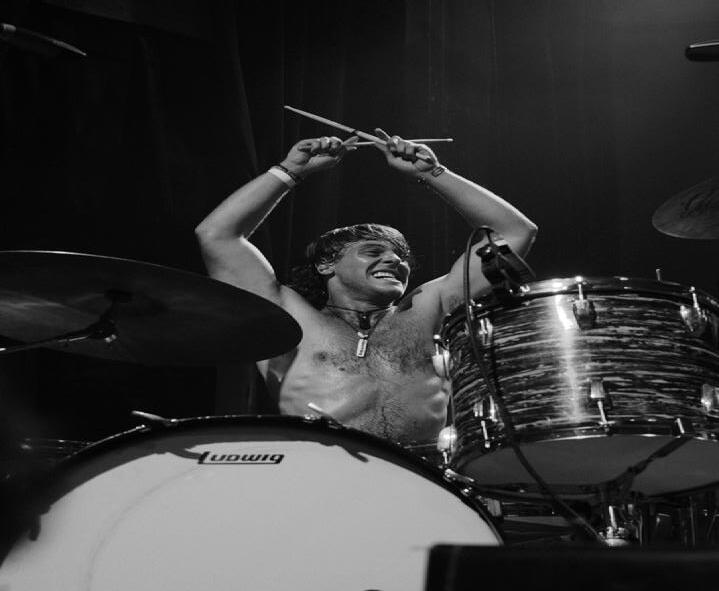
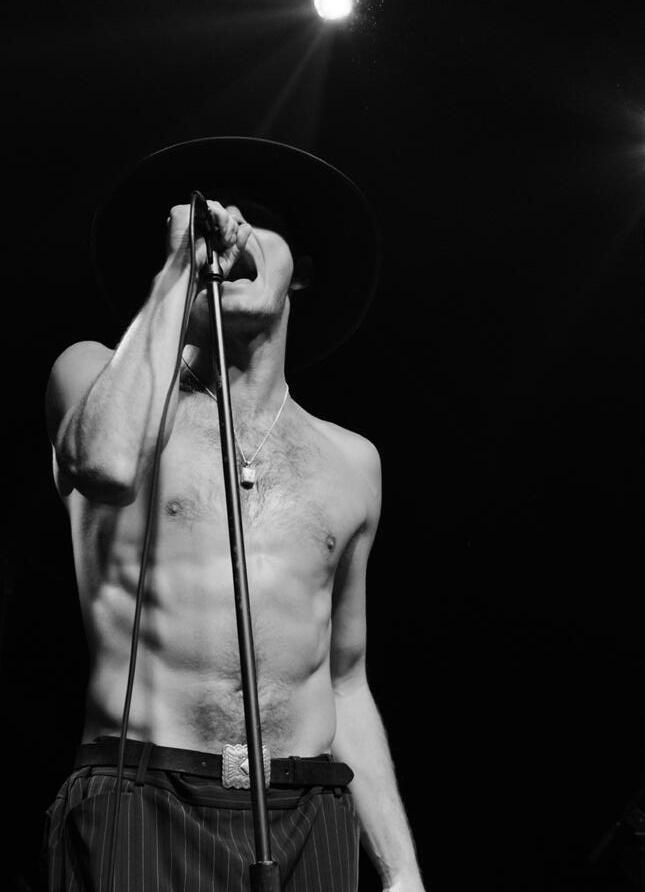
What started in backyards and frat houses at the University of Colorado Boulder has led The Dirty Turkeys to their first nationwide tour and feature documentary.
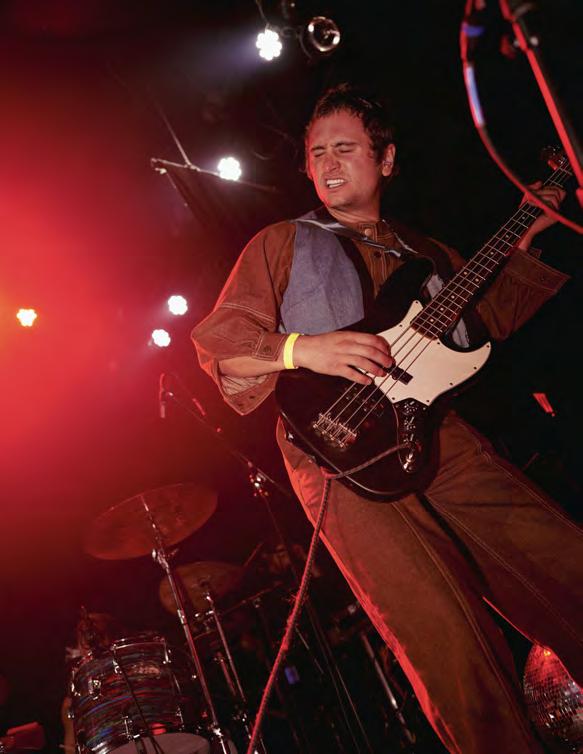
Comprised of brothers Brad and Justin Hansen, a preschool friend Sam Baker and another from college, Ty Tullar, the band deliberately formed outside the spotlight.
“A lot of our early jam sessions were at Ty’s tiny little basement,” said lead guitarist Justin, who goes by Russ. “Just being in a confined space, we’d turn all the lights off and just fucking rock out man.”
Playing in the dark removed the uniform way they’d learn to master instruments. It made them truly feel — instead of just see — what they were playing. Once the reverie turned routine, fresh, experimental tones sprouted. Before they knew it, they had an original sound.
The band released their debut single “Benny” on streaming platforms in March 2024. It was followed
“Russ”
tyCowboy Caravan is an iridescent, 12-song entranced acid rock project that gives you tones from beachpunk to The Beatles. With a lot of the foundational sound from the creativity of Russ, the band decided to go back to their in-the-dark practices to piece together and complete the project.
“It’s a progression into more experimental and psychedelic soundscape,” Tullar said. “We really put everything we had into this album.”
After the LP’s release, the guys embarked on the “Feast Your Ears Tour 2025,” which took them across five states over the summer. They later upped the ante with the month-long, nationwide Turkey Tour that fall. Even with a handful of concerts along the West Coast being unavoidably cancelled, the guys were able to hit 14 shows across 11 states.
Kicking off in Denver, with an additional homecoming show at the Fox Theater in Boulder, the circuit took them all across the country. They got to play in venues like the White Oak Music Hall in Houston and the Grey Eagle in Asheville, North Carolina.
“This tour was definitely our most expansive and successful tour,” Tullar said. “[We] played some of our favorite shows we’ve ever played before.”
The campaign was just another pit stop in a lively year for the band, including some stirring initiatives slated to make 2026 a breakout year. Since July, a documentary crew has been following the boys around.
The title track, released as a single on Halloween, introduced a boisterous new energy to the ensemble. With the speed and punch of 2000s Green Day, the song powerfully sets the tone for the rest of the LP.
“gonzo” sam brad
“I thought it was a joke at first,” said lead singer Brad, who goes by Gonzo. “Next thing you know, all these grown men flew out for our album release party and threw a contract in front of us, and now we’re best friends with them.”
The band did not disclose much about the project that’s set to come out in 2026. It’s supposed to show what life is like being a part of the band and will give each member a spot to share their insights with fans.
On top of the feature film, their newest record, “Soul Sugar,” is scheduled to hit the shelves in March.
“It’s a coalition of a lot of songs we made on the road,” Gonzo said. “New songs, old songs. I think people are gonna be really excited that there’s a bit of variety with this album.”
The guys followed it up with “Preacher’s Son” on Nov. 28, a grungy desert-twang-punk-infused single with modern tastes of The Black Keys.
“We’re really, really stoked to get it out,” Gonzo said about the project. “You have some really heavy stuff, some psychedelic stuff, some more punk stuff … I think we’re kind of finding our sound, and it’s very exciting.”
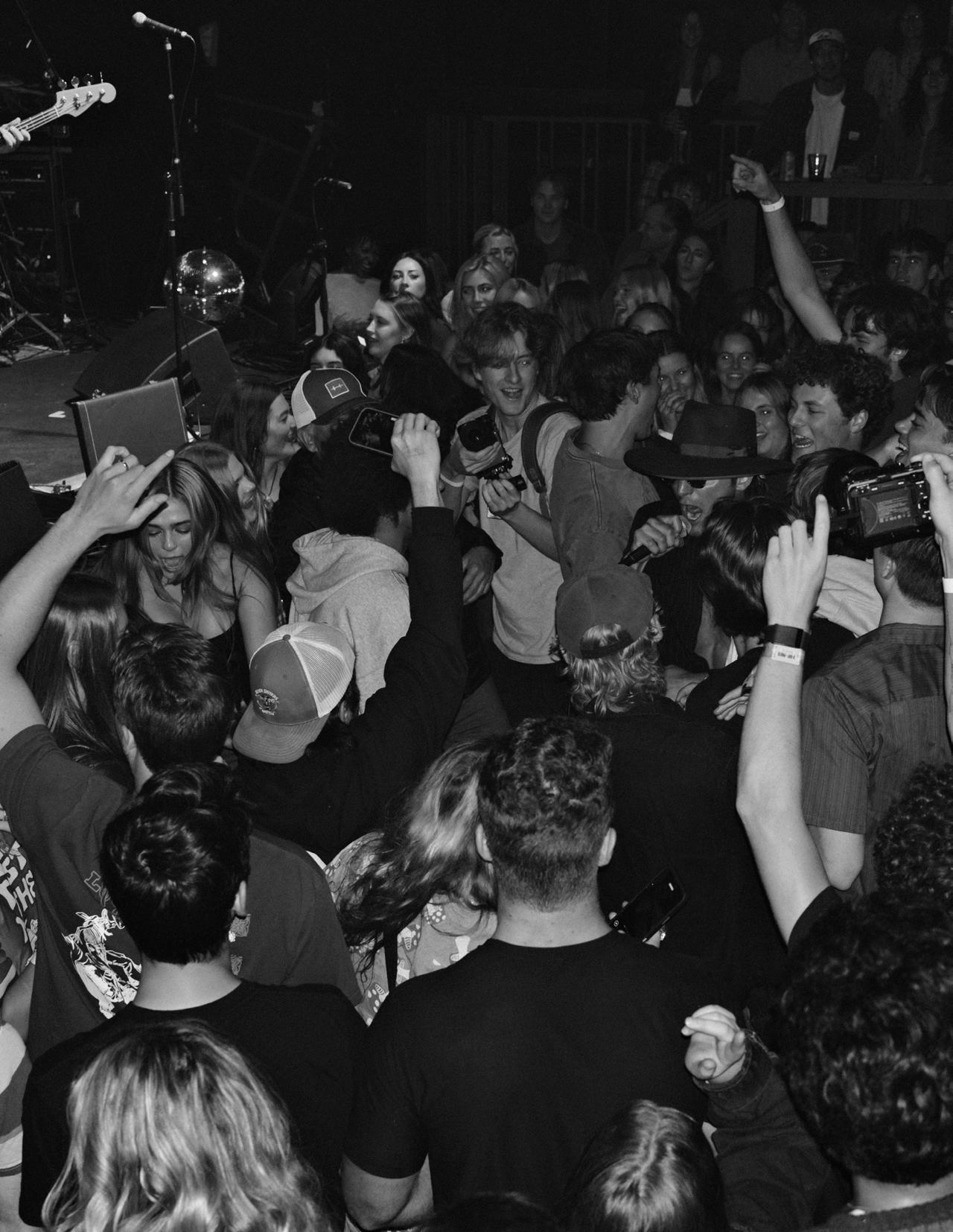
With the album releasing in March and the documentary premiering later this year, life has taken off for The Dirty Turkeys since graduating. Even with the business and commotion of being a full-time band, they stay true to supplying raucous, chest-pounding energy at shows.
“We’d love to take our tours to the next level,” Russ said looking forward. “[We’re] just going to keep touring and keep spreading the love and music, man. That’s what it’s all about for us.”
Words: Lila
Photos: Dom Daher of FWT & Scott Tan Design: Emma Taylor
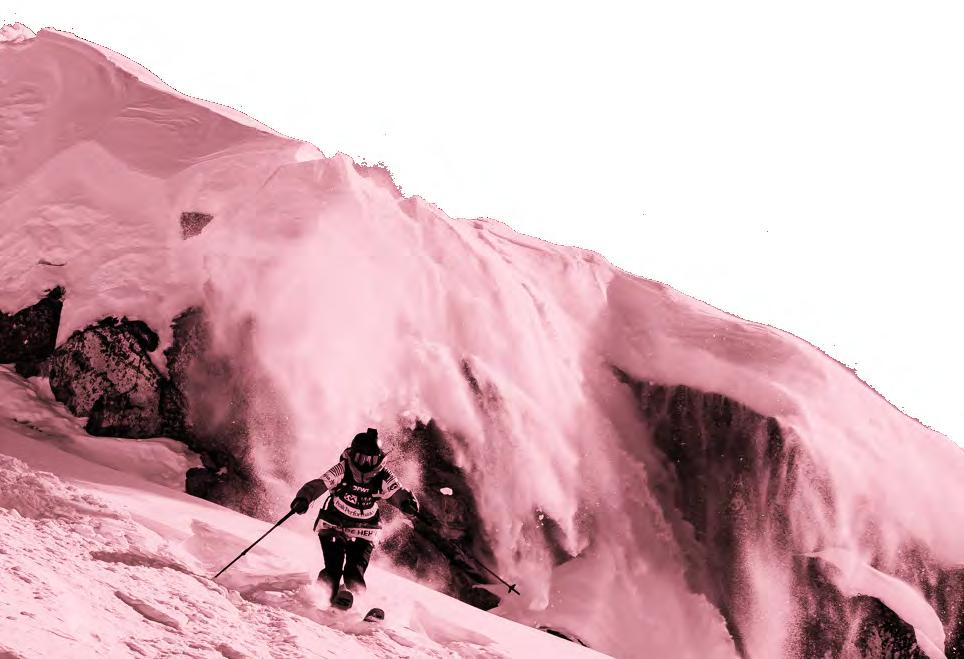
Chloe Hehir was practically born on skis.
Raised in Ophir, Colorado, a small town just outside of Telluride with dirt roads and a population of less than 200, Hehir could be seen as the poster child for granola Colorado kids.
“[We] didn’t have internet for, like, the first 14 years of my life,” she said.
Her parents, who met at the University of Colorado Boulder, leaned into the state’s outdoor vibe before getting “real jobs.” When she was younger, they would take her up the mountains in a backpack so she could ski down with her “little baby skis.” She’s kept at it ever since.
“It’s just been a part of my life for so long,” Hehir said. “The community within the sport is so awesome that it kind of just made me fall in love with it.”
At age 12, she began competing in big mountain skiing, which features off-piste, technical terrain — the kind of stuff in ski films. Athletes choose their own line down an ungroomed mountain and are judged on line choice, difficulty, control, style and fluidity.
Now a senior at CU and fueled by her love of the sport, Hehir is part of the CU Freeski team and competed in the 2025 Freeride World Tour.
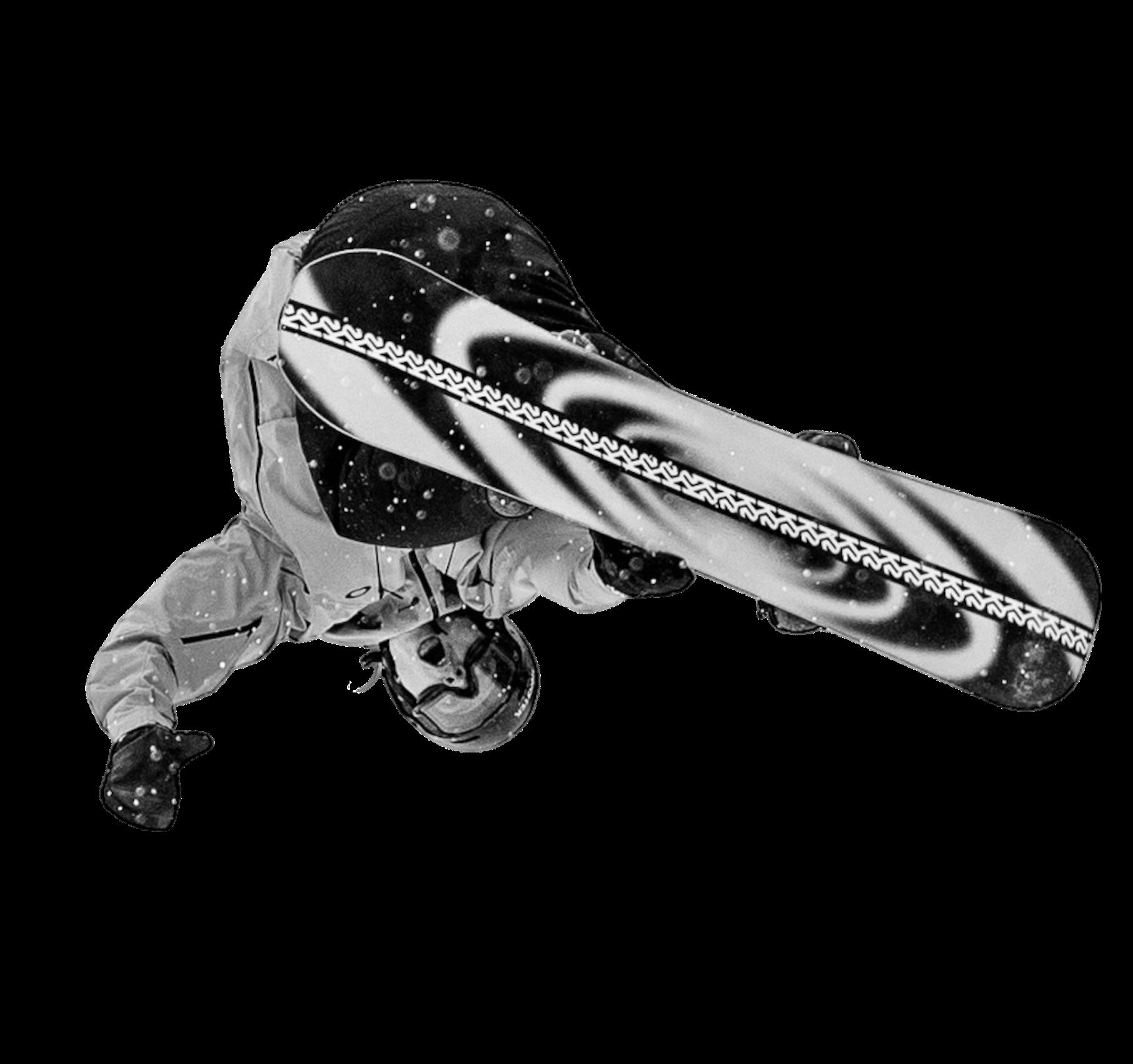
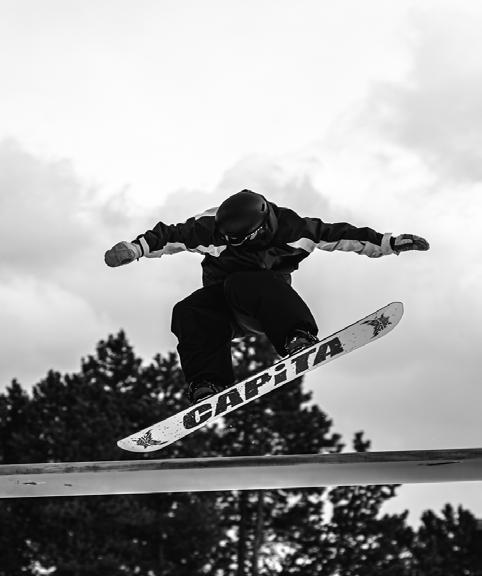
The World Tour is the pinnacle of freeride. It features elite skiers and snowboarders in a circuit of big mountain competitions around the world, where some of the very athletes Hehir grew up idolizing became her peers.
The way Hehir approaches big mountain skiing is largely influenced by Telluride, where she learned to ski.
“In Telluride, our snowpack isn’t the best,” Hehir explained. “A lot of times, there’s a lot of rocks and your skis
Nuttle
get scratched up, so I’m kind of just used to skiing on rocks.”
This translates into her style in freeride competitions, where she often chooses lines with more technical elements.
“People think that I really like techy stuff, but I kind of just like trying to find something that excites me,” Hehir said.
In addition to skiing, Hehir also competed in gymnastics up until college. While she ultimately focused on skiing, she says the skills she learned in gymnastics like air awareness helped her in big mountain competition.
“I feel like it taught me a lot about working hard, perseverance,
falling, getting back up, all the classic, cheesy sports things,” she said.
Qualifying for the World Tour is a multi-level process, beginning with the World Tour Qualifier, where the top performers move on to the World Tour Challenger. The Challenger pits the top qualifiers against the lower performers on the pro tour to determine the roster of the next World Tour.
Hehir had qualified for the Challenger circuit, the foremost obstacle in her underdog journey. However, her performance in the first two competitions at the 2024 Challenger didn’t point towards qualifying for the Tour.
She had secured fourth place in
Crested Butte but had fallen at the competition in Silverton. Going into the last competition of the season at Kirkwood, in California, she had no expectations of qualifying.
“I was just soaking up the moment,” Hehir recalled. “I was like, ‘I’m here. I’m going to do what I want to do. I’m going to ski a run I want [and] stay true to myself.’”
Her line choice at Kirkwood was exactly that: technical, with a tight shoot into a cliff drop, where she “delivered it with style, showing full control and fluidity from top to bottom,” according to the Freeride World Tour’s summary of the competition.
But despite how much her run
impressed, Hehir didn’t think much of it.
“It was just fun, but I didn’t think it was anything crazy,” she said. “And then they said that I won. And then I was like, okay yay. But then, I didn’t realize that meant I qualified.”
Her qualification came down to a tie-breaker. There was another athlete who also had a first and fourth place, just like Hehir. However, even with her fall, Hehir had snagged eighth place at Silverton, which put her ahead.
“It’s like standing in the pyramid and dropping in,” Heir said.
At 19, Hehir was the youngest woman competing on the Tour.
“It was more just kind of pushing [to] see what I could do,” she said about her mindset during the Tour. “Even though I didn’t accomplish all my goals, I was just trying to be proud of what I did.”
Hehir ended the season outside the rankings to requalify in 10th place. She went back to the Challenger but didn’t requalify there either.
“It was like, fake, straight up,” Hehir said. “And then they called my name for the tour. The dude came up to me and he was like ‘You did it, you qualified.’ It was just, out of body, the wildest dreams coming true.”
IIn the early months of 2025, Hehir joined the ranks of elite athletes competing on the world stage. “I just felt so grateful to be there because [there were] a lot of the people I’ve been looking up to for my whole life,” she said.
One of the highlights of the Tour was her very first competition at the Baqueria Beret Pro in Spain, where they took a helicopter up to the venue. She recalled it being icy, with everyone falling down.
But the real moment came at the top of the run, overlooking La Bamba, the mountain face she’d be skiing down. At the top of every World Tour run, is a pyramid structure, where athletes begin their line. To Hehir, it is an iconic symbol of the World Tour.
“It was so hard coming from that whole season and then going back to where I came from,” she said. “So hopefully I can qualify again for Challengers, and hopefully I could qualify again for the Tour, but right now I’m back at the beginning.”
Although she didn’t requalify for the World Tour, Hehir said her experience was still valuable and motivating. While she’s looking ahead to getting back to where she was, Hehir is making sure to stay in the moment.
“I learned so much about myself, how I react in situations … how I handle stress, how I handle failure, because that happened,” she said. “But now I’m like, I’ll just try again. I think it worked out because I’m still in college, so I get to compete with all my friends.”
Photos: Remi Krupinski Design: Ingrid Pehrson
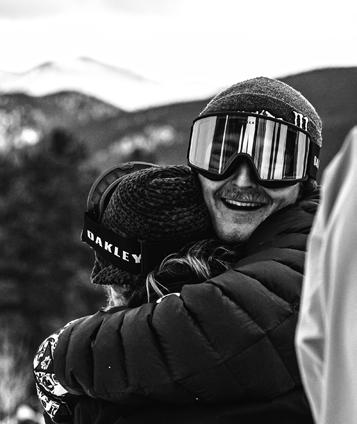
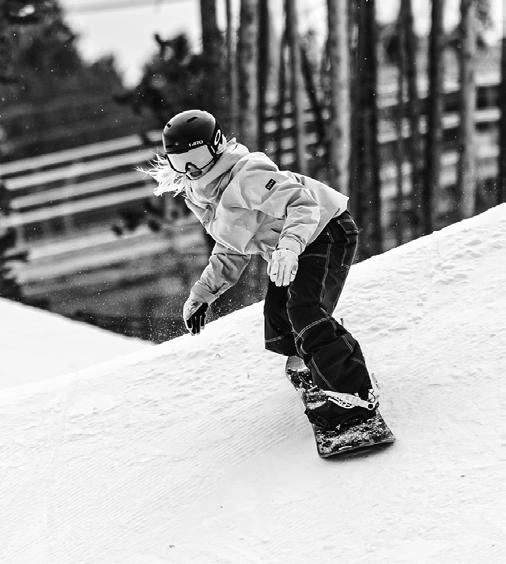
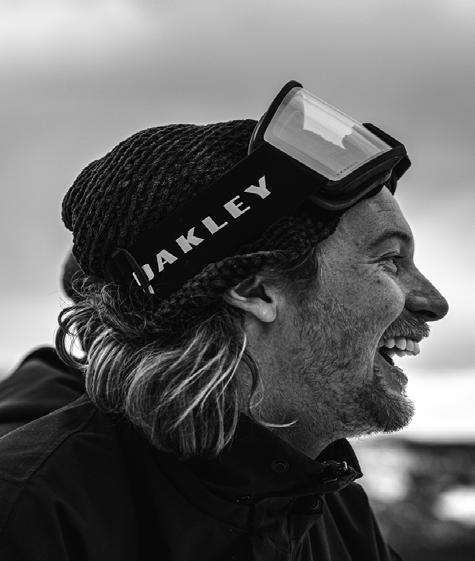
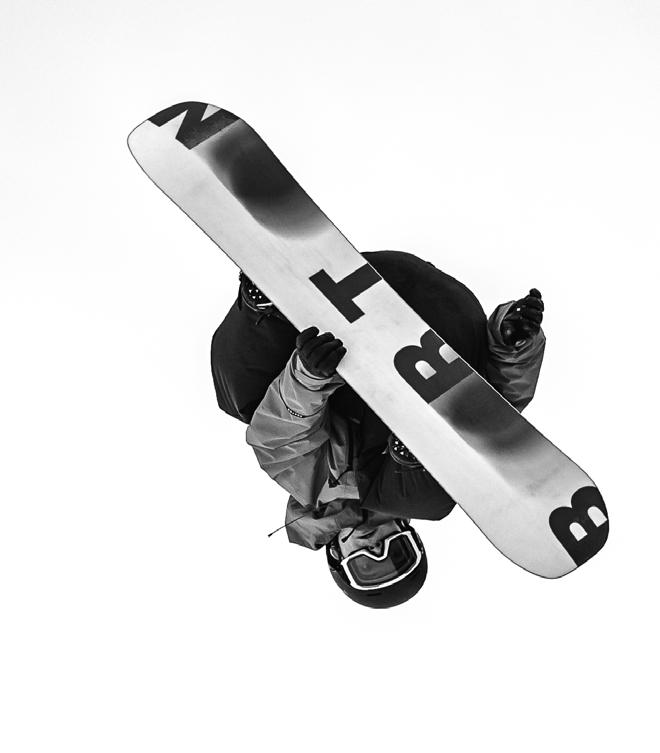
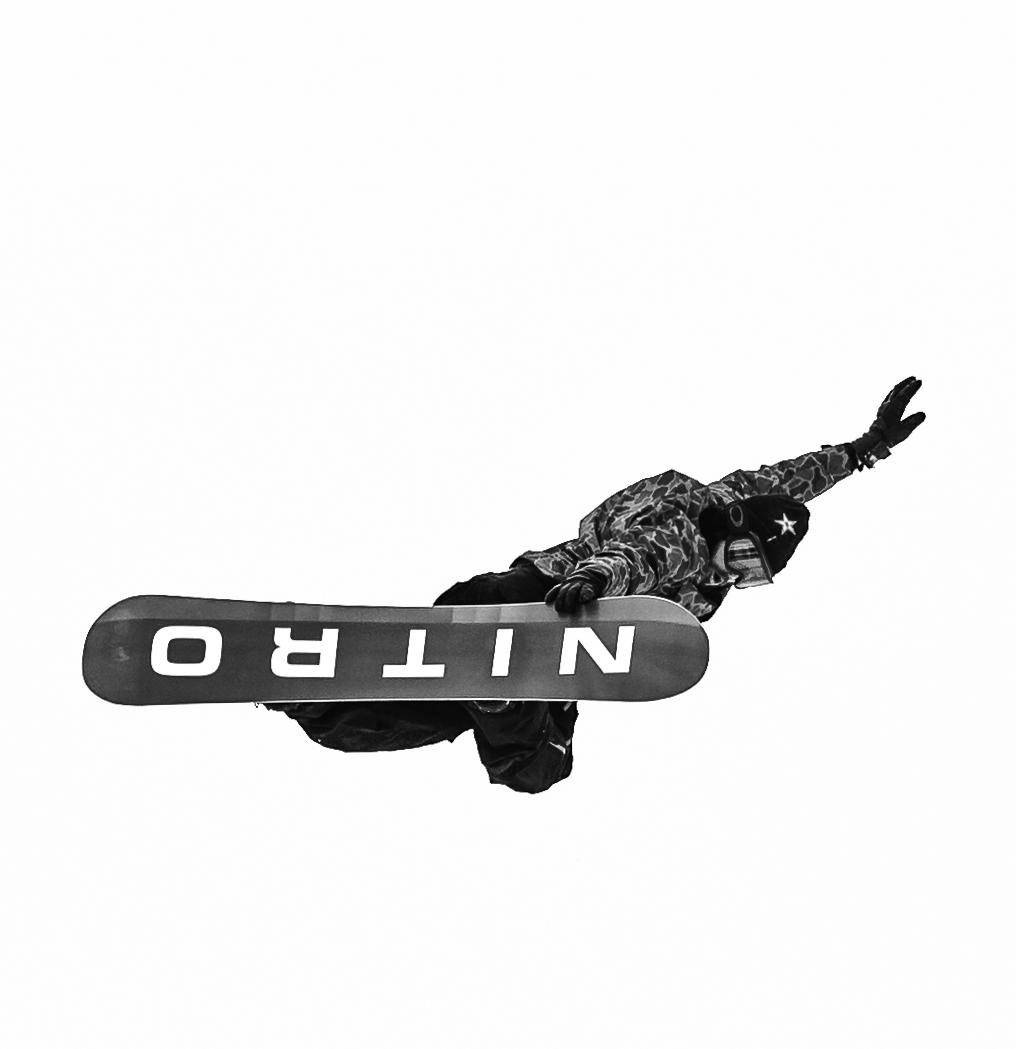
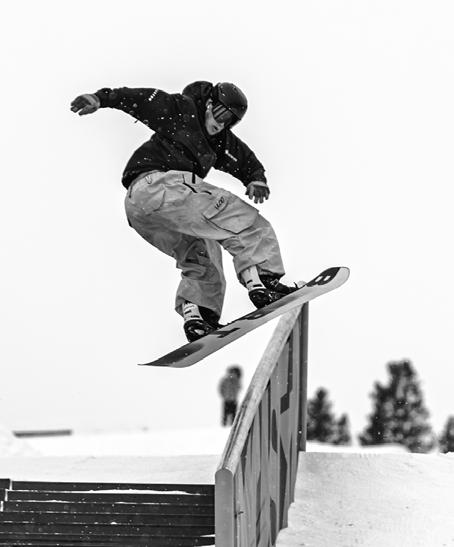
Tired of reading? In late December, our photographer Remi Krupinski spent two days at the Rockstar Energy Open at Breckenridge. Unfortunately, the event was months past the deadline for this issue’s article. But we like Remi — and he endured two eventful nights in a hostel for the assignment — so here are some of his best pics.
- Linclon
Words & Photos:
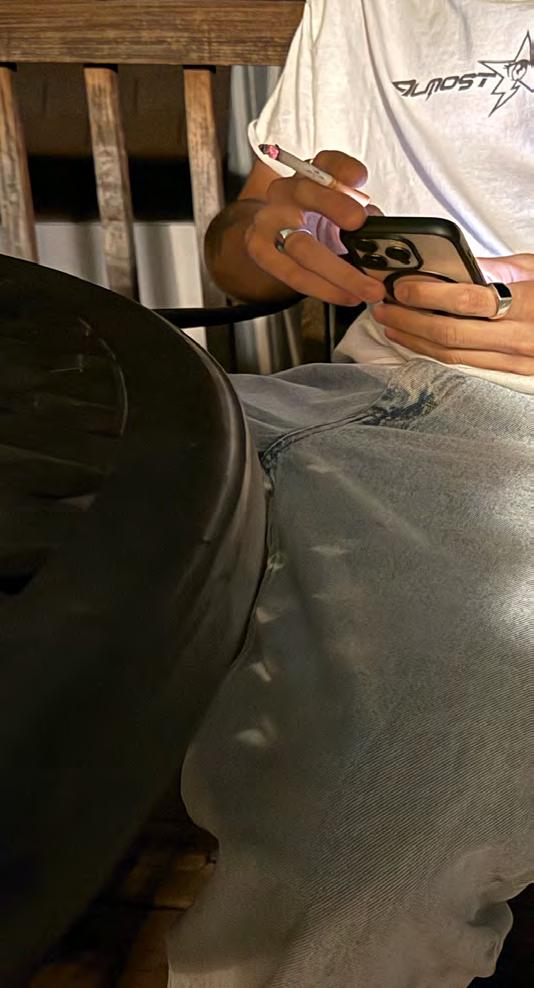
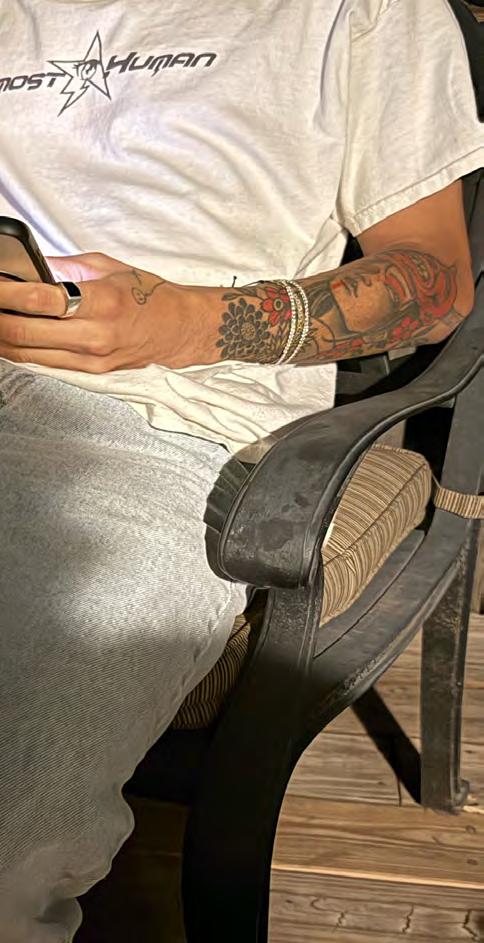
What it’s all led to these days is users often participating in multiple different ways of consumption. According to Truth Initiative in 2023, 73% of nicotine pouch users also smoke cigarettes and 49%
Nickie had quit vaping after getting surgery for a knee injury caused
But during the healing process, Nickie’s main activity consisted of lying on the couch, so his only social interactions revolved around smoking — reverting him to old
“When everyone was hanging out, they’d all go out on the balcony and rip cigs,” he said. “And I wanted to be a part of the gang, so I’d go out and have a smoke or
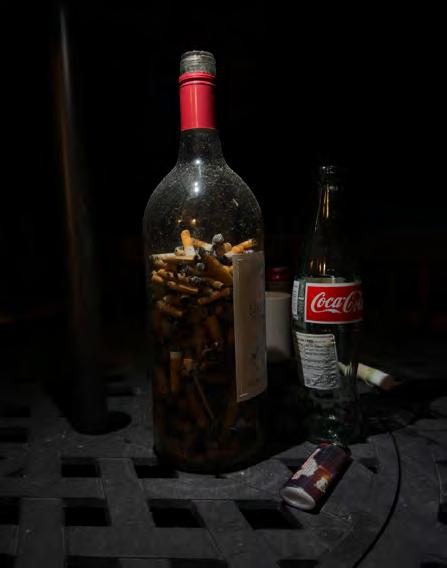
Another phenomenon affecting young people is known as the “drunk cig.” A combination occurs between drinking and nicotine where the user allows themself to
smoke a cigarette only when they are drunk. Many users argue that they are already intoxicated so what’s the harm of taking a couple puffs.
Some people never smoke cigarettes unless they’re drunk. Nickie knows many people who started with occasional drunk cigs, but later evolved into everyday smokers, including a close friend.
“She was like, ‘I’m only going to smoke when I drink,’” he said. “And then it’d be a Tuesday night and she’d be having a beer and sure enough she was smoking.”
Smoking cigarettes in any setting is often seen as a social activity which is part of what kept Nickie going, but the aesthetics of cigarette smoking contributed to some extent.
Many movies use cigarettes to indicate a hard edge to a character. Nickie agrees that he perceives
some sense of style within them, something he thinks vaping does not resonate with.
“Cool guys smoke cigarettes,” he said. “Lame people vape.”
But even if vaping is not seen as “cool” anymore, there is still a high percentage of young adults who’ve had their fair share. The appeal of inhaling or absorbing nicotine to look cool drives young people to find ways around regulations or age restrictions.
Trevor Thornton is a 25-year-old who was introduced to nicotine in the seventh grade. Like most firsttime users, his initial interaction with nicotine, specifically vaping, was not necessarily a positive experience.
“I took a rip of it and it was a really, really large one and instantly my lungs felt like they were on fire,” Thornton said. “I immediately had to lay down because I thought I was having a heart attack and
almost had my friends call an ambulance.”
Even with this terrifying experience, Thornton decided to try his luck a second time.
“I don’t know what compelled me to try it again, probably its addictive nature,” he said. “But I hit it again later and I was like, ‘That’s actually kind of sick. I like that.’”
Once he adjusted to vaping, he formed a new habit and before long he was fully addicted. The unique flavors appealed to Thornton alongside the highly addictive chemicals within nicotine.
Many states and cities, including Boulder, have added regulations where vapes cannot have appealing flavors in an attempt to dissuade younger users. Perhaps in an attempt to combat regulations, some vape companies have added visually appealing technological features to disposable vapes
including minigames or digital displays.
These new advancements are entertaining to some but for Thornton they are too absurd to be taken seriously.
“There’s no reason that ripping your vape should have a Honda Civic dash on it where it’s got all sorts of lights and blinking,” he said. “You can play games on those things. They’re just ridiculous.”
Part of his plan to quit, however, came with shying away from the fruity flavors and flashing lights and leaning into the less favorable parts of nicotine. He thought that
“COOL GUYS SMOKE CIGARETTES..
taking away the satisfying aspects of nicotine would make him less likely to crave it.
“The only thing that got me to quit was when I started buying tobacco Juul pods because I hated them,” Thornton said. “And then I picked up Zyns and found the flavor I hated the most and used that one.”
While new products like Zyns helped Thornton quit, they can do the opposite for others by adding another product to the addiction list.
Ethan Boeckers began vaping in his freshman year of high school. Because he was an athlete, he switched to Zyns during his junior year for a non-inhalant alternative.
Upon getting into college, his Zyn addiction only got worse as his peers and social spaces were also infiltrated with Zyn users. Greek life is a big part of his nicotine experience as the pledge packs he once carried at the beginning of fraternity rush put nicotine right in his hands at all times.
“Part of our pledge packs were to have some form of nicotine,” he said. “It’s a requirement to have it and then you get addicted because you always have it on you.”
While many fraternities are experiencing pressure to mend hazing rituals and implement some safety measures, nicotine and drug usage can fall through the cracks.
Federal regulations may sway some from nicotine use, but the concern of its health effects may not necessarily extend to fraternities. The main priority at a party school is not to get rid of vaping or cigarettes and therefore they continue to impact students.
“You don’t really hear about them cracking down on frat boys smoking cigarettes,” Boeckers said.
But governmental crackdowns on nicotine cannot fully convince every user to quit. And once users reach the legal age to purchase any new and upcoming products, they have that freedom to consume or quit at their leisure.
“In college I probably won’t quit,” Boeckers said. “I think after college I definitely don’t want to have this crutch with me for the rest of my life.”
Nearly 70% of smokers say they want to quit and have made attempts to in the past. Other studies show that 56.1% of those who quit do so for health reasons and 10.3% for financial purposes. Regulations have likely played a part in these numbers, but it ultimately comes down to the wishes of the consumer.
Nickie is an example of someone who has made attempts to quit for various reasons, but will he ever actually quit?
Words: Sarah Taylor Design: Mia Pendergast
In another reality, Braeden and Hannah Pfau might remember their wedding day in stressful glimpses. They would be standing in a church hall surrounded by estranged third cousins and parents’ coworkers, hoping the big crowd couldn’t tell that Hannah’s wedding dress zipper was fastened by safety pins and eyelash glue.
Fussy from the start, the zipper split irrevocably down the middle that morning. It revealed Hannah’s camouflage shapewear underneath.
“Thinking back, if we were doing a traditional wedding, that would have been a much bigger stressor, probably, for all of us,” Braeden says.
But the Pfaus remember their big day with easy contentment. Like a growing number of couples, they opted to elope – avoiding the big ticket contemporary weddings that have seen average prices rise to $20,000 and beyond. With that decision, a little improvisation was all they needed to brush off the mishap.
Why Elope?
Both from Kansas, Braeden is an educator and Hannah is a graduate student. Growing up, they had only really
attended big church weddings followed by elaborate receptions with over 300 attendees. When they became engaged in December 2023, they knew their busy schedules and financial values would be incompatible with “a massive a bunch of strangers,” as
largely relaxed “It was like, we’re on our own schedule,” Braeden says, “We’ll get to the site when we get there, and we’ll start when we’re ready.”
They eloped at Halfway House, a small venue on Flagstaff Mountain.
Braeden referred to the traditional way as.
The morning of, their mothers prepared breakfast. Braeden watched cartoons with his niece and nephew while Hannah got ready with her sister and mother. Hannah swiftly made peace with the broken zipper, and knew that only her loved ones would see it covered by her veil. They recall feeling nervous for their vows, but
Less than 20 guests attended, just immediate family and closest friends.
Elopements or ‘micro’ weddings have been on the rise among younger millennial and Gen Z couples since the COVID-19 pandemic. Some reject the wedding industry for its increasing commercialization to make ceremonies last longer and accommodate more guests.
Courtesy of Braeden and Hannah Pfau
“A wedding is really a party for everyone else,” Hannah says. “I’m not spending that amount of money for other people to have a party.”
Consequently, the term “elopement” is carrying new meanings of financial intentionality and intimacy instead of impulsiveness and parents’ disapproval.
Economics Professor Jennifer Klein at the University of Colorado Boulder notes that on average, couples are getting married later in life, have higher education rates and financial independence.
In 2015 to 2019, the average age to marry in the U.S. was 28 for women and 31.1 for men. Klein argues that couples in 2025 are more likely to pay for their wedding without help from their parents.
“I certainly think that the rise in housing costs is impacting this as well, because you figure that’s another huge expense that many newly married couples are going to face,” Klein says. “Do you really want to spend all of this money on a huge wedding ceremony, if you are paying for it, that is then going to cut into money that you have available to then buy a house?”
Breaking the Picture Perfect Mold
There are memories of the big day, then there’s the picture frames around the house and the videotapes collecting dust in the DVD collection.
Becca Cannon, 30, is an elopement -specialized photographer. She
lives in a van and accompanies her clients, largely visiting from the Midwest, on immersive elopements surrounded by Colorado’s vast mountains, rivers and forests. She books couples anytime from a year out to only weeks in advance.
Coming from Tennessee, Cannon started with big southern church weddings. She remembers the days unfolding in formulaic sections: getting ready close-ups, first looks, ceremonies, receptions. The first five years of her business were spent scrambling to capture couples’ love amidst the stress of their weddings.
“I remember a big, big stressor [at the time] was basically playing the playing the role of photographer and coordinator for the day itself,” Cannon says.
Through brain fog and burnout, her favorite part was shooting and editing couples’ portraits. After the COVID-19 pandemic, Cannon took a leap of faith and transitioned to only doing elopements,
where the whole shoot is portraits and landscapes that show unreserved love.
They say that your wedding day marks the first day of the rest of your life. Elopements are one way that couples are prioritizing their aspirations to set off on the right foot.
“As far as my couples who are eloping goes, it feels like they are so in love. They want to be married and get married, and they want this experience to be about them,” Cannon says.
Courtesy of Becca Cannon
Courtesy of Becca Cannon
The Resurgence of retro
When Luke Klaus was 8 years old, he started to feel sick and asked his teacher if he could go home from school. A call ushered his father to pick him up. Hoping to cheer up the boy, his father turned on the radio, when Rush’s “Working Man” emanated from the speakers.
Soon, they were windows down, radio all the way up, speeding. Suddenly, their joyride was interrupted by flashing red and blue lights.
“It was electric from the start,” Klaus said, adding that at first all he and his father could do was laugh.
This memory was a gateway drug for Klaus and kickstarted his passion for retro aesthetics, music and technology.
The University of Colorado Boulder junior is majoring in aerospace engineering with a music minor. He joins a rush of
Gen Zers looking for fun and identity in old tech. From collecting vinyl records and CDs to sporting vintage clothing, there is a steady surplus of analog options to choose from.
While it’s part sheer fascination with retro, it’s also something of a reaction to the plethora of technology the generation has inherited. Now, worries arise as the evolution of artificial intelligence has caused mixed feelings within the population about its integration.
Now, worries arise among some young people as artificial intelligence becomes more integrated into everyday life.
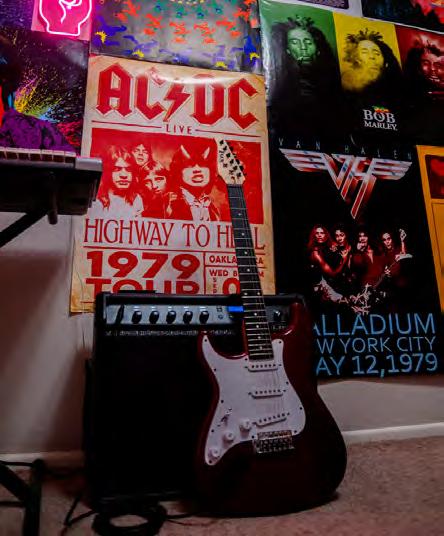
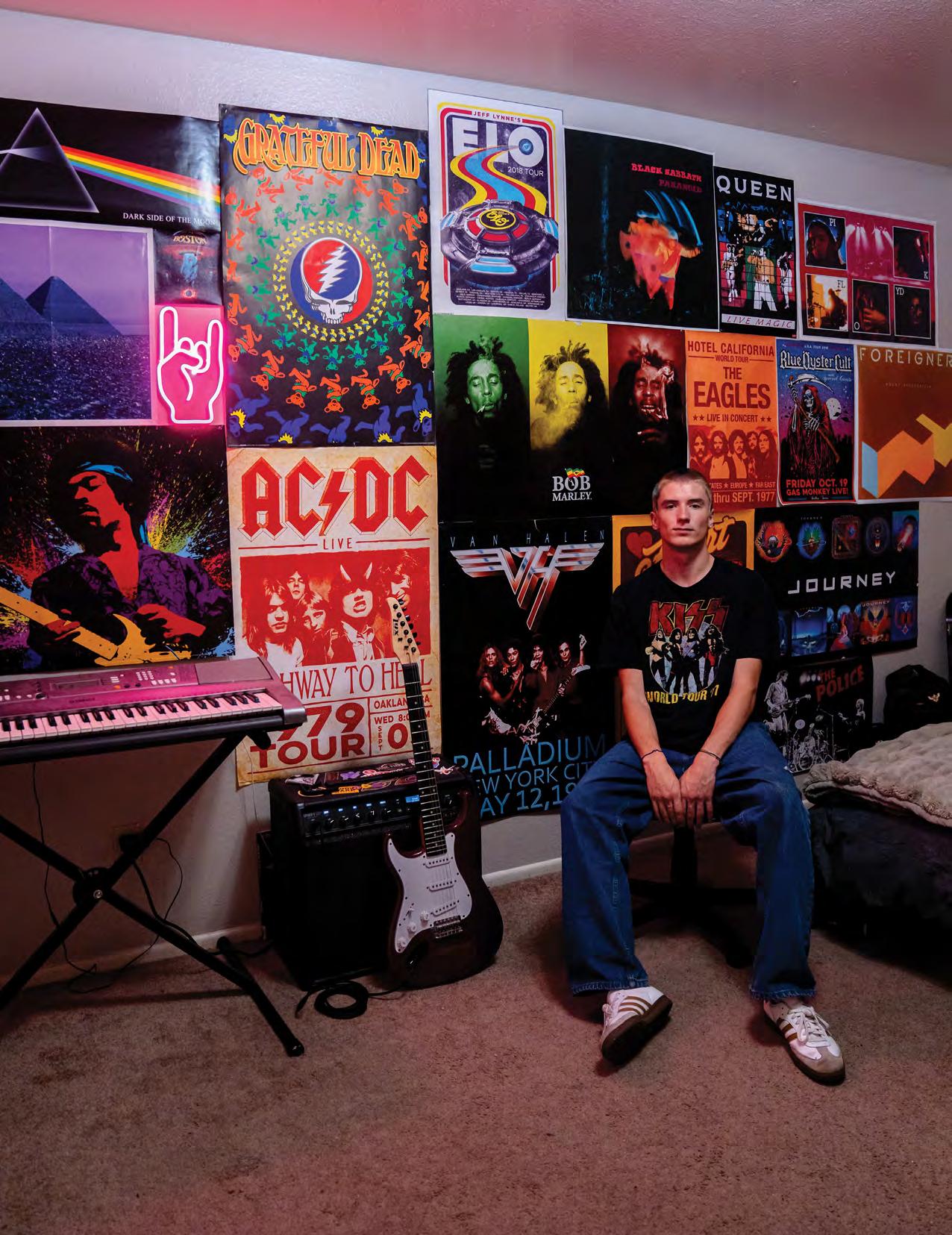
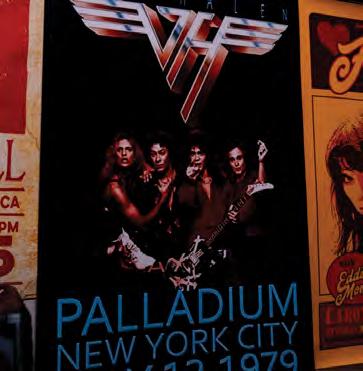
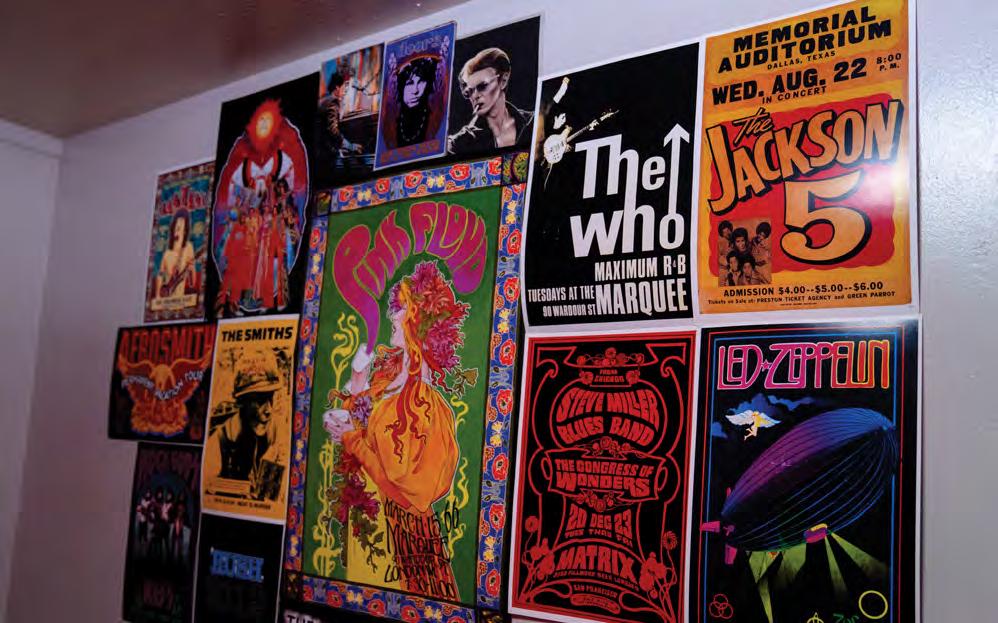
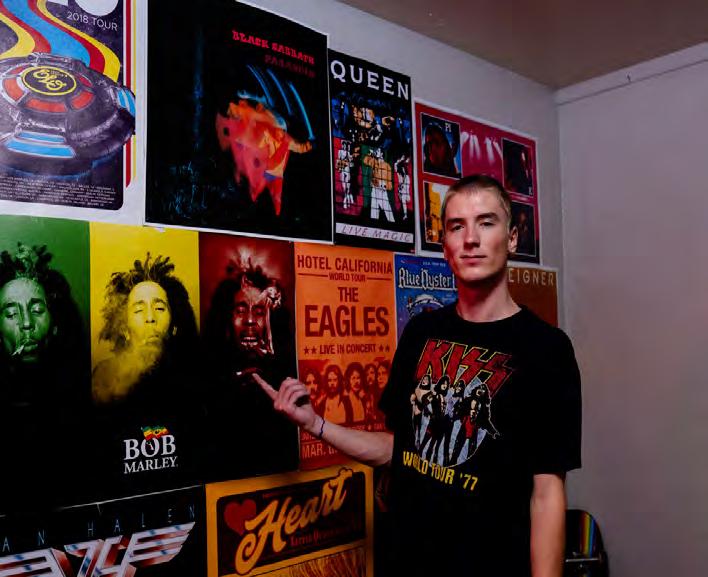
These days, Klaus’ room is littered with classic rock posters, various instruments and rocket-themed trinkets.
“I started listening to classic rock and I was like, ‘This is awesome,’”
he said. “And so, I decided this is going to be my personality for the next month.”
Rock became his personality for more than a month and continues to impact the way in which he lives. Klaus owns his beloved Walkman cassette player that he plugs into a modern pair of headphones, blending a love for the new and old. He has music streaming services downloaded like Spotify but has his own reservations on its usage.
“Spotify is incredibly too convenient,” he deadpanned, adding that it can also detract from the personal connection between the artist and the listener.
“I’ll pick vinyl records from my favorite bands because it’s like I’m immersed in their realm,” Klaus said.
Sky Hume also grew up listening to music on retro technologies
Words ruEmurray
remi Krupinski
EMMA TAYLOR
Gen Z’s fascination with old tech and feelings about AI
such as radio and cassettes but part of that contributed to where she grew up.
“I lived in the middle of nowhere in Kansas until I was nine, so I didn’t even have a movie theater near me,” she said.
Upon leaving her hometown, Hume held onto her traditions and embraced what she knew best. She feels at home with CDs in her possession, catalyzing her to amass a 70-plus collection.
Playing CDs became second nature for her but was foreign to her friends who were accustomed to listening through their phones. “I remember listening to the radio and my friends would give me crap for having the radio on in my car because they’d rather listen to a Spotify playlist,” Hume said.
In addition to her surplus of CDs and other analog music mediums,
she now collects vinyl records. Hume believes that although vinyl collecting is now popular among Gen Z, not all of them actually tune in to what they’ve collected. “Disclaimer,” she said. “I do actually listen to them.”
Whether the records come in contact with a needle or not, there is still a large number of Gen Z who collect them, and often at that. The Liverpool Institute for Performing Arts found that 76% of Gen Z vinyl fans purchase it at least once a month, creating a resurgence in vinyl consumption.
This dynamic has bolstered Boulder’s Paradise Found Records, where Sean Rourke, assistant manager and Gen Xer, has followed vinyl’s popularity throughout the years as the rise of digital media began to erase its physical counterpart.
“All of our physical media went away and we started streaming,” Rourke said. “But Gen Z recognized that something was missing.”
Rourke believes that another appeal vinyl brings to the next generation is the experience of listening to an album in full instead of picking specific songs on a streaming service. According to him, Gen Z is starting to understand the appeal and appreciate a comprehensive album.
“When it’s time to get serious about the artist, they are sitting down with a vinyl or cassette and they’re taking the deep dive,” he said. “They’re listening from A to Z.”
When it comes to why Gen Z is so fascinated with older aesthetics, Rourke reflects on a time in the store when he overheard a customer debating why the 1980s did not sustain its musical impact as much as the 60s or 70s. Rourke believed he had the answers.
“It’s because it was a time of excess,” he explained. “We had no problems like gas crises or wars.”
Rourke said the current environment brings higher political tensions and a sense of
hopelessness for some. Finding solace in older times, when hope was in excess, may be why Gen Z holds onto retro aesthetics. And while modern technology is accessible and used by many, if not all, of Gen Z, there is still an appeal to the aesthetics of simpler times.
“The technologies now are what they cut their teeth on and what’s been made available, but they also recognize that there’s something else,” he said. “When it’s time to get serious, old school happens.”
Similar to older music, vintage or secondhand clothing has also appealed to Gen Z given its ability to add visual aesthetics that would not be found in modern clothing design.
A study by WGSN found that 40% of Gen Z shop secondhand, as the styles they love are not found in typical retail stores.
“I genuinely can’t think of a fast fashion store that I would go into and think ‘Yes this is my style,’” Hume said.
Dressing the part completes the
the retro look and lifestyle, causing enthusiasts to seek clothing matching that aesthetic. With the popularity of vintage and retro clothing growing, however, prices have followed suit.
“The aesthetic has so much attention that people are marking up the prices,” Klaus said. “Now it’s 150 bucks and it’s popular so it loses its niche vintage value.”
While vintage clothing has risen to the top of the Gen Z priority list, recent technologies have continued to progress and evolve.
Generative AI companies like ChatGPT have created large language models that quickly answer any prompt or question. There is a level of convenience to AI, but its development is not advanced enough to get every question right.
Perspectives on AI vary and it seems a large portion of Gen Z has their doubts. In a web survey done by the Walton Family Foundation and GSV Ventures in 2023, 53% of Gen Z adults said they felt anxious about AI.
“AI absolutely undermines human creativity for the exchange of convenience and lack of thought,” Klaus said. “It’s inadvertently harming humans.”
Rourke has a slightly grimmer point of view on AI, understanding its possible negative impacts.
“I’ll admit I’m almost a conspiracy theorist on this: I think AI is going to be our downfall,” Rourke said. “Anyone who’s watched ‘Terminator’ or ‘I, Robot’ should know better.”
Technology will continue to evolve with modern developments and discoveries, but retro ideals and aesthetics have persevered time after time.
Regardless, Rourke believes that technologies’ rudimentary purposes should be understood and that time should be taken to reflect on the simpler priorities of retro times.
“Technology is a tool and nothing more,” Rourke said.
“Go outside and touch grass.”
BAYLAN
“This album has lots of versatility and sincerity, with no song like another that carries you through unconventional storytelling.”
“It really brings that feeling of driving down a backroad with the windows down.”
BRODY
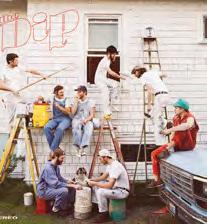
THE DIP (2015)
THE DIP
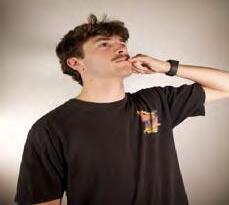
AN AWESOME WAVE (2012)
ALT-J
EMMA
“Elizabeth Fraser’s vocals feel like an instrument rather than a story, and the music as a whole sounds completely otherworldly.”
“As a kid, I could picture all the whimsical stories sung on this album, with each song carrying its own unique specter of horror that touched my soul.”
“I feel like this is everyone’s go-to answer, but it’s so valid for all the right reasons!”
“Makes me feel like I’m wrapped in a warm cozy blanket being rocked to sleep by sweet melodies.”
MYRA
SARAH INGRID
“Queer and nostalgic! It exudes the feeling of bare feet in springtime grass.”
“Between his early hits and his discography makers, he takes a detour to a funky and cohesive album in his first artistically controlled project.”
XAVIER
DARK SIDE OF THE MOON (1973) PINK FLOYD
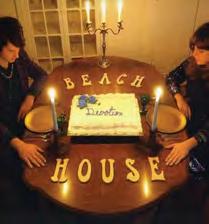
DEVOTION (2008) BEACH HOUSE
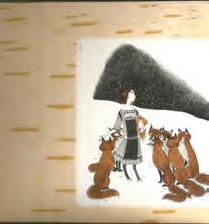
FOX CONFESOOR BRINGS THE FLOOD (2008) NEKO CASE
MUSIC OF MY MIND (1972)
STEVIE WONDER
HEAVEN OR LAS VEGAS (1990)
COCTEAU TWINS
CALICO (2023)
RYAN BEATTY
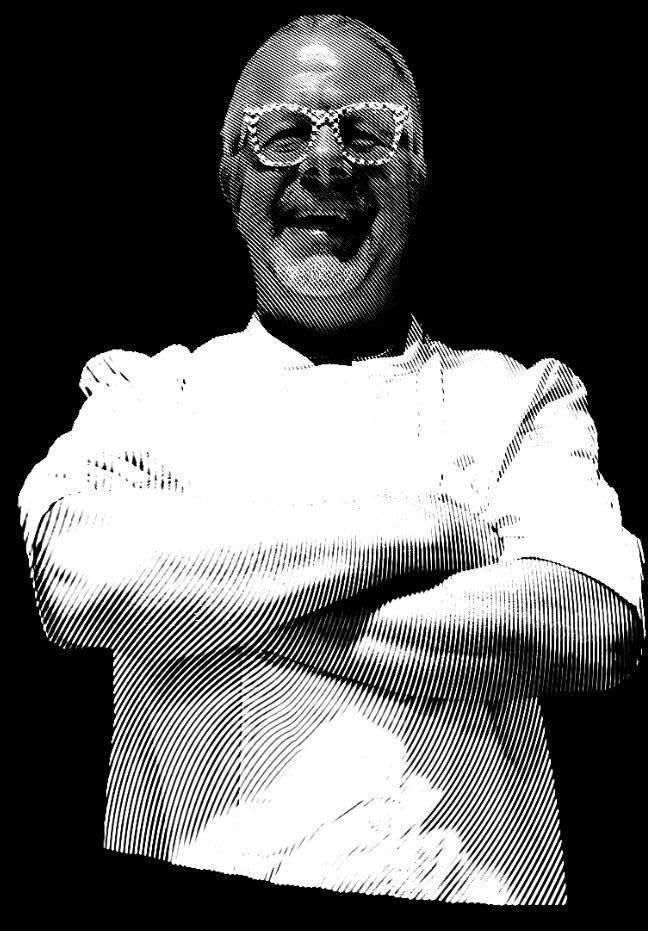
Two years ago, 61-year-old Chuck Carver hoisted a 6-foot-long maple top baking table into the bed of his pickup truck. He drove all around Boulder, hoping to find a baker who would take it off his hands after decades of neglect. With no luck, he returned home.
Little did he know, he would soon be using the table to bake over 100 loaves of gluten-free sourdough every week and sell out at one of the nation’s only gluten-free farmer’s markets.
“It was so evident right away that it was gluten…which was devastating,” he says. “And so, you know, you can’t go out to
Chuck purchased the table in 1987 for $600 after working at a pastry bakery in Michigan. He has worked in healthcare as a surgical technician in the meantime, though home baking has remained integral to his life.
He and his wife, J.T. Carver, have traveled far and wide to experience gluten-based specialties. They drove to North Carolina to get their first grist mill, a small mill to make flour at home, attended a Bakers’ Guild Conference in Philadelphia and visited the world-famous Poilâne bakery in Paris.
photo courtesy of @fullcircleglutenfreebakery
“It was one of those things, when it gets in your blood, I can’t even explain it,” he says. “It never left me.”
Sourdough without wheat: A work in progress
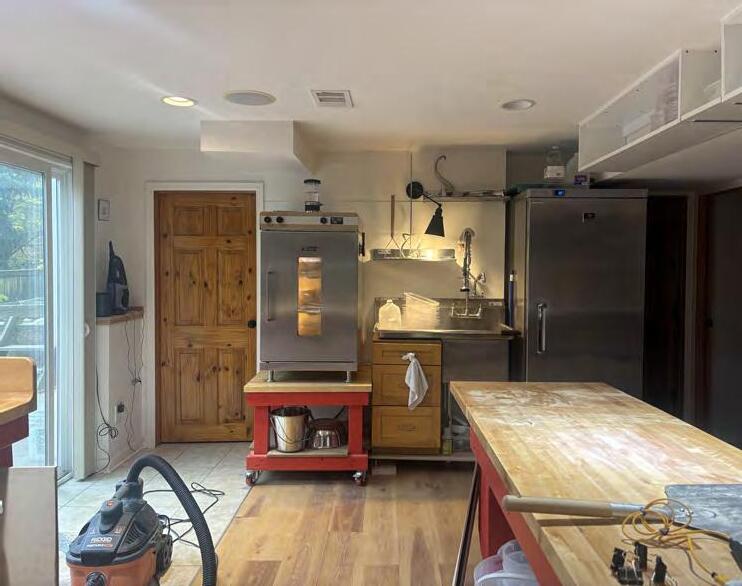
Today, the couple bakes out of their remodeled basement in compliance with Colorado’s Cottage Food Act and operates as the only bakery exclusively selling gluten-free sourdough in Boulder. “Sourdough” is the common name for leavened breads made from a fermented starter (a collection of water, flour, wild yeasts and lactic acid bacterias) instead of artificial yeast. It gained the name for its sour flavor comparable to yogurt-like tanginess and vinegary acidity.
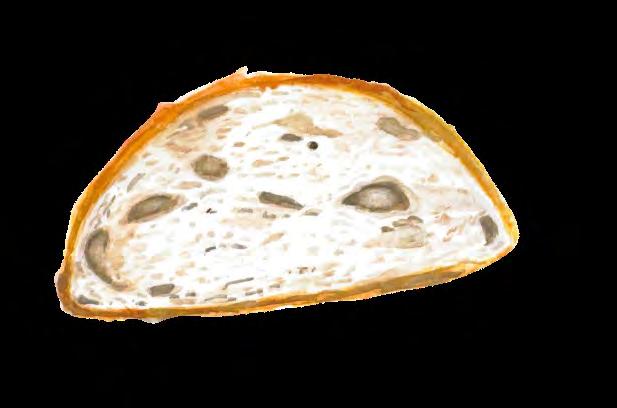
Proteins in wheat-based flours like gluten are crucial to the dough’s lattice structure and elasticity. When you see a slice of sourdough, those delicate holes in the bread are carbon bubbles trapped by strong gluten webbing. The Carvers can attest that it is difficult to execute that structure without it, which is why a lot of alternative bread options are soft yeasted breads and not sourdough.
Since discovering joint pain and irritability, Chuck gradually cut gluten out of his diet.
Having endured the grief of losing a diet staple like bread, he wanted to bring his baking experience to the gluten-free community. The reconnection sparked during the COVID-19 pandemic when the Carvers came across microbakeries trending globally online, a movement of cottage bakers catering to their local communities. They named their business Full Circle Bakery, an ode to Chuck’s return to his first passion and with it, the baking table.
“Even our bread, it’s not as good as wheat bread. There’s no way, gluten is an amazing protein,” Chuck says. “We’ll watch these videos of these people [baking with wheat flour] that get this stretchy dough. Like, ‘Oh my god, I miss that.”
After months of experimentation, the Carvers have found that their ideal 950 gram loaf is made with a blend of white and brown rice flour, water, salt and psyllium husk — an ingredient that can mimic gluten’s binding properties.
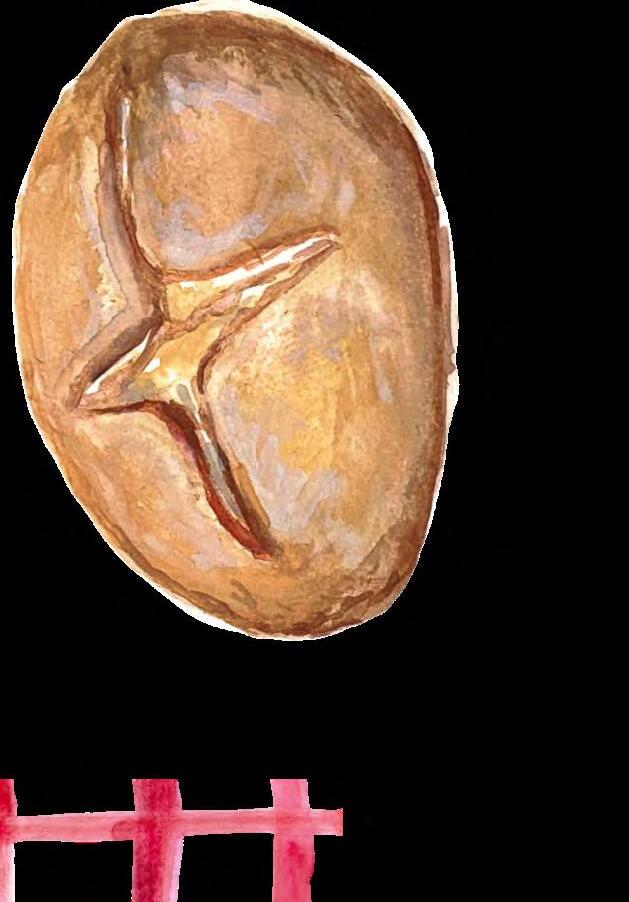
Still, gluten-free sourdough does not hold its shape well in traditional bannetons, an ovular proofing bowl that gives the loaves their shape before baking, and normally flattens out to a pancake. Chuck prototyped his own bread banneton to be steeper and narrower, giving his proofing loaves more height.
They follow similar baking instructions as traditional sourdough, including a steaming period halfway through to achieve that iconic crunchy exterior that sourdough is known for. The Carvers describe the flavor profile of their classic and multi-seed loaves as more neutral and nutty than sour.
Chuck and J.T. are beyond happy with their current product but acknowledge that they’re still in
sourdough movement. They hold no secrets and want to spread the word.
“We would like to seed the community because, you know, we’re too old,” J.T. says. “We’re not going to take over the world with gluten-free … But, what we can do is provide resources, advice, whatever others might need to seed their own business.”
The Carvers’ first and most consistent customers were their neighbors, many of whom are gluten-intolerant or have celiac disease. The support fueled Full Circle Bakery to become a community necessity.
Their biggest sales this year came
on the second Saturday of each month at the Denver Celiacs Gluten-Free Farmer’s Market from July through October 2025. On the last day, they sold out within the first two hours.
The market was born out of shared struggles among celiacs. Worldwide, the autoimmune disease affects 1 in 100 individuals, though only 30% of cases are accurately diagnosed. Kelsey Cole, the chapter president of Denver Celiacs, says it only takes a tiny amount of gluten (think the size of a ballpoint pen) to trigger any of 200 possible symptoms that attack the small intestine.
Cole was sick of waiting in long lines for the small handful of celiac-safe booths at other farmer’s markets. She wanted to organize an alternative option for fellow gluten-intolerant Coloradans while simultaneously supporting local businesses.
“The most fulfilling part, I think, is just people coming and having such a comfortable space,” Cole says. “Seeing [the] smiles on their faces, being able to enjoy something without having the stressful toll of communicating their needs, because a lot of times people with celiac disease don’t even want that attention.”
Autoimmune diseases are not the only reason people are removing gluten from their diets. Colorado is an epicenter for physical activity and health consciousness, which has led many to think critically about what foods they consume and how it affects their bodies. J.T. joined her husband’s gluten-free journey simply outof solidarity, but
believes the transformation
“It’s
… always really stressful to
Why just going platinum blonde isn’t cutting it anymore.
Words:
Myra Kirk
Art: Emma Taylor & Mia Pendergast
Design: Emma Taylor
In my fateful return to Boulder in the fall, I was greeted by the holy trinity: giant balloon boobs, obvious lip filler and a Botoxridden face. Innocence I didn’t know I had sloughed off my virgin eyes.
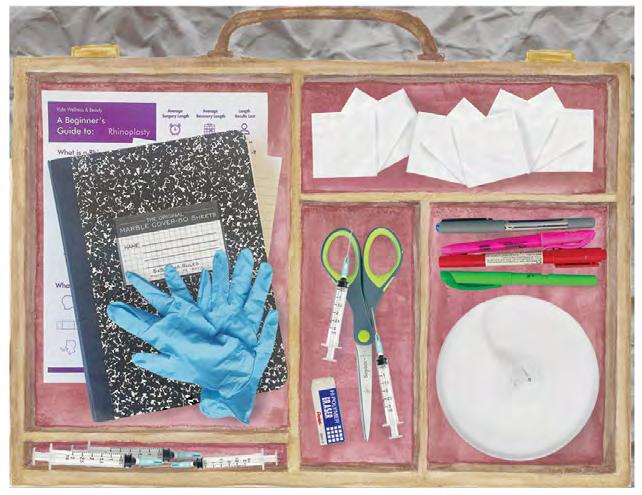
After sitting in the discomfort of seeing that college student, I started to wonder: Does taking offense to plastic surgery — and a girl’s choice in that department — make me less of a feminist? Is a girl spending thousands of dollars on a
procedure with bodily risks as long as a CVS receipt really something I should turn a blind eye to? Is that really empowerment?
According to the International Society of Aesthetic Plastic Surgery’s (ISAPS) global survey for 2024, aesthetic procedures have increased by 42.5% over the last four years. Young women have accounted for a significant share of this growth. In a June press release, ISAPS reported that the majority of breast augmentations
rhinoplasties (60.1%) and external genital surgery (48.4%) were performed on women aged 18 t o 34.
There’s a strange irony to college students and college-aged girls getting plastic surgery. Instead of weighing the enviable neuroplasticity of their brains, the plasticity of their bodies seemingly bears more thought.
While mortality rates from complications of medical and
surgical care declined to 0.85 per 100,000 deaths in 2022, there are still risks to these procedures that your parasocial influencer friends don’t tell you. For one, you can get necrosis from certain nose jobs, where parts of your nasal tissues can die, and it may never function the same.
Secondly, Brazilian butt lifts, another strong contender in the cosmetic surgery boom, are cautioned by surgeons due to the sheer amount of botched jobs. The procedure has an estimated mortality rate of 1 in 3,000, according to the American Society of Plastic Surgeons. Nerve damage, blood clots and organ perforation, too, are all very real risks from a variety of procedures to otherwise healthy bodies.
These operations are a romanticized version of self-harm that a slim number of young women have the gall to say, “fuck this” to. With every passing girl that I see who ruins her body, it further propagates the message that all of us women should do the same – whether the girl realizes it or not.
The claim that these patients can assuage their confidence or acquire self-love is a total crockpot of lies. It’s in the same vein as eating disorders: “If I just lost X amount of weight, then I can truly accept myself.” In fact, this kind of thinking is common among young adults. The majority of young adults with positive attitudes towards cosmetic procedures
boil down to two main reasons:
40.2% aim to increase self-esteem and 45.1% aim to “feel better” in general.
However, according to GardnerWebb University, “Having had previous cosmetic surgery is a predictor for the likelihood of having future procedures.” And these repeat surgeries occur in approximately 40% of cosmetic surgery patients and 60% of minimally invasive procedure patients. So, given the number of returning customers, plastic surgery being the cure-all for poor self-esteem and self-love is fallacious thinking.
I, too, once fell for the propaganda that if my chest perkily cleaved like an overripe orange, I would be “happier” and “like myself more.” But I soon realized that I was critiquing myself through the lens of a misogynistic, adolescent boy who doesn’t understand
basic anatomy. Our bodies — our anatomy — are intrinsic to our survival. So why is it so radical to celebrate them as they are, for the mere fact that they keep us alive?
Beauty and body trends have changed for millennia. There isn’t a single body type that wasn’t worshiped, and there isn’t a single feature universally loathed. We can see this in the variability of the kinds of people we see everywhere, every day. Love was made with your version of ugly and your version of beautiful. But if this god-awful trend picks up pace, everyone will look the same, and that isn’t beautiful.
If this trend does pick up the pace, though, I sure hope literature will keep up with it. “Her countenance of sheer, prepossessing plastic entranced Mr. Rochester.”
How romantic.
Daisy vs. ‘The Boulder Body’
Boulder’s regimented health culture gnaws at a young woman’s body image.
Written:
Myra Kirk
Art & Design: Emma Taylor
Editor’s note: This story contains accounts of eating disorders.
When Daisy Calthorpe moved to Boulder, hailing from the lofty skylines and thick accents of New Jersey, she marveled at the idea of finally being independent from her parents. Little did she know that a once-closeted secret of hers would be difficult to resolve and keep under wraps in a place like Boulder.
“Everyone is just so health-focused, and everybody’s so thin,” she said. “So I feel like I almost moved to the worst place I could have so early in recovery from my eating disorder.”
Her concern isn’t unfounded.
According to the BBC’s reporting in 2014, Boulder was ranked as the thinnest city in the nation. The city’s body-conscious culture was so pronounced that the BBC started to investigate how it correlated with anorexia and bulimia rates in Boulder. It was so intense that physiques in the area were coined by locals as the “Boulder Body.”
“Being around skinny people
like that all the time, in a crazy way, feels kind of competitive,” Daisy said. “It’s like people are humblebragging when they’re definitely not.”
Daisy has been in recovery from bulimia nervosa and anorexia nervosa — disorders characterized by binging and purging food and restricting food intake — for around a year. But she’s still seeking resources in Boulder that feel like the right fit.
“A lot of the support that’s out there is for people who are younger than 23, which is my age,” she said. “And it’s very heavily involved with your family, which I don’t want to do because I’m an adult.”
According to the National Institute of Mental Health, the median age for binge eating is 21 years old, and 18 years old for bulimia and anorexia.
Claire Berens, a registered dietitian at Jane Reagan Nutrition in Boulder, said the city’s culture contributes to this influx of younger clients.
“Kids growing up in Boulder, not just at the university, they’ve maybe been exposed to fast food being bad,” she said. “Boulder even has the sugar tax on sodas. So, I would say we see a lot more of that granola or that almond mom-type mentality.”
Dietitian Jane Reagan, initially worked with college students at the Wardenburg Health Center, before
starting her own private practice. She hosts online programs, such as a college workshop and “Preventing Eating Issues”, which are under $50 each, to thwart eating disorders in Boulder.
However, in the case that anyone outside the university, like Daisy, wants to receive more intensive care without breaking the bank, it can pose a real challenge.
“You have to be experiencing disordered eating enough, but you can’t be too disordered,” said Eric Meckel, a licensed therapist based in Boulder.“Or else you have to then be inpatient, and that’s a huge hurdle and can be expensive.” He had a client that attempted to get into a recovery program, but they were not “healthy enough” to qualify. Meckel knew they were not going to be consistently healthy enough to be admitted.
“There’s this other trend of concierge-style eating disorder support,” Meckel continued. “Which is you pay, like, $6,000 or more a month to have someone who’s always monitoring what’s going on. I don’t know who can afford that, but that’s something I’ve seen more of in Boulder and the surrounding areas as well.”
Another variable is how this health-obsessed culture could
breach into what clients think of practices in the city.
“I’m just scared of getting a health nut doctor and being criticized a little bit,” Daisy said.
Eating disorders often thrive in secret, compromising trust and rapport between clients and clinicians. Some patients also aren’t fully recovering out of their own volition. The external pressures of Boulder and its culture mount this problem.
“I think sometimes it can feel really unfair to our clients we are working with,” Berens said. “When they feel like, ‘Why am I having to make these changes to my eating habits when everyone else around me is still engaging in disordered eating behaviors, too?’”
Even though Daisy is physically recovered — in part involuntarily, due to physical ailments from the disorder — her mind still wages a more persistent battle.
“[There are] parts of us that experience anxiety when they go to the grocery store, or experience anxiety when we go to eat dinner,” Meckel said. “When there’s a part within us that fears something more than whatever’s being eaten in that moment, that’s the thing that it can exert control over to get its point made.”
Meckel points to eating disorders as a minute part in a broader phenomenon called the power and control wheel. The wheel is an illustration of how behaviors
or subtleties within a relationship between anything can exert dynamics of control, such as eating habits.
“[In] the Venn diagram of somebody who experiences disordered eating and someone who has trauma somewhere in their background, there’s a lot of overlap,” Meckel said.
For Daisy, that overlap began when she was in middle school. She divulged that she never had close friends and resorted to finding comfort in food. She soon found out about eating disorders, however, and started to replace that habit with purging. At 20 years old, she then began to restrict her diet instead.
“I feel like for me personally, it has a lot to do with control,” Daisy said. “But also it just gives you a feeling of purpose and something to do all the time. … It’s so all-consuming that you’re never just sitting there thinking about nothing.”
Her thoughts can be unrestrained from real logic or practicality, which she said is something that people don’t understand fully about the disorder.
“My boyfriend was making me pasta, and I wanted parmesan cheese,” she said. “And I was told we didn’t have it. I was like, ‘Oh, OK.’ But in my head I’m like, ‘He doesn’t want me to have the parmesan cheese.’”
Beyond just control, comparison is
is at the heart of the issue for Calthorpe, too. She fixates on bikini pictures of women that emerge on her timeline and scours Reddit for propaganda that can trigger her. Celebrities like Ariana Grande, who have noticeably lost weight or have ribs that protrude, also vie for Calthorpe’s attention. The typical discourse on what you ate today, while for some could seem irrelevant, is triggering for others. This is a common thread universally, not just in Boulder.
However, the city seems to exacerbate it with its competitive health culture that borders on disordered.
“I feel like when I was sick, I just wanted someone to tell me it was OK to eat cake every day,” Calthorpe said. “I couldn’t think rationally about it yet, and I feel like people just don’t have that kind of attitude in Boulder.”
In a city where wellness is worn like a badge, recovery can sometimes feel like a path of revolt. But at the end of that crossroads lies “legging legs” — or life.
“It’s really hard to be that sick and also still manage your actual life,” Caltorphe said. “You don’t deserve a joyless existence, and you should get better. Life is so much better when you’re better.”
Dancing Daisies
what cigarette are you?
1.
Your ideal outfit is...
a. Black leather jacket, docs, band tee you thrifted in 2016
b. Baggy jeans, rings on every finger, knit beenie
c. Pajama pants you wore to class without apology
d. Carhartt jacket that has never seen manual labor
2.
Design: Ingrid Pehrson
Your music taste is:
a. Nirvana, Radiohead, emotionally unavailable playlists
b. Backseat Lovers and indie “driving-at-dusk” energy
c. Lana Del Rey on repeat, especially when spiraling
d. Johnny Cash in theory, Zach Bryan in reality
3. 4. 5.
Where do you usually go to smoke?
a. Alone outside, pretending you’re fine
b. Walking around a quiet neighborhood
c. Anywhere. Parking lot, porch, Waffle House entrance
d. Outside a bar or frat house, pretending the truck is yours
6.
Your car is:
a. A black Honda Civic held together by vibes
b. A Subaru with stickers on the back
c. A rusted Toyota Corolla that smells like fast food
d. A truck you didn’t need but wanted
Your relationship status is best described as:
a. Someone hurt you and you never really recovered
b. Bi, artsy, emotionally aware...
c. Complicated, dramatic, misunderstood
d. You’re the guy dating the bi, artsy, emotionally aware girl
7.
Your friends would describe your aesthetic as:
a. Grunge bands and thrift shops
b. Role Model and greenwashing
c. Hello Kitty and duct tape wallets
d. Trucker hats and casual entitlement
Your coffee order is:
a. Just a black coffee
b. Iced coffee, matcha, or something local
c. Venti latte, extra foam, and a dash of cinnamon