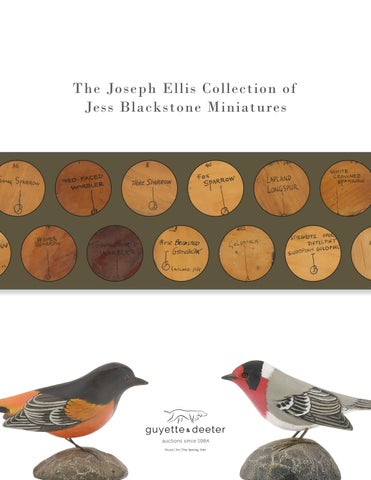
The Joseph Ellis Collection of Jess Blackstone Miniatures
Jess Blackstone 1909 - 1988 | Concord, New Hampshire
2
Of all the talented and noted New England carvers of miniatures, Jess Blackstone was probably the most serious birder and ardent student of ornithology. He was born in Melrose, MA, a suburban community just north of Boston and named after his mother, Jesse Gertrude Dill (1884 – 1951). His father, Arthur (1881 – 1951), described himself as a commercial artist when Jess was born and by 1920, he referred to himself as an interior decorator (probably a painter). These artistic talents must have surely had an influence on his son. When Jesse graduated from Melrose High School in 1926, his yearbook notes that “Here we see one of our class artist.” who “- - - can draw anything imaginable - - -”. By the time he was 21, he was employed by the local newspaper as a cartoonist. His 1931 Mason membership form lists him as a “sign designer” and between at least 1931 and 1933, the Melrose City Directory refers to him as a “sign painter”. His father, Arthur, had carved some miniatures as a hobby and, in 1937, began to carve them commercially. Jess had attended Cambridge Art School in Boston and soon joined his father in the fledgling business. In the early years, the team found it difficult to market their work, even though they were exhibiting with other noted carvers such as Cape Cod’s A.E. Crowell and Maurice Day of the Whittle Shop in Damariscotta, ME. By the time of the WWII draft, Jess had married Edith Ruth Newman, and the couple had moved to New Hampshire so that Jess could join the New Hampshire League of Craftsmen which had a string of successful sales outlets but required instate residency. After serving in WWII, Blackstone returned to New Hampshire and began his lifelong career as a professional carver of miniatures. His deeply rooted interest in ornithology quickly became apparent in his work. Comprehensive study drawings were made of each new bird, and his painting was meticulous in its detail. His most common bases were somewhat reminiscent of those employed by Elmer Crowell and displayed the birds mounted on roughly circular, chip carved “rocks” with wire legs and painted feet. Occasionally he would employ a driftwood mount. Over the years he developed a coding system to somewhat date his carvings and this, along with his stylized initials and individual species name appears on the bottom of the bases.
Blackstone, c. 1955 He was extremely prolific and is known to have carved over 160 different species and/or sexes of birds. Certain popular species, such as chickadees, were produced in great numbers while others may be represented by only one or two examples. His lifetime production is estimated to have been between 8500 and 8750 miniatures. In 1947, these were sold for an average of $2.00 apiece and, by the 1950’s, they were priced at between $5.95 and $15.00 each. He was beginning to slow down in the 1980’s when he was then pricing his birds at between $45.00 and $95.00 dollars. He was extremely active in the Boy Scouts of America and the Audubon Society of New Hampshire. He died after a stay in the McKerley Medical Center in Concord and was buried privately in the Dartmouth College Cemetery in Hanover without any services or calling hours. Without a doubt, Jess Blackstone should be considered one of the very finest and most accomplished of the New England carvers of miniatures. His are some of the most life-like and finely detailed carvings and are included in many of the finest ornithological collections in the country.
League of NH Craftsman show c1940
3
From Bird Hunting to Bird Watching Man’s interest in birds can be traced to paleolithic cave art dating back tens of thousands of years. As one would expect, early humans must have occasionally gazed in awe at the creatures, marveling at their beauty or their song and, certainly, they must have pondered their mysterious ability to fly. For the centuries to follow, however, his primary interest was focused on the creatures as simply being a source of meat, eggs and feathers, items all critical for survival.
Ironically, as firearms improved so did advances in optical equipment, making it much easier to view wildlife in their natural habitat at a distance. Simple telescopes had been around for some time but, in1823, J. F. Voigtländer patented the combination of two achromatic spyglasses into a pair of simple opera glasses, and in 1894, Carl Ziess developed the first pair of successful porro prism binoculars.
Paleolithic owl and bird, France
Wm Brewster
As human populations grew, man continued to depend on wildlife for what it could provide, and the stories of the associated market hunting are well known. Eventually the widespread killing of birds led to drastic reductions in the population numbers of many species and hunting was a factor in the actual extinction of some. With time, a few individuals began to promote a different approach to their relationship with our feathered neighbors. Interest in birds for something other than food or feathers was not totally new. As early societies developed, some individuals acquired the means and leisure time to make collections of avian specimens fashionable. Egyptian pharaohs filled their tombs with artifacts and Inca chiefs filled their menageries. By the 1700’s better firearms and easier travel fostered not only increased market hunting but the interest in the collecting of wildlife among a widening segment of the population. By the 1800’s the amassing of bird skins, eggs and nests had become extremely popular. This was how ornithology was conducted at the time. Having an actual specimen in hand to refer to and compare with others was considered the basis of scientific bird study. To put the extent of this practice into scale, Yale University’s historic collection of labeled bird skins and eggs alone numbers around 165,000 specimens and Harvard University’s holdings of eggs, nest and skins include about 375,000 examples. Other colleges, museums and universities can cite similar numbers, and these do not include the thousands of personal collections that have disappeared over the years. It goes without saying that these practice’s, too, all necessitated the killing of the birds or their offspring. The opening sentence in the first chapter of “Field Ornithology” published in 1874 by Massachusetts author Elliot Coues begins with the statement, “The double barrel shotgun is your main reliance”.
For many years, the scientific study of birds, including collecting, was, for the most part, a male dominated world. Men such as Boston’s William Brewster were at the forefront of the academic study of birds, elevating it to a level of serious social and collegiate recognition. He was the founder of the Nuttall Ornithological Club in Boston in 1873 and, in 1883, the co-founder of the American Ornithological Union. This male influence and control would slowly begin to erode, and woman began to play an increasingly influential role. By the late 1800’s illustrated field guides began to be more available, greatly easing the identification of species which, previously, was largely reliant only on a written taxonomic description of the birds. When Florence A Merriam (Bailey) was born in 1863, women’s hats were crowned with feathers and sometimes whole birds, all to satisfy the whims of female fashion. On a Manhattan walk in 1886, she saw 40 species displayed on hats in shop windows and in 1889, she released “Birds Through an Opera-Glass”, the first modern illustrated field guide for everyday enthusiasts promoting observation over killing. In 1896 The Massachusetts Audubon Society was formed by Harriet L Hemenway and Minnie B Hall in Boston and, by the turn of the century, similar sentiments were becoming increasingly popular throughout the country.
F.A. Merriam
Passenger pigeons Chicago Field Museum
4
Illinois State Museum
Smithsonian
Harriet Hemenway
Minnie B Hall
Eventually, the observation of birds in their natural habitat became the prefered method of study for many. Hunting would remain popular in a sporting sense but it was increasingly being governed by stricter laws and restrictive seasons. “Bird Watching”, as it was known, became a recognized leisure activity. The first use of the term was coined in 1901 by British ornithologist Edmund Selos who penned his well received book titled simply “Bird Watching” in which he detailed his thoughts on observing birds rather than killing them. He wrote: “Let anyone who has an eye and a brain … lay down the gun and take up the glasses for a week, a day, even for an hour, if he is lucky, and he will never wish to change back again. He will soon come to regard the killing of birds as not only brutal, but dreadfully silly”.
Arthur A. Allen By the beginning of the 20th century the study of birds became a serious academic pursuit in its own right. In 1911 Arthur A. Allen became the first Ph.D. ornithologist in the U.S. (Cornell, 1911) and, in 1915 he founded today’s world-renowned Cornell Laboratory of Ornithology. With increasing popularity and growing acknowledgement and acceptance as a legitimate pastime, bird watching became widely renamed as “Birding” in recognition that it had progressed beyond the mere identification of a species to a more in-depth study of not only the individual but it’s ecology. Clubs and societies, both large and small, emerged throughout the country both in rural and urban settings. Men and women of all ages, either singularly or in groups participated in the practice at all levels ranging from casual observation to elaborately planned outings and the compilation of prized “life list”. Today, the U.S. Fish and Wildlife Service estimates that “Birding”, at some level, is enjoyed by about 37% of the population of the Country.
This rapidly growing interest in birds beyond the traditional circle of hunters did not go unnoticed by the early miniaturists in New England. The men who had begun their careers as decoy carvers focused their initial efforts on tiny replicas of their working birds, both ducks and geese as well as shorebirds. Some would slowly make the transition from a concentration on waterfowl and upland game to non-game species. Others, notably those born post 1900, would show a favoritism towards songbirds. In almost every case, the miniature carvings were intended to evoke a fond remembrance of some past experience afield, either with a gun or with optics. Men such as Crowell intended many of their carvings to be sold in groups to schools and libraries as three-dimensional models of the live birds which, along with rapidly improving field guides such as Roger Tory Peterson’s groundbreaking 1934 “A Field Guide to the Birds”, could serve as an aid in identification, certainly a primary step in any future study. By the first quarter of the 20th century, a time when many of the carvers were in their artistic and productive prime, the “minis” were small, attractive, and inexpensive souvenirs meant for the increasing number of tourists frequenting our shorelines, mountains and vacation destinations. Many found their way onto the shelves of prestigious stores such as Abercrombie and Fitch, Shreve Crump and Lowe, The Crossroads of Sport and others where they were eagerly sought as popular gift items. Organizations such as The Massachusetts Audubon Society and the League of New Hampshire Craftsmen offered them through their catalogs and retail outlets where they similarly found a ready market. Miniature bird carving was practiced to varying degrees throughout the United States, but perhaps nowhere did it flourish as it did in New England where birding can proudly trace its roots. Today the tiny replicas are as popular as when they were carved, and represent a wonderful addition to any sporting or ornithological collection.
Central Park, New York c1950’s
5
The Collection
Nuthatch
Song Spar row
Field Spar row
6
Tree Spar row
Fox Spar row
Lapland Longspur
7
White Crowned Spar row
English Spar row
Vesper Spar row
8
White Throat Spar row
Lark Spar row
Bluejay
9
Goldfinch
Redstar t
Rose Breasted Grosbeak
10
Robin
Red-Faced Warbler
Townsend’s Warbler
11
Killdeer
European Goldfinch
Her mit T hr ush
12
Baltimore Oriole
T hrasher
Bluejay
13
Robin
Cardinal
Wood T hr ush
14
Scarlet Tanager
Pur ple Finch
Rose Breasted Grosbeak
15
Evening Grosbeak
Nor ther n Water T hr ush
Black and White Warbler
16
Canada Warbler
Magnolia Warbler
Kentuc ky Warbler
17
Ovenbird
Blackpoll Warbler
Black T hroated Blue Warbler
18
Bay Breasted Warbler
Black T hroated Green Warbler
Yellow T hroat
19
Yellow T hroat Warbler
Palm Warbler
Myr tle Warbler
20
Black T hroated Green Warbler
Meadow Lark
Painted Warbler
21
Tennessee Warbler
Semi Palmated Plover
Tur nstone
22
Junco
Nuthatch
Carolina Wren
23
Goldfinch
Redpoll
Ruby Crowned Kinglet
24
Kinglet
Gnatcatcher
Chickadee
*
25
Chickadee
Red Eyed Vireo
Blue Winged Warbler
26
Golden Winged Warbler
Hooded Warbler
Prairie Warbler
27
F licker
Canada Goose
Ruddy Duck
28
Canada Goose
Goldeneye
Baldpate
29
Redhead
Blue-Winged Teal
Mallard
30
Green-Winged Teal
Old Squaw
Green-Winged Teal
31
Loon
Savannah Spar row
Bluebird
32
Redhead
Sandpiper
Par ula Warbler
33
Blackbur nian Warbler
Cape May Warbler
34
Cer ulean Warbler
Chestnut Sided Warbler
35